CELEBRATING 30 YEARS
JOURNAL S T U D I O A R T Q U I LT A S S O C I AT E S 2019 | Volume 29, No. 4
I N S I D E : M I K I KO TA K A S E • D E S I G N O N A L O N G A R M • I N S TA G R A M I N S I G H T • ART CLOTH NETWORK AT 20 • WISE WORDS • IAN BERRY • INSPIRED • ART TALK • CONNECTING OUR NATURAL WORLDS • JAM SHOWCASE • MEMBER GALLERY
The origins of Spanish tiles go back thousands of years… Beautiful pieces of artisan tiles were made for churches and palaces throughout Spain, taking Spanish culture and decor to another level. It later developed and spread throughout Spanish homes to floors, kitchens, bathrooms and most of all, indoor patios. Inspired by this traditional art form, Banyan Batiks’ new Baralla collection captures this rich Spanish history by using a hand done screen effect to achieve an iridescent quality. It features a main print with three different designs, truly unique to this collection. Visit BanyanBatiks.com to download the free pattern and see all seven gorgeous colorways.
Baralla Bed Runner 78” x 30” By Banyan Batiks Studio
IN THIS ISSUE FEATURE ARTICLES: BOARD MEMBERS
Featured Artist: Mikiko Takase. . . . . . . . . . . . . . . . . . . . . . . . . . . . . . 10
PRESIDENT
Art Cloth Network: 20 years and counting. . . . . . . . . . . . . . . . . . 16
Lisa Walton
Sydney, Australia
Instagram: Tips to up your game. . . . . . . . . . . . . . . . . . . . . . . . . . . . 18
VICE PRESIDENT
Ian Berry: Collages in denim. . . . . . . . . . . . . . . . . . . . . . . . . . . . . . . . . 22
Lewisville, Texas
Words: Tricky, slippery, and precise. . . . . . . . . . . . . . . . . . . . . . . . . . 29
Deborah Boschert TREASURER
Marvin Fletcher Athens, Ohio
COLUMNS:
SECRETARY
Thoughts from the President. . . . . . . . . . . . . . . . . . . . . . . . . . . . . . . . . 4
Davis, California
Editor’s Notes. . . . . . . . . . . . . . . . . . . . . . . . . . . . . . . . . . . . . . . . . . . . . . . . . 6
Martha Wolfe Holly Brackmann Ukiah, California
Vivika Hansen DeNegre Guilford, Connecticut
Carolyn Ducey
Lincoln, Nebraska
Art Talk: Regina B Dunn on Color Theory. . . . . . . . . . . . . . . . . . . . 26 Inspired by stories: Mary Ruth Smith. . . . . . . . . . . . . . . . . . . . . . . . 38 GALLERIES:
Member Gallery: Action!. . . . . . . . . . . . . . . . . . . . . . . . . . . . . . . . . . . . . . 8
Susan Else
Santa Cruz, California
SAQA Global Exhibitions: Connecting Our Natural Worlds. . . 14
Cindy Friedman
JAM Showcase. . . . . . . . . . . . . . . . . . . . . . . . . . . . . . . . . . . . . . . . . . . . . . 20
Merion Station, Pennsylvania
Jayne Gaskins Reston, Virginia
SAQA NEWS
Gül Laporte
In Memoriam: Liz Axford and Margot Jensen. . . . . . . . . . . . . . . 6
Linho Sintra, Portugal
Dolores Miller
San Jose, California
Volunteer Spotlight: Sarah Ann Smith. . . . . . . . . . . . . . . . . . 7
Candice Phelan
Wellington, Florida
Gwyned Trefethen
New Special Interest Group: Art Quilt Design on Longarm and Midarm Machines. . . . . . . . . . . 30
Cohasset, Massachusetts EXECUTIVE DIRECTOR
Martha Sielman
Hebron, Connecticut
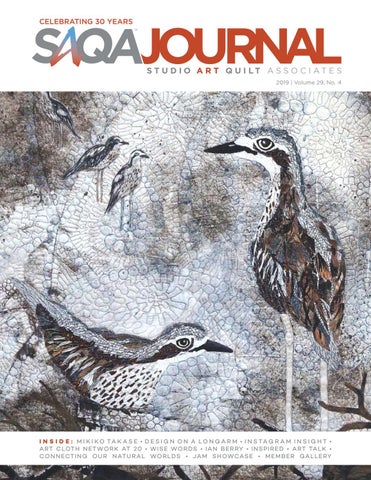
ON THE COVER:
SAQA JOURNAL
Linden Lancaster
EDITOR
Bush Stone-Curlew 40 x 30 inches | 2018
Diane Howell
Photo by Cameron Lancaster
Chandler, Arizona DESIGNER
YellowDog
Denver, Colorado
Go Green! You can choose to read the
QUICK NOTES
To find out more about SAQA, contact Martha Sielman, executive director, at 860-530-1551 or execdirector@saqa.com. Visit our website at www.saqa.com. Annual membership (U.S. and international): Artist/Associate, $80; Juried Artist, $145; Student (full time with copy of ID) $45. Studio Art Quilt Associates, Inc. (SAQA) is a nonprofit organization whose mission is to promote the art quilt. We provide education, exhibitions, professional development, documentation, and publications.
SAQA Journal online only.
The SAQA Journal is published four times a year. To submit articles or story ideas, contact the SAQA Journal editor at editor@saqa.com. See the submission guidelines at www.saqa.com/journal-submit.
Login to mySAQA (www.
For delivery questions, please contact circulation@saqa.com.
saqa.com/mySAQA) and select Manage Your Account.
For more information about advertising in the SAQA Journal , visit saqa.com/ads. SAQA Journal • 2019 | No. 4 •
3
THOUGHTS FROM THE PRESIDENT
SAQA pushes boundaries to advance exhibitions
I represented SAQA at the Festival of
When I started on the board more
Quilts in Birmingham, England. Our
than six years ago, we aspired to place
works: Abstract & Geometric at the Max
SAQA Global Exhibition Dusk to
our exhibitions in museums. A few of
Berk Textilkunst Museum—Palatinate
Dawn was there, and I was pleased at
our members had achieved this goal,
Museum in Heidelberg, Germany.
the response it received. Although an
but SAQA exhibitions seldom had.
This is our first non-U.S. museum
extremely large venue, many people
When Stories of Migration appeared
booking, and I don’t think it will be
made a point to come to our exhibi-
in 2016 at The Textile Museum in
the last.
tion first and were so happy that we
Washington, D.C., it marked a turn-
were there. It made me think how far
ing point for the organization. We
to push the boundaries to promote
we have come in our 30-year history.
decided to be a vendor at the annual
our work. We continue to consider
In 2020, we will exhibit Master-
SAQA is always looking for ways
ideas that once would have seemed
“
completely out of the norm as we
Our vision statement now reflects where we want to be: The art quilt is universally respected as a fine art medium.
”
The board of directors recently
promote the art quilt. We conquer new realms with artwork as we push our own boundaries to develop and grow as artists. This is one benefit of belonging to an organization such as SAQA. We have a commitment to ourselves to become better artists. While not all of us
American Alliance of Museums con-
think our work is good enough to be
approved our new strategic plan
ference to offer our traveling exhibi-
in a museum, it doesn’t stop us from
which was the result of hard work by
tions. This industry show is now a
aspiring to reach that goal. SAQA
a committee that was responsible for
continuing commitment. We produce
gives all of us support, interactions,
distilling SAQA’s purpose. The mission
a marketing catalog for potential ven-
and opportunities. What we choose
statement is clear—SAQA promotes
ues that showcases the work of our
to do with this network is up to us.
the art quilt. Our vision statement
artists and quality of our exhibitions.
now reflects where we want to be: The
Today, museums approach us to book
art quilt is universally respected as a
exhibitions—15 new museum con-
fine art medium. I think that we are
tracts were signed in 2019!
well-positioned to achieve this goal.
4
• SAQA Journal • 2019 | No. 4
Regards,
on Lisa Walt
The Neighborhood (detail), Geri Patterson-Kutras PHOTO CREDIT: Gregory Case
Imagine a new SAQA Shipping Center This year, SAQA shipped 664 quilts to 32 venues in 10 countries— all from a 12 x 12-foot space in Ohio. In this small space, up to 300 quilts at a time are carefully stored and labeled on tables. Bill Reker, Director of SAQA Global Exhibitions, packs exhibitions into large wheeled trunks that weigh up to 220 pounds. Bill also stores and ships exhibition catalogs, back issues of the SAQA Journal and Art Quilt Quarterly, hanging rods, banners, SAQA store items, 450 trunk show quilts, and 443 Benefit Auction quilts. Our shipping center is bursting at the seams. We need a larger, more efficient space.
Help us grow SAQA’s exhibitions! Please make a gift in support of our new shipping center today. www.saqa.com/donate
EDITOR’S NOTES
Life moves fast by Diane Howell With so much zooming by us every
Words can be tricky. A phrase can
day, that’s all the more reason to be
be slippery. But you can avoid con-
clear when you communicate. Every-
fusion. Enjoy Quinn McDonald’s
thing from an email newsletter to an
essay on word choice and misadven-
artist statement calls for clear mes-
ture on page 29. It will help make
saging and precise language. How do
your next writing project zing with
you make sure you reach peers and
accuracy. All it takes is a few well-
collectors with the message you want
chosen words.
them to have? One way to communicate in today’s
A new SAQA Special Interest Group (SIG) helps give new mean-
digital age is on Instagram. In this
ing to life with a longarm. Art Quilt
issue, writer Cheryl Sleboda looks at
Design on Longarm and Midarm
the latest tricks you can perform to
Machines brings together artists
make this platform your own. It is all
who are doing amazing things on
nate with audiences around the world.
about the pictures, but if you create a
these machines, from design to
Enjoy this issue’s galleries and articles,
focused theme for your posts, you will
binding. Longarms aren’t just for
brimming with artwork. Featured artist
enrich viewer experience and reinforce
quilting anymore! When the group
Mikiko Takase shares her journey from
your voice. To build a strategy to make
starts up again in 2020, anyone is
traditional quilter to quilt artist. Ian
your brand stand out in the platform’s
welcome to join it and its compan-
Berry from the United Kingdom cre-
algorithm, start by reading her article
ion Facebook page. Members are
ates moving portraits and scenes using
on page 18.
quickly learning from each other
only denim. Mary Ruth Smith, the
and pushing boundaries. See how
subject of this issue’s Inspired column,
Instagram text posts a regular part of
they are doing this on page 30, and
explains how stories and news photos
your outreach, you might want help
consider joining this exciting new
bring her work to life.
putting your thoughts into words.
SIG. Learn more at saqa.com/groups.
If, like Sleboda, you decide to make
Finally, art quilts continue to reso-
There is purpose in the telling of tales in cloth. Ask yourself what story you want to tell and make it clear. ■
In Memoriam Sara Sharp Milkweed and Hummingbirds 33 x 49 inches | 2013
Follow these busy little birds to page 8, where you will find this issue’s installment of Member Gallery, Action!
We are sad to report that two beloved quilt artists have passed away, Elizabeth “Liz” Jean Axford and Margot Strand Jensen. Liz Axford was born in Canada in April 1953 and passed away in July at her home on Whidbey Island, Washington. Her artistic inclinations led her to pursue architecture for 15 years, before turning to her true passion: creating textile art, especially art quilts. Her last exhibition was Overlay, a solo show at the International Quilt Museum at the University of Nebraska see “In Memoriam” on page 34
6
• SAQA Journal • 2019 | No. 4
VOLUNTEER SPOTLIG HT
Sarah Ann Smith Sarah Ann Smith and Pigwidgeon enjoy time in their studio in Hope, Maine.
Q: What volunteer roles do you serve in for SAQA?
Q: How does volunteering reinforce your art practice?
the SAQA Yahoo and Facebook groups incredibly useful.
A: Since 2015, I have been a member of the Exhibition Committee (EC). As such, I am currently chairman of the DevCom, properly titled the Development Subcommittee. My previous committee role as exhibition coordinator manager morphed into my current responsibility. I also work with our new Special Interest Group, Art Quilt Design on Longarm and Midarm Machines, and the Online Exhibitions Study Group.
A: The example of past and present EC members, who inspire me, helps me give back to the organization, and be more productive and careful with my time. I need to make sure that I make time for art rather than fit it in around everything else.
Travel in New England is challenging—all roads lead to Boston, which is great if that is where you are headed. If you want to go elsewhere, say west from Maine to New Hampshire or Vermont, there are a lot of twisty, two-lane roads. That makes regional group meetings difficult to reach. We still have a small but interested Local Connection. I enjoy meeting with them and our counterparts in the Massachusetts and Rhode Island region when I can.
Q: How do these roles enrich your SAQA membership? A: Going to the EC and DevCom meetings is just plain FUN. Can you imagine looking forward to meetings? We meet monthly online via Zoom so that we can see each other in real time. We have members from three continents on a regular basis, and some of SAQA’s finest artists, creative minds, and dedicated staff are on the EC. As SAQA’s core staff has grown, SAQA has been able to centralize its work, thereby shifting the roles for the Exhibition Committee and its volunteers. We no longer have a volunteer sending accept/deny letters from a personal computer. Today, all information is kept in a centralized database where the staff can easily access it. It has been wonderful to see that evolution from behind the scenes and be part of the group that is leading SAQA into the future.
I also learn a ton from the artists in the EC who are more experienced than I am about exhibiting and the art world. Learning about how much happens behind the scenes in SAQA makes me appreciate how many volunteer hours are donated by members around the world to make SAQA the robust organization that it is. Q: Tell us about your time with SAQA. A: I joined SAQA in March 2006. My sons were still in grade school, so the next eight years were busy with endless Mom things and sporting events. As the boys became independent, I was able to make more work, respond to more SAQA calls for entry (the vast majority of which I am not juried into— I view my entry fees as regular donations to support SAQA’s mission to promote the art quilt), develop my nationwide teaching and exhibiting career, and begin selling my art. Browsing SAQA artist galleries and online images of the exhibitions is always inspiring. As always, seeing the exhibitions in person— usually when I’m teaching at International Quilt Festival/Houston—is so much better than even the best photography. I also find
Last but not least, Art Quilt Quarterly is the magazine I had hoped to find for nearly two decades, since I began making art quilts. I love it—if you don’t subscribe, DO! I love the wide-ranging and in-depth articles. Combined with the SAQA Journal, I have regular opportunities to learn about others in our medium. Q: Are you a SAQA JAM? A: In 2007 a dear friend and fellow SAQA member sent me Portfolio 14 as a Christmas gift. As soon as I saw it, I knew I wanted to be a part of it. I applied in early 2008 and was accepted as what was then called a Professional Artist Member, now Juried Artist Member. I appreciate the exposure from being in Portfolio, now published in Art Quilt Quarterly. I feel my JAM dues help support an organization that does so much for art quilts. ■
SAQA Journal • 2019 | No. 4 •
7
MEMBER GALLERY
Action!
Diane Melms Life Dance
42 x 27 inches | 2017
Sharon Casey Cosmic Shift
39 x 36 inches | 2018 Photo by Michael Thorpe
Sara Sharp Milkweed and Hummingbirds 33 x 49 inches | 2013
Kathy York A Few of My Favorite Things 47 x 35 inches | 2009
8
• SAQA Journal • 2019 | No. 4
Teresita Leal In the Spotlight 8 x 8 inches | 2017 Photo by Daniel Chen
Frauke Palmer The Watchers
45 x 45 inches | 2017
Jean Wells Keenan Pacific Gyre
Joanna Mack
59 x 23 inches | 2019 Photo by Gary Alvis
Lea McComas Running Commentary
Flaming Out
19.5 x 16 inches | 2016
51 x 21 inches | 2013
SAQA Journal • 2019 | No. 4 •
9
FEATURED ARTIST
Mikiko Takase
Art quilts spring from spirited inspiration by Cindy Grisdela
Japanese artist Mikiko Takase discovered art quilts in 2011, having spent nearly 30 years making traditional quilts. Traditional quilting in Japan generally means concentration on great accuracy and attention to detail, elements that make wonderful quilts, she says. Following this convention, she used to plan each of her quilts completely before doing any sewing. But her studies with Jim Hay, the SAQA rep in Japan, helped her understand the importance of inspiration. “Now, when I make quilts, I let inspiration guide me during the process, discovering and expressing my image as I go.” Inspiration for Jim Hay’s Art Class School Trip, made in 2017, grew out of her visit to Hay’s hometown of Battle Creek, Michigan, as well as several other cities in the United States. This piece has a playful, folk art feel to it. Another quilt influenced by the same trip has a more traditional feel, with
10
• SAQA Journal • 2019 | No. 4
Jim Hay’s Art Class School Trip 77 x 57 inches | 2017
Ice Castle
Christmas Tree Hunting
2016
77 x 71 inches | 2017
a red-and-white color scheme and
kimonos. Her mother made tradi-
star-block composition. Christmas Tree
tional Japanese dolls.
Hunting, also from 2017, was inspired
Takase is drawn to fabric. “I love fabrics. I’m happy just seeing it.”
Takase now lives in Gunma prefec-
She enjoys cutting cloth into smaller
by the white Christmases Takase
ture, about an hour north of Tokyo via
pieces to make her own art. She cre-
imagines occur in Michigan.
the bullet train. She began studying
ates her art quilts using both hand
quilting in 1982 at a patchwork school
and machine techniques, including
run by Chuck Nohara and her hus-
piecing, appliqué, dyeing, and stencil-
band, who are known as pioneers in
ing. Sometimes she adds beads, lace,
Japanese quiltmaking, Takase says.
or ribbon.
Textile appreciation Takase finds inspiration in many places. She collects ideas from newspapers, photos, and posters; she visits museums to look at works of art. For example, Ice Castle, created in 2016, pays homage to the paper-cut art of author Hans Christian Andersen. There were no quilters in Takase’s family as she grew up. She was born in Shizuoka prefecture in Japan, near Mt. Fuji. “In ancient Japan, people didn’t make these kinds of patchworks.” Nonetheless, her family had a close association with cloth. Her grandmother made yarn from silk cocoons, then dyed the yarn, wove it into cloth, and sewed the cloth into
Traditional Japanese dolls reside in Mikiko Takase’s studio.
SAQA Journal • 2019 | No. 4 •
11
Time Machine
Swim in the Wind
20 x 14 inches | 2019
19 x 13 inches | 2015
Swim in the Wind, from 2015, is a colorful exploration of some of the freedoms Japanese women have wore tight, heavy kimonos and usu-
year’s Cloth in Common prompts,
ally stayed inside their homes in their
road. It was inspired by the lyrics to
small world. Now they move more
a Ray Charles song of the same name
actively in a wider world to become
about lost love. Takase used a gray
who they are. They are free to swim
color palette; houses are closely tilted
in the wind.”
together and a figure dressed in black
also able to cook and watch TV.” Her
• SAQA Journal • 2019 | No. 4
is in the lower left corner to paint a picture of sadness. She enjoys the artistic challenge of
sewing machine is set up on a table,
the prompts. “My mind must work
and she has a display of traditional
within the same constraints as the
Japanese dolls nearby.
other members of our group to create
In 2017, Takase was asked to
12
Lonely Avenue (not pictured) was created in response to one of last
Takase’s studio is in her family liv-
30 x 20 inches | 2018
spring, sound, and kitchen.
achieved. “In the old days, women
ing room. “So while I’m quilting, I’m
The Shape of Water
recent prompts are water, touch,
[a piece], and this shared challenge is
join an international group of art
inspiring and empowering.” Hope-
quilters called Cloth in Common.
fully, participation in the group will
Although hesitant at first, she agreed
help her quilts continue to evolve as
to take part with encouragement
art quilts, she adds.
from Hay. The group, which includes
Her art quilts do continue to
SAQA members in the United States,
delight. The Shape of Water, 2018,
Europe, and Australia, issues a prompt
includes a group of ethereal looking
every two months as the design
jellyfish floating on a gradated blue
theme for an art quilt. Examples of
background stitched with wavy lines
and bubbles. The jellies are different sizes, making them appear to recede into the distance. Jellyfish aquariums are popular in Japan; seeing the jellies float through the water is relaxing, Takase says. Time Machine, 2019, features a glittering object that looks like it is made of cut glass, or perhaps diamonds, floating on a dark background stitched with wavy lines. Made in response to yet another prompt, time, the piece references one of Takase’s favorite movies. She has used improvisational piecing to create the shapes and lines of the sci-fi object to great effect, contrasting the light areas of the machine with the dark of the background space. Being in this international group
Fairy Circle
89 x 89 inches | 2010
is different for Takase in other ways as well. “Japanese groups tend to be like small ‘kingdoms,’ centering on one leader,” whereas the Cloth in Common members treat each other as equals, she explains. Through the internet, the group is able to unite members from different parts of the world. “Sometimes it feels like a dream that I am part of such a creative process that is both challenging and inspiring.” Takase is interested in studying work by quilt artists in other countries to incorporate more freedom to her own work. “I want to mix my traditional Japanese quilting style with the more modern Western styles. I would be very happy to create a kind of hybrid quilting.” Learn more about Takase’s work at the Cloth in Common blog, clothincommon.com/blog, and on Instagram, where her handle is @mickytakase. ■ Cindy Grisdela is a SAQA JAM who resides in Reston, Virginia. You can view her work at cindygrisdela.com.
Light Pizza House
38 x 31 inches | 2014
SAQA Journal • 2019 | No. 4 •
13
Selections from
Connecting Our Natural Worlds This exhibition showcases works about the natural wonder of habitats around the globe and how we can become better stewards of them. The artists identified endangered flora and fauna in their own backyards and recommended a call to action to save the species. Connecting Our Natural Worlds premiered at the ArizonaSonora Desert Museum, near Tucson, Arizona, where it continues through Jan. 5, 2020. The museum provided interpretive context for the exhibition. The juror was Holly Swangstu, former director and curator of the Art Institute and Ironwood Gallery at the Arizona-Sonora Desert Museum. The museum strives to inspire people to live in harmony with the natural world by fostering love, appreciation, and understanding of the Sonoran Desert. The exhibition benefactor is Shirley Neary and its art patrons are Nancy Erickson, Ann Johnston, Frank Klein, and Bobbe Shapiro Nolan.
Elisabeth J. Vereycken Connecting Our Natural Worlds 37 x 24 inches | 2019
For more information about this exhibition, visit saqa.com/naturalworlds.
Nancy Costea Texas Wild Rice
34 x 43 inches | 2019
Amanda Miller Regeneration (Diptych) 41 x 44 inches | 2018
Photo by Jon Christopher Meyer
14
• SAQA Journal • 2019 | No. 4
Linden Lancaster
Brenda H. Smith
Bush Stone-Curlew
Soon the Summer Sun
40 x 30 inches | 2018 Photo by Cameron Lancaster
41 x 29 inches | 2013
Aileyn Renli Ecob Spring
35 x 58 inches | 2018 Photo by Kerby Smith
Deborah Boschert Treelines
31 x 80 inches | 2019
SAQA Journal • 2019 | No. 4 •
15
Art Cloth Network turns 20 by Deborah Weir
Regina Marzlin
Ascending
20 x 24 inches | 2017
Art Cloth Network (ACN) celebrates its twentieth
framed nor quilted. Initially, Dunnewold defined
birthday in 2020 with activities that include Full
art cloth as “lengths of white/plain cloth enhanced
Circle, a juried exhibition March 23 through June
with layers of surface design processes.” Instead of
22 at Textile Center in Minneapolis, Minnesota, the
dyeing or printing, she was dyeing and printing
city where ACN was born.
as well as foiling, collaging, stitching, and more to
Art Cloth Network (ACN) was founded in 2000 by Jane Dunnewold and students in her master
create layers of patterning. Over time, with the experimentation of many
class: Complex Cloth. Art cloth is defined as “mate-
sophisticated practitioners and innovative artists,
rial transformed by adding or subtracting color,
art cloth has expanded to include 3D work, digital
line, shape, texture, or fiber to make a compel-
techniques, installation pieces, and artwork that
ling surface and composition.” Dunnewold first
can withstand placement outdoors. ACN is at the
introduced the concept of layering many varied
forefront of this evolution. Much of the work cre-
techniques on one length of cloth to create intri-
ated by ACN members represents the artists’ beliefs
cate fabrics that stood as art on their own, neither
and responses to the world around them. The medium may not be
“Art cloth has expanded to include 3D work, digital techniques, installation pieces, and artwork that can withstand placement outdoors.”
the message, but simply a refined vehicle for expressing it. The organization issues an annual call for a juried exhibition. Full Circle’s premiere
16
• SAQA Journal • 2019 | No. 4
Merill Comeau
The Sins of the Mother Rest Heavily 52 x 60 inches | 2014
Photo by Will Howcroft Photography
installation at Textile Center aptly coincides with ACN’s milestone 2020 meeting, also in Minneapolis. Russ Little, current ACN president, was in the first class of juried members in 2008. The desire for connection with like-minded artists inspired him to apply. He brought digital printing to the fore as a new technique applicable to the ever-growing list of creative processes available to textile artists. Little comments that the self-assurance of members can be attributed to their willingness to take risks and push their chosen medium so that their voices are heard. ACN exhibitions are found in museums, galleries, and major airports throughout North America up to three times per year. Members locate appropriate venues and standing committees arrange details and publicity. Even though members are juried into ACN, their work must be juried into each annual exhibition cycle. The group hires world-renowned textile practitioners for this task. Michael James, Els van Baarle, and Bruce Hoffman are the among former jurors. A catalog is produced for each exhibi-
Sherri Lipman McCauley
Layers of the Truth 56 x 26.5 inches | 2016
tion, with images and information available online. ACN remains relevant today because of its receptivity to change. The organization is on the cutting see “Art Cloth” on page 32 SAQA Journal • 2019 | No. 4 •
17
Take your Instagram game to the next level! by Cheryl Sleboda
they came for,” and that is pictures of your fiber art. Did you know that posts with low engagement cause your next posts to be pushed to
are an artist who uses this platform for business, Instagram becomes more of a challenge. Here are some tips and tricks to excite your customers and let you see real engagement on this vital platform.
Beyond basics
font and branding, thereby maintaining a uniform look. Today, I’m much happier with how my brand is repre-
posts your followers engage
sented to new or returning followers
with the most, and make more
who click through to my profile.
be the most popular, not a family
goodness in one stream. But if you
post, which I create using the same
algorithm. Take notice of which
of those! More than likely, images
Instagram. It is a high dose of visual
grounds. Every sixth picture is a text
fewer followers? That’s part of the
of your process or finished work will
As a fiber artist, you probably love
text posts now have black back-
birthday party.
Curate your feed Review your profile to determine
Business accounts If you decide that you must share your family photos, open a second account for that purpose. Then convert your art account to a business one. To establish a business account,
how it looks to the average outsider.
open your profile and click on the
Does it give a sense of who you are
three lines at the top. Choose “Set-
or what your business is about? What
tings” at the bottom of this menu,
kind of artist you are?
and then “Account.” At the bottom,
I took stock of my own feed about
it will say to “Switch to a Professional
a year ago. After watching an online
Account.” From there, select the type
video on how to customize your
of account you are (“Creator” or
Instagram feed, I noticed that certain
“Business”).
companies kept a similar look in
Once this account is activated,
all of their posts. When I went to
you have access to Insights, metrics
and you take pictures and post them.
their profile, I saw how curated their
provided by Instagram that show
You are working on taking better and
content was. An account I follow
how your account performs. This
more interesting pictures for your
on refinishing furniture has a very
feature details how many people
feed. You have probably heard people
“shabby chic” pink, turquoise, and
click on your profile or website link
talk about “the algorithm” and how
white feel to every photo. Their brand
plus much more. You will see cus-
it’s potentially suppressing your
was unmistakable on their profile.
tomer demographics such as age,
You have your Instagram account,
content to your followers. The one
In contrast, my photos were all
gender, etc. This kind of data can be
surefire, free way to run the algorithm
over the place in regards to color and
overwhelming, but as I explained
blockade is to post consistently, pref-
theme. They didn’t tell my brand’s
earlier, consistent content is what will
erably every day.
story the way I wanted it told. Since
improve your numbers. Try to not get
Your posts should also be on topic
my brand color is black and my logo
too bogged down in details until you
for your brand. It’s tempting to share
includes skulls, I started editing my
are ready to tweak your posts to test
your cat, dog, or kids, but your busi-
photos with heavy filters to darken
their maximum effectiveness with
ness needs you to “give them what
them. My memes and other graphic
different market segments.
18
• SAQA Journal • 2019 | No. 4
Stories for you Stories, the circles at the top of your Instagram page, is a feature that is here to stay. In fact, experts say that eventually most social media content will be more like Stories and less like static posts that live forever on your page. If you are not using the Stories option, start right away. Many people use Stories for Behind The Scenes (shortened to BTS on Instagram), day-to-day, or insider looks into your business or artistic process. Here you can sneak in family or animal pictures. An image of your cat curled up on fabric is still on brand, but is also a
to Instagram to access each one. I can
is just that, social. Increase your reach
nice slice-of-life post that may no lon-
say “go to my blog, link in bio,” and
by inviting people to comment on a
ger be appropriate in your main feed.
know they can get there.
question you pose. Commenting is
Since changing to my dark, curated
Next up, let’s look at your bio. You
currently the greatest factor at play
feed, this is where my brighter, hap-
only have 150 characters to tell your
in the Instagram algorithm; posts
pier pictures reside. People can still
customers what’s what; only the first
with lots of comments get pushed to
appreciate my personality and the
four lines are visible before customers
the top. That is why it’s good to ask
goofy things in my crazy life.
reach the “More” option. Try to get
your followers questions, such as,
the essence of your brand in those
“Would you want to see more of this
top four lines. Clever use of emojis
process?” or “Which color do you like
cuts down on long words and shows
better?” When someone can easily
only one place for customers to click
customers your playful side. Lastly,
comment, you have the opportu-
through to your website, and that
your Stories can be selected to archive
nity to answer back, furthering the
is through your profile. This causes
and organized into categories on your
discussion, and creating a connection
a lot of “Click my link in my bio”
profile. With a little planning, you
with your fans. And remember, it is
captions, so maximize the impression
can create graphics to act as header
an Instagram best practice to always
people have when they go to your
cards, further separating your Stories
comment back to people who com-
profile. Ensure your profile is click
into topics people will click through.
ment to you. Also, be sure to answer
worthy with a few tricks.
If you teach, you can list where you
your messages in the upper corner as
will be. If you have products or art for
quickly as you can.
Maximize Your Profile Instagram is notorious for having
First of all, let’s tackle the link. There are lots of tools to take a
sale, you can highlight them. You can
Hashtags are often vilified and feel
customer to a “link tree” where they
also archive specific BTS posts of your
a bit ugly, but they are still one of the
can select options such as your shop,
process for a particular work. Use a
top ways to have your post arrive in
blog, or about me page on your web-
graphic to collect this info to make
the overall conversation and search
site. Linktree is one of those services.
your brand stand out.
function on Instagram. As quilters,
You also can make a landing page on your own website. Both of my business pages link out to one of these
Marketing with Instagram Social media marketing is some-
trees, allowing customers to explore
thing you can do yourself with a little
my many options without returning
practice and know-how. Social media
hashtags like #quilt or #quilter have millions of items to sort through. Use a hashtag that’s more unique and crosses over into other areas to see “Instagram Game” on page 36 SAQA Journal • 2019 | No. 4 •
19
JAM SHOWCASE
JAM Showcase is a gallery of work produced by artists who have each been named a Juried Artist Member (JAM) of SAQA. A JAM is an artist who has successfully presented a portfolio to the JAM Review Panel. This portfolio includes a selected body of work and documentation showing a professional approach to art.
Barbara Schneider Line Play, var. 1 32.5 x 52 inches | 2017
Judith Tomlinson Trager Rift—Dakota Formation 32 x 59 inches | 2017
20
• SAQA Journal • 2019 | No. 4
Teresa Shippy 1960 Covertible Cadillac with a 1961 Shasta Airflyte Trailer 19.5 x 42 inches | 2017
Eileen J. Williams Sandra Bruce Dame Lorraine
The Wild Surf 31 x 28 inches | 2018
79 x 49 inches | 2018
SAQA Journal • 2019 | No. 4 •
21
Ian Berry:
Works in denim reflect contemporary times by ZJ Humbach
What is more universal than denim? From clothing to bedding, from upholstered furniture to insulation in homes, we love denim. It’s versatile, durable, and comfortable. Ian Berry takes denim to another level, creating art that speaks to everyone. “It started when I noticed my old pile of jeans in my childhood home. I was moving to London and didn’t want to throw them out,” explains Berry. “I’d done a collage of Gordon Brown and Tony Blair out of newspaper and thought I could apply the same principle, but in denim.” What started as a simple observation became so much more. Today, Berry is a member of two elite global clubs. In 2013, Art Business News recognized him in an article entitled 30 Under Thirty: Young Artists Revolutionizing the World of Fine Arts. Sourcing Journal named him to
Ian Berry works on Ideal Home, a piece in his Behind Closed Doors series, at his studio in 2016. Photo by Debbie Bragg
22
• SAQA Journal • 2019 | No. 4
And Still the Voices are Calling from Far Away 47 x 47 inches | 2019 Photo by Debbie Bragg
its latest Rivet 50, an index
The color photographs
of the top 50 influencers in the
also enable him to better see
world for the denim industry.
the effect of the light. “Lighting is so
When Berry first began work-
important. I always think about the
ing with denim, he was studying to
also organize by shade and by wash
way light hits things, such as a metal-
become an advertising art director.
and those with interesting charac-
lic subway car, a shiny polished bar
“As I began cutting up my blue jeans,
teristics.” Most of his inventory is
top, the tiled floor, or a shimmering
I thought about the times wearing
donated from brands, mills, friends,
pool. I love to take denim, a matte
them. Then I thought about the
and people who send packages from
material, and make it shine.”
people, particularly [as seen] in adver-
all around the world. “The studio
tising, who made jeans into what
is very large. I need it for all of the
varying range of denim, usually
they are today,” says Berry. “I found
jeans. I often joke that people love
starting with a palette of seven and
it fascinating that because some icons
the studio more than my work!” His
adding more to create the layers in
wore jeans, it led to us all wearing
studio overlooks the oldest canal in
his work. “For example, the laun-
them. For most, a pair of jeans is the
London, and is a haven of peace for
derette machine door alone has 15
default garment in the wardrobe.
him. He lives above the studio in
layers. My goal is to blend the layers
Denim is the only material I feel truly
an apartment that used to be a dog
to make it look like it isn’t denim.
comfortable wearing.”
biscuit factory with his wife, who is
Rather than using pockets and rivets,
from Sweden, and their five-year-old
which would overemphasize that it’s
son.
denim, I like to use interesting pieces
Berry is literally surrounded by denim 24 hours a day. “I have
To create a work, he first cuts a
approximately 3,000 pairs of jeans in
Berry requires few tools to create his
of denim to make it look like paint.
my studio—it is a sea of blue. I have
art. “It is quite simple. It’s my scissors—
I love it when someone looks at my
a room with just greys and blacks. I
sharp for detail; blunt for portraits—
work and suddenly says (particularly
also have many jeans hanging on the
glue, and my hands. I rarely sew, but
in a cool American accent), ‘Oh my
walls. While it may look like a mess,
have on occasion. I work directly from
God, it’s made of blue jeans!’ My
it’s my organized mess, and I do
color photographs as you lose the
work is so much more than denim,
remember where certain jeans are. I
detail in black-and-white photos.”
which is just my paint.” SAQA Journal • 2019 | No. 4 •
23
Ian Berry in the Secret Garden installation
Secret Garden installation
Photo by Lucinda Grange
Photo by Lucinda Grange
2017
Close-up | 2017
Berry’s work is defined by his
so alone,” explains Berry. “It really
difficult because I had to also deal
attention to detail. His art, while
connected with people, and many
with the reflection.”
breathtaking in photos, truly needs
said, ‘This is me.’ It was really mov-
to be seen in person to appreciate
ing to see all kinds of people express
part of Berry’s work in the last few
its intricacies, the labor of love that
this. I am very proud of this body
years. Secret Garden includes the last
goes into each piece, and the message
of work because at the time, I was
denim manufactured in America by
being portrayed.
also working with Campaign Against
Cone Mills after 112 years of produc-
Living Miserably (CALM), a British
tion. The work was initially exhibited
life and current issues. “I depict the
movement against male suicide—the
at Children’s Museum of the Arts
fading urban fabric that makes up
leading cause of death for men under
in New York City and is now being
our communities such as the local
45 in the UK.”
requested by other museums world-
His work portrays contemporary
Installations have become a big
pubs and launderettes that are clos-
After doing Behind Closed Doors,
ing down. Places where people had
his work took a different direction.
interacted in the past are fading,”
“I wanted to go brighter, happier. I
expresses Berry. “And while we are
had been in Los Angeles, California,
in my work, and that holds true for
much more connected thanks to
and had a great time. I began work-
my installations. The only excep-
technology, in person it is becoming
ing on Hotel California, which was
tion I make just for my installation
less.”
inspired by the hotels I stayed at and
work is that I cannot cut everything
Berry typically works in series,
wide and even famous department stores. “I say no paint, no bleach, no dyes
their pools,” says Berry. “I wanted to
by hand,” confesses Berry. “I use my
which can take up to a year to put
bring that brightness into my London
friends at Tonello [a garment finish-
together, and Behind Closed Doors
doom and gloom. I also wanted to
ing technologies company] in Italy
is one of his favorites. “This body
challenge myself with water, par-
to laser cut some things like the vines
portrayed beautiful, Elle Decoration
ticularly the ripples. The details just
in Secret Garden. Some may say it’s
magazine-style homes but was juxta-
went on and on. If I decided I didn’t
cheating, but it’s the tools the denim
posed with a single person, who sat in
want something in or I wanted to
industry uses now, and it allows me
the dream of materialism but appears
add something, it was particularly
to do bigger creations.”
24
• SAQA Journal • 2019 | No. 4
I Had to Stop for the Night 24 x 48 inches | 2019 Photo by Debbie Bragg
The Gently Revolving Drum Goes Quiet 20 x 48 inches | 2015 Photo by ianberry art
Berry’s hope for Secret Garden was to inspire children to tap into their imaginations to become more creative. He often offers free lessons for children. “I really believe in education to inspire children and to also help schools that are now underfunded.” He finds denim crosses borders, languages, cultures, and more. “It allows me to communicate to many people. I truly believe there is something in the denim that draws people in. People who are normally scared of a gallery tell me they just had to come in. I think there is something familiar and comfortable in the denim that does that,” muses Berry. “You don’t need to be an expert to enjoy or wear denim. It’s the material of our time, and since I portray contemporary life, I don’t think there’s a better material to use.” ■ ZJ Humbach is a freelance writer, quilting
The Laundry
Approximately 10 x 18 x 10 feet | 2017 Photo by Lucinda Grange
and sewing teacher, and professional longarm quilter. She owns and operates Dream Stitcher Quilt Studio in Thornton, Colorado. SAQA Journal • 2019 | No. 4 •
25
ART TALK
Customize color studies to discover favorite palettes by Regina B Dunn
I’ve studied color theory through books and talks, but it has been valuable to me to create my own color studies. Even though I create art using fabric, I find cardstock to be a better medium to study color relationships. That’s because I can paint the paper
Figure 1A
Figure 1B
Figure 2A
Figure 2B
Figure 3A
Figure 3B
Figure 4A
Figure 4B
any hue, tint, or shade I want in just a few minutes, as opposed to having to buy fabric in colors that may not be exactly what I need. I use a few colors of Prochem fabric paint to mix all the others. For some studies, I need the perfect hues found on a twelve-color color wheel. To ensure the outcome, I bought a set of
usually like cool colors better than
same cool-colored grid, but replaced
premade papers called Color-aid to
warm ones, but looking at these
one square with a red that was about
use as a reference point.
two, I definitely like the warm one
the same value as the colors sur-
better. When I took photos of them
rounding it. It immediately acted as a
with pure hues, tints, and shades,
and converted them to black and
focal point. Then, I added a red with
referring to the Color-Aid papers.
white, I realized why. The warm one
a lighter value and it stood out much
Then I cut my painted papers into
(Figure 2B) has a lot more contrast
more than the same-value red (Figure
¾-inch squares. Using a blank, white
in value. That’s because yellow is the
3A and Figure 3B).
piece of cardstock for a background
lightest color and is about one-third
So, yes, a different temperature
and support, I assemble a design on
lighter than red. So in this composi-
color can act as a focal point, but is
top with the colored squares. Once
tion, the yellow is light, the orange
much more interesting if it is a differ-
I have a design, I glue the squares
acts as a medium, and the red acts
ent value too. The cool colors stand
down and write comments on the
as the dark. A little more than half
out on the warm grid because they
back of the card. I store them in a
is medium with accents of light and
are so much darker in value than the
three-ring binder in clear plastic
dark, which provide interest and the
warm colors (Figure 4A and Figure
sleeves.
ability to visually rank the colors and
4B). If I had instead put a tint of cool
To start, I paint pieces of cardstock
see designs. In the cool color range
colors on the grid that were the same
effects of warm and cool colors on
(Figure 1B), there are no light value
value as the pure hues of the warms,
each other. I started by making two
colors. The composition I created
it wouldn’t have been as interesting,
grids: one cool (Figure 1A) with
has a nice variety of colors, but is
even though they would act as focal
squares of green, blue-green, blue,
all medium and dark hues. No real
points.
blue-violet, and violet in pure hues,
accents stand out and it is harder to
and the other warm (Figure 2A)
find a pattern.
My latest study involved the
The next part of my study was with complementary colors. I chose
with squares of pure hues of yellow,
Next I wanted to see if a color can
orange, red-orange, and red. Then I
stand out if it is a different tempera-
First, I painted cardstock with three
took some time to analyze them. I
ture, but the same value. I created the
tints and three shades of each color
26
• SAQA Journal • 2019 | No. 4
to use yellow-orange and blue-violet.
Figure 5
Figure 6A
as well as the pure hues. I also mixed the complementary colors together in various ratios to get a series of less intense hues and neutrals for each tint and shade and pure color (Figure 5). Then I placed the cut squares of each on one piece of cardstock to rank each tint, shade, pure hue, and neutral according to value (Figure 6A). I knew yellow was the lightest color and violet was the darkest, but still discovered some surprises (Figure 6B). For example, the lightest tint I made of blue-violet is darker than
Figure 6B
not only the tints and pure hue of yellow-orange, but also of the shades of yellow-orange. It needs to be a very dark shade of yellow-orange to equal the value of the pure blue-violet. All of the yellow-oranges, even the shades, fooled my eye into thinking they were darker than they actually were. The lightest tints of blue-violet seemed much lighter to my eye than the camera saw.
Figure 7A
Figure 7B
Figure 8A
Figure 8B
The first grid (Figure 7A), with tints of blue-violet and shades of yellow-orange, at first looked like it had some interest due to the coolwarm contrast. But, according to the camera, all the squares have medium value (Figure 7B). I realized that it wasn’t that expressive after I created one with the same blue-violet tints, but with a darker shade of yelloworange (Figure 8A). In this one, there is quite a difference in value in
SAQA Journal • 2019 | No. 4 •
27
addition to the temperature difference (Figure 8B). Value wins out again even though this darker yelloworange isn’t as intense or saturated as the yellow-orange in the other one. To wrap up this study, I wanted to create some grids with the complements in varying values and intensities to check out the effects these properties cause and see if one has a greater effect than the other. I cre-
Figure 9A
Figure 9B
Figure 10A
Figure 10B
Figure 11A
Figure 11B
ated two grids with about the same amount of neutrals and placed the most intense square (pure yelloworange) in the same location on both (Figure 9A and Figure 10A). The difference between the grids was that one had few medium values (Figure 9B). Since that grid had a lot darks and lights, neither value stood out. The other contained mostly medium values (Figure 10B), so the smaller quantity of the lights and darks were more noticeable. But that layout didn’t have any interesting patterns to guide the eye. So I created the last one (Figure 11A) with mostly medium values and about the same amount of neutrals, but arranged the values (Figure 11B) to form a stair-step pattern in the middle; I also placed most of the warm colors on one side of the diagonal and cool hues on the other. This formed a pleasing arrangement. There was adequate contrast due mainly to the values, but also due to the temperature differences. Art is always subjective and one
another. It is interesting and informative to take some time to analyze which
Regina B Dunn is a SAQA member
arrangement of colors and values
arrangements you do and do not like
residing in DeLand, Florida. You can
may appeal to one person, but not to
and apply the results in your work. ■
view her work at reginabdunn.com.
These books are recommended by the author to learn more about color theory:
28
Color: A Course in Mastering the Art of Mixing Colors, by Dr. Betty Edwards
Color and Composition for the Creative Quilter, by Katie Pasquini Masopust and Brett Barker
Playing with Color: 50 Graphic Experiments for Exploring Color Design Principles, by Richard Mehl
Color Magic for Quilters, by Ann Seely and Joyce Stewart
• SAQA Journal • 2019 | No. 4
Words: Tricky, Slippery, and Precise Choose yours wisely by Quinn McDonald
Words shape our thoughts into reality,
my art supplies from theft by covering
maybe a blend? Are you cutting or
but words are tricky. Word choice and
them. I had interpreted it as, “I’ll do
tearing the fabric? Is it an edge or a
word order are the main culprits that
your job.”
selvage? Sure, you are using thread,
can slide us quite unexpectedly into awkward moments. One of those moments came when
Both of us were right. The phrase can be understood either way. I didn’t ask, and she didn’t explain because
but what kind or brand and why did you choose it? Some of your readers or students
I was a volunteer at an art supply
we each knew what the other meant.
may be experienced, but some may be
convention. Teaching outside your
Except, lacking mind-reading abilities,
beginners. They both need help, but
studio is always tricky work. Success
we could not know.
in different ways.
depends on carefully planned supplies
The story is a perfect example of
The world of color also demands
and checklists. On the first day of the
the problem with the English lan-
precision. It may be light green for
convention, five experimenters happily
guage: syntax is squishy and easily
you, but to others it could be cela-
worked on an art project at my table.
molded. It has few rules and hun-
don, apple green, sage, mint, or sea-
My job was straightforward: run
dreds of exceptions. Your grammar
glass green.
the demo twice a day plus do one Oh, wow! project each day. Oh, wow! proj-
checker is wrong quite often, too. No matter what you write, from an
When the sentence says, “The mayor talked about the high cost of living with
ects get their name from the delighted
email to an artist’s statement, words
sighs of the audience as they watch
shape what others
art transformed into practical objects.
think of you. It’s
In this case, I was surface decorating a
not what you say
piece of paper and then making it into
as much as what
a photo mat.
others hear. How can you be clear?
living with several women is expensive,
• Don’t go with your first draft. It’s
or that the audience was a group of
people exploring creativity at my table, I was surprised to see Jean, the marketing manager of the store I was representing, rush over.
what you write, ... words shape “Nowhatmatter others think of you.
never finely tuned. • Read your writing out loud; it helps you hear it as your audience does.
“
As I happily worked with the
several women,” do we understand that
women? Word order is important. The news reader said, “A body was found in the Sonoran Desert yesterday, half-eaten by Game and Fish employ-
• Have someone else read your writ-
ees.” The employees did not dispatch
show up,” Jean said. “Could you do
ing and ask them, “What is the
anyone, but it sounded like they did.
yours now?” I glanced at my experiment-
main idea you get?”
Word order also created that problem.
“The 11 a.m. Oh, wow! project didn’t
ers. I didn’t want to abandon them. Jean
• You may be surprised at what
The sign read, ”Hunters please use
noticed my concern. Smiling, she said,
others hear. Rewriting saves your
caution when hunting pedestrians
“I’ll cover your table for you.” She knew
communication.
using walk trails.” A period after
the project. Her clever solution to finish
Words that are spelled the same are
“hunting” would help pedestrians
the project was perfect. “Thanks,” I said,
pronounced differently in context. There
and headed to the high counter.
is a 60-second minute, but a tiny differ-
It’s not a good idea to say, “Well,
ence is called minute. Read is both pres-
you know what I meant,” because your
lapel, my papers were in order under
ent tense and past tense, but pronounced
audience knows only what they think
the counter. Ready! I glanced back
differently. You can object if you don’t
you meant. They will act on their
at the table to see Jean throw a bed
like something, but if that “thing” is an
belief. Make it the same as yours by
sheet over my project leftovers and
object, you’ll hear that verbs and nouns
choosing your words carefully. ■
the participants leaving. This was not
aren’t always pronounced the same.
The microphone was clipped to my
what I thought was going to happen.
You may be a beacon of clarity, but
feels safer.
Quinn McDonald is a writer who
Then I replayed what she had said:
only to yourself. To make your writ-
helps people grow into the stories they
“I’ll cover your table for you.” She had
ing precise, word choice is critical. It’s
tell about themselves. Learn more about
meant it literally—she would protect
not just fabric, it’s cotton, silk, wool,
her at quinncreative.com. SAQA Journal • 2019 | No. 4 •
29
The Longarm: A game changer in art quilt design by Candice Phelan
Some innovative SAQA artists have found that creating art quilt designs can be easier, faster, and more effective on these machines, whether they are sit-down or stand-up models. By joining the new SAQA Special Interest Group (SIG), Art Quilt Design on Longarm and Midarm Machines, you can connect with our growing group as we experiment, share, and learn from each other. Each month, a different artist shares techniques via live video. A group discussion follows where ideas on what works are shared.
Sarah Ann Smith She persisted in her quest to reach the shore and sing the anthem of the sea 59 x 80 inches | 2017
Topics include appliqué, couching, thread painting, piecing, binding,
sit-down midarm machine. Her cur-
Benefits and drawbacks
ruler work, best threads, paper piec-
rent work celebrates her home envi-
ing, unconventional materials such as
rons of MidCoast Maine. “Once the
leather or metal, and more.
component parts of an image are col-
Why would anyone want to use a midarm or longarm to create their design layer? The obvious benefit is a workspace of approximately 2.5 by 13 feet. You can see much more of your design as you work. Because your design is held flat and still while you glide the machine head over the fabrics, there’s no scrunching up your fabric to thread paint. Even a sitdown midarm machine has at least 16 inches of workspace, and your work is usually spread out on a 36-inch table. You can sew much faster, which makes dense thread painting quicker. Plus, new techniques and tools, including templates, rulers, and presser feet, are being developed all the time.
New horizons One innovator in the multiple uses
laged and complete, I use my midarm machine to join the parts to create the overall image.” Sometimes Smith
of a longarm is Lea McComas. She
uses paint to further blend the fabrics
uses her machine to create realistic
by printing, stenciling, or painting on
pictorial works conveying stories
the cloth. Finally, she selects threads
about the human experience. McCo-
that allow her to blend and refine her
mas builds her design layer and then
imagery.
densely thread paints her designs,
Phyllis Cullen’s captivating tropical
sometimes using two threads in the
art quilts are also made on a longarm
needle as she shades and highlights.
machine, including the binding. In
“I lay down a basic design in fabric,
case you think these machines are
similar to a base layer or under-paint-
difficult to use, consider this: Cul-
ing, and use my longarm to blend the
len’s young granddaughters make
hard lines and add extra detail.”
their own quilts this way. Children
Sarah Ann Smith is known for her
can guide the machine head by the
There are some challenges to
collaged fabric with intense thread
handles, keeping their hands clear of
owning such a large machine. The
painting and quilting done on a
the needle.
obvious one is that it takes up
30
• SAQA Journal • 2019 | No. 4
Lea McComas Bike Boys
46 x 83 inches | 2014 Photo by Ken Sanville
considerable space. However, almost
together or rent time on a machine
is 16 to 32 inches wide by a chosen
every inch of the space under a lon-
from a local dealer.
frame length; about 6 inches of space
garm machine can serve as storage.
Another challenge of a longarm can
is taken up by the frame bars. You can
The table frames made by Texas-
be viewing your design from a dis-
stand up or sit on a stool to use this
based Innova, a SAQA sponsor, can
tance since your work is mounted on
style of machine; many frames are
be custom-ordered by the foot. Other
a frame. There are now quick-release
adjustable for height.
brands are available in a variety of
holders to allow easy demounting
lengths.
A sit-down model has a stationary
so that you can view your piece on
machine with about a 16-inch throat
Cost is another issue, but art quil-
a design wall. Some art quilters have
between the needle and the back of
ters have an advantage since we tend
discussed mounting a mirror above
the machine; some makes are deeper.
to develop our own designs, lessen-
the longarm frame to allow viewing
The table space is often about 30 or
ing or eliminating the need for the
from a greater distance.
36 inches square and it is usually
expensive software that automates machine quilting. To reduce cost, some art quilters purchase a used machine. Others chip in to buy one
Sarah Ann Smith Rose Hip 36 x 36 inches | 2019
Machine features A stand-up machine typically provides you with a workspace that
about 30 inches high. Innovations, such as digital photography and art, allow for new see “The Longarm” on page 37
Candice Phelan’s Purple Yin Yang was created on her longarm machine.
SAQA Journal • 2019 | No. 4 •
31
Art Cloth Network Turns 20 from page 17
edge of the textile art field. Dunnewold notes the recent prevalence of textural and abstract work as a new area of exploration. Recently, members have brought more mixed media, sculptural work, use of gut, transparency, layering, and bolder stitching to the expansion of the medium. No longer is the finished artwork exclusively a two-yard silk panel. ACN members, several of whom are also SAQA members, meet annually across North America to share current artwork, plan future exhibitions, handle business issues, and inspire each other. It has intentionally remained an intimate group, and currently has twenty-eight juried members from the United States and Canada. Learn about individual members through profile links on the ACN website. Applications for membership are open most autumns. Visit artclothnetwork.com for details. Exhibition catalogs can be viewed at behance.net/ArtClothNetwork. ■
Russ Little
Interplay #2
33 x 26.5 inches | 2019
32
• SAQA Journal • 2019 | No. 4
Deborah Weir is a member of ACN and SAQA. She resides in California and has exhibited her work on six continents. Visit deborahweir.net to learn more about her art.
World’s Largest Quilting Membership Organization
SHOWS
Quilt Detail: KABOOM! by Tere D’Amato
Plan now to attend an American Quilter’s Society QuiltWeek Show! AQS QuiltWeek Shows are coming to an exciting destination near you. Each show is different! Plan now for 2020 & 2021. There’s so much to see and do. • Hundreds of quilts on display from around the world • Contest quilts competing for the largest prize dollars in the industry • Workshops, classes, and special events with quilting’s biggest stars • Huge merchant malls with vendors offering the latest machines, fabrics, and other tools used in quiltmaking
Learn more at QuiltWeek.com
Daytona Beach, FL February 26–29, 2020 February 24–27, 2021
Lancaster – The Nook, PA August 5–7, 2020 August 4–6, 2021
Lancaster – Downtown, PA March 25–28, 2020
Grand Rapids, MI August 19–22, 2020 August 18–21, 2021
Branson, MO March 24–27, 2021 Paducah, KY April 22–25, 2020 April 21–24, 2021
Charleston, SC Sept. 30–Oct. 2, 2020
NATIONAL BRAND PARTNER
Your art belongs in the moSAiQA Spotlight Auction! The conference may be sold out, but your art can still attend! Donate a piece to the Spotlight Auction. Collectors eagerly bid for work in this silent auction that raises funds for SAQA’s exhibitions and other programs. FORM SUBMISSIONS DUE: February 1, 2020 (one entry per artist) DELIVERY DEADLINES: February 7, 2020 - Deadline for artwork to arrive in Ohio (US and non-Canadian artists) February 21, 2020 - Deadline for artwork to arrive in Canada (Canadian artists only) For full details, visit saqa.com/spotlight
Photo by Jesse Milns
SAQA Journal • 2019 | No. 4 •
33
In Memoriam from page 6
in Lincoln from May 17 through September 22, 2019.
Surface Design Association
During her 32-year art career, her works were exhibited in Europe, Asia, and throughout the United States. Her textiles were juried into more than 30 exhibitions and featured in more than 25 publications. She received the Quilt Japan Prize from Quilt Visions in 1997 and the Award of Excellence from Quilt National in 2017. Most recently, she won the Excellence in Fibers 2019 award for Wall/Floor Works.
INNOVATION IN FIBER, ART & DESIGN
Margot Jensen was born in August 1947 and passed away in September from inherited cardiomyopathy. She devoted her life to her family and to all forms of creativity.
Regional Groups + International Connections
Graduating from the University of California, Davis, in 1969, Margot exhibited her work in art galleries and museums throughout the United States, including the Denver Art Museum and the Smithsonian. A national lecturer, Margot also published many articles about art. One of her favorite endeavors was being the curator of a number of special exhibitions in Colorado. She also enjoyed becoming a dancer/choreographer by forming the Hoofin’ High Country Cloggers in Denver and teaching and performing throughout the state. She was very grateful to have fulfilled her childhood dreams of becoming a respected artist, mother, wife, dancer, choreographer, writer, and teacher. She was delighted to be “Yaya” to her four grandchildren, and proud to be the keeper of multigenerational documents and photos from her family’s eight ancestral lines. She was proud of her role as an artist facilitator, working for five years with female inmates in a California state prison. She also restored and donated dolls to needy and disabled children in Stockton, California. We will miss the creative voices of these two talented artists. We extend our condolences to their families and friends.
34
• SAQA Journal • 2019 | No. 4
The quarterly Surface Design Journal explores new ideas, emerging voices and leaders in the field. Plus membership includes: Grants + Awards Exhibitions + Conferences Workshops + Presentations
www.surfacedesign.org
(Image Detail: Christine Aaron, Vestiges II, 2019, burnt drawing with stitching on hand made abaca paper, 18” x 12” x 0”)
SAQA has provided support, counsel, information, inspiration, and joy over the twenty-seven years I have been a member. I have learned enormously from others in the organization. It has given me an opportunity to share my talents and dreams, and to help others do the same. I want SAQA’s work to continue after my lifetime—the work of educating people about the art quilt and providing a “home” for artists like myself who are seeking to express themselves through art quilts. That’s why I’ve left a gift to SAQA in my will. —Judith Trager, Board member, SAQA Legacy Circle donor
Is SAQA in YOUR will?
Join Judith in supporting SAQA’s future! Contact Jean Tutolo, SAQA’s Development Director, for details about how you can give a legacy gift.
saqajean@gmail.com
art quilt quarterly Studio Art Quilt Associates
Issue No. 17
We bring your art to the world!
CALL FOR ENTRY: JANUARY 1-31, 2020
Many things in life and history demonstrate a recurring pattern of cycles and change, of growth and decline. Artists are invited to explore ebb and flow in a two-dimensional artwork.
CALL FOR ENTRY: FEBRUARY 1-29, 2020
In the digital age, we cannot escape our own images, whether taken as a selfie or found on social media. Does our image reflect our individual identity, or do we see what we are conditioned by society to see?
FOR COMPLETE DETAILS, VISIT WWW.SAQA.COM/CALLS
Art quilts in Norway Racine Art Museum
Katie Pasquini Masopust
Cloth in Common Sales at the Houston
Quilt Festival
120
art quilts
$14.99US / $17.99CAN
SAQA’s quarterly publication designed for collectors, arts professionals, and admirers of art quilts everywhere!
Subscribe today! www.saqa.com/aqq SAQA Journal • 2019 | No. 4 •
35
Instagram Game from page 19
gain new followers who may discover you. You can use a maximum of 30 hashtags per post, and experts say to use every one of them. It is currently open to debate whether there is much difference between putting hashtags in a caption versus in the first comment. It’s more important that you do it at all. Don’t feel like typing the most common ones you want to use all the time for each time you post? Copy and paste them from a note on your phone. If you want to promote something,
on YouTube that cover how to set up an Instagram ad. Remember, your Insights tools will let you see how your efforts are paying off. You can see if your Instagram URL is being clicked, if your profile is being viewed, and whether your stories are effective. By putting all of these best practice tips together, you will have a powerhouse Instagram account ready to take the world by storm! ■ Cheryl Sleboda is an award-winning fiber artist, costumer, and quilter who
with a business account you can cre-
owns Muppin.com and SewMuchCo-
ate promotions and ads on Instagram.
splay.com. Sleboda travels and teaches
Take a look at ads you receive on Ins-
sewing and quilting nationally. She also
tagram to see what elements prompt
teaches business management and more
you to click on them. Typically, a
to entrepreneurs in the fiber arts industry.
video pushes people to take action,
She has been featured in many magazines
but a really great photo can be
and has a DVD called Heirloom Sewing
as effective. There are lots of tutorials
Techniques for Today’s Quilter.
SAQA
THANKS YOU! Our 2019 Benefit Auction was a success because of you, the 443 talented artists who donated a piece and the many bidders who fell in love with them.
Your action supports SAQA’s exhibition programs, publications, and education outreach. Plus, each purchase increases recognition for art quilts and the artists who make them. We can’t wait for next year! Watch for 2020 donation and bidding details. www.saqa.com/auction
36
• SAQA Journal • 2019 | No. 4
The Longarm
from page 31
techniques in today’s art quilts. Access to more flexible machines, with all the new tools and techniques being created for them, will provide quilt artists with new capabilities. For example, with a blank “canvas,” quilt artists can make large, sweeping marks and designs across entire compositions. They can sketch, thread paint, and combine fabrics across larger areas, and they can shade and highlight with all types of threads.
SIG brings growth To learn more, consider joining the SIG and its associated Facebook page. You don’t have to be an expert to join, just a SAQA member. Because this is a new area of interest, most SIG members are new to this approach. The group’s motto is: “We are all learners and we are all teachers.” It is a sentiment that reflects how we share experiments, lessons learned, challenges, and solutions. Art Quilt Design on Longarm and Midarm Machines meets on the fourth Thursday of each month, January through October, at 6 p.m. ET. Each session is advertised as a Facebook Event and all sessions are recorded and listed in the Files section, along with photos and/or presentations shown during the session. The SIG sessions are now using live video to show the featured artists’ studios and work. For more information on how to join and a current schedule, visit saqa.com/groups. ■ Candice Phelan is a member of the SAQA Board of Directors. She resides in Wellington, Florida. She was part of the planning team for Art Quilt Design on Longarm and Midarm Machines SIG; other planners were Lea McComas, Phyllis Cullen, and Sarah Ann Smith. SAQA Journal • 2019 | No. 4 •
37
Stories
INSPIRED BY
by N.K. Quan
Mary Ruth Smith
Thousands of Stories 15 x 27 inches | 2011
E
xploring the ability of images to tell a story was the inspiration for Dr. Mary Ruth Smith’s Thousands of Stories. The first in her Stitched Statements series, this quilt creates new visual narratives through images primarily sourced from newspapers. The concept for the series evolved from Smith’s interest in the visual impact of pictures. In her youth, she would spend countless hours devouring newspapers, catalogs, magazines, and other printed materials. Today, she keeps a collection of clipped and torn pictures as well as text saved from newspapers for use in her art. “My composition is a mixture of images and text that I find appealing. They present an unexpected juxtaposition of stories.” Her interest in advertising is another influence on the design of Thousands of Stories. Advertising tells a story and appeals to our emotions, hopes, and dreams, she says. “I like exploring the ways print advertising uses art and
38
• SAQA Journal • 2019 | No. 4
design to capture our attention and get us to act. I think print ads prompt the viewer to create a story from the way a product or service is portrayed.” In the same manner, the images in each of the work’s panels tell a story, or provide the foundation for the viewer to create their own story. While the panel structure appears to be an organizational element, the frames are not uniform, which adds a chaotic sense of separation between individual stories. “We are inundated with a wealth of visual information and stimuli on a daily basis; and, at some point, they all run together. That simultaneous flood of information is part of what the piece is expressing.” To compose the piece, Smith placed a barrage of pictures on her work table. Some had personal meaning, some were selected for visual appeal, and others for specific subject matter. The images were then laminated to silk organza using a modified technique she learned from a
YouTube video featuring mixed-media artist Claire Benn. As she began to stitch, she decided to add her own drawings and marks. Mummy-like figures and words, such as believe, who, and what, were added and stitched. Other elements also were enhanced with stitching. “My materials and techniques are simple ones. In the hand stitching that I do, I use mainly a backstitch, sometimes a simple running stitch or seeding stitch.” She prefers hand stitching to machine stitching. “It’s the hands-on action of using a needle and thread to physically move stitches through the fabric that creates the kind of lines and shapes I’m looking for. ” Smith is an award-winning fiber and fabric design artist, a SAQA JAM, and educator living in Waco, Texas. She is a professor of art at Baylor University, also in Waco. N.K. Quan is a Phoenix-based writer and editor.
SAQA Journal • 2019 | No. 4 •
39
Sleek, Colorful... Sophisticated
The new With a beautiful new sleek and colorful design, the is sure to be appealing to the quilters sense of sophisticated style. The INNOVA has become the industry’s benchmark with its core foundation in industrial design. There are many new innovative hardware and software features streamlining the The
setup and use. integrates a new power supply box, eliminating the need for
consumer purchased power surge protectors. It houses all the power needs of the INNOVA longarm systems, provides filtering, and simplifies wiring. Addition of AutoPilot is effortless with plug-in components at the rear of the machine. • Viewing windows for LED diagnostics.
• Integrated PantoVision when activated.
• Integrated strip LED lighting system with black light, dim, and bright.
• Tested at speeds up to 4000 stitches per minute.
• Integrated needle laser light.
• Automotive sound deadening insulation.
• Fully adjustable handles with multiple joints allowing nearly 360 degrees of rotation for perfect positioning.
• Cooling system for increased life.
• Power button at front of machine. • Integrated Lightning Stitch control system with new horizontal orientation and new user interface. • Integrated Autopilot when activated.
• 10 Year limited warranty see website for details. • Integrated Grand Format Embroidery for AutoPilot, needs only to be activated. • Another INNOVA exclusive innovation, High Definition Stitch for AutoPilot! HD Stitch allows the user to define parameters for perfect corners and points.
INNOVA M series machines are Built To Quilt! www.innovalongarm.com
Download the INNOVA Everywhere app today!