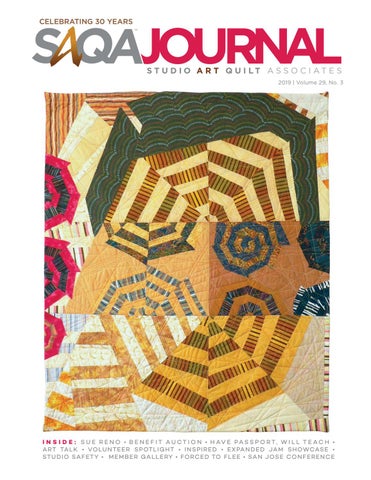
CELEBRATING 30 YEARS
JOURNAL S T U D I O A R T Q U I LT A S S O C I AT E S
2019 | Volume 29, No. 3
I N S I D E : S U E R E N O • B E N E F I T A U C T I O N • H AV E P A S S P O R T , W I L L T E A C H • ART TALK • VOLUNTEER SPOTLIG HT • INSPIRED • EXPANDED JAM SHOWCASE • STUDIO SAFETY • MEMBER GALLERY • FORCED TO FLEE • SAN JOSE CONFERENCE
IN THIS ISSUE FEATURE ARTICLES: BOARD MEMBERS PRESIDENT
Lisa Walton
Featured Artist: Sue Reno. . . . . . . . . . . . . . . . . . . . . . . . . . . . . . . . . . . . 8 Be safe and comfortable in your studio. . . . . . . . . . . . . . . . . . . . . 14
Sydney, Australia
Benefit Auction honors SAQA’s 30th birthday. . . . . . . . . . . . . . 22
VICE PRESIDENT
Tips for teaching around the world. . . . . . . . . . . . . . . . . . . . . . . . . . 31
Deborah Boschert Lewisville, Texas TREASURER
Marvin Fletcher Athens, Ohio
COLUMNS:
Thoughts from the President. . . . . . . . . . . . . . . . . . . . . . . . . . . . . . . . . 4
SECRETARY
Editor’s Notes. . . . . . . . . . . . . . . . . . . . . . . . . . . . . . . . . . . . . . . . . . . . . . . . . 6
Martha Wolfe
Art Talk: Walk to boost health and creativity. . . . . . . . . . . . . . . . 18
Davis, California
Holly Brackmann
Inspired by photography: Caryl Bryer Fallert-Gentry. . . . . . . . 38
Ukiah, California
Vivika Hansen DeNegre Guilford, Connecticut
Carolyn Ducey
GALLERIES:
Lincoln, Nebraska
SAQA Global Exhibitions: Forced to Flee. . . . . . . . . . . . . . . . . . . . 16
Susan Else Santa Cruz, California
JAM Showcase. . . . . . . . . . . . . . . . . . . . . . . . . . . . . . . . . . . . . . . . . . . . . . 20
Cindy Friedman
Member Gallery: Face Off. . . . . . . . . . . . . . . . . . . . . . . . . . . . . . . . . . . 26
Merion Station, Pennsylvania
Jayne Gaskins Reston, Virginia
SAQA NEWS
Gül Laporte Linho Sintra, Portugal
SAQA Award. . . . . . . . . . . . . . . . . . . 7
Dolores Miller
Volunteer Spotlight: Georgia French. . . . . . . . . . . . . . . . . 7
San Jose, California
Candice Phelan Wellington, Florida
San Jose Conference: Threads of Innovation. . . . . . . . 28
Gwyned Trefethen Cohasset, Massachusetts EXECUTIVE DIRECTOR
In Memoriam . . . . . . . . . . . . . . . . . 35
Martha Sielman Hebron, Connecticut
ON THE COVER:
Nancy Bardach
SAQA JOURNAL
Bravo! Brava! 41 x 34 inches | 2018
EDITOR
Diane Howell
From Member Gallery: Face Off, page 26.
Chandler, Arizona DESIGNER
Jennifer Gauerke Denver, Colorado
Go Green! You can choose to read the
QUICK NOTES
To find out more about SAQA, contact Martha Sielman, executive director, at 860-530-1551 or execdirector@saqa.com. Visit our website at www.saqa.com. Annual membership (U.S. and international): Artist/Associate, $80; Juried Artist, $145; Student (full time with copy of ID) $45. Studio Art Quilt Associates, Inc. (SAQA) is a nonprofit organization whose mission is to promote the art quilt. We provide education, exhibitions, professional development, documentation, and publications.
SAQA Journal online only.
The SAQA Journal is published four times a year. To submit articles or story ideas, contact the SAQA Journal editor at editor@saqa.com. See the submission guidelines at www.saqa.com/journal-submit.
Login to mySAQA (www.
For delivery questions, please contact circulation@saqa.com.
saqa.com/mySAQA) and select Manage Your Account.
For more information about advertising in the SAQA Journal , visit saqa.com/ads. SAQA Journal • 2019 | No. 3 •
3
THOUGHTS FROM THE PRESIDENT
Conference provides reminder of what’s important The Threads of Innovation
on donated fabrics and tools to allow
how SAQA members can help SJSA
conference in San Jose is now a
young people to create blocks and
on page 29 as part of our convention
wonderful memory. I know many
whole quilts which are then sent to
coverage.
of you shared my pleasure in the
volunteer embroiderers to stitch and
activities and speakers we enjoyed in
return. This amazing collaboration
worthy programs throughout our
California.
has resulted in quilts that express
communities, and it is important to
the social concerns of the makers.
support ones that you feel strongly
have the honor to see something that
These quilts are being exhibited and
about. SAQA has enabled me to see
makes you stop and think. This year,
winning awards at prestigious quilt
and think beyond my own little
we were given the opportunity to
shows, including the Modern Quilt
world and feel part of the larger
hear from the Social Justice Sewing
Guild’s QuiltCon. The pride in their
community of like-minded souls.
Academy (SJSA). I had the pleasure
work shown by these two young men
Sometimes we are so consumed by
of meeting SJSA founder Sara Trail in
was evident and inspiring, as was
our own issues that we forget what
Houston last year, but did not fully
their connection to the women who
is happening daily to thousands of
understand the organization’s work.
helped complete their quilts.
others. It is good to be reminded.
Sometimes at such an event, you
Sara is an amazing young woman
I would encourage you all to look
who learned to sew at age 4, wrote
at their website, sjsacademy.com. I
a book at 13, and, after graduating
have signed up to be an embroiderer,
from the Harvard School of Educa-
as people from all over the world are
tion, founded the Social Justice
welcome to be part of this amaz-
Sewing Academy in 2017. The orga-
ing effort. When I return
nization is “piecing together youth
my blocks, I will also send
voices, textile art, and community in
some fabric from my stash,
a 21st century sewing circle.” What
which is far larger than I will
a worthy mission! They introduce
ever need, perhaps just like
young people to sewing, empower
yours. Of course, cash dona-
them to express their concerns about
tions are welcome as well.
social justice, and create opportuni-
You can read more about
ties for growth and change. In San Jose, they included two of their participants in a panel presentation, Juan Tapia and Bryan Robinson, young men who have been able to create deeply meaningful quilts. Bryan’s flag quilt moved many of us to tears. SJSA’s main program relies
4
• SAQA Journal • 2019 | No. 3
I know that there are many
The Social Justice Sewing Academy presenters were (left to right): Sara Trail, Nancy Williams, Juan Tapia, Bryan Robinson, and Kate Godfrey.
Regards,
on Lisa Walt
View. Dream. Bid.
Be part of SAQA’s most anticipated fund-raising event!
2019 SAQA
BENEFIT AUCTION SEPTEMBER 13-OCTOBER 6 Donate a 12 x 12-inch quilt to support SAQA’s Global Exhibitions program. Last year, these small works raised nearly $75,000. Can we top that in 2019? It starts with you! SUBMISSION DEADLINEget IS JUNE Don’t let your favorite away.1. For details on how to donate, visit saqa.com/auction
Sept. 13-Oct. 6 • Details: saqa.com/auction Clockwise from upper left: Sonya Prchal, Day’s Over; Alice Beasley, The Race is On; Frances Murphy, Invasion of the Body Snatchers; Margaret Abramshe, Typewriter; Thelma Newbury, Millau Viaduct; Kathy Angel Lee, Sunday Drive.
SAQA Journal • 2019 | No. 3 •
5
EDITOR’S NOTES
Letting go, reaching out by Diane Howell
The last few weeks have been a roller
awe at the level of blood pressure
30 quilts on exhibition at the Inter-
coaster ride. Our little man, Dusty,
medicine he takes.
national Quilt Museum that promote
was diagnosed with congestive heart
At some point, I had to start letting
the event and help celebrate SAQA’s
failure. My main occupation has
go of the fear of losing him. I had
30th anniversary year. Museum visi-
been living in a state of suspended
to look around and see what I could
tors love the quilts! They find them
animation as I wait for my precious
treasure in the here and now. Here is
an unexpected gem as they tour the
dog’s next pill time.
what I found:
venue’s various exhibitions. Learn
Why did this happen? We don’t
First, I had to learn to look out-
about a selection of works from that
know. Did he eat a food suspected of
ward. The first thing that came
exhibition and all manner of facts
being causally linked? Yes. How long
from this realignment was a creative
and figures about the auction on
will he be with us? Vets are of varying
collaborator in the form of Patricia
page 22.
opinions. What are we doing? What
Gould, our Benefit Auction coordina-
the doctors tell us, although two
tor. She produced an article about our
good walk. I found it is okay to take
pharmacy techs have expressed
beloved auction. She wrote about the
a break and enjoy the company of
Second, I discovered the value of a
my little man. We go the distance he is able, and I am free to relax and think happy thoughts. This activity is validated in this issue’s Art Talk column by Jennie Johnston. Learn how walking can be a valuable part of your
Ruth Powers Don’t Piss Off The Fairies 12 x 12 inches | 2008
artistic practice and keep you healthy on page 18. Third, I learned to let go. A commitment I couldn’t meet was postponed. Normally, I would gear up into high stress for days or weeks over
This fairy is in a right little snit because I’ve separated her from her compatriots. It’s for a good cause: to announce that Face Off, this issue’s Member Gallery, is on page 26.
6
• SAQA Journal • 2019 | No. 3
such a disappointment, but instead I looked at it as a blessing. I couldn’t do the task and I needed my attention elsewhere. As I continued to pace see Editor’s Notes on page 35
Curvaceous 1 41.5 x 41.5 inches
Sylvia Gegaregian receives SAQA Award Congratulations to Sylvia Gegaregian, recipient of the SAQA Award at Quilt National ’19. Her work, Curvacious 1, was selected by Quilt National jurors for being “compelling, dynamic, and progressive.” Sylvia says her work was inspired when members of her quilting bee decided to try a new technique. “Since then, (that) small exploratory project has given me the courage to expand on my initial ideas and step out of my comfort zone.” Curvaceous 1 includes many techniques: hand embroidery, painting, fused appliqué, and cut/slashed strips. The SAQA Award is presented to one artist at three prestigious textile exhibitions: Quilt National, Art Quilt Elements, and Quilt Visions.
VOLUNTEER SPOTLIG HT
Georgia French Q: What volunteer roles do you perform for SAQA?
Q: How does volunteering reinforce your art practice?
A: This year I am co-chairing the Special Events Committee, which plans the SAQA Annual Conference. Our committee works with local SAQA members and SAQA staff to make each conference the best possible experience for attendees. I am also helping out in the SAQA/Oregon region with our first regional retreat.
A: Sometimes it has replaced my art practice, but when I do get back to the studio, I know there is much going on that wouldn’t happen without all I have learned from SAQA. Right now I am seeing a larger window for my own creativity: Time is on my side at last and I’m enjoying making my art a priority instead of a leisure activity. I still have so much to learn, and so much to make!
Q: How do these roles enrich your SAQA membership? A: Every committee or project allows me to get to know and work with new people, and I’ve made many friends who share my passion for supporting SAQA and its mission. I’ve learned (and am still learning) how SAQA works; it is so much more than the mere sum of its many parts. It’s an amazing organization and so wellmanaged.
Q: Tell us about your time with SAQA. A: I have worked on prior SAQA/Oregon regional conferences and several of our regional exhibitions. I am co-chair of the seven-region exhibition Shifting Tides, which will travel through autumn 2021. Nationally, I was the first chair of the regional grant program and still sit on that committee. I began as a regional co-rep years ago when Oregon membership was less than 10
percent of what it is today. I am guessing that was around 2005. I had been a member for a long time before then, even though there was no opportunity for any local involvement. My membership may have lapsed once or twice, but I always came back, because I knew then as I know now that art quilts are the visual art I most want to see, and supporting SAQA ensures I will have a lot to look at. The art enriches my life. The relationships enrich my life. And I am happy that I can contribute some administrative experience and support volunteer empowerment, which has always been a major interest. SAQA Journal • 2019 | No. 3 •
7
FEATURED ARTIST
Not color corrected
Sue Reno
Capturing the light, reflecting nature by Cindy Grisdela
Capturing the light, reflecting nature by Cindy Grisdela
Heat Index
54 x 51 inches | 2018 Sue Reno has lived near the Susque-
experimented with “wet” cyanotype,
hanna River in Pennsylvania most of
which introduces “moisture and
her life, and the river and its natural
extreme exposure times into the pro-
environment play outsized roles in
cedure, with semi-predictable results.
her art.
The cyanotype chemicals break
Sue’s technique of choice is cyano-
8
• SAQA Journal • 2019 | No. 3
down into a range of colors and
type prints on fabric. Cyanotype is a
patterns that make the prints really
photographic process that combines
exciting and addictive to produce,”
chemicals and sunlight to create blue
she says. Reno adds patchwork to
prints of the artist’s chosen images,
frame the imagery she creates and
either on photo paper or fabric, as
free motion quilts various motifs
in Reno’s case. She uses both plant
on her Bernina domestic sewing
matter and digital images to cre-
machine. She has a large collection
ate cyanotypes. Recently she has
of fabric, ranging from commercial
In Dreams I Drifted Away 60 x 45 inches | 2018
Heat Lightning 78 x 32 inches | 2018
cotton prints that date back to the
Thermofax printing. Simply put,
1940s to silks from a sojourn in India
she employs several methods to put
while a student.
imagery on fabric; she mixes and
Heat Index, from 2018, is a great example of Reno’s process. She combined four blocks of botanical prints
matches them as appropriate for the focus of the quilt. Reno learned to sew at a young age.
created with wet cyanotype and solar
“I had a very traditional, practical
dye printing on a hot, humid August
Pennsylvania Dutch upbringing that
day with luminous silk patchwork.
included a full, informal schooling
The result is a dynamic composition
in life skills.” Her first quilts were
that evokes summer’s heat, a lively
utilitarian, but her work evolved in a
mix of blue and white prints with red
more artistic direction thanks to the
and green patchwork.
early pioneers in the art quilt move-
Reno also uses sun printing, free-form gelli plate printing, and
ment who opened her mind to the possibilities. SAQA Journal • 2019 | No. 3 •
9
Rabbit and Maple
71 x 86 inches | 2018
Reno’s studio time varies with the
the design process without interrup-
most of her printmaking with plants
tion.” She doesn’t normally sketch or
gathered from her garden or on hikes.
create a formal plan. “I sincerely, on
Winters are for more indoor pursuits.
a deep level, hate measuring things.”
She has a studio in a walkout base-
While she was trained as a traditional
ment of her home, where the sink,
quiltmaker and understands precision
washer, and dryer are easily acces-
sewing, improvisation fits better with
sible. There are few frills. Fabric is
her creative design process.
stored in plastic bins, and bookcases
large quilts at a time. That way, if
quilt. This simple setup allows Reno
she runs into a stumbling block on
to focus on what she has on the
one, she has something else to focus
design wall at any given time. Her
on as her subconscious mulls over a
most creative time is in the afternoon
solution.
ings for routine tasks.
10
• SAQA Journal • 2019 | No. 3
She usually works on two or three
of binders hold notes about each
and evening hours, so she uses morn-
Squirrel and Locust, detail, 2011
time to “really get into the flow of
seasons. In the summer, she does
Not all of Reno’s prints are made from plants. She also uses skulls of
When she begins a new piece,
woodland animals that she finds on
Reno assembles the prints and the
her hikes or ethically sources. Rabbit
patchwork in place, then blocks out
and Maple, 2018, uses a combination
of botanical prints and prints made from a rabbit skeleton. Reno also included some small embroidery panels in the composition, part of her Flora and Fauna series. Another quilt in that series, Squirrel and Locust, was included in SAQA’s Metamorphosis exhibition. A detail of the piece shows one of the squirrel skull prints next to a leaf print with intricate beading separating the images and
Silk Mill #3
adding color and sparkle.
53 x 60 inches | 2013
Another series focuses on buildings, primarily historic architecture in Lancaster County, Pennsylvania. Silk Mill #3, 2013, was inspired by the former Ashley and Bailey mill in Columbia, Pennsylvania, and now is part of the permanent fine art collection of the State Museum of Pennsylvania in Harrisburg. Yet another series was a yearlong project Reno tackled in 2017 called 52 Ways to Look at the River. She visited different places along the Susquehanna River every week for a year and took photographs. Back in the studio she used the imagery to create a 9 x 12-inch needle-felted panel for each week. She assembled them into a quilt when all 52 were complete. Reno’s work documents the things that grow, the seasons, and the historic buildings in her corner of the world. “It’s important to me that my work is beautiful; even when I’m portraying death or decay, the work ends up with a joyous aesthetic. I work intuitively so I’m not certain how that happens, but I’m glad it does,” she says. Reno took advantage of a unique
52 Ways to Look at the River 72 x 82 inches | 2017
opportunity in late 2016. She heard about a call for artists for an event at NASA’s Goddard Space Center called the James Webb Space Telescope Artist Event and applied, even though she didn’t have any space-themed
52 Ways to Look at the River, detail SAQA Journal • 2019 | No. 3 •
11
artwork. Twenty-two artists in a variety of media were chosen, all creating art inspired by the telescope. Luminosity, was her result. Reno began this piece by hand stitching gold hexagons on site in the telescope viewing room. There were no restrictions on the artwork created, which was “simultaneously liberating and slightly terrifying,” Reno says. The hexagons represent the mirrors of the telescope. She set her telescope representation on a beaded, needle-felted background to represent the cosmos, and bordered it with cyanotypes, solar dye prints, and digital prints made from the photos she took on site. Exhibition is the primary focus of her work. She started out mainly applying to quilt shows, but as her work has evolved artistically, she has
Luminosity
60 x 74 inches | 2017
12
• SAQA Journal • 2019 | No. 3
Luminosity, detail
Jack in the Pulpit 60 x 72 inches | 2014 Photo by Gregory Chase
been seeking acceptances at fine art
also appeared on Quilting Arts TV
natural phenomena, paired with the
and fine craft shows as well. She does
and writes magazine articles. All this
sheer glee involved in manipulating
her research and applies to exhibitions
drives requests for lectures and trunk
materials and creating something
where she has a reasonable chance
shows to guilds and groups.
brand new to the world.”
of acceptance and to some that seem
Because her work is large, sales are
more of a stretch. Even with research
“sporadic but gratifying.” She creates
of the venue and the jurors, some
some smaller work to sell at presenta-
acceptances are “just luck.” Good
tions and is looking into increasing
work, high-quality photos, and well-
her stock of those pieces and adding
written artist statements can increase
prints to her offerings.
your “luck quotient,” Reno notes. She
It is a challenge to balance time
still gets her share of rejections where
for creative work with the demands
her work did not match the juror’s
of exhibiting, maintaining her blog,
concept of an exhibition. “I never take
updating social media platforms, trav-
rejection personally.”
eling, and honoring other responsi-
Reno has a website and main-
Cindy Grisdela is a SAQA JAM who resides in Reston, Virginia. You can explore her work at cindygrisdela.com.
bilities. “I prioritize making the work
tains a strong blog and social media
that’s important to me because that’s
presence where she shares her
the foundation that holds up all the
process and inspiration. “None of
rest of it.”
the techniques I use are proprietary,
You can see more of Reno’s work at suereno.com. n
Reno plans to keep her focus on
most yield very different results
creating. “I’m in the process of rear-
when wielded by different artists,
ranging my life to free up more time
and I enjoy using the internet for its
to focus and work on making art.
highest and best purpose of advanc-
Being an artist lets me indulge my
ing human knowledge.” She has
penchant for close observation of
Sue Reno in her studio.
SAQA Journal • 2019 | No. 3 •
13
Avoid studio pitfalls Know the hazards, risks, and dangers of being a quilt artist by Phyllis Cullen, MD
Experienced textile and quilt artists
cardiovascular system, gastrointesti-
stiffness, soreness, etc.), bony inju-
know the challenges presented by the
nal tract, and urinary tract. Localized
ries, nerve damage, and lacerations.
chemicals, tools, and machines of our
damage from hot glue, bleach, heavy
Vibration-producing tools can cause
trade—mostly. They also know how
metals in paints, and solvents are
finger spasms and permanent nerve
to maintain a safe working environ-
some common problems.
damage and numbness.
ment—mostly. But our studios do
Skin
hold their share of danger. Let’s divide our work hazards into two phases. The first phase is what we do to our fabrics. Chemical, mechanical, and heat treatments impact our fabrics and subject our bodies to the same processes. The second phase is construction, which involves physical and mechanical issues that affect musculoskeletal, neurologic systems, and the like. Often referred to as ergonomic issues, these arise from tools and the way we use them.
Phase 1: Fabric treatment Hazards include heat and burns, poor lighting and eye strain, and physical injuries from broken needles, sharp pins, and rotary cutters. These hazards are inherent in any sewing or quilting process. However, surface design and material manipulation increase the risk for injury. Inhalation or contact with dye powders, bleaches, photoreactive, and other chemicals, as well as toxic exposure via various paints, mediums, glues, and cleaning products, can cause extensive damage to the skin, mucous membranes, and lungs. The damage may be more serious when these toxins gain access to our nervous system,
14
• SAQA Journal • 2019 | No. 3
The skin can be damaged by contact (dermatosis), and, along with the lungs, serve as an entry point for certain toxins that cause chemical destruction via percutaneous absorption, which occurs through unbroken skin. Acute contact dermatitis can be
Prevention is less painful than treatment! Even for quick processes, wear gloves—at least small plastic bags—when handling chemicals. Be careful with irons, heat guns, glue guns, or rotary cutters and other sharp objects. A needle guard on the sewing machine can prevent injury.
Lungs
caused by hundreds of irritating
The lungs and upper airways are
and sensitizing chemicals, plants,
sensitive to aerosolized chemicals,
and photoreactive agents. More are
especially through liquids or powders
being developed daily. Read every
that can damage the throat and cause
label. Even skin color change from
asthma in the airways. Repeated or
non-heavy metal dye or paint is not
highly toxic exposure can perma-
harmless. Some damage is being
nently damage lungs. Some plastics
done. Symptoms can include heat,
require high heat for manipulation,
swelling, redness, blistering, ooz-
which can release toxins. Aerosolized
ing, itching, burning, and general
glues do what they are made for—
discomfort.
inside your lungs! Many poisons are
More long-term problems can occur
absorbed through the lungs which, as
due to a cumulative effect of repeated
through skin absorption, can damage
contact with weak or moderate
every organ in the body.
irritants. These can end up as dry red
Even if you don’t do surface design,
plaques or chronic dermatitis with
fabrics may be treated with formalde-
dry, thickened, cracked, and scaly
hyde or other chemicals which cause
skin, especially on hands.
sensitivity in susceptible individuals.
We also see mechanical damage to
If you buy bargain-priced, lower-
the skin from friction, pressure, heat,
quality fabrics of questionable origin,
cold, crushing, scratching, macerat-
most experts advise that you wash
ing, and other trauma. These can
it before you handle or breathe it. If
result in tenosynovitis (inflammation
you use a spray or powder, make sure
of tendons and soft tissues), myositis
to use proper respiratory protection.
(muscle inflammation with swelling,
Environment & workstation
edges that curve downward—on your
you are using is hazardous, find
In many studio environments, poorly
chair seat may put less stress on the
out or take universal precautions.
designed workstations, tools, and
backs of your thighs.
Read the labels. Know the products,
equipment are the norm. Studios
maintain proper ventilation, and use
are cluttered with bags and boxes of
allow your elbows to be at about 90
respiratory protection every time.
materials. Liquids teeter precariously.
degrees when you sew, with shoul-
Eyes
Electrical issues include cords knock-
ders in a relaxed position. An adjust-
Eye protection is critical when you
ing over toxic chemicals, electrocu-
able chair can help you obtain this
work with chemicals, sharp objects,
tion, and exposure to excessive heat.
position. Another tip is to tilt your
vibrating tools, etc. A lot of chemical
Keep floors and passageways clean,
machine slightly forward. You can
burns, foreign bodies, and injuries are
clear, well lighted, and dry to minimize
get a couple of rubber door stops to
due to compressed air. Also problem-
slips, trips, and falls. Electric-powered
put under the back of the machine to
atic are effects of poor lighting, dirty
equipment should be certified flame-
protect your neck from being sharply
air, and eye strain, which produce
proof and should be grounded to
bent; this will also protect your low
cumulative effects on vision. Eye
prevent static electricity buildup.
back from strain. Having enough
dryness and age-related eye changes
Sitting and standing
table space to the left of your sewing
accelerate damage.
When working at sewing machines,
If you don’t know if a substance
It allows us to notice possible hazards
cutting tables, ironing boards, or
from chemicals, sharp implements,
desks, poor posture combined with
and heat sources.
highly repetitive work is prevalent.
Phase 2: Construction Phase
This is true even though major advances have been made in the
Hazards to the neuromuscular system
design and production of ergonomic,
occur most often during construc-
well-lit stations for sewing, cutting,
tion. It is common to have strains to
ironing, painting, and other tasks.
muscles, joints, tendons, and liga-
I see a lot of patients who don’t use
Sewing machine height should
machine is important when you work with large or heavy projects. That setup supports the project’s weight without straining your neck, back, and shoulders. Having a mat or nonstick surface below your foot pedal is also important. A sliding pedal may force you to extend or twist your knee, and lose your back curve. Standing on hard floors for extended periods isn’t good for your
ments from repetitive motions. Con-
appropriate adjustable chairs. This
torted positions of the hands, elbows,
leads to leaning forward and reversal
shoulders, neck, knees, and low back
of the curves of the upper and lower
can lead to occupational cervicobra-
spine; that posture stresses the hip
chial (neck and shoulder) disorders,
joints and lower back. You might
cumulative trauma disorders, and
develop problems with the low back
Tools
overuse syndromes. Repetitive hand
and the lower extremities if your
Proper storage and placement of
and wrist movements lead to arthritis
chair doesn’t have a back rest, which
equipment and tools is key. Art-
at the base of the thumb (often the
minimizes hunching over. Sitting too
ists and craftspeople cut, sew, lift,
first location of arthritis), carpal tun-
long in an awkward position puts
press, and twist in awkward posi-
nel syndrome (earliest sign may be
strain on the upper back and the
tions to retrieve items in cluttered
numbness in your hands when you
shoulders, neck, and skull, causing
environments.
wake up), ganglion cysts, and forearm
cervical disc injuries and degen-
tendonitis. Acute injuries often occur from
back. There are many good foam or rubberized mats (make sure they are nonslip!) that can be placed where you cut or iron.
Using heavy irons for extended
eration, spinal arthritis, muscular
periods can aggravate disorders of the
spasms, and stiffness.
wrist, shoulder, elbow, and fore-
crushing injuries, (dropping irons on
Make sure your legs fit under a
arm. You may develop related nerve
our feet!) and entanglement in cords
table or desk comfortably and that
entrapment disorders from pressing
and wires.
your feet are flat on the ground. A
as well as repeatedly setting the iron
waterfall front—one with rounded
see Studio Safety on page 37 SAQA Journal • 2019 | No. 3 •
15
Selections from
Forced to Flee Throughout history people have been forced to flee from their homes for their own safety and survival due to war, oppression, natural disasters, and atrocious human rights violations. The refugee crisis has impacted the social, economic, and political structures of host countries, especially poor and developing countries. Forced to Flee was juried by Dr. Susan Beryl Marks, associate fellow of the International Quilt Museum in Lincoln, Nebraska. It premiered at the Ruth Funk Center for Textile Arts in Melbourne, Florida. It is now on exhibit at The Historical & Cultural Society of Clay County in Moorhead, Minnesota, where it will be through October. Visit saqa.com/ forcedtoflee to view the video featuring Dr. Marks and the exhibition artists who attended the premiere. More details about the exhibition are available there too.
Sara Sharp Fleeing from Drought 53 x 34 inches | 2015
Eunhee Lee They Are Also Us 42.5 x 29 inches | 2018
16
• SAQA Journal • 2019 | No. 3
Jim Hay Refuge or Refuse: Offer Sanctuary or Discard as Trash 91 x 78 inches | 2018
Diane E. Wespiser Wanted—A Home 68 x 54 inches | 2018 Photo by Robert Wespiser
Jo Thomas Child Behind Barbed Wire 36 x 27 inches | 2018 Inspiration photo by Zoriah Miller
Anne Daughtry Aleppo 55.5 x 38.5 inches | 2018
Catherine A. Drummond Displaced 26.5 x 31 inches | 2018 Photo by Larry Goldstein
SAQA Journal • 2019 | No. 3 •
17
ART TALK
Walking creates healthy, creative avenues by Jennie Johnston
What links Beethoven, Charles Dickens, and Georgia O’Keeffe? They were habitual and devoted
SAQA/Michigan member Beth
our thoughts,” writes Rebecca Solnit
Markel puts it this way: “Being a
in Wanderlust: A History of Walking.
quilter is often a sedentary thing,
Within our screen heavy mod-
walkers. While we often discuss
so walking gets my body moving in
ern world, we have more and more
artistic tools, such as paint brushes,
ways that really help with circulation.
excuses to sit and look rather than
rotary cutters, or sewing machines,
I swing my arms, sometimes like pen-
experience things as our ancestors
we can easily overlook the deeper
dulums, sometimes bent and close to
did. While some of us may try to walk
reasons successful creative people
my body like I’m race walking, and
while looking at our smart phones,
maintain high levels of productiv-
sometimes it’s leisurely when I hold
our mental health does not thank us
ity. What are their secrets to success?
hands with my husband.”
for this habit. When out walking, our
What routines do they adhere to, and
Movement is a human act that our
brain has the chance to encounter
how do those routines inform their
bodies need. Working a daily walk
new things and this helps us settle
work? Let’s consider how we can, and
into your creative routine can provide
our minds, slow our breathing, and
should, incorporate walking into our
the added benefit of a more fit body
just be. The pace of our days can
artistic tool box.
as it gets your blood pumping. While
lead to anxiety and depression and
this may be a given to many, it is easy
being outside is a proven mood lifter.
to let the simple act of a walk around
SAQA/Pennsylvania member Peggy
Physical health The hum of the sewing machine
the block drop from our schedules.
Black says that walking “clears the
fills our days and the intricacy of
Even adding in a 5- to 15-minute
mind and allows the focus to shift
handwork requires stillness. Unfortu-
walk will increase your circulation,
to meditation and reflection.” This
nately, sitting for long periods is not
stretch out your muscles—especially
health benefit is one that any artist
good for our health. In Born to Walk:
if you have been holding one posi-
can utilize. After all, we are human beings first. Taking care of our mental
“
We are human beings first. Taking care of our mental and physical health is necessary to produce the work we love.
and physical health is necessary to produce the work we love. Movement also decreases the risk of developing dementia and cognitive decline, according to multiple sources, including England’s Walking for Health, which organizes a large network of
“
network of health walks. The Transformative Power of a Pedes-
tion for too long—and revitalize your
trian Act by Dan Rubinstein, he lists
eyes and mind after the strain of
Creative inspiration
the unequivocal benefits to our bodies
making.
The wonderful places one can walk
that walking provides: “Walking builds
when seeking inspiration can also be
bone mass, strengthens the muscles
Mental health
in your arms and legs, and gives
“Walking allows us to be in our bod-
their primary ideas from nature need
your joints better range of motion. It
ies and in the world without being
to get outside to feed their inspira-
enhances your balance, preventing
made busy by them. It leaves us free
tion. Their interactions may take the
falls, and eases back pain.”
to think without being wholly lost in
form of walking with camera in hand,
18
• SAQA Journal • 2019 | No. 3
a motivating factor. Artists who draw
sketching, or gathering plant materi-
is not working, or if you cannot
als for dyes and printing. Markel fills
decide between two fabrics for your
her mind with possible new creations
foreground, put down the work and
as she walks. She finds that “walk-
let your body wander through your
ing informs my creativity (by) seeing
neighborhood for a few minutes. This
things more clearly.” Her description
physical act may give you clarity on
of a recent walk brings that statement
the issue you are struggling with. Of
to life: “The blue of the sky next to
course, ideas may emerge later, but
the brown of the winter tree limbs
walking can be much more calming
suddenly inspired me. The crunch
and beneficial than panicking in your
of the snow under my feet made me
studio and becoming more frustrated.
think of new ways to sew angles into my work attempting to create that
Walk every day
crunchy dynamic. The first robin of
Forming a new habit is a challeng-
spring moved me to pull reds from
ing feat. If we are used to the steady
my fabric stash and even purchase
daily rhythm of coffee, newspaper,
new red fabric when I was out shop-
and then sewing, it may seem almost
ping. Walking informs my creativity
impossible to insert a 10-minute walk
in countless positive ways, from atti-
around the block into our morn-
tude to inspiration.” City walks can
ing. Many of us also struggle with
also prove invaluable when artists see
outside constraints such as children
architecture, storm drain covers, or
or elderly parents to care for, jobs
walkway railings. Angles, textures, or
that start early or finish late, and the
light shining onto glass buildings col-
reality of cold, ice-covered walkways
lectively prove there is no end to the
or extreme high temperatures. If you
new work that daily walks can spark.
are not a morning person, consider
Unblock creative channels
mid- to late-afternoon walks. This will help with the afternoon slump
Learn more about walking’s health and creative benefits through the following resources: Books • Walking in the World: The Practical Art of Creativity by Julia Cameron • Born to Walk: The Transformative Power of a Pedestrian Act by Dan Rubenstein • Daily Rituals: How Artists Work by Mason Currey • Wanderlust: A History of Walking by Rebecca Solnit Websites • walkingforhealth.org.uk • everybodywalk.wpengine.com • healthline.com/health-news/ walking-indoors-outdoors-increasescreativity-042814#1 • realsimple.com/health/fitness-exercise/ how-to-walk?
Creative block is the dread of most
many of us experience, boost your
creative people, but it happens to us
energy levels, and hopefully give you
all. Things can be humming along
a second wind. If outdoor tempera-
smoothly one minute and in the next
tures are soaring, early morning or
everything shuts down. What do
evening walks are a good idea. Many
will notice how movement is making
artists who walk do in that moment?
people walk in the mall to avoid
a positive change in your health and
They get moving.
extreme temperatures. If the pavement
creativity. “How you walk matters
Regina Marzlin, a SAQA/Atlantic
is uneven in your neighborhood and
less than that you walk,” champions
Canada member, says walking helps
you are worried about injuries or falls,
author Cameron in her Walking in
her conquer creative blocks. “Look-
look for a walking or running track in
this World book.
ing at a faraway space broadens my
your town, or consider walking with
So look at walking as your newest
view, literally, and instead of staring
a friend or family member. A walk-
creative tool. It may bring you fabu-
at fabric from a close distance I take
ing buddy can be a good way to keep
lous results! n
in the bigger picture and free my
yourself accountable and allow you to
mind from the restrictions of the
socialize during your day.
Jennie Johnston resides in British Columbia and is co-rep for the SAQA/ Western Canada region. She has shown her work in venues throughout North America. She blogs and shares her mixedmedia art quilts at jenniejohnston.com
small studio room I work in.” Author
If walking proves a challenge for
Julia Cameron, who wrote Walking in
other reasons, the key is to start small
this World: The Practical Art of Creativ-
and gradually increase your time. Five
ity, says walking is where “difficult
minutes is better than nothing, and
clarity emerges.” So, if a technique
as you build up your stamina, you SAQA Journal • 2019 | No. 3 •
19
JAM SHOWCASE
Martha Ressler Purple Sky, Red Roof 16 x 20 inches | 2018 Photo by Jay Ressler
Marjan Kluepfel A Year in the Forest 40 x 66 inches | 2016
20
• SAQA Journal • 2019 | No. 3
Barbara Lange Urban Bugs 27 x 66 inches | 2018
Sheila Frampton Cooper Ruins of Roussillon 28 x 33 inches | 2017
Grace Harbin Wever, Ph.D. And the Sky Rolled Up Like a Scroll 66 x 40 inches | 2018 Photo by Jeff White Photography
SAQA Journal • 2019 | No. 3 •
21
Benefit Auction offers ‘wonderful’ mix of quilts by Patricia Gould
SAQA’s Benefit Auction celebrates our 30th anniversary with a special exhibition of 30 auction
auction quilts bring to IQM’s visitors. The great
quilts at the International Quilt Museum (IQM) in
advantage to being the Benefit Auction coordina-
Lincoln, Nebraska. These quilts were on display at
tor is that I get to see all of the quilts as they come
the museum through August 4.
in. And this year, they are wonderful. The pieces
The quilts proved to be a popular point of interest at IQM. “We have had a great response to the
convey heartfelt messages often expressed through the innovative use of materials.
SAQA 30th Anniversary exhibition. Our viewers
I’ve reviewed a few pieces from those I selected
have really enjoyed the wide-ranging topics and
for the 30th Anniversary exhibition to give you a
techniques. I think the art quilts always intrigue
glimpse of what awaits bidders during the three-
visitors, as they are not as familiar with the
week auction from September 13 through October 6.
(medium),” says Carolyn Ducey, IQM’s curator of
22
I completely understand the delight the 2019
collections. “I hear things like, ‘Wow, I didn’t know
Animal kingdom
people made quilts like that!’ or comments on the
In addition to being an artist and an adventurer, I
fun imagery. People have spent a lot of time perus-
am an animal lover. So it is no wonder that four of
ing each of the pieces closely and marveling at the
my favorite artworks beautifully depict animals and
artistry.”
their connection to us and their environment.
• SAQA Journal • 2019 | No. 3
From left to right: Jane Haworth, Otis 1; Sue Sherman, Thoughtful Penguin; Susan Smith, Those Eyes; and Mary Ann Van Soest, Spring.
Jane Haworth’s piece, Otis 1, is a great example of how the artist’s loose approach works so well. This funny, and perhaps lazy, dog’s personality is captured in raw-edge appliqué and free-motion stitching, which build texture and furry details. Sue Sherman’s Thoughtful Penguin is a majestic portrait of a Magellanic penguin. I was fortunate to spend time in the Falkland Islands and on the Antarctic Peninsula in 2002, where I fell in love with all the penguin species that we encountered. Since they have no predators other than leopard seals and skuas (a bird that preys on the penguin chicks and eggs), we could sit on the ice and penguins would come right up to us without fear. Sherman’s portrait captures that inquisitive nature of the species while her painting and stitching depict the unique feather patterns and handsome face of this beautiful bird. Susan Smith’s Those Eyes brings back wonderful memories of my three-week trip to Tanzania and Kenya. We camped in a small tent and were greeted only by wild animals, such as zebras and lions, who breathed on our tent at night. Smith’s zebra’s eyes are enchanting and engaging. You feel as though you are looking into his soul and conversing with
Benefit Auction by the numbers What does it take to launch the SAQA Benefit Auction? Lots of effort by lots of dedicated people. An analysis of this year’s auction quilts yields impressive data. A total of 443 quilts were donated, a tie with 2018’s record-breaking sum. Each quilt is made by a different artist. Of the 443 contributing artists, 23 percent live outside the United States, which closely aligns with our overall membership makeup. New contributors also totaled 23 percent. There is a strong chance the newcomers will continue to be a part of the event, based on the fact that 40 percent of 2019’s artists have donated a piece for five or more years. Those who have donated for 10 years or more make up 10 percent of the total donors. We want to give a special nod to the ten artists who have made a piece for all thirteen auctions: Linda Colsh, Judith Content, Bodil Gardner, Monique Gilbert, Denise Oyama Miller, Alison Muir, Wen Redmond, Susan Shie, Lynn Welsch, and Diane Wright. Again this year we held a regional challenge, with regions split into large and small categories. A rundown of quilts by region shows that SAQA/ Oceania contributed the most quilts in the large region category; second was Southern California/Southern Nevada, with Oregon a close third. In the small region category, SAQA/Alaska was the winner, followed by Nebraska and Arkansas/Louisiana. Each winning region received $250 to support its activities.
him. Smith splits the portrait into two distinct SAQA Journal • 2019 | No. 3 •
23
Christine Predd, Wading by the Rocks
Penni Barger, The Artist Within
parts, each with its own color and fabric treatments, to make the piece all the more eye-catching. Spring, by Mary Ann Van Soest, seems like a simple design at first, but her collage of written elements and a sketchbook appearance add depth beyond a mere portrait of a bird. I especially like that she has cropped off the feathers at the edges so that it looks like a page from a sketchbook rather than a formal composition.
All the people
Maria Stoller, Stuart
Penni Barger’s The Artist Within highlights her passion for and expertise at painting. This still life is reminiscent of Vermeer’s paintings with lovely highlights and subtlety of color and shadows. Only
levels. He’s not looking at us or even beyond us.
after careful examination do we see the reflection
What exactly is he looking at? I love the ammo-
of a painter, perhaps Barger herself, working at her
nites that comprise the backdrop for this portrait.
easel.
They almost make you believe he is underwater—or
I love the energy of the child and the rocky beach in Wading by the Rocks by Christine Predd. You can sense the excitement this little girl is feel-
24
Stuart, by Maria Stoller, is an engaging portrait of a man that is open to interpretation on many
maybe he views himself as a fossil. He’s a fascinating conundrum.
ing as she enters the water, definitely the way I felt
Our world
as a child collecting rocks, shells, and beach glass
Two artworks in this anniversary collection
on the Atlantic Ocean.
address environmental issues with very different
• SAQA Journal • 2019 | No. 3
Lisa Jenni, Rings of Eternity II
Pixeladies, Watercolor Pencils 5: Let’s Talk About Water
approaches. Lisa Jenni’s abstract collage, Rings of
water by human activity. The use of watercolor pen-
Eternity II, includes plastic rings and netting that
cils as their backdrop for newspaper clippings and
can be found on beaches, in rivers and lakes, and
other references to water is a bold composition, one
in massive piles in all the world’s oceans. This is a
that attracts attention and opens dialogs about seri-
very strong statement that these pieces of plastic
ous threats to a critical element of life on Earth.
will be around when we are long gone and are a serious threat to the health of our planet.
As you can see, the work in the 30th Anniversary exhibition proudly represents SAQA and the art
Deb Cashatt and Kris Sazaki have collaborated for
quilt medium. Enjoy an online view of all 443 pieces
years as Pixeladies. Their dynamic piece, Watercolor
donated by SAQA members at saqa.com/auction.
Pencils 5: Let’s Talk About Water, highlights the crises
Make a list of your favorites and bid in our popular
we face with water shortages and the polluting of
fundraising event September 13-October 6. n
How the auction works Our 2019 Benefit Auction begins with Diamond Day, an opportunity to make any auction quilt yours for $1,000. This toptier bidding starts at 2 p.m. ET on Friday, September 13. Then, from September 16-October 6, the 12 x 12-inch auction quilts will be available
in three sections. A new section opens each Monday at a bid price of $750. The price is reduced daily until it reaches $100 on Saturday. The first bid on a piece wins. At week’s end, any remaining quilts in that section move to the SAQA Store, where they will be for sale at $100 apiece.
Remaining quilts also will be in the SAQA booth at International Quilt Festival/ Houston Oct. 31-Nov. 3. If any remain after that event, they will make one last appearance in the SAQA Store through December 20. For full details, visit saqa.com/auction.
SAQA 2019 Benefit Auction Pricing Schedule $750
$550
$350
$250
$150
$100
Section 1
Sept 16
Sept 17
Sept 18
Sept 19
Sept 20
Sept 21
Section 2
Sept 23
Sept 24
Sept 25
Sept 26
Sept 27
Sept 28
Section 3
Sept 30
Oct 1
Oct 2
Oct 3
Oct 4
Oct 5
Every quilt is available as a Buy It Now purchase of $1,000 for the duration of the auction, even if the section is not yet open for bidding. Prices change at 2 p.m. ET. No bids will be accepted between 1:45-2 p.m. ET while system updates are being made. SAQA Journal • 2019 | No. 3 •
25
MEMBER GALLERY
Face Off
Denise Oyama Miller Eunice 31 x 17 inches | 2010
Jeanelle McCall I’m Listening Still 13 x 13.5 inches | 2018
Tiziana Tateo Inside and Outside 42 x 63 inches | 2012
26
• SAQA Journal • 2019 | No. 3
Mary Pal Willie 45 x 34 inches | 2018
Claire Passmore Do You See What I See? 46.5 x 71 inches | 2018
Barbara Schneider Beautiful Faces, var. 1 16 x 20 inches | 2016
Sarah Ann Smith Cookie? PLEEEZE COOKIE! 22 x 17 inches | 2009
Peggy Blei Hracho Small Talk 4 x 6 inches | 2018
SAQA Journal • 2019 | No. 3 •
27
2019 SAQA Annual Conference Wrapup Threads of Innovation charged with creative energy by Diane Howell
The creative energy flowed freely at
creative spark is present at every con-
Napa, California. Her new company
SAQA’s 2019 annual conference April
ference, with each conference shaped
produces the Craft Napa art retreat
25-28 at the San Jose (California)
by the unique resources and strong
and publishes select projects.
Hilton.
talent found in each locale. In San
Bolton was followed by artist Lisa
“I am not sure how you could
Jose, conference attendees benefitted
Congdon, who presented an up-to-
market the creative energy and joy
from a tip of the hat to Silicon Valley
date program on how to use Insta-
on steroids that is a SAQA confer-
and strong regional speakers, includ-
gram in your artistic practice. Because
ence,” stated one new attendee in her
ing Patricia “Pokey” Bolton and fine
it is the largest visually driven social
post-conference survey. That palpable
artist and illustrator Lisa Congdon.
network, it is a natural home for
The conference kicked off with the
visual artists. Some of Congdon’s
Thursday evening ice breaker. Mem-
points were:
bers at each table brainstormed about
• The Instagram algorithm decides
one topic, such as creative rituals or innovative tools. Mel Beach compiled notes from all 18 table topics into one document to share. The next morning, Patricia “Pokey” Bolton gave the opening keynote address. Her main message was that you can succeed by doing what you love. She traced her professional journey from founding Quilting Arts LLC, which published Quilting Arts and other magazine titles (the firm was sold, first to Interweave and then to F+W Publications), to her current venture, Crafting a Life, based in
what you see, which makes engagement important; engagement includes likes, shares, and reposts. • Recent posts are favored over older ones. • Introduce yourself periodically to help new followers. • Be responsive to comments and direct messages. • Engage with and support others who do similar work. • Post consistently, but not more than once or twice a day.
SAQA thanks the sponsors who helped make Threads of Innovation a success. Our corporate sponsors were: All photos by
Platinum Sponsor Innova
Maggie Vand
erweit
Top: Gerrie and Lisa Congdon shared a quick break during the plenary sessions. Bottom: Georgia French hands out registration info to Susan Else.
28
• SAQA Journal • 2019 | No. 3
Silver Sponsors Attached Inc. / Mistyfuse C&T Publishing
Bronze Sponsors Alegre Retreat Aurifil eQuilter.com The Quilt Show.com Turtle Hand
We also thank the volunteers and attendees who energized this conference with their creative spirit and support.
• Consider following a schedule, such as Inspiration Monday, etc.
Breakout sessions
Monday gave an excellent introduction to digital design. Her practical advice is to focus on your artistic voice to navigate and choose among
Breakout sessions were also part of
the many available apps. “Make it
Friday’s schedule. Photographer James
your own by spending time and
Dewrance discussed fine art photogra-
knowing what you want to say.” She
phy and SAQA member Katie Fowler
teaches an online course in digital
led a creativity exercise. Two more
design twice year.
SAQA members, Valerie Goodwin and Susie Monday, detailed their experi-
Finding a way
ences with laser cutting and com-
On Saturday, attendees learned about
puter design.
a successful collaboration: RoCoCo.
Goodwin has created many intri-
Formed in 2015 by KC Rosenberg
cate designs through use of a high-
and Modesto Covarrubias, their work
tech laser cutter; she has recently
most often takes form through sculp-
mastered similar techniques on the
tural installations, but has included
Cameo Silhouette. Noted for her
video, performance, drawing, paint-
ability to transform real places into
ing, and audience participation.
abstract representations, the laser
Saturday also brought a moving
cutting adds new depth to her work.
presentation by the Social Justice Sew-
She notes that where art and tech-
ing Academy. Founded by Sara Trail,
nology overlap, magic happens. She
it is an innovative, intergenerational
brought some of her finished work
initiative that produces intensely
to share with attendees, as well as a
moving work (see sidebar).
box of laser-cut materials to examine.
Pleasant walking tours of art exhibi-
Goodwin will teach workshops using
tions and spaces in downtown San
the Cameo machine beginning in
Jose—including SAQA’s H20h! exhibi-
summer 2020. (You can read about
tion at the San Jose Quilt & Textile
her use of laser cutting in SAQA Journal
Museum and the regional exhibition
Vol. 26, No. 1)
Shifting Tides: Convergence in Cloth at
Bottom: Lisa Jenni tried on some wings during our downtown art tour.
Special Interest Group, Art Quilt Design on a Longarm.
project to life. It started as a temporary installation to mark the original shoreline at Cooley Landing in East Palo Alto. It became a living land installation; the California native plant Juncus patens now marks the location.
Top: Diane Nunez, Valerie Goodwin, Judith Trager, and Nancy Turbitt enjoy networking time.
Lightning Talks This series of short presentations became a conference favorite when it debuted at the 2016 Philadelphia conference. The talks bridge longer plenary sessions and offer insight into studio practices. Jane Haworth presented her approach to meeting one-of-kind requests for memory quilts. Elisabeth Nacenta de la Croix’s presentation (read by Maria Shell), explained how memory guides her to add shapes for a more personal piece. Candice Phelan spoke about using a longarm to appliqué, piece, thread paint, and more. She moderates a new SAQA
Kathy Suprenant gave a tour of her series, What did Ming Miss? It highlights events in the lifespan of a 500-year-old, deep-sea clam that was dredged up by scientists off the coast of Iceland in 2006. A fascinating compare-and-contrast lesson was given by sisters Jean Renli Jurgenson and Aileyn Renli Ecob. One makes quilts based on architecture, the other on nature. Side by side, their works are full of depth and wonder. Linda Gass brought her Living Shoreline
Cindy Parry advised how to boost creativity by devoting one day a week to studio time: be consistent, don’t answer the phone or read email, and turn down everything else. Sandra Bruce encouraged attendees to overcome fears. “What you need to know about your next piece is in your last piece,” she said. “Do whatever scares you; you’ll overcome it.” SAQA Journal • 2019 | No. 3 •
29
Bryan Robinson Blood, White and Blue
Works/San Jose—led up to Saturday night’s banquet.
2018 SJSA Summer Institute 60 x 45 inches
A feature of every banquet is the Spotlight Auction, which features small 6 x 8-inch works donated by members. Conference attendees eagerly anticipate owning these tiny works. our exhibition and other programs.
Social Justice Sewing Academy
A final bow
Group creates ‘artivists’ to foster change
The event raised more than $17,000 for
Closing out the conference on Sunday were two more dynamic presentations. The first was a panel discussion with Martha Sielman, Sandra Sider, Lisa Ellis, and Nancy Bavor, the authors of Art Quilts Unfolding: 50 Years of Innovation. They talked about the decisions made to create this comprehensive history of the art quilt movement. Everything from the timeline to who would serve as editor had to be worked out. There was also the tedious process to find good photographs and obtain permission to use them. That step revealed an important lesson for today’s artists: maintain high-quality and up-to-date photography. The book, published by Schiffer Publishing, is a labor of love as the authors donated all proceeds to SAQA. It is available at saqa.com/aqu. The final keynote presentation was by Joan Schulze, who presented a reflective overview of her artistic journey. Schulze has always used innovation in her work, such as image transfer, and writes poetry. Her advice included to consider everything an experience. Schulze’s was a contemplative ending to a conference full of ideas, networking, energy, and innovation Join us March 19-22, 2020, in Toronto for moSAiQA, our first conference outside the United States. Registration opens in September at saqa.com/conference. n
30
• SAQA Journal • 2019 | No. 3
The Social Justice Sewing Academy (SJSA) brings together young people, ideas, and art--a winning combination that yields ‘artivists.’ Founded in 2017, the California-based organization empowers young people to express themselves in textile art. SJSA made a lasting impression on SAQA members who attended the 2019 Threads of Innovation conference. On the dais for the group’s panel presentation were founder Sara Trail, two young artists, quilter Nancy Williams, and SJSA’s publication director Kate Godfrey. The art created by artists such as Bryan Robinson and co-panelist Juan Tapia creates opportunities for growth and social justice. Through a series of hands-on workshops in schools, prisons, and community centers, SJSA artists create art that explores issues of gender discrimination, mass incarceration, gun violence, and gentrification. To help complete the artists’ designs, quilt blocks are shipped to volunteers around the world to embroider and embellish. Finished quilts are displayed in museums, galleries, and major quilt shows across the country. This visual dialogue bridges differences in race, age, and socioeconomics to ignite a social revolution for change. SAQA members found Robinson’s quilt particularly moving. Godfrey painted red dye on the vertical stripes, adding to its starkness. Robinson represented himself with the figure wearing a graduation cap, emphasizing howhard it is to overcome prejudice. To continue this work, Trail says they want to build their organization through human and financial resources. Volunteers are needed for marketing, grant writing, fundraising,
exhibition operations, donor relations, bookkeeping, workshop facilitation, and partnerships. “If you have special skill sets such as nonprofit compliance, or know how to price for and partner with museums, we’d love to learn from you.” One near-term goal is creation of a revenue strategy that will allow SJSA to be self-sustaining. The group is raising approximately $10,000 to build and enact this plan. Startup capital also is critical. Initial funds will go toward professional curriculum design in several different formats. A train-thetrainer program is needed to prepare the volunteers around the country to work with youth in their own communities. The addition of an adult corporate curriculum will generate significantly more revenue per workshop, offsetting what schools are able to afford for SJSA programs. Sponsorships of all types are another cornerstone. “A shipping sponsor would make a huge difference for SJSA as our business model relies on quilt blocks traveling around the world,” Trail says. Finished quilts are heavy and expensive to ship to quilt shows and museums, “but our impact comes from getting exposure for youth artivists’ work and the meaningful conversations sparked amongst those who see it.” In the San Francisco Bay Area, volunteers are needed to piece quilts together in SJSA’s sewing studio. Longarm volunteers are needed to help finish the quilts. To help SJSA, or to sponsor a workshop in your area, contact the organization at info@sjsacademy.com.
TEACHING: PART 3 IN A SERIES
Wing your way to success Tips for international traveling teachers by Lyric Montgomery Kinard The opportunity to explore the world was a top reason I became a traveling textile teacher. It took about ten years to build name recognition and make the right connections, but meeting quilters around the world is one of the best parts of the best job ever! It’s also complicated. You will deal with laws, currency, customs, and languages that might be unfamiliar. There will be things you don’t expect and questions that you don’t even know to ask. My advice is to be professional. The same processes apply abroad as they do for a domestic workshop booking, but with a few added complications. Your most important asset is a contact where you will teach. Try to find someone who knows the teaching trade, preferably one who has taught in your home country so that they can compare and contrast experiences. You should also reach out to teachers in your home country who have recently taught in your destination. Ask how travel to your destination works and what adjustments were needed in classes. Here is a rundown of things to do before you go:
Contracts and Payment Whether you use the hiring group’s contract or yours, it is more important than ever to have everything spelled out in advance. Include all of the usual information noted in previous articles (SAQA Journal Volume 28, No. 4, and Volume 29, Issue 1), but pay close attention to several fine
points. Decide how much you will charge and what currency you will be paid in; make sure you understand exchange rates. It is a good idea to spell out in writing the amount in both currencies: “Teacher will be paid (x)USD/(x)EU to be directly deposited into (X) account via wire transfer.” How will you be paid? You can use cash for spending money if you stay past your workshop dates, but you will need to exchange leftover cash. Airport exchange fees take a good percentage of that cash, as will your bank at home. If you are paid by check in a foreign currency, find out how your financial institution processes international checks. My credit union once took almost six months to deposit my payment. I find the easiest payment method is a direct wire transfer into my account. Spell out your daily food per-diem or which meals will be paid for. What is your budget for airfare? What ground transportation will be provided and paid for? Exactly how many nights of lodging will be provided?
international law and neither are you. Read the host country’s immigration website carefully and talk to as many teachers as you can who recently travelled to your destination. If you need a work visa, apply well in advance. There is nothing more nerve-racking than waiting for a last minute visa.
Language
Research the weather. A local’s description of blistering heat might be your idea of a spring breeze. Bring layers. On my last international trip, the weather conditions went from winter chill to hot summer all in one day, and a lightweight rain jacket was the most useful thing in my suitcase. Wear shoes you can walk in, and bring a fancy pair for your lecture if you must. Find out whether locals dress casually or wear nice clothes most of the time.
Will you need a translator? Does your translator understand quilting lingo? It pays to learn as much of the language as you can before you go. At a minimum, learn the necessities: hello, thank you, how much, and where is the toilet?
Visa This can be one of the most difficult bits to nail down. Your organizer is most likely not an expert in
Medicines If you take regular medications, bring them in your carry on. Use an abundance of caution; have your doctor write a note listing your medications and supplements and stating they are all being taken under her supervision. It is a good idea to ask what immunizations are recommended and schedule those in plenty of time. You don’t want to discover an adverse reaction to a shot while you are on the plane or risk getting an illness. It’s a good bet that at some point your gut will be unhappy one way or another. Bring medications with you to help either way.
Packing
SAQA Journal • 2019 | No. 3 •
31
Flights I prefer making my own reservations. I recommend using a travel agent for international bookings. She/he can handle what might be complicated schedules, especially if a partner will meet you mid-journey, and the agent can get a better price than you or your organizers.
Ground Transport Make sure you clearly understand how ground transportation will be handled. You will probably be exhausted and disoriented when you land. You will need to navigate customs screenings. It’s sometimes difficult to get out of a huge international airport that is also a bus, train, and subway hub, with signs you can’t read. Will you need to make your own way to the venue? If you arrive in the middle of the night, will there even be transport available to your destination? Will public transport require advance tickets or can you pay onboard? Do they accept onboard payments or must you buy a ticket ahead of time? Will the ticket station be open when you arrive? I recommend requesting a local to meet you at the airport. Don’t assume that the hiring group will provide transport for you from your lodging to your classroom. Remember, you might be hauling a hundred pounds of luggage. Are there elevators? How far will you be walking? Are the streets cobbled? Will your driver or public transport be able to accommodate your luggage? Go through as many details as possible ahead of time with your organizer.
Safety Research conditions in your host country but don’t get paranoid. You will likely be with locals who know how to navigate the environment. Carry a money belt or a purse that is relatively pickpocket-proof. Make copies of the front and back of your
32
• SAQA Journal • 2019 | No. 3
passport and all your cards; keep the copies in a different bag than the originals. Leave another copy sealed in an envelope with a family member or friend at home that you can call in an emergency. Upload them to the cloud (encrypted) so you can access them from a local computer.
Travel Insurance Get it. International travel is expensive for you and your hosts. Insurance can cover delayed luggage, emergency, or delayed departures as well as illnesses and accidents. Talk to your travel agent or homeowner’s insurance to find your best coverage. Things do happen. Luggage might never make it to a destination. A family emergency may require a quick flight home. Make a copy of the policy and all of your other contact info and upload that to the cloud as well.
Money Get some cash in the currency before you go, especially if you are arriving in the middle of the night and aren’t being met by a local. There is no guarantee that ATM machines will be available and working.
Teaching Make sure you go through every detail of your teaching schedule with your organizer and with experienced teachers before you leave. Supplies might be the stickiest issue. If students cannot find specific items, they can’t continue your lessons later. You may or may not be able to ship or bring items in your luggage. Adjust accordingly. If you can work with a local shop owner, that’s the best scenario for you and it creates a win for your students. Pay close attention to what materials each country prohibits. I found out at the last minute that I could not bring wood products into New Zealand, and I scrambled to find plastic
handled craft brushes for my surface design class. I was unprepared for tea breaks when I taught in New Zealand. I am used to cramming as much information as possible into my six hours, but my students much preferred a more relaxed pace. If you work with a translator everything will take twice as long; adjust your class syllabus accordingly. If you work with electronics such as a projector in the classroom, understand the differences between electrical systems. I brought both a power converter and a plug adapter, having been told the former was necessary for my projector. I’m glad I had both because the converter didn’t work and the adapter did. Your projector will be different than mine, so simply be prepared. Bring extra adapters and cords. For my lectures I brought my iPad and three USB sticks, each stored in a different bag. The USB had the lecture stored in Keynote and PowerPoint formats, as well as numbered photos. I used all three on my most recent tour. Once you arrive, more details will be in play:
Jet Lag How many travel hours will you use to get to your destination? Will you get off the plane and need to go straight to a welcome dinner and lecture? Will you need an extra day or two to adjust your internal clock and catch up on sleep? Who will pay for extra days of food and lodging?
Lodging There might be no elevator in your hotel and even toilet customs might be different from yours. Is tipping customary? How does heating and air conditioning work? I spent two nights freezing in an unheated room before I realized there were wonderful electric heating pads on the bed. Don’t be too
embarrassed to ask about things you can’t figure out.
Food I’m an adventurous eater and absolutely love trying new food. You might not be. You might need to bring something familiar to snack on just in case, but beware. Many countries don’t allow food of any kind through customs. If you have food allergies make sure your hosts are clear on what that means. Are they life-threatening or are you flexible? You decide whether this teaching gig is a time to take a reasonable risk or be extra cautious. Do some research on the local cuisine so that you will have an idea ahead of time what will work and what to avoid.
Sleep You might be a person who can sleep on a long overseas flight. Your
lodging might be in a room with someone else unless you’ve specified otherwise. You might be used to windows or doors being open or closed, or sleeping in a different temperature. Meal schedules might be entirely flipped from what you are used to. One country I visited didn’t start the evening meal until well after the time I’m usually asleep, and open windows meant lots of evening noise. Figure out what will help you rest. I use earplugs. On flights I have a large dark silk scarf that I drape around my head to block out light and filter the air when I sleep.
Smart Phones In most places I’ve been able to use my mobile phone by purchasing a local SIM card with a good amount of data on it. It’s much cheaper than paying your carrier for an international plan. Text your organizer and contacts and let them know your
local number. Use WhatsApp to phone and video call your family overseas. It might also be useful to load a world clock app so that you don’t accidentally call them at 3 a.m. Learn to use your mapping app offline, as access to cell service might be limited. A language translating app is a fantastic backup tool.
Enjoy Yourself Learning about new places and people is one of the best things about travel. You have the advantage of being with locals eager to show you the best of their homeland. Don’t be embarrassed to ask all the questions that pop into your mind. It’s amazing how much you can learn. n Lyric Montgomery Kinard is a SAQA JAM who resides in Cary, North Carolina. Her book, Tips for Traveling Quilt Teachers, is available from Amazon.com.
SAQA Journal • 2019 | No. 3 •
33
art quilt quarterly Studio Art Quilt Associates
Issue No. 16
Quilt National SALES
Katie Pasquini Masopust Art quilts in Australia and
New Zealand
127
art quilts
$14.99US / $17.99 CAN
SAQA’s quarterly publication designed for collectors, arts professionals, and admirers of art quilts everywhere!
Subscribe today! www.saqa.com/aqq
AQS
I am
SHOWS 2019
Join the fun this fall at an American Quilter’s Society QuiltWeek Show. GRAND RAPIDS August 21–24 • • • •
34
Take a class from a world-renowned instructor Shop at the huge Merchant Malls Have a quilt appraised by one of our certified appraisers Enter a quilt in an AQS Quilt Contest – Charleston entry deadline May 31, 2019 • SAQA Journal • 2019 | No. 3
FALL - PADUCAH September 11–14
Charleston September 25–27
Learn more at QuiltWeek.com NATIONAL BRAND PARTNER
Quilt Detail: BARBARA’S CIRCLE by Beth Nufer and Clem Buzick and DIAMOND EFFERVESCENCE by Beth Nufer and Clem Buzick Image Credit: Experience Grand Rapids, Terry Johnston
Editor’s Notes from page 6 myself, more good things started to happen. Quotes and images I needed for this issue started to come in, individual treasures I took to make a whole. They were added to items I already had, like Phyllis Cullen’s piece on safety issues in our studios (page 14), Cindy Grisdela’s interview with featured artist Sue Reno (page 8), Lyric Montgomery Kinard’s how-to article on teaching abroad (page 31), and our Inspired column’s look at a work by Caryl Bryer Fallert-Gentry, Splash (page 38). It is an issue of creative outlook and accomplishment. May I suggest you let go and enjoy the read, preferably with a favorite pet at your side, where my little man was as I wrote this
In Memoriam It is with regret that we report the passing of four SAQA members. Katherine Balfour, of Australia, was always eager to learn and create even while battling with her body, says SAQA president Lisa Walton. We will miss her enthusiasm. Eliza Brewster was one of SAQA’s first members, a longtime donor, and an innovative artist whose work can be seen in the book Art Quilts Unfolding (page 285), and in Issue 3 of SAQA’s subscription magazine Art Quilt Quarterly (called Art Quilt Collector at the time of Eliza’s Artists to Watch interview). Her work also can be seen at fineartquilt.com. Catherine Joan “Joanie” Pigford, of Taos, New Mexico, and Birmingham,
Alabama, was a true joy, quietly helping those in need. She supported many arts-based organizations and her life was filled with art making, dance, and time well spent as a fairy godmother to all. Marion Coleman, a force within the contemporary quilt movement, provided community art education in schools, libraries, community organizations, and juvenile justice centers, while exhibiting her own work nationally and internationally. In 2018, Coleman was the recipient of the NEA National Heritage Fellowship—the nation’s highest honor in the folk and traditional arts. We express our condolences to the families and friends of all four of these beloved artists.
column. n
Enjoy SAQA’s 2020 conference in Toronto, our first outside the United States! moSAiQA will be a reflection of the diverse global, artistic, ethnic, and cultural elements that make both SAQA and Canada wonderful. March 19-22, 2020 | Hilton Toronto Registration opens in September. Visit saqa.com/conference for details.
Photo by Jesse Milns
SAQA Journal • 2019 | No. 3 •
35
press easy get 15% off with code SAQA15
at www.oliso.com
Thank you for opening a window of opportunity for art quilts! Your generous gifts in support of SAQA exhibitions ensure viewers around the globe will see our work in renowned museums. Fine art venues are requesting our exhibitions, and your donations have made it possible for SAQA to have 15 themed exhibitions available to tour this year.
Support from donors like you is vital to our organization and its mission to promote the art quilt. 36
• SAQA Journal • 2019 | No. 3
Studio Safety from page 15
on its heel and turning it back onto its face. Using irons that you don’t have to stand up in between pressing tasks, such as the Oliso Pro iron with a pop-up feature, may be helpful. Cutting devices, especially rotary cutters, lead to many emergency room trips. Using a rotary cutter that doesn’t close on its own every time you put it down is asking for trouble. Use cutters that retract the blade when you put it down, especially when working with kids, friends who don’t often use rotary cutters, students, or pets. This will save your feet too, especially if you work barefoot— another hazard considering what lies on studio floors. Scissors are safer, but still have sharp edges. Use scissors
City Side Lights, detail, Melody Randol; Topography II: Crest Trail, detail, Shannon Conley; The Journey, detail, Kathleen McCabe
Quilt Visions 2020 Call for Entries
January 1 to February 15, 2020
Jurors
Nancy Bavor, Melody Randol and Emily Richardson
Cash Awards For more information, visit www.visionsartmuseum.org. 2825 Dewey Road, Suite 100 San Diego, CA 92106
that spring open if you are prone to tendonitis or you’re developing any hand problems. Your fusing/drawing/folding/painting/cutting table should be elevated so that your elbows are, again, at about 90 degrees. Keep your tools in a convenient location to avoid the need to twist and turn to reach them. This practice will save your back and help maintain good posture. It’s all common sense isn’t it? Yet, in the throes of creativity, in less than ideal conditions, or with deadlines looming, safety sense does not seem to be all that, well, common! Before you start another project, look around and see if you can improve on any of the conditions I’ve discussed—just don’t look at MY floor! n Phyllis Cullen, MD, is a SAQA JAM and the regional rep for Hawaii. Her work has been included in many SAQA global exhibitions. As a physician, she specializes in treating patients with chronic pain, many of whom are artists, musicians, and other creatives. SAQA Journal • 2019 | No. 3 •
37
photography
INSPIRED BY
by N.K. Quan
Splash 41 x 41 inches | 2018
A
newfound interest in photography led artist Caryl Bryer Fallert-Gentry to add digital fiber art to her practice. “The use of photography and digital manipulation is not new, but it was new to me. It introduced me to unexpected possibilities in terms of my art.” Fallert-Gentry’s quilt, Splash, was inspired by a photo taken by her husband, Ron Gentry, during a photo tour to Vancouver Island in British Columbia, Canada. True to her philosophy of creating art that lifts the spirit, she sought to capture the majesty of a pod of dolphins swimming and jumping through the waves. “I choose to focus on positive images and things that bring me joy.” Working directly on the screen of her Microsoft Surface laptop, she
38
• SAQA Journal • 2019 | No. 3
manipulated the photograph using Corel Draw and Corel Photo-Paint software, heavily modifying the dolphin, splash, and reflection. The final image was printed on cotton fabric and incorporated into a background made from four different fabrics. While most of her past quilts have been pieced, she finds the need to include some appliqué in her more realistic pieces. The work was then quilted with dozens of different colors of thread. An iridescent thread and dots of textile paint were added to give sparkle to and extend the splash. Best known for her abstract quilts featuring organic, curved-seam designs, Fallert-Gentry’s art quilts are based on her very real immediate environment and travels. “Sometimes I just use a
particular combination of colors or organic shapes that catch my eye and are purely abstract when they show up in my quilts. Splash may be the most realistic piece I have completed so far.” Fallert-Gentry’s longstanding ability to create visual illusions, master intricacies of light and shadow, and produce precise stitching is the reason she is a recognized leader in the art quilt medium. Her skilled, artistic approach to digital art underscores the creative new possibilities she has discovered in its use. Fallert-Gentry lives in Port Townsend, Washington. You can view her work at bryerpatch.com. n N.K. Quan is a Phoenix-based writer and editor.
SAQA Journal • 2019 | No. 3 •
39
Sleek, Colorful... Sophisticated
The new With a beautiful new sleek and colorful design, the is sure to be appealing to the quilters sense of sophisticated style. The INNOVA has become the industry’s benchmark with its core foundation in industrial design. There are many new innovative hardware and software features streamlining the The
setup and use. integrates a new power supply box, eliminating the need for
consumer purchased power surge protectors. It houses all the power needs of the INNOVA longarm systems, provides filtering, and simplifies wiring. Addition of AutoPilot is effortless with plug-in components at the rear of the machine. • Viewing windows for LED diagnostics.
• Integrated PantoVision when activated.
• Integrated strip LED lighting system with black light, dim, and bright.
• Tested at speeds up to 4000 stitches per minute.
• Integrated needle laser light.
• Automotive sound deadening insulation.
• Fully adjustable handles with multiple joints allowing nearly 360 degrees of rotation for perfect positioning.
• Cooling system for increased life.
• Power button at front of machine. • Integrated Lightning Stitch control system with new horizontal orientation and new user interface. • Integrated Autopilot when activated.
• 10 Year limited warranty see website for details. • Integrated Grand Format Embroidery for AutoPilot, needs only to be activated. • Another INNOVA exclusive innovation, High Definition Stitch for AutoPilot! HD Stitch allows the user to define parameters for perfect corners and points.
INNOVA M series machines are Built To Quilt! www.innovalongarm.com
Download the INNOVA Everywhere app today!