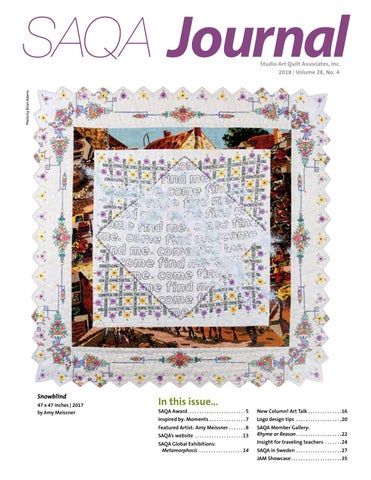
SAQA Journal Photo by Brian Adams
Studio Art Quilt Associates, Inc. 2018 | Volume 28, No. 4
Snowblind 47 x 47 inches | 2017 by Amy Meissner
In this issue… SAQA Award. . . . . . . . . . . . . . . . . . . . . . . . 5
New Column! Art Talk. . . . . . . . . . . . . . 16
Inspired by: Moments. . . . . . . . . . . . . . . 7
Logo design tips . . . . . . . . . . . . . . . . . . . 20
Featured Artist: Amy Meissner. . . . . . . 8 SAQA’s website . . . . . . . . . . . . . . . . . . . . 13
SAQA Member Gallery: Rhyme or Reason. . . . . . . . . . . . . . . . . . . 22
SAQA Global Exhibitions: Metamorphosis . . . . . . . . . . . . . . . . . . 14
SAQA in Sweden. . . . . . . . . . . . . . . . . . . 27
Insight for traveling teachers . . . . . . . 24 JAM Showcase. . . . . . . . . . . . . . . . . . . . . 35
A full width exquisite ombre is now available in Stonehenge! It is digitally printed to coordinate with each palette in Stonehenge Gradations. The ombre travels from dark to light, encompassing a variety of subtle textures in hues that will make your projects sing! Discover the infinite creative possibilities by using this beautiful ombre in your next art project! Visit www.northcott.com to view the entire collection and all of the coordinating patterns. Use the product finder tool to find a local quilt shop that carries these fabrics.
Good Vibrations • 93 ½” x 104 ¼” • Pattern includes 4 color options • by Patti Carey of Patti’s Patchwork
Thoughts from the president
Be a mentor to build a strong SAQA community by Lisa Walton
I
have spoken to many long-standing and new members recently to ask
what they want from SAQA. What a fascinating discussion! Everyone
trip that seemed to last forever! Upon
community. As artists, we often feel
has different needs and expecta-
arrival, I had to go straight to a func-
isolated and insecure. How wonderful
tions, creating a tricky balance. One
tion. I walked in the door, bedraggled
that we have SAQA!
universal note is the need to feel part
and exhausted, only to be enveloped
of our SAQA community. Within any
in a hug from a “stranger” who
One member benefit that fosters a strong connection is our Mentorship
community, there will always be the
Program. You can help further this
experts and the elders—those who
program by offering to be a men-
feel like they have seen and done
tor. You don’t have to be an expert
it all. Then there are the newcomers who look up to the experienced members with awe, reverence, and sometimes fear. Most of us find ourselves in the middle, looking for a way to move forward on the path to belonging. No matter at what stage we find ourselves, our passion for art quilts always brings us together. Have you
No matter at what stage we find ourselves, our passion for art quilts always brings us together.
to help others. We all have skills to share. Imagine how wonderful it would have been at the start of your creative journey for someone to have looked at your work more critically, taught you how to master social media, or guided you as you developed an exhibition proposal. So think about offering your skills as a mentor. It really doesn’t matter what you are able to do—there will be someone
noticed that when we gather, we
keen to have you guide them.*
instantly have something to talk
SAQA is here for everyone. We can’t
about? Whether we are at an exhibi-
looked familiar. I looked down at her
tion or a SAQA event, we relish this
name tag to read Yvonne Porcella! I
make everyone happy 100 percent
common ground.
immediately felt at home; I was part
of the time, but each of us can reach
of something much grander than I
out to one other person to build our
imagined possible.
community.
My most memorable such moment happened when I traveled from Australia to Alexandria, Virginia, for my first SAQA Conference. It was a
We all need experiences that bring us closer and make us part of our
*To learn more about becoming a mentor, visit saqa.com/mentorship.
SAQA Journal • 2018 | No. 4 •
3
Editor’s Notes
A personal issue for your consideration by Diane Howell
T
an abundance of works that revolves
ensure your signature is evident in
Brenda Wroe walks us through her
everything you do? So many ways!
experience as a first-time SAQA judge
want to share your techniques or
at an exhibition in Sweden. And
volunteer your time? Write a think
the basics of how to design a per-
Lyric Montgomery Kinard explores
piece for Art Talk? That would be my
sonal logo. Illustrating the points in
the motivations behind becoming a
first choice for you!
her article are branding images from
professional teacher in the first of a
The people you admire for their
SAQA members.
two-part series on the subject. Even
accomplishments put in long, hard
Susan Lenz, helping us debut a
our featured SAQA Global Exhibition,
hours to build a foundation from
new column called Art Talk, relates
Metamorphosis, takes on the mantle of
which to flourish. You can do that
how she took turned criticism into
rebirth. It’s like I planned it! (Let’s just
too. Successful writers work on a
an asset. Her creative reaction was
say I did, okay?)
schedule. They set the goal of writing
his issue is all about you and your art practice. How do you
Cheryl Sleboda walks you through
around the romantic allure of buttons.
What do you want to explore going forward? Do you want more exposure in the art-quilt medium? Do you
for a length of time or to produce a certain number of words and then they keep at it every day until a novel emerges. Successful visual artists work in the same way. They plan their time
Kathryn Pellman Word Salad 12 x 12 inches | 2017 Word Salad is a found poem that represents the endless chatter that surrounds us. It may or may not have rhyme or reason.
This piece is part of Member Gallery: Rhyme or Reason. You can see other selections on page 22.
and look for opportunities to exhibit, always working toward a goal. The artists who can respond to a call for entry with solid work are the ones who know where they want to go and have a schedule that supports their efforts. These are the same people who have solo shows and sell at large consumer shows. The secret is focusing on the details with an eye on the prize. It’s all up to you to decide what you want and how to get it. Enjoy the tips to help you on your way as we close out 2018 with this issue.
4
• SAQA Journal • 2018 | No. 4
SAQA Treasurer’s Report 2017 Financials In 2017, SAQA saw continued organizational growth. We ended the year with more than 3,500 members in 39 countries (21 percent were non-U.S. members). SAQA offered members even more exhibition opportunities in more countries as well as a wide variety of other programs regionally and globally.
Denise Roberts receives SAQA Award at Quilt Visions 2018
With the goal of running SAQA efficiently, the budget is reviewed quarterly by the Finance Committee and twice a year by the full SAQA Board. Our accountants then conduct a full audit each year. These numbers summarize the information filed in SAQA’s IRS Form 990 tax filing for 2017. SAQA would not exist without your support: membership dues, volunteer hours, artwork for auctions, and financial donations. Thank you for making SAQA so successful! Income Membership dues........................................$241,205 Donations..........................................................$208,872 Auction income ..............................................$77,530 Conference income ......................................$56,471 Exhibition fees ..................................................$48,850 Product sales and other income ...........$52,457 Investment income and Interest on savings accounts.......................$8,416 Income total................................... $693,801 Expenditures Member service.............................................$392,388 Administration................................................$170,262 Conference expenses...................................$82,175 Exhibition expenses.......................................$67,464 Expenditures total......................... $712,289 Bank/Investment Account Balances as of December 31, 2017 Checking...............................................................$63,264 Savings................................................................$135,098 Endowment investment account......$217,354 Total bank balances...................... $415,716 Respectfully submitted, Marvin Fletcher SAQA Treasurer
Finding Connections #6 84 x 41 inches | 2016
T
he SAQA Award has been awarded to Denise Roberts for her piece Finding Connections #6. Her art quilt was juried into Quilt Visions
2018: Connections, on display at the Visions Art Museum in San Diego, California, through Jan. 6, 2019. The award is presented to an artist whose work is compelling, dynamic, and progressive. The SAQA Award is given to one artist selected by jurors at each of three international exhibitions. In addition to Quilt Visions, a winner also is named by the jurors of Art Quilt Elements in Wayne, Pennsylvania, and Quilt National in Athens, Ohio. Winning artists receive a $500 prize and are given a one-year membership to SAQA if they are not already members. Roberts’ artist statement about her winning work states that “after years of creating complex work I have a desire to explore spare composition. I approached this series with curvilinear shapes in mind that would interact with one another to create new shapes in a spare manner. My primary focus is on beautiful spacing to find the tension of interplay between the figure/ground relationship.” SAQA Journal • 2018 | No. 4 •
5
Big Pink House, Sally Sellers
Help build our new home! Our website is our home. It connects and inspires us. But after ten years, we need a new home built on new technology. A new website will allow us to better: • Connect with our global community • Attract collectors, curators, and gallerists • Be the go-to source for the art quilt • Expand member access to resources
A gift to SAQA’s New Home campaign will build a new website for you! Please make a gift today at saqa.com/newhome 6
• SAQA Journal • 2018 | No. 4
moments
Inspired by
by N.K. Quan
H
ow do you tell the story of your life in a quilt? That was Misik Kim’s quandary when she designed The Story of My Life, a quilt inspired by day-to-day moments she has experienced. After many years of machine quilt work, Kim abandoned self-imposed boundaries of what a quilt is supposed to be in favor of abstraction and experimentation. Her cotton hand-dyed quilt comprises a series of squares surrounded by a grey border. However, what seems visually simple is surprisingly complex. Each square is surrounded by lines, some straight, some squiggly. The pieces range from colorful to neutral, some repeating squares within squares, some completely empty. The grey border alternates from vertical to horizontal bands of varying widths that impose a yin and yang effect, setting up a sense of struggle. “I thought about the memories and the paths I took during my life. As each day is different, each piece of the quilt is different. Every piece is different in shape, color, and detail. They are a reflection of the days of my life story, the good, bad, and mundane.”
Misik Kim The Story of My Life 52 x 53 inches
When constructing earlier quilts, Kim noticed that where the seams of each piece meet, they create their own beautiful designs. Why should seams always be folded backward and hidden between the top and back layer? What would happen if she didn’t follow this rule? So Kim decided to construct the quilt in a different manner. “First I made each piece with three layers, as if I were making a whole quilt,” Kim says. “Then I assembled the pieces. The seams of the neighboring pieces were put together to be seen on the top so that when you look at the quilt from the side,
each block has six layers of seams. [This approach] creates a harmony of colors and shapes all its own.” In terms of color, Kim prefers to use her own hand-dyed fabrics. She finds that commercial fabrics cannot adequately express her feelings about everyday life. In addition, the use of custom colors is a way to differentiate a quilt from other artists’ quilts. Kim is a SAQA JAM and has been a professional fiber artist since the mid-1980s. She is SAQA’s South Korean regional representative. N.K. Quan is a Phoenix-based writer and editor. SAQA Journal • 2018 | No. 4 •
7
Amy Meissner
Beautiful contemporary art carries ‘terrible undertones’ by Cindy Grisdela All photos by Brian Adams
Southern view of Inheritance: makers. memory. myth. at the Anchorage Museum at Rasmuson Center in summer 2018.
A
my Meissner creates power-
quilt. Her son’s nine-word question is
ful art from vintage textiles.
repeated as many times, with a differ-
From her home in Anchorage, Alaska,
ent word highlighted in each repeti-
she gathers table linens, doilies,
tion. The result is a tenth iteration
handkerchiefs, and old clothing—all
viewed as a cascade (page 12).
discarded or “saved” for a future use—and gives them a new, contem-
Anchorage Museum and is now in its
porary life.
permanent collection. The validation
Her first quilt, Spontaneous Combus-
offered by that purchase was “a huge
tion, was made in 2006 in response to
catalyst for me,” Meissner says. Since
an accidental fire in her home. The
that time, she has received two Ras-
fire was caused by her then-four-year-
muson Foundation Individual Artist
old son putting a penny into a night-
Awards, a Sustainable Arts Foundation
light socket. Her frightened child kept
Individual Award, and her work has
asking, “Mama, what in this house
been accepted into Quilt National.
can catch on fire?” because he didn’t
SAQA JAM Amy Meissner at home in her studio.
8
• SAQA Journal • 2018 | No. 4
The piece was purchased by the
Meissner has a long relationship
understand what had happened.
with fiber and art. She learned to cro-
Exhausted from answering the ques-
chet, embroider, and sew before she
tion over and over, she finally asked
was six years old, thanks to her Swed-
him what exactly he wanted to know.
ish heritage on her mother’s side. As
After she explained the concept of
an adult, she created custom wedding
spontaneous combustion, he never
gowns, illustrated children’s books in
asked again. To process for herself
watercolor, and did creative writing.
what had happened, she cut up all
When she became a mother, she
her inherited family cloth-—without
shifted her thinking on where she
telling her mother—and made the
needed to go as an artist. So she
Lamb 43 x 13 inches | 2018
returned to the creative fiber work she
created this work in response to her
had been taught as a child because it
four-year ordeal with postpartum
could be done with the children right
depression. She had a collection of
there. “Being an artist and a mother
beautiful crocheted flowers from her
is something I very much draw from
grandmother and wasn’t sure what
in order to create the work that I do,”
to do with them. They were so “sac-
Meissner says.
charine and decorative.” It wasn’t
She didn’t have to learn anything
until she began thinking about them
new about technique or construc-
as a landscape that she wondered
tion with fabric, so she had complete
what the descent of something ter-
freedom to explore the concepts that
rible onto that landscape would look
interested her. Fiber offered another
like. This led her to ask: “What does
huge plus. Nobody was going to
postpartum depression look like as an
dump her watercolor paint or scribble
emotional landscape?”
on drawings that needed to be submitted to an editor, she says. Meissner uses decorative materials
39.5 x 142 inches | 2011
Descent was exhibited at the Anchorage Museum as part of Meissner’s Inheritance: makers. memory.
to create her fiber art, but her work
myth. project. The museum made a
is anything but decorative. Descent
light table for the piece so light could
(page 12) is a good example. In this
shine through its center. “It’s stunning
piece from 2017, a dark black shape
and it makes me happy to see it.”
hovers over a field of crocheted pastel
Iron
The Inheritance project began in
flowers. The space beneath the dark
2015 when someone sent Meissner a
shape is also blackened. Meissner
mystery box full of linens and vintage
War Room, detail Part of Inheritance: makers. memories. myth.
SAQA Journal • 2018 | No. 4 •
9
River, detail
clothing. For the next three years, she
and other household linens, plus
collected more handmade, hand-
parts of an abandoned quilt. Meissner
embroidered cloth of all types, even-
machine stitched open mouths into
tually amassing more than 650 items
the centers of some of the doilies and
along with their stories. The body of
potholders.
work she created was exhibited earlier
River 21 feet x 36.5 inches | 2018
quilter of any stripe. Though she uses
Some artists would have felt con-
quilting techniques, it’s important to
strained by the idea of deconstructing
her to think about why she uses cloth
and repurposing so many textiles that
as her medium. To use cloth to create
represented so many hours of work
art that addresses women makes sense
by largely unknown women. Meiss-
because it “adds another layer of
ner looked at it differently. Although
power” to the work, she says. Because
it saddens her that more than 90
Meissner prefers to tackle uncomfort-
percent of the makers are unknown,
able topics, deconstructed textiles
she finds immense freedom in the
offer a softness and vulnerability
confines of old cloth. Most of the tex-
that people can relate to. The materi-
tiles were intended for decoration—
als help draw people into difficult
on a table, as a curtain, or a piece of
discussions in a way that painting,
clothing—but they were discarded,
for example, could not. She wants
damaged, or simply outlived their
her art to be “technically as good as
makers. “The emotional residue that
I can make it and beautiful, but with
is left behind on women’s handwork
terrible undertones.”
and I want to give it another life.” To push the limits of possibility,
77 x 24 x 24 inches | 2018
10
• SAQA Journal • 2018 | No. 4
Meissner doesn’t consider herself a
this year at the Anchorage Museum.
is really inspiring to me. It’s had a life
Birth Rope, detail
River, detail
Meissner works both by hand and by machine, depending on what she believes the piece calls for. Most of
she sometimes cuts up the items
her piecing is done on an old Pfaff
beyond recognition. Sometimes she
sewing machine that she received as
works with the textiles as they come
a gift from her mother in 1994. She
to her, as she did in Hysteria (page 11)
recently invested in an industrial
from 2018. This piece is an amalga-
machine that made short work of the
mation of vintage potholders, doilies,
potholders in Hysteria. Embroidery,
Hysteria 85 x 95 inches | 2018
crochet, and other tasks that need to be “soft and drapey” are done by hand. A typical day in Meissner’s studio depends on the season. In the winter, she begins her day at 5 a.m., often exercising on the elliptical or bike while she takes care of studio-related tasks. She tries to be in the studio every day, even if only for a few minutes, while her children are in school. In the summer, there is a lot of daylight and everyone in the family feels a need to be outside after the cold, dark winter. Meissner schedules more portable handwork in the summertime that can go where she goes. The family travels to Prince William
Birth Rope, detail
Sound most weekends, a trip that is an hour by car and two more hours by boat. One of the activities which SAQA Journal • 2018 | No. 4 •
11
they do there is to clear the beaches of trash that washes up on the shore. Meissner grew up on the West Coast of the United States, but she has lived in Alaska for 18 years. “Living in Alaska shapes a person,” she observes. Anything is available online now, but there is a cost. Much of the trash they pick up relates to shipping. It’s one of the reasons that working with new materials and fabrics does not appeal to her, with the exception of batting. She doesn’t really have a strategy for sales or teaching. Her primary goal for her work is to show it and spark conversation. Sales are not her driving force. Sometimes she creates 16-inchsquare pieces on cradled board that sell at her solo shows to “certain edgy collectors.” As far as teaching, she has put that on a back burner until her children are older. “It’s a lot of travel and time away from home, and I’m the kids’ primary caregiver, so I don’t want to miss out on that.” What is next on the horizon for Meissner? She is interested in “explor-
Spontaneous Combustion 77 x 54 inches | 2013
ing birth and mythological tools that would be associated with giving birth,” she says. This doesn’t mean literal tools like birthing chairs or forceps, but more the intrinsic tools a woman draws on when she gives birth. Birth Rope (page 10), 2018, is one of these pieces. The piece began with a section of discarded marine rope, and she built on that with silk organza and vintage doilies. It is intended to be suspended. “The rope is a relic—possibly a midwifery tool or the aftermath of trauma—symbolic of a literal and emotional unmoored state,” she says in the artist statement for the piece. It is both “beautiful and terrible.”
Descent 20 x 9 x 9 inches | 2017
12
• SAQA Journal • 2018 | No. 4
Cindy Grisdela is a SAQA JAM who resides in Reston, Virginia. To see her work, visit cindygrisdela.com.
Big Pink House, Sally Sellers
Help SAQA build a new home by Allison Reker
H
ome renovation shows are popular these days, thanks to tele-
SAQA’s website, at one time a mod-
we want to keep. In the final phase,
ern, up-to-date site, has outlived its
everything will need to be checked
vision networks like HGTV and DIY.
ability to provide what our members
for errors, tested, tweaked, then tested
There’s something satisfying about
need. Technology has advanced con-
and tweaked again.
watching contractors and designers
siderably in recent years, but because
take a broken down, dysfunctional
of our antiquated website platform,
do alone. It’s somewhat easy to go
house, and turn it into a glamorous
we have not been able to take advan-
through the existing website and
masterpiece that would be an abso-
tage of myriad innovative applica-
point out what we don’t like and
lute dream to live in. Though we get
tions available to us.
what doesn’t work. Coming up with
to watch the progress—disasters and
It’s time to make some significant
This is a renovation that we can’t
a sound, realistic vision that will take
triumphs alike—in neat, one-hour
changes. You have told us that you
us into the future is more compli-
increments, the reality is that quality
want a SAQA website that is viewable
cated, particularly because technol-
renovations take serious planning,
from all of your devices—and one
ogy—and our needs—are constantly
and a huge commitment of time and
that is easy to search.
changing.
resources. SAQA doesn’t have a brick and
We are imagining so much more.
We’d like to invite you to be part of
Imagine a new SAQA website that
the process, from the initial planning
mortar home like many other busi-
connects all of us, from Paris to Peo-
through beta testing regardless of
nesses and organizations. We’re
ria, from Auckland to Akron. What
whether or not you consider yourself
largely virtual, with members, board,
if we could connect personally with
tech-savvy. Take this opportunity to
volunteers, and staff reaching from
other artists, collectors, or curators?
let the website committee know what
one end of the globe to the other. Our
The truth is, we don’t even know the
you want most in a new website. Is
family home, the one place where we
full range of possibilities for our new
there something positive about the
can all go to connect, is our website.
website.
current site that you don’t want to
It is where we go to be inspired—to
Renovating a website is not as
lose in the new design? What kind
learn more about art quilts, and to get
glamorous as a televised home
of information do you search for the
news about what’s going on within
makeover, but it’s just as expensive
most? What do you wish our site
our organization at the global and
and time-consuming. Even though
could do that you’ve seen imple-
regional levels. It is full of valuable
we began to lay the groundwork in
mented well on other websites?
resources, including directories, calen-
August, the projected completion
dars, SAQA Journal articles, webinars,
date for the new website is not until
website by going to www.saqa.com/
information about all of our exhibi-
the summer of 2020. The process
website to share your thoughts and
tions, galleries of beautiful artwork to
requires a succession of steps. We
let us know what you think.
peruse, and much more. The website
must first secure funding and bid out
is also quite often the face of SAQA
contractors as well as figure out what
to those who are getting to know us,
we need and want. Not all of the
such as potential new members, col-
work is technological. A solid struc-
lectors, museums, and sponsors. First
ture needs to display well-organized
impressions are key. What image do
content that features fresh images,
we present, and how user-friendly is
new written material, and updates to
our online home?
calendars and other existing features
You can help shape SAQA’s future
Allison Reker is SAQA’s membership coordinator and catalog editor. She is also the author of four books of fiction and a freelance editor for various publications. She resides in Beavercreek, Ohio.
SAQA Journal • 2018 | No. 4 •
13
Selections from
Metamorphosis Metamorphosis examines transformative change in shape, nature, or structure. Animals physically develop and change from birth to maturity. Concepts and ideas morph and change over time. Even the earth’s landscape progresses through many geological and ecological stages. Change may be positive, negative, frightening, or enlightening. The pieces in this eponymous exhibition demonstrate the inevitability of change—physical, philosophical or personal—and the results of such transformations, no matter how subtle. The juror was David Hornung, a painter who lives and works in Queens, New York. He is currently a professor of art at Adelphi University in New York. Metamorphosis was featured at International Quilt Festival/ Houston in November and will be at International Quilt Festival/ Chicago March 28-30, 2019. Watch saqa.com/metamorphosis for additional venues and dates.
Bella Kaplan Philodendron 47 x 36 inches | 2018 Photo by Dror Miller
Diana M. Bailey Fragmenting Circles 36 x 24.5 inches | 2017 Photo by Vaughn Sills
Sandra Champion Sea Wall Secheron Bay #2 36 x 47 inches | 2018 Photo by Bruce Champion
14
• SAQA Journal • 2018 | No. 4
Michele Makinen Turmoil: Recovering From Trauma 39 x 39 inches | 2016
Orit Modiano
Photo by Chris Cassidy
The Burning Bush 40 x 29.5 inches | 2017 Photo by Yaron Weinberg
Helen Geglio Boro Shape Shifting 1 36 x 33 inches | 2014
Maggie Vanderweit The Mystery of Thought 43 x 44 inches | 2016
SAQA Journal • 2018 | No. 4 •
15
Art talk
Let critical comments spur creativity by Susan Lenz
I
cannot remember a time in my life when I didn’t suffer from low
self-esteem. I know there are many people who don’t believe the statement above. They think that because I create a lot
Romantic Buttons III
of art, have gallery representation,
20 x 16, matted | 2017
teach workshops, and enjoy solo shows that I must be full of selfconfidence. They think I don’t have to deal with rejection and can let
Button Show. I referenced my own
I had a decision to make. I could
criticism roll off my back like water
TEDx talk too. Best of all, the pro-
believe it, cry over it, dismiss it, or
on a duck.
posal had already been accepted by
even use it to my own advantage. I
They are wrong!
Homestead National Monument of
elected the last option.
It’s not easy to receive negative
America in Beatrice, Nebraska, for a
feedback cloaked as critical analysis.
residency later in that year.
You romanticize your materials. The more I thought about it, the
Reading the unfavorable reac-
more I knew this statement was
administrator wrote: “You romanti-
tion stung. I could have ignored it.
and will remain absolutely true.
cize your materials. You don’t push
I could have written a flaming blog
I do romanticize buttons. I rely
the boundaries of your studio art
post or shared my experience on a
on the fact that viewers identify
practice.” This was in response to
private online group where sympa-
with objects from the past. Much
an art residency proposal in which
thies would have flowed toward me.
of my work depends on a sense of
I outlined plans for my enormous
I could have hurled insults on Face-
nostalgia to communicate themes
stash of vintage buttons. My plan
book. But I didn’t. Because I suffer
of loss, remembrance, and mortal-
was to transform buttons into signifi-
from low self-esteem, I wallowed in
ity. Buttons speak the language I
ers of class, politics, race, beauty, and
self-pity for almost two days until
need. The more I thought about
personal narratives. The art quilts I
common sense interfered.
expressive vocabulary, the more my
It hurt in May 2017 when a local arts
intended to make would express the
Logically, I knew my creative
mind put buttons together with
accumulated memory inherent in
reputation and the nepotism in
all sorts of romance, including sex.
these seemingly insignificant objects.
my town’s arts community. I knew
Soon, images of naughty Victo-
My proposal cited New York City
the comment’s pessimism was
rian women were fused to fabric.
curator Peter “Souleo” Wright’s state-
intentional, even cruel. Yet, it was
I added suggestive phrases, a few
ment for a 2016 exhibition called The
disguised as constructive criticism.
lines of free-motion stitching, and
16
• SAQA Journal • 2018 | No. 4
buttons. Three pieces immediately sold. Undoubtedly, this was emotional, sweet revenge. I had seriously considered the criticism and simply decided the statement wasn’t a flaw but an asset. You don’t push the boundaries of your studio art practice. This was a harder pill to swallow. In Columbia, South Carolina, I am considered quite inventive, even cutting-edge. Outside the city limits is another matter. I thought about art-
A Life in Buttons
ists whose careers I admire, artists like
3 x 8.5 x 5 inches | 2017
Sonya Clark. Her The Comb Series is an investigation into the cultural, racial, and personal meanings associated
Women Were) To Be Seen and Not
with an ordinary plastic comb and
Heard. Five glass spice jars were filled
with hair. She pushes the boundaries
with carefully selected buttons for a
in ways I haven’t. There was only one
three-dimensional piece called A Life
thing I could do: push harder!
in Buttons.
To do this, I brainstormed, think-
The more button art I made, the
ing about alternative uses for but-
more ideas came. I remembered
tons, unique ways to display them,
having a well-used police practice
and the various kinds of buttons,
target sheet. Bullseyes, buttons, and
from clothing fasteners to flashing
a human target came together rather
red objects depicted in movies for
quickly as Ready, Aim, Fire! During
launching nuclear missiles. I thought
the process, I found the SAQA call for
about different ways to challenge this
entry for Guns: Loaded Conversations. I
traditional object for contemporary
entered the piece and it was accepted.
meaning. Soon, all sorts of ideas came
Then, I got an interesting email from
to mind.
Dot Moye, an Atlanta-based curator.
A manual typewriter and an old
She requested the piece for a show
flip phone were covered in buttons.
called Transformers: Artistic Alchemy
Antique photogravures from the
at Agnes Scott College in Decatur,
World’s Columbian Exposition in
Georgia. Because the work was not
1893 were fused to fabric and altered
available, I wrote back asking if she
with buttons. Crowd-sourced snap-
might consider me making another
shots of people’s mouths became
one. That’s how Ready, Aim, Fire! II
His Secrets, Her Secrets and Silence is
(aka Second Shot) came into existence.
Golden. More than eighty antique
I was quite excited to drop off my
engravings of idealized women were
piece. It gave me a chance to see most
carefully dissected and glued together.
of the other work in the invitational
Ready, Aim, Fire! II 42 x 26 inches, framed | 2018
Tiny buttons were stitched over every mouth in the creation of (When
see “Critical comments” on page 30 SAQA Journal • 2018 | No. 4 •
17
INNOVATECH™ is available in 60 of the most popular color choices, and can be purchased in 3000 or 6000-yard cones. Contact an Innova® dealer near you to buy INNOVATECH™ quilting thread. ABM International is known for its innovative and cutting-edge technology and products. We constantly strive to stay ahead of the curve; to be at the forefront of major advancements in the quilting industry.
Use the only thread designed specifically for use on a longarm quilting machine BY THE PEOPLE WHO KNOW longarm quilting machines.
Innova longarm quilting machines are manufactured by ABM International, a three generation family owned and operated business near Houston, Texas. The Innova® has been engineered to meet the most discerning quilter’s needs. Based on a long term commitment to excellence, ABM International offers a full array of high quality quilting machinery. As such, Innova has been working for some time now to develop a unique, superiorquality thread. After much research and development, Innova is pleased to introduce INNOVATECH™ Quilting Thread. After its debut at the 2017 International Quilt Market and Festival in Houston, it has been flying off our dealers’ shelves! INNOVATECH™ is an exclusive thread engineered specifically for longarm quilting. It is a tex 27, 40-weight poly wrapped poly, and its sleek design and beautiful finish allow for maximum efficiency while providing superior visual appeal. One customer even claims, “It runs like melted butter.”
Built To Quilt® Contact a local Innova Dealer for special offers on the only longarm machine that’s “Built to Quilt®” www.innovalongarm.com
Innova Gives Back One of the major aims of ABM International is its corporate responsibility – not only to the entire quilting community, but its local community as well. Innova has always strived to make it a top priority to give back to the community and those in need. Comfort quilts are made and donated with love and generosity, and that comes through to those individuals who receive them at times that are often the most difficult. Comfort quilts represent the sheer goodness of complete strangers. They illustrate the goodwill and caring attitudes of people who want nothing more than to help their fellow man. It is a labor of love for the giver, and, for the receiver, a source of comfort and positive reminder of the world’s goodness.
Hurricane Harvey Comfort Quilts With the recent storms that devastated the gulf coast region this past summer, Innova has been involved in quilt drives whose goal is to get comfort quilts into the hands of the hurricane victims, specifically those devastated and/or still displaced by Hurricane Harvey. Innova’s factory and main office are located just north of Houston, so it is perfectly situated to act as a shipping destination for comfort quilts sent to them by quilters from all over the country. Innova, in turn, has been organizing quilt donations to those in most need of these beautiful quilts, and it has been a huge success.
Las Vegas Comfort Quilts Within just weeks of the devastating hurricanes that hit Houston and surrounding areas, the Las Vegas Massacre occurred. On his recent trip to Nevada, ABM Innova’s president, Neal Schwarzberger, met Chantal McCrorie, an attendee at the concert during the shooting. She shared with him her story, and he knew Innova needed to do something to help the victims and their families. So again, calling upon what seems like a never-ending supply of generosity from the quilting community in this country, Innova sent more donated comfort quilts to McCrorie, and she has been distributing each quilt individually to victims most in need of healing from this horrible tragedy. McCrorie says it has been immensely therapeutic for her and has done wonders in her own emotional healing to be a part of something like this.
I gotta be
me!
Create a logo for your personal brand by Cheryl Sleboda
F
or many businesses, a logo is
when you arrive! This also means
a motif you frequently return to. If
necessary for identity online and
that if you change your appearance
your quilts are mostly about chairs,
in advertising. How do you go about
drastically, you need to update your
a chair should appear in your logo.
creating a great logo for your personal
headshot. Alternatively, you can use
If you wrote the book on a particular
brand?
a drawing or caricature of yourself if
style, that style should be part of your
you have an iconic look.
logo. A good case study is the late
First, think about how the public “sees” you. Are you the face of your
If you have a particular, recogniz-
Thomas Kinkade. He trademarked the
studio, or is your artwork the focus?
able style, your own artwork is an
phrase Painter of Light™. His logo
Many artists are their businesses.
option for your logo. You will need to
included his studio’s name, Thomas
Facial recognition connects them
decide if you want an entire artwork
Kinkade Studios, and a lit lantern.
with their marketplace whether they
or just a detail shot to be used. Keep
Often this graphic would be overlaid
teach, sell work, or write about art.
in mind that as you advertise your
on a painting, allowing the artwork
For other artists, their artwork is more
business, you will reproduce that
to be part of the logo.
iconic. This distinction is an impor-
artwork in many forms, and it needs
tant consideration in logo design.
to have the flexibility to do that. You
Another factor is whether you plan
can include text over the artwork so
DIY or not? As creatives, we sometimes think
to sell items other than artwork. If
that people can find your website or
that we can save a few dollars and
you plan to publish patterns, books,
studio name.
design our own logos. There are a
or tools, it is probably a good idea to create a logo up front to save yourself the possible need to rebrand later.
Graphic logos If you want to market your per-
few pitfalls to avoid here. A logo can easily be overdesigned to the point of being unreadable. Also, a good logo
You also need to consider the name
sonal brand in more ways, or find
needs to work in either color or black
of your brand; whether you market
your brand growing quickly into
and white; you never know how
yourself under your own name or a
many branches of products and
another company may use it to adver-
studio brand affects your logo’s look
services, then a graphic logo may be
tise you or your work.
as well.
for you. If your appearance or artwork
If you want to design your own
changes often, this may be the way to
logo, there are many online and free
establish your brand identity.
logo design services that allow you to
Photo vs. artwork For many artists, a quality headshot
The choices for using a graphic
is an acceptable way to represent your
or text are so wide open, it can be
be sure of is that you are using copy-
brand. Getting a headshot taken does
paralyzing. There are unlimited pos-
right- and royalty-free materials in
indeed cost money, but it’s worth it.
sibilities in colors and fonts to choose
your designs. You do not want to be
Selfies are not what you want on your
from. When designing, it’s probably
on the other end of a lawsuit because
marketing materials or submission
a good idea to include relatable items
the free logo designer you used did
forms. It’s important to keep your
to make it clear what you do. For
not have permission for a design ele-
headshot updated as well. You do not
example, if you use paint in mak-
ment. A service such as Canva [canva.
want to be the speaker who sent a
ing your quilts, perhaps including
com] can help you design a basic
headshot from fifteen years ago, only
a paintbrush will help solidify what
logo. The company’s site has many
to have organizers not recognize you
you do. Another option is to include
examples and a wide array of clip
20
• SAQA Journal • 2018 | No. 4
do some graphic design. One thing to
SAQA members’ logos feature varied design options Iconic style Lyric Montgomery Kinard’s logomark brings her recognizable style to life. Her caricature is one she drew herself.
In character
art elements or licensable designs to
Paula Kovarik has a couple of different approaches to branding. One is a detail shot of her piece Round and Round It Goes. The other is a character—a very clever bird—who turns a thread into a representation of her quilting style. While not a true logo, the little bird has the honor of making the occasional appearance on her quilts, so he’s earned his place on her business cards.
incorporate in your design. A professional graphic designer may be the best option, however. A good designer will take the elements of your brand, color choices, and artwork and create design options for
Graphic tales
you to review. A really good graphic
Linda Colsh, B. J. Adams, and Louise Hall opted for a strong graphic element for their personal logos. All incorporate their name, although that element is not always included in use.
artist will be able to surprise you with insight about your business and the addition of an element you never expected. We are often too close to our own work to see what it really is.
Off and running Once you have developed your brand’s logo, it’s time to use that identity in your marketing. Your logo should appear on your social media accounts as the profile image. This
Word pictures Sandi Colwell, Lisa Reber, Karol Kusmaul, and Sarah J. Aubry took an illustrative approach to their logos. Colwell’s logo is very much in keeping with the style of her pattern designs. Reber’s Dippy Dyes logo was designed by Brian Boehm. Kusmaul carved the stamp for her logomark. Its design includes stitching and her initial to form the word OK; it also reflects the fact that she likes to wear overalls. Aubry’s Cloud Hill Studio logo is a stylized version of the view from her studio windows.
placement lets your customers know they are on your company’s official pages. Your logo should be included on your merchandise, letterhead, and even as part of your email signature. Your logo helps establish your identity in the market, so develop a
Name ID Maggie Dillon and Jayne Bentley Gaskins use artistic signatures to mark their brands.
good one! Cheryl Sleboda is an award-winning fiber artist, costumer, and quilter who owns Muppin.com and SewMuchCosplay. com. Cheryl travels and teaches sewing and quilting nationally. She also teaches business management and more to entrepreneurs in the fiber arts industry, including the online course, Building up your Branding. She has been featured in many magazines and has a DVD titled Heirloom Sewing Techniques for Today’s Quilter.
Defining elements Barb Gardner, Mel Beach, and Nanette S. Zeller combine name recognition with illustrations for their logos. Zeller’s uses artistic tools to emphasize what she does. Beach’s emphasizes her straightforward style. Gardner’s plays off her name.
SAQA Journal • 2018 | No. 4 •
21
SAQA Member Gallery: Rhyme or Reason
Cathy Perlmutter Rhymes & Reasons 15 x 15 inches | 2018 Each of the 100 objects on this quilt rhymes with at least one other object.
Erika Carter Subterranean Efflorescence III: Love and Peace 42 x 45 inches | 2017 This series explores the images created by my inner child with artist’s tools.
Cheryl Olson Ananda at Last 36 x 40 inches | 2017 The forest symbolizes life, wisdom, protection, strength and growth; it brings me inspiration, harmony, unity, and peace.
22
• SAQA Journal • 2018 | No. 4
Clara Nartey Rhythm #1: Dancing 22 x 48 inches | 2015 My Rhythm series explores our experience with sounds and music. The design started with a shofar horn and incorporated techniques that create a sense of rhythm.
Susie Monday Jazz, 3 27 x 35.5 inches | 2016 Part of a series based on iPad doodles made at a jazz club. The repetition of shapes is analogous to rhyme and meter in the written word.
Sara Sharp Words Can Hurt 48 x 32 inches | 2017 Our politicians and public figures increasingly use insulting words to threaten, bully, humiliate, and spread falsehoods about those with less power and status. Anger and conflict are the result.
Lucy Autrey Wilson Florida Spoonbill 85.5 x 80 inches | 2016 On a trip to Florida I hoped to see a Spoonbill. It didn’t happen. So I created one with appliqué.
SAQA Journal • 2018 | No. 4 •
23
Teaching: Part 1 in a series
For love or money Tips to build a career as a teacher on the go by Lyric Montgomery Kinard
A
traveling quilt teacher enjoys a soul-feeding
the skill and experience to help students overcome
profession. To join this collegial club, plan
difficulties. You also have to have the ability to
your approach so you streamline the process and
think ahead about each student’s progress and help
avoid pitfalls. In this first of two articles on the sub-
them avoid stumbling blocks.
ject, I’ll explore motivation, potential class offerings, and practical tips to navigate the field.
to share your ideas. Students are there to learn
There are as many reasons to teach as there are
from you. The very best teachers don’t hold back
teachers. Four main reasons are: earning income,
information. Copyright covers your publications,
enjoying travel, meeting new people, and sharing
but it’s a good idea to gently remind students that
your knowledge. Understanding your motivation
it is unethical to copy and share your handouts
lets you develop your style. Here is a rundown of
and patterns. There are easy ways to protect your
each factor and tips to consider.
publications, such as watermarking handouts or
Money matters
patterns. Think honestly about how you best interact
Do you need the money? Teaching is not one of
with people. If you are an extrovert, develop
the better-paying professions. For every day you
entertaining lectures and work with structured
teach, you spend many days running your busi-
group activities. If you are an introvert, you may
ness. If you need to support yourself, learn to
focus on courses that provide individual attention.
maximize your profits and still offer a wonderful
Both personalities make wonderful teachers, and
experience. You will need to gain serious marketing
both will need to be patient with a wide variety
skills plus have the stamina and organization to
of people. Talk to other quilt teachers. When they
regularly work back-to-back gigs.
share their “most difficult student ever” story, ask
If teaching will be a pleasant side hustle, you
how they handled the scenario. Also, watch teach-
may be more concerned with guarding your time.
ers in action. Put yourself in situations where you
Estimate how much time you want to devote and
must diplomatically help someone with a difficult
know your limits. Many teachers overbook them-
personality.
selves, get burnt out, but still have obligations
Know that a teacher is always “on.” You are edu-
a year or two into the future. Also, make sure to
cating and entertaining. Students expect you to be
reserve time for family events as well as to create
as wonderful, enthusiastic, and generous in the hall
your own work.
as you are in class. I include a note in my hostess
Caring to share
24
Remember, the primary goal of teaching is
instructions that I need to be in my room alone by a certain hour so I can wind down and rest.
If you want to share, evaluate your technical skill
Nobody has ever been offended by this request,
level. You don’t have to be perfect, but you need
and it has allowed for graceful retreats.
• SAQA Journal • 2018 | No. 4
If you love teaching projects, do you have
Do you love to travel? Can you manage long drives or dragging luggage through multiple airports? Your physical strength and stamina may determine the supplies you bring to a workshop. You are likely to arrive at your destination after staying up late the night before to pack and getting up ridiculously early that morning to catch your flight. Many times the women who escort you are elderly and cannot
patterns to teach your favorite techniques? Many larger conferences want fresh classes every year. Developing new patterns is a way to accomplish this. If you teach a standard technique, this is a fabulous way to make your classes your own. Think again about how much stuff you want to transport. Do you want to bring everything? I guarantee every class will have at least one student who brings the wrong materials
help with luggage. Once you are in the car, you might be whisked off to dinner, followed straightaway by an evening lecture. A late night with a talkative hostess could follow. Then by morning you need to be ready for a full day of teaching. There isn’t always time
and you must be prepared
Understanding your motivation lets you develop your style.
sightseeing, especially if you cram in a full schedule of gigs. Even so, I find that when I can schedule an extra day, someone is always willing to show me the best of their
for that. Are the supplies you use easily accessible or hard to find? Not every student will have access to a quilt shop. I use a lot of art supplies so I bring almost everything. They love the short supply list, and I have yet to hear a complaint about the supply fee. But if
in your schedule for
you use materials that most quilters have on hand, have the students bring everything. Be aware that if you teach sewing classes, you
hometown.
will need to help with every kind of machine. It
Lesson plans
know how to operate their machine or if one
Do you have something unique, interesting, or
breaks down.
popular to offer? I believe there is rarely anything new, but I don’t let that stop me from sharing. You might do something in an unusual way, or you might be adept at a technique that has high interest. Do you want to teach projects or processes? You can focus on one or do both at the same time. You don’t have to be the only teacher in the world covering your subject, but you cannot copy the work or technique of another teacher. Do you mind teaching what you do over and over and over? Students have a sixth sense for knowing when a teacher is disinterested. If you are easily bored, figure out how to make your class interesting to teach repeatedly.
Photo illustration by Lyric Montgomery Kinard
Going places
slows down a class when one student does not
Practice makes perfect After you choose your classes, hone your teaching skills. Creating and teaching are two different skills. You must communicate clearly and present your material in an organized fashion. Every student has a different learning style, and you need to understand how to reach as many as possible with your presentation style. Develop your class structure first. Write out detailed steps and practice saying them aloud. Write down every supply used, how much time it takes you (triple the total for beginning students), if the class lends itself to kits, and how much space each student needs. Determine if you need to
SAQA Journal • 2018 | No. 4 •
25
charge a supply fee. These notes form the first draft
how they get their ideas across and watch how they
of your presentation and course particulars; they
interact with students. You are not copying their
are also a starting point for clear handouts.
content, but you are learning what will and will
Next, I create a detailed outline for myself. It
not work for your teaching style. Never be afraid to
includes what step I will teach when and lists
ask questions. I find that quilting teachers are some
equipment, supplies, and techniques to be covered
of the most generous people I’ve met.
in each segment. If you teach handwork, consider a screen and projector to display live demonstrations.
Marketing savvy
If you teach surface design, do you need access to
Once you are confident, spread the word. Use every
water or hard flooring? No matter how neat you
avenue available to promote yourself. It is almost
are, someone will spill paint and you will be left to
impossible to be successful without a website.
clean up. It’s just part of the job.
Both guilds and students will appreciate an easily
Once you have an outline, find students to do
accessible site with clear descriptions and photos
a practice run. Select friends with a range of skill
of each class, an easy way to contact you, and as
levels and interests who will provide reliable and
much hiring information as you are comfortable
honest feedback. If you
sharing. I am a proponent
can teach a timid beginner
of putting it all out there. It
and capture the interest of
saves hiring entities asking
a confident rule-breaker at the same time, you are getting somewhere. Every time you teach, ask for feedback. I call this “suggestions for improvement” and I ask specific questions, such as, “What supplies would you rather the teacher bring?” or, “What technique needed more or less time?” Watch for local opportunities to teach. Art centers, senior centers, and youth
Never be afraid to ask questions. I find that quilting teachers are some of the most generous people I’ve met.
programs are great places for beginners. Your local guild would probably jump at the chance for an informal workshop as you develop your skills. If you start at a local quilt shop, make sure you
basic questions about dates, pricing, and supplies, and it saves you responding to those questions. Make sure you offer a consistent, informative email newsletter and that your website has a way to subscribe to it. Your students want to get to know you and your art. They are more likely to take or request your class if they feel they know you. Blogs are not dead and are a good way to share your story. Use whatever social
media you have to get the word out. To expand your teaching opportunities, take part in statewide guild meetings, give a demo at the International Quilt Festival, and send printed
establish a win-win arrangement. You need the
brochures or emails to groups you want to teach
experience, but the shop needs to pay the rent.
for. My favorite way to advertise is to write articles
Come prepared to help bring in new customers and
for magazines. They have a broad circulation and
make sure your class uses supplies the shop offers.
you get paid for your effort. Just keep in mind the
You can request the shop order supplies if it doesn’t
magazine then owns the article and you cannot use
normally carry them.
those exact words or illustrations as handouts for
I strongly suggest you take classes from teachers
your own class without permission.
with a good reputation. Take notes on how they organize their time and supplies. Listen closely to
26
• SAQA Journal • 2018 | No. 4
see “Love or money” on page 33
First-time SAQA judge travels to Sweden by Brenda Wroe
I
recently responded to a request in the SAQA
nine quilts were exhibited at the Vänermuseet
Europe/Middle East newsletter for judges for the
through September.
Swedish Guild’s 11th Träffpunkt Quiltköping. This
I was also asked to be one of judges in the tra-
three-day event took place August 31-September
ditional and modern categories. That request was
2, 2018, at Vänermuseet museum in Lidköping,
based on my experience in the UK as a judge and
Sweden.
a tutor for the judging course presented by The
To apply, I submitted my artist statement and
Quilter’s Guild. The public was present as the quilts
bio, my reasons for applying, and three images of
were assessed, posing an unusual challenge. The
my work. Regional representatives Baiba Vagule
unexpected benefit was that after the prizes had
and Christine Seager evaluated the submissions.
been announced at the festival dinner, Jana and
My application was accepted, and I had my first
I were able to talk about what we as judges were
assignment as a SAQA judge. The request from the
looking for and to explain the discerning process of
Swedish organization was for two SAQA judges; I
selecting the final winners.
was joined by SAQA member Jana Štěrbová of the
Our judging assignment was accompanied by
Czech Republic. We also had a third team member,
an invitation to set up a SAQA stand in the main
Swedish artist Rolf Wessman.
hall during the three-day event. Our organizational
This festival is an intimate event, but visitors
needs were met by SAQA member Monica Daniels-
from other Nordic countries and further afield are
son Bichsel. During the event, Jana and I promoted
warmly welcomed. The 2018 Quiltköping quilts
SAQA to many Swedish visitors, explaining the
were divided into three categories: art, traditional,
benefits of being an artist member of our world-
and modern. Approximately fifty makers entered
wide community.
work in the 2018 competition, which carried the theme Line Games.
see “Sweden” on page 29
Jana and I had not met before, but we found we had much in common in our evaluation of art quilts. We were focused on making a professional, fair, and objective assessment. Rolf, who works outside the art-quilt medium, brought a different perspective to our joint task. Together, we evaluated how makers interpreted the theme and how they demonstrated mastery in design and execution. The shortlist for potential prizewinners was not difficult to agree upon. We were then able to enjoy an interesting discussion as we stood before each candidate’s work before we made our final choices. Each category had three prizes. These top
Brenda Wroe’s work was installed through September at the Vänermuseet Museum in Lidköping, Sweden.
SAQA Journal • 2018 | No. 4 •
27
THANKS TO THE 443 ARTISTS and hundreds of bidders who made our
2018 SAQA aBENEFIT AUCTION smash hit! Together, we raised over $72,000 to support SAQA’s exhibition program
Ready to do it again? For details on our 2019 event, visit: www.saqa.com/auction
Sweden from page 27 Jana and I also were invited to exhibit several pieces of our own work through the end of September. This local museum focuses on the natural and cultural heritage of nearby Lake Vanern. Our work was installed near a beautiful glass vessel in the shape of a canoe suspended from the ceiling. The side benefit to the assignment was the town of Lidköping, not to be confused with the larger city of Linköping. It is an interesting Swedish town that is easy to explore on foot. After judging duties were finished, we visited the 700-year-old baroque castle, Läckö Slott, located a short drive away on Kållandsö, an island in Lake Vanern. I came away full of ideas for my next quilt—the sign of a successful trip.
JOIN US ON FACEBOOK SAQA - Members Only
ENJOY
• Daily contact with SAQA members around the world • Inspiration
• Special invitations • Works in progress • Camaraderie
Connect today! https://www.facebook.com/groups/mySAQA SAQA Like
Seen by 57 Comment
SAQA Journal • 2018 | No. 4 •
29
Critical comments
Fiber Art
now
fibers | mixed media | textiles A fiber arts magazine & community
print & digital magazine, exhibition listings, artist submissions, artist interview program, events calendar & map, jobs board & more!
rt Fiber A now
tiles d media | tex fibers | mixe
APES: LANDSCGO DI TAKING BREATH WITH IN
R ART: PAPEUL ATING
MANIP MEDIUM THE
G DYEIN
LTURE KING ING CU EXPRESS H FELT MA THROUG
A AVING
WE STRY TAPEGA LE CY
OIDERY
EMBR PORARY CONTEM
& ! CIRCUS, VADA PLUSKN ITTING A NE SPRING
4, Issue 2015 Vol.
LYNN POLLARD
CAN $10US+
30
3
RR RUST! THE SIE QUILTING
subscribe now! www.fiberartnow.net
from page 17 exhibition, including one of Clark’s pieces from The Comb Series. Having my framed work hang near one of Clark’s two-dimensional works reminded me of another instance when constructive criticism broadened my artistic horizon. As a certified professional picture framer for more than thirty years, I thought I knew best how to present my own artwork. Yet, I’ve been told on more than one occasion that my framing isn’t right. I could easily dismiss this criticism. A gallery owner in Florida wanted my artwork, but only with a minimalistic, white-on-white presentation. The Grovewood Gallery in Asheville, North Carolina, totally dislikes this framing style. So I now have two totally different ways to offer my work. The constructive criticism taught me to consider a client’s point of view and a gallery’s
• SAQA Journal • 2018 | No. 4
preference, even if the reasons arise from an interior décor different from my own. It is true that criticism is hard. Some of it is petty. Some of it is irrelevant. Some of it is nothing more than an insult. Some of it, however, can lead to amazing artwork, personal growth, and unimaginable opportunities. You must work out whether offered criticism is helpful or not. You must determine how to react and the consequences of those actions. The trick to criticism comes from using it to your own advantage, even when the suggestions hurt. I’m sure there will more unfavorable judgments in my future. Hopefully, I’ll remember what I’ve written here and will spin negativity into a knowing smile and another art adventure. Susan Lenz is a SAQA JAM who resides in Columbia, South Carolina. You can view her work at www.susanlenz.com.
Let your artwork travel the world! CALL FOR ENTRIES
Connecting our Natural Worlds CALL FOR ENTRY: January
3D Expression
1-31, 2019
CALL FOR ENTRY: February
Upcycle!
CALL FOR ENTRY: March
Musica!
CALL FOR ENTRY: May
1-28, 2019
1-31, 2019
1-31, 2019
Opposites Attract CALL FOR ENTRY: Aug.
1-31, 2019
For complete details, visit www.saqa.com/calls
SAQA Journal • 2018 | No. 4 •
31
SAQA
Studio Art Quilt Associates, Inc.
art quilt quarterly
Issue No. 13
the MARKET for ART QUILTS
Art quilts in ALASKA
A PPRAISALS SEASON after SEASON
103
art quilts
$14.99US / $17.99 CAN
SAQA’s quarterly publication designed for collectors, arts professionals, and admirers of art quilts everywhere!
Subscribe today! www.saqa.com/aqq
32
• SAQA Journal • 2018 | No. 4
Love or money from page 26 I never imagined I would end up doing what I do now. I can’t think of a more satisfying profession. I’m my own boss, I get to travel all over the world, and I spend time playing with wonderfully creative people. Even after all the time and struggle it takes to get to this point, as soon as I enter a classroom I often think: “I can’t believe I get paid to do this!” In my next article, I will give details on how to operate your teaching business, including information on contracts, communication, equipment, merchandising, and organization. Lyric Montgomery Kinard is a SAQA JAM who resides in Cary, North Carolina. Her book, Tips for Traveling Quilt Teachers, is available from Amazon.com.
Order Today! Art Quilts Unfolding: 50 Years of Innovation Showcases 50 years of the history of the art quilt Includes 400 full-color images plus interviews and profiles of 58 influential artists Written by Sandra Sider, Nancy Bavor, Lisa Ellis, and Martha Sielman for SAQA’s Art Quilt Retrospective project Published by Schiffer Publishing
Available at saqa.com/aqu
SAQA Journal • 2018 | No. 4 •
33
Board Members President Lisa Walton, Sydney, Australia Vice president Deborah Boschert, Lewisville, Texas Treasurer Marvin Fletcher, Athens, Ohio Secretary Martha Wolfe, Davis, California
Quick Notes
Vivika Hansen DeNegre, Guilford, Connecticut Carolyn Ducey, Lincoln, Nebraska Susan Else, Santa Cruz, California Jayne Gaskins, Reston, Virginia Gül Laporte, Linho Sintra, Portugal Jeanne Marklin, Williamstown, Massachusetts Dolores Miller, San Jose, California Chris Nielsen, Nova Scotia, Canada Gwyned Trefethen, Cohasset, Massachusetts
Studio Art Quilt Associates, Inc. (SAQA) is a nonproft organization whose mission is to promote the art quilt through education, exhibitions, professional development, documentation and publications.
Executive director Martha Sielman, Hebron, Connecticut
For more information about advertising in the SAQA Journal , visit saqa.com/ads.
SAQA Journal Editor Diane Howell, Chandler, Arizona Designer Jennifer Gauerke, Denver, Colorado
34
• SAQA Journal • 2018 | No. 4
To fnd out more about SAQA, contact Martha Sielman, executive director, at 860-530-1551 or execdirector@saqa.com. Visit our website at www.saqa.com. Annual membership (U.S. and international): artist/associate member, $80; juried artist, $145; student (full time with copy of ID), $45.
The SAQA Journal is published four times a year. To submit articles or story ideas, contact the SAQA Journal editor at editor@saqa.com. See the submission guidelines at www.saqa.com/journal-submit. For delivery questions, please contact circulation@saqa.com.
You can help SAQA save on printing and mailing costs by choosing to read the SAQA Journal online only. Login to mySAQA (saqa.com/mySAQA) and select Manage Your Account.
JAM SHOWCASE
Sandy Curran Post Truth 56 x 39.5 inches | 2016 I continue to be upset at the millions of people who choose to overlook or ignore facts, and choose rather to believe anything that corroborates their ideology. The work, which features Rupert Murdoch, is quilted with the definition of post-truth and many other statements by “pundits.”
SAQA Journal • 2018 | No. 4 •
35