SAQA Journal Studio Art Quilt Associates, Inc. 2018 | Volume 28, No. 3
Inside: A special preview of
art quilt Issue No.
12
quarterly
In this issue‌ Featured Artists: DAMSS: Daniela Arnoldi and Marco Sarzi-Sartori. . . . . 6 Branding Part 2: Build your online brand. . . . . . . . . . . . . 10 Website design tips. . . . . . . . . . . . . . . . 11 SAQA Global Exhibitions: Guns: Loaded Conversations . . . . . . . 12 SAQA Benefit Auction behind the scenes. . . . . . . . . . . . . . . . 14 Create dynamic PowerPoint presentations. . . . . . . . . . . . . . . . . . . . 20 SAQA Member Gallery: Great Outdoors. . . . . . . . . . . . . . . . . . . 22 Navigate high-end craft shows. . . . . . 24 Inspired: Martha Wolfe. . . . . . . . . . . . . 27 JAM Showcase: Isabelle Wiessler. . . . 35
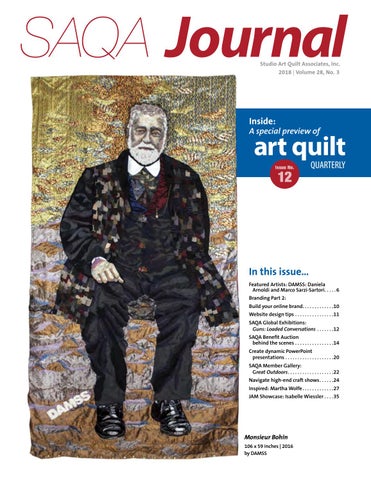
Monsieur Bohin 106 x 59 inches | 2016 by DAMSS
Thoughts from the president
Volunteer to make SAQA yours by Lisa Walton
I
keep getting asked how I was able
half of our activities. It was a light
a far too small group of dedicated
to rise to the role of president of
bulb moment and I gained a better
employees, everyone working behind
our amazing organization. Sometimes
appreciation and understanding of
the scenes to provide our amazing
I am not sure myself, but one thing
the need for more funds. Volunteer-
exhibitions, educational opportuni-
that keeps coming to
ing to be a regional
ties, and conferences is a volunteer,
mind is that I am curi-
rep also opened my
working because they believe in what
ous. Previous incarna-
eyes to what we do
SAQA does.
tions in my journey included being a theater stage manager and a chef. Both of these roles are backstage roles. I like to be involved and nosy, if the truth be known. I want to know what makes things tick and what is happening behind the scenes. The
I want to know what makes things tick and what is happening behind the scenes.
only way I know to do both of these things is
and how we could
enough hands, brains, resources,
became a pretty good
or ideas to keep us developing. So
recruiter as I devel-
if you, like me, want to be part of
oped more passion
what makes SAQA tick, think about
for SAQA. I think this
volunteering. Check out the commit-
is why I received a
tees on the SAQA website and write to
phone call one day
volunteer@saqa.com. Maybe you are a
from Mary Pal, board
future board member or president.
secretary at the time, with the news: “We have been watching you!” I thought
to be part of them. If you know how
I must have done something wrong,
things work, you get a better appreci-
but I was asked if I was interested in
ation of what is happening on stage.
being on the SAQA board!
As a new SAQA member, I couldn’t
Of course, we can never have
do even more. I
Everything we do as regional reps,
work out why I was always being
board members, or committee mem-
asked for money. Didn’t they already
bers is a volunteer activity. Volunteers
have my membership money? It
are the absolute lifeblood of our orga-
wasn’t until I became more involved
nization and I personally thank every
as a regional rep that I saw the full
one of you for your dedication and
extent of what SAQA does and how
commitment to OUR organization. I
our membership dues cover less than
say OUR because it is ours. Apart from
In Memoriam We are sorry to report the passing of three of our members, and express our condolences to their beloved friends and families. Our members who have recently passed are June Rose, Mary Ann Klussman, and Virginia “Ginny” Abrams. We will greatly miss their contributions to SAQA and the art quilt.
SAQA Journal • 2018 | No. 3 •
3
Editor’s Notes
Get ready! Make plans today for future success by Diane Howell
T
here is a great deal of discord
current passport and reservations.
How did she get ready to be success-
in the world. Still, good things
Want to sell your house in a year?
ful? She had a plan and put in a lot of
Learn to love beige and paint now!
hard work. Acceptance to and navi-
happen, especially to people who put plans in place to realize their dreams.
I love this issue’s professional devel-
gation of a high-end show requires
All around me I see people succeed-
opment stories because they demon-
everything from a professional booth
ing, whether it is by letting go of bad
strate how planning delivers success.
setup to substantial on-hand inven-
situations or by taking steps to get
Susan Lenz, in her story on high-end
tory. Did I mention she had a plan?
to the next level. You can’t sit back,
craft shows, gives us the nuts and
think happy thoughts, and expect
bolts of how those shows work. She
to dynamic PowerPoint presenta-
something good to happen.
takes us on her journey, which most
tions. The secret? Careful planning
You need a plan. Want to go to
recently found her at the Smithson-
and attention to detail. In this issue,
Tahiti? You’re not going without a
ian Craft Show in Washington, D.C.
Nartey also completes our series on
Clara Nartey lets us in on the secret
branding as she zeroes in on building an online brand. The answer to how you best represent yourself online involves being consistent across platforms, something you only get through planning. Our behind-the-scenes look at the 2018 SAQA Benefit Auction reveals something bidders might not know. Our three-week annual event has a
Michele Hardy High-Country Color #1 48 x 32 inches | 2017 Autumn in the mountains of Colorado is a time of glorious color.
This work is part of Member Gallery: Great Outdoors on page 22.
yearlong planning schedule. So much planning! I end with two selfish requests. One, have you put a plan into action that succeeded and relates to art quilts? Send me a story idea at editor@saqa.com. Two, from September 14-October 7, bid high and bid often in the benefit auction—just not on the quilt I want.
4
• SAQA Journal • 2018 | No. 3
I find m o r f n o i t inspira n i s l a i r e Mat io. d u t s y m SAQA. rt from o p p u s I find
Ivy Jensen Spring, TX
Do you see the big picture? Become a SAQA Visionary We're looking for people who look outward to see the big picture, people like SAQA Visionary Ivy Jensen whose story is at saqa.com/ivy. SAQA's Visionaries are a leadership group who invest in our vibrant global art quilt movement. A monthly gift of just $20 makes you part of the Visionaries group. Or you can give a generous annual gift of $240.
Visionaries also receive: • biannual newsletter which highlights early bird news about upcoming happenings in SAQA and exciting global textile trends • exclusive invites to conference receptions and online events • special recognition in the SAQA Journal and website
isionarY www.saqa.com/gift
SAQA Journal • 2018 | No. 3 •
5
Featured Artists
DAMSS:
Daniela Arnoldi and Marco Sarzi-Sartori Expansive artwork spreads message of sustainability by Cindy Grisdela
Italian artists Daniela Arnoldi and Marco Sarzi-Sartori—known collaboratively by their initials DAMSS—have turned recycling into an art form. Based in Milan, Italy, they make use of all types of cast-off textiles to build their large-scale works and installations.
Marco Sarzi-Sartori and Daniela Arnoldi pose with an enormous pile of fabrics waiting to find their way into the couple’s large-scale artwork.
6
• SAQA Journal • 2018 | No. 3
Roma 3000 13 x 33 feet | 2017
“Our creations aim at recycling
influence of the French Impres-
and at promoting the sustainability
sionists is clear in their approach to
of artistic and industrial products,”
textile design with images formed by
they say. Their first step is to seek out
the strategic placement of the fabric
waste fiber materials. Once they have
tiles. The 2016 portrait of Monsieur
the materials in their studio, they
Bohin pictured on the cover is a good
must be classified and stored. The
example, particularly in the construc-
fabric may be divided into attribute
tion of his jacket. The process is also
types such as color, weight, pat-
apparent in Cinque Terre Corniglia
tern, thickness, quality, and storage
from 2015. Thread painting adds
method needed.
color and detail. “Random stitching
One image of their studio shows
[is used] for a realistic scene and more
Arnoldi and Sarzi-Sartori sitting
precise and careful [stitching] for the
behind an enormous mound of fiber
fine details.”
strips rolled into balls. Their materi-
The way the Impressionists used
als are not just cotton, but almost
their brushes to create their paintings
every type of fabric, from voile to
resonates with Arnoldi and Sarzi-
heavy winter textiles, silk shantung
Sartori. “Our methods derive from
to organdy. Once the material is
in-depth analysis of their brushstrokes
on hand, Arnoldi and Sarzi-Sartori
and their way of holding the brush,
manipulate and process it into
the characteristics of their colors and
shapes, using a variety of techniques,
study of subjects.”
such as cutting, restructuring with
Sewing machines are set up in the
alcohol. These processes turn material
studio for different tasks. Most of the
into fabric “tiles” for their projects.
work is done on a frame they built
like bricks,” they explain. The
98 x 98 inches | 2015
All the work is done by machine.
acid, and coloring with dripping
“The fabric tiles are reassembled
Cinque Terre Corniglia
themselves that is nearly 10 feet long. It has “two sliding layers, set with fast SAQA Journal • 2018 | No. 3 •
7
Milan Cathedral 63 x 63 inches | 2010
and powerful sewing machines and presser feet modified to perform more difficult tasks.” The fabric tiles are assembled on a base layer, as seen in the photograph of the large sewing machine setup in their studio. “The sewing of various layers of fabric with rows of stitching at varying widths allows us to vary the [textural look] of the textile to create the appearance of topography, hills, rocks, and other pieces of the picture.” Their studio is located in the same building as their apartment in Milan, making for a short work commute. They work every day of the week,
8
• SAQA Journal • 2018 | No. 3
Iron spending time in the studio during
“We followed any technique that
the day and doing computer work in
we thought could be useful in our
the evening to create the computer
future,” Arnoldi and Sarzi-Sartori say.
graphics needed for their projects.
39.5 x 142 inches | 2011
In recent years, the couple has
They also keep up with email, market-
created large-scale work measured in
People, installed in 2017 at a craft
ing, blogging, and other work related
feet rather than inches. Roma 3000,
exhibition in Vicenza, Italy. The work
to their business.
finished in 2017 and pictured on
features 300 pounds of colorful fabric
By training, Arnoldi is an engineer
page 7, is one example of this gran-
strips attached top and bottom in
and Sarzi-Sartori is an architect. They
deur, measuring about 13 x 33 feet.
diagonal lines. The process for one
began to explore
Photographs of the art-
of these pieces is somewhat differ-
the possibility of
ists standing in front of
ent from their hanging quilts, as the
the pieces give a sense
artists create a scale model for the
working together to create art in 2000, and were drawn to the textile medium during a visit to an international
‘Textile is a fascinating medium as it is soft and flexible.’
quilt exhibition
of the works’ enormous scale. A project such as this can take many months to complete. Once the topic has been decided, they plan it using com-
in France. “Textile
puter graphics which
is a fascinating medium as it is soft
have become an essential part of the
and flexible. It can be cut, disrupted,
creation. The composition is then
restructured and reassembled, spun,
divided into sections and printed
twirled, painted, embroidered,
full-size onto canvas to be used as a
burned, and wrinkled—a wide range
template.
of manipulating possibilities not
At this stage, each artist chooses
provided by any other medium,”
an area of the piece to work on. As
they say. Iron, completed in 2011,
the image grows, they exchange their
shows some of these transformative
work so each has input on all the
possibilities. The panels were burned
panels. “It is practically impossible
with acid and then ironed at a high
to define the paternity of the stitches
temperature.
within our work because they are
Their first tapestries were fabricated using vertical looms they built. Later, their work developed into frameless
see “DAMSS” on page 33
mixed in such a manner as to define our common style.” In addition to large-scale textiles,
textile art supported by metal, using
they also collaborated on fiber art
enameled metal threads.
installations such as Connecting SAQA Journal • 2018 | No. 3 •
9
Branding: Part 2
A brand new you Build an online brand that lets you shine
identify you, although you can work without them. A great profile picture is another key to personal branding. Use the same professional photo
by Clara Nartey
W
and tagline are effective tools to
across all of your online platforms. This puts a face on your brand and
e live in the age of Google. If your name or artwork
comes up for discussion, chances are a Google search is part and parcel to the dialogue. Online access creates an exciting opportunity by giving you direct access to an audience. But how do you stand out from so many websites? Your online brand is made up of two components. The first part is the written story you tell about yourself: artist statement, bio, and blog posts. The second part is your visual identity: logo, web design, profile photo, and images on social media posts. Your online brand needs to: • Create awareness
• Social media accounts (such as Facebook, Instagram, LinkedIn, etc.) • A newsletter Build a cohesive identity by main-
connects people to the person behind the artwork. My online profile photo matches my color theme as well.
Artist website
taining consistency on all platforms
Your online identity centers around
in terms of your name, design
your website or blog. The places you
standards, logo, and profile picture.
socialize online should direct people
I chose to use my given name as my
back to whichever of these is your
brand name. This allows people to
primary online presence.
search my name and to find me on
To make your website your online
all platforms.
brand central, follow these tips:
Design
• Create a domain name or web
If you would prefer not to develop branding on your own, there are design services to create a unified design for your brand. If you use a professional designer for your web-
address that is consistent with your brand name. • Include an About page where you share your brand story. • Curate your art portfolio to match
• Make you likeable
site, discuss up front the colors, fonts,
the story on your About page.
• Make people trust you
and mood you want to represent you.
• Update your website frequently
• Encourage people to work with you I approach online branding by crafting a compelling story that communicates how I want to be
Remember, everything has to relate to the story of who you are and how you want your clients and followers to perceive you. If you do your own design, two
perceived. Your story should answer
things you can use to tie your design
what kind of art you create, why you
together are consistency in color and
make it, and who you make it for. An
fonts. Not only does this make you
example is:
recognizable, but it allows you to
Art feeds my spirit and I want to help people find fulfillment in creative self-expression. Tailor your branding to effectively communicate your story on your platform assets, which should include: • A professional website/blog • A professional email address
10
• SAQA Journal • 2018 | No. 3
have a template for everything from a website page to a Pinterest header. Building your online brand means building your visual identity. A logo
with recent news about exhibitions, new work, sales, classes, etc. Give visitors a reason to come back to your website • Plan for change. As you grow as an artist, your brand can and will evolve. Clara Nartey is a SAQA member who resides in West Haven, Connecticut. She is an artist who creates video lessons and writes about the practice and science of creativity. Learn more about her at www. claranartey.com.
Tips to grow your brand by Clara Nartey Pro Tip #1 To easily remember and get the right color each time, find and save the number code for the colors of your design. This way, when you want to create something new such as an image for a blogpost, a newsletter, or an announcement, you don’t have to visually guess which colors to use. Pro Tip #2 Email plays an important part in your online brand. Let your email reflect your brand name. For example, when you receive an email from me, it will be from me@ ClaraNartey.com.
Use an email signature in your emails to reinforce your brand and direct people back to your website. You can also provide links to your social media accounts. Pro Tip #3 Use templates to create consistency. Create one template with your brand’s colors and fonts. The text or image will change when you need to create a new post, but the overall look will be the same. Pro Tip #4 Choose your brand colors wisely to evoke the emotions or mood you wish to convey.
Pro Tip #5 Each social media platform has specific image sizes. Check to make sure you use the right image sizes in your headers and posts; otherwise, your images could be cut off or display oddly. Pro Tip #6 I use Canva.com to design my blog images and social media posts. You can use Photoshop or other graphics software. PicMonkey.com and Snappa.com are other online graphic design tools you can try. These online tools have templates that allow you to plug in information. You could also hire a graphic designer.
What makes a website zip along? by Diane Howell
our website powers your online brand. Make
Y
presents art images the way a buyer or curator
sure it tells your story and is easy to use.
thinks, with categories for abstract, representa-
answers from SAQA members give insight into how
ful groupings would be landscape, still life, nudes,
art and information is best presented for viewers.
buildings, or sports.
What key features make websites efficient? These
“I like to see websites that clearly categorize an
tional, and three dimensional. She says other help-
Closely related to this topic is image navigation.
artist’s work by medium and/or dates. I always go
Terry Howard Grant says she loves galleries of work
directly to ‘new work’ then work my way back.
where a viewer can easily navigate from one image
Vague series titles don’t really help,” says Sharon
to the next without going back to the main page
McCartney.
after each one. Images should also be a decent size,
While searching for art online for exhibitions, Kevan Lunney found the need for clarity. “Most
she says. Other members focused on teaching informa-
websites were particularly frustrating to comb
tion. Bern Johnson says: “I like to see clearly where
through the images. Paging through images one by
artists give classes, particularly online classes.” She
one, looking at thumbnails that were too small, or
also wants easy-to-find instructions to subscribe to a
at a run-on list of work that wasn’t categorized just
newsletter. “I find that I follow an artist more when
takes too much time,” she says.
they send out an email newsletter or blog post.”
Lunney turned her experience into a positive, though. Her personal website [kevanart.com]
see “Website” on page 30 SAQA Journal • 2018 | No. 3 •
11
Selections from
Guns: Loaded Conversations Today gun violence feels commonplace. Yet an enormous divide exists between people who cherish their heritage of gun ownership and others who are concerned about the rising tide of gun violence. Guns: Loaded Conversations seeks to engage viewers of differing opinions to listen to each other and to encourage community initiatives that may inspire action in seeking solutions. The juror for this exhibition was Dr. Vicky A. Clark. The exhibition premiered at San Jose Museum of Quilts & Textiles in California. It will be installed at the New England Quilt Museum in Lowell, Massachusetts, Jan. 9-April 6, 2019. To view more artwork from Guns: Loaded Conversations, visit www.saqa.com/loadedconversations. A catalog also is available for sale in www.saqa.com/store.
Pamela Rocco Without Gun Control 44 x 33 inches | 2015
Sabrina Zarco One Pulse 58.5 x 32.5 inches | 2017 Photo by Liliana Hueso Productions
Shawn Quinlan This Is Not the Time to Talk about Gun Control 53 x 53 inches | 2016
12
• SAQA Journal • 2018 | No. 3
Alisa Golden Hand Gun 39 x 45.5 inches | 2017
Kathryn Pellman End Gun Violence 58 x 39 inches | 2017 Photo by Johanna Wissler
Kelly Burke Quilted Reimagined American Flag Series III: Don’t Lives Matter? 58 x 108 inches | 2016 Photo by A. Stuart Hanson
Elizabeth Michellod-Dutheil The Madness of Men – La Folie des Hommes 66 x 30 inches | 2017
SAQA Journal • 2018 | No. 3 •
13
From start to finish
Behind the scenes at SAQA’s Benefit Auction
S
AQA’s Benefit Auction is a fastpaced competition energized
by the love for textile art. In 2017, the auction raised nearly $65,000 to promote the art quilt. But what does it take to make this three-week event a smashing success? It all starts with the artists—443 of them this year—who pledge to make and donate a 12 x 12-inch quilt. The quilts are the engine that drives the auction. Anticipation builds for weeks as images of the auction quilts start to appear on saqa.com/auction. Bidders make lists. They check the site again and again, hoping to collect a favorite
14
• SAQA Journal • 2018 | No. 3
Clockwise from upper left: Anna Viadero, Buzz; Carolyn Skei, Prickly Pear Fantasy; Regina Marzlin, Red Giant; Jim Hay, Two for Lunch; Charlotte Bird, Close Encounters of the Lichen Kind; Katie Walwyn, Coy Koi; and Catherine Kleeman, Inspiration Exists.
artist at a steal or snag the work of a
there’s always the chance a bid-
rising star. As the auction nears, many
der’s most sought-after work will be
SAQA members engage viewers with
purchased on Diamond Day, Sept. 14.
online Dream Collections, six-piece
That is the auction’s virtual black-tie
mini-exhibitions curated to themes
affair, an early-bird opportunity to
that members develop.
purchase any quilt for $1,000 each.
The first steps Before the bidding can begin, the
And that’s pretty much it, right? Au contraire. People need to know the auction is
finished quilts make their way to the
coming. The SAQA marketing team
SAQA shipping center. If the donor’s
promotes the auction through news-
photography shows the quilt in its
letters, social media platforms, and
best light, it is placed in a labeled
the SAQA Journal. The team also asks
plastic sleeve and shelved in alpha-
members to invite their friends and
betical order with the other quilts. If
collectors to view the auction offer-
not, it is re-photographed and then
ings. Postcards are mailed to winners
processed.
and are also handed out at events and
The digital images are uploaded to the website with the artist’s name
exhibitions.
and title. Later, they are grouped
We’re live!
into weekly time slots for bidding
On opening day it gets real. Bids
purposes, which allows bidders to
arrive, quilts are marked SOLD, credit
strategize their purchases. Of course,
cards run, and thank-you emails SAQA Journal • 2018 | No. 3 •
15
Auction by the numbers The 2018 SAQA Benefit Auction opens Sept. 14 with 443 donated art quilts. As if to prove that auction fever runs high throughout SAQA, an amazing 23 percent of this year’s quilts are from first time donors and 22 percent are from members outside the United States. Twelve of the quilts are from artists who have donated to all 12 auctions. An impressive 40 percent are from artists who have donated a quilt at least five times. And then there are the 443 thank-you notes written by SAQA executive director Martha Sielman, one to each donor artist. This year brought a regional competition for the highest participation rate, determined by the number of donated pieces divided by the number of members. The results are: Regions over 100 members: First place: Oceania Second place: Texas Regions under 100 members: First place: Nebraska Second place: Alaska Joanne Alberda, Sunset Over a Red Field
sent to winning bidders with a list of
Paperwork
their purchases. Unsuccessful bidders
The auction event wraps up in
are invited to bid again. Artists are thanked for the sale, and provided with the price realized and the buyer’s contact information. Daily totals are posted on the website and social media, which continue to build sales momentum. At the end of each week, it’s still not over. Any unsold quilts are moved to the SAQA Store for sale until December 28, with a brief hiatus to make them available for sale at the SAQA Booth Nov. 8-11 at the International Quilt Stephanie Crawford, The Harbour Inn
Festival/Houston. After that, they are shipped back to the artist or swapped for another artist’s quilt, according to each artist’s instructions.
16
• SAQA Journal • 2018 | No. 3
December as final income and expenses are analyzed. The analysis is provided to the SAQA Board and then to membership. Feedback about what worked and what steps need to be improved is noted for the next auction. In January preparation begins for the next auction when the auction donor form goes live. That means the annual Benefit Auction is a yearlong labor of love. So remember: bid high and bid often! —Diane Howell
Barbara Yates Beasley, Kimba
Jenny Bowker, Abu Ali, Cairo, Egypt
Nancy Bardach, Circus 10
How the auction works The 2018 Benefit Auction is almost upon us! Diamond Day kicks off the bidding at 2 p.m. ET on Friday, Sept. 14, when all quilts are available for $1,000 each. The auction’s weekly schedule runs from September 17-October 7. A new section opens each Monday at a bid price of $750.
The price is reduced each day until it reaches $100 on Saturday. The first bid for a piece wins. At week’s end, any remaining quilts in that section move to the SAQA Store, where they are for sale at $100 each. The quilts will be for sale November 8-11 in the SAQA booth
at International Quilt Festival/Houston. They will make one last appearance in the SAQA store through December 28. For full details, visit saqa.com/auction.
SAQA 2018 Benefit Auction Pricing Schedule $750
$550
$350
$250
$150
$100
Section 1
Sept. 17
Sept. 18
Sept. 19
Sept. 20
Sept. 21
Sept. 22
Section 2
Sept. 24
Sept. 25
Sept. 26
Sept. 27
Sept. 28
Sept. 29
Section 3
Oct. 1
Oct. 2
Oct. 3
Oct. 4
Oct. 5
Oct. 6
Every quilt is available for a Buy It Now purchase of $1,000 for the duration of the auction, even if the section is not yet open for bidding. Prices change at 2 p.m. ET. No bids will be accepted between 1:45-2 p.m. ET while system updates are being made. SAQA Journal • 2018 | No. 3 •
17
INNOVATECH™ is available in 60 of the most popular color choices, and can be purchased in 3000 or 6000-yard cones. Contact an Innova® dealer near you to buy INNOVATECH™ quilting thread. ABM International is known for its innovative and cutting-edge technology and products. We constantly strive to stay ahead of the curve; to be at the forefront of major advancements in the quilting industry.
Use the only thread designed specifically for use on a longarm quilting machine BY THE PEOPLE WHO KNOW longarm quilting machines.
Innova longarm quilting machines are manufactured by ABM International, a three generation family owned and operated business near Houston, Texas. The Innova® has been engineered to meet the most discerning quilter’s needs. Based on a long term commitment to excellence, ABM International offers a full array of high quality quilting machinery. As such, Innova has been working for some time now to develop a unique, superiorquality thread. After much research and development, Innova is pleased to introduce INNOVATECH™ Quilting Thread. After its debut at the 2017 International Quilt Market and Festival in Houston, it has been flying off our dealers’ shelves! INNOVATECH™ is an exclusive thread engineered specifically for longarm quilting. It is a tex 27, 40-weight poly wrapped poly, and its sleek design and beautiful finish allow for maximum efficiency while providing superior visual appeal. One customer even claims, “It runs like melted butter.”
Built To Quilt® Contact a local Innova Dealer for special offers on the only longarm machine that’s “Built to Quilt®” www.innovalongarm.com
Innova Gives Back One of the major aims of ABM International is its corporate responsibility – not only to the entire quilting community, but its local community as well. Innova has always strived to make it a top priority to give back to the community and those in need. Comfort quilts are made and donated with love and generosity, and that comes through to those individuals who receive them at times that are often the most difficult. Comfort quilts represent the sheer goodness of complete strangers. They illustrate the goodwill and caring attitudes of people who want nothing more than to help their fellow man. It is a labor of love for the giver, and, for the receiver, a source of comfort and positive reminder of the world’s goodness.
Hurricane Harvey Comfort Quilts With the recent storms that devastated the gulf coast region this past summer, Innova has been involved in quilt drives whose goal is to get comfort quilts into the hands of the hurricane victims, specifically those devastated and/or still displaced by Hurricane Harvey. Innova’s factory and main office are located just north of Houston, so it is perfectly situated to act as a shipping destination for comfort quilts sent to them by quilters from all over the country. Innova, in turn, has been organizing quilt donations to those in most need of these beautiful quilts, and it has been a huge success.
Las Vegas Comfort Quilts Within just weeks of the devastating hurricanes that hit Houston and surrounding areas, the Las Vegas Massacre occurred. On his recent trip to Nevada, ABM Innova’s president, Neal Schwarzberger, met Chantal McCrorie, an attendee at the concert during the shooting. She shared with him her story, and he knew Innova needed to do something to help the victims and their families. So again, calling upon what seems like a never-ending supply of generosity from the quilting community in this country, Innova sent more donated comfort quilts to McCrorie, and she has been distributing each quilt individually to victims most in need of healing from this horrible tragedy. McCrorie says it has been immensely therapeutic for her and has done wonders in her own emotional healing to be a part of something like this.
Use best practices to create dynamic PowerPoint presentations by Clara Nartey
P
owerPoint’s longevity is a testa-
Decide which points you want people
text, graphs, images, or video? What
ment to its effectiveness as a
to remember and craft a storyline to
will keep your audience members
presentation tool—when used prop-
engage your audience on multiple
engaged and help them remember
erly. I say when used properly because
levels: intellectual, emotional, visual,
the points or respond to a call for
everyone knows how painful it is
and auditory.
action? Hint: It’s not always text.
to sit through a terrible PowerPoint
Once a plan is in place, write your
presentation. You can’t wait for it to
speech. Do this step before you cre-
be over.
ate your slides because the slides are
Four elements play a critical role in designing your PowerPoint slides.
Do you have to use PowerPoint to
visual aids; they are not your speech.
Text
make a presentation? Absolutely not.
From your completed speech, identify
Text needs to be legible so the person
If you are motivating a group of peo-
the main points found in every two
sitting at the back of the room can
ple or making one or two key points,
or three paragraphs. These highlights
read it. Sans serif fonts such as Arial
a slide presentation is not necessary.
are the basis for your PowerPoint
are easier to read. A font size of at
However, a dynamic PowerPoint
slides.
least 30 points is recommended.
presentation can help your audience
There are a lot of design and
Limit the amount of text by includ-
remember key points when your talk
content possibilities for slides. Don’t
ing one idea on each slide. Your slides
is information-packed.
be tempted to use too many of the
should be filled with a lot of white space, not text. Your spelling and grammar must be correct.
Color When it comes to color, think high contrast. For example, don’t combine a dark-colored or busy background with equally dark text colors. Colors on opposite sides of the color wheel are complements. This combination gives you high contrast, but make sure you select a color saturation level that is pleasing and makes text easier to read. You don’t want your audience focused on a discordant color scheme. If you choose to use a photo as a slide background, ensure the text is typed on a portion of the photo The most common PowerPoint mis-
design options found in Power-
takes are easy to avoid. Start by know-
Point. Keep your choices simple and
ing what you want to achieve with
consistent.
your speech. You should want your audience to leave with takeaways.
20
• SAQA Journal • 2018 | No. 3
Think about the most effective way to make each point. Is it by using
where it will be legible.
Graphics Use graphics only when they help tell your story. Blurry photos are not a
good choice. Diagrams, infographics, charts, and graphs all help tell your story visually. However, don’t make your graphics so complicated that they require extensive explanation. A picture must be worth a thousand words.
Consistency Pull your design together with consistent design elements. The creators of PowerPoint know this approach works, so they’ve provided templates and themes, which are collections of colors that work well together. When you use a template, the colors, fonts, layout and entire design of your presentation remains consistent throughout. You are not limited to the available templates in Power-
with the content and the timing.
Remember, your PowerPoint pre-
After all, you don’t want to read the
sentation is effective when it engages
slides to your audience. Use the slides
your audience on multiple levels, is
as a cue for what you’ll say.
a complement to your speech, and
If you have more to communicate beyond your speech, create handouts to pass out after you’re done speaking. That way your audience will pay attention to your presentation and not read your handout while you speak.
provides the desired takeaways. Clara Nartey is a SAQA member who resides in West Haven, Connecticut. She is an artist who creates video lessons and writes about the practice and science of creativity. Learn more about her at www. claranartey.com.
Point. You can always tweak them or brand them to make them your own. To tweak a template, all you’ve got to do is edit the slide master. The changes you make to fonts, colors, and layout will be applied to your entire presentation. You can also choose or change themes.
Animations Many presenters believe animations will keep their audience engaged. That’s not the case. Indiscriminately using animations in your presentation can be distracting to your audience. If at all possible, skip animations or use them sparingly. Now that you’re done with preparing your slides, do a few practice runs of your presentation. Get comfortable SAQA Journal • 2018 | No. 3 •
21
SAQA Member Gallery: Great Outdoors
Carolyn Collins Mangroves 12 x 30 inches | 2016 In New South Wales, Australia, the boardwalk through the mangroves on the edge of Jervis Bay is a magical place.
Ruth Briggs Mending Fences III 27 x 38 inches | 2017 Border fences separate countries and families. These breaches are often irreconcilable. Fortunately fabric is easily mended.
Rickie Seifried Sheila 21 x 21 inches | 2012 The lizard, Sheila, developed a smile during the creative process.
Dianna VanderDoes Autumnal Equinox 46 x 48 inches | 2017 I love being outside at night in the autumn. The mystery never fails to move me.
22
• SAQA Journal • 2018 | No. 3
Katie Stein Sather Mondrian Paddlers 24 x 24 inches | 2017 A photo from my friend Betty McLeod was transformed in Prisma and interpreted in raw-edge appliqué.
Margaret Abramshe Narrows 39 x 32 inches | 2017 This quilt was inspired by a photo captured in early spring on a hike through Zion National Park in Utah on The Narrows trail.
Marianne Williamson Very Early Frost 43 x 43 inches | 2017 A very early frost catches nature by surprise; the rhythm of the seasons is disrupted.
SAQA Journal • 2018 | No. 3 •
23
Research. Apply. Pack. Detailed plans ease navigation of high-end craft shows by Susan Lenz
In Box CCXCII, Detail
S
ix years ago I decided to join the high-end craft show circuit. I had an established body
started with a package deal on interlocking carpet
of work, a website, and gallery representation, plus
tiles for a 10 x 10-foot booth ($188 plus shipping).
the desire to share my work with potential buyers.
For the Philadelphia Museum of Art Craft Show, I
I researched events and focused on three indoor
was accepted in two categories—decorative fibers
shows: the Smithsonian Craft Show, the Philadel-
and basketry—and needed a 10 x 15-foot booth. I
phia Museum of Art Craft Show, and the Ameri-
had to purchase a new floor because my original
can Craft Show produced by the American Craft
floor tiles were no longer available.
Council. These are among the most respected and competitive such marketplaces in the United States. My first step was to attend a show. I looked at
The start-up expenses to participate in these shows can be overwhelming and the distances between artist and show vast. As a result, some art-
booth designs, approaches to lighting, and even
ists don’t own a booth. They rent pipe-and-drape
the size of pricing labels. I saw the need for a
units, display cabinets, and other fixtures from
hidden storage area within the allotted space. I
companies specializing in art trade shows. These
learned that booth design is important and often
providers also store privately owned booths in a
works hand-in-hand with an artist’s branding and
temperature-controlled warehouse and transport
demands of a particular medium.
booths to the venue. These services come in handy
The setup Artists working in all media are presented side by side in long convention center aisles. The standard-
for artists living on one coast but exhibiting on the other. I transport my booth in a cargo van. At first, I rented a vehicle. Now, I own one.
sized booth is 10 x 10 feet and rent can be $850 to
Selling details
$1,280, depending on the show. Larger booths or
Beyond the physical considerations of a booth and
corner locations are priced higher. An additional
the artwork to fill it, many other preparations must
fee of $95-$160 is often charged for electricity.
be made. Every artist needs a business license and
I decided against a custom-designed booth. I
the proper forms to file sales tax in the state in
purchased a basic structure from ProPanels ($1,349
which the trade show is held. For the Philadelphia
and up) with four track lighting strips and eight
Museum of Art Craft Show, a city business privilege
bulbs ($580). My purchase was delivered on a truck,
license also is required. To conduct a sale, duplicate
which added considerably to the shipping charge.
invoices are needed. Credit card processing is essen-
Since then, I have ordered a matching shelf, a few
tial; I have a handheld PayPal chip reader.
extra lights, two shorter wall panels, and a heavyduty cart.
24
Flooring is another consideration and expense. I
• SAQA Journal • 2018 | No. 3
Customers expect their new purchase to be appropriately wrapped and/or bagged. Most shows
provide a small number of small- and mediumsized paper bags. Unfortunately, most of my framed artwork doesn’t fit in those bags. I bring a roll of bubble wrap and plenty of extra-large handled bags.
The details Then there are the little things. My checklist includes extension cords, multipronged electrical strips, extra light bulbs, a handheld vacuum cleaner, tape, pens, business cards, small labels for prices, and a folding chair. Because my artwork is framed, I also bring glass cleaner and rags, woodtoned markers, and other items to keep my inventory in tip-top condition.
Booth design often works hand-in-hand with an artist’s branding.
The Smithsonian Craft Show is held in the National Building Museum in Washington, D.C.
Everything must fit into my cargo van and be packed to allow for quick unloading. Each show designates a time for artists to arrive on site. There is usually a line of cram-packed vehicles with outof-state license plates waiting to unload at their assigned time. The typical amount of time for unloading is a mere half hour. Your vehicle must be moved immediately to make way for the next artist. Some shows allow artists to drive onto the convention floor. Others require artists to roll their booths and artwork into the space from a designated parking lot. With so many artists in so little space, you are expected to work within your booth space and not block aisles. Fortunately, there is always plenty of time to set up and fine tune the look of your booth. I’ve never been rushed to aim flood lights or hang artwork. During this period, artists meet their neighbors, snap photos for social media, and find
Susan Lenz adjusts lighting in her booth at the Smithsonian Craft Show.
the hospitality room. SAQA Journal • 2018 | No. 3 •
25
The show Most high-end craft shows have a private room for exhibiting artists with coffee, light refreshments, and helpful show committee members. The Philadelphia and Smithsonian shows hold preview galas before they are open to the public. These dressattire evenings present a perfect way to start selling. Lenz agreed to fill a corner booth this year after being wait-listed for the Smithsonian Craft Show.
It is paramount that artists know how to best approach potential buyers. This introduction varies from artist to artist according to work and personality. The opening conversation is what many call an elevator speech. Most people who enter my booth ask, “What is it?” They don’t immediately recognize my work as fabric. Therefore, I wait for a bit before saying: “What you’re looking at is polyester stretch velvet on recycled packaging felt with machine embroidery and melting techniques. I know that’s a mouthful so I brought this step-bystep demonstration piece.” Quickly, I explain the process using my small visual aid. I always end by focusing on a nearby hanging work. If the browser lingers, I talk about my inspiration: “Much of my work is based on architecture, especially the fanciful 20th century buildings designed by Friedensreich Hundertwasser,
Careful packing means everything has to fit in the van plus be arranged for quick unloading.
an Austrian who stressed individualism. My work represents an aerial view of an imaginary Hundertwasser city. In each little box is a unique motif to reflect the individuals who live there.” Most people who attend high-end craft shows walk the entire show before buying. Artists refer to these people as “be backs”, people with whom a conversation went well, especially ones that suggested a purchase might happen. It is important to remember
Lenz and her husband, Steve Dingman, add some levity to setup. Photo by Teddi Fine
what these people look like. Eye contact and a smile are often the way a transaction is initiated.
Show survival I’m lucky because my husband, Steve Dingman, works the shows with me. When a selection is made, I hand the invoice on a clipboard to him. He handles the payment while I bubble wrap the artwork. For artists who do the shows alone, the craft shows provide booth sitters, committee members who staff a booth during prearranged times so that the artist can take an occasional break. see “Craft shows” on page 29
26
• SAQA Journal • 2018 | No. 3
ideology
Inspired by
by N.K. Quan
A
tweet was the inspiration for Martha Wolfe’s Privileged Times: “The epitome of White Privilege = I don’t follow the news.” That short missive caused Wolfe to think hard about who she is. To recognize—and accept— things about herself that were difficult. “Some of us inherit a number of privileges at birth and never give a lot of thought to all of the protections and advantages they provide through no effort of our own, or how our privileges may impact everyone else.” Take the men displayed in the quilt, men of privilege who sign bills concerning police violence and the ban on Muslim migration, issues that do not affect them but impact the lives of millions, she says. “Their privilege has the potential to shield and isolate them from the concerns of predominately marginalized populations. It’s important to recognize that this is not just about ‘white’ privilege, but it extends to things like religious freedom and protections for LGBTQ community members, and even women’s health issues.”
and come home to a safe comfortable house with plenty of food, employment opportunities, and the chance to get an education.” Considering those two factors—white privilege and personal growth—the quilt can be interpreted as a reminder of how one’s decisions affect others. “It’s also a bit of an indictment of those pictured, I’ll admit, as they have been some of the more prominent faces proposing, implementing, or being complacent about troubling things we’ve seen recently.”
Coming to terms
Building blocks
Wolfe’s biggest challenge in terms of personal growth was coming to terms with where she fits into the discussion of white privilege. Her parents were outspoken and actively involved in the civil rights movement. “I’m proud of that, but the missing part was the privilege piece, the fact that we could fight battles
Wolfe used layered organza to give the quilt a gauze-like appearance, a technique seen in her other works. The subtle types of privilege overlay the newsprint, which she created by repeating those descriptions over and over again. The relative dimensions are the same as a standard folded newspaper.
Martha Wolfe Privileged Times 28 x 29 inches | 2017
The font is similar to that used by the New York Times. When creating quilts, Wolfe starts with a subject and then considers what would visually tell the story. Sometimes it is literal, sometimes it is metaphor. If the idea starts from a word or event, she will look up definitions, synonyms, news, and history. This quilt was created for the Threads of Resistance exhibition and has been part of its traveling exhibition since July 2017. To learn more about the quilts for this project, visit www.threadsofresistance.org. To learn more about Wolfe’s work, visit www.marthawolfe.com. N.K. Quan is a Phoenix-based writer and editor. SAQA Journal • 2018 | No. 3 •
27
2018 SAQA BENEFIT AUCTION Hundreds of art quilts. Hundreds of bidders. The competition is on. Bid for your favorites September 14 - October 7
DETAILS
www.saqa.com/auction
Craft shows from page 26 Breaks are needed, especially on a day that runs from 10 a.m.-8 p.m. Show schedules and times vary, but there is generally at least one day that courts the after-work crowd. Comfortable shoes are essential. Having a water bottle is helpful, too.
Practicality Before any of this happens, there’s an application process. It is hard to gain acceptance into a high-end craft show. The application fee is generally $50. The Philadelphia Museum of Art Craft Show accepts only 190 artists across all media from a field of applications numbering more than 1,000. I have made it in four times, including the upcoming 2018 show in November. The Smithsonian Craft Show accepts 120 artists; this year, there were more than 1,200 hopefuls. I wasn’t among the successful. I was wait-listed and for months Steve and I joked that “someone would have to die” before I got a spot. Three weeks before the April event, an artist had to withdraw and I agreed to take over the booth. Within 24 hours, I had charged the $1,925 booth fee to a credit card, returned a signed contract via email, and was listed on the official website. Steve booked an Airbnb basement apartment. We were soon on our way to the Smithsonian Craft Show in the National Building Museum in Washington, D.C. To be among this talented group of artists had been one of my lofty goals. I was only able to take part because I was totally prepared. And before going, I agreed to write this article to help others make their dreams come true. Susan Lenz is a SAQA JAM who resides in Columbia, South Carolina. You can view her work at www.susanlenz.com.
spirituality
grief
peace joy healing inspiration
Marafiki by Barbara Allen
CALL FOR ENTRIES:
Oct. 1, 2018 – Jan. 10, 2019 Life’s Journeys: Joy, Healing, Spirituality, Grief, Peace
SPONSORED BY:
TRAVELING EXHIBIT:
Showing in: North Carolina, Georgia,Texas, California, Michigan, Connecticut. Check the website for dates and locations.
2019 BIENNIAL EXHIBIT:
July 11-28, 2019 - Outside Washington DC in Herndon, VA
www.sacredthreadsquilts.com SAQA Journal • 2018 | No. 3 •
29
Website 2018 Surface Design Association International Member Exhibition 2018 Surface Design Association International Member Exhibition San Jose Museum of Quilts & Textiles 520 S. First Street, San Jose, CA 95113 San Jose Museum of Quilts & Textiles www.sjquiltmuseum.org 520 S.July First22 Street, San Jose, CA 95113 - October 14, 2018 www.sjquiltmuseum.org July 22 - October 14, 2018
from page 11 Catherine McDonald’s comments expand on teaching information. McDonald likes to see workshop menus that provide good descriptions of the classes. She also wants to read what teachers request from workshop organizers, not necessarily pricing, but other requirements to run the workshop. Ellen Lindner’s main focus is to
Jurors Carole Frances Lung, artist/activist/academic Jurors Amy DiFrances Placido, SJMQT Exhibitions Curator Carole Lung, artist/activist/academic Amy Di Placido, SJMQT Dates Exhibitions Curator Exhibition JulyExhibition 22-OctoberDates 14, 2018 July July 22-October 14, 2018 22, 2018 Opening Reception July 22, 2018 Questions? Email us at: info@surfacedesign.org Opening Reception www.surfacedesign.org/events-exhibits/exhibits/ Questions? Email us at: info@surfacedesign.org www.surfacedesign.org/events-exhibits/exhibits/
add dates to her teaching calendar. “Therefore, I try to sell me, speaking in first person and including a casual
No matter the focus, keeping the site updated with new work, events, or a link to an active blog is beneficial. headshot on every page. I have a very large ‘Learn with Ellen’ section [on adventurequilter.com], which includes not only class offerings, but lots of how-to articles and information. I [want to] come across as personable, knowledgeable, and willing to share.” No matter the focus, keeping the site updated with new work, events, or a link to an active blog is beneficial. Susan Lenz says: “I regularly update [susanlenz.com]. Keeping the information current is important. Who really likes clicking on a bio with 2014 or 2015 listed as the latest date? Plus, I’ve been told that changing content on a regular basis helps a site’s Google ranking,” she says.
30
• SAQA Journal • 2018 | No. 3
“Linking to an active blog helps too.” Lindner says her blog does generate visits to other areas of her website. Elena Stokes says her website [elenastokes.com] stands out because of user-friendly navigation, well-chosen
Let your artwork travel the world!
color scheme, and large full-screen images available as a slide show on her home page. “I purchased a theme
CALL FOR ENTRIES
from Imagely that is extremely flexi-
Forced to Flee
ble, allowing me to change the design
CALL FOR ENTRY: October
and look of my website at a whim.
1-31, 2018
Connecting our Natural Worlds
One of the design options of the
CALL FOR ENTRY: January
theme is the header placement, either across the top or down the left side.
3D Expression
I like the left side header as it allows
1-31, 2019
CALL FOR ENTRY: February
the viewer to always have access to
Upcycle!
the menu for easy navigation. No more having to scroll all the way back
CALL FOR ENTRY: March
up to click to another page. It also
Musica!
has my name and color scheme so
CALL FOR ENTRY: May
the viewer knows where they are and whose website it is.”
1-28, 2019
1-31, 2019
1-31, 2019
For complete details, visit www.saqa.com/calls
Stokes makes a good point about image use. “I want a website that can display full screen images of my art-
Fiber Art
work. Anybody can create a website that looks and functions like mine if
now
they want to, but nobody else has my artwork. That’s mine and mine alone. And I want it big and beautiful so
fibers | mixed media | textiles
viewers can feel like they’re right up close to the work. I only use the full screen on my home page with a slide
A fiber arts magazine & community
show, but I hope that first impression
print & digital magazine, exhibition listings, artist submissions, artist interview program, events calendar & map, jobs board & more!
makes an impact on my audience.” Linda Colsh’s consistency makes her website easily recognizable, even
rt Fiber A now
though it has undergone updates.
tiles d media | tex fibers | mixe
“When I had my website redesigned
APES: LANDSCGO DI TAKING BREATH G WITH IN
in the last year to improve appear-
R ART: PAPEUL ATING
MANIP MEDIUM THE
ance and full use of screen real estate
ST TAPEGA LE CY
OIDERY
EMBR PORARY CONTEM
& ! CIRCUS, VADA PLUSKN ITTING A NE
basic look of my previous website as I
SPRING
4, Issue 2015 Vol.
CAN $10US+
wanted to transition while maintainLYNN POLLARD
ing the look I established for present-
Diane Howell is editor of the SAQA Journal.
LTURE KING ING CU EXPRESS H FELT MA THROUG
A WEAVING RY
on cell phones and tablets, I kept the
ing my artwork on line.”
DYEIN
3
RR RUST! THE SIE QUILTING
subscribe now! www.fiberartnow.net SAQA Journal • 2018 | No. 3 •
31
Join SAQA - Members Only on Facebook Be part of SAQA - Members Only to enjoy • Daily contact with SAQA members around the world • Inspiration
• Special invitations • Works in progress • Camaraderie
Connect today!
Join
https://www.facebook.com/groups/mySAQA
SAQA Like
8 Comments Seen by 13 Comment
Hundreds of Beautiful Quilts on Exhibit Aisles of Fabrics, Machines & Quilting Supply Vendors World-Renowned Quiltmaking Instructors See an exciting Studio Art Quilt Associates exhibit at these AQS QuiltWeek events!
Grand Rapids, MI August 22–25
FALL PADUCAH, KY VIRGINIA BEACH. VA September 12–15
October 3–6
For more information, visit QuiltWeek.com NATIONAL BRAND PARTNER
32
• SAQA Journal • 2018 | No. 3
Detail: KALEIDOSCOPIC CALAMITY by Margaret Solomon Gunn
2018
DAMSS
SAQA
Studio Art Quilt Associates, Inc.
from page 9
art quilt quarterly
project and then acquire the materials
dimensions of our displays, which
and assemble the piece on site. Fabric
means that they are more [suitable]
compositions have an optical-kinetic
for collectors, hotels, companies, and
relationship with the viewer because
institutions linked to the topic of the
they can be experienced in three
work itself, and [who also] have large
dimensions.
areas for display.” Focusing on the
Arnoldi and Sarzi-Sartori teach master classes to students interested in learning about their style of work-
idea that their work is made in Italy is
teaching we learn more than we give.
rial to vibrating compositions.”
means their approach to exhibiting and selling their work is specific to a certain type of collector or dis-
Cindy Grisdela is a SAQA JAM who resides in Reston, Virginia. You can see her work at cindygrisdela.com [Editor’s Note: Arnoldi and SarziSartori responded to written questions for this article through a translator, their English friend David Ashworth, who also lives in Milan.]
Photos: Team San Jose
play. “We are bound by the large
art quilts
Arnoldi and Sarzi-Sartori use the Their tagline is “from discarded mate-
The scale of many of their pieces
100
helpful too, they add.
well as travel to other venues. “While
confronting, and discovery.”
Judith Larzelere METAMORPHOSIS
acronym DAMSS to brand their work.
acts of sharing, discussing, pondering,
Art quilts in FRANCE
Indiana State Museum
ing. They teach in their studio, as
This positive outcome is due to the
Issue No. 12
SAQA quarterly publication designed for collectors, arts professionals, and admirers of art quilts everywhere!
Subscribe today! www.saqa.com/aqq
2019 SAQA Annual Conference
Threads of Innovation April 25-28, 2019 HILTON SAN JOSE SAN JOSE, CALIFORNIA SAN PEDRO SQUARE MARKET
Enjoy a full schedule of activities, informative presenters, local outings, exhibitions, and more! Early-bird registration opens in September LEARN MORE AT
www.saqa.com/conference SAN JOSE MUSEUM OF QUILTS & TEXTILES
SAQA Journal • 2018 | No. 3 •
33
Board Members President Lisa Walton, Sydney, Australia Vice president Deborah Boschert, Lewisville, Texas Treasurer Marvin Fletcher, Athens, Ohio Secretary Martha Wolfe, Davis, California Vivika Hansen DeNegre, Guilford, Connecticut Carolyn Ducey, Lincoln, Nebraska Susan Else, Santa Cruz, California Jayne Gaskins, Reston, Virginia Gül Laporte, Linho Sintra, Portugal Jeanne Marklin, Williamstown, Massachusetts Dolores Miller, San Jose, California Chris Nielsen, Nova Scotia, Canada Gwyned Trefethen, Cohasset, Massachusetts
Quick Notes To find out more about SAQA, contact Martha Sielman, executive director, at 860-530-1551 or execdirector@saqa.com. Visit our website at www.saqa.com. Annual membership (U.S. and international): artist/associate member, $80; juried artist, $145; student (full time with copy of ID), $45. Studio Art Quilt Associates, Inc. (SAQA) is a nonprofit organization whose mission is to promote the art quilt through education, exhibitions, professional development, documentation and publications. The SAQA Journal is published four times a year. To submit articles, contact the SAQA Journal editor at editor@saqa.com. See the submission guidelines at www.saqa.com/journal-submit. For more information about advertising in the SAQA Journal , visit saqa.com/ads.
Executive director Martha Sielman, Hebron, Connecticut
SAQA Journal Editor Diane Howell, Chandler, Arizona Designer Jennifer Gauerke, Denver, Colorado
You can help SAQA save on printing and mailing costs by choosing to read the SAQA Journal online only. Login to mySAQA (www.saqa.com/ mySAQA) and select Manage Your Account.
SAQA has provided support, counsel, information, inspiration, and joy over the twenty-seven years I have been a member. I have learned enormously from others in the organization. It has given me an opportunity to share my talents and dreams, and to help others do the same. I want SAQA’s work to continue after my lifetime—the work of educating people about the art quilt and providing a “home” for artists like myself who are seeking to express themselves through art quilts. That’s why I’ve left a gift to SAQA in my will. —Judith Trager, Board member, SAQA Legacy Circle donor
Is SAQA in YOUR will? 34
• SAQA Journal • 2018 | No. 3
Join Judith in supporting SAQA’s future! Contact Jean Tutolo, SAQA’s Development Director, for details about how you can give a legacy gift.
saqajean@gmail.com
SAQA
Studio Art Quilt Associates, Inc.
art quilt quarterly
Issue No. 12
Art quilts in FRANCE
Judith Larzelere Indiana State Museum
SPECIAL PREVIEW
METAMORPHOSIS
100
art quilts
In each issue: • A broad array of art to enjoy, including work by SAQA’s Juried Artist Members
Art Quilt Quarterly
• Artist interviews offering inspiration and guidance on navigating your creative career
To subscribe or purchase back issues:
• Galleries of artwork from SAQA’s exhibitions PLUS insider details about private collections
is published 4 times a year.
www.saqa.com/aqq
• And MUCH MORE!
SAQA Art Quilt Quarterly special preview |
1
As the world turns SAQA now has more than 3400 members in thirty-six countries, with twenty percent residing outside the United States, mainly in Australia, Canada, Europe, and the United Kingdom. As part of SAQA’s Global Exhibitions Program, Masterworks: Abstract & Geometric is touring Japan, Concrete & Grassland is being exhibited in the British Isles, and My Corner of the World can be seen throughout Australia, with SAQA’s new president, Lisa Walton, hailing from Sydney. In recognition of this global interest in art quilts, we have launched an initiative to publish a series of articles on international quilt artists. This issue brings you Gül Laporte discussing French artists, and later this year Jacqueline Atkins will be writing about art quilts in Japan, with more worldwide coverage planned for 2019. In this issue of Art Quilt Quarterly we explore the Indiana State Museum’s collection of art quilts in an article written by Kate Lenkowsky. SAQA
Journal editor Diane Howell shares how several collectors document their quilt holdings, while our SAQA exhibition feature introduces Metamorphosis, which considers several aspects of the inevitability of change. — Sandra Sider, Editor editor-aqq@saqa.com
Contents Collecting art quilts at the Indiana State Museum . . . . . . . . . . . .1 Document your art quilts. . . . . . . . . . . . . . . . . . . . . . . . . . . . . . .4 Focus on Commissions: Merle Axelrad . . . . . . . . . . . . . . . . . . . .8 Art quilts in France . . . . . . . . . . . . . . . . . . . . . . . . . . . . . . . . . .11 Light Show exhibition . . . . . . . . . . . . . . . . . . . . . . . . . . . . . . . .14 Artists to watch Maggie Dillon . . . . . . . . . . . . . . . . . . . . . . . . . . . . . . . . . . .16 Terry Grant . . . . . . . . . . . . . . . . . . . . . . . . . . . . . . . . . . . . .20 Jim Hay . . . . . . . . . . . . . . . . . . . . . . . . . . . . . . . . . . . . . . . .24 Kit Vincent . . . . . . . . . . . . . . . . . . . . . . . . . . . . . . . . . . . . . .28 SAQA Global Exhibition: Metamorphosis . . . . . . . . . . . . . . . . . .32 Art Quilts Unfolding . . . . . . . . . . . . . . . . . . . . . . . . . . . . . . . . . .34 Collector’s bookshelf . . . . . . . . . . . . . . . . . . . . . . . . . . . . . . . .35 Portfolio. . . . . . . . . . . . . . . . . . . . . . . . . . . . . . . . . . . . . . . . . .37
special preview 2 | SAQA Art Quilt Quarterly
Studio Art Quilt Associates, Inc. (SAQA) is a nonprofit organization whose mission is to promote the art quilt through education, exhibitions, professional development, documentation, and publications. ©2018 Studio Art Quilt Associates, Inc. All rights reserved. Reproduction without permission is strictly prohibited. SAQA Art Quilt Quarterly is published by Studio Art Quilt Associates, Inc., a nonprofit educational organization. Publications Office: P.O. Box 141, Hebron, CT 06248. ISSN 2379-9439 (print) ISSN 2379-9455 (online) Editor: Sandra Sider Managing editor: Martha Sielman Artists to watch contributing editor: Diane Howell Collector’s bookshelf editor: Patricia Kennedy-Zafred Designer: Deidre Adams Circulation consultant: Peter Walsh Subscription is $29.95 for four issues Outside USA: add $12.00 Subscribe online: saqa.com/aqq Cover: Jennifer H. Landau, Transition 37 x 34 inches, 2017 photo by Sibila Savage Photography
see story, p. 32
Art quilts in France by Gül Laporte
U
ntil the 1970s, quilting in France consisted almost exclusively of the traditional Provençal “boutis,” whole-cloth quilts of which the most famous examples are intricately hand-stitched white quilts from Marseilles. In 1972, the Museum of Decorative Arts in Paris hosted a large exhibition of mostly Amish quilts made in the U.S. curated by Jonathan Holstein. That exhibition caught
the attention of the French public. Soon afterwards, Sophie Campbell, an American woman living in France, began teaching classes that helped popularize quilting. But for many years the concept of quilt making as a form of studio art did not exist in France, and outside Paris, which had a quilt shop, it was difficult to find the materials and tools for quilting.
Anne Woringer Huis clos (Closed Session) 61 x 46 inches, 2001 Photo by Bruno Jarret
SAQA Art Quilt Quarterly | 11
special preview SAQA Art Quilt Quarterly |
3
above:
Edith Raymond Echelle jaune (Yellow Ladder) 31 x 24 inches, 2011 Photo by Yves Denoyelle
above right:
Cosabeth Parriaud Métro parisien (Paris Subway) 40 x 40 inches, 2014 Photo by Yves Denoyelle
opposite:
Geneviève Attinger La rumeur (The Rumor) 46 x 46 inches, 2011 Collection of the International Quilt Study Center & Museum (Lincoln, Nebraska)
12 | SAQA Art Quilt Quarterly
special preview 4 | SAQA Art Quilt Quarterly
The founding in 1984 of France Patchwork gathered together quilters from different geographic areas who worked in different styles. By organizing classes and exhibitions, France Patchwork contributed to the spread of traditional patchwork in France. Soon, however, a more creative movement began to emerge, enabling studio artists to express themselves using textiles, and leading in 1998 to the creation of a new movement inside France Patchwork called “Artextures.” This group attracts a number of fiber artists, most of them professionals. They use innovative materials, create three-dimensional pieces, and, thanks to the help of France Patchwork, are exhibited in national museums. A new generation of 30-something artists is joining this movement, an encouraging sign for art quilts throughout France. Most of the French artists work alone, perhaps due to the fact that the French are quite individualistic. Anne Woringer, Edith Raymond, and Cosabeth Parriaud, who live in Paris, are probably the individuals most credited with initiating the art quilt movement in France back in the 1970s, followed by artists throughout France, including Geneviève Attinger, Maryvonne Deville Guillot, Solange Lasbleis, Lena Mezsaros, Marie Claude Bertin, Lydie Clergerie, France Brechignac, Gabrielle Paquin, and many more. Anne Woringer studied fine arts. The 1972 quilt exhibition was a major discovery for her, after which she made traditional quilts. But then she found her
own style, inspired by ethnic art, and began dyeing her own fabrics. Woringer’s art quilts are now in international private collections as well as in museums, such as the International Quilt Study Center & Museum in Lincoln, Nebraska, and the Museum of Arts and Design in New York. Woringer believes the art quilt needs to find more followers in France, and textile artists have difficulty being recognized as such in France. Edith Raymond is an architect, an illustrator of children’s books, and a fashion designer. She is a self-taught textile artist, influenced by her own naive drawings that she reproduces in textiles. Raymond loves to embroider, as this handwork enables her to relax. About her approach to art making, she says, “Patchwork is the appearance, the large format, a physical work, an opening; it’s also the precision of shapes; it’s a day-time work, while embroidery, masks, and small characters are intimate, a secret work, thus a night-time work.” Cosabeth Parriaud explores colors, adapting them to simple geometric shapes — squares, rectangles, circles, and stripes, whose familiar lines are universal. She combines different techniques and materials and continually tries to refine her work, keeping in mind that “less is more.” Gabrielle Paquin, unable to find an identity through painting, found hers in creating art quilts. She started by making traditional quilts while attending design classes in an art school. Fifteen years ago, after reading a book on the history of striped fabrics by Michel Pastoureau, a French medieval scholar, she started to combine striped fabrics in her quilts. “I consider myself
a part of the group of French artists who explore all the aspects of textile creation without being influenced by any particular style, while the Americans tend to follow a certain trend. The Modern quilt movement is one example,” says Paquin. Geneviève Attinger lives in Brittany and works alone in her studio. Her work is very personal; she considers herself a storyteller who writes what she feels with textiles and threads. “I am a self-made artist who took some embroidery and lace-making classes. Because I never took any art classes with textile teachers, I have never been influenced by their work, and my creations reflect my feelings exclusively.” Attinger’s quilts have been acquired by various museums and private collections in France as well as in the U.S. One of her pieces was selected for Quilt Visions 2018 San Diego, California. “I
am so proud and happy! I tried many times without success and at last here it is, my work has been selected, which means that we should never give up,” she says. My apologies to all the artists whose comments cannot be published here for lack of space. We could talk at length about the art quilt situation in France and how much we still need to strive to be recognized as artists and accepted into national museums. Slowly but surely, that will happen! Gül Laporte discovered quilting when she moved to Houston, Texas, in 1982. Back in Europe, she helped spread new techniques learned in the U.S. to French and other European students. She also authored two quilting books, one in French and one in English, and today she writes articles for Magic Patch magazine. From 2003 until 2016, Laporte served as a consultant for the European Patchwork Meeting. A board member of SAQA and member of several SAQA committees, Laporte now resides in Portugal.
SAQA Art Quilt Quarterly | 13
special preview SAQA Art Quilt Quarterly |
5
artists to watch
Kit Vincent Ottawa, Ontario, Canada Kit Vincent’s painterly, abstract pieces are the work of a master colorist. Strip piecing forms the powerful strokes in her work. Hand-dyed fabrics and surface design techniques build true personal color and layered meaning into each piece.
special preview 28 Quarterly | SAQA Art Quilt Quarterly 6 | SAQA Art Quilt
Catching the bug I came to quilting through the back door for an odd but practical reason. A few years ago, my new dining room was an echo chamber. I needed something large and colorful to dampen the sound. A large, mid-century masterpiece was not within my budget, so I made a wall hanging. After all, I could sew a bit, but what I knew about quilting would have fit into a teacup. I found a Threads article on Judith Larzelere’s strip-piecing technique. I was impressed with her beautiful, bold quilts and also with the efficient
right:
Tricolor White 72 x 72 inches, 2017 below right:
Tricolor Blue 72 x 72 inches, 2017
“quilt as you go� technique. Inspired by the article, my very first quilt measured no less than 8 by 8 feet. It hung on my dining room wall for several years despite the fact that it was a technical mess. More importantly, I had caught the quilting bug.
Style evolution I soon came across the work of Nancy Crow. I had dabbled with several fine arts media over the years, but Crow’s large, bold fabric compositions stopped me in my tracks. Her stunning work reminded me of large and colorful mid-century abstract paintings. Her work proved that quilting could be fine art. I took her classes and have benefitted from her artistic insight ever since. I found success shaping fabric freehand with a rotary cutter and composing directly on a design wall. I learned how to compose and piece large abstract and semi-abstract works. I experimented with several construction methods. My work is all about color and cloth. I begin without expectation and allow the design to surface. Gesture, movement, and color are the key elements as I stitch across pieced substrate panels with narrow strips of cloth. Each panel sets the tone for its neighbor. The only things I know up front are the approximate size of the final piece and a sense of the overall texture and color palette. The top layer works with underlying shapes to create a visual dance that feeds its neighboring panels. This is the part of the design process I enjoy the most. Each surface strip is cut to measure and applied in a specific direction to create a line, a mark, or a group of lines that produce a colored SAQA Art Quilt Quarterly | 29
special preview SAQA Art Quilt Quarterly |
7
shape. Pinning and sewing these strips is the slowest part of the process, but it’s not unlike applying daubs of paint or collaging shapes to a colored surface. The fabric strips butt against each other and work together to create patterns within each square and across the piece.
New direction Recently, I felt the need to breathe new life into my work. My goal is to create a magical color vibration with several layers of dyed fabric sewn atop each other. I want to suggest movement using narrow 30 | SAQA Art Quilt Quarterly
special preview 8 | SAQA Art Quilt Quarterly
strips of fabric. It wasn’t until I began cutting and layering thin strips of hand-dyed fabric that I could see this as a possibility. Still working in an improvisational way directly on the wall, I have let go of the clean, sewn, quilted surfaces and “no loose threads” rule of my early work. I now feature raw edges and loose threads. These new compositions have taken on a painterly aspect that I like. In 2008, I began an art-cloth study program with Jane Dunnewold of San Antonio, Texas. For three years, I was immersed in dyeing, painting, discharging, laminating, and foiling. These processes allow
me to build in true personal color and layer meaning into my work. I gained an in-depth understanding of what art cloth is and how I could use it in my textile work. I now buy prepared-for-dyeing cotton and silk fabrics and create my own personal color palette. The resulting fabrics represent a sensual and easily manipulated ground that can be dyed, painted, folded, cut, stitched, or embroidered. They can be made to have weight, mass, and texture, and are less constraining than primed stretched canvas. Making abstract art with cloth involves varying degrees of getting it right, doing something with it, perhaps even redesigning it. I get a thrill by honoring and universalizing my own personal views.
left:
Chaos Butterfly 65 x 65 inches, 2014 below:
Seagate 47 x 67 inches, 2013
I’m currently focused on creative lines, shapes, spaces, forms, and textures. These elements underpin most images I see every day and with which I am familiar. The variety of ways these elements can be mixed, matched, and reinterpreted is mind-boggling and thrilling.
Inspiration All genres in art are valid. All are authentic. Elemental lines, shapes, forms, and textures are universal in nature and embedded in our subconscious. I seek these out to recombine them into an overall textile composition — not unlike an abstract painter. My goal is to challenge the perception of this chosen material and create an emotional response with the viewer. Apart from the inspiration that comes from the tactile appeal of dyed cotton and silk under my fingers, I am often inspired by other visual art. For me, inspiration can be elusive; there’s no formula to it. It could result from a trip to a museum, a news item that grabs me, or simply a piece of fabric. www.kitvincent.com
special preview SAQA Art Quilt Quarterly |
9
Portfolio Margaret Abramshe St. George, Utah USA metaphysicalquilter.com
Nan 33 x 29 inches (84 x 74 cm) | 2017 private collection
special preview 38Quilt | Quarterly SAQA Art Quilt Quarterly 10 | SAQA Art
Caryl Bryer Fallert-Gentry Port Townsend, Washington, USA www.bryerpatch.com
Garden Party #2 53 x 36 inches (137 x 91 cm) | 2016
special preview SAQA Art Quilt SAQA Quarterly | 53 Art Quilt Quarterly |
11
Portfolio Kathleen Sharp Tucson, Arizona, USA www.kathleensharpartquilts.blogspot.com
We hope you have enjoyed this special preview of SAQA’s
Art Quilt Quarterly To subscribe or purchase back issues:
Council of Six 71 x 73 inches (180 x 185 cm) | 2016 photo by Jack Kulawick
78 | SAQA Art Quilt Quarterly
www.saqa.com/aqq
JAM SHOWCASE
Isabelle Wiessler Rindenspiel I 31.5 x 12 inches | 2016
Nature, life, strength, and durability—there is hardly another symbol that could be as meaningful as the tree. The color and the structure of tree bark, which comes through weather and time, was my inspiration for a varied combination of stitching and mark making. In this three-dimensional sculpture, my aim is to give room for everyone’s own imagination.
SAQA Journal • 2018 | No. 3 •
47 35