SAQA Journal
Photo by David Patterson
Studio Art Quilt Associates, Inc. 2018 | Volume 28, No. 2
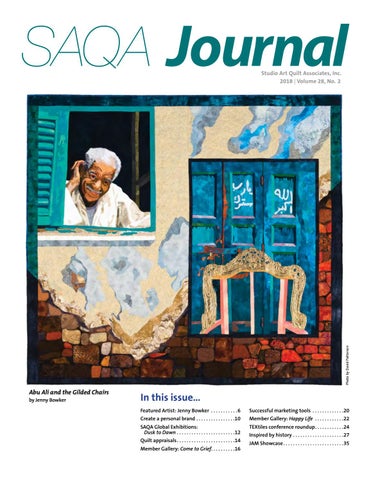
Abu Ali and the Gilded Chairs by Jenny Bowker
In this issue‌ Featured Artist: Jenny Bowker . . . . . . . . . . . 6
Successful marketing tools . . . . . . . . . . . . . 20
Create a personal brand. . . . . . . . . . . . . . . . 10
Member Gallery: Happy Life . . . . . . . . . . . . 22
SAQA Global Exhibitions: Dusk to Dawn. . . . . . . . . . . . . . . . . . . . . . . . 12
TEXtiles conference roundup. . . . . . . . . . . . 24
Quilt appraisals. . . . . . . . . . . . . . . . . . . . . . . . 14 Member Gallery: Come to Grief. . . . . . . . . .16
Inspired by history. . . . . . . . . . . . . . . . . . . . . 27 JAM Showcase. . . . . . . . . . . . . . . . . . . . . . . . . 35
Thoughts from the president
Leap and the net will appear by Lisa Walton
T
his is how I live my life. I often
that it is my role to remind everyone
doors
make a great leap into the
that we have many international
for me
unknown and find that a net appears,
members. Those members often feel
and gave
making the landing soft and forgiv-
ostracized by words and deeds, but
me the
ing. When I finally succumbed to
we have made progress to overcome
confidence to do many things I
requests to stand for president of
those feelings. Have you noticed that
would never have thought possible,
SAQA, I had many misgivings: How
the SAQA Journal is now organized
including writing my first book. Some
would our members relate to a non-
by issue number rather than season?
things change your life, and this
U.S. president for the first time? Am
Have you seen the translations for
award was one of them.
I arty enough? Can I cope with the
many website pages, including for
I also have a passion for food and
amazing variety of issues that will
online forms that provide non-U.S.
travel and have managed to combine
arise? Being a very practical person,
information? Those details make a
these activities with my art and teach-
I wondered how many days a week I
huge difference. Also, the board now
ing by designing and leading textile
could get up at 5 a.m. and be intel-
has three international members,
tours to wonderful destinations,
ligent in meetings with people on
which is in line with the 22 percent
which provide me with even more
the other side of the world. I thought
international membership.
inspiration.
about how new responsibilities would
I am a practicing artist and a JAM,
I am not sure yet what sort of presi-
fit into an already frantic life to be
but I find it difficult to express deep
dent I will be for SAQA. I feel strongly
able to do my best for SAQA.
thoughts about my work. I love color,
about continuing to develop our
I leapt anyway.
shape, and texture, yet the journey
Community and make Connections.
Now I am the new president of an
to create is often far more satisfying
I am sure I will frustrate some and
organization I feel strongly about and
than the end result. I find it difficult
be applauded by others, but I abso-
for which I hope to do my best. For
to write intellectual artist statements,
lutely know I cannot please all the
those who did not get to meet me
but admire those who can. I was a
people all of the time. Please make
at one of the annual conferences, I
traditional quilter for only about a
allowances for me while the train-
thought a quick introduction would
week when I discovered breaking the
ing wheels are on. I know that with
be a good idea for my first column.
rules was much more fun. I am also
your support and the support of the
a teacher and have been blessed with
wonderful staff and volunteers who
a few years I was a SAQA rep for the
the opportunities to teach all over the
work tirelessly behind the scenes, I
Oceania region, before becoming
world. I was the last recipient of the
will definitely try to do my best.
the first international member of the
International Quilt Festival/Houston
board of directors. I think I ruffled a
Jewel Pearce Patterson Scholarship for
few feathers at first (and probably still
Quilting Teachers, awarded by Karey
do!) with my typically Australian, no-
Bresenhan, a longtime supporter of
nonsense attitude, but I feel strongly
SAQA. This award opened up many
I live in Sydney, Australia, and for
SAQA Journal • 2018 | No. 2 •
3
Editor’s Notes
Touchpoints for carrying on by Diane Howell
In an instant, I realized what made
every eligible man was involved in
that visit possible. “I only had to
World War II. Gratefully, they all
be friends with him for 40 years for
returned home from various mili-
today to happen,” I said.
tary branches, including the United
This is how history moves, from
States Navy. One of my uncles was
one moment to the next, from one
lost for a time, only to be found by
relationship to the next. So deep
another brother in a military hospi-
eff Kida, photo editor of Arizona
is our desire to be special, to rein-
tal. One fought in France and earned
Highways, wrote a story on cam-
vent the wheel, that we often forget
a citation. One worked in an artil-
eras for our 2017 No. 3 issue. When
the events that brought us to this
lery plant here at home. All of them
members of my local art-quilting
point. Whether we are happy or
played a distinct role.
group here in Arizona read it, they
sad depends on so many factors, as
wanted a personal visit.
explored by the artists’ works selected
talked about their service, they came
J
So Kida, being the kind person that
While these gentlemen never
for our two Member Gallery features in
home, raised families, and enriched
he is, came to our group and set up
this issue. Whether we recognize the
my life as I watched them do things:
two mini studios so that we could
past or not, it shapes our future.
build machinery, run a grocery store,
see how to take better photos of our
I see my own past, present, and
secretly surprise disadvantaged kids
quilts. Afterward, someone thanked
future in Nautical Narrative, the
on Christmas. My mother was par-
me for bringing him to the meeting.
image on this page. In my family,
ticularly exasperated one Christmas Eve that my father, out playing Santa for kids in his company, stopped on
B.J. Adams
the way home at a Laundromat to
Nautical Narrative
give a child candy. He saw the little
20 x 20 inches / 2009 www.bjadamsart.com
boy crying through the window and
A few years after my father died, I received his hat and pictures of medals and ribbons documenting his 32 years in the United States Navy. My father taught me the importance of details. I wanted to make a memorial with a few of the colorful Navy details I was given.
This image is part of Member Gallery: Come to Grief. You can see the rest of the images on page 16. Enjoy our bonus feature this issue, Member Gallery: Happy Life, on page 22.
4
• SAQA Journal • 2018 | No. 2
couldn’t stand it. Their life lessons continue through me and my cousins. It’s easy to forget the importance of sacrifice and selflessness, though. It’s a daily commitment that slips through the cracks as we busy ourselves with tasks and worry. I think when we are at our most frazzled, that’s the time to stop and reflect on how you arrived at today. See the journey and find your direction.
SAQA adds two members to board of directors SAQA welcomes Carolyn Ducey and Gwyned Trefethen to its board of directors. Carolyn is the curator of collections at the International Quilt Study Center & Museum (IQSCM) at the University of Nebraska-Lincoln, a position she has held since 1998. She oversees the ongoing care and management of the IQSCM collection of more than 5,200 quilts. She also is co-editor of American Quilts in the Industrial Age: A Catalog of the IQSCM Collections, to be published in February 2019.
Carolyn Ducey
In 1998, she earned a master’s degree in American art history from Indiana University, and her Ph.D. in textiles, clothing and design, with an emphasis in quilt studies, at the University of Nebraska in 2010. Gwyned has been a SAQA member for 15 years. She served as the regional rep for SAQA Massachusetts/Rhode Island and held several positions on SAQA’s exhibition committee, including chair of the development subcommittee and secretary. She joins the board after just completing a three-year stint as chair of that committee. She recently returned to Massachusetts after living eight years in Wisconsin. She looks forward to putting her new studio to the test, living closer to family, and hearing from SAQA members.
Gwyned Trefethen
Marty Moon and Butch Davies became involved with SAQA attending regional meetings, annual conferences, workshops, and exhibits. They have purchased quilts from SAQA benefit auctions and at annual conferences. They started contributing to help SAQA more than a decade ago. They have committed a bequest to SAQA in their estate plans. Giving to SAQA helps others expand their interest in quilting and in SAQA’s mission. Marty and Butch invite you to join them in their support of SAQA.
Is SAQA in YOUR will? SAQA Journal • 2018 | No. 2 •
5
Featured Artist
Jenny Bowker
A life lived in many lands yields insightful artwork by Cindy Grisdela
A
ustralian artist Jenny Bowker began her professional life as an electron microscopy
technician. While working, she continued to make good use of her mother’s sewing lessons, which included dressmaking starting at age 11. “Through my early working years, I sometimes got up in the morning and made a quick dress if I had forgotten to put that week’s wash on the line,” she confesses.
New direction Her life took an unexpected turn when she married a diplomat. Their first posting as a married couple was Syria, and there wasn’t an electron microscope in the entire country. It was a somewhat moot point, though, as at the time she did not speak enough Arabic to communicate with peers. Her husband’s work took them to various postings in the Middle East. Bowker learned to paint from an artist in Jordan. She applied for and was
Abu Bellas 64 x 30 inches | 2010 Photo by David Patterson
accepted to a visual arts program at a university, largely on the basis of daily sketchbooks filled with small images and writings that she kept as notes for future projects.
6
• SAQA Journal • 2018 | No. 2
Mohamed Sa’ad — Caretaker of the Mosque 59 x 66 inches | 2009 Photo by Daniel Heather
“Four years of full-time study later,
Bowker has now lived in many
I had an honors degree in visual arts.
places, including Syria, Samoa, Malay-
I was painted out,” she says. “I made
sia, Jordan, Jerusalem, and Egypt.
a quick quilt for fun. Then another.
Her experiences in so many different
Then I took a beginner’s class. Then I
countries have a “huge influence” on
moved almost immediately to Jerusa-
her work. The experience of living in
lem,” Bowker says.
another culture makes you appreci-
Two discoveries After the move, Bowker real-
ate your own culture while you also “face the fact that there are many other ways to live, and each country
ized she could combine her love of
has the right to create its own rules
painting and her love of fabric. “It
of living,” she says. “Travel makes me
was an amazing moment. Anything
more understanding and resilient, less
I could say with paint, I could say
dogmatic. It opens doors.”
with fabric. Fabric was infinitely more tactile, and it is in many ways a
Style and approach
woman’s language. People reach out
Bowker works primarily with cot-
hands to touch it in a way that they
ton fabrics. For piecing, she works on
don’t reach out to paint.” Bowker is
a Bernina 750 sewing machine, and
attracted to the color of fabric, which
for quilting she uses a Bernina Q20
she feels is “richer and deeper” than
sit-down longarm machine.
paint, and color is very important in her work.
Her studio has large windows that let in plenty of light, and a design SAQA Journal • 2018 | No. 2 •
7
wall to create her large pieces. She has a dedicated space for pressing underneath a bookshelf. Fabrics are stored in plastic bins by color and arranged in a closet space. Bowker combines piecing and rawedge appliqué. “I dislike the art-craft divide, and pieced backgrounds or elements are a nod to the tradition of our particular medium.” To organize her work, Bowker keeps a list of project ideas and makes notes in her sketchbooks about elements she might like to include on each one. Once she is ready to start, she creates the elements from her notes to see how she likes them. Sometimes early samples don’t make it into the finished piece. “I build the work up. Sometimes there is a plan, but not
Margaret Rolfe — Quiltmaker
always.” Her portrait of quiltmaker Marga-
83 x 99 inches | 2012
ret Rolfe began with the background
Photo by Ken Fife
of traditional blocks in a color-wash design. Then she added the blocks of Rolfe’s paper-pieced animals. Bowker left the portrait until the end. “I knew I was edging very closely into traditional patchwork — but that summed up Margaret and her work, so it was appropriate,” she says. Bowker works in several series that include figurative pieces and landscapes. Her series of portraits of Arab men is particularly compelling. “My portrait work started with the idea of making Arabs real people to [viewers in] the West. I felt that I could make quilts showing people I admired, men who are competent at their work and who work hard and long hours for little money, but somehow keep a sense of humor and a love of company though it. I wanted to put a
Acheulean Hand Axes 64 x 30 inches | 2010 Photo by David Patterson
very human face on the Arab world.” A good example of this approach is Hashim, a portrait of a thoughtful man seated in front of a warm gold
8
• SAQA Journal • 2018 | No. 2
Hashim 71 x 58 inches | 2007 Photo by David Patterson
background. “There is an admirable
Abu Bellas, Water Mountain, and
quality in the people of Egypt, a qual-
Acheulean Hand Axes.
ity of accepting the life that is given to them regardless of its difficulty or the poverty they have to endure. It
Day job Much of Bowker’s time is spent
often shows in their faces,” Bowker
teaching, which she considers her day
says.
job. “There is no greater delight than
Her landscape work is based on
to offer tools to a quilter who wants
places where she has lived that have
to make original work, but doesn’t
particular meaning. The series Earth,
Water Mountain
know how to access her own ideas,”
65 x 30 inches | 2010
Air and the Memory of Water is a
she says on her website.
Photo by David Patterson
tribute to the Egyptian countryside.
Bowker doesn’t sell her work
A trip across the Sahara provided the
because of the time it takes to create,
inspiration for the four pieces, each
but she does use her own quilts to
with a view from the windshield at
find opportunities to teach. Some-
the top, a grid “to represent our need
times her classes turn into patterns.
as humans to put things into order,”
“I now see pattern sales as a new day
and things found along the way at the bottom. They are Ammonite Fields,
see “Bowker” on page 33
SAQA Journal • 2018 | No. 2 •
9
Professional Development
Shine a light on your career: Create your personal brand as an artist by Joe Ray
W
hat do people say about your art when you’re not
around?
You want your work to be known
• What is the name of your business, i.e., your brand name? • Who is your audience?
• What do you do, and why? • How do others see you and your work?
• What makes you unique?
• What does the look of your art, your
ity, and concrete statement. These
• What are you known for?
marketing materials, website, and
individual elements claim a distinc-
• Would you hire yourself?
for its signature style, visceral qual-
tive spot in your field and create your brand. Even though you may not
• Why should your clients care?
messaging communicate about you? • What is the first impression you want people to have when they
consider yourself a brand, perhaps it
come in contact with you or any
is time that you think of yourself and
touchpoint of your brand?
your work as just that. You are now a brand. Why now? Let’s say you want to move forward with your career, and you’ve found your own voice and/or style as a fiber artist. It’s time for you to plant your flag in the ground around you. It’s your voice and what you bring to the world. Claim it. Own it.
Getting started Beyond a specific trademarked
‘It may be easy to say you are a fiber artist, but you need to make that term your own.’ It may be easy to say you are a fiber
about you and what others say about
artist, but you need to make that term
you when you’re not in the room. A
your own. A great example of a value
brand experience applies to a busi-
statement is found in the promo-
ness, a product, or a service.
tional video on the SAQA website, Stitching Together a Global Commu-
will focus on your personal brand,
nity. In that video, I really appreciate
which is based upon the experience
Maria Shell’s statement. She explains
and impressions that others have
what she does and why she enjoys
acquired about you and your work. As
her art and being part of SAQA. She
a marketing/branding practitioner, I
positions herself with a clear, concise,
ask clients to answer these questions
and approachable statement.
to help position themselves in their market(s):
10
• SAQA Journal • 2018 | No. 2
branding.
Brand benefits One obvious benefit to branding is that you will have your work recognized for a certain style. This goes back to the experience that you provide and the story you tell. The late Andy Warhol and the late Keith and their legacies live on through the
that you provide to others. It is the
For the sake of this article, we
ible? I refer to these are the 3 Cs of
Haring were bigger-than-life brands,
product, a brand is the experience impression that the world gleans
• Is it clear, consistent, and cred-
To hammer out your definition, ask yourself these questions:
Andy Warhol Museum and the Keith Haring Foundation. Theirs is branding on an outsized level. Most of us are working artists who will benefit from using the lessons learned by these two artists about focusing on a directional style, building a mystique around the work and themselves, promotion, and finding solutions and outlets that fit with their brands. Some of the artists I admire for their overall talent and their personal brands include Kathy Cano-Murillo
and her Crafty Chica brand, Lisa Con-
If you don’t have a logo, just make
issues and have a more serious nature?
gdon, Gustavo Rimada, and author
sure your message and the experience
Whatever your style, be genuine.
Luís Alberto Urrea. Here are traits
you provide is consistent, and what
they have in common:
you want to portray.
• They offer a defining introduction as
What kind of experience do you
are passionate about and enjoy their journeys. • They present a sense of welcome to their websites. • They engage with their audiences through workshops, social media, and teaching about what they do. Through this engagement, you get to know them.
Know your brand
‘Another way to carry your brand message is to be consciously consistent at every touchpoint.’
at every touchpoint. Do you have a logo? This could be something as simple as your signature, but it should appear on all of your correspondence.
ity at an event where your work is on and something that you control. Another aspect of your brand is your cultural heritage. Does it come through in your work? If not, then this is something that you should consider incorporating into your personal brand. If it’s in your DNA, it’ll show up in your work.
Brand essentials You don’t have to go to great lengths and expense in order to establish your brand. But one basic musthave is a solid digital presence. In this
Another way to carry your brand message is to be consciously consistent
around you? What is your personaldisplay? This is part of your brand
to who they are and what they do. • They give an overall sense that they
How do you respond to the world
digital presence, you have to include: provide? Is it approachable (think Crafty Chica and Lisa Congdon), and do you have a friendly aura about you? Or are you more cerebral and perhaps intensely focused on social
• Website: What are you about? Show some work, tell us about you. We want to like you, especially if see “Branding” on page 30
Tips to create your visual identity As an artist developing your personal brand, think of how you are going to establish your visual identity. Remember, a logo is not your brand. YOU are your brand. This is my signature. It is also my logo. It has evolved over 20 years by simplifying it to allow it to be more flexible within different formats, including horizontal and vertical. This particular color is used when reversed out of black, as on my website. I use the full image for presentations and exhibition submissions. I no longer use a particular icon as my logomark, but I sometimes utilize certain elements as secondary icons. Those elements are representative of the work I do and include hearts, mermaids, and angels. Terms of the trade Logo - A logo also is referred to as a logomark or a brandmark in marketing
speak. The logo can be a pictorial mark that is representative of something (a heart, angel, etc.), or an abstract mark that conveys an idea. It can also be letterforms, such as IBM. Is your logo representative of your work? Is it textural? Does it represent a weave or a shape? Wordmark - My logo is an example of a wordmark. One of the best known wordmarks is Google. If you pursue this direction, do you go neutral as I did? Or do you want to design something that has more flair and personality? Logotype - This is the name or set of words for a brand’s identity. It’s consistently displayed in a determined manner and designed with specific font usage. When designing logotype, ensure that it is readable in different sizes and mediums.
Signature Logo
Presentation Logo
SAQA Journal • 2018 | No. 2 •
11
Selections from
Dusk to Dawn The world changes when the sun dips below the horizon. The 35 works included in the SAQA Global Exhibition Dusk to Dawn form a collection of abstract nightscapes, animal portraits, and other overnight observations. They offer a glimpse of the mysterious world that emerges when darkness arrives. The juror was Marilyn Zapf, assistant director at The Center for Craft, Creativity & Design and curator of its Benchspace Gallery & Workshop in Asheville, North Carolina. Dusk to Dawn will premiere at International Quilt Festival/Houston, November 8-11, and continue on to International Quilt Festival/Chicago, March 28-30, 2019. Additional venues will be added through December 31, 2021. For more images and information, visit www.saqa. com/dusktodawn.
Pat Pauly Nightscape in the City 40 x 40 inches | 2018
Sara Sharp Summer Solstice 34 x 26 inches | 2018
Betty A. Hahn Insomnia 51 x 37 inches | 2018
12
• SAQA Journal • 2018 | No. 2
Lisa Walton Another Long Night 26 x 37 inches | 2018
Dianne Firth Trundling Orbs 33 x 40 inches | 2018
Pat Baum-Bishop I See 48 x 28 inches | 2014
Terry Aske Aurora 27 x 29 inches | 2018
SAQA Journal • 2018 | No. 2 •
13
Confirm your work’s value with quilt appraisal by Cindy Grisdela
A
quilt appraisal covers more
techniques, and condition), Jordan
or art. “Some intangible items may
than how much you paid for
explains. She also includes a “narra-
carry slightly different weight, such as
fabric and how many hours it took to
tive presenting a case for arriving at
graphic appeal or the cost of materi-
make a piece. It is a written docu-
value, which might include a listing
als, but that is true of all appraisals,”
ment that assesses the value of your
of comparative work.” Providing at
East says. “One thing makers do not
quilt based on a series of factors. It is
least one photo is important, too.
always understand is that the amount
created by trained professionals who
The most common type of
of time they’ve put into a piece car-
keep track of sale trends so that they
appraisal is for insurance replace-
ries no weight at all. Because we are
know what sells, current price points,
ment value. This type of appraisal
considering quality of workmanship,
and where sales occur, explains
establishes a value for “replacing the
among other things, the amount of
Bunnie Jordan, a quilt appraiser in
quilt with one of a similar like, kind,
time is already factored in,” she adds.
Virginia certified by the American
and quality,” explains Sandra Starley,
A quilt that is hand-appliquéd will
Society of Appraisers.
an AQS certified appraiser in Utah.
likely be valued more highly than
An artist would need this type of
a similar piece using fusibles, for
examination of the quilt to determine
appraisal to seek reimbursement if a
example.
its condition, construction tech-
quilt was lost, damaged, or stolen.
An appraisal includes a personal
niques used, amount and distribution
If you have a quilt collection and
Jordan notes that collectors who wish to divest themselves of art quilts
of quilting stitches, artistic con-
you wanted to sell one or more of the
may have an easier time finding
cept, resume of the maker, and the
pieces in it, or make a donation to a
museums and other institutions will-
provenance or history of the quilt,
museum, you would need a fair mar-
ing to accept donations than they
according to the Professional Associa-
ket value appraisal, which is different
would with antique quilt collections.
tion of Appraisers — Quilted Textiles
than an appraisal for insurance, East
This is especially true of well-known
(PAAQT) website. The appraiser uses
says.
names in the art quilting world, such
his or her knowledge of the field and
Fair market value is determined
assessment of these and other factors
“based on what the quilt would sell
says. Museums already have classic
to determine the value of the quilt.
for in a transaction with a knowledge-
examples of antique quilts, but don’t
The appraisal “includes written docu-
able and willing buyer and a willing
have as many examples of great art
mentation substantiating that value,
seller in a standard marketplace for
quilts, Jordan explains.
and requires an unbiased opinion
the item on the current open mar-
from an educated professional. It is at
ket,” Starley explains. Value for dona-
corporate collections and public areas
once both art and science,” says Lorie
tion purposes is also based on fair
like hospitals and airports has made
East, an American Quilter’s Society
market value, she says. But be aware
people look differently at art quilts,”
(AQS) certified appraiser in Missouri.
that if you donate your own work to
she says. This exposure is “a positive
a charitable organization or cause,
thing for the marketplace,” along
information: name of owner and
the IRS allows you to deduct only the
with the recent exhibition of quilts
maker, date of inspection, purpose
cost of materials, not the fair market
owned by filmmaker Ken Burns at the
of appraisal/definition of value,
value. Check with your tax adviser for
International Quilt Study Center &
approach to value (market com-
details.
Museum in Lincoln, Nebraska. “It’s a
All appraisals include similar
parison, sales data, and cost to
The process is similar whether
as Michael James or Nancy Crow, she
In addition, “Seeing fiber pieces in
nice boost for quilt collectors to find
reproduce), and a description of the
the quilt being appraised is antique,
out that prominent people appreciate
quilt (size, date created, materials,
vintage, new, traditional, modern,
quilts,” Jordan observes.
14
• SAQA Journal • 2018 | No. 2
The three appraisers all stress that
If you want to have your quilts
getting an online appraisal using
they are not judges of the work.
or your quilt collection appraised,
photographs of your quilt. “Written
When they assess a quilt, their main
what’s next? There are about 100
and certified quilt appraisals are legal
concern is in “positioning it in its
quilt appraisers in the United States
documents and require the appraiser
genre,” Jordan explains. So technique
and Canada who are certified by
to personally examine the quilt,” she
matters only in context of other
AQS. These appraisers are trained and
says.
similar work. “Is it a great example or
tested, and must undergo recertifica-
Once you’ve found an appraiser,
a common example?” she asks. For
tion on a regular schedule. “Apprais-
he or she will usually have a ques-
instance, Jordan recently attended
ing is assigning realistic values that
tionnaire for you to fill out to get
the 2018 Tokyo Quilt Festival and
can be defended using factual data in
background information on the quilt
noted there were “lots of log cabin”
itself — materials, techniques, any
quilts at the show, but they were
unusual elements — and on the quilt-
more innovative than traditional log cabin designs. Does winning an award or a prize affect a quilt’s appraised value? “No. Yes. It depends,” East says. It’s an intangible that gets considered. “One award at a small local show may not have much impact on the value, but a history of top awards and recognition at international shows can make a difference,” she explains. Jordan adds: “If there’s a prize, it shows a level of aesthetic appreciation,” particularly a prize at a major national or interna-
‘One thing makers do not always understand is that the amount of time they’ve put into a piece carries no weight at all.’ - Lorie East
tional show. But in the end, a prize
Do stylistic changes over an artist’s
will include a resume, CV, or other document detailing their publication history (of the quilt as well as articles they have written), show and award history (of that particular quilt as well as others), and the maker’s teaching/ lecturing experience,” East says. East also recommends that you ask the appraiser up front if they are comfortable appraising art quilts. “While we are all trained to write appraisals for art quilts, some people prefer not to do them. All you have to do is ask,” she says.
may be only one factor that helps determine value.
maker. “Most of my art quilt clients
Prices for an appraisal vary from a court of law, if necessary,” according to the AQS website. To find an AQS
about $50 to $150. Finally, if you are getting an
career impact value? Michael James,
Appraiser visit www.americanquilter.
appraisal for insurance value, be sure
for example, famously changed his
com/quilting_community/appraisers.
to check with your insurance com-
style from his early, colorful strip-
php.
pany to confirm that they will cover
pieced work to more recent quilts
Starley says most certified apprais-
your quilt for the appraised amount.
with less color and more digital
ers belong to PAAQT, which was
Some insurance companies require a
imaging. According to Jordan, such
established in 1992 “to promote the
rider for quilt coverage separate from
a change in style is “not a significant
importance of quilt appraisals and
your homeowner’s insurance.
change in valuing his work,” since
to provide continuing education
James’ work is still recognizable and
and networking for appraisers.” Visit
getting an appraisal of your own
he continues to show and sell.
www.quiltappraisers.org for a list of
work or of the quilts in your collec-
appraisers.
tion, keep as many records as you can
Jordan makes another important point for quilt artists who are consid-
If a certified appraiser from these
ering whether their own work needs
resources isn’t available in your area,
to be appraised. If an artist has a
many national quilt shows offer
robust record of sales, that might be
appraisal services by appointment.
sufficient to assess value without an
Remember that you will have to have
appraisal, she says. Keeping very good
your quilt with you for the appraiser
records is key, however.
to examine. Starley cautions against
Whether you are thinking about
about the quilt and its creation to optimize its value over time. Cindy Grisdela is a SAQA JAM who resides in Reston, Virginia. You can see her work at cindygrisdela.com.
SAQA Journal • 2018 | No. 2 •
15
SAQA Member Gallery: Come to Grief
Judith Quinn Garnett First Love 24 x 24 inches | 2017 www.blackdogdesignPDX.com It is painful to observe a young person encounter love and loss for the first time.
Judy Kirpich Anxiety No. 7 / Richard 80 x 61 inches | 2012 www.judykirpich.com I had to let go a close friend and employee who had worked with me for 20 years. The act of slashing fabric was healing.
Susan Kelly Summer’s End
Bev Haring Persistent Resistance 38 x 25 inches | 2017 www.esmerldas.blogspot.com This is a portrait of my mother as she carries on after the death of my dad — fighting on!
16
• SAQA Journal • 2018 | No. 2
30 x 20 inches | 2017 www.sizzlewaggle.wordpress.com In spring 2017, I tended my mother, who left us on May 10. At the same time, I was part of a group challenge about flowers. The image of a fading flower was before me. This quilt is in memory of my mom.
Joan Nicholson Jenny My Jenny 46 x 53 inches | 2015
Susie Monday Milagros 70 x 52 x 1.5 inches | 2013 www.susiemonday.com
Before Jenny died, I promised her that she would be remembered. The small quilt I planned didn’t say who she was. I printed pictures and wrote her story.
The Sirena’s body is made of milagros, amulets used in Latin American churches. Each icon represents something my father taught or shared with me.
Marie Murphy Wolfe Turmoil: Alone 42 x 31 inches | 2015 After my husband passed away, art let me explore and release grief. The call for the SAQA Global Exhibition Turmoil made me think about what caused me the most turmoil.
SAQA Journal • 2018 | No. 2 •
17
INNOVATECH™ is available in 60 of the most popular color choices, and can be purchased in 3000 or 6000-yard cones. Contact an Innova® dealer near you to buy INNOVATECH™ quilting thread. ABM International is known for its innovative and cutting-edge technology and products. We constantly strive to stay ahead of the curve; to be at the forefront of major advancements in the quilting industry.
Use the only thread designed specifically for use on a longarm quilting machine BY THE PEOPLE WHO KNOW longarm quilting machines.
Innova longarm quilting machines are manufactured by ABM International, a three generation family owned and operated business near Houston, Texas. The Innova® has been engineered to meet the most discerning quilter’s needs. Based on a long term commitment to excellence, ABM International offers a full array of high quality quilting machinery. As such, Innova has been working for some time now to develop a unique, superiorquality thread. After much research and development, Innova is pleased to introduce INNOVATECH™ Quilting Thread. After its debut at the 2017 International Quilt Market and Festival in Houston, it has been flying off our dealers’ shelves! INNOVATECH™ is an exclusive thread engineered specifically for longarm quilting. It is a tex 27, 40-weight poly wrapped poly, and its sleek design and beautiful finish allow for maximum efficiency while providing superior visual appeal. One customer even claims, “It runs like melted butter.”
Built To Quilt® Contact a local Innova Dealer for special offers on the only longarm machine that’s “Built to Quilt®” www.innovalongarm.com
Innova Gives Back One of the major aims of ABM International is its corporate responsibility – not only to the entire quilting community, but its local community as well. Innova has always strived to make it a top priority to give back to the community and those in need. Comfort quilts are made and donated with love and generosity, and that comes through to those individuals who receive them at times that are often the most difficult. Comfort quilts represent the sheer goodness of complete strangers. They illustrate the goodwill and caring attitudes of people who want nothing more than to help their fellow man. It is a labor of love for the giver, and, for the receiver, a source of comfort and positive reminder of the world’s goodness.
Hurricane Harvey Comfort Quilts With the recent storms that devastated the gulf coast region this past summer, Innova has been involved in quilt drives whose goal is to get comfort quilts into the hands of the hurricane victims, specifically those devastated and/or still displaced by Hurricane Harvey. Innova’s factory and main office are located just north of Houston, so it is perfectly situated to act as a shipping destination for comfort quilts sent to them by quilters from all over the country. Innova, in turn, has been organizing quilt donations to those in most need of these beautiful quilts, and it has been a huge success.
Las Vegas Comfort Quilts Within just weeks of the devastating hurricanes that hit Houston and surrounding areas, the Las Vegas Massacre occurred. On his recent trip to Nevada, ABM Innova’s president, Neal Schwarzberger, met Chantal McCrorie, an attendee at the concert during the shooting. She shared with him her story, and he knew Innova needed to do something to help the victims and their families. So again, calling upon what seems like a never-ending supply of generosity from the quilting community in this country, Innova sent more donated comfort quilts to McCrorie, and she has been distributing each quilt individually to victims most in need of healing from this horrible tragedy. McCrorie says it has been immensely therapeutic for her and has done wonders in her own emotional healing to be a part of something like this.
Marketing success found in tools that connect buyers with artists
hat is the most effective way to promote
W
Email efficiency
art quilts?
Another way to achieve meaningful contact with
tools have brought them the most success. Answers
straightforward marketing staple.
The SAQA Journal asked members what marketing
ranged from email newsletters and Facebook to open studio tours and even one lucrative doctor’s visit. The common thread was a personal touch that made the artist visible and approachable.
Get ‘out there’ Several responding artists parlayed exhibition opportunities and attendance at events such as exhibition openings into everything from sales to teaching opportunities. Maggie Dillon of Sarasota, Florida, says her key marketing components are exhibiting her work and attending openings and artist receptions. One exhibition she was part of led to her getting a solo show at an art museum, while others led to trunk shows that in turn led to booking workshops. Terry Grant of Beaverton, Oregon, had similar results when she became a part of her local open studios tour. “My main goals are sales and name recognition. For me, my blog and participating in the local open studios tour have been the most successful tools to bring both sales and recognition. “For a basically introverted person, it isn’t always comfortable to put my work and myself out there in those ways, but I have come to believe that buyers respond as much to the artist as they do the art. A personal connection adds a layer of meaning to an artwork. To my surprise, I found that I actually enjoy both blogging and welcoming people into my studio, and both feel like natural and genuine ways to meet new friends who are also often buyers. In addition, both my blogging and open studio [participation] have given me opportunities for TV appearances, invitations to participate in shows, and valuable connections,” Grant says.
your fans and collectors is an email newsletter, a Cindy Grisdela of Reston, Virginia, reports that her email newsletter is her most successful marketing tool. “I collect emails from people who visit my booth at shows, take my classes, or attend my lectures. I also have a signup widget on my website and a link at the bottom of every email I send,” she says. “I send out an email newsletter about once a month, and it works well because these are people who are interested in my work and they have given me permission to contact them. I use MailChimp, but there are other providers out there — Constant Contact is another popular one. The newsletter doesn’t have to be long, and it usually refers to a show I have coming up, new work, a TV appearance, or a new blog post that I want to feature as a call to action.” Ellen Lindner of Melbourne, Florida, uses her email newsletter to promote her classes. She also sends her newsletter out monthly, always with new work, and usually with a helpful teaching tip.
Custom messages Lindner also targets venues. “I wanted to have a solo show in the local art museum. I bought a book about preparing presentations, and put everything together very professionally. I sent it to the museum and followed up 10 days later. Amazingly, I was invited to come show my portfolio to the curator and she offered me a solo show!” Lindner says she had traditional marketing materials already in place when she made overtures to the museum. “My portfolio was already in professional shape and up-to-date, thanks to articles I read in the SAQA Journal about being prepared.” In addition, she had done a free art quilt presentation for a sorority alumni group as a favor to a friend. “One of the women who loved my work turned
20
• SAQA Journal • 2018 | No. 2
out to be a mover and shaker among the museum
conditions. “It makes it really easy for them to
volunteers and she lobbied for my show,” Lindner
decide what they want and what the budget will
says. “Everything works together.”
need to be,” she says. “It’s a challenge to stay orga-
Online presence
nized though. These things need to be constantly updated!”
Bridget O’Flaherty of Perth, Ontario, Canada,
Elena Stokes of Clinton, New Jersey, says one
says her social media campaign is her market-
thing that has had an enormous impact on her
ing foundation. Her long-term goals are to travel
marketing efforts is her website. “It is important to
and teach. “I came back to my art last July after a
have a visually impactful, well-designed website. I
10-year diversion. I decided to target gaining an
use Wordpress and a theme that is very dynamic,
audience before working on sales. I gave myself
versatile, and has good SEO [search engine optimi-
a year. I’m targeting 5,000 followers across all
zation]. I have been contacted through my website
platforms. To date, I’m at about 35 percent of my
many times with invitations to exhibit my work,
goal,” she says. “I have been working on platforms
write about my work and process in magazines, and
that are somewhat integrated: my blog, Facebook,
most recently by a commercial interior designer
and Instagram, which all lead to my email list.” She
whose client is interested in several pieces for a new
also has a presence on YouTube, Twitter, Pinterest,
hospital. She said she found me through a Google
and LinkedIn.
search.”
O’Flaherty’s efforts are paying off. She was recently contacted by a textile magazine based in
Networking success
the United Kingdom after they found her work
Stokes also feels belonging to a group like SAQA
online. She was also invited to teach to a collective
is important. “I joined SAQA in 2011 with the
of quilters on the East Coast.
intention of pursuing exhibitions. I was fortunate
Her approach to social media is systematic. “I use
enough to be accepted into [the SAQA Global Exhi-
an editorial calendar to map out my posts, though
bitions] Seasonal Palette and then Celebrating Silver.
if I’m being honest I’ve let that slide and have just
From those two exhibitions, so many things have
been posting multiple times per week,” she says. “I
happened. My work has appeared in magazines
prefer the calendar, as it forces me to plan. I think
and contemporary quilt art books. I’ve sold work
about what I’m saying with purpose. I then post on
through a SAQA exhibition and got a commission
my page and sometimes share that post in groups.
as well. I am connected with and inspired by my
I feel that slow and steady growth is a good way to
fellow artists to stretch artistically, dig deep, find
go. I’m hoping I will get exponential growth for
my voice, and elevate my work. As a result, I’ve
the last half of my target year.” Another sign of
been juried into the top quilt art competitions and
her success is the fact that she has few unsubscribe
won awards.”
requests. Social media messages don’t just roll off the
Valerie Wilson of Winnipeg, Manitoba, Canada, had an initial goal to be in more exhibitions. “To
keyboard, however. “It’s been a long development
attain that end, I joined a group called the Fibre Art
of figuring out what to say, what my message
Network and was able to exhibit with them. The
should be. So many iterations of a mission, vision,
camaraderie and sharing of expertise have been
core values, a bio, artist statement, and CV,” says
a valuable aspect of this group as well,” Wilson
O’Flaherty. “I was just listening to a podcast that
says. “I have been able to acquire solo exhibitions
talked about having a media kit at the ready. That’s
by applying to public galleries and venues. Some
my next project, to put all of these things into a
of these opportunities have come about through
slick package with visuals, so when media comes
networking with other artists.”
looking, I’m ready!” She already has many marketing tools at the ready. O’Flaherty booked one gig because she responded immediately and sent a prepared sheet with workshops, lectures, and terms and
While FAN is for artists living in Western Canada, Wilson formed a local fiber art group that has created its first successful exhibition. By reaching out see “Marketing” on page 29
SAQA Journal • 2018 | No. 2 •
21
SAQA Member Gallery: Happy Life
Maude Wallace Haeger Modern Muses Hanging Out at a Party 32 x 51 inches | 2017 Layers of embroidery and transparent fabric, inspired by Byzantine tapestries and a fabric glazing technique, give greater surface depth and allow the human eye to mix colors.
Shannon Conley 4th of July, 2015 35 x 31 inches | 2016 shannonconleyartquilts.com Childhood’s innocent secrets, imaginary worlds, and whispered conversations remain elusive to those outside. This quilt depicts my beloved niece and nephew.
Mary Ritter Tea Time on Calle de Cadiz 33 x 25 inches | 2017 www.muniqueblog.wordpress.com Tea is poured and I relax on the balcony as families gather for siesta in Valencia, Spain.
Kathryn Pellman Downtown 31 x 43 inches | 2015 www.kathrynpellman.com My fantasy downtown.
22
• SAQA Journal • 2018 | No. 2
Bonnie J. Smith Celebration 65 x 35 inches | 2013 www.bonniejofiberarts.com All happenings big or small should be celebrated, as we are worth it! This is the 12th piece in my Swimming Upstream series.
Jeannie Moore No Worries 60 x 38 inches | 2016 www.jpmartist.com Polar bears at the San Diego Zoo cool off in the water. I wanted to capture the movement of this bear’s thick layers of fat and fur with the undulating water.
Susan Callahan Saucing the Plate 31 x 39.5 inches | 2017 Working as a chef, there is satisfaction in finishing the perfect plate.
SAQA Journal • 2018 | No. 2 •
23
Photo provided by visitsanantonio.com
Direct from San Antonio: SAQA’s 2018 conference roundup by Cindy Grisdela
O
ur 2018 Annual Conference in
be grateful, be ready” for the ideas
Conference favorites
San Antonio, Texas, had it all
brimming in your head, Dunnewold
Making their third appearance at
— lightning talks, vendors, dynamic speakers, and nighttime boat rides on the San Antonio River Walk.
said. It’s important to “love your own work better than anyone else’s,” and
Could it get any better?
become emotionally invested in it
Yes!
so that viewers can feel your energy.
Vibrant speakers
However, don’t become so personally involved with your work that you
TEXtiles gave attendees all that and
can’t step back and evaluate it objec-
more. One of the highlights was Jane
tively. You can use design principles
Dunnewold’s Sunday keynote address
to see what’s going wrong with a par-
that gave attendees a framework to
ticular design, but you must “listen to
care for themselves and grow as art-
your heart and your intuition to fix
ists. Dunnewold, an artist, author,
it,” she said.
and teacher who lives in San Antonio,
Journalist and popular lecturer
has inspired countless artists with
Meg Cox also gave an entertaining
her books, such as the iconic Complex
presentation on Sunday with tips on
Cloth and Creative Strength Training:
how to deliver a memorable lecture.
Prompts, Exercises and Personal Stories
She recommended opening yourself
for Encouraging Artistic Genius. She
to the audience, making eye con-
told conference attendees that the
tact whenever possible and being
first step to move forward as an artist
dramatic in your voice and gestures,
is to stop caring about what others
rather than simply reading from
think about your work. This is often
notes. Use humor to draw your audi-
difficult to do if you have people in
ence in, especially if you are relating
your life who are important to you —
a personal anecdote that shows your
parents, spouses, children, or teachers
initial struggles with the topic you’re
— whose good opinions you crave.
speaking about.
Next, you must take ownership of
“Stage fright is a real thing. Make
your ideas, and “become convinced
friends with it,” Cox advised. Even
of the validity and strength” of those
experienced lecturers experience stage
ideas. Trusting your own instincts
fright and they cope with it by prac-
and learning to work with them is
ticing their speech and their delivery
vital to the creative process. “Be open,
until they are comfortable.
24
• SAQA Journal • 2018 | No. 2
a SAQA Annual Conference were the popular lightning talks. Each speaker presented 20 slides and had 20 seconds to speak about each one. This year there were 16 presentations divided into three sessions over two days. Topics included: Inspiration vs. Emulation by Heather Pregger; Chairs — Choosing an Icon by Maggie Vanderweit; Quilting in an Oslo Concrete Factory by Daisy Aschehoug; Lessons from an Art Teacher by Margaret Abramshe; Time Travel through Textiles by Susie Monday; and Always Have a Safe Word by Jaye Dodds and Andrea Dodds. If you have an informative topic you’d like to present in this format at a future conference, contact the special events committee. The conference officially opened on Thursday with the opportunity for a riverboat cruise along the San Antonio River Walk right outside the hotel. Attendees took the cruise in small groups, while the rest enjoyed an Icebreaker Reception featuring artist speed dating. In this fun activity, participants are encouraged to sit at a table with people they don’t know. Each person has 90 seconds to share information with the rest of the table about their work and to hand out postcards or business cards. The end
Outgoing president Lisa Ellis, left, passed the crown to incoming president Lisa Walton.
Networking was a major benefit for conference attendees.
Conference attendees enjoyed boat rides along the San Antonio River Walk route.
Several of our Visionaries, donors who contribute a minimum of $240, attended a reception Friday night, including Paul Foerster, Peggy McCaskill Foerster, and Marianne Williamson.
of each turn is punctuated by the
a meal and go sightseeing. Friday
sound of executive director Martha
Night Out was a chance for attendees
Sielman’s gong.
to dine at one of several preselected
On Friday, conference attendees
restaurants. During free time on
heard presentations on opportuni-
Saturday, attendees met in the lobby
ties in the different SAQA regions
and formed groups to explore various
and news on SAQA exhibitions. Four
San Antonio destinations, such as
breakout sessions followed with
the Blue Star Arts Complex, a tour of
attendees selecting two. The topics
the San Antonio Missions, museums
were: Best Practices for Professional Art
on the north side of town, the Pearl
Instructors by Heather Grant from the
Brewery District, downtown, and
Modern Quilt Guild; Back to Basics
the River Walk area, which includes
— Design Basics, That Is by artist and
sights such as the Alamo, the most
teacher Lynn Koolish; Design Rebel by
visited historic site in Texas.
San Antonio artist Miki Rodriguez;
On Saturday afternoon, those who
and TEXtiles Gallery Talk by juror
had reserved a spot ahead of time
Carole Staples. TEXtiles was not only
were able to have new work or work
the name of our conference, but also
in progress critiqued. The sessions
the name of an SAQA Texas exhibi-
were led by Texas Quilt Museum cura-
tion at the hotel. On Friday night and
tor and former SAQA president San-
Saturday, participants had a chance to
dra Sider and by former SAQA board
get together in small groups to enjoy
member Judith Trager. Anyone could
Upcoming Conferences Our next two conferences are already scheduled, and plans are being made for speakers and activities. Mark your calendars for April 2528, 2019, in San Jose, California. Registration begins this September. We will hold our first international conference in Toronto, Ontario, Canada, March 19-22, 2020. If you have suggestions for a future conference site, please contact executive director Martha Sielman at execdirector@saqa.com.
SAQA Journal • 2018 | No. 2 •
25
be part of the audience, and many took advantage of the opportunity to see this process.
Spotlight Auction The Spotlight Auction held after the conference banquet on Saturday night had a record number of donations this year — 204. The artwork The new owners of just a few of the 204 pieces in the Spotlight Auction were happy to show off their acquisitions.
raised $22,445, a record amount that will be used to further SAQA’s mission to promote the art quilt. There was palpable energy in the room as attendees circled the tables to view
Ryan Israel, sales representative for ABM International, Inc., answered questions about the many features of the Innova longarm machines. His company recently introduced an embroidery component that allows owners to embroider on their Innova longarm.
the quilts on display. Led by special events chair Susan Lapham and a dedicated crew of volunteers, each 6 x 8-inch quilt donation was received, matted, and slipped into a clear protective sleeve. The quilts were set up on small easels on tables around the perimeter of the banquet room. There was some spirited, but goodnatured, competition in the bidding on several special pieces. As each table closed, the details were entered into a computer at the front. A running total of the winning bids was projected on a large screen, adding to
SAQA thanks all of our sponsors who made TEXtiles a success.
the excitement.
The companies who sponsored this year’s Annual Conference were:
nity to see art quilts in person, hear
Gold Sponsor: Innova Silver Sponsors: Attached Inc. / Mistyfuse
Turtle Hand
C&T Publishing
Bronze Sponsor: eQuilter.com We also want to thank our volunteers and attendees who made this conference a productive and fun-filled experience.
26
• SAQA Journal • 2018 | No. 2
There is something for everyone at each SAQA conference: the opportuwell-known speakers, discover more about SAQA resources, get information on the business of art, and above all, network with other creative people who understand your challenges and applaud your successes. Cindy Grisdela is a SAQA JAM residing in Reston, Virginia. You can view her work at www.cindygrisdela.com
Inspired by
history
Design book lays groundwork for innovative piece by N.K. Quan
During the first half of the 19th century, English-born Welsh architect Owen Jones began a project that became a seminal design sourcebook, The Grammar of Ornament. Originally published in 1856, Jones’ book formulated principles of decorative arts and included key examples from historic and geographic sources. Still in print today, it maintains relevance as an inspiration source for contemporary designers. And inspire it has. “Because my work is conceptually based on architecture, I generally snap photos of unique buildings and their various decorative elements for inspiration,” says Susan Lenz of Columbia, South Carolina.“ Occasionally, I will sketch a new motif in a journal, writing daily stream-of-consciousness entries that help pull new approaches and ideas from the back of my mind.” Lenz owns a copy of The Grammar of Ornament and used her copy to find a bit of inspiration. Her objective was to be inspired by one of the images in the book and to take to heart Jones’ principles that “true art consists of idealizing, and not copying, the forms of nature.” Her inspiration was an Indian vase image. The result was Stained Glass LXXXI, a striking quilt rich with color and detail that sets its own style. Designing
the quilt brought several challenges. First the original inspirational image from The Grammar of Ornament was complex, too complex to be literally copied in fabric. Color selection was another issue. She used polyester stretch velvet that had limited colors. In essence, she was forced to idealize, not copy, the image due to the restrictions of her chosen art form. To compensate, she simplified the original details, elongated the design, eliminated borders, created a completely different upper section and changed all of the colors. Using melting techniques she developed, she fused layers of polyester stretch velvet onto a substrata of recycled packaging felt. Then she free-motion stitched the design and carefully linked the foundation pieces in thread. Finally, she melted holes through the synthetic layers and zapped the piece with an industrial heat gun. Lenz, a SAQA JAM, has seen her work juried into national and international exhibitions. She was most recently an exhibitor at the Smithsonian Craft Show in Washington, D.C., where she included several works from her Stained Glass series.
Susan Lenz Stained Glass LXXXI 63 x 23 inches (framed) | 2017
N.K. Quan is a Phoenix-based writer and editor. SAQA Journal • 2018 | No. 2 •
27
2018 SAQA BENEFIT AUCTION Hundreds of art quilts. Hundreds of bidders. The competition is on. Bid for your favorites September 14-October 7 Details: www.saqa.com/auction
28
• SAQA Journal • 2018 | No. 2
Marketing from page 21 to small galleries, that exhibition is now traveling throughout Manitoba.
Combining elements Ann Brauer of Shelburne Falls, Massachusetts, has a comprehensive marketing plan which involves being part of a number of select fine craft shows, selling online, and selling from her retail studio. “To accomplish this I rely on frequent social media updates, written materials, word of mouth, and paid advertisements. Most people need to become acquainted with my work before they then choose to purchase. I try to vary where I concentrate my efforts each year by reminding my existing base that I am making new work, and I also work to introduce my quilts to new audiences.” Brauer found it particularly effective last year to post 36 quilts one at a time on her blog to celebrate 36 years of supporting herself through quiltmaking. “This was a lot of work, but it also got me two articles,” she says.
Surprising serendipity Never let it be said that serendipity doesn’t lend a hand in success, too. “My greatest success happened at a doctor visit,” says Regina Dunn of DeLand, Florida. “I was a new patient and the doctor asked what I did for a living. I gave him my elevator speech and he was interested in the concept of an art quilt. So, on my next visit, I brought him three of my pieces to show him with the purpose of education in mind. He bought one of them and wrote me a check for $700 on the spot. Best doctor visit ever!” This article was compiled by Diane Howell, editor of the SAQA Journal. She resides in Chandler, Arizona.
spirituality
grief
peace joy healing inspiration
Marafiki by Barbara Allen
CALL FOR ENTRIES:
Oct. 1, 2018 – Jan. 10, 2019 Life’s Journeys: Joy, Healing, Spirituality, Grief, Peace
SPONSORED BY:
TRAVELING EXHIBIT:
Showing in: North Carolina, Georgia,Texas, California, Michigan, Connecticut. Check the website for dates and locations.
2019 BIENNIAL EXHIBIT:
July 11-28, 2019 - Outside Washington DC in Herndon, VA
www.sacredthreadsquilts.com SAQA Journal • 2018 | No. 2 •
29
2018 Surface Design Association International Member Exhibition San Jose Museum of Quilts & Textiles 520 S. First Street, San Jose, CA 95113 www.sjquiltmuseum.org July 22 - October 14, 2018
Branding from page 11 we like your work. Tell us. We want you to enlighten us. • Social Media: The more visual, the better, so think Instagram and Facebook. Share your work, lead us to a photo album, lead us to your website, tell us about your involvement in exhibitions, community
Jurors Carole Frances Lung, artist/activist/academic Amy Di Placido, SJMQT Exhibitions Curator
Exhibition Dates
July 22-October 14, 2018
July 22, 2018
Opening Reception Questions? Email us at: info@surfacedesign.org www.surfacedesign.org/events-exhibits/exhibits/
involvement, and social causes, etc. Ensure you maintain a consistent voice and style between these platforms.
Your work I’m amazed how many artists don’t show their work, or claim that they don’t have any work to show. You have a talent and an ability to do something that others envy. Celebrate it. Share it. Below are a few of the ways your work can help build your brand. • Inspire others by mentoring younger artists, leading and teaching workshops and demonstrations, or participating in philanthropic and socially conscious events. • Donate to causes you support. By associating your work and your brand with an event in a positive manner, you become a part of it. Although this doesn’t mean always donating your work to every cause that comes your way, by associating your work and your brand with the event in a positive manner, you become a part of it. Be known for the good you do, and don’t feel bad for drawing attention to yourself. This establishes you as a good human being as well as a good artist. • Collaborate with other artists, especially from different disciplines. • Maintain a consistent look in all of your paperwork, whether it’s a
30
• SAQA Journal • 2018 | No. 2
proposal or an invoice. You’re a professional — show it and you will be treated as such.
Let your artwork travel the world!
Remember the 3 Cs involved in establishing and maintaining your brand. They are:
CALL FOR ENTRIES
• Consistency: Be consistent with
Season After Season
your message. You don’t have to
CALL FOR ENTRY: May
box yourself into immovable parts,
1-31, 2018
Forced to Flee
but be consistent with your story and what you are dedicated to. You
CALL FOR ENTRY: October
are in charge of your story, your art,
Connecting our Natural Worlds
and your career.
CALL FOR ENTRY: January
• Clarity: Be clear on what you do
3D Expression
and what you stand for and why. It’s important to know how you
1-31, 2019
CALL FOR ENTRY: February
want to position yourself and how
Musica!
you want to be perceived in the
CALL FOR ENTRY: May
marketplace. • Credibility: You’re a professional
1-28, 2019
1-31, 2019
For complete details, visit www.saqa.com/calls
artist. You’re confident in what you do. Go do it.
Fiber Art
People have a tendency to buy goods and services from people they
now
like. Not everybody is going to like you or your work. You can’t be all things to all people. However, those
fibers | mixed media | textiles
who do like you and your brand will purchase your work. Some will become collectors.
A fiber arts magazine & community
As an artist, it’s important to estab-
print & digital magazine, exhibition listings, artist submissions, artist interview program, events calendar & map, jobs board & more!
lish and take control of your personal brand. Otherwise, your brand can become like a rumor, something that
rt Fiber A now
changes with everybody else’s interpretation of it. You should be in charge
tiles d media | tex fibers | mixe
APES: LANDSCGO DI TAKING BREATH G WITH IN
of that interpretation by defining who
R ART: PAPEUL ATING
you are and what your brand is.
MANIP MEDIUM THE
DYEIN
LTURE KING ING CU EXPRESS H FELT MA THROUG
A WEAVING RY
ST TAPEGA LE CY
OIDERY
EMBR PORARY CONTEM
& ! CIRCUS, VADA PLUSKN ITTING A NE SPRING
4, Issue 2015 Vol.
CAN $10US+
LYNN POLLARD
Joe Ray is the president and creative director of Maximo Branding in Arizona. In addition to serving clients in the pharmaceutical, food and beverage, and luxury resort industries, he is an artist and a writer and speaker on marketing and branding topics. You can see his work at www.joeray.com.
1-31, 2018
3
RR RUST! THE SIE QUILTING
subscribe now! www.fiberartnow.net SAQA Journal • 2018 | No. 2 •
31
Do YOU see the big picture?
1.
isionarY
Become a SAQA
Our Visionaries are a leadership group of committed SAQA members who are passionate about the art quilt and the community of artists who create them. By making an annual gift of $240+, Visionaries provide a foundation of support for SAQA, ensuring that art quilts have the visibility and recognition they deserve.
Visionaries also receive: • biannual newsletter which highlights early bird news about upcoming happenings in SAQA and exciting global textile trends • exclusive invites to conference receptions and online events • special recognition in the SAQA Journal and website
www.saqa.com/donate
Hundreds of Beautiful Quilts on Exhibit Aisles of Fabrics, Machines & Quilting Supply Vendors World-Renowned Quiltmaking Instructors See an exciting Studio Art Quilt Associates exhibit at these AQS QuiltWeek events!
Grand Rapids, MI
FALL PADUCAH, KY
August 22–25
September 12–15
For more information, visit QuiltWeek.com NATIONAL BRAND PARTNER
32
• SAQA Journal • 2018 | No. 2
Detail: KALEIDOSCOPIC CALAMITY by Margaret Solomon Gunn
2018
Bowker from page 9 job,” she says. Her patterns can be
projects of her own. “I will make
seen at www.craftsy.com.
work based on the upheaval in the
Bowker has been involved in sev-
Middle East in the last 10 years,
eral international projects to teach
which has echoes with changes in
quiltmaking to women in areas that
world politics recently, and two large
do not have a quilting tradition,
pieces for this subject are close to
including Iran and Palestine. Another
finished,” she says.
project involved helping the Tent-
She acknowledges that these pieces
makers of Cairo preserve their dying
may be difficult to find exhibition
art form. The Tentmakers are almost
space for. “I think the themes I
all men who create colorful appliqué
want to work on are not as gener-
pieces that years ago decorated the
ally accepted and that will create it
interior walls of Egyptian tents. But
own complications, but I am looking
the work fell out of favor for a variety
forward to the absolute freedom of
of reasons.
making something I want to make
Bowker works to organize exhibi-
without feeling that that work has to
tions in other countries of the stun-
earn its own income,” Bowker says.
ning appliqué works created by these
“That is the ultimate freedom.”
master stitchers to help keep the traditional art alive. Begun about 10 years ago, the project has been “prob-
Cindy Grisdela is a SAQA JAM who resides in Reston, Virginia. You can see her work at cindygrisdela.com
ably the most deeply satisfying thing I have done, as I have had a part in keeping an ancient art going for at least another 20 years, when it was on the verge of complete collapse. I love what they do. They are amazing artists and very adaptable to new ideas while still holding on to their tradition.”
New project Bowker plans to take the next year off from teaching to work on new
Sandstorm over the White Desert 82 x 97 inches | 2010 Photo by David Patterson
SAQA Journal • 2018 | No. 2 •
33
Board Members President Lisa Walton, Sydney, Australia Vice president Deborah Boschert, Lewisville, Texas Treasurer Marvin Fletcher, Athens, Ohio Secretary Martha Wolfe, Davis, California Vivika Hansen DeNegre, Guilford, Connecticut Carolyn Ducey, Lincoln, Nebraska Susan Else, Santa Cruz, California Jayne Gaskins, Reston, Virginia Gül Laporte, Linho Sintra, Portugal Jeanne Marklin, Williamstown, Massachusetts Dolores Miller, San Jose, California Chris Nielsen, Nova Scotia, Canada Gwyned Trefethen, Cohasset, Massachusetts Executive director Martha Sielman, Hebron, Connecticut
SAQA Journal Editor Diane Howell, Chandler, Arizona Designer Jennifer Gauerke, Denver, Colorado
Quick Notes To find out more about SAQA, contact Martha Sielman, executive director, at 860-530-1551 or execdirector@saqa.com. Visit our website at www.saqa.com. Annual membership (U.S. and international): artist/associate member, $80; juried artist, $145; student (full time with copy of ID), $45. Studio Art Quilt Associates, Inc. (SAQA) is a nonprofit organization whose mission is to promote the art quilt through education, exhibitions, professional development, documentation and publications. The SAQA Journal is published four times a year. To submit articles, contact the SAQA Journal editor at editor@saqa.com. See the submission guidelines at www.saqa.com/journal-submit. Deadlines for articles: 2018 Issue 4 August 1, 2018 2019 Issue 1 October 1, 2018 For information about advertising in the SAQA Journal: ads@saqa.com
You can help SAQA save on printing and mailing costs by choosing to read the SAQA Journal online only. Login to mySAQA (www.saqa.com/mySAQA) and select Manage Your Account.
Join SAQA - Members Only on Facebook
Be part of SAQA - Members Only to enjoy • Daily contact with SAQA members around the world • Inspiration • Special invitations • Works in progress • Camaraderie
Connect today!
Join
https://www.facebook.com/groups/mySAQA
SAQA Like
34
• SAQA Journal • 2018 | No. 2
8 Comments Seen by 13 Comment
JAM SHOWCASE
Pam RuBert Tlaquepaque, Mexico — Wish You Were Hair 43 x 34 inches | 2017 This quilt was inspired by my drawings of mariachi musicians and beautiful cathedrals in Tlaquepaque, Mexico, the sister city of Springfield, Missouri. I made this quilt after talk began of building a wall between our two countries. I remain hopeful that music, art, and shared culture will break through the barriers of borders and walls. SAQA Journal • 2018 | No. 2 •
35
Take the art of uilting to a whole new level at a fraction of the cost!
The Affordable Professional Mid-Arm Quilter
Extended Work Area
15 inches of throat space Get all of the professional long-arm features at a fraction of the professional long-arm price! The Grace Company is proud to announce the quilting machine as unique as your artistic style. The new Grace Q’nique 14+. Call today to ask about special package deals and learn more about the Grace Q’nique 14+!
1-800-264-0644 www.graceframe.com