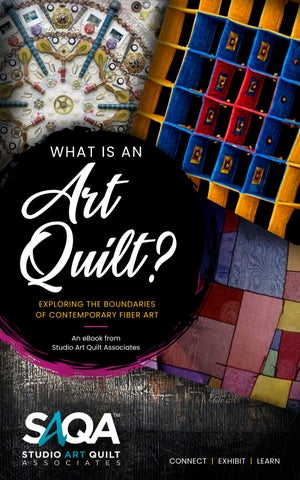
WHAT IS AN
EXPLORING THE BOUNDARIES OF CONTEMPORARY FIBER ART An eBook from Studio Art Quilt Associates
CONNECT | EXHIBIT | LEARN
EXPLORE MORE
© 2026 Studio Art Quilt Associates (SAQA)
All rights reserved. No part of this publication may be reproduced, distributed, or transmitted in any form or by any means without prior written permission from the publisher, except in the case of brief quotations used in reviews, scholarly works, or educational references. Artwork images, quotations, and excerpts remain the property of their respective artists, authors, photographers, and copyright holders and are used with permission where applicable. Published by Studio Art Quilt Associates (SAQA) www.saqa.com Cover design by Standout Arts, LLC Book design and layout by Standout Arts, LLC Published in the United States of America
WHAT IS AN ART QUILT? An art quilt is defined by SAQA as “a creative visual work that is layered and stitched or that references this form of stitched layered structure”. The word “references” allows for a broader understanding of the art quilt that welcomes growth and development of individual style. This may include: • 3D work and work in media other than fiber/ textile/fabric/cloth • Techniques and materials not found in traditional quilting • Framed, unframed, bound, and unbound work
Natalya Khorover, Rhetoric
TABLE OF CONTENTS SAQA’s Definition of the Art Quilt................................................1 Unusual Materials...............................................................................4 “Non-Quilting” Techniques...........................................................7 Quilts that Incorportate Electricity..........................................10 Quilts that Hang from the Ceiling.............................................12 Quilts that are Not Rectangles..................................................14 Quilts that are Framed..................................................................16 Quilts that do Not have 3 Layers..............................................18 Sources...................................................................................................19
SAQA’S DEFINITION OF THE ART QUILT by Linda Colsh and Kris Sazaki
It’s hard to believe that it’s been fourteen years since SAQA announced its revised definition of the art quilt: “The art quilt is a creative visual work that is layered and stitched or that references this form of stitched layered structure.” We were curious as to how well the definition has held up over the years, so we decided to take a closer look at what SAQA artists have been creating over the ensuing years. One can’t help but notice how creative, diverse, and impactful their work is. Let’s revisit how the definition came into being and how it still describes what SAQA artists create today.
THE HISTORY
SAQA had long realized that its definition of the art quilt did not adequately reflect the diversity of the artwork created by our members. Our previous definition was: “A contemporary artwork exploring and expressing aesthetic concerns common to the whole range of visual arts: painting, printmaking, photography, graphic design, assemblage and sculpture, which retains, through materials or technique, a clear relationship to the folk art quilt from which it descends.” 1
Submissions from artists seeking to become juried artist members included works that tested the boundaries of this definition. Wanting to stay current on the genre became an important reason to revise the definition. SAQA artists, too, had been dissatisfied with how the organization defined the art quilt. What to do about this encumbered definition was top of mind as the two of us joined the SAQA Board of Directors. So, in 2009, the nine members of the Long-Range Planning Committee made a proposal to the board to redefine the art quilt. The committee presented art not only from SAQA members but work made by non-SAQA artists that should fall under any new definition. In 2010, the committee members brought the case for a new definition to attendees at the SAQA Annual Conference. 2
SAQA members and invited experts were then sent a survey in 2011 to gain their input on a new definition. The committee put forward its proposal to the board at the beginning of 2012, whereupon it was approved. Yes, it took around three years of concentrated effort to bring this definition to fruition, but we felt it was important to get it right this time. We wanted to avoid repeatedly reconsidering the definition and sought a simple, concise definition that would flex to include new ideas. We wanted it to be descriptive without being prescriptive. The artwork of Linda Gass is a clarion call about our fragile environment. Her art quilts are intrinsically tied to nature, to the cyclical nature of destruction and renewal, but their message is made approachable through the softness of textiles. “I’ve had a love affair with textiles since my grandmother taught me to sew and embroider as a child. My interest in textiles grew through international travel, seeing artisans practice local traditions, and visiting textile museums.”
3
UNUSUAL MATERIALS
Arturo Alonzo Sandoval honors tradition. He began a life-long exploration of textiles in graduate school, learning to weave on a 4-harness floor loom. Weaving, he would later learn, is a family legacy stretching back 250 years. He has spent the past 44 years as an artist and educator in Kentucky, a place with a proud history of fine crafts. Sandoval honors tradition but isn’t interested in replication. He uses tradition as a springboard to create environments responding to the present and reaching toward the future. “My complex art quilt creations communicate my involvement with life.”
Arturo Sandoval Pattern Fusion No. 14: Motherboard No. 5 80.5 x 54 in | 204 x 137 cm | 2016 (microfilm)
Photo by Scott Walz Photography
Sherry Davis Kleinman Barn Quilt Screen Style 43 x 43 | 109 x 109 cm | 2018 (window screens) Photo by Steve Kleinman
Natalya Khorover Rhetoric 40 x 40 | 102 x 102 | 2015 (repurposed single-use plastic bags)
4 7
THE PROCESS
When the commitee began the process of revising the definition, we had to decide if SAQA even wanted to define the art quilt at all. Many arts organizations do not define their art. It is simply understood. In the end, we decided if SAQA wanted to be the resource for artists and the public in general, then SAQA should define the art quilt. Moreover, if SAQA were not to have a definition, an undue burden would fall on the Exhibition Committee to define the art quilt for purposes of submission. We discussed the survey results at great length. Many respondents maintained that the original definition was too long and confusing. It did not easily lend itself to being added to one’s elevator speech. We quickly gleaned from the surveys that respondents used similar words over and again: “fiber,” “fabric,” “textile,” “cloth,” “layered,” and “stitched.” Along with the survey results, our deliberations brought us to conclude that while “fiber,” “fabric,” “textile,” and “cloth” were indeed essential for many SAQA artists, it was less the materials 5
and more the form (layered) and the technique (stitched) that were the hallmark of an art quilt. With all this in mind, we composed this onesentence definition: “The art quilt is a creative visual work that is layered and stitched or that references this form of stitched layered structure.”
THE VISION
Looking back on this definition, we still believe that the committee was able to craft a statement that was visionary at the time and remains so today. Here is what the current definition of the art quilt achieves: • The statement is simple. • The word “references” allows for a broader understanding of the art quilt, thus creating a potential growth in SAQA membership in terms of numbers and diversity of artists. • The definition allows for three dimensional work and work in media other than fiber/textile/fabric/cloth. • The definition allows for techniques and materials not found in traditional quilting.
6
“NONQUILTING” TECHNIQUES
The silkscreened images in Patricia Kennedy-Zafred’s work seem to reach out to viewers. Some do so from the vantage point of history; others proffer imagery from a modern place in culture. All have a dynamic story to tell. “The photographic image has always been a passion for me. As a child, I was captivated by the pages of Look and Life magazines with their big, glossy pages. I experimented in my own darkroom during college and for several years thereafter. I carried my camera wherever I went, developed my own film, and printed the images. That darkroom was a magical place. Today, I feel the same sense of wonder when I silkscreen images onto fabric.” “My style is reminiscent of Andy Warhol’s use of repeated images, but I’m also influenced by artists like Robert Rauschenberg and Roy Lichtenstein.My favorite part of making art quilts is dyeing the fabric and printing the silkscreens. Once the images are selected, I begin to dye the fabrics in colors that further express the subject matter and highlight the images. My quilting is simple to keep the focus on the imagery. Many people initially believe my pieces are printed from an inkjet, or are commercially produced after being created on the computer. They are often surprised to experience the nuance inherent in layering ink onto hand-dyed fabrics, something difficult to capture in a photograph.” 10 7
• The definition allows for growth and development of individual style. • The definition allows for framed, unframed, bound, and unbound work. • The definition can be made more restrictive by the SAQA Exhibition Committee, depending on its needs for any particular exhibition or specific venue.
THE DEFINITION IN ACTION
We remain in awe of the work that SAQA artists create and well appreciate how we can describe all their work with this one-sentence definition. It’s worth perusing the SAQA website to see the incredible work SAQA artists are posting there. You would perhaps find Ana Buzzalino’s homage to disappearing grain elevators, The Prairies Changing Landscape, which incorporates printing and painting along with layers of laminated paper and stitching. The mass of oblique markings that dominate the piece echo her quilted lines and also reference the demolition debris of the huge structures. From her Heartbeat of the City series, Jayne Gaskins’s Washington DC Taxi 8
is not bound by the familiar rectilinear structure of a quilt. The taxi features many of the hallmarks of a “traditional” quilt: it is layered and stitched and is basically two-dimensional, but its shape is that of a DC cab in full-frontal view. The massive vehicle bears down menacingly on a viewer standing in its path.
Jayne Bentley Gaskins Washington-DC-Taxi 72 x 55 inches
9
QUILTS THAT INCORPORATE ELECTRICITY Inspiration: The L Prize (Bright Tomorrow Lighting Prize) awarded to Royal Philips Electronics for developing an energysaving bulbs with the same kind of light emitted from a common incandescent bulb. Philips’ project worked to improve the color quality of energy saving bulb, for which they have won an award. My husband wrote the patent for this bulb. I was inspired by the immense towers in which people live, like the skyscrapers in the U.S. or the enormous tower apartment blocks in the outskirts of St. Petersburg, Russia. The title of the work is derived from the Light Tower, the nickname of the Philips tower building where bulbs and tubes were tested.
10 13
SAQA artists have been creating art installations that challenge and yet adhere to the definition of the art quilt. Installation art aims to change a viewer’s perception of the space and environment in which the work exists.
Diane Núñez Two By Two 12 x 12 x 2 in | 30 x 30 x 5 cm | 2009 Photo by Ron Nunez
As the viewer moves, the perspective changes. Linda Gass’s When We Listen to the Watershed (see Page 3) separates the layers of a traditional three-layered quilt, while including stitch and embroidery. The artwork also has a sound component. Four speakers are mounted behind the work and there is a four-channel sound system with a looping recording of people speaking about their experiences of living in the watershed, interspersed with watershed sounds such as flowing water, thunderstorms, traffic noises, animal and bird sounds, and an ancestral song of an indigenous tribe. In Water Bubbles Around the Rocks, (see Page 8) Bonnie J. Smith places her stitched fabric water bubbles in a beach landscape. The stitched bubbles nestle in low spots like small pools that form in the sand when the tide recedes. Inspired by children playing in puddles, Smith created a pattern and process to create the stiffened indigo-dyed fabric bubbles she installs in various 11
QUILTS THAT HANG FROM THE CEILING Judy Martin discussed her piece Not to Know, But to Go On for the “3D Expression” exhibition. “[The title comes from] words that seem very apt for this uncertain situation that we’re now in as a globe. We just have to trust and continue. I started it on my 59th birthday when it occurred to me that I was going to turn 60 in a year and that was a big deal. So I started to mark every day of my 59th year and continued until I turned 62. So there’s three years of time documented in this piece. It was done daily, and it measures 13 inches by 220 feet.”
15 12
natural sculptural, three-dimensional work, inclusion of non-traditional, non-fiber materials, recycled and found objects, and new interpretations of “stitch.” Some of the techniques and materials we see regularly today were not as readily available when SAQA was founded in 1989. Take, for example, Regina Benson’s Wildfire II. She incorporated LED lights into her assemblage and individually programmed them into a flame pattern, thereby visually describing the moments of burn. She even burned fabric to help create the final fiery image. The Mechanical Elephant is Lena Meszaros’s reinterpretation of the Mechanical Elephant of Nantes, a beast that figures in La maison àvapeur by Nantesnative Jules Verne. Meszaros’s elephant is freemotion quilted and includes steampunk imagery like gears, clockworks, and metal pipes as well Regina Benson as non-traditional Wildfire-II 12 x 28 x 3 inches
13
QUILTS THAT ARE NOT RECTANGLES Fuzzy Mall’s portraits are peopled with interesting subjects, all involved in the business of living. The artist snaps their photographs and recreates them in fabrics largely plucked from thrift-store aisles, thereby anchoring subjects and viewers to a candid moment in time. “The figure is a dominant subject in my work. In my paintings, figures and faces were often abstracted, silhouetted, or in profile, referencing cameos. It wasn’t until I began to work with textiles that I delved into realism. I find it interesting to work within the parameters of a face but to bring something new to each piece. I take my own source photographs, and I choose poses that offer new challenges and details as well as showcase the personalities and energies of the subjects.”
14 17
materials such as copper wire, plastic, leather, and metal foil. Look closely and you can see other nods to Verne in Meszaros’s imagery, including goggles, fantastic fish, maps, and a hot air balloon. For her sculptural art quilt, Time Worn, (see Page 17) Mary Beth Bellah sprayed an actual cobweb with ink to monoprint the web pattern on silk fabric, quilted the print, and used opalescent thread to suspend the printed silk within the crook of a driftwood branch. She crafted the spider from beads, watch parts, and wire. SAQA’s art quilt definition also intersects with wearable art and artbooks. In Shin-hee Chin’s Mother Tongue and Foreign Language, flat rectangular pieces “wear” three dimensional jackets, thereby rethinking the concept of a quilt. By placing a traditional English jacket next to a Korean jeogori, she creates a diptych that explores culture and otherness. We cannot mention threedimensional work without calling attention to the body of work by artist Susan Else. She describes her work as “stealth art: the comfortable ambience of the medium draws viewers in, where they are confronted with the uncomfortable paradoxes of contemporary life.” One example from her ground18 15
Shin-hee Chin Mother Tongue and Foreign Language 78 x 25 inches
QUILTS THAT ARE FRAMED Generally using needle and thread for self-expression, Susan Lenz works to articulate the accumulated memory inherent in discarded things. She seeks a partnership with her materials, their purposes, values, and familiar associations. Memory, universal mortality, and personal legacy are central themes. Vintage and recycled materials are combined with meticulous handwork. Susan is drawn to textiles for their tactile qualities and often makes work that is meant to touch and be touched. Hand stitched on a section of an antique Grandmother’s Flower Basket quilt. Assorted found objects include: textile mill spindles, felt piano hammers, brass lamp fixtures, keys, Nehi bottle caps, slides, buttons, metal washers, pieces of a folding yardstick, clock gears, perle cotton labels, square cut nails, assorted paper clips, U-shaped brackets, single pronged drapery hook, bolts, plastic and metal rings, and hardware from a bifolding door donated to my stash by my Facebook friend Kim Davison.
16 19
breaking sculptural art quilts is Lullaby, (see Page 5) in which Else uses an armature of cloth-covered bones to construct, collage, and stitch her art quilt in the form of a rocking chair. Her three-dimensional art quilt sculptures were, for us when formulating SAQA’s new art quilt definition, one of the reasons we sought a new definition of the art quilt. How best to be inclusive of work that breaks the conventions of a traditional quilt? As we mentioned earlier, the answer lies in being descriptive rather than prescriptive. We look forward to seeing even more creative work by SAQA artists in the future as quilt artists continue to explore new techniques, experiment with non-traditional, often non-textile materials, and push boundaries. 17
Mary Beth Bellah Time worn 18 in x 14 in x 13 in | 46 cm x 36 cm x 33 cm | 2017
QUILTS THAT DO NOT HAVE 3 LAYERS “A Fulbright scholar at RISD in the 1990s, Lee Chunghie has lectured and exhibited around the globe, from the Victoria & Albert Museum to Hongik University, which is renowned for its studio art programs. In her decades-long artistic practice as well as her work as a professor, curator, and writer, Lee has remained deeply engaged in the ongoing vitality of this traditional form of Korean wrapping cloth for presentday fiber arts. In 2012, she founded the Korean Bojagi Forum, a biennial conference devoted to the living tradition of bojagi and its potential as a source of contemporary inspiration.” Jeannie Kenmotsu, Japan Foundation Associate Curator of Japanese Art & Interim Head of Asian Art
18 21
SOURCES Colsh, Linda, and Kris Sazaki. “SAQA’s Definition of the Art Quilt: Still Standing Fourteen Years On.” SAQA Journal 2025, no. 4 (2025): 9–14. Gass, Linda. “Linda Gass.” SAQA Art Quilt Quarterly. Issue No. 22, 2020, pp. 22. Arney, Suzanne Smith. “Arturo Alonzo Sandoval: Finding Magnificence, Creating Beauty.” SAQA Art Quilt Quarterly. Issue No. 11, 2018, pp. 6–7. Howell, Diane. “Patricia Kennedy-Zafred.” SAQA Art Quilt Quarterly. Issue No. 18, 2020, pp. 26–28. Howell, Diane. “Fuzzy Mall.” SAQA Art Quilt Quarterly. Issue No. 24, 2021, pp. 20–21. Martin, Judy. “3D Expression Exhibition Artist Talk.” YouTube video. SAQA Art. Accessed May 2026. https://www.youtube.com/watch?v=2_saHLYDWfA
19 22
EXPLORE MORE
Studio Art Quilt Associates, Inc PO Box 141 Hebron, CT 06248 Email: info@saqa.art 23