ION
IVE
T
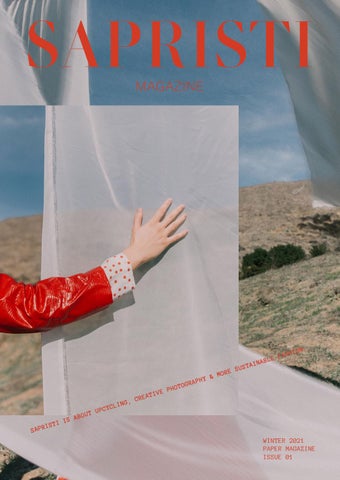
ABOU S I ISTI SAPR
T CREA , G CLIN UPCY
FASH E L B AINA T S U S MORE & Y RAPH G O T PHO
WINTER 2021 PAPER MAGAZINE ISSUE 01
1
Sapristi
(french subst., dated):
“GOOD HEAVENS” – A PRETTY QUAINT WORD MY GRANDMOTHER WOULD SAY, THAT I WANTED TO UPDATE... OR RATHER UPCYCLE!
SAPRISTI MAGAZINE WAS BORN FROM THE NEED FOR A NEW CHALLENGE FOR MYSELF... AND THE NEED TO CHALLENGE FASHION AND SOCIETY TOO: WE HUMANS NEED TO TAKE A STEP BACK AND THINK MORE ABOUT THE WAY WE DO AND BUY THINGS, AND I BELIEVE FASHION IS ONE OF THE ESSENTIAL ISSUE TO TACKLE. SAPRISTI MAGAZINE IS CURIOUS, AUTHENTIC, ENGAGED, FEMINIST AND ECO-FRIENDLY. THE PAGES YOU HOLD IN YOUR HANDS ARE A MANIFESTO FOR FREEDOM AND THE ENVIRONMENT, THE CORNER STONES TO A HEALTHY AND HAPPY LIFESTYLE. WE AIM AT GIVING YOU A NEW POINT OF VIEW ON SLOW FASHION – OFTEN SEEN AS EITHER BORING OR ELITIST – AND SHOWING YOU HOW IT RANGES FROM DIY (FOLLOW OUR TUTORIALS TO JOIN THE GANG) TO LUXURY BRANDS. SLOW FASHION IS FASHION, WITH MUCH MORE BEAUTY TO IT THAN UNETHICAL CLOTHING. SAPRISTI IS A BLEND OF OUR PASSIONS AND BELIEFS. THROUGH OUR MANY EDITORIALS, WE OFFER YOU HIGH QUALITY AND LOW RETOUCH PHOTOGRAPHY, CARRYING A STRONG STATEMENT REGARDING STYLE AND ETHICS, WITH A TOUCH OF OPTIMISTIC POETRY. OUR ARTICLES INTRODUCE YOU TO SLOW FASHION AND THE ACTORS SHAKING AND SHAPING IT (READ OUR STATE OF SLOW FASHION P.XX AND MEET THE FRENCH LABEL REUNI P.XX). WE ALSO INVITE YOU TO BECOME AN ACTOR YOURSELF, THROUGH UPCYCLING TUTORIALS AND WISE SHOPPING TIPS. SAPRISTI SPEAKS CHEERFUL TOUCH. PEOPLE WHO CARE IT. SAPRISTI IS
FOR LIBERTY SAPRISTI IS AS MUCH FOR FASHION AND
AND ETHICS. SAPRISTI CARRIES AN ELEGANT AND YOUR NEW QUARTERLY DIGITAL AND PRINT MAGAZINE ABOUT BEAUTY AS FOR THE PLANET AND THE PEOPLE WHO INHABIT LIFESTYLE, WITH A PLUS.
I WISH YOU A NICE MOMENT WITH US AND LONG LIVE THOSE WHO CARE,
Nelly Briet Editor in chief and founder
2
SAPRISTI ART DIRECTION & GRAPHIC DESIGN Agathe Boudin
EDITOR IN CHIEF & PUBLICATION DIRECTOR Nelly Briet
@studioabdn www.agatheboudin.com
@nellybriet www.nellybriet.fr
SUBMISSIONS hello@saprisitimag.com France www.saprisitimag.com
CONTRIBUTORS
MAUD DABS
AMÉLIE LAMOUR
MONTANA LOWERY
Words
Stylism & Words
Photography
@mauddbs
@amelielmr
@montanalowery
-
-
-
ISABELLE REDA
RUSTY RIDGEWAY
ELISE DABAS
Make-up artist
Words
@isabelleredamua
@neildylan
-
-
LAUREN NAYLOR ORSO Photography
Words @e_dbs
PABLO SALAZAR Photography
@lnaynay
ISSN : 978-2-492880-01-8 Sapristi Magazine was created in 2020 by Nelly Briet. Sapristi Magazine is not to be responsible for the topicality, correctness, completeness or quality of the information provided. Liability claims regarding damage caused by the use of any information provided, including any kind of information which is incomplete or incorrect, will therefore be rejected. All offers are non-binding and without obligation. Parts of the content or the complete publication including all offers and information might be extended, changed or deleted by the author without separate announcement. Sapristi Magazine is intending not to use any copyrighted material without the prior consent of the copyright owner. In any case the author will indicate the copyright of the respective object. The copyright for any material created by Sapristi Magazine is reserved. Any duplication or use of objects such as images, diagrams, sounds or texts in other electronic or printed publications is not permitted without the author’s prior consent. All rights reserved, nothing can be partially or in whole reprinted or reproduced without a written consent. SAPRISTI MAG ©2021 16 route de la villa Heriot, 78110 Le Vesinet, France The authors and the photographers Reproduction without permission prohibited.
3
01
Editor letter
05
The (not so) big words of slow fashion
07
L’appel du Criou
17
RÉUNI - The new born feel good (and pretty) French label
25
The world’s rarest flowers
35
The Wayward Ship of Fast Fashion
39
Hummingbyrd
49
Green Fairy Tales
51
The 10 eco-responsible winter looks: everything to dress in style and greener!
55
Fast Fashion
63
An eco-friendly day in Paris
67
DIY : scrunchy & pouch
71
How to read your clothing label
JACKET VINTAGE PULLOVER IN CROCHET HOMEMADE PULLOVER VINTAGE HAT BIS SOLIDAIRE BELT VINTAGE BOOTS VINTAGE JEWELS ELISE TSIKIS
12
13
PULLOVER VINTAGE, T-SHIRT VINTAGE, HAT VINTAGE, JEWELS ELISE TSIKIS
RÉUNI
Words: Maud Dabs Photographs: RÉUNI
16
17
the new born feel good (and pretty) French label
IN THE MIDST OF NEWLY BORN ETHICAL LABELS, RÉUNI QUALIFIES AS ONE OF THE MOST EXCITING LAUNCHES. WE MET ADRIEN GARCIA AND ALICE BAILLY FOR A CHAT ABOUT THEIR BRAND AND PHILOSOPHY. THEY LAUNCHED THEIR FIRST PIECE, A JUMPER, A YEAR AGO, AND SINCE THEN THE TIMELESS, HIGH-END WARDROBE OF ADRIEN GARCIA AND ALICE BAILLY GREW UP ONE GARMENT AT A TIME, AS IF THE STORY OF THE FRENCH LABEL WAS TO BE WRITTEN CHAPTER BY CHAPTER WITH AN EMPHASIS ON QUALITY AND ELEGANCE. EACH RÉUNI EDITION OFFERS A REVISITATION OF A BASIC GARMENT WITH A UNIQUE SIGNATURE, BORN FROM ADRIEN AND ALICE’S COMMON PASSION FOR CLOTHES THAT LAST DECADES, WITHOUT EVER FADING NEITHER IN QUALITY NOR STYLE. SLOW FASHION BEARS A VERY LITERAL MEANING AT RÉUNI: “TAKE YOUR TIME” SEEMS TO BE THE DESIGNERS MOTTO AS WELL AS THEIR CREATIVE PROCESS. A SINGLE PIECE DEMANDS MONTHS TO BE LAUNCHED. FIRST, THEY ASK CUSTOMERS, FRIENDS AND FAMILY ABOUT WHAT THEY EXPECT. THEN, THEY GATHER ANSWERS AND MIX THEM UP WITH THEIR OWN VISION TO EVENTUALLY DESIGN THE GARMENT, ONE YOU CAN WEAR FOR YEARS, ONE YOUR SIBLINGS AND KIDS WILL SNEAK INTO YOUR WARDROBE TO STEAL FROM TIME TO TIME – A PERFECT PIECE THAT CARRIES A CLASSIC DNA BUT ALSO A UNIQUE PERSONALITY.
The world’s rarest flowers 24
Photography: Montana Lowery Stylist: Phoebe Brannick Model: Grace Mee Hair: Angela Lowery Make-up: Emily Dhanjal using Ilia Beauty Studio: @stepthirtyone Concept and Set design: Montana Lowery
25
DRESS MAGPIES & PEACOCKS
34
The Wayward Ship of Fast Fashion
Words: Rusty Ridgeway
IT SEEMS EVERYTHING THESE DAYS IS SUSTAINABLE, OR SO THEY SAY. THE TERM HAS BECOME MORE COMMON THAN LEGWARMERS ON JANE FONDA. BUT WHAT DOES SUSTAINABLE ACTUALLY MEAN? AND MORE IMPORTANTLY, HOW DOES IT AFFECT THE FASHION INDUSTRY? SIMPLY PUT, SUSTAINABLE FASHION MAKES YOU FEEL AWESOME, CARES FOR THE EARTH, AND YOU LOOK AMAZING AS WELL. BUT BEFORE WE CAN PUT THAT PACKAGE ALL TOGETHER, WE NEED TO CONSIDER THE OLD DEVIL HIMSELF… FAST FASHION.
35
Quality? Negative, Ma’am. Overproduction and Overconsumption are the captains of this ship. They’re both drunk and way off course. Their business model is set to make as much money as possible. Period. They replicate marketable fashion styles with scaled-down quality and scaledup production quantities. These low-cost, low-quality materials land in malls around the world in hopes of living their best life in your wardrobe. Unfortunately, this relationship won’t even last as long as your worst Tinder date.
Wasted If captains Overproduction and Overconsumption are drunk you can surely imagine the first mate isn’t far behind, her name is Wasted. Where does that ‘trendy’ dress go when it’s no longer trendy? Sure you can pass it off to a friend or to charity, but that’s more for your conscience than the joy of giving. In reality, that cutie top will end up in a landfill within 5 years. Newsweek suggests annually 84% of unwanted clothes land in an incinerator or a landfill. Besides, you’re get-
ting rid of that ‘old’ article for a reason, and it’s probably the same reason your friends are gonna ‘fake’ smile and ‘say’ thanks. But don’t worry they may just be handing one back to you in a very short time.
Labor conditions With the leadership imbibes the finest booze based on their massive bottom lines, no one is watching the crew on the ship. How is it possible we can buy a top for $5 when it already includes the fabric, sewing, marketing, shipping, and margins? Fast fashion exploits workers, primarily women, and children, in low and middle-income countries. These noble folks are making those garments by hand in deplorable conditions. They are underpaid and overworked, and in many cases are actually happy just to have a job to buy food. They are the frontline soldiers in our battle to look good at a bargain.
Fabrics Is there anything to hold our ship and crew together? It won’t be the fabric that’s for sure. The Environmental Health Journal
JACKET VINTAGE, UNITARD VINTAGE, SHOES VINTAGE, EARRINGS VINTAGE Photography Lauren Naylor Orso Art Direction Nightdove Studio Prop Design Claire Kirk Hair & Makeup Jessie Maranda Styling Chainé Leyendecker Model Kayla Ehle @wilhelminamodels
39
abl oS ala Ma zar keu pA Fas r tis hio t: S nS han tylis t, A eM nge ond lina en Sca Mo del ntle Kar bur en y H Sot air o@ Sty Wil list: hel Sat min osh aM i Ik ode eda ls
Pho tog rap hy: P
FAST 54
FASHION
55
EARRINGS COLOUR ADDICT, NECKLACE ARTEGIA, RING AND BRACELET GEORGINA JEWELRY, RINGS MONICA VARELA
HOW TO READ YOUR CLOTHING LABEL Texts: Amélie Lamour
Imagine yourself in these situations : today is Saturday and you decide to refresh your wardrobe. Or maybe you are walking around and you come across that pretty dress in that shop window and suddenly fall in love with it. Or, even better, you are surfing the web and you see this nice backpack that you have been needing for a while ! Whatever the situation, you are aware of environmental issues and the impact of the fashion industry on the planet, so you would like your shopping to really be eco-responsible and meaningful. Well good news, you’re reading the right article to help you achieve it! To shop wisely, the secret is to know how to decipher labels: they are the equivalent of a garment’s passport. They tell you a lot about the origin, the composition and how to care for the piece you consider buying. There are a lot of different information and misconceptions about the ways a garment is made. So, obviously, there are a lot of questions you need to ask yourself.... Is it made locally and are the ingredients and raw materials local as well? Does the production process respect the environment? Again, what about raw materials and ingredients? And what about the people? Has anyone been exploited to produce, sell or transport these products? Are their working conditions safe and decent? Are their salaries decent? Is this product harmful? Can it be a source of hazard or cause health problems to my loved ones and myself? Obviously, it is extremely rare that a new product is perfectly clean, environment-friendly and ethical. Indeed, the production and shipment of an item most often leads to using - if not wasting - energy and resources, from the manufacture to the store… to your home. That is why you can easily get lost in your way to making the right choice: should you trust certifications, or should you rather focus on the country of origin, or the carbon footprint, or the materials and their farming? That said, know that you can control damage with just a little bit of research and knowledge. Let us explain everything to you so you never feel lost again!
70
NATURAL MATERIALS FROM ANIMALS
NATURAL FIBERS
WHAT MATERIALS REALLY ARE ECO-RESPONSIBLE? FIBER TYPE
ASSOCIATED CERTIFICATIONS
Organic cotton
RECOMMENDED GOTS label OCS 100 NOT TRUSTWORTHY BCI (Better Cotton Initiative)
- Organic or non-organic linen -Jute -Organic or non-organic hemp -Nettle -Ramie -Cork Certified or organic wool
RWS
Certified feathers
RDS
DISADVANTAGES
DID YOU KNOW?
Hypoallergenic fiber, supple, allows skin to breathe, easy care.
Colors fade with time. Cotton tears easily and is sensitive to moisture.
Nearly 25% of the pesticides/insecticides used in the world today are destined for cotton fields, even though they represent only 2.5% of the world’s cultivated land. The result is pollution of soils, waterways and biodiversity...
Linen: thermo-regulating textile that will let the air pass through and thus reduce the sensation of heat in summer by avoiding perspiration, robust
Linen: rough, wrinkles and is not easy to iron.
- Vegetable tanned leather - Low chrome tanned leather - Resistant, breathable, and biodegradable, looks like silk. - Store in a cool and airy place. - Low temperature washing (30°). - Tencel does not need to be ironed often.
Tencel = Lyocell SYNTHETIC MATERIALS
ADVANTAGES
Lenzing Ecovero
Synthetic fibers are obtained after chemical treatment of natural materials. Some processes can be polluting, although regulated, as in the case of viscose. Others, on the other hand, are ecological because they are recycled fibers, like lyocell or modal.
The wood used for ECOVERO® fibers comes from sustainable forests, certified FSC
RECYCLED MATERIALS
-Modal -Cupro -Pinatex
Econyl
- Recycled polyester - Recycled cotton - Recycled wool
Be careful when washing recycled clothing, as they can release micro-particles of plastic into the ocean. We therefore advise to wash them in a specific bag, the Guppy Friend, which prevents the passage of these particles in nature.
Econyl is the name given to a fiber recycled from fishing nets harvested from the sea. It is mostly used to make recycled swimsuits.
It takes 2,700 liters of water for a new cotton T-shirt, compared to only 50 liters for a recycled cotton T-shirt.
Do you want to be thorough ? The materials to avoid are: viscose, polyester, acrylic, polyamide, polyurethane, lycra, spandex, elastane. They are most often found in sportswear, swimsuits, and the “invisible” kind of underwear. Uncertified wool, fur, angora wool, silk, leather and non-organic cotton are also to be avoided.
72
THE CERTIFICATIONS GUIDE Certifications are the best indicator of trustworthiness for an eco-responsible garment.
ENVIRONMENTAL LABELS
The BCI (Better Cotton Initiative) institution gives recommendations on cotton cultivation, but does no actual examinations afterwards. Therefore it is difficult to be sure that a BCI garment is truly eco-responsible. We do not recommend to trust it.
On the other hand, the GOTS label, one of the most popular in the industry, is only granted after thorough controls according to strict guidelines by independent examiners. A grade 1 GOTS item is made of at least 95% of organic materials, and a grade 2 is at least 70%.
OCS 100 is also a reliable label for organic cotton.
ECOCERT is one of the independent organizations that certify GOTS and OCS 100 products.
OEKO-TEX® certification was created in 1992. An OEKO-TEX® Standard 100 fabric went through check-points at every stage of processing: raw materials, yarns, dyeing so that it does not contain any chemicals harmful to health. An OEKO-TEX® fabric can be synthetic (unlike an organic fabric). OEKO-TEX® yet does not care as much as GOTS for the ethical treatment of workers, and does not control it.
The wood used for ECOVERO® fibers comes from sustainable forests, certified FSC (Forest Stewardship Council) or PEFC (Pan European Forest Certification). Lenzing is fully transparent about the sources of the wood purchased.
The Responsible Down Standard (RDS) label guarantees the protection of geese and ducks reared for their down and feathers.
PETA-Approved Vegan: it certifies the absence of any material of animal origin.
ENVIRONMENTAL LABELS
The Responsible Wool Standard (RWS). It is a tool for the fashion industry to identify environment and animals friendly farmers; ensuring that wool comes from farms that have a progressive approach to managing their land and respect the welfare of the sheep (avoiding mulesing for example).
SOCIAL LABELS
Fair Trade (from Max Havelaar): this label offers a framework for fair trade to cotton producers, through the assurance of a fair and stable fee. Working conditions are also regulated: legal minimum wage, freedom of association, prohibition of forced and child labor... Controls occur at least twice every three years.
Fair Wear Foundation (FWF): this label is based on the standards of the International Labor Organization (ILO) to certify clothing factories: decent wages, freedom of association, prohibition of forced and child labor, control of working hours... Controls are annual.
SA 8000: it is not a label but a standard of social responsibility, which can certify companies. It implements decent working conditions, according to the standards of the International Labour Organization (ILO): decent wages, freedom of association, prohibition of forced and child labor, control of working hours... Certification cycle of 3 years, including follow-up audits every 6 months.
BSCI: BSCI is considered a prerequisite for SA 8000 certification and is therefore less stringent. Member companies follow a code of conduct based on the standards of the International Labour Organization (ILO). They must undergo audits until they meet all the requirements and are thus able to obtain SA 8000 certification.
FRENCH MANUFACTURING LABELS
We often spot these famous phrases «Created in France» or «French creation»: here, the nuance between creation and origin is subtle! The important thing to remember is that 45% of the product must have been designed (not made, designed!) in France for this statement to appear on a label. In other words, a garment may bear this mention even though it was actually made in China. About the «made in France»: it means that the last «transformation» of the item happened in France, but does not mean it is 100% French manufacturing. Careful. This is where the labels come into play, the only certifications of a guaranteed French manufacture are...
The Logo ORIGINE FRANCE GARANTIE label: since 2010, this mention indicates that the main activities carried out on the product were made in France, such as cutting, finishing, etc... But also that at least 50% of the production cost of the item was paid to French companies.
The label logo «Entreprises du Patrimoine Vivant» indicates that the brand or manufacturing company is French and that it has excellent craftsmanship and industrial savoir-faire.
The «France Terre Textile» certification is only allowed for products that were made at least at 75% in France, amongst certified French manufactures.
Certifications are not free and some brands cannot yet afford them, despite their commitment. You can find it hard to believe a company actually behaves well without a certification pinned on their garments, but it does happen and you should get to know these small respectful brands to trust them. These brands rely on transparency rather than labels - in a word, they are like restaurants with an open kitchen in which you can check every step of the preparation of your meal! If you can easily find information about the country where a brand makes their items, their relationship with the partner factories, the people who work there, activity reports... it’s a good sign.Then it’s up to you to decide whether you want to trust in them or not. It’s up to you to find out where a garment comes from. You hold all the cards now ! Piece of advice, pay attention to the label, and even if it is itchy, don’t cut it or at least keep it in a drawer so you can care for your fav’ tee-shirt the best way!
978-2-492880-01-8