RADIO CLUB OF AMERICA
RADIO CLUB OF AMERICA
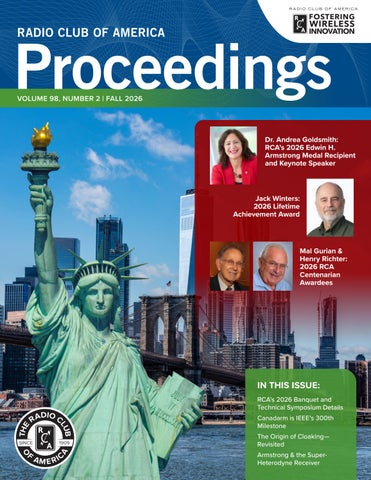
Proceedings VOLUME 98, NUMBER 2 | FALL 2026
Dr. Andrea Goldsmith: RCA’s 2026 Edwin H. Armstrong Medal Recipient and Keynote Speaker
Jack Winters: 2026 Lifetime Achievement Award
Mal Gurian & Henry Richter: 2026 RCA Centenarian Awardees
IN THIS ISSUE: RCA’s 2026 Banquet and IN THIS ISSUE: Technical Symposium Details
RCA’s 2023 Banquet and Technical
Symposium Canadarm is Details IEEE’s 300th Milestone Paradigms, Cell Phones, and the
Contributions of RCA Members to The Origin of Cloaking— the World Revisited
RCA Interview with Dr. Marty Cooper
Armstrong & the SuperNASA and HAARP Conclude Heterodyne Receiver Asteroid Experiment
Conference: March 8-11, 2027 Exhibits: March 10-11, 2027 North Hall, Las Vegas Convention Center Las Vegas, NV
Where radio’s legacy meets the wireless future RCA members helped build the foundation of wireless. Now see where it’s headed.
JOIN
4,000+ Attendees
250+
300+
Sponsors & Exhibitors
Expert Speakers
Whether you’re looking to showcase a new product, generate buzz for your company, reach key decision-makers, or nurture existing relationships, IWCE provides the ideal venue to connect with the critical communications community. Learn more iwceexpo.com
Interested in sponsoring or exhibiting? Secure your booth or sponsorship package — click here to explore our opportunities.
Get Hands-On with the Latest Technology
Hear from Industry Experts & Agencies
Plan for the LMR + LTE + 5G Future
Level Up Your Skills & Certifications
Network with Fellow Operators
Meet Top Radio Vendors in One Place
Use code RCA20 for 20% off select conference passes. Not valid on ETA or UAS training and already reduced public safety and government rates.
JOIN US IN LAS VEGAS
#IWCE50
PROCEEDINGS • FALL 2026
2
WWW.RADIOCLUBOFAMERICA.ORG
Proceedings
VOLUME 98, NUMBER 2 FALL 2026
2026 BOARD OF DIRECTORS
CONTENTS
PRESIDENT Alan Spindel*
From Your President ..................................................................................................... 4 RCA Achieves Significant New Milestones....................................................................... 5 RCA Tours New York City: Broadcasting, Wireless History & Innovation............................... 9 The Empire State Building and the 90th Anniversary of FM Radio .................................. 10 Dr. Andrea Goldsmith: RCA’s 2026 Edwin H. Armstrong Medal Recipient and The Keynote Speaker at the 2026 Banquet............................................................. 15 2026 RCA Awards...................................................................................................... 18 2026 RCA Fellows ..................................................................................................... 25 2026 Technical Symposium Presenters......................................................................... 28 Technical Symposium Speaker Biographies................................................................... 29 Technical Symposium Poster Presentations................................................................... 39 Features The Origin of Cloaking—Revisited ................................................................................ 40 Dr. Henry Richter to Receive RCA’s 2026 Centenarian Award (Honorary) ......................... 49 Mal Gurian: A Pioneer of Personal Communications: Radio Club of America Centenarian Award................................................................. 53 Canadarm is IEEE’s 300th Milestone—A Celebration of Robotic Control and Space Communications......................................................................................................... 56 Where Can a Cell Tower Stand? Washington Is About to Weigh In.................................... 63 Industry Updates Dayton Hamvention 2026 Award Winners Include Distinguished RCA Members............ 69 RCA Contributes to IEEE Public Safety Forum........................................................... 71 2026 Dayton Hamvention—Signals Without Borders.................................................. 73 Iconic Collins Radio Company Communication Van: My Story – An “Auto”Biography ..... 76 IEEE and the ETHW Collect First-Hand Histories Related to Communications............... 78 New 2026 R&D Benchmark Report Released ........................................................... 81 RCA News RCA Unveils New Podcast Program in Fall 2026........................................................ 82 Women Powering Critical Communications: Conversations That Connect at APCO..........83 RCA Leadership Shines at IWCE And APCO...............................................................84 RCA Announces the Recipient of the 2026 Young Ham Lends a Hand Contest.............. 87 RCA Provides Major Programming at Hamvention.......................................................88 Travel Review: A Visit to the Rutherford Museum at McGill University in Montreal ........ 89 Book Review: Vox Ex Machina................................................................................. 95 Featured Documents Armstrong & the Super-Heterodyne Receiver: An Outline by Lewis M. Clement.............. 97 RCA Calendar & Events ............................................................................................ 116
EXECUTIVE VICE PRESIDENT Nick Pennance* VICE PRESIDENT Richard P. Biby* VICE PRESIDENT/COUNSEL Chester “Barney” Scholl, Jr. VICE PRESIDENT/CO-COUNSEL Edward Ryan* TREASURER Andy Maxymillian SECRETARY Precious Fodor DIRECTORS JonPaul Beauchamp Dr. James Breakall Jack Burbank Karen Clark Dr. Nathan Cohen Cheryl Giggetts Ronald J. Jakubowski
Stephen Jeffries Rachel Jones Michael Kalter Charles Kirmuss Carole Perry (Emerita) Dr. Ajay Poddar Dr. Julio Urbina
PRESIDENTS EMERITI Steven L. Aldinger David Bart Sandra Black Philip Casciano Mercy Contreras Timothy Duffy
John Facella P.E. Mal Gurian Carroll Hollingsworth Bruce McIntyre Stan Reubenstein Anthony Sabino, Jr.
STAFF Amy Beckham, Administrative Director
COMMITTEE CHAIRPERSONS Awards & Fellows: Charles Kirmuss Banquet: Open Constitution/By-Laws: Chester B. Scholl, Jr., Edward Ryan* Education: Rich Biby Executive: Alan Spindel* Finance: Andy Maxymillian Historical/Museums & Archives: Jim and Felicia Kreuzer Interview Series: Open Marketing: David Bart* Membership: Chester B. Scholl, Jr. Nominations & Elections: Jon Paul Beauchamp Publications: David Bart* RCA Radio Amateur Club License: Edward Ryan* Rocky Mountain CO Chapter: Karen Clark/Mercy Contreras Scholarships: Alan Spindel* Shows/Conferences: Alan Spindel* Sponsors/Fundraising: Karen Clark Strategic Planning: Nick Pennance Technical Symposium: David Bart, Dr. Nathan Cohen Website: Alan Spindel* Women in Wireless: Cheryl Giggetts Youth Activities: Carole Perry
*Executive Committee Member
RADIO CLUB OF AMERICA
HEADQUARTERS OFFICE: 13570 Grove Drive #302 Maple Grove MN 55311 (612) 430-6995 amy@radioclubofamerica.org www.radioclubofamerica.org
PROCEEDINGS • FALL 2026
3
EDITORIAL DIRECTOR David P. Bart 8512 Kedvale Ave., Skokie, IL 60076 (847) 542-9873 jbart1964@gmail.com
PROCEEDINGS SCIENTIFIC ADVISOR Nathan “Chip” Cohen, Ph.D. 2 Ledgewood Place, Belmont MA 02478 (781) 275-2300 w1yw@aol.com
ADVERTISING CONTACT Amy Beckham (612) 430-6995 Amy@radioclubofAmerica.org
PRODUCTION Sapphyre Group
WWW.RADIOCLUBOFAMERICA.ORG
FROM YOUR PRESIDENT We have also relaunched the Young Professionals Program in collaboration with IWCE. The wireless industry depends on its next generation, and RCA is well positioned to recognize and support them. I encourage every member to think of the rising stars in their own organizations and nominate them. The nomination forms are online.
Dear Fellow RCA Members, As the year draws to a close, I am pleased to present the Fall 2026 edition of the Proceedings. It has been a busy season, and I am grateful for the energy each of you brings to the club. Our presence at the Dayton Hamvention this past May was a strong one. Members engaged with visitors, reconnected with old friends, and welcomed new faces to RCA, and that visibility reflects the continued vitality of the organization.
Stay tuned for our new podcast, which will replace our longstanding interview series. It will give us a fresh way to share the stories and technical insights that make RCA special. I look forward to seeing everyone at our November event in New York. The program will feature speakers at our technical symposium and another round of tours and presentations. It is always a pleasure to gather in person, and I hope you will join us.
Our summer was equally full. In August, we held a successful cocktail reception at the APCO conference in San Antonio, followed by the RCA Fellows’ Dinner, which recognized our Fellows and their guests. The evening brought together longtime members and newcomers in the kind of fellowship that makes this club what it is.
Congratulations to all of this year’s award recipients. Your contributions to wireless technology and to the Radio Club of America are deeply appreciated.
RCA also took part in the IEEE World Forum on Public Safety Technology. We are grateful to our sponsors, PCTel and Coomba, for providing speakers for the IEEE program. Their participation strengthened our contribution and reflected the value industry partners place on RCA’s technical expertise.
Finally, I am very proud of the Proceedings staff. Their dedication has produced another excellent issue covering the leading concepts in wireless technology. No other journal offers such broad coverage of the industry as a whole, and that breadth is a direct result of their hard work.
On the financial side, our new Treasurer, Andy Maxymillian, has completed the club’s fiscal review, and the finances of the Radio Club of America are in fine shape. I thank Andy and Ron Jakubowski for their careful stewardship. Sound finances give us the freedom to plan ahead with confidence.
Sincerely, ALAN SPINDEL President The Radio Club of America Inc.
Our outreach at industry events has brought RCA membership back to pre-pandemic levels. That result is a credit to every member who invited a colleague or friend to join us. I ask that you keep that momentum going.
Register Today! 2026 TECHNICAL SYMPOSIUM & 117 TH AWARDS BANQUET SATURDAY, NOVEMBER 21, 2026 WESTIN TIME SQUARE NEW YORK CITY
PROCEEDINGS • FALL 2026
4
WWW.RADIOCLUBOFAMERICA.ORG
RCA Achieves Significant New Milestones The Radio Club of America has undergone a major, successful transformation into a new business model over the past four years. Our efforts spanned two presidents and have established RCA’s viability for the 21st century.
premier networking organization, and the opportunity to meet them was RCA’s historic offering.
SPONSORS AND PARTNERS Sponsorship has noticeably increased. Our sponsor list has changed over the years as the industry evolved. Our relationships include an ever-growing list of strategic partnerships with other organizations.
A NEW BUSINESS MODEL RCA moved away from its historic pay-as-you-go, memberdues-based business model. The transformation reflects dramatically new approaches to nonprofit management. RCA’s foremost goal is to prioritize and build awareness of the organization. In the process, we are seeking new sponsors while continuing to minimize the marginal cost of adding members. Our reputation is built and maintained by the top-tier quality of our members. Membership dues remain a vital source of revenue; however, dues alone cannot sustain the organization. Our new business model relies on our reputation and industry awareness to attract engagement.
• We highlight RCA sponsors and partners at our events and activities through signage, invitations to participate in our programs, and at dinners. • We feature and thank our sponsors and partners on our website and in our publications. • Our advertising and notices about our sponsors’ participation in RCA are now reaching 10,000 industry participants who see the logos and identities of our sponsors and our partners.
Sponsors are key, and they want to see benefits from RCA’s overall presence in the industry. Sponsors want to know that the industry perceives value in our programs and services. What does a sponsor get? They get opportunities to advertise themselves and for their people to participate in RCA’s leadership opportunities. Sponsors get the opportunity to be our partners and to tell others that they support RCA’s endeavors.
• Our sponsors are provided RCA memberships for their professionals to participate in our programs and services; the number of memberships depends on the sponsorship level.
In response, RCA has refocused on outreach and expanded the ways we can demonstrate our leadership in order to reinvigorate the reputation of the world’s oldest wireless organization.
INDUSTRY ACTIVITIES
Guilty by association, this group is a who’s who of organizations working with RCA to grow and develop industry leaders for the future.
RCA’s participation in industry activities changes over time as we respond to industry trends and member requests. A scorecard of our industry activities since COVID includes (in alphabetical order):
EXPANDED OUTREACH
• APCO International
RCA’s efforts have borne fruit. You, our members, and you, our board of directors, have worked hard to achieve two amazing milestones:
• Connect(X) Connectivity Expo • Hamcation
• Our email lists, once under 1,000 contacts, have grown to 10,000. This is a huge milestone. It means that we are seen, heard, and visible. Our Aerogram newsletter reaches this vast audience. Our Proceedings, a paid member benefit distributed periodically to the full email list, reaches this same audience.
• Hamvention
• Our full members, historically about 1,000 paid members, declined by half during COVID. Today, they are back to 1,000. RCA peaked at 1,100 in the 1990s. Our members are a cultivated group. RCA does not seek thousands of members. Instead, our members want an intimate, valuable experience with the best in the business. These people are, in fact, the source of RCA’s reputation as a
• NATE: The Communications Infrastructure Contractors Association UNITE Conference
PROCEEDINGS • FALL 2026
• IEEE World Forum on Public Safety Technology (WF-PST) • National Association of Broadcasters – New York (NABNYC) • International Wireless Communications Expo (IWCE)
• United Technologies Council (UTC) Telecom & Technology Conference • Wireless Communications Alliance (WCA) ConnectX Conference
5
WWW.RADIOCLUBOFAMERICA.ORG
ION:
motes the cooperation c investigation in the With a vision focused e Past, RCA strives to e students of all ages of wireless careers.
LEADERS AT THE FOREFRONT OF RF TECHNOLOGY
This is an amazing record, and it is evolving. RCA will be involved in the National Association of Broadcasters (NAB) show in Las Vegas in 2027, the world’s largest meeting place for radio- and communications-related professionals.
RCA members provide leadership at the forefront of the industry. We are increasingly visible, hosting programs, leading panels, and responding to requests to help organize the industry’s leading activities. This is a return to the glory days when RCA was seen as an indispensable partner at the top of the industry.
REBRANDING RCA began to study rebranding some time ago. Those initial efforts went into full throttle after COVID. RCA designed a new logo, new slogans, new trade show booths, new marketing materials, and a new website. Industry event booths no longer face inward or have a barrier table. Booths are open to the aisle and invite conversation. They are generally 10x20 double-wide showcases with video screens and computers. RCA has developed plenty of swag (e.g., bags, shirts, shot glasses, mugs, thermoses, tablets, pens, coasters, and other items) to give away. RCA has also become more nimble. Booth signage is bold, large, and prominent at the back and on front stands and tables. Smaller flexible variations are available for singletable setups as well. NETWORKING • RECOGNITION • EDUCATION • YOUTH PROGRAMS
NETWORKING • RECOGNITION • EDUCATION • YOUTH PROGRAMS
R AD IO CLUB O F AMERI CA
R AD I O CLUB O F AMERI CA
RCA brings together professionals and non-professionals from every segment of the wireless industry
• APCO International • Hamcation • Hamvention • IEEE World Forum on Public Safety Technology (WF-PST) • IEEE conferences on antennas, propagation, and electronic communications in the US and Canada • International Wireless Communications Expo (IWCE) • Wireless Communications Alliance (WCA) ConnectX Conference RCA has also played an important role in celebrating communications history and its members’ contributions to technological development. Since COVID, RCA has: • Directly participated in the celebration of Bell Laboratories Centennial • Celebrated Nobel Laureates and expanded the range of RCA award recipients
RCA brings together professionals and non-professionals from every segment of the wireless industry
• Created new RCA awards to celebrate scientific and applied science achievements in RF • Provided senior leadership for the IEEE History Committee and chaired the IEEE Milestones Program • Provided leadership in creating IEEE’s dedicated conference on public safety at WF-PST
am Director merica.org ake Road N 55311 5.2012 .6995
america.org
Since COVID, RCA members, its officers, and its board members have been featured at and provided numerous presentations and panels about communications technology at:
TECHNICAL SYMPOSIUM AND POSTER PRESENTATIONS EXPAND www.radioclubofamerica.org
www.radioclubofamerica.org
Our credentials are strong. This is seen in the explosion of the RCA Technical Symposium. The one-day event now regularly features 12-14 speakers, with a waiting list for the following year. Speakers continue to span the gamut from Nobel laureates to advanced students. The Technical
Two new brochures focus on RCA’s value offering: trifold (left) and booklet (right). If you would like copies for use at trade shows or for marketing, please contact Amy Beckham.
HAS YOUR CONTACT INFORMATION CHANGED? If you have recently changed your address, email, or phone number, please login to your membership page on our website to update your information, email amy@radioclubofamerica.org or call (612) 430-6995.
PROCEEDINGS • FALL 2026
6
WWW.RADIOCLUBOFAMERICA.ORG
RETURN OF RCA FELLOWS DINNERS
Symposium is known for its high quality and the access our participants have to the speakers.
Once informal and occasional, Fellows dinners have returned from the early days and grown. Most of our major industry events are accompanied by casual evening gatherings for drinks plus a separate RCA Fellows dinner. These are excellent opportunities to meet and get to know industry peers, and they have grown from a few people to regularly including 30-50 attendees per occasion. This is networking at its best.
A new RCA Poster Presentation Session at the Technical Symposium features 12-20 PhD or advanced college students and young professionals. This new part of the Technical Symposium introduces the best of the promising younger generation into a rapidly changing profession. Our list of participating schools has grown from 2 to 6 in just two years. As a testament to the program’s quality, since its inception, all presenters have received scholarships, job offers, and other major benefits based on their work and their affiliation with RCA.
MILESTONES FOR THE FUTURE Are you interested in leading RCA further into the 21st century? Are you interested in helping raise awareness about RCA and our unique offerings? Are you interested in joining our team and featuring your innovations and your company to senior influencers and decision-makers in the industry?
RCA PROCEEDINGS EXPANSION RCA’s Proceedings, published since 1913, has never been stronger. Issued twice annually, each issue is now approximately 100 pages, with special issues reaching 120 pages. This is a stunning pace of output for RCA. The range of content, writing quality, and author participation is an amazing testament to RCA’s commitment to serious writing and thought leadership. Authors range from Nobel Laureates to industry opinion setters, and from scientific researchers to students. This range, quality, and consistency of RFrelated subjects is not available anywhere else.
We need your help, and we welcome you to RCA. Help us decide what other services would benefit you and which shows we should attend. Join us, or at least visit, the RCA booth. Please contact Amy Beckham at Amy@radioclubofamerica. org with ideas or volunteer opportunities.
NEW LOGO MERCHANDISE! ORDER YOUR NEW RCA BRANDED SWAG AND HAVE IT SHIPPED RIGHT TO YOUR DOOR!
ORDER AT WWW.RADIOCLUBSTORE.COM
PROCEEDINGS • FALL 2026
7
WWW.RADIOCLUBOFAMERICA.ORG
PROCEEDINGS • FALL 2026
8
WWW.RADIOCLUBOFAMERICA.ORG
RCA Tours New York City: Broadcasting, Wireless History & Innovation FRIDAY AFTERNOON, NOVEMBER 20, 2026
New York City has played a pivotal role in the evolution of wireless communications and broadcasting, and this November, Radio Club of America members will have the opportunity to experience that legacy firsthand. Two exclusive behind-the-scenes tours offer a closer look at the technology, infrastructure, and innovation that continue to shape how we communicate.
Inside the Empire State Building’s Emergency Communications Center Explore the intersection of New York City history, wireless innovation, and public safety with a special behind-thescenes visit to the Empire State Building’s emergency communications center. The afternoon begins with a driving tour of sites connected to the history of the Radio Club of America, offering a unique opportunity to trace the organization’s legacy through the city where so much of wireless communications history unfolded. The experience continues at one of New York’s most recognizable landmarks, where participants will gain a closer look at the communications infrastructure and emergency-response capabilities that help support this iconic building. For RCA members, this is a particularly meaningful opportunity to connect the Club’s pioneering legacy with the continuing importance of reliable communications in today’s world.
THURSDAY AFTERNOON, NOVEMBER 19, 2026 Behind the Scenes at NBC Studios Step inside one of the most iconic names in broadcasting with a behind-the-scenes tour of NBC Studios at Rockefeller Center. Led by an NBC Page, this guided experience takes you into the world of television production, offering a glimpse of the studios where some of America’s best-known programs are created, including Saturday Night Live, The Tonight Show Starring Jimmy Fallon, and NBC News. Studio access varies depending on the day’s production schedule, making each visit a unique experience. Along the way, discover the technology, teamwork, and creative process that bring television to life, and take part in an interactive experience where you and your fellow guests can create your own show. The tour lasts approximately 75–90 minutes.
PROCEEDINGS • FALL 2026
RESERVATIONS Complete information about the banquet is available on the RCA website, or contact Amy Beckham at amy@radioclubofamerica.org.
9
WWW.RADIOCLUBOFAMERICA.ORG
The Empire State Building and the 90th Anniversary of FM Radio Armstrong moved FM from a controversial lab demonstration into the peer-reviewed engineering mainstream, giving independent manufacturers like Zenith Radio Company and General Electric the technical documentation needed to build commercial equipment.
Ninety years ago, in May 1936, Edwin Howard Armstrong published his paper in the Proceedings of the Institute of Radio Engineers outlining “A Method of Reducing Disturbances in Radio Signaling by a System of Frequency Modulation.” The paper explained the basis for FM radio and described his experiments conducted at the Empire State Building. Armstrong, a major contributor to the Radio Club of America, and already the father of the superregenerative circuit, provided the means for an entirely new system of radio communication.
By outlining how FM made existing AM radio transmitters and receivers obsolete, the paper set off both a massive technological shift and a fierce regulatory/corporate battle over spectrum allocation with David Sarnoff’s Radio Corporation of America (RCA).
Armstrong explaining superregenerative circuits at Columbia University meeting of the Radio Club of America, 1922. (Wikipedia)
IMPORTANCE OF THE 1936 PAPER The paper provided the rigorous engineering proof that significantly increasing the signal bandwidth (wide-band FM) allowed receivers to suppress background noise and static by capturing frequency shifts while ignoring amplitude spikes. Armstrong presented his first paper on FM to the New York section of the Institute of Radio Engineers on November 6, 1935. It was published 90 years ago in Proceedings of the IRE, 24, no. 5, (1936) 689–740. Armstrong overturned conventional broadcasting wisdom. Prior mathematical consensus (such as John Carson’s 1922 theory) held that narrow-band frequency modulation offered no bandwidth or static-reduction advantages over amplitude modulation (AM) methods. Armstrong’s paper mathematically and practically demolished this assumption.
PROCEEDINGS PROCEEDINGS •• FALL FALL 2025 2026
Armstrong’s FM article in the Proceedings of the IRE, May 1936.
10
WWW.RADIOCLUBOFAMERICA.ORG WWW.RADIOCLUBOFAMERICA.ORG
JOIN OR RENEW TODAY AND ENJOY SIGNIFICANT SAVINGS:
Construction of the modulation system at the Empire State Building. Several of these original breadboards now reside at the Antique Wireless Association’s Communication Technologies Museum. (IRE)
EMPIRE STATE BUILDING EXPERIMENTS Armstrong began researching the capabilities of FM in early 1928. Although there were others involved in FM research at this time, he knew of an RCA project to see if FM shortwave transmissions were less susceptible to fading than AM.
Regular Membership: 1 year for $95, or 3 years for $250 (save $30!)
Working in the basement laboratory of Columbia University’s Philosophy Hall, Armstrong developed “wideband” FM, discovering its significant advantages over the earlier “narrow-band” FM transmissions. Armstrong was granted simultaneously four basic US patents covering the key features of the new system on December 26, 1933. He conducted the first large scale field tests of his FM radio technology on the 85th floor of Radio Corporation of America’s Empire State Building laboratory from May 1934 until October 1935. The paper describes in detail the transmitter at the Empire State Building and the receiver at Haddonfield.
Senior (65+) Membership: 1 year for $80, or 3 years for $200 (save $20!)
THE STRUGGLE AND EVENTUAL DOMINANCE At the time, RCA was heavily invested in and focusing on television broadcasting, and it chose not to buy Armstrong’s FM patents. A June 17, 1936, presentation at the Federal Communications Commission’s (FCC) headquarters made headlines nationwide. Armstrong played a jazz record over conventional AM radio, then switched to an FM broadcast. One reporter noted, “If the audience of 50 engineers had closed their eyes they would have believed the jazz band was in the same room. There were no extraneous sounds.” Armstrong added that several engineers described the invention “as one of the most important radio developments since the first earphone crystal sets were introduced.”
PROCEEDINGS • FALL 2026
Don’t miss your chance to be part of RCA’s legendary wireless community.
radioclubofamerica.org
11
WWW.RADIOCLUBOFAMERICA.ORG
located in Alpine, New Jersey, across the Hudson River from Manhattan. A commercial FM broadcasting band was formally established in the US as of January 1,1941 with the first fifteen construction permits announced on October 31, 1940. These stations primarily simulcast their AM sister stations, but they also broadcast orchestral music for stores and offices, classical music to an upmarket listenership in urban areas, and educational programming. On June 27, 1945, the FCC announced a reassignment of the FM band to 90 channels from 88–106 MHz (which was soon expanded to 100 channels from 88–108 MHz). This shift was driven by RCA to protect its AM-broadcasting networks and its market for consumer AM radios. It immediately rendered all the Armstrong-era FM receivers useless and significantly delayed the expansion of FM. By 1961, WEFM in the Chicago area and WGFM in Schenectady, New York were reported as the first stereo stations. By the late 1960s, FM had been adopted for broadcasting stereo, but it was not until 1978 that listenership to FM stations exceeded that of AM stations in North America. It all began with Armstrong’s landmark paper that had documented the superior capabilities of using wide-band FM.
SOURCES
Advertisement for Radio Engineering Labs., Inc. showing Armstrong’s transmitter tower in Alpine, New Jersey and highlighting the growing number of FM stations. Note, W2XMN’s antenna is mounted between the top two tiers, visible as a vertical line at the far upper right (see the “W” in the word “Why”) (Broadcasting, Nov. 15, 1940)
The Legacies of Edwin Howard Armstrong, Proceedings of the Radio Club of America, Nov. 1990. Lessing, L. (1956), Man of High Fidelity, Philadelphia: Lippincott. Lewis, T. (1991), Empire of the Air: The Men Who Made Radio, New York: Edward Burlingame Books.
FM broadcasting slowly grew in the late 1930s, when it was initiated by a handful of early pioneer experimental stations. Despite RCA’s rejection, Armstrong carried on and financed his own operation of W2XMN, the first FM radio station
PROCEEDINGS PROCEEDINGS •• FALL FALL 2025 2026
Wikipedia articles on: Edwin Howard Armstrong, FM Broadcasting.
12
WWW.RADIOCLUBOFAMERICA.ORG WWW.RADIOCLUBOFAMERICA.ORG
NETWORKING • RECOGNITION • EDUCATION • YOUTH PROGRAMS
R A D I O C LUB O F A M ERI CA
YOUNG PROFESSIONALS PROGRAM
Nominations now being accepted for RCA Young Professionals Award! The Young Professionals (YP) Award program celebrates industry professionals 40 years old and under who have a minimum of two years of experience in wireless communications. Your nominations are invaluable in helping us identify and honor the next generation of innovators shaping the field.
SCAN TO LEARN MORE!
FIND YOUR PEOPLE WITH RCA www.radioclubofamerica.org/join PROCEEDINGS • FALL 2026
13
WWW.RADIOCLUBOFAMERICA.ORG
Register today!
2026 TECHNICAL SYMPOSIUM AND 117TH BANQUET & AWARDS PRESENTATION SATURDAY, NOVEMBER 21 | NEW YORK CITY Featuring Keynote Speaker Dr. Andrea Goldsmith
REASONS TO ATTEND THE RCA BANQUET AND TECHNICAL SYMPOSIUM Connect with Wireless Industry Leaders
Gain Fresh Perspectives
Build relationships with influential professionals, innovators, executives, and emerging leaders across the wireless communications industry.
Hear from distinguished speakers and technical presenters who are pushing boundaries and inspiring the next generation of wireless innovation.
Explore the Latest Innovations
Expand Your Professional Network
Discover new technologies, research, and ideas shaping the future of wireless communications at the RCA Technical Symposium.
Connect with peers from industry, academia, government, and beyond in an intimate setting designed to encourage meaningful conversations and collaboration.
Celebrate Excellence and Achievement
Be Part of Wireless History Join the Radio Club of America, the wireless industry’s oldest and most prestigious association, for a signature gathering that bridges its remarkable legacy with the innovations of tomorrow.
Honor the individuals and organizations whose contributions have advanced the wireless industry during the 117th RCA Awards Banquet.
Register for the 2026 Technical Symposium and Banquet at www.radioclubofamerica.org.
PROCEEDINGS • FALL 2026
14
WWW.RADIOCLUBOFAMERICA.ORG
RADIO CLUB OF AMERICA
Dr. Andrea Goldsmith
RCA’S 2026 EDWIN H. ARMSTRONG MEDAL RECIPIENT AND THE KEYNOTE SPEAKER AT THE 2026 BANQUET The Radio Club of America (RCA) is thrilled to announce that Dr. Andrea Goldsmith will receive the Edwin H. Armstrong Medal and deliver the Keynote Address at the 2026 RCA Banquet and Awards Ceremony. The event will be held on Saturday, November 21, at the Westin Times Square Hotel in New York City. Registration and details are available on the RCA website.
produces silicon chipsets designed for high-speed, wireless high-definition video home networking. She served as chief technology officer until she returned to Stanford in 2008. Dr. Goldsmith was also a founder and CTO of Plume Wi-Fi (formerly Accelera, Inc.), established in 2010, that develops cloud-managed WiFi mesh networking systems.
Dr. Goldsmith is a pioneering researcher, educator, entrepreneur, and global leader whose groundbreaking work has helped shape the future of wireless communications. Her research in information theory, communication theory, and signal processing has contributed to technologies including adaptive modulation, MIMO, multi-user MIMO, and Wi-Fi.
Dr. Goldsmith joined Princeton University in 2020 as dean of Engineering and Applied Science. This was a pivotal period when the department grew its faculty by 33%, built new facilities for all engineering departments and interdisciplinary institutes, and developed ways to foster significantly more innovation, entrepreneurship, and industry partnerships. Key accomplishments included expanding disciplinary and interdisciplinary faculty and graduate students while increasing sponsored research by 25%, founding the Omenn-Darling Bioengineering Institute, and launching cross-cutting research initiatives in robotics, blockchain, wireless technologies, and artificial intelligence.
A longtime IEEE leader and advocate for diversity in technology, Dr. Goldsmith has also co-founded successful wireless technology companies and held leading roles at the nation’s premier universities. Dr. Goldsmith will be honored as the first woman to receive the prestigious Edwin E. Armstrong Medal from the Radio Club of America.
BIOGRAPHY Dr. Goldsmith grew up in the San Fernando Valley, California. Her father, a Holocaust survivor, was a professor of mechanical engineering at UC Berkeley, and her mother was an animator for television cartoon shows, including The Rocky and Bullwinkle Show. Dr. Goldsmith earned her degrees at UC Berkeley, including a BS in engineering math in 1986, and her MS and PhD in electrical engineering in 1991 and 1994, respectively. She spent four years as a systems engineer at a Silicon Valley defense communications startup between earning her BS and PhD. Dr. Goldsmith’s PhD thesis (1994) was on Design and Performance of High-Speed Communication Systems over Time-Varying Radio Channels.
From 2021–2025, Dr. Goldsmith served on President Joe Biden’s Council of Advisors on Science and Technology (PCAST), advising the president on science, technology innovation, sustainability, and public policy. She co-chaired the PCAST Working Group on the Vibrancy of Fundamental Research and the PCAST Exploratory Group on US Competitiveness in Technology and Innovation. She served as a member of the Semiconductor Working Group In August 2025, Dr. Goldsmith became the seventh president of Stony Brook University, one of the nation’s most prominent public research universities. As president, she oversees Stony Brook Medicine, Long Island’s premier academic healthcare system; co-chairs Brookhaven Science Associates LLC, which manages Brookhaven National Laboratory for the U.S. Department of Energy; and chairs the board of the New York Climate Exchange, a historic partnership anchored by Stony Brook University to build an international climate solutions center on Governors Island.
CAREER Dr. Goldsmith began her academic career at the California Institute of Technology. After four years at Caltech, she joined Stanford University in 1999, becoming an associate professor in 2002 and a full professor in 2007. At Stanford, she chaired the faculty senate and served on the university’s task force on women and leadership. In 2006, she took a leave of absence from Stanford and co-founded Quantenna Communications, a company that
PROCEEDINGS • FALL 2026
Dr. Andrea Goldsmith.
15
WWW.RADIOCLUBOFAMERICA.ORG
PATENTS, BOOKS & PROJECTS
Edinburgh (United Kingdom), and the Hong Kong University of Science and Technology (Hong Kong).
Dr. Goldsmith has published over 200 journal papers, two of which have won best paper awards. She has published over 400 peer-reviewed conference papers, six of which have won best paper awards. Her publications have been cited over 90,000 times in Google Scholar with an h-index of 102. As an inventor and consultant, Dr. Goldsmith was granted 40 patents. She has authored and/or co-authored several books, including:
In 2027, Dr. Goldsmith will receive the IEEE Claude E. Shannon Award for outstanding contributions to the field of information theory. In 2025, she received the Brooklyn 6G Summit Lifetime Academic Achievement Award, given to individuals who have made great strides in telecommunications, wireless networking, and academia. In 2020, she received the Marconi Prize, the highest honor in telecommunications research, and she was the first woman to receive this recognition.
• Wireless Communication (2005), 2nd Edition in press. • MIMO Wireless Communications and Principles of Cognitive Radio (2007) • Principles of Cognitive Radio (2012) • Machine Learning and Wireless Communications (2022)
Dr. Goldsmith has received numerous other awards for her work, including: • Induction into the Wireless History Foundation Hall of Fame • Induction into the National Academy of Inventors Hall of Fame • IEEE Dresselhaus Medal • IEEE James H. Mulligan Jr. Education Medal • ACM Sigmobile Outstanding Contribution Award • IEEE Women in Communications Engineering Mentorship (WICE) Award • Silicon Valley/San Jose Business Journal’s Women of Influence Award • Named to City & State of New York’s Responsible 100 list
She has launched and led many multi-university research projects, including DARPA’s ITMANET program, and she is a principal investigator in the National Science Foundation Center on the Science of Information. At Stanford University, Dr. Goldsmith held numerous leadership positions and service roles. Notably, she served as chair of Stanford’s Faculty Senate and for multiple terms as a senator, and on its Academic Council Advisory Board, Budget Group, Committee on Research, Planning and Policy Board, Commissions on Graduate and Undergraduate Education, and Task Force on Women and Leadership. Dr. Goldsmith served on the board of governors for the IEEE Information Theory Society and the IEEE Communications Society. She has also been a distinguished lecturer for both societies, served as president of the IEEE Information Theory Society in 2009, founded and chaired the Student Committee of the IEEE Information Theory Society, and chaired the Emerging Technology Committee of the IEEE Communications Society. She launched the IEEE Journal on Selected Areas in Information Theory as its founding editorin-chief. She also served as the founding chair of the IEEE Board of Directors Committee on Diversity and Inclusion.
The Radio Club of America looks forward to welcoming Dr. Andrea Goldsmith and our members, honorees, and guests to RCA’s 2026 celebration of innovation, recognition, and community.
SOURCES “Andrea Goldsmith (engineer),” Wikipedia, https://en.wikipedia. org/wiki/Andrea_Goldsmith_(engineer). Cohen, A. “Talking With a Wizard in the Field of Wireless,” The Jewish News of Northern California, Mar. 7, 2014, https://jweekly. com/2014/03/07/talking-with-a-wizard-in-the-field-of-wireless/.
KEY AREAS OF IMPACT & AWARDS
Curriculum Vitae of Andrea J. Goldsmith, Stony Brook University, https://www.stonybrook.edu/pres/_media/goldsmith-CV-071825.pdf.
Dr. Goldsmith’s research interests focus on communications, control, and signal processing, and their application to wireless communications, interconnected systems, and biomedical devices. She serves on the board of directors for Intel, Medtronic, Crown Castle Inc., and the Marconi Society.
“Dr. Andrea Goldsmith, Board Chair, Stony Brook University President,” New York Climate Exchange, https://nyce.org/andreagoldsmith. “President Andrea Goldsmith,” Stony Brook University, https:// www.stonybrook.edu/pres/about/bio.html.
Dr. Goldsmith considers herself, first and foremost, an educator. She has supervised 26 doctoral students, 24 postdoctoral researchers, and numerous undergraduate and graduate research projects.
“Stony Brook University’s New President Will Be Andrea Goldsmith of Princeton University,” Newsday, Feb. 20, 2025, https://www.newsday.com/long-island/education/stony-brookuniversity-president-andrea-goldsmith-n2wvigfs.
Dr. Goldsmith is a member of the National Academy of Engineering, the Royal Academy of Engineering, the Royal Swedish Academy of Engineering Sciences, and the American Academy of Arts and Sciences. She has received Doctor Honoris Causa degrees from the University of Málaga (Spain), Tel Aviv University (Israel), the University of
PROCEEDINGS • FALL 2026
Wishingrad, S. “Three Stanford Professors Elected to National Academy of Engineering,” The Stanford Daily, Mar. 6, 2017, https://stanforddaily.com/2017/03/06/three-stanford-professorselected-to-national-academy-of-engineering/.
16
WWW.RADIOCLUBOFAMERICA.ORG
THANK YOU 2026 SPONSORS The Radio Club of America Board of Directors and its members would like to thank the generous 2026 sponsors. Be sure to tell them that you saw their company mentioned in the Radio Club of America Awards Program.
2026 AWARDS PROGRAM SPONSORS TITANIUM
GOLD
SILVER
BRONZE Carroll Hollingsworth
Stan Reubenstein
IN-KIND SPONSORS
INDIVIDUAL SPONSORS Gordon Beattie Jr Jim Breakall Karen Clark
Mercy Contreras John Facella Michael Kalter
Stephen Nichols Mary And Charles Soulliard Robert Walsh
TECHNICAL SYMPOSIUM SPONSORS David and Julia Bart Rich Biby Jim Breakall
Stephen Jeffries Charles Kirmuss Andy Maxymillian
Nick Pennance Barney Scholl Ten-Tec
17
WWW.RADIOCLUBOFAMERICA.ORG
PROCEEDINGS • FALL 2026
2026 RCA Awards The Radio Club of America (RCA) proudly announces its 2026 annual award recipients and its incoming class of 2026 Fellows. Since 1935, RCA has recognized through its awards program major contributors to wireless communications. pioneering MIMO technology enabled carrier-grade wireless video distribution throughout the home and was adopted by major carriers worldwide. She also cofounded Plume Design, a leader in adaptive Wi-Fi mesh networking.
THE ARMSTRONG MEDAL
DR. ANDREA GOLDSMITH In 1935, the Radio Club of America established a tradition of publicly recognizing outstanding achievements in the arts and sciences of radio and wireless communications. RCA’s first award was presented to Major Edward H. Armstrong for his invention of circuits that make AM and FM radio possible, and for Major Armstrong’s lifetime of championing work that established the foundation for modern radio technology. The award, now known as the Armstrong Medal, is only awarded when an individual has demonstrated excellence and made lasting contributions.
An accomplished educator, Dr. Goldsmith authored the celebrated textbook Wireless Communications, used by universities worldwide, and co-authored three additional books. Her leadership extends throughout IEEE, where she became the first woman president of the IEEE Information Theory Society and later served as founding chair of the IEEE Board of Directors Committee on Diversity and Inclusion. Her numerous honors include induction into the National Inventors Hall of Fame in 2024, the 2024 IEEE James H. Mulligan, Jr. Education Medal, and the 2020 Marconi Prize, which she was the first woman to receive. Beyond her technical achievements, Dr. Goldsmith has been a tireless advocate for diversity and for encouraging women and younger generations to pursue careers in technology.
Professor Andrea Goldsmith is a pioneering researcher, educator, entrepreneur, and global leader whose work has fundamentally shaped modern wireless communications. In recognition of her extraordinary contributions to the field, she will become the first woman to receive the Edwin E. Armstrong Award.
Her career embodies the innovation, leadership, and lasting influence celebrated by the Edwin E. Armstrong Award. LIFETIME ACHIEVEMENT AWARD
Dr. Goldsmith’s research spans information theory, communication theory, and signal processing, with applications to wireless communications, interconnected systems, and neuroscience. Her scholarly impact is exceptional: she has authored more than 200 journal papers, nearly 400 conference papers, four books, and 29 patents, with more than 78,000 Google Scholar citations and an h-index of 101.
DR. JACK WINTERS
Established in 2015, RCA’s Board of Directors recognizes very significant achievements and a major body of work accomplished over a lifetime that has advanced the art and science of wireless technology.
Among her most influential contributions was her pioneering work on adaptive modulation and its fundamental performance limits. Her research in the 1990s provided the theoretical foundation for modulation-and-coding schemes that were subsequently adopted in Wi-Fi, EDGE, and 3GPP/LTE systems. She also developed fundamental capacity results for multipleantenna wireless systems, including work that helped establish the principles underlying MIMO and massive MIMO technologies.
Dr. Jack H. Winters is a pioneering wireless communications researcher, inventor, educator, and entrepreneur whose groundbreaking work has helped shape modern wireless technology. During more than two decades at AT&T Labs-Research, he pioneered multiple-input, multiple-output (MIMO) communications and spatial multiplexing, as well as adaptive and smart antenna technologies for cellular and wireless systems. His innovations contributed to improved wireless capacity,
Dr. Goldsmith has consistently translated groundbreaking research into real-world technology. She co-founded and served as CTO of Quantenna Communications, whose
PROCEEDINGS • FALL 2026
18
WWW.RADIOCLUBOFAMERICA.ORG
2026 RCA Awards reliability, interference cancellation, and broadband access, and were incorporated into commercial wireless infrastructure. Dr. Winters also made significant advances in high-speed optical communications, pioneering electronic dispersion compensation and adaptive equalization techniques for multi-gigabit systems.
his “doubly differenced” phase technique could provide millimeter- to centimeter-level positioning accuracy. He and a former MIT colleague developed the Macrometer Interferometric Surveyor, the first practical system to achieve highly accurate positioning using GPS satellite signals without access to the military codes. Introduced in 1982, Macrometer systems were adopted by the National Geodetic Survey and surveying firms worldwide.
Dr. Winters earned a BSEE at the University of Cincinnati and an MSc and PhD in Electrical Engineering from The Ohio State University. Dr. Winters is an IEEE Life Fellow, a member of the National Academy of Engineering, and was named as a New Jersey Inventor of the Year. He holds 109 issued U.S. patents and has authored more than 60 journal and 80 conference papers. He has served as an IEEE Distinguished Lecturer and editor for IEEE Transactions on Communications. Today, he continues advancing communications technology as a Lockheed Martin Fellow, an entrepreneur, consultant, and adjunct professor at Stevens Institute of Technology and Drexel University.
Dr. Counselman’s pioneering work earned the 2016 ASPRS Outstanding Technical Achievement Award and helped lay the technological foundation for modern highprecision GPS. DR ARNO PENZIAS AWARD FOR CONTRIBUTIONS TO BASIC RESEARCH IN RADIO SCIENCES
DR. AJAY PODDAR
Dr. Arno Penzias received the Nobel Prize for his discovery of cosmic microwave background radiation. He was an innovator and leader in radio astronomy related research at Bell Laboratories. Established in 2023, this award recognizes significant contributions to basic research involving RF and related subjects to inspire future generations of scientific professionals.
DR ULRICH L ROHDE AWARD FOR INNOVATION IN APPLIED SCIENCE AND ENGINEERING
DR. CHARLES COUNSELMAN
Dr. Ulrich L. Rohde is a German and American electrical engineer, entrepreneur, and university professor. Established in 2023, this award recognizes significant contributions to innovation in applied radio science and engineering in the wireless industry to inspire future generations of wireless professionals.
Dr. Ajay K. Poddar is an internationally recognized scientist, inventor, and technical leader whose distinguished career spans more than 35 years of pioneering contributions to radio science, electrical engineering, and microwave and millimeter-wave technologies. Since 2001, he has served as Chief Scientist at Synergy Microwave Corporation, New Jersey, where he leads advanced research and technology development in precision signal generation and processing, frequency synthesis and control, RF-MEMS, advanced antennas, metamaterial-based resonators and sensors, and next-generation communication and electronic systems.
Dr. Charles C. Counselman III is a pioneering scientist and engineer whose innovations fundamentally transformed satellite-based positioning and made highly accurate GPS positioning available to the public. A professor at MIT, Dr. Counselman developed a revolutionary method for determining position from GPS signals without knowledge of the encrypted codes used by the U.S. military.
Dr. Poddar’s technical contributions encompass ultralow-phase-noise signal generation, precision frequency synthesis, radio transmitters and receivers, advanced antenna technologies, microwave and millimeter-wave electronics, signal-generation and signal-processing architectures, metamaterial resonators, and terahertz
Building on radio-astronomical techniques he had developed for applications ranging from determining the positions of quasars and testing Einstein’s General Theory of Relativity to lunar surveying and tracking the Apollo Lunar Roving Vehicles, Dr. Counselman recognized that
PROCEEDINGS • FALL 2026
19
WWW.RADIOCLUBOFAMERICA.ORG
2026 RCA Awards His contributions have been recognized through numerous professional honors, including the 2025 IEEE Antennas and Propagation Society Outstanding Service Award, 2023 Radio Club of America Armstrong Medal Award, 2018 IEEE Microwave Theory and Technology Society Innovation Award, 2015 IEEE International Frequency Control Symposium W. G. Cady Award, and IEEE Region 1 Scientific Innovation and Scientific Contributions Awards. He is an IEEE Fellow and a member of IEEE Eta Kappa Nu.
signal sources and sensors. His research and inventions have enabled and supported technological advances in electronics, aerospace, radio astronomy, satellite communications, navigation, defense, medical and industrial systems, and humanitarian applications. A particularly influential chapter in his scientific career was his association with Nobel Laureate Dr. Arno A. Penzias. Their technical exchanges on radio astronomy, pulsar observations, the search for extraterrestrial life, and the detection of extremely weak signals from deep space profoundly influenced Dr. Poddar’s continuing pursuit of ultra-low-noise signal sources and highly sensitive, high-precision radio technologies.
Beyond his technical accomplishments, Dr. Poddar has provided sustained leadership and service to the engineering community through professional societies, technical organizations, education, mentoring, and editorial activities. His professional interests also extend to emerging technologies addressing global challenges, including environmental sensing, metamaterials, renewable energy, decarbonization, and advanced energystorage technologies.
Prior to joining Synergy Microwave Corporation, Dr. Poddar served from 1991 to 2001 as a Senior Scientist and Program Director with India’s Defence Research and Development Organisation (DRDO), Ministry of Defence. During this period, he also served as a Visiting Professor at the University of Pune. His continuing commitment to education and mentorship is reflected in his academic appointments as Visiting Professor at the University of Oradea, Romania, and IIT Jammu, India, and as Guest Lecturer at the Technical University of Munich, Germany.
Through a career defined by scientific innovation, technological leadership, education, and professional service, Dr. Poddar has made significant contributions to the advancement of radio science and engineering. He continues to bridge fundamental research and practical technology while mentoring the next generation of scientists and engineers and advancing technologies that serve science, industry, and society.
Dr. Poddar received his graduate degree from the Indian Institute of Technology Delhi, followed by a Dr.-Ing. from the Technical University of Berlin, Germany, and a Dr.-Ing. habil. from Brandenburg Technical University Cottbus, Germany. He has authored or co-authored more than 400 research publications in international journals, magazines, and conference proceedings, contributed to six technical books and book chapters, and holds more than 50 patents.
Support RCA Youth Activities by Donating Your Frequent Flyer Miles Due to the efforts of Carole Perry, the Youth Activities Program has been very successful. During the year, Carole travels all over the country to meet with people and to speak on behalf of the program. Almost all of the travel is at Carole’s personal expense. You can help by donating your frequent flyer miles to the Radio Club. If you would like to participate, please contact Carole Perry at wb2mgp@gmail.com and she will assist you.
PROCEEDINGS • FALL 2026
20
WWW.RADIOCLUBOFAMERICA.ORG
2026 RCA Awards RCA CENTENARIAN AWARD - HONORARY
RCA CENTENARIAN AWARD
MAL GURIAN
DR. HENRY RICHTER Initiated in 1989, this award recognizes any living RCA member who is 100 years old.
Initiated in 1989, this award recognizes any living RCA member who is 100 years old.
Mal Gurian’s remarkable career spans the evolution of wireless communications from two-way radio to the dawn of cellular—and his influence on the industry continues to be felt today. Born and raised in New York City, Mal served as a photographer in the Pacific during World War II before photography led him into the two-way radio business. He joined Radio Telephone Corporation in 1960 and later became Senior Vice President of Aerotron Inc.
Dr. Henry Leopold Richter was a pioneering scientist and telecommunications engineer whose contributions helped advance America’s early space program and the field of radio communications. After earning his Ph.D. from the California Institute of Technology in 1956, he joined NASA’s Jet Propulsion Laboratory, where he contributed to the development of Explorer 1, the first successful U.S. satellite launched in 1958, including its communications systems and satellite-tracking network.
In 1981, Mal joined Oki Electric Industry Company of Japan and built its U.S. operations from the ground up, becoming CEO of Oki Advanced Communications. Under his leadership, Oki developed and manufactured the first commercial cellular telephone offered to the public, helping usher in a transformative new era of wireless communications.
Throughout his distinguished career, Dr. Richter held leadership positions in aerospace technology and public safety communications before establishing a telecommunications consulting practice serving public service agencies nationwide. A lifelong amateur radio operator, he remained active in the profession well into his eighties and was widely respected for his expertise in radio telecommunications.
Following Oki, Mal continued his leadership in the communications industry as president and CEO of several companies, while also pursuing innovation in voice recognition and networking. A longtime and devoted member of the Radio Club of America, he has served as President Emeritus since 1994.
A longtime member of the Radio Club of America, Dr. Richter received RCA’s Lifetime Achievement Award in 2019. He also authored America’s Leap Into Space, documenting the history of Explorer 1 and America’s early space program. His legacy reflects a lifelong commitment to scientific innovation, technical excellence, and service to the wireless industry.
Inducted into the Wireless Hall of Fame in 2003, Mal has received numerous distinguished honors, including the Sarnoff Citation and NABER Chairman’s Award. Today, RCA proudly celebrates Mal Gurian—not only for a century of life, but for a century of connection, innovation, leadership, and lasting contributions to the wireless industry.
PROCEEDINGS • FALL 2026
Dr. Richter passed away on August 12, 2026, at the age of 99.
21
WWW.RADIOCLUBOFAMERICA.ORG
2026 RCA Awards communications equipment and is granted to any person who has contributed substantially to the advancement of electronics for the benefit of humanity.
RALPH BATCHER MEMORIAL AWARD
JAY ADRICK
Established in 1976, this award is presented to an RCA member for their significant work in preserving the history of radio and electronic communications.
Charles Kirmuss is an accomplished inventor whose work has bridged communications, public safety, media preservation, and advanced sensing technologies. His innovations include the development of digital video and audio recording systems for public safety, providing first responders with enhanced situational awareness through GPS-enabled technology.
Jay Adrick is a pioneering broadcast engineer, educator, entrepreneur, and visionary whose career spans more than six decades of innovation in radio and television. A graduate of Xavier University, where he earned bachelor’s and master’s degrees, Adrick began his career as a teenager, earning his First-Class FCC license and working as a radio engineer.
Mr. Kirmuss also pioneered event-based recording of video and audio with metadata, creating new capabilities for the retrieval and restoration of historic sound recordings, including vinyl records, lacquers, Edison Cylinders, and vintage compact cassettes. Extending this innovative approach beyond preservation, he developed event-based recording and metadata systems for retrieving and creating precisely timed light spectrums for agricultural applications on Earth and in space, in collaboration with NASA’s Jet Propulsion Laboratory.
At Xavier, he helped build the university’s television and radio facilities and later joined the faculty as a professor and Director of Broadcasting. He went on to become Executive Vice President of Midwest Communications, leading the design and construction of broadcast facilities for major networks and more than 200 television stations worldwide. Later, as Vice President of Broadcast Systems and Advanced Broadcast Technologies at Harris Corporation, he played a significant role in the development and implementation of digital television and served as Vice Chairman of the Advanced Television Systems Committee.
Through these diverse accomplishments, Mr. Kirmuss has demonstrated an exceptional ability to apply inventive thinking and emerging technologies to challenges across public safety, cultural preservation, agriculture, and space exploration. His contributions exemplify the spirit of innovation recognized by the Henri Busignies Memorial Award. CAROLE PERRY YOUNG PROFESSIONAL AWARD
AUDREY MCELROY
Mr. Adrick holds three patents and received the National Association of Broadcasters’ Television Engineering Achievement Award. A Fellow of the Society of Broadcast Engineers, he remains active in broadcasting, education, and amateur radio.
Established in 2023, the Carole Perry Young Professional Award was established to honor a Young Professional who was part of the RCA Youth Activities Program in their formative years and who has gone on to a career in wireless science.
HENRI BUSIGNIES MEMORIAL AWARD
CHARLES KIRMUSS
Henri Busignies, an electronics and communications expert, was responsible for over 140 inventions in aerial navigation and direction finding to guide aircraft. One of his inventions, the “Huff-Duff” high-frequency direction finder, is credited with helping to thwart German submarine wolfpacks during WWII. The award, established in 1981, primarily recognizes achievements in the field of
PROCEEDINGS • FALL 2026
Audrey McElroy is an electrical engineer and Georgia Tech graduate, earning her B.S. in Electrical Engineering with High Honors in December 2025, with concentrations in analog electronics and RF. She currently works as an engineer at Lockheed Martin in Marietta, GA. During her time at Georgia Tech, Ms. McElroy was deeply involved in the engineering community. She served as a Peer Instructor in the Interdisciplinary Design Commons (HIVE), where she helped students with electronics,
22
WWW.RADIOCLUBOFAMERICA.ORG
2026 RCA Awards prototyping, soldering, and troubleshooting, and served on the executive board of Women in Electrical and Computer Engineering (WECE). She also served as president of the Georgia Tech Amateur Radio Club (W4AQL) for two years. A licensed amateur radio operator for over a decade, she has had radio as a long-standing part of both her technical interests and her community involvement. She is well known for her leadership, technical presentations on high altitude balloon research, and active promotion of STEM and youth involvement in ham radio. She received RCA’s Young Achiever Award in 2021 and Newsline’s Young Ham of The Year Award in 2022.
applied research to develop practical cyber defense solutions and mentor future cyber professionals. A dedicated amateur radio operator for more than 30 years, he received numerous operating awards and has designed innovative satellite communications equipment. He also mentors students and schools through amateur radio and ARISS programs, inspiring future communicators and engineers. EXCELLENCE IN SALES AND MARKETING AWARD
MIKE WOLF
This award recognizes an individual who exhibits the “Esprit de Corps” of sales, marketing, and promotion in the wireless industry. It salutes their dedication to the industry, and their professional and ethical approach to business relationships and their integrity when representing the industry and working for the betterment of the Radio Club of America.
Outside of engineering, Ms. McElroy enjoys exploring Atlanta and spending time with her cat, Toby. FRANK A. GUNTHER AWARD
DR. ANTHONY RIZI
Frank A. Gunther is credited with building the first two-way mobile police radio system and installed the first two-way radio system on an airplane. He built the first FM mobile transmitter for the U.S. military, and he designed and manufactured LORAN transmitters used by the Allies in WWII. Established in 1996, this award recognizes an individual for their dedication to the field of military communications.
Mike Wolf is the founder of Eastern Communications and a respected leader in the wireless communications industry, recognized for his values-driven leadership, industry influence, and commitment to developing others. Founded in 1976, Eastern evolved under Mike’s leadership from a CB repair shop into a leading provider of mission-critical communications systems serving public safety, transportation, utilities, and other criticalinfrastructure organizations.
Retired Senior Chief Anthony Rizi, PhD, is a distinguished military communications and cybersecurity professional whose career reflects more than three decades of service, technical innovation, and dedication to advancing the art and science of communications.
For more than 25 years, Mike served as Chairman of the Dealer Advisory Board across General Electric, Ericsson, M/A-COM, and Harris Corporation, earning the trust of manufacturers and channel partners through his ability to find common ground and create solutions that benefited all stakeholders.
A U.S. Navy Senior Chief Cryptologic Technician, Dr. Rizi served from 1991 to 2011, conducting cryptologic operations and supporting five deployments to the Arabian Gulf, as well as operations in Kosovo and Iraq. He continued his national security work with the Department of Defense in cyber before earning a PhD in Cyber Operations from Dakota State University.
In 2017, Mike established Eastern’s Implementation Assurance Program, helping radio dealers across the country expand their capabilities and successfully deliver complex communications systems. Throughout his career, Mike has led with integrity, fairness, respect, and a commitment to mentoring others—leaving a lasting impact on both the organizations he built and the professionals he helped develop.
Today, Dr. Rizi serves as an assistant professor at Augusta University, educating the next generation of cyber and communications professionals. His research focuses on applying AI/ML to cybersecurity challenges, including malware classification, anomaly detection, and threat intelligence. He combines operational experience with
PROCEEDINGS • FALL 2026
23
WWW.RADIOCLUBOFAMERICA.ORG
2026 RCA Awards Professionally, Andy is Principal Consultant with Blue Wing Services, specializing in public safety and critical communications, and serves as President of the Government Wireless Technology and Communications Association. His passion for radio communications began during eight years of service in the United States Air Force and has continued throughout a distinguished career with major radio manufacturers and as a consultant, speaker, and industry contributor.
RCA SPECIAL SERVICES AWARD
ANDREW MAXYMILLIAN Services Award was established in 1975 to recognize those RCA members who have performed significant work to advance the goals and objectives of the Radio Club of America. Andrew Maxymillian is a longtime and dedicated member of the Radio Club of America, with more than 20 years of service to the organization. An RCA Fellow, Andy currently serves on the Board of Directors and has recently taken on the important role of Treasurer, helping guide the organization’s financial stewardship and continued growth.
PROCEEDINGS • FALL 2026
Andy’s commitment to RCA extends well beyond his board responsibilities. His willingness to step forward, lend his expertise, and take on the demanding responsibilities of Treasurer reflects the spirit of service that strengthens the organization. RCA is proud to recognize Andrew Maxymillian with the Special Services Award for his dedication, leadership, and invaluable service to the Club.
24
WWW.RADIOCLUBOFAMERICA.ORG
2026 RCA Fellows Elevation to the status of Fellow is by invitation only to those persons who have been a member in good standing for the previous five years and whose contributions to the art and science of Radio Communications or Broadcast or the Radio Club of America are deemed outstanding by the Club.
STEVE FLOYD
sertation focuses on creating an open-source space cybersecurity curriculum for undergraduate students.
Steve Floyd is a BSEE graduate of Virginia Tech, a former student DJ and Chief Engineer at WUVT-FM in Blacksburg, VA, and obtained his MSEE (with emphasis on RF and Microwave Engineering and Radar Systems Engineering) from The Johns Hopkins University in 1991. He became a licensed Amateur Radio operator at 12 years old and is active as W4YHD and acquired his First Class FCC Radiotelephone License at the age of 17 years old. Steve began his professional career designing high power RF communications and Radar systems at E-Systems Inc., then became Chief RF Systems Design Engineer for the HAARP program working at APTI/BAE Systems. As Chief Engineer for the HAARP facility he was responsible for all hardware systems designs, equipment installations, and site operations until 2014 when he became a part time consultant to the program. His current responsibilities are primarily involved in the design of high power SDR based Radar systems, including EW and Communications systems, at Ultra Electronics. Steve is also active in the broadcast industry, he is an active SBE member of DC Chapter 37 and has a lifelong love of radio broadcasting and amateur radio.
Her professional interests and publications include satellite cybersecurity, space systems, and amateur radio applications in space. Ms. Jones is committed to mentoring the next generation of scientists and fostering collaboration through research, presentations, and STEM outreach.
DOUGLAS KWIATKOWSKI Douglas Kwiatkowski is a wireless telecommunications executive with more than 20 years of leadership experience spanning private LTE, CBRS network architecture, RF engineering, and enterprise wireless infrastructure. As Vice President of Engineering at Extreme Engineering Solutions, he leads engineering strategy and execution for private wireless, RF network design, and enterprise connectivity solutions serving Fortune 100 companies, municipalities, and government agencies. Mr. Kwiatkowski has been at the forefront of private wireless innovation, serving as an early adopter of CBRS-based deployments since 2018. His career includes leadership roles with RF Connect, Urban Wireless Solutions, KLA Laboratories, and Verizon Wireless, where he has guided complex wireless deployments and advanced network design.
RACHEL JONES
His expertise encompasses DAS, 5G network planning, smart-city connectivity, and carrier integration, including collaboration with Verizon, AT&T, and T-Mobile. He holds degrees in electrical engineering, business administration, and an MBA from Lawrence Technological University.
Rachel Jones is an educator, space and cybersecurity researcher, STEM mentor, and radio communications and aerospace specialist whose interdisciplinary work addresses the unique security challenges facing space-based systems. Combining expertise in cybersecurity, aerospace, and radio communications, Ms. Jones is passionate about translating complex technical concepts into engaging, hands-on learning experiences for students and early-career scientists.
GEOFFREY N. MENDENHALL Geoffrey N. Mendenhall, P.E., is a renowned RF engineering consultant and one of the broadcast industry’s leading experts in AM and FM transmission technology. With an extraordinary 55-year career developing broadcast equipment technology, Mendenhall has held senior engineering and technology leadership positions with Broadcast Electronics and Harris Broadcast, and later served as a technology advisor to GatesAir. He also contributed his expertise as a Spectrum Repack Engineering Consultant to the FCC.
Her work includes applied research advancing cybersecurity for aerospace technologies, inclusive STEM initiatives designed to develop diverse technical talent, and partnerships that connect academic research with industry needs. Rachel is currently completing her PhD. in Aerospace Sciences at the University of North Dakota, where her dis-
PROCEEDINGS • FALL 2026
25
WWW.RADIOCLUBOFAMERICA.ORG
2026 RCA Fellows Mr. Mendenhall has authored more than 60 technical papers and presentations on DTV and radio technology, and his work on FM and digital radio broadcast transmitters appears in the 8th, 9th, and 10th editions of the NAB Engineering Handbook. He is the inventor and has been awarded nine U.S. patents related to broadcast transmission equipment and a Registered Professional Engineer.
led the design of P25 subscriber equipment. In 2010, Nick relocated to the United States to support P25 sales, certification, and compliance activities. His leadership career includes senior roles with Icom and Tait, including Vice President of Engineering, President of Tait Americas, and Chief Revenue Officer. Today, as Vice President of Technical Services at Eastern Communications, he leads the delivery of mission-critical communications solutions for public safety, critical infrastructure, and enterprise customers.
His achievements include the 1999 NAB Radio Engineering Achievement Award, 2008 Harris Engineering Fellow recognition, and the 2011 IEEE Broadcast Symposium Best Paper Award.
Nick serves as Executive Vice President of the Radio Club of America and on the Board of Directors of the Enterprise Wireless Alliance. He also holds an Extra Class Amateur Radio license.
NICK PENNANCE Nick Pennance is a wireless industry executive and communications engineer with experience spanning engineering, product development, sales, and executive leadership. Originally from England, he earned a BEng (Hons) in Communications Engineering from the University of Plymouth. He began his career with Bell Northern Research, later Nortel Networks, developing embedded software for optical networks before joining Tait Communications in New Zealand, where he
DOMINIC “NICK” TUSA Dominic “Nick” Tusa has been a member of the Radio Club of America since 1993 and is an Extra Class amateur radio operator, K5EF. A respected radio engineer and consultant, Nick has designed scores of land mobile radio and microwave commu-
AWA CONGRATULATES THE 2026 RCA AWARD RECIPIENTS AND NEW FELLOWS! AWA is dedicated to preserving and sharing nearly 200 years of history in communication technologies
AWA cordially invites RCA members to join AWASave 5% with a Partner membership at www.antiquewireless.org/joinrenew Visit the world-famous AWA Communication Technologies Museum in Bloomfield, New York near Rochester
PROCEEDINGS • FALL 2026
26
WWW.RADIOCLUBOFAMERICA.ORG
2026 RCA Awards nication systems throughout a career spanning more than four decades.
to become Chief of Communications. He then moved into Homeland Security and Emergency Preparedness before becoming the Deputy Director at St. Tammany Parish Communications District in March 2004. In May of 2013 Jack was offered, and accepted, the position of Captain at Livingston Parish Sheriff’s Office, Communications Division, in the parish he has called home for nearly 30 years. He was responsible for 9-1-1 Operations and Emergency Communications for 7 Law Enforcement Agencies and 11 Fire Departments. Jack then moved into the 9-1-1 Director position with Livingston Parish Sheriff’s Office where he is overseeing the current transition to the FIRST true Next Generation 9-1-1 System in Louisiana along with a new cloud-based CAD System.
Beginning his career with Exxon Company USA in 1978, Nick entered contract radio engineering in 1980 and founded Crescent Radio Electronics in 1984. In 1991, he established Tusa Consulting Services, later expanding the firm to Tusa Consulting Services II, LLC. His approach to system design emphasizes resilience, including site hardening, disaster preparedness, and eliminating single points of failure. That philosophy proved invaluable during Hurricane Katrina, when systems he designed remained operational despite widespread communications failures. Nick was mentored by amateur radio pioneer Wes Schum, whose story he chronicled in Wes Schum: Amateur Radio’s Unsung Hero. Today, Nick remains active in the wireless industry and amateur radio.
He has also served as an Adjunct Instructor with the APCO Institute from 2002-2020 during this time he had the honor of representing the APCO Institute in Amman, Jordan where he conducted training for the Jordanian National Police Force and then conducting training at the APCO World Congress in Dubai, United Arab Emirates.
JACK VARNADO Jack Varnado began his public safety career in 1986 as a volunteer firefighter where he earned his EMT-Basic certification. Jack began working in Emergency Communications in 1989 as a line-level Emergency Communications Officer with East Baton Rouge Parish EMS/911 and promoted through the ranks
Jack is currently serving as the Immediate Past President of APCO International and has also served President of APCO International and on the Board of Directors of APCO, International representing the Gulf Coast Region. He enjoys spending time with his wife Peggy and their children, Madelynn (26) and Jacob (24), on their family farm.
HAS YOUR CONTACT INFORMATION CHANGED? If you have recently changed your address, email, or phone number, please login to your membership page on our website to update your information, email amy@radioclubofamerica.org or call (612) 430-6995.
PROCEEDINGS • FALL 2026
27
WWW.RADIOCLUBOFAMERICA.ORG
2026 Technical Symposium Presenters Doug Kwiatkowski...........................................................................................................Satellite Aggregation Audrey McElroy......................................................................Building Better Engineers Through Amateur Radio Matt Butcher.................................................................................Practical/Theoretical UN Radiation Exposure Spencer Markowitz...................................................... Optimal Waveform Design in the Presence of Interference Jay Adrick............................................................................................. From Historic Radio Site to Museum— The Story of the Voice of America Museum of Broadcasting Vishal Kumar................................................................. Transforming Technical and Industrial Education with AI and Digital Twins: A CubeSat Case Study David Bart..................................................IEEE Milestones Promote Communications & Public Safety Education Dr. Anthony Rizi.................................................................... What 30 Years of Amateur Radio Taught Me About Cybersecurity Subtitle: From Transistors and Antennas to Naval Cryptology, Military Communications, and Assembly-Level Malware Reverse Engineering Mo Shakouri.................................. Communications Challenges and Opportunities for Cooperative Drone Systems Hon. Judge Sohail Mohammed......................................... I, VR, AR, Space Exploration & Emerging Technologies: Courts, Digital Trust, and Accountability Bud Williamson........................................................................ Reaching the Next Generation: Growing Younger Employment and Listenership in Broadcasting Dr. Nathan “Chip” Cohen....................................................................................................Cloaking Revisited Dr. Andrea Goldsmith.................................................The Future of Wireless Technology and What It Will Enable Poster Presentations will be available for viewing and discussion during the lunch break, from 11:40 - 1:15.
Tomorrow’s Wireless Leaders Are Already Making Waves
Start thinking now about who deserves recognition in the 2027 RCA Young Professionals Program—celebrating emerging innovators helping shape the future of wireless communications.
The Radio Club of America Young Professionals Program honors outstanding professionals under 40 who are making an impact across the wireless industry. From engineering and public safety to innovation and leadership, now is the time to identify rising stars in our organization and prepare nominations for the 2027 program. More details coming soon. Learn more at www.bit.ly/RCAYoungProfessionals or scan QR code.
PROCEEDINGS • FALL 2026
28
WWW.RADIOCLUBOFAMERICA.ORG
2026 RCA Technical Symposium Speaker Biographies Satellite Bandwidth Aggregation: Supercells
wireless deployments and advanced network design.
Doug Kwiatkowski
ABSTRACT: This presentation will discuss how multiple satellite links can be combined into supercells to power next-generation connectivity. It will highlight how to combine multiple satellite links for greater throughput; how they boost capacity and reliability for mobile networks; how they enable rapid deployment coverage for disaster response and remote access; how they support 5G/4G mobile cell sites with resilient backhaul; and, we will explore realworld performance, architecture, and lessons learned. BIOGRAPHY: Douglas Kwiatkowski is a wireless telecommunications executive with more than 20 years of leadership experience spanning private LTE, CBRS network architecture, RF engineering, and enterprise wireless infrastructure. As Vice President of Engineering at Extreme Engineering Solutions, he leads engineering strategy and execution for private wireless, RF network design, and enterprise connectivity solutions serving Fortune 100 companies, municipalities, and government agencies. Mr. Kwiatkowski has been at the forefront of private wireless innovation, serving as an early adopter of CBRS-based deployments since 2018. His career includes leadership roles with RF Connect, Urban Wireless Solutions, KLA Laboratories, and Verizon Wireless, where he has guided complex
His expertise encompasses DAS, 5G network planning, smart-city connectivity, and carrier integration, including collaboration with Verizon, AT&T, and T-Mobile. He holds degrees in electrical engineering, business administration, and an MBA from Lawrence Technological University.
Building Better Engineers Through Amateur Radio Audrey McElroy
ABSTRACT: Amateur radio gives students a unique opportunity to take classroom principles and then apply them in a practical, hands-on setting. Working with radios, antennas, electronics, software, and test equipment builds troubleshooting abilities, technical confidence, and a better understanding of how complex engineering systems can work together. This presentation will explore how collegiate amateur radio can help prepare students for engineering careers, even if they do not plan to specialize in RF. Amateur radio clubs give students opportunities to learn from both peers and experienced professionals, teach newer members, take on technical projects, and build connections within the broader engineering community. Examples from Georgia Tech’s W4AQL, including student-led workshops and projects that help new members earn their first amateur radio license, will show what this can look like in practice.
PROCEEDINGS • FALL 2026
29
These experiences can strengthen problem-solving, communication, leadership, and technical skills while giving students real examples to draw from when networking, interviewing, and starting their engineering careers. BIOGRAPHY: Audrey McElroy is an electrical engineer and Georgia Tech graduate, earning her B.S. in Electrical Engineering with High Honors in December 2025, with concentrations in analog electronics and RF. She currently works as an engineer at Lockheed Martin in Marietta, GA. During her time at Georgia Tech, Ms. McElroy was deeply involved in the engineering community. She served as a Peer Instructor in the Interdisciplinary Design Commons (HIVE), where she helped students with electronics, prototyping, soldering, and troubleshooting, and served on the executive board of Women in Electrical and Computer Engineering (WECE). She also served as president of the Georgia Tech Amateur Radio Club (W4AQL) for two years. A licensed amateur radio operator for over a decade, she has had radio as a long-standing part of both her technical interests and her community involvement. She is well known for her leadership, technical presentations on high altitude balloon research, and active promotion of STEM and youth involvement in ham radio. She received RCA’s Young Achiever Award in 2021 and Newsline’s Young Ham of The Year Award in 2022. Outside of engineering, Ms. McElroy enjoys exploring Atlanta and spending time with her cat, Toby.
WWW.RADIOCLUBOFAMERICA.ORG
2026 RCA Technical Symposium Speaker Biographies Practical/ Theoretical UN Radiation Exposure Matthew J Butcher, PE
ABSTRACT: The Association of Federal Communications Consulting Engineers in Washington, DC (AFCCE) has a long history of advising the FCC with technical engineering guidance. Most recently, this has meant responding to FCC Notices of Proposed Rulemaking or Requests for Information. This presentation will outline how to participate in the FCC process, including preparing and submitting filings to the Commission. BIOGRAPHY: Matt Butcher, principal of Sublight Engineering, has over 30 years of experience as an electrical engineer with practice areas of radio frequency (RF), electrical, and computer engineering. His RF work includes human exposure assessment; wireless network design; and interference assessment and mitigation. Measuring, modeling, providing guidance on, and developing standards related to human exposure to RF is a primary focus of Sublight Engineering. Since 2000 Mr. Butcher has been working with industry, government, workers, and the public on this topic. As a Senior Member of the IEEE and the International Committee on Electromagnetic Safety (ICES) Mr. Butcher helps develop the C95 standards for the safe use of electromagnetic energy. He is the co-chair of (SC1) Techniques, Procedures, & Instrumentation, responsible for C95.3 - IEEE Recommended Practice for
Measurements and Computations of Electric, Magnetic, and Electromagnetic Fields with Respect to Human Exposure to Such Fields, 0 Hz to 300 GHz. He also is on the United States National Committee of the International Electrotechnical Commission (USNC/IEC) for TC106: Methods for the assessment of electric, magnetic and electromagnetic fields associated with human exposure. Mr. Butcher earned a Bachelor of Science in Electrical Engineering from the University of Maryland and holds Professional Engineer licenses in multiple states. He is the President of the Association of Federal Communications Consulting Engineers (AFCCE) and is an advisor to the Chair of the Board of Directors and Senior Vice President of the National Council on Radiation Protection and Measurements. Mr. Butcher has been qualified as an expert witness in federal court.
Optimal Waveform Design in the Presence of Interference Spencer Markowitz
ABSTRACT: As more radars and wireless devices compete for the same bandwidth, contending with interference is becoming increasingly critical. Yet, avoiding the interfering signals is only the first step. One must not let interference avoidance cripple the ability to meet waveform performance objectives. This talk discusses how to approach this problem optimally by shaping a waveform’s spectrum so the transmitted signal stays out of protected bands, while
PROCEEDINGS • FALL 2026
30
still delivering the best possible performance from the remaining bandwidth. Specifically, we address methods for keeping the main signal lobe narrow and the sidelobes low under the constraint of a constant envelope that real hardware can transmit. We demonstrate the approach in two applications that share a surprising common foundation: FMCW radar and LoRa, a chirp-based communications scheme operating in the increasingly congested ISM band. BIOGRAPHY: Spencer Markowitz is a radar engineer who develops radar signal processing and sensor fusion algorithms for real-world systems. He currently works at a stealth-mode company and consults on radar and sensing problems through Two Hill Sensing, LLC. His background spans automotive FMCW radar, deep learning for perception, navigation, and tracking. His work has taken him from prototype algorithms to real-time systems. He has published in IEEE journals on camera–radar fusion and co-authored patents in the digital communications and computer vision fields. Spencer holds a B.S. and M.S. in Electrical Engineering from the University of Illinois at Urbana-Champaign.
From Historic Radio Site to Museum— The Story of the Voice of America Museum of Broadcasting Jay C. Adrick
ABSTRACT: The Voice of America Bethany Station in Ohio was conceived as a tool to counter enemy propaganda by broadcasting accurate and reliable news to help win World War II. It began
WWW.RADIOCLUBOFAMERICA.ORG
2026 RCA Technical Symposium Speaker Biographies international broadcasting in mid1944. While successful in the war effort, many of its greatest contributions came after 1945, during the period known as the Cold War. VOA Bethany ceased operation in 1995. Some of the property, including the main transmitter building and some equipment, was repurposed as a museum. The museum’s main exhibit areas tell the the VOA’s history, mission, and technology; the amazing story of the Crosley brothers in the development of broadcasting; and the rich history of innovation in electronic media from the Southwest Ohio region. A new exhibit area under development addresses the science and technology behind the development
and application of radio frequency technology. The Radio Discovery Lab is geared toward a young audience, contemplating a future in the world of technology. BIOGRAPHY: Jay Adrick is a pioneering broadcast engineer, educator, entrepreneur, and visionary whose career spans more than six decades of innovation in radio and television. A graduate of Xavier University, where he earned bachelor’s and master’s degrees, Adrick began his career as a teenager, earning his First-Class FCC license and working as a radio engineer.
facilities and later joined the faculty as a professor and Director of Broadcasting. He went on to become Executive Vice President of Midwest Communications, leading the design and construction of broadcast facilities for major networks and more than 200 television stations worldwide. Later, as Vice President of Broadcast Systems and Advanced Broadcast Technologies at Harris Corporation, he played a significant role in the development and implementation of digital television and served as Vice Chairman of the Advanced Television Systems Committee.
At Xavier, he helped build the university’s television and radio
Mr. Adrick holds three patents and received the National Association of
APRIL 3-7, 2027 | EXHIBITS APRIL 4-7 LAS VEGAS, NEVADA
The Global Destination For Media And Entertainment The tech, the trends, the people. Join the thousands of visionaries and storytellers convening to find the inspiration, tools and technologies needed to create, distribute and monetize content.
PROCEEDINGS • FALL 2026
31
nabshow.com
WWW.RADIOCLUBOFAMERICA.ORG
2026 RCA Technical Symposium Speaker Biographies Broadcasters’ Television Engineering Achievement Award. A Fellow of the Society of Broadcast Engineers, he remains active in broadcasting, education, and amateur radio.
Transforming Technical and Industrial Education with AI and Digital Twins: A CubeSat Case Study Vishal Kumar
ABSTRACT: Artificial intelligence (AI) and digital twin technologies are transforming technical and industrial education by enabling immersive, data-driven, and experiential learning. This talk presents a CubeSat case study that integrates AI, extended reality (XR), and digital twin technologies to enhance aerospace engineering education. The presentation explores virtual satellite modeling, system-level simulation, hardware integration, and AI-assisted engineering applications. By combining physical prototyping with immersive visualization and virtual experimentation, the case study demonstrates how emerging digital technologies bridge the gap between theoretical instruction and practical engineering, foster interdisciplinary problem-solving, and prepare learners for complex satellite design, integration, testing, and mission development. A key highlight of the presentation will be a five-minute, real-time demonstration of a digital twin of an actual CubeSat hardware system using the Meta Quest virtual reality (VR) headset. This live demonstration will showcase how AIenabled immersive technologies can
bring physical hardware into a virtual environment, allowing attendees to experience firsthand the potential of VR and digital twins in engineering education, technical training, and industrial applications. BIOGRAPHY: Vishal Kumar is a technology executive, entrepreneur, and engineering innovator with more than 25 years of experience in software engineering, technology architecture, product development, and emerging digital technologies. His expertise spans artificial intelligence (AI), machine learning, augmented and virtual reality (AR/ VR), mixed reality (MR), digital twins, engineering simulation, and immersive aerospace applications.
Mr. Kumar is Chief Technology Officer and Co-Founder of Ocean2Sand LLC, based in New Jersey, where he leads technology strategy, product innovation, and the development of advanced digital solutions. He also directs technology initiatives through Ocean2Sand Technology in Pune, India. His career includes technology and leadership contributions at Digital Control Inc. and Synechron, as well as entrepreneurial ventures through MetaTel and Poddar Apps. His work focuses on bridging software innovation with realworld engineering applications. By integrating AI, XR, the Internet of Things (IoT), and digital twin technologies, he develops interactive
RCA SEEKS YOUR HISTORICAL MATERIALS The Radio Club of America (RCA) and The Antique Wireless Association (AWA) have installed a display in the AWA Museum about RCA. In addition, RCA’s historical documents, publications, papers, pictures and more have been cataloged and filed in the AWA Museum’s archives. Many other displays at the AWA Museum feature RCA members and their innovations. RCA’s archived historical material is available to the public. There is considerable additional RCA historical material in the possession of past RCA officers and members. We ask that you please donate these items to the RCA historical collection. This is your history, and we want to preserve it for future generations. Please contact the co-chairs of the RCA Historical Committee, Felicia and Jim Kreuzer, to donate RCA historical items to the RCA archives at the AWA museum. Contact Felicia at feliciaa.kreuzer@gmail.com and Jim@wireless@pce.net.
PROCEEDINGS • FALL 2026
32
WWW.RADIOCLUBOFAMERICA.ORG
2026 RCA Technical Symposium Speaker Biographies this history through its members’ achievements and through ongoing support for historical research, preservation, and public education. This presentation outlines the program, reviews communication and public safety themes, and RCA member contributions.
platforms that make complex systems more accessible and understandable. A particular area of interest is applying immersive technologies to engineering education, technical training, and aerospace applications, where simulation and experiential learning can enhance technical knowledge, visualization, and practical skills. Combining strategic vision with hands-on technical expertise, Mr. Kumar is passionate about transforming complex engineering concepts into practical, intelligent, and engaging digital experiences. Through his leadership and entrepreneurial endeavors, he continues to advance the application of emerging technologies to engineering, education, and industrial innovation.
IEEE Milestones Promoting Communications and Public Safety Education David Bart
ABSTRACT: The IEEE Milestones Program is a public education initiative that commemorates significant technical achievements in engineering, computing, information technology, and the physical and related sciences. Established in 1983, the program recognizes achievements which are at least 25 years old that have had broad geographic impact, advanced technology, and contributed to humanity. As of October 2026, 305 IEEE Milestones have been recognized worldwide. Approximately half of the IEEE Milestones are located in the United States and Canada, and many are related to communications and public safety. The Radio Club of America has contributed to
BIOGRAPHY: David Bart has spent more than 35 years leading organizations by fostering a spirit of service, participation, collaboration, positive outlook, and teamwork, encouraging the open involvement of both members and the public. Mr. Bart is the former President of the Radio Club of America. He is a Life Member and Fellow of RCA and serves as Editor of the Proceedings of the Radio Club of America. He is a Vice President, Life Member, and Fellow of the Antique Wireless Association, and was a former Co-editor of the AWA Review. He is a Senior Member of IEEE and the longtime Treasurer of the IEEE History Committee. David was a former Vice President of Chicago’s Museum of Broadcast Communications and continues to serve on the Collections Committee of the Board of Directors for the Adler Planetarium. He is the former President of the Antique Radio Club of Illinois. Mr. Bart was inducted into IEEE Eta Kappa Nu as a professional member and has received RCA’s Jay Kitchen Award, Ralph Batcher Memorial Award, and its Service Award, as well as the AWA’s Harry Houck Award, Dr. Max Bodmer Award, and Curator’s Award for his work in publications, historic preservation, and museum exhibit development. David holds a BA and an MBA from the University of Chicago and multiple professional certifications.
PROCEEDINGS • FALL 2026
33
What 30 Years of Amateur Radio Taught Me About Cybersecurity Subtitle: From Transistors and Antennas to Naval Cryptology, Military Communications, and Assembly-Level Malware Reverse Engineering Dr. Anthony Rizi
ABSTRACT: For more than 30 years, amateur radio has been more than a hobby; it has been a hands-on education in electronics, communications, problem-solving, and the operation of complex systems. My journey began with understanding the fundamental components and the interconnected systems that make radio communications possible. These lessons carried into my experiences in naval cryptology and military communications, where understanding communications systems, recognizing patterns, interpreting information, and maintaining operational awareness became essential skills. Working with complex communications environments reinforced the importance of precision, disciplined troubleshooting, and understanding how information moves through interconnected systems. This presentation connects three decades of amateur radio experiences, practical electronics, Naval Cryptology, and military communications with modern cybersecurity investigations through personal experiences and technical examples. The fundamental lessons of technology remain unchanged; the key is to understand the components, follow the signal,
WWW.RADIOCLUBOFAMERICA.ORG
2026 RCA Technical Symposium Speaker Biographies question assumptions, and never stop investigating how things work. Amateur radio, naval cryptology, and military communications taught me how to think like an engineer, an investigator, and a reverse engineer. BIOGRAPHY: Retired Senior Chief Anthony Rizi, PhD, is a distinguished military communications and cybersecurity professional whose career reflects more than three decades of service, technical innovation, and dedication to advancing the art and science of communications. A U.S. Navy Senior Chief Cryptologic Technician, Dr. Rizi served from 1991 to 2011, conducting cryptologic operations and supporting five deployments to the Arabian Gulf, as well as operations in Kosovo and Iraq. He continued his national security work with the Department of Defense in cyber before earning a PhD in Cyber Operations from Dakota State University. Today, Dr. Rizi serves as an assistant professor at Augusta University, educating the next generation of cyber and communications professionals. His research focuses on applying AI/ML to cybersecurity challenges, including malware classification, anomaly detection, and threat intelligence. He combines operational experience with applied research to develop practical cyber defense solutions and mentor future cyber professionals. A dedicated amateur radio operator for more than 30 years, he received numerous operating awards and has designed innovative satellite communications equipment. He also mentors students and schools through amateur radio and
ARISS programs, inspiring future communicators and engineers.
When the Network Takes Flight— Communications Challenges and Opportunities for Cooperative Drone Systems Mo Shakouri
ABSTRACT: Most drone deployments still treat each aircraft as a single platform. Yet groups increasingly coordinate on tasks beyond any one craft, such as broad searches or infrastructure checks. For these cooperative systems, flight is no longer the main hurdle; communication is. This presentation reviews the communication issues created by cooperative drones, including rapid network shifts, air-to-ground interference, and the tension between reliable control links and high-capacity data. We examine how Software-Defined Radio, shared spectrum access, edge intelligence, and mesh networking might resolve these problems. We also compare insights from land mobile radio, such as direct-mode fallback during infrastructure loss and the long path toward interoperability. We suggest that cooperative drone systems require mission-critical Quality of Experience metrics, not just link-level readings, before public safety and utility users can rely on them. The aim is not to forecast the future, but to start a practical conversation about radio architectures, measurements, standards, and practices required to reach it.
PROCEEDINGS • FALL 2026
34
BIOGRAPHY: Dr. Mo Shakouri is co-founder, President & CEO of Microsanj LLC, a leading supplier of high-resolution thermal imaging systems designed to address the thermal challenges faced by today’s advanced device designers. Dr. Shakouri received his PhD from Stanford University and has more than 20 years of experience directing major programs with Hewlett-Packard Corporation, Lucent Technologies, and Alvarion Corporation prior to the founding of Microsanj in 2007. Dr. Shakouri also serves as CEO of Telewave.io, which designs and manufactures highquality products for RF networks. Dr. Shakouri is also the Board Chairman for the WiMAX Forum, an industry trade organization formed by leading communications, component, and equipment companies to promote and certify compatibility and interoperability of broadband wireless access equipment that conforms to the IEEE 802.16 and ETSI HiperMAN standards.
AI, VR, AR, Space Exploration & Emerging Technologies: Courts, Digital Trust, and Accountability Hon. Judge Sohail Mohammed
ABSTRACT: Emerging technologies, including artificial intelligence (AI), virtual and augmented reality (VR/AR), and space exploration, present significant legal challenges concerning accountability, privacy, evidence, cybersecurity, and fundamental rights. This keynote examines how courts can address these challenges within established legal frameworks while
WWW.RADIOCLUBOFAMERICA.ORG
2026 RCA Technical Symposium Speaker Biographies upholding due process, fairness, transparency, and the rule of law. It will consider the admissibility and reliability of digital evidence, liability for technology-driven harm, and the evolving responsibilities of institutions and developers. Ultimately, the address emphasizes that judicial oversight, effective governance, and public trust are essential to ensuring technological innovation advances justice, protects individual rights, and strengthens the rule of law. BIOGRAPHY: Judge Sohail Mohammed has served on the New Jersey Superior Courtsince July 2011. His professional journey reflects an uncommon combination of engineering, law, and public service, bringing a multidisciplinary perspective to complex issues involving technology, society, and the law.
community. Working with the FBI and the U.S. Attorney’s Office, he helped facilitate community outreach and participated in training more than 7,000 law enforcement personnel on Islamic culture and practices. He also co-founded the American Muslim Union to promote cross-cultural understanding. Judge Mohammed’s career exemplifies the value of interdisciplinary thinking, lifelong learning, and the application of technical and analytical perspectives to complex challenges.
Reaching the Next Generation: Growing Younger Employment and Listenership in Broadcasting
IP and fiber connectivity, audio processing, metadata management, RDS and HD Radio data, and digital streaming technologies. He emphasizes sound technical design and proper system configuration, helping stations maximize performance regardless of market size or resources by combining traditional broadcast engineering with current digital infrastructure. Mr. Williamson also contributes to Radio World, where he shares practical technical insights and lessons from station inspections, engineering assessments, and real-world broadcast challenges. His work reflects a commitment to high broadcast standards while helping radio operators navigate an increasingly complex, interconnected technical environment.
Bud Williamson
Born in Hyderabad, India, Judge Mohammed immigrated to New Jersey at age 17. He earned a BS in electrical engineering, cum laude, from the New Jersey Institute of Technology in 1988. While working full-time as an electrical engineer, he pursued his legal education at Seton Hall University School of Law, earning a JD in 1993. During law school, he founded the Science and Technology Law Society, reflecting his longstanding interest in the intersection of technology and the legal profession. Before his judicial appointment, Judge Mohammed specialized in immigration law. Following the September 11, 2001, attacks, he played an important role in fostering communication and understanding between law enforcement agencies and New Jersey’s Muslim American
Cloaking Revisited
ABSTRACT: Unavailable at time of publication. BIOGRAPHY: Bud Williamson is an entrepreneur, engineer, and technical consultant with extensive experience in radio broadcasting, facility engineering, and broadcast technology. He is the managing member of Neversink Media Group and leads Digital Radio Broadcasting Inc., where he provides technical consulting and licensing expertise for FM stations, translators, boosters, and complete broadcast facilities. Known for his practical, solutionsoriented approach, Mr. Williamson works with broadcasters to evaluate facility performance, identify technical deficiencies, and optimize signal quality and reliability. His expertise encompasses broadcast audio chains, digital audio transport,
PROCEEDINGS • FALL 2026
35
Dr. Nathan “Chip” Cohen
ABSTRACT: Twenty years after the landmark 2006 invisibility cloak announcement and its 2010 followup, it is time to reconsider what was actually demonstrated, establish a more accurate historical record, and assess where invisibility technology is headed. A peer-reviewed scientific paper appearing in the Fall 2026 Proceedings of the RCA presents a new analysis, finding that the Duke University team’s claimed cloak did not demonstrate convincing evidence of cloaking. The statistical significance of the reported results was less than 1.7
WWW.RADIOCLUBOFAMERICA.ORG
2026 RCA Technical Symposium Speaker Biographies sigma, consistent with no cloaking effect. These findings challenge the widely accepted account of the first experimental demonstrations of electromagnetic cloaking, and, in doing so, redefine the historical priority of the invention of invisibility cloaking. This presentation revisits the early history of invisibility technology, from theoretical proposals to practical metamaterial implementations. Particular attention is given to pioneering work using fractals in early cloaking experiments and patented inventions, including developments that have received limited recognition in conventional historical accounts, such as largescale cloaking capable of concealing a person. The presentation then examines the current state of cloaking research, including major developments in China, and surveys emerging applications: radar stealth for aircraft, drones, and balloons; concealing antennas and sensors; cloaked robotics (“CLOABOTS”); Diverted Around Obstructions (DAO) technology for improved communications; thermal management; electromagnetic interference reduction; and the protection of sensitive equipment and people. A particular emphasis is placed on the emerging potential of cloaking as a fundamental design tool for future electronics and photonics, especially in space-based systems. By incorporating electromagnetic ray tracing and field manipulation into circuit architecture, it may become possible to route electromagnetic energy around components, minimize self-interference, and
enable unprecedented levels of functional integration. Such ray-traced circuit design could fundamentally change the criteria governing circuit layouts, component density, and form factors. Complementary thermal cloaking techniques may also help address the increasingly severe challenges of self-heating. Circuit complexity may eventually be constrained less by the physical proximity of components and more by our ability to engineer electromagnetic energy flow among them. BIOGRAPHY: Dr. Nathan Cohen (“Chip”) is the founder and CEO of Fractal Antenna Systems, Inc., and is a physicist, radio astronomer, and innovator/inventor. Dr. Cohen possesses a broad scope of knowledge across many fields, which has led him down many roads throughout his career. Research and or professorial positions held include the following institutions: Harvard; MIT; Cornell; NAIC (Arecibo); NASA-JPL and Ames; and Boston University. He is a Ph.D.; former professor of Science and Engineering; spent time as a Quant trader on Wall Street with a seat on the AMEX; studied astrophysics under Frank Drake (a RCA Lifetime Achievement Award winner); is a songwriter in the music business; and is a published book author. Other accolades aside, Dr. Cohen is perhaps most notable for his contributions to the field of electromagnetics being responsible for over 100 technical papers and 93 US patents. He is the inventor of fractal antennas and resonators, fractal metamaterials, and the invisibility cloak, conducting basic and applied research on same, and
PROCEEDINGS • FALL 2026
36
holds the source patents in these fields. Dr. Cohen is an RCA Fellow, DeForest and Grebe Awards winner and former RCA Vice President.
The Future of Wireless Technology and What It Will Enable Dr. Andrea Goldsmith
ABSTRACT: As 5G becomes more ubiquitous, we now turn our imagination to the next generation of wireless technology and what it will enable. The rollout of 5G has, so far, provided only incremental benefits to consumers and operators relative to 4G. Will 6G be different? Can we make it so? 6G aspires to not only support significantly higher data rates than 5G, but also improved reliability along with excellent coverage indoors and out, including for underserved areas. New techniques will be needed to opportunistically exploit available spectrum. New architectures, including edge computing, must be designed to drastically enhance efficient resource allocation, while also reducing latency for real-time control. Breakthrough, energyefficient architectures, algorithms, and hardware will be needed so that wireless devices can be powered by tiny batteries, energy harvesting, or over-the-air power transfer. Stony Brook just demonstrated the world’s first wireless link, sending quantum information via entangled photons, opening up many design challenges to build the future Quantum Internet of Things. And, AI will play a big role in the underlying technologies for 6G as well as the “killer apps”
WWW.RADIOCLUBOFAMERICA.ORG
2026 RCA Technical Symposium Speaker Biographies that will drive its deployment and success. This talk will describe what 6G might look like along with some of the innovations and breakthroughs required to realize this vision. BIOGRAPHY: Professor Andrea Goldsmith is a pioneering researcher, educator, entrepreneur, and global leader whose work has fundamentally shaped modern wireless communications. In recognition of her extraordinary contributions to the field, she will become the first woman to receive the Edwin E. Armstrong Award.
Among her most influential contributions was her pioneering work on adaptive modulation and its fundamental performance limits. Her research in the 1990s provided the theoretical foundation for modulation-and-coding schemes that were subsequently adopted in WiFi, EDGE, and 3GPP/LTE systems. She also developed fundamental capacity results for multiple-antenna wireless systems, including work that helped establish the principles underlying MIMO and massive MIMO technologies.
Dr. Goldsmith’s research spans information theory, communication theory, and signal processing, with applications to wireless communications, interconnected systems, and neuroscience. Her scholarly impact is exceptional: she has authored more than 200 journal papers, nearly 400 conference papers, four books, and 29 patents, with more than 78,000 Google Scholar citations and an h-index of 101.
Dr. Goldsmith has consistently translated groundbreaking research into real-world technology. She co-founded and served as CTO of Quantenna Communications, whose pioneering MIMO technology enabled carrier-grade wireless video distribution throughout the home and was adopted by major carriers worldwide. She also co-founded Plume Design, a leader in adaptive Wi-Fi mesh networking.
textbook Wireless Communications, used by universities worldwide, and co-authored three additional books. Her leadership extends throughout IEEE, where she became the first woman president of the IEEE Information Theory Society and later served as founding chair of the IEEE Board of Directors Committee on Diversity and Inclusion. Her numerous honors include induction into the National Inventors Hall of Fame in 2024, the 2024 IEEE James H. Mulligan, Jr. Education Medal, and the 2020 Marconi Prize, which she was the first woman to receive. Beyond her technical achievements, Dr. Goldsmith has been a tireless advocate for diversity and for encouraging women and younger generations to pursue careers in technology. Her career embodies the innovation, leadership, and lasting influence celebrated by the Edwin E. Armstrong Award.
An accomplished educator, Dr. Goldsmith authored the celebrated
PROCEEDINGS • FALL 2026
37
WWW.RADIOCLUBOFAMERICA.ORG
SECURE YOUR ANNUAL SPONSORSHIP TODAY! Thanks to our sleek new RCA web site, opportunities to host innovative virtual programs and more new ways to connect with RCA members, being an RCA sponsor is a better-than-ever investment in the future.
Contact Karen Clark, Sponsor Committee Chair at kjclark33@comcast.net for more information!
Our organization grows and encourages innovation because of your support. With your support, our organization continues to grow and encourage innovation. Thank you!
ANNUAL SPONSORS
Andy Maxymillian, PMP Principal Consultant Blue Wing Services 235 Summer Hill Drive Gilbertsville, PA 19525 Telephone: (610) 473-2171 Mobile: (610) 316-2660 E-mail: andrew.maxymillian@bluewing.com
Stan Reubenstein
Carroll Hollingsworth
PARTNER ORGANIZATIONS
PROCEEDINGS • FALL 2026
38
WWW.RADIOCLUBOFAMERICA.ORG
Thank you sponsors! The following Poster Presentations will be available for viewing and discussion during our reception on November 22, beginning at 5:30 pm.
Poster Presentations
The posters were selected in a competitive peer reviewed process.
A CLOSED-LOOP AI-ASSISTED AUGMENTED REALITY FRAMEWORK FOR INTERACTIVE CUBESAT DESIGN AND REAL-TIME ORBITAL OPTIMIZATION Brandenburg University of Technology—Cottbus SAFE SPACES: PERSONAL EMF AWARENESS FOR PEOPLE WITH IMPLANTED MEDICAL DEVICES Rutgers University READ THE MATH FOR MATERNAL HEALTH: PRISM AND MAMALINK Rutgers University AURORA: WIRELESS MUSIC-GUIDED BREATHING AND PHYSIOLOGICAL BIOFEEDBACK Rutgers University TEMPORAL REFLECTION IN RF TRANSMISSION LINES UNDER FINITE SWITCHING TIMES New Jersey Institute of Technology REINFORCEMENT LEARNING-BASED PARALLEL LDPC DECODING FOR LOW LATENCY 5G SYSTEMS New Jersey Institute of Technology LISA: THE WIRELESS CONNECTION THAT SENDS THE SERVICE DOG Stevens Institute WATER EVALUATION AND TREATMENT DIGITAL TWIN (WET-DT): A FRAMEWORK FOR CONTROL OF WATER TREATMENT SYSTEMS Penn State SPECIAL HISTORICAL PRESENTATION: 150 YEARS OF CONNECTIVITY AND COMMUNICATIONS—TOWARD AN AGE OF WISDOM
CELEBRATING ROLE MODELS ALEXANDER GRAHAM BELL AND LEWIS HOWARD LATIMER
The posters presented may be subject to change prior to the event.
PROCEEDINGS • FALL 2026
39
WWW.RADIOCLUBOFAMERICA.ORG
FEATURE
THE ORIGIN OF CLOAKING—REVISITED Dr. Nathan Cohen ABSTRACT
and engineering, with an application that seemed to reach directly from H. G. Wells, Star Trek, and Harry Potter into the laboratory.
The history of electromagnetic invisibility cloaking began with the 2006 transformation-optics experiment of Schurig et al. and the 2010 quantitative follow-up of Kundtz, Gaultney, and Smith. These studies are widely cited as establishing the first practical realization of an invisibility cloak. Here we re-examine that conclusion by statistically analyzing the quantitative data from that 2010 cloaking attempt.
In 2026, there can be little doubt that invisibility cloaking has been experimentally proven at microwave wavelengths (3), and cloaking has entered the broader landscape of practical applications. Yet, as in the early days of radio, the historical question of who laid the foundations of the field remains surprisingly murky. Repeated public assertions and two decades of citation cascades following the original publication (see, for example, 4, 5, 6) have obscured the underlying facts and chronology.
The 2006 experiment attempted to demonstrate microwave propagation around a conducting cylinder but provided only qualitative field maps, with no numerical measure of the cylinder’s concealment and no uncertainty analysis. The 2010 study introduced a quantitative scattering-width measurement and reported a reduction from approximately 110 mm to 84 mm at 10.06 GHz, corresponding to 26 mm, or 24%, scattering. In other words, it reported partial cloaking.
In this analysis, we explore whether the original experiment and its quantitative follow-up provided sufficient experimental evidence that an object was cloaked, either partially or fully. We examine what was reported, how cloaking performance was quantified, and whether the reported results support the conclusions drawn from them. These questions bear directly on whether the experiments demonstrated enablement and actual reduction to practice of an invisibility cloak, and therefore whether they are
We digitized the published quantitative data and estimated empirical spectral variability. Standard deviations were 14.9 mm for the bare-object trace and 20.7 mm for the cloak-plus-object trace, with a quadrature value of 25.5 mm. The claimed 26 mm effect therefore corresponds to only about 1.0σ–1.7σ. Thus, the data does not support a statistically defensible determination of partial cloaking. Accordingly, the description of the 2006 device as a demonstrated invisibility cloak is not supported. As an invention, the data does not support characterization of the cloaking device as enabled or reduced to practice.
INTRODUCTION Few radio or wireless breakthroughs have generated the degree of intrigue and popular excitement surrounding the invention of the invisibility cloak. Twenty years ago, at microwave frequencies, the first widely publicized experimental work in this area (1), followed by a confirmatory attempt (2), took the nascent field of metamaterials and thrust it into the mainstream of cutting-edge physics
Clear evidence of what we now call a ‘metamaterial’ appears in the Marconi and Franklin patent 1301473. The adjacent modern ‘metasurface’ is shown from 2017 (9).
PROCEEDINGS • FALL 2026
40
WWW.RADIOCLUBOFAMERICA.ORG
Mass-warping generates gravitational lenses, where spacetime geodesics are bent and distorted by an intervening mass, such as a galaxy.
sufficient to support the historical claim of a “first demonstration of an invisibility cloak.”
metamaterials and their ability to control propagation characteristics. It was given the moniker “transformation optics” (10). Theory thus showed a new path that could be experimentally tested.
METAMATERIALS, MAXWELL’S EQUATIONS, AND WARPING
The 2006 work introduced an important means of wraparound warping, but a cosmic version was already known from the general theory of relativity (12). Thus, two distinct modalities may be identified: 1) curvature arising from the geometry of spacetime itself, as happens near massive bodies in outer space; and 2) curvature or redirection imposed through the electromagnetic properties and boundaries of a medium. These modalities can be termed mass-warping and medium-warping, respectively.
Engineering electromagnetic behavior through artificial structure long predates the modern term metamaterial. In 1898, Jagadis Chunder Bose published an experimental report about an early electromagnetic material in the form of a polarizer made from structurally chiral jute bundles for operation at 10 GHz, which today qualifies as a metamaterial device (7). In 1919, Guglielmo Marconi and Charles Samuel Franklin patented (8) unusual radio reflectors, including one composed of multiple closely spaced resonant conducting elements shaped like “I beams.” The metamaterial principle was fundamental: closely spaced resonators and materials can create and manipulate electromagnetic properties, and Maxwell’s equations describe the propagation in matter through constitutive parameters, particularly permittivity and permeability. By engineering these parameters and structures spatially, the propagation itself can be controlled.
Mass-warping occurs via geometry, and the ability to describe electromagnetic propagation through spatial and temporal distortion is inherent in the mathematics of Maxwell’s equations, as shown by Plebanski in 1960 (13). The effect becomes evident on cosmic scales through gravitational lensing, where a massive star or galaxy warps spacetime and curves the paths along which electromagnetic radiation propagates, essentially slipstreaming the light from behind the mass. Light from distant galaxies and quasars can be diverted around an intervening mass, forming bizarre and unexpected images (14), many of which form full or partial ring images around the massive object. Note that while the wraparound effect occurs, the images are distorted and are not replications of the unperturbed image.
A major theoretical step came in May 2006, when two research groups presented theories whereby coordinate transformations could prescribe a “slip-stream”-like diversion of electromagnetic propagation around an object (10,11). In physical terms, the transformation acts as a wraparound warping algorithm: a desired deformation of propagation is specified mathematically, and the required spatial distributions and gradients of permittivity and permeability follow. Conventional diffraction could not achieve this wraparound attribute, which required
PROCEEDINGS • FALL 2026
In medium-warping, the engineered properties of a material redirect electromagnetic energy and obtain some
41
WWW.RADIOCLUBOFAMERICA.ORG
the object and thereby produce substantial “forward” or “front” scatter: energy diverted around the object and delivered into the downstream/forward direction; that is, no redirection to the sides and significant transport to the back. An invisibility cloak thus makes an object electromagnetically hidden—i.e., either absent or almost absent, to an observer. Rather than being intercepted, reflected, absorbed, or shadowed by the object, the observer receives substantially the intensity or image from the other side. Ideally, no detail, shadow, reflection, scattering, or other electromagnetic signature attributable to the object remains. The object is therefore substantially or totally invisible to the observer, and the waves propagate as if the object were either totally or almost absent. To demonstrate a bona fide invisibility cloak, the relevant experimental question is whether propagation has been warped around the concealed region sufficiently so that the object itself is no longer, or only minimally, detectable. A cloak functions to hide: the object must therefore be hidden, or substantially so. If the object remains readily detectable, it cannot meaningfully be described as cloaked. The criteria for “partial cloaking” are necessarily not absolute, but the essential evidentiary question remains the same: do the experimental measurements demonstrate, with sufficient significance, that the object is being hidden? If there is no demonstrated hiding, then no demonstrated cloaking has been achieved.
Mass-warping generates gravitational lenses, where spacetime geodesics are bent and distorted by an intervening mass, such as a galaxy.
degree of fidelity on the other side, thereby hiding the object. Maxwell’s equations accommodate such control through spatial variations in constitutive parameters and boundary conditions. Metamaterials provide the freedom to engineer these responses and thereby prescribe paths along which electromagnetic waves propagate. Thus, whereas mass-warping arises naturally from spacetime geometry, the medium-warping used in transformationoptics cloaking is deliberately engineered and enabled by metamaterials. Furthermore, the wraparound aims to reproduce the image and thereby hide the object.
This foundation requires the next step: the theoretical basis for medium-warping has been shown; so, is there an extant invisibility cloak that verifies the theory?
For medium-warping, we call the warping device an ‘invisibility cloak’. It has a specific warping purpose: to restore the intensity and arrangement of the image on one side of the object to the other side. Applied around the object, the invisibility cloak diverts the wave’s electromagnetic field around the object and returns the wave’s electromagnetic field toward its original trajectory with its original characteristics—effectively allowing the wave field to slip-stream around the concealed object. The waves continue with no appreciable shadowing by
CLOAKING: PAPER ONE AND PAPER TWO Paper One The original experimental publication (1), here called Paper One, and its principal follow-up (2), Paper Two, form the primary basis for the claim of achieving the first invisibility cloak. The conclusions therefore must be considered in terms of what was measured and experimentally demonstrated.
FRESH CONTENT – ON THE –
RCA WEBSITE The RCA website is the go-to place for RCA news and events. TROUBLE LOGGING IN?
RADIOCLUBOFAMERICA.ORG
Please email Amy@radioclubofamerica.org if you need a new password or have difficulty logging in.
PROCEEDINGS • FALL 2026
42
WWW.RADIOCLUBOFAMERICA.ORG
measurements. The cloak and object resembled a large, ringed hockey puck. In Paper One, simulations served, in effect, as the principal control or reference against which the experimental field maps were judged. That comparison is useful, but it is not equivalent to experimental control. A simulation shows the characteristics predicted by a model under specified assumptions; it does not establish what the physical device accomplished. Its result depends upon the imposed boundary and initial conditions, assumed constitutive parameters, material losses, parameter values, discretization, and other modeling choices. Agreement between an experiment and a simulation can support interpretation of the measurements, but it cannot substitute for an independent experimental determination of whether the object itself was hidden. Nor is that the same as a model devised to fit the data itself. The hypothesis must be tested directly by measurement and constrained by the limitations of those measurements in devising an interpretation. The experimental results were presented primarily as ripple-tank-style microwave field maps showing the bare copper cylinder and the cylinder surrounded by the metamaterial cloaking ‘annulus’. A wave field at a single microwave frequency was shown impinging on the cloaked object—the object surrounded by the metamaterial annulus—and then reforming on the other side of the object. A perfect cloak should reconnect and realign the wave field as if the object were absent. In other words, there should be no shadow on the other side.
Qualitative false-color ripple-tank re-plots by the author of the Schurig et al. 2006 cloak data. The left image shows the object with a shallow but distinct shadow shown in green. The object with the cloak on the right shows improvement in reducing the shadow, which is clearly bifurcated. David Smith later stated that these results “left a lot to be desired” (15). The shadow did not disappear, and the object was still easily detectable by its shadow.
An important distinction must be emphasized first. The theory of an invisibility cloak is distinctly different from a proof-of-concept device—a prototype invisibility cloak with the intended function to cloak—and is further distinct from a measurement that demonstrates whether an object’s cloaking has been achieved. Obviously, a bona fide measurement displaying substantial cloaking both proves out the device and supports the theory. The invisibility cloak as an invention is a device that cloaks; if not totally, then significantly enough to elude detection. Without compelling supporting data, an invisibility cloak cannot be claimed as enabled or reduced to practice.
The authors interpreted these maps as showing reduced backscatter and reduced shadow, as anticipated by cloaking. The authors selected the 8.5-GHz operating point because its measured field pattern best matched the simulated field distribution. The measurements were qualitative: a visual and descriptive representation of the field pattern without assigning a numerical magnitude and uncertainty to the claimed cloaking effect. Neither the paper nor its Supporting Online Material provided measurement error bars or a quantitative uncertainty analysis. The paper reported no numerical reduction in shadow or backscatter, and it did not define a scalar measure of invisibility or detectability. Consequently, although the measured data showed that the metamaterial annulus substantially changed propagation around the copper cylinder, the measurements did not establish how much the object itself was hidden, whether the apparent reduction of the shadow exceeded measurement variation, or with what confidence any reasonable degree of hiding was achieved.
Schurig et al. reported in 2006 (1) a proof-of-concept device designed to test the then-recently proposed transformation-optics hypothesis that an engineered anisotropic medium could guide electromagnetic waves around a concealed region (10). They built a prototype device. The device consisted of ten concentric rings populated with split-ring resonators surrounding a conducting copper cylinder, which served as the object to be hidden. The cloaking device was an annulus of rings surrounding an inner copper cylinder acting as the object. The cloaking device was somewhat more than twice the object’s diameter. The experiment was performed in a twodimensional parallel-plate waveguide, with approximately 8.5 GHz selected as the best-performing frequency. Both an ideal cloak and the experimentally realizable reducedparameter cloak were simulated and compared with
PROCEEDINGS • FALL 2026
The most revealing evidence comes from a direct comparison of the two ripple-tank-style field maps. The bare cylinder produced a pronounced downstream shadow. With the metamaterial annulus present, that shadow was altered, but it did not disappear. Instead, it became a conspicuous bifurcated shadow, and the wavefronts failed
43
WWW.RADIOCLUBOFAMERICA.ORG
quantitative measure of its performance. The metamaterial cloak was nearly identical in concept to that reported in 2006, again surrounding a 50-mm conducting cylinder, but this time the experiment aimed to determine an actual scattering cross section rather than relying primarily on qualitative field-map comparisons. The cloak operated near 10 GHz, with its minimum measured scattering at 10.06 GHz rather than at the approximately 8.5-GHz operating point of the earlier experiment. The principal advance was the introduction of a quantitative scattering width, a one-dimensional analog of conventional scattering cross section (SCS) for threedimensional objects, in which the effective width of a cylindrical body is measured rather than an effective area. It was expressed in meters or millimeters. The incident field was measured with the chamber empty; the total field was then measured with the scattering object present, and subtraction provided the scattered field. Measurements around a ring enclosing the object were then expanded into cylindrical waves and integrated to obtain the SCS. Curiously, these new wave-field images did not include the experimental control represented by the object alone. Thus, we have another qualitative image of shadow, and without a control reference. The measured field provides a visual example that the cloaked-object field map still Qualitative false-color re-plot of the Paper Two cloak-and-object field. The shadow persists in this revisit. The quantitative data address whether cloaking has in fact occurred. Note that there is no control image of the object by itself in Paper Two.
to reconnect downstream into the undisturbed propagation pattern expected if the object had been hidden. The metamaterial annulus clearly redirected the field and redistributed the scattering, but the cloaked object remained readily evident in the measured field through a shadow. To the eye, some warping may be present, but it is insufficient to demonstrate even partial cloaking. A claim of cloaking requires more than an apparent visual representation of reduction in scattering or shadow. It requires a quantitative measurement of the hiding effect together with an estimate of the experimental uncertainty sufficient to establish that the measured reduction is real and significant. No such uncertainty estimate was provided in Paper One or its Supporting Online Material. Accordingly, the 2006 measurements did not conclusively establish cloaking. Or, as PI David Smith later summarized the result, the 2006 cloaking device produced results that “left much to be desired” (15). In other words, Paper One produced a prototype device whose measurements, at best, yielded an ambiguous result insufficient to support a claim of successful cloaking. Paper Two Kundtz, Gaultney, and Smith returned to the 2006 experiment in 2010 (2) with an explicit objective: to repeat the earlier cloaking experiment while providing a
PROCEEDINGS • FALL 2026
Re-plots of scattering widths for cloak plus object (red) and object alone (blue).
44
WWW.RADIOCLUBOFAMERICA.ORG
contains a visible downstream shadow and phase offset of the emerging wavefronts; the disturbance characterizes the effect of the cloak-object combination, without a resolution as to whether the effect is the cloak, the object, or the combination.
measurement of scattering width, which underpins the claimed 24% cloaking value. First, we took Figure 4 from Kundtz et al. and re-digitized the curves to produce a data set. This data set comprises the curve representing the object itself and a second curve representing the cloak plus the object. We imported Figure 4 of Kundtz et al. as a raster image, and the published frequency and scattering-width axes were used to calibrate the coordinate scale. The object and cloak-plus-object curves were then traced separately and resampled at 0.02-GHz intervals over the 8–12 GHz range, producing 200 points for each curve. The digital roundoff in the sampling was estimated at about 0.7mm, which was not considered material to the outcome. As a check on the reconstruction, we found that the digitized values near 10.06 GHz successfully reproduced the published values of approximately 110 mm for the bare cylinder and 84 mm for the cloak-plus-object case. The precision of the reconstructed data is therefore limited by the graphical resolution of the published figure rather than by the number of decimal places retained in the digitized data.
Unlike Paper One, however, Paper Two provided a numerical measure of the change which presumably resolves the question of cloaking. The experimentally measured scattering width of the bare metal cylinder was approximately 110 mm at the best-performing frequency, while that of the cylinder surrounded by the cloak fell to approximately 84 mm. The measured scattering width was thus reduced by 24%. The authors reported reduced scattering width over approximately 9.91–10.14 GHz, with the maximum reduction occurring at about 10.06 GHz. The significance claimed for Paper Two therefore rested on something Paper One had not provided: a quantifiable reduction in the physical scattering width of the objectplus-cloak system relative to the bare object. Although a visible shadow remained, Kundtz et al. interpreted the 24% reduction in scattering width as quantitative evidence that the metamaterial structure produced partial cloaking. Overall, the presentation included numerical data that could be independently analyzed.
Paper Two’s Figure 4 shows an inferred measurement of scattering width. As is well known in radar physics, the scattering width of a conducting cylinder remains essentially constant over a reasonable frequency range; indeed, Kundtz et al. noted this characteristic. Accordingly, the reconstructed object curve reveals frequency-dependent variation about its nominal constant expected response.
In Smith’s later wording, that study showed “some degree of cloaking” (15).
ASSESSMENT OF UNCERTAINTY
The origin of this variation need not be assigned to any single source. It may contain contributions from thermal and receiver noise, source fluctuations, standingwave effects, calibration and drift, boundary-condition effects, and other frequency-dependent properties of the experimental system. Because Kundtz et al. provided
Does Paper Two indicate a viable proof-of-concept device capable of scatter control? Whether a 24% reduction in scattering width constitutes a sufficient measure of cloaking ability is a reasonable question. For example, if a submarine only submerges 24%, is it functionally a submarine? A far deeper issue exists for Paper Two that prevents it from establishing even the modest 24% cloaking claim: the paper lacks any information on measurement uncertainty, a vital indication of whether the measurement can support statistically significant results. It is therefore puzzling that Paper Two, like Paper One, fails to provide any estimate of uncertainty in the measurements. In that absence, the published data can be examined to develop an empirical estimate of variability. We reconstructed the original data set as shown in Figure 4 of Paper Two and assessed the implied uncertainty of the inferred
Differential scattering width. Indication of any cloaking requires positive values on this representation, with zero indicating the object alone. Estimated uncertainties are shown.
PROCEEDINGS • FALL 2026
45
WWW.RADIOCLUBOFAMERICA.ORG
determined that figure by subtracting the cloak-plus-object value from the object value at 10.06 GHz, then dividing by the value of the object itself, and expressing the result as a percentage. We duplicated this methodology.
neither repeated-measurement statistics nor a separate uncertainty budget, we cannot separate these contributions from the published data. We therefore characterized the observed spectral variation directly and used its standard deviation as an empirical measure of the variability present in the reported measurement. This is not the standard error of repeated measurements at a single frequency, but rather, it is the experimentally observed spectral variability against which the magnitude of the reported cloaking effect can be compared.
Yet, Paper Two reported the 24% value without any uncertainty. Without such uncertainty, the statistical significance of the reported reduction cannot be determined from the quoted percentage alone. We therefore estimated the variability evident in the published measurements and examined its effect on interpretation of the result.
Next, we performed a similar digitization on the data set for the cloak plus the object. In this spectrum, the cloak response appears over a limited frequency range, representing an inverted spectral-line feature superposed on the underlying spectral variation. Because this physical feature should not be included in an estimate of measurement variability, we excluded the region containing the cloak response from the standard-deviation calculation. The remaining off-feature portions of the spectrum, after removal of their smooth local baselines, provide an independent empirical measure of the spectral variability present in the cloak-plus-object measurement. As with the object spectrum, this variation may contain several combined instrumental and systematic contributions and is not attributed to any single noise source.
Table 1 summarizes the resulting standard deviations. This treatment follows the established practice in microwave spectroscopy of estimating measurement variability from spectral regions outside the feature under examination (17, 18). The standard deviations obtained were 14.9 mm for the bare-object curve and 20.7 mm for the cloak-plus-object curve, with a quadrature combination of 25.5 mm for the differential comparison. We next plotted the differential between the object and cloak-plus-object data sets to indicate whether any cloaking was present. Positive values indicate a reduction in scattering width associated with the cloak. This reproduces the 26 mm that corresponds to the 24% claimed in Paper Two: obtained by dividing the differential value, 26 mm, by the object value, 110 mm, and expressing the result as a percentage. The graph therefore shows a value compatible with partial cloaking—but only before uncertainty is considered.
For the object curve, we calculated the standard deviation (16) from the reconstructed scattering-width values over the digitized frequency range. For the cloak-plusobject curve, the 9.6–11.2 GHz interval containing the apparent cloak response was excluded so that the physical feature itself would not inflate the variability estimate. We removed smooth local baselines from the remaining off-feature regions, and then calculated the standard deviation of the residuals. We also combined the two resulting variability estimates in quadrature to provide a conservative estimate of the uncertainty applicable to their difference.
The graph also shows, in the legend, the standard deviations derived and summarized in Table 1. Applying this data, the magnitude of the reported 26-mm effect can be expressed in units of the experimentally observed spectral variability. This statistical measure is given as z.
As with the methodology adopted by Kundtz et al., a differential estimate represents the divergence between the cloak-plus-object data set and the object data set itself. We represent this as a differential graph of scattering width, which should be interpreted as representing cloaking of the object at positive values and scattering by the cloak itself at negative values. In other words, a positive value represents a differential scattering width indicative of cloaking.
Depending on the uncertainty measure applied, the z ranges from approximately 1.0σ to 1.7σ. The object trace contains no expected frequency-dependent physical structure over this range; its observed spectral variation therefore provides a direct empirical measure of measurement variability. Using its standard deviation of 14.9 mm, the reported 26-mm reduction corresponds to 1.7σ. Critically, 3σ is the standard necessary to claim demonstrated evidence in physics and 5σ is the standard for discovery (19, 20); the 26-mm reduction and its 1.7σ is only 57% of 3σ. Thus, even the most favorable variability estimate does not provide statistically significant evidence for partial cloaking.
Because we did not wish to over-interpret the data set, we constrained the analysis to the methodology of Kundtz et al. They found a differential scattering width of 26 mm at 10.06 GHz, representing 24% cloaking of the object. They
Statistical result Z for various standard deviations. Physics convention is Z = 3 for evidence; Z = 5 for discovery.
PROCEEDINGS • FALL 2026
46
This is an important, defining result: the uncertainty represented by the variation
WWW.RADIOCLUBOFAMERICA.ORG
in the data indicates that the apparent feature believed to manifest partial cloaking at 10.06 GHz is statistically indistinguishable from the system’s own variability.
system. When that variation is characterized from the published data, the nominal 26-mm reduction associated with the claimed 24% cloaking corresponds to 1.0σ–1.7σ, depending upon the uncertainty treatment employed. Even using the most favorable estimate, the reported effect remains below the conventional 3σ criterion commonly used in physics for evidence. The nominal 24% reduction is therefore not a statistically established detection of cloaking; in the most favorable treatment, it is approximately 24 ± 14%.
An important additional question is whether adjacent frequency samples provide independent evidence of the feature. The published paper does not specify the frequency-sampling interval or effective frequency resolution, so this cannot be determined. Consequently, the published data cannot establish the number of independent channel measurements spanning the apparent feature. The only explicitly identified optimum is the value reported at 10.06 GHz.
Nor can neighboring portions of the spectral feature rescue the claimed result. Kundtz et al. did not report the frequency-sampling interval or the measurement’s effective frequency resolution. Consequently, the published record does not show how many independent measurements the apparent feature represents. The explicitly identified optimum at 10.06 GHz must therefore stand on its own, and that datum does not satisfy the stated evidentiary criteria.
Thus, there is no evidence that the cloaking device could cloak the object at 10.06 GHz. There is no evidence that the cloaking device partially cloaked the object at 10.06 GHz. Put another way, the 24% cloaking value given in Paper Two is more accurately represented, in the most favorable uncertainty treatment, as approximately 24 ± 14%. Again, this is not a basis for a claim of cloaking in any form. Cloaking was not achieved.
These findings do not diminish the importance of transformation optics, metamaterials, or the considerable experimental achievement represented by the 2006 and 2010 devices. They do, however, change what those experiments can legitimately be said to have demonstrated. A theory of cloaking through medium-warping is not evidence that a cloak has been achieved. A structure designed to cloak is not, by that fact alone, a demonstrated cloak. And an apparent measured reduction in scattering that is not distinguishable from experimental variation cannot establish that an object was cloaked.
COMMENTS AND CONCLUSIONS The historical record distinguishes three very different accomplishments: the theoretical prescription of electromagnetic redirection, the construction of a device intended to implement that prescription, and the experimental demonstration that an object has actually been hidden, partially or completely. The first two were unquestionably achieved in the 2006(10,1) work. The third was not experimentally established. Schurig et al. (1) demonstrated that an engineered metamaterial structure could alter the propagation of a microwave field around a conducting object, but their experimental evidence was qualitative. They provided no numerical measure of hiding, assigned no uncertainty to the apparent reduction in shadow or scattering, and the measured field retained a conspicuous downstream disturbance. The experiment therefore demonstrated field manipulation and a prototype cloaking structure, but did not quantitatively establish cloaking of the object itself.
The evidence therefore supports a narrower and more precise historical conclusion. The 2006 experiment established an important idea for a prototype that might redirect electromagnetic propagation. The 2010 experiment reported measurable scatter control and a possible reduction associated with that prototype. Neither experiment, however, supplied statistically sufficient experimental evidence that the enclosed object had been cloaked, even partially. The often-repeated description of the 2006 work as the “first demonstration of a working invisibility cloak” thus goes beyond what the experimental record itself establishes and is not supported by the measurements provided in the two seminal papers. As an invention, these data do not support characterization of the device as an enabled and reduced-to-practice invisibility cloak.
Kundtz et al. (2) addressed this deficiency in 2010 by introducing a quantitative scattering-width measurement. Their result—approximately 110 mm for the bare cylinder and 84 mm for the cloak-plus-cylinder system at 10.06 GHz—yielded the now frequently cited 24% reduction in scattering. This was an important advance, because it converted the question of cloaking from a visual interpretation of field maps into a numerical experimental claim capable of independent examination. Yet, the crucial quantity required to interpret that number is absent: the uncertainty of the measurement.
This paper was peer reviewed and accepted for publication on September 29, 2026.
ACKNOWLEDGEMENTS We thank the peer reviewer and editor for additional references and helpful comments. AI was used to render the graphics and copyedit the manuscript. The author is solely responsible for the content and its accuracy. William Crespo-Miranda is gratefully and belatedly thanked for his
Reconstructed published spectra show why that omission matters. The experimental curves themselves contain substantial variation attributable to the measurement
PROCEEDINGS • FALL 2026
47
WWW.RADIOCLUBOFAMERICA.ORG
insistence that his 2002 lateral measurement (originally perceived by the author as bizarre) of a metamaterial ‘sidelobe’ was not a measurement error, and the late Dr. Eli Brookner for confirming that said annoyance should be explored further, thus setting the stage for what should now be denoted as the invention of cloaking (21).
the Royal Society of London, vol. 63, nos. 389–400, pp. 146–152, 1898, doi: 10.1098/rspl.1898.0019. (8)
G. Marconi and C. S. Franklin, “Reflector for Use in Wireless Telegraphy and Telephony,” U.S. Patent No. 1,301,473, filed 26 February 1919, issued 22 April 1919.
ABOUT THE AUTHOR
(9)
L. Zhang, X. Wan, S. Liu, J. Y. Yin, Q. Zhang, H. T. Wu, and T. J. Cui, “Realization of Low Scattering for a High-Gain Fabry–Perot Antenna Using Coding Metasurface,” IEEE Transactions on Antennas and Propagation, vol. 65, no. 7, pp. 3374–3383, July 2017.
Dr. Nathan “Chip” Cohen is the founder and CEO of Fractal Antenna Systems, Inc. He is a physicist, radio astronomer, and innovator/inventor. Dr. Cohen has held research and or professorial positions at: Harvard; MIT; Cornell; NAIC (Arecibo); NASA-JPL and Ames; and Boston University. He is a former professor of Science and Engineering; spent time as a Quant trader on Wall Street with a seat on the AMEX; studied astrophysics under Dr. Frank Drake (an RCA Lifetime Achievement Award winner). Dr Cohen published over 100 technical papers and holds 94 US patents. He is the inventor of fractal antennas and resonators, fractal metamaterials, and the invisibility cloak, conducting basic and applied research on these, and holds the source patents in these fields. Dr. Cohen is a Fellow of the Radio Club of America, received RCA’s Arno Penzias, Lee De Forest, and Alfred Grebe Awards, and is a former RCA Vice President.
(10) J. B. Pendry, D. Schurig, and D. R. Smith, “Controlling Electromagnetic Fields,” Science, vol. 312, no. 5781, pp. 1780–1782, 23 June 2006. DOI: 10.1126/science.1125907. (11) U. Leonhardt, “Optical Conformal Mapping,” Science, vol. 312, no. 5781, pp. 1777–1780, 23 June 2006. DOI: 10.1126/science.1126493. (12) A. Einstein, “Lens-Like Action of a Star by the Deviation of Light in the Gravitational Field,” Science, vol. 84, no. 2188, pp. 506–507, 4 December 1936. DOI: 10.1126/science.84.2188.506. (13) J. Plébanski, “Electromagnetic Waves in Gravitational Fields,” Phys. Rev., vol. 118, pp. 1396–1408, 1960, doi: 10.1103/PhysRev.118.1396
REFERENCES (1)
(2)
(3)
D. Schurig, J. J. Mock, B. J. Justice, S. A. Cummer, J. B. Pendry, A. F. Starr, and D. R. Smith, “Metamaterial Electromagnetic Cloak at Microwave Frequencies,” Science, vol. 314, no. 5801, pp. 977–980, 10 November 2006. DOI: 10.1126/science.1133628.
(16) J. R. Taylor, An Introduction to Error Analysis: The Study of Uncertainties in Physical Measurements, University Science Books, Sausalito, CA, 1982. (17) T. L. Wilson, K. Rohlfs, and S. Hüttemeister, Tools of Radio Astronomy, 6th ed., Springer, Berlin, 2013.
N. Cohen, “Wideband Omnidirectional Microwave Cloaking,” Microwave Journal, 14 January 2015. Microwave Journal article. Duke University, “First Demonstration of a Working Invisibility Cloak,” Duke Today, 19 October 2006. Duke Today press release.
(5)
Y. Hao, “Ten Years On, Invisibility Cloaks Are Close to Becoming a Manufacturable Reality,” Phys.org, 24 September 2015.https://phys.org/news/2015-09-tenyears-invisibility-cloaks-reality.html.
(7)
(15) D. R. Smith, “The Metamaterial Cloak Experiment: 2006,” David R. Smith Group, Duke University, Transformation Optics. Duke cloak experiment page.
N. Kundtz, D. Gaultney, and D. R. Smith, “Scattering cross-section of a transformation optics-based metamaterial cloak,” New Journal of Physics, vol. 12, 043039, 2010. DOI: 10.1088/13672630/12/4/043039.
(4)
(6)
(14) N. Cohen, “Milliarcsecond Morphology of the Twin Quasar 0957-56A, B: The View Through a Gravitational Lens,” Ph.D. dissertation, Cornell University, 1985.
(18) M. J. Alves et al., “HIPASS Survey of the Galactic Plane in Radio Recombination Lines,” Monthly Notices of the Royal Astronomical Society, vol. 450, no. 2, pp. 2025–2042, 2015. (19) M. Rini, “First Glimpses of the Neutrino Fog,” Physics, vol. 17, 161, 7 November 2024. DOI: 10.1103/Physics.17.161. (20) M. Rini, “Researchers Capture Gravitational-Wave Background with Pulsar ‘Antennae’,” Physics, vol. 16, 118, 29 June 2023.
S. Guenneau, “Cloaking Fields and Twinning Spectra,” Plenary Lecture, WAVES 2025, Karlsruhe Institute of Technology, 2025. Conference abstract.
(21) N. Cohen, “Wideband Electromagnetic Cloaking Systems”, U.S. Patent No. 8,253,639, filed 25 August 2008, issued 12 Sept 2012.
J. C. Bose, “On the Rotation of Plane of Polarisation of Electric Waves by a Twisted Structure,” Proceedings of
PROCEEDINGS • FALL 2026
48
WWW.RADIOCLUBOFAMERICA.ORG
FEATURE
DR. HENRY RICHTER TO RECEIVE RCA’S 2026 CENTENARIAN AWARD (HONORARY) HENRY RICHTER, JR., PH.D., PE (W6VZA)
the California Institute of Technology. He then worked for NASA’s Jet Propulsion Laboratory (JPL).
Dr. Henry Richter, Jr. will receive the Radio Club of America’s 2026 RCA Centenarian Award (Honorary) at its November 21, 2026, banquet and awards ceremony. Dr. Richter passed away in August. His family will be present to receive this posthumous award. The following article describes Dr. Richter’s key contributions to the field of radio science.
Dr. Richter started at JPL in 1955 as an engineer and supervisor for the New Circuit Elements Group. Later, he served as a staff engineer for what became the Deep Space Network and then as chief of the Space Instruments Section (322). During the Explorer satellite project, Dr. Richter served as project manager for satellite design. He oversaw JPL’s experiments developed for the International Geophysical Year (IGY, a massive global scientific project that ran from July 1, 1957, to December 31, 1958) and served as the liaison between the Satellite Instrumentation Group and the Operations and Data Groups. In 2015, he published a book describing his life in radio that detailed these experiences: America’s Leap into Space: My Time at JPL and the First Explorer Satellites.
Dr. Henry Richter’s obituary photo. (Courtesy Gail Richter Jacobs and Steven Richter)
SATELLITES AND SPACE RESEARCH
The Radio Club of America is saddened to announce the passing of Dr. Henry Richter, Jr. He was a friend to many and inspired countless people to enter or expand their involvement in radio science, public safety, and amateur radio. Dr. Richter passed away in his sleep on August 12, 2026, at his home in Escondido, California. He was months away from his 100th birthday. By action of RCA’s Board of Directors, Dr. Richter will receive RCA’s Centenarian Award (Honorary) at the November 2026 awards banquet in recognition of his many important contributions. Members of his family will attend to receive the award.
America’s space program successfully launched its first satellite, Explorer 1, on January 31, 1958. Dr. Richter served as a JPL section chief, where he headed development of Explorer 1’s communications package beginning in 1956. The payload included two transmitters, each with four telemetry channels. Explorer 1’s scientific package also included a cosmic ray detection package developed under Dr. James Van Allen and Dr. George Ludwig. The launch succeeded; the transmitter worked; and the cosmic ray experiment also worked, with its results
BACKGROUND Dr. Henry Richter was born in 1927 in Long Beach, California, and served a short tour of duty in the U.S. Navy during World War II. After his service, he joined the Association of Public-Safety Communications OfficialsInternational (APCO) and the California Public-Safety Radio Association (CPRA) in 1946, where he began a public safety career. He soon left the field and earned a BS and PhD (Chemistry, Physics, and Electrical Engineering) from Dr. Richter in 1959 (Courtesy JPL).
PROCEEDINGS • FALL 2026
Dr. Richter (l) with Explorer 1’s transmitter and Dr. Ludwig (r) with its cosmic ray package. (JPL)
49
WWW.RADIOCLUBOFAMERICA.ORG
government; the states of Arizona, California, Nevada, and Oklahoma; the Hawaiian counties of Hawaii, Kauai, Maui, and Oahu; and the California counties of Marin, Riverside, San Diego, San Joaquin, Sonoma, Ventura, and Yolo. He also worked for more than 60 cities in eight states, including Boston, Fairbanks, Honolulu, Kodiak, Long Beach, Los Angeles, and San Diego; numerous special districts, including the Coachella Valley Water District, Los Angeles County Metropolitan Transportation Authority, and the South Bay Regional Public Communications Authority; several school districts including the Los Angeles Unified and the San Diego Unified; several universities including the California Institute of Technology, the University of California, and Azusa Pacific University; and more than two dozen private sector clients as well. Explorer 1’s two radio transmitters: (left) low power, (right) high power.
Projects included information technology (IT) strategic planning; telephone system needs analyses; telephone system specification development, acquisition and implementation management; computer-aided dispatch (CAD) system and console studies, specifications development, and acquisition; design, acquisition and implementation of CCTV and paging systems; needs analyses, specifications development and implementation of microwave networks; and needs studies, master plan development, specifications creation, and implementation management of public safety conventional and trunked mobile radio systems.
transmitted back to Earth. Even better, Dr. Richter was the first person to receive the radio signals from Explorer 1. The satellite transmitted data on micrometeorites and cosmic radiation for 105 days. (See Dr. Richter’s article “America Starts Its Space Program – Explorer 1” in the Fall 2019 RCA Proceedings.) Dr. Richter later oversaw all scientific instrument packages developed for the Ranger, Surveyor, and Mariner programs and spacecraft, and he helped develop the worldwide spacecraft tracking and communications network known as the Department of Defense/NASA Deep Space Network.
AMATEUR RADIO Dr. Richter was an avid amateur radio operator and received his license at age 14 in 1942, but due to the start of World War II he could not get a call sign. Finally, after the end of the war, Henry got his call sign, W6VZA, in 1946. He credited his amateur background with providing him with a different perspective on solving problems and thinking about radio communications. He supported its free-spirited, egalitarian, entrepreneurial culture, and he was well known in the Southern California radio community. His efforts to develop spacecraft tracking in the 1950s included developing networks of professional and amateur radio tracking systems (Minitrack) set up during the IGY. While he was working at JPL, he was the president of the San Gabriel Valley Radio Club. He worked with the club to set up a satellite tracking station in Temple City, which was the first to report “Temple has acquired,” indicating that the satellite’s signal was received as Explorer 1 circled the Earth for the first time.
A LIFETIME OF DIVERSE PROJECTS Dr. Richter left JPL in 1960, accepting a position at Xerox Electro Optical Systems (EOS, now Loral Corporation) in Pasadena as a division manager of contracts with government agencies such as NASA, ARPA, and the Pentagon for projects involving spacecraft instrumentation, electro-optical work, and information systems. Dr. Richter served as vice president and technical director, where he supervised a wide variety of scientific research, engineering development, and hardware production in the fields of communications, upper atmosphere rocketry, tracking and telemetry, space power systems, exotic space propulsion systems, scientific instruments, semiconductor devices, computer applications, biosciences, and military hardware. After serving as vice president of marketing, he left EOS to join a team developing a new campus for UCLA, but the effort was unsuccessful.
HISTORICAL PRESERVATION
In the mid-1970s, he returned to public safety, serving as the communications engineer for the Los Angeles County Sheriff’s Department’s extensive microwave and mobile radio networks. Because of his involvement in ham radio disaster communications across LA County, he established his own telecommunications consulting practice, which he maintained for more than 20 years. He focused on public safety applications, serving clients such as the federal
PROCEEDINGS • FALL 2026
Dr. Richter’s efforts to preserve Explorer 1’s history were well known at the JPL Library and at the Smithsonian Institution. He was a resource for students and the librarians at JPL, regularly visiting to tell stories, offer guidance, and give presentations. Dr. Richter personally restored a backup of the Explorer 1 transmitter made in 1958. JPL discarded the backup transmitter. Dr. Richter
50
WWW.RADIOCLUBOFAMERICA.ORG
EDUCATION AND AWARDS
refurbished it between 1993–1996 and donated it to the Smithsonian Air and Space Museum in 1997, for the 40th anniversary of Explorer 1. It remains on display at the National Air and Space Museum’s Steven F. Udvar-Hazy Center near Dulles Airport.
Dr. Richter received his Ph.D. in chemistry, physics, and electrical engineering from the California Institute of Technology, as well as his Bachelor of Science degree from the same institution. He was the first Newmont Fellow of the California Institute of Technology, was a senior life member of the Institute of Electrical and Electronic Engineers (IEEE), a senior member emeritus of the American Chemical Society (ACS), a senior member of the American Geophysical Union (AGU), and was elected a member of the New York Academy of Sciences (NYAS). He received was the Chauncy Rose Medal from the Rose Hulman Institute of Technology for being the 1987 lecturer of the Oscar C. Schmidt Memorial Lecture series. Dr. Richter has served on the National Industrial Advisory Committee to the Federal Communications Commission (FCC) and the Evaluation and Advisory Panel on Time and Frequency of the National Bureau of Standards. He held a First Class radio-telephone license and an Amateur Extra Class amateur radio license issued by the FCC. He was a retired California professional engineer (PE) (QU5567). In 2008, the American Institute of Aeronautics and Astronautics honored Dr. Richter, along with the present and three former Directors of JPL, with the Annual Achievement Award as a spaceflight pioneer.
Dr. Richter presented his JPL Story at the 2018 Explorer 1 anniversary celebrations.
DR. RICHTER AND RCA
Dr. Richter authored several publications on space exploration, including: • Microlock: A Tracking Receiver for Satellite Communications, QST (Dec. 1957) • Explorer Satellite Electronics, JPL Technical Release 3412 (1960) • Instruments and Spacecraft Oct. 1957-Mar 1965, NASA SP 3028 (1966) • The Universe-A Surprising Cosmological Accident (2006) • America’s Leap Into Space: My Time at JPL and the First Explorer Satellites (2015 autobiography) • Spacecraft Earth (2018)
Dr. Richter had a long history with the Radio Club of America. He was a member since 1980; he was elevated to Fellow and became a Life Member. Dr. Richter received RCA’s Lifetime Achievement Award in 2019. He presented at RCA’s Technical Symposium and authored articles published in the Proceedings of the Radio Club of America: • 2010 TS: Historic Communications Equipment, Communications Equipment, Communications with Spacecraft and Innovations in Amateur Radio (Panelist with Bruce Roloson, Felicia Kruezer, Carole Perry) • Fall 2012 Proceedings: Amateur Radio and the IGY – Satellite Tracking • Fall 2019 Proceedings: America Starts Its Space Program – Explorer 1 • Fall 2019 Proceedings: Instrumenting the Explorer I Satellite • 2019 TS: The Explorer 1 Satellite Program
FINAL YEARS Dr. Richter married his first wife, Marilyn Wood, in 1947. He married his second wife, Beverly Ott, in 1970. Henry and Beverly moved to the Meadowbrook Village Christian Retirement Community in Escondido in 2010. He is survived by his children, daughter Gail Richter Jacobs and son Steven Richter, four grandchildren, six great-grandchildren, one great-great-grandchild, and two nephews. He was preceded in death by his wife, Beverly; three children, sons Norman and David, and daughter Jan Richter Saunchegrow; and his sister, Elsa Benguiat.
Dr. Richter brought an unusual depth of experience and expertise to projects across the voice, data, and wireless communications fields, across more than 50 years in these disciplines. As news of his passing circulated, RCA received several emails from members noting the inspiration they received from meeting him and getting to know him at RCA in the 1970s. They noted his humor, guidance, and encouragement.
PROCEEDINGS • FALL 2026
In lieu of flowers, memorial contributions may be made in his name to Wounded Warrior Project, St. Jude Children’s Research Hospital, and No Kid Hungry.
51
WWW.RADIOCLUBOFAMERICA.ORG
ADVANCING THE INDUSTRY. BRINGING THE INDUSTRY TOGETHER.
Rosen Shingle Creek Orlando, Florida
CONNECT. LEARN. GROW. FREE EXHIBIT HALL PASS
REGISTER TODAY!
Use code RCA when registering to receive your complimentary Exhibit Hall Pass.
NATEUNITE.COM
PROCEEDINGS • FALL 2026
52
WWW.RADIOCLUBOFAMERICA.ORG
FEATURE
MAL GURIAN: A PIONEER OF PERSONAL COMMUNICATIONS Radio Club of America Centenarian Award
equipment, including a factory-manufactured cellular terminal designed for Bell Telephone Laboratories in 1976.
The Radio Club of America proudly recognizes Mal Gurian with its Centenarian Award, honoring a distinguished career that helped shape the development of the personal communications industry. A Fellow and lifetime member of RCA, Gurian has been a member since 1969 and served as the Club’s president in 1994. His decades of leadership, Mal Gurian. innovation, and service reflect the pioneering spirit that has advanced wireless communications from its earliest commercial cellular applications to the connected world we know today.
As president and chief executive officer of OKI Telecom’s Cellular Telephone division and a member of its board of directors, Gurian led the development of U.S. operations, including offices in Fair Lawn, New Jersey, and a robotic manufacturing facility in Norcross, Georgia. Under his leadership, OKI achieved the first FCC type certification for a cellular telephone and became a leading supplier to the American cellular market. Gurian was also instrumental in negotiating privatelabel agreements with all seven Regional Bell Operating Companies following the 1984 divestiture of AT&T. These agreements helped establish OKI as a significant supplier during the formative years of commercial cellular service. The company introduced several innovative products under his leadership, including a briefcase-portable cellular telephone, the OKI/Chrysler Visor Phone, and a creditcard-style “swipe” phone. These products reflected the industry’s early efforts to make mobile communications increasingly practical, portable, and accessible.
Gurian’s professional journey spans more than seven decades and encompasses executive leadership, entrepreneurship, telecommunications consulting, and industry advocacy. Widely regarded as a pioneer in personal communications, he has played an important role in bringing cellular technology to the American marketplace and establishing the commercial foundations of an industry that would transform how people communicate.
A particularly notable milestone occurred on October 13, 1983, when the first commercial cellular call was placed to Alexander Graham Bell’s great-grandson in Germany using an OKI cellular telephone. The occasion symbolically connected the legacy of the telephone’s invention with the emergence of a new era in personal wireless communications. Gurian remained on OKI’s board and served as an adviser after leaving the company in 1988.
Following service in the U.S. Marine Corps during World War II, Gurian began his civilian career as an industrial photographer, specializing in construction and aerial photography from 1946 to 1970. His military service in the South Pacific from 1943 to 1946 earned him the Air Medal. He subsequently entered the telecommunications industry, beginning with Radio Telephone Corporation in New York City in 1960, where he served as vice president. In 1963, he joined Aerotron, Inc., a Siemens company in Raleigh, North Carolina, rising to the position of senior vice president before departing in 1980.
His subsequent career continued to demonstrate his entrepreneurial vision and leadership. He served as president of Cellcom Corporation from 1989 until its successful sale in 1991, then became president and CEO of Universal Cellular in California from 1991 to 1993. In 1994, he co-founded GlobalLink Communications, Inc., serving as chairman through 1997. He also co-founded Authentix Network, Inc., later associated with SimplySay, in 1995, holding the positions of chairman, CEO, and president through 2001.
That year marked a pivotal moment in Gurian’s career and in the emerging cellular industry. Three years before commercial cellular service launched in the United States, he was recruited by Japan’s OKI Electric Industry Company to establish and build its U.S. cellular telephone division. OKI had been involved in the development of early cellular
PROCEEDINGS • FALL 2026
In 2002, Gurian established Mal Gurian Associates in Bradenton, Florida, where he serves as president of the telecommunications advisory firm. Throughout his career, he has cultivated relationships with major cellular
53
WWW.RADIOCLUBOFAMERICA.ORG
carriers and has been frequently consulted by industry leaders on significant business and technology issues. His expertise has also benefited major corporations, including Sony, TRW Wireless, Murata, BMW, and Ford. In addition to serving on corporate boards, he has worked as an arbitrator for the American Arbitration Association, specializing in telecommunications, and has participated as a speaker and moderator at industry conventions and professional forums.
service. From 1966 to 1997, he volunteered with the Old Tappan First Aid Corps in New Jersey, contributing to his community for more than three decades. For the Radio Club of America, Gurian’s legacy holds particular significance. His membership, leadership as RCA president, and continued standing as a Fellow and lifetime member exemplify the Club’s commitment to recognizing individuals whose work advances wireless technology and strengthens the professional community surrounding it. His career bridges the early development of commercial cellular systems and the extraordinary growth of mobile communications, illustrating how technical innovation, business leadership, and industry collaboration can work together to transform an entire field.
Gurian’s contributions have been recognized throughout the wireless community. The Radio Club of America presented him with its Special Service Award in 1986, the Sarnoff Citation in 1988, and the Fred Link Award in 1989. The National Association of Business and Educational Radio honored him with its Chairman’s Award in 1985. In 1995, he received an honorary medal from the Alexander S. Popov Scientific Society at St. Petersburg Electrotechnical University in Russia. His accomplishments were further recognized in 2003 with induction into the Wireless Hall of Fame, placing him among distinguished industry figures whose work has helped define modern communications.
The Centenarian Award celebrates not only the passage of time, but also a lifetime of accomplishment and enduring influence. Mal Gurian’s contributions to cellular communications, his dedication to professional service, and his lasting connection to the Radio Club of America make him a fitting recipient of this distinguished recognition.
Beyond his professional achievements, Gurian has demonstrated a longstanding commitment to public
Register Today! 2026 TECHNICAL SYMPOSIUM & 117 TH AWARDS BANQUET SATURDAY, NOVEMBER 21, 2026 WESTIN TIME SQUARE NEW YORK CITY
PROCEEDINGS • FALL 2026
54
WWW.RADIOCLUBOFAMERICA.ORG
PROCEEDINGS • FALL 2026
55
WWW.RADIOCLUBOFAMERICA.ORG
FEATURE
CANADARM IS IEEE’S 300TH MILESTONE—A CELEBRATION OF ROBOTIC CONTROL AND SPACE COMMUNICATIONS David Bart The Institute of Electrical and Electronics Engineers (IEEE) recognized Canada’s iconic Shuttle Remote Manipulator System (SRMS or Canadarm) as an IEEE Milestone in June 2026, with a dedicated ceremony and a bronze plaque held at MDA Space headquarters in Toronto.
IEEE MILESTONE Since 1983, the IEEE Milestone program has recognized historic technical achievements in electrical engineering, communications, computer science, information technology, and the physical sciences. In June 2026, IEEE dedicated its 300th milestone in Toronto. Ironically, IEEE’s first milestone was also located in Canada for the Alouette–ISIS satellite program. Each milestone proposal is developed and then vetted through a rigorous review process led by volunteers, administered by IEEE staff, and approved by IEEE’s Board of Directors. Upon approval, a historical commemorative plaque and a celebration take place at a designated site, and an online page is posted on the ETHW website (Engineering Technology History Website).
IEEE Milestone plaque for Canadarm. (Author photo)
Dozens of MDA Space employees (many of whom worked on Canadarm over the years), IEEE representatives, and special guests attended a ceremony led by Holly Johnson, MDA Vice President of Robotics and Space Operations.
Holly Johnson, MDA Space Vice President of Robotics and Space Operations, and David Michelson, IEEE Milestone Proposer, unveil the commemorative bronze plaque honoring Canadarm. (MDA Space)
PROCEEDINGS • FALL 2026
Holly Johnson and David Bart, Chair of IEEE’s Milestone Program Subcommittee, recognize IEEE’s 300th milestone honoring Canadarm. (MDA Space)
56
WWW.RADIOCLUBOFAMERICA.ORG
IEEE recognition of the 300th IEEE Milestone, Canadarm. (Author photo)
Working with Canadarm2 on ISS; note the astronaut at the end of the arm. (MDRobotics)
The milestone’s proposer, David Michelson, Director of the Radio Science Laboratory at the University of British Columbia (Vancouver), unveiled the IEEE commemorative bronze plaque. David Bart, Chair of IEEE’s Milestone Program Subcommittee, presented a special recognition to MDA for becoming the 300th IEEE Milestone.
CANADARM2 AND CANADARM3 Based on Canadarm1 (33 cm exterior diameter of composite boom and 15 m length), MDA/MD Robotics developed the Mobile Servicing System for the International Space Station (ISS), which includes the Space Station Remote Manipulator System (SSRMS), known as Canadarm2.
The Milestone plaque will be mounted on a stand in the MDA Space reception area near other awards and mementos.
Canadarm2 was installed on ISS in 2001. It is slightly larger than its predecessors (35 cm exterior diameter of composite boom and 17 m length) and nearly twice as fast. It is three times stronger, much more agile, and considerably more useful. ISS uses Canadarm2 to berth trusses and commercial vehicles and to inspect the space station.
CANADARM DEVELOPMENT SRMS was a joint venture between the governments of the United States and Canada to supply the NASA Space Shuttle program with a robotic arm to deploy and retrieve space hardware from the orbiter’s payload bay. Spar Aerospace (SPAR) was appointed the prime subcontractor to the National Research Council of Canada, now the Canadian Space Agency (CSA), in July 1975 to Design, Develop, Test, and Evaluate (DDT&E) the manipulator arm system, which the Canadian government would supply to NASA. The first flight of the SRMS, now known as Canadarm1, was in 1981. NASA subsequently ordered four additional Canadarms, one of which was lost in the Challenger accident.
MDA developed a smaller version, Canadarm3 (23 cm exterior diameter of composite boom and 8.5 m length), intended for lunar operations. Canadarm3 incorporates significant advances in autonomous operation. It features both a large arm and a small arm to perform autonomous maintenance, assembly, and capture operations on the Lunar Gateway space station, operating 400,000 km (248,548 mi) from Earth.
SPAR developed the main control algorithms with its subcontractor Dynacon Inc. of Toronto. CAE Electronics Ltd. in Montreal provided the display and control panel and the hand controllers located in the Shuttle aft flight deck. SPAR designed and built other electronic interfaces, servo amplifiers, and power conditioners located on Canadarm at its Montreal factory. SPAR sold its space division to Orbital Sciences in 1999, which later sold its robotics division to MacDonald, Dettwiler and Associates (MDA) in 2001. Here, it became a subsidiary of MDA’s Space Mission division, MD Robotics. MDA changed ownership and branding over the decades, eventually rebranding to MDA Space in 2024. MDA continues developing Canadarm today.
PROCEEDINGS • FALL 2026
Artist’s rendering of Canadarm3 on NASA’s Lunar Orbiting Platform Gateway project for moon exploration. (CSA)
57
WWW.RADIOCLUBOFAMERICA.ORG
MECHANICAL STRUCTURE
Variations of Canadarm will also be deployed on lunar rovers. A micro-rover (developed by Canadensys Aerospace) is being developed for operations directly on the Moon as part of NASA’s Artemis Program. A larger concept, known as the Canadian Lunar Utility Vehicle (or LUV), is meant for heavy logistics and moving materials. (Note: The initial Canadian micro-rover mission was canceled in 2025 by the second Trump administration, and the Lunar Gateway Program was terminated; although the technology and expertise continue to feed into ongoing lunar utility and international surface concepts.)
Canadarm1 was a robotic arm with shoulder, elbow, and wrist joints, separated by an upper and lower arm boom, giving it six degrees of freedom. It was constructed of carbon composites, multiple layers of graphite epoxy, stainless steel, and aluminum. A white thermal insulation blanket covered the arm to protect delicate electronics and parts from extreme temperatures. Later variations incorporated more elbow joints, permitting even greater dexterity, and more sophisticated ‘hands.’
Canadarm1’s mechanical parts. (Spar)
At a total weight of approximately 431 kg (950 lbs.), Canadarm managed payloads of up to 14,515 kg (32,000 lbs.) at a rate of 0.06 m/sec, with a maximum contingency operation payload of 265,810 kg (586,010 lbs.). Ironically, the Canadarm is so heavy that it cannot support its own weight on Earth and must be supported by specialized ground-handling equipment during acceptance testing and shipment. It is designed to operate in microgravity (0g), rather than to manage its excessive mass on Earth. (Note: While these exact figures appear in historical IEEE technical summaries for Canadarm, the 265,810 kg corresponds to the maximum mass of the Space Shuttle orbiter itself, allowing the arm to maneuver or berth with a massive, attached structure/
The author with a Canadian Lunar Utility Vehicle (or LUV), deploying a smaller version of Canadarm for work on the lunar surface, on display at MDA Space. (Author photo)
DISPLAY YOUR RCA MEMBERSHIP WITH OUR CUSTOMIZABLE MEMBER PINS! Wear it on its own, or add Life Member, Senior Member, or Fellow bars to reflect your unique membership distinctions. • $9.95 for the standard pin • $3 per bar for Life Member, Senior Member, and Fellow bars ORDER AT: https://bit.ly/3eqX64O Prices include shipping & handling.
PROCEEDINGS • FALL 2026
58
WWW.RADIOCLUBOFAMERICA.ORG
orbiter in contingency scenarios rather than an unattached deployable payload.) Although Canadarm can manage very heavy payloads, the tip movement is very accurate, allowing precise handling of delicate payloads. Canadarm is approximately 15 m, and a computerized control system can deploy payloads to a positional accuracy of +/- 2.0 in and +/- 1.0 degree of a pre-programmed target zone. The original Canadarm was designed to last ten years or one hundred missions.
CANADARM CONTROL SYSTEMS Movement of the original Canadarm was controlled by the Space Shuttle’s general-purpose computer (GPC). It was outfitted with closed-circuit television (CCTV) cameras at the elbow and wrist joints. Astronauts used hand controllers to tell GPC what they wanted the arm to do. CCTV allowed controllers to see/monitor the operation. Built-in software examined the astronauts’ commanded inputs and calculated which joints to move, in what direction, how fast, and to what angle. GPC also monitors each joint every 80 milliseconds. GPC re-examined and recalculated any changes the astronauts input for the initial commanded trajectory, then sent updated commands to each joint. This basic system remains in use today.
The “Canadian handshake” as the Space Shuttle’s robotic arm (left) takes a pallet from ISS’s robotic arm (right). (NASA)
station to move the arm around. This can be a problem because ROBO may lose contact with the space station, so a chain of commands may be sent to execute a sequence of steps when communication is interrupted. If ROBO loses communication during the maneuver, the arm will still follow the sequence. In actual operation, automated safety interlocks and onboard fault-protection algorithms automatically halt arm motion if real-time communication is lost or anomalous telemetry occurs during a planned sequence. Canadarm2 on the ISS, nearly 17 m (57.7 feet) long, can travel across the space station. It can either ride the train-like Mobile Base System, traversing the length of the station in an hour, or it can walk like an inchworm. MDA has developed a more adroit hand, the Special Purpose Dexterous Manipulator (SPDM), capable of performing more minute tasks. Many of the ISS exterior components were designed with a robot hand in mind, and ground control can use the SPDM to replace external batteries and manipulate other replaceable units.
Canadarm ‘Skymaker’ hovering over MDA Space’s lobby. (Author photo)
The ground control team responsible for issuing commands to Canadarm includes three robotic officers (ROBOs) at any time: one to create the commands, and two more to verify their accuracy and relay them to space. ROBOs in Houston’s Mission Control successfully controlled Canadarm 2 on ISS. This permits ground-control-based assistance during extravehicular activities (EVAs). In particular, ground controllers can move the arm to position CCTV cameras and see what the astronauts are doing. But the real benefit of remote control is that it lessens the astronauts’ workload while they are aboard the station.
Operations of all three Canadarms were monitored by television cameras. Canadarm1 had two black-andwhite cameras: one on the elbow and one on the wrist. Canadarm2 uses four color cameras: one on each side of the elbow, and two on the ‘hands’. Canadarm3 will use four color 4K resolution cameras: one on each boom on swivel mounts, and two on the hands. Sensors now include touch. Canadarm1 had no sense of touch. Canadarm2 includes force-moment sensors that provide a sense of ‘touch’, enabling automatic collision avoidance. Canadarm3 includes more sophisticated forcemoment sensors and a 3-D Vision Sensor Tool that maps objects around it.
A separate mission control center just for Canadarm is being installed at MDA’s Toronto facility. A CSA mission controller and ROBO on the ground will issue a sequence of commands sent in a single transmission to the space
PROCEEDINGS • FALL 2026
59
WWW.RADIOCLUBOFAMERICA.ORG
be controlled autonomously but can also be controlled from the ground or by astronauts on the Lunar Gateway Station. Ground support for Canadarm operations has been expanded. In addition to Houston, CSA built a ground control center for Canadarm2 at its Saint-Hubert, Quebec, headquarters. This facility is linked directly to NASA’s Mission Control in Houston. ISS crew members control the arm, with personnel in Quebec and Houston providing realtime support and troubleshooting during operations. MDA is building its own control facility in Toronto to remotely operate Canadarm2 and Canadarm3.
RADIO’S ROLE Canadarm1 and Canadarm2 do not communicate directly using radio frequencies; however, operations rely heavily on external space-to-ground radio networks for data, telemetry, and live camera-feed relay to Mission Control. Flight controllers closely supervise Canadarm2 operations, and ISS space-to-ground radio frequencies (e.g., S-band and Ku-band) route operational commands, arm telemetry, and health diagnostics to Earth. When astronauts operate the arms from ISS’s Cupola or ride on a platform during EVAs, they communicate via VHF/UHF radios located in their spacesuits and onboard ISS.
ISS’s Canadarm2 catching SpaceX’s Dragon resupply ship. (CSA)
Control has also shifted. NASA’s Johnson Space Center Mission Control in Houston monitored the original Canadarm, which astronauts operated on the Space Shuttle. During orbital operation, an astronaut sat at the aft flight deck control station inside the Space Shuttle, using hand controllers and looking through the windows or via television cameras mounted on the arm. Ground support included flight controllers and robotics specialists in Houston who tracked telemetry, verified procedures, and assisted the crew in real time. Canadarm2 is controlled from the ground or by astronauts on ISS. Canadarm3 will
Canadarm operations rely on space-to-ground radio networks via ISS S-band and Ku-band links through NASA’s Tracking and Data Relay Satellite System (TDRSS). A 74” diameter gimbaled Ku-band Cassegrain antenna on
APRIL 3-7, 2027 | EXHIBITS APRIL 4-7 LAS VEGAS, NEVADA
The Global Destination For Media And Entertainment The tech, the trends, the people. Join the thousands of visionaries and storytellers convening to find the inspiration, tools and technologies needed to create, distribute and monetize content.
PROCEEDINGS • FALL 2026
60
nabshow.com
WWW.RADIOCLUBOFAMERICA.ORG
ISS provides primary high-data-rate uplink and downlink communications between ISS and NASA ground stations. The Ku-band antenna, built by EMS’ Space & Technology Group in Montreal, automatically communicates with TDRSS and transmits data up to 75 Mbps. EMS also provides a gimballed S-Band horn and omnidirectional antenna for voice communications and telemetry tracking and control communications.
in the repair of several satellites. Famously, Canadarm was used during the restoration of the Hubble Space Telescope. Canadarm continued service through the remainder of the shuttle program until 2011, and it continues to deploy on the ISS. NASA was impressed and invited Canada to expand its space efforts. Canada launched its official astronaut program in 1983. As a result, Canadarm enabled Canada to become a leader in space robotics despite its relatively small space budget compared with NASA, the European Space Agency, and other space powers.
Lunar operations of various Canadarms will rely on NASA’s Deep Space Network, Lunanet, and other communications systems for autonomous control that are still being developed (see RCA Proceedings, Spring 2026). Communication delays due to the distance between Earth and the Moon, dark periods caused by differences in orbital periods and trajectories, and other risks of signal interruption will demand new forms of communication with Canadarm3.
MDA has grown as well. MDA’s Toronto operations include new training simulators for future astronauts and its own mission control facility. MDA also produces defense, satellite, and geospatial intelligence systems, but the golden child is still its Canadarm program. This new and evolving technology demonstrates the ongoing legacy of the original Canadarm technology, a worthy IEEE Milestone achievement.
AI ENTERS THE PICTURE Canadarm3 is incorporating artificial intelligence (AI) to overcome the limitations of distant communications in a lunar environment. The system’s core architecture is being programmed with a dedicated onboard AI computer. The software will evolve, meaning its algorithms and capabilities can update, learn, and improve while remaining in orbit. Instead of an operator programming out every joint movement, ground control will send a macrocommand (e.g., “Inspect Module X” or “Catch Cargo Ship Y”). Then AI planning software will autonomously calculate the optimal path, maneuver around obstacles, and execute the task. AI-enabled sensors and 3D machine vision will prevent damage by detecting structural damage, managing delicate scientific payloads, and safely anchoring to different ports around the station without striking surrounding hardware. Powered by AI diagnostic telemetry, pairs of arms will be able to actively swap out each other’s worn tools, cameras, and parts without waiting for human intervention.
ABOUT THE AUTHOR David Bart is President Emeritus of the Radio Club of America, Editor of the RCA Proceedings, and an RCA Fellow. He is also the Vice Chair of the IEEE History Committee and Chair of its Milestones Subcommittee. He is a Vice President and Fellow of the Antique Wireless Association. He has received numerous awards for his work in the history of communications.
SOURCES The Amazing Canadarm2, SpaceRef, SpaceNews.com, April 18, 2001, https://spacenews.com/the-amazing-canadarm2. The Artemis Campaign: Humanity’s Return to the Moon, Canadian Space Agency, https://www.asc-csa.gc.ca/eng/ astronomy/moon-exploration/artemis-missions.asp. Bart, D., Light and Sound: Artemis II’s Revolutionary Communications, Proceedings of the Radio Club of America, Spring 2026, pp. 42–55.
LEGACY Canadarm1 was not the first robotic arm used in a space environment. The Surveyor landers sent to the Moon in 1966-68 and the Viking landers sent to Mars in 1976 incorporated robotic arms. But Canadarm1 was the first space robotic arm designed and used for orbital servicing tasks. Since 2001, other countries have developed multiple remote manipulator systems, but none seem to match Canadarm’s robust performance.
Canadarm Recognized as IEEE Milestone, MDA Space, June 29, 2026, https://mda.space/insights/canadarmrecognized-as-ieee-milestone. Carey, B., Remote Access: Canadarm 2 Gets a Hand From Ground Control, Space.com, May 4, 2005, https://www. space.com/1033-remote-access-canadarm-2-hand-groundcontrol.html.
Canadarm became a globally recognized, iconic symbol of space exploration, strongly associated with Space Shuttle operations. Many retrospective articles discuss the importance of this pioneering work. Canadarm was deployed on 90 Space Shuttle missions. Numerous EVAs used Canadarm, and it managed many satellite and payload deployments. Canadarm deployed, captured, or participated
PROCEEDINGS • FALL 2026
EMS Technologies’ Ku-Band and S-Band Communications Systems in Route To International Space Station, Press Release: SpaceRef, SpaceNews, Oct. 12, 2000, https:// spacenews.com/ems-technologies-ku-band-and-s-bandcommunications-systems-in-route-to-international-spacestation/.
61
WWW.RADIOCLUBOFAMERICA.ORG
Mouallem, O., Canada’s Big Flex in Space, Science, June 7, 2023, https://thewalrus.ca/canadarm/. Howell, E., A Guide to the Canadian Space Agency: Key Missions, Achievements, and Future Plans, Space.com, Nov. 15, 2024, https://www.space.com/22534-canadianspace-agency.html. Howell, E., Canada Joins NASA’s Lunar Gateway Station Project with ‘Canadarm3’ Robotic Arm, Space.com, Mar. 1, 2019, https://www.space.com/nasa-lunar-gateway-canadacanadarm3-robot-arm.html.
200 Years of Electronic Communication Technologies History: For Future Generations • Preserving • Historical Research
McLeod, S., Canadian Ingenuity: The Robotics and Scientific Innovation of Canadarm, June 8, 2022, The Kingston Whig Standard, https://www.thewhig.com/opinion/ columnists/canadian-ingenuity-the-robotics-and-scientificinnovation-of-canadarm.
• Sharing • Education
Visit the world-renowned AWA Communication Technologies Museum in Bloomfield, NY, near Rochester
Milestones: Canadarm, 1981, IEEE, https://ethw.org/ Milestones:Canadarm,_1981.
AWA cordially invites RCA members to join AWA: save with an affinity membership
The Shuttle Remote Manipulator System — The Canadarm, Canadarm — The SRMS Technical Details, Reprinted courtesy of MacDonald Dettwiler Space and Advanced Robotics Ltd., https://ewh.ieee.org/reg/7/millennium/ canadarm/canadarm_technical.html.
See www.antiquewireless.org/joinrenew www.facebook.com/antiquewirelessmuseum AWA Twitter handle: @antiquewireless AWA YouTube Channel: https://www.youtube.com/channel/UCX55peBhzeX 1qps_VYXdLBA
Uri, J., STS-100 Brings Canadian Robotic Arm to the Space Station, NASA website, April 21, 2021, https://www. nasa.gov/history/sts-100-brings-canadian-robotic-arm-tothe-space-station/.
IT’S TIME TO SECURE YOUR 2027 SPONSORSHIP RCA values our many sponsors! Contact us today to be part of our 2027 Sponsor Program.
Let us design a sponsorship package just for you. Our organization grows and encourages innovation because of your support.
Thank you! Contact Karen Clark, Sponsor Committee Chair at kjclark33@comcast.net for more information.
PROCEEDINGS • FALL 2026
62
WWW.RADIOCLUBOFAMERICA.ORG
FEATURE
WHERE CAN A CELL TOWER STAND? WASHINGTON IS ABOUT TO WEIGH IN David Witkowski, W6DTW, RCA Fellow Two years ago, in these pages, I asked readers to picture a world with an unanswered federal court remand, a Secretary of Health and Human Services skeptical of wireless technology, and a Supreme Court that had stopped deferring to federal agencies. I offered it as a thought experiment in the spirit of Rod Serling. As of this writing in October 2026, the thought experiment has acquired docket numbers. Three federal actions are converging on one very ordinary question: how close to a home may a cell tower stand?
the remanded issues, setting a comments deadline of October 22, 2026. The notice reveals how the Commission will weigh evidence. It will give particular weight to submissions reflecting specialized expertise, and it does not anticipate giving scientific weight to the meta-analyses of studies with widely varying rigor, or to unverifiable and repetitive testimonials. It specifically requested input from the IEEE and NCRP. That is welcome news to anyone who has sat through a public hearing about cellular tower permitting where volume and emotion substituted for evidence. The FCC is looking for quality science.
This article will not appear until after the FCC’s expected November 2 action, so I will describe what is known today and what I expect, and leave you to check my predictions against the record. (Disclaimer: I am not a lawyer, and nothing here is legal advice. I am a member of the IEEE International Committee on Electromagnetic Safety and Secretary of the IEEE Committee on Man and Radiation, but these opinions are my own.)
THE REMAND THAT WAITED FIVE YEARS
THE MAHA AGENDA ARRIVES
In 2019, the FCC closed a nearly six-year inquiry (WT 13-84) and maintained its existing RF exposure limits, which rest on the work of the IEEE, the congressionally funded National Council on Radiation Protection and Measurements (NCRP), and the EU’s International Committee on Non-Ionizing Radiation Protection (ICNIRP). In 2021, in Environmental Health Trust v. FCC, the D.C. Circuit Court of Appeals upheld most of that decision, including the finding that exposure below the limits does not cause cancer. But the DC Circuit court sent three issues back without vacating the FCC’s ruling: it wanted clarity on the procedures for testing cell phones and other portable devices; the possible effects on children, the possible implications of long-term exposure, the ubiquity of wireless devices, and the non-human environmental effects of RF. The court took no position in the scientific debate. It said, in effect, that the FCC had gotten the answer correct but did not show its work.
The Make America Healthy Again agenda has reached the same intersection. The MAHA Commission’s Strategy, released in September 2025, lists “a review of electromagnetic radiation exposure science” among NIH’s research priorities. On September 21, 2026, HHS published a Request for Information (RFI) on EMF, RF, and wireless radiation exposure, with responses due October 21. It asks about health evidence, compares exposure standards, and seeks research gaps. It also asks what evidence should be considered when evaluating RF exposure from wireless infrastructure, including proximity to homes, schools, childcare facilities, healthcare facilities, and workplaces; cumulative neighborhood exposure; antenna density; and small-cell deployment. Read that last question twice. A federal health agency is asking whether distance from a cell site belongs in an exposure discussion at the very moment a federal communications agency is asking whether cities may regulate distance at all. I do not know whether that is coordination or coincidence. An RFI is not a rule, and it commits HHS to nothing, but activists in city council chambers rarely appreciate the distinction.
For five years, the FCC remained silent. Under former chair Rosenworcel, the FCC took no action on the remand. In response to a writ of mandamus requested by the Children’s Health Defense and the Environmental Health Trust, in September 2026, the FCC took up the remand. A Public Notice in ET Docket 13-84 seeks comment on
PROCEEDINGS • FALL 2026
63
WWW.RADIOCLUBOFAMERICA.ORG
WHAT THE FCC HAS ON THE TABLE
time-limited conditional use permits? My guess is that the Commission adopts a package, trims some proposals, and sends the most contentious, deemed granted among them, back for further comment. The Ninth Circuit previously upheld the FCC for declining to adopt that remedy, so reversing course would need a fresh explanation.
The FCC’s change vehicle is WT Docket 25-276, “Build America: Eliminating Barriers to Wireless Deployments,” a Notice of Proposed Rulemaking (NPRM) adopted on September 30, 2025. As of this writing, the Commission has not yet ruled, so what follows is my read of the NPRM, not a report of the outcome.
THE SETBACK QUESTION
The NPRM has two halves. The first concerns Section 6409(a) of the Spectrum Act, which requires local governments to approve certain modifications to existing towers and base stations within 60 days, so long as the change is not “substantial.” One disqualifier is defeating the “concealment elements” of a stealth-designed facility, such as a monopine or a rooftop screen. The FCC clarified that term in 2020, but in 2024 the Ninth Circuit Court of Appeals, in League of California Cities v. FCC, sent the question back because the Commission had skipped notice and comment. The NPRM answers the Ninth Circuit with proposed rule text. Concealment elements would be defined as elements intended to make a stealth-designed facility look like something other than a wireless tower or base station, and a modification would defeat them only if it would cause a reasonable person to view the intended stealth design as ineffective. Conditions attached to an earlier approval, including aesthetic conditions, could not be used to block an otherwise eligible modification.
Paragraphs 61 and 62 are the ones I read most closely. The Commission observes that some localities adopted setbacks and height limits “for the purpose of limiting human exposure to RF emissions,” and that others make carriers pay for randomized third-party RF testing “regardless of whether there is any objective basis to suspect” noncompliance. It cites the cities of San Mateo CA, Los Altos CA, Fountain Hills AZ, Ithaca NY, and the New Hampshire 5G Commission findings. It then asks whether it should preempt such ordinances and whether it should adopt a rule barring RF-based setbacks and limiting RF testing mandates. Paragraph 67 goes further and asks whether setbacks of “such size or frequency” function as de facto moratoria. The statute does much of the work here. Section 332(c) (7)(B)(iv) bars state and local governments from regulating wireless facilities on the basis of RF emissions to the extent the facilities comply with the FCC’s rules. Of the open-ended proposals, this is the one I think most likely to be adopted in some form.
This is the narrowest and most legally grounded part of the item, and I expect the Commission to adopt it largely as proposed.
Regular readers of this column know my opinion of “roundnumber” setbacks. In its January 2026 reply comments in the docket, IEEE COMAR offered a worked example using the FCC’s own OET Bulletin 65 method for a representative 3.7 GHz base station. (Disclaimer: I am the secretary of COMAR and participated in the reply comment
The second half rests on Sections 253 and 332(c)(7) of the Communications Act, and it is a long list of questions. Should the FCC add shot clocks and reconsider a “deemed granted” remedy for missed deadlines? Should it cap fees, narrow aesthetic requirements, and address moratoria and
Tomorrow’s Wireless Leaders Are Already Making Waves
Start thinking now about who deserves recognition in the 2027 RCA Young Professionals Program—celebrating emerging innovators helping shape the future of wireless communications.
The Radio Club of America Young Professionals Program honors outstanding professionals under 40 who are making an impact across the wireless industry. From engineering and public safety to innovation and leadership, now is the time to identify rising stars in our organization and prepare nominations for the 2027 program. More details coming soon. Learn more at www.bit.ly/RCAYoungProfessionals or scan QR code.
PROCEEDINGS • FALL 2026
64
WWW.RADIOCLUBOFAMERICA.ORG
draft.) The compliance distance calculated was 37 meters. Not 100, not 150. A real engineering calculation produces an ugly non-integer number because it depends on power, frequency, antenna gain/pattern, and height. A COMAR survey of municipal codes found ordinances clustering on 200, 250, 300, 500, 1,000, and 1,500 feet, the same “digit preference” that demographers see when people report their ages from memory. In Europe, setbacks are in round numbers of meters. Nobody calculates their way to exactly 500 feet. Someone picks it because it sounds sufficient.
agency questioning proximity effects hands every local opponent a citation for the next hearing.
WHAT TO WATCH By the time you read this, all three dates have passed. Look for three things. Did the FCC adopt the concealment definition and the limit on aesthetic conditions? Did it preempt RF-based setbacks and testing mandates, or defer them to a further notice? And what has HHS said, or signaled, about the RFI responses? Expect litigation whichever way the Commission goes.
There is another irony, too. The RF sources that matter most to your total exposure are the ones closest to your body, and your phone transmits at higher power when it must reach a distant tower. Pushing towers away from your home can and does actually raise exposure.
Whatever happens, the cell tower will not move itself. For the first time in years, however, the answer to “how far is far enough?” may come from a calculation rather than a feeling.
ABOUT THE AUTHOR
WHY THIS IS ONE STORY
David Witkowski, W6DTW, is an author, advisor, and strategist who works at the intersection between local government and the telecommunication industry. He is a Fellow of the Radio Club of America, a Senior Member of the IEEE, a Life Member of the IEEE Microwave Theory and Technology Society, and the Founder and CEO of Oku Solutions LLC. He served in the U.S. Coast Guard and earned his B.Sc. in Electrical Engineering from the University of California, Davis. He is a member of the IEEE International Committee on Electromagnetic Safety, and serves as Secretary of the IEEE Committee on Man and Radiation. He is the author of several books and many articles about the state of the industry.
The preemption in Section 332(c)(7)(B)(iv) applies “to the extent” a facility complies with the FCC’s emissions rules. Those are the same rules that sit on partial remand in Environmental Health Trust. Because the court did not vacate them, they remain in force today. But after the Supreme Court’s Loper Bright decision, courts no longer defer to an agency’s reading of an ambiguous statute, and I expect any challenger to argue that preemption built on unfinished RF reasoning is built on sand. That makes the record built from the FCC’s remand comments, due October 22, the foundation for its siting preemption. The HHS RFI, due October 21, could reinforce that foundation or undermine it. A strong, expertdriven record helps preemption survive. A federal health
Explore the ‘World of Wireless’ There are many different interesting facets of the wireless communications world. RCA’s ‘World of Wireless’ web page has links to multiple places, ideas, articles, and videos that may be of interest to you. Links include: Hot Topics, Fascinating Information, Interesting Articles, Short Wave Listening, Wireless Museums and more! If you know of anything that could be included here, please contact us. Learn more at www.bit.ly/RCAWorldofWireless.
PROCEEDINGS • FALL 2026
65
WWW.RADIOCLUBOFAMERICA.ORG
PAPER COPIES OF RADIO CLUB OF AMERICA TECHNICAL PROCEEDINGS – FREE (while they last) Just pay shipping - or to eliminate shipping charge, come to AWA in Bloomfield, NY and pick them up
Acoustics and Microphone Placement in Broadcast Studios Part I Acoustics and Microphone Placement in Broadcast Studios Part II THE A-B-Cs of Amplifier Circuits Measurements on Broadcast Receivers Measurement & Design of Audio Frequency Transformers High Power Output Tube Characteristics of Filament Type Rectifiers Servicing Radio Receivers Characteristics of Audio Transformers Grid Suppressor Circuit Circuit Combinations that Provide Uniform Signal Selection Screen-Grid Tubes for Audio Frequency Amplifiers Pentode Tube Practical Television System Equipotential Indirectly Heated Cathode for Receiver Tubes Adjustable Tone Compensation Improves Audio Amplifiers Broadcast Program Protection Proving Lab for Radio Receivers The “Stenode” Multicoupler Antenna System for Apartment Buildings Design & Construction of Standard Signal Generators Design of a Complete Television System Synchronization of Westinghouse Radio Stations WBZ & WBZA Continuity Testing in Radio Service Work Auditorium Sound Adsorption Balance Portable Speech Input Eqpt for Remote Control Broadcasting Voice Recording for Industrial & Social Uses Short-wave Transoceanic Telephone Receiving Eqpt Antenna Transmission Line Systems for Transmission Reception Radio Servicing Instruments from Engineering Viewpoint Correlations on Class C Radio Amplifiers Photronic Cell & Control
Dreher Dreher Crom Hull Johnson Weaver Wise Aceves Turner Harris Uehling Glauber Henney Replogle Allen Aceves Brown Reinken Robinson Amy Franks Huffman Gregory Rider Schlenker Lyon White Polkinghorn Brigham Miller Davis Pierce
Continued on next page.
PROCEEDINGS • FALL 2026
66
WWW.RADIOCLUBOFAMERICA.ORG
May June Sept Oct Nov Dec Jan Jun Sept Oct Nov Feb Mar May July Sept Oct Nov Dec April May July Aug Nov Dec July Sept Nov Jan May Nov Jun
1928 1928 1928 1928 1928 1928 1929 1929 1929 1929 1929 1930 1930 1930 1930 1930 1930 1930 1930 1931 1931 1931 1931 1931 1931 1932 1932 1932 1933 1933 1933 1934
Carrier Deviation in FM Transmitters Includes Orbital Beam Multiplier Tube for 500 MC Amplification Includes Inductive-Output Tube Applications Impedance Measurements over a Wide Frequency Range Wire Transmission of News Pictures Taming the High Frequency Signal Generator Cathode Ray Tube Applications Audio Distortion in Radio Reception Radio Detector Operating Characteristics Saturable Reactor Considerations Direct Drive Horizontal Scan System Traffic Capacity of Distance-Measuring-Equipment RF Transmission Lines & Wave Guides Multiplexed Transmission of FM Broadcast Signals Armstrong – The Hero as Inventor (Article from Harpers) Teleglobe Pay-TV System Reliability & Maintainability of Electronic Devices New York Fire Communications
Thomas Ferris Dow Packard Hancock Van Beuren Christaldi Minter Armstron Shepard Thalner Hirsch Winlund Armstrong Dreher Kamen Calabro Rheinhardt
Aug “ “ Apr Dec Dec Nov Jan year year year year year year Apr Apr Jul Nov
1941
1942 1942 1943 1945 1946 1948 1950 1950 1950 1951 1953 1956 1963 1963 1963
Name: ____________________________________________________________ Email:_____________________________________________________________ Mailing Address:____________________________________________________ __________________________________________________________________ __________________________________________________________________
Print these 2 pages and mark the desired issues. Proceedings are free, but shipping charges are the responsibility of the recipient. Shipments to a US address are $1 (for the envelope) plus $1 per Proceeding for shipping. AWA’s mailing address for your order form and check is: AWA c/o RCA Proceedings, PO Box 421, Bloomfield, NY 14469 check should be made out to AWA. Please include your mailing address on the form. Proceedings will be mailed within 2 weeks of receipt of your order & check. For international destinations, email a list of desired Proceedings (RCA-proceedings@ antiquewireless.org) and we will reply with a US$ price for your international shipment.
PROCEEDINGS • FALL 2026
67
WWW.RADIOCLUBOFAMERICA.ORG
RCA’S EXPANSIVE ONLINE RESOURCES R ADIO CLUB OF AMERICA
Radio Club of America brings together professionals and non-professionals from every segment of the wireless industry
Do you know about RCA’s numerous online resources? For more than a century, the Radio Club of America (RCA) has fostered wireless innovation by providing premier networking and education opportunities. RCA’s members are a premier group who built and are building the world of wireless communication. Our members leadership in the field of wireless communications encompasses professional, academic, entrepreneurial, and amateur individuals who are interested in the art and science of wireless communication. Regardless of membership in any other local or national organization, RCA fosters innovation by bringing together a unique and high value group of talented and enthusiastic members from every segment of the wireless industry.
RCA PROVIDES A WIDE ARRAY OF ONLINE RESOURCES TO OUR MEMBERS NETWORKING
RECOGNITION
• RCA Events – links to join us at RCA events, including laboratory
• Experts and Legends – snapshot biographies of RCA’s legends
visits, technical symposium, industry events at conferences, awards banquet
who made and are making the modern world of wireless • Award Applications – to elevate achievers, pioneers, game
• Facebook, Twitter, LinkedIn – follow us on social networking sites
changers and inventors
• Publications – follow RCA and contribute to RCA’s ENews,
PROGRAMS FOR WOMEN
RCA Proceedings, and website
• Women in Wireless – links, archives, recordings and resources
VIDEO ARCHIVES
highlighting the contributions, historical, and ongoing, of women to wireless communications
• RCA’s Interview Series – nearly 50 online interviews of leaders
in the industry share their perspectives
YOUTH PROGRAMS
• RCA Video Archives – containing recordings of the
Technical Symposium and annual awards
• Youth Activities – special programs for middle and high school
• RCA on YouTube – follow our YouTube page
using wireless and amateur radio as a teaching and leadership development tool
CAREER DEVELOPMENT
• Scholarship Applications – for middle school, high school,
college, and graduate school
• Mentorship Opportunities – Supporting professional growth and
providing opportunities for those industry up-and-comers to meet with more experienced members to learn and grow their careers
TRAINING & EDUCATION
• Young Professional Award Applications – to elevate individuals
• Training – links to certification, training, and RCA introductory
under age 35 for their innovation, leadership, and creativity in wireless communications
video resources • Document Library – links to past issues of the RCA Proceedings,
• Career Links - for job listings
white papers, and other publications Amy Beckham Administrative Director amy@radioclubofamerica.org 612.405.2012
www.radioclubofamerica.org Facebook: facebook.com/RadioClubOfAmerica Twitter: @RCA1909 YouTube: @radioclubofamerica7981 LinkedIn: www.linkedin.com/groups/844837 PROCEEDINGS PROCEEDINGS••FALL FALL2026 2026
68
WWW.RADIOCLUBOFAMERICA.ORG
INDUSTRY UPDATES INDUSTRY UPDATES
Dayton Hamvention 2026 Award Winners Include Distinguished RCA Members Dayton Hamvention is one of the world’s largest amateur radio conventions. Held each May near Dayton, Ohio, it draws more than 35,000 attendees from around the world. Since 2017, it has been held at the Greene County Fairgrounds in Xenia, Ohio. Each year since 1955, Hamvention has presented annual awards to honor outstanding amateur radio operators for their service, technical skills, and dedication to the hobby. In May 2026, the awards included several Radio Club of America distinguished honorees.
believes amateur radio’s core value lies in operators’ skills, service, and technical capability— not merely spectrum access —and he has worked to translate complex technical issues—spectrum coexistence, interference mitigation, and regulatory compliance—into clear, actionable recommendations for policymakers. His blend of engineering, legal acumen, and emergency response experience has encouraged continuous training, lowered barriers to participation, and inspired new generations of ham radio operators.
TECHNICAL ACHIEVEMENT AWARD: ROBERT FAMIGLIO, K3RF
AMATEUR OF THE YEAR AWARD: DR. JOSE “OTIS” VICENS, NP4G Dr. Jose “Otis” Vicens, NP4G, was born and raised in Humacao, Puerto Rico. He was first licensed at the age of 16 and is the only amateur radio operator in his family.
Robert B. “Bob” Famiglio, K3RF, has spent almost 60 years in amateur radio, blending technical expertise, legal knowledge, and leadership in emergency communications. Licensed at age 13, he later earned a BSE in electrical engineering and a JD. For more Robert Famiglio, K3RF. than 40 years, he has served as volunteer counsel, advising hams on PRB-1 matters, zoning and antenna ordinances, RFI enforcement, and club governance. His technical understanding of station engineering and interference resolution has informed effective legal strategies and regulatory comments.
One of his early memories of service through amateur radio was in 1998, when Dr. Vicens helped provide communications support in Puerto Rico following Hurricane Georges. During the 2017 Puerto Rico hurricane disasters, he helped coordinate amateur radio emergency communications across eastern Puerto Rico.
Mr. Famiglio served in many ARRL leadership roles, including EPA Section Manager, Atlantic Division Vice Director, and later Director. He also served several terms as Vice President & General Counsel of the Radio Club of America and functioned as corporate counsel for the board. In emergency communications, he served as Amateur Radio Emergency Service® District Emergency Coordinator for Greater Philadelphia, supporting regional response agencies by applying technical expertise, message handling skills, and interoperability between amateur and public safety systems. His formal training as a professional firefighter strengthens his ability to align ham radio technology with the operational needs of the agencies he serves.
Dr. Vicens recalled attending the DX Forum at Dayton Hamvention, where presentations on major DXpeditions inspired him to join future adventures. He has participated in many DXpeditions worldwide, including Bouvet Island (3Y) and, most recently, as Team Leader for KP5/NP3VI, the Desecheo Island DXpedition of 2026. He is a past President of the Puerto Rico Amateur Radio League (PRARL) and President of the International DX Association (INDEXA).
A longtime mentor, Mr. Famiglio supports on-air training nets and club programs that stress technical competence, regulatory literacy, and readiness for public service. He
PROCEEDINGS PROCEEDINGS •• FALL FALL 2026 2026
Dr. Jose “Otis” Vicens, NP4G.
Dr. Vicens studied biology at Purdue University, where he became active with the W9YB Purdue University Amateur Radio Club. He graduated from the University of Puerto Rico School of Dental Medicine and completed a specialty program in Pediatric Dentistry at Brookdale University Hospital and Medical Center in Brooklyn, New York. In 2008, Vicens returned to his hometown of Humacao to begin practicing orthodontics.
69
WWW.RADIOCLUBOFAMERICA.ORG WWW.RADIOCLUBOFAMERICA.ORG
SPECIAL ACHIEVEMENT AWARD: MARTHA FELL, N3QBE, AND JOE FELL, W3GMS
CLUB OF THE YEAR: LONG ISLAND CW CLUB Long Island CW Club (LICW) is an online Morse code training community designed to help hams become confident, proficient CW operators. The club emphasizes high standards alongside a welcoming culture, focusing on teaching practical operational skills while fostering mutual respect and a spirit of learning for fun.
Martha and Joe Fell’s journey began in 1966, when Joe earned his Novice license (WN3GMS) at age fourteen. Shortly thereafter, he met Joe Fell, W3GMS and Harry I. Davis, W3FDY (SK), Martha Fell, N3QBE. who mentored him for four years. Harry taught him to think critically, design circuits, and execute projects with precision. His guidance was lifechanging, and Joe pledged to honor his request by giving back to others, just as Harry had done for him.
LICW offers structured classes from beginner through advanced, a wide range of topical forums and practice resources that help students move from “copying characters” to true conversational flow.
To fulfill this promise, Joe chose to retire at age 56, following a 34-year corporate career and the successful launch of his own company. This mission’s success is thanks to his wife, Martha, whose dedication to overseeing administration and logistics has greatly benefited their students.
Instructors are volunteers who remember what it felt like to be new, and who coach students through plateaus with clear, effective teaching methods, encouragement, and accountability.
Their program’s reach has grown significantly over the decades. In 1976, Joe designed and built a repeater for his mentor’s radio site, which remains operational 50 years later and serves about 85 operators. Their weekly technical net has become a primary resource for both new and seasoned amateurs, including many professional electrical engineers.
LICW includes strong participation and leadership across generations, including more than 400 women who serve as instructors and club leaders, along with programs that support youth and hams with disabilities. LICW is a community where people show up for each other, celebrate progress, and share the joy of CW on the air.
Today, Martha and Joe Fell mentor students of all ages and interests. Their first student is currently pursuing a Ph.D. in Electrical Engineering at MIT, and their youngest started at just eight years old.
SOURCE https://hamvention.org/event-details/awards/
They are also members of the Radio Club of America, and they serve on the Antique Wireless Association Board of Directors where they provide numerous services to the AWA and its members.
DO YOU KNOW SOMEONE WHO WOULD BE A GREAT FIT FOR RCA? With our new online membership application it’s easier than ever to get involved! RCA members include inventors, scientists, industry professionals, members of the press, the FCC, government agencies, and world class amateur operators. We were there at the dawn of radio history and are committed to keeping our members up to date on the latest in wireless technology. RCA believes in the future of the industry and your membership will help us with the important work of encouraging the next generation of wireless pioneers and entrepreneurs. Help spread the word about why you belong, and direct potential members to www.radioclubofamerica.org/join to learn more about the benefits of membership!
PROCEEDINGS • FALL 2026
70
WWW.RADIOCLUBOFAMERICA.ORG
INDUSTRY UPDATES
RCA Contributes to IEEE Public Safety Forum The 2026 IEEE World Forum on Public Safety Technology (WF-PST) took place from September 21–23, 2026, at the Renaissance Boulder Flatiron Hotel in Boulder, Colorado. The Radio Club of America (RCA) served as an official sponsor and partner. This is the second year RCA is participating in WF-PST. In only its third year, this annual event is still in its formative stages. fosters dialogue among researchers, practitioners, and industry stakeholders to improve emerging technologies for public safety applications.
It
The 2026 Forum’s overall theme was “5G and Next-Gen Communications.” As part of the 2026 program, RCA hosted a public safety panel moderated by RCA President Alan Spindel. The panel, “Safer Buildings: ERCES and BDA/ DAS Systems — Implementation and Certification Strategies,” focused on in-building wireless communications and public safety tracking, exploring how interoperability and next-gen network technology are transforming missioncritical communications. Panelists included Senior Electrical Engineers from Ten-Tec and other industry experts. The event brought together public safety professionals, researchers, and prominent industry organizations—including the National Institute of Standards and Technology (NIST) and Texas A&M—to discuss advanced public safety technologies and communications infrastructure. RCA looks forward to participating again in 2027.
PROCEEDINGS • FALL 2026
71
WWW.RADIOCLUBOFAMERICA.ORG
See you soon! 2026 TECHNICAL SYMPOSIUM & 117TH AWARDS BANQUET SATURDAY, NOVEMBER 21, 2026 WESTIN TIME SQUARE NEW YORK CITY
PROCEEDINGS PROCEEDINGS••FALL FALL2026 2026
72
WWW.RADIOCLUBOFAMERICA.ORG
INDUSTRY UPDATES
2026 Dayton Hamvention—Signals Without Borders By Michael Kalter, W8CI more about people: friendships-maintained year after year over the same crowded tables; mentors passing knowledge to newcomers who did not know, six months ago, what a feedline was; and young operators discovering that this hobby has no ceiling.
Hamvention 2026 drew a world of kindred spirits to the Greene County Fairgrounds — and reminded us that radio waves have always been humanity’s most quietly miraculous language.
2026 HAMVENTION
“HAMVENTION IS THE ANNUAL PINNACLE EVENT OF OUR HOBBY. IT IS AN HONOR TO WORK WITH A GREAT TEAM TO MAKE THIS A SUCCESSFUL EVENT. EACH YEAR, WE WORK TO IMPROVE THE EVENT. IT TAKES A TEAM OF DEDICATED VOLUNTEERS WHO SHARE THE PASSION AND LOVE OF AMATEUR RADIO. I ENCOURAGE EVERYONE WHO LOVES THIS HOBBY TO GET INVOLVED!” — JACK GERBS, WB8SCT, HAMVENTION 2026 EXECUTIVE COMMITTEE.
35,000+ ATTENDEES 600+ 43+ COUNTRIES REPRESENTED
VOLUNTEERS
The 74th annual Dayton Hamvention, held at the Greene County Fair and Expo Center in Xenia, Ohio, was a big success, leaving behind a fairground full of memories, friendships renewed and forged, and a quiet sense of awe at just how far a radio signal can travel.
THE NEXT GENERATION TAKES THE STAGE Among the most inspiring moments of the entire weekend was the Radio Club of America Youth Forum — a Saturday morning tradition that has run for more than three decades, and one that never fails to silence a room full of seasoned operators with nothing more than the enthusiasm of a tenyear-old at a microphone.
From the moment the gates opened last May, it was clear the 2026 gathering was going to be something special. Crowds poured in from across the United States and more than 43 countries around the world — engineers and experimenters, retired servicemen and curious teenagers, seasoned DX chasers and brand-new licensees. Every walk of life. Every mode of communication. All converging on a single fairground in Greene County, Ohio, united by one invisible thread: the radio wave.
Founded and guided for many years by legendary amateur radio educator Carole Perry, WB2MGP — a Fellow and Director of the Radio Club of America, past Hamvention Ham of the Year, and ARRL Instructor of the Year — the RCA Youth Forum brought together carefully selected young ham radio operators, some barely out of elementary school, to deliver polished and passionate presentations on their work within the hobby. Topics ranged across the full breadth of amateur radio: satellite communications, high-altitude ballooning, antenna construction, digital modes, emergency preparedness, and the inspiring mission of bringing ham radio into schools and communities across the globe.
“IT DOESN’T MATTER WHERE YOU’RE FROM — WE CAN STILL HAVE FUN, TALK ON THE RADIO, CONNECT AROUND THE WORLD, AND JUST BE FRIENDS.” — HAZEL EVERETTS, ASSISTANT GENERAL CHAIRPERSON, HAMVENTION 2026.
A GATHERING UNLIKE ANY OTHER Hamvention is often called the world’s largest amateur radio convention, and the numbers bear that out. Thousands of attendees filled the exhibit halls, forums, and the sprawling flea market tucked inside the fairground’s horse track infield — with official final attendance figures reporting more than 35 thousand. Over 350 vendor booths offered everything from brand-new transceivers to decades-old components, with 162 vendors representing the hobby’s full spectrum.
RCA YOUTH FORUM Each year, seven to eleven young operators — some as young as nine or ten — take the Hamvention stage to share their experiments, achievements, and passion for their hobby. The forum is consistently one of the most wellattended and warmly received events of the entire weekend
But statistics tell only part of the story. Walk through any aisle of the flea market, sit in on any forum, and you quickly understand that Hamvention is less about equipment and
PROCEEDINGS PROCEEDINGS •• FALL FALL 2026 2026
73
WWW.RADIOCLUBOFAMERICA.ORG WWW.RADIOCLUBOFAMERICA.ORG
The audience was captivated. Here were young people who had built their own antennas, chased DX across continents, bounced signals off the moon, and worked satellites passing hundreds of miles overhead — presenting their accomplishments not as hobbies, but as serious scientific and technical endeavors. The room was packed, and the applause was genuine.
light-day away — the first human-made object ever to reach that distance. A signal sent in the morning will arrive the following morning. A reply will not be returned until the day after that. This is radio at its most humbling. The same fundamental principle — an oscillating electromagnetic field propagating through space — that lets a ham in Xenia, Ohio contact a counterpart in Tokyo is the very thing keeping humanity tethered to its most distant ambassador. The physics does not change. Only the distance grows.
The forum reached a remarkable crescendo when Astronaut John Shoffner, KO4MJC (Axiom Space’s Ax-2 pilot), took the stage to address the young presenters directly — urging them to dream bigger, reach farther, and recognize that the skills they were developing in amateur radio were the same skills that take human beings beyond the atmosphere. It drew the connection between radio waves and space exploration into vivid, personal focus: a person who had orbited the Earth, looking out at a room of young operators who might one day follow a similar path. He said, “The next generation of operators is already here — already curious, already building, already calling CQ.”
VOYAGER SPACECRAFT DISTANCE TO VOYAGER
For many in the audience, it was the single most memorable moment of Hamvention 2026. For the young presenters themselves, it may well have been the moment that set the trajectory of a lifetime.
THE INVISIBLE WORLD WE INHABIT
ONE-WAY RF SIGNAL TRAVEL TIME
23.5 hours
IN CONTINUOUS OPERATION
49 years
600 VOLUNTEERS, ONE COMMUNITY
There is a particular joy in belonging to a community that understands what most people walk past without a second thought: that the air around us is alive with signals. Radio waves propagate through walls, across oceans, off the ionosphere, and out beyond the atmosphere entirely. Amateur radio operators don’t just use this invisible world — they know it, in a way that is almost devotional.
None of this happens without the people who make it happen. More than 600 volunteers gave their time, expertise, and energy to produce Hamvention 2026 — directing traffic, staffing forums, manning information booths, setting up equipment, and doing the thousand invisible tasks that keep an event of this scale moving smoothly. They did it harmoniously, enthusiastically, and without any apparent desire for credit. That, too, is very much in the spirit of amateur radio.
Every mode of amateur communication was on display at this year’s event. CW operators tapped out Morse code. Digital enthusiasts demonstrated FT8 contacts spanning continents on a fraction of a watt. Satellite operators tracked overhead passes. EME enthusiasts — Moon bouncers — described reflecting signals off the lunar surface and catching the echo nearly three seconds later. The hobby, in its full breadth, is staggering.
The event also made a meaningful impact on the surrounding community. Hamvention generates an estimated $35 million in regional economic activity each year, filling hotels and restaurants and creating a visible surge of energy throughout Greene County. For Miami Valley, this is not just a radio convention. It is an annual affirmation that Xenia, Ohio, is, for one weekend in May, the center of a global conversation.
FROM XENIA TO INTERSTELLAR SPACE No reflection on amateur radio and the wonder of electromagnetic communication would be complete without a thought toward the Voyager spacecraft. Launched in 1977 — the same era that shaped a generation of today’s operators — Voyager 1 is now more than 15.8 billion miles from Earth, deep in interstellar space, beyond the heliosphere, beyond the solar system itself. And yet we are still talking about it.
UNTIL NEXT YEAR The fairgrounds were quiet after the event closed. The vendors had packed their tables, the forums ended, and operators from dozens of countries went home — by plane, by car, by train — many of them already looking forward to May 2027, when Hamvention will return for its 75th year. In the meantime, the radios will keep humming. Signals will keep traveling. Somewhere in the darkness between the
A radio signal sent from Earth today takes nearly 23.5 hours to reach Voyager 1. By November 15th of this year, the probe will cross a historic threshold: it will be a full
PROCEEDINGS • FALL 2026
15.8 Billion Miles
74
WWW.RADIOCLUBOFAMERICA.ORG
Hamvention 2027 will be INDUSTRY held May 21–23 inUPDATES Xenia, Ohio. Organized by the Dayton Amateur Radio Association (DARA).
stars, Voyager 1 will keep moving outward at 38,000 miles per hour, faithfully answering every call we send its way. And somewhere in that audience at the RCA Youth Forum, a ten-year-old who just heard an astronaut tell them to reach for the stars is already thinking about what comes next.
ABOUT THE AUTHOR Michael Kalter, W8CI, is the voice and steady hand behind the Dayton Hamvention, serving on its executive committee and as official spokesperson while also helping lead the Dayton Amateur Radio Association. He is a Fellow and a Director of the Radio Club of America.
We are a remarkable species. We built something that crossed into interstellar space, and we still talk to it every day. We gather by the tens of thousands to celebrate the art of sending a signal into the unknown. We do it peacefully. We do it joyfully. We do it together. 73, and we’ll see you in Xenia next May.
PHOTOS FROM HAMVENTION
Youth Forum: Neil Rapp (Moderator), Carsten Glasbrenner (KQ4SJM), Adam Grubb (KF8EKW), Maggie Dill (KR4FTN), Haley Pendell (KE2EVX), Anderson Ray (L4RAY), Violetta Latham (KN2P).
PROCEEDINGS • FALL 2026
75
WWW.RADIOCLUBOFAMERICA.ORG
INDUSTRY UPDATES
The Iconic Collins Radio Company Communication Van My Story – An “Auto”Biography By Robert Hobday Hi. This is my story, and I am so proud to tell the world. My life has been a roller coaster ride of highs and lows, but here I am on a super high in my new, permanent home in the Antique Wireless Association Communication Technology Museum in Bloomfield, NY. But, I get ahead of myself in my story.
Jim is such a great friend who lovingly cared for me for over 20 years. He took me to events all over the country. I went to Dayton, Xenia, Dallas, Cedar Rapids and Hartford just to name a few. I was so proud! I was the Collins Van again. Lots of new friends visited me, signed my bulkhead and enjoyed using my radios.
I was born in February 1964 at the Ford Lorain Assembly Plant in Lorain, Ohio one of 9,249 siblings as a Ford Econoline Falcon Station Bus all decked out in Ford Wimbleton White. At the time, what I did not know was that I was to become the iconic Collins Radio Communication Van and make friends all over the country.
But, my story has another new chapter. In 2026, Jim told me I am moving to Bloomfield, NY to my permanent home in the AWA Communication Technologies Museum. WOW. I am going to be on display inside the Museum as the Collins Van! I can do that! When I arrived at the Museum, the whole staff of 40 or 50 were waiting for me. I am making lots of friend already. They gave me a bath and that felt great. They pushed and pulled me into the Museum through a door that was very tight, but they were really careful. There I stand on my permanent spot on display proud as could be. And, they are going to use radios. I am now the Collins Van forever. I am so happy! Please, come see me. I love visitors and make new friends.
In 1964, my first job out of the Ford factory was with Collins Radio to promote the “S Line” of Collins Radio. Art Collins wanted a “communication van” to tour the country. Mr. Collins had his engineers buy me, send me to Texas to create a custom interior and back to Cedar Rapids for built-in, working Collins radios. At first I did not understand, but when they finished and began to drive me to shows on my 14 inch whitewalls, with my fancy interior and my very “special” Collins radios, I was very proud and happy. Lots and lots of new friends came to see me and use my radios. Over the next two years, my very special friend at Collins, Ted Craven drove me for 40,000 miles to all sorts of amateur radio hamfests, events and meetings. New friends signed their names on my bulkhead. I was very happy. But, in 1996, I was sold to Ed Moory of Wholesale Electronics, a Collins and appliance dealer in Arkansas. I was very sad I was not the Collins Van anymore. Initially, Ed took me to radio events, but then only sold appliances. He sold my radios and only used me to deliver appliances. After 20,000 miles and almost 30 years of very hard work, I was very, very tired and Ed parked me in his driveway all alone. No one wanted me. One day in 1993, Jim (Jim Stitzinger WA3CEX) showed up and bought me. We became instant friends. Jim moved me to California and had me fixed up like new. I felt great. But wait, Jim is putting radios in me. I am going to be the Collins Van again! FANTASTIC.
PROCEEDINGS • FALL 2026
76
WWW.RADIOCLUBOFAMERICA.ORG
ABOUT THE AUTHOR
been a member of AWA since 1984. Bob retired from Rochester Gas & Electric in 2007 after 42 years of service. Bob is a Fellow of both the AWA and the Radio Club of America (RCA). He is a recipient of AWA’s Director’s Award and its Museum Award, and he was awarded RCA’s Ralph Batcher and Jack Poppele Awards.
Robert Hobday, N2EVG, is the President and Chairman of the Board of the Antique Wireless Association (AWA) and its AWA Communication Technologies Museum in Bloomfield, New York. Previously, he was deputy director of the museum. He has
Display your RCA membership with pride! Purchase RCA apparel from our online store. Options are available for men and women. Order now at https://radioclubstore.com
PROCEEDINGS • FALL 2026
77
WWW.RADIOCLUBOFAMERICA.ORG
INDUSTRY UPDATES
IEEE and the ETHW Collect First-Hand Histories Related to Communications By David Bart The Institute of Electrical and Electronics Engineers (IEEE) administers the Engineering and Technology History Wiki (ETHW), one of the world’s premier websites for documenting, analyzing, and explaining the history of technology. It includes information about the scientists, engineers, and businesspeople who made these technologies, and the organizations to which these men and women belonged. ETHW is developed in a partnership between the United Engineering Foundation and the AIAA, AIChE, AIME, ASHRAE, ASCE, ASME, IEEE, SPE, and SWE.
The contents are organized with appropriate links to the articles as follows: 1. Group First-Hand Histories 1.1. 50 Year Member First-Hand Histories 1.2. ASEE Fellows 1.3. Sportsvision 2. Single Author First-Hand Histories 2.1 Bioengineering 2.2 Communications 2.3 Components, Circuits, Devices and Systems 2.4 Computers and Information Processing 2.5 Energy (Petroleum) 2.6 Energy (Power) 2.7 Engineering Profession and Education 2.8 IEEE 2.8.1 IEEE Award Recipient Series: Q&As with Icons of Engineering & Technology 2.9 Lighting and Lasers 2.10 Materials 2.11 Microwaves 2.12 Nuclear and Plasma Sciences 2.13 Radio and Radar
FIRST-HAND HISTORIES ETHW contains a collection of first-hand histories written by engineers, scientists, and related professionals who have long been the main actors in the drama of technological innovation. Their stories, and the stories of their organizations, are essential to understanding how and why technology has developed as it has for the benefit of humanity. This website gives technologists worldwide the opportunity to share their personal, first-hand experiences as central participants in technical innovation in its broadest context.
2.14 Transportation, Aerospace, and Military
ETHW and IEEE invite additions to the First-Hand archival collection. Areas of interest might include the thought processes that led to choosing a particular engineering solution, how one came up with an invention idea, or projects that have given the most personal and professional satisfaction.
GROUP SUBMISSIONS The Group Submissions collection includes several sets of contributions by multiple authors, or collected submissions that were initially published as groups: • 2 submissions were written by multiple authors on the “Evolution of the 2-Person Crew Jet Transport Flight Deck” and “Gigabit Wireless Networks.” • 20 submissions were initially published by the IEEE’s Solid-State Circuits Society. • 73 submissions are from IEEE 50 Year Members, written by those people who were IEEE members between 1963 and 2012; IEEE’s first 50 years following the merger of the Institute of Radio Engineers (IRE) and the American Institute of Electrical Engineers (AIEE). • 39 submissions are from Fellows of the American Society for Engineering Education (ASEE). • 2 submissions outline the evolution of Sportsvision technology.
PROCEEDINGS • FALL 2026
78
WWW.RADIOCLUBOFAMERICA.ORG
SINGLE AUTHOR SUBMISSIONS
document the history of accomplishments. IEEE invites you to add memoirs to the collection. Submissions can be made at https://ethw.org/Create.
Submissions from single authors span a broad range of subjects. These submissions encompass 383 articles grouped into 14 categories as shown above. Of these, 87 articles specifically relate to communication subjects:
SOURCES First-Hand: List of First Hand Histories, https://ethw.org/ First-Hand:List_of_First_Hand_Histories.
30 Components, Circuits, Devices and Systems 28 Communications 28 Radio and Radar 1 Microwave
ABOUT THE AUTHOR David Bart is the President Emeritus of the Radio Club of America, Editor of the RCA Proceedings, and an RCA Fellow. He is also the Vice Chair of the IEEE History Committee and Chair of its Milestones Subcommittee. He is a Vice President and Fellow of the Antique Wireless Association. He has received numerous awards for his work in the history of communications.
In fact, a search of the main webpage shows that the word “radio” appears 44 times, “television” appears 21 times, “network” appears 8 times, and both “circuit” and “digital” appear 15 times each.
REQUEST FOR MEMOIRS This archival collection is a wonderful resource for historians. It is also a great place to share memories and to
RADIO CLUB OF AMERICA
Make It Official
BECOME A LIFE MEMBER OF RCA! Step up to Life Membership and join the ranks of RCA’s most dedicated members. Say goodbye to annual renewals and cement your place in wireless history—for life! You may qualify for Life Membership under one of the following options: ✅
Standard Life Membership: For members in good standing for the past 3 years, upgrade now for a one-time fee of $2,375.
✅
65+ Life Membership: For members age 65 or older and in good standing for the past 3 years, upgrade now for a one-time fee of $1,200.
✅
20-Year Member Life Option: If you’ve been an RCA member for 20 years or more, upgrade now for a one-time fee of $1,200.
Make a one-time investment and enjoy RCA benefits for life—no more renewals, ever.
www.radioclubofamerica.org Radio Club of America | 13570 Grove Dr. #302, Maple Grove, MN 55311 | 612-430-6995
PROCEEDINGS • FALL 2026
79
WWW.RADIOCLUBOFAMERICA.ORG
OPPORTUNITIES TO SUPPORT RCA The Radio Club of America provides many opportunities to support the organization and its activities. Sponsors can make specific requests or provide funding for general operations. INDIVIDUAL SUSTAINING DONATIONS Make a difference in how quickly we progress with our many initiatives for young people, young wireless professionals and those in established careers. We encourage any member who is impressed with the operations of the club to make a tax-deductible donation earmarked to sustaining operations. Donations to support our day-to-day operations are critical to our future as an organization. You can also select RCA as your full or partial beneficiary on an IRA, so funds are tax-free to RCA, or set up a monthly donation through a credit card or ACH withdrawal.
CORPORATE SPONSORSHIPS AT SPECIFIC EVENTS Networking is a key reason many of our members get involved and stay active with RCA. Breakfasts, cocktail parties and other social events can be underwritten by sponsors who receive promotional considerations for their donations and heightened visibility to the membership.
3 YEAR SUSTAINING CORPORATE SPONSORS There is a unique set of advantages to corporate sponsors who participate in our three-year program. See our summary of benefits by level of sponsorship.
SCHOLARSHIPS Donate to an existing scholarship fund or create your own and you will be supporting university students pursuing wireless communications as a career.
YOUTH ACTIVITIES The Youth Activities program brings the excitement of learning about amateur radio and vivid lessons in science, math and electronics to middle and high school children in this unique and innovative program sponsored by RCA.
HOW YOU CAN APPLY YOUR DONATIONS A variety of funds are available to support specific goals of the initial donors and RCA operations. Please contact RCA for more information on these opportunities. • General Club Operations (unrestricted) • Archive Preservation • Barone-DiBlasi-Facella • Biggs • Brownson • DeMello Award • Continuing Education • Dettra, Finch • General Grants in Aid • Goldwater • Grebe • Gunther • Legacy Fund • Link • Meyer • Meyerson • Poppele • Tom Sorley Memorial Fund to RCA • Youth Activities • Richard G. Somers Youth Edu Fund
RCA is classified as a 501(c)(3) organization under IRS rules. Contributions may be tax deductible in the United States depending on a person’s individual tax situation.
HOW TO SPONSOR/DONATE The RCA donations form is on the website. Please contact our Executive Secretary, Amy Beckham, for more information on any of these opportunities. She can be reached at 612.405.2012 or amy@radioclubofamerica.org.
PROCEEDINGS PROCEEDINGS••FALL FALL2026 2026
80
WWW.RADIOCLUBOFAMERICA.ORG
INDUSTRY UPDATES
New 2026 R&D Benchmark Report Released exceeding $50 million. Respondents included product development leaders, research scientists, R&D managers, innovation leaders, technical leaders, and heads of R&D. Half of the companies were headquartered in the US, and most were at the mature stage, split between public (39%) and private (47%) ownership. Annual R&D spending ranged from $50 million to over $10 billion. Fieldwork was conducted in March 2026.
Wiley released a new 2026 R&D benchmark report, sponsored by Patsnap, and in partnership with IEEE Spectrum. Based on a survey of more than 200 senior R&D professionals across North America, the UK, and Europe, the report reveals where innovation teams lose time, budget, and competitive advantage. The report outlines how better intelligence can improve decision-making before costly investments are incurred. • The Wiley Science and Engineering Content Hub provides a curated resource for presenting article collections, expert insights, case studies, and other content that offers actionable insights and fresh perspectives. • Patsnap, founded in Singapore in 2007, is a leading innovation intelligence company that leverages AI agents and provides analytics tools to help IP and R&D teams accelerate discoveries and protect breakthroughs.
The report surveys the R&D landscape, reviews wasterelated challenges, considers gains from better intelligence to save time and prioritize issues, and focuses on accelerating speed-to-market strategies using AI.
• IEEE Spectrum Magazine, the flagship publication of IEEE, explores the development, applications, and implications of new technologies. It anticipates trends in engineering, science, and technology, and provides a forum for understanding, discussion, and leadership in these areas.
Nearly half of respondents said the biggest improvement in R&D productivity would come from better, faster access to intelligence.
The report draws on responses from more than 200 senior R&D leaders across nine industries. It provides practical benchmark data and insights into the strategies organizations are using to reduce R&D waste and accelerate time to market.
• Most companies are using AI (92%), and most report that implementation of AI has been successful (70%). • Eliminating waste, late-stage failures, and slow go/nogo decisions can be seen as information problems. For example, when projects are dropped late, losses range from $1–5 million per instance (38% of respondents).
SOME KEY FINDINGS INCLUDE: • The single biggest pressure point is time (29% of respondents), and accelerating ever-faster time-to-market is the key strategic challenge (28%), caused by poor cross-functional alignment and approval bottlenecks (23%).
The goal is to improve intelligence by generating it earlier during ideation and feasibility, before the sunk costs are incurred. AI is an important provider of information, but it is only part of the answer. Organizational improvements are essential. One-third of respondents reported that IP/Patent intelligence is not formally part of formal stage-gate or phase-gate processes (33%). Poor alignment with business goals (23%) and resource constraints (13%) are also preventing viable ideas from progressing (26%).
• Half or fewer R&D projects get to market (73%), while up to 40% of R&D budgets are spent on projects that never launch (37%). • Lack of early-stage funding and poor prioritization are the biggest sources of viability failure for new ideas (26%).
With 80% of respondents anticipating increases in R&D tool budgets, their spending on patent/IP intelligence, databases, and analytics platforms all rank first as priorities, and more than half are planning to increase investments in AI agent capabilities and infrastructure. AI can speed up idea-totesting-to-iteration times by identifying non-viable projects, improving cross-functional coordination, and reducing administrative time. The goal is to get the best intelligence to reach the right people at the right time.
• Nearly half of respondents cite the need for better and faster intelligence to improve R&D productivity (46%). • AI is proving successful, with moderate or extensive use (92%), successful implementation (70%), and as an opportunistic source of competitive intelligence (14%). The full report is 35 pages, and it is filled with data and insights. Ovation Market Research conducted the surveys. All surveyed organizations have annual R&D expenditures
PROCEEDINGS PROCEEDINGS •• FALL FALL 2026 2026
81
WWW.RADIOCLUBOFAMERICA.ORG WWW.RADIOCLUBOFAMERICA.ORG
RCA NEWS
RCA Unveils New Podcast Program in Fall 2026 The Radio Club of America (RCA) unveiled a new podcast program in fall 2026. This new program offers a new format for meeting industry luminaries and others in the world of radio.
RCA’S INTERVIEW SERIES RCA previously hosted a long-running online interview series. Thanks to former RCA presidents John Facella and Tim Duffy, and co-host RCA General Counsel Barney Scholl, the series provided an online interview program that fostered innovation before, during, and after the COVID pandemic. RCA also ran Women In Wireless and Member Networking programs online. We graciously thank RCA’s leaders and their guests for their time and dedication.
All interviews are available to watch on Youtube at https://www.youtube.com/@radioclubofamerica7981/playlists.
Over the past seven years, nearly 50 people participated in the RCA Interview Series. Many sessions are recorded and available on RCA’s YouTube Channel. These programs provided discussions of current viewpoints and continue to offer a valuable historical resource. Each interview runs approximately 1 hour. Guests included a wide range of notable figures in wireless, discussing their careers, passions for radio, views on industry trends, and outlooks for technology. Those interviews that were recorded are available at: https://www.youtube.com/@ radioclubofamerica7981/playlists.
communication system professionals. Daniel is also a research scientist at the Systems Engineering Research Center (SERC), where he contributes to knowledge representation research using Semantic Web Technologies and graph data structures to foster multidisciplinary collaboration in the Digital Engineering domain. Previously, he was a Systems Engineer at Motorola Solutions, where he designed and implemented land mobile radio systems, primarily for public safety customers across the southeastern US. He has published several papers about his research. Below is a sample of those publications:
RCA’S PODCAST PROGRAM
Daniel Dunbar, Program Director, RCA Podcast Program.
• Dunbar, D., Hagedorn, T., Blackburn, M., & Verma, D. (2024). A Three-Pronged Verification Approach to HigherLevel Verification Using Graph Data Structures. Systems, 12(1), 27. https://doi.org/10.3390/systems12010027.
This summer, a new volunteer met with RCA at APCO and offered his services to develop a new podcast program. The technology and formats are being updated; the approach will also vary from short segments to fulllength interviews. We are very excited to welcome Daniel Dunbar as the new Program Director of the RCA Podcast Program.
• Dunbar, D., Hagedorn, T., Blackburn, M., Dzielski, J., Hespelt, S., Kruse, B., Verma, D., & Yu, Z. (2023). Driving digital engineering integration and interoperability through semantic integration of models with ontologies. Systems Engineering, sys.21662. https://doi.org/10.1002/ sys.21662. • D. Dunbar, M. Vierlboeck and M. Blackburn, “Use of Natural Language Processing in Digital Engineering Context to Aid Tagging of Model,” 2023 IEEE International Systems Conference (SysCon), Vancouver, BC, Canada, 2023, pp. 1-8, https://doi.org/10.1109/ SysCon53073.2023.10131050.
Daniel earned an MEng and a PhD in Systems Engineering from Stevens Institute of Technology, and he earned a BEE with a double major in Electrical Engineering and Wireless Engineering from Auburn University. He also earned a Systems Engineering Management Graduate Certificate from Stevens and a Project Management Professional (PMP) Certification from the Project Management Institute.
• M. Vierlboeck, D. Dunbar and R. Nilchiani, “Natural Language Processing to Extract Contextual Structure from Requirements,” 2022 IEEE International Systems Conference (SysCon), Montreal, QC, Canada, 2022, pp. 1-8, https://doi.org/10.1109/ SysCon53536.2022.9773855.
Daniel is the founder and principal engineer of SynergySE, an applied systems engineering firm providing software platforms and engineering services to public safety radio
PROCEEDINGS PROCEEDINGS •• FALL FALL 2026 2026
82
WWW.RADIOCLUBOFAMERICA.ORG WWW.RADIOCLUBOFAMERICA.ORG
• D. Dunbar and M. Mansouri, “Themed Entertainment in the Age of Coronavirus,” 2021 IEEE International Systems Conference (SysCon), Vancouver, BC, Canada, 2021, pp. 1-7, https://doi.org/10.1109/ SysCon48628.2021.9447070.
Stay Connected with the Radio Club of America! Follow us on Facebook for the latest updates in wireless innovation, club events, member spotlights, and industry news. Whether you’re a longtime member or just discovering the world of wireless, our page is your hub for history, networking, and the future of radio.
One of the major goals of the new RCA Podcast Program is to find a newer, younger audience. RCA wants the series to reflect the interests of younger professionals, students, and new entrants into the wireless industry. Our goal is to meet industry heroes and hear their insights, but also to discuss new ideas and fresh topics, and to invite younger people to provide their own stories. Some of the programs may be recorded; others may be live exchanges. In short, this is an opportunity to meet and learn from others as RCA helps foster wireless innovation. RCA looks forward to our new Podcast Program and wishes Daniel success in providing this new member service.
facebook.com/RadioClubOfAmerica
RCA NEWS
Women Powering Critical Communications: Conversations That Connect at APCO career evolution, overcoming obstacles, the importance of networking, and what young professionals should expect as they build their careers.
RCA brought together a group of Women Powering Critical Communications during this year’s APCO Convention for an engaging conversation over lunch. The discussion explored career journeys, defining moments, lessons we wish we had learned earlier, and advice for those just beginning their careers in the industry.
The audience brought thoughtful questions and tackled topics that resonate across every stage of a career, including imposter syndrome, setbacks, mentorship, and the hardfought balance between confidence and humility.
At RCA, we believe some of the most valuable conversations happen around a table—not just on a conference stage. The Women in Wireless Lunch was created to bring professionals from across the wireless ecosystem together to share experiences, ask questions, build relationships, and learn from one another. By connecting people across industries, generations, and career paths, RCA is helping strengthen the collaborative community that drives innovation in wireless communications.
RCA looks forward to bringing more Women in Wireless conversations to events around the country. We invite you to continue the conversation at RCA’s Welcome Reception on Friday, November 20, from 5:30–6:30 p.m. in the Ambassador Room at the Westin Times Square in New York City. Thank you to CTA Consultants and Diga-Talk Solutions for supporting RCA’s Women in Wireless program and helping create spaces where women across the industry can connect, share, and grow.
Facilitated by Patti Ryg of Diga-Talk Solutions and Cheryl Giggetts of CTA Consultants, the conversation covered
PROCEEDINGS • FALL 2026
83
WWW.RADIOCLUBOFAMERICA.ORG
RCA NEWS
RCA Leadership Shines at IWCE And APCO • Stephen Nichols, Project 25 Technology Interest Group (PTIG)
The Radio Club of America put on quite a show at the annual IWCE and APCO conventions in 2026. We experienced heavy booth traffic and signed up nearly 150 new members at these shows. RCA hosted several breakfast and dinner events to recognize our Fellows and to provide networking opportunities. Our members also led multiple leadership forums.
• Scott Wright, Connecticut Department of Emergency Service and Public Protection, P25 User “P25 Questions? Ask the Experts” The panel provided an open forum to cover a range of questions associated with P25, standards, and interoperability issues.
• APCO International (Association of Public-Safety Communications Officials) is the world’s oldest and largest organization of public safety communications professionals
• Stephen Nichols, Project 25 Technology Interest Group (PTIG)
• The International Wireless Communications Expo (IWCE) is the leading annual event for critical and mission-critical communications technology professionals.
• Don Root P25 Steering Committee Chair, APCO P25 Manager
RCA was featured very prominently at these major international conventions. A sampling of the RCA-related programs follows. Congratulations and thank you to everyone who contributed to these forums. This is where RCA’s industry knowledge and leadership really flourish.
• John Lambrou, Motorola Solutions, TIA TR-8 Chair • Jeremy Elder, L3Harris • Scott Wright, Connecticut Dept. of Emer. Service and Public Protection, P25 User Needs Working Group (UNWG) Co-Chair, Connecticut Deputy SWIC
P25 LMR & 4G/5G Cellular: Better Together with StandardsBased Interworking
P25 and FirstNet: How It Works and Why It Matters The panel explained the underlying architecture of P25— its phases, security features, and interoperability goals— followed by a deep dive into FirstNet, the nationwide broadband network dedicated to public safety. The session focused on how P25 and FirstNet can complement each other, the current state of LMR and LTE integration, and future possibilities for this technology.
An expert panel explored interworking between P25 LMR and 4G/5G Cellular Broadband. They discussed why you do not need to choose one or the other; P25 LMR and Broadband can operate “Better Together.” The panel presented publications, studies, and reports on current developments and examined interoperability issues. • Alan Spindel, President, Radio Club of America
PROCEEDINGS • FALL 2026
• Alan Spindel, President, Radio Club of America
84
WWW.RADIOCLUBOFAMERICA.ORG
RCA NEWS
PROCEEDINGS • FALL 2026
85
WWW.RADIOCLUBOFAMERICA.ORG
RCA NEWS
PROCEEDINGS • FALL 2026
86
WWW.RADIOCLUBOFAMERICA.ORG
RCA NEWS
RCA Announces the Recipient of the 2026 Young Ham Lends a Hand Contest RCA is excited to recognize the 2026 Young Ham Lends a Hand Contest winner: Andrew Auster, KO4TZK. Andrew, a 17-year-old high school senior last May, was honored for his outstanding volunteer spirit and community involvement— both on and off the air. His dedication exemplifies amateur radio’s core values. Andrew has been a ham since 2021. He was featured on the cover of the October 2024 issue of QST. He is President of the South Florida Digital Group; a member of the Boca Raton Amateur Radio Association and Davie/Cooper City Amateur Radio Club; a Life Member of the Long Island CW #9805; and the Section Youth Coordinator for the Southern Florida Section of the ARRL. He is currently operating as K4UCF at the University of Central Florida Radio Club. He is a recipient of the 2026 RCA Young Achiever’s Award. Andrew appears regularly on KF4LZA’s Boca Raton 444.750 repeater. Andrew received the Young Ham Lends a Hand Award at the Dayton Hamvention in May 2026, where he was presented with a $100 prize from the Radio Club of America’s Youth Activities Fund. The RCA Youth Activities Program supports and encourages the next generation of wireless professionals and hobbyists through scholarships, mentorship, and recognition of youth achievements. This contest is just one way RCA fosters engagement and inspires young people to explore the many facets of wireless technology. Congratulations again to Andrew on this well-deserved honor!
RCA’s 2026 Young Ham Lends a Hand Contest winner: Andrew Auster, K04TZK.
SILENT AUCTION DONATIONS NEEDED! The RCA banquet Silent Auction returns in 2023! The Silent Auction historically offered a wide range of unusual donations, the sale of which benefited RCA. Absent for some time, this favorite activity has returned. To date, we have received notice that some unusual and rare historical items will be available. Other non-wireless items will also be available. We encourage all attendees to consider bringing a donation, and we ask everyone to participate in helping to raise funds for RCA. Please send your donation information to info@radioclcubofamerica.org.
PROCEEDINGS • FALL 2026
87
WWW.RADIOCLUBOFAMERICA.ORG
RCA RCANEWS NEWS
RCA Provides Major Programming at Hamvention • RCA President Alan Spindel (AG4WK) and RCA President Emeritus David Bart (W9DPB) hosted a panel on “Supersonic Heterodynes, Frequency Modulation, Brick Phones, 5G, and Cosmic Radiation,” describing the history and technical background of massive contributions from legendary RCA honorees like Edwin Armstrong and Marty Cooper.
The Radio Club of America (RCA) continued to provide excellent leadership and important programming at Hamvention last May in Xenia, Ohio (Dayton area). Each year, RCA is proud to participate by providing leading-edge topics that span the amateur and professional audiences that attend Hamvention. We are grateful to RCA board member Michael Kalter (W8CI) and RCA member Jack Gerbs (WB8SCT) for their support in bringing together the RCA Hamvention leadership teams for another success! • Dr. Nathan Frissell (W2NAF) moderated a panel on HamSCI: The Ham Radio Science Citizen Investigation. This year, the panel discussed new results for the Large Scale Traveling Ionospheric Disturbance Project, a version of the Personal Space Weather Station that you can build from scratch, Meteor Scatter QSO Party Results, and an upcoming collaboration with a NASA mission.
• RCA President Alan Spindel (AG4WK) with Gordon Beatti (W2TTT) and Stephen Jeffries (KA9ZRU) provided the “Radio Club of America and Viavi Test Equipment Tutorial and Workshop;” a technical workshop detailing measurement and testing of amateur radio equipment using professional-grade Viavi service monitor equipment.
• RCA President Emeritus Tim Duffy (K3LR) led the Antenna Forum. In addition to his responsibilities running Contest University, Tim moderated this panel, which included discussion about “Investigating the End Fed Half Wave (EFHW) Antenna & What Makes a Good RF Connector”, “The Yagi Turns 100”, “Effective Antennas Without Towers”, and “The C-Match Method of Phasing Vertical Antennas.”
In addition to programming, many RCA board members provide significant vendor support and sponsorship of Hamvention and its RCA activities. Particular thanks go to ICOM and DX Engineering for supporting RCA, Hamvention, and the Youth Forum.
HELP US ENSURE RCA’S WORK FOR
FUTURE GENERATIONS Please remember Radio Club of America in your wills and trusts. Call us at 612-405-2012 or visit radioclubofamerica. org to learn more about legacy giving and bequests. RADIO CLUB OF AMERICA
www.radioclubofamerica.org Radio Club of America | 13570 Grove Dr. #302, Maple Grove, MN 55311 | 612-430-6995
PROCEEDINGS PROCEEDINGS •• FALL FALL 2026 2025 2026
88
WWW.RADIOCLUBOFAMERICA.ORG WWW.RADIOCLUBOFAMERICA.ORG
Follow us!
TRAVEL REVIEW
A Visit to the Rutherford Museum at McGill University in Montreal by David Bart A BRIEF BIOGRAPHY
If you are traveling to Montreal, Canada, I highly recommend visiting the Rutherford Museum and the adjacent Anna McPherson Collection at McGill University, as well as the university’s Redpath Museum.
Rutherford was born in 1871 in New Zealand. He studied at Canterbury College before moving to England in 1895 to work at the University of Cambridge’s Cavendish Laboratory (1895–1898) under J. J. Thomson. He later held academic positions at McGill University in Canada (1898–1907) and the University of Manchester in England (1907–1919).
Ernest Rutherford’s (1871–1937) many contributions to physics (notably, the Rutherford atomic model) and to wireless communications (notably, the magnetic detector) cannot be overstated. The Rutherford Museum holds the Rutherford Collection of original scientific equipment that Rutherford used during his radioactivity research from 1898–1907 at McGill University. The museum is located on the McGill University campus in the Rutherford Physics Building (Room 111), 3600 Rue University, Montréal, QC. This is the world’s largest collection of equipment preserved from Rutherford’s experiments. Exhibits feature Rutherford’s experimental apparatus, personal letters, documents, photographs, and early texts on radioactivity. The Rutherford Museum opens into the next room, which contains the Anna McPherson Collection that displays primarily antique physics instruments from the mid-19th century to 1920. Both rooms are open by appointment only, but visitors have frequent access. You can arrange a visit by emailing curator@physics.mcgill.ca or calling the department. A website at https://www.physics.mcgill.ca/museum/ rutherfordcollection.html provides information and a video tour.
Ernest Rutherford at McGill University circa 1905. (McGill University)
Rutherford is often called “the father of nuclear physics.” He is most famous for his groundbreaking work on radioactivity. He named alpha and beta rays and proved that radioactive elements decay into other elements over time. He received the Nobel Prize in Chemistry in 1908 for his work at McGill University. Rutherford is renowned for his 1909 gold foil experiment, which showed that the atom has a tiny, dense, positively charged nucleus surrounded by mostly empty space and orbiting electrons.
Rutherford Museum and McPherson Collection. (Author photos)
PROCEEDINGS • FALL 2026
89
Rutherford became Director of the Cavendish Laboratory at the University of Cambridge in 1919 at 47 years of age. He remained at the Cavendish Laboratory until his unexpected death from a brief illness. He was knighted
WWW.RADIOCLUBOFAMERICA.ORG
enabled him to develop and commercialize a complete wireless telegraphy system.
in 1914 and was recognized as a baron of the U.K. in 1931. He died in 1937, in Cambridge, England.
RUTHERFORD’S CONTRIBUTIONS TO WIRELESS Rutherford began investigating the magnetization of iron from high-frequency discharges in 1893 while still a student at Canterbury College in New Zealand. After arriving at Cambridge, he conducted pioneering early wireless research in 1895 at Cavendish Laboratory under J. J. Thomson. Rutherford invented a sensitive magnetic detector that could receive electromagnetic radio waves over unprecedented distances. He built a novel radio receiver using magnetized steel needles to detect fast electrical current pulses from Hertzian spark transmitters. Rutherford’s magnetic radio wave In February 1896, detector. (Cavendish Laboratory) he successfully transmitted and detected signals using a Hertzian spark transmitter over increasing outdoor distances, eventually reaching nearly three-quarters of a mile, a world record at the time. Guglielmo Marconi surpassed Rutherford’s distance records by September 1896, detecting radio waves at distances of up to 10 miles. Thereafter, Rutherford shifted his primary focus to the newly discovered phenomenon of radioactivity. Marconi’s subsequent work
Rutherford’s contributions to early wireless were important. Rutherford’s wireless detector utilized the concept of hysteresis. Hysteresis in early wireless receivers refers to the physical property in which a radio frequency wave temporarily annuls or reduces the magnetic hysteresis (the lag in magnetization) of an iron core. Rutherford designed a receiver in which a bundle of 20 magnetized steel wire needles placed at the center of a solenoid was connected to a Hertzian receiver rather than a spark gap. About 20 steel wires were used, separated from one another by a layer of shellac varnish. A deflection magnetometer monitored their magnetization. When a pulse of oscillatory current from the Hertzian receiver flowed through the coil, the needles were partly demagnetized, and the magnetometer deflected. Rutherford received signals of about 45 MHz over a distance of 3/4 mile across Cambridge. Marconi’s detectors utilized similar principles. Thus, the magnetic detector, or “Maggie”, is credited as invented by Rutherford and is considered to be refined and further developed by Marconi in 1902. Marconi’s version of the detector used a continuously moving band of fine iron wires driven by a clockwork motor. Permanent magnets magnetized the moving iron wire as it passed through primary and secondary coils. The iron resisted changes to its magnetic state because of magnetic hysteresis, creating a steady baseline condition. When incoming radio waves from a spark-gap transmitter flowed through the primary coil, their energy abruptly reduced the hysteresis, altering the magnetization of the iron. This sudden magnetic change generated an induced current spike in the secondary coil, producing a clear dot-or-dash tone in the operator’s headphones.
RUTHERFORD’S TIME AT MCGILL At J. J. Thomson’s recommendation, Rutherford joined the faculty of McGill University (1898–1907) in Montreal, Canada, as the Macdonald Professor of Physics. This was the same period when Marie and Pierre Curie in Paris were discovering polonium (1898) and radium (1899). The new phenomenon of radioactivity was a mystery. At McGill, Rutherford collaborated with chemist Frederick Soddy and conducted experiments that led to several major discoveries in this new field:
Marconi magnetic detector (front) and multiple tuner (back) on display in the McPherson Collection. (Author photograph)
PROCEEDINGS • FALL 2026
90
(i)
Radioactive Decay Theory: They found that radioactivity involves the spontaneous disintegration of atoms into different elements.
(ii)
Alpha and Beta Radiation: They identified and named alpha and beta rays and later characterized the nature of alpha particles as positively charged helium ions.
WWW.RADIOCLUBOFAMERICA.ORG
Rutherford’s apparatus and equipment, which had been in storage for many decades. Note: A plaque commemorating Frederick Soddy is in the Otto Maass Chemistry Building. The Rutherford Museum features the Rutherford Collection. It displays the original apparatus Rutherford and his research team designed, built, and used. Rutherford’s apparatus is presented in five cabinets, each with detailed descriptions of the items and explanations of their use in significant experiments. Each cabinet focuses on a different aspect of Rutherford’s work: • The Nature of Alpha Rays • Emanations From Thorium and Radium • Excited Radioactivity • Heating Effects of Radiations • Ionization Studies A freestanding display case features the Decay Series. This case includes 12 sections showing the materials (as distinct from apparatus) that Rutherford used in 1904 to elucidate the decay of radium beyond the stage of “excited” radioactivity. Each section includes the original samples, with dated labels and Rutherford’s handwritten notes. As a result of these experiments, Rutherford identified three decay products, which he designated Radium D, E, and F.
Ernest Rutherford’s bust in the entrance to the McGill University Physics Building. (Author photo)
(iii) Concept of Half-Life: They discovered the exponential law of radioactive decay and coined the term “half-life.”
Additional documents, articles, newspaper cuttings, and other published material are displayed on the central table.
(iv) Radioactive Emanations: They studied the radioactive gas “emanation” produced by radium and thorium (later known as radon).
Many original reprints of his published papers are displayed around the room. The walls contain many photographs, including portraits of Rutherford at various times in his career, as well as photographs of colleagues and other scientists who made important contributions to the early history of radiation and radioactivity. Finally, the museum houses a small collection of books, both by and about Rutherford, as well as early volumes on radioactivity. Rutherford’s desk from his Montreal home was moved to make space, and it is now on display in the McPherson Collection.
Rutherford published 69 papers and wrote his definitive textbook, Radioactivity (1904), at McGill, forming the core body of work that led to his receipt of the 1908 Nobel Prize in Chemistry. The book summarizes his research and outlines his model of the nuclear atom. His studies on radioactive elements led him to conclude that radioactivity was caused by atoms of one element disintegrating into atoms of a totally different element. Rutherford’s “transformation theory” showed that radioactivity was a nuclear property. McGill University named its physics building after Rutherford in 1977 when it officially opened. The new building, located adjacent to the Foster Radiation Laboratory, provided modern laboratories and equipment.
THE MUSEUMS The Rutherford Museum opened in 1967 in the old Macdonald Physics Building. It was later relocated to the new Rutherford Physics Building named in his honor. The former Macdonald Physics Building now houses the university’s Macdonald-Stewart Library. Dr. Ferdinand Terroux, a former student of Rutherford at Cambridge University, created the museum after coming to McGill in 1931, where he became professor of physics. Dr. Terroux opened the museum in 1967 after assembling
PROCEEDINGS • FALL 2026
The Rutherford Museum. (Author photo)
91
WWW.RADIOCLUBOFAMERICA.ORG
and magnetism, heat, light, and sound. Much of this apparatus was used for teaching, and some for scientific research. Anna McPherson, a member of the McGill Physics Faculty from 1940 until her death in 1979, assembled the collection. The collection focuses primarily on 1892–1920, with some more modern instruments included. Highlights include a first edition of Isaac Newton’s Opticks (1704), one of the first medical X-ray pictures taken in North America (1896), instruments for measuring voltage and current, gold leaf electroscopes, and other instruments for studying sound, including an 1879 phonograph. A large external display cabinet is in the hall opposite the elevators. It is easy to miss this case, which is a bit hidden from the hallway view. It features electrodynamometers, acoustic research items such as a double siren to study phase shifting, giant tuning forks, and brass resonators. Look for Rutherford’s bust presiding over the elevator bank, then turn right.
REDPATH MUSEUM Another interesting museum to visit on campus is the Redpath Museum. Established in 1882, the Redpath Museum is Canada’s first natural history museum. It preserves and displays large collections of ancient and modern animals and other organisms, dinosaurs, minerals, and cultural belongings. It serves as a teaching and research unit, focusing on the history of living things and the planet’s biodiversity.
The author at Rutherford’s desk in the McPherson Collection
The McPherson Collection, in the next room, comprises physical apparatus from the Department of Physics at McGill University, mostly in mechanics, electricity
Two views of the McPherson Collection. (Author photos)
PROCEEDINGS • FALL 2026
92
WWW.RADIOCLUBOFAMERICA.ORG
VISITING THE RUTHERFORD MUSEUM AND MCPHERSON COLLECTION Visitors can arrange a tour with Dr. Jean Barrette, the curator. He provides a wonderful tour with detailed explanations of Rutherford’s work that lasts about an hour. Dr. Barrette has been a professor at McGill University since 1987. He is the former chair of the university’s Department of Physics and the former director of the Foster Radiation Laboratory. Previously, he held positions at Brookhaven National Laboratory in the U.S. and at the Max Planck Institute in Germany. He can be reached at jean.barrette@mcgill.ca or 514-3987030 (see https://www.physics.mcgill.ca/~barrette/). You can also arrange tours via curator@physics.mcgill.ca. A YouTube video is available with a virtual tour of Rutherford’s experiments at McGill. Detailed virtual tours are also available for the Rutherford Museum cases and the McPherson Collection displays. These museums offer a chance to truly engage in Rutherford’s work. The equipment is ingeniously designed; it was remarkably simple and effective at capturing crucial data. Seeing these items firsthand lets you appreciate the inspiration and insights gained from one of the most important contributors to experimental and theoretical physics. Those discoveries not only advanced physics but also expanded our understanding of the nature of physical properties that became crucial to designing ever more complex communications technology. If you want the thrill of experiencing Rutherford’s genius and seeing the world of late 19th- and early 20th-
Dr. Jean Barrette, the curator.
Look for Leading RCA Members! RCA members play an important leading role at Hamvention. This year is no different. Look for these people at programs and booths. • Youth Forum (Jim Storms)
• ICOM (Ray Novak)
• Instructor Academy (Gordon West)
• TenTec (Alan Spindel)
• DX Engineering (Tim Duffy)
• Hamvention Leadership: Jack Gerbs, Michael Kalter, Jim Storms
• Ham Nation and Friends (Gordon West)
PROCEEDINGS • FALL 2026
93
WWW.RADIOCLUBOFAMERICA.ORG
century university physics, you will want to spend some time on a trip here. I thoroughly enjoyed my visit to McGill University and highly recommend seeing these sites if you are in Montreal; amusez-vous bien.
DONOR GIFT:
COMMEMORATIVE CODE PRACTICE OSCILLATOR
SOURCES Badash, L., “Rutherford at McGill,” in Bunge, M. and Shea, W. R., (eds.), Rutherford and Physics at the Turn of the Century, (New York: Science History Publications, 1979) pp. 23–41. Longair, M., “Rutherford and the Cavendish Laboratory,” J. of the Royal Society of New Zealand, Mar. 4, 2021, Vol. 51, Nos. 3–4, pp. 444–466, https://doi.org/10.1080/0303675 8.2021.1885452. Marshall, J. L. and Marshall, V. R., “Rediscovery of the Elements: Rutherford and Radon,” The Hexagon, Alpha Chi Sigma, Summer 2010, pp. 22–26, https://digital.library. unt.edu/ark:/67531/metadc111247/m2/1/high_res_d/ metadc111247.pdf. Phillips, V. J., Early Radio Wave Detectors, (Institution of Electrical Engineers, Peter Peregrinus Ltd., 1980) pp. 92–93, 103–107. The Rutherford Collection, McGill University website, https:// www.physics.mcgill.ca/museum/rutherfordcollection.html.
We all know that students today are often more interested in computers than wireless. As a result, the future of wireless depends on getting more youth interestesd in wireless.
Rutherford, E., “I. A Magnetic Detector of Electrical Waves and Some of Its Applications,” Phil. Trans. R. Soc. A., Dec. 31, 1897, Vol. 189, pp. 1–24, https://doi.org/10.1098/ rsta.1897.0001.
Here is a great opportunity to support our RCA Youth Program under Director Carole Perry and obtain a free gift as a result. Carole has been driving our Youth Program for 30 years this year! As a surprise to her, Director Charles Kirmuss commissioned a CW Morse code practice oscillator that was the same design Carole used years before with her early amateur radio classes with middle school and high school.
ABOUT THE AUTHOR David Bart is President Emeritus of the Radio Club of America, Editor of the RCA Proceedings, and an RCA Fellow. He is also the Vice Chair of the IEEE History Committee and Chair of its Milestones Subcommittee. He is a Vice President and Fellow of the Antique Wireless Association. He has received numerous awards for his work in the history of communications.
If you donate at least $30 to Carole's RCA Youth Program, you will receive a commemorative code practice oscillator. Your donation will be used to assist with costs like awards to the children, donation materials for school radio clubs, travel expenses for youth presenters to the Technical Symposium, and more. In addition, if you renew your RCA membership for three years, you will also receive a code practice oscillator. If you have interest in donating to the Youth Program, please email Director Carole Perry directly (wb2mgp@gmail.com) and she will provide instructions as to how to send a check. If you wish to renew your membership for three years, contact Amy Beckham (Amy@radioclubofAmerica.org) for details on getting the code practice oscillator.
PROCEEDINGS • FALL 2026
94
WWW.RADIOCLUBOFAMERICA.ORG
BOOK REVIEW Vox Ex Machina by Sarah A. Bell Reviewed by David Bart, RCA President Emeritus EDITOR’S NOTE: The following book has been suggested as interesting reading or as a useful resource. The following review does not constitute an endorsement or recommendation by RCA. We welcome suggestions and recommendations from RCA’s members regarding books, movies, and videos to share with the RCA membership. The scope can include technical, regulatory, fiction, or other subjects. We encourage you to send your suggestions to David Bart at jbart1964@gmail.com for publication in a future issue of the Proceedings. The book Vox Ex Machina by Sarah A. Bell presents the history of scientists and engineers who attempted to simulate the human voice through electronic machines. The book grew out of the author’s PhD thesis. It begins with a 16-page, lengthy academic Introduction outlining the philosophy of the research. The author focuses on key examples to trace the technology’s evolution through the rapidly changing world of the 20th Century. Six chapters bring the reader through the selected examples: the Voder voice synthesizer (1939), Electronic Vocal Tract (1950), AM-Quote (1964), Speak & Spell (1978), Perfect Paul (1979), and S.A.M. the Software Automatic Mouth (1982). A 6-page Epilogue brings the reader up to 2023, offering observations on public acceptance of digital voice-simulation technology, such as Alexa, and the emergence of artificial intelligence. Along the way, readers encounter many other products and experiments. 35 pages of Notes and a 16-page Index anchor and cross-reference the history. The book surveys the promise of voice-enhanced or voice-synthesized machines, along with public reactions and acceptance, as a technology for teachers, a means of supplementing care for the ill, and a mechanism for providing companionship. The author cautions against the influence and impact of corporate interests that may prioritize profit over public benefit, instilling bias into synthetic voices that may reinforce existing racial and gender stereotypes. The author stresses that voice synthesis must be engaged with critically, with awareness of its social impact.
• What constitutes automation versus a substitution of humanness? • What is going on inside the machine: is it a black box or even a fake created for a demonstration? • How much human intervention is required for the device to function, or is it capable of operating independently? • Does the replicated sound of a modulated voice imply that human cognition is occurring? • Can the modulated, replicated voice imply the emotion and understanding that are essential to human communication? • Is a synthesized voice with programmed responses really a companion? • Is a synthesized voice that provides programmed messaging or that uses algorithms to generate responses providing thoughtful interaction or merely marketing communications? The author writes in excellent prose, conveying the story with ease. The history covers significant ground and is very readable. The book provides a terrific discussion. It starts with talking machines and moves through AIdriven digital technology.
The author has a background in this technology. Sarah A. Bell is a writer and professor who studies how information technologies affect society. She earned a PhD in Communication from the University of Utah in 2015. She is currently an Associate Professor of Digital Media at Michigan Technological University. The scholarship is excellent overall, and it incorporates a wide range of source material. The technological detail is fairly thorough, and the author clearly explains and documents public perceptions of this technology.
PROCEEDINGS • FALL 2026
The author addresses three themes: the history of voice technology, the impact of corporate influence, and user experiences and public reaction. The author’s perspective is clearly skeptical of the media’s coverage of inventions, the public’s ease of adoption, the motives for creating technology, and the struggle to create a realistic-sounding, even response-generating, human voice. A number of questions are discussed:
95
At times, the author’s political perspective comes through. Numerous stray sentences expressing the author’s worries or disapproval can be distracting. For example, the author evaluates the use of a female rather than a male synthesized voice, which supposedly appeals to most potential listeners. The author argues that these decisions by technology
WWW.RADIOCLUBOFAMERICA.ORG
corporations are driven by a pursuit of increased profits and power, and they reinforce gender and other biases and stereotypes. The author asserts that the impact of these decisions should be deeply concerning. While interesting and reasonably supported, the author goes too far by expressing judgments that come across as preachy, and offering politicized views rather than objective observations. Overall, this is a well-written and fascinating tour. The arc of the historical story is the point; the questions raised are worth considering; and the book is very well done. The book does suffer from a lack of illustrations. Many technologies are carefully discussed and described in great detail. An educated reader with a relevant background should be able to stay focused; a less educated reader may be easily distracted by searching for other information. Readers would benefit from seeing photos of those devices, an occasional newspaper headline, and photos of the devices during demonstrations. These are easy to find online, but the hunt and subsequent side-trail online reading distract from sticking with the author’s story. The book was recognized as one of The New Yorker’s Best Books of 2024. Endorsements include Merideth Bak (Rutgers and author of Playful Visions), Andrew McGee (National Air and Space Museum, Smithsonian Institution), and Joseph Turow (author of The Voice Catchers). The MIT Technology Review and H-Net Reviews gave the book very favorable reviews. The reader interested in voice technology will find this a draw. I am less certain about the general audience. Those interested in media or corporate themes may also be attracted to this book. Overall, those interested in the history of human-electronic machine interaction, electronic sound, communication, and technology will find this an excellent read. Those familiar with these technologies will appreciate the detail and the discussion. Those unfamiliar with these technologies should plan for some side reading.
ABOUT THE REVIEWER David Bart is President Emeritus of the Radio Club of America, Editor of the RCA Proceedings, and an RCA Fellow. He is also the Vice Chair of the IEEE History Committee and a Vice President and Fellow of the Antique Wireless Association. He has received numerous awards for his work involving the history of communications. RADIO CLUB OF AMERICA
PROCEEDINGS • FALL 2026
96
WWW.RADIOCLUBOFAMERICA.ORG
FEATURED DOCUMENTS
ARMSTRONG & THE SUPERHETERODYNE RECEIVER: AN OUTLINE BY LEWIS M. CLEMENT Submitted By Robert Rydzewski INTRODUCTION
The corresponding #5 attachment consists of 11 pages (6 of handwriting plus 5 photos) of severely faded photocopies along with one actual 8x10” photograph. Although the photocopies had not aged well, through the modern magic of digital enhancement and after surmounting the learning curve for interpreting his late-inlife handwriting we have recovered Lewis Clement’s story as presented below. This has been only very lightly edited for grammar, punctuation, and consistent formatting. Items in brackets and footnotes are the editor’s.
“Written history bears little resemblance to the actual facts!” —Lewis Mason Clement Like many of his generation, as a youth Oakland, California native Lewis Clement was lured into the world of electronics by amateur radio. He went to sea as a ship’s wireless operator in 1911, received his engineering degree at Berkeley with fellow radio pioneer Haraden Pratt, helped install the high-power Marconi spark station at Kahuku, Oahu, and went on to a distinguished career at companies such as Western Electric (WECo) and RCA. Inventor of many patents and recipient of numerous awards, Clement had in fact been president of the Radio Club of America (1929) and oversaw development of the VT proximity fuze at Crosley during World War 2.
Although the document was sent to Dickow who apparently forwarded it to SOWP president Richard Johnstone, perhaps for publication in a Society journal, and although Haraden Pratt had also received it, to my knowledge it has never previously been published. Not being an electrical engineer or patent attorney, I leave it to others to determine the place it may or may not have in the accepted canon of superheterodyne invention history. Anyone wishing to see scans of the originals should contact me per below.
In retirement he sought the company of kindred spirits as a member of the Society of Wireless Pioneers (SOWP), an organization of “professional brasspounders,” largely West-Coast based former ship Radio Officers. Membership in SOWP exceeded 5000 before its inevitable decline as satellite communication and GPS decimated the profession in the 1980s. Fortunately for posterity, the Society, which had captured a slice of radio and American history in the form of documents, diaries, photographs, books, ship logs, schematics, catalogs, and ephemera from the earliest days of wireless communication, was able to transfer these unique records to the California Historical Radio Society (CHRS) where they are now preserved. It was in the process of organizing the SOWP archives that I came across about 100 pages of handwritten letters and reminiscences of Lewis Clement, SOWP member #153SGP (for Spark Gap Pioneer, the earliest radiomen).
Robert M. Rydzewski Archivist California Historical Radio Society bob@chrsradio.org
TRANSCRIPTION OF DOCUMENT #5 BY LEWIS MASON CLEMENT A. Background. 1. Double Modulated Transmitter & Receiver (WECo 1916-1917) 1.1.
Most of these letters were written to fellow SOWP member Henry Dickow, himself a pioneer of early wireless. In one such letter dated January 13, 1970, Clement notes “Today [I] looked into my file and found copies of some things I had sent to [Haraden] Pratt some 5 or 10 years ago... You may find these interesting.” He then goes on to list seven subjects. Here is #5: “Armstrong Superhet. Can you believe it - But it is true!”
PROCEEDINGS • FALL 2026
Ray Heising invented a secrecy (so called) system using 100-200 meter carrier and 25-35 & 45 kc modulation upon which speech was carried.
1.2. Experimental equipment was made, and tests were performed out of Navy Yard during the last half of 1916. Slaughter and I were on the U.S.S. Florida & Heising & Farrington were in the ?. This demonstrated the possibility of multiplex transmission by superimposed carrier & double detection.
97
WWW.RADIOCLUBOFAMERICA.ORG
1.3. Erroneously its transmission was thought to be secret because ordinary receivers could not select its speech channel at the high carrier frequencies. 1.4. In 1917, WECo made two transmitters and receivers. Heising designed the transmitters and I designed the receivers. They were tested on the U.S.S. Pennsylvania and the U.S.S. ?. during a war game out of Newport, R.I. Slaughter, Clement, & Royce [were] on the Pennsylvania, Heising, Farrington, & ? were on the other ship. The attached photos show the transmitter and receiver & details. The equipment was known as “THE BLACK HOLE OF CALCUTTA” [Fig. 1] because of the transmitter tube door! The equipment was not given much attention by the Navy as WW I started a few weeks after the demonstration. 2. In Oct 1917 the Signal Corps and the Navy thought the Mexicans were using secrecy methods because much U.S.A. information was leaking to Mexico. 2.1. Western Electric was asked to build 6 receivers carrier range 100-20,000 meters and a sub-carrier frequency range from 5000 cycles to about 500,000 cycles for installations around the Mexican border to monitor any secret transmissions from Mexican stations. WECo was able to train some 12 people to operate these receivers—some PhDs. I only remember Dr. Dempster from M_____. 2.2. Crash program produced these receivers. 22 1/2V Batteries were made by taping 5 - 4 1/2 V flashlight batteries. The paper _____ tube grid leaks [?] were made by Knoop of Research Dept. B. Lt. Armstrong’s 2-week indoctrination at WECo under my direction. 1. Had a great deal of difficulty getting across to him the double modulation - double detection system used by these receivers. He also got information on Signal Corps SCR 57, 59, 64, 65, & Navy CW924 & 936 CW1055 systems for Air - Air, Air to Ground, C_____ to C_____ & C_____ to Shore communication. 2. He saw & operated some of the experimental crash program 100-20,000 meter - 5000 - 50,000 cycle double modulation receivers. He also saw the “Black Hole of Calcutta equipment.” C. Based on information received from Lt. Armstrong’s visit to England and later work on superhet. 1. Visited H.J. Round & C.S. Franklin of Marconi. 2. They had built [a] 26-stage RF amplifier (gain 1.2 per stage) set to receive signals from German fleet at Heligoland-Kiel canal. Germans made the practice of local communication with each other with transmitters not connected to ships’ antennas.
PROCEEDINGS • FALL 2026
3. When Armstrong was in Paris he built and, [I] believe, gave Marconi a receiver, detector, & tuner tuned to desired stations. Local oscillator, differing from station frequency by ±10 kc, and a resistance amplifier + second detector. This gave excellent gain but did not contribute to selectivity. D. WECo developed superheterodyne receivers for toll circuit. 1. WECo developed superheterodyne receivers (19161920) with iron core IF transformers - 40 kc - 50 kc for receivers for the Peking Tientsin Radio Toll Circuit. Equipments [sic] were completed in 1921 & sent to China. Fred Lack sent to China to install these equipments. Because of change of government the equipments were never used as P.T. Toll circuit! Transmitters were used as first broadcast transmitters in China by F.R. Lack. The IF transformers and 5 section Band Pass filters were borrowed to make the receivers for Catalina May 1920. E. WECo Development of superheterodyne receivers for broadcast reception. Believe 1922? Know it was before first Radio Show at the Grand Central Palace, 1923. 1. Carl Englund & H.T. Friis at __________ developed a small two condenser three stage (50 Kc IF iron core transformer) and used over coupled circuits for selectivity. The receiver was battery operated & used W.E. peanut tubes. 2. I was given the job to product design the research development so that 100 receivers could be made to give the officers of AT&T. Co, Teleph. companies & WECo to give the best broadcast reception. This receiver was loop operated, operating on dry batteries and with a 10A amplifier and 518AW horn loudspeaker gave excellent quality and superb selectivity. It was known as 3A Radio Receiver. Later the 4A, 4B, 4C, 4D[?] superheterodyne receivers were produced & sold with each W.E. broadcast transmitter. F. Demonstration of superheterodyne receiver to RCA & reasons. 1. At that time the John Hay Hammond group (200) of patents was up for sale. The telephone company wanted RCA to purchase this. Of course, AT.T. would then have rights under them in accordance with the RCA - ATT - GE - West[inghouse] agreement. 2. A letter was written to RCA asking someone to attend a demonstration of a remarkable - small - receiver of outstanding performance. 3. RCA sent WE one each of Aerola [sic] Jr, Aerola Sr, Aerola Grand, etc., etc. These were poor, as you know. 4. WE sent 3A Receivers to RCA - GE - W for $900 each. A demonstration was arranged in Mr. O.M. Glunt’s office on the 9th floor at 463 West St. WEAF was located and operating on the 11th floor just two floors over Mr. Glunt’s office. The receiver was set up in Mr.
98
WWW.RADIOCLUBOFAMERICA.ORG
Glunt’s desk some 5 feet from the windows in the steel West A[?] Building. The 3A receiver was operated on loop antennas - from dry batteries and it drove a 518AW horn loud speaker through a 10A amplifier (2 Watts). Dr. Goldsmith arrived in his green Packard car & when he walked into the office WOO Wanamaker’s store station was heard without any interference. Dr. Goldsmith said, “The local stations must be off the air.” I said, “No,” walked over to the receiver, and
moved the oscillator condenser slightly and WEAF (upstairs) boomed in. He said, “Mr. Sarnoff must hear about this immediately.” We loaded the receiving equipment in his car and in a few days Sarnoff made the statement that “Super heterodyne receiver is the future receiver for radio.”
Fig. 1. Presumably the “Black Hole of Calcutta.” Reverse side is labelled: RF 50-100 meters, IF 25-40kc, Power Output 100 Watts.
PROCEEDINGS • FALL 2026
99
WWW.RADIOCLUBOFAMERICA.ORG
G. Radio Show Grand Central Palace 1923. 1. Armstrong demonstrated super-het receivers using peanut tubes 50 Kc iron core IF transformers etc. given to him by WECo arranged by me. H. Armstrong - Houck - Wilson And - [?] went to GE Schenectady & in cooperation with Carpenter[?] Carlson & others produced the RCA portable loop operated - Catacomb Super. I. Armstrong paper at IRE.
1. Described GE Portable Super-Regenoflex & other receiver. No credit was given to Western Electric Co. J. RCA purchased John Hay Hammond group of 200 patents & got the double detection patent which controlled super het receivers - I do not know anything about how RCA got control of Levy situation if they did.
ACKNOWLEDGEMENTS Thanks are due to eminent radio historian Bartholemew Lee, through whose efforts these and other SOWP records were saved from destruction and preserved at CHRS.
PROCEEDINGS • FALL 2026 100
WWW.RADIOCLUBOFAMERICA.ORG
PROCEEDINGS • FALL 2026 101 WWW.RADIOCLUBOFAMERICA.ORG
PROCEEDINGS • FALL 2026 102
WWW.RADIOCLUBOFAMERICA.ORG
PROCEEDINGS • FALL 2026 103 WWW.RADIOCLUBOFAMERICA.ORG
PROCEEDINGS • FALL 2026 104
WWW.RADIOCLUBOFAMERICA.ORG
PROCEEDINGS • FALL 2026 105 WWW.RADIOCLUBOFAMERICA.ORG
PROCEEDINGS • FALL 2026 106
WWW.RADIOCLUBOFAMERICA.ORG
PROCEEDINGS • FALL 2026 107 WWW.RADIOCLUBOFAMERICA.ORG
This is the best we can do with the image that was provided.
PROCEEDINGS • FALL 2026 108
WWW.RADIOCLUBOFAMERICA.ORG
PROCEEDINGS • FALL 2026 109 WWW.RADIOCLUBOFAMERICA.ORG
PROCEEDINGS • FALL 2026 110
WWW.RADIOCLUBOFAMERICA.ORG
PROCEEDINGS • FALL 2026 111 WWW.RADIOCLUBOFAMERICA.ORG
PROCEEDINGS • FALL 2026 112
WWW.RADIOCLUBOFAMERICA.ORG
PROCEEDINGS • FALL 2026 113 WWW.RADIOCLUBOFAMERICA.ORG
RADIO CLUB OF AMERICA
CALL FOR PAPERS & EDITORIAL COMMENTS
The Proceedings of the Radio Club of America is known for bringing you a wide mix of papers, ranging from sophisticated technical material to historical surveys of subjects related to electronic communications. RCA also is known for fostering discussion and sharing the viewpoints of its members. RCA is therefore issuing a call for papers and editorial comments for publication in upcoming issues of the Proceedings.
We seek interesting or important technical articles, editorials and discussion pieces in any of the following areas: • Antennas and supporting structures (i.e., towers) • Broadband communications • Broadcast
The Proceedings is published semi-annually, and has been issued since 1914. The Proceedings is considered to be the first publication geared to promoting and sharing the intellectual development of all aspects of radio and wireless communications. Coverage has expanded to include relevant articles encompassing science, technology development, marketing and regulatory topics. We seek articles from knowledgeable engineers, professionals, academics and amateurs who are participating in building future applications, as well as those who want to document the history of relevant technologies.
• Cellular telephony
As a fellow reader of the Proceedings, we would like you to author an article or editorial for publication. We welcome “early work,” even if it is still in the process of being drafted. RCA offers a unique opportunity for you to get an early reaction to important work now underway in wireless communications. It is also a unique opportunity to air your views, inviting commentary and response from the membership.
• Satellites
Please submit an abstract (1-3 paragraphs) including the title, author(s) and contact information, a synopsis of the material to be published, and a note as to why you think the subject is interesting or important to the wireless industry. Authors of papers selected for publication in the Proceedings may be given an opportunity to present at one of the RCA’s upcoming events, such as the annual Technical Symposium. (Note: participants are responsible for their own travel expenses to RCA events.)
PROCEEDINGS • FALL 2026 114
• FirstNet • Ham (amateur) radio • Land mobile radio • Long-Term Evolution (LTE) • Military communications • Regulatory topics • Robotics
• 4G/5G Cellular • Semiconductors, LED or other devices supporting wireless communications • Any other wireless/radio technologies
Please send abstracts for articles and editorials to be published in the Proceedings to: David Bart at jbart1964@gmail.com. Please send abstracts for potential presentation topics at RCA events to: David Bart at jbart1964@gmail.com. For general questions about RCA, an article idea or submission, please contact Amy Beckham at Amy@radioclubofAmerica.org.
WWW.RADIOCLUBOFAMERICA.ORG
READY TO INVEST IN THE FUTURE? Thanks to our sleek new RCA website, opportunities to host innovative virtual programs and more new ways to connect with RCA members, being an RCA sponsor is a better-than-ever investment in the future. Details are coming soon. If you can’t wait, contact Karen Clark, Sponsor Committee Chair at kjclark33@comcast.net to get a sneak peek! The RCA Awards Banquet is the premier industry event to honor exceptional achievements by those who devote themselves to the innovation and development of all forms of wireless communications. The event also showcases the achievements of middle and high school students involved in the RCA Youth Activities Program. Your sponsorship makes it possible for us to keep this event affordable for attendees and shows your support for our industry’s finest performers—both established and up-and-coming — whose invention, ingenuity and dedication benefit us all.
SPONSORSHIP BENEFITS
PINNACLE $5,000
LEADERSHIP SUPPORTING COMMUNITY $3,000 $1,500 $500
ACCESS $250
TRADESHOW BREAKFASTS / RECEPTIONS Website recognition
✓
✓
✓
✓
✓
Recognition in official RCA event communications
✓
✓
✓
✓
✓
Logo on materials & signage
✓
✓
✓
Name
Name
Social media recognition
✓
✓
✓
✓
✓
Speaking opportunity
✓
Tickets included
6
4
2
1
1
ANNUAL AWARDS BANQUET & TECHNICAL SYMPOSIUM (COMBINED SPONSORSHIP) Website recognition
✓
✓
✓
✓
✓
Recognition in official RCA banquet and symposium communications
✓
✓
✓
✓
✓
Logo on materials & signage
✓
✓
✓
Name
Name
Social media recognition
✓
✓
✓
✓
✓
Inside Cover
Full-page
Half-page
Quarter-page
Business card
Banquet tickets
10
6
4
2
1
Symposium registrations
5
3
2
1
1
Speaking / award presentation
✓
Keynote or session sponsorship
✓
Exhibit / booth space
✓
✓
✓
Hand-outs only
Hand-outs only
Print program ads (banquet & symposium)
All sponsorships include recognition as a supporter of the Radio Club of America. Please contact Karen Clark for additional information, or call our office at 612.430.6995. You may also sponsor online HERE.
COMPANY NAME (as you would like it to appear in promotional materials):
YOUR NAME ADDRESS PHONE EMAIL WEBSITE
You can pay online at www.radioclubofamerica.org or call Karen Clark at kjclark33@comcast.net for more information, to pay by check or for the specifications for your company logo. PROCEEDINGS • FALL 2026 115 WWW.RADIOCLUBOFAMERICA.ORG
RCA CALENDAR
EVENTS
CALENDAR
Visit the event calendar on the RCA website for the most up-to-date event information.
OCTOBER 2026
APRIL 2027
OCTOBER 2027
National Association of Broadcasters October 21-21, 2026 | New York City https://www.nabshow.com
National Association of Broadcasters April 3-7, 2027 | Las Vegas https://cloud.e.nabshow.com
National Association of Broadcasters September 29-30, 2027 | New York City https://www.nabshow.com
NOVEMBER 2026
MAY 2027
NOVEMBER 2027
RCA Technical Symposium & Annual Awards Banquet November 21, 2026 | New York City https://www.radioclubofamerica.org/Symposium-Banquet
WIA Connectivity (X) May 10-12, 2027 | Phoenix https://www.connectivityexpo.com/
EWA Leadership Summit November 17-18 2027 | St Louis, MO https://www.enterprisewireless.org/WLS
Dayton Hamvention May 15-17, 2027 | Dayton, OH https://hamvention.org/
JANUARY 2027
UTC Telecom & Technology Conference May 17-20, 2027 | Las Vegas https://utctelecom.org/
SMPTE MTS September 29-30 2027 | New York City https://www.sportsvideo.org/2026/10/26/ nab-show-new-york-and-smpte-summit-toco-locate-in-2027/
CES (Consumer Technology Association) January 6-9 2027 | Las Vegas https://www.ces.tech/
DAS & Small Cells Congress May 25-26, 2027 | London https://www.smallcells.world
AFCEA West February 16-18, 2027 | Orlando https://www.westconference.org/West25/ Public/Enter.aspx
RCA Technical Symposium & Annual Awards Banquet November 18-20, 2027 | San Diego https://www.radioclubofamerica.org/Symposium-Banquet
JULY 2027 APCO July 25-28, 2027 | Anaheim, CA https://apco2026.org/
FEBRUARY 2027 Hamcation February 12-14, 2027 | Orlando https://www.hamcation.com/
AUGUST 2027
NATE Unite February 22-25, 2027 | Las Vegas https://nu25.mapyourshow.com/8_0/#/
Huntsville Hamfest August 22-23, 2027 | Huntsville, AL https://hamfest.org/
MARCH 2027
SEPTEMBER 2027
GSMA Mobile World Congress March 1-4, 2027 | Barcelona Spain https://www.mwcbarcelona.com/
Competitive Carrier Assoc Annual Convention September 13-15, 2027 | Palm Springs, CA https://www.ccamobile.org/cca-events#FutureCCAEvents
Satellite 2026 March 8-11, 2027 | Washington DC https://www.satshow.com IoT World USA March 22-23, 2027 | Boston https://www.industryofthingsworldusa.com/
Do you want to see RCA at more shows? Please drop us a line and help organize an RCA booth. We are ready to come to you!!
IEEE WF-PST September 20-23, 2027 | Boulder CO https://ieee-wfpst.org
IWCE March 8-11, 2027 | Las Vegas https://iwceexpo.com/
PROCEEDINGS • FALL 2026 116
WWW.RADIOCLUBOFAMERICA.ORG
One Brand, Band After Band HF - 160 -10M 1.8 MHz
6M
2M
70CM
23CM
13CM
5CM
*10GHz with the optional CX-10G transverter on the IC-905
3CM* 10 GHz
Optional
çX-10G
Iç-9700
Iç-905
2M 70CM 23CM ALL MODE
2M 70CM 23CM 13CM 5CM
D-STAR DV DD SAT
ALL MODE D-STAR DV DD
Iç-7300MK2 HF
6M
ALL MODE
Iç-7610
Iç-7760
HF
HF
6M
ALL MODE
6M
ALL MODE
A full kilowatt, operated from anywhere.
Remote base operation is growing fast, and Icom delivers the whole chain — HF through microwave, even satellite — in one brand. The IC-905, IC-9700, IC-7300MK2, and IC-7610 all run on RS-BA1 V2. Push further with the IC-7760, which splits into an RF deck and RC-7760 control head, then add the IC-PW2 behind it for a full kilowatt. With RS-BA1 V2 software and RS-PW2 via the Microsoft Store, you have your full station on your PC.
Iç-PW2 HF / 6M 1kW amplifier IC-7760 / RC-7760
IC-PW2 1kW
RS-BA1 V2
RS-PW2 / Microsoft Store
For the love of ham radio. www.icomamerica.com/amateur
insidesales@icomamerica.com
©2026/2027 Icom America Inc. The Icom logo is a registered trademark of Icom Inc. All specifications are subject to change without notice or obligation. 31743
PROCEEDINGS • FALL 2026 117 WWW.RADIOCLUBOFAMERICA.ORG
SHARE YOUR RCA STORY
SHOP AMAZON & HELP RCA
We had a record number of new members last year help us continue this momentum by spreading the word about why you belong to the oldest, most prestigious group of wireless professionals in the world! Direct potential members to the Why RCA? page of the website to learn what sets us apart.
Amazon has a program called Amazon Smile, through which Amazon will donate .5% of a qualified purchase to a charitable organization of your choice. To designate proceeds towards RCA, go to smile.amazon.com and use your Amazon login. You will be asked to select a charitable organization (Radio Club of America) and start shopping. It is an easy way to help the Radio Club and at the same time get a great deal on amazon.com. If you are an Amazon Prime member, you will continue to receive the benefits of your Prime membership.
Signing up for RCA Membership has never been easier! Use the new online membership application to submit your information in a matter of minutes.
HAS YOUR CONTACT INFORMATION CHANGED? If you have recently changed your address, email, or phone number, please login to your membership page on our website to update your information, email amy@radioclubofamerica.org or call (612) 430-6995.
HEADQUARTERS OFFICE ADDRESS: 13570 Grove Drive #302 Maple Grove MN 55311 PHONE: (612) 430-6995 EMAIL: amy@radioclubofamerica.org WEBSITE: www.radioclubofamerica.org
PROCEEDINGS • FALL 2026 118
WWW.RADIOCLUBOFAMERICA.ORG