SAOS Update
Autumn 2026
WO R K I N G T O G E T H E R T O SHA P E T H E F U T U R E O F FA R M I N G A N D F O O D
Collective Challenges Need Collective Solutions!
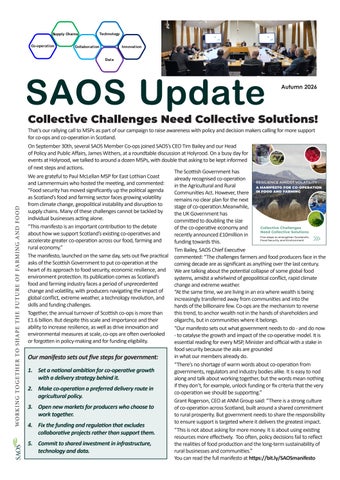
That’s our rallying call to MSPs as part of our campaign to raise awareness with policy and decision makers calling for more support for co-ops and co-operation in Scotland. On September 30th, several SAOS Member Co-ops joined SAOS’s CEO Tim Bailey and our Head of Policy and Public Affairs, James Withers, at a roundtable discussion at Holyrood. On a busy day for events at Holyrood, we talked to around a dozen MSPs, with double that asking to be kept informed of next steps and actions. The Scottish Government has We are grateful to Paul McLellan MSP for East Lothian Coast already recognised co-operation and Lammermuirs who hosted the meeting, and commented: in the Agricultural and Rural “Food security has moved significantly up the political agenda Communities Act. However, there as Scotland’s food and farming sector faces growing volatility remains no clear plan for the next from climate change, geopolitical instability and disruption to stage of co-operation.Meanwhile, supply chains. Many of these challenges cannot be tackled by the UK Government has individual businesses acting alone. committed to doubling the size “This manifesto is an important contribution to the debate of the co-operative economy and about how we support Scotland’s existing co-operatives and recently announced £10million in accelerate greater co-operation across our food, farming and funding towards this. rural economy.” Tim Bailey, SAOS Chief Executive The manifesto, launched on the same day, sets out five practical commented: “The challenges farmers and food producers face in the asks of the Scottish Government to put co-operation at the coming decade are as significant as anything over the last century. heart of its approach to food security, economic resilience, and We are talking about the potential collapse of some global food environment protection. Its publication comes as Scotland’s systems, amidst a whirlwind of geopolitical conflict, rapid climate food and farming industry faces a period of unprecedented change and extreme weather. change and volatility, with producers navigating the impact of “At the same time, we are living in an era where wealth is being global conflict, extreme weather, a technology revolution, and increasingly transferred away from communities and into the skills and funding challenges. hands of the billionaire few. Co-ops are the mechanism to reverse this trend, to anchor wealth not in the hands of shareholders and Together, the annual turnover of Scottish co-ops is more than oligarchs, but in communities where it belongs. £1.6 billion. But despite this scale and importance and their ability to increase resilience, as well as drive innovation and “Our manifesto sets out what government needs to do - and do now environmental measures at scale, co-ops are often overlooked - to catalyse the growth and impact of the co-operative model. It is or forgotten in policy-making and for funding eligibility. essential reading for every MSP, Minister and official with a stake in food security because the asks are grounded in what our members already do. Our manifesto sets out five steps for government: “There’s no shortage of warm words about co-operation from 1. Set a national ambition for co-operative growth governments, regulators and industry bodies alike. It is easy to nod with a delivery strategy behind it. along and talk about working together, but the words mean nothing if they don’t, for example, unlock funding or fix criteria that the very 2. Make co-operation a preferred delivery route in co-operation we should be supporting.” agricultural policy. Grant Rogerson, CEO at ANM Group said: “There is a strong culture 3. Open new markets for producers who choose to of co-operation across Scotland, built around a shared commitment work together. to rural prosperity. But government needs to share the responsibility to ensure support is targeted where it delivers the greatest impact. 4. Fix the funding and regulation that excludes “This is not about asking for more money. It is about using existing collaborative projects rather than support them. resources more effectively. Too often, policy decisions fail to reflect 5. Commit to shared investment in infrastructure, the realities of food production and the long-term sustainability of rural businesses and communities.” technology and data. You can read the full manifesto at https://bit.ly/SAOSmanifesto
saos news & views
SAOS AGM & Annual Report It was a small but well-fed turnout for our AGM this year as we were delighted to be hosted at Lurgan Farm near Aberfeldy, by former NFUS President, Martin Kennedy, who is now Chair of ScotEID. It was a great day and a beautiful spot for a barbecue lunch and farm tour. It was a really interesting afternoon for those who could stay on and great to see the ‘original’ version of land management, with traditional breeds maintaining, and thriving on, upland Perthshire. The business of the day was dealt with swiftly with Chairman’s Report from Rory Christie, business report from Tim Bailey CEO and our financial statements covered by Financial Controller, David Caskie, who reported on a satisfactory financial performance over the last year. “We had clean audit reports for the Consolidated Accounts and all the subsidiaries’ Accounts. The Consolidated Financial Statements show a bottom line transfer to reserves of £152k compared to £159k last year. Our consolidated turnover was up £255k including an R&D Tax Credit adjustment of £84k. Staff costs were up £201k (6%), and there was an increase in Corporation Tax of £48k offsetting the Tax Credit adjustment mentioned. The Year End bank balance was £490k , up £252k on last year. Net Assets have grown by £152k year on year. “Regarding the underlying Society Accounts we had a bottom line transfer to reserves of £40k compared to £11k last year. This was 0.7% of turnover, so a very small margin. Turnover was up £118k but staff costs increased by £293k including £45k of Employers NI. This is a 14% increase. However last year we had a 10% decrease so over the last three years there has been an average 2% increase. The fluctuation arose due to the timing of staffing changes where long serving employees have retired and new staff have joined us. Offsetting that increase our third party costs were down £200k as in 2024/25 we had £260k of funding from the Agricultural Transformation Programme which didn’t continue into 2025/26. Net Assets have grown by £40k. With regard to subsidiary companies, SmartRural Operations incurred a loss of £38k and ScotEID.Com reported a profit of £44k, while Food Integrity Assurance provided £105k profit, just above last year’s outcome.” You can find the full Financial Statements at https://saos.coop/about-us/latest-annual-reports/
SAOS Board on Tour 2026
Robert Logan, our Head of Co-op Development and Company Secretary, reports: “We held the annual ‘get away’ for SAOS’s Board Members at the end of July. These are usually based around visits to member co-ops and/or to gain better understanding of an industry challenge or opportunity. Last year the Board visited Borders Machinery Ring and Farmstock Scotland before heading out on site visits to explore opportunities and current blockers to establishing a new hemp grower co-op and primary processing facility in the Scottish Borders. This year’s programme saw them learning more about members Ringlink Scotland and Angus Growers. Presentations and discussions with John Gray, Vice Chair, and Graham Bruce, Managing Director, as well as departmental heads at Ringlink, provided detail on the scale and breadth of work being done on behalf of members. Their offices now stretch from Cupar to the Black Isle, and have over 4000 members. The ring has specialist teams covering the core services of machinery and labour matching, as well as commodities, energy and fuel, training, pre-apprenticeships, and HR – making them an essential solutions provider and trusted one-stop-shop for the farming and wider communities. The following morning, the Board headed to Angus Soft Fruits and then out to the fruit tunnels of an Angus Growers member. The visit showcased the strong partnership between these two businesses that effectively forms a vertically integrated supply chain. Angela Porchez (AG General Manager) explained the structure
of the PO and its members, and Neil Findlayson, Head of Supply Chain, explained the technical complexity in breeding new fruits, managing strong relationships with retailers for a seasonal and permissible product, and how they are developing data insights for better management decision making. Bringing the numbers to life, East Seaton farm manager, Allan Innes, provided on farm insight of the operational complexity of managing labour and satisfying supply chain demands and requests. The cherry on top, was some fruit tasting at the end, I can personally recommend their new AVA raspberry varieties and the strawberries were delicious too! These visits give the Board a practical and valuable insight into the workings of some of our members in different sectors. Shared discussions help build experience and strengthen relationships and informed contribution of directors when developing the SAOS strategy to support members and build resilience and growth in our sector.”
Plans are progressing well for our conference at Crieff on 21st January 2027 when our focus will be on Growing Capability for a Resilient Future. We’re sharing a few details here and open our Early Bird Booking Offer (with limited availability) at https://saosconference2027.eventbee.com A Scottish agri-food sector able to attract, support and retain the next generation of employees and leaders to work in co-ops and their supply chains is vital for a vibrant, resilient future. Our conference 2027 day will be focused on how we can grow our future agri-food business resilience, and we’ll be exploring how to make that happen through mindset, skills and leadership development. We are delighted with our line up of speakers who will share their thinking, innovative business models and fresh approaches. In our first session, we’ll hear from arable farmer and agritech entrepreneur, Jacob van der Borne, who many of you will recognise from the latest series of Clarkson’s Farm. We’ll also hear from former NFU President, Minette Batters. A member of the House of Lords since 2024, Baroness Batters runs her mixed family farm in Wiltshire with a number of diversified enterprises and published her Government commissioned review on farm profitability which sets out 57 recommendations intended to inform the government’s food strategy, farming roadmap and land use framework. Our keynote speaker for the third session is Fiona Dewar. Fiona’s mission is to develop the next generation of great leaders through practical, results-oriented training, coaching, and advisory services. We’ll also hear from Lynne Sommerville of the Digital Dairy Chain who we are delighted to have as a session sponsor. We’re very grateful to have the support of NFU Mutual as our headline sponsor once again. More details, including member co-op involvement, session specifics and full booking details to follow soon!
Scottish Agri Bodies Unite to Launch Farmer-Led Data Partnership Key organisations across Scotland’s agricultural sector have come together to progress plans for farmer-governed, industry-owned data solutions, marking a major step towards giving Scottish farmers and crofters greater control and value from their data. At a meeting convened by SAOS, representatives from NFU Scotland, Scottish Quality Crops, Scottish Crofting Federation, Scottish Land & Estates, Scottish Pigs, and the National Sheep Association agreed on the need to establish a Scottish Agri Data Partnership. Additional Partnership members include National Beef Association, Quality Meat Scotland, and AHDB Dairy. The proposed initiative aims to tackle growing concerns around how farm data is collected, used, and shared, while addressing widespread inefficiencies caused by repeated data entry across multiple systems. The partnership will benefit from SAOS’s trusted agri data track record with development and operation of ScotEID, MyHerdStats and pioneering data innovation initiatives being undertaken by its SmartRural subsidiary. The Partnership will explore the development of a centralised data co-operative model, governed by farmers and built on a permissions-based system. This would allow individual producers to control what data is shared, with whom, and for what purpose, ensuring data ownership remains with those who generate it. This development builds on a pilot project
exploring foundational infrastructure completed in 2025 with funding support from SAOS, QMS and Scottish Pig Producers. Tim Bailey, SAOS Chief Executive: “Farmers and crofters are increasingly being asked for data, but often see no benefit from providing it. This initiative is about ensuring they retain ownership and receive value working with early adopters to from their data, while reducing duplication showcase real-world benefits and and administrative burden.” encourage wider participation. George Noble of SmartRural added: “The Drawing on international best technology to deliver this already exists practice, draft terms of reference and we’ve seen similar partnerships and a data charter have been working elsewhere in the world. The real prepared to be agreed by challenge - and opportunity - is building participating organisations. trust, governance and collaboration The aim is to seek comprehensive across the sector.” sector-wide support, including from Participants expressed broad support for the Scottish Government and other a co-ordinated, sector-wide approach, interested stakeholders, to build highlighting the importance of collective momentum and pace behind this action and aligning around shared initiative. principles for data governance. Organisations so far involved are: The group also discussed the importance • SAOS of maintaining a distinct Scottish-focused • NFU Scotland model, ensuring interoperability with • Scottish Quality Crops UK and international systems, while • Scottish Crofting Federation safeguarding access and control over Scottish agricultural data. • Scottish Land & Estates A key focus of the partnership will be • Scottish Pigs overcoming scepticism from farmers and • National Sheep Assoc (Scotland) crofters around data use. Industry leaders • National Beef Association acknowledged concerns about how data • Quality Meat Scotland might be used and stressed the need for transparency, clear benefits, and robust • AHDB Dairy governance. Plans are already in place to launch pilot projects and demonstration initiatives,
saos news & views
SAOS Conference 2027 - Get Booking Early Birds!
saos news & views
Mikaela Linden Shares Reflections from an Organic Learning Journey and businesses, and that no organic initiatives or investment go to waste. This was a core theme during the Organic Learning Journey that SAOS recently attended in London, as part of our work with the Scotland Food & Drink Partnership. Organised by Scotland Food & Drink and Lumina Intelligence, the journey is part of the work outlined in the Scottish Organic Action Plan 2026–2029, which you can read more about at the link below. The Organic Learning Journey brought together a range of Scottish organic businesses and stakeholders for an insights-packed day of travel around London to explore various outlets, organic propositions and routes to market. London is a major market for organic produce, with the UK’s highest concentration of organic shoppers and 72% of stores offering an organic option, compared to 53% for Edinburgh, making it ideal to learn and identify realistic growth opportunities. A day of interesting conversations and tastings, included a stop at London’s first-ever Scottish café-deli The Shoap, ended at Scotland House to reflect on our learnings and discuss next moves. Lots of great relationships were formed, insightful conversations were had and it was a true privilege to spend the day with some of Scotland’s many ambitious and creative entrepreneurs! The second day of the learning journey involved a visit to the Natural & Organic Food Show, where we met inspiring entrepreneurs alongside some of the most established brands
in the organic market. Several Scottish businesses were represented, giving me the opportunity to hear their views on supply chain opportunities and challenges, and explore how collaboration could help address some of these. Collaboration was also a key theme when I spoke to some of the business owners at Organic Sweden’s pavilion, where I dusted off my ‘business Swedish’ and gained useful insights on everything from alternative proteins to the role of consumer education in organics and how to create confidence throughout the supply chain.
“Every farmer in the country would go organic tomorrow if they were paid properly for it!” This was the closing remark of Craig Sams, founder of organic chocolate brand Green & Black’s, at the Natural & Organic Food Show in September. Whilst perhaps a little optimistic and exaggerative, it does touch on two core challenges: profitability and a confident, functioning supply chain. These challenges are in no way unique to the organic sector, but with land use for organics expanding rapidly in Scotland, addressing them is becoming increasingly more important to ensure a sustainable future for organic growers. I returned to Scotland full of Scottish ‘in-conversion’ land – the inspiration and optimism. The organic area of land in the process of being sector has significant opportunities converted to fully organic – grew and, importantly, plenty of appetite for by 102% in 2024. Meanwhile, total growth – but there are also challenges. organic land in Scotland, including I’m looking forward to continuing both fully organic and in-conversion this work and exploring how SAOS land, surpassed 168,000 hectares in can help strengthen collaboration, 2025: up 28% in one year and 62% build more resilient supply chains and since 2021. overcome some of those challenges This calls for focus on strengthening to ensure that the growth of organic the organic supply chain in Scotland, production in Scotland translates into ensuring that this growth translates real opportunities. into viable opportunities for farmers Find out more at: https://foodanddrink.scot/helping-business/services/growth/scottish-organic-action-plan-2026-2029/
2026/27 GTL Cohort Gets Underway The fifth cohort of Growing Tomorrow’s Leaders (GTL) got underway in September, bringing together another group from across Scotland’s agriculture, food and drink and wider land-based sector. Developed by SAOS in partnership with NFU Scotland and NFU Mutual, GTL supports people to develop their leadership confidence, skills and self-awareness, while learning alongside others from across the industry. This year also brings an exciting first for the programme. Thanks to support from the Women in Agriculture Scotland Practical Training Fund, administered by Lantra Scotland, we have been able to offer a fully funded GTL place for the first time, helping to widen access to the programme. Over the coming months, the cohort will take part in workshops, leadership profiling, masterclasses and practical learning, supported by Tack TMI Leadership Factory. So who’s ready to take the next step in your organisation? If you have someone stepping into a new role, taking on greater responsibility or looking to develop their leadership skills, you can register your interest for the 2027 cohort now by contacting: emma.koubayssi@saos.coop
From navigating market volatility to responding to changing regulations and member expectations, leadership in rural organisations is as demanding now as it has ever been. As part of our ongoing commitment to supporting co-ops and rural organisations, SAOS has refreshed its 2026/27 training programme under the theme Capable People > Effective Boards > Successful Rural Organisations. The programme combines practical sector knowledge, co-operative governance expertise and applied industry experience to help organisations make better decisions, strengthen member participation, and build long-term value. Technology and markets continue to change, but successful organisations still depend on capable people, effective boards, and confident leadership. A key element of the refreshed offer is the roll-out of three core Director Development modules: Director Fundamentals, Member Participation and Strategy & Future Thinking. The modules are designed for directors, managers, and member-led organisations, with a clear focus on practical outcomes that support good governance, democratic accountability, member engagement and stronger strategic leadership. The first open workshops are planned for winter 2026/27: Director Fundamentals on Wed 9th Dec, online; Member Participation on Tues 26th Jan, online Strategy & Future Thinking on Tues 9th Feb, in person. The wider programme also includes Co-op Managers’ Forums in November, a Co-op Chairpersons’ Forum in December, and the SAOS Annual Conference on Thursday 21 January. Alongside the director development modules, SAOS also plans to offer a Persuasion & Influencing Skills workshop with a specialist training partner, helping participants communicate with greater clarity, influence constructively, and build commitment across boards, teams, stakeholders, and customers. All workshops can also be tailored for individual boards and executive teams, with regional delivery options available where there is interest. Places may be limited, so early booking is recommended. Learn more/register interest at www.saos.coop or email Allison.watson@saos.coop
Fare thee well to Hamish Walls
We bid farewell to another SAOS stalwart at the end of September when Hamish Walls made his bid for freedom over the barbed wire fence having completed 28 years with us. Hamish has been a much valued team member, particularly for his dry sense of humour and innate ability for cutting through the “manure” on many an occasion! He joined the SAOS team in 1998 having moved up the ranks in sales positions with SAI, J Hogarth and H O Short and Son, where he was Sales Director. Adding to his original Agricultural (Hons) degree from Newcastle, Hamish completed a post grad CIM in Marketing in his time with SAOS, which was of great benefit to many through his Director Development training modules on member communications. A real all rounder, Hamish was an excellent sounding board and voice of good sense for both the co-op and the supply chain teams and his list of project involvement was impressively varied. We’ve recently added two case studies to our website (which had the working title Hamish’s Greatest Hits) and reflect on key roles he played through his work with the Machinery Rings and on the FastBreeders project. (You can find these at https://saos.coop/what-we-do/case-studies/) Hamish is looking forward to having more time to spend with Pip his wife and his girls, one of whom is in London and one in Australia. We are sure all our members will join us in thanking him and wishing him all the very best.
saos news & views
New Training and Development Programme for 2026/27
saos news & views
Adam and Douglas share their takeaways from Groundswell Summer seems ages ago, but Adam Forrest and Douglas Bowden-Smith share their takeaways here from a scorching couple of days at the Groundswell Regenerative Agriculture Festival.
around the value of facilitators. Skilled facilitation has been key to enabling investment and to the professionalisation of these partnerships – this has been really good to see.”
Celebrating its tenth anniversary, the Groundswell festival continues to live up to its name and was bigger than ever this year. SAOS was there again to learn, exchange ideas, strengthen relationships, and celebrate collaborative working.
When asked how this Groundswell has compared with previous years, Adam noted that the event is becoming more commercially-focused – most likely because the industry is changing while at the same time the event is growing and attracting a more mainstream audience.
Groundswell has come a long way since 2016, when it was founded as a relatively niche event with around 400 farmers in attendance at Lannock Farm in Weston, Hertfordshire. This year, the event attracted over 10,000 attendees (spread across two days), with farmers being joined by researchers, advisors, and a variety of industry stakeholders, including representatives from some of the biggest food and drink companies in the world. The main focus of Co-op Development Manager Adam Forrest’s visit was to see first-hand how farmer collaboration is developing in England. “One core message that kept resurfacing was that successful change in agricultural practice depends as much on relationships, trust, and collective organisation, as it does on individual farm practices. Farmer collaboration is moving from the margins to the centre of agricultural transition,” Adam reflected. This is illustrated in part by the new £30m Farmer Collaboration Fund recently launched by Defra. The fund runs for three years and aims to help England-based farmers better handle shared challenges through collaboration, specialist advice, and peer learning. Delivery will be by local facilitators such as NGO’s and charities. Another inspiring point from a co-op perspective is the strong farmer cluster network that has emerged in England over the past decade. Many of these clusters have received strong support from the government, as Adam explains: “One example is a project in Cotswolds which was recently funded with over £100 million of blended public and private finance, focused on delivering nature restoration. It would be great to see more structured government support for farmer clusters and informal forms of farmer collaboration in Scotland. It was also interesting to see the understanding
The growing range of people attending was also something that surprised Project Manager Douglas Bowden-Smith, who attended the event with a focus on supply chain collaboration. Douglas told us: “You really do meet people from all parts of the supply chain. I can’t think of another example where you can chat to the Head of Sustainability at Heineken and then turn around and chat to a group of farmers and all kinds of corporates. Groundswell provides a wonderfully eclectic melting pot.” A key take-away from discussions with such major food companies, be it Heineken or PepsiCo, was the rigidity of their vertically integrated supply chains, with so many middlemen
between the farmer and the producer. Douglas explains: “That left a bit of a sticking point in my head. I couldn’t help thinking that there’s a possibility here for SAOS to get involved, as more of a grassroots organisation, helping to reduce the distance between farmer and processor.” Like Adam, Douglas was really interested in England’s successful farmer cluster groups. A key aspect of their success is
having access to funding for facilitators, a role that SAOS could play if the concept were to gain further traction in Scotland. There is now a strong base of large, landscape-wide, multi-stakeholder collective projects deeply rooted in England, which was really encouraging. One such example is the launch of the Food & Nature Resilience Fund, by Lloyds Banking Group and farming regeneration business, Wildfarmed, which helps UK farmers transition to nature-positive practices without having to carry the financial burden. The fund pools investments from banks, utility companies, and insurers to reward farmers financially for improving soil health and biodiversity while keeping land in production.
On a less optimistic note, Adam and Douglas were both shocked at the level of dryness in the countryside as they made their way down to Hertfordshire. “If there’s ever a wake-up call for climate change, being down south and seeing how much of the country was tinder dry really brought the message home,” said Douglas. He continued: “water scarcity is becoming a real problem and there is definitely increased awareness of the need for resilience in farming systems. Things are getting hot enough that people really can’t ignore it.” The challenges facing agriculture are too great for any farm to tackle alone. As the impacts of climate change become harder to ignore, collaboration will be critical in turning shared challenges into shared solutions. Get in touch with adam.forrest@saos. coop or douglas.bowden-smith@saos. coop to learn how SAOS can help.
We recently had to change our Facebook account and sadly that means we have to start from scratch to build up our following. We’re also just getting going on Instagram too so we thought it was a good time for a reminder of all the ways you can keep up with our news and what grabs our interest - and we’re happy to support you too! Click on the icons on the left or links below for our pages and do please follow us! •
https://www.facebook.com/profile.php?id=61593244320136
•
https://www.linkedin.com/company/saos
•
https://x.com/saos_agri_coops & https://x.com/SAOS Supply Chain
•
https://www.instagram.com/saos_workingtogether/
•
https://www.youtube.com/@SAOS_working_together
saos news & views
We’re Very Social - Come and Join us!
First Milk White Paper Calls for a More Resilient Food System
Record Investment
In other news, First Milk recently announced its largest single capital investment project to date at its Lake District Creamery in Aspatria, Cumbria, reinforcing their long-term commitment to British cheese production. The £16.8 million investment project, which follows previous investment totalling £30m at the site in recent years, will see the existing cheese vats replaced with
new, larger vats as part of a significant upgrade to the creamery’s production capabilities. Once complete, the investment will increase production capacity by a further 20%. The multi-million-pound project will span two financial years and is designed to support the efficient production of high-quality cheddar cheese and dairy ingredients, while strengthening the creamery’s long-term operational resilience and future growth potential.
co-ops news
A resilient food supply cannot be built on fragile natural foundations. That’s the theme for the recently-published white paper from our dairy co-op member, First Milk. Climate volatility, nature depletion, poor water quality, geopolitical instability, and volatile input markets are no longer separate sustainability issues. For food businesses, they are direct commercial risks to supply confidence, cost reputation and long term growth. Regenerative agriculture has gained momentum because it offers a practical response to these pressures. But its future credibility depends on evidence. Principles and practices matter but they are not enough. The next phase of regenerative farming must be judged by what it delivers - healthier soils, improved water stewardship, enhanced biodiversity, better animal welfare and more resilient farm businesses. First Milk and its members are working to define the next phase of regenerative dairy: evidence-led, operating at commercial scale and rooted in real farm change. Over the past five years, it has built one of the UK’s most advanced and comprehensive, farmer-centric, regenerative dairy programmes: with 96% of its 700 farmer members adopting regenerative practices, supported by the Regenerative Farming Pledge, annual farm engagement, regenerative scoring, digital field mapping, intervention recording and long-term scientific partnerships. Regenerative performance is also recognised through First Milk’s member payment structure, embedding the programme in the commercial model of the co-operative. Through partnerships with Agricarbon, Farm Carbon Toolkit, Kingshay, Senus and the UK Centre for Ecology & Hydrology, First Milk is building robust evidence across soil carbon, water quality risk, nutrient efficiency, biodiversity and animal welfare, using leading methodologies and expert oversight. Early soil carbon re-measurement results show increases in soil carbon stocks across farms sampled to date, while field-level water risk analysis and biodiversity monitoring extend the same outcome-led approach beyond carbon. First Milk is showing how regenerative dairy can become a measurable operating model for resilient, grassbased dairy production, commercial confidence and environmental progress. In doing so, it offers a practical case study for a wider shift in the UK food system: from activity to evidence, from practice adoption to measurable outcomes, and from sustainability intention to proof. You can read the full document at: https://www.firstmilk.co.uk/app/media/FM-white-paper-Jun26-WEB_FINAL.pdf
co-ops news
Farm Stock and Damn Delicious Enjoy the Taste of Victory Farm Stock Scotland and farmer member Michael Shannon of Damn Delicious are celebrating after winning a coveted Silver Medal at the World Steak Challenge in Amsterdam with a 100% grass-fed Aberdeen Angus heifer sourced through the co-operative’s farm-to-farm trading service.
The award brings international recognition to a collaborative Scottish beef supply chain involving breeder, farmer, livestock marketing co-operative and butcher with the animal ultimately selected, finished, matured and butchered by Michael and his team at Damn Delicious. The Aberdeen Angus heifer was originally bred by James Playfair Hannay of Morebattle Tofts in the Scottish Borders and subsequently purchased and finished by Michael Shannon. The farm-to-farm deal was facilitated by Nikki Gilbertson, Assistant Manager (Farm-to-Farm Trading) at Farm Stock Scotland, who matched the animal to Michael’s specific requirements. As both a farmer and butcher, Michael is involved throughout the production process. His attention to finishing, animal selection, maturation and butchery was key to producing beef capable of competing against steaks from around the world. The World Steak Challenge attracts more than 600 entries from leading beef-producing countries, with steaks independently assessed on characteristics including appearance, aroma, tenderness, flavour and overall eating quality. Jonny Williams, Managing Director of Farm Stock Scotland, said: “This is a fantastic result and Michael deserves an
enormous amount of credit. He has put a huge amount of time, effort and enthusiasm into this, from selecting and finishing the animal through to preparing the beef and getting our entry to Amsterdam. “Michael is passionate about producing exceptional beef and, as both a farmer and butcher, he understands the whole process from the animal in the field right through to the steak on the plate. Winning a Silver Medal against international competition is a tremendous endorsement of what he and Damn Delicious are doing. “There is also a great Farm Stock collaborative story behind the animal. She was a grass-fed Angus heifer, originally bred by James at Morebattle Tofts, and the farm-to-farm sale to Michael was facilitated by Nikki from our team. “Our staff’s role is all about knowing our members, knowing the stock that is available and matching it to the right customer. In this case, that journey ended with a Silver Medal at the World Steak Challenge in Amsterdam which is a Pictured: Farm Stock’s Nikki Gilbertson fantastic result.” with Michael Shannon of Damn Delicious
Making Plans for Thainstone
ANM Group recently unveiled its long-term vision to regenerate, modernise and futureproof the Thainstone Centre. As part of ANM’s wider work to explore the future potential of the site, SAOS provided support through our Co-op Support Service, carrying out market research to help ANM examine possible commercial uses for underutilised areas of the Centre. The research explored the types of businesses, services and activities that could complement the Centre’s existing agricultural activities, while helping to attract new visitors and customers. This included gathering views from stallholders and members of the public at ANM’s Christmas Classic and Taste of Christmas event, which attracted more than 4,000 attendees. We also reviewed examples of similar rural hubs and developments, providing ANM with additional evidence and reference points to consider as part of its wider planning and decision-making. It’s an exciting time for ANM and their members. As they put it: “From our roots as a member-owned co-operative to the creation of Thainstone Centre, ANM has always evolved around one purpose: helping people, businesses and communities across the North-east trade, connect and prosper. The next chapter is no different. From 2026, the Thainstone Vision sets out a ten-year plan to regenerate, modernise and futureproof the site for the next generation of members, customers, businesses and communities. We’re investing in the infrastructure, services and spaces that will allow Thainstone to continue playing a vital role in the region’s economy for decades to come. Members are encouraged to sign up to follow the progress of the Thainstone Vision at: https://anmgroupvision.co.uk/ The project is a good example of the type of practical support available to SAOS members through the Co-op Support Service. Get in touch with any member of the Co-op Development team if we can help with your vision!
This year’s PotatoEurope 2026 took place in early September in Gestorf, near Hanover, Germany. For the first time this year it was held alongside a new event, SugarBeet Expo. The event is one of Europe’s leading specialist exhibitions for the potato industry, and brings together growers, machinery manufacturers, processors, agronomists, researchers, and suppliers from around the world. The location of Potato Europe rotates every year and there were over 10,000 visitors attending from 79 countries, which highlights its strong international reach. Once again, Scottish Agri Export Hub organised a collaborative stand for the Scottish Seed Potato sector to showcase their capabilities and meet with existing and prospective clients. Seven partners were on this year’s stand • Seed Potato Organisation • Alan Twatt Potato Merchants Limited • J & E Smillie (Growers) Limited • Grampian Growers Limited • Greenvale • Science and Advice for Scottish Agriculture (SASA) • GB Potatoes Organisation This collaborative stand format was first trialled in 2025 and again proved to be hugely successful. Thankfully the weather behaved for what turned out to be an amazing couple of days with the stand providing the perfect platform for exporters
to showcase their excellence, meet clients and scope out new opportunities. Having a collaborative stand really demonstrates Scotland well as a key exporting nation and is vitally important to reach buyers from across the world at this key event. The strong attendance, international participation, and demand for automation and precision farming technologies reflected growing investment confidence following the difficult 2025/26 season for many competing nations. The overall outlook from the Scottish sector was one of optimism with the current signs indicating a productive export season ahead.
supply chains
Positive Signs for a Productive Potato Export Season
AMU Case Study Reflects on Positive Findings data
A new case study has been published by Quality Meat Scotland on Scotland’s AMU pilot, the collaborative project led by SAOS and supported by QMS, Farmvet Systems and ScotEID, with funding from by Scottish Government. The pilot supports 15 vet practices “We can talk with farmers about where sheep now, though we occasionally to produce AMU reports for their there’s been higher use of a particular put our fattening lambs through the clients, helping lead the way in tracking antimicrobial due to, say, a pneumonia footbath. antibiotic use in livestock. More farmers outbreak and can then discuss “For me, having the AMU report is a are now being invited to take part in investigative work such as nasal swab no-brainer as the vet is doing the work the project. PCR testing before tailoring a vaccine for it. It’s useful to have the information protocol to what’s circulating in their Each farm receives an individual annual collated and to look for any patterns with antimicrobial use report, generated from stock. Investigation leads to informed our vet as part of our annual health plan decision making, rather than guess data collected by the vet. This prompts work. work.” discussions on different options, such as “Wales has been producing these introducing a vaccination programme. “Developing preventative strategies such reports for a while, but I think Scottish as tailored vaccination helps to improve The project has found lower-thanagriculture has a very good story to tell health and reduce antimicrobial use.” expected levels of AMU among the on AMU use as it is low.” farms involved, and reports are already For Inverness-shire suckler and sheep Seb agrees, adding that with some helping identify animal health issues on producer Hugh Fraser, who farms at lobbyists seeking a ban on antimicrobial farm. Seb Batchelor is clinical director of Kinchyle, the annual AMU report has use in animals, being able to prove Caledonia Farm Vets, one of the practices highlighted his low use on farm, a responsible use is crucial. “The industry involved. “It’s really good to be involved common theme with Seb’s clients too. is doing a lot to reduce use, but we will as I enjoy working with producers to He says: “We don’t use any never achieve zero use as animal welfare improve production and their returns antimicrobials routinely. We aren’t would be compromised. I think the rather than firefighting problems.” buying-in stock from everywhere for AMU reporting and discussion is hugely While many farmers are already finishing and don’t tend to do many valuable – the Scottish Government vaccinating against key diseases, others caesareans, which can often put usage should get off the fence and adopt it in may not be. The AMU report helps to up. In the past, we did treat foot rot, but Scottish agriculture now.” identify potential recurring disease issues we started vaccinating a few years ago and prompts discussion, says Seb. and it’s not a problem in our breeding You can read the full case study on the QMS website at: https://qmscotland.co.uk/news/scotlands-amu-pilot-helps-safeguard-antimicrobials-animal-welfare-and-profitability
The Net Zero Programme provides leadership, guidance and practical support for food and drink businesses across Scotland. Hosted by Food & Drink Federation Scotland on behalf of the Scotland Food & Drink Partnership, and funded by the Scottish Government, the Net Zero Programme forms part of the Partnership’s shared commitment to deliver net zero food and drink products by 2045, providing: In collaboration with the Net Zero • Tools and resources that simplify climate action Programme, SAOS is launching a • Guidance tailored to every stage of the net zero quarterly Sustainability Bulletin to journey improve understanding of climate, • Access to specialists, advisors, and wider industry supply-chain and commercial support sustainability risks and opportunities across the Scottish food • Insight into customer and market expectations and drink industry. around sustainability Sign up for this bulletin to keep up to date at: • Alignment with Scotland’s environmental goals https://tinyurl.com/bdz2z8uf and policies.
ScotEID and RSABI: Building Better Mental Health Awareness
We were really delighted to hear that the whole Scoteid team had been taking part in RSABI’s Mental Health First Aid training recently. The training is delivered by IED Training Solutions Ltd and kindly supported by NFU Mutual’s Charitable Trust. Here’s the first group pictured at ScotEID’s Huntly office where the friendly, professional staff answer around 200 calls a day, proving help, support and encouragement to farmers with queries about livestock registrations. It was great to hear that RSABI really appreciate the work of the ScotEID team who go above and beyond to help livestock keepers sort out their queries. They are all very aware that it can be a stressful part of farming for many. Don’t hesitate to give them a call if you have concerns about late registrations or updating your herd records. Tel: 01466 794323 Email: help@scoteid.com And if you are feeling stressed or overwhelmed by compliance issues, remember RSABI provides free, 24-hour support via 0808 1234 555 and you can also request a free, confidential call back from a cattle traceability specialist.
What can The Knowledge Bank do for you?
It’s been a while since we reminded members about how useful The Knowledge Bank could potentially be to them. The Knowledge Bank is about accessible intelligence, accurate information and tangible actions, and its insight service gives access to a unique blend of customised market research, data analysis and consumer insights. The expertise available enables using intelligence to inform strategy, identifying new routes to market and developing resilient supply chains. With all of that at your fingertips you have the essential information to identify where the best opportunities are to sell more, or sell more profitably. The Knowledge Bank is a resource dedicated to the Scotland Food & Drink industry and those that support them. Find out more at: https://theknowledgebank.scot/ We produce four newsletters a year, two of which are printed with copies sent to our Co-op Member Directors (our Summer and Winter editions). All are available at https://saos.coop/whats-new/quarterly-newsletters/. Let us know if you’d like to be added to, or taken off, the email list and if you’ve any suggestions for content. Contact: jennifer.thompson@saos.coop
collaboration
Stay Ahead on Sustainability!