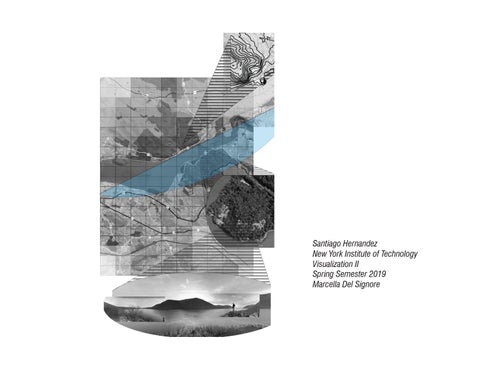
Santiago Hernandez New York Institute of Technology Visualization II Spring Semester 2019 Marcella Del Signore
01 Taxonomy of Edges, Contours, Planes and Color.
Cut-Outs and Planar Extracts Spatial Analysis and Taxonomy of Armatures. Edges, Geometric Centers, and Color Armatures Taxonomy of Volumes, Volumetric Vessels.
02 Site Formation
Performative Site Drawing Site Model
03 Exterior and Interior Environment
Outdoor Spatial and Exploration Conditions Indoor Spatial and Programmatic Conditions
04 Paneling system
Geometrical Variation Renderings Model
Taxonomy of Edges, Contours, Planes and Color. Cut-Outs and Planar Extracts Spatial Analysis and Armatures. Edges and Center Volumetric Vessels Models
Cut-Outs and Planar Extracts 2+3D Diagrams and Analysis of Edges, Contours, and Planes
Cut-Outs and Planar Extracts
Relationship Between Parts, Organization and Separation.
Cut-Outs and Planar Extracts Taxonomy of Colors
Cut-Outs and Planar Extracts
Color Zones and Transition / Axonometric Drawing
Spatial Analysis and armatures. Edges and Center
2D Diagrams of Armatures, Horizontal and Vertical Axis Intersections with Center
Spatial Analysis and armatures. Edges and Center Taxonomy of Color Armatures
Volumetric Vessels
Taxonomy of Volumes
Volumetric Vessels
3D Volumetric Axonometrics
Site Formation
Performative Site Drawing Site Model
Site Formation
Performative Site Drawing
Exterior and Interior Environment
Outdoor Spatial and Exploration Conditions Indoor Spatial and Programmatic Conditions
Outdoor Spatial and Exploration Conditions Outdoor Renderings
Indoor Spatial and Programmatic Conditions Indoor Rendering
Paneling system
Geometrical Variation Renderings Model
Geometrical Variation Patterns
Renderings
Elevation and Axonometric
Model
Programming in computational processes.
There were 5 presentations and a round table, which discussed technology in design. Each of the speakers brought forth their own and other research that represent designing via computational processes. Tom Verebes led us off by going into detail about disciplinary indeterminacy and Urban Projects. urban design, landscape urbanism, and architecture. Verebes gave his take on how these four components make up an urban city and how it influences the way people live and operate through an urban city. Christian Pongratz, another speaker, talked about textures, tools and robotic automation. showing us how he made robots to do very specific actions with materials. The HyperCell project which was an interactive design of Singular bodies that self-assemble and can perform and build architecture with a “mind of their own�. The project was a parametric design, in which the cells were programmed and given instruction on how to work and how to respond to outside regulations done to them It was very interesting how technology is taking to the maximum level to design in a more efficient way