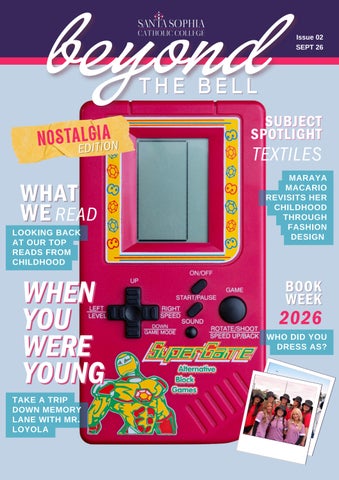
beyond
Issue 02 SEPT 26
THE BELL
N O S TA LDGI TIIA E ON
WHAT WE READ
LOOKING BACK AT OUR TOP READS FROM CHILDHOOD
WHEN YOU WERE YOUNG
TAKE A TRIP DOWN MEMORY LANE WITH MR. LOYOLA
SUBJECT SPOTLIGHT
TEXTILES
MARAYA MACARIO REVISITS HER CHILDHOOD THROUGH FASHION DESIGN
BOOK WEEK
2026
WHO DID YOU DRESS AS?
IN THIS ISSUE 3
A Note From The Team
4-5
What We Used To Read
What nostalgia looks like for us and the inspiration behind this edition.
Looking back at our top reads from childhood
6
Nostalgic Timeout
7
What We Liked To Watch
8
Subject Spotlight: Textiles
9-11
Which Superhero Are You?
12
Book Week 2026
13
Year 12 Podcast
Did you ever play spot the difference as a kid?
Looking back at some of the more popular kids shows and movies we were obsessed with
Maraya Macario revisits her childhood through fashion design
Complete the quiz to find out which superhero you are!
What did you dress as?
Nostalgia
A NOTE FROM THE TEAM Why We’re Feeling Nostalgic... The idea for this edition came from looking back at the books, games and memories that made childhood so special. With Book Week bringing nostalgic characters back to life through dress-ups, it seemed like the perfect opportunity to explore why we love revisiting the past.
This edition also looks at how nostalgia can inspire creativity, particularly in Textiles, where childhood memories, trends and styles can be reimagined into new fashion designs.
OLD IS GOLD
WHAT WE USED TO READ
Remember these gems?
A Bad Case of Stripes
A wonderfully nostalgic childhood favourite, bringing back memories of colourful illustrations, quirky humour, and the comforting message that it’s okay to be yourself.
The Very Hungry Catterpillar
A nostalgic childhood classic that brings back memories of learning, growing up and early childhood storytime.
The Magic School Buss Rides The Wind
A nostalgic childhood story that makes learning about wind, air and weather feel like a fun adventure.
Possum Magic
A nostalgic Australian childhood classic filled with magic, adventure and iconic Australian foods and places.
4
WHAT WE USED TO READ Rainbow Magic: Amber The Orange Fairy
A nostalgic childhood adventure filled with magic and friendship as Rachel and Kirsty search for Amber the Orange Fairy and help bring colour back to Fairyland.
Diary Of A Wimpy Kid
A funny and nostalgic childhood favourite that follows Greg Heffley through the awkward, embarrassing and relatable challenges of school, friendships and growing up.
The Baby Sitters Club: Dawn And The Impossible Three
A nostalgic series with a relatable story about Dawn adjusting to the Baby-Sitters Club while dealing with the challenges of caring for three difficult children.
Captain Underpants And The Attack Of The Talking Toilets
A funny and nostalgic childhood story about George and Harold battling an army of talking toilets after one of their crazy creations comes to life.
5
NOSTALGIC TIMEOUT
SPOT THE DIFFERENCE... Look at the image and find the
5
differences! Enjoy this throwback to a fun childhood activity and memories of, racing your friends and the excitement of spotting sneaky differences!
6
WHAT WE LIKED TO WATCH
MOVIES & SHOW S Can you name the movie or show based on the picture clue?
7
SUBJECT SPOTLIGHT: TEXTILES
YEAR 10 PROJECT RUNWAY
MARAYA MACARIO REVISITS HER CHILDHOOD THROUGH FASHION DESIGN
Why did you choose Barbie as the main influence for your collection?
What inspired you to base your Project Runway collection around childhood memories and nostalgia? I reflected on some of my favourite childhood memories, which ultimately led me to Barbie as the central inspiration for my collection.
I felt that Barbie best represented my personality and my passion for incorporating personal elements into my designs. I wanted my collection to showcase my authentic self while allowing me to elevate familiar ideas through my own creative style.
8
SUBJECT SPOTLIGHT: TEXTILES
Was there a particular Barbie, childhood memory, or experience that inspired your designs? My main inspiration was the fairy princess aesthetic, which reminded me of the Barbie films and characters I loved during my childhood.
Can you tell me about your collection and what you wanted it to communicate through the designs? Pink is my favourite colour, so I wanted it to feature heavily throughout my collection. I also drew inspiration from dresses in my favourite Barbie movies, putting my own spin on these ideas to create designs that reflect my individual style.
DREAMHOUSE
9
SUBJECT SPOTLIGHT: TEXTILES
YEAR 10 PROJECT RUNWAY What was the idea behind this creative project? The idea behind this project was to give students an opportunity to experience the fashion design process in a way that closely reflects industry practice. We began with a fashion illustration course, where students developed the skills to create their own collection based on a set theme. From there, they selected one design to bring to life through the construction process. The exciting final stage will be seeing students showcase their finished designs on the runway at our Term 4 Stage 5 Showcase Evening.
Can you explain this year’s theme? This year’s theme is ‘Through Time and Place’, which we deliberately kept quite
MISS BAILEY GIVES AN OVERVIEW OF THE PROJECT RUNWAY PROJECT
broad to allow students plenty of room for their own interpretation. Students might draw inspiration from a particular historical period, reflect on travel and significant places, or investigate cultural influences and expression.
What initially stood out to you about Maraya’s idea for this Project Runway collection? What initially stood out to me was Maraya’s different interpretation of the theme “Time.” She looked at a period within her own life and drew inspiration from her own childhood memories. her use of nostalgia makes the concept particularly interesting, as it is something everyone can relate to in their own way. While the inspiration is very
personal to Maraya, the feeling of looking back fondly on childhood is universal.
What aspects of her design or work have impressed you the most? I have been particularly impressed by Maraya’s confidence in developing and communicating her ideas. She built strong skills during the fashion illustration component of the course, learning about body proportions and how to apply these techniques to her own unique concepts. Her willingness to experiment with bold colours and explore her ideas without feeling overly restricted has allowed her personality and creativity to really come through in the collection.
10
QUIZ TIME!
WHICH SUPERHERO ARE YOU?
1. Pick the ultimate nostalgic treat: A. Fairy bread — 1 point B. Bubble O’Bill — 2 points C. Tiny Teddies — 3 points D. A Slushie — 4 points
COMPLETE THE QUIZ TO FIND OUT WHICH NOSTALGIC SUPERHERO YOU ARE!
2. It’s Saturday morning. What are you doing? A. Watching cartoons in your PJs — 1 point B. Riding your bike around the neighbourhood — 2 points C. Playing video games for way too long — 3 points D. Making up an elaborate game with your friends — 4 points
3. What was your childhood superpower? A. Always knowing when snacks were coming — 1 point B. Making friends with everyone — 2 points C. Turning absolutely anything into a competition — 3 points D. Having a very overactive imagination — 4 points
5–8 points Superman You’re the classic! Dependable, kind and always ready to help, you give off wholesome Saturday-morningcartoon energy.
4. Choose your ideal Book Week costume: A. Something colourful and classic — 1 point B. A homemade costume that took way too much effort — 2 points C. An action hero with an impressive cape — 3 points D. Something dramatic that guarantees you’ll be noticed — 4 points
5. Pick a nostalgic school-day essential: A. A colourful lunchbox — 1 point B. Gel pens and scented stationery — 2 points C. Pokémon or footy cards — 3 points D. A fidget spinner — 4 points
17–20 points Powerpuff Girl Colourful, confident and full of personality, you bring big main-character energy and aren’t afraid to stand out.
9–12 points Spider-Man You’re fun, energetic and a little chaotic. You might get yourself into trouble, but somehow you always find a way out. 13–16 points Batman You’re clever, determined and probably took playground games far too seriously. You like having a plan and are always prepared.
11
BOOK WEEK 2026
Teacher Favs! Double click to watch!
A SYMPHO N S T O R I E SY O F
12
The Stories We Never Really Grow Out Of
YEAR 12 PODCAST
RIANSHI: I think there’s a difference between remembering a story and remembering what it felt like to watch it when you were little. OLIVIA: Definitely. Because there are things I remember watching that I couldn’t tell you the plot of now. RIANSHI: Exactly. Ask me what actually happened in In the Night Garden and I genuinely couldn't tell you. OLIVIA: But you remember it. RIANSHI: I remember it. I remember the feeling of it. And I think that's what makes something a childhood story. OLIVIA: It's funny how some things just become part of your childhood without you ever deciding that they will. Little Lunch, Giggle and Hoot, Ben and Holly's Little Kingdom - they were just things that were there. RIANSHI: And then suddenly you're older, and you hear the theme song of something you haven't thought about in years, and you're eight years old again. OLIVIA: I think Little Lunch is a particularly Australian kind of nostalgia. It wasn't some huge fantasy world. It was just kids standing around a school eating lunch. RIANSHI: Which somehow made it more relatable. OLIVIA: And more ridiculous. RIANSHI: Very much more ridiculous. OLIVIA: But then there were the stories that felt like they belonged to another world. Mako Mermaids was one of those for me. It was completely unrealistic, but when you're a kid, realism isn't really the point. RIANSHI: You don't question it. OLIVIA: Exactly. You just accept that mermaids exist and move on with your day. RIANSHI: And I think that's something we lose as we get older. When you're little , you don't need a story to convince you that its world is possible. You just enter it. OLIVIA: Which brings us to Harry Potter. RIANSHI: Obviously. OLIVIA: I don't think either of us can talk about childhood stories without mentioning it.
13
YEAR 12 PODCAST RIANSHI: Harry Potter feels different from some of the other things we watched though. Ben and Holly and Giggle and Hoot feel like childhood because they are so far away from who we are now. Harry Potter somehow grew up with us. OLIVIA: That's probably why it stayed. RIANSHI: When we first watched it, Hogwarts was just this incredible place you wanted to visit. Now, watching it again, you notice completely different things. The characters grow up. The story gets darker. And suddenly you understand parts of it that you were too young to notice the first time. OLIVIA: Which is strange, because when you're a child, growing up is exactly what you want. RIANSHI: And then you do it. OLIVIA: And suddenly you’re nostalgic for being the person who wanted to grow up. RIANSHI: I think The Parent Trap is another one like that. It's one of those films that feels permanently attached to being young. You can watch it now and know that it's ridiculous in ways you didn't notice before, but that almost makes it better. OLIVIA: Because you don't really want to watch it for the same reasons anymore. RIANSHI: You watch it because you remember watching it. OLIVIA: That's the strange thing about nostalgia. Sometimes we aren't nostalgic for the story itself. We're nostalgic for the person we were when we first saw it. RIANSHI: Maybe that's why even the most random childhood shows stay with us. We don't remember every episode. We don't necessarily even remember why we liked them. OLIVIA: We just remember that we did. RIANSHI: And maybe that's enough. OLIVIA: Because childhood isn't one big RIANSHI: It's a collection of little ones. story that you remember from beginning to OLIVIA: A lunch break at school. A tv show after school. A movie you've watched so many times you end. know the next line. A book you once wished you could step inside. RIANSHI: A magical school that you secretly hoped you might receive a letter from. OLIVIA: Even though at some point, you knew you weren't getting one. RIANSHI: Or at least you pretended not to know. OLIVIA: Maybe that's the best part of childhood stories. They let you believe for a little while. RIANSHI: And even when you grow out of the stories, you don't necessarily grow out of what they gave you. OLIVIA: So maybe we don't really revisit our childhood stories because we want to be children again. RIANSHI: Maybe we revisit them because they remind us that we once were. OLIVIA: And that we were pretty good at believing in impossible things. RIANSHI: Which, honestly, doesn't seem like such a bad thing to remember.
14