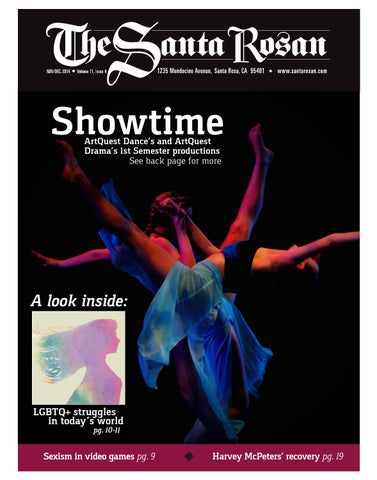
Showtime ArtQuest Dance's and ArtQuest Drama's 1st Semester productions See back page for more
LGBTQ+ struggles in today's world pg. 10-11
Sexism in video games pg. 9
Harvey McPeters' recovery pg. 19
2
NEWS
Staff of The Santa Rosan EDITOR-IN-CHIEF
MANAGING EDITORS EDITORIAL BOARD
BUSINESS MANAGER STAFF WRITERS
SPECIAL THANKS ADVISOR
isabellaFROMAN milenaDUARTE opalWHITE lindsayBRIBIESCAS tracyFERNANDEZ mirandaMCCANN thomasPASTIS brynaHAUGEN hannahAPPEL peterAQUI aprilCORREA justinDANTE geenaESPINOZA jakeESPINOZA kiraFINDLING suncèFRANICEVIC andrewHERNANDEZ sienaLAKE ashleighMENDEZ pamelaMENENDEZ cassyMORETTO gabeMULCAIRE maiaPAGÁN kathyPHAM abbyVOLZ dakotaMCGRANAHAN caseyELSA
Check out our online content at santarosan.com, on our Facebook profile (The Santa Rosan), and on our twitter account (@Santa_Rosan) Note: The views expressed in this newspaper are those of the Santa Rosan staff as approved by the Santa Rosan newspaper staff and do not necessarily represent the opinions of the school, students, faculty or the Santa Rosa City School District. An effort will be made to print all letters to the editor, as long as they are signed. The Santa Rosan reserves the right to edit letters for length, clarity, and factual correctness, but will not guarantee their accuracy. Letters should be delivered to Ms. Elsa, room D101, or put in her mailbox. Cover photo by Dakota McGranahan Teaser picture by Tracy Fernandez
World News Snapshots gabeMULCAIRE STAFF WRITER
Ferguson decision, subsequent protests On November 24, after a hearing, a St. Louis County grand jury announced that they had decided not to indict Darren Wilson, the officer who shot unarmed black teenager Michael Brown in Ferguson, Missouri. As expected, this led to widespread protests in Ferguson and around the country. There have been reports of looting and violence associated with these protests, but the extent of the violence is a matter of great controversy in the media. Ebola threat remains Despite having largely dropped off the face of American media coverage and public consciousness, the Ebola virus remains a serious threat
in West Africa, with death tolls rising. The CDC has reported roughly 6,000 deaths and almost 17,000 cases, mostly in Guinea, Sierra Leone, and Liberia. Mass protests in Mexico Since the September kidnapping and probably murder of a group of students, citizens all over Mexico have begun to protest the level of governmental corruption and drug violence in their country. Many blame President Enrique Pena Nieto for the massacre that is presumed to have befallen these students. Tens of thousands have marched in Mexico City, with violence soon following.
Mr. Franzman stars UC tuition rises will in possible Super affect future students Bowl commmercial gabeMULCAIRE
milenaDUARTE
MANAGING EDITOR
Mr. Franzman, beloved SRHS American history teacher, has become a rising star in the acting world. In September, he participated in the Lamplight Tour at the Santa Rosa Rural Cemetery, where he portrayed a city councilman from 1890. Impressed by his acting skills, a viewer called a production manager to email Mr. Franzman about a role in a TV commercial. Intrigued, he accepted the offer. “I had no idea who I was going to play and what the commercial was for. I just went,” says Mr. Franzman. On the day of filming, he learned his role was the father in a Doritos commercial. The setting was a hospital scene filmed at a convalescent home near Fountain Grove. Mr. Franzman’s role had no lines, but definitely left an impression on his audience. His commercial is competing to be televised during the 2015 Superbowl. If his commercial is chosen to air, Mr. Franzman wins a trip to the Superbowl. He adds, “The only acting I did was a couple musicals as a teenager, so I’m surprised they chose me.” Those musicals sure paid off. To help get him to the Superbowl, visit crashthesuperbowl.com, look for the commercial titled “Dorito A Day,” and give it 5 stars.
STAFF WRITER
On November 20, the regents of the University of California voted to approve significant tuition increases for undergraduate students. Tuition would increase by up to 5% each year, for the next five years. This has provoked widespread outrage. Thousands of students across the state have staged walkouts and protests, with the largest at UC Berkeley. Many are pointing to the exclusion of lower-income individuals from higher education, with insurmountable costs at universities. The University of California was in fact tuition-free until 1970, and now the base tuition is almost $13,000 per year, which could prevent poorer students from ever attending these schools. The UC regents, and president Janet Napolitano in particular, are bearing a lot of personal criticism in the wake of this decision. They enjoy large sixfigure salaries and lavish perks, which, when juxtaposed with the struggle of low-income students, creates an unpleasant contrast. Dozens of SRHS students apply to UCs every year, many of whom are concerned about the cost; consequently, many of the students and staff members here are critical of this decision. SRHS instrumental music teacher Mark Wardlaw wrote a letter to the San Francisco Chronicle voicing his displeasure. “While we continue to talk a good game about the importance of a college education, the reality is that college is becoming less accessible and shamefully unaffordable. We already have the highest tuition costs in the world, and they’re about to get higher.”
NEWS
2 5 6
Girls Basketball
Heritage @ 3:30 pm
School Resumes First Day of 2nd Semester AQ Application Deadline Girls Basketball @ Casa Grande 4:30/6/7:30 pm
7 8
Boys Basketball @ Casa Grande
9
Boys Basketball home vs. Windsor
10 13 14 15
2015
January
16 16-18
4:30/6/7:30 pm
4:30/6/7:30 pm
Debate Tournament, TBD Girls Basketball @ Ukiah 4:30/6/7:30 pm
Boys Basketball @ Ukiah 4:30/6/7:30 pm
Senate Meeting @ MPR 11:30 am
Girls Basketball Home vs. Maria Carrillo
4:30/6/7:30 pm
Instrumental Music Winter Concert
23 24
Girls Basketball @ Montgomery
Debate Tournament MLK Invitational, James Logan AQ Advanced Drama Winter Production, “Female Transport”, (18th @ 2:00 pm)
Girls Basketball home vs. Windsor
4:30/6/7:30 pm
Boys Basketball Home vs. Maria Carrillo
22
@ Black Box, Room 24, 7:30 pm
17 19 20 21
Girls Basketball @ Rancho Cotate
22
Boys Basketball Home vs. Newman
4:30/6/7:30 pm
Martin Luther King Day NO SCHOOL Boys Basketball @ Rancho Cotate 4:30/6/7:30 pm
Girls Basketball Home vs. Newman 4:30/6/7:30 pm
4:30/6/7:30 pm
3
@ Auditorium, 7:00 pm 4:30/6/7:30 pm
SAT, 8:00 am
(Reg. at www.collegeboard.com by 12/29)
Mr. Panther Contest
@ Auditoriumww, 7:30 pm
26
Boys Basketball @ Montgomery 4:30/6/7:30 pm
26-29
Tentative potential AQ Registration,TBD
27
Girls Basketball Home vs. Casa Grande
28
Boys Basketball Home vs. Casa Grande
29 30
Girls Basketball @ Windsor
4:30/6/7:30 pm
4:30/6/7:30 pm 4:30/6/7:30 pm
Boys Basketball @ Windsor 4:30/6/7:30 pm
4:30/6/7:30 pm
2 2-5
Girls Basketball Home vs. Ukiah 4:30/6/7:30 pm
Tentative potential AQ Registration, TBD
3-4
CAHSEE Testing
3
Boys Basketball Home vs. Ukiah
4 5 6
Girls Basketball @ Maria Carrillo
7
4:30/6/7:30 pm 4:30/6/7:30 pm
Boys Basketball @ Maria Carrillo 4:30/6/7:30 pm
Girls Basketball Home vs. Rancho Cotate
February 9
(Reg. at www.act .org by 1/9)
Spring Dance
@ North Gym, 8:00 pm,
NO SCHOOL
Boys Basketball Home vs. Rancho Cotate 4:30/6/7:30 pm
10 11 12
Girls Basketball @ Cardinal Newman
13
Singing Valentines
4:30/6/7:30
ACT Test, 8:00 am-2:00 pm
Lincoln’s Day
4:30/6/7:30 pm
Boys Basketball @ Cardinal Newman 4:30/6/7:30 pm
Girls Basketball Home vs. Montgomery 4:30/6/7:30 pm
Contact Vocal Music for information
Boys Basketball Home vs. Montgomery 4:30/6/7:30 pm
14-15
Sonoma County Philharmonic @ Auditorium, 7:00 pm
16 17
President’s Day
18
Boys Basketball NBL Playoffs
20-21
NO SCHOOL
Girls Basketball NBL Playoffs 7:00 pm
Girls Basketball NBL Championship @ SRJC, 6:30 pm
21
Debate Tournament @ Windsor High Boys Basketball NBL Championships @ SRJC
AQ Mardi Gras Ball @ DeTurk Round Barn Time TBD
Calendar design by Isabella Froman
4
FEATURES
Assistant Principal Mr. Harper comes to SRHS cassyMORETTO STAFF WRITER
Santa Rosa High welcomes a new administrator, Forrest Harper. Mr. Harper was hired recently as a new assistant principal. Born and raised in Laguna Beach, California, Harper always knew he wanted to work in the education system. “I’ve always wanted to become a teacher. I remember as early as [the] third grade when my teacher would teach a lesson, I would imagine how I would teach the lesson; and in my head I would always do such a better job. My mom’s a teacher, my grandma’s a teacher, and so is my aunt, so I come from a long line of teachers, and I really can’t imagine doing anything other than being in the education system and working with kids,” Harper said. Harper attended Hartford University for four years, where he double-majored in History and Politics/Government. After finishing college, and doing some small teaching jobs back in Laguna Beach, Harper set out to find a new job. After applying to numerous teaching jobs at schools all over California during the housing crash of 2008, Harper was hired for a position at Roseland University Preparatory, and moved to the Bay Area to begin a new life. After living in Santa Rosa for a couple of years and constantly hearing about how great Santa Rosa High was, Harper knew he wanted to work at our school. So when an opening appeared, he instantly applied for the job to become Santa Rosa
High’s new assistant principal. “In college, I really developed my leadership skills and I realized being a leader is something I've always wanted to be. Santa Rosa High School is a really great school, and at the time I had heard all of these great things about it, so I jumped at the opportunity to apply and soon got an interview and then got the job.” When asked which school system he has liked to work at better, public or private, Harper answered with, “Well, I really like both, but I love how many different programs there are for the kids. From ArtQuest to Ag, there are so many unique things about our school. It makes for a really diverse school because you have the future farmers hanging out with the future artists. And that’s something you can’t really find at a private school.” Along with his love for teaching, Harper has always been fond of traveling. “I always encourage people to go somewhere new, even if you’re just going to Southern California, because it’s a different culture and a different vibe. The more you travel, the more you see the world, and the more you go to different places, the more you grow as a person.” He has been to forty-two of the fifty states and twenty-two of the thirty baseball stadiums in the US and he still wants to go to more. He also plans to go to every single continent in
Photo by Cassy Moretto
Mr. Harper gives a friendly thumbs up to the students of SRHS. Working in the education system has been his passion since he was very young.
the world, “including Antarctica!” says Harper. “I’m a huge traveler; traveling is something that I absolutely love to do.” Along with being an avid traveler, Harper is a definite people person. Harper feels that some of the most important things he has to offer to SRHS are his collaboration and his people skills. He loves to work with people in a beneficial and positive way. “I don’t come in with an iron fist to situations, which most teachers don’t like and most students don’t respond to. But I think my people skills are one of the top things that I can [offer] to this school.” When asked how he likes SRHS so far, he responded, “All of the kids are really nice and the teachers have been great. I’m just really happy to be here!”So next time you see Mr. Harper passing you in the hallways or hanging out in the quad, feel free to introduce yourself and say hello.
Senior Mira Craig-Morse will graduate early to volunteer abroad lindsayBRIBIESCAS EDITORIAL BOARD
While most seniors are preparing for college, Mira Craig-Morse is preparing to go to Palestine with Project Hope — one of the largest educational projects in the West Bank — to teach youth in refugee camps or especially impoverished neighborhoods. Craig-Morse plans to graduate a semester early, then work full-time to pay for her departure in March. After her three months in Palestine, she will then head back to Ecuador for her third time volunteering there. To graduate early, Craig-Morse is taking eight academic classes — four at SRHS, three at the Junior College, and one online. She is also president and founder of the International Relations Club at SRHS. Her hectic schedule forced her to quit ArtQuest Dance Company, which she had been in-
volved with for all of her high school career. But Craig-Morse has managed to balance her classes with two jobs, one at Goji Kitchen and one in childcare. Her earnings will go towards her trip to Palestine, and likely to her college tuition as well. She’s submitted her early decision application to Barnard, an all-women’s college affiliated with Columbia University, where she plans to major in International Relations. From there, she’d like to get her Masters, and then become a conflict journalist or a peacekeeper for the United Nations. In Palestine, Craig-Morse plans to teach English, and will likely also teach kickboxing and performing arts (like plays, dance, or music). She has been involved in kickboxing for two-and-a-half years, and she wants to teach the skill because “[Palestin-
Photos courtesy of Mira Craig-Morse
Above: Craig-Morse stands with Soraya Cruz (right) and her daughter Andrea Alvaro Cruz (left), who hosted Craig-Morse for two months during her second trip to Ecuador. Right: Craig-Morse laughs with students she taught in Ecuador.
ian girls are] pretty disempowered in their culture, so I want to help them get empowered and be physically fit. Diabetes is a huge issue there, too,” said Craig-Morse. She initially became involved in humanitarian efforts outside of the United States when she traveled to Ecuador with a youth group for ten days. “We painted a house, or a
building. We helped with homework. So then the next year I went back. I’ve always wanted to travel with the intent of seeing the people in more intimate settings than just tourism,” said Craig-Morse. With her involvement in Project Hope, it looks like she’ll be getting her wish. For more information on Project Hope, go to projecthope.ps.
Admins address student complaints mirandaMCCANN EDITORIAL BOARD
Throughout the four years that a student experiences at SRHS, disagreements are made and conflicts are raised. When any altercation involves a teacher, procedure can be confusing and often uncomfortable. However, with the assistance of counsellors and administrators, the process can be simple and effective. “Teachers, while they obviously have authority over students, aren’t always right,” shared a Sophomore, “I have witnessed numerous times where a teacher has used his or her authority to punish a student unjustly. Not all teachers are like this, but the ones that are can blow things out of proportion and blame students for minor reasons.” If students are willing to speak up, their conflicts with teachers can be resolved. According to Assistant Principal Forrest Harper, there are many courses of action students can take to voice their concerns. “If a student has a problem with a teacher they can either come see their counselor or they can come see an administrator. So principal, vice principal: Mr. Coscarelli, Ms. Baldenegro, or the assistant principals: me or Ms. Valente,” said Harper. If the issue is still relevant after speaking with an administrator, further steps can be taken. Vice Principal Monica Baldenegro said, “I would meet with the student and find out what the issue was and ask the student to write a statement to talk to the teacher... It could be related to grades, it could be related to a comment made in class, it could be related to anything... [I would] talk to the teacher or have the parent talk to the teacher and try to set up a meeting. After that, sometimes the issue is resolved and we can move forward and we can repair whatever issue it was and we can move on.” Although not recommended, students are always allowed to remain anonymous. If a student doesn’t feel comfortable sharing their name, he
or she is not under any obligation. “I would encourage them to [use their name], but I know in some cases, some students don’t want to... I’m not going to force someone to do something that they don’t want to do... We would move forward, and I would talk to the teacher about the issue but I would not be able to obviously sit down and have a meeting and that’s really the goal... to come to a conclusion and solve the problem, whatever the problem is, so if a student wants to remain anonymous, then its not as powerful as a change,” shared Baldenegro. Although student complaints are usually valid, teachers often make harmless remarks that have a completely different connotation when taken out of context. An SRHS teacher shares, “[At a different school] I had a complaint from a student where I was called into the counselling office and I had to discuss something. It was about sex ed... I was answering questions out of a little box and I answered questions that were maybe more mature content... so I had to go and talk to the counselor about what the material was about. At that point I completely changed the way that I did that particular material in class. I didn’t feel like it was particularly my place to discuss that material and I don’t anymore. It has made me more reticent to go outside the box, to say the least.” According to Baldenegro, complaints about teachers are most often resolved when a misunderstanding is clarified. “It’s important to get the whole picture which is why it’s important to have the sit down and really... for someone to hear each perspective and that can really help,” she explained. Above all else, the administration wants to solve issues in a manner both fair to the students as well as teachers. Baldenegro explained that although sometimes the student-teacher relationship is beyond repair, attempts to fix it are taken seriously, whether through working through it or simply talking it out.
10
FEATURE
5
Things:
to do during a study break kiraFINDLING STAFF WRITER
Winter break is just around the corner — but before the semester ends, students must endure late nights and intense study sessions, all in preparation for finals. Breaks are important to help yourself stay refreshed and energized. Once per hour, take five minutes off from studying and do one of these things!
1) Doodle on a fresh sheet of paper, or draw mustaches on all the faces in an old magazine. Be creative! 2) Go outside and get some sun! Take a walk to stretch your legs. 3) Make a list of fun things to do when finals are over. 4) Do as many jumping jacks as you can. Get that blood flowing to your brain! 5) Call a friend who’s also studying and complain to them. 6) Eat some chocolate. You deserve it. 7) Teach yourself how to juggle! It’s been proven to increase brain function. 8) Make a playlist of study songs to keep you engaged for the next hour. 9) Look up cat videos. Watch as many as you can in five minutes, but make sure you don’t get lost in an endless Youtube spiral. 10) Have a quick dance party! Sing badly at the top of your lungs.
6
FEATURES
Rosa, a kitten saved on campus, needs help milenaDUARTE
MANAGING EDITOR
In mid-November, senior Taylor Kyse walked to her car and saw a little ball of fur laying in the student parking lot. As she approached it, she realized it was a small, black kitten. She noticed that its eye was bleeding and both of its back legs were broken. First, she called someone to help coax the kitten to her. It was frightened and resistant to help, but eventually Taylor was able to catch it, wrap it in a blanket, and take the injured kitten to the Humane Society. There the kitten
was x-rayed and the vet confirmed that the kitten’s back legs were broken and that, if its eye did not heal, then it would have to be removed. It is suspected that the kitten was hit by a car in the student parking lot. The kitten has been named Rosa, because she was found on campus. Rosa is now being taken care of by the Human Society; however, she needs a $6,000 surgery for her back legs. To help pay for the surgery, the journalism class will be collecting donations over the next couple weeks. If you would like to donate, bring money to Mrs. Elsa’s room, D101. Help raise money for Rosa!
—
Photo courtesy of Taylor Kyse
Mr. Kennedy: teacher extraordinaire abbyVOLZ
STAFF WRITER
By now, almost everyone has heard that Student Government has a new teacher. However, as he is fairly new to the spotlight, not many students know much about the man himself. Mr. Kennedy has been a math teacher at SRHS for a few years. He recently took on a couple of Life Skills classes, as well as the student government class. His love for teaching began at age 13 or 14, when his math teacher asked him to begin tutoring one of his classmates. Until then, he had never thought of becoming a teacher at all. Slowly, Mr. Kennedy began to realize just what a fantastic feeling it was to witness the learning process. “Teaching gives us that privilege. We get to see something one of a kind and unique and precious and dangerous and messy and chaotic, and I love all of that stuff.” Even though he loved teaching as a teen, it took Mr. Kennedy a while to realize that he truly wanted to be a teacher. At first, he was on route to becoming a doctor. While in college studying biology, music, and psychology, he worked as a clerk in a Kaiser hospital. However, after talking to the doctors and nurses about how frustrating the line of work was and what terrible things they have to tell their patients, Mr. Kennedy realized it might not be for him. “I realized I had to make a decision between going and fully committing to that route, or doing what I actually love,” he explained. So he took a year off from med school and went to England, where he taught preschoolers music and tutored in his 20s. In the future, he plans to possibly return to med school in Costa Rica to become an international doctor. Teaching teenagers became his top priority after Mr. Kennedy went to Cape Town in Africa for a project for his green MBA, mainly focusing on sustainable entrepreneurship and helping people
Photos by Abby Volz
Mr. Kennedy is a professional who takes his job very seriously, but he keeps his sense of humor in the meantime.
who had the skills but lacked the logistics start a business. While he was there, he tutored and taught kids on the side at one of the high schools. After spending time with the teenagers there, it occurred to him that he wanted to be a part of kids’ lives and make a difference in the lives of teens. When he began teaching legitimately, Mr. Kennedy decided to become a math teacher. “I found that math was the area, with my skills, that I was able to make the most transformative differences.” Math is important to him, and he feels like it will be important to students for the rest of their lives. In mid-March, Mr. Kennedy asked the faculty for more classes to teach. Once scheduling and enrollment were sorted out, Mr. Coscarelli came to him with the classes that were left to be filled. Student Government was one of them. After some deliberation, Mr. Kennedy took it, with an agreement that he would try it out for two years. If it proved to be too difficult or not the right fit, he could stop after the two years. However, once he became more comfortable with the responsibilities and the kids, he knew that this was the class for him. While explain-
ing his role in Student Government, he happily said, “I’m their guide on the side.” He feels really good about being the teacher, and hopes to be for a long time, as well as possibly for the Life Skills class. Outside of teaching, he loves music and playing instruments, mostly the drums. He plays the drums for friends who are recording songs or in bands. His main instrument is the bass guitar, but he learned to play drums from his brother. He is also an avid gardener and a vegetarian. He plans to maybe bring his knowledge of gardening to the school farm. “The future is what you make of it,” he replied. When I asked him to give one piece of advice to students, he said, “just be nice to each other. A little bit of kindness can put out fires or ignite flames if need be. If there’s one thing I want the Panthers to know, it’s to be more supportive of each other-- and it’s not because I think we’re not, it’s because we can always be a bit more.”
7 Recent police brutality sparks nationwide protests OPINION
gabeMULCAIRE
exactly why the case should have been brought to trial. There is no reason whatsoever that a police officer who shoots an unarmed civilian six If you have been paying the least bit of attimes, with no proof that the officer was in dantention, you know about the controversial death ger, should not be charged with a crime. of Michael Brown. Brown, an eighteen-year-old Now for Eric Garner. As I said, there is a black man, was shot and killed by white police readily available video of the entire incident. If officer Darren Wilson in Ferguson, Missouri this you have the stomach for disturbing material, August. Eyewitness reports vary, but two things watch it. It is clearly shot, leaving little room are very clear: Brown was unarmed, and he was for confusion. Garner is unarmed and physically shot at least six times. On November 24, a St. Louis County grand jury nonthreatening, although he berates the police announced their decision not to indict Wilson for for confronting him unnecessarily. The officers, Brown’s death; that is, they decided not to charge seemingly unprovoked, attempt to restrain him, and Daniel Pantaleo puts Garner in a chokehold him with a crime and bring the case to trial. (Garner was asthmatic, and chokeholds are Less well-known is the case of Eric Garner. against NYPD policy). As he is dragged to the Garner, a 43-year-old black man, was placed in ground, Garner can clearly be heard crying, “I a chokehold and killed by white officer Daniel can’t breathe!” He was pronounced dead within Pantaleo in New York City this July. Clear video an hour. and audio of the incident were recorded. What was Eric Garner’s crime to provoke this On December 3, a Staten Island grand jury anattack? He was accused of selling loose nounced their decision not to indict Pantaleo for cigarettes. Garner’s death. Words are incapable of capturing the magI’ll be the first to admit the possibility for bias nitude of this injustice. The case of Eric Garner on both sides of the issue, but any rational person can recognize the egregious in- seems open-and-shut: even the coroner ruled it a homicide. To see it fail to even be brought to justice exhibited by these two cases. The details trial is beyond infuriating; it is utterly baffling of Brown’s case are admittedly fuzzy, but that is STAFF WRITER
and profoundly depressing. It has shocked a lot of people into a rage they did not experience even after the Michael Brown case. The Daily Show’s Jon Stewart, who, like many, was angry and struggling to find words, provided the best reaction to this case we are likely to see. “We are definitely not living in a post-racial society, and I can imagine there are a lot of people out there wondering how much of a society we’re living in at all.” These cases have provoked a country-wide nationwide wave of protest. Some of the demonstrations, especially in Ferguson, have spilled over into violence and looting, an ugly development which has provoked an ugly response from police forces armed with enough military equipment to invade Moscow. But there are countless peaceful protesters, people who are lawful, reasonable, and angry beyond belief. I’m about ready to join them. If you’re not angry, you’re not paying attention, and you’d better start. These are not isolated cases; they very clearly represent a trend of deadly racial bias. We’re going to see more murders, and more unprosecuted murderers, unless the American people take a stand against this disastrously twisted system.
The problem with “politically correct” holiday greetings geenaESPINOZA STAFF WRITER
As the holidays approach, one may find himself or herself biting their tongue when tempted to say “Merry Christmas,” “Happy Hanukkah,” or anything else that denotes a specific religion or belief system. How have such innocent and wellmeaning phrases become so outdated and “politically incorrect?” In today's hyper-vigilant culture, acceptance and kindness are praised, but at what point does it go from acceptance and kindness to the loss of culture? While it is true that the nation is diversifying rapidly, with more importance being placed on cultural respect, this whole debate seems a bit ridiculous. Giving someone a greeting specific to your religious or cultural beliefs does not mean you are disrespecting their culture — it is merely an expression of good will. In turn, when someone greets you in a way that does not comply with your beliefs, it is not particularly logical to feel offended. Despite how trivial holiday greetings may seem in our personal lives, it is important to be more careful when in a workplace or educational environment. An appropriate solution to this problem, particularly in educational settings, could be the celebration of all holidays and beliefs instead of the exclusion of all. Schools could host multicul-
tural holiday weeks. Those who do not celebrate holidays would not be forced to take part in any holiday-themed activities. When it comes to corporate sensitivity, an inclusion of all holidays would be an easy and very marketable solution. Think about it — people of often-overlooked religions would be thrilled to find merchandise specific to their celebrations. According to a poll by the Public Religion Research Institute, 49% of customers at large retailer chains were opposed to nonspecific holiday greetings, 44% supported them, and 7% had no opinion. This shows that a larger percentage of consumers at these big chains would support specific holiday greetings than would oppose them. If the specific holiday greeting was not just “Merry Christmas,” but instead several different greetings that each celebrate a different culture, it’s likely even fewer customers would be opposed. With a greater diversity of greetings, a larger number of customers would find themselves represented and be likely to support specific greetings. Remember to keep an open mind not just during the holidays, but all year round. Respect the beliefs of others, celebrate whatever you believe, or, if you prefer, don’t celebrate at all. Try learning about a new holiday or challenge yourself to learn five different holiday greetings, so you can finish off the year on a great note.
Lesser-known holidays Jan. 21 - “National Hugging Day” - Created by Kevin Zaborney to encourage friends and family to show their love. Feb. 16 - “Do a Grouch a Favor Day” - See someone who looks like they’re in a bad mood and needs some cheering up? Do them a favor and make the world a better place! Apr. 30 - “National Honesty Day” - Have you been wanting to come clean about who actually dropped tomato sauce on the white rug? Or tell your crush how you’ve felt about them for the past 2 years? May 14 - “National Dance Like a Chicken Day”Feeling like creating some great memories and funny picture-perfect moments? Get your grooves on and dance like a chicken! Jul. 3 - “National Compliment your Mirror Day”We all have insecurities and things we want to change about ourselves, but we often overlook the things that are great about us and focus on the bad. So on this day, appreciate the good qualities that you have and compliment yourself! Aug. 8 - “Sneak Some Zucchini onto your Neighbor’s Porch Night” - I mean, why not? Dec. 26 - “National Whiner’s Day” - Often, many people are not pleased with what they did or did not get the day after Christmas. So, this day, created by Kevin Zaborney, was made to remind people to be grateful for the things they do have.
8
OPINION
Frat Culture: A menace to the college system justinDANTE STAFF WRITER
With application deadlines right around the corner, high school hallways across the nation are bound to be bristling with the excited fervor of college and future plans. Many seniors look forward to joining a fraternity in college, and why not? Fraternities offer a unique camaraderie among members, foster leadership skills, and provide a professional network of alumni after graduation. But the “Greek system,” as it’s commonly referred to, is also a hotbed for the kind of environment and behavior that contributes to rape culture. In 2010, new pledges to a frat at Yale University marched through the campus chanting, “No means yes! Yes means anal!” In 2012, Beta Theta Pi at Wesleyan University became known as the “Rape Factory” after a string of sexual assaults. Another frat, associated with the University of Texas at Arlington, was shut down after three sexual assaults allegedly took place in less than a month. A frat member at Georgia Tech has recently apologized for sending a highly publicized email titled “Luring your Rapebait.” Another
email, sent by a frat brother at USC, explained that women are “targets” and not “actual people like us men.” The list goes on. And, all too frequently, this misogynistic behavior is swept under the rug as a few bad apples. Boys will be boys. Just a joke. But it’s not funny. The White House estimates that one in five women will be sexually assaulted before graduation at a four-year university. And while there have been steps to curb this trend — adopting “yes means yes” as a standard for consent, holding college administrations accountable, and encouraging bystander intervention — it’s not enough. It’s disturbing that the Greek system, a widely accepted institution, is able to go on unchecked. But rather than reforming fraternities, college university policies actually contribute to the problem. In fact, the university rules which govern the Greek system are shrouded in a double standard. Sororities are typically held to higher standards than their male counterparts. They have tighter restrictions on the recruitment process and the planning of social events, and many are also bound to a noalcohol policy. Consequently, sorority sisters go to frat parties, where they are at a much greater
Photo by Lindsay Bribiescas
risk of being victimized. Some advocate for the abolishment of the Greek system, viewing fraternities as petri dishes that breed misogyny, alcoholism, drug abuse, and violent hazing rituals. But it’s unlikely that frats will disappear; steeped in tradition and supported by powerful alumni, they’re here to stay. And so we, as a society, need to condemn the darker elements of frat culture and instill in the youth of today a greater sense of respect for women. This means properly punishing offenders, discouraging the objective ways in which boys talk of girls, and reforming institutional sexism.
Death Over Dignity: Should the Oregon law be brought to CA? sienaLAKE
STAFF WRITER
On October 27,1997, Oregon introduced the Death with Dignity Act, which allows terminally-ill Oregonians to voluntarily self-administer enough medication to cause them to pass away. However, a person was only eligible if over eighteen, capable of making coherent decisions, and going to die within the next six months. This created quite a stir at the time, and even provoked a Supreme Court case about the right to die, but eventually the issue faded from the spotlight. But on November 1, 2014, Death with Dignity resurfaced after terminally ill 29-yearold Brittany Maynard publically made use of the statute. When Maynard was diagnosed with Stage Four brain cancer, she and her family were devastated. Since she was living in California at the time, Maynard had to move to Oregon in order to access the Death with Dignity program. “I had to find new physicians...search for a new home, obtain a new driver’s license,” Maynard told CNN in an interview. Brittany and her family had to establish residency in Oregon so Maynard could fully qualify. This raises the question of whether or not California should
adopt a similar Death with Dignity Act. Right-to-die bills have been continually blocked by religious groups like the Catholic Church. It is important to remember that, although some might consider the process a sin against God, the government and church are two entirely separate entities. “Who has the right to tell me that I don’t deserve this choice? That I should suffer for weeks or months in tremendous amounts of physical and emotional pain?” Maynard asked during her CNN interview. It is important to remember this is a matter which requires a written request to the doctor signed by two witnesses, a diagnosis and prognosis performed by a prescribing and consulting physician, and doctor-provided information to the patient of other alternatives such as hospice care and pain control. It must also be noted that, although some view this as suicide, the people in this program are inevitably going to pass away, and the Death with Dignity Act gives them a painless way out. Even so, this gives rise to questions such as, “Wouldn’t giving patients this choice begin a slippery slope towards euthanasia?” Euthanasia, the doctor-initiated painless killing of a patient suffering from an incurable disease, remains il-
Photo by Lindsay Bribiescas
legal in most countries. While people may worry that Death with Dignity is a glorified version of euthanasia, it is not. The difference lies in who makes the decision. Death with Dignity requires the patient to request death, while euthanasia allows the doctor to determine the undertaking of the process. It is important to recognize Oregon’s Death with Dignity Act has remained in place for ten years and there has never been an unwilling participant. Death with Dignity is a way out for those who wish to die a painless death surrounded by people they care about. In the end it should be the patients who choose how they die, not their doctors or their family members.
OPINION
9
Dangerous behavior in the gaming community
Women in video games justinDANTE
Photo by Lindsay Bribiesca
The term “gamer” often conjures images of the solitary geek: a teenage boy living in the shadows of his mother’s basement, only revealing himself for a slice of leftover pizza. But this couldn’t be farther from the truth. With an estimated worth of 21 billion dollars, the video game industry rivals the likes of Hollywood. In fact, a recent Pew Research poll found that 59% of Americans play video games. And roughly half of those gamers are women. But as in most things— Congress, for example — women are underrepresented in the gaming sphere. Data collected by the marketing research firm Electronic Entertainment Design and Research shows just how rarely female protagonists are featured. In a sample of nearly 700 games in 2012, only 24 had a female lead. This is partly due to the popular view of many game developers that strong female protagonists won’t
STAFF WRITER
Photo and Illustrations by Isabella Froman
sell. Instead, women often play the role of the sidekick or the damsel in distress. Games like Super Mario Bros., Starfox Adventures, and Pandora’s Tower, just to name a few, portray women as helpless and fragile, always in need of rescuing by some bold male character. Not only is this lazy writing, but these constant tropes reinforce sexist stereotypes. It would seem that in the gaming world, traits like independence, strength, cunning, and self-sacrifice are inherent only to males. Far too frequently, women play the role of “eye candy” which is nothing more than an accessory to the main character that contributes nothing to the overall plot. They’re dressed in revealing costumes and overly sexualized, no matter the context. Female warriors don’t wear armor, they wear “chainmail bikinis.” More often than not, they are romantic interests. And their physiques are exaggerated
with slim waists and enhanced busts. After releasing a demo for Ninja Gaiden 3, developer Yosuke Hayashi actually received feedback in which fans asked for “larger breasts.” It’s a laughable request, no doubt, but also a sad one. Video games are one of the fastest growing sectors in the entertainment industry today. And their influence is ubiquitous. As in movies, ads, and magazines, the sexism that permeates gaming has an extraordinary impact on how people, especially youth, perceive themselves and others. If only this great entertainment medium could be used to promote positive and healthy female characters. Imagine a game whose primary character is an intelligent and capable woman, with a complex personality and a fulfilling obstacle to overcome. That’d be a good game.
Controversy over misogyny in video games lindsayBRIBIESCAS EDITORIAL BOARD
There is a long history of misogynistic behavior in the video game community, not only from video game developers, but also from gamers themselves. And yes, I know, not all gamers. The issue came to a head with the #gamergate movement, which was started by the outcry of gamers over corruption in video game journalism. It began with an allegation against video game developer Zoe Quinn that accused her of having sex with a video game reviewer in order to get good reviews of her game. This accusation — originating with Quinn’s ex-boyfriend, which should have caused some doubt of the allegation — was quickly proved false. Quinn did have a relationship with a reviewer, but that reviewer never reviewed any of her games, and didn’t
write anything on Quinn after the commencement of the relationship. By that point, the phenomenon had taken off. The initial question of reviewing ethics led to more questions that eventually turned into a flurry of misogynistic attacks and comments. Harassers eventually drove Quinn out of her home, after vigorous doxxing (releasing of personal information like home addresses, phone numbers, and credit card details). The movement eventually branched out to harass other women involved in the gaming world, with little legitimate criticism of the ethics of video game journalism, the claimed cause of the movement. Anita Sarkeesian, after the release of the next segment in her series that critiqued women’s roles in popular video games, was targeted with death threats to such an extent that
she cancelled a speaking appearance at Utah State University when the university could not guarantee her safety. The primary issue, clearly, is that the movement isn’t so much criticizing corruption in video game journalism as it is attacking women, and only women. The male gamers that have criticized #gamergate, and the community as a whole, have managed to bypass the frenzied harassment the female critics have endured Before all gamers are condemned as misogynistic harassers, it is important to remember that the gamer community isn’t fairly represented by those involved in #gamergate. While the gaming community could work on becoming more inclusive to female gamers, many developers are working to include games that blot out the often sexist attitude that exists in that world.
Filling a
What is romantic orientation?
T
tioning, and all individu
the 20th century and we
demonized, degraded, cas
kiraFINDLING
advances toward legaliz
STAFF WRITER
Sexual orientation is a term used frequently, from government documents to casual conversations. If someone describes themselves as gay, for example, that would typically be considered their sexual orientation. But there’s another important topic that we’ve been forgetting: romantic orientation. While a person’s sexual orientation relates to the gender(s) that someone is sexually attracted to, their romantic orientation describes with whom they are interested in being in a romantic relationship. For some people, their sexual and romantic orientations line up. But others may find that the two diverge. For example, a person could be bisexual and heteroromantic; this means that they are sexually attracted to people of two genders, but only drawn romantically to people of the opposite gender. Types of orientation come up when discussing asexuality and aromanticism. A person could be both asexual and aromantic (meaning they are not sexually or romantically attracted to anyone) or just one of them. Additionally, a person could identify as, for example, homosexual and aromantic, meaning they are sexually attracted to members of the same gender, but possess no romantic desire for anyone. As always, it is important to accept and validate the labels that others choose to use. Furthermore, remember that sexual and romantic attraction are fluid. It’s perfectly okay if your label and identity change over time!
Bisexual erasure: what it is and why it’s bad tracyFERNANDEZ EDITORIAL BOARD
Branded as “confused,”, “greedy,” and even “fake,” bisexuality has suffered stigma for a long period of time. Yet, surprisingly, this hostility resides not only in heterosexuals, but also within the LGBTQ+ community. A study conducted by the University of Pittsburgh found that about 15 percent of the overall sample disagreed that bisexuality was a real sexual orientation. The researchers also revealed that gays and lesbians were more negative towards bisexuality as a sexual orientation than towards bisexuals themselves. Clearly, this prejudice against bisexuality exists — but why? “I think, for a lot of people, they still see being bi as a phase or they think people just say they’re bi to receive attention. A lot of the time be-
he LGBTQ+ communit
ing bisexual and a woman is a little more acceptable because most people believe the bisexual man is a myth — it's not, by the way. There's a lot for people to learn about bisexuality,” said senior Yajaira Cardona. This inaccurate portrayal purported by others causes bisexuality to be limited by stereotypes — and falsely advertised. The actual definition of bisexuality is a person who has the capacity for romantic and/or sexual attraction to two genders, according to the American Institute of Bisexuality. But an important distinction to include is that, as a bisexual, you do not have to feel the same kind of intensity of attraction to all genders. Contrary to the standard myth, a bisexual person does not need to be sexually involved with both a man and a woman simultaneously. In reality, a bisexual may never engage
in sexual activity with one or the other (or either) gender. This does not make any bisexual lesser; like heterosexuals and homosexuals, sexual and emotional attraction varies for everyone. Like any other valid sexual orientation, bisexuality has its particularities. Perhaps it is time we finally look behind the labels and treat bisexuals with the respect they deserve. Illustration by Tracy Fernandez
stigma still stands. Eve
individuals seems to be a it means to be queer and and our future.
LGBTQ+ kathyPHAM
STAFF WRITER
Words hurt. Clearly, this is no surprise, but what is the impact of something as common and “innocent” as the phrase “that’s so gay”? It’s obvious that terms such as “faggot” and “dyke” are extremely offensive and cringeworthy, but a majority of teenagers don’t realize that using a phrase as common as “that’s so gay” has negative repercussions for the LGBTQ+ community. The phrase has been part of the adolescent lexicon for some time, and is often not intended to offend the LGBTQ+ community. However, it is still offensive. According to a study from the University of Michigan, LGBTQ+ students who frequently heard the phrase “that’s so gay” were more likely to feel isolated and experience headaches, poor appetite, or eating problems, compared to those who didn’t. What’s even more alarming is that, according to the
This survey wa
g in the shades about sexuality
ty, which stands for Lesbian, Gay, Bisexual, Transgender, Queer/Ques-
uals who aren’t straight, has been a target of persecution for most of
ell into the 21st. The individuals who are in this community have been
st aside, and even killed. While the United States has recently made
zing same-sex marriage and some minimal transgender rights, social
en in areas, like Sonoma County, where discrimination against queer
a non-issue, there is a distinct lack of broader education about what how queer people — especially queer youth — fits into our world
+ slurs are still harmful survey conducted by SRHS’s journalism class, only 5.6% of respondents never hear slurs. That means the rest have heard slurs. In the past, “faggot” signified “a bundle a sticks,” and then later turned into an insult. Similarly, the word “gay” used to mean happy; now it means “homosexual.” But today, it also means “stupid” colloquially. “That’s so gay” conveys that there is something wrong with being gay. Many people aren’t aware of the weight of the phrase and continue to use it in their everyday language. Likewise, terms such as “nigga” and “retarded” are commonly used
without regards to who they may affect. Some people argue that they are decontextualized; they are just a part of the everyday language that people use, without intending harm to others. Yet, even though people use these words out of context (“nigga” as “friend” and “retarded” as “stupid”), the words still inflict harm. There is history, significance, and impact behind these terms and phrases. No matter how "common" these words are, there isn't a valid reason to offend people. These words may not disappear anytime soon, but it’s important to realize that this is hurtful language.
as completed by 213 SRHS students in their classrooms. Chart by Tracy Fernandez
OUT
Spelling it
LGBTQ +terminology explained
gender - refers to the attitudes, feelings, and behaviors that a given culture associates with a person’s biological sex (masculine/feminine/etc.) gender identity - one’s personal attitudes toward their own gender. This may align with their medically-assigned biological sex (making the individual cisgender) or may not (making the individual transgender or genderqueer) genderqueer - when one’s gender identity is neither male nor female, is a combination of both, is fluid, or is undefined. Genderqueer individuals may go by they/them pronouns. sex - refers to a person’s biological status; indicators of biological sex include sex chromosomes, gonads, internal reproductive organs, and external genitalia (male/female/ intersex/etc.) intersex - a physical condition in which a person’s internal or external genitals do not align with textbook definitions of male or female. This phenomenon is rarely talked about but surprisingly common, affected about 1 in 2000 people. sexual orientation - a trait which describes one’s sexual/ physical attraction, or lack-therof, toward others asexual* - lacking sexual desire, or not being sexually attracted to others. Asexuality includes those who are repulsed by sex, those who are not but feel no sexual desire toward other people, those who are other sexually attracted to others only after establishing an emotional connection, and others. bisexual* - being sexually attracted to two sexes/genders, but not necessarily simultaneously or equally. heterosexual* - sexually attracted to a sex/gender other than their own homosexual* - sexually attracted to the same sex/gender pansexual* - being fluid in sexual orientation; attracted to all sexes/genders polysexual* - sexually attracted to multiple (but not necessarily all) genders; similar to bisexuality, but denies the presense of a gender dichotomy (the idea that there are only male and female genders). This is different from polyamory, which is a relationship structure including romantic/sexual relationships between more than two people. questioning - being unsure of or exploring one’s sexual orientation, gender identity, or gender expression queer - used in two ways: either as an umbrella term to mean all people in the LGBTQ+ community (such as in “many queer people have faced discrimination”) or as an identifier that means not straight but not labelled. The word itself is controversial as it was once a derogatory slur, but it has been reclaimed by most of the community. However, if someone says they are uncomfortable with the term, you must refrain from using it so as to respect them. *replacing “-sexual” in these words with “-romantic” denotes romantic attraction instead of sexual attraction. Sometimes the two are closely related, but not in all cases.
Spread design by Tracy Fernandez and Isabella Froman
12
COLUMNS
/
Sincere Sarcastic An advice column
My locker partner has recently been encroaching on my space, and I’m getting pretty frustrated with him. How do you tell your locker partner that he needs to respect your space? isabellaFROMAN EDITOR-IN-CHIEF
Depending on how close you are with your locker partner and how well they take criticism, you will need to address this in different ways. If you’ve been friends with him for a while, hopefully you’ve gotten to the point that you can ask him nicely and he’ll respect your space. All you would have to do is ask him between classes or over a text to make sure you can fit your stuff in too. Tell him what kinds of things you put in there and why it’s important that you have enough space. Any respectful friend would apologize and correct himself. If your friend is very sensitive, be sensitive too. Ask him gently and with a smile. This should be very simple unless you’re on the shy side and often have trouble voicing your concerns. In which case, plan ahead for exactly what you’re going to say, and even practice your speech in the mirror if that’s what you need to feel comfortable. If you need more encouragement, realize this — organizing your space with other people will be important in the future. If you have a roommate in college, how will you tell him to stop leaving dirty dishes or laundry around? If you share an office with a coworker, how will you tell them that their supplies shouldn’t be on your desk? Practicing now with a small-scale situation will help prepare you for the future. In the case that you don’t feel close enough to talk to your partner face-to-face, leave a note in the locker for them to find. Make it friendly, but firm. Let them know that you need space too. If your partner becomes irrationally mad about you voicing your issues, tell them that it’s your locker too and you deserve half of the space. If you feel that the problem is escalating and you are worried that leaving your stuff in your locker may let your partner sabotage or throw away your belongings, tell an administrator. Sharing a locker is a very basic skill, and someone who has such a problem sharing may be facing underlying issues that need to be addressed by an adult. Though it seems very unlikely that your situation will come to this.
thomasPASTIS
EDITORIAL BOARD
Okay, well, whenever two people have to share a finite amount of space (especially a small amount of space), conflict is inevitable. Hopefully, I can steer you towards this conflict so that you can get any inevitable violence out of the way. So, there are multiple ways to get your locker partner to take a hint. The first is to start storing annoying items on your partner’s shelf. Several items will do, from heavy things that will crush your partner’s stuff, perishables which go bad within seconds, or things that are likely to spill, like glitter. If you’ve ever tried to pick up an opened bag of glitter, you’ll know what I’m talking about. No matter what precautions you take, short of a HAZMAT suit, you’re going to get glitter on your hands. So, start storing your glitter on top of your locker partner’s books. Inevitably, the glitter will fall and go everywhere. And glitter is more permanent than superglue. Once it comes in contact with your skin, it’s impossible to get it off. Hopefully, the glitter gets all over your partner’s books, so that whenever he turns the page, he cakes more glitter onto his hands. Whoever invented glitter obviously hated people, so use this to your advantage. Another method is to start moving the shelf upwards or downwards to give yourself more space. You may think that those shelves don’t move, and you’d be right. That’s why you need belt sanders, or, better yet, a chainsaw. Just take your sander or chainsaw, saw off the shelf, move it a bit lower, then glue it back on. You may think that this is impossible to do without getting caught, but the people in the main building make so much noise that one extra chainsaw wouldn’t matter. Or, even better, you could saw off the shelf during one of the periods. There’s nothing that teachers like more than construction noises while they’re trying to teach, especially superfluous construction. Of course, there are more direct ways. Since both of you have access to the locker, you could easily take his books out. Then, just so that he gets the message, hide the books. Put them somewhere fun, like in the pool, or on the roof, or underground. This will drive the point home in a lighthearted way. If you use one of these methods, your locker partner will be out of your hair within a week. I guarantee it.
Need advice? Send your letters to D101 or message them to the Santa Rosan Facebook page. They will be printed anonymously.
13
COLUMNS
Insight from a quiet observer: Catcalling
tracyFERNANDEZ EDITORIAL BOARD
You are walking down the street, hearing: "What's up beautiful?," "Hey baby," "Smile," "Have a nice evening, darling." This type of verbal harassment is all too familiar to most women and is known as catcalling. Several months ago, the non-profit organization Hollaback! released a video entitled, “10 Hours of Walking In NYC As A Woman.” In the video, the actress, Shoshana Roberts, is obligated to remain completely silent, ignoring all comments. Never-
theless, she, like countless other women, becomes a victim of street harassment, with men imposing their comments — and even themselves — on her. At one point in the video, a man silently walks beside Roberts for five minutes, attempting to provoke a response from her. On the surface, this video is shocking. Yet street harassment is a regular reality for women. According to Stop Street Harassment, 65% of women surveyed shared that they had experienced street harassment, 57% surveyed had experienced verbal harassment, 23% had been sexually touched, 20% had been followed, 14% had been "flashed," and 9% had been forced to do something sexual. Evidently, this is a problem. Yet some people consider catcalling nothing more than a “harmless compliment.” But since when does a compliment require that men remark on the sexual nature of women? Is “Hey, shorts!,” “Sweet Mami,” “Nice body!,” or "You're sexy. Damn!" supposed to be “flattering”? It’s not — there is nothing “cute” about catcalling. “A group of guys in China catcalled at me before. I felt like my privacy had been invaded. Why can't I walk down the street without feeling completely safe? Shouldn't I be entitled to that right?” said senior Caroline Chu.
Dressed down and exposed, catcalling is unveiled to be what it’s always been: harassment. In the Thought Catalog’s article, “11 People Who CatCall Women On The Street Explain Why They Do It,” several men disclose their reasons for catcalling: “A catcall or a car horn beep gives me a momentary feeling of power over them because I can see their discomfort.” Never a compliment to begin with, street harassment seeks only to benefit the harasser. Recently, in response to the video released by Hollaback!, women have begun documenting their own experiences with street harassment. A woman named Kati Heng has organized a Tumblr page called “But What She Was Wearing: Stop the CatCall” to record what women were wearing when they were catcalled, showing that clothes do not determine the likelihood of being harassed. Often, women are told to ignore their harassers — catcalls are something you should simply accept in life as a woman. Yet this approach is all too forgiving. Harassers are free of repercussion; bystanders continue their lives. Cast in the shadows far too long, street harassment is long over-due for a discussion. So, let’s talk about it, because street harassment is real — and it is happening whether or not you choose to see it.
commit suicide had one or more mental disorders. Depression is perhaps the most widely recognized disorder, and often garners the most sympathy. It is a mood disorder in which feelings of sadness, loss, anger, or frustration interfere with daily life for weeks or longer. It can distort perceptions of oneself or other aspects of life, and can cause substance abuse and/or suicide, among other things. Schizophrenia is a long-term disorder that involves a breakdown in the relation of thought, emotion, and behavior. It can cause hallucinations, delusions, loose associations, and a number of other things. Bipolar disorder is a condition in which a person has periods of depression and periods of being extremely happy or cross or irritable, and extreme changes in activity and energy levels. Eating problems can arise, as well as concentration difficulties, substance abuse, and suicide. These are just a few of the mental illnesses that millions of people are forced to live with. People tend to react to mental illness with fear, which often leads to exclusion. Social avoidance is perhaps the most common, and the subtlest, way that people deal (or don’t deal) with victims of mental disorders. It can be as extreme as withholding treatment, or simply taking measures to avoid interactions with those who suffer from
mental illnesses. This means that a large number of victims have difficulty finding jobs and housing, not to mention companionship. Mental illness isn’t glamorous. It isn’t “tragically beautiful.” People don’t choose to have it, and people most assuredly don’t want to live with it. They can’t just “shake it off,” and it isn’t something they’re making up for attention. If they’re asking for attention, give it to them. Mental illnesses aren’t laughable, and they aren’t problems that will go away if they’re ignored. Victims deserve and require treatment and understanding, not fear and mockery. This doesn’t vary from illness to illness. It isn’t right to treat someone who suffers from depression with respect and empathy, while mocking or avoiding a victim of schizophrenia. Those who live with eating and substance-use disorders ought to be treated with the same respect as those that live with autism, and even treatment of those with autism leaves something to be desired. People with mental illnesses should be treated with the exact same respect that is afforded a socalled “normal” person. Mental illnesses are legitimate, frustrating, and at times terrifying problems that people are forced to endure. Don’t make it worse because of a lack of understanding or empathy. Sources: http://www.nami.org
Get some glasses: Mental illness
lindsayBRIBIESCAS EDITORIAL BOARD
Let’s talk about the elephant in the room. 1 in 4 adults experience mental illness in a given year. 20 percent of youth aged 13-18 suffer severe mental disorders in a given year. About a quarter of homeless adults living in shelters suffer from severe mental illness, and if those struggling with substance-use disorders are included, that estimate jumps up to nearly 50 percent. Over 20 percent of the prison population lives with severe mental illness, with more in the juvenile justice system. More than 90 percent of those that
14
ARTS & ENTERTAINMENT
Childhood Nostalgia: which games raised this generation of gamers? kathyPHAM
andrewHERNANDEZ
Surely, most of you watched Pokémon when you were younger (I hope). However, Pokémon actually started as a video game series in 1998. I don’t exactly remember when I first started playing Pokémon, but I do remember it was a huge part of my childhood. I remember all of the music in the towns and cities, the soundtracks to every battle scenario, the different routes, caves, and oceans explored, the various unique Pokémon. I especially remember restarting my journey (and crying) after my Gameboy Advance died and I forgot to save. Starting a new game and having the professor ask, “Erm, what was my grandson’s name again?” was a great feeling because in that moment, I knew I had ultimate power. “Ah! That’s right! His name was ButtFace!” Picking a starter Pokémon was always a hassle too. Should I go for charmander? Or squirtle? (Bulbasaur was obviously irrelevant because no one likes grass. What kind of Pokémon type is grass anyways?) As fun as Pokémon is, one of the things that always bothered me was the caves. I dreaded those caves. The dark ones that required every single HM to get through were the worse though. And the Zubats! My gaming experience could have done without entering a battle every two steps, thank you very much. Regardless, the Pokémon game series is great. If you haven’t played any Pokémon games, you can’t be my friend.
This street racing franchise has held a special place in my heart for as long as I can remember. From being able to customize my own car to participating in high speed chases, the fun is endless. This amazing franchise, created by the great producers at Angel Studios and Rebellion Developments, combines fun gaming with nerve-wracking races and chases. The franchise did have some glitches and boring parts, but they always made up for it in the next game. Some favorites of mine were the Dub Edition series and Midnight Club LA. I remember waking up at 8:00 am every Saturday and going downstairs to play Midnight Club on my PS2. I never really got the hang of fixing my engine though. I would only fix the looks of the car, which affected the progress I made in the game. First released on October 26, 2000, the game can be played in either single or multiplayer mode. The game takes you through many cities and countries, such as Los Angeles, London, and San Diego (all being in different series). The game starts with a New York City cab driver discovering an underground street racing club. He begins racing in his cab, gradually climbing the leaderboard and eventually beating the world champion in a race. For its time, this game had astounding graphics and great and many hours of gameplay. These games are available on PC, XBOX, and Playstation. This franchise really knew how to keep players in their seats for hours on end playing against friends and siblings.
STAFF WRITER
STAFF WRITER
THE
thomasPASTIS
EDITORIAL BOARD
GAMING CORNER
I’m sure that most of us still remember our first game system. For some, it was the NES, while others first had the SNES or the Playstation One. For us nineties kids, our first system was the Gamecube (It’s a nineties thing. You wouldn’t know). If you were born in 1997, you were a kid at the right time. The Gamecube, arguably the best console in the last fifteen years, was released in 2001, right when many of us were just starting to play video games. Like many other consoles, the triple-A releases swiftly followed, and they were abnormally good. Within a year of the release of the console, Animal Crossing, Legend of Zelda: Wind Waker, Super Mario Sunshine, Luigi’s Mansion, Super Smash Bros Melee, Pikmin, Super Monkey Ball, Mario Kart: Double Dash, and many other titles were released: games which are still amazing today. Some people might disagree with me, but they’re wrong. This crop of games was one of the best in history, and I go back and replay them to this day. If you had a friend with a Gamecube during this time period, he or she had and loved at least one of these games, and probably has fond memories of them to this day. In terms of nostalgia, this was one of the best times in gaming history, and the fact that we nineties kids were kids at this time makes it that much better. So, in terms of nostalgia, these games were some of the best ever. I, and many others who had these games, still remember them to this day.
jakeESPINOZA STAFF WRITER
Everybody has fond memories of their past. I have fond memories of video games. As a child growing up at the turn of the century, I was exposed to the early age of popular educational video games. I’m talking about games like Spy Fox and Pajama Sam. If you’re in high school right now, and you had a computer when you were 4 to 6 years old, then you probably know what I’m talking about. These are the games we found so enjoyable, that at the same time taught us logic and problem solving skills. Pajama Sam was a hero to me as a child first learning how to use the computer. I felt powerful and smart while I figured out the challenges and puzzles. I was frustrated and quickly lost my temper if I became stuck. Some of my earliest memories are of helping Pajama Sam fight the dark in his closet so that he could sleep at night. I have no doubt that for a large portion of my life, I modeled my behavior after Spy Fox. The protagonist of the Spy Fox video games had three games created for him. I played them all — repeatedly. I loved Spy Fox's smooth, casual demeanor and the way he was a spy. I still vividly recall several scenes from the games, such as using a gadget packed bowling ball to thwart the evil mastermind. For me as a child, these games were as important to me as many of the books I was exposed to at the time. I certainly have no doubt that these early video games have shaped my life more than any book I've read. While video games are often cast in a negative light, people must remember that our generation has had them thoroughly ingrained, and we seem to be no worse for it.
ARTS & ENTERTAINMENT
Drama to Sci-Fi: incredible underrated books
15
Illustration by Isabella Froman
the spooky "Dark They Were, and GoldenEyed" takes a look at what happens to a famSTAFF WRITER ily that moves to Mars. "A Sound of Thunder" Will Grayson, Will Grayson by explores the butterfly effect (and has dino John Green and David Levithan saurs!). Though these stories are science ficFor all those John Green fans out there — tion, Bradbury imbues them with a reality you you probably haven’t heard of this one. Will won’t forget. Grayson, Will Grayson follows two teenage It Chooses You by Miranda July boys with the same name (yes, it’s Will GrayWhile writing her second screenplay, Mison) as they cope with love, loss, and high randa July was experiencing such terrible school. It explores LGBTQ+ themes with grace writer’s block that she began to read the Penand humor, and features several gay main nySaver (basically, Craigslist in booklet form!) characters that are not defined by their sexu- to distract herself. Before long, she began ality. Though delightfully cheesy at times, to wonder about the lives of the people who this book packs an emotional punch. If you were selling their personal items. It Chooses love musicals, character development, and You was born when July decided to meet, phomoments of serendipity, you should definitely tograph, and interview thirteen random Pencheck out Will Grayson, Will Grayson! nySaver sellers in the Los Angeles area. This book is honest, engaging, and, most of all, huRay Bradbury’s short stories If you don’t have time to read an entire nov- man; it is a reminder that you don’t need to el, look no further! Ray Bradbury’s science look very far to find a good story. kiraFINDLING
fiction stories are enthralling and suspenseful, Fun Home by Alison Bechdel offering a glimpse of a dangerous and dystopiHave you ever read a graphic novel? If not, an world. For those interested in outer space, Fun Home is the perfect place to start! As
they say, “A picture’s worth a thousand words,” and Alison Bechdel proves just that in this beautifully illustrated memoir. Bechdel explores her relationship with her late father, as well as her personal experiences with reconciling her identity as a lesbian. Whether you’re interested in Greek mythology, family drama, or cartoons, Fun Home will capture your heart.
The Poisonwood Bible by Barbara Kingsolver
It is 1959, and the Price family has moved from the all-American state of Georgia to the jungle of Africa’s Belgian Congo. The unfeeling missionary father offers little support to his wife and four daughters, whose lives have been suddenly uprooted. The Poisonwood Bible is narrated by these women, as they struggle to determine how to relate to their surroundings and to each other. This lyrical, striking novel is immersive in a way that few books are — you’ll want to read it again and again.
proves to be charming and inclusive, not offensive kathyPHAM STAFF WRITER
When most people think of MTV’s Faking It, they think of “fake lesbians” and go on about how the show is absolutely homophobic, offensive, and degrading to the LGBTQ+ community. However, despite the negative judgments that many people seem to hold against the show, it’s actually not as bad as people believe. Before airing, the show was originally pitched as two best friends who are outed as lesbians (even though they’re “straight”). Upon realizing that being a lesbian couple makes them popular, they keep up the ruse. One of the girls, Karma, is faking it for the fame. Amy, on the other hand, ends up confused about her sexuality. Many people against the show argue that the “girls
pretending to be gay to get attention” trope gives viewers the impression that being gay is a trend, when in fact it’s often very difficult and scary, considering that many LGBTQ+ people are bullied and face discrimination every day. Although the trailer for Faking It may have been misleading, viewers should watch the show to realize that it’s not actually about two fake lesbians trying to get attention. It’s actually about a girl named Amy who’s queer and in love with her best friend; this is made clear by the end of the first episode. Not only that, but Faking It also happens to be the first TV show ever to feature an intersex character. Intersex is an umbrella term describing people born with one of over 30 variations in sex anatomy resulting in neither purely male or purely female bodies (internal
and/or external). For example, the intersex character in the show has both X and Y chromosomes, but developed as neither sex. Despite this, she has feminine characteristics. About one in every 2,000 people are born with intersex traits and the condition is as common as people with red hair. Intersex traits are also very diverse, considering that there is no single intersex body part; there are actually many ways for the condition to manifest and all of them are completely okay. Overall, Faking It is a show that strives to represent the LGBTQ+ community, not discriminate against it. It aims to educate the public on the issues that queer people experience every day, as well as topics that the public may not even know about. The show itself is also fast-paced and wildly entertaining: bonus!
FOOD & HEALTH
Contraception
Illustration by Isabella Froman
16
brynaHAUGEN
BUSINESS MANAGER
The purpose of this article is not only to inform and educate about the human body, but also to spark discussion about topics that have long been viewed as ‘wrong’ or ‘inappropriate’. Teenagers deserve to understand their own bodies, their own sexuality, without shame. After fifth and sixth grade sex ed, most youth feel fairly comfortable with one common type of contraceptive: the condom. However, fewer will know of the wide range of contraceptives available. This article will provide a quick summary of how several other types of contraceptives work and where they can be found cheaply or for free, in order to ensure that safe sex is always practiced. In addition, there are two types of statistics that will be used in this article: “perfect use" and “typical use." Perfect use success rates are essentially lab trials- everything is taken, put on, or inserted in perfect condition. Typical use rates are more telling for the average individual, as they assume that occasionally something will go wrong, as things often do in everyday life. It’s usually safer to assume the worst with contraceptives, so typical use statistics are the better option. Effectiveness rates of contraceptive methods are all figured based on one full year of use, not for each incident of sex or use of a method, so keep that in mind as well. 1. Condoms: Penile: 98% perfect use, 86% typical use. Vaginal: 95% perfect use, 79% typical use. There are two types of condoms, the penile condom and the vaginal condom. The penile condom covers the penis, the vaginal condom is inserted
into the vagina, and both are to be removed carefully after use. However, there are a few important notes about condoms. Firstly, they must be used with lubricant in most cases to prevent tearing. Secondly, there are right and wrong ways to put on both types (more information can be found on the internet). Thirdly, the penile condom is the only type of contraceptive mentioned in this article that prevents the spread of STIs (sexually transmitted infections). Therefore, it is advisable to combine a penile condom with another method for optimal protection. They can be found in convenience stores or health clinics (the latter for free), and anyone can buy them. 2. Cervical Barriers Diaphragms: 94% perfect use, 86% typical use. Cervical caps: 91% perfect use, 84% typical use. Diaphragms and cervical caps are barrier methods of birth control which are used by inserting them into the vagina, after filling the cervical barrier with spermicide. They work in two ways: by creating a barrier that covers the cervix, preventing sperm cells from entering, and by a backup method through added spermicide, which will kill any sperm cells that manage to get around that barrier. They are both reusable, which is fantastic for the environment, but also both require fitting and practice in order to insert them comfortably. More information about pricing, fitting, and inserting cervical caps can be found online. They can be used in addition to any of the other methods in this article, with the exception of the vaginal ring. 3. The Vaginal Ring 99.7% perfect use, 92% typical use. Much like oral contraceptives (as well as the patch, implant, and IUD, not all of which are discussed in this article- look them up if you’re interested in more information), the vaginal ring, often known as NuvaRing, uses two synthetic hormones, estrogen and progestin, to prevent pregnancy. Those hormones work in three ways: to thicken cervical mucus to make sperm less able to get into the cervix, to prevent ovulation, and to make the lining of the uterus thinner. The ring is a hormonal contraceptive, and so it will affect the body’s hormonal balance, but these changes to hormones are not always negative. Some people will react badly to estrogen/ progestin, so the ring is not for them. However, others do very well with hormonal birth control,
so the best thing to do is research online and consult with a physician about the ring to see if it or any other hormonal birth control works for you. It can be used with condoms or “the morning after” pills, but no other hormonal methods at the same time. 4. The Pill 99.7% perfect use, 91% typical use. The pill is, much like the ring, a hormonal contraceptive, and uses both estrogen and progestin (or in the case of the minipill, only progestin) to prevent pregnancy. It works in the same way as the ring in preventing pregnancy, and usually comes in packs of 28 pills, which must be taken at the same time every day to be effective. It can be used with condoms, spermicides, cervical barriers, sponges (look them up!), and “morning after pills,” and is available with a prescription from a licensed physician. Many types of insurance cover the pill, and you can get a prescription from a doctor without parental permission. 5. Intrauterine Devices (IUDs) 99+% perfect OR typical use An IUD (intrauterine device), sometimes also called an IUS or IUC, is a small device which is inserted into the uterus through the vagina and cervix by a sexual healthcare provider. It remains in the uterus until removed. Believe it or not, it's still a bit of a mystery as to how and why IUDs work. However, they are the single most effective methods for birth control currently available. Copper IUDs do not contain hormones, but other popular brands contain a small amount. What really makes IUDs stand out, however, is that they can remain safely within the uterus for 5+ years and remain 99+% effective for the duration of that time. Getting an IUD can be a long, expensive, and sometimes painful process, but the end result is 5 (and in some brands, 10) years of pregnancy prevention that is completely reversible. For this reason, it’s unique in the world of contraceptive devices. These are only a few of many types of contraceptives. Some of the items on this list can also be used for other medicinal properties than pregnancy and STI prevention/protection. Please remember that the only method that can truly guarantee a lack of STIs and/or pregnancy is abstinence If you decide to engage in sexual activity, please stay safe and informed.
FOOD & HEALTH
17
Follow-up: A response to “The V Word” A Santa Rosan subscriber took issue with Bryna Haugen’s column about vaginas that ran in the September issue. Read his criticism and Haugen’s response below. timothyESPINOZA
brynaHAUGEN
SANTA ROSAN SUBSCRIBER
BUSINESS MANAGER
I found the “V” article less than positive, boarding on vulgarity. I question if these few paragraphs would be printed in The Press Democrat or The San Francisco Chronicle. I also wonder about the thinking process of the adult advisors. I will first state that I am 73 years old, born into a world where I was taught a sense of proprietary dealing with language and behavior. I learned to respect authority, respond with yes sir and yes ma'am when speaking to adults if I were to drop an F bomb in a public place, I could expect to be taken to task by any adult within hearing. If I mouthed off to a teacher, I could endure corporal punishment and a call to my parents who would respond in concert with the school principal. With trepidation, I am looking forward to the article dealing with proper cleansing of the anal orifice. I can say with pride, my DNA is well represented within the newspaper, writing articles that are interesting and instructive. Other students are doing equally well. I suggest body functions/parts are best discussed in a health class with competent instructors. Let us use the high school newspaper to wrap fish rather than use “smell like fish” to describe a female organ. Regards, Timothy C. Espinoza
First of all, thank you for writing to the paper. It is important to provide dialogue between writers and readers, and you have assisted in furthering that goal of community involvement. As the beginning of each of the articles in this series states, “The purpose of this article is not only to inform and educate about the human body, but also to spark discussion about topics that have long been viewed as ‘wrong’ or ‘inappropriate’. Teenagers deserve to understand their own bodies, their own sexuality, without shame.” For a long time, youth have been taught to remain silent about their anatomy and health. Guilt and shame have permeated any and all discussions of sexual health, responsibility, or sexuality. But times are changing. Youth are being encouraged to be educated in all topics, even those once considered taboo. Open dialogue about human bodies is becoming more commonplace, and the veil of ignorance and disgust that once shielded topics such as vaginal health is being lifted. You found this article “bordering on vulgarity,” but the function of a vagina, which more than half the world possesses, cannot be vulgar. The facts of life, of reproductive health, cannot be winced at, cannot be dismissed as explicit or profane. In order to create a safer world — a more knowledgeable world — these topics cannot be shelved and only opened in health class. Anatomy is not shameful. Moreover, if the public continues to act as though it is, the many benefits of sexual education, such as lower teen pregnancy rates and lower STI rates, will disappear. I have and will continue to write the truth in my column. I intend to do this in a way that is respectful, candid, and educational. To do otherwise would be the epitome of what I believe is wrong with America’s attitude towards sex ed. I appreciate your candor and input, and hope you will continue to enjoy our paper in the future.
Super simple latkes for this year’s Hanukkah kiraFINDLING STAFF WRITER
Hanukkah begins at sunset on December 16, and what does that mean? It’s latke time! Commonly known as “potato pancakes,” latkes are composed of flour, eggs, and grated potatoes. They’re often seasoned with garlic or onion, and are customarily eaten with apple sauce or sour cream. So why do Jews eat latkes at Hanukkah? The oil used to cook them symbolizes the oil that kept the flame burning for eight nights in the original Hanukkah story. Now, latkes are so popular that they have been chosen as the national dish of Belarus, and adopted under a variety of names by many different cultures, including those of Austria, the Czech Republic, Poland, Lithuania, Ukraine, and more. If you haven’t tried a latke before, head to the supermarket — with just a few ingredients, you’ll have a delicious winter treat!
Recipe (approximately 20 latkes) Ingredients: 5 large potatoes 3 eggs 3-4 tbsp. flour Large onion About 1.5 teaspoons salt A pinch of pepper Oil 1. Peel and grate potatoes. Grate onion in the same bowl to combine 2. Stir in the eggs, salt, pepper, and flour. 3. Drain excess water as it forms. Photo by Isabella Froman 4. Heat the oil in a pan. Drop spoonfuls of mixture onto the pan and press down to form a pancake shape. Fry latkes over medium heat until brown and crisp. 5. Turn and brown the second side. 6. Season as desired and serve with apple sauce or sour cream. Enjoy!
18
SPORTS
Wrestling season begins in full force jakeESPINOZA STAFF WRITER
Wrestling is a sport that has a long and illustrious history. It began with the ancient Greeks, who included it in the original Olympic games. Since then, wrestling has stayed popular in many diverse cultures. In some countries, wrestling matches are an event of cultural importance. In other countries, such as the United States, wrestling is viewed as only a sport. But this doesn't mean that it's any less important. This year, the Santa Rosa High School wrestling team shows promise for development. The team is young, with most of its members being sophomores or freshmen. Noah Spierings, a sophomore who started wrestling in seventh grade, said that he is “looking forward to the tournaments in the coming season.” The head coach, Joe Dennison, wrestled in high school and college at Embry-Riddle Aeronautical University. He encourages anyone who is motivated to join the wrestling team. In Coach Dennison’s words, the only thing you need to wrestle is “the drive and willpower.” According to him, you don’t have to be six feet tall and packed with muscle ei-
ther. Wrestling requires all body types, and anyone with the proper work ethic can be successful. Cynthia Crossen, a senior, is wrestling this year for the first time. Crossen is the perfect example of the fact that one doesn’t need to start early or be a hulking giant to wrestle. Crossen joined the team simply because she always wrestled with her brother and found it fun. She figured that if wrestling with her family was fun, wrestling at high school would be too. She is looking forward to the tournaments this season.
Photos by Jake Espinoza
Left: Senior Cynthia Crossen ties on her wrestling shoes for a practice. This is her first year wrestling, but she is hopeful for the season. Above: Crossen and Senior Joshua Valentino receive extra instruction from Coach Kurt, who has also been involved with the Fire Department for many years.
Alumni basketball games bring former students home Left: Junior Bella Passey slows her dribble to evade a defender during the girls Alumni game. The varsity girls’ team beat the alumni.
Above: During the second half of the alumni game for the boys basketball program, Michael Ahnberg pulls up to shoot a jumpshot over his defender. This was Ahnberg’s first game back with the varsity team after missing the league portion of the schedule last season. Right: Bre Ririe sports up for a jumper at the edge of the free-throw line. On the court with her is Emily Codding’s grandmother (far right), who returned to her alma mater for the game and made a few baskets.
SPORTS
19
Senior Harvey McPeters recovers from major football injury geenaESPINOZA
during which time he was visited by several teammates and cheerleaders. The day was August 29, and the chill of autumn Discharged from the hospital with a sling, had not yet disturbed the balmy, late summer air. and told that his shoulder would keep dislocat“It was the first game of my senior year,” says ing if he was not careful, McPeters began the varsity football star Harvey McPeters. “I mean, long and bumpy road to recovery. Everyday that’s anyone’s dream.” Little did he know that tasks that many take for granted became diffithat fateful game would end up being more of a cult and frustrating. “I couldn’t raise my arm up nightmare than a dream to put my shirts on,” says come true. Harvey, “but it was I thought my season was good that it wasn’t my That night, McPeters dislocated his left shoulgone. I rolled onto my side right arm.” der in a fourth down Fortunately, he had and couldn’t feel my shoulder. against Petaluma High the support of his famSchool. “I went to drop ily, team, and friends. I felt like it was shattered. back and pass the ball On a particularly rough and, as I rolled out, the day, his coach told him defender and I hit each other and my shoulder to “Keep fighting through.” was just gone,…broken.” His mother took the injury particularly hard. “I thought my season was gone,” said Mc- “When it first happened, she told me, ‘I don’t Peters. “I rolled onto my side and couldn’t feel want to see you play football anymore.’” As he my shoulder. I felt like it was shattered.” sees himself grow stronger, however, Harvey The quarterback and safety on defense was has decided to continue to play football. “I’ve rushed to the hospital, where he was given mor- grown up playing it,” he says of the sport, and he phine, which “took the pain away a little bit, but loves it because he “gets to be out there with all it still hurt so much.” The numbness was attrib- of his friends.” uted to a pinched nerve, and McPeters was diagHe made a point to go to every football game nosed with a dislocated left shoulder. to cheer on his team and show his school spirHe was put under anesthesia to set his shoul- it. Sophomore Cassius Banks has taken over his der, which was fortunately an “easy fix.” The role as quarterback and McPeters says he “thinks senior was in the hospital from 9 PM to 2 AM, Banks can do it.” STAFF WRITER
Photo by Geena Espinoza
Senior Harvey McPeters has played football all four years of high school. The game is one of his greatest passions, so being kept from the field by an injury was frustrating.
When asked what advice he would give young athletes to avoid injury, Harvey replied, “Just work out hard in the weight room and take care of your body. It’s really all you can do.” Regarding his future, he says, “I want to play for as long as I can.” McPeters hopes to go on to play football at the Santa Rosa Junior College and, afterwards, somewhere bigger. Wherever he may go, football will follow him.
Photos by Andrew Hernandez
Left: McPeters is guided to the sidelines immediately after the injury. Above: A doctor checks McPeters and decides to send him to the emergency room. McPeters was diagnosed with a dislocated left shoulder.
20
PANTHER LIFE
Fall and Winter Shows please and impress
ArtQuest Drama’s
ArtQuest Dance’s
1
5
2
6
“Our Country’s Good"
“Journey of Discovery"
7
8 3
4
Photos by Sunce Franicevic
1: (Left to right) Seniors Jone Bacinskaite, Vivienne Luthin, Ellora Gordon, and Michael Sultana have been caught doing "illegal activity" by Lieutenant Ross, played by Senior Adriana Jackson. 2: Junior Shayla Nordby and Senior Brian O'Halloran are confused by Junior Devon Keelty's character. Harry, played by Keelty, is going insane and hallucinating about a young man he sent to death. 3: Senior Michael Sultana, as Reverend, glares at Lieutenant Ross, played by Jackson. 4: Senior Aron Corradi, as the Aboriginal, narrates some of the scenes.
Photos by Tracy Fernandez
5: ArtQuest Dance Company performs Ancient Wisdom by guest choreographer Erin Landry. Dance Company brings in guest choreographers to expose the students to new teachings styles and genres of dance. 6 and 7: Senior Hannah Maffia performs a solo in a piece about perseverence and community in the pursuit of what you believe in. 8: Senior Ashley West (purposefully) improvises a solo in a showcase of latin ballroom techniques.