

INSIDE A
Wildfire
Regional
Authority for Santa Monica Mountains Could Be in the Making
See Page 6
Fight on Santa Monica Pier ends in shooting, 18-year-old suspect arrested
One person was shot in the arm during a large fight on Sunday night.
Santa Monica Police officers arrested an 18-year-old Rialto resident following a shooting that left one person wounded Sunday night during a large fight on the Santa Monica Pier, according to a SMPD press release.
Officers with the Santa Monica Police Department responded around 9 p.m. March 15 to reports of gunfire at the pier, where a confrontation involving several individuals had broken out.
Responding officers located a victim suffering from a gunshot wound to the
arm and provided emergency aid before paramedics arrived. The victim was transported to a local hospital for treatment, police said.
Another individual later sought medical treatment at a nearby hospital for what officials described as a graze wound. During the investigation, detectives determined that the second injured individual was allegedly the person who fired the weapon.
Authorities identified the suspect as Jaysawn Williams, 18, of Rialto. After receiving medical care, Williams was taken into custody and transported to the Santa Monica Jail.
Williams was booked on suspicion of assault with a firearm and grossly negligent discharge of a firearm, according to police.
The Santa Monica Police Department said officers maintain a regular patrol presence on the Santa Monica Pier, allowing for rapid response to incidents in

the high-traffic tourist area.
Pier operations have since resumed, and the area has reopened to the public.
Anyone with information about the incident is asked to contact Detective
Esteban Hernandez at esteban.hernandez@ santamonica.gov or the Santa Monica Police Department Watch Commander at 310-458-8427.
Santa Monica releases draft plan for an airport park as public input phase opens
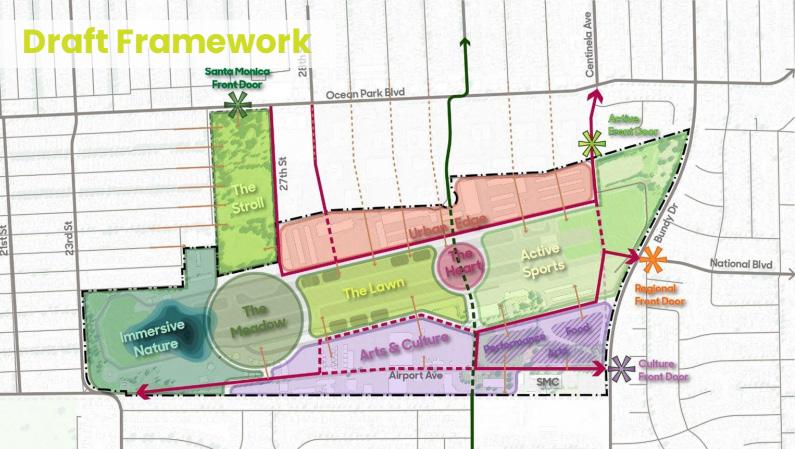
Officials unveil Framework Diagram for airport site and invite community feedback through March 29.
Planning for the future of the Santa Monica Airport site has moved into a new phase, with city officials releasing a draft
framework outlining potential uses and design concepts for the property.
The Santa Monica Airport Conversion Project has entered Phase 3B, during which a “Framework Diagram” has been introduced to guide how the site could be organized as it transitions into a large public park.
City officials said the draft reflects direction from the City Council as well as input gathered from community members during earlier phases of outreach. The diagram presents a high-level vision for how different areas of the site might be used and how the overall character of the

future park could take shape.
Residents are invited to review the framework and provide feedback through an online survey, which will remain open through March 29. The survey and presentation materials are available on the project’s engagement website.
You can review the framework at the Santa Monica Airport Conversion website. The survey is available in English here and in Spanish here.
The framework will also be discussed at public meetings. The remaining meetings are the VA Advisory committee meeting, which is to be scheduled, and the Los Angeles Neighborhood Councils of Mar Vista and Venice in April, with details to be announced.
Public input collected during this phase will be used to refine the framework plan and help shape the next stage of the project.































Delivery Hours: 7am-3pm Call or Email before 2pm for same




Curbside pick-up available 9am-5pm Daily (310) 452-2493 • www.bobsmkt.com























Two = Three - Possible Scenarios For SMO
SM
a.r.t.
A Comparative Environmental, Financial, and Regulatory Analysis
The Two Scenarios (Three?)
The airport remains operational or closed, but likely leading to the third and future use of the land. So it should be worth taking a look at an analysis of environmental, water infrastructure, financial, and regulatory data to see what keeping the airport operational or closing it is the most environmentally and fiscally defensible option.
Environmental Comparison
The lead and ultrafine particle (UFP) argument — the environmental cornerstone of the closure case — is substantially weaker than publicly presented, and will largely resolve itself independently of any land use decision.
The UCLA Paulson atmospheric study (https:/www.smithsonianmag. com/air-space-magazine/can airportbesaved-180952758/), the primary research cited by closure advocates, found no detectable airport signature on the north, south, or west sides of SMO. The measurable impact was directionally to the east, is periodic, and driven by the prevailing westerly onshore flow. Critically, that research was conducted at approximately 83,000 annual operations. SMO now operates at roughly 57,400 annual operations — a 31% decline from the study baseline, and more than 70% below the airport's operational peak.
The lead issue is further resolved by federal and California law. The FAA has mandated the elimination of leaded avgas nationwide by 2030, and California's SB 1193 sets a 2031 deadline. The FAA has already approved unleaded Swift Fuels and GAMI’S G100UL in September 2024, covering the dominant propellerdriven and training aircraft at SMO. The primary environmental argument for closure will have resolved itself before any development on the site could realistically occur.
Financial Reality
The City just released its "Santa Monica Airport Conversion Project” report, in which, listed as its Guiding Principles, a section titled "Balance Economics” states: "The project capital costs should be linked to a reliable funding source(s)." It goes on to state, “Financial responsibility for the project to be defined as the composite of revenue-generating activities, capital strategies, and funding allocations required to avoid an unfunded liability for the City government, shall be adhered to.” But there are no funding sources identified. Developers? Cloverfield Commons? The airport, meanwhile, generates about $20mil/yr with operating expenses of about $6.5mil/yr.
Is the 3,000-unit affordable-only
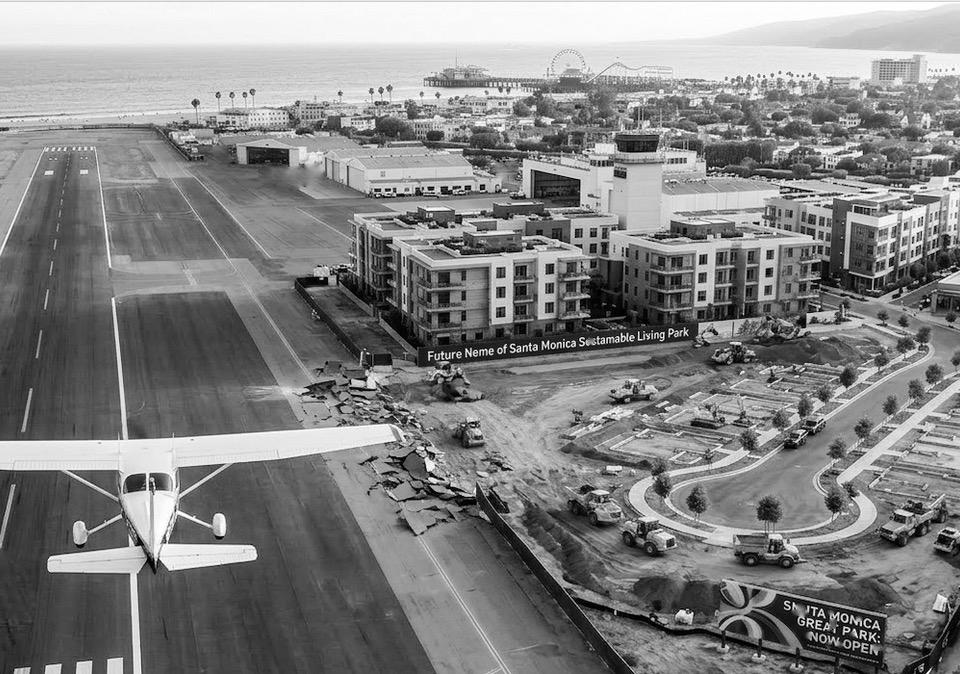
Cloverfield Commons proposal financially coherent as being proposed?
At a construction cost of approximately $850,000 per unit, total construction costs reach $2 billion+. Even with City-owned land contributed at zero cost, the financing gap for purely affordable units at the proposed income mix is $450–750 million. Closing that gap requires 1,800– 5,000 market-rate units generating $150,000–$250,000 of cross-subsidy capacity per unit.
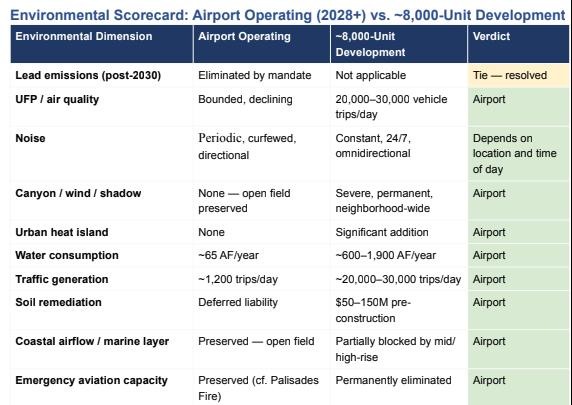
The 5,000–8,000 unit scenario is the most financially coherent of the closure options discussed. Note that to fit 3000 to 8000 units on site has an additional ‘cost’ of Canyon Effect, Wind, Shadows, and Traffic, and up to +/-120 of the 192 acres. Heights of 6-20 stories are required, creating an "Urban Canyon" effect, elevating local temperatures by 2-4°C, and blocking coastal airflow significantly. Shadows from 15-20 story towers would permanently alter the solar environment of Sunset Park. The airport generates periodic, directional, curfewed noise - it's closed through the night, and only about 1200 vehicle trips per day. An 8,000-unit project generates 20,000-30,000 daily vehicle trips, creating a 24 hr/day noise and traffic crisis on Ocean Park Boulevard, 23rd St, and throughout Sunset Park.
Water Infrastructure
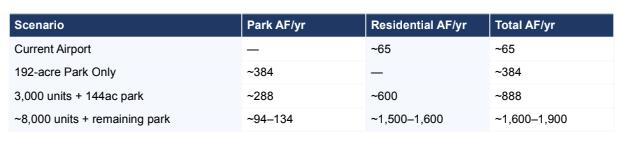
Santa Monica has spent over $200 million and more than a decade restoring local water self-sufficiency, reaching approximately 75% local / 25% imported supply by late 2025, up from a nearcomplete MWD dependency following the 1996 Charnock well contamination. The city's remaining capacity gap between maximum local production and current demand — is approximately 1,800 acrefeet per year.
The 8,000-unit development scenario consumes essentially the entirety of the city's remaining self-sufficiency headroom, directly undermining the $200+ million infrastructure investment made to achieve it. Even the park-only scenario represents a 6x increase in site water demand, with zero revenue to fund it or the supply expansion would require.
Regulatory Framework: SLA, SB 330, and Measure LC
The California Surplus Land Act does not, as written, self-execute. The trigger is disposition on any sale or lease for nonagency use. If the City closes the airport and formally designates the entire 192 acres for use as a park and makes no qualifying disposition, the SLA is not automatically
triggered, though no guarantee the State can’t impose anyway during the declared Housing Crisis.
And, the moment the City attempts to generate revenue through any long-term lease — including an educational use arrangement, e.g., with Santa Monica College, which is permitted under Measure LC without a public vote — a qualifying disposition occurs and SLA attaches to that parcel. Once SLA procedures apply, HCD notification and priority negotiation with affordable housing developers is mandatory, with penalties of 30% of fair market value for non-compliance. The only guaranteed protection of the land from the SLA is by maintaining SMO operational.
SB 330 compounds this exposure. It prohibits downzoning below January 1, 2018 intensity levels, caps public hearings on compliant housing applications at five, and makes retroactive 'Parks Only' zoning legally vulnerable once a developer files a preliminary application on unzoned land. The Measure LC educational use exemption — undefined, with no statutory parameters on scale or intensity — is a genuine loophole exploitable by a fourvote Council majority, but any lease arrangement emerging from it likely triggers SLA regardless of how the use is locally characterized.
Conclusion
The environmental case for closure was always strongest when lead was the primary argument. That argument dissolves on its own regulatory timeline — independently of anything the City Council decides. Against that residual and diminishing liability, the development alternative substitutes permanent, irreversible,
360-degree urban infrastructure impacts — traffic, canyon effect, shadow, heat island, water stress — affecting a far larger number of existing residents with no mitigating technological transition on the horizon. Keeping SMO operational is, across environmental, water infrastructure, and financial dimensions, the most defensible position available to the City, and the only guaranteed protection against implementation of the SLA. The case for closure has always rested on noise and environmental arguments. As the lead issue resolves itself by federal mandate and the financial and infrastructure costs of the development alternative come into sharper focus, those closure arguments fail.
Bob Taylor, AlA for SMa.r.t.
Santa Monica Architects for a Responsible Tomorrow
Dan Jansenson, Architect, (ex-Building & Fire-Life Safety Commissioner); Robert H.Taylor, Architect AlA; Thane Roberts, Architect; Mario Fonda-Bonardi, Architect AlA (ex-Planning Commissioner); Sam Tolkin, Architect, (ex-Planning Commissioner); MichaelJolly ARECRE; Jack Hillbrand AlA, Landmarks Commissioner Architect; Matt Hoefler, Architect NCARB; Charles Andrews, Journalist/Columnist
For previous articles, see www. santamonicaarcn.wordoress.com/wruno We addressed water specifically last week (https://smmirror.com/2026/03/ sm-a-r-tcolumn-have housing-mandatesignored-state-water-shortages/) and will address environmental and cost issues more in depth in future weeks.
Santa Monica Architects for a Responsible Tomorrow


A Regional Wildfire Authority for Santa Monica Mountains Could Be in the Making
Supervisors direct agencies to assess feasibility of coordinated mitigation effort after 2025 fires
The Los Angeles County Board of Supervisors on Tuesday approved a motion directing county agencies to study the creation of a regional authority aimed at improving wildfire prevention efforts across the Santa Monica Mountains.
The measure calls for the county’s Department of Regional Planning and the Los Angeles County Fire Department to evaluate the feasibility of forming a Regional Wildfire Mitigation Joint Powers Authority, which would coordinate prevention strategies across multiple jurisdictions in the mountain range.
The study comes in the wake of major fires in 2025 that burned more than 23,000
acres and damaged or destroyed thousands of homes in the region.
Land in the Santa Monica Mountains is managed by a mix of agencies — including the National Park Service, California State Parks, county departments and local entities — as well as private landowners.
Officials say the fragmented oversight has resulted in varying approaches to vegetation management and wildfire prevention, despite shared risk across the region.
Under the motion, county departments will analyze existing fuel and vegetation management practices and assess how a regional authority could coordinate efforts among public agencies, nonprofits, environmental groups, academics and residents.
The analysis will also consider potential governance structures, implementation strategies and funding sources, including state and federal grants.
Supporters of the proposal say a regional approach could help align policies on defensible space, fuel reduction and community preparedness, while improving coordination in advance of future wildfires.
Santa Monica Appoints New City Attorney, Salary Set at Nearly $400K

During her tenure with the city, von Tongeln has represented Santa Monica in both litigation and transactional matters and has advised the city’s boards and commissions
next city attorney following a nationwide recruitment process.
Von Tongeln will assume the role upon the City Council’s formal approval of her contract on March 24. Her annual salary will be $395,352.
Von Tongeln has served as interim city attorney since September 2025 after the departure of former City Attorney Doug Sloan. She brings nearly two decades of experience in municipal law and has worked in the Santa Monica City Attorney’s Office since 2012. She has served as chief deputy city attorney since 2022 and began acting in the top role in mid-August.
During her tenure with the city, von Tongeln has represented Santa Monica in both litigation and transactional matters and has advised the city’s boards and commissions.
Mayor Caroline Torosis praised the appointment, calling von Tongeln “an incredible leader and a proven advisor.”
“Her experience, professionalism and deep commitment to public service will be a tremendous asset to our community,” Torosis said. “This role is essential to ensuring the city operates with transparency, integrity and sound legal guidance. I’m confident her leadership will strengthen our ability to serve residents and support the city’s continued progress.”
Before joining Santa Monica, von Tongeln worked as a deputy city attorney for three municipalities and served as
assistant legal counsel to redevelopment agencies, joint powers authorities and special districts while at the law firm Green, de Bortnowsky & Quintanilla LLP.
She holds a bachelor’s degree in English and French from Pepperdine University and a law degree from Pepperdine University School of Law.
“I’m honored by the opportunity to serve as city attorney and grateful for the trust placed in me by the city’s leadership,” von Tongeln said. “I look forward to working alongside the mayor, councilmembers, city staff and the community to provide thoughtful legal guidance and support the city’s work on behalf of its residents.”

The Santa Monica City Council appointed Heidi von Tongeln as the city’s

BEHIND THE SCREEN
By Kathryn Whitney Boole
This movie is a trip! It’s a burst of demented personalities on a vengeful, highly misguided journey to survive and to find happiness. It is in the style of the avant-garde films of the late ‘60’s and early ‘70’s. Jessie Buckley stars as “The Bride.” Not many people know that Buckley is a triple threat performer (actor/singer/ dancer) who, early in her career, was told that she would never be successful because she didn’t project enough femininity.
Well, the subtitle of The Bride could be “Jessie Buckley Lets Loose.” In this movie, the actress absolutely succeeds in displaying her unabashed, jubilant personality as “The Bride of Frankenstein.” It may be that Buckley’s unfiltered interpretation of the monstrous “Bride” makes some audience members uncomfortable, and the timing of the film’s release could be the problem. It has conflicted with the attention Buckley is receiving for a completely different type of character, “Agnes” in Hamnet. It is to Buckley’s credit that she can turn on a dime and give life to such opposing characters, but audiences may resist seeing the warm and caring Agnes now as a wild hedonistic specter.
Gyllenhaal had worked with Buckley previously on a film she wrote and directed in 2021, The Lost Daughter. Buckley’s career began after placing second in a BBC talent show series. She is a musician, singer, and dancer, starred in the London revival of Stephen Sondheim’s

A Little Night Music, and performed at Andrew Lloyd Webber’s birthday show in 2008. She has played roles as varied as “Miranda” in Shakespeare’s The Tempest and a country music singer in the movie Wild Rose. Buckley is awesome as The Bride. This character could easily be made into a caricature, but the actress puts her heart into it and makes her come alive.
Opposite Buckley, one of my favorite actors, Christian Bale, plays “Frankenstein’s Monster.” As always, Bale is completely unrecognizable. He truly inhabits the monster, and when he says, “She’s too beautiful,” as he first glimpses The Bride, you believe him. Penelope Cruz is striking as a liberated female detective. Annette Bening and Jeannie Berlin camp it up as the Mad Doctor and her sidekick, and they’re a gas to watch. You won’t forget these characters.
The Bride pulls together different pieces of history, carrying the theme of bringing the dead back to life - a topic of human curiosity that will never cease to fascinate our collective imagination. The inspiration is taken from Mary Shelley’s novel titled Frankenstein; or, The Modern Prometheus, that she wrote in 1818 on a dare from friends, although within the strict social mores of her time, Shelley probably could not put on the page what she really wanted to convey.
FICTITIOUS BUSINESS NAME STATEMENT
FILE NUMBER: 202660139 ORIGINAL FILING This statement was filed with the County Clerk of LOS ANGELES ON 03/18/26. The following person (persons) is (are) doing business as 1. SANTA MONICA HOMEOPATHIC PHARMACY. The full name of registrant(s) is/are: SANTA MONICA HOMEOPATHIC PHARMACY, INC 629 BROADWAY, Santa Monica, Ca. 90401. This business is conducted by A Corporation. The registrant commenced to transact business under the fictitious business name or names listed above on 01/1944. I declare that all information in this statement is true and correct. (A registrant who declares as true information which he or she knows to be false is guilty of a crime). Signed STEVEN LITVAK. This Statement was filed with the County Clerk of LOS ANGELES County on MARCH 18, 2026. NOTICE: IN ACCORDANCE WITH SUBDIVISION (a) OF SECTION 17920, A FICTITIOUS NAME STATEMENT GENERALLY EXPIRES AT THE END OF FIVE YEARS FROM THE DATE ON WHICH IT WAS FILED IN THE OFFICE OF THE COUNTY CLERK, EXCEPT, AS PROVIDED IN SUBDIVISION (b) OF SECTION 17920, WHERE IT EXPIRES 40 DAYS AFTER ANY CHANGE IN THE FACTS SET FORTH IN THE STATEMENT PURSUANT TO SECTION 17913 OTHER THAN A CHANGE IN THE RESIDENCE ADDRESS OF A REGISTERED OWNER. A NEW FICTITIOUS BUSINESS NAME STATEMENT MUST BE FILED BEFORE THE EXPIRATION. THE FILING OF THIS STATEMENT DOES NOT OF ITSELF AUTHORIZE THE USE IN THIS STATE OF A FICTITIOUS BUSINESS NAME IN VIOLATION OF THE RIGHTS OF ANOTHER UNDER FEDERAL, STATE, OR COMMON LAW (SEE SECTION 14411 ET SEQ., BUSINESS AND PROFESSIONS CODE). SANTA MONICA MIRROR to publish 03/20/2026, 03/27/2026, 04/03/2026, 04/10/2026

At least that’s what director Maggie Gyllenhaal believes. In making this film, Gyllenhaal hopes that she has come close to the tale that Shelley truly meant to tell. Shelley’s life had been filled with unbearable tragedy, and from that her tale of reincarnation was born. Her mother had died 11 days after her birth, and she was raised by her father. During her marriage to poet Percy Bysshe Shelley, she miscarried several times. In the movie, Buckley also plays “Mary Shelley” as the narrator, adding her thoughts to the story, probably thoughts that she could not say aloud in 1818.
The movie’s style is train-of-thought, and that train sometimes veers from its tracks, but the crazy characters and the camp images and outrageous exploits they conjure up pull you in. At one point, a macabre rendition of “Bonnie and Clyde” lights up the screen. Gyllenhaal chose early 1930’s Chicago as the setting for her film, a time of upheaval and rebellion against the strict moral standards of society. Production designer Karen Murphy and the costumers and makeup artists have meticulously recreated the behavior and style of this period, whose characters reveled in rebellion, flaunting scandalously short skirts and short hair at drunken parties with suggestive, wild, and crazed dancing. The choreography of the uninhibited
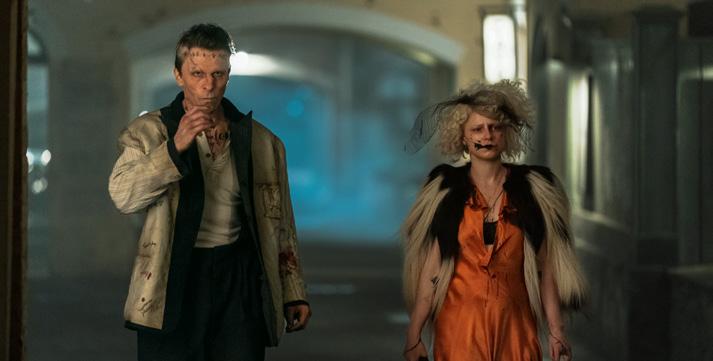
parties is some of the best I’ve seen, and the musical numbers convey the hysterical energy of the time. The theme of repressed women winning retribution permeates the story.
Gyllenhaal’s inspirational muse for making this film was a guy she met at a party who had a tattoo of Frankenstein’s Bride on his arm. It made her wonder how significant this character must be to him that he wanted to display her permanently on his body. Buckley, speaking as Mary Shelley at the beginning of the film, wonders if the sequel she planned to write and never had the chance before her death in 1851, would be “a horror story, a ghost story, or, most frightening of all, a love story.” Jessie Buckley, you don’t have to play feminine; feel free to play outside the box.
Note that the Oscars will be handed out this Sunday, March 15th. To read my Oscars column, go to the March 6th edition of the Santa Monica Mirror, see social media, or click here.
Kathryn Whitney Boole has spent most of her life in the entertainment industry, which has been the backdrop for remarkable adventures with extraordinary people. She is a Talent Manager with Studio Talent Group in Santa Monica. kboole@gmail.com
FICTITIOUS BUSINESS NAME STATEMENT
FILE NUMBER: 2026046387 ORIGINAL FILING This statement was filed with the County Clerk of LOS ANGELES ON 03/02/26. The following person (persons) is (are) doing business as 1. SANTA MONICA CHRISTIAN TOWERS. The full name of registrant(s) is/are: SM TSA Housing LLC, 11811 San Vicente Blvd.. This business is conducted by A Limited Partnership. The registrant commenced to transact business under the fictitious business name or names listed above on 02/2026. I declare that all information in this statement is true and correct. (A registrant who declares as true information which he or she knows to be false is guilty of a crime). Signed Jordan Pynes. This Statement was filed with the County Clerk of LOS ANGELES County on September, 25, 2023. NOTICE: IN ACCORDANCE WITH SUBDIVISION (a) OF SECTION 17920, A FICTITIOUS NAME STATEMENT GENERALLY EXPIRES AT THE END OF FIVE YEARS FROM THE DATE ON WHICH IT WAS FILED IN THE OFFICE OF THE COUNTY CLERK, EXCEPT, AS PROVIDED IN SUBDIVISION (b) OF SECTION 17920, WHERE IT EXPIRES 40 DAYS AFTER ANY CHANGE IN THE FACTS SET FORTH IN THE STATEMENT PURSUANT TO SECTION 17913 OTHER THAN A CHANGE IN THE RESIDENCE ADDRESS OF A REGISTERED OWNER. A NEW FICTITIOUS BUSINESS NAME STATEMENT MUST BE FILED BEFORE THE EXPIRATION. THE FILING OF THIS STATEMENT DOES NOT OF ITSELF AUTHORIZE THE USE IN THIS STATE OF A FICTITIOUS BUSINESS NAME IN VIOLATION OF THE RIGHTS OF ANOTHER UNDER FEDERAL, STATE, OR COMMON LAW (SEE SECTION 14411 ET SEQ., BUSINESS AND PROFESSIONS CODE). SANTA MONICA MIRROR to publish 03/06/26, 03/13/26, 03/20/26, 03/27/26

SANTA MONICA COLLEGE
SANTA MONICA COMMUNITY COLLEGE DISTRICT BOARD OF TRUSTEES
Dr. Sion Roy, Chair; Dr. Tom Peters, Vice Chair; Dr. Luis Barrera Castañón; Anastasia Foster; Dr. Nancy Greenstein; Dr. Margaret Quiñones-Perez; Rob Rader; Sophia Manavi, Student Trustee; Kathryn E. Jeffery, Ph.D., Superintendent/President Santa Monica College | 1900 Pico Blvd. Santa Monica, CA 90405 | smc.edu
Photo by Amy Williams