

INSIDE
Three independent food pop-ups are taking over this popular Santa Monica bakery
See Page 5

Santa Monica kidnapping suspect Courtney Perrone missing after car found stripped
The woman was on diversion for a 2024 child abduction attempt when she vanished from Los Angeles.
Courtney Perrone, a 41-year-old woman who was arrested in Santa Monica on an attempted kidnapping charge, has been missing for nearly two months, the Los Angeles Police Department confirmed Thursday.
Perrone was last seen on May 17 around 10:30 p.m. near Exposition Park, close to the University of Southern California campus. Her family reported her disappearance that same day. Investigators stated that Perrone left the area in her white 2014 BMW sedan and has not been heard from since.
Five days after she vanished, California Highway Patrol officers located Perrone’s vehicle near Avenue T and 150th Street East in Littlerock, located in the Antelope Valley. According to a CHP impound report, the vehicle had been abandoned, stripped, and vandalized.
The sedan was found wrecked without tires, wheels, or a battery, with significant damage sustained to most of the vehicle except for the roof and left side, according to a CHP impound report as reported by NBC 4 News LA.
The LAPD Missing Persons Unit stated that the circumstances surrounding Perrone's disappearance place her at risk, noting she may require medical attention. Officials described Perrone as white, approximately 5 feet 4 inches tall, and weighing 105 pounds.
She has black hair, hazel eyes, and was last seen wearing a pink bikini top, a beige jacket, red boots, and red lipstick. She also has several distinctive tattoos, including a scorpion on her left forearm, the phrase "Comfortably Numb" on her left arm, and
a cross on her calf.
Legal proceedings for her August 2024 attempted kidnapping case involving an 8-year-old girl in Santa Monica had been placed on diversion back in February 2025.
Perrone remains scheduled for a court status conference on Feb. 19, 2027, ahead of a preliminary hearing.
During the 2024 incident, Santa Monica police alleged that Perrone approached a young girl and a neighbor in an alleyway, claimed to be with the Russian police, and tried to pull the child away. Following a physical struggle with the neighbor, Perrone allegedly tried to pry open the neighbor's car door and brandished a switchblade knife before fleeing. She was later arrested in a nearby supermarket parking lot. Perrone also has outstanding warrants from New Hampshire on suspicion of stalking and forgery, and was on probation for an assault with a deadly weapon conviction in Nevada. The police believed that at the time, Perrone was unhoused and living in her car.

Anyone with information regarding Perrone’s whereabouts is urged to contact the LAPD Missing Persons Unit at 213996-1800 or 1-877-527-3247. Anonymous tips can be submitted to L.A. Regional Crime Stoppers at 1-800-222-8477 or online at lacrimestoppers.org.
Overnight Parking Ban Enforced on Santa Monica Cul-de-Sac After Man Tried to Intimidate Residents
Residents submitted a qualifying petition citing concerns including extended overnight parking, late-night noise, conflicts with vehicle occupants, and sanitation issues
The Santa Monica City Council has approved a new overnight permit parking zone on a residential cul-de-sac to address repeated nighttime harassment of residents by a man who drove onto the street and attempted to intimidate them.
The council voted June 23 to establish Preferential Parking Zone AAA on Larkin Place, a short cul-de-sac north of San
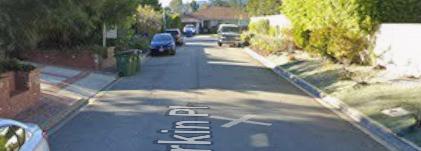
Vicente Boulevard between Ninth and 11th streets. The new rules prohibit parking from 8 p.m. to 6 a.m. daily, except for vehicles displaying a valid resident permit.
City Manager Oliver Chi told the council that staff had worked with residents for two months to address the ongoing situation. An individual had been driving onto the street several nights a week, donning a mask and trying to intimidate people who
live there.
Residents submitted a qualifying petition citing concerns including extended overnight parking, late-night noise, nuisance activity, conflicts with vehicle occupants, reduced sense of safety and sanitation issues. The problems were concentrated during overnight hours, according to city staff.
The City Council’s action follows a staff
recommendation to create the overnightonly restrictions to discourage recurring overnight occupancy of curb space while preserving daytime public parking.
Implementation, including signage installation and resident notification, is expected within eight to 10 weeks. A grace period will precede enforcement.
Instagram influencer Summer Wheaton
pleads not guilty in deadly Malibu coast crash case
The thirty-five-yearold’s defense claims the rideshare driver was at fault for the head-on collision.
Social media influencer Summer Wheaton pleaded not guilty during a court arraignment following a fatal 2024 suspected drunk driving collision that claimed the life of a rideshare driver along Pacific Coast Highway. Wheaton has asserted that the crash was the fault of the victim, as reported by KTLA 5 News.
The 35-year-old entered her plea in Van Nuys Superior Court. Wheaton faces criminal charges of vehicular manslaughter alongside two counts of driving under the influence. Since the high-profile incident, her social media following has dropped by roughly 5,500 users from her previous peak of 100,000 followers.
Prosecutors allege that Wheaton left a holiday party at Nobu Malibu before

crossing the center median into oncoming traffic within the 22000 block of Pacific Coast Highway. Her eastbound 2019 Mercedes-Benz sedan collided directly with a westbound 2020 Cadillac SUV.

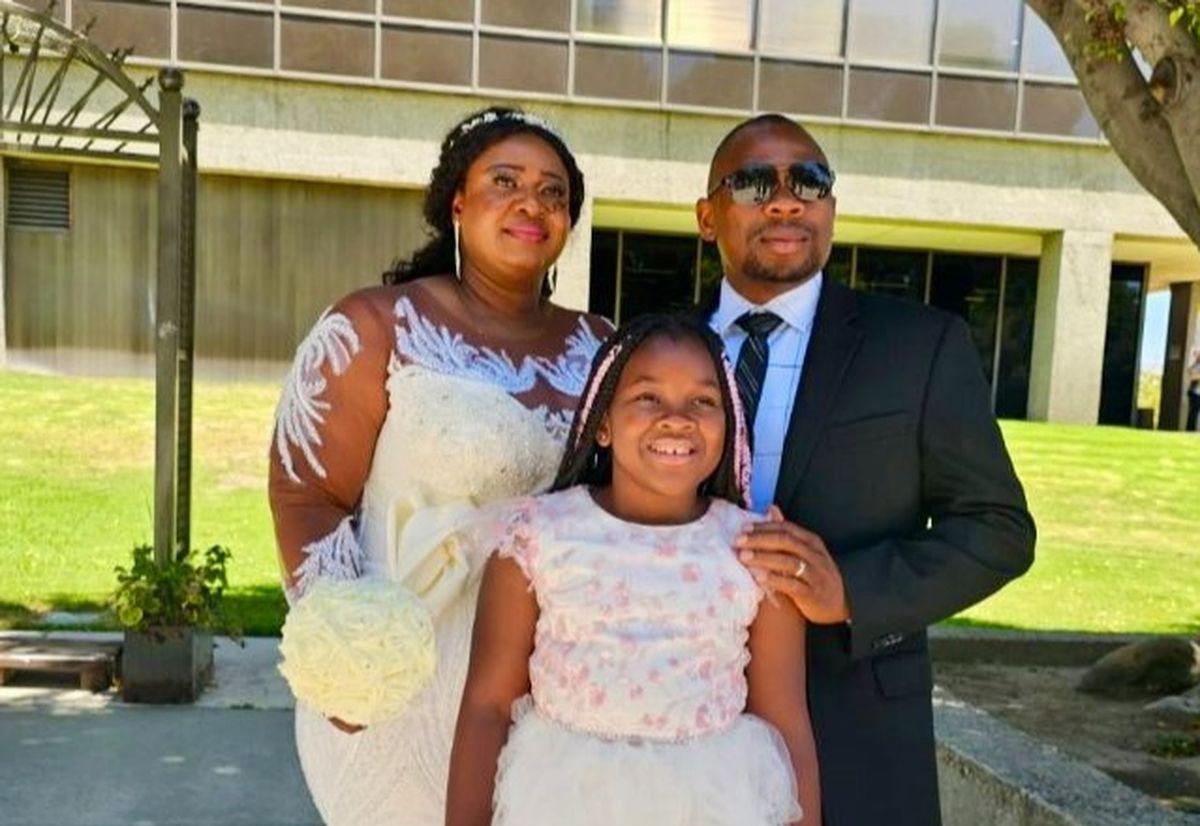
to support Okeke’s wife and children and cover his funeral expenses, describing the late father as a man known for his unwavering love and generosity, which did not reach its goal.

The impact killed the driver of the SUV, 44-year-old Martin Okeke, who was working as a rideshare driver at the time of the collision. Family members and friends organized a GoFundMe campaign

















































Curious City 06/19/26: THE FREEWAY IS ON FIRE!

By CHARLES ANDREWS
THE GLOVES ARE OFF
I'm a very patient man. Always have been. I have written for publication since high school, so I have a pretty good idea of what it takes to bring people to your point of view. It can be a glacial process. But I’m a very patient man.
The Byrds (“Turn! Turn! Turn,” 1965) reminded us, from Ecclesiastes (3: 1-8), through the prophet Peter Seeger, that there is a time for everything. Thing is, no one knows when a time has come, how long it will last, or what’s next. So this is a handy philosophy for explaining and accepting what is, but offers no guidance for tomorrow.
We have been suffering (and dying) through 10 years of never-dreamed-of chaos and cruelty, and attacks on our laws and Constitution, from our own elected and non-elected officials. We thought it was over when Trump lost to Biden by more than 7 million votes in 2020, and an electoral college landslide of 306-232. But thanks to gerrymandering and other political dirty tricks, the GOP emerged with control of all three branches of government, if you include the corrupt and partisan Supreme Court.
AND OUR CORRUPT CITY GOVERNMENT
has become turbocharged to remake our world-famous city by the sea into a Miami Beach-style high-rise tourist trap. We already get millions of tourists for the delights of unurban ocean views and sea breezes surrounding our famous beach we have always offered, but those will disappear when our beach is lined with rows of towering hotels and millionaire condos, right on the sand and blocking the ocean view on the bluffs above. Does that sound like a plan you approve of?
If it doesn’t, you need to become informed about what is shakin’ here politically, because if you thought we were getting sold down the river the last 20 or 30 years, you ain’t seen nuthin’ yet. The reprehensible Republicans in DC and across the country are coming for you if you are not white (and a lot of you who are), and our local greed mongers have taken note and are playing by the same

“rules.” Subtlety and hiding are off the table; now it is more a matter of here it is, stop me if you can.
LET’S TAKE A PAUSE HERE
Because that sounds like pretty strong language. Yup. If the barn is on fire, or the beach is being put up for the highest bidder, it’s not the time to inquire, a little help here? It’s time to yell, fire!
Let me make one more point, writing with my gloves off. I don’t hate any of our politicians, elected or appointed officials, or staff. But I think some are terribly misguided, even to the point of being corrupt, and I hate what they are doing and plan to do to this amazing, historic, unique, cherished, irreplaceable, globally famous town on the beach on the edge of a sprawling urban goliath, and if I think I, we, need NOW to yell Fire! - I will. Over and over, until you see all the burn spots and realize it adds up to irreversible loss of our town, our democracy, our beacon nation, and that it has been orchestrated, and well-planned, for years. Some of us have been sounding this alarm for many years. Now it is time for all of us to pay attention. And do something.
Yeah, I know, that’s inconvenient, but so was Valley Forge in the winter snow with boots falling apart and no food or ammunition. Democracy, we have painfully learned of late, is not a given. Ben Franklin famously quipped right after the Constitutional Convention that we rejected monarchy and now had “a republic – if you can keep it.” The same goes for the kind of small city we residents love and want to keep. Both depend on an informed, engaged, and active citizenry. Good things don’t come free or easy. I’ll try to do my part on the informed.
Here’s the other thing. I know so many of us are discouraged and feel beat down by both local and national events. But there is a lot going on that points the
other direction. A lot of people and groups getting together to fight for what they feel is right. That’s called community, and it is very important for all of us to feel that. We are not alone; we are not even in the minority. We are the majority, by millions. I will try to keep that good news coming in this column as well.
HOW ABOUT RIGHT NOW?
I've been referring often to our beach. More than anything, it defines Santa Monica, doesn’t it? I like the comparison of SM and our beach to New York’s Central Park. A huge open area of relief for a large urban population, a place to escape a hot, crowded neighborhood on a summer day. In this regard, some of us consider defending the beach our obligation to millions of Angelenos. Sadly, defending it against our own “leaders.”
So the recent machinations to turn our precious beach over to developers, to the exclusion of the rest of us, is particularly corrupt. It’s a complicated tale revolving around a state Assembly Bill 1740. The players: our Assembly Member Rick Zbur and his staff, who got the ball rolling and are now trying to cover their posteriors as outrage has grown; City Council Member Dan Hall, who journeyed to Sacramento to testify and support the bill, not as a private citizen but identifying himself as a Council Member, saying he was filling in for Mayor Caroline Torosis who couldn’t make it, note – Torosis, running this fall for re-election, seems to me very adept at keeping her name out of controversy (except when she doesn’t, as in the hiding from residents the activation on Ocean Avenue of two buildings for a private drug and mental rehab group, so, no community input); the Santa Monica Democratic Club, whose opposition to this bill seems a bit unpredictable, had opposition approved by a subcommittee, then “no recommendation” from the executive board, then a 66% vote
by the entire membership to oppose it. GET SMa.r.t
The columns in The Mirror by the SMa.r.t. group (Santa Monica Architects for a Responsible Tomorrow) have for 15 years given perspective on city issues, from those very experienced with city planning. They have been invaluable to understanding what is really going on, and they have been getting even more nuanced and insightful the last few years. Member Dan Jansenson wrote a series of three columns about this issue, 1740, that will give a deep (and frightening) understanding – here’s a link to the last one, and you can work your way back.
https://smmirror.com/2026/06/sm-a-rt-column-santa-monicas-coast-is-aboutto-change-forever-most-residents-dontknow-its-happening-part-3/
Fellow architect Jack Hillbrand’s piece last Friday is the first of three to lay out this important issue and the forces behind it.
https://smmirror.com/2026/06/sm-a-r-tcolumn-santa-monica-built-the-delay-itnow-wants-a-law-to-erase-part-one/ GET RID OF THE 10 FREEWAY!
I have to throw in one more recent absurdity from a City Council that should be focusing on our many real-world problems. Council Member Ellis Raskin recently directed staff to study capping our portion of the 10 Freeway for park areas, and… eliminating the 10 completely. Can’t make this up. And Council Member Barry Snell seconded it. With a straight face? I don’t know.
Folks, this is who you voted for to lead this city. Please don't make the same mistakes this fall.
Charles Andrews has lived in Santa Monica for 40 years and wouldn’t live anywhere else in the world. Really. Send love and/or rebuke to him at therealmrmusic@gmail.com
Three independent food pop-ups are taking over this popular Santa Monica bakery

Petitgrain Boulangerie lines up a delicious slate of local guest chefs for the rest of July.
Acclaimed Westside bakery Petitgrain Boulangerie will host a rotating series of culinary pop-ups throughout the remainder of July, giving its space to independent and up-and-coming Los Angeles chefs and bakers.
The special pop-up schedule at the 1209 Wilshire Boulevard storefront features a mix of daytime and evening services, offering unique menus from some of the best and most exciting pastry chefs and
bakers around.
Monday, July 13 (9 a.m. to 2 p.m.):
Pastry chef, Leah Chin Katz’s Double Chin LA will take over the space to serve custom pastries, seasonal jams, and specialty desserts. This isn’t the first time that Katz has been to Petitgrain, and it won’t be long before she returns with her signature baked goods.
Monday, July 20 (9 a.m. to 2 p.m.):
Boutique pastry brand D'Lili Pastry will offer a menu featuring artisan cakes and traditional Colombian specialties in its first Los Angeles pop-up.
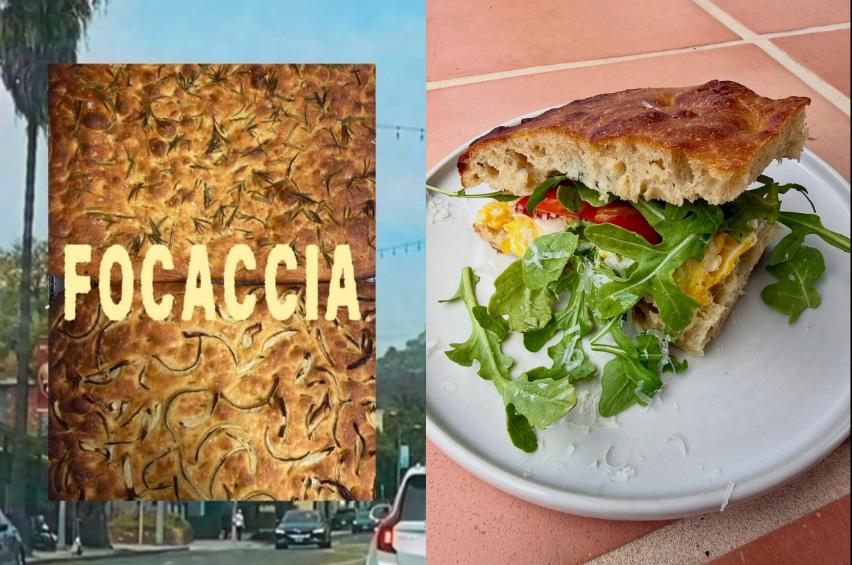
Monday, July 26 (5 p.m. to 8 p.m.): In case you missed their first appearance, Jennie's House returns for a specialized evening service highlighting a curated selection of sweet and savory focaccias. Petitgrain Boulangerie gently reminds

you that the bakery is closed on Monday and Tuesday, and that the pastry chefs and bakers will handle their own pop-ups,
independent of Petitgrain, and that none of the boulangerie’s signature pastries will be on sale during the events.

BEHIND THE SCREEN
By Kathryn Whitney Boole
This is not your grandmother’s Supergirl. Gone are the perfect sweet smiles and sparkling, neatly tight bodysuit, the shining example of charm, strength, and feminine heroism.
This contemporary version of Supergirl is messy, lazy, sullen, unambitious, kind of miserable, and unable to find her way. This movie takes a chance on portraying Supergirl more like a real young adult still growing into her powers than the image of perfection that has always been cast before. This Supergirl is questioning her life and fiercely refusing to be accountable to anyone else on the planet - or in the universe.
Her state at the beginning of the story is one of continuous inebriation, as she bounces from bar to bar, slinging back strong boozy concoctions, apparently softening the edges of some serious inner
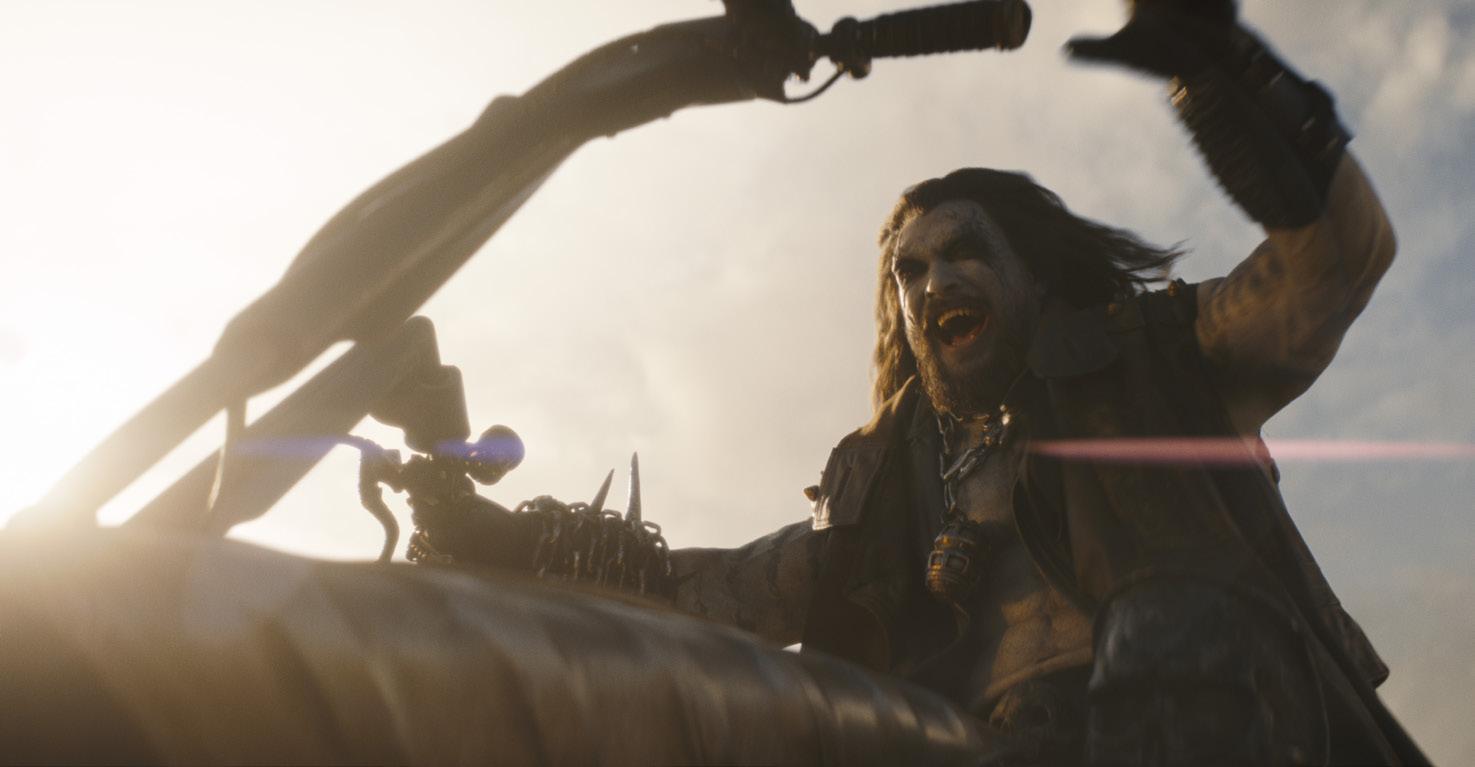
way. The film never develops a clear style, either classic or avant-garde. The battles and fight choreography rely on quick takes, cutaways, and confusion. Some of the scenes at the beginning of the movie are so similar in style to Star Wars sets and characters that it distracts from the story. The most effective power in the movie is Supergirl’s determination to pull herself together, to find some drive and a purpose.

angst. I would like to have seen more comedy at this point and more about the angst.
Australian actress Milly Allcock shines at showing this troubled side to a character usually depicted as perfection incarnate. The story would have helped her more if it had delved into some of the relationships and incidents that caused her malaise. She seems to strongly prefer being alone - but why? She does love her dog “Krypto,” and that connection becomes a compelling emotion builder in the plot. But another thread takes over the narrative and is built on the revenge of a “Ruthye,” a teen whose family is killed, played with a genuine sense of tragedy by young Eve Ridley. The story is as untidy as its main character. It’s more mood-built rather than a clear tale with emotional arcs. This sometimes works, sometimes loses its
The script was written by actress Ana Noguerra and directed by Australian director Craig Gillespie. Gillespie has directed a variety of highly regarded films and TV series, including The Finest Hours, Lars and the Real Girl, Cruella, and I, Tonya. He’s the showrunner (creator and director) of the edgy and complex Apple TV limited series Your Friends & Neighbors, starring Jon Hamm. On that project, Gillespie developed his characters with intricate story lines and relationships. You may remember Alcock as “Rhaenyra Targaryen” from the first season of House of the Dragon. She’s been acting in commercials and on TV and film in her native Australia since she was 14 and won Best Comedy Performer at the 10th Annual AACTA Awards. She’s a unique talent whose international career will no doubt take off after her performance in this film.

I wish her comedic ability had been more prominent here.
Belgian actor Matthias Schoenaerts is an extraordinary villain as “Krem.” I’ve enjoyed seeing him always in goodguy roles, where he is one of those performers who can communicate a whole encyclopedia of feelings with his eyes. A quintessential actor, Schoenaerts here converts his plentiful good guy charisma into terrifying bad guy vibes. Schoenaerts built his career in his home country. He’s been one of my favorite actors for years, even though he’s not been seen on screen as often as American leads.
In his youth, he was an aspiring architect and pro soccer player, but he was drawn to acting after appearing in a film with his actor father as a teen. He became a big name in Flemish films and rose to international prominence starring in Rust and Bone (2015) and The Danish Girl (2015). He has done movies in several languages. In this film, he embodies a completely different type of character in Krem, a power-hungry being whose aura is evil on steroids. I applaud his dedication to this role for the many hours he must have spent in the “Hair & Makeup” chair before each shoot.
Other standouts in the cast are Jason Momoa as wandering biker “Lobo,” and Ridley as “Ruthey,” a teen “damsel in distress.” I would like to have seen much more of the always colorful Momoa,
Rated PG-13
107 Minutes
Released June 26th


and Ridley has star quality that I think is underused here. Both are worth watching. There was a huge marketing campaign for Supergirl, and the film had very high expectations, which led to some reviewers giving it a negative review. A marketing poster for the movie reads “Truth. Justice. Whatever.” and is meant to mirror the main character’s personality. In the movie, that “Whatever” should have been turned on its head, but it wasn’t.
The weakness is in the storyline and not in the actors or the characters they’ve brought to life, or the costumes. It’s an exciting movie to watch, and Iceland’s landscape and the Scottish Highlands’ terrain are impressive stand-ins for extraterrestrial planets. The film needed more comedy - the filmmakers could have taken a hint from Ant-Man for that. See this movie for the great performances in a hit-or-miss story, creative spaceships and striking landscapes, the realistic personality of perennial tomboy Kara/ Supergirl, and the wicked performance of Schoenaerts as Krem.
Kathryn Whitney Boole has spent most of her life in the entertainment industry, which has been the backdrop for remarkable adventures with extraordinary people. She is a Talent Manager with Studio Talent Group in Santa Monica. kboole@gmail.com
The Promenade Wasn't Built to Be a Billboard
SM a.r.t.
Santa Monica Architects for a Responsible Tomorrow
For nearly forty years, Santa Monica has largely resisted one thing that much of Los Angeles eventually embraced: billboards. That wasn't an accident.
The Third Street Promenade became successful because it felt different. It wasn't Sunset Boulevard. It wasn't Times Square. It was a place where people came to walk, eat dinner, watch street performers, and enjoy being outside without being overwhelmed by advertising.
The City has now approved large digital displays along portions of the Promenade as part of its effort to revitalize downtown, and the first proposals — including one for a landmarked building — are arriving. The reasoning is understandable: vacancies remain a challenge, city finances are tight, and officials are looking for ways to generate revenue and draw visitors back downtown. Filling storefronts, shoring up the budget, and bringing people back are worthwhile goals.
But before these screens go up, it's worth asking a simple question: what problem is actually being solved?
Will larger advertisements encourage new businesses to open? Will brighter screens create a stronger sense of place? Or is this proposal putting at risk the very character that has made the Promenade successful for more than thirty years?
As architects, we spend our careers thinking about how people experience cities. The places people remember aren't defined by their advertisements. They're defined by buildings, landscaping, public spaces, and the way people interact with them. Great architecture quietly frames life. Great public spaces encourage people to look at each other, not at a screen.
Digital billboards reverse that relationship. They become the architecture, while everything else becomes the backdrop.
To be fair, some cities have embraced large digital displays successfully. Supporters believe they create energy, modernize aging districts, and provide revenue that can be reinvested in the community. Given the challenges facing downtown Santa Monica, it's easy to see why city leaders are exploring the idea. But there are consequences that deserve equal attention.
Los Angeles recently received an unexpected case study with the Tesla Diner in Hollywood. Long before opinions formed about the restaurant itself, nearby residents began voicing concerns about the enormous LED displays, increased nighttime brightness, traffic, and the impact on their quality of life. Whether every complaint proves justified is almost beside the point. The lesson is that digital displays don't stop at the property line. Light travels. Noise travels. Their impacts
extend well beyond the business that benefits from them.
A Process Worth Examining
The Promenade proposal deserves that same scrutiny, and how the City arrived here matters. Authority over these signs was steered away from the Landmarks Commission early on. The Digital Display District Ordinance adopted in December, 2025. The City Manager is to certify, after non-binding consultation with the Landmarks Commission at a duly noticed public hearing, whether a display on a landmarked building is reversible, whether it materially impairs the landmark's significance, and whether the features behind the screen stay physically intact, after considering, but not being bound by, the Landmarks Commission's input.
That process is now playing out at 1355 Third Street Promenade, where a 1,000-square-foot, full-motion LED display has been proposed for two facades of a landmarked building. The Commission has yet to receive a formal staff presentation, though the sign company's attorney recently invited commissioners to an informal viewing ahead of the Commission's July 13th public hearing.
All of this is legal. The ordinance deliberately carves digital displays out of Chapter 9.56 of the City's Landmarks Ordinance — exempting them from certificate of appropriateness review, which is otherwise required for changes to landmarked buildings. Each sign operator will pay the City $500,000 up front, plus the greater of 20% of gross revenue or a $500,000 annual guarantee, with citywide projections of $3.5 to $7 million a year. Those figures explain the City's interest, and they also mean the same official judging whether a landmark is impaired is evaluating a revenue stream the City depends on. That's not a conflict of interest in the legal sense; it's a structural one, in which the decider has a fiscal stake in the outcome.
More troubling, the three criteria themselves never ask the question that actually matters. Preservation law, following the National Register framework that Santa Monica's own criteria are modeled on, protects seven aspects of a landmark's integrity: location, design, setting, materials, workmanship, feeling, and association. The ordinance checks only whether an installation is removable and whether the material fabric survives, borrowing the "reversibility" language of preservation standards while dropping the companion requirement that new work be visually compatible with the landmark. A screen can leave every brick untouched while erasing a building's design, setting, and feeling for decades. And "reversible" means little over a thirty-year term; for anyone alive today, it's permanent. A landmark is experienced through its facade. One that can't be seen isn't preserved. It's warehoused behind an advertisement. None of this required anyone to break a rule. But a review that protects only
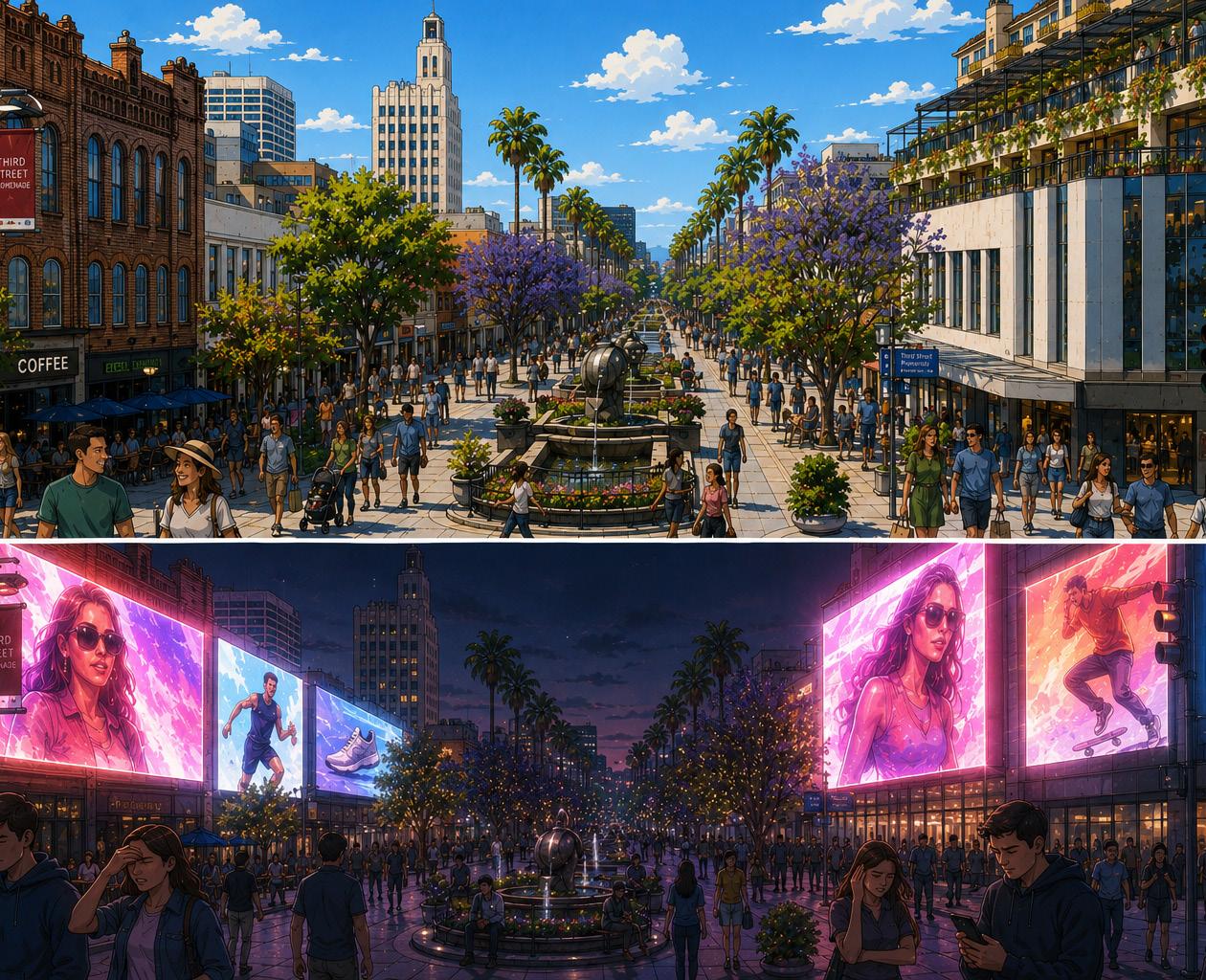
what nobody can see, while monetizing what everyone does, isn't really asking the question preservation is supposed to answer.
What's Really Being Decided
The larger concern extends beyond any single building or approval.
It's what these displays represent.
Advertising has become nearly impossible to escape. It's on phones, social media feeds, streaming services, and podcasts. Ironically, many people now pay extra simply to experience fewer advertisements, because uninterrupted attention has become something worth paying for.
Which raises the question of why Santa Monica would choose to introduce more advertising into one of its most cherished public spaces.
This isn't an argument against business or economic development. The Promenade has always been a commercial district, and that's part of its success. Restaurants, retailers, hotels, and entertainment all belong there. Commerce creates vibrant cities.
Advertising is different.
There is an important distinction between creating places where businesses thrive and creating places where advertising dominates the experience. One supports the city. The other competes with it.
Cities are shaped by thousands of small decisions. One more sign. One more screen. One more opportunity to generate revenue. Individually, each decision seems reasonable. Collectively, they determine whether a city feels timeless or temporary.
Santa Monica should absolutely invest in the Promenade, but that investment should focus on what made it successful in the first place: exceptional public spaces, thoughtful architecture, local businesses, cultural events, landscaping, safety, and experiences that bring people together.
Those are the things that create lasting destinations.
Digital billboards don't create those experiences. They simply monetize the people who are already there.
Perhaps these displays will generate meaningful revenue. Perhaps they will help fund improvements that benefit everyone. If that's the case, the City should present clear projections, measurable goals, and an honest public discussion of the tradeoffs, including a hard look at whether the review process is actually evaluating the thing it claims to protect. A five-year sunset review with genuine removal authority, and annual public reporting of actual revenue against those projections, would be a fair place to start.
Because this decision isn't really about advertising. It's about identity.
Every city eventually decides what is worth protecting. Santa Monica's greatest asset has never been its advertising. It's been the experience of walking down the Promenade.
Matt Hoefler, Architect NCARB for SMa.r.t., Santa Monica Architects for a Responsible Tomorrow.
Dan Jansenson, Architect (former Building & Fire-Life Safety Commissioner); Robert H. Taylor, Architect AIA; Mario Fonda-Bonardi, Architect AIA (former Planning Commissioner); Sam Tolkin, Architect (former Planning Commissioner); Michael Jolly ARECRE; Jack Hillbrand AIA, Landmarks Commission Architect; Phil Brock (SM Mayor, ret.); Matt Hoefler, Architect NCARB; Heather Thomason, community organizer; Charles Andrews, columnist. journalist; Bruce Leddy, Human Services Commissioner and NOMA Co-Chair.
A Class for Every Dream

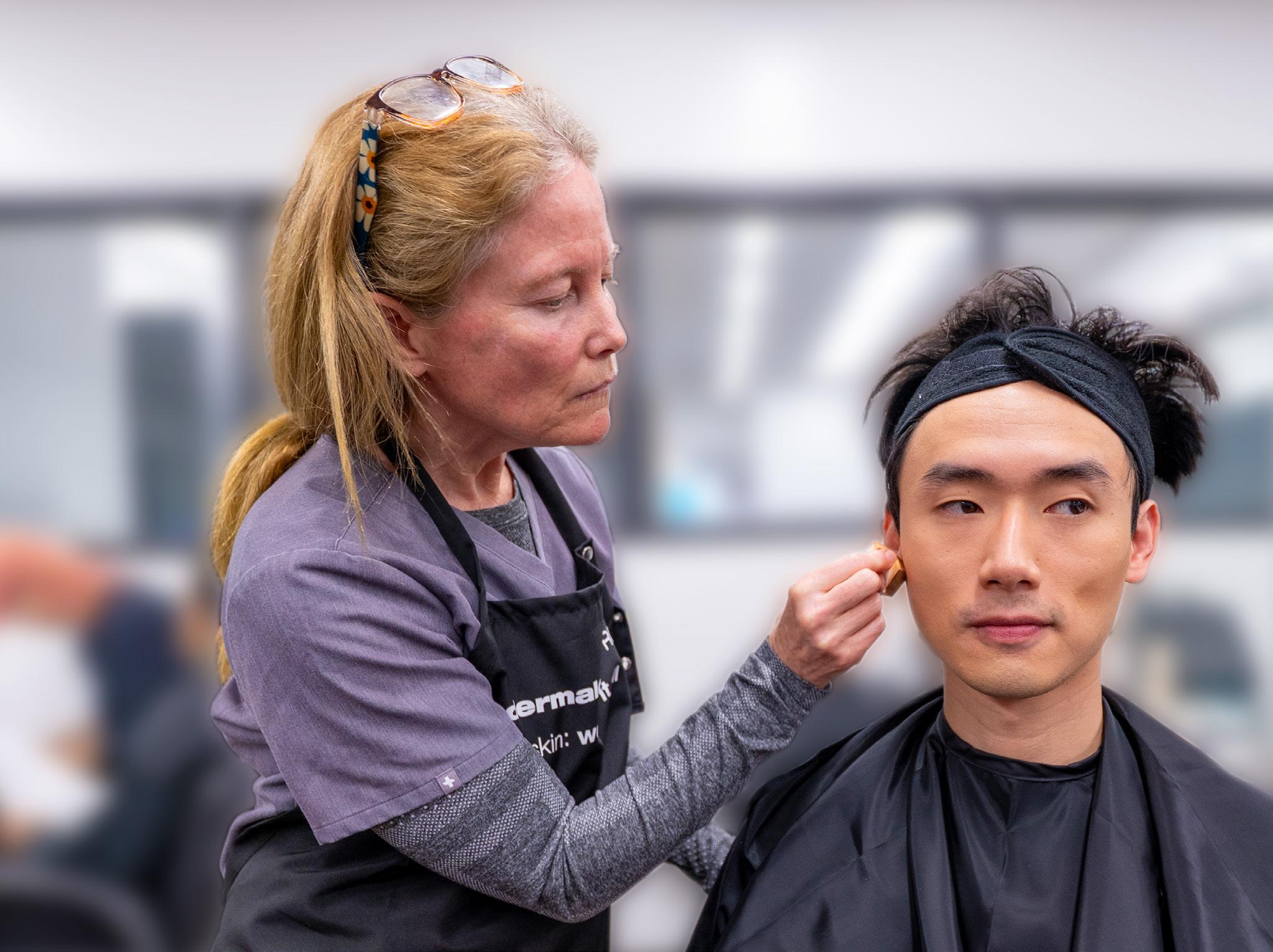
SANTA MONICA COMMUNITY COLLEGE DISTRICT BOARD OF TRUSTEES
Dr. Sion Roy, Chair; Dr. Tom Peters, Vice Chair; Dr. Luis Barrera Castañón; Anastasia Foster; Dr. Nancy Greenstein; Dr. Margaret Quiñones-Perez; Rob Rader; Audrey Liljegren, Student Trustee; Kathryn E. Jeffery, Ph.D., Superintendent/President Santa Monica