Comprehensive Multi-Agency Juvenile Justice Plan & Juvenile Justice Realignment Plan Consolidated 20
I. INTRODUCTION
The County of Santa Barbara combines the Comprehensive Multi-Agency Juvenile Justice Plan (CMJJP) and the Juvenile Justice Realignment Plan (JJRP) into one document to highlight the continuum of services available to youth and the strategies to support success, while at the same time addressing required elements of each plan. Each document begins with its own introduction that speaks to the historical foundations for the plan, the requirements of each plan, and efforts in the County of Santa Barbara to address the needs of youth and families.
PLAN REVISIONS
The CMJJP/JJRP have been updated to reflect the evolving needs of justice-involved youth. This update includes a review of current trends, identified service gaps, and system challenges. Findings from these assessments were used to refine priorities and update goals and objectives to ensure programs, services, and resource allocations are responsive, coordinated, and aligned with present needs. Though several service gaps persisted, some advancements were highlighted, including the expansion of vocational training at the Juvenile Justice Center (JJC) and in the Santa Maria School District, a modicum of additional community service opportunities, the facilitation of the ARISE program year-round at the JJC by a communitybased organization, and the use of less restrictive programs as a step down measure as research into opportunities in this area continue.
Specific revisions to the combined plan include a newly devised goal to develop a caseload projection model to assess the impact of AB 1376, which limits the term of wardship to twelve months post disposition notwithstanding specified exceptions, which will allow the Department to anticipate staffing needs, restructure caseloads, and establish caseload guidelines that support effective supervision grounded in core correctional practices. In support of enhancing professional training for staff, while fostering a safe environment at the JJC, a goal of all Juvenile Institution Officers (JIOs) completing de-escalation training to strengthen their capacity to prevent and safely manage escalated situations while maintaining youth dignity and respect was included this year. While this training is in the current repertoire of mandatory JIO courses, many staff are within their first year of employment and have yet to benefit from such training. Inclusion of this goal will memorialize the importance of de-escalation, serve to increase staff trauma-informed training, and enhance their ability to work with detained youth.
Related to further support of enhancing the use of diversion for appropriate youth, a subgoal was added to quantify the percentage of all restorative justice referrals that occur post-filing to establish a baseline, confirm appropriate use, and support future analysis of the extent to
which restorative justice reduces or prevents deeper system involvement for youth. Another new subgoal targets diversionary youth by implementing a collaborative incentive plan to increase youth enrollment in the Youth Empowerment Services (YES) program to increase the number of youth who complete this intervention. A third newly created subgoal involves quantifying the percentage of youth who successfully terminate wardship at or before twelve months post disposition to establish a baseline which will inform future case management practices.
In a strategy to coordinate efforts and improve system collaboration to support connection of youth and families to the community, a new subgoal supports increased access to community service work opportunities by exploring partnerships with local municipalities. Related added subgoals involve implementation of job fairs at the JJC highlighting vital trade providers and union representatives, as well as expanding youth access to horticulture program opportunities. For youth in the community, an added subgoal involves 100% of youth identified as being at risk of removal having a Child and Family Team Meeting (CFTM) completed within 14 days of identification to ensure collaborative case planning and mitigate the need for out of home placement. In addition, to further support families, a subgoal of establishing a pantry at each Probation juvenile location (JJC, Santa Maria, Santa Barbara, and Lompoc) with clothing, food, and hygiene items was added. Resource binders will also be created and added to each location to help youth and families identify preferred supports to meet their needs. A final new subgoal related to system collaboration offers quarterly youth-specific family engagement opportunities at the JJC involving partner agencies, such as Behavioral Wellness and Reentry Navigators, who can offer youth and their families real-time feedback, resources, and support.
Finally, to greater support a systemic approach to studying and addressing disparities in juvenile justice, Behavioral Wellness will provide at least two presentations to Probation Juvenile Division and JJC staff on sexual orientation, gender identity, and expression (SOGIE); available services; and self-harm risk for this population to foster understanding, support, and inclusive environments for all justice-involved youth. Additional new subgoals in this vein involve expanding gender-specific, SOGIE-affirming programming to support SYTF youth; Commercial Sexual Exploitation of Children (CSEC) lived-experience mentors providing presentations to youth at the JJC; and culturally responsive subgoals to contract with an indigenous-serving organization to provide culturally competent services to youth at the JJC and to hold focused workshops increasing awareness of the unique experiences of Latinx communities within Santa Barbara County.
The overarching aim of these updated combined plans remains one of strengthening outcomes for youth and young adults by ensuring the plans remain relevant, data-informed, and aligned with best practices and local needs.
Community Member Hugo Calderon-Zamora Personalemailredacted Personalphone redacted
CommUnify
Santa Barbara Police Department
Hope Elementary School District
Future Leaders of America
Lompoc Police Department
Lompoc Unified School District
Santa Maria Police Department
UCSB Gevirtz Graduate School of Education
Fighting Back Santa Maria Valley
Santa Maria Bonita School District
Maico Hernandez, Program Manager mhernandez@communifysb.org
805-964-8857
Kelly Gordon, Police Chief kgordon@sbpd.com 805-897-2396
Anne Hubbard, Ed.D., Superintendent ahubbard@hopeschooldistrict.org 805-682-2564
Gloria Soto, Executive Director gloria@futureleadersnow.org 805-642-6208
Kevin Martin, Police Chief KMartin@ci.lompoc.ca.us 805-875-8103
Lesley Davis, Coordinator, Pupil Support Services davis.lesley@lusd.org 805-742-3310
Christopher Williams, Police Chief cwilliams@cityofsantamaria.org 805-928-3781
Jill Sharkey, Ph.D., Professor, School Psychology jsharkey@education.ucsb.edu 805-893-3441
Dawnette KingsleySmith, Programs Director dawnette@fbsmv.com 805-346-1774
Mark Palmerston, Director, Student and Family Services mpalmerston@smbsd.net 805-361-8141
Non-Profit Community Based Agency Serving Juveniles VACANT
JUVENILE JUSTICE COORDINATING COUNCIL WORKGROUP
The JJCC appointed a workgroup tasked with collaborating on the development of the CMJJP and the JJRP, as well as identifying priorities and strategies for the local juvenile justice system. In FY25/26, the Workgroup will meet monthly, and the voting members are:
Agency
Probation Department (Chair)
District Attorney’s Office Representative
Maria Story, Deputy Chief Probation Officer mbongio@countyofsb.org 805-803-8586
Carrie Gallagher, Chief Deputy District Attorney cgallagher@countyofsb.org 805-934-6979
Public Defender’s Office Representative Sara Elturk, Deputy Public Defender selturk@countyofsb.org 805-934-6985
Department of Social Services Representative Amy Krueger, Assistant Director akrueg@countyofsb.org 805-346-8351
Department of Behavioral Wellness
Board of Supervisors Representative
County Executive Office Representative
John Winckler, MFT, Division Chief of Clinical Operations jwinckler@sbcbwell.org 805-692-5785
Wade Stewart Cowper, 1st District Representative wcowper@countyofsb.org 805-335-0778
Santa Barbara Police Department Representative Kenneth Kushner, Commander KKushner@sbpd.com 805-897-2397
JUVENILE JUSTICE REALIGNMENT SUBCOMMITTEE
To be eligible for funding allocations associated with juvenile justice realignment, the local JJCC must create the Juvenile Justice Realignment Subcommittee (JJRS). JJRS’s primary responsibility is to develop a plan describing the facilities, programs, placements, services, supervision, and reentry strategies that are needed to provide appropriate rehabilitative services for realigned youth. Per JJCC by-laws, the vacant community member position on the JJRS will be filled by an eligible JJCC member and recruitment is underway. The JJRS generally meets jointly with the JJCC six times per year. Meeting information can be found at: https://www.countyofsb.org/1740/Juvenile-Justice-Coordinating-Council-JJ.
JUVENILE JUSTICE REALIGNMENT SUBCOMMITTEE
List the subcommittee members, agency affiliation where applicable, and contact information:
Three Community Members (defined as “individuals who have experience providing community-based youth services, youth justice advocates with expertise and knowledge of the juvenile justice system or have been directly involved in the juvenile justice system” (Welf. & Inst. Code § 1995(b).))
Jill Sharkey, Ph.D., Professor, School Psychology jsharkey@ucsb.edu 805-893-3441
Dawnette Kingsley-Smith, Programs Director, Fighting Back Santa Maria Valley dawnette@fbsmv.com 805-346-1774
COUNTY PROFILE
The County of Santa Barbara is situated on the central coast of California. Known for its coastal beauty, it is bordered by the Pacific Ocean to the south and west and the Santa Ynez Mountains to the east. It is positioned between two major urban centers, Los Angeles 100 miles to the south and San Francisco 250 miles to the north. Santa Barbara County spans 3,789 square miles of which 2,735 square miles is land.
The County of Santa Barbara is typically referred to by North, Mid, and South County designations. However, the unique regions of the county are better defined as the areas created by the topography of the Santa Ynez and San Rafael Mountain Ranges – Santa Maria Valley, Lompoc Valley, Santa Ynez Valley, and Santa Barbara Coast.
Santa Maria Valley: This region is bordered by San Luis Obispo County to the north and includes the cities of Santa Maria and Guadalupe and the unincorporated towns of New Cuyama, Cuyama, Ventucopa, Orcutt, Los Alamos, Casmalia, Garey, and Sisquoc.
Lompoc Valley: The western portion of the County includes Vandenberg Space Force Base, a major contributor to the local economy, as well as the city of Lompoc and the unincorporated areas of Vandenberg Village and Mission Hills.
Santa Ynez Valley: Located in the heart of the County and home to Lake Cachuma and the Chumash Reservation. This region includes Santa Ynez, Solvang, Buellton, and the unincorporated cities of Los Olivos and Ballard.
Santa Barbara Coast: Also known as the “American Riviera” and bordered to the southeast by Ventura County, this region includes the cities of Santa Barbara, Goleta, and Carpinteria as well as the unincorporated areas of Hope Ranch, Summerland, Mission Canyon, Montecito, and Isla Vista.
Local Economy
Recent growth on the Central Coast has stalled due to housing shortages and high living costs, making it hard for employers to attract and retain talent, students to stay after graduation, and families to thrive. This issue is magnified by a surplus of low-wage workers in agriculture and tourism, hitting underserved communities the hardest.
Higher education is a highlight of the Central Coast, primarily led by institutions like University of California Santa Barbara (UCSB) and a strong community college presence with Allan Hancock College (AHC) and Santa Barbara City College (SBCC), all together employing around 20,000 people and drawing students from afar.
Tourism is a thriving industry on the Central Coast, attracting talent and visitors with its cultural and natural attractions. Other key employers include the military, agriculture, commercial fishing, and business services, particularly engineering.
III. COMPREHENSIVE MULTI-AGENCY JUVENILE JUSTICE PLAN
The CMJJP is required under the Juvenile Justice Crime Prevention Act (JJCPA) as enacted in 2000 and codified under Assembly Bill (AB) 1913. JJCPA provides funding for programs and services to reduce juvenile delinquency and establishes the local JJCC. The JJCC is charged with collaborating to identify local needs and developing supportive programming while considering budget priorities. The CMJJP includes an assessment of local law enforcement, probation, education, mental health, social services, substance use disorder, and other youth resources that serve at-risk youth, youth on probation, and their families. The plan identifies and prioritizes neighborhoods, schools, and other areas in local communities that face significant public safety risks from youth crime. The plan looks at services available for youth and families across the county, including those not referred to Probation. This plan provides a continuum of responses to juvenile delinquency from prevention to intervention, through probation supervision, and detention and reentry when necessary. This demonstrates a collaborative and integrated approach for implementing swift, certain, and graduated responses for youth referred to Probation, as well as youth on probation, which also includes incentives to reward positive behavior. Lastly, the plan provides a description of the programs, strategies, and system enhancements funded through JJCPA and the Youthful Offender Block Grant (YOBG). The combined plan is submitted to OYCR annually.
Part I. Service Needs, Priorities & Strategy
(Government Code Section 30061(b)(4)(A))
A. Assessment of Existing Services
Include here an assessment of existing law enforcement, probation, education, mental health, health, social services, drug and alcohol, and youth services resources that specifically target at-risk juveniles, juvenile offenders, and their families.
The County of Santa Barbara continues to benefit from a strong, collaborative network of partner agencies, community-based organizations (CBOs), advocacy groups, and local resources that collectively provide a wide range of services to support youth and families. These services include, but are not limited to, substance use disorder treatment, mental health services, mentoring, and reentry planning, reflecting a comprehensive, community-centered approach to promoting youth well-being and positive outcomes.
As formatted last year for ease of reference, the breadth of services available to families in Santa Barbara County is outlined in Appendices A and B of the CMJJP. This resource guide is updated annually and was expanded this year to include additional resources; specifically, the work the South Coast Youth Safety Partnership is doing to support organizations with a focus on positive youth development, the services available through Noah’s Anchorage, the Academy of Healing Arts (AHA), and the shift in crisis response from SAFTY under Casa Pacifica to Behavioral Wellness (BWell). Many organizations and schools also provided updates to their services provided.
As outlined in the appendices, the County of Santa Barbara provides a broad continuum of services, ranging from prevention to intervention. A greater proportion of youth—particularly those most likely to require these services—reside in the northern region of the county, as reflected by higher youth crime rates detailed in the Crime Trends section of this report (pages 17–21); thus, there is increased focus on enhancing services available in that area. The appendices identify the specific areas of need each listed service is intended to address, including mental health, substance use treatment, family and parenting support, mentoring and prosocial activities, youth employment, housing, medical and basic needs, school-based support, and diversion. Many agencies provide these services throughout the county, offering youth and families multiple points of access and engagement.
Throughout the year, the Probation Department gathers and verifies information on available resources, and the JJCC and its Workgroup receive presentations that help identify opportunities to strengthen or enhance services. In addition to existing services available to meet mental health, substance abuse, parenting, employment, and scholastic needs, presentations this past year highlighted specific areas of need and added services. Enhancements explored were the provision of services to the indigenous population in the northern region of the county, expanded restorative justice diversion opportunities, enhanced mentoring services offered to youth at risk of or confirmed to have been commercially sexually exploited (CSEC), and those provided by a newly installed Public Defender Holistic Defense Advocate.
To further early intervention efforts and to provide services to those affected by exploitation, in a collaborative effort, Noah’s Anchorage Youth Shelter, a Santa Barbara based residential, clinical, and drop-in service provider hired a CSEC case manager to work with CSEC youth. In addition to attending collaborative meetings and offering linkages to external services, they provide direct services to youth. Kingdom Causes, an organization in Santa Barbara focused on addressing homelessness and supporting local communities, has also been actively involved in addressing human trafficking. In addition to helping secure the funding for the CSEC case manager, they are currently working with a diverse, collaborative committee to create a threeyear action plan working toward agreement on a strategy to combat trafficking and to support implementation.
Collaboration around youth at risk for exploitation is vital to prevent victimization. In terms of early intervention, the Mental Wellness Education and Linkages (MWEL) Program, a grant through the Behavioral Health Services Oversight and Accountability Commission between Santa Barbara County Behavioral Wellness (BWell) and Santa Barbara County of Education Office (SBCEO), provides prevention and education focused on CSEC for local school districts. MWEL provides education to school personnel on warning signs, risk factors, stigma reduction, and using a trauma informed approach with youth at risk of commercial sexual exploitation. In addition, MWEL provides training on the mandated reporting requirements for suspected CSEC and how to use the First Responder Identification Tool (FRIT) with support on how to make suspected child abuse reports related to CSEC. MWEL staff also attend Multidisciplinary Team (MDT) meetings and School Attendance Review Board (SARB) hearings to also support linkage to mental health services for students at risk for CSEC.
Describe what approach will be used to facilitate collaboration among the organizations listed above and support the integration of services.
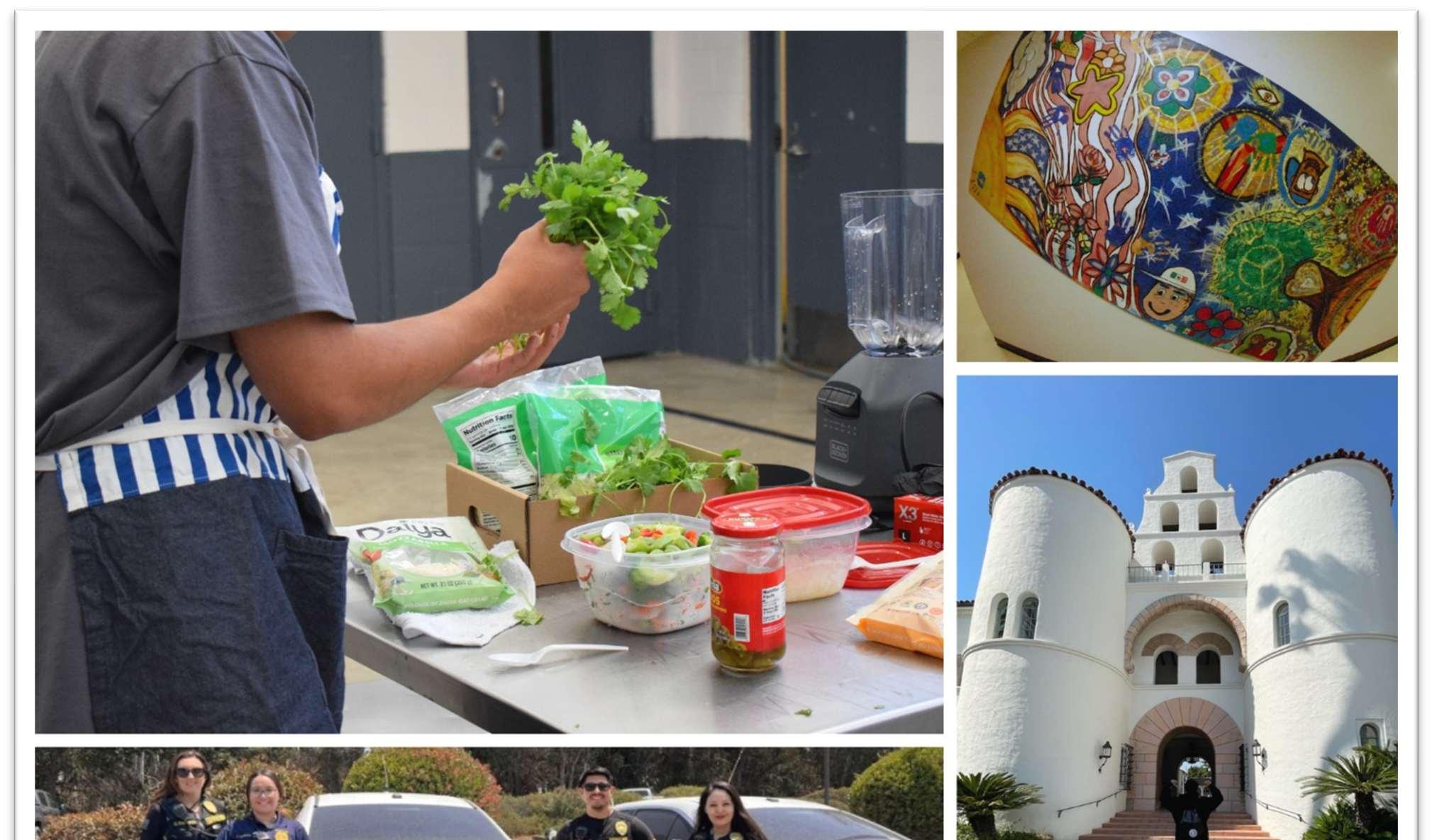
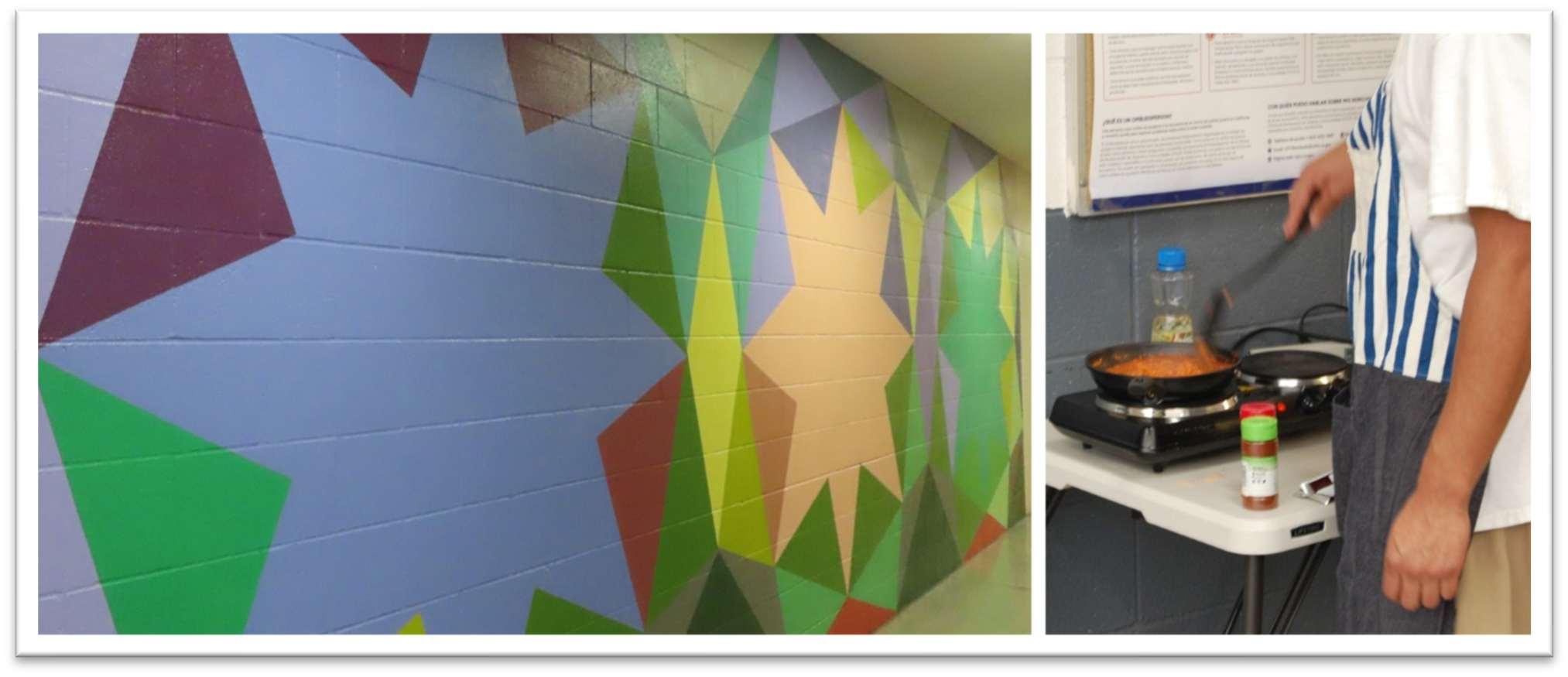
Annually, the JJCC and its Workgroup review current data and insights (see pages 16–24) alongside presentations from community service providers to better understand existing gaps and challenges facing youth in our local communities. New agencies are invited to present emerging programs and resources for youth and families, while agencies that have previously presented provide updates on service enhancements, newly implemented initiatives, and accompanying reference materials. This year presentations included Fighting Back Santa Maria Valley (FBSMV) related to additional services provided; Behavioral Wellness presenting on their Men’s Program, Substance Use Disorder Program, and California Advancing and Innovating Medi-Cal (CalAIM) justice involved initiative; the Mixteco Indigena Community Organization Project (MICOP); the Juvenile Justice Centers Mural and Culinary Programs; the Public Defender’s Holistic Defense Program; and the CSEC Lived Experience Mentors.
Multiple agencies frequently collaborate to develop coordinated, individualized responses to youths’ behaviors and treatment needs across the continuum of care. Youth and families may receive concurrent services from Probation, BWell, community-based partners, local school districts, and County Health. Through a coordinated approach, County agencies, communitybased organizations, and partner entities prioritize collaborative program development and the strategic use of available resources in the creation of new supports and services. These entities share information as permitted, frequently collaborate through regularly scheduled interagency meetings, and implement comprehensive whole-person and whole-family strategies while minimizing duplication of services. In April 2026, these efforts were enhanced even further as CalAIM in-reach is implemented for detained youth 90 days prior to release. This allows for increased service delivery to detained youth, active Medi-Cal for 90 days prior to release to fund services, and stronger release planning and a continuum of services from custody to community for youth.
Service Gaps
Though many services exist in the County of Santa Barbara through local schools, county agencies, and CBOs to address mental health, substance use disorder, trauma, educational needs, and a variety of socio-economic issues for youth and families, as are noted throughout the plan and categorized in the appendices, some gaps persist, as noted by the JJCC Workgroup. The need for local substance abuse disorder residential treatment persists; while a modicum of progress was made, community service worksites for youth remain limited; and Mixteco interpreters are difficult to source based on their limited number, combined with the number of Mixteco languages spoken.
In other areas, greater progress can be evidenced; specifically, vocational programs for youth at the JJC have been expanded to include culinary arts and barbering, though additional avenues of hands-on training are still needed. While an evidence-based gang intervention program is still needed, a contract has been executed for a community-based organization to deliver the ARISE gang curriculum to youth in a manner that renders it a promising practice. To enhance services designed for LGBTQIA+ youth, the Probation Department is currently meeting with a provider to identify potential opportunities to grow outreach and connection efforts for LGBTQIA+ youth. As additional Less Restrictive Programs emerge, the Probation Department evaluates them to determine suitability for local youth.
The overarching service gaps, as concurred upon by the JJCC Workgroup, as well as incremental progress made in addressing them, are outlined below:
Full array of Substance Use Disorder (SUD) counseling – SUD counseling provided by BWell has continued to be provided at the Juvenile Justice Center (JJC), including a comprehensive assessment of the youth’s needs, and the use of the evidence-based Seeking Safety curriculum. Services available for youth within the County of Santa Barbara include Early Intervention, Outpatient Services, Intensive Outpatient Services, and Recovery Services. Services that are not accessible within the county include Intensive Outpatient/Partial Hospitalization, Residential/Inpatient Services, Clinically Managed Low-Intensity Residential Services, Clinically Managed Population-Specific High-Intensity Residential Services, Medically Monitored High-Intensity Inpatient Services, and Medically Managed Intensive Inpatient Services. Youth in need of Inpatient Treatment Services are offered voluntary opportunities to reside at Tarzana Treatment Center, a contracted program in Los Angeles County, which is the only nearby program available. This provides a challenge for youth being away from their support system and adapting to new providers and a new environment. Most stay only 30 days, though some stays can be extended to up to 90 days. For youth with extensive SUD needs, more intensive local services remain unavailable.
Vocational programs for youth – Challenges remain in creating and providing robust vocational programming at the JJC and for youth in the community. As has been noted in prior plans, the JJC is housing youth for longer periods of time and well past the age of 18,
which is typically similar to the demographics of youth on supervised probation in the community. That population continues to expand, and while these youth are enrolled in post-secondary education, the need for vocational training options remains. To address this need, Santa Maria Unified School District is positioned to offer Career Technical Education (CTE) courses to youth, including Agriculture/Farming, Culinary Arts, Hospitality, Diesel Engine Repair, Automotive, and Residential and Commercial Construction upon securing a credentialed provider. In the interim, Santa Maria Unified School District offers job awareness provided by a full-time Community Outreach and Career Counselor who does both classroom presentations and meets individually with students to do interest surveys. Youth at the JJC participate in the Allison online vocational program outlined in the JJRP. The JJC has now has a culinary arts program, as well as a barber program. Empower U also offers employment readiness and job placement programming to youth in north county. While there have been meaningful expansions in this area, additional hands-on vocational training and youth access to it warrants further attention and resources.
Community service sites – During the pandemic, many community-led sites stopped providing locations for youth to complete community service hours. In terms of locations the Probation Department can directly refer youth to, there are four sites in Santa Barbara, and all require the youth be 16 years of age or older. There are two in Lompoc, one of which has the same age requirement; three sites in Santa Maria, all of which have this age requirement; and no sites in Guadalupe. Goodwill Industries accepts youth 15 and older in Santa Barbara, Lompoc, and Santa Maria. Although the Court has on occasion authorized youth to substitute prosocial activities in lieu of community service work, community service work provides a different opportunity for youth to be positively engaged and to give back to their communities, while also acquiring work experience for future employment. YouthWell offers opportunities for youth to participate in a variety of self-improvement workshops, as well as opportunities for youth to become trainers for other youth in things such as mental health related curricula. Probation has continued to help youth identify organizations where they may complete hours and continue outreach when in contact with CBOs and schools to determine additional opportunities; however, offering a comprehensive array of agencies and locations for community service hours to be performed offers the opportunity for this to be a meaningful experience for youth.
Mixteco interpreters – The County of Santa Barbara has an indigenous migrant community residing mainly in the North County region who work primarily in the agriculture industry. This community faces unique challenges as they typically only speak a Mixtec language, of which there are over 81 varieties. Language barriers, including there being no written form of Mixtec language, prohibit this community from accessing prevention and intervention services. Probation continues to contract for interpretation services, though at times availability is limited. Probation also refers families to MICOP for a variety of case management related matters, such as school enrollment and accessing community resources.
Gang intervention programs – Research has shown that gang suppression and intervention programs have mixed results, but there are promising practices and new programs under development, including mentorship. Community prevention remains one of the strongest strategies, well before a youth becomes justice-involved; Probation is a member of the South Coast Youth Safety Partnership (SCYSP), a multi-agency team with a mission to improve and support the safety and quality of life for youth, families, and community. This group has moved to a positive youth development (PYD) lens and supports agencies in reviewing their practices to help them embrace this approach further, offering an opportunity to deter youth from joining gangs. Probation has also contracted with FBSMV to facilitate the ARISE program, delivered as a promising practice to help youth at the JJC evaluate their allegiance to gangs and to focus on alternatives.
Services designed specifically for Lesbian, Gay, Bisexual, Transgender, Queer or Questioning, Intersex, Asexual (LGBTQIA+) youth – Although there is a local program offering services to adult LGBTQIA+ individuals, their youth program is not currently active. LGBTQIA+ youth are often overrepresented and underreported in the juvenile justice system1, and those who encounter Probation would benefit from services tailored to their needs. Probation continues to reach out to this organization for updates on available services, while researching other non-local organizations that offer training, workshops, and other opportunities to educate staff in working with this population and in supporting youth who identify as LGBTQIA+. The Probation Department is currently meeting with the One Circle Foundation to identify potential opportunities for curriculum to be provided to staff and youth to grow outreach and connection efforts for LGBTQIA+ youth. In addition, BWell will provide educational training to JJC and juvenile probation staff in the next fiscal year.
Less Restrictive Programs (LRP) for Secure Treatment Youth – There continues to be a need for less restrictive program options for appropriate youth to step down from Secure Youth Treatment Facility (SYTF) commitments. The Probation Department has executed a contract with Pine Grove, a fire camp for youth, though eligibility and suitability criteria are stringent and it is anticipated to be used conservatively. The Probation Department is also tailoring step-down programs to meet youth needs in terms of furloughs and supportive housing options locally and in neighboring counties. One youth is at CREDO-47 in Santa Barbara and is attending San Diego State University. A new LRP specific to the Santa Maria area through Formerly Incarcerated Striving and Thriving Strive, Thrive, And Rise (FIST and STARs) recently opened and appears appropriate as a release option; however, bedspace is limited to six male beds, with several individuals already waitlisted for entry. Other youth are attending a variety of furlough opportunities leading up to release, including Equine Therapy which can be continued upon release. Probation meets regularly with the Public Defender’s Office to discuss LRP opportunities for youth, while meeting with potential LRPs across the state to find the right fit for each youth.
Tribal Engagement – While the local Chumash tribe is engaged with specific identified youth, further outreach is necessary to engage the tribe proactively in various plans and in program and resource use conversations. Outreach has been successful in gaining their participation in the County Process Improvement Plan (CPIP), which focuses on the importance of the inclusion of youth, families, and identified supports in case planning. It is hoped this is the first step that will lead to participation in the County Self-Assessment, other planning activities, and potentially the facilitation of culturally relevant educational workshops for youth.
The County of Santa Barbara offers a wide range of support for youth and families, and the strength of its partnerships and collaborative efforts is reflected in the programs and services provided. One example of this collaboration is the ongoing partnership between Child Welfare Services (CWS) and Probation, which jointly develop several plans each year to advance interagency coordination. This year marks the beginning of the five-year County SelfAssessment (CSA) cycle, led collaboratively by Probation and CWS, to identify opportunities to improve outcomes for youth in foster care. Progress identified through the CSA is supported by annual System Improvement Plans (SIPs), which outline strategies for continued improvement. Joint planning efforts this year also include the CPIP, which describes current processes ensuring all foster youth, including non-minor dependents, receive CFTMs and have Integrated Practice Child and Adolescent Needs and Strengths (IP-CANS) assessments completed at regular intervals to address identified needs. Additional collaborative plans include the Biennial County Action Plan, which focuses on accurate data entry to support evaluation of outcomes for youth in foster care, and the High-Fidelity Wraparound Plan, which ensures youth transitioning out of foster care receive appropriate supports and services to promote success in less restrictive, therapeutically supportive settings that address their mental health and overall wellbeing.
In addition, Probation continues to actively participate in multi-agency collaborations to support the efforts of county partners and CBOs, including:
South Coast Youth Safety Partnership (SCYSP) – As previously noted, the SCYSP is a collaborative initiative involving Santa Barbara County, CBOs, and elected officials from the Cities of Carpinteria, Santa Barbara, and Goleta, with a shared focus on reducing violence and enhancing youth safety. The initiative is now partially funded through the JJCPA, with an expanded emphasis on educating and supporting participating agencies in the implementation of a PYD approach to service delivery. This strategic shift was launched through an introductory workshop on PYD principles and is being sustained through ongoing meetings in which stakeholders regularly convene to share progress, discuss implementation efforts, and identify opportunities for cross-agency support.
Santa Barbara County Human Trafficking Task Force – Initially established by the District Attorney’s Office under the Victim Witness Assistance Program, this collaborative partnership among local and regional law enforcement agencies, nonprofit organizations, and social service providers is now administered through a contract with
Kingdom Causes, Inc. to carry out a strategic plan for combating sex and labor trafficking. Currently, Kingdom Causes, Inc. is spearheading the creation of a three-year CSEC Action Plan for Santa Barbara County to address human trafficking with local resources.
Kids’ Network – This group of agencies and individuals is dedicated to implementing comprehensive, collaborative, and integrated services to children, youth, and families and serves as an advisory group to the County Board of Supervisors. Since the last plan was authored, Together for Children, a similar collaboration to Kids’ Network, was absorbed into this group, where much discussion occurs around the Children’s Scorecard, a report on the status of Santa Barbara County's children, youth and families across multiple indicators of well-being. The group considers areas of need for youth and families across the county.
Santa Barbara Opioid Safety Coalition –This coalition focuses on public education and media outreach, strengthening opioid surveillance efforts, preventing overdose, expanding access to Naloxone, promoting safe medication disposal practices, encouraging early intervention, and increasing treatment access and recovery services throughout the county. The Coalition’s website offers resources such as Drug Take Back events for unused prescription medication, information on drugs many may not be familiar with such as Kratom and Xylazine, application based behavioral health services for families with youth, as well as toolkits and information on campaigns to combat drug abuse.
While there is a great deal of collaboration occurring regularly throughout the county, there is always room for increased communication and collaboration to further strengthen existing service delivery, to ensure agencies are effectively partnering on mutual cases, and to identify and secure missing or limited resources needed for youth and families.
B. Identifying and Prioritizing Focus Areas
Identify and prioritize the neighborhoods, schools, and other areas of the county that face the most significant public safety risk from juvenile crime.
COUNTY DEMOGRAPHICS
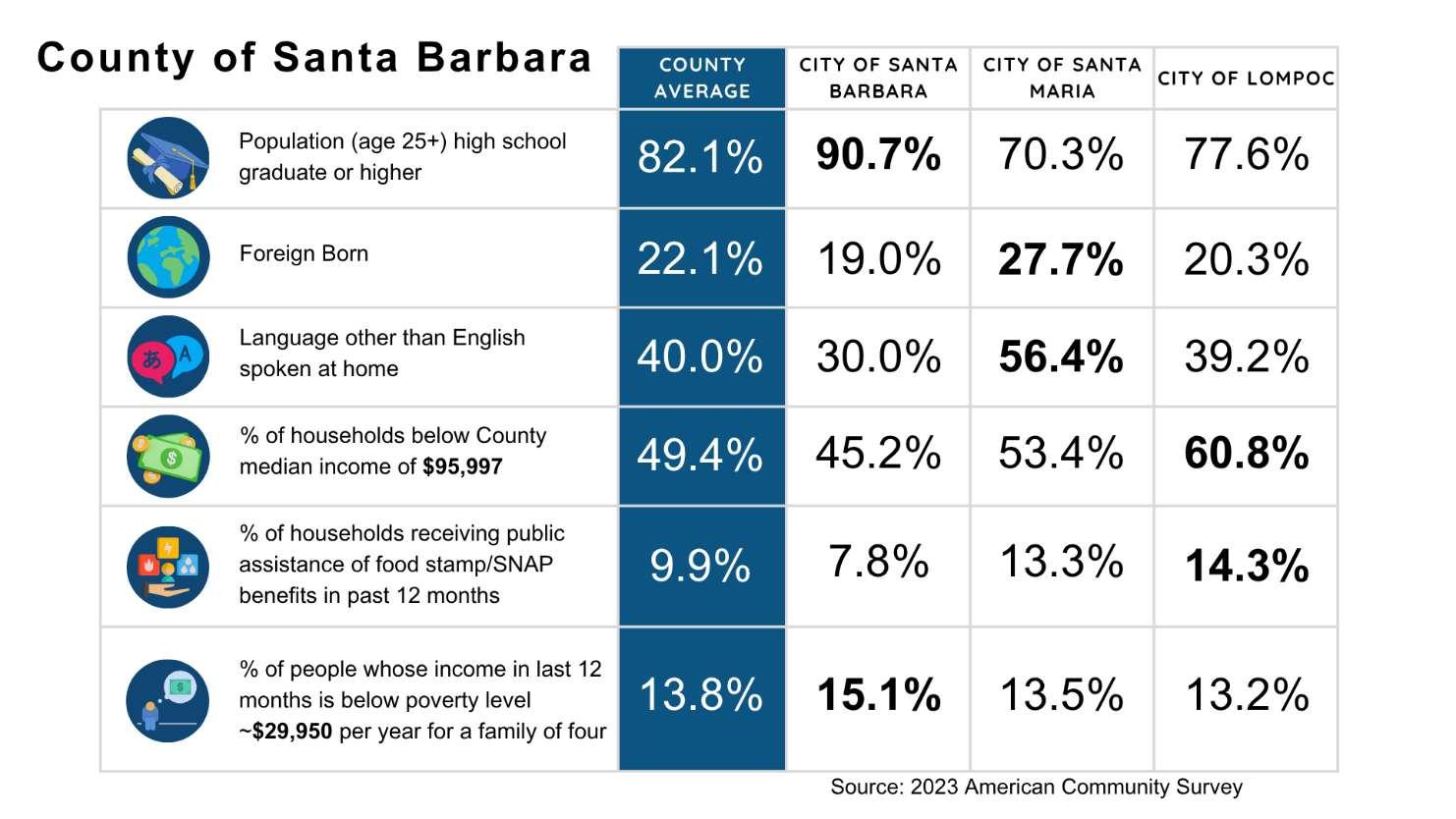
According to the 2023 American Community Survey, the County of Santa Barbara has a total population of 443,975 with 99,608 (22%) individuals under the age of 18. Communities within a county often face very different challenges with each city displaying its own unique combination of demographic factors. Because of this, a one-size-fits-all approach to services does not work.
Exhibit 1
As we can see in Exhibit 1, while Santa Barbara has the largest educated population, it also has the highest percentage of people with income below the poverty level. Lompoc has the highest percentage of households below the median income and on public assistance, along with a decreasingly educated population; and Santa Maria with the lowest educated and largest immigrant population, is also showing increased numbers of households below the median, on public assistance, and individuals below poverty. Of note, compared to last year – the percentage of households below county median income increased across the board, 13.6% higher in Santa Maria, 9.7% higher in Santa Barbara, and 9.1% higher in Lompoc.
To meet families where they are, partners need to know what resources are available countywide and strengthen cross-agency connections. Better coordination between schools, social services, health providers, and CBOs ensures services are tailored, gaps are closed, and youth and families receive the right support at the right time.
CRIME TREND DATA
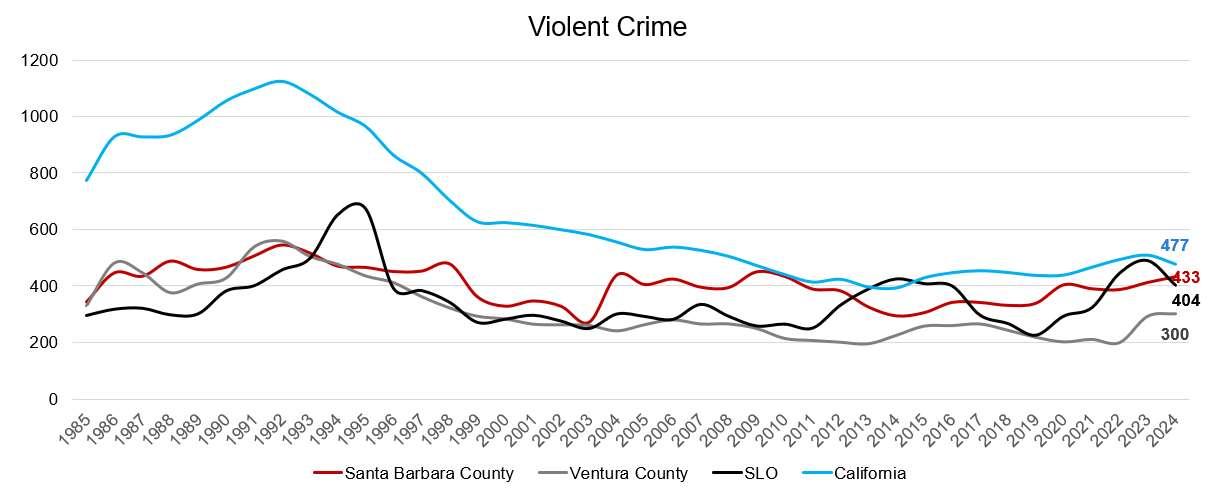
Exhibit 22 presents a comparison of violent crime rates between Santa Barbara County and the State of California, obtained from publicly available data provided by the California Department of Justice’s OpenJustice Transparency Initiative. Between 2023 and 2024, violent crime in California declined by 6%, whereas Santa Barbara County experienced a 5% increase over the same period. Even with this increase, the County’s violent crime rate remains lower than the statewide rate, at 433 incidents per 100,000 residents compared to 477 across California.
Historically, Santa Barbara’s violent crime rate has been higher than both Ventura and San Luis Obispo counties, but this changed during the pandemic, when San Luis Obispo experienced a significant spike in violent crime. In the last two years (2023–2024), both Ventura and Santa Barbara experienced increases, though Ventura’s rise was substantially steeper. Despite these trends, all three counties remain below the statewide rate for violent crime.
Exhibit 2
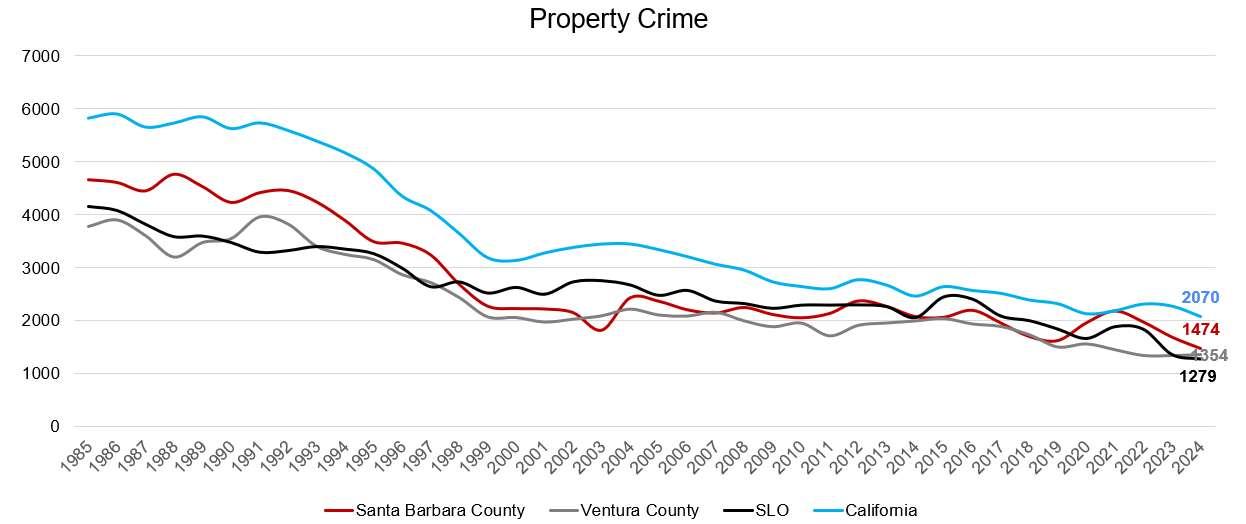
From 2023 to 2024, California’s property crime rate decreased by 9%, dropping from 2,226 to 2,070 per 100,000 residents. During that same period, Santa Barbara County experienced an even greater decline of 13%, from 1,689 to 1,474 per 100,000 residents. (Exhibit 3). Locally, this marks the third consecutive year of decline following a post-COVID peak in 2021, reaching the lowest level recorded in the 40-year period shown in Exhibit 3.
Comparing neighboring counties, property crime also declined in San Luis Obispo County and statewide, while Ventura County was an exception, experiencing a small increase of 1.4%.
Overall, Santa Barbara County’s property crime rate is now among the lowest observed locally in decades.
2 Crime data retrieved from https://data-openjustice.doj.ca.gov/sites/default/files/dataset/2024-07/arrests-context06062024.pdf. Population data retrieved from https://dof.ca.gov/forecasting/demographics/estimates/
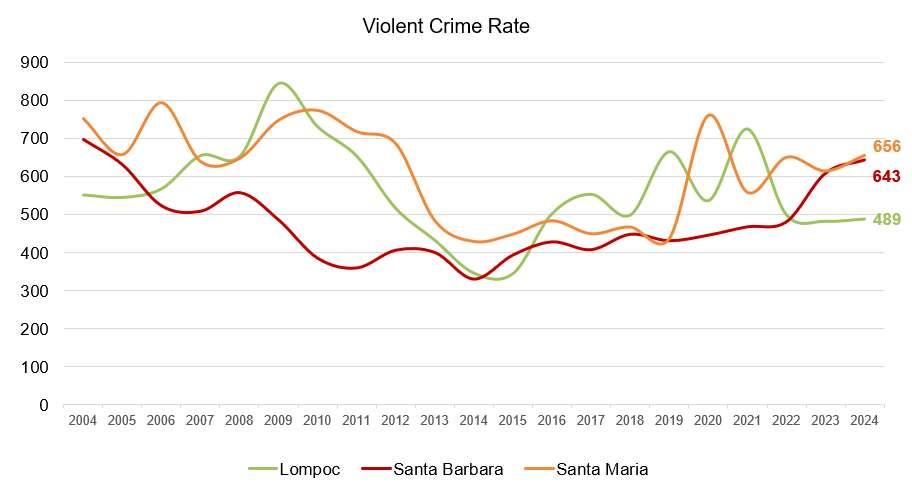
Although local school districts and law enforcement agencies do not provide crime data at the neighborhood level, the data can be analyzed by city. Exhibit 43 illustrates violent crime trends in the cities of Santa Barbara, Santa Maria, and Lompoc. In 2024, Santa Maria reported 656 violent crimes per 100,000 residents, Santa Barbara reported 643, and Lompoc reported 489.
3 Crime data retrieved from https://data-openjustice.doj.ca.gov/sites/default/files/dataset/2024-07/arrests-context06062024.pdf. Population data retrieved from https://dof.ca.gov/forecasting/demographics/estimates/ 2003: Santa Maria Police Department (located in Santa Barbara County) did not report for the year. 2015: Lompoc Police Department (located in Santa Barbara County) did not report for September through December. 2019: Santa Maria Police Department (located in Santa Barbara County) did not report for November through December. 2023: Lompoc Police Department (located in Santa Barbara County) did not report a full year of data.
Although Santa Maria and Lompoc have maintained relatively stable violent crime rates in recent years, Santa Barbara has experienced a sharp 34% increase since 2022, signaling an emerging area of concern.
This increase in Santa Barbara is driven entirely by aggravated assaults, a trend that began in 2019 and has continued steadily through the pandemic years. In Santa Maria, aggravated assaults involving firearms remain elevated compared to pre-pandemic levels, alongside observed increases in robberies and rapes. In Lompoc, robberies and rapes remain the primary contributors to violent crime.
While Santa Maria and nearby communities remain a continuing focus for public safety initiatives, the data now point to a clear and growing need for targeted strategies to address the sustained increase in aggravated assaults in the City of Santa Barbara.
Exhibit 5
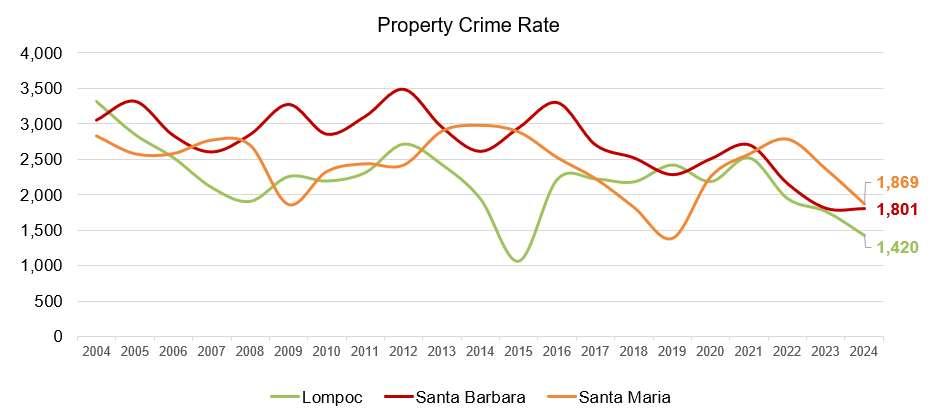
Countywide, property crime declined by 13 percent between 2023 and 2024, reaching its lowest level in the 40-year period shown in Exhibit 3. At the city level, property crime trends within Santa Barbara, Santa Maria, and Lompoc show a similar pattern of improvement (Exhibit 5), with all three cities reporting declines over the past two years. Despite these positive trends, Santa Maria continues to experience higher property crime rates than both Santa Barbara and Lompoc for the third consecutive year. Across all three jurisdictions, larceny-theft remains the predominant offense type, accounting for the largest share of property crimes reported.
Examining overall crime rate data, Santa Maria and the surrounding area remain a priority for focused interventions, while trends indicate a growing need for targeted strategies to address the sustained increase in aggravated assaults in Santa Barbara. Age-specific arrest data allow for further examination of trends specifically among youth.
Juvenile Arrests
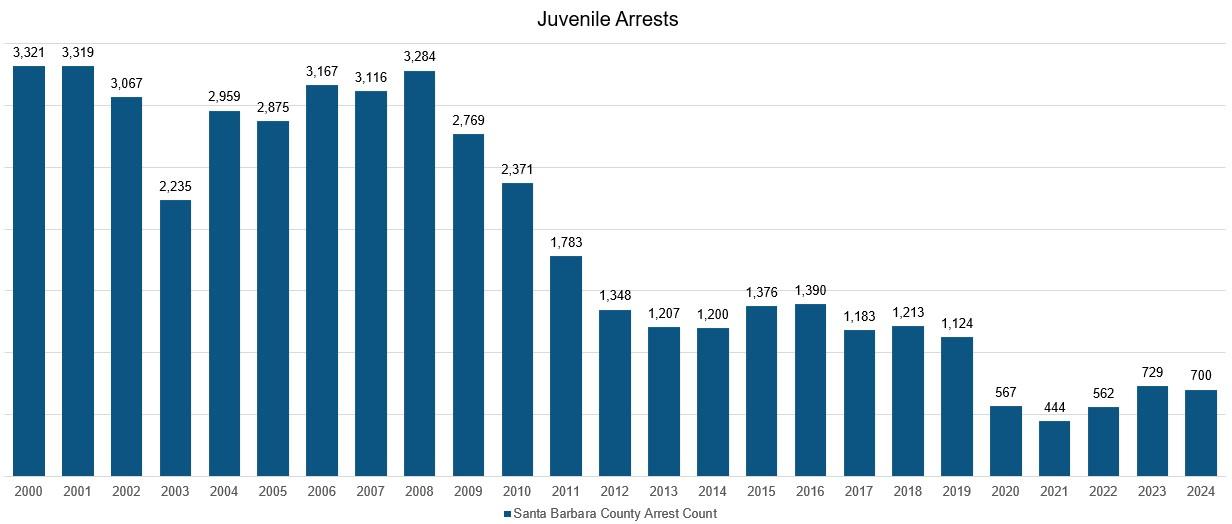
Publicly available arrest data are reported only at the county level and do not include offensespecific or city-level detail; nevertheless, long-term trends remain apparent. Total juvenile arrests in Santa Barbara County have declined sharply—down 80% since 2000 (Exhibit 6). Although there was a modest increase following the pandemic lows in 2020 and 2021, arrests remain well below pre-pandemic levels. From 2023 to 2024, juvenile arrests declined again, continuing this long-term downward trend.
6
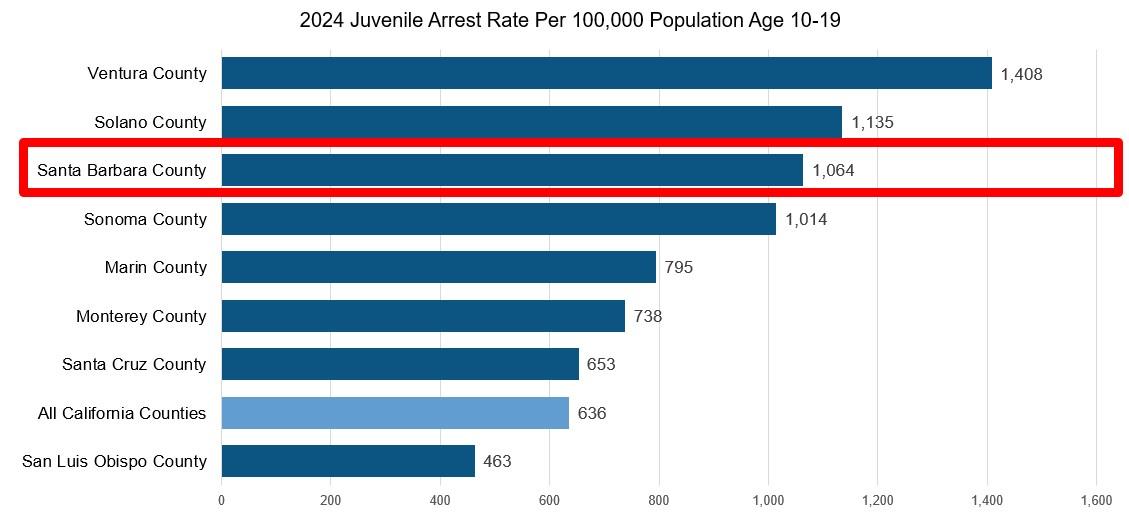
By rate, Santa Barbara County’s juvenile arrest rate is lower than Ventura and Solano, but higher than Sonoma, Marin, Monterey, Santa Cruz, San Luis Obispo, and the state average (Exhibit 7). At 1,064 arrests per 100,000 youth, the County’s rate remains at historic lows, among the lowest observed locally. Most juvenile arrests are for misdemeanors, though onethird are felonies.
Exhibit 7
Exhibit
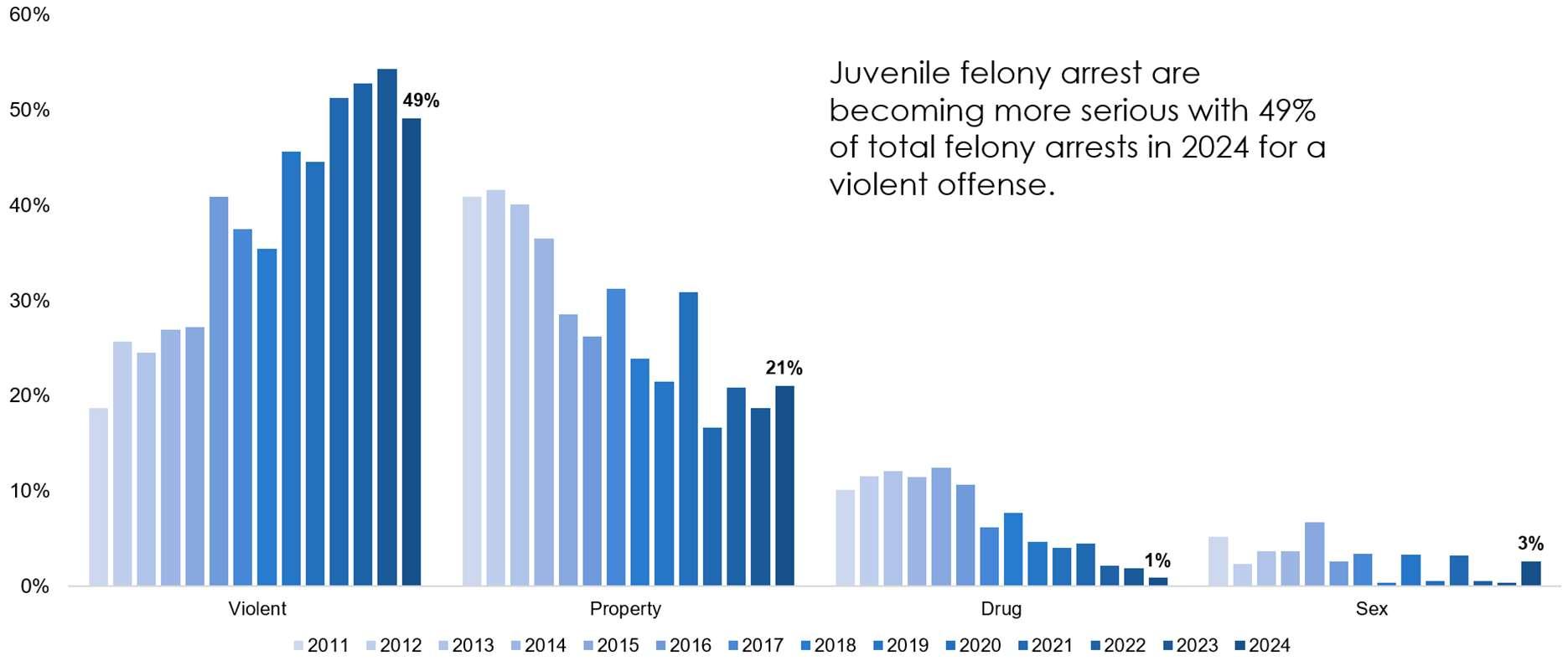
Among felony arrests, nearly half (49% in 2024) are for violent offenses—a pattern that has been consistent since 2011 (Exhibit 8). Property, drug, and sex-related felonies have generally declined, with a small increase in property crimes from 2023 to 2024. While felonies are less frequent than misdemeanors, they are for increasingly serious crimes, including homicide, rape, robbery, and aggravated assault, reflecting the types of offenses observed among youth under Probation supervision.
Exhibit 8
Juvenile arrest data, along with findings in the following section (pages 21–24) showing that Santa Maria has the highest concentration of youth with gang terms and referrals, reinforce overall crime rate trends (pages 17–21) and highlight the importance of directing youth-serving resources to Santa Maria. At the same time, the broader rise in violent crime in Santa Barbara warrants attention, although these trends are not exclusively youth-related.
SUPERVISED POPULATION
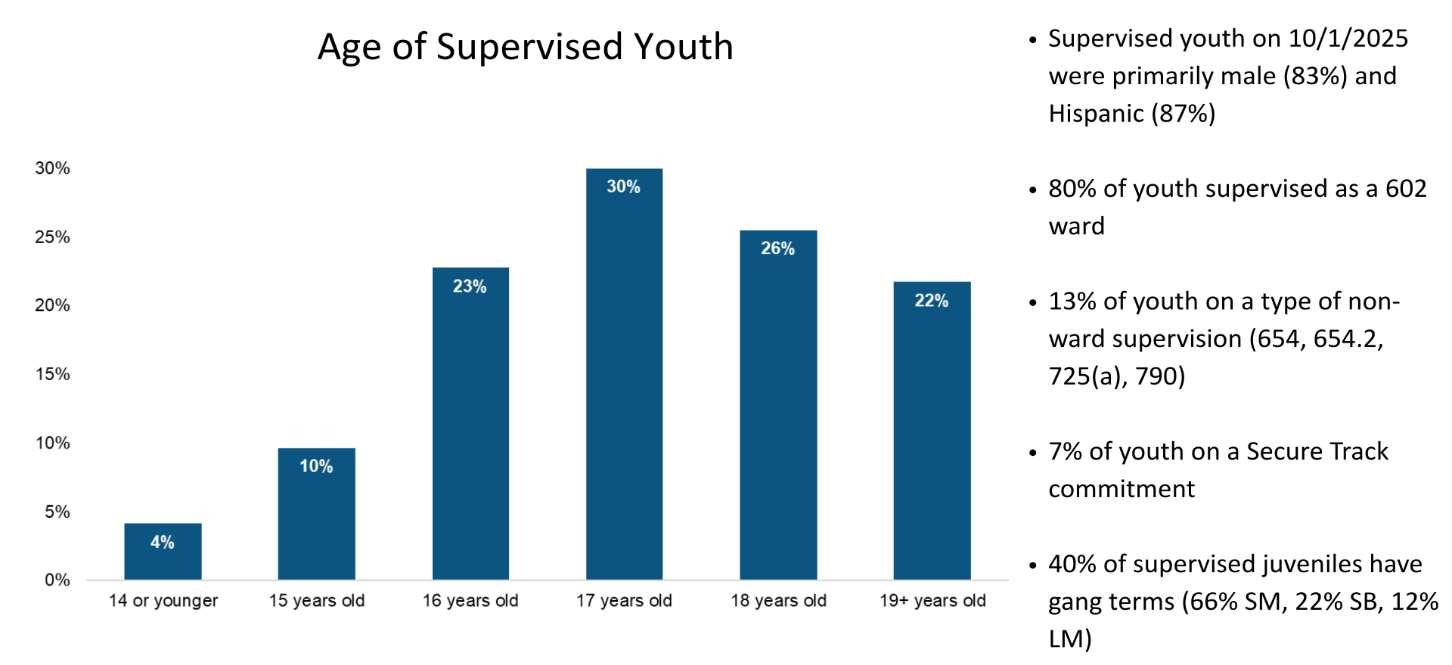
In the County of Santa Barbara, the supervised population is primarily male (83%), 17 years of age or older and Hispanic (87%) (Exhibit 9). Hispanic youth are represented at a higher percentage in the juvenile justice system than in the county youth population overall4 .
4 As compared to 58% in the County of Santa Barbara. Data from the Department of Finance (DOF) was used for Santa Barbara County’s youth population (age 14-20). (http://www.dof.ca.gov/Forecasting/Demographics/Projections/). The California DOF produces population projections for the state and counties of California on a regular basis. The Demographic Research Unit is responsible by statute for maintaining up-to-date postcensal population estimates and projections, which are both calculated using the identity known as the demographic balancing equation.
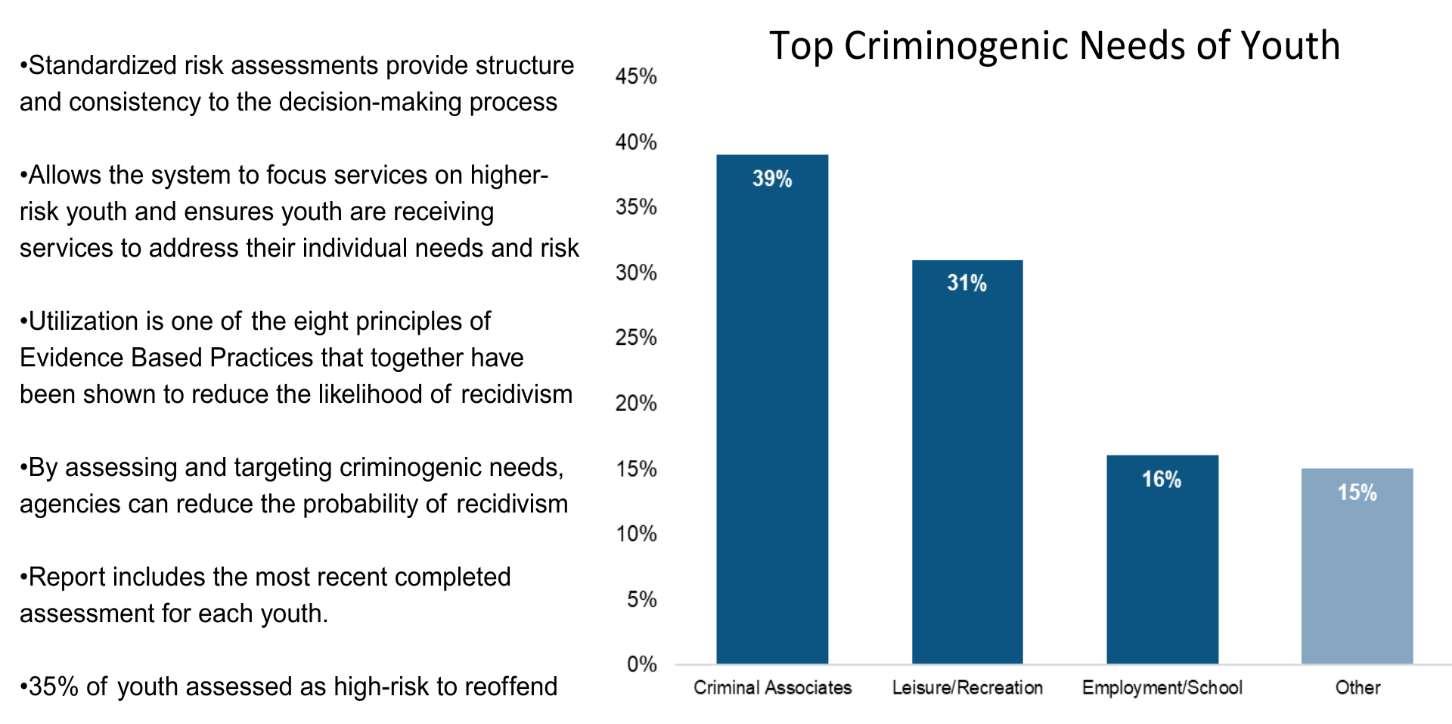
Youth under supervision of the Probation Department are assessed using the comprehensive evidence-based Positive Achievement Change Tool (PACT), which identifies a youth’s risk to reoffend and their criminogenic needs (those needs which drive a youth’s criminal behavior). This information allows officers to tailor interventions and responses to each youth and family. It also identifies youth and families’ existing strengths to build upon.
Exhibit 10
A snapshot on October 1, 2025, (Exhibit 10) reveals the top needs5 of assessed youth as 1) Criminal Associates (39%) 2) Leisure/Recreation (31%) and 3) Employment/School (16%).
Exhibit 11
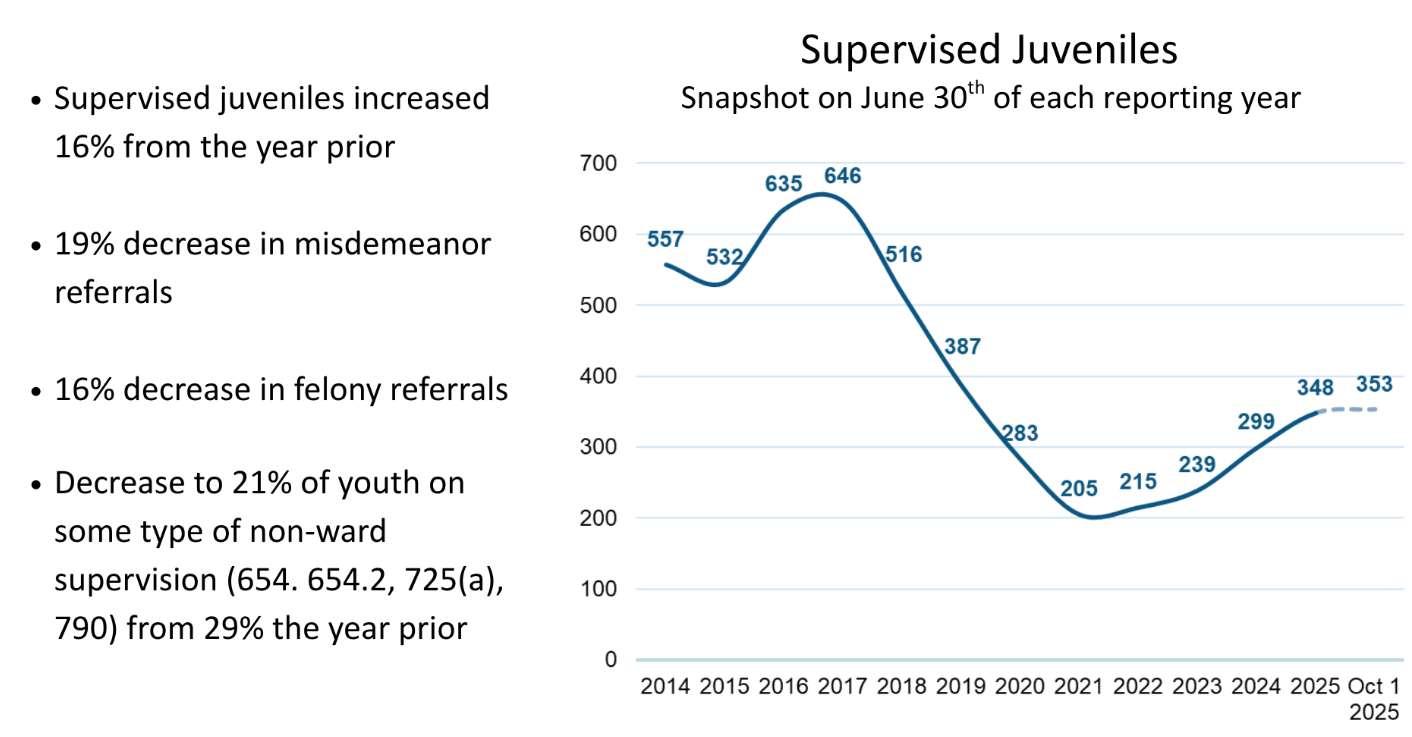
The number of juveniles supervised by the Probation Department rose by 16% over the past year, returning to pre-pandemic levels (Exhibit 11). As displayed in Exhibits 4 & 5, Santa Maria appears to be the community impacted most by violent and property crime; however, while Santa Maria’s violent crime rate rose by 1% over the last two years, the city of Santa Barbara recorded a 34% increase during the same time period. This underscores the importance of continuing focused efforts in Santa Maria and surrounding areas, while also recognizing the growing need for attention in Santa Barbara to address this upward trend.
It is also important to consider trends in youth with gang terms and conditions. Although there has been an overall decrease in youth with gang terms and conditions from 2017 to 2023, data from the past two calendar years indicates a 24% increase between 2023 and 2024. During this period, the majority of youth with gang terms and conditions have been located in the North County, further emphasizing the area’s ongoing need for prevention and targeted intervention. Furthermore, of the total number of juvenile referrals received by the Probation Department in fiscal year (FY) 24/25, 44% originated from Santa Maria, 32% from Lompoc and 24% from Santa Barbara. Of total youth supervised, 58% are in Santa Maria, 17% in Lompoc and 25% in Santa Barbara.
5 Data for assessments as of 10/1/2025. Data displays the frequency that different need areas are selected as the top need for all youth in the system. Data includes the most recent completed assessment for each youth. As new assessments are performed, this data may change.
Notably, since peaking in FY16/17 (Exhibit 11), the supervised juvenile population has decreased 46% as of June 30, 2025. This decline is partly attributed to the introduction of the PACT assessment, which identifies youth at the highest risk of reoffending and with the greatest needs, allowing for a more focused approach to supervision. Additionally, Probation implemented various diversion programs (detailed on pages 36 to 38), further reducing the supervised population. Finally, the impact of COVID-19, including court closures, lockdowns, and restrictions on activities, likely impacted law enforcement referrals and reduced opportunities for youth to commit crimes, likely contributing to the decline observed in 2020 and 2021.
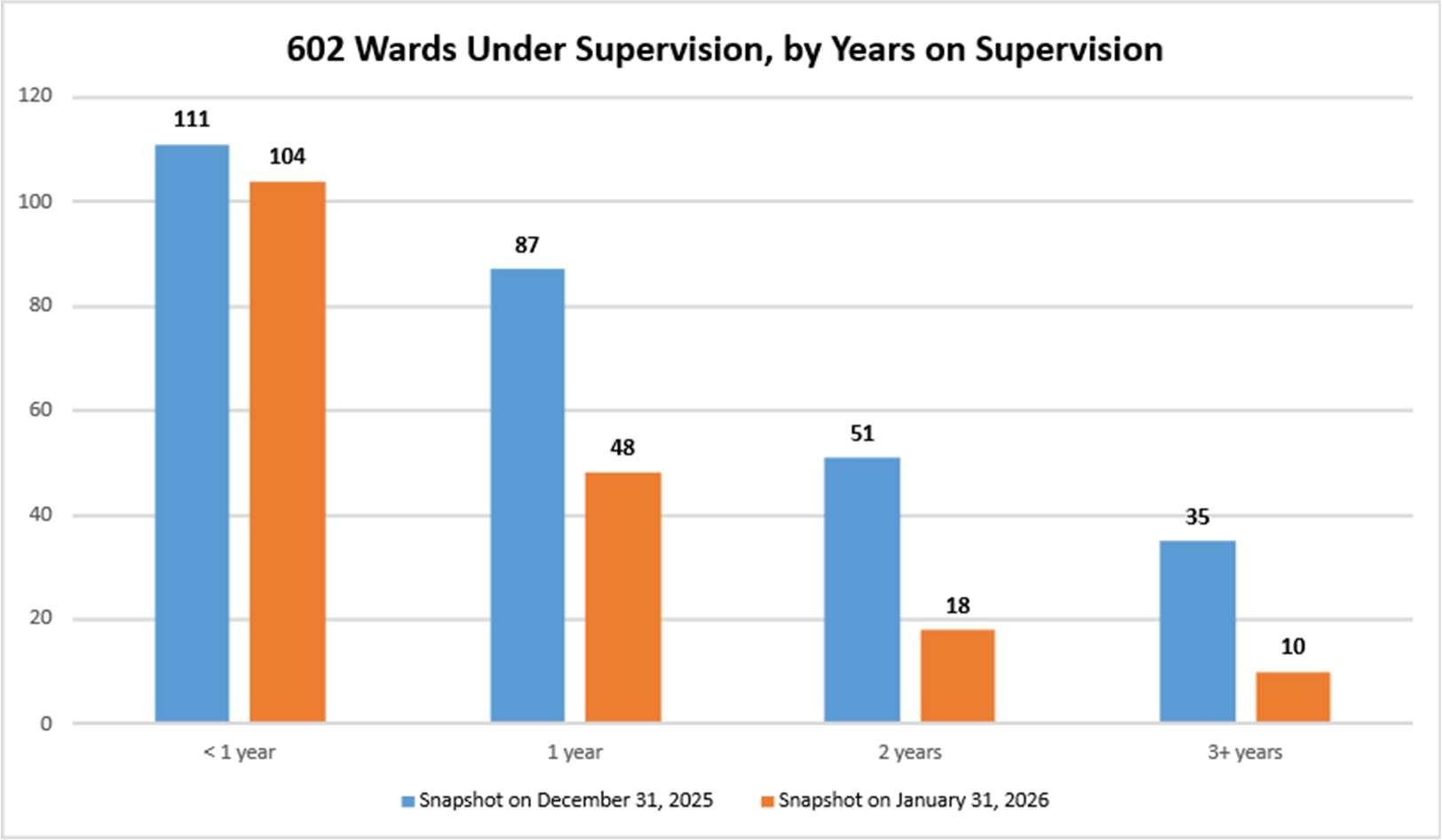
On January 1, 2026, AB 1376 become effective. In summary, this legislation and corresponding welfare and institutions code sections ensures youth who are wards of the court, excepting those who are in placement, serving a custodial commitment, or transferred from a SYTF to a LRP, do not remain on probation in excess of one year, absent a finding being made on the record that indicates the rehabilitative reasons for that youth to remain on probation On January 1, 2026, approximately 100 youth were retroactively terminated from probation by operation of law in line with this legislation (Exhibit 12), allowing Probation to focus efforts on the highest of risk, highest needs youth.
Exhibit 12
Exhibit 12 demonstrates the shift in the population of supervised 602 wards and their cumulative time on probation at snapshot points before AB 1376 implementation on December 31, 2025, and after implementation on January 31, 2026.
C. Juvenile Justice Action Strategy
Describe your county's juvenile justice action strategy. Include an explanation of your county's continuum of responses to juvenile crime and delinquency as well as a description of the approach used to ensure a collaborative and integrated approach for implementing a system of swift, certain, and graduated responses for at-risk youth and juvenile offenders.
Research continues to support the importance of diversion in the juvenile justice system, allowing for early intervention to divert youth from formal processing and labeling, and to provide supportive services to families. Diversion also aids efforts to reduce racial and ethnic disparities in the juvenile justice system and to reduce or eliminate net widening. As noted in more detail under funded programs, there are two restorative justice programs, funded by JJCPA and YOBG, which are used to divert youth from formal processing and further contact with the juvenile justice system. Restorative justice, when practiced with fidelity, has excellent outcomes in reducing recidivism, leading to many involved youth not being re-referred to Probation for additional matters. Additionally, there is a Cannabis Education program, which diverts youth with marijuana related offenses from formal processing with no interaction with Probation. Schools also directly refer to this program, further reducing the stigma for youth of being referred to the juvenile justice system.
In the last fiscal year, the Department experienced a 19% decrease in misdemeanor referrals and a 16% decrease in felony referrals, which may loosely correlate with the countywide drop in juvenile arrets (Exhibit 6). Of the total number of youth supervised on June 30, 2025, 21% were on non-ward diversionary supervision [§654, §654.2, §725(a), §790 Welfare and Institution Code (WIC)] (Exhibit 11). However, it should be noted that this percentage does not include what is often referred to as “true diversion” or pre-adjudication diversion, such as the Youth Empowerment Services (YES) program, implemented in 2020 in partnership with the Council on Alcoholism and Drug Abuse (CADA). YES is a direct diversion opportunity from schools and Probation for youth with specific low-level offenses and education code violations discussed later in this plan in more detail. From the start of referrals in May 2020 through December 31, 2025, 1,495 youth were referred to the program.
Probation Supervision Levels
When diversion is not appropriate, there is a spectrum of probation grants available to youth which are determined by Probation or the Court, which include:
Informal Probation (§654 WIC) is considered a pre-filing diversionary grant of probation. This grant is a maximum of six months and consists of a contract between Probation, the youth, and the youth’s parent or guardian, in which certain conditions will be met. The matter is not referred to the District Attorney’s Office and there is no formal court action taken unless a youth fails to complete the contract.
An informal grant of probation (§654.2 WIC) can be allowed by the Court after a petition has been filed. This is a six-month contract between Probation, the youth, and the youth’s parent or guardian, in which the youth agrees to abide by terms and conditions, with the Court holding a hearing to determine whether the contract has been completed.
Non-wardship Probation (§725(a) WIC) is granted by the Court for a six-month period when the youth admits the charges or allegations are found true.
Deferred Entry of Judgment (§790 WIC) is granted by the Court for youth 14 to 17 years of age who have committed a felony offense not outlined in WIC Section §707(b). This grant is a minimum of one year and a maximum of three years.
Formal Wardship (§602 WIC) is determined by the Court and these youth are considered wards of the Court. Youth who are wards may remain in the community under supervision with community interventions. Youth may also serve time at the JJC as a term and condition of probation and can also be placed in out-of-home care or committed to the Secure Youth Treatment Facility (SYTF) program within the JJC. On January 1, 2026, Assembly Bill (AB) 1376 went into effect which added §602.05 WIC, limiting this term of probation to one year for most youth under wardship supervision, absent a finding made during a noticed hearing regarding the continued need for probation supervision for the youth’s rehabilitation and community safety.
Retaining the Target Population in the Juvenile Justice System
Probation aims to avoid pulling youth deeper into the juvenile justice system. As is noted above, Probation uses diversion and informal grants of probation whenever possible. Formal wardship is only recommended when other grants of probation have failed to aid in the youth’s rehabilitation, when youth have committed a serious or violent offense, or when youth are not eligible for other grants of probation. The following pages describe the tools and strategies used to keep youth in the local community and to prevent transfer to the adult system, where appropriate.
COMMUNITY SUPERVISION
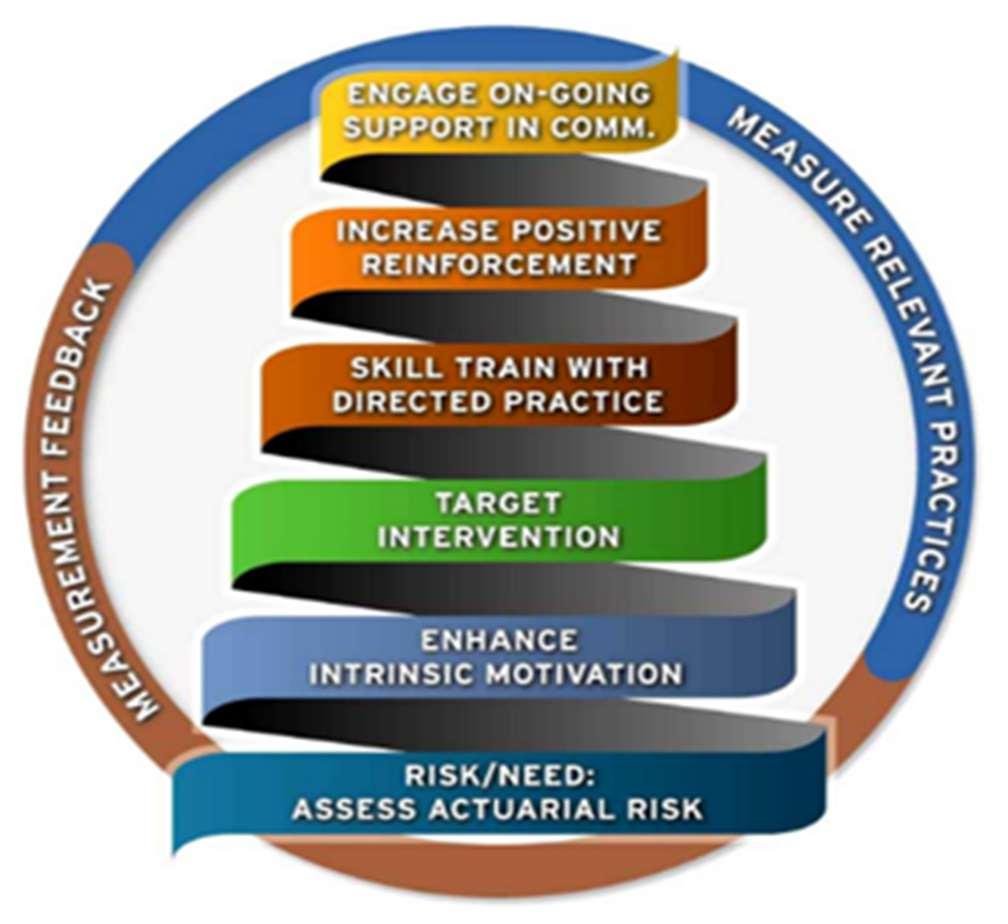
Since 2019, Probation has used the Risk-Need-Responsivity (RNR) Community Supervision Model. Supervision caseloads were restructured to incorporate a differentiated approach as informed by the evidence-based risk and needs instrument. Resources are concentrated on the youth that present with the highest need and risk to reoffend, with a smaller ratio of officer to youth for those caseloads.
As of December 31, 2025, Officers providing intensive supervision to the highest of risk youth have an average caseload size between 20-30 youth per officer, though with the inception of AB 1376, which was interpreted to be retroactive, post January 1, 2026, intensive supervision
caseloads are anticipated to average closer to 20 youth per officer. The most appropriate caseload size is continually evaluated, particularly for high-risk youth, to maximize case management to best reflect the RNR principles. RNR principles are significantly amplified by practitioners skilled in techniques proven to influence youth to change behavior.
In addition, staff are trained to use Motivational Interviewing (MI) techniques. MI is an evidence-based style of communication used to engage youth and enhance motivation toward positive behavior change in various areas connected to criminal behavior. When used by a skilled Probation Officer, MI can increase a youth’s motivation to comply with supervision requirements, participate in treatment, and address criminogenic needs, thereby increasing their success on supervision. The Department continually strives to enhance staff MI proficiency by offering advanced training opportunities annually. These include courses designed to ensure staff maintain and refine their skills, such as training on case planning and youth and family engagement.
In FY23/24, the Department further strengthened its approach to evidence-based practices (EBPs) by launching training that integrated strategic case management into youth office visits. This training included the use of Carey Guides to teach community supervision officers how to translate principles of effective intervention into practice, and how to use core correctional practices in their interactions with youth. The completion of Carey Guides is now an option for interventions listed in youth’s case plans to address criminogenic needs which allows Probation Officers to use a direct service approach to youth to assist them in addressing their needs while building rapport with youth. As of December 31, 2025, 50% of juvenile staff have been trained in Carey Guides.
Staff participate in training cohorts, and each cohort has time specific goals in which to demonstrate proficiency. This begins with submitting recordings reviewed by the trainers to ensure demonstration of MI in interactions with youth. These cohorts then have goals to complete caseplans created collaboratively with youth, families, and treatment providers with officers using MI skills to elicit participation. Finally, the cohorts complete Carey Guides with youth which help officers build rapport and actively engage youth in their goal setting and addressing their criminogenic needs.
Assessments
Probation and its partner agencies use several assessments to best determine a youth and families to need to target appropriate services.
Youth not referred to the diversionary programs outlined earlier are assessed with this evidence-based tool that determines the youth’s risk of reoffending and identifies their needs and strengths. Supervision level aligns with the youth’s risk level. Thus, youth determined at high risk of recidivism are supervised on smaller caseloads, receive more services and interventions, and are visited more often. On the other hand, youth assessed at low risk of recidivism are supervised on larger caseloads and are contacted only to facilitate service referrals and ensure completion of those services to terminate probation.
Youth committed by the Court to a Secure Youth Treatment Facility (SYTF) are assessed using the R-PACT, an Evidenced-Based Practice (EBP) assessment tool that measures the criminogenic risks, as well as the protective factors of youth. The R-PACT assessment is used to determine the youth’s level of risk; low, moderate or high, by assessing the eight guiding principles for developing the youth’s Individual Rehabilitation Plan (IRP).
BWell Assessments
JJCPA and YOBG funding is used to fund two BWell clinicians who provide for assessment and transition services for youth leaving a custody setting. These assessments include:
● Integrated Practice Child and Adolescent Needs and Strengths – (IP-CANS) – A trauma informed behavioral health evaluation tool designed to support case planning and the linkage between the assessment and service implementation.
● Qualified Individual (QI) Assessments – BWell staff complete QI assessments to determine the most appropriate foster placement for youth requiring out-of-home placement. This ranges from a short-term residential therapeutic program (STRTP), to a home-based foster care setting, or potentially a return to their home and community. The IP-CANS, a CFTM, and records from prior placements and other evaluations, as well as an interview with youth and parents/guardians are conducted as a part of this evaluation.
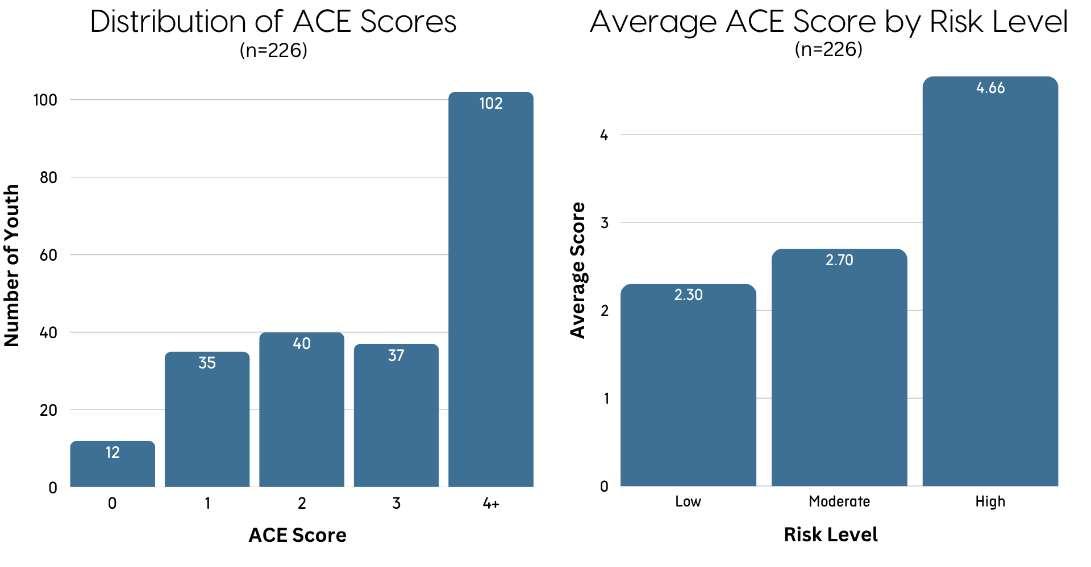
● Adverse Childhood Experience (ACE) Surveys – Negative childhood experiences include abuse, neglect, caregiver mental illness, and household violence. The more ACEs a child experiences, the higher their risk of developing health issues such as heart disease and diabetes, facing academic challenges, and struggling with substance abuse in the future. Research indicates an ACEs score of four or more is significantly associated with increased rates of chronic disease.
As seen in Exhibit 13, a snapshot on October 1, 2025, shows out of 226 supervised youth with ACE scores available, 102 or 45% have a score of four or more, indicating the potential for increased risk of developing negative physiological, psychological, and behavioral issues. Additionally, these scores show that as risk level increases, the average ACE score increases. This suggests an importance in prioritizing protective factors for this group of youth.
Juvenile Sexual Offense Recidivism Risk Assessment Tool-II (JSORRAT II)
Probation officers complete this assessment for male youth ages 12 through 17 who sexually offend to determine their risk to reoffend.
Commercial Sexual Exploitation-Identification Tool (CSE-IT)
Probation uses this tool to determine a youth’s risk of sexual exploitation. If the youth is determined to be at risk, they are referred to the District Attorney’s (DA) Office’s Commercial Sexual Exploitation of Children (CSEC) Coordinator, who in turn schedules a Multidimensional Team Meeting (MDT) to address the youth’s needs. Team members include the DA’s CSEC Coordinator from Victim Witness, CWS, Rape Crisis, and Probation, when appropriate.
Psychological Assessments
For youth with more complex needs, a contracted psychologist completes Court-ordered assessments that include intellectual testing (when necessary), effects of trauma, risk to reoffend, and appropriate interventions for all referred youth and for all those adjudicated of a sexual offense.
Intervention Matrix
Probation is committed to the implementation of an evidence-based system of services and supervision, including a system of responses to non-compliant behaviors. The use of a violation matrix has been found to be an important factor in promoting community safety and positive behavior change, while using detention only when necessary for the protection of the youth and/or community. It also brings standardization and reduces officer objectivity. This
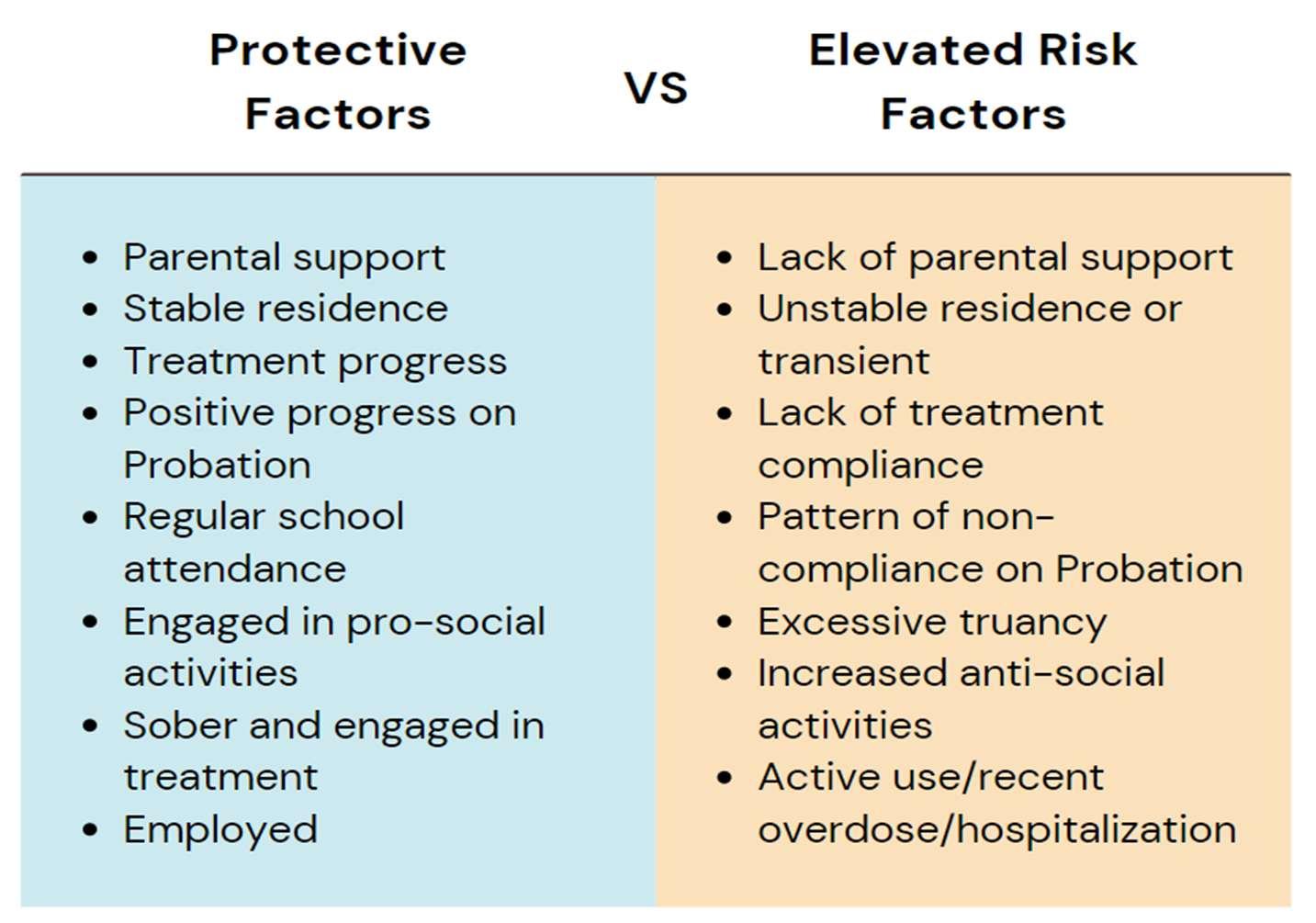
commitment includes, but is not limited to, ongoing monitoring and continuous outcome evaluation of youth success and/or failure and their relationships to applied interventions. Interventions and/or responses to non-compliance are designed to achieve the maximum positive impact on youth behavior. To determine the appropriate response to youth’s behavior, officers must initially determine relevant factors, such as the youth’s risk level and the seriousness of the violation. The seriousness of the violation will depend on how the actions relate to the original offense, the community impact, the victim impact, the duration of the violation, the frequency of the violation, and the youth’s general compliance with supervision. Officers must also recognize signs of increased risk that perpetuate a youth’s likelihood to reoffend. They must also consider the following protective factors and/or elevated risk factors as seen in Exhibit 14.
Exhibit 14
Responses are categorized into low, medium, and high. Low responses generally include problem solving conversations, school progress reports, curfew adjustments, writing assignments, and/or referral to resources. Medium responses generally include a CFTM, an increased level of supervision, referral to contracted services, increased monitoring of terms, or an adjustment of probation terms. High responses generally include referral to contracted services, MDTs followed by CFTMs, court hearings, home supervision, electronic supervision, or detention. Officers are not expected to include all the responses for each level, rather they are to employ the option most appropriate for the youth, given the specific situation. Additionally, as the majority of interventions are informal and not binding by the Court, officers do not necessarily initiate violation proceedings should a youth fail to comply with a response. Lastly, officer experience, judgment, and expertise enable wise interpretations of the facts of each case and help identify situations that require deviations from the matrix. In these situations, the officer must obtain supervisor approval.
Wellness Operations
Probation conducts approximately eight wellness operations annually, with two operations specific to the Juvenile Division. The first occurs prior to the new school year wherein officers engage with families in their homes to ensure youth and their siblings have school supplies and that families have support to enroll youth in their local district. In FY25/26, 30 homes were visited and provided with backpacks and school supplies for youth on probation, as well as with additional school supplies for siblings provided by the Santa Barbara County Education Office. Referrals to community-based services were provided as needed, as well as school enrollment assistance. The second operation occurs prior to the December holidays. In FY25/26, 45 homes were visited, during which families received gift certificates for grocery stores and warm blankets for youth on probation. These operations allow families to receive much needed basic items, assistance, and increase rapport with officers as they act in this capacity.
Incentives
Probation recognizes that it is important to acknowledge youth’s progress and encourage positive gains. An evidence-based incentive program allows officers to provide rewards in response to specific behaviors to increase positive behavioral change. Developing a successful response process involves providing incentives that can be implemented in a timely fashion, are developmentally appropriate, are integrated with other aspects of the supervision process, can evolve as behaviors change, and provide proportional incentives that gradually shape the desired behaviors. Further, providing youth the opportunity to share the incentives that may motivate them can increase their desire to work toward the change required to attain the incentive as it is meaningful, of value to them, and they had agency in the process.
Through the use of the Incentive Matrix, an officer can reward a variety of behaviors categorized as low, moderate, high, and platinum milestone achievements. A low-level positive behavior can include improved attendance at school, better behavior at home, reporting to Probation as directed, joining a prosocial organization, following curfew, or attending treatment for a specified period of time. Low level behaviors can be rewarded with verbal praise, a certificate of accomplishment, or selection from the treasure chest which has items such as lotion, socks, art supplies, and popular snacks. Moderate milestones generally include a significant and sustained improvement in school attendance, completion of community service hours, maintaining sobriety for an extended period, regularly attending treatment, obtaining employment, or completing 30 days of electronic supervision without unauthorized leaves. High achievement behaviors can include completing treatment, maintaining sobriety for more than three months, maintaining employment for more than 30 days, or paying off restitution. Moderate or high-level milestones will be awarded points or higher monetary valued items such gift cards, movie tickets, framed certificates, reduced supervision, pro-social field trips, or recommendations for probation termination. Depending on a particular youth and their particular elevated risk factors, some achievements may be deemed significant or extraordinary platinum level behavior. Platinum level incentives can include shopping trips, tickets to
amusement parks, or electronics. Graduating high school, obtaining a general education diploma, or completing a first semester in post-secondary education are examples of high achievements often rewarded at the platinum level. Each youth is evaluated on a case-by-case basis to set achievement levels and corresponding incentive rewards, as for some, what may seem like small achievements are actually large milestones worthy of celebration and encouragement.
Alternatives to Detention
At times, a youth’s behavior may escalate to where they pose a safety risk to themselves or others. However, Probation recognizes that retaining youth in the community preserves their ability to remain connected to resources and systems of support. Having alternatives to detention allows youth to continue their rehabilitation as they remain in their school of origin, attend community programming, and participate in prosocial activities. When appropriate, the following detention alternatives are available:
● Home Supervision: This form of monitoring does not involve electronic surveillance. Instead, youth provide a schedule for school and other programming to the Probation Officer, and youth are required to be at home unless authorized to leave.
● Global Positioning System (GPS) Monitoring: This is a form of electronic surveillance used to ensure the youth’s whereabouts are always known. Probation Officers review youths’ movements daily to ensure they are not in unauthorized areas, such as near a victim’s home or near an area known for gang or drug activity. Youth receive custody credits for any time served on GPS as they would if detained at the JJC.
● Remote Alcohol Breath Monitoring: This involves a breathalyzer being plugged in at a youth’s home and the youth is required to provide a breath sample at random intervals to ensure the youth has not consumed alcohol.
Termination of Supervision
Upon successfully completing their terms and conditions, termination of probation is recommended to the Court. Most often, these terms include completion of counseling and other programming to address the youth’s criminogenic needs. It is also noted not all programming needs to be completed prior to youth being recommended for termination. For example, youth are often referred to drug and alcohol treatment, and aftercare is an important component for sobriety. However, youth do not need to remain on probation to participate in these services. In these situations, termination may be recommended prior to completion of programming. With the institution of AB 1376, designed to minimize the time youth spend on probation, many youth will be eligible for automatic expiration of formal wardship after one year on supervision who may have previously remained wards; those youth are also eligible for earlier termination of wardship should they have substantially complied with their terms and conditions prior to that point. Many youth are eligible to have their records sealed upon successfully completing their probation grant.
D. Comprehensive Plan Revisions
Describe how your Plan has been updated for this year.
This year’s plan was again reassessed to ensure it reflects the State’s template. Each area was reassessed and reviewed, and goals were updated to reflect shifting focus and priorities. Specifically, a subgoal was added to Goal 1 to support maintaining public safety by reducing recidivism. This new subgoal reflects the development of caseload projection model to assess the impact of AB 1376 to allow the Department to anticipate staffing needs, restructure caseloads, and establish caseload guidelines that support effective supervision grounded in core correctional practices.
For Goal 2, enhancing the use of diversion for appropriate youth, a subgoal was added to quantify the percentage of all restorative justice referrals that occur post-filing to establish a baseline, confirm appropriate use, and support future analysis of the extent to which restorative justice reduces or prevents deeper system involvement for youth. This added goal builds on the successful use of restorative justice in diversion to help mitigate further system involvement for post filing youth. Another subgoal also targets diversionary youth by implementing a collaborative incentive plan to increase youth enrollment in the YES program to increase the number of youth who complete this intervention. A third newly created subgoal involves quantifying the percentage of youth who successfully terminate wardship at or before twelve months post disposition to establish a baseline which will inform future case management practices.
As Goal 3 seeks to coordinate efforts and improve system collaboration to support connection of youth and families to the community, a subgoal has 100% of youth identified as being at risk of removal having a CFTM completed within 14 days of identification by June 2027 to ensure collaborative case planning and to further mitigate the need for out of home placement. In addition, to further support families, a subgoal of establishing a pantry at each Probation juvenile location (JJC, Santa Maria, Santa Barbara, and Lompoc) with clothing, food, and hygiene items was added. Resource binders will also be created and added to each location to help youth and families identify preferred supports to meet their needs. In a strategy to coordinate efforts and improve system collaboration to support connection of youth and families to the community, a new subgoal supports increased access to community service work opportunities by exploring partnerships with local municipalities.
Finally, Goal 4 works to support a systemic approach to studying and addressing disparities in juvenile justice. To do so, as an added subgoal, BWell will provide at least two presentations to Probation Juvenile Division and facility staff on SOGIE, available services, and self-harm risk for this population to foster understanding, support, and inclusive environments for all justiceinvolved youth. A newly created culturally responsive subgoal involves holding focused workshops increasing awareness of the unique experiences of Latinx communities within Santa Barbara County to support cultural understanding and pride.
Additionally, the plan includes added evidence-based programming and mentoring opportunities countywide for youth, as well as the expansion of the ARISE program to a promising practice for all SYTF youth, facilitated by a CBO rather than by Probation staff. Of further note, the South Coast Youth Safety Partnership has shifted focus from gang-involved youth to focusing on a positive youth development (PYD) model, ideally redirecting youth prior to gang involvement. Advances have been made in human trafficking, with Kingdom Causes, Inc. working to create a comprehensive three-year action plan in the coming year, Noah’s Anchorage launching a full-time case manager for youth at risk of trafficking, and BWell continuing to target education for those working with youth as to the warning signs for exploitation.
Part II. Juvenile Justice Crime Prevention Act (JJCPA)
(Government Code Section 30061(b)(4))
A. Information Sharing and Data. Describe your information systems and their ability to facilitate the sharing of data across agencies within your county. Describe the data obtained through these systems and how those data are used to measure the success of juvenile justice programs and strategies.
Analysis of supervised youth data, along with state and local juvenile crime data, informs decision making processes, guiding necessary program enhancements and adjustments in supervision strategies. Locally, data is used to assess program performance, explore the drivers of trends, and inform collective practice. The data is nearly exclusively contained in the Probation Department’s case management system. For youth in foster care, data is also entered in the State database utilized by CWS; notably, later this year, CWS will transition to a new case management system that may potentially interact with Probation’s case management system which would mark a significant process improvement.
Data is used internally and externally for a variety of purposes including research, resource management, and trend analysis. These include informing committees such as the JJCC, or groups such as the Board of Supervisors, of current supervision trends, population demographics, programming and recidivism outcomes. Data is also used for informing the renewal and creation of new contracts to ensure services are in line with youth and families’ needs and are funded at appropriate projected levels. Information is also shared with CBOs to respond to grant requirements or to support their mission. Within this document, the data used to assess and forecast progress on system goals and objectives is highlighted.
Data on youth’s Sexual Orientation, Gender Identity and Expression (SOGIE) is gathered and all youth entering the juvenile justice system are screened for CSEC, yielding crucial insights into service needs. Probation also collects and analyzes data from the YES diversion program. This
data is shared with stakeholders through presentations and written reports to further conversation around service delivery.
The Probation Department employs Department Business Specialists who regularly review contract invoices to measure utilization of services, as well as conduct quality assurance through the administration of program fidelity reviews. These reviews ensure programs are delivered in accordance with the curriculum’s research-based model. CBOs participate in debriefings on the outcomes of these quality assurance reviews which help shape the contract and program in upcoming years, as well as allow for any course correction needed in the current year. Self, peer, and onsite fidelity reviews of a program session completed by an individual within the organization providing the service, a peer organization delivering the same program, and Probation staff are conducted annually. The assessments evaluate various aspects of the sessions, in addition to allowing for open-ended comments to the session facilitator(s).
Under CalAIM, a universal release of information was created that allows for information sharing. CalAIM allows for this to begin when youth are detained to ensure they receive appropriate services while in custody, and needed services are in place prior to release.
Additionally, local providers are required to provide quarterly data on performance measures of their contracted services. Detailed performance measures are included in all juvenile and facility contracts to ensure transparency and optimal outcomes for youth. These include:
Administration of pre/post surveys to assess for change in knowledge, behavior, attitudes;
Specific guidelines around facilitation of programming to adhere to the research-based design of the practice or program;
Accomplishment of youth case plan goals;
Timeliness and dosage of intervention to youth;
Engagement of youth in services;
Participation in quality assurance processes, including self, peer, and onsite assessments to ensure programs are provided in accordance with the research-based models; and
Submission of data/information to measure service utilization.
B. Juvenile Justice Coordinating Councils
Does your county have a fully constituted Juvenile Justice Council (JJCC) as prescribed by Welfare & Institutions Code 749.22?
The County of Santa Barbara has a nearly fully constituted JJCC with one vacancy for a nonprofit community-based agency that is undergoing recruitment; please refer to pages 3-4 for the complete membership list and contact information.
If no, please list the current vacancies that exist on your JJCC, when those vacancies occurred, and your plan for filling them.
The current vacancy to the non-profit community-based organization serving juveniles occurred in December 2025, with the expiration of one community-based organization member representative. A replacement for this position was solicited at the October 3, 2025, JJCC meeting; however, there was no applicant for that specific vacancy. Recruitment for this vacancy is ongoing and will involve direct outreach to community-based organizations.
C. Funded Programs, Strategies and/or System Enhancements (JJCPA)
Freedom-4-Youth Restorative Justice Program – EXPANDED
Probation uses JJPCA funding to support this evidence-based Restorative Justice model, formerly referred to as the Tara Haaland-Ford Restorative Justice Program, for youth in south county who can be directly diverted from formal processing, and beginning in July of 2025, for youth entering the court process in lieu of a formal disposition and finding in court, or as part of a disposition to a petition for youth on probation. Trained facilitators work with the youth, family, and victims to provide opportunities for meaningful dialogue, mutual understanding, and to repair harm. Surrogate community members and victim impact panels are used when victims are unable or unwilling to participate in the process. In FY24/25, seven youth were referred with 4 or 57% enrolling in services. Of youth who exited, three (100%) completed their Restorative Action Plan (RAP) successfully.
Youth Empowerment Services (YES)
The YES program is a school-based pre-adjudication diversion program provided by CADA for youth ages 12-17 which originated from a Youth Reinvestment Grant (YRG) which ended in February 2023. Under the YRG, direct referrals were accepted from law enforcement agencies, schools, and Probation. Under JJCPA funding, referrals are only accepted from Probation; however, CADA established agreements with several school districts to provide student services. In FY24/25, 373 youth were referred, with 222 or 60% enrolling6 in services, and 211 or 89% of exiting youth, successfully completed their treatment plans. For the entirety of the program, from May 2020 through December 31, 2025, there have been 1,495 youth referred to YES by schools, Probation, and law enforcement. In that time, 990 or 66% of youth enrolled in services, and 627 or 81% youth, successfully completed the program. These represent youth who would have otherwise been referred to Probation for further processing into the juvenile justice system. Further, of the 241-youth exiting the program in FY23/24, 11 youth or 5%, had a formal petition adjudicated in juvenile court within one year from program discharge. After the original grant ended in March 2023, the program was continued through the use of JJCPA funding.
6 Where enrolling constitutes youth who engaged in at least one program session.
BWell Clinicians – EXPANDED
JJCPA and YOBG funds are used to fund three BWell Clinicians who provide services to youth as referred by Probation, from those just coming to Probation’s attention through to those transitioning from the JJC to the community. In addition, they conduct assessments funded by JJCPA, provide short term services for youth and families, and transition youth to community services once released. YOBG also funds a full-time SUD counselor at the JJC. The Transitions Team continues to work with youth prior to release and in the community, providing direct services and warm hand-offs to other providers. They also accompany youth to programs such as the Therapeutic Riding Program in Santa Ynez to offer youth an opportunity to participate in therapy in a non-traditional setting. For FY24/25, a total of 5,292 contacts7 were made with 743 youth8, for an average of 441 contacts with 62 youth each month.
High Risk Supervision Officers
JJCPA also funds five high-risk officers who provide intensive supervision, case management, and referrals to services for these youth. These officers work in all three area offices, supervising youth across the county, and use the PACT validated assessment tool to determine the youths’ criminogenic needs and areas of strength from which to build case plans and referrals to services. In addition, one full-time Probation Supervisor who oversees these officers is funded by JJCPA, and the Probation Manager who oversees the Juvenile Division, including staffing and contracted services and providers, is 50% funded by JJCPA.
Part III. Youthful Offender Block Grant (YOBG) (Welfare & Institutions Code Section 1961(a))
A. Strategy for Non-707(b) Offenders
Describe your county's overall strategy for dealing with non-707(b) youthful offenders who are not eligible for commitment to the Division of Juvenile Justice. Explain how this Plan relates to or supports that strategy.
Annually, this plan describes the continuum of services provided to justice-involved youth and families from diversion through formal probation, detention, and reentry. Many of these youth are non-§707(b) WIC youthful offenders, and the plan outlines interventions offered to prevent these youth from further entry into the juvenile justice system.
Youth on probation for non-§707(b) WIC offenses are supervised in the community and offered interventions and services according to their assessed risks and needs. Evidencebased programming is used when appropriate. These include services funded by Probation,
7 Contacts include psychiatric services, assessments, individual and group therapy sessions, and referrals.
8 This number includes duplicate youth who may receive services in more than one month.
and many other services available in the community. For example, when a youth’s criminogenic needs indicate a need for support in prosocial activities, officers have a variety of prosocial activities they can offer upon working collaboratively with the youth and family to discover their areas of interest.
When youth are detained at the JJC, reentry planning begins immediately, and they may access the Reentry Navigator funded through YOBG to help plan for their release. That navigator, alongside the Probation Officer, and the Enhanced Care Manager assigned under the CalAIM program, ensure services are in place prior to release and youth can access them post release. These services are designed to address the youth’s identified criminogenic needs, as well as other areas of need identified by the youth and family.
This plan contains various goals and objectives which are updated annually and tailored to the youth served by Santa Barbara County. Service gaps are re-assessed each year, current trends and the make-up of the population served are analyzed, and providers to meet youth and family need are sourced.
B. Regional Agreements
Describe any regional agreements or arrangements to be supported with YOBG funds. The County of Santa Barbara does not currently have any regional agreements with any other jurisdiction supported with YOBG or realignment block grant allocation funds.
C. Funded Programs, Strategies and/or System Enhancements (YOBG)
Restorative Justice – EXPANDED
Similar to the Freedom-4-Youth program outlined under JJCPA funding (on page 36), FBSMV provides restorative justice programming based on EBPs in Lompoc and Santa Maria and other communities north of Santa Barbara for youth ranging from those who are on diversion, to those supervised on probation. In FY24/25, 44 youth were referred with 43 or 98% enrolling in services. Of youth who exited, 21 (95%) completed their Restorative Action Plan (RAP) successfully. As with the Freedom-4-Youth program, in July of 2025, this service was expanded to post filing youth to allow an opportunity to benefit from this intervention.
Cannabis Education
Funded by YOBG, FBSMV provides a diversion education intervention program and community service work opportunities for youth cited for the possession of marijuana as required by Health and Safety Code section §11357, with three regional case managers assigned across the county. The classes include an evidence-based curriculum designed for youth, with different modules for initial and subsequent referrals. In FY24/25, 115 youth were referred with 100%
enrollment. Of youth who exited, 60 (73%) successfully completed the program. Exhibit 15 illustrates the vast number of schools taking advantage of this opportunity to not only provide education that deters further substance use, but also the significant use of another diversionary option for youth.
Targeted Interventions
At times, youth have minor or low-level violations of probation that do not require a formal response or preventative support in identified areas of criminogenic needs. This YOBG funded program through FBSMV provided targeted interventions to improve youth’s progress on case plan goals. Positive behavior was reinforced with incentives. Youth were supported in identifying prosocial activities and in their engagement in school, family, employment, and other life domains. This program specifically aimed to improve school attendance and performance, and to prepare youth to obtain employment. While the program ended in December of 2025, its goals are now included in mentoring noted below and offered to youth county-wide. For FY24/25, 22 youth from Santa Maria were referred to the program with 100% enrollment. Of youth who exited program, 11 (69%) completed successfully.
Holistic Defense Advocate – NEW
The Public Defender’s Office now has a YOBG funded Holistic Defense Advocate. The Advocate works with youth identified by the assigned Deputy Public Defender in a variety of different areas from basic need assistance, gathering and reporting on background information related to previously unreported trauma, housing assistance, and pre-release planning and transition services. Probation Officers can also refer youth to this individual who also provides assistance to prefiling youth to facilitate their engagement in restorative justice to avoid their matters being filed in court.
Evidence-Based Programs – NEW
Beginning in January 2026, two full-time Youth Program Specialists (YPS) through FBSMV were funded to provide evidence-based programming to youth detained at the JJC, and to youth in the community. The programming runs at the same time so youth can participate in and out of custody if they are detained or released during the cohort. These programs include Seeking Safety, El Joven Noble, Thinking for a Change, and Reasoning and Rehabilitation 2, with each designed to address youth’s identified criminogenic needs.
Seeking Safety
Seeking Safety curriculum is a widely adopted, evidence-based treatment model designed to help individuals attain safety from co-occurring trauma (including PTSD) and substance abuse. It is a present-focused, coping skills therapy that emphasizes developing healthy coping mechanisms without requiring clients to delve into detailed descriptions of past traumatic experiences.
El Joven Noble
The El Joven Noble curriculum is a culturally-based, indigenous-informed youth development program for male youth focused on healing, character building, and leadership, guiding them through "rites of passage" to prevent substance abuse, violence, and teen pregnancy, emphasizing positive identity, cultural values, and mentorship for responsible manhood. El Joven Noble provides a framework for young men to heal, connect with their heritage, develop strong character, and learn to navigate life's challenges with support from their community and positive role models.
Thinking for a Change (T4C)
A cognitive-behavioral program teaching prosocial skills like empathy, problem-solving, impulse control, self-control to high-risk adolescents to reduce antisocial behavior, addressing deficits in critical thinking and social competence through interactive sessions, role-playing, and real-world practice. The curriculum aims to empower individuals to take control of their lives by taking control of their thinking, leading to positive behavioral changes and a safer, more positive future.
Reasoning and Rehabilitation 2 (R&R2)
A cognitive-behavioral program teaching prosocial skills like empathy, problem-solving, impulse control, self-control to high-risk youth to reduce antisocial behavior, addressing deficits in critical thinking and social competence through interactive sessions, role-playing, and real-world practice. R&R2 aims to build positive social skills to counteract antisocial tendencies. Participants learn to see situations differently, manage emotions like anger, and make better choices, often through practical application and support from peers and trainers. The program emphasizes skill transfer to real-life situations.
Mentoring – NEW
Beginning in February 2026, FBSMV began utilizing the YPS who facilitate evidence-based programming to also provide mentoring services to youth across the county. Mentoring services provide critical support, guidance, and opportunities that foster personal growth, academic success and improved social skills through a positive prosocial model.
Competency Restoration – NEW
REM Californiaunder Sevita Health provides vital competency restoration services to youth through YOBG funding. After the Court has made a finding the youth is incompetent to stand trial, and the Court orders restorative services be provided, REM completes an assessment to determine needed services. Services are then provided virtually twice a week to work toward restoring the youth to competency. These services are particularly vital to youth at the JJC who may decompensate during stints in a carceral facility.
Sober Living Support – NEW
Through YOBG funding, a contract is in place with D&J Counseling and Support Services sober living home in Santa Maria to allow youth over 18 in need of housing and SUD support a safe living space.
SB 163 Wraparound Services – NEWLY FUNDED
While SB 163 Wraparound Services are not new, they are newly funded by YOBG to secure three wraparound spots to provide services for youth at imminent risk of removal to help prevent that removal, and for youth returning from out-of-home placement to support them in their reentry. Services include a youth specialist, a parent partner, a wraparound facilitator, and therapy as needed, providing a holistic approach of providing services to the entire family.
ARISE – EXPANDED
A gender-neutral interactive program designed for youth ages 13-25. This is an open program, allowing gang involved youth to participate in the varied topic standalone sessions, irrespective of the length of time in the facility. Curriculum topics include violence and conflict, gang dynamics, fatherhood, hygiene, self-esteem, substance abuse, and managing finances. In addition, the curriculum teaches core life skills, strategies and techniques, problem solving, critical thinking, effective communication, decision-making, creative thinking, empathy, selfawareness building, coping with stress and emotions, and interpersonal relationships. This program began being delivered to youth serving long term commitments at the JJC by FBSMV’s YPSs in March of 2026 as a promising practice.
Reentry Navigation
A full-time reentry navigator is funded through YOBG, also under FBSMV. Their work begins with them working with youth while they are housed at the JJC and continues post release, as they support them in accessing services. The navigator works with all youth detained in the
facility who are assessed as needing assistance in their reentry planning and reentry into the community. Navigators also work with families to determine what supports might be of assistance to aid in the youths’ return to their homes. In FY24/25, 67 youth received reentry services.
BWell Clinicians
YOBG funds are used to fund BWell Clinicians who provide services to youth as they transition from the JJC to the community. In addition, they conduct assessments, provide short term services for youth and families, and transition youth to community services once released. They also participate in a variety of collaborative meetings to ensure a continuum of care for youth. For FY24/25, a total of 5,292 contacts9 were made with 743 youth10, for an average of 441 contacts with 62 youth each month.
Substance Use Disorder Counseling
BWell also provides individual and group substance use disorder counseling. The group sessions use the Seeking Safety evidence-based curriculum to support youth in their recovery. Substance use disorder services begin with an assessment of the youth’s needs, move to service delivery at the JJC to meet those needs, and culminate with a release plan to continue these services in the community. From the start of this program in late June 2025, 68 unique youth received services while detained in the JJC. The American Society of Addiction Medicine (ASAM) assessment was administered to 39 youth, and the Drug Abuse Screening Test (DAST) was completed on 14 youth to help determine the needed level of services; notably, youth must agree to participate in an assessment, explaining the disparity between the number who received services versus those who were assessed. Youth exiting the JJC were also referred to transitional SUD services.
Interactive Journaling
Facilitated by BWell staff, The Courage to Change Interactive Journaling® System is an evidencebased supervision/case management model. Through the use of this cognitive-behavioral Interactive Journaling® System and interaction with their support team, participants address their individual challenge areas based on a criminogenic risk and needs assessment. Implementation is flexible and can be customized based on risk, responsivity, and programming needs. By personalizing the information presented in the journals to their own circumstances, youth develop a record of their commitments and progress toward making positive behavior change. This program is funded by YOBG. These are primarily used with youth housed at the JJC.
9 Contacts include psychiatric services, assessments, individual and group therapy sessions, and referrals.
10 This number includes duplicate youth who may receive services in more than one month.
Sexual Offending Treatment
The Counseling and Psychotherapy Center, Inc. (CPC) uses an initial risk and needs assessment to identify treatment goals and consider the different developmental stages and mental health needs of each youth. The intensity of services is defined by individualized assessments of risk and treatment needs, and on psychological evaluations funded by Probation. CPC has different programming with resource guides which can be used to individualize treatment planning throughout the course of treatment. The different programs include CPC’s Program for Youth who are 12-17 years of age and CPC’s Emerging Adult program for youth 18-25 years old who were adjudicated as a juvenile. CPC also has a short term “Healthy Sexual Behavior Program” for low level offending behavior. These services are offered virtually, which allows for a continuum of care when youth are detained at the JJC or for youth in out-of-home placement if indicated. For FY24/25, 63 sessions were delivered to eight unique youth served by this YOBG funded program.
Community Solutions, Inc. (CSI) Youth Support Specialist
Facilitated by CSI and funded by YOBG, there is one full-time Youth Specialist Coach and a 1/3time Youth Specialist Coach Supervisor located at the JJC who actively engage youth in prosocial activities. The primary role of this service is to provide the youth supplemental age-appropriate education, prosocial activity programming, recreational activities, and educational support. Providing a total of seven and a half hours of services each day between three units, the Coach engages with the youth while participating in extracurricular activities, art projects, life skills activities, and many more positive growth opportunities. The coach also works to engage youth individually when they demonstrate reluctance to participate in activities in a group setting. The goal is to expose the youth to a variety of prosocial activities they can engage in to positively occupy their time at the JJC and potentially upon release.
Funded Sworn Staff
Four high-risk supervision officers are funded through YOBG. YOBG also funds two full time county-wide intake officers to assess Probation’s ability to intervene at the lowest level possible for youth new to Probation. They use the PACT risk assessment tool to determine the appropriate interventions for youth, as was noted under the officers funded through JJCPA. In addition, the Probation Manager is 50% funded through YOBG to oversee the Juvenile Division, including allocation of resources in contract for services, the facilitation of those contracts, and the evaluation of additional services needed to serve youth and families. YOBG also funds a Senior Deputy Probation Officer at the JJC who is specifically assigned to programming. This includes overseeing referrals and participation in existing programming and inclusion of additional programming to meet youths’ needs.
Other Funded Positions and Programs
A Department Business Specialist is funded through YOBG. This position entails review of performance measures for CBOs providing services, research into additional evidence-based
programs available for youth, and extensive analysis of data related to justice involved youth from diversion through reentry.
In addition, the Probation Department allocates $25,000 per year for youth supports through YOBG funding. This allows officers to craft incentives for youth tailored to that which individually rewards and motivates them, as well as support for items such as clothing, school and household supplies, and other necessities to help them maintain their school and home placements. This also provides for items delivered during Wellness Operations.
YOBG funding of up to $24,750 is used to support a consultant who provides expertise in developing and sustaining frameworks for data collection and modeling. This includes analyzing specific juvenile populations and trends to inform decision-making and improve outcomes.
IV. JUVENILE JUSTICE REALIGNMENT BLOCK GRANT
The Juvenile Justice Realignment Block Grant Plan (locally referred to as the Juvenile Justice Realignment Plan, or JJRP) is required by Senate Bill (SB) 823 which took effect July 1, 2021. SB 823 realigned the responsibility for the care, custody, and supervision of local justice-involved youth who would have previously been committed to the Division of Juvenile Justice (DJJ) to the counties in which they reside. The JJRP, as codified in §1995 WIC, provides a description of the realigned population supported and served by the allocated Block Grant funds, as well as SB 823 funds. This includes the number of youth served, disaggregated by factors including their ages, offense, offense histories, gender, race or ethnicity, and by the programs, placements, or facilities to which they are referred. The plan describes how these funds address the need and development for realigned youth in the following areas: mental health, sex offender treatment, or related behavioral or trauma based needs; support programs or services that promote healthy adolescent development; family engagement; reentry including planning and linkages to employment, housing, and continued education; evidence-based, promising traumainformed and culturally responsive programming; and a description of how data will be collected on youth served, including outcomes to measure the results of programs and interventions utilized. The plan includes services and programs for realigned youth that are provided by non-governmental or community-based partners.
List the subcommittee members, agency affiliation where applicable, and contact information:
The County of Santa Barbara has a nearly fully constituted JJRS, with one current vacancy; please refer to page 6 for the complete membership list and contact information. The current vacancy is for a non-profit community-based organization serving juveniles. It is anticipated this vacancy will be filled prior to the end of the fiscal year.
Describe the process used to determine whether to select a co-chair for your subcommittee (Welf. & Inst. Code § 1995(b)):
On February 2, 2024, during the joint JJCC/JJRS meeting, the JJRS considered the requirements of AB 505, which provides for the JJRS to have any member as co-chair along with the Chief Probation Officer. Ultimately a motion was made to create a co-chair position for the group, and the JJRS voted to approve the motion. The group then determined through consensus to select a member for the position via nomination and vote. Assistant Public Defender La Mer Kyle-Griffiths was nominated for the position, and the group voted to approve the motion to select her as co-chair. Ms. Kyle-Griffiths subsequently left her position at the Public Defender’s
Office and on February 7, 2025, the JJRS once again discussed the co-chair position. No JJRS members expressed interest in taking the role of co-chair, and the group did not see a need for a co-chair this time. A motion was put forward for Chief Probation Officer Holly Benton to remain the sole Chair at this time, and the motion was approved by the JJRS.
Provide the dates of the last two meetings that the subcommittee convened to discuss your county’s JJRBG plan?
MeetingDate1: February6,2026
MeetingDate2: April3,2026
Additional meeting dates of the subcommittee, if applicable: October 3, 2025, and December 5, 2025
Date that the subcommittee approved the plan by a majority vote: April 3, 2026
Describe how the plan was developed, including the review and participation of the subcommittee community members as defined in Welf. & Inst. Code § 1995(b):
The JJRP is developed over the course of several meetings each year through consultation with the JJCC Workgroup and presented to both the JJCC and the JJRS for their feedback. Members of both the JJCC and JJRS provide direction on programming and input for future goals of the JJRP, in particular on February 6, 2026, prior to plan finalization. The JJCC Workgroup meets monthly to promote communication between systems and to facilitate a forum for county partners and CBOs to highlight the services they provide to youth and families. In addition, the JJRS meets jointly with the JJCC. All JJCC, JJRS, and JJCC Workgroup meetings are subject to Brown Act requirements, thereby affording the community notice of the meetings and the ability to participate in person or virtually. The JJRP is approved by JJRS and submitted to the Office of Youth and Community Restoration annually. The FY26/27 plan was approved April 3, 2026, by the JJCC and JJRS.
PART 2: TARGET POPULATION (WELF. & INST. CODE § 1995(D)(1))
Briefly describe the County’s realignment target population supported by the block grant. The “target population” is defined as “youth who were eligible for commitment to the Division of Juvenile Justice prior to its closure and shall further be defined as persons who are adjudicated to be a ward of the juvenile court based on an offense described in subdivision (b) of Section 707 or an offense described in Section 290.008 of the Penal Code.” (Welf. & Inst. Code § 1990(b))
Locally, the Secure Youth Treatment Facility (SYTF) program is known as the Perseverance, Equity, Accountability, and Knowledge (PEAK) Restoration Program. The SYTF program provides
individualized interventions that promote behavior change through data-informed programs delivered in a safe and secure environment for those who are at the highest risk of reoffending. Youth committed to the SYTF program are housed at the JJC according to classification and individual needs.
One YOBG-funded and one SB 823 funded Deputy Probation Officer (DPO) serve the SYTF population. These Officers meet with youth multiple times per week to address their needs within the facility, work toward reentry planning, arrange family visitation, support family counseling efforts, escort youth on furloughs, and coordinate release planning as it relates to the family’s involvement. Additionally, the DPOs assess each youth using the Residential Positive Achievement Change Tool (R-PACT). The R-PACT is completed within 15 days of court commitment into SYTF, an MDT consisting of Probation, youth, family (or other supportive persons), BWell, Santa Barbara County Education Office (SBCEO), defense counsel, and other treatment providers convenes to develop an Individualized Rehabilitation Plan (IRP). Guided by factors from the R-PACT, CANS, and ACES, the IRP is tailored to provide necessary services for the youth to successfully reenter the community and is provided to the Court within 30 days of commitment. Review hearings occur every six months to evaluate the youth’s progress, and to determine whether the baseline term of commitment should be lowered. Should the youth demonstrate positive progression, the Court can reduce commitments by up to six months at every review hearing. Six months prior to a youth’s anticipated release date, CFTMs with youth, their family, and partner agencies are conducted to aid in the development of the youth’s transition plan.
These practices align with an intentional pro-social Positive Youth Development (PYD) model that:
● Engages youth within their communities, schools, organizations, peer groups, and families in a manner that is productive and constructive;
● Recognizes, utilizes, and enhances youths’ strengths; and
● Promotes positive outcomes for young people by providing opportunities, fostering positive relationships, and furnishing the support needed to build on their leadership strengths.
Demographics of identified target population, including anticipated numbers of youth served, disaggregated by factors including age, gender, race or ethnicity, and offense/offense history.
In total, 30 youth were adjudicated for a §707(b) WIC offense in FY24/25 (see Exhibit 16). The majority of youth (63% or 19 of 30) were adjudicated with assault as their highest offense. As can also be seen in Exhibit 16, 15 youth have received §707(b) WIC adjudications in the first two quarters of FY25/26, with an additional 15 youth pending dispositions for §707(b)WIC offenses through December 31, 2025. As noted on page 21 and in Exhibit 8, violent offenses- including homicide, rape, robbery, and aggravated assault- among local youth with felony arrests have
increased over the past decade. This increase highlights the growing number of youth being arrested for crimes that meet the criteria for SYTF.
16
Exhibit
Describe the target population, disaggregated by programs, placements and/or facilities to which they have been referred.
Currently, the County of Santa Barbara uses one facility for the housing of SYTF youth. The Juvenile Justice Center (JJC) currently houses all of the county’s youth who have been ordered to complete a SYTF commitment.
As of December 31, 2025, local commitments continued to exceed the anticipated projection. In the first two quarters of FY25/26, 15 youth had been adjudicated of §707(b) WIC offenses (Exhibit 16) with five youth committed to the SYTF program (Exhibit 17). When examining this specific population placed into SYTF, one of the five youth had an enhancement to their sustained charges for participating in a criminal street gang. Additionally, two of the five youth have previous adjudications for §707(b) WIC offenses, ranging from robbery to various assault with deadly weapon charges. Since inception of the SYTF program, a total of 36 unique youth have been committed, ten of whom have since exited to community supervision or to serve adult sentences. As of December 31, 2025, 26 youth were in the SYTF program. Their demographics are displayed in Exhibit 18, as well as the anticipated length of commitment to be served.
17
Exhibit
PART 3: PROGRAMS AND SERVICES (WELF. & INST. CODE §1995(D)(2))
Provide a description of the facilities, programs, placements, services and service providers, supervision, and other responses that will be provided to the target population. Describe any progress on this element since the previous annual plan submission (Welf. & Inst. Code §1995(D)(2) and (d)(8)):
The JJC safely houses a diverse population of youth of different ages, genders, special needs, and other relevant characteristics. Since the implementation of SB 823, the JJC has adapted to be able to house and protect SYTF youth up to age 25 with unique classification, housing and programming needs. Based on their individualized assessments, SYTF youth are integrated into the various units at the JJC to be housed with youth with similar classification and treatment needs. They receive intensive supervision and support to ensure their unique needs are addressed, and that any necessary safety measures are implemented. This is achieved using a coordinated service delivery facilitated through Treatment Team, MDTs and CFTMs. Safety, treatment, and classification considerations are regularly discussed at those meetings as a means of determining the specific clinical, medical, safety, and behavioral needs of the SYTF youth.
The JJC already had program offerings prior to SB 823 that were primarily funded by YOBG, JJCPA, and County General Funds. A portion of Juvenile Justice Realignment Block Grant (JJRBG) funding is being used to augment staffing to ensure the safety and protection needs of the SYTF youth, as well as to facilitate the transportation and supervision necessary for youth to access treatment programming. Additionally, Juvenile Justice Realignment Block grant funding is being allocated to support identified needs specific to SYTF youth, such as CBO-facilitated Conflict Mediation, CBO-facilitated Youth Leadership Council (YLC), external specialized housing, vocational/educational programming, and other miscellaneous youth support needs. See pages 36-43, and 55-66 for more detailed descriptions of programming.
When possible, Probation will include the voices of people with lived experience to aid in forming policy, shaping services, and educating providers. AHC has many staff with lived experience who work with youth at the JJC. All of the programs provided at the JJC are designed to address the needs of the youth, many of whom have experienced childhood trauma. By providing these tailored services, the JJC continues to offer a supportive environment that acknowledges and addresses the unique backgrounds and challenges faced by the youth.
Facility Incentives
The JJC offers a variety of incentive programs for youth residing within the facility and actively participating in the SYTF program. These incentive opportunities are designed to motivate and engage youth, fostering personal growth and positive behavioral changes. Complementing these programs, individualized treatment and reentry plans are developed
to support each youth in addressing their unique needs and preparing for successful reintegration into their communities.
While being housed at the JJC, youth benefit from an environment tailored to their developmental stage, where they can interact with peers of similar age and maturity levels. This structured and supportive setting aims to promote a sense of belonging and mutual understanding while facilitating their rehabilitation and personal development under the oversight of the Juvenile Court.
SYTF uses a point-based behavioral modification system to help youth use their time in a positive manner and to provide feedback on areas for future growth. Behavior modification focuses mainly on positive reinforcement, which involves rewarding youth for good behavior by encouraging adherence to facility rules, providing prosocial activities, offering skill-building chores to willing youth, and recognizing hard work and good behavior as youth advance to reach excellent conduct and enhanced privileges. Youth who show positive behavior earn points throughout the day. Depending on the total amount of accumulated points, the youth has the opportunity to participate in daily incentive activities such as a later bedtime, participation in unit clean-up and special projects, and the privilege to pick the movie or television show for the unit to watch. Weekly incentives include increased time in the recreation room, Saturday night movies, special snacks, and extra telephone calls.
During the intake process, youth are provided with an Excellent Behavior Card which is used to earn special surprises, meals, art supplies, and gifts. Recognition is given to youth when they exhibit safe behavior, use respectful language towards other youth and staff, attend school, follow directions, and for clean and tidy personal and communal areas. All staff, including teachers, clinicians, and community-based representatives, can punch a youth’s incentive card when a positive behavior is observed. Once a youth has filled their card, they pick a prize.
Since May 1, 2025, the Juvenile Justice Center (JJC) has further enhanced its programming to promote skill-building, self-expression, and vocational readiness. New and expanded programing includes Cooking with Care: Life Skills Through Food, which provides hands-on cooking instruction and practical life skills; a Book Club designed to encourage literacy, critical thinking, and positive group discussion; a Mural Project allowing youth to engage in creative expression while contributing to a positive and respectful living environment; and a program that teaches barbering skills, licensing requirements, and equipment sanitation requirements, while supporting confidence, responsibility, and vocational exploration. Additionally, the Alison Empower Yourself online vocational program was expanded and offers youth more opportunities to explore various fields of interest and earn certifications that support workforce readiness and employment goals upon release.
The JJC, in collaboration with Behavioral Wellness, implemented a Men’s Group focused on healthy relationships, accountability, and emotional awareness and added a Substance Use Disorder (SUD) counselor, as described on pages 66 and 42, to support youth establishing and maintaining sobriety.
Throughout the year, the JJC has continued utilizing two full-time Reentry Navigators, one YOBG funded and one SB 823 funded. These specialists continue to be an integral part of the rehabilitation and reintegration process for the youth in the facility. One Reentry Specialist is assigned to support long-term residents, while the other focuses on those with shorter stays. Their primary responsibilities include fostering life skills development during the youth's time at the JJC, coordinating community-based services, and facilitating a smooth transition back into society.
The JJC also expanded the YLC by adding an additional youth representative to allow for increased youth voice. This council plays a pivotal role in ensuring that the voices of the youth are heard and considered in the decision-making process. The council has successfully contributed to several positive changes within the facility, including a facility-wide basketball tournament between the housing units, creation of a youth led Men’s Group, and quarterly meals with family for youth housed in the Trust Unit. These initiatives have both enhanced the living experience for all youth in the facility and have continued to empower youth to take an active role in their community within the JJC.
PART 4: JUVENILE JUSTICE REALIGNMENT BLOCK GRANT FUNDS (WELF. & INST. CODE
§1995(D)(3))
Describe how the County plans to apply grant funds to address the mental health, sex offender treatment, or related behavioral or trauma-based needs of the target population. Describe any progress on this element since the previous annual plan submission (Welf. & Inst. Code §1995(d)(3)(A) and (d)(8)):
To understand the unique needs of youth in our care, they are evaluated with many assessments and individualized plans are created. While not all of these tools are funded by grant funds, they are included to get a true understanding of treatment. The assessments include:
Intake Assessment
Completed upon intake, this assessment process is to identify youth who have been victims of violent crimes, are experiencing current/chronic/past medical conditions, in crisis, suffering from drug addiction, or in need of any immediate care. This initial assessment is utilized to determine the appropriate housing unit.
This tool was specifically created for detained youth and is utilized upon intake to assist in determining appropriate classification of youth and any immediate service needs. The tool asks 52 questions regarding thoughts and behaviors in the following areas: alcohol and drug use; anger/irritability; depression/anxiety; somatic complaints; suicidal ideation; thought disturbance; and traumatic experiences.
First Responder Identification Tool (FRIT)
The FRIT for CSEC is a specialized assessment and screening tool designed to identify and support youth who may be victims of commercial sexual exploitation. It equips first responders and juvenile justice professionals with a structured approach to recognize indicators of exploitation, provide immediate intervention, and connect individuals to appropriate services. This tool ensures that first responders can identify CSEC victims quickly and accurately, providing a vital link to the resources and protections needed to address their trauma and facilitate recovery.
Simple Screening Instrument
The Simple Screening Instrument for Substance Abuse (SSI-SA) is a 16-item screening tool designed to identify individuals who may be experiencing substance use disorders, particularly in mental health and healthcare settings. This instrument is structured to capture a broad range of signs and symptoms associated with substance misuse, including behavioral patterns, emotional responses, and physical consequences related to substance use. It is commonly used as an initial screening measure to determine whether an individual may require a more comprehensive substance use assessment.
Medical Assessment
Upon booking the youth are provided an initial medical examination by a medical professional. On-going medical needs are assessed, and youth are taken to outside providers when needed. Additionally, youth receive dental care which includes cleanings, xrays, fillings, etc.
Child and Adolescent Needs and Strengths (CANS)
Utilized by BWell, the CANS is a multi-purpose tool used for assessing and addressing the needs, strengths, and well-being of children and adolescents. Developed as a structured decision-support tool, it facilitates effective communication and collaboration among service providers, caregivers, and other stakeholders involved in a young person’s care.
Once the youth’s needs have been identified, plans are created by Probation and partners and include:
Individualized Education Plans (IEP)
SBCEO works to ensure these are regularly updated to meet youth’s needs both in the facility and upon reentry to their community schools.
Individualized Rehabilitation Plan (IRP)
Guided by criminogenic, education, and mental health risk and needs assessments, the IRP is tailored and includes input from the youth and family to develop a case plan with appropriate program interventions. The IRP addresses services necessary for the youth to successfully reenter the community and includes their personal goals and dreams.
Treatment Plan
The BWell Clinicians assigned to the JJC develop a comprehensive and individualized treatment plan for youth within the first two weeks of their arrival at the facility. This proactive approach ensures timely identification and intervention for the unique needs of each young person in their care. The treatment plans are designed to be holistic and goaloriented, incorporating EBPs and therapeutic interventions tailored to the youth’s strengths, needs, and circumstances. These plans may include mental health counseling, skill-building activities, trauma-informed care, and support for substance use challenges, if applicable. By prioritizing collaboration and engaging the youth in the development of their treatment plan, the BWell team fosters a sense of empowerment and ownership in the rehabilitation process. The ultimate goal is to create a pathway for the youth to achieve personal growth, emotional stability, and improved outcomes during their time at the facility and beyond.
Based on the assessments, and following the IEP and IRP, youth can participate in:
Individual/Family Therapy
Each youth is assigned to an on-site BWell clinician who provides tailored mental health support. The assigned clinician conducts a comprehensive assessment to identify the youth's specific needs and develops an individualized treatment plan based on the findings. These treatment plans often include individual and family therapy sessions designed to address targeted mental health concerns, strengthen family relationships, and enhance overall family cohesion.
Individual/Group Substance Use Disorder Programming
As described on page 42.
Interactive Journaling
As described on page 42.
Specialized Treatment
The facility takes a case-by-case approach to ensure that specialized treatment is provided for youth with highly specific needs and challenges. Recognizing that certain conditions require targeted expertise, the facility coordinates care with community-based service providers to deliver appropriate, evidence-based interventions tailored to each youth's circumstances. For youth presenting with complex issues such as eating disorders, sex offender treatment needs, or trauma-specific concerns, the facility leverages the expertise of external professionals who specialize in these areas. This collaboration ensures that treatment aligns with best practices and is delivered by providers with the requisite training and experience to address these specialized needs effectively.
An evidence-based, cognitive behavioral treatment program which targets recidivism reduction and is designed to facilitate the development of higher stages of moral reasoning. MRT aims to change faulty thought processes that have led to poor decision-making and substance abuse. The course is to be completed in 20-30 sessions and in open-ended groups where participants can enter at any time and work at their own pace. Completion of the program is defined when the youth successfully complete MRT’s 12th step. This program is funded by the general fund.
Treatment Team
While detained at the JJC, the youth’s progress is reviewed regularly by the Treatment Team which is a collaborative team meeting of Probation, BWell, medical personnel, and any community-based providers who are actively working with the youth are held weekly. The Team creates an individualized plan that is realistic, case specific, and addresses the youth’s and family’s needs and challenges.
Eye Movement Desensitization and Reprocessing (EMDR)
The BWell Clinicians assigned to the JJC are trained in the facilitation of EMDR therapy, a highly effective, evidence-based treatment for addressing past trauma, post-traumatic stress disorder (PTSD), and experiences of abuse. EMDR is a structured therapeutic approach that helps individuals process and resolve distressing memories and the emotional responses tied to traumatic experiences. Through guided bilateral stimulation, such as eye movements, tapping, or auditory cues, EMDR facilitates the brain’s natural ability to reprocess traumatic memories in a way that reduces their emotional intensity and negative impact. By integrating EMDR therapy into their treatment repertoire, the BWell Clinicians provide a powerful tool for healing and growth, helping youth move beyond the impact of their past traumas and build a foundation for healthier futures.
Since May 1, 2025, the facility has expanded services to CSEC youth in the form of livedexperienced CSEC mentors who are connected with appropriate youth through a ‘no barrier’
referral process to provide support to youth iden fied as at risk or confirmed to be CSEC. The mentors have helped find missing and exploited youth and act as conduits in helping youth engage in therapy to address their exploita on. Previously, this work was done solely with youth outside the facility and was expanded to allow for the con nuity of this vital rela onship should a youth return to the JJC.
Describe how the County plans to apply grant funds to address support programs or services that promote healthy adolescent development for the target population. Describe any progress on this element since the previous annual plan submission (Welf. & Inst. Code §1995(d)(3)(B) and (d)(8)):
While not all programs are funded by SB 823, youth at the JJC are offered the following programs to promote healthy adolescent development:
Conflict Mediation/Restorative Justice Circles
Funded by SB 823, FBSMV utilizes evidence-based programming and promising practices including the Community Resiliency Model, Social Emotional Learning (SEL), and Restorative Justice Circles during individual and group interactions with youth. Youth are referred for services and ongoing intervention, as well as during times of imminent need to prevent or resolve conflict. FBSMV complements and supports BWell services by providing these services during the evening hours and on weekends. From the start of this program in April 2023 through December 31, 2025, 149 unique youth participated in 582 individual or check-in sessions and 153 group or restorative circle sessions.
Recreation Activities
SB 823 funds were previously used to create a beautiful green space recreation yard created with bright and uplifting color schemes to reduce stress, promote a positive mood, and improve mental health and behavior. Youth have the opportunity to use a full-length soccer field, basketball courts, stationary workout equipment, and play both volleyball and handball.
Sex Education
Funded by a grant, FBSMV utilizes Healthy Boundaries curriculum to provide four sessions of sexual health education that includes prevention, disease symptomology, and how to receive treatment when needed.
Youth Leadership Council (YLC)
Implemented in March 2024 at the JJC, YLC is facilitated by FBSMV, as funded through SB 823, and a Juvenile Institutions Officer (JIO). Team members of the YLC meet on a weekly basis to allow youth a voice in program improvement. This includes discussions on current programming and potential future programming opportunities that best meet youth’s
needs and areas of interest to positively occupy their time, build their skillsets, and to help build resiliency. Youth can identify these programs, using a positive youth development lens, thus gaining their buy-in to program participation, as well as incorporating their voice in a variety of ways. Currently, staff identify youth to participate in YLC who have demonstrated good behavior and have shown an ability and desire to represent the needs of youth in the facility. An application process allows more youth the opportunity to participate in the council. A future goal is to establish a path for youth who participate in YLC to mentor other youth within the facility to enhance their leadership skills.
Youth Support Specialist
As described on page 43.
Drama Kings/Odyssey Project
This three-week workshop, facilitated by the People’s Voice Organization in partnership with UCSB, offered a transformative and empowering experience for participating youth. The program inspires self-expression, fosters creativity, and builds a strong sense of community while equipping participants with innovative media-making skills. Throughout the workshop, youth are guided in finding their voice through a variety of creative mediums, including creative writing, spoken word performance, and AI-generated art. These activities encourage participants to reflect on their experiences, articulate their thoughts and emotions, and explore new ways of storytelling. In collaboration with UCSB faculty and students, they also gain hands-on exposure to advanced media production techniques and cutting-edge digital tools, enhancing their understanding of art and technology. At the culmination of the workshop, participants reimagine Homer’s Odyssey through a modern lens, drawing parallels between the epic narrative and their own life journeys. This project allows them to explore their personal challenges and triumphs through a heroic framework, while also using art as a medium to speak truth to power. By engaging in this creative reinterpretation, participants claim their identity as artists, recognizing the power of their voices and creativity to inspire change and advocate for their values. This innovative program not only provides practical skills but also instills a deep sense of empowerment and self-awareness, preparing youth to engage meaningfully with the world and envision their lives as heroic journeys. Services provided free of charge to the County.
Mindful Meditation
The Santa Barbara County Schools program has implemented mindfulness meditation to their daily curriculum. Mindful Meditation has been introduced as a means to promote self-awareness, stress reduction, and emotional regulation. This practice helps youth develop coping mechanisms for managing challenging emotions and situations, contributing to their overall mental health and well-being. The sessions are guided by trained facilitators who provide tools and techniques that youth can incorporate into their
daily lives, both during their time in custody and beyond. Before the start of every school day, the youth are guided through a mindfulness exercise which includes deep breathing, focusing on having a successful day, and how to treat and respect each other within the classroom setting. Services provided free of charge to the County.
Prison Yoga and Mindfulness Program (PYP)
Funded by SB 823, youth can participate in PYP, whose core consists of regular in-person yoga and mindfulness sessions guided by PYP facilitators experienced in offering traumainformed yoga and mindfulness practices. This program not only improves physical health, flexibility, and strength but also helps participants cultivate mindfulness and reduce anxiety. By focusing on the connection between mind and body, PYP provides a pathway for youth to process their experiences and build resilience. Each session includes physical movement, conscious breathing, games and activities, and deep relaxation tailored to the specific needs of youth in recovery, focusing on developing emotional regulation, and cultivation of empathy, compassion, and personal growth.
Since May 1, 2025, the facility has expanded its program offerings to include a culinary arts vocational training course, a book club, and a mural project, offered as part of the JJC’s comprehensive programming. Each of these initiatives was intentionally developed to support a holistic approach to rehabilitation and to foster growth across multiple areas of a youth’s development. Collectively, these offerings are designed to enhance the overall well-being of each youth, support pro-social skill building, and contribute to their long-term success both within the program and upon reentry into their home and community environments.
Cooking with Care: Life Skills Through Food – NEW
The Cooking with Care: Life Skills Through Food course is a six-week, hands-on program that teaches youth practical kitchen skills in a safe and supportive environment. Participants work in small groups to prepare nutritious meals while building teamwork, communication, personal responsibility, and confidence through structured tutelage. The curriculum covers essential cooking techniques, nutrition, and safe food-handling practices, and supports pathways to employment or further education in the culinary field. Each weekly two-tothree-hour session includes a safety refresher, introduction of new skills, guided cooking, a group challenge, and reflection. Youth apply to participate in the course and have the opportunity to earn ServSafe Certification upon completion.
Book Club – NEW
The Book Club is a structured six-week reading initiative offered to youth within the JJC. The program is designed to promote literacy, critical thinking, and positive social engagement by creating space for guided discussion, reflection, and exposure to diverse ideas. Through guided exploration of age-appropriate literature, participants are encouraged to connect themes from readings to real-life experiences, challenges, and personal goals. The Book
Club provides a safe and supportive environment where youth can openly reflect, share perspectives, and consider new ways of thinking. Discussions are intentionally crafted to help participants build critical thinking skills, examine the impact of their choices, and identify opportunities for personal growth and positive change. By engaging with stories that mirror real-world issues and diverse viewpoints, youth strengthen communication skills, deepen their understanding of themselves and others, and gain tools that support healthier decision-making. The ultimate goal of the Book Club is to inspire ongoing learning while helping each participant move toward a more informed, confident, and constructive path forward.
Creative Netwerk Artistic Projects – NEW
The Mural Project was developed in partnership with Creative Netwerk, an organization that collaborates with local schools to provide art-focused opportunities for students. Through a joint effort with County Schools and the Probation Department, Creative Netwerk introduced both a mural initiative and a dance class program to the facility. As part of this project, youth from the JJC worked directly with Creative Netwerk artists to design and paint a large-scale mural now displayed in the main hallway. This hands-on experience allowed participants to explore artistic expression, develop new skills, and contribute to a meaningful, permanent enhancement of their environment. Female youth also elected to participate in a series of dance classes offered by Creative Netwerk. These offerings reflect the values of creative learning and positive community collaboration within the facility’s rehabilitative programming.
Describe how the County plans to apply grant funds to address family engagement in programs for the target population. Describe any progress on this element since the previous annual plan submission (Welf. & Inst. Code §1995(d)(3)(C) and (d)(8)):
A goal of detention is to provide a transformative experience for youth so they can remain in their communities, make better decisions, and develop into healthy adults. Families are central to a young person’s support network, sense of identity, and healthy development. Additionally, “family” is not always composed of blood relatives, as supportive adults can be found in mentors, family friends, coaches, and so many other individuals. Upon approval, these extended family members can participate in weekly visitation, special visitation, CFTMs, and Treatment Team planning. Probation values the youth’s connections and strives to empower the voice of the family. Probation is diligent to eliminate any barriers a family may have that would prohibit them from visiting or participating in treatment. When needed, Probation assists with providing transportation or scheduling visits around parents work schedule. As such, Probation engages families in the following ways:
Family Therapy
As described on page 55.
Visitation
Youth are provided with visitation twice a week, in person or via Zoom, based on their family’s availability. Additionally, youth with children can have one-on-one sessions with their child and the co-parent to assist with healthy bonding and encourage productive interactions between the two parents.
Child and Family Team Meeting (CFTM)
CFTMs11 are collaborative meetings inclusive of the youth, family, and supportive adults to jointly set objectives. Practitioners, the youth, and their families actively participate in discussions about treatment goals and objectives. System of Care principles are practiced so that the meetings are family driven, inclusive, family centered, strength-based and solution focused. BWell clinicians may incorporate the CANS to assist in charting a course of treatment.
High School Graduation Ceremony
The Probation Department, in collaboration with County Schools, organizes graduation ceremonies to recognize and celebrate the academic achievements of youth who earn a County Schools high school diploma. These ceremonies are intentionally designed to honor each graduate’s accomplishments and provide a meaningful and memorable experience. Graduates are permitted to invite up to ten guests, including family members, friends, mentors, peers, and other significant individuals, and are also encouraged to identify Juvenile Justice Center (JJC) staff members they wish to attend in recognition of their support.
Ceremonies are held either in a designated classroom or within the facility’s outdoor green space, with graduates participating in traditional cap and gown attire. A central component of each ceremony is the inclusion of a guest speaker, typically an individual who has played a significant role in the graduate’s educational progress and success. Additionally, each graduate delivers a personal speech reflecting on their journey, accomplishments, and future goals. Following the formal proceedings, graduates and their guests participate in a shared meal, further fostering a sense of community and providing an opportunity to commemorate this important milestone together.
College Graduation Ceremony
With an increasing number of youth participating in secondary education programs, the JJC recognizes the importance of celebrating their academic accomplishments and reinforcing the value of higher education via collegiate graduation ceremonies. These ceremonies are held on-site, providing an opportunity for youth to be honored for their
11 CFTMs are held to determine how best to address the child's needs and achieve positive outcomes of safety, permanency, and well-being for all youth identified to be at risk of out of home placement as well as utilized in case planning for youth not at risk of removal from their home to help establish case plan goals and services to address criminogenic needs.
dedication and hard work in a formal yet supportive environment. Family members, mentors, and staff are invited to attend, creating a meaningful and encouraging experience for the graduates.
Family-Style Visiting
The JJC offers family-style visits within the housing unit recreation rooms or the large outdoor play yard in order to create a more welcoming and inclusive environment for youth to connect with their families and supportive adults. Each youth has the opportunity to engage with immediate family members, extended relatives, and other supportive adults. Additionally, youth who are parents have dedicated time to bond with their children in a safe and nurturing setting. The goal of this visitation format is to strengthen or rebuild family connections, fostering a sense of cohesion that is vital for the youth’s rehabilitation and overall wellbeing. Beyond individual family connections, this program also provides an opportunity for families of different youth to interact, potentially building friendships and support networks. These connections could serve as a foundation for a broader community of support, benefiting not only the youth but also their families and caregivers as they navigate the challenges of reintegration and recovery.
Hospice of Santa Barbara
Hospice of Santa Barbara provides free, confidential counseling services to youth within the JJC detention facility, offering vital emotional support to those facing serious illness, preparing for end-of-life care, or grieving the loss of a loved one. A licensed and experienced professional understands the unique challenges that come with processing grief and serious health concerns, especially in a detention setting. Through compassionate guidance, they help youth navigate feelings of loss, fear, and uncertainty, providing a safe space for them to express their emotions and develop coping strategies. Their goal is to ensure every young person receives the support they need to process their experiences with dignity, resilience, and hope for the future.
Since May 1, 2025, the facility has implemented a family-style meal dining option, offered as an earned privilege within the facility. Additionally, with the inception of the Cooking with Care: Life Skills Through Food program, alumni have had the opportunity to prepare a meal for or with their family, showcasing their new skills and allowing them to participate in real world family activities while under the observation of Behavioral Wellness staff who are able to offer feedback on family dynamics and conflict management.
Family Style Meals – NEW
When a youth meets the required behavioral expectations, parents or guardians are permitted to bring in a meal for the family to share on site. This opportunity is designed to support several key objectives; it serves as a meaningful incentive that encourages and reinforces sustained positive behavior from the youth, as well as provides a structured
environment in which families can engage in healthy, supportive interaction outside of traditional visitation parameters. Sharing a meal together allows families to practice communication skills, rebuild trust, and strengthen natural supports in a setting that feels familiar and nurturing. Ultimately, the intention of the family-style meal is to promote improved family functioning and enhance the emotional connection between the youth and their parent or guardian. By integrating these experiences into the program, we aim to support long-term stability, healthier relationships, and continued progress beyond our care.
Describe how the County plans to apply grant funds to address reentry, including planning and linkages to support employment, housing, and continuing education for the target population. Describe any progress on this element since the previous annual plan submission (Welf. & Inst. Code §1995(d)(3)(D) and (d)(8)):
The reentry process involves many steps and includes:
Pre-Release Planning
Pre-release planning begins upon entry to the facility, as youth’s needs and assets are assessed as was outlined early in this plan. Six months prior to release, the Treatment Team will concentrate on criminogenic needs that have not been resolved and evaluate the strengths of both the youth and family. CFTMs become more frequent as the youth nears release to prepare for the transition back to the community. Release plans include continuing education, linkage to employment, and continuity of services. Preparation can include furloughs to apply for college and visit campuses, housing, or employment, as well as for any service transitions or to obtain clothing, identification, or basic necessities.
This year, the County of Santa Barbara will implement the CalAIM Initiative to significantly enhance the services provided to youth in custody. This initiative marks a transformative step in ensuring continuity of care and access to critical health services for youth within the JJC. Under CalAIM, youth in custody will, for the first time, be eligible to retain Medi-Cal benefits for up to 90 days while in detention, as well as re-establish benefits 90 days prior to release. This is a substantial improvement from previous regulations, which automatically discontinued Medi-Cal eligibility upon a youth's placement in a detention facility. The extension of Medi-Cal benefits will allow the facility to provide more comprehensive, coordinated care tailored to the needs of each youth.
These services will include Enhanced Care Management, which focuses on addressing complex physical and behavioral health needs through individualized care plans. Reentry assistance will also be a key component, supporting youth as they transition back into their communities by connecting them with necessary resources, such as healthcare, housing, and employment services. Additionally, the initiative will allow for a broader array of preventive and
rehabilitative services, further aligning the facility's efforts with a holistic and trauma-informed approach to care.
Reentry Specialists
In July of 2024, a contract with a CBO implemented two Reentry Specialists. One specialist is dedicated to serving the SYTF youth, while the other specialist’s efforts are focused on youth who are detained for two years of less. The Reentry Specialists are onsite which allows them to build a rapport by frequently interacting with the youth housed. This resource being provided by a local CBO assists with breaking barriers and distrust, which is sometimes present with the families who are involved in the justice system. The Reentry Specialists create youth specific reentry plans and assist the youth to meet their individual goals. Additionally, the specialists advocate for the youth’s needs within weekly Treatment Team meetings and Multi-disciplinary Team Meetings (MDTM). The specialists follow the youth after release for a minimum of 60 days to ensure continuity of care and a successful handoff to community-based resources. Additionally, the specialists serve as advocates for the youth during weekly Treatment Team Meetings and MDTM, ensuring the youth’s needs are prioritized and addressed collaboratively.
Post-Release
Post-release, the Reentry Specialists provide a minimum of 60 days of follow-up support, maintaining continuity of care and facilitating a seamless handoff to appropriate communitybased resources. This continued engagement is critical in fostering sustainable progress and helping the youth build connections within their communities. By incorporating Reentry Specialists from a trusted local CBO, the JJC aims to break down systemic barriers, reduce recidivism, and promote long-term success for the youth under its care.
Supervision
Post-release planning for youth who serve long term commitments at the JJC, includes intensive supervision from a Probation Officer who assists in transporting the youth to needed appointments. An assigned BWell clinician provides transitional mental health services and provides linkages to other community supports. Youth over 18 years of age can utilize the Probation Report and Resource Center (PRRC) which include evidencebased programming, employment and housing support, and provisions for basic needs. Once youth complete their terms and conditions and demonstrate rehabilitation, requests for termination are submitted to the Court.
Housing
For youth unable to be reunited with families, Probation works with FBSMV, My Home, CWS transitional age youth housing support, and/or with the adult PRRC to obtain housing. When needed, housing is provided through YOBG or SB 823 funding. There is
also a contract with D&J’s Counseling and Support Services sober living home in Santa Maria to provide housing for youth over 18.
Education
Secondary Education efforts made for youth while detained at the JJC are detailed on pages 66-67. Youth are encouraged to continue their education, and staff will assist them in applying for college, financial aid and scholarships. Additionally, SB 823 funds have been specifically set aside for purchasing textbooks, paying for college admissions and/or vocational training, and for specialized housing upon their release.
Post May 1, 2025, one youth was transitioned from the SYTF setting to a Less Restrictive Program (LRP) at the CREDO-47 Stabilization Center step-down housing operated by Good Samaritan Shelter, Inc. SB823 Offender Support funds were used to purchase items geared for the youth’s reentry in the community, such as clothing, and also to pay for the youth’s educational needs not covered under FAFSA. The youth was also connected with an Enhanced Care Management (ECM) provider, a Medi-Cal benefit under the CalAIM Justice Involved initiative, who arranged for the youth to receive CalFresh benefits.
Describe how the County plans to apply grant funds to address evidence-based, promising, trauma- informed and culturally responsive programs or services for the target population. Describe any progress on this element since the previous annual plan submission (Welf. & Inst. Code §1995(d)(3)(E) and (d)(8)):
As previously mentioned, the JJC offered an array of programs with other funding. In addition to those already mentioned, youth can also participate in the following:
Since May 1, 2025, the JJC has enhanced its service offerings by instituting a youth-led, adult guided Men’s Group, focusing on emotional development, healthy communication, and positive identity formation, offering participants an opportunity to explore topics related to character, decision-making, and personal responsibility.
Men’s Group – NEW
The Men’s Group at the JJC offers young men a space to rethink masculinity, practice emotional honesty, and build stronger identities. Facilitated by the Substance Use Disorder Counselor employed by BWell, the group guides participants through discussions on feminism, trauma, and healthy expressions of manhood while encouraging empathy, confidence, and self-reflection. Youth feedback highlights breakthroughs in openness, understanding, and personal growth. The program also cultivates leadership, with graduates stepping into peer-led work on Substance Abuse Awareness. Overall, it strengthens communication, teamwork, and emotional intelligence while giving participants a safe place to show up as their real selves.
Describe whether and how the County plans to apply grant funds to include services or programs for the target population that are provided by nongovernmental or communitybased providers. Describe any progress on this element since the previous annual plan submission (Welf. & Inst. Code §1995(d)(3)(F) and (d)(8)):
While in our care, youth are offered a wide variety of programming options that are specific, based on their needs, and assist with future goals. In addition to a dedicated Probation Officer (described on page 47), SYTF youth have services for Conflict Mediation/Restorative Circles and a YLC (described on page 57) that are funded by SB 823. Youth are also offered opportunities to participate in Seeking Safety, El Joven Noble, and Mentoring (described on pages 40-41), as well as the following programs:
Individual and Family Therapy
BWell staff funded by the general fund conduct an evaluation on each youth who enters the facility. That assessment contains a CANS assessment and an assessment of the youth’s ACEs, and from that, a treatment plan is developed which can include individual and/or family therapy as needed. In FY24/25, 42 initial assessments were conducted and resulted in 1,482 individual therapy sessions.
Secondary Education Programs
Detained youth are offered the opportunity to earn college credits while they are still enrolled in high school and also upon graduation. Youth are able to participate in any or all of these college programs:
Rising Scholars AHC
This program serves both current and formerly justice involved students. The program focuses on connecting youth with supportive services/resources both on and off campus, academic support, and mentorship. Each student has a formerly justice involved mentor who helps them navigate their academic career. The members of Rising Scholars provide a unique and extremely valuable perspective on what struggles and challenges youth may encounter during their quest for higher education. Services are currently offered both virtually and in person.
Rising Scholars SBCC
This program provides specialized services and support to youth who were formerly incarcerated. Among other services, this virtual program offers tutoring, support groups, financial aid assistance, and employment assistance.
Prison Education Project (PEP)
Provided virtually by Cal Poly Pomona, this program provides academic, life skills, and career development. PEP aims to educate, empower, and transform the lives of incarcerated individuals. Their goal is to achieve a "Prison-to-School Pipeline" and to provide youth with the cognitive tools necessary to function as productive citizens. PEP courses available to youth have included:
● Introduction to College
● Introduction to College Success
● Career Development
● Introduction to Soft Skills
● Introduction to Financial Literacy
● Introduction to College Math
● Yoga/Meditation
● Forgiveness & Healing
● Importance of Hobbies
● Creative Expression
Vocational Programs
Career Readiness Training
This program is offered by AHC’s Rising Scholar program, and it includes assessment, exploration, training, and assistance in securing employment.
Career Technical Education (CTE)
Historically, Dos Puertas School at the JJC has offered several different industry modules determined to be relevant in the local workforce. Students engaged in hands-on learning
experiences where they applied previously learned academies and newly learned technical skills to solve real-work challenges. Students used authentic tools and equipment to simulate specific careers with the goal of preparing them for work within the community. Students were able to earn industry recognized certifications in Occupational Safety and Health Administration and ServSafe, which can be used in future employment. As of the preparation of this plan, CTE offerings are temporarily on hold as the Santa Barbara County Education Office actively seeks a properly credential teacher to resume CTE; they aim to have the position filled no later than the start of the next fiscal year.
The following CTE modules will be available to the youth at the JJC once a credentialed teacher has been onboarded:
● HVAC: Students take electrical measurements using correct industry tools to calculate air volume/air speed.
● Electrical Skills: Students make electrical circuits for appliances and fixtures. Also, they learn about “Green” electrical practices.
● Intro to Culinary Arts: Students explore the principles and fundamental techniques needed for basic food preparation.
● Intro to Engineering and Design: Students apply engineering concepts in hands-on, problem-based learning while honing their interpersonal skills and understanding of the design process.
● Emergency Services and Fire Management: Students define roles and responsibilities of emergency personnel (EMR, ambulance, firefighting), and be able to describe strategies for prevention, mitigation, and emergency management.
● Computer Graphics and Game Development: Students can create logos, packaging, media design and animated works and learn how to utilize media to increase purchases and business success.
● Robotics: Students set up, program, and perform simulations.
● Research and Development: Students design/construct a raceway, CO2 powered racer, produce sketches and layouts, and use math formulas to assist with drag and increasing the speed of their racer.
● Flight and Drone Technology: Student build, test, and fly rockets to help students understand the correlation between flight performance and science, math, physics.
● Small Engine Project: Students learn how an engine functions, parts of an engine and howto self-diagnosis issues. Additionally, students are taught how to take a small engine apart and put it back together.
● Digital Manufacturing: Students will learn how to use industry standard 3D design sculpting software and learn the fundamentals of 3D coordinates.
● Home Maintenance Fundamentals: Students learn basic home repair, such as changing a door handle, hanging drapes/curtains, and basic electric repairs.
● Environment and Ecology: Students study the relationships between organisms and their environment. Students learn about expanding populations, food scarcities, environmental pollution including global warming, and extinctions of plant and animal species.
● Intro to Health and Science Careers: Students learn the history of health care and explore different careers. They become familiar with anatomy and physiology, disease processes and hand-on health care skills like handwashing and body mechanics.
Since May 1, 2025, the Rising Scholars cohort which visits the facility on a weekly basis has expanded services being offered to the youth by developing a college pathway program, which continues to grow. The program offers a specific academic counselor who works solely with the youth within the care of the JJC with a goal of providing the youth with the opportunity to participate in higher education and a strong foundation to allow them to be successful in their course work.
Additionally, the JJC has continued to expand the number of PEP courses being offered onsite; specifically, the Introduction to Social Problems: Understanding Trauma module was added to expand the curriculum and provide a course vital to those suffering from trauma. As trauma is a pervasive issue that affects individuals, communities, and societies, understanding the social implications of trauma is essential for promoting community resilience and recovery.
Other new PEP courses offered at JJC include Introduction to Sociology, The Importance of Self Care, Self-Regulation, and Coping Skills. Together, these courses focus on both academic growth and personal development, giving students a strong foundation for success in and out of the classroom. From understanding society and real-world issues to learning practical strategies for managing stress, emotions, and responsibilities, the program is designed to help students build confidence, resilience, and essential life skills while adjusting to college life.
PART 5: FACILITY PLAN (WELF & INST. CODE § 1995(D)(4))
Provide a detailed facility plan indicating which facilities will be used to house or confine the target population at varying levels of offense severity and treatment need. Describe any progress made on this element since the previous annual plan submission (Welf. & Inst. Code §1995(d)(8)). Include the following (Welf. & Inst. Code §1995(d)(4)):
• Any less restrictive programs the county uses, and whether those programs are in facilities regulated by Subchapter 5 (commencing with Section 1300) of Chapter 1 of Division 1 of Title 15 of the California Code of Regulations
Post May 1, 2025, the Probation Department executed a contract with Pine Grove, a fire camp for youth located in Northern California, which is an LRP, though eligibility and suitability
criteria are stringent and it is anticipated to be used conservatively. As previously mentioned, in September 2025, the county released one SYTF youth to a local LRP, the CREDO-47 step-down housing program in Santa Barbara, reflecting the first use of an in-county LRP option. Another new potential LRP specific to the Santa Maria area through Formerly Incarcerated Striving and Thriving Strive, Thrive, And Rise (FIST and STARs) opened in November 2025 and appears appropriate as a release option; however, bedspace is limited to six male beds and there is currently a waitlist for entry. None of the aforementioned LRPs are subject to Title 15 regulations as they are not secure facilities.
• Any facility improvements made to support long-term commitments
The JJC made improvements designed to support long-term commitments by promoting stability, wellness, and personal growth within each housing unit. New exercise equipment was purchased for each housing unit, encouraging youth to maintain a healthy lifestyle and build positive daily routines. In addition, a mural project in the main hallway has created a more welcoming and inspiring environment, giving youth an opportunity to contribute creatively and take pride in their surroundings. These enhancements to the living space foster a sense of ownership, responsibility, and community connection that supports long-term engagement and personal development.
• How the county ensures youth safety and protection, including for youth of different ages, genders, special needs, and other relevant characteristics
The County of Santa Barbara operates a single juvenile facility. Located in Santa Maria, the original detention center had three housing units with small spaces for schooling. In April of 2005, the JJC was expanded to include an intake and release area, administration offices, a medical clinic, a Master Control Room (MCR), a prep kitchen and three 30-bed living units. Each of the newer units has two classrooms, a counseling room, a kitchenette, a dining room, a dayroom, and an outdoor recreation area.
The MCR visually monitors over 95 cameras and provides keyless entry and exit within the interior and exterior of the facility. Youth are housed in individual rooms and receive daily nutrition per Title 15 and federal School Lunch Program standards. In addition to the variety of programs detailed throughout this report, youth have access to recreation, education, religious, health, and dental services.
The JJC conducts a comprehensive assessment of each youth upon admission, evaluating factors such as level of criminal sophistication, age, potential outside affiliations, and gender. These considerations inform placement decisions and ensure that each youth is housed in the most appropriate and safe environment within the facility. To support ongoing responsiveness to each youth’s circumstances, weekly multidisciplinary meetings are held involving Probation, Medical, BWell, and educational staff. These meetings allow for continual reassessment and
coordination, ensuring that each youth’s individual needs are accurately identified and addressed as they evolve. Through this collaborative process, service plans are regularly updated to reflect changes in behavior, health, educational progress, or treatment needs. In addition, a formal treatment team plan is developed monthly. This plan provides a structured summary of current goals, interventions, and services, ensuring clear communication and alignment among all involved parties regarding the youth’s status, progress, and ongoing needs.
The implementation of SYTF has introduced unique challenges never encountered before. For example, the extended length of stay for youth has led to increased incidents of contraband entering the facility. Contraband has entered the facility through various means, including being thrown over the exterior fencing and during visitation. To address these issues, the facility has initiated and completed several projects aimed at enhancing security measures to safeguard the youth in its care, which are not described here in detail to ensure safety and security. These proactive measures are essential to maintaining a safe and healthy environment for the youth.
Trust Unit:
In January 2020, the Trust Unit was established as an open, home-like environment designed to promote growth, accountability, and independence among youth. The unit operates under four core member expectations: follow instructions, demonstrate respect, meet expectations, and take responsibility for one’s actions. During waking hours, youth are permitted to move freely throughout the unit and the outdoor yard, fostering a sense of trust and autonomy. The dayroom is intentionally designed to resemble a family living room, complete with carpeted floors and comfortable sofas arranged around televisions. Youth have access to one television with a DVD player and another equipped with a gaming system, allowing for healthy recreation and social interaction. Within the past year, the maximum population of the Trust Unit has increased from eight to twelve youth due to overall growth in the average daily population of the JJC and youth meeting criteria for Trust Unit admittance. Notably, the unit houses several SYTF youth as adjudicated charges alone do not disqualify youth from placement in this specialized unit, and their ongoing appropriate behavior met admission criteria.
Beyond providing a more comfortable and normalized environment, the Trust Unit emphasizes personal development. Youth learn essential life skills such as time management, personal hygiene, laundry care, and maintaining cleanliness in shared spaces. These responsibilities help reinforce independence and accountability. Through daily interactions and shared responsibilities, youth also build self-esteem, strengthen positive communication and teamwork skills, and begin working toward realistic, positive life goals. The Trust Unit ultimately serves as a supportive space where structure and trust work together to prepare youth for success beyond the unit.
College Room:
Within the Trust Unit, a room has been designed to support higher education learning in a peaceful environment. It is painted with vibrant colors and adorned with college pendants.
Each youth is provided with their own workstation, which includes a desk, laptop computer, individual workstation supplies (pens, paper, etc.), as well as earbuds so they can relax and enjoy their college experience. The room also maintains a small refrigerator stocked with beverages and snacks.
The department has worked with a local architect to create plans for the redesign of units 1, 2, and 3 of the JJC. Units 1 and 2 require upgrades to the hardware, camera system, new paint, doors and making the units ADA compliant. Additionally, in Unit 3, the plans currently reflect a total remodel of the older housing unit, which would create a therapeutic setting with unlocked doors, a free flowing set up, a home-like environment, dorm style rooms, and a community style bathroom with privacy doors.
Also after May 1, 2025, BWell clinicians expanded their onsite availability from Monday through Friday, to seven-day per week coverage, as well as expanded their hours-of-service delivery daily. After-hours mental health support is available through the Santa Barbara County ACCESS Line, supported by the County’s SAFETY team. Youth in the facility participate in weekly checkins with their assigned clinicians, ensuring consistent access to mental health care.
These combined efforts reflect the county’s commitment to ensuring the safety, health, and well-being of the youth in its care while addressing the challenges posed by SYTF implementation.
PART 6: RETAINING THE TARGET POPULATION IN THE JUVENILE JUSTICE SYSTEM (WELF & INST. CODE § 1995(D)(5))
Describe how the plan will incentivize or facilitate the retention of the target population within the jurisdiction and rehabilitative foundation of the juvenile justice system, in lieu of transfer to the adult criminal justice system. Describe any progress on this element since the previous annual plan submission (Welf. & Inst. Code (d)(8)):
The County of Santa Barbara takes a highly thoughtful and comprehensive approach to assessing a youth’s current risks and needs. To ensure effective and individualized support, the department employs several evidence-based assessment tools, including the MAYSI-II (Massachusetts Youth Screening Instrument), PACT (Positive Achievement Change Tool), RPACT (Residential Positive Achievement Change Tool), SSI (Substance Use Screening Inventory), and CASI (Comprehensive Adolescent Severity Inventory). These tools provide valuable insights into a youth’s specific needs, strengths, and areas requiring intervention, allowing for the development of tailored rehabilitation plans.
The department’s overarching goal is to use the least restrictive level of detention necessary to support a youth’s rehabilitation. This approach prioritizes interventions that balance
accountability with opportunities for personal growth, ensuring that each youth receives the appropriate level of care and support to facilitate positive outcomes. By focusing on rehabilitation over punitive measures, the County remains committed to fostering long-term success and reducing recidivism among youth in the justice system.
The adult criminal justice system, with its emphasis on punishment rather than rehabilitation, lacks the tailored interventions necessary to meet the developmental and social needs of youthful offenders. In contrast, the juvenile system is specifically designed to promote rehabilitation, accountability, and reintegration into society. The provisions outlined in this plan align with this rehabilitative philosophy, reinforcing the importance of keeping youth within the juvenile system.
Additionally, providing rehabilitative services within a youth's home county offers several distinct advantages. Localized services foster family engagement, which is critical for supporting a youth’s behavioral and emotional development. Moreover, maintaining connections to local schools, employment opportunities, and community-based programs strengthens ties to positive social networks and resources. These factors collectively enhance the youth's likelihood of successfully reintegrating into their community.
By offering intensive, localized services, this approach increases the chances of youth making meaningful changes in their lives. Youth who receive targeted interventions and support in their own communities are not only more likely to embrace these opportunities but are also better positioned to achieve long-term success.
The County of Santa Barbara is committed to operating rehabilitative programs and referring youth to community-based services when appropriate, aiming to reduce recidivism and minimize the need for transferring cases to the Adult Criminal Justice System. Transfers to the adult system will only occur when the Juvenile Court determines that rehabilitative services within the Juvenile Justice System are insufficient for the youth’s needs. This program seeks to provide comprehensive security and service delivery, serving as a robust alternative to case transfers and ensuring such transfers are reserved for only the most serious cases. In FY23/24, there were seven youth ordered to have Transfer Hearings. Three of those seven youth remained under the juvenile court’s jurisdiction, all committed to SYTF, and four youth were transferred to adult court for murder charges. In FY24/25, seven more youth were ordered to have Transfer Hearings. As of December 31, 2025, one has been transferred to adult court for a murder charge, one remains under the juvenile court’s jurisdiction committed to SYTF, and the outcomes for the remaining five are still pending.
Since May 1, 2025, the department has implemented numerous services to support the youth’s rehabilitative journey, such as Cooking with Care: Life Skills Through Food, Mural Project, Book Club, Behavioral Wellness Men’s Group, Substance Use Disorder (SUD) counseling, and expanded Equine Therapy in collaboration between Tsa HO Fa, Serenity Counseling, and an
Equine Assisted Growth and Learning Association (EAGALA) certified Behavioral Wellness clinician from the Juvenile Justice Mental Health Team. Consistent programming growth and attentiveness to youth needs are focal areas to continue to promote youth remaining in the juvenile justice system.
PART 7: REGIONAL EFFORT (WELF & INST. CODE § 1995(D)(6))
Describe any regional agreements or arrangements supported by the County’s block grant allocation. Describe any progress on this element since the previous annual plan submission (Welf. & Inst. Code (d)(8)):
The County of Santa Barbara does not currently have any regional agreements with any other jurisdiction supported with realignment block grant allocation funds.
PART 8: DATA (WELF & INST. CODE § 1995(D)(7))
Describe how data will be collected on youth served by the block grant. Describe any progress on this element since the previous annual plan submission:
In addition to the data collected on pages 47 through 50, the County of Santa Barbara reports the following data to include the number of youth by gender, age, race/ethnicity and most serious commitment/adjudicated offense who were:
Committed to a SYTF
Adjudicated of a §707(b) WIC offense
Adjudicated of an offense identified in Penal Code 290.008
Transferred from a SYTF to a less restrictive placement
For whom a hearing was ordered to determine whether to transfer jurisdiction to an adult criminal court
Whose transfer hearing resulted in transfer to adult criminal court, and number of youth whose transfer hearing resulted in no transfer to adult criminal court.
After implementing the collection of SOGIE and CSEC data in the prior year, since May 1, 2025, efforts have focused on internal analysis of these datasets to assess trends and unmet needs, supporting data-driven decisions to strengthen future programming and outcomes for youth.
Describe outcome measures that will be utilized to measure or determine the results of programs and interventions supported by block grant funds. Describe any progress on this element since the previous annual plan submission:
Within the SYTF program, four surveys are administered to youth at designated intervals to evaluate changes in cognitive patterns and levels of satisfaction with program services and supports. These surveys are facilitated by SYTF supervision officers and FBSMV Reentry staff, who work directly with participating youth and are familiar with their individual needs. Three of the four instruments were developed by the Texas Christian University Institute of Behavioral Research and were adapted for program use. To promote comprehension and reduce survey fatigue, selected items were reworded to a lower reading level and consolidated where appropriate. The fourth survey, developed by Tufts University, focuses on the PYD framework. Clear protocols guide the timing and administration of all surveys to ensure youth are able to participate meaningfully and understand that participation is voluntary. Detailed descriptions of each survey, including the outcomes measured and administration12 frequency, are provided in Exhibit 19.
Since the implementation of the SYTF program, and as of December 31, 2025, 29 youth have participated in surveys. Although the limited sample size requires careful interpretation of the findings, the majority of assessed domains demonstrate positive trends. Modest declines observed in certain areas are not unexpected, as youth become more aware of healthy social supports and begin to articulate concerns related to community reentry. Notably, PYD scores increased across all participants, with particularly strong improvements in the Character, Competence, and Caring domains. Longitudinal trends since 2023 suggest that scores commonly decrease at the second assessment point before showing measurable improvement by the third administration.
Since May 1, 2025, high caseload demands have limited the frequency of survey administration. In response, an adjustment has been made to have contracted staff from FBSMV administer two of the four surveys to support the SYTF supervision officers and improve overall survey capacity. This FBSMV staff has been added to the calendar notification system developed in the previous year to track survey due dates. Additionally, the FBSMV staff is included on reports sent to the SYTF supervision officers that include score histories and trend analyses, supporting a data-informed and collaborative approach to supervision.
12 Frequency of Administration are ‘targets’ and are adjusted to ensure youth are approached when they are able to fully participate
Exhibit19
Survey Outcomes Measured
Thinking / Social / Psychological
Trauma
Treatment Engagement
Positive Youth Development
Various domains of thinking are assessed such as premeditation, attention, selfesteem, depression, hostility, and social support.
This mental trauma and post-traumatic stress disorder (PTSD) screen contains 17 symptom-severity items representing PTSD.
Assessment comprises four scales that address treatment participation, satisfaction, and relationships established in treatment
Survey measures five psychological, behavioral, and social characteristics that indicate youth are thriving: Competence, Confidence, Character, Caring, and Connection.
Frequency
of Administration Staff to Deliver
Administer within two weeks of youth arrival at the JCC, then administer every six months thereafter.
Administer within two weeks of youth arrival at the JCC, then administer every six months thereafter.
Administer within two weeks of the youth’s program / treatment start date; then re-administer within 60 days of the start date.
SYTF Supervision Officer
SYTF Supervision Officer
Administer within four weeks of youth arrival at the JJC, then administer once annually thereafter.
FBSMV Staff
FBSMV Staff
V. GOALS
PART 9: OTHER UPDATES: DESCRIBE ANY PROGRESS ON ELEMENTS SINCE MAY 1, 2025: (WELF. & INST. CODE (D)(8))
Provide a description of progress made regarding any plan elements and any objectives and outcomes in the prior year's plan, to the extent that they have not already been described above.
In addition to all the strategies and services previously documented, the County of Santa Barbara’s strategic approach as outlined in the CMJJP and JJRP has focused on and prioritized four primary systemic goals: reducing recidivism; enhancing diversion opportunities; coordinating system collaboration; and addressing disparities. As required by statute, the goals are based upon the needs of our current youth population, the continued analysis of existing services, gaps in services, and an assessment of youths’ criminogenic needs and assessed strengths. The goals have been approved by the JJCC Workgroup, the JJCC, and the JJRS. As noted below, several of these goals are specific to the JJRBG. The final outcomes for FY24/25 objectives are reported below and our progress on FY25/26 objectives are provided. Our plan revisions are outlined as goals for FY26/27.
GOAL 1
Maintain public safety by reducing recidivism.
Maintaining public safety is a primary focus of the JJC and JJRS. Strategies for affecting the drivers of criminal behavior require the use of evidence-based programs delivered to model fidelity.
Objective: Utilize evidence-based approaches with youth adjudicated of a crime to decrease the youth’s risk of committing future offenses. FY24/25 Outcomes FY25/26 Goal Progress on FY25/26 FY26/27 Goal
As of June 30, 2025, the department had established a mechanism to access the needed subset of juvenile records required to run the FY23/24 data. This effort will enable the department to establish an accurate baseline for FY23/24 and set a measurable goal for FY24/25.
Achieve a percentage of youth without a new felony sustained petition or adult conviction one year from the start of supervision or release from a juvenile institution, that is consistent with, or improves upon, the FY23/24 baseline.
The FY23/24 baseline—defined as youth who began supervision or were released from a juvenile institution between July 1, 2022, and June 30, 2023—showed that 83% had no new felony sustained petition or adult conviction within one year (July 1, 2023–June 30, 2024). In FY24/25, the same outcome was achieved, with 83% of youth who began supervision or were released between from a juvenile institution July 1, 2023, and June 30, 2024, had no new felony sustained petition or adult conviction within one year (July 1, 2024–June 30, 2025). This reflects performance that was consistent with the established baseline.
Achieve a percentage of youth without a new felony sustained petition or adult conviction one year from the start of supervision or release from a juvenile institution, that is consistent with, or improves upon, the FY23/24 baseline rate of 83%.
CMJJP GOAL
Of youth that exited Probation supervision between July 1, 2024, through June 30, 2025, 85.4% had no new sustained petition for a felony offense during their term of Probation supervision exceeding the goal of 80% for this objective.
100% of funded, in-session evidence-based programs completed curriculumspecific fidelity13 reviews by June 30, 2025, exceeding the goal for this objective.
Maintain the percentage of youth with no new sustained petition for a felony offense during their term of Probation supervision to no less than 80%.
Of youth that exited Probation supervision between July 1, 2025, through December 31, 2025, 91% had no new sustained petition for a felony offense during their term of Probation supervision.
To assess quality and monitor program fidelity ensure no less than 90% of funded evidence-based programs have completed curriculum-specific fidelity reviews.
COMBINED GOAL
It is projected that 100% of funded, in-session evidencebased programs will have completed curriculum-specific fidelity review by June 30, 2026.
13 Fidelity reviews assess how closely a program adheres to its research-based design
Maintain the percentage of youth with no new sustained petition for a felony offense during their term of Probation supervision to no less than 80%.
CMJJP GOAL
To assess quality and monitor program fidelity ensure no less than 90% of funded evidence-based programs have completed curriculum-specific fidelity reviews.
COMBINED GOAL
GOAL 1
Continued from previous page.
Objective: Utilize evidence-based approaches with youth adjudicated of a crime to decrease the youth’s risk of committing future offenses. (Continued from previous page)
Outcomes
Supervisors traveled to other counties14 to evaluate the implementation of vocational training programs within juvenile detention facilities, providing valuable insights into effective practices. However, as of June 30, 2025, the comprehensive inventory of vocational programs had not yet been finalized.
Assess the vocational programs identified in the FY24/25 inventory of programs to identify those suitable for adaptation at the JJC and launch at least one to enhance vocational opportunities for youth at the JJC.
JJRBG GOAL
As of December 31, 2025, the JJC successfully launched Cooking with Care: Life Skills Through Food, a culinary vocational program, meeting the goal. Two cohorts have been completed, serving a total of five youth — all of whom earned their ServSafe certification. In addition, Alison Empower Yourself, an online vocational platform, is being offered to SYTF youth to provide exposure to a range of trades and career pathways.
The JJC also engaged youth through a book club and a youth-led mural project.
Develop a caseload projection model to assess the impact of AB 1376’s 12month supervision limit, allowing the Department to anticipate staffing needs, restructure caseloads, and establish caseload guidelines that support effective supervision grounded in core correctional practices.
CMJJP
GOAL
Objective: Expand the use of best practices for evidence-based supervision that utilizes a youth’s specific risk, needs, and responsivity measures.
As of December 1, 2024, the Juvenile Division’s case plan policy included the use of Carey Guides to facilitate structured office visits and intentional case planning sessions with youth, achieving this objective in advance of the June 30, 2025, target. Staff continue to be trained in cohorts in strategic case management in cohorts as they become eligible.
Officers trained in the use of Carey Guides will facilitate structured office visits with youth within 30 days of completing a youth’s case plan.
As of December 31, 2025, approximately 50% of Juvenile Officers completed Carey Guide training. Among those trained, structured office visits within 30 days of case plan completion had not yet occurred. Staff have been reminded of expectations, and additional guidance and support will be offered to encourage timely completion moving forward.
As additional officers are trained in the use of Carey Guides, officers will facilitate structured office visits with youth within 30 days of completing a youth’s case plan.
CMJJP
GOAL
GOAL 1
Continued from previous page.
Objective: Support professional training to advance system-wide knowledge of evidencebased practices (EBP) in the criminal justice field.
FY24/25 Outcomes FY25/26 Goal Progress on FY25/26 FY26/27 Goal
As of June 30, 2025, 86% of eligible certified staff completed MI in Case Planning15 training.
80% of eligible juvenile and facility staff will be actively engaged in the MI certification process. This includes being currently certified, submitting recorded sessions for review, or regularly meeting with an MI coach to achieve certification.
COMBINED GOAL
As of December 31, 2025, 28% of eligible juvenile and facility staff were actively engaged in the MI certification process, falling short of the goal for this measure.
80% of eligible juvenile staff will be actively engaged in the MI certification process. This includes being currently certified, submitting recorded sessions for review, or regularly meeting with an MI coach to achieve certification.
COMBINED GOAL
As of June 30, 2025, 60% of eligible juvenile staff have attended at least one adolescent brain development training.
Ensure all staff receive either initial or refresher training in CSEC, TraumaInformed Care (TIC), and Adolescent Brain Development at least once every three years to support ongoing professional development.
COMBINED GOAL
As of December 31, 2025, 73% of eligible staff, defined as employees with at least three years in the division, have completed at least two of the three targeted courses within the first two years of this goal’s implementation.
All eligible16 Juvenile Institution Officer (JIOs) will complete de-escalation training to strengthen staff capacity to prevent and safely manage escalated situations while maintaining youth dignity and respect.
JJRBG GOAL
15 The training for motivational interviewing (MI) in case planning focuses on using MI skills such as open-ended questioning, reflective listening, and eliciting change talk to support behavior change. These skills are applied to address a youth’s criminogenic risk and needs, align with case plan goals, and promote meaningful engagement. This one-day course provides practical opportunities for staff to practice and strengthen these techniques, ensuring staff can effectively guide youth toward positive outcomes.
16 Eligibility is defined as staff who are on full duty (not on a leave of absence or light/modified duty). Staff within their first year of employment are required to complete MANDT de-escalation training.
GOAL 2
Enhance the use of diversion for appropriate youth.
The JJCC and JJRS are committed to reduce the reliance on detention through the utilization of evidence-based alternatives and diversion options for appropriate youth, utilizing confinement only when necessary for the safety of victims, the community, and youth.
Objective: Enhance partnerships with community-based organizations (CBOs) to offer diversion alternatives for youth who are at risk for involvement with the juvenile justice system.
As of January 1, 2025, the Probation Department identified additional restorative justice programs through Fighting Back Santa Maria Valley (FBSMV) and the Santa Barbara Teen Legal Clinic (SBTLC) to expand diversion opportunities for youth, meeting the goal.
Expand existing restorative justice contracts to include referrals to youth postpetition filing to increase victim involvement and youth accountability.
As of December 31, 2025, this goal has been met. Existing restorative justice contracts have been expanded to include referrals for youth postpetition filing, and referrals are now actively being made.
Quantify the percentage of all restorative justice referrals that occur post-filing to establish a baseline, confirm appropriate utilization, and support future analysis of the extent to which restorative justice reduces or prevents deeper system involvement for youth.
CMJJP GOAL
Objective: Expand the diversion of appropriate youth from the juvenile justice system.
Outcomes
As of June 30, 2025, 59.5% of youth referred for diversion to YES enrolled in the program (222 youth enrolled out of 373 referred), not meeting the goal for this expectation
Collaborate with the provider to develop an incentive plan aimed at increasing enrollment of youth referred to the YES program and optimize the referral process to successfully enroll 85% of referred youth.
Collaboration with CADA to develop an incentive plan for increasing YES program enrollment began in January 2026 after delays related to leadership changes. A final plan is expected by June 30, 2026.
As of December 31, 2025, 61% of referred youth were enrolled in YES, not yet meeting the 85% goal for the fiscal year.
Implement the collaborative incentive plan to increase youth enrollment in the YES program.
Of those enrolled, successful program completion will meet or exceed the FY24/25 rate of 88.7%.
CMJJP GOAL
As of June 30, 2025, 21% of Probation youth were on non-ward supervision (654 WIC, 654.2 WIC, 725(a) WIC, 790 WIC) in lieu of wardship.
No less than 30% of youth will be on non-ward supervision (654 WIC, 654.2 WIC, 725(a) WIC, 790 WIC) in lieu of wardship in FY25/26.
As of December 31, 2025, 13% of Probation youth were on non-ward supervision (654 WIC, 654.2 WIC, 725(a) WIC, 790 WIC) in lieu of wardship.
Conduct analysis of youth who transition from nonward supervision (654, 654.2, 725(a), 790) to 602 wardship to identify factors contributing to unsuccessful non-ward supervision and inform probation supervision practices.
CMJJP GOAL
GOAL 2
Continued from previous page.
Objective: Expand the diversion of appropriate youth from the juvenile justice system. (Continued from previous page)
Between July 1, 2024, and June 30, 2025, the percentage of technical Probation violations filed was 16.8%, exceeding the 10% target.
Conduct analysis of the FY24/25 youth with an alleged violation of probation to evaluate behaviors contributing to the violation and referred services prior to and after the violation to inform Probation’s response to youth behavior.
As of December 31, 2025, analysis of FY24/25 youth with alleged probation violations was completed. Drug- and alcohol-related violations were most common, followed by absconding. Substance-related violations were primarily marijuana or alcohol. Criminogenic needs were highest in antisocial behavior, criminal associates, employment/school, and substance use. Notably, 29% of youth referred to substance use programming did not have a substance use need identified and a portion of youth with substancerelated violations did not receive a referral to substance use programming.
GOAL 3
Quantify the percentage of youth who successfully terminate 602 wardship at or before 12 months post initial disposition.
Coordinate efforts and improve system collaboration to support connection of youth and families to the community.
Working collaboratively, the JJCC and JJRS are able to address emerging issues, support justice-involved youth, and promote community safety. These efforts include increased community and family engagement, and strategies to engage youth and families with needed resources and services to support the whole family.
Objective: Collaborate with justice and community partners for information sharing and coordination of efforts and best practices.
As of June 30, 2025, the Holistic Defense Advocate position was in place to connect youth and their families to support services, advocate for their needs, promote rehabilitation and restorative justice opportunities, and support reentry plans.
As the Holistic Defense Advocate position has not yet been secured, the goal to recruit and hire for this critical role will continue to be a FY25/26 priority.
At the time the FY25/26 plan was published, the Holistic Defense Advocate position had not yet been secured, and recruitment for the role was identified as a continuing priority. However, as of June 30, 2025, the position had been successfully filled, meeting the goal.
With this milestone achieved, no further actions will be carried forward for this goal.
Increase access to community work service opportunities for youth in North County through partnerships, including with the City of Santa Maria.
CMJJP GOAL
CMJJP GOAL
GOAL 3
Continued from previous page.
Objective: Collaborate with justice and community partners for information sharing and coordination of efforts and best practices. (Continued from previous page)
FY24/25 Outcomes
As of June 30, 2025, wellness programming had expanded to include yoga, music, dance, and book club.
FY25/26 Goal Progress on FY25/26
Continue to expand wellness programs within the JJC by introducing no fewer than two additional pro-social activities, such as gardening, or book club to promote well-being.
JJRBG GOAL
As of December 31, 2025, the JJC expanded wellness programming through several new pro-social and therapeutic activities. The Equine-Assisted Growth and Learning Association (EAGALA) program engages youth with horses in a structured, experiential setting to promote emotional healing, confidence, and personal growth.
Two additional initiatives—the Juvy Project and Al-Anon/Alateen of Santa Barbara—are pending final approval.
The Juvy Project offers faith-based group sessions and mentorship, while Al-Anon/Alateen provides confidential peer support for teens affected by alcoholism.
In addition, the JJC successfully launched Cooking with Care: Life Skills Through Food, a culinary vocational program, along with a book club and a youth-led mural project.
FY26/27 Goal
By June 2027, implement job fairs at the Juvenile Justice Center featuring various vital trade providers and union representatives to expose youth to enduring career opportunities.
JJRBG GOAL
Expand rehabilitative programming by ensuring 100% of youth in the JJC Trust Unit have access to horticulture opportunities.
JJRBG GOAL
With the contract finalized and in place, both Reentry Navigators have begun accepting referrals. As of June 30, 2025, 68 youth have been referred, including 26 SYTF youth.
In agreement with Probation and Child Welfare Services, a contracted agency was in place as of June 30, 2025, to facilitate CFTMs in alignment with best practices.
Implement a CalAIM pilot for pre-release services to define the roles of care coordinators, enhanced care managers, and reentry navigators and assess opportunities to strengthen collaboration for reentry planning.
JJRBG GOAL
Pilot a facilitated CFTM program with a youth at risk for out-of-home placement and explore expansion to additional populations.
A CalAIM pilot was successfully launched in May 2025, meeting the goal. The pilot is expected to run through March 31, 2026, concluding just prior to the April 1, 2026, go-live date. As part of the pilot, the Department also developed a CalAIM database to support timely connections with providers and youth services and to track the mandated reentry plan.
The facilitated CFTM model was piloted with placement youth; however, the contract was discontinued September 2025. As a result, Probation staff were trained to facilitate CFTM’s with youth identified at imminent risk of removal.
To support uninterrupted access to care upon reentry, Medi-Cal benefits will be established for all youth within 90 days of their departure from the JJC.
JJRBG GOAL
By June 30, 2027, 100% of youth identified as being at risk of removal will have a CFTM completed within 14 days of identification.
CMJJP GOAL
GOAL 3
Continued from previous page.
Objective: Solicit input from justice-involved youth and families on the challenges faced and opportunities to improve system delivery.
FY24/25 Outcomes FY25/26 Goal Progress on FY25/26 FY26/27 Goal
Data from 251 surveys representing approximately 44% of fair attendees was analyzed and shared with the JJCC on June 7, 2024, meeting the FY24/25 goal. Respondents cited food access, mental health care, transportation and physical health care as unmet needs encountered during interactions with service providers. Additionally, respondents identified several barriers to accessing services including the need for identification, program fees, waiting lists, and not meeting eligibility requirements.
Ensure no less than 80% of eligible medium and high-risk supervised youth, both in custody and in the community, are referred to Enhanced Care Management services to address the needs and barriers identified in the Family Engagement surveys.
Additionally, survey justice involved youth and their families to assess if barriers and service accessibility has improved.
As of December 31, 2025, a process was established to capture Enhanced Care Management (ECM) referral data for eligible medium- and high-risk youth, both in custody and in the community.
A youth survey was launched on September 1, 2025, and ran through October 17, 2025, with a total of 166 respondents. Analysis of the data identified key needs among youth and their families, including transportation, housing, and basic necessities such as food, clothing, and employment services.
Establish a pantry at each Probation juvenile location (JJC, Santa Maria, Santa Barbara, and Lompoc) with clothing, food, and hygiene items to address basic needs identified in the youth survey.
COMBINED GOAL
Objective: Collaborate with justice partners and coordinate efforts to promote accountability and youth and family wellness.
As of June 30, 2025, an expanded SUD contract was executed in, achieving the goal.
All consenting youth will receive a SUD assessment. For youth assessed as needing SUD services, data will be shared with collaborative partners to secure treatment and transition to SUD community programs upon release.
COMBINED GOAL
As of July 1, 2025, all consenting youth received an ASAM-DAST assessment, achieving the goal.
Offer quarterly youthspecific family engagement opportunities at the JJC, involving partner agencies (e.g., BWell, Reentry Navigators) to provide feedback, resources, support, and connection opportunities for youth and families.
GOAL
JJRBG
GOAL 3
Continued from previous page.
Objective: Collaborate with justice partners and coordinate efforts to promote accountability and youth and family wellness. (Continued from previous page)
As of June 30, 2025, the Probation Department had completed two community wellness operations meeting the FY24/25 goal. On August 7, 2024, Probation visited 35 homes and delivered care packages and backpacks to youth and their siblings. On December 12, 2024, 26 care packages were delivered to individual families including gift cards and toys.
Explore opportunities to collaborate with external agencies to enhance support services.
Continue conducting no less than two annual community wellness operations focused on back-to-school readiness and providing family resources during the holiday season.
As of December 31, 2025, the Juvenile Division conducted outreach to local schools to better understand services available through school-based mental wellness centers. Planning is also underway for a convening with youth-serving agencies and Probation staff to strengthen coordination and awareness of available resources.
In addition, the Probation Department completed two community wellness operations, meeting the goal for this measure. In August, staff conducted three days of countywide Back-to-School wellness visits (August 5, 8, and 18), reaching 30 youth under probation supervision to confirm school enrollment, assist with registration, and distribute essential school supplies. In December, staff conducted holiday wellness visits over three days (December 15, 18, and 19), visiting 45 homes to distribute blankets, grocery store gift cards, and information on community resources.
In response to youth survey findings indicating families often do not know where to go or who to contact for support, create regional resource binders for each area office which include program brochures and referrals reflective of the categories of services outlined in this plan’s appendices. These binders are to be used by officers in CFTMs and case planning to ensure youth and families are actively involved in identifying services to address their criminogenic needs, as well as in targeted Community Care Visits for families under supervision. These visits will provide families with access to regional resource guides, connect families with community partners such as Indigenousserving organizations and BWell, and offer food support to address identified basic needs.
CMJJP GOAL
GOAL 4
Support a systemic approach to studying and addressing disparities in the juvenile justice system including but not limited to gender, race, ethnicity, sexual orientation, gender identity, and gender expression (SOGIE).
The JJCC and JJRS are committed to understanding the extent to which disparities exist within the criminal justice system, and addressing and implementing processes to assist in reducing disproportionality.
Objective: Utilizing data on disparities to inform decision-making, collaborate with local justice partners to educate staff and stakeholders, and strategize approaches to address disparities in the local justice system.
As of June 30, 2025, following discussions with CBOs regarding their capacity to support enhanced restorative justice programs, one contract with FBSMV had been executed, and an additional contract with SBTLC was in progress.
Under the CalAIM pilot, ensure 100% of eligible youth at the JJC are assessed and referred to services.
JJRBG GOAL
As of June 30, 2025, 100% of youth continued to be screened for CSEC via the First Responder tool upon booking into the JJC. On December 1, 2024, juvenile field staff transitioned to the CSEIT screener, replacing an outdated tool and ensuring more accurate data collection.
Collect and analyze CSEC data from the First Responder and CSE-IT tool and determine any potential action steps or services to address needs of the youth CSEC population.
COMBINED
GOAL
As of December 31, 2025, 100% of eligible youth at the JJC were being assessed and referred to services.
Facility Division Managers will complete at least one site visit to an in-state juvenile facility with comparable size and demographics to observe and review genderresponsive and SOGIE-inclusive programming for female youth. Using information gathered from the site visit(s), the Juvenile Justice Center (JJC) will develop and implement at least one genderspecific, SOGIE-affirming program to support the needs of SYTF youth.
JJRBG GOAL
As of December 31, 2025, 84% of youth (288 out of 344) had been screened using either the CSE-IT or the First Responder Identification Tool. Of those screened, 24 youth (8%) were identified as a “possible” or “clear concern” on the CSE-IT, indicating elevated or confirmed risk requiring monitoring or immediate intervention. A Suspected Child Abuse Report (SCAR) was completed for 3% of youth (10 of 288).
Provide monthly presentations by a lived-experience CSEC mentor to youth at the JJC, offering guidance, support, and education.
JJRBG GOAL
GOAL 4
Continued from previous page.
Objective: Utilizing data on disparities to inform decision-making, collaborate with local justice partners to educate staff and stakeholders, and strategize approaches to address disparities in the local justice system. (Continued from previous page)
As of December 1, 2024, data had been pulled, and staff were actively reminded to enter youth SOGIE information. Preliminary analysis indicated a small sample size, which remained insufficient as of June 30, 2025. Consequently, the goal of analyzing the data to identify actionable strategies was not met, and additional time is needed to fully collect and evaluate the data.
Objective: Partner
Building on the progress from FY24/25, allow additional time to collect a larger sample SOGIE data to conduct analysis, build findings and identify potential services for the population.
As of December 31, 2025, approximately two-thirds of youth had SOGIE data entered. Analysis is expected to be completed by June 30, 2026, to inform potential services for this population.
BWell will provide at least two presentations to Probation Juvenile Division and facility staff on SOGIE, available services, and self-harm risk for this population to foster understanding, support, and inclusive environments for all justice-involved youth.
COMBINED GOAL
with community-based organizations serving LGBTQIA+ and/or indigenous youth populations to improve services.
Mixteca Indigena Cultural Awareness Training was provided to all staff17 , meeting the goal for this objective.
As of December 1, 2024, 100% (23 out of 23) contracted service providers have completed Probation provided training, achieving the FY24/25 goal.
Explore partnership opportunities with MICOP and/or other indigenous serving groups and implement at least one collaboration tailored to the needs of the justice involved indigenous population.
Engage those serving LGBTQIA+ youth in quarterly conversations regarding currently available programs for youth, supporting youth engagement in community events, expanding youth programming, and at least one educational workshop for JJC Youth.
COMBINED GOAL
As of December 31, 2025, the Probation Department, in partnership with MICOP, developed a short video series to explain what occurs when a youth is taken to the Juvenile Justice Center (JJC) and what parents and guardians can expect. The six videos were translated into three Mixteco languages, resulting in a total of 18 Mixteco-language videos, for the justice-involved Indigenous population.
As of December 31, 2025, the Juvenile Justice Center (JJC) hosted a Planned Parenthood workshop focused on healthy relationships and sexual awareness/practices, and a male nurse is now periodically available to provide health support and education to youth. The Juvenile Division has also initiated outreach to Pacific Pride to explore additional partnership opportunities and is awaiting a response.
Establish a contract with an Indigenousserving organization to provide culturally competent services for youth at the JJC.
JJRBG GOAL
Increase awareness among youth of the unique experiences of Latinx communities in Santa Barbara County through a focused workshop that supports cultural understanding and pride.
COMBINED GOAL
17 Mixteca Indigena Cultural Awareness Training was provided on: 09/19/2024, 10/02/2024, 10/17/2024, 10/31/2024 and 11/12/2024
PART 10: PRIOR-YEAR EXPENDITURES-SUMMARY OF OUTCOMES/IMPACTS: (WELF. & INST. CODE § 1995(D)(9))
Please use the table provided below to summarize prior-year expenditures in accordance with Welf. & Inst. Code §1995(d)(9), which requires counties to report:
• Total expenditures of block grant funds;
• Whether these expenditures were consistent with the plan described in subdivision (a); and
• How the expenditures improved outcomes for the realignment target population described in Section 1990.
Please itemize expenditures by each subject area described in Part 4 of the 2025 JJRBG County Plan Template.
Expenditure Subject Area18 Total Expenditures ($) Did you meet the goals described for this expenditure subject area? (Yes/No)
Mental health, sex offender treatment, or related behavioral or trauma-based needs
Support programs or services that promote healthy adolescent development
$0
Please describe how protocols, services, partnerships, or practices have changed as a result of this expenditure subject area.
Describe how the expenditures improve outcomes for the realignment of target population.
$181,519.03 Yes
This expenditure was for programs /services delineated on pages 57-58 and offered by Fighting Back Santa Maria Valley. These are ongoing services for Conflict Mediation/ Restorative Justice and facilitation of
There is strong evidence that restorative justice in the criminal justice system reduces recidivism19. For juvenile offenders, effects on recidivism
18 This table corresponds to Part 4 of the JJRBG County Plan Template and fulfills the reporting requirements of WIC §1995(d)(9) by itemizing expenditures according to the five areas of need or development for realigned youth described in WIC §1995(d)(3)(A)–(E).
19 Latimer 2005 - Latimer J, Dowden C, Muise D. The effectiveness of restorative justice practices: A meta-analysis. The Prison Journal. 2005;85(2):127–44; Sherman 2007 - Sherman LW, Strang H. Restorative justice: The evidence. London, UK: Smith Institute; 2007; Fulham 2023 - Fulham, L., Blais, J., Rugge, T., & Schultheis, E. A. (2023). The effectiveness of restorative justice programs: A metaanalysis of recidivism and other relevant outcomes. Criminology & Criminal Justice. Advance online publication.; Mills 2019 - Mills, L. G., Barocas, B., Butters, R. P., & Ariel, B. (2019). A randomized controlled trial of restorative justice-informed treatment for domestic violence crimes. Nature Humam Behaviour, 3, 1284–1294.; Han 2021 - Han, S., Valdovinos Olson, M., & Davis, R. C. (2021). Reducing recidivism through restorative justice: An evaluation of Bridges to Life in Dallas. Journal of Offender Rehabilitation, 60(7), 444–463. Campbell-Strang 2013 - Strang H, Sherman LW, Mayo-Wilson E, Woods D, Ariel B. Restorative justice conferencing (RJC) using face-toface meetings of offenders and victims: Effects on offender recidivism and victim satisfaction: A systematic review. Campbell Systematic Reviews. 2013:12.; Sherman 2015 - Sherman LW, Strang H, Barnes G, et al. Twelve experiments in restorative justice: The Jerry Lee program of randomized trials of restorative justice conferences. Journal of Experimental Criminology. 2015;11(4):501–540.
Expenditure Subject Area18 Total Expenditures ($)
Did you meet the goals described for this expenditure subject area? (Yes/No)
Please describe how protocols, services, partnerships, or practices have changed as a result of this expenditure subject area.
Describe how the expenditures improve outcomes for the realignment of target population. the Youth Leadership Council. can persist longterm.20
Conflict resolution procedures and peer mediation is based on conflict resolution theory and research which aims to reduce violence motivate prosocial decisions and create a supportive facility community21 .
$9,695.00 Yes
This expenditure was for the Prison Yoga and Mindfulness Program delineated on page 59. This is an ongoing program geared toward improving physical health and reducing anxiety.
The intervention is based on the process model of emotional regulation22 which identifies five points at which emotions can be regulated. These points are 1) situation selection, 2) situation modification (tailoring a situation to modify its emotional impact), 3) attention deployment and
20 Shem-Tov 2024 - Shem-Tov, Y., Raphael, S., & Skog, A. (2024). Can restorative justice conferencing reduce recidivism? Evidence from the Make-it-Right program. Econometrica, 92(1), 61-78.
21 Stevahn, L., Johnson, D. W., Johnson, R. T., Laginski, A. M., & O'Coin, I. (1996). Effects on high school students of integrating conflict resolution and peer mediation training into an academic unit. Mediation Quarterly, 14(1), 21-36; Landry, Robert. 2003. Peers Making Peace: Evaluation Report. Houston, Texas: Research and Educational Services; Johnson, D. W., Johnson, R., Dudley, B., Ward, M., & Magnuson, D. (1995). The impact of peer mediation training on the management of school and home conflicts. American Educational Research Journal, 32(4), 829-844.
22 Gross, James J. 1998. “The Emerging Field of Emotion Regulation: An Integrative Review.” Review of General Psychology 2(3):271–99.
Expenditure Subject Area18
Total Expenditures ($)
Did you meet the goals described for this expenditure subject area? (Yes/No)
Please describe how protocols, services, partnerships, or practices have changed as a result of this expenditure subject area.
Describe how the expenditures improve outcomes for the realignment of target population. appraisal (selecting the aspects of a situation to focus on), 4) cognitive change (selecting meanings to attach to the situation), and 5) response modulation (influencing response tendencies). Both Interventions are designed to decrease the emotional, cognitive, and psychophysiological factors present in the justice involved youth population23 .
Family engagement in programs
$0 Reentry, including planning and linkages to support employment, housing, and continuing education
$2,860.00 Yes
This expenditure was for housing for one specific youth at a contracted sober living home delineated on page 41 whose needs at the time were met through temporary residency there.
This practice consists of reintegrative programs and services designed to prepare juveniles, who were placed out of their homes, for reentry into the community24
23 Fishbein, Diana, Shari Miller, Mindy Herman-Stahl, Jason Williams, Bud Lavery, Lara Markovitz, Marianne Kluckman, Greg Mosoriak, and Michelle Johnson. 2015. “Behavioral and Psychophysiological Effects of a Yoga Intervention on High-Risk Adolescents: A Randomized Control Trial.” Journal of Child and Family Studies 25:518–29.; Leonard, Noelle R., Amishi P. Jha, Bethany Casarjian, Merissa Goolsarran, Cristina Garcia, Charles M. Cleland, Marya V. Gwadz, and Zohar Massey. 2013. “Mindfulness Training Improves Attentional Task Performance in Incarcerated Youth: A Group Randomized Controlled Intervention Trial.” Frontiers in Psychology 4(792):1–10.
24 Bouchard, Jessica, and Jennifer S. Wong. 2018. “Examining the Effects of Intensive Supervision and Aftercare Programs for At-Risk Youth: A Systematic Review and Meta-Analysis.” International Journal of Offender Therapy and Comparative Criminology 62(2):1509–34; Development Services Group, Inc. 2017. “Juvenile Reentry.” Literature review. Washington, D.C.: Office of Juvenile Justice and Delinquency Prevention. https://ojjdp.ojp.gov/sites/g/files/xyckuh176/files/media/document/aftercare.pdf
Expenditure Subject Area18
Did you meet the goals described for this expenditure subject area? (Yes/No)
Please describe how protocols, services, partnerships, or practices have changed as a result of this expenditure subject area.
Describe how the expenditures improve outcomes for the realignment of target population.
Evidence-based, promising, traumainformed, and culturally responsive practices.
While JJRBG funds are not directly used for mental health services, sex offender treatment, trauma-based care, family engagement, or other evidence-based and culturally responsive practices, this does not mean youth at the JJC and their families are going without these supports. Instead, these services are provided through other funding sources. For example, one youth serving an SYTF commitment for a sex offense received Conflict Mediation and Reentry Navigation services through FBSMV, Moral Reconation Therapy and individual counseling through BWell, and specialized sex offender treatment through the Counseling and Psychotherapy Center, services largely funded through YOBG. Similarly, a wide range of evidence-based programs such as ARISE, Seeking Safety, and El Joven Noble are delivered to eligible youth by FBSMV, with some FBSMV staff funded through JJRBG and others through YOBG. BWell staff also provide family engagement opportunities for JJC youth, supported by a combination of JJCPA and YOBG funding.
Most JJRBG funds are allocated to staffing, supporting nine Juvenile Institutions Officers, one Senior Deputy Probation Officer assigned to the JJC, and one SYTF Deputy Probation Officer. Since the closure of DJJ, the average daily population at the JJC has steadily increased, as have annual SYTF commitments, reaching 26 youth at the end of 2025. Adequate staffing is therefore essential to maintain a safe and secure facility while also delivering necessary treatment and programming. Because all youth at the JJC—whether serving SYTF commitments or not—have individualized needs, services are provided to all JJC youth and tailored accordingly. These supports are sustained through a blend of funding sources, with the Probation Department remaining committed to fiscal responsibility while ensuring that youth needs are fully met.
VI. CLOSING
This year was marked by significant upheaval both within Santa Barbara County and across the nation, as immigration enforcement policies resulted in widespread deportations that disproportionately impacted justice-involved immigrants. These actions contributed to increased distrust of law enforcement broadly and underscored the need for Probation Departments to further strengthen partnerships with community-based organizations and other county agencies. Doing so was essential to ensure continuity of services for youth while reinforcing trust in Probation. Although these collaborative relationships have long been strong and grounded in a shared commitment to serving local youth, this period required Probation staff to reassess and refocus their approach through a more trust-centered lens.
To do so, and to better understand and respond to the needs of justice-involved youth, a youth and family survey was conducted with clients both in the community and at the Juvenile Justice Center. The survey sought to identify priority resource needs, determine the most trusted referral sources, and assess the quality of relationships between Probation staff and youth and families. Feedback from this effort directly informed several objectives included in this year’s combined plan for the upcoming fiscal year. Examples include expanding access to basic needs at regional offices and the Juvenile Justice Center, partnering with a local indigenous-serving organization to provide culturally responsive services, and strengthening Probation Officer–youth relationships through more intentional and individualized case planning.
The JJCC and its workgroup continue to prioritize the needs of youth under Probation supervision in the community, as well as those housed at the Juvenile Justice Center, by emphasizing contemporary youth services and facilitating ongoing presentations on new or enhanced programming. These efforts collectively shape the goals and objectives for the coming year. More than ever, youth and family voice remain central to this work. To advance the overarching goals of reducing recidivism, expanding diversion opportunities, strengthening system collaboration, and addressing disparities, stakeholder feedback has been intentionally integrated into many of the objectives outlined for the next fiscal year.
Santa Barbara County remains committed to providing justice-involved youth and families with the highest level of care possible. This commitment is reflected through updated objectives targeting increased efforts to offer low-barrier access to essential resources; added vocational opportunities to build employment skills; enhanced trauma-informed de-escalation training for Probation personnel; expanded diversion opportunities where appropriate; increased family engagement; strengthened services for commercially exploited youth; and, at its foundation, a continued focus on building and sustaining trust. With partner youth-serving organizations using a Positive Youth Development framework and the Probation Department emphasizing a “meet people where they are” approach, the coming year is positioned to be one of opportunity for our youth and families.
211 is a multi-language comprehensive information and referral system connecting people quickly and effectively to health and human services, mental wellness, transportation, disaster relief, public information and more. This service is available to all Santa Barbara County residents, just dial 211 for help.
Program/ Initiative
Provider
211santabarbarac
ounty.org
AHA! equips teens, educators, and parents with social-emotional learning tools to help young people feel safe, seen, and emotionally connected while fostering resilience, empathy, and healthy relationships. Its offerings include in-school and after-school programs, summer camps, youth leadership initiatives, community events, and workshops for adults and educators that build emotional intelligence and supportive community climates. AHA! also provides supportive services like free therapy sessions and certification series, serving diverse participants through bilingual and inclusive programming. https://ahasb.org/
To support community-based initiatives to reduce the risks and harms associated with alcohol and drug misuse
Community Coalitions
2-1-1
Through presentations and programs that support youth –provides information on requested drugs and Opioid Overdose prevention in many situations including schools, community and parent forums. Adolescent opioid overdoses occurring in the schools and educating on the substances that are being mixed with Fentanyl.
Community Outreach
Youth-led media campaigns have been highlighted throughout the county through social media, tabling events and community outreach to include messages on Fentanyl, drugs that youth are accessing and sharing resources to the community that include the Fentanylisforeversb.org and Oksbc.org websites
Media Campaigns
BWell’s Alcohol and Drug Program
The Friday Night Live program encourages and empowers young people to be active leaders and to participate in peer-oriented programming in Lompoc. The county also supports youth empowerment in a Cannabis Education Program designed to educate youth leaders on cannabis who in turn, conduct educational presentations on cannabis to adolescents and adults in our communities. The youth provide the outreach and education in both Spanish and English countywide reaching approximately 1000 people per year.
Youth Development Programs
Provides assessment and referrals to unserved/underserved community members for mental health and substance abuse services and completes crisis intervention services county-wide. Six out of twelve staff are bilingual and has resulted in an increase in Spanish-speaking calls.
Access and Assessment Teams
Provides outreach and peer support services to all new Behavioral Wellness clients. This includes all ages, post-hospitalization and for those who have received a screening from the ACCESS Line, prior to their first appointment.
Access Peer Team
BWell's Access and Linkages
Provides outreach to all CARE Court referred individuals for referrals, establish trust and link to mental health services, and then assist individuals in accessing those services.
Provided by Transitions Mental Health Association (THMA), a peer-led program in the Santa Maria area to train and educate community gatekeepers on how to reduce stigma and discrimination for people with a mental health diagnosis. X
Bwell's AntiStigma and Discrimnation Reduction Programs Lived Experience Advocacy Development
Partnered with Santa Barbara County Education Office (SBCEO) county school districts provide prevention and early intervention services, education, linkages and reduce the stigma of mental health issues.
Mental Health Student Services Act (MHSSA)
Bwell's AntiStigma and Discrimnation Reduction Programs
Uses a “whatever it takes” approach to serve youth ages 16-25 who require assistance for serious emotional conditions or severe mental illness and require a higher level of care. X Pathways to Recovery Program
New Heights TAY Full Service Partnership
Provides mental health services for foster youth and their foster families to solve problems in the home environment.
A specialized team that provides intensive, high frequency services to a disenfranchised, underserved population of children and families that have limited resources, have failed to thrive with conventional treatment, and whose children are at risk for placement in high-level group home facilities due to emotional and behavioral issues.
SPIRIT
Children’s Wraparound FullService Partnership
Designed to provide short term treatment to children ages 6-15 who demonstrate moderate-to-severe mental health needs.
Wellness, Recovery and Resiliency
Early Childhood Specialty Mental Health Program By Child Abuse Listening and Mediation (CALM) Inc., an early intervention program to provide mental health services to children 0-9 years old. X
An early intervention program that provides mental health services for youth ages 16-25.
Early Detection and Intervention Teams for Transitional Aged Youth (TAY)
Homeless Early Intervention Team Goes into the community and offers mental health treatment services for the unhoused population. X
Santa Ynez Valley People Helping People
Provides school-based early intervention services for youth and families in the Santa Ynez Valley area. X START program
X
An early intervention program to provide school-based mental health services to children and youth in the Carpinteria area.
X
Provides an outreach and engagement program to increase early recognition of mental illness in the Santa Maria area.
BWell's Mental Health Education Community Health Centers of the Central Coast
Advocacy Development A peer-led program in the Santa Maria area to train and educate community gatekeepers on how to reduce stigma and discrimination for people with a mental health diagnosis, provided by Transitions Mental Health Association (TMHA)
Lived Experience
Mixteco Indigena Community Organizing Project (MICOP) Provides mental health outreach for increasing early signs of mental illness, prevention activities and linkages to behavioral health services for Mixtec and Indigenous populations living in the Santa Maria Valley and Guadalupe areas.
X
X Santa Ynez Valley Tribal Health Clinic Provides an outreach, engagement, and support group for Chumash and other indigenous communities.
Three Promotores Provide outreach, education and access to linkages especially to Latinx and Spanish speaking members of the Santa Barbara County community.
X Youth Advisory Board Was formed in 2023 with MHSA funding. In alliance with YouthWell, a contracted provider facilitates this board of high school students to learn about mental health resources and become mental health advocates. This program also co-leads an ongoing collaborative for school staff and other providers who work with youth to try and create uniformity of information and resources for programs that work with youth throughout the County.
BWell's Mental Health Education
YouthWell’s Youth Linkages Network Connects school staff and others in the community to educate on preventionbased care and practices for youth and families throughout the county.
BWell's SchoolBased Early Intervention Mental Health Services Mental Health Student Services Act (MHSSA) In collaboration with Santa Barbara County Education Office (SBCEO) county school districts provide prevention and early intervention services, education, linkages and reduce the stigma of mental health issues.
Media Campaigns A sponsored county-wide media campaign on suicide prevention.
BWell is developing a Department Suicide Prevention Plan that will include suicide prevention for older adults.
BWell’s Community Engagement Team provides suicide prevention training throughout the County.
Plan
BWell's Suicide Prevention Programs
Training
Early Childhood Mental Health By Child Abuse Listening and Mediation (CALM) Inc., provides outreach and prevention strategies for parents and children 0-5 years old.
Provides enriching and community-building activities that intend to reduce risk factors for developing mental illness and increase protecting factors to decrease the likelihood of developing mental illness, as well as case management and resource linkages services at a minimum of twelve senior housing properties across the County.
FSA Wellness Promotion for Seniors
Provided by THMA, a relapse prevention program that offers vocational development to adults with a serious and persistent mental illness.
Growing Grounds Program
BWell's Wellness and Recovery Prevention Programs
Mobile Crisis Services include mobile crisis response, hotline services, safety plans and continued supportive services for youth in crisis. Any youth who meet medical necessity receive intake, assessment, and services by BWell regional mental health clinics. X
Offered by Mental Wellness Center, an outreach and engagement program for family members living with an adult with serious and persistent mental illness. This is a peer-led program intended to provide prevention to reduce risk factors and increase protective factors, and provide access and linkages to mental health services for the family members, as well as the adult with serious and persistent mental illness.
Program/ Initiative
Provider
Peer and Parent Partners in Recovery and Wellness
Tarzana Treatment Center A contracted residential treatment program located in Antelope Valley for youth ages 12 to 17.
Provides substance abuse treatment for TAY in Lompoc and Santa Maria.
Youth Opioid Response (YOR) Place
This program provides individual and family therapy to assist children and families in recovering from child abuse, neglect, or exposure to family or community violence.
Childhood Trauma Treatment
This program provides individual therapy for parents and caregivers experiencing mental health symptoms that interfere with their capacity to parent. Services address conditions such as depression, anxiety, trauma, or other behavioral health concerns that may impact caregiver functioning. The goal is to improve caregiver well-being, strengthen parental capacity, and support overall family stability.
Intensive InHome Therapy
The IIH program serves children and youth with moderate to severe mental health needs and requires intensive coordination and treatment. Services are delivered in the home or other community-based settings and engage parents as partners in assessment, goal setting, and treatment planning.
Parent Treatment Program
Designed to treat youth ages 12-17, who struggle with emotion dysregulation and high-risk behaviors that could jeopardize their safety at home, school, and/or in the community. Levels of care include Residential Treatment Program, Partial Hospitalization Program, Intensive Outpatient Program (IOP), and Intensive InHome Behavioral Health Services. Intensive In-Home services are offered throughout Santa Barbara County. The IOP is located in Santa Maria and offered virtually or in person. IOP includes nine hours of clinical groups per week with a focus on Dialectical Behavioral Therapy (DBT) skills and additional art, recreation, and living skills groups It also includes one hour of individual therapy weekly.
Camino A Casa
Parent DBT skills are also offered weekly, as well as parent coaching/check-ins as needed.
1-833-939-3877 –A 24/7 phone-base/in–person support during situations of instability, conflict, support, etc. as an alternative to calling law enforcement or
911.FURS is available to current and former foster youth, as well as probation youth until the age of 21.
Family Urgent Response Service (FURS)
Intensive behavioral services (e.g. emotion regulation, coping skill development, etc.) to support in meeting mental health goals.
In-home Therapeutic Programs
Short term intensive behavioral support for youth who are exhibiting behaviors that impair an area of life functioning.
Intensive HomeBased Services (IHBS)
Short-term stabilization services to youth, including crisis response and safety plans.
Provide supports identified within an Individual Education Program (IEP) including individual counseling and guidance/therapy, behavioral intervention, parent counseling and guidance, as well as in school crisis intervention. Implemented based on contracts with schools/districts.
School Based Services
X
A short term intensive (4-5x per week) behavioral support for youth at risk of being placed in a higher level of care, psychiatric hospitalization, or for youth transitioning to a lower level of care. TBS also requires parent participation (weekly parent meetings).
Therapeutic Behavioral Services (TBS)
An alternative to residential treatment, using a team-based approach to coordinate services with the community and other natural supports for youth who are part of child welfare or formal probation. Members of adopted families could also qualify. The team consists of a Family Facilitator, Child Family Specialist, and Parent Partner. The team meets weekly as a group with the family for Child and Family Team meetings, as well as youth will meet with their Child Family Specialist once or twice per week, and Parent Partner will meet with parents once per week (or as needed). Wraparound provides 24/7 crisis support.
Wraparound (SB 163)
Provides coordination for those referred for primary care services, acute care needs, behavioral health, developmental health, oral health, other communitybased supports, and referrals to other community resources.
Enhanced Care Management
Assists those experiencing homelessness or at risk of homelessness to find or pay for one-time services needed for your living space. Assistance consists of security deposits, utility set up fees, first and last month rent, services to make spaces safe items for the home such as air conditioning units, heaters, and medical necessities including but not limited to hospital beds, ramps, air filters, etc.
Housing Supports
Helps those at-risk of losing their housing, keep housing and make sure it is safe. Services include helping solve issues of late rent, hoarding, substance use, and other lease violations, educating on member rights and responsibilities as a tenant, coaching on how members can be a successful tenant, coaching on independent living/life skills, working with the landlord on any issues, resolving disputes with landlord or neighbors to avoid eviction, referring to community resources to prevent eviction, assisting with applications for other benefits, helping with annual housing recertification process, creating a personal housing support and crisis plan, and providing health and safety visits.
Housing Tenancy and Sustaining Services
For those experiencing homelessness or risk of homelessness to obtain housing. Services include discussing living preferences and anything that is stopping the client from having stable housing, creating a personal support plan, searching for housing options, and assistance with housing applications.
Housing Transition Navigation Services
For those with chronic conditions and chronic or disabling mental/behavioral health disorders; members discharged from the hospital or skilled nursing facility or at a high-risk hospitalization or nursing facility placement; or members with extensive care coordination needs. Provides access to medically appropriate meals designed by registered dietitians. Those who qualify will be provided with two meals delivered to their homes for up to 12 weeks. Eligibility criteria include:Chronic condition(s); Recent discharge from an inpatient hospital or emergency room visits; Discharge from a Skilled Nursing Facility; Complex care coordination needs.
For those need help with Activities of Daily Living and Instrumental Activities of Daily Living. This program includes In-Home
Supportive Services and helps members to remain in their homes. Services include assistance with eating and drinking, using the bathroom, meal preparation, grocery shopping, and transportation to medical and mental health appointments.
Program/ Initiative
Provider
For those experiencing homelessness who need medical services and resources after hospital discharge. The intent of the RCP is to improve health outcomes and decrease use of emergency room and hospital facilities. The RCP is available for those who meet criteria for up to 90 days after a hospital stay, and services include temporary housing, medical care, and case management. X
Personal Care and Homemaker Services
Recuperative Care Program (RCP)
Offered to caregivers of those eligible for services. Services are offered short-term when a caregiver is absent or needs respite. These services may include light cleaning, cooking, laundry, and supervision to provide for rest for the caregiver. These services are provided to members’ caregivers and are provided on a shortterm basis if the caregiver must be absent or needs relief.
Respite Services
Assists those currently or previously experiencing homelessness with training and help to develop or improve skills they need to live successfully in their environment. Supported skills include how to access public transportation, conflict resolution, cooking, cleaning, and shopping.
The Day Habiation Program
X
For youth ages 12-17 and their families.
Clinical support and mental health services
A program for all county youth ages 18-24 which includes case management, housing linkages, support, financial literacy, education support, employment assistance, health and wellness referrals, community engagement opportunities, and basic needs supplies. They also offer transitional housing for youth for up to 21 months, rental assistance for up to one year, and housing vouchers.
My Home
A youth shelter and drop-in center that provides respite care, meals, prosocial activities, education support, independent living skills, family mediation, conflict resolution, mental health services, and case management. Noah's serves youth who are experiencing family conflict, behavioral and social-emotional challenges, academic issues, system involvement, and who are at risk for or are experiencing Commercial Sexual Exploitation of Children (CSEC).
Noah’s Anchorage
For expecting and parenting youth ages 12-21 referred by Social Services, Clinics, schools and local hospitals. These youth receive intensive case management through the utilization of the Positive Youth Development model.
Adolescent Life Program
A program serving youth aged 15-18 who currently live in, or post-custody will return to Lompoc or Santa Maria. The program will support youth to develop and implement educational/career plans, gain paid work experience, and build personal characteristics that can help them avoid future justice-involvement. X
U
Empower
A program for elementary to high-school youth referred by probation and schools. It includes case management services, mentoring, and/or Joven Noble, Seeking Safety, and Cara y Corazon curricula.
The South Coast Youth Safety Partnership (SCYSP) mission is to expand the mobilization and alignment of community resources to improve the safety and quality of life for our youth, their families, and the community. The vision is to have safe and caring communities that provide opportunities for youth to fulfill their educational, employment, and personal potential. SCYSP believes that gangrelated challenges in our community are best addressed locally and collectively.
South Coast Youth Safety Partnership
Available for youth as a part of SUD treatment as well as for any youth age 12-21 struggling with emotional regulation or effects of trauma.
Dialectical Behavioral Therapy
Provides caring mentors to youth in third through eighth grade in the Santa Barbara, Goleta, & Carpinteria school districts. The mentors use positive interaction and support personal growth, positive self-esteem and family support to deter problematic behaviors.
Fighting Back Mentor
Youth within CADA’s outpatient SUD program are linked to medical providers to prescribe and monitor youth who would benefit from medications to assist with their treatment needs.
Medication Assisted Treatment
Available for youth ages 10-25 and their families to address substance abuse disorders as well as other problematic behaviors.
Multidimensional Family Therapy, group, and individual therapy
Council on Alcohol and Drug Abuse (CADA)
A parent support group.
Parenting Together
Available for youth struggling with alcohol or drug use, Early Intervention services for youth at risk of SUD, and recovery services for those recovering from SUD.
Substance Use Disorder (SUD)
Counseling
Provides support to a variety of indigent care programs for and assist residents who are uninsured and not eligible for other healthcare coverage.
Benefits and Referral Center
Provides medical care to children who are at risk for or who have serious, chronic and disabling physical conditions or diseases.
California Children Services
The Communicable Disease and Tuberculosis Programs work to reduce risk factors and disease burden associated with preventable communicable diseases.
We provide education and resources to healthcare providers, deliver culturally and linguistically appropriate community health promotion, and conduct disease surveillance, investigations and treatment to mitigate the spread of communicable diseases in the community.
Communicable Disease and the Tuberculosis Programs
County Health
The Immunization Program provides leadership and support to public and private sector efforts to protect the population against vaccine-preventable diseases. Our goal is to reduce vaccine preventable diseases in Santa Barbara County by improving vaccine coverage rates by conducting quality assessments, promoting community collaboration, offering proper guidance and education.
Falls under the California Department of Public Health and is administered locally by Santa Barbara County Health with the goals of increasing access to health and social services; improving preconception health by decreasing risk factors for adverse life course events among women of reproductive age; reducing infant morbidity and mortality; increasing healthy weight of children, adolescents and women of reproductive age; and improving cognitive, physical, and emotional development of all children. Specific programs under the MCAH include: MCAH
Field Nursing Home Visitation & Case Management Public Health Nurses provide short-term, in-home case management for women, infants, children and adolescents and their families who are at high risk for adverse health outcomes.
•Healthy Families America® Home Visiting Program is a nationally recognized program that connects expectant parents and parents of newborns with free child development assistance in their homes. Home visitors provide guidance, information, and support to help parents be the best parents they can be.
AppendixA
Program/ Initiative
Provider
Maternal Child Adolescent Health Program (MCAH)
County Health
The Sexual Health Program works to provide comprehensive STD/STI services to Santa Barbara County through education, awareness, and access. Our guiding values are reducing the stigma of sexuality, empowering individuals to be in control of their sexual health and wellbeing, providing non-judgmental services and ensuring health equity.
Sexual Health Program
Working in collaboration with Community-Based Organizations, policy makers, other county agencies, and community groupsProvides support, education, and resources to: oAssist smokers in their efforts to quit oPrevent nonsmokers from becoming nicotine or cannabis users oProtect the residents of Santa Barbara County from the harmful effects of second and third-hand smoke
Tobacco Prevention and Cannabis Education Program
A supplemental nutrition program for pregnant and postpartum individuals, infants and children. WIC helps families by providing nutrition education, breastfeeding support, monthly benefits for healthy foods and resources to health care and community services.
Women Infants and Children (WIC) Program
A supplemental program that helps limited-income individuals and families buy the food they need to stay healthy.
CalFresh
Provides cash aid and services to help eligible needy families obtain food, shelter, and essentials.
CalWORKs
When a referral meets criteria for an in-person investigation, interviews of the parent or caretaker and the child are conducted by an Assessment and Investigation Social Worker responding individually or as part of a multidisciplinary team.
Emergency Response
If the investigation finds evidence of continuing risk of neglect or abuse and the need for ongoing services, social workers develop case plans for the services to be subsequently received from FM (voluntary or court ordered), if it is determined the child is safe in the home. FM provides services to families in crisis to prevent or remedy abuse or neglect, allowing social workers to work with the family while keeping the child in the home. Services can include counseling, emergency shelter care, respite care, emergency in-home caretakers, substance abuse treatment, domestic violence intervention and services, and parenting education.
Provided for child abuse and/or neglect referrals. The Central Intake Unit (CIU) will process the referrals using clinical judgement and decision-making tools to determine if an in-person response is needed. If they do not require a response but there are concerns that may lead to future harm, the CIU Social Worker may recommend a DR for the referral.
Provides medical services to children and adults with limited income and resources.
Programs for adoption, to reunify families, and transitional housing/programs for youth who are unable to return home. The various programs include Family
Reunification, Concurrent Planning, Permanency Planning, Adoption, Legal Guardianship, Supportive Transition, Independent Living Programs, and Transition Housing.
A multi-agency collaboration led by Child Welfare Services (CWS). Under the Family First Services Prevention Act, a County Prevention Plan was developed which offers community-based services to youth and families to prevent them from entering the child welfare and juvenile justice systems. These services are designed to address the highest areas of need for families which locally were identified as economic stability, health care, and social needs. The goal of these services is to mitigate these unmet needs from becoming pathways into system involvement, instead becoming a community pathway to services without the need for formal system involvement. Services are designed based on not only identified needs, but also on the age of youth referred, utilizing Parent Child Interaction
Therapy (PCIT) and Healthy Families America (HFA), evidence-based programming to provide support.
A program to build stronger relationships within families, including parent child relationships.
Our parenting classes and workshops are designed to strengthen and enhance parent-child relationships. Offered in English and Spanish, these classes feature group discussion, home practice exercises, and activities to improve family dynamics.
Linkage to social service programs, financial stability, literacy and continuing education classes.
FSA’s School-Based Therapy program delivers therapy, case management, home visits, and critical incident response services. Available at TK-12 school campuses in Carpinteria Unified School District, Santa Barbara Unified School District, Guadalupe Unifed School District, Santa Maria-Bonita School District, Santa Barbara County Education Office-Community Schools and Lompoc Unified School District.
Teen Mental Health First Aid (tMHFA) teaches teens grades 10-12 how to respond to mental health challenges among friends and peers. tMHFA is an evidencebased course that teaches teenagers the skills they need to recognize and help their friends with potential mental health and substance use problems and crises and how to get the help of an appropriate adult. The course is designed to be delivered in high schools or other community sites by a trained teen Mental Health First Aid Instructor in three interactive classroom sessions of 75 minutes each or five sessions of 45 minutes each on non-consecutive days.
Program/ Initiative
Provider
Hotline
Medi-Cal
Reunification Services
Department of Social Services (DSS)
Together for Children
Connected Couples Connected Families
Parenting classes and Supported Fatherhood Education
FSA offers a wide array of mental health counseling services that result in positive, long-term improvements for overall quality of life, decreasing the likelihood of highrisk behaviors, and for students, improving academic success. Mental health counseling is provided by licensed therapists and pre-licensed clinicians supervised by experienced licensed therapists. Services available in our office locations in Santa Barbara, Lompoc, and Santa Maria.
Program/ Initiative
Provider
Youth and Family Behavioral Health
Youth Mental Health First Aid (YMHFA) is a comprehensive, online training that teaches educators, family members, and caregivers (18+ years old) to approach, assess, and assist a young person with a mental health challenge or substance use concern. YMHFA is an evidence-based curriculum that teaches participants how to recognize and respond to signs and symptoms while addressing the role of resilience and the impact of traumatic experiences on adolescent development.
Youth Mental Health First Aid
Provides sports scholarships for youth to participate in team sports. Participation in team sports acts as a buffer against ACEs and nurtures a supportive and competitive environment for children to thrive.
A Team for Every Child
Serves justice-involved youth both in custody and in the community. Through structured mentoring and evidence-based curriculums—such as Seeking Safety, Thinking for a Change, Joven Noble, and ARISE—the program develops critical thinking, decision-making, and life skills. Participants build accountability, reinforce prosocial behaviors, and work toward reducing recidivism, while receiving consistent guidance, support, and opportunities for personal growth.
Bridge Mentoring Program
Offers peer-to-peer educational presentations for junior high and high school students focused on cannabis prevention and education.
Cannabis Champions
Provides education, case management, and community service opportunities for youth ages 12–17 who have been cited by law enforcement or referred by school administration for cannabis possession. The program supports students in completing their required drug education and community service hours as outlined under Health and Safety Code Section 11357.
Cannabis Education Program
Provides mentoring for elementary and junior high students with chronic attendance challenges. Truancy Mentors focus on building students’ problemsolving skills, social emotional regulation, and academic skills in partnership with parents, teachers, and school administrators to improve attendance. CCR’s primary goal is to help students and families understand the value of consistent school attendance.
Check, Connect, Respect
Provides conflict mediation services utilizing restorative approaches to junior high students through the Santa Maria Bonita School District and high school students through the Santa Maria Joint Union High School District. Students learn how to mediate conflict, problem solve solutions, take accountability and learn coping skills.
Conflict Mediation
FBSMV Coalition’s mission is to partner with community members to achieve resilience against substance abuse, reduce violence, and promote a healthy and safe environment for youth and families. Call to join today.
Drug-Free Coalition
Every 15 Minutes A two-day program for high school juniors and seniors which challenges them to think about drinking, driving, personal safety, the responsibility of making mature decisions, and the impact their decisions have on family and friends.
Provides comprehensive educationally supportive services to foster youth through the Santa Maria Bonita School District and Santa Maria Joint Union High School District. Case management, coordination of care and direct mentoring are provided to foster youth and their families at school, at home or in the community.
Program/ Initiative
Provider
Foundations for Success
Provides housing assistance with supportive services to youth ages 18-24.
Homeless Permanent Supportive Housing Program
Provides engagement services, immediate crisis and basic needs support, and connects them to resources to youth ages 16-24. This is available to youth from mid to north county.
Homeless Street Outreach Program
A hub offering a myriad of resources from housing guidance and job support to meals and mental health counseling.
Housing Navigation Center
A comprehensive youth leadership development program supports and guides youth through their “rites of passage” process while focusing on the prevention of substance abuse, teen pregnancy, relationship violence, gang violence and school failure.
Joven Noble
Referral-based short-term intervention services designed to help 18-24 individuals quickly exit homelessness and return to permanent housing. Services provided are housing navigation, temporary rental assistance and case management.
Rapid Rehousing Program
Fighting Back Santa Maria Valley (FBSMV)
Provides eligible 18–24-year-old individuals experiencing homelessness, temporary housing in a shared coed 4-bedroom home located in Santa Maria for up to 24 months. Provides subsidized rent, case management, housing navigation, and skills development to build the skills necessary to live an independent life and transition into permanent housing
Resilient Place Transitional Housing Program
Provides Restorative Justice Mediation services for youth referred by Santa Barbara County Probation. We serve ages 12-17 at the time of offense as a preadjudication diversionary service for youth in Lompoc, Santa Maria, Buellton, Santa Ynez, Orcutt and Guadalupe.
Restorative Justice Diversion
Provides comprehensive support services to youth and their families experiencing homelessness through the Santa Maria Bonita School District and Santa Maria Joint Union High School District. FBSMV collaborates with these local school districts to provide comprehensive services, educational support, basic needs assistance and coordination efforts to ensure their well-being and academic engagement.
Students in Transition
The TUPE program aims to reduce youth tobacco use by providing researchvalidated educational resources, including the Stanford Tobacco Toolkit and curriculum from the American Lung Association. These tools help strengthen students’ knowledge, social skills, and overall youth development. The program engages schools, parents, and the broader community to support student health and long-term success.
Tobacco Use
Prevention Education
Trust and Verify Provides workshops on communication, setting boundaries, and monitoring adolescent activities to help build trust between parents and adolescents.
A dedicated group of local junior high and high school students who are passionate about combating violence, drugs, and alcohol issues in their schools and community. They provide peer-to-peer support, raise awareness, host prevention and intervention programs, and advocate for important community issues.
In partnership with UCSB students, this program offers academic support through homework assistance and tutoring, helping youth excel in their educational goals.
Collaborates with a renowned artist to teach youth how to create murals, fostering creativity and offering potential career pathways in the arts sector.
Provides hands-on experience in a commercial kitchen setting, equipping youth with entry-level culinary skills for a career in the industry.
Program/ Initiative
Provider
Youth Action Coalition
Fighting Back Santa Maria Valley (FBSMV)
After-School Homework Club
Arts Program
Culinary Arts Program
Tailored mental health support ensures youth receive the care they need to thrive.
Mental Health Services
Provides personalized mentorship to help youth navigate personal and academic challenges, with mentors offering positive role modeling and dedicated support.
One-on-One Mentorship
Connects youth with necessary community resources and provides guidance to meet their unique needs.
Resource Access and Information
Offers reliable transportation to appointments, F4Y activities, and other essential destinations to ensure accessibility to critical resources.
Transportation
Group sessions provide a safe space for youth to connect with peers from similar backgrounds. These groups foster a sense of belonging, build friendships, and encourage youth to share their experiences.
Youth Groups
Trained advocate will provide confidential crisis intervention, needed support, and appropriate referrals for survivors.
24-Hour Crisis Line
Trained advocates will accompany survivors to forensic medical exams and law enforcement interviews and will act as a liaison with other agencies.
Accompaniment and Advocacy
For survivors 12 years and older, female or male who have experience sexual abuse or assault. Counseling services are also available for all significant others such as parents or spouses. An Adults Molested as Children support group is available for adult women who would benefit from the group process. Resiliency building art support groups and individual sessions are available for adults and teens.
Counseling and Support Groups
Trained advocates are always available to provide confidential counseling and information over the phone.
24-Hour Hotline
STESA advocates are available to help a survivor navigate their medical and legal options. In conjunction with our local partners, STESA can help a survivor: Receive medical attention related to an assault; make a police report; obtain an Emergency Protective Order; assess for emergency services such as shelter, food, and/or transportation; apply for a U-visa or T-visa; receive referrals for other services. X
Advocacy & Accompaniment
We also offer long-term counseling and group counseling for survivors who have already begun healing and are interested in further exploring their feelings and relationships, or the impact of sexual violence on their lives.
Survivors may receive in-person crisis counseling at our office, without an appointment. Walk-in hours are Monday-Friday 9:00 a.m. –5:00 p.m.
In-Person Counseling
Serves youth ages 16-24 who are justice-involved, at risk of justice involvement, or living with disabilities. Designed to meet the unique needs of these individuals, the program offers paid work experience, job readiness training, supportive services, and employer engagement opportunities. Focused on empowering young people to build brighter futures, Breaking Barriers is set to conclude in March 2025.
Breaking Barriers
Serves high school and college students with disabilities ages 16-21, providing them with paid work experience and job readiness training opportunities. This program is scheduled to conclude in December 2026. X
STEP
Workforce Development Board
Focuses on youth ages 14 to 24, can receive paid work experience, training opportunities, employment preparation, skills certification, leadership development, job and school placement, as well as other supportive services.
Operated locally by Goodwill Industries who maintain offices in Santa Barbara, Lompoc and Santa Maria but also hold weekly office hours for this program at each of the local Probation offices.
Youth Career Services
Find a complete list of organizations providing youth and family mental health and wellness services in Santa Barbara County. Find crisis resources, therapists, treatment programs, parent and youth support groups, and more. https://youthwell.org/business-directory/
An AHC juvenile outreach program that offers specialized services to probation youth residing in north county. The courses completed lead to degrees, certificates, and specialized training that result in enhanced workforce skills or the ability to transfer to a four-year university.
Program
Provider
Allan Hancock College (AHC) Rising Scholars
Cal Soap Tutoring Services In North and mid-County, Allan Hancock College (AHC) facilitates the California Student Opportunity and Access Program (Cal Soap) tutoring program at local schools and community centers. In South County, Cal Soap is facilitated by Cal State Channel Islands at local junior high and high schools.
Various onsite counseling services as well as referrals to outside agencies when needed.
Mental Wellness
An integrated, comprehensive framework that focuses on improving academic, social, and emotional outcomes for students. Attention is focused on creating and sustaining Tier 1 supports (all students), Tier 2 supports (identified students), and Tier 3 supports (individualized) to strategically address student needs in schools and districts.
Multi-Tiered Systems of Support
A framework or approach for assisting school personnel in adopting and organizing evidence-based behavioral interventions into an integrated continuum designed to promote a positive and safe school climate. In this model, effective classroom management is essential for supporting teaching and learning.
Positive Behavior Intervention and Support
College and career guidance planning allow for building awareness regarding options; helping students create goals and develop plans; helping students with skillsets such as resume writing, interviewing, and developing professional work habits; providing Career Technical Education coursework; helping students gain professional certifications; and helping students gain internships and employment opportunities.
Post-Secondary Opportunities
Preparing students to return to their home districts following expulsion is the development of a realistic and attainable rehabilitation plan that is individualized based on the specific needs of the student, including counseling, treatment, academic achievement, rehabilitative programs, and job training. These plans are monitored for progress to ensure students are successfully meeting the terms, and ongoing counseling and support is necessary to ensure students are taking responsibility for their own progress.
Rehabilitation Plans and Monitoring Progress
Involves problem solving based on three basic concepts: when a crime (or wrongdoing) occurs, the focus is on the harm that has been done to people and relationships; when harm has been done, obligations are created; and the way forward involves the wrongdoer engaging in efforts to heal the harm and to make things right. It requires students to think about themselves and how they deal with others in their community and to work on developing healthy relationships by learning how to manage conflict in a healthy manner.
Restorative Practices
A juvenile justice diversion program for early teen offenders where youth, accompanied by their parents, go in front of an adult judge and a jury of teen peers, who create unique and restorative sentences.
Provide a roadmap for successful reintegration back to the home district after attending school outside their regularly assigned district. Plans celebrate completion of rehabilitation plans; identify student assets (academic, behavioral, social and emotional) and remaining challenges; identify extra academic or other supports the student may need; identify strategies to help students develop positive attitudes and behaviors; identify counseling supports that may be needed, including trauma-informed practices, anger management, substance abuse, etc.; identify family supports that may help during the transition period; and identify strategies to help the student regroup when feeling stressed, rather than being removed from the campus.
Program
Provider
Carpinteria
Transition Plans
Unified School District
Joven Noble, Xinachtli, and Girasol are conducted by staff for students to participate in a rites of passage program from children to young adults.
Culturally- relevant leadership programs
To promote personal transformation and civic engagement facilitated by Dr. Victor Rios from the UCSB.
Intensive Support Group
Addresses disruptive on-campus behaviors that impact student achievement and safety.
Lompoc Youth Prevention Project
Provide individualized interventions with students through mentoring, skill building, and activity-based programming.
Outreach Consultants
A program designed to engender proper behavior in academics, peer relationships, self-regulation, and conflict resolution.
Positive Behavior Interventions and Supports
Lompoc Unified School District
Implement SEL academies, individual supports to students, classroom lessons, and art therapy lessons.
Social Emotional Learning (SEL) Counselors
Facilitate parent engagement, parenting classes, individual counseling, restorative practices, and workshops for parents.
Social Workers
Used to improve student motivation, self-reflection, and goal setting.
Student Scholar System
Coordinates enrollment services and monitor progress for youth who have been impacted by the court system. In addition, the Counselor shall ensure coordination of transition services and provide continuous supports aiming to increase educational outcomes for juvenile justice engaged youth.
Community Outreach and Career Counselor
Various onsite counseling services as well as referrals to outside agencies when needed.
This opportunity is available to all students ages 15–18 attending Santa Barbara County public schools. Workshops will take place in Santa Barbara, Santa Maria, and Lompoc starting in February. 7-week series focused on career exploration and professionalism, supported by our dedicated volunteer Career Coaches; Topics include: Resume building, financial literacy, networking, interview skills, professional communication, and career exploration; Students can earn community service hours or a $100 stipend; Successful completion provides eligibility for a paid internship (pending availability; employment authorization required)
Facilitated by One Community Action to provide Culturally responsive support services to students in the SMJUHSD schools and at FItzGerald Community School. The program provides intensive case management, mentorship, and support groups focusing on academics/attendance, belonging, and holistic
wellness.
Engage and educate families about countywide programs that are culturally relevant for underserved, marginalized, immigrant communities. Promotores are contracted to engage families to improve community awareness about health and social service issues impacting them.
Provider Program
Readiness Training & Internship Program
Job
Program
Peter B. Fitzgerald Community School (SBCEO)
Promotores
Address behavior, trauma, depression, anxiety, and other emotional problems including bullying, alienation, and disengagement to learn skills that improve their social and academic functioning in partnership with FSA.
School Based
Therapists
Counselor address therapeutic needs related to drug and alcohol use through a partnership with CADA.
Substance Use Disorder (SUD)
Provides conflict resolution skills to referred students with the goal of reducing violence.
Alternatives to Violence Program
Provides virtual counseling to junior high and high school students who prefer that mode of therapy.
Daybreak
Connect families to community resources.
Family Engagement Liaisons
Aclimate/culture survey administered to students, staff, and parents. The results of the survey are used to improve school climate/culture.
Panorama
Initiative aims to reduce hate, bias, and anti-Black incidents by improving the school’s ability to identify and address incidents.
Recognize, Respond, Report
Provides mental health counseling to referred students.
RISE Program
Counselor Address therapeutic needs related to drug and alcohol use through a partnership with CADA.
SUD
A diversion program for referred students as an alternative means to correct behavior from a restorative justice approach.
Teen Legal Clinic
Training to recognize signs of mental health distress is provided to district staff.
Youth Outreach Workers help students build positive relationships at school and exposing students to the experiences outside their immediate surroundings.
•A crisis response teams at each of the 21 schools;
•Eight bicultural Family Outreach Advocates, four of whom are also trilingual (English, Spanish, and Mixteco);
• Family Resource Centers located at three elementary schools and one in the community which are supported by FSA;
•Two food bank distributions offered monthly for families.
Program
Provider
Conducted through BWell and involves a 90-minute intervention with parents and student to develop a plan to improved actions and behaviors.
Risk Reduction Intervention and Interview
District Community Liaisons: Connect families to school-based/community resources.
Provides the following tiered services:
o Tier 1 services include the trauma-attuned model, nurtured heart, parent education meetings, faculty coaching and training, and the multi-tiered system of support playbook.
o Tier 2 services include support for students with mild to moderate challenges, crisis intervention, school clearance assessments, and skill building. o Tier 3 services include wraparound support for students with intensive challenges. Community Health Centers of the Central Coast provide services for adolescent behavioral health in the areas of pediatric psychiatry, adolescent parenting/teen parenting, justice-involved youth, LGBTQ/GNCT youth, unhoused youth, mental health support, and family resources.
Effective School Solutions
Available for families at the Parent Resource Center.
Family and Community Engagement Manager
Empowers families by providing resources, check-out learning materials, workshops and trainings to support student learning in school and in the home. The center also provides interpretation and translation services.
Family Resource Center
Provides social/emotional and academic support by using the following three principles: create an individual plan to address student needs with clear expectations for student growth and success; train staff to redirect and encourage struggling students when trigger behaviors are present, and; trained staff work with students to control their emotions and redirect their motivation.
Provides school sites with detailed information about the needs of students from school climate/attitude survey results and ties in an extensive profile of the student’s attendance, grades, and behavior. The program allows counselors and others to implement and monitor intervention plans.
Panorama Education Student Success
Facilitated by One Community Action to provide Culturally responsive support services to students in the SMJUHSD schools and at FItzGerald Community School. The program provides intensive case management, mentorship, and support groups focusing on academics/attendance, belonging, and holistic wellness.
POR VIDA! Program
School Site Wellness Centers Deliver Tier 1 and Tier 2 support services, offering students a space to recharge while connecting them with external resources. Each center is staffed by a school counselor and a crisis intervention consultant.
Classroom Presentations Conducted by Mothers Against Drunk Driving (MADD), North County Rape Crisis Center, MWEL Cyberbullying, Mental Health & Wellness (Mental Health Matters)
Provide family workshops on grief and loss, communicating with teens, and relationships.
Community Conversations
Counseling Available for students through telehealth and in person.
Education Provided by CADA and FBSMV.
Every 15 Minutes Held next in Spring 2027.
Great Kindness Challenge Occurs in January and includes various events to promote kindness among the school community.
Grief counseling Available from Hospice of Santa Barbara.
Health Fair Held each May to promote physical exercise, nutrition, and mental wellness.
Health Navigators Provide linkages and mental health evaluations for families.
Ynez
Mentoring Provided to students with less than a 2.0 GPA or students who need a check in with trusted adults.
Pirate Compass Wellness Club
Prevention Events
Consist of a poster contest, assembly, classroom presentations and a tabling event with multiple agencies.
Red Ribbon Week
Student Assemblies Address healthy relationships, drug and alcohol prevention, and Fentanyl awareness.
Includes presentations, tabling with multiple agencies, parent training, and classroom presentations.
Suicide Prevention and Awareness Month
Provided to staff for Narcan and Fentanyl.
Teen Mental Health First Aid X On de-escalation techniques and how to respond to a student in an activated brain state are provided to staff annually. X
Santa Barbara County features various SARB models, each collaborating with community organizations to support families and youth facing significant attendance issues, whether excused or unexcused. For students in grades K–8 who are chronically truant, the District Attorney’s office participates in the process by receiving referrals.