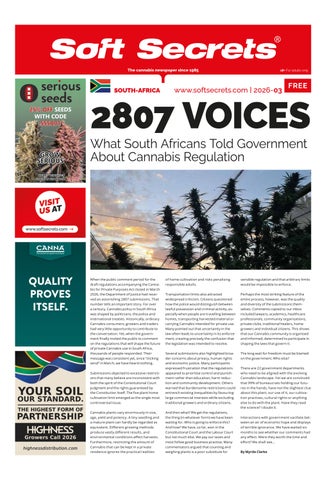
The cannabis newspaper since 1985
SOUTH-AFRICA
QUALITY PROVES ITSELF.
SERIOTICA
AK-47
AWARD WINNING GENETICS SINCE 1994
www.softsecrets.com } 2026-03
FREE
2807 VOICES
25% OFF SEEDS WITH CODE SSSA01
GROW SERIOUS
18+ For adults only
What South Africans Told Government About Cannabis Regulation
When the public comment period for the draft regulations accompanying the Cannabis for Private Purposes Act closed in March 2026, the Department of Justice had received an astonishing 2807 submissions. That number tells an important story. For over a century, Cannabis policy in South Africa was shaped by politicians, the police and international treaties. Historically, ordinary Cannabis consumers, growers and traders had very little opportunity to contribute to the conversation. Yet, when the government finally invited the public to comment on the regulations that will shape the future of private Cannabis use in South Africa, thousands of people responded. Their message was consistent yet, since “clicking send” in March, we have heard nothing.
of home cultivation and risks penalising responsible adults.
sensible regulation and that arbitrary limits would be impossible to enforce.
Transportation limits also attracted widespread criticism. Citizens questioned how the police would distinguish between lawful possession and criminal activity, es-
Perhaps the most striking feature of the entire process, however, was the quality and diversity of the submissions themselves. Comments copied to our inbox included lawyers, academics, healthcare professionals, community organisations, private clubs, traditional healers, home growers and individual citizens. This shows that our Cannabis community is organised and informed, determined to participate in shaping the laws that govern it.
pecially when people are travelling between homes, transporting harvested material or carrying Cannabis intended for private use. Many pointed out that uncertainty in the law often leads to uncertainty in its enforcement, creating precisely the confusion that the legislation was intended to resolve.
Submissions objected to excessive restrictions that many believe are inconsistent with both the spirit of the Constitutional Court judgment and the rights guaranteed by the Constitution itself. The five plant home cultivation limit emerged as the single most controversial issue.
Several submissions also highlighted broader concerns about privacy, human rights and economic justice. Many participants expressed frustration that the regulations appeared to prioritise control and punishment rather than education, harm reduction and community development. Others warned that burdensome restrictions could entrench existing inequalities by favouring large commercial interests while excluding traditional growers and ordinary citizens.
Cannabis plants vary enormously in size, age, yield and potency. A tiny seedling and a mature plant can hardly be regarded as equivalent. Different growing methods produce vastly different results, and environmental conditions affect harvests. Furthermore, restricting the amount of Cannabis that can be kept in a private residence ignores the practical realities
And then what? We get the regulations, the thing (in whatever form) we have been waiting for. Who is going to enforce this? And how? We have, so far, won in the Constitutional Court and the Labour Court but not much else. We pay our taxes and most follow good business practise. Many commentators argued that counting and weighing plants is a poor substitute for
The long wait for freedom must be blamed on the government. Who else? There are 22 government departments who need to be aligned with the evolving Cannabis landscape. Yet we are convinced that 99% of bureaucrats holding our futures in the hands, have not the slightest clue about this plant, our use of it, our cultivation practises, cultural rights or anything else to do with the plant. Have they read the science? I doubt it. Interactions with government vacillate between an air of economic hope and displays of terrible ignorance. We have waited six months to see whether our comments had any effect. Were they worth the time and effort? We shall see… By Myrtle Clarke
3 Page
8
Why South Africa's Cannabis Industry Must Grow Outdoors by Garreth Prince
Page
12
The Cape of Dagga by Natie Ferreira
Page
16
Neuroscience and the endocannabinoid system by Amazinyo amacane
Home Grow Ed Rosenthal
Page
22
20
GROWING GIANT TRIANGLE PLANTS26 Africa’s Premier Cannabis Cultivation Grow-off The Growdown
Page
Greenshock Farms and Mendo Dope grow the massive tree-sized cannabis plants the West Coast has become famous for. Their award-winning flowers have rich scents and high terpene content, which they attribute to their back-to-nature volcanomound soil method and diligent work in breeding cultivars that thrive in the garden’s microclimate.
Greenshock produces one sun-grown harvest a year. Clones and seeds for the pheno hunt are started indoors in January and February under basic fluorescent fixtures. The plants root and grow vegetatively indoors in the winter and are then transplanted to one to two gallon (4–7.5 l) pots before being placed in a greenhouse in the early spring. By April they are planted directly in the ground and have grown 2 to 3 feet (0.6–1 m) high. When they are harvested in October, they will be up to 12 to 14 feet (3.6–4.25 m) tall and wide, producing an average of 8 to 10 pounds (3.6–4.5 kg) of finished dried buds each. Each root system is planted in a volcanoshaped mound that rises about three feet (1 m) from the soil’s surface. Without the mounds, the plants would not grow as healthy or large. Mark Greyshock of Greenshock Farms says the practice is common with giant pumpkin farmers because it secures the roots in the ground, manages moisture, and increases oxygen at the root level while preventing root rot and providing the plant nutrients through layers of natural amendments to the native soil ecosystem. The mounds are formed, amended, and replanted each year and throughout the plant’s growth and flowering through top dressing of dry amendments, including alfalfa straw, compost, manures, kelp, guanos, lava rocks, and trace mineral sand. Once planted, the soil will not be disturbed again. The goal is to provide a healthy root environment thriving with microlife to fuel the massive growth and flowering of the giant plants.
Mark Greyshock learned in the 1990s while tending clandestine gardens in Southern California’s Santa Ana mountains. At the time, blending the native plants in the garden was a technique used to help evade law enforcement, but Mark fell in love with the native plants and the bees, butterflies, and hummingbirds they attracted to the garden. He attributes the quality of the finished product to the garden’s healthy soil ecosystem.
Growing giant triangle plants
by Ed Rosenthal
Growing in Mendocino, they use regenerative farming practices that do not disturb the native redwood forest or damage the local native soils. Alongside every year’s “Avenue of the Giants,” or the massive plants grown from clones to harvest their flower, is a “pheno patch,” where more mounds are utilized to test the seed-plant variations of new cultivars they are experimenting with. The Greenshock Mendocino farm is a partnership between longtime grower Mark Greyshock and brothers Daniel and Bryan Eatmon, aka Old E and Bleezy of Mendo Dope. Mendo Dope is known for its music and YouTube videos that celebrate the culture and communities of California’s Emerald Triangle. Old E and Bleezy started working as cannabis trimmers in 2007. Gradually their home garden grew larger, which culminated in a raid by the Mendocino County Sheriff’s Office in 2013. Although the garden was within the legal plant count limit of 25, they were very large, which the sheriff claimed meant they were no longer legal. The garden was destroyed. Shortly after California legalized cannabis, they paired up with Mark Greyshock to produce a range of new cultivars that could grow as giants through Greenshock farms using the Mendo Dope brand. The most popular cultivar of the moment is the Tropical Sleigh Ride, a winner of the highest-terpene flower and most interesting terpene-cannabinoid combination at the 2019 Emerald Cup. Their Passion Orange Guava “POG” took second place.
The growth of native plants between the mounds is encouraged.
Subcool’s Querkle and Locomotion. They have also produced several Tropical Sleigh Ride crosses: Peppermint Sleigh Ride, Trifle (Tropical Truffle x Tropical Sleigh Ride), and Spumoni Kush, a cross of Tropical Sleigh Ride and a legacy version of Barney’s Farm’s Vanilla Kush that Mendo Dope has nurtured for nearly a decade. They have recently started breeding with CBD flowers. Results include two cultivars, Dr. Greenshock, described as a “perfect 1:1 ratio” of THC to CBD, each testing about 10%, with a high terpene content of 3.8%, and the flavorful G Lime Burst, testing at about 5% THC to 18% CBD. They hope the high-CBD sun-grown flowers will be a gentle introduction to cannabis for new users. Pollen is collected and stored to pollinate selected plants in the pheno patch in late summer. The phenos must be able to adjust to the specific microclimate about 2,000 feet (610 m) above sea level near Willits, California. Just 20 miles (32 km) from the Pacific Ocean, the region is a coastal mountain range covered in redwood forest full of microclimates that range from hot and dry to moist and cool. In the Greenshock garden, summers are hot and sunny, but sometimes
outside the pheno patch. At the start of the grow cycle, the plants are hand-watered. Once transplanted to the mound, they are watered using a drip system that rings around the top of the mounds and guides water away from the plant stems, keeping them dry to prevent mold as they grow as thick as tree trunks. Before the plants are placed in the ground, the hole is lined with wire cages to prevent gophers and voles from destroying the heart of the root ball. Another advantage of using wire cages is that they help the root system support the top-heavy plants from wind. Wire cages are placed around the plant to support the branches and spread them out so that they capture more light. As the plants grow larger, the supports are adjusted. To control pests in the garden, they utilize integrated pest management (IPM) techniques like predators and traps. Dyna Traps are used to control caterpillars by capturing moths that lay eggs on the plants. The Dyna Trap has a small light and a fan that attracts and catches moths and little bugs. The crop begins to mature around October, and colas and branches are cut from the plants as they ripen. The plants
Products
AUTOPOT XXL 50L The AutoPot XXL 50L fabric pot system delivers power-free, automated fertigation driven entirely by gravity and the plant-controlled AQUAvalve5 technology. Designed for giant growing, its zero-waste engineering triggers natural wet-dry cycles without any pumps, electricity, or timers. The 50-liter porous FlexiPot eliminates root circling through air-pruning, heavily boosting oxygen exchange and secondary root branching. This substantial pot volume is purpose-built for massive, long-cycle plants. It easily supports fruiting trees and shrubs over six feet tall - including full-sized dwarf papaya trees, monster tomatoes, or heavy-canopy indoor/outdoor crops scaling minimal maintenance into true agricultural-sized cultivation.
4
XTCEE Clean Energy & Performance Complex XTCEE is a plant-based nootropic performance supplement created for adults seeking clean energy, improved focus and an elevated social experience. Formulated as a convenient fourcapsule shot pack, it combines carefully selected botanical ingredients and amino acids to deliver fast-acting energy without the crash while supporting mood, mental clarity and cognitive performance. Designed for festivals, nightlife, social events and high-energy occasions, XTCEE helps users feel more present, alert and engaged throughout the evening. Lab tested and quality assured, XTCEE is marketed as a premium dietary supplement made with integrity. It is intended for adults only and is not for medicinal use. www.cannamart.co.za
www.hydroponic.co.za
MUNCHIE MONSTERS
Sweetened Condensed Milk
Garden HighPro 2 Speed Inline Fans
Munchie Monsters Sweetened Condensed Milk is a rich, creamy indulgence crafted for adults seeking a convenient and flavourful cannabis-infused treat. Each pocket-sized 40 g tube contains 30 mg of full-spectrum cannabis and is formulated with nano emulsified technology for a fast-acting experience and improved absorption. The smooth condensed milk flavour makes it easy to enjoy straight from the tube, offering a mess-free option for relaxation or sweet cravings while on the go. Precision dosed for consistency and made with premium ingredients, Munchie Monsters combines quality, convenience and irresistible flavour in a compact format designed exclusively for adult consumers. www.cannamart.co.za
Manage your grow ventilation like a pro with Garden HighPro 2 Speed Inline Fans. They deliver reliable, energy-efficient airflow from 145 m³/h up to 1,040 m³/h, depending on size and speed. Paired with ducting and carbon filters, these inline fans help keep temperature, humidity and odours under control, so that growers can stress less. A toggle switch lets you choose between a higher or lower flow-rate, while clip-off flanges make cleaning or inspection effortless. Available in 100mm, 125mm, 150mm and 200mm diameters, and fitted with a 90cm power cord and ZA plug — ready to go. www.hydroponic.co.za
Travelling
5
By Erica Penfold
Ripe but not ready Cannabis tourism in South Africa and its take-off The South African cannabis sector has the perfect set-up for a thriving cannabis tourism industry: a culture of cannabis “terroir” and cultivation regions, a network of private cannabis clubs and international interest and investment. Despite this, the sector is not ready for take-off. Without dedicated sectoral changes, and deliberate efforts to include small scale, rural and legacy growers, cannabis tourism risks exacerbating existing market inequalities, widening the gap between large-scale, financed operations and small-scale farmers with limited resources. In addition, there is no regulation of the social problems that exacerbate the cannabis economic divide. Tourists can access cannabis in private residences, in hotels and on tours. Cannabis users who live in overcrowded blocks of flats and informal settlements are not afforded the same rights to exclusive and private use. These areas are policed differently and monitored closely. Punitive measures for cannabis possession, regardless of the right to private use are different for those in disadvantaged areas. Arrest is still the main tool to enforce possession and use, instead of a broader community-based approach, to teach users their rights, responsibilities and about harm reduction, regardless of their socio-economic backgrounds.
What needs to change for cannabis tourism to take off? We need to accept that there is no point in waiting for legislative reform, which crawls along at a snail’s pace. However, the following steps can ensure an integrated approach to a holistic cannabis tourism experience.
Green potential for tourism Cannabis tours are a prolific and increasing part of South Africa’s tourist offerings. Cannabis tourism can boost the economic of the cannabis sector and contribute significantly to the South African economy, by bringing in global and local 420 fans from across the green earth. Existing commercial packages can start
from $180 a day (+-R3000/day), offering a hefty price tag for foreign currency earners to pay to go up Table Mountain. The curated cannabis experience is not the primary focus of the tour. Tourists are certainly not getting a custom-rolled joint or tasting for that amount. Budget friendlier options integrate local growers and provide education on current activism and cannabis reform. This model
should be the norm. There is a clear need to drive tourist dollars back into a local growing economy, for small-scale growers to benefit financially, and more importantly, for them to feed their families.
Cannabis tourism is not inclusive The regulation of commercial consumption of cannabis sits in a grey pond. Cannabis tourists can legally consume within the framework of private use, typically through the private club model, or as private consumers in private residences. However, tourism is a broad and unrestricted access market. There is bound to be crossover of public consumption and the risk of illicit consumption. This creates uncertainty for operators to market cannabis experiences to international visitors. The distinction between private and public consumption becomes blurred. Cannabis tourism forms part of the drive for cannabis reform, but reform follows old patterns of exclusion. The larger facilities, chains of private clubs and growing operations are established and funded by those with access to financial resources. The smaller growers in rural areas do not get the same access to finances and are sometimes only growing to support their families and put food on the
table. Small-scale farmers are not going to see those large tourism dollars. The current reform process has not addressed the existing barriers to commercial access that face rural, legacy, and small-scale growers. Tourism businesses rely on consistent product quality. Small-scale growers often carry the production risk without access to insurance, finance, or technical support. There is no promised support from tour operators to provide
Tour operators need to ensure that tour proceeds are fed back into cannabis operations and include small-scale growers as priority. This will showcase the true nature of the South African cannabis experience, which originated in and is grounded in small-scale farming. Financial proceeds must be used to provide sustained support to growers in case of crop failures or disease outbreaks. The money generated can also be channelled into additional training, marketing, the development of cooperatives, long-term purchasing agreements, and the opportunity for growers to tell their stories. This creates a higher standard of authenticity for a cannabis experience and does not relegate it to an addon to a tour of wine farms in the Western Cape. By ensuring an inclusive approach to cannabis tourism that also considers the socio-economic imbalances of the industry, cannabis tourism can assist in closing the barriers to access and the widening economic divide between commercial operations and small-scale farmers.
sustained funding and technical support for growers whose crops may fail or be infected by crop diseases. If their crops fail, they do not make it on to the tour map and they do not have the resources to revitalise their harvests.
Cannabis can evidentially contribute to the South African economy. The implementation of economic practices, however, must ensure inclusivity of everyone in the sector, to breach the widening gap between the wealthy and those who grow on a smaller scale or to survive.
Taxi Jack column
6
By Taxi Jack
Taxi Jack's Toll Gate The Green Rush, Blue Lights & New Laws Sho'left, Mzansi. It's your boy, Taxi Jack, back with another fill-up of local news for the column that drives the conversation. August was a wild ride, suka. From international drug syndicates to constitutional battles and a child justice bombshell, let's get you up to speed.
First Stop: The Green Gold Rush (The Positives) We start with the good news, bra the kind that makes you want to hoot and wave at the rank. The Eastern Cape is leading the charge in the hemp revolution, and it's looking like proper job creation, not just pipe dreams. The East London Industrial Development Zone (ELIDZ) has thrown its weight behind the industry. Through its Science and Technology Park, they've launched an Expression of Interest for enterprises involved in hemp and cannabis beneficiation. They're looking for businesses that have moved beyond the concept stage and are ready to scale up to commercial production. Think biofuels, bioplastics, textiles, and biomaterials - all from our very own soil. The deadline? 18 September, so if you know someone in the game, tell them to get their skates on. And it's not just government pushing. Young entrepreneurs are proving doubters wrong. Take Mahlatsi Mohlala and his Green Route Hemp Industries team, based near Walkerville. They're breeding local hemp seeds and turning them into textile-quality fabric, right here in SA. Mohlala puts it perfectly: "We have a strong heritage of farming and a strong heritage of textiles. Introducing a local fibre like hemp gives local mills an opportunity to actually bump up their capacity, maintain those jobs versus losing money from importing foreign material." That's the hustle we need.
Second Stop: The Hawks & The Bad Apples (The Negatives) While politicians are writing laws, police are still kicking down doors. And the biggest story from May? The cops arresting their own. On 12 May 2026, a 33-year-old SAPS Constable from Carolina in Mpumalanga was arrested along with two accomplices after 17 bales of compressed cannabis worth an estimated R200,000 were found in two vehicles en route to Musina. The constable and his co-accused appeared in the Groblersdal Magistrate's Court on 13 May and were remanded in custody. The Democratic Alliance called on IPID [Independent Police Investigative Directorate] to investigate. When the very people meant to enforce the law are breaking it, no wonder public trust is low.
Then, on 20 May 2026, Mahamba SAPS members arrested five suspects during a stop-andsearch along the N2 Road. Police stopped a white Toyota Venture with KZN plates travelling towards Newcastle. Inside? 15 rolls of cannabis plants weighing 25.5kg, with an estimated street value of over R153,000. The five suspects, aged between 30 and 34, were arrested and charged with possession and dealing. A day later, on 21 May, a tip-off from residents in Polokwane led to another seizure. Members of the Provincial Community Policing Forum and the SAPS Organised Crime Unit recovered cannabis worth R5,000 at a park in Bendor. The suspect spotted officers and fled on foot like a taxi driver spotting a traffic cop. Small bust, but it shows communities are fed up with open dealing in their neighbourhoods. And on 22 May, KZN police arrested a constable - a member of Public Order Police in Durban - along with two accomplices for transporting 31 bales of dagga from Nongoma to Ulundi, worth R34,000.
Third Stop: The Green Gold (The Positives) Now for more good news - the stuff that makes you want to hoot and wave. On 27 May 2026, TimesLIVE reported a major breakthrough: local manufacturers proved they can process hemp using existing cotton technology. For the first time, garments made from locally processed hemp fabric were displayed in Nelson Mandela Bay. Clothing designed by the Koloni Hub Fashion Incubator in KuGompo and manufactured by Time Clothing in Gqeberha was modelled on the runway. Locally grown, locally processed, locally made. That's the circular economy we've been begging for. This is huge, bra. Farmers have been sitting with thousands of hemp permits but no buyers. Archie Madumane, a Stutterheim farmer and member of the Eastern Cape Hemp Producer's Association, said: "We have grown hemp successfully, but the problem was there was nobody to buy what we had planted and harvested".
Raj Jagesar, founder of Ledile Textile and Fibre Processing, said: "We were told it could not be done using the equipment we have in South Africa, but we proved the doubters wrong". Ledile aims to produce organic hemp fabric for the premium European market. The Eastern Cape Rural Development Agency is supporting the project, and Dr Sunshine Blouw said: "For the first three years, government should support the farmers 100%. That is how other countries support new industries". With over 50,000 products that can be made from hemp, the potential is massive - jobs, economic growth, and a chance for rural communities to thrive. That's the kind of green gold we want to see powering Mzansi forward. Until next time, keep one headlight working and your story straight. Taxi Jack Driving the news, one rank at a time.
Regulation
7
By Brett Hilton-Barber
African countries are integrating Cannabis into Public Health Systems for other ailments for centuries, is but one of hundreds of Afrobotanical plants that have medical value. The study and practice of medical cannabis should therefore be integrated with research and development of other Afrobotanicals that have proven medical benefits, for instance skeletium and artemisa, and there needs to be a holistic approach in developing medical plant products that can be used for the good of Africans. Part of the new ‘whole plant’ approach is to use indigenous landraces for industrial cannabis and drop the traditional barriers between medical cannabis and hemp.
The first decade of cannabis legalization in Africa, beginning with Lesotho in 2017, has been an exercise in colonialism. In short, African policy-makers bought in to international medical cannabis frameworks designed around European standards. The policy frameworks developed by all 11 African states that have partially legalized cannabis are without exception designed to favour multinationals seeking cheap biomass for European medical cannabis patients. With the exception of Morocco, which has designed its cannabis policy around licensing legacy farmers and building an industry around its famed Beldia landrace, African governments have chosen export markets over developing domestic cannabis economies. Besides South Africa, no other African government intends legalizing general adultuse consumption any time soon. Illicit cannabis markets thrive in every African country, and in most cases have been doing so for generations. According to the World Drug Report 2026, roughly 5% of African adults consume cannabis regularly and the figure is rising faster than in any other region in the world. Most African countries see cannabis as a narcotic and are engaged in a relentless war against drugs. What has made the situation more complicated is the explosion of synthetic drugs across Africa. Various synthetic drugs, mostly
opioid-based, are mixed with cannabis to create short, but intense highs, and have become alarmingly popular among the youth and unemployed. Known by a variety of names, these polydrug cocktails have provoked a public health crisis, particularly in West Africa, where use of ‘Killer Kush’ as it’s known, is so widespread as to be causing
Prof Katerere’s philosophy has found enthusiastic support among a new generation of policy-makers, spearheaded by Dr Prosper Sievu, a leading cannabis consultant in Africa and one of the regulators on Zambia’s newly formed Medicines Control Council. Zambia legalized the cultivation and export of medical cannabis in 2021, but has struggled to get the industry off the ground. The Zambian Defence Force, which was temporarily in charge of cannabis regulation, has made 134.000 ha available for hemp cultivation and has secured the backing of traditional leaders. social breakdown in poorer areas. Against this backdrop, it’s easy to see how African governments are reluctant to drop cannabis prohibition. However, as the health and medical benefits of cannabis become increasingly clear through scientific research, there is a change in mindset that is beginning to emerge. One of the most prominent influential thinkers behind this new wave is Professor David Kuterere, the head of cannabis research at South Africa’s Tshwane University of Technology and chairman of PharmaConnect. Prof Kuterere is motivating for a completely new approach to cannabis in Africa, calling for regional collaboration in developing a uniquely African medical cannabis model, which ultimately would result in the definition of plant medicine as its own category, make use of the rich genetics found in indigenous landraces and create a new Afro-pharma sector that would develop medicines and practices in public health care systems that African countries could collaborate around. His argument can be summed up as such: the study of plant medicine in Africa is rooted in indigenous knowledge systems (IKS) that are hundreds of years old. Cannabis, which has been used in the treatment of pain and
Dr Sievu says the plan is to incorporate thousands of small-scale farmers into cultivating industrial hemp and cannabis for medical purposes, and putting resources into clinical trials that would form the basis of a new-look public healthcare system that utilized the benefits of cannabis and other Afrobotanicals. He told me at the Cannabis Expo in Johannesburg in May this year, that his vision also included training doctors in the endo-cannabinoid system and be able to prescribe flower to patients. Dr Sievu believes that cannabis could also be used in the treatment of the substance abusers. Dr Sievu’s appointment and the reconfiguration of cannabis oversight in Zambia, has been echoed in Lesotho, Botswana and Malawi, all of which are shifting their focus away from a reliance on exporting raw flower and seeking ways of adding value to biomass through processing cannabis into medical products – for local markets and export. Although Africa’s cannabis licensing regimes have a long way to go before the health benefits of cannabis can be enjoyed by Africans, 2026 may be seen as the year in which a new generation of African thought-leaders are beginning to stir the pot of a new African cannabis medical model in the making.
Cannabis & Environment
8
By Garreth Prince
Why South Africa's Cannabis Industry Must Grow Outdoors, Not Just Upward South Africa stands at a rare juncture. As the cannabis economy formalises under the National Cannabis Master Plan and instruments like the IKS Cannabis Sandbox, the country has an opportunity most established markets never had: to build an industry's environmental footprint correctly from the outset, rather than retrofit it after the damage is done. That window will not stay open long. The choices made now about how cannabis is grown will determine whether this becomes an engine of inclusive, ecologically sound rural development — or another extractive industry that concentrates profit while externalising its costs onto water tables, electricity grids, and the very communities whose knowledge made the crop viable in the first place.
should sit with those seeking to introduce the activity, not with those who might be harmed by it. Applied here: before regulators wave through water-intensive, energy-intensive indoor mega-cultivation at scale, the burden should fall on that model to demonstrate it will not deplete aquifers, strain municipal grids, or crowd out the smallholder and IKS growers who cannot compete with capital-intensive infrastructure. It is far easier to build environmental safeguards into a nascent industry than to claw them back once large capital has been sunk into a resource-hungry model that is now "too big to regulate."
The IKS Cannabis Sandbox as the proving ground This is precisely the gap the IKS Cannabis Sandbox exists to test. A sandbox, by design, is meant to let regulators observe a contained, lower-risk model before committing the full regulatory architecture to it. Used properly, it is the ideal instrument for demonstrating — with real data, not just principle — that IKS-aligned outdoor and low-input cultivation can meet quality, traceability, and export-compliance standards without the environmental cost profile of indoor production. Every harvest cycle inside the sandbox is an opportunity to build the evidentiary record that regulators, investors, and international bodies like the INCB will eventually need to see: that sustainable cultivation is not a compromise on quality or compliance, but a genuinely competitive model in its own right.
The economic case is not the environmental case's enemy It is tempting to frame environmental responsibility and economic ambition as competing priorities — sustainability as a cost centre to be tolerated once the industry can "afford" it. That framing gets South Africa's comparative advantage backwards. The country's real edge in the global cannabis trade is not artificial climate control; it is actual climate. Landrace genetics developed over generations in the Eastern Cape, KwaZulu-Natal, and Limpopo are already adapted to sun, seasonal rainfall, and regional soil — this is precisely what full-sun and light-deprivation greenhouse cultivation exploit at a fraction of the input cost of indoor facilities. Chasing an indoor-cultivation model designed for climates that lack South Africa's sunlight would mean importing an expensive solution to a problem the country doesn't have. The scale of that expense is not trivial. Interna-
tionally, life-cycle research on the US cannabis industry has estimated that indoor cultivation accounts for roughly 90% of the sector's greenhouse gas emissions, with energy demand driven overwhelmingly by artificial lighting and by heating, ventilation, and dehumidification systems working to substitute for what sunlight and open air provide for free. Estimates of the resulting carbon footprint run into thousands of kilograms of CO2-equivalent per kilogram of dried flower — multiple orders of magnitude above outdoor or greenhouse production. For a country managing chronic electricity constraints, building a domestic cannabis industry on an indoor-first model would mean competing with hospitals, schools, and households for scarce grid capacity, all to replicate what South African sunlight already does.
sed country, and its cannabis policy cannot be written as though it were being drafted for a water-abundant jurisdiction. Outdoor and dryland cultivation, particularly of landrace varieties bred for resilience rather than maximum yield, requires substantially less irrigation than the recirculating, high-frequency fertigation systems that indoor and intensive greenhouse operations depend on to compensate for the absence of natural rainfall and soil biology. There is a real symbiosis available here: cultivation practices that respect natural rainfall cycles and soil health are not just gentler on the environment, they are also closer to how IKS-holding communities have already been cultivating cannabis for generations, often without the industrial irrigation infrastructure that intensive operations assume as a baseline.
Water is the sharper edge in the South African context
This is where the precautionary principle earns its place in cannabis policy rather than remaining a slogan borrowed from environmental law. The precautionary principle counsels that where an activity carries a credible risk of serious or irreversible harm, the burden of proof
If energy is the defining environmental cost of indoor cultivation globally, water is the defining constraint locally. South Africa is a water-stres-
That evidentiary record matters for a second reason beyond the environment. Communities holding indigenous knowledge of landrace cultivation are structurally better positioned to compete in an outdoor, low-input model than in an indoor one, where the capital cost of lighting rigs, climate control, and industrial-scale infrastructure functions as a barrier that only well-financed entrants can clear. An environmental policy that favours outdoor and appropriate-scale greenhouse cultivation is, in the same stroke, an economic transformation policy. It keeps the terms of competition set by soil, sun, and generational knowledge — the assets IKS communities actually hold — rather than by access to capital markets, which they largely do not.
Environmental rights and socioeconomic rights are not in competition South African cannabis policy is sometimes debated as though section 24 of the Constitution — the environmental right — and the socio-economic rights in sections 25 to 27 pull in opposite directions: environment versus jobs, conservation versus land access, sustainability versus livelihoods. The Constitution itself rejects that framing. Section 24(b)(iii) protects the environment by securing "ecologically sustainable development and use of natural resources while promoting justifiable economic and social development" — the balance is written into the right, not bolted on afterward.
9 sustainable is, in effect, a template for exactly the outdoor, IKS-aligned cultivation model this article argues for: one where present economic need and future ecological integrity are treated as a single design constraint rather than sequential trade-offs. A progressive and purposive reading of South African cannabis policy, then, is not one that defers environmental protection until the industry is "mature enough" to afford it, nor one that freezes development in the name of a precautionary principle applied indiscriminately. It is one that uses the precautionary principle to shape which model of economic development gets a head start — favouring the pathway that lets current generations of IKS communities build sustainable livelihoods without compromising the water, soil and ecological systems those same communities, and their descendants, will continue to depend on.
What a sustainable framework should actually require Translating this into policy does not require choosing between growth and environmental care; it requires sequencing and safeguards: - A rebuttable presumption favouring outdoor and appropriate-technology greenhouse cultivation, with indoor cultivation permitted only where a genuine, demonstrated need exists (such as specific medicinal-grade cultivar requirements), not as a default model.
The Constitutional Court gave that text real teeth in Fuel Retailers Association of SA v Director-General: Environmental Management, Mpumalanga (2007), holding that sustainable development functions as the mediating principle that reconciles environmental protection with social and economic development, rather than treating the two as a zero-sum trade-off resolved by picking a winner. Economic development, social development, and environmental protection were described as three integrated pillars of the same constitutional project, not competing claims to be ranked against one another. Applied to cannabis regulation, this means an environmental authority (or DTIC, or Agriculture) cannot lawfully treat "this will create rural jobs" and "this will strain water resources" as separate conversations decided by different departments in isolation — a purposive reading requires them to be reconciled within the same decision.
That reconciliation matters most for IKS communities specifically, because for them the environmental right and the socio-economic rights are not abstractions in tension — they are the same right. Section 25's land reform and tenure provisions, section 26's housing rights, and section 27's rights to health, food and water are only meaningfully realised in these communities through continued access to functioning land, water and ecological systems. A cultivation model that degrades the water table or soil health in the name of shortterm economic development doesn't trade off against these communities' socio-economic rights — it directly undermines them. Section 7(2)'s duty on the state to respect, protect, promote and fulfil the rights in the Bill of Rights, read purposively per section 39(1), points toward regulatory choices that advance section 24 and sections 25–27 together, not a forced choice between them.
The Earth Charter's contribution: intergenerational responsibility as a design constraint Section 24(b) already commits South Africa to protecting the environment "for the benefit of present and future generations" — an explicit intergenerational-equity mandate embedded in domestic law. The Earth Charter sharpens what that commitment should mean in practice. Its four pillars — respect and care for the community of life, ecological integrity, social and economic justice, and democracy, nonviolence and peace — insist that ecological protection and the eradication of poverty be pursued as a single ethical and practical project, not sequenced as though poverty reduction must wait its turn behind environmental protection, or vice versa. The Charter's call to ensure economic activities support human development in ways that are both equitable and ecologically
- Water-use licensing calibrated to catchment realities, so permitting decisions under the National Water Act are made in coordination with cannabis regulators rather than treated as an afterthought once cultivation licences are already issued. - Sandbox data made genuinely public and comparative, so the environmental and economic performance of IKS-aligned outdoor cultivation is measured against indoor and industrial-scale alternatives, not assessed in isolation. - Benefit-sharing and land-access mechanisms that ensure the communities generating this evidentiary and genetic value are also the ones positioned to scale into the formal market as it matures, rather than being priced out once the model they proved viable becomes attractive to larger capital.
@ocb_southafrica
OCB and Zig-Zag are the ultimate global standards in quality and craftsmanship for the smoking and recreationnal market. From iconic papers to premium filters and MYO/RYO accessories, these legendary brands deliver the perfect smoking experience every time—and they are officially available right here in South Africa through Clippa Sales. Eastport Boulevard, Eastport Logistics Park Cnr R21 expressway and R25, Witfontein Ext 86, Kempton Park - Tel.: 0861244277 www.clippasales.com / info@clippasales.com
Events
10
By Leela Baer
International Cannabis Symposium Cape Town 2026 Back to Basics: Creating Foundational Policy & Law for Equitable Cannabis & Hemp
Throughout the panels, speakers and attendees realised that the issues faced in their own territories are not unique. Indeed, as the discussions deepened, shared realities of slow, fractured reforms emerged. However, in dissecting these shared challenges, success stories of collaboration between local communities and governments as well as using legislation toward the benefit of the people over corporate interests often took centre-stage. On the panel themed From Washington to California - The West Coast Experience, directed by Bob Hoban (USA), the successful inclusion of LatinX communities in California’s emerging legal market were highlighted by Mariana Larrea Arias (Mexico).
The recent International Cannabis Symposium Cape Town 2026 stands out for its highly innovative, educational three days of open and frank discussions and debates deconstructing the current state of cannabis reforms the world over toward finding workable solutions.
Organised by Sean Hocking of Cannabis Law Report and Atiyyah Ferouz of ICQSA (International Cannabis Quality Standards Association), this second South African installment of the International Cannabis Symposium also drew support from South Africa’s very own Fields of Green for ALL and the Centre of Criminology, as well as Cultiva Law from the United States. Attracting expert and emerging voices from around the globe under the theme Back to Basics: Creating Foundational Policy & Law for Equitable Cannabis & Hemp, the International Cannabis Symposium (ICS), highlighted the shared challenges of liberalising the people who interact with cannabis while offering workable and proven solutions to the challenges posed by slow, often fragmented reforms. As such, the main objectives of the ICS aimed to establish evidence-based policy frameworks, foster international collaboration, address social justice concerns, and advance cannabis and hemp policy development sustainably and inclusively. The ICS panels took place across three
rooms over 25–27 June 2026 at the Law Faculty of the University of Cape Town. Panel topics covered everything from legal and regulatory reforms and frameworks, police engagement, collaboration with local and indigenous communities and government, cultivation and genetics, ethical approaches to cannabis research, development and reforms, failures and successes. Medicinal cannabis, standards, education, barriers to entry and participation, and corporate capture were also major topics. Speakers at the ICS formed a diverse grouping of experienced and emerging academics, policymakers, legal experts, industry professionals, stakeholders, and activists from around the world involved in cannabis reforms and developments. Carefully selected by Sean and Atiyyah for their contributions and experience in their various territories and fields, the speakers both balanced and challenged each other during panel discussions. Speakers presented both in-person and online to ensure as much diversity and nuance as possible across panel topics.
While South African speakers were in the majority on the panels, many speakers came from far and wide, and online, to present at this year’s Cape Town chapter of the ICS. Throughout the panels, attendees were invited to engage with the speakers. This unique approach equalised the cannabis field, so to speak, in a way that truly fostered the collaborative spirit of the Symposium. This approach also gave speakers insights into the lived experiences of those they may not otherwise have the opportunity to interact with outside of their fields of focus or practice. Attendees were likewise able to learn from and engage with experts usually beyond their reach, while hot topics continued to be discussed into the evenings’ social events. Veteran activist Steve De’Angelo kicked the Symposium off with his online keynote address by introducing the 3 Golden Pillars (3GP): A common sense, science based, equitable foundation for global cannabis regulation. This set the stage for bringing things back to basics.
In Mitch Chargo’s panel on Indigenous State Compacts, collaborations with indigenous communities in Minnesota and the resulting positive outcomes were shared and explored. The South African perspective on the same panel brought by Marleen Theunissen and Bonke Mfanekiso of the Mpondoland Plug Project on working with local communities left behind by local reforms and government illustrated that development can happen even when frameworks are lacking. Dr Prosper Sievu of Zambia shared one of the greatest success stories of the African continent on the Pan African Panel on the second day. Zambia’s success, as explained by Dr Sievu, is the result of using existing legislation and institutions to benefit the people rather than regulating for corporate interests. He also encouraged similar approaches in other territories. One major takeaway from the ICS came from Darryl Bickler, who kept speakers and attendees on their toes about how to correctly contextualise cannabis within legal frameworks. Darryl explained that cannabis, as an object, cannot be regulated nor legislated. Rather, it is the use of cannabis and the user, as subject, that are regulated. This core point forms part of the initial outset of the ICS - to foster ongoing global collaboration between experts, stakeholders, legislators, academics, and activists toward establishing foundational principles grounded in justice, equity, and evidence-based decision making toward sustainable reforms.
Growing
11
By: M. Zansiman
When water becomes the limiting factor
We talk endlessly about genetics, yield, lighting and nutrients. But visit enough grows in South Africa and another subject keeps coming up: water. And usually not because there is too much of it. One thing I've noticed when talking to growers in South Africa is how quickly a conversation can turn to water. You might be discussing genetics or looking at a new room, and suddenly you're talking about boreholes, storage tanks, water quality or what it costs to treat it. The situation differs from place to place, but water is rarely something you can just assume will be there in the quantity and quality you need. That becomes more serious as grows get bigger. We tend to discuss irrigation in litres per plant, which makes the numbers sound manageable. Multiply those litres by several thousand plants, several irrigations a day and crop after crop, and you're dealing with a substantial amount of water moving through a facility. Recent research at a commercial cannabis farm in KwaZulu Natal gives some perspective. Researchers measured average daily water use of 28.4 litres per plant under the conditions studied. That's not a number growers should simply apply to their own crops, because growing conditions and systems vary enormously. Still, in a country where agriculture already ac-
counts for around 66% of water use, it is worth paying attention to. What interests me more than the amount going into a grow is what happens to it afterwards. Water is filtered, stored, sometimes treated, mixed with nutrients and pumped to the plants. Some is taken up and eventually leaves through transpiration. Some stays in the substrate. And in many systems, a considerable amount leaves again as drainage. There are good reasons for maintaining drain in substrate cultivation, particularly when managing EC in the root zone, but that drainage is still water we have already spent money and resources preparing. This is where irrigation efficiency becomes more interesting than simply telling growers to use less. A 2025 cannabis study comparing conventional drip irrigation with subsurface drip irrigation reported 18.6% lower water use while flower yield increased by 5% under the conditions tested. Other controlled environment research has found that moderate water restriction can reduce consumption without negatively
affecting biomass or CBD yield. Restrict it too far and the crop suffers, as you would expect. Nobody wants to save water at the expense of the plant. The opportunity is in the water that wasn't helping the plant in the first place.
Looking at what others are doing Canada is interesting in this respect. Its commercial cannabis industry scaled much earlier than South Africa's, and many facilities have already had to deal with the practical consequences of running thousands of plants under one roof. At that size, percentages that look insignificant on a feeding chart can turn into serious volumes over a year. Recirculating hydroponics is one way of approaching this. Instead of using nutrient solution once, drainage is collected and returned to the system. In practice, that requires considerably more control than simply pumping it back into the reservoir. The plants have already taken up water and nutrients in different proportions, so the returning solution needs to be managed for EC, pH, nutrient balance and hygiene. You can see that thinking reflected in the way some of the largest licensed producers operate. CANNA, the Dutch plant nutrition company, for example, distinguishes within
its commercial AGRI Solutions programme between SUBSTRA for inert substrate cultivation and AQUA, which was developed specifically for recirculating hydroponics. These approaches are already used in large scale Canadian cannabis cultivation. The product names aren't really the interesting part. What matters is that water management and nutrition are increasingly being considered as parts of the same system. Once water comes back around for a second pass, you need to know what is still in it and what the crop has already removed. South Africa won't need the same solution everywhere. Water quality alone can make one system sensible in one location and unnecessarily complicated in another. Scale, substrate, climate, infrastructure and the people running the facility all matter. But our cannabis industry is still young enough to learn from markets that scaled before us. We don't have to build large facilities first and start thinking about water efficiency afterwards. After seeing how much effort goes into controlling almost every other variable in a modern grow, it seems strange to treat water as the cheap part of the equation. In South Africa, we probably can't afford to.
History of Cannabis
12
By Natie Ferreira
The Cape of Dagga
A brief history of Cannabis in the Western Cape Cape Town today is a live documentary of the recent history of Cannabis. A stroll through the streets of Sea Point or Observatory makes it difficult to believe that it was a mere eight years ago that our highest court confirmed South Africans’ right to consume and cultivate Cannabis in private. Today, you cannot walk into a mall or down a street without seeing some interpretation of this ruling.
With the Cape’s winter rainfall climate not being suitable for the year-round growing of Cannabis, trade was established with pastoral tribes up the East Coast, with |Xam clans often living amongst other nations, to be near their supply for the yearly journey to trade their wares in the Cape. This contact between nomadic and pastoral tribes is evident in the clicking sound in the Xhosa language today. What is interesting to note though is that the Cape got a separate word for Cannabis, not the well-known linguistic geographical path from the Sanskrit “Bhang”, through Swahili “Mbange”, to the Nguni “Ntsango”. Could this point to Cannabis arriving in Southern Africa through more than one route? The word “Dagga” stems from a term sounding like “Dachab” which referred to a range of mind-altering plants, including Wild Dagga (Leonotis species). The term was translated by early settlers as “to make drunk” or “- silly”. There is no correct spelling, though, as any attempt at putting into writing what is a complex phonetic language, would at best be a poor imitation of nuanced sounds unfamiliar to the writers’ ears. Whether Van Riebeeck ever partook in smoking the herb, we don’t know, but maybe he was desperate for some stress relief after waiting for his grapevines that would only yield his first wine in 1659. The next century saw a boom in trade around the Cape.
Whether for pain or pleasure, you will find your fix; for some, it is a few joints with friends in a private lounge, and for others, a quick pick-up-and-go from a dispensary. Tourists are not only being entertained in luxury lounges while sampling some of the best Cannabis products in the world, but they can also stay in a hemp hotel, a world class experience. That same tourist might spare a thought for those who came before him, and wonder who the first stoners of the Cape were, and where they got their stash from. It’s a fascinating story told through folklore, diary entries, medical and criminal records, artifacts and academia. It’s also a story where much was lost in translation and hearsay, with every teller of the story bringing their own interpretation. ‘De Haucumguas, welcke. . . mede lantbouwen, daar se daccha in teelen, sijnde een droogh cruijt dat de Hottentoos eeten ende droncken van worden.' – Jan Van Riebeeck’s journal, 1658. Jan van Riebeeck arrived at the Cape believing he is setting up a new trading post. Instead, he found one that already existed. Little did he know that he would find a sophisticated barter and trade system with a large variety of wares on offer. Van Riebeeck knew that some
of these commodities would stir the capitalist hearts of his masters. One that stood out was a highly esteemed herb with some very interesting properties. The locals called it what Jan van Riebeeck translated in a 1652 journal entry as “Daccha”. He was told, through his interpreters, that this herb was traded and consumed by locals to create an altered state of mind; described in his journal as similar to opium or being drunk. Shipping captains were soon instructed to acquire this herb further up the East Coast for trade with the local inhabitants. In 1658, Van Riebeeck discovered that the Humcumqua, a local pastoral tribe, was cultivating and supplying the market locally. The VOC, the powers that be of the day and Van Riebeeck’s employer, soon picked up on his diary entry and commissioned the planting of Cannabis in the Cape. The plant was easy to grow in the flood irrigated furrowed market gardens of the settler farmers, and in 1680 the VOC banned the growing of Cannabis outside of the Company Gardens. Their attempt at monopolising the supply chain soon proved futile. Cannabis trade and supply was already so embedded in the culture of the country that they could not make a dent in the market suffi-
ciently supplied through ancient trade routes, and the favourable climate for the cultivation of the plant. Travelers reported stands of feral Cannabis, showing that the plant was well naturalised by the time settlers arrived. How, when, and from where the plant got here, nobody really knows. Ancient cultures in South Africa were governed as true theocracies, with the spiritual leader of the nation also the political leader. These leaders travelled far and wide for guidance. Conversations with modern day leaders tell stories of cross-continental shamanic contact with other tribes dating back thousands of years. This contact led to the obvious trade in psychoactive and charm plants, and compounds being used as catalysts in their spiritual journey. Cannabis may well have been one of these compounds being introduced into new cultures and rituals around the world through these ancient routes and contacts. By the time written records began in the Cape, the practice of consuming Cannabis by the general population had spread well beyond spiritual guidance into regular consumption for therapeutic and recreational purposes.
Ships from Batavia, India, Amsterdam, Madagascar, Mozambique and elsewhere docked regularly to refresh and restock supplies. Each of those countries had their own Cannabis culture, and one can only imagine them not only imbibing and stocking up on the Cape’s wine and notorious “fire water”, but also some fresh Dagga from the Humcumqua and settlers. More settlers arrived in the Cape from Britain and France, as well as slaves from Asia and East Africa, bringing together the mixture of cultures that makes Cape Town such a vibrant city of diverse flavours. All these people arrived on wooden ships with the sails and tackling made from hemp. The abundance of timber along the Southern Cape coast, and what seemed like a favourable climate for the growing of hemp, soon identified Knysna as a potential hub for shipbuilding. George Rex included hemp amongst flax, tobacco, and even mulberries for silkworm farming. The abundance of indigenous forests made the timber industry too lucrative, and these early attempts at establishing a fibre industry in the Western Cape were soon abandoned. Jump to today, where Cape Town is also at the forefront of the hemp industry development in South Africa. Not only does the city host the oldest and biggest hemp-based clothing retailer in Hemporium, but it also brags with the tallest building in the world made with hemp walling. Most of the hemp used is unfortunate-
13 With Cannabis, and the consumption thereof, as common as tobacco and coffee in the Cape, prohibition must have come as a shock. Natal province was first, said to ban Cannabis to control Indian indentured workers. The Cape Colony cited environmental grounds, outlawing it as a noxious weed in 1891. The Freestate followed next, banning dealing in 1903, and by 1922 the union government declared Cannabis a habit-forming drug under the national excise and control act. Cannabis culture quickly moved underground, and cultivation was forced indoors or into remote rural areas. Laws were
ly imported from elsewhere, with the Western Cape winter rainfall climate not suitable for the cultivation of European low-THC hemp variety. Fortunately, our Department of Agriculture saw this contrast with the long tradition of successful Cannabis farming in the Cape, and have shifted their focus to the industrial potential of acclimatised landrace varieties. The THC limit for industrial hemp was recently adjusted to 2%, specifically with this development in mind. Early research by the ARC and a private researcher had promising results. With the initial interest in monopolising the trade in Cannabis quickly fading, the expanding settler population soon discovered the other benefits of the plant, including its therapeutic and medicinal use. Local people have been using decoctions, poultices, ointments and ferments from different parts of the plant for everything, from assistance in childbirth, to snakebites, intestinal parasites, dysentery, fever, and blood poisoning. Working aged men
would smoke it to stave off hunger and provide stamina. The elderly were known to smoke it in decorative long-stemmed pipes to ease their pains and worries about the youth of the day. By the time the overpopulated Cape, with its tough farming climate, became too much for the “Trekboers”, Cannabis was an integral part of the home apothecary. With them, they also carried the knowledge and handwritten notes and recipes documenting the folklore that would be known as “Boererate”, loosely translated as folk remedies of the Boer nation. In these well documented Boererate, we are told to blow Dagga smoke into the mouth of a stroke victim until their tongue is loose enough to smoke it, steep the flower in brandy to be drunk against pain, fever, and cough, as well as to feed it to horses as a general tonic and immune booster. From the looks of it, Dagga has always been easy to access throughout the Cape and further, even for these nomadic Trekboer that had no way to cultivate their own.
brutally enforced, often targeting marginalised communities and the already oppressed. It was also in Cape Town where these brutal laws were successfully challenged in 2017. Today, 9 years later, Ras Prince is back in court. Prince demands a stop to all Cannabis arrests while the constitutionality and legality of the new Cannabis for Private Purposes Act and subsequent regulations are challenged. Whether this will bring the rapid reform we need, or place us back 9 years, only time will tell.
Economy
The Green Economy
14
Can Cannabis Create South Africa's Next Generation of Jobs? Unemployment has shadowed South Africa's democracy from the start. Three decades on, millions of people, many under 35, remain jobless in an economy that never created work fast enough to absorb them. Cannabis is now drawing a new kind of attention. In Pondoland, KwaZulu-Natal and Limpopo, cannabis has quietly kept families going for generations. Once off the books, it now surfaces in policy and investment circles as a possible engine for jobs. The real question is whether that value can be captured without flowing to a few operators while the communities that grew the crop are left out.
materials supports more jobs when goods are finished at home rather than exported raw. The clearest opportunity, and the easiest to fumble, sits with communities that grew cannabis long before licences. Traditional growers, especially in the Eastern Cape, have preserved prized landrace genetics, yet many are excluded by licensing costs and compliance rules built for larger operations. The task is not to build an industry from nothing, but to bring an existing informal one into the legal economy without crushing it under the cost of entry.
An ecosystem built for participation Real employment will come only if participation reaches beyond a few well-capitalised companies. For Louis Eksteen, managing director of Cannamart and chairperson of the Cannabis Retail Association, the goal is an industry open to businesses of every size: "The greatest opportunity for South Africa's cannabis industry is not simply to create another agricultural export sector, but to build an ecosystem that enables thousands of small businesses to participate across the entire value chain. The longterm economic impact will come from lowering barriers to entry, encouraging entrepreneurship, and ensuring that growers, processors, retailers, service providers and wellness practitioners all have a place in the legal market. If we measure success only by exports or large-scale investment, we'll miss the industry's true potential. Success should be measured by how many sustainable businesses we create, how many jobs they support, and how much value remains in local communities."
The numbers everyone quotes
It was never just about farming
The 2021 National Cannabis Master Plan valued a fully commercialised sector at about R28 billion and 10,000 to 25,000 jobs; President Cyril Ramaphosa has suggested more than 130,000. These are projections, not promises.
Cultivation is only the start; a real industry also runs on technicians, processors, packaging and compliance. Manufacturing matters even more: turning the plant into medical cannabis, CBD products, hemp fibre and building
Retail platforms are part of that ecosystem too, opening a route to market for start-ups and home-industry entrepreneurs. For Sharon Basel, Owner and Brand Manager of Cannamart, the role is both commercial and educational: " Cannamart has provided a platform that encompasses not only your established suppliers and brands, but also your startups, those new to the industry and your small home-industry entrepreneurs. We support growth in the industry, consumer accessibility to both new and established product suppliers,
with quality product and consumer protection in mind. This ranges from ensuring products are clearly labelled and securely packaged, with detailed and accurate product ingredients, as well as informed dosage instructions and/or an application guide for the consumer. We aim to not only support the growth of the industry, but also to assist in sharing a valuable knowledge base for the purpose of education. The more we grow together and support each other, from cultivation and our local cultural farmers right through to the end-consumer, the more we all benefit. On a personal note, and having been in this industry for close on ten years now, it has been an exciting journey, though not without its challenges. The cannabis retail industry has grown so much over the years, with the potential for massive growth not only in this industry but for our South African economy."
Beyond the borders Exports may matter more than the domestic market, with real openings in Germany and the wider EU. But Lesotho is the cautionary tale next door: its EU-GMP export channels mostly benefited operators able to meet costly standards, not smaller growers. That growth must be designed to include them. Public opinion is no longer the main obstacle; regulation is. The Cannabis for Private Purposes Act (2024) decriminalised private adult possession and cultivation but did not open a broad commercial market. The fragility showed in March 2025, when a ban on cannabis and hemp foodstuffs was gazetted without consultation, then withdrawn after industry pushback.
Not a miracle, and not a mirage Cannabis will not fix unemployment; no single sector will. Yet the raw material already exists: knowledge, genetics, growers and informal networks. Policymakers need only convert an industry that survived outside the law into something modern, inclusive and competitive. Get the rules right, and cannabis could support farmers, manufacturers, researchers, retailers and the small operators who carried it this far. Get them wrong, and it delivers narrow gains. The plant is already in the ground; what remains undecided is who benefits when it grows.
Cannabis Science
16
By Amazinyo amacane
Neuroscience and the endocannabinoid system Jessica Giuffrida holds a degree in Cognitive and Behavioral Neuroscience from the University of Padua, where she also specialized in Cognitive and Behavioral Psychotherapy. During her clinical internships, she focused primarily on developmental neuropsychology, the diagnosis and treatment of congenital and acquired brain disorders in adults, and neurodegenerative disorders associated with aging. Since 2012, she has been working in clinical research, focusing primarily on neurocognitive and psychiatric disorders. In 2015, she moved to France, where she practiced clinically and taught at the University of Nimes for four years. Thanks to her availability, today we will discuss the endocannabinoid system through the prism of neuroscience.
When do you first remember hearing about the Endocannabinoid System? Considering that N-arachidonoylethanolamide (later fortunately renamed anandamide) was first isolated in 1992 and that textbooks are updated at a slower rate than scientific literature, I believe I heard about it, briefly, in the late 1990s during my high school biology class.
Do you remember what impression you had upon discovering that our bodies produce the same chemical compounds naturally produced by cannabis? I can't say this discovery particularly surprised me: our brain's heightened response to chemicals is generally due to the presence of receptors compatible with those chemi-
very similar to the original one enters the "traffic jam" of molecules that come into contact with the brain, it identifies the parking space most compatible with its structure and stops there, blocking the access of endogenous molecules intended to act on those receptors.
So are receptors more stimulated by external substances? A greater affinity has been observed between exogenous substances and compatible receptors: this is why the effects of these substances, which are essentially similar to those of endogenous substances, are significantly amplified. Along my journey, I've developed a particular interest in altered states of consciousness, conditions that seemingly stall the "default" functioning mode to make room for... something else. These conditions are commonly associated with the
“ENDOCANNABINOIDS CONTRIBUTE TO THE BALANCE AND STABILITY OF PROCESSES OCCURRING IN THE CENTRAL NERVOUS SYSTEM” cals. This can occur for various reasons, but primarily because the external molecule has a similar structure to the main neurotransmitters produced by the brain—this is the case, for example, of the structural similarity between the active ingredients of classic psychedelics and the serotonin molecule; or because the brain produces specific substances, extremely similar to external active ingredients – this is the case of endogenous opioids, whose molecular structure differs minimally from that of morphine.
How would you describe the role of brain receptors? Receptors can be compared to parking spaces, whose shape is adapted to a car model. If a car
use of psychoactive substances, but not only: we can think of competitive trance, particularly in endurance sports (Runner's High), or meditation, or the consequences of certain breathing methods.
Can you tell us about endogenous cannabinoids, those produced internally by our body? Endogenous cannabinoids affect various physiological, cognitive, and psychological aspects (mood, cognitive processes, hunger perception, immune response, etc.). The two main molecules are anandamide (AEA) and 2-arachidonoylglycerol (2-AG). Once synthesized, these molecules are immediately released from the cell and bind to cannabinoid
receptors on neighboring cells or on the same cell that produced them.
this effect is at the basis of the addiction mechanisms that can develop in the long term.
What specific characteristics do these cannabinoids have?
For a neuroscientist, how important is the endocannabinoid system to the functioning of the human body?
The peculiarity of endogenous cannabinoids is their retrograde messenger action. Synthesized in the postsynaptic cell, they activate specific receptors, CB1 receptors, on the axons [Editor's note: the main extension of the nerve cell that conducts impulses towards the periphery] of the presynaptic cell, thereby modulating synaptic transmission. CB1 receptors are present primarily in the brain (subcortical structures, hippocampus, and amygdala) and, to a lesser extent, in the cerebellum. Outside the central nervous system, CB1 receptors are found in the lungs, liver, kidneys, and cells of both the male and female reproductive tracts.
And what about naturally occurring cannabinoids? Exogenous cannabinoids, such as THC and CBD, act on the same mechanisms, but the intensity of this action is amplified to the point of preventing any interaction between endogenous cannabinoids and specialized receptors:
Endocannabinoids exert a neuromodulatory effect by regulating the release of other neurotransmitters such as glutamate, GABA, dopamine, and serotonin. In this way, they contribute to the balance and stability of processes occurring in the central nervous system. They also affect memory and learning. Indeed, the modulation of synaptic plasticity by endocannabinoids can influence, in the long term, both the strengthening—the facilitation of the creation of connections between neurons—and depression—the impediment to the creation of other connections. In this case, therefore, depression is not understood in the psychopathological sense, but rather as the inhibition of certain synaptic connections essential for memory formation. Third, endocannabinoids are associated with neuroprotective effects and, in fact, can help reduce neuronal damage and inflammation in response to various injuries,
17 such as head trauma, stroke, and neurodegenerative diseases.
And what about pain regulation? Both centrally and peripherally, the endocannabinoid system plays a significant role in pain regulation. Endocannabinoids can inhibit pain signaling pathways and attenuate pain perception. But there's more, consider the fact that endocannabinoids are involved in regulating
standing its role in the treatment of obesity. Another extremely important area concerns the interaction between the endocannabinoid system and the immune system: research explores its modulatory action on inflammatory processes, with potential implications for autoimmune and inflammatory diseases. I am personally particularly interested in two topics: the role of the endocannabinoid system in brain plasticity mechanisms and the pos-
“THE ENDOCANNABINOID SYSTEM PLAYS A SIGNIFICANT ROLE IN PAIN REGULATION” mood and emotional processing. Dysregulation of the endocannabinoid system has been linked to mood disorders such as anxiety and depression. Finally, I think it's important to clarify that these functions are the prerogative of endogenous cannabinoids and are profoundly altered, not always adaptively, following the ingestion of exogenous cannabinoids.
What are the most interesting research directions to develop regarding this endogenous system? Potential research areas are numerous, ranging from mechanisms of pain regulation and treatment to the effect of the endocannabinoid system on appetite, with a view to under-
sibility that, among the various functions of the endogenous cannabinoid system, there is also a neuroprotective effect. One of the main lines of research, in fact, concerns the action of endocannabinoids on synaptic transmission and their intervention on learning and memory processes. Another, more recent, area focuses on the hypothesis that the endocannabinoid system may be involved in the prevention or treatment of neurodegenerative diseases such as Alzheimer's, Parkinson's, and multiple sclerosis.
What cognitive impact does cannabis have on our brain? First, smoking and vaping rapidly expose the brain not only to psychoactive compounds, but
also to the chemicals to which they bind, resulting in neurotoxicity from the very first exposures. Side effects in this sense are less significant when cannabis is ingested in edible form, given the greater control over dosage and the absence of binders. It's also important to consider subjective reactivity based on a specific genetic profile, any previous experience, the amount consumed, and the product's composition. However, as with all psychoactive substances, including caffeine, the age of exposure must be considered, and exposure should be avoided during critical stages of brain development unless medically justified. Lastly, of course, the amount consumed and frequency of consumption are essential variables.
Given this background, can we describe the main brain implications of short-term cannabis use? In the short term, cannabis interferes with memory, attention, and concentration, temporarily reducing cognitive performance. Secondly, cannabis use temporarily reduces coordination and reactivity; therefore, as with alcohol, it is essential to avoid driving or exposing oneself to potentially dangerous situations. The psychoactive effects of cannabis, primarily due to delta-9-tetrahydrocannabinol (THC), can include euphoria, feelings of relaxation, or, in some cases, anxiety. However, as previously noted, the effects experienced are subjective and depend on each individual's genetic profile. Finally, the psychoactive effects can enhance the phase of the creative
process dominated by divergent thinking.
And in the medium to long term? In the medium term, chronic use can lead to a reduction in sensitivity to the effects of the psychotropic ingredients, requiring increasingly larger doses to achieve the same effects. Prolonged use and subsequent cessation can lead to withdrawal symptoms, such as irritability, anxiety, sleep disturbances, and loss of appetite. Third, regular cannabis use can increase the risk of developing or worsening mood disorders, such as anxiety and depression, especially in genetically predisposed individuals. Regarding long-term exposure, chronic use during adolescence and young adulthood, when the brain is still developing, can negatively impact brain maturation and lead to a risk of addiction. Finally, long-term exposure (due to near-chronic use) carries risks beyond purely cognitive and psychological aspects, such as respiratory problems and the impact on the cardiovascular system.
We know that the same plant can treat psychiatric disorders, but also unleash dormant schizophrenia. What are your thoughts? Cannabis contains numerous active ingredients, so the therapeutic or unleashing effects depend on which active ingredients are predominantly present in the strain consumed, the individual's genetic and neurochemical profile, and any vulnerability to certain psychiatric conditions.
Grow with Jorge Cervantes Jorge Cervantes jorge@marijuanagrowing.com
24 18
WASHING AND MANICURING YOUR CROP After harvesting, separate stems, leaves and flowers before or after drying. Roots are separated from the main stems at harvest. Washing the harvest helps remove contaminants including dust, mold, insects and their eggs and feces. Large and small leaves are dried for later use and stems are made into compost or discarded. The remaining flowers are manicured, dried and cured. Manicuring removes small leaves and stems that contain low levels of cannabinoids. The remaining flowers are air-dried and later cured to ensure unsavory pigments and other residuals have dissipated. Regular, feminized, auto-flowering, cannabinoid-rich cannabis flowers all follow the same guidelines for harvest, drying and curing. Drying facilities are often too small. Plant, harvest and dry early-maturing cannabis varieties so that they are out of the way before using the same space to later-maturing varieties. Cannabis, regardless of the amounts of cannabinoids – CBD, CBG, THC, etc. – is the same plant with the same requirements for growth and the same range of harvest windows. There is a full range of CBD-rich cultivars that have the same range of harvest dates as do THC-rich cultivars. And all new CBG-rich varieties are ready to harvest in
early September. Breeders are continually producing new early maturing varieties. Note: Selling CBD and CBG hemp legally in the USA requires a third-party laboratory test that shows it is below the legal limit for THC (0.3 percent). The legal CBD crop harvested about two weeks early so that the THC level does not surpass 0.3 percent. The arbitrary 0.3 percent of THC was decided upon by politicians rather than botanists or agriculturists. Make sure to study the current laws in the state, province, or country where you plan to grow cannabis before planting your crop. And keep abreast of any changes in local laws and legal requirements for growing all types of cannabis.
WASH THE HARVEST Wash flowers in a dilute solution of hydrogen peroxide (H2O2) to kill and remove mold, caterpillar, insect and mite feces and other contaminants found on the surface. Residuals from sprays, dust, insect feces and mold spores are usually present in low levels on all fresh cannabis. Cannabis in enclosed gardens usually accumulate as many or more contaminates than outdoor gardens because no natural forces are available to wash contaminants away. Do not worry about wetting harvested plants. You wash vegetables
To prepare a large container of dilute hydrogen peroxide, dilute one cup (24 ml) of 3 percent H2O2 concentrate into two gallons (7.5 L)
Harvesting cannabis is a big job. It requires space, ventilation and planning. Some growers prefer to manicure flowers immediately after harvest and dry afterward. Other growers like to dry their plants first before manicuring. Either way, everything in this chapter will give you the tools to make a plan for post-harvest.
Cut recently harvested branches into 12-24-inch (30-60 cm) lengths that easily fit in the container filled with hydrogen peroxide. Dip branches in the solution and swirl around for 5-10 seconds, long enough for the dilute H2O2 solution to act upon the contaminants.
25 19
Hanging complete plants on a drying line is a good option if you need to harvest the garden quickly because of inclimate weater. Branches are easily removed for processing.
Resin falls easily from dry foliage during drying and manicuring. Trimming dry brittle foliage is tedious and time-consuming. Drying more foliage takes longer. Equalizing the moisture in stems and foliage takes extra time.
Remove branches and rinse thoroughly with a spray of fresh water to remove any residual contaminants that may be sticking to foliage. Gently shake off excess water from foliage.
Defoliate growing plants up to seven days before harvest to spread out the intensive labor needed at harvest. Remove large shade leaves when plants are still in the ground. Labor is a major concern when growing
It is a toss up as to who prefers spring-loaded trimmers. Both types have their advantages.
Remove branches and rinse thoroughly with a spray of fresh water to remove any residual contaminants that may be sticking to foliage. Gently shake off excess water from foliage.
before consuming. Cannabis is no different. Drying is essential. Skim off the oily film of contaminants that forms on the surface of the H2O2 solution with a sponge to prolong the life of the solution. Rinse the sponge between skimming. Manicure immediately after flowers are dry. Remove and leaves from around flowers. Remove flowers from branches to manicure. To see this process from beginning to end, see the video I shot in Humboldt county on my YouTube channel, https://www.youtube.com/ user/jorgecervantesmj.
CANNABIS MANICURING TECHNIQUES
Hand-trimming cannabis flowers may be a fun social event, but it is time-consuming. The average trimmer can complete one pound in 6-8 hours. A fast trimmer can do twice that much. Machinetrimmed flowers are more common today because of the volume of cannabis.
Once harvested, carefully manicure flowers by cutting large leaves where they attach to the stem. Leaving the petiole (leaf stem) can cause mold to grow. Snip off smaller, lowpotency leaves around flowers that show little resin, so a beautiful cannabinoid-potent flower remains. Leaves are supple and easy to manicure shortly after harvest. Less resin falls from leaves. Resin sticks to pliable leaves better than it adheres to dry leaves. Shorten drying time by manicuring immediately after harvest. Remove large stems and dry only flowers. Stems contain more moisture and dry at a much slower rate than leaves and flowers. Plants with outer „fan“ leaves intact take longer to dry and require much more time to manicure. The outer leaves form a sheath that helps protect delicate trichomes when drying.
Manicuring by hand is rewarding but also time-consuming. An experienced manuricurist spends from about six hours to manicure one pound (454 gm) of cannabis flowers.
more than a few plants. Use scissors with small blades to reach inside buds to snip off leaves and their stems. Purchase scissors with padded or soft handles that fit in your hand comfortably. You will be using them for long periods of time and comfortable handles will make manicuring more enjoyable. Wear tight-fitting surgical gloves that you can buy at most pharmacies to avoid sticky fingers during manicuring. Scrape the resin directly from the gloves.
Manicuring machines work much faster than hand trimming. But, the rough edges left by machine-trimmed flowers are typically cleaned up by hand. Industrial type manicuring devices can process up to 10 pounds (4.5 kg) per day. Machine-manicured flowers usually must be “cleaned up” manually.
This article is supported by the Cannabis Encyclopedia, ¡¡FREE!! in Eleven (11) lanuages – Czech, Dutch, English, French, Italian, Japanese, German, Portuguese, Russian, Spanish, and Ukrainian at, www.marijuanagrowing.com.
Home Growing
20
@sudestfam
TRIPLOID CANNABIS Genetics and Practical Applications In Cannabis sativa breeding, triploidy, a central and increasingly discussed topic in recent years, is opening new horizons by introducing new dynamics in cannabis genetics and production.
Triploid breeding program
POLYPLOID CANNABIS Polyploidy is one of the most interesting genetic alterations that can occur in Cannabis sativa. Under natural conditions, cannabis is diploid, with two sets of chromosomes, referred to as 2n, one copy inherited from each parent. In some cases, during cell division, errors can occur that lead to the formation of three sets of chromosomes, called 3n, a condition called triploidy, or four sets, called 4n, a condition called tetraploidy. This alteration in chromosomal balance can influence cell size, plant morphology, and reproductive behavior, resulting in several advantages in breeding, such as increased biomass and vegetative vigor, increased density of glandular trichomes, and, in triploids, a drastic reduction in fertility—a controversial aspect with both positive and negative effects on cultivation.
HOW TETRAPLOIDY COMES ABOUT Tetraploidy occurs when, during cell division, chromosomes do not separate correctly. More specifically, during meiosis, a process essential for sexual reproduction in which a diploid cell produces four haploid cells with a single set of chromosomes, which give rise to pollen in male plants and to ovules in female plants. If the proper functioning of the meiotic spindle, the structure responsible for distributing each chromosome into new cells, is disrupted, the chromosomes remain within the mother cell, giving rise to tetraploid cells. This alteration can be induced, both in cannabis and other plant species, through treatments with substances capable of disrupting the correct functioning of the meiotic spindle. The me-
thods by which tetraploidism can be induced will be explained later.
TRIPLOID CANNABIS Triploid cannabis plants possess three sets of chromosomes, 3n, a characteristic that can significantly influence plant architecture. Some breeders and seed banks have long since begun studying the advantages of triploid plants and producing the first seed lines. Currently, there are not many strains available, but the supply is expected to increase. The advantages observed so far in triploid cannabis plants, compared to their diploid counterparts, include: – Colchicine 1 mg tablets – Distilled water – Syringe – Graduated measuring cup – Stirring rod – Petri dish or similar – Gauze • Protective equipment The first step is to dissolve the required amount of colchicine in distilled water in a graduated measuring cup, stirring constantly until a completely homogeneous solution is obtained. The ideal concentration varies depending on the plant being treated, as each species responds differently. Some tests have demonstrated the effectiveness of a range between 0.05% and 0.2%. To make a 10-milliliter solution, 5 to 20 milligrams of colchicine will be needed. Caution: It is necessary to wear protective equipment such as gloves, a mask, and goggles during the entire procedure, as colchicine is toxic to humans and can also be absorbed through inhalation or skin contact.
Super-vigorous triploid cannabis specimen
Depending on the type of treatment performed, partially or fully tetraploid plants can be obtained. Administering the solution to newly germinated seeds can help produce tetraploid individuals, while treating only the apical area can induce a partial change in the plant, which could end up being composed of diploid and tetraploid parts.
clearly visible. In a breeding program, starting with newly germinated seeds to obtain tetraploids is not ideal, as the characteristics of the future parent plant are still unknown. Confirmation of tetraploidy must be performed with cytometric analysis to verify chromosome doubling and exclude any individuals that are not fully tetraploid.
Germinated seeds should be treated by placing them in a Petri dish with gauze on the bottom. The solution should be administered in small doses with a syringe over a period of about 12 hours. The seeds should then be rinsed thoroughly with water to remove any colchicine residue that could interfere with development.
The procedure described was adopted by the team at La Huerta del Diablo, whose work represents an important reference point. It is available, along with multimedia material, on the website supercannabis.ar.
Not all treated seeds will survive or become tetraploid. If you wish to treat already-grown plants, you can wrap the selected meristem in colchicine-soaked gauze, placing it in a bag to maintain constant humidity for about 24 hours. Once the treatment is complete, rinse thoroughly with water. In the early stages of growth, tetraploid plants develop more slowly than diploid individuals, but after a few weeks, the differences will be
THE CRITICAL FACTOR Tripleloid cannabis plants have extremely low fertility, due to their unequal chromosomal endowment, which generates non-viable gametes. This can be an advantage, especially for large-scale outdoor cultivation, where pollen drift is a problem, such as in Morocco. However, the inability to pollinate plants creates problems that negatively impact ecosystem balance and reduce genetic variability, creating the basis for potential monopolies.
Lifestyle
21 Coffee Neat: The Day I Laughed Myself Back to Earth By Liz Farah
A Stoner Mamma note on cannagars, cappuccino, and responsible re-entry There are moments in life where you arrive with a plan. Your grown-up brain is switched on, your business stops are mapped out, and your professional personality is packed neatly in your handbag next to the lip balm.
The lady asked, kindly, "Like CBD?"
Then life says, "Yes, lovely. But first, let me humble you."
What came out was: "Nope. Not even CBD. Coffee for normal people. I am high as fuck." And just like that, Coffee Neat™ was born. No THC. No CBD. No spiritual garnish. No extra journey. Just coffee. Neat.
At the Cannabis Expo in Sandton, we decided to move differently. No feeding the noise. We were going to complete our business, consume responsibly, stay focused, and enjoy the day. And for a while, that is exactly what happened. We flowed through the Expo with purpose and softness. Stalls, people, plants, conversations, culture everywhere. It meant structure without the stress. Then we found ourselves in the Just Blaze lounge, where a beautifully curated duo of cannagars waited like a monument to human ambition. Now listen. My tolerance is not shy. My cannabis relationship is not my first rodeo. I respect the plant. I know her moods. But this invention?
In my mind, I was saying, "No thank you, I would like a normal caffeinated beverage to assist my return to ordinary consciousness."
Of course, once the safety parameters were established, I ordered the biggest cappuccino they had. Apparently my emergency protocol includes foam. While we waited, life sent in the next character. A young gentleman nearby was clearly suffering the same fate. That look of someone whose soul has gone slightly ahead and they are trying to catch up politely. We recognised each other immediately. Not by name. By altitude. He got his drink first. Hot chocolate. I needed caffeine to reboot the system. He needed a hug from inside a cup. Both were valid. Then he tasted it and said, coyly, "It's not sweet enough."
Different. Beautiful. Powerful. Luxurious. A botanical board meeting I was not fully prepared to chair. At first, it felt awesome. Then it felt very awesome. Then my grown-up brain looked at my body and whispered, "Babes, we still have two more business stops." And my body whispered back, "That sounds like a previous version of us."
Under normal circumstances, I might have understood. But I was under cannagar circumstances. My Stoner Mamma brain heard a practical problem and thought, yes, more sugar. Harm reduction. Blood sugar. Sensible. Then it dawned on me. He was flirting. Unfortunately, my mouth announced it to the room.
And sometimes the most responsible thing you can do is laugh.
"He is flirting." There it was, the ancient cannabis lesson even experienced consumers occasionally forget: respect the flower. Because underestimated consumption does not always arrive as panic. Sometimes it arrives as a soft internal announcement: "You are now too high for the shape of this building." So, naturally, my Gen X brain reached for the most practical solution known to our people. Coffee. We arrived at the coffee stationlike we were seeking medical equipment. I tried to explain, that I required a beverage not infused with anything.
shade, coffee, a chair, and a safe way home. It is admitting, "I overestimated myself," without turning it into a moral failure.
So we laughed. The young man dropped his cup. Spoons scattered. The coffee station became a full sensory experience. The staff looked at us with gentle disbelief asking, "Is it really like this?" Honestly? Sometimes, yes. Sometimes cannabis is magnificent, humbling, hilarious, disorientating, communal, and deeply human. Sometimes the product is stronger than expected. Sometimes confidence arrives before common sense. Sometimes a stranger becomes your re-entry buddy. Sometimes the coffee station becomes ground control.
Harder and harder. That deep, ridiculous laughter that clears the panic out of the room. Nobody was harmed. Nobody was judged. We just laughed it out. Not because it was polished. Because it was real. I left lighter. We shook hands, wished each other well, and went on with business more grounded and more human. That is responsible cannabis culture to me. Not pretending nothing can go sideways. Not using cannabis as an excuse to become careless. It is knowing when to pause. Choosing water, food,
Sometimes grounding does not look like a yoga mat. Sometimes it looks like asking for Coffee Neat™ because even CBD feels like too much ambition. Sometimes harm reduction looks like hot chocolate. Sometimes community care looks like laughing with a stranger until the awkward moment becomes lighter. And sometimes the flower teaches you, kindly but firmly: You can go with the flow. But keep your feet on the floor.
Growing
22
South Africa’s Premier Cannabis Cultivation Grow-off
The Growdown The idea for Growdown began with the vision of creating a South African cannabis cultivation competition. From there, a small team of passionate industry professionals came together to develop what would become Growdown. The goal was to build a platform that celebrates the grower not just the harvest and that celebrates the skill, creativity, and dedication of South Africa's home growers while fostering a strong sense of community. Then, under the partnership of Biobizz, the project quickly became a true collaboration.
Azie (@growlikeaz) coined the name “Growdown” and manages the day-to-day operations. Megan from Hydroponic.co.za coordinates sponsor relationships and assists with financial oversight. Brett and Shifa from Smiley Seeds provided the website infrastructure and software solutions and management to ensure everything comes together smoothly. Now that this competition has come to an end, we are pleased to host Shifa from Simley Seeds and Megan from Hydroponic.co.za to hear how this adventure came about and what their feelings are after the closing of the legendary first edition...
How is Growdown different from the many other grower cups? Shifa: Most grower cups focus primarily on the final harvested product. Growdown is different because it celebrates the entire cultivation journey. Participants are required to document their grow from seed to harvest through public grow diaries, allowing both judges and the community to follow their progress. This provides insight into cultivation techniques, problem-solving, consistency, plant development, and the real challenges growers experience throughout a full cycle. We believe cannabis cultivation is about much more than the final flower. It is about the dedication, learning, setbacks, victories, and passion that go into producing exceptional cannabis. Growdown rewards cultivation skill, education, community participation, and storytelling—not just the end result.
What categories were there? Shifa: The inaugural Growdown featured six categories designed to showcase different cultivation styles and environments: Best Indoor Grow – Sponsored by Garden HighPro, Best Organic Grow – Sponsored by BioBizz, Best Sungrown Grow – Sponsored by Smiley Seeds, Highest Yielding Autoflower – Sponsored by Renegade Seed Co, Best Autoflower Grow – Sponsored by SeedbankZA and Best Overall Content Creator – Sponsored by Hydroponic.co.za Each category has its own criteria, allowing growers using different methods to compete fairly.
What rules did you apply for judging and final scoring? Megan: Fairness, transparency and consistency are at the heart of The Growdown. All competitors were required to start from seed, ensuring everyone began on equal footing.
Throughout the competition they submitted regular updates with photographs, videos and written progress reports. Expert judging forms the foundation of the scoring process, with judges evaluating every stage of the cultivation journey, including plant health, growing techniques, consistency, environmental management, problem-solving, quality of documentation and the final result. This ensures that The Growdown rewards not only exceptional plants, but exceptional growers. Shifa: Growdown uses a structured and transparent judging system that evaluates both cultivation skill and community engagement. Judging is based on six key pillars: Grow Diary Quality, Cultivation Insight & Technique
standard of the competition has nevertheless been exceptionally high, with many entrants producing botanical work that has exceeded our expectations. Perhaps even more rewarding has been the spirit of the competition. Growers have openly shared both their
“THE GROWDOWN REWARDS NOT ONLY EXCEPTIONAL PLANTS, BUT EXCEPTIONAL GROWERS” Sharing, Consistency & Commitment, Plant Health & Canopy Structure, Creativity & Visual Storytelling and Grower Spirit & Community Engagement. Each judge awards a maximum of 35 points. Final scoring is weighted as follows: 70% Expert Judges’ Score, 20% Community / Peer Vote and 10% Public Vote. This system ensures that both technical ability and community impact are fairly recognized. Full judging criteria can be viewed here: https://growdown.co.za/judging-scoringcriteria
Have any entrants surprised you with the quality of their botanical work? Megan: Absolutely. One of the biggest highlights has been seeing the dedication and resilience of the entrants. Not every grow went according to plan. Some competitors had to withdraw due to challenges such as seeds failing to germinate, severe weather conditions, unforeseen setbacks, or not being able to consistently document their growing journey as required. That, in itself, reflects the reality of growing. Nature doesn't always cooperate, and even experienced growers face obstacles beyond their control. Rather than seeing these as failures, they became valuable learning experiences that highlighted the true journey of cultivation. The overall
successes and setbacks, offered advice to one another and genuinely celebrated each other's achievements. That willingness to learn together, support fellow competitors and share knowledge has helped create exactly the kind of community we had hoped The Growdown would become.
When will the second edition begin, and what are your hopes for it? Megan: Looking ahead, the second edition of The Growdown will begin in Spring 2026. Our goal for 2026 is to attract more growers, expand the educational content, strengthen the competition and continue raising the standard of home cultivation in South Africa. We also hope The Growdown becomes a platform where talented growers gain recognition within the industry. Winning a category is a tremendous achievement, but opening doors to future opportunities through industry recognition, sponsorships and collaborations is equally rewarding. Ultimately, we want The Growdown to become South Africa's premier cultivation competition—not simply by finding the best plants, but by recognising, celebrating and developing the country's best growers. If every edition leaves the community more knowledgeable, more connected and more inspired than before, we'll consider
The Growdown a success. Anyone interested in participating in the 2026/27 edition should keep an eye on The Growdown website, along with our Instagram and Facebook pages, where announcements, entry details and important updates will be shared in the lead-up to the competition. Shifa: Our hope for the next edition is to continue growing this community, attract even more talented cultivators from across the country, and further elevate the standard of home cultivation in South Africa. We also aim to expand educational opportunities, deepen engagement between growers and sponsors, and create even more pathways for recognition and growth within the industry. The success of the first Growdown has shown us that there is a strong appetite for a competition that values not only exceptional cannabis, but also the journey, learning, and community behind every grow. We are excited to build on that foundation and take Growdown to the next level. More information can be found here: https://growdown.co.za/
Growing
23
Growdown Let's celebrate the winners !
The inaugural Growdown edition featured six categories designed to showcase different cultivation styles and environments. By offering multiple categories, The Growdown recognised different growing styles and strengths, ensuring that success wasn't measured by yield alone. Each category winner is in line to receive R34,000 worth of prizes, together with R6,000 in cash, making the total prize package worth R40,000. The generosity and enthusiasm of sponsors played a huge role in making the inaugural edition of The Growdown possible. Highest Yielding Autoflower : Sponsored by Renegade Seed Co Winner Mouss
Mr Indoors, a home grower by the coast for over two years, whose passion is for plants and the experience with nature and water, he strongly believes “less is more backed with consistency” and using his secret ingredient “extra salt (Sea air)”. His Key performance area of Growing Strawberry Cheesecake autos from Seedsman, was growing in the Deep Water Culture system backed with a solid foundation of nutrients from Athena’s core, grow and bloom range giving the plant everything it needed with healthy roots been maintained by San O Agri Extra which made his grows successful.
Best Sungrown : Sponsored by Smiley Seeds Winner Greenhand Grower CPT
Taking part in Growdown 2025 pushed me to prove what one auto can really do. I ran Barney’s Farm Purple Punch Auto for 95 days, seed to harvest, and pulled 275 grams of dried, trimmed flower. That was enough for Highest Yield. I kept the plant compact and hungry for light: 24-hour cycle, Freedom Farms soil in fabric pots, borehole water, and early LST, pruning and defoliation. Nutrients: Greenhouse Feed Short Flower + Booster. I was not chasing a monster plant. I wanted a clean canopy and stacked colas. Purple Punch is one of my favourite hash strains, and this girl delivered. Short, dense, heavy. The competition made me stay honest with every decision, and she paid that attention back.
Best Autoflower : Sponsored by SeedbankZA Winner Mr Indoor
I'm a passionate home grower based out in Cape Town , South Africa. The journey began as a way to reconnect with nature and it's healing qualities. Strain : West Coast Purple Diesel from Nebula seeds, originally bred by the legendary John snow of Snow High Seeds. Terps - loud, funky diesel with hints of sour grape And subtle earthy notes. Environment – Sun grown goodness just as mother nature entended. Nutrients used - The full Atami line - Root , Coco A , Coco B , Growth , Bloom , Bloombastic (my personal favorite ) & Rokzbastic. All nutrients were used with natural spring water sourced from the mountains of the Cape . Grown with love, good energy and plenty of South African sun, Aweh !
Best Organic Grow : Sponsored by BioBizz Winner Sticky Herbs
been hooked ever since. For the GrowDown, I used a 150x150cm grow tent along with my 720w SpeedGrow LED light and 35L Bato pots. For my feed, I used EHG’s Coco, Micro, Bloom and Ripener and the plants loved it. As a clone grower, I asked a friend for seed recommendations and he suggested THC Tribe. That’s how I ended up growing Tropicana Goo S1. I found two amazing phenos with completely different expressions and chose my entry based on plant structure.
Best Content Creator : Sponsored by Hydroponic.co.za Winner Mouss I’m the founder of StickyHerbs, a South African cannabis cultivation and consulting specialist, built around a passion for living soil, organic cultivation and exceptional genetics. With years of hands-on experience across cannabis and hemp farming, I’ve dedicated my work to growing plants in harmony with healthy soil biology. Substrate: Organics Matter Living Soil. Nutrients: BioBizz. At StickyHerbs, we believe that great cannabis starts from the ground up — nurturing living soil, using natural and veganic inputs, and respecting the ecosystem that makes the plant thrive. Our goal is simple: grow better, cultivate responsibly, share knowledge and help shape the future of quality cannabis in South Africa.
Best Indoor Grow : Sponsored by Garden HighPro Winner Thor Grow's
I started growing my own about six years ago back in 2020 during the lockdown and have
Growdown 2025 was never just about the plant for me. I documented the whole run. Training, feeding, fade, harvest - so other growers could sit in the tent with me. That habit won Best Content Creator. I film the unglamorous parts on purpose. The prune. The thirsty fan leaf. The moment you decide to flush. I want people to see the thinking, not only the frost. Sharing the journey kept me accountable and made the competition feel alive. Winning this category means the story landed. If one grower watched a reel, tried a cleaner canopy, and grew with more confidence, then the content did its job.
Growing
24
Are we feeding cannabis to death? More in doesn’t always mean more out That distinction is particularly relevant in South Africa. Depending on where you grow, water availability, quality and cost can vary enormously. Fertiliser costs money too, and imported cultivation inputs aren't getting cheaper. Whatever the plant doesn't use also has to go somewhere, whether it remains in the substrate or leaves as runoff. Other cannabis research suggests there may be more room for efficiency than we assume. One study achieved around 95% of the CBD yield while using roughly a third less fertiliser. Research into very high EC crop steering has also shown that pushing concentration can alter plant growth without necessarily improving cannabinoid levels or flower yield. CANNA, the Dutch plant nutrition company known to growers around the world, has spent decades researching plant nutrition and nutrient uptake. That work has shaped a simple principle behind its approach to feeding: more is only better when the plant can actually use it. Rather than pushing EC higher simply to supply more nutrients, CANNA has long focused on concentrations that research and practical growing experience show the plant can use effectively. Which nutrients are actually taken up? What remains in the root zone? What accumulates in plant tissue? And does adding more actually improve the crop?
South African growers are getting better at controlling every part of the crop. But in the race for bigger yields, are we giving cannabis more than it can actually use?
Spend some time talking to growers in South Africa and you quickly notice how much cultivation has changed. Grow rooms are getting more sophisticated, irrigation more precise and growers have access to knowledge and equipment that was difficult to find here not so long ago. There is plenty of ambition too. Everyone wants healthier plants, heavier flowers and better quality. Walk through a serious grow and EC will usually enter the conversation. How hard are you feeding? How often are you irrigating? What EC are you running? The numbers have been creeping up. A lot of modern cannabis cultivation knowledge comes from markets such as North America, where high intensity lighting, CO2, frequent irrigation and aggressive feeding strategies have become common. South African growers see the results and natural-
ly start experimenting themselves. If EC 2.5 works well, why not try 3 or even a bit higher? Growers have always learned by pushing plants and seeing how they respond. But that higher number on the EC meter tells us less than many growers think.
What does your EC really tell you? EC measures the electrical conductivity of the nutrient solution. In practical terms, it indicates the concentration of dissolved salts around the roots. It is an essential tool, but it cannot tell you how much the plant is actually using. A cannabis plant doesn't simply take up everything we put in front of it. Uptake differs between nutrients and throughout the crop cycle. Temperature, light, transpiration, water availability and root health all play
a role. Increasing the amount around the roots doesn't automatically increase what the crop can use. Research from Utah State University put some useful numbers behind this. Cannabis plants grown at an EC of 2 were compared with plants receiving twice the nutrient concentration at EC 4. More nutrients accumulated in the root zone at the higher EC, but there was no significant increase in flower yield or cannabinoid concentration. Earlier research from the same university showed a similar pattern. Tripling phosphorus input caused a twelvefold increase in phosphorus in the leachate, without significantly improving flower yield or cannabinoid levels. “That is quite a lot of extra fertiliser for very little extra return.” This doesn't mean high EC growing is wrong. Experienced growers achieve excellent results at relatively high EC levels. What matters is why you are doing it and what the plant is actually getting from it.
For growers, this is more than a technical discussion about EC. Efficient use of water and fertiliser can make a real difference to production costs. Getting more from the nutrients already being supplied may prove more valuable than simply adding more.
South Africa doesn’t have to copy WSouth Africa doesn't need to copy every cultivation trend coming out of California, Canada or Europe. We have different conditions, different costs and, in many places, a different relationship with resources such as water. What works in a facility on the other side of the world isn't automatically the best approach here. So next time you're standing in the grow room, reservoir full and EC meter in hand, don't just ask whether the plants could take a little more. Ask what they're doing with what you're already giving them. Because nobody gets paid for the EC left in the root zone.
Regulation
25
By Myrtle Clarke
Our Relationship with Dagga is a Human Rights Issue
“As you know, the current overarching international drug regime – characterised by punitive approaches and repressive policies – has had devastating impacts on human rights at all levels. Yes, drugs kill and destroy lives and communities. But so do oppressive and regressive drug policies. One thing is clear: the disproportionate use of criminal penalties and repressive approaches to address the world drug problem is causing far more harm than good. We therefore need a paradigm shift in global drug policy. A more responsible - and humane - regulation of the drug market to eliminate profits from illegal trafficking, criminality and violence. And ultimately, we must remember that at the heart of the world’s drug problem lie people. So, at the heart of the laws, policies and practices applied in this area must also be people and their rights, freedoms and dignity.” Volker Turk, United Nations High Commissioner for Human Rights CND67, March 2024 Lofty ideals are often lost amidst the noise of everyday life. Everyday people often forget that conversations around Human Rights are conversations about them. Every single person in South Africa is protected by our Bill of Rights, which is enshrined in our world class Constitution, which is, in turn, guided by international human rights standards. South Africa must respect, protect and fulfil its obligations as a
Constitutional Democracy. It must align local laws with global standards, submit compliance reports and grant access to justice. The Universal Declaration of Human Rights, adopted in 1948, sets out a wide span of rights covering all aspects of life including civil, political, economic, social and cultural rights. There is a bridge between this historical declaration and someone sitting on their couch at home, enjoying the effects of consuming the Cannabis plant. Over the years I have encountered many who scoff at this connection. Let’s join the dots. Laws are made to protect us from harm. Those harms should be clearly defined if they are not obvious. Harms should not be identified through hearsay, stigma or outdated opinions. South Africans have the Constitutional right to use and cultivate Cannabis within private spaces, yet the harms associated with Cannabis continue to be overstated by those drafting the regulations needed to remove Cannabis from our Drugs and Drug Trafficking Act of 1992. The best way to illustrate this is through the proposed five plant private space cultivation limit. Say I grow twenty-five plants, and law enforcement arrives with a warrant to count
the plants in my garden. I will be breaking the law and criminally charged. I could also be locked up in a cage for anything from a few hours to a few months and longer. That is the worst-case scenario but highly possible too. We’ve heard that “The cops are not going to run around counting plants”, but the fact remains that they can. Respect for rights means that nobody should interfere with the enjoyment of those rights – Human or Constitutional. Surely such a nitpicky thing as plant counting would constitute interference with rights, given that the harms of twenty-five plants (or sixty-five, for that matter) has never been established? Protection of our rights means preventing others from interfering with the enjoyment of their rights. This is a biggie as it can cover everything from the police invading my garden to the massive barriers to entry for economic opportunity in Cannabis. There is a stark contrast between what our governments say in public about the potential for Cannabis in South Africa and the reality on the ground. The final regulations we are all waiting so patiently for are most likely to interfere with our rights. Let’s see… Fulfilment of our rights by government and
justice means that “they” must adopt appropriate measures towards full realisation of our rights. This can only happen when we all, collectively and through dogged determination, get the message across to government that we know our rights, but we also work hard to know our responsibilities. South Africa, since 1994, has worked hard to uphold its Human Rights obligations. We are not perfect, but we are also the first country in the world to restore the right as adults to use and cultivate Cannabis in private, over and above health and industrial uses. We also have the highest (!) THC threshold for hemp. Thresholds for hemp are unscientific, but there you have it. We also have the potential to be an example for the rest of Africa. However, we see several developments in other African countries that might just put us to shame if our government doesn’t hurry up. There is a friendly rivalry amongst us activists. This is a both a reminder to keep our eyes on the prize and celebrate how far we have come in South Africa. I felt inspired to write on the subject following years of high-level exposure to Human Rights issues at the UN and through very educational discussions with staff at the office of the High Commissioner in Pretoria.
Home Grow
20 26
Ed Rosenthal
GROWING GIANT TRIANGLE PLANTS Greenshock Farms and Mendo Dope grow the massive tree-sized cannabis plants the West Coast has become famous for. Their award-winning flowers have rich scents and high terpene content, which they attribute to their back-to-nature volcanomound soil method and diligent work in breeding cultivars that thrive in the garden’s microclimate. Greenshock produces one sun-grown harvest a year. Clones and seeds for the pheno hunt are started indoors in January and February under basic fluorescent fixtures. The plants root and grow vegetatively indoors in the winter and are then transplanted to one to two gallon (4–7.5 l) pots before being placed in a greenhouse in the early spring. By April they are planted directly in the ground and have grown 2 to 3 feet (0.6–1 m) high. When they are harvested in October, they will be up to 12 to 14 feet (3.6–4.25 m) tall and wide, producing an average of 8 to 10 pounds (3.6–4.5 kg) of finished dried buds each. Each root system is planted in a volcanoshaped mound that rises about three feet (1 m) from the soil’s surface. Without the mounds, the plants would not grow as healthy or large. Mark Greyshock of Greenshock Farms says the practice is common with giant pumpkin farmers because it secures the roots in the ground, manages moisture, and increases oxygen at the root level while preventing root rot and providing the plant nutrients through layers of natural amendments to the native soil ecosystem. The mounds are formed, amended, and replanted each year and throughout the plant’s growth and flowering through top dressing of dry amendments, including alfalfa straw, compost, manures, kelp, guanos, lava rocks, and trace mineral sand. Once planted, the soil will not be disturbed again. The goal is to provide a healthy root environment thriving with microlife to fuel the massive growth and flowering of the giant plants. Cover crop seeds such as red clover and Dutch white clover are tossed into the top layers of the mounds early in the planting season. The rows of plants are interspersed with native plants, a technique
Mark Greyshock learned in the 1990s while tending clandestine gardens in Southern California’s Santa Ana mountains. At the time, blending the native plants in the garden was a technique used to help evade law enforcement, but Mark fell in love with the native plants and the bees, butterflies, and hummingbirds they attracted to the garden. He attributes the quality of the finished product to the garden’s healthy soil ecosystem. Growing in Mendocino, they use regenerative farming practices that do not disturb the native redwood forest or damage the local native soils. Alongside every year’s “Avenue of the Giants,” or the massive plants grown from clones to harvest their flower, is a “pheno patch,” where more mounds are utilized to test the seed-plant variations of new cultivars they are experimenting with. The Greenshock Mendocino farm is a partnership between longtime grower Mark Greyshock and brothers Daniel and Bryan Eatmon, aka Old E and Bleezy of Mendo Dope. Mendo Dope is known for its music and YouTube videos that celebrate the culture and communities of California’s Emerald Triangle. Old E and Bleezy started working as cannabis trimmers in 2007. Gradually their home garden grew larger, which culminated in a raid by the Mendocino County Sheriff’s Office in 2013. Although the garden was within the legal plant count limit of 25, they were very large, which the sheriff claimed meant they were no longer legal. The garden was destroyed. Shortly after California legalized cannabis, they paired up with Mark Greyshock to produce a range of new cultivars that could grow as giants through Greenshock farms using the Mendo Dope brand. The most popular cultivar of the moment is the Tropical Sleigh Ride, a winner of the highest-terpene flower and most interesting terpene-cannabinoid combination at the 2019 Emerald Cup. Their Passion Orange Guava “POG” took second place. Other favorites in the garden include The Mendo Dope, a collaboration between Mendo Dope and legendary breeder Subcool, who passed away in February 2020. The Mendo Dope is a cross between
The growth of native plants between the mounds is encouraged.
Subcool’s Querkle and Locomotion. They have also produced several Tropical Sleigh Ride crosses: Peppermint Sleigh Ride, Trifle (Tropical Truffle x Tropical Sleigh Ride), and Spumoni Kush, a cross of Tropical Sleigh Ride and a legacy version of Barney’s Farm’s Vanilla Kush that Mendo Dope has nurtured for nearly a decade. They have recently started breeding with CBD flowers. Results include two cultivars, Dr. Greenshock, described as a “perfect 1:1 ratio” of THC to CBD, each testing about 10%, with a high terpene content of 3.8%, and the flavorful G Lime Burst, testing at about 5% THC to 18% CBD. They hope the high-CBD sun-grown flowers will be a gentle introduction to cannabis for new users. Pollen is collected and stored to pollinate selected plants in the pheno patch in late summer. The phenos must be able to adjust to the specific microclimate about 2,000 feet (610 m) above sea level near Willits, California. Just 20 miles (32 km) from the Pacific Ocean, the region is a coastal mountain range covered in redwood forest full of microclimates that range from hot and dry to moist and cool. In the Greenshock garden, summers are hot and sunny, but sometimes rain and even snow come early in fall, making it a challenge to harvest before the buds are damaged. This is why the pheno hunt focuses heavily on mold-resistant cultivars and why mold problems are rare
outside the pheno patch. At the start of the grow cycle, the plants are hand-watered. Once transplanted to the mound, they are watered using a drip system that rings around the top of the mounds and guides water away from the plant stems, keeping them dry to prevent mold as they grow as thick as tree trunks. Before the plants are placed in the ground, the hole is lined with wire cages to prevent gophers and voles from destroying the heart of the root ball. Another advantage of using wire cages is that they help the root system support the top-heavy plants from wind. Wire cages are placed around the plant to support the branches and spread them out so that they capture more light. As the plants grow larger, the supports are adjusted. To control pests in the garden, they utilize integrated pest management (IPM) techniques like predators and traps. Dyna Traps are used to control caterpillars by capturing moths that lay eggs on the plants. The Dyna Trap has a small light and a fan that attracts and catches moths and little bugs. The crop begins to mature around October, and colas and branches are cut from the plants as they ripen. The plants are dried in a dark room with dehumidifiers and fans to regulate the climate. After drying for one to two weeks, they are broken down into buds and put in a temperaturecontrolled room to cure.
21 27
Wire cages are buried around the root ball to protect it from gophers and voles.
Health
28
By Charl Botha
Cannabis and Functional Mushrooms Ancient Ingredients, Modern Formulation That makes the phrase “water-soluble CBD” worth examining. Often the CBD molecule has not literally become water soluble. Formulation technology has enabled the lipophilic cannabinoid to disperse through an aqueous system. Getting it into the drink is only the beginning. Particle characteristics, pH, temperature, oxygen, light, packaging and storage can affect stability. A beverage that looks perfectly mixed on manufacturing day does not guarantee the same cannabinoid concentration in every serving months later. The real question is not simply: does it mix? It is: does it remain stable and accurately dosed throughout its shelf life? Now imagine combining water-dispersible CBD with a standardised Lion’s Mane extract. The marketing department sees two fashionable ingredients. The formulation scientist sees questions.
For thousands of years, people have turned to plants and fungi in the search for health, resilience and balance. Cannabis, Reishi and Cordyceps all have long histories of human use, while Lion’s Mane has its own place in Asian food and traditional practice. Modern formulation asks a different question. Not simply whether people used these ingredients, but what they contain, where their compounds act, at what dose, and whether combining very different chemistries makes scientific sense. Cannabis is not one active substance. It contains numerous cannabinoids and other compounds, with THC and CBD the best known. THC produces cannabis intoxication largely through cannabinoid receptor activity, especially CB1 receptors in the central nervous system. CBD behaves differently and has been investigated across several molecular systems. The body’s endocannabinoid system includes receptors, naturally occurring signalling molecules and metabolic enzymes. That does not mean cannabis automatically treats every condition involving those systems. A biological mechanism gives science somewhere to look. It does not prove a therapeutic outcome. Functional mushrooms bring an entirely different chemistry. Fungal cell walls contain polysaccharides, including beta-glucans, which can interact with pattern-recognition systems involved in innate immunity. Reishi contains polysaccharides and characteristic triterpenoids. Cordyceps-related
fungi contain nucleosides and other metabolites, with cordycepin attracting scientific interest. Lion’s Mane adds another dimension. Hericenones are associated predominantly with the fruiting body, while erinacines have been particularly investigated in mycelial cultures. Those very different chemistries are precisely what make combinations interesting. If cannabinoids and fungal compounds influence different biological pathways associated with the same physiological process, researchers can reasonably ask whether their effects might complement one another.
The familiar mushroom is the fruiting body. The fungus also consists of mycelium, the branching network from which it develops. They belong to the same organism, but they need not have identical chemical profiles. Lion’s Mane illustrates this particularly well. Hericenones are generally associated with fruiting bodies, while erinacines are particularly associated with mycelial cultures. Strain, growing substrate, cultivation conditions and extraction can change the chemistry further. So “Lion’s Mane 1,000 mg” may tell a scientifically curious consumer surprisingly little.
Complementarity is a hypothesis. Any claimed synergy or clinically meaningful interaction must be demonstrated.
Was fruiting body or mycelium used? Is it powder or extract? Which compounds were measured? What is the beta-glucan content?
A study showing an effect from CBD and another showing an effect from Lion’s Mane does not prove that combining the two produces a greater effect. Direct controlled human research into cannabis-and-functional-mushroom combinations remains limited. For now, claimed synergy belongs more comfortably in the research question than on the label.
Other functional fungi under investigation include Turkey Tail, Chaga, Maitake and Shiitake, each with its own chemistry and evidence base.
Evidence is only part of the formulation problem. Ingredient identity matters too.
Cannabinoids bring another technical challenge. CBD is highly lipophilic and has poor intrinsic water solubility. Conventional CBD oil therefore does not simply dissolve in water. Modern formulations use emulsification, encapsulation and other dispersion systems to incorporate cannabinoids into aqueous products.
How much CBD is delivered per serving? Does it remain evenly dispersed? Which Lion’s Mane material is being used? Which compounds are standardised? Are both ingredients stable in the finished product? Could there be medicine interactions? Most importantly, is there evidence that this combination, at the stated dose, produces the outcome being claimed? That is the difference between formulation science and ingredient storytelling. Dose changes everything. Five milligrams and fifty milligrams of a cannabinoid are not equivalent exposures. Neither is one gram of dried mushroom powder equivalent to one gram of concentrated extract. Species, fungal material, extraction method, concentration, metabolism, timing and medicine interactions can all change the biological response. “Natural” does not solve these questions. Natural describes origin. It does not establish safety, efficacy or appropriate dose. Traditional knowledge and modern science need not compete. Tradition can tell us which plants and fungi people considered valuable enough to preserve across generations. Science can identify their compounds, measure doses, test stability, investigate mechanisms and determine whether proposed effects survive controlled testing. That is the real opportunity presented by cannabis and functional mushrooms. Not to put ancient ingredients into modern packaging and call it innovation, but to subject them to modern measurement. Because the most exciting word in this field is not synergy. It is evidence. Tradition preserved the ingredients. Science is beginning to determine whether we understand the recipe.
Media
29
By Rob Peace
Three feature films about cannabis: comedy, horror and tragedy
Cannabis creates creativity, so many films are made in which weed plays a role. Big films, such as the Oscar winner One Battle After Another, but also small films that are less well known. We list three of them from 2024 here, which you may have missed.
ROSETTA STONED
THE GANJA
ROB PEACE
Ryan, a reclusive weed smoker, agrees to help his autistic classmate Edward in exchange for answers to his homework. Edward wants to get high for the first time. However, Ryan soon finds out that he gets into more trouble than he expected when Edward approaches him to become real friends.
Tone and Flip are two cannabis dealers who are looking for a new supplier, but after they get weed from the new supplier, things get out of hand because this batch of weed turns out to be cursed. A crazy low-budget (an amount of only 10,000 dollars is mentioned somewhere) horror film that brings out the often used theme of 'cursed weed' once again. The fact that they were able to make 82 minutes with this budget is highly commendable. Not very easy to find, this American film production, but the few who have seen it are satisfied: 'They had a vision, a great plot, and I can see the potential this would have had with a bigger budget. Fortunately, the best things come in small packages and this film is delicious, funny, crazy and entertaining.'
This true story is based on the book The Short and Tragic Life of Robert Peace (2014) by Jeff Hobbs. Both studied at the renowned Yale University in the USA. Robert DeShaun Peace grew up in New Jersey. His life is dominated by the loss of his father who disappears behind bars when Robert is seven years old. He visits his father, who says he is innocent, often in prison. He needs 30,000 dollars to help him with the legal costs to realize a possible release in a review of the process. As a biochemistry student, he starts working with cannabis and sells it to his fellow students. Tragically, his father Robert 'Skeet' Douglas dies in prison in 2006. The trauma continues to haunt Robert, as does the tragedy. At the age of 30 he was killed in a deal over more than 20 kilos of cannabis. The perpetrator was never found.
Rosetta Stoned is a microbudget project that was filmed entirely in Ann Arbor, Michigan with a budget of approximately 30,000 dollars. Is it worth it? According to this reviewer: 'Rosetta Stoned is exactly what the title promises: a high school stoner comedy in its purest form. The central theme of friendship and forging a bond through smoking and trust comes across well. The main roles ensure that viewers will enjoy the growing dynamic at the core of the film and the jokes that resulted from it. As a self-proclaimed passion project of director and screenwriter Benjamin Vomastek, it is just one of the many signs of love and admiration for the stoner counterculture.'
Colofon
Soft Secrets is published by Discover Publisher BV Bruistensingel 400, 5232 AG ‘s Hertogenbosch Netherlands Telephone: +31(0)6 13 00 65 33 E-mail: info@softsecrets.nl Web: www.softsecrets.com Contributors: Myrtle Clarke, Erica Penfold, Taxi Jack, Brett Hilton-Barber, Garreth Prince, Leela Baer, M. Zansiman, Natie Ferreira, Amaziyo amacane, Jorge Cervantes, sudestfam, Rob Peace, Liz Farah, Ed Rosenthal and Charl Bota. Photography: depositphotos.com - Genereative AI.
Editorial adress: E-Mail: info@softsecrets.nl Advertisements: E-Mail: fabrizio@softsecrets.nl
Soft Secrets is printed by novus print, Paarden Eiland www.novusprint.co.za
Distributed throughout Denmark, Finland, Georgia, Germany, Greece, The Netherlands, Malta, Slovenia, Spain, Switzerland, Thailand, United Kingdom (England and Ireland) and South-Africa.
A word from the publisher: World wide there is a process going on of relative liberalisation towards the use of cannabis, be it for medicinal or recreational purposes. Several countries legalised cannabis as a way of separating soft and hard drugs, as it has proven to do in Holland. Other countries legalised the use of medicinal cannabis, including the right to grow cannabis plants for one’s own use. The publisher wants to highlight the process of normalisation of cannabis use. This assumes that the publisher does not necessarily agree with everything that appears in articles and advertisements. The publisher therefore distances himself explicitly from published statements or images that might give the impression that an endorsement is being made for the use and/or production of cannabis. Nothing from this publication may be copied or reproduced in any format without prior permission from the publisher and other copyright holders. The publisher is not responsible for the content and/or point of view of advertisements. The editor takes no responsibility for unsollicited submissions. The publisher has endeavored to reach all copyright holders of photos and/or images. Those who still believe they are entitled to these rights may contact the publisher.
Index of ads Name
30 Page
Canna ���������������������������������������������������������������������������������������������������������������������������������������������������������1
Canna ������������������������������������������������������������������������������������������������������������������������������������������������������ 32
Cannamart.co.za ����������������������������������������������������������������������������������������������������������������������������������� 15
Eti Agri ����������������������������������������������������������������������������������������������������������������������������������������������������� 14
Highness ����������������������������������������������������������������������������������������������������������������������������������������������������1
Hydroponic �����������������������������������������������������������������������������������������������������������������������������������������������2
OCB ������������������������������������������������������������������������������������������������������������������������������������������������������������9
Serious Seeds ��������������������������������������������������������������������������������������������������������������������������������������������1
Soft Secrets �������������������������������������������������������������������������������������������������������������������������������������������� 31
Next issue out
23rd of November 2026
Terra Aquatica �������������������������������������������������������������������������������������������������������������������������������������������3
Veloutee ������������������������������������������������������������������������������������������������������������������������������������������������� 13
FOLLOW US ON ALL OUR PLATFORMS:
NO LIMITS, JUST GROWTH. FEED YOUR CURIOSITY.
www.softsecrets.com