“Politics, n. strife of interests masquerading as a contest of principles.”
— Ambrose Bierce, from The Devil’s Dictionary
$16.7 billion dollars
That’s how much was spent nationwide on the 2022 midterm elections, making this the most expensive midterm election in U.S. history. Idaho’s share of the $16.7 billion was $22 million, most of which was spent during the May primary. To put things in perspective, the entire gross domestic product of the Republic of Georgia was $16.2 billion dollars in 2017. The USS Gerald R. Ford aircraft carrier cost $13 billion, not including planes and ammunition. The IRS Child Tax Credit payment for 2021 totaled about $16 billion, which was distributed to 36 million families across the country. It would also cost $16 billion to pay the rent for about 1 million Americans — for an entire year.
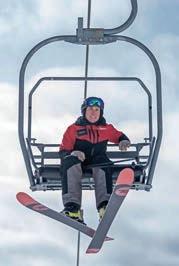
The first ski lift
DEAR READERS,
Thank you to everyone who voted on Nov. 8, and congratulations to the candidates who won their races.
One of our contributors, Nishelle Gonzales, is embarking on a project to help our community heal from so much political division. She is looking for your story about how political division has affected a personal relationship — specifically, one from which you’ve become estranged and are longing to repair and reconnect with.
“How has this division changed you?” Gonzales wrote. “What do you miss about this person? What are their positive attributes? What did their relationship contribute to your life? What are they missing in your life that you wish they were a part of? Do you think there’s a chance they’d be open to reconciliation? What are the boundaries that would need to be established so that you could love yourself and them at the same time?”
Those interested in participating can write to Gonzales at 7belonging@gmail.com. I applaud her for this project. We all need to heal a little, I think.
–Ben Olson, publisher
READER
111 Cedar Street, Suite 9 Sandpoint, ID 83864 (208) 946-4368
Cameron Rasmusson (emeritus) John Reuter (emeritus)
Advertising: Jodi Berge
Jodi@sandpointreader.com
Contributing Artists:
Ben Olson (cover design), Lyndsie Kiebert-Carey, Stephen Schultz, Romey Stuckart, Bill Borders
Contributing Writers:
Zach Hagadone, Ben Olson, Lyndsie Kiebert-Carey, Lorraine H. Marie, Brenden Bobby, Emily Erickson, Adrian Murillo
Submit stories to: stories@sandpointreader.com
Printed weekly at: Tribune Publishing Co. Lewiston, ID
Today’s skiers and snowboarders may take for granted how easy it is for them to access so many alpine regions and travel so many thousands of vertical feet. Did you know the first chairlift in the country was built right here in Idaho? Sun Valley was the first destination ski resort in the U.S., inspired by European resorts and developed by the railroad company Union Pacific, which thought the endeavor would help boost passenger rail travel. Train engineer James Curran is credited as the designer for the first lift, known as the Dollar, which was 2,360 feet long and rose 634 feet in elevation. Steamboat Springs in Colorado opened in 1915, followed by another 20 resorts around the country; but, in order to reach the skiable heights, skiers would board trains or horse-drawn sleighs and hop off at the top of their run. Sun Valley, opening in 1936, became the first resort to feature modern ski lifts. Every open-air chairlift, enclosed gondola and tram shares the same technology of Curran’s initial design.
weird exercise
Frustrated about the election results? Take out those frustrations by exercising. Banging your head against the wall for one hour will burn 150 calories. Just sleeping burns about 50 calories per hour, so don’t hesitate to crawl into bed and pull the covers over your head. Hang in there.
let’s get it on
Having sexual intercourse at least once per week can lower a person’s risk of heart disease by 30%, diabetes by 40% and stroke by 50%. Also, a recent study determined that those with active sex lives — defined by intercourse about once per week — are more likely to live past 80 years old. Some may say that “the good die young,” but “the good (in bed)” don’t seem to.
Subscription Price: $155 per year
Web Content: Keokee
The Sandpoint Reader is a weekly publication owned and operated by Ben Olson and Keokee. It is devoted to the arts, entertainment, politics and lifestyle in and around Sandpoint, Idaho. We hope to provide a quality alternative by offering honest, in-depth reporting that reflects the intelligence and interests of our diverse and growing community.
The Reader is printed on recycled paper using soy-based ink. Leftover copies are collected and recycled weekly, or burned in massive bonfires to appease the gods of journalism. Free to all, limit two copies per person
SandpointReader letter policy:
The Sandpoint Reader welcomes letters to the editor on all topics.
Requirements:
–No more than 300 words –Letters may not contain excessive profanity or libelous material. Please elevate the discussion. Letters will be edited to comply with the above requirements. Opinions expressed in these pages are those of the writers, not necessarily the publishers.
Email letters to: letters@sandpointreader.com
Check us out on the web at: www.sandpointreader.com Like us on Facebook.
About the Cover
This week’s cover was designed by Ben Olson, who used an old WWII propaganda poster from the US Army as the basis for this cover.
Midterm 2022 election results
Despite strong showing by write-in candidate Johnson, Herndon will head to Boise in January
By Zach Hagadone and Lyndsie Kiebert-Carey Reader Staff
Midterms often draw fewer voters than presidential elections, but a few big-ticket ballot items brought citizens to the polls in unusual numbers.
Most of the up-ballot races played out as expected: Republican Gov. Brad Little retained his seat, longtime Republican lawmaker and Speaker of the House Scotte Bedke won the race for lieutenant governor, Republican U.S. Reps. Russ Fulcher and Mike Simpson held onto their positions, as did Republican Sen. Mike Crapo.
Former-Idaho Republican Congressman and failed 2020 gubernatorial candidate Raul Labrador will be the new Idaho attorney general come January, Debbie Critchfield will be the superintendent of public instruction and Ada County Clerk Phil McGrane will be secretary of state.
Meanwhile, Idaho residents will be governed by a much more conservative Legislature when it gavels into session in January, with scores of hard-right candidates gaining office either through redistricting, retirement of incumbents or primary wins. And the Legislature will all but certainly meet more regularly than its customary three-month session, with the passage of SJR 102, the constitutional
amendment allowing legislators to call themselves into a special session without the governor’s approval. That measure squeaked by Idaho voters, 52.03% to 48%.
Idahoans also expressed their approval of the “advisory question” on whether to spend $410 million each year on education funding — though it came with political baggage.
As statewide media reported earlier this year, Reclaim Idaho’s education initiative passed — including tax increases to high-earning individuals and corporations — but Idaho lawmakers, including the governor, fronted another plan in the the latter days of the special session in September to fund education without Reclaim’s pinch on big pockets.
Specific to voters in the Sandpoint city limits, the ballot question as to whether the city should increase its tourist lodging tax from 7% to 14% and extend it to 2035 passed on a margin of 65% in favor to 35% against.
Among the most interesting races in the state was between Republican nominee Scott Herndon, who defeated two-term incumbent District 1 Republican Sen. Jim Woodward in the May GOP primary, and independent write-in candidate Steve Johnson.
Johnson had previously been in the election cycle as a Democratic challenger to District 1A Republican House candidate Mark Sauter, but dropped out of
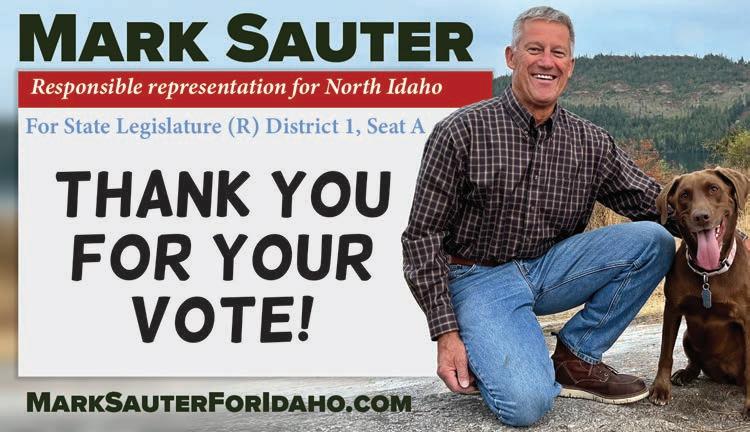
that race and changed his party affiliation to independent in order to oppose Herndon in the general election. Sauter, unopposed, drew 18,434 — the highest number of votes of any candidate in District 1.The next nearest was incumbent Republican 1B Rep. Sage Dixon, who drew 17,501 votes.
The only contested race in the district was Herndon vs. Johnson, with Herndon earning 13,064 votes to Johnson’s 9,025.
According to Bonner County Clerk Mike Rosedale, local turnout in the Nov. 8 election exceeded 66% and, with the writein candidacy of Johnson, stretched the counting process until around 6 a.m. on Nov. 9.
“All my poll workers were commenting on how big [the turnout] was,” Rosedale said.
Herndon had strong support in Boundary Country, with 3,239 votes to Johnson’s 1,616 — with Herndon winning by more than 50%. In Bonner County, however, Herndon drew 9,825 votes to Johnson’s 7,409 — a margin of about 25%, marking a huge showing for a write-in candidate.
Rosedale was nothing short of impressed with the outcome of the contest for the District 1 Idaho Senate seat.
“This is the most effective write-in race I have ever seen. Kudos to Steve Johnson for the campaign he did,” Rosedale told the Reader. “It was phenomenal. He did the best example of a
write-in campaign I’ve ever seen. … It’s an uphill battle for a writein candidate.”
Rosedale said his office, with the help of a bipartisan adjudication team, began individually analyzing and either accepting or denying write-in votes at 8 p.m., as soon as polls closed. The last of those ballots weren’t processed until 6 a.m.
Over those 10 hours, “the massive lionshare” of write-ins were votes for Steve Johnson in the senate race — 99%, Rosedale estimated. He said that maybe two or three votes went uncounted due to write-in illegibility; but, for the most part, the adjudication team found itself in agreement.
“We have to just be able to discern the intent of the voter,” he said. “If we can’t discern the intent, then we can’t count them. They have to have parts of the first name and last name. It doesn’t have to be spelled perfectly or right or anything like that, but it can’t be ‘Scott Johnson,’ or ‘Steve Herndon.’”
Initial results, stemming from early and absentee voting, showed Johnson with a considerable lead.
“I think the biggest shocker was the degree of the whipsaw from early voting and absentee to the Election Day [voting] at the polls,” Rosedale said. “Steve Johnson had it two-to-one, and then [Herndon] came back.”
That was the mood at Idaho Pour Authority on Nov. 8, where
Johnson met with about 60 of his supporters, who drifted in and out of the popular bottle shop, sharing hugs, handshakes and congratulations for what they considered a nervous but hopeful effort.
“This is really something,” Johnson told the crowd on election night, adding with visible emotion that he was “humbled” by the work of volunteer campaign workers and affirming his “faith in the future.”
“Much love to you all,” he said. “You can’t begin to describe the creativity, passion and energy that has gone into this campaign. …
“If we haven’t come out a winner in this campaign, then at least we have made a difference.”
On the morning of Nov. 9, Johnson shared his concession message with the Reader:
“My Congratulations to Scott Herndon for winning the state Senate seat for District 1.
My sincere Thank You to the 9,025 people who voted for me. That is the largest number of votes a write-in candidate has ever received in District 1. My sincere Thank You to the hundreds of volunteers who spent many hours working throughout Bonner and Boundary counties. My sincere Thank You to our amazing campaign team — local, extremely talented and all-volunteer.
We will continue to work for balance and stability in the
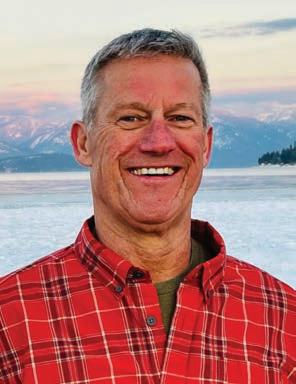
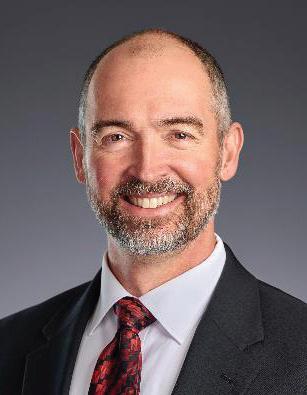
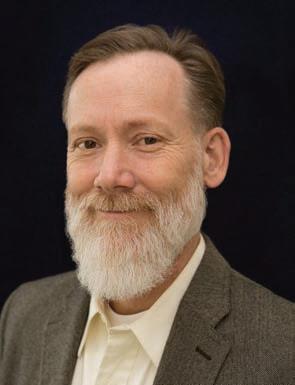
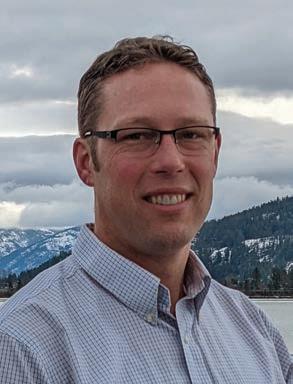
From left to right: Reps. Mark Sauter and Sage Dixon, Sen. Scott Herndon, Bonner Co. Commissioners Asia Williams and Luke Omodt. Courtesy photos.
community we all love. We are not going anywhere. We will monitor Mr. Herndon’s behaviors.
“It is my fervent hope that Mr. Herndon will rise to the occasion and replace his personal agenda with a commitment to honorably represent all the citizens of Idaho.”
Herndon, in his post-election statement Nov. 9, told the Reader: “The results from the election are in. We have secured the District 1 Idaho State Senate seat and will take office in three short weeks. Thank you to those who voted for me, volunteered for the campaign and donated over the last 18-month effort.
“Democrats, Republicans and those of other parties will find me easy to work with and eager to represent their constitutional and other necessary interests.
“Even before becoming a legislator, I have been able to write two bills that have passed the Idaho Legislature with unanimous, bipartisan support. It is my objective to be an effective legislator for the needs of Boundary and Bonner counties.
“If you know anyone in the district who needs to contact me, they can always reach me at 208610-2680.”
Herndon added: “In other good news, the constitutional amendment SJR 102 is on track to succeed. This will provide the people needed representation should it ever be required in times of urgency.”
Dixon did not provide a post-election statement by press time.
“I’m humbled by the support of our district, excited about the upcoming legislative session and committed to doing the work,” Sauter told the Reader.
In Bonner County, all five positions up for election saw unopposed Republican candidates, including incumbents Rosedale — who will continue serving as Bonner County Clerk — and Robert Beers, who was re-elected as coroner.
“First, I want to thank the citizens of Bonner County who came out to vote regardless of party affiliation,” Beers told the Reader “Second, a special thank you to all of those who took the time to
check the box next to my name. It is an honor and privilege to serve you for (Lord willing) another four years.”
Continuing in a familiar role will be Bonner County Treasurer Clorissa Koster, who was appointed to the position in May after it was vacated by Cheryl Piehl.
“I would like to thank all those who got out and voted in this Election and I thank you and truly appreciate all those who chose to vote for me,” she said. “I look forward to serving all Bonner County citizens as your Bonner County treasurer and my office is
here to serve all of you. My door is always open and please do not hesitate to contact me if you have questions or concerns.”
Bonner County will have a new assessor in the new year: Grant Dorman, who successfully challenged fellow Republican Donna Gow in the primary.
“Thank you Bonner County for your support in my race for county assessor! Property valuations, taxes and DMV services are important to all of us, so it is not a responsibility to be taken lightly,” he said. “I am humbled and honored to serve the community
in this capacity and look forward to working with all to provide a smooth transition on Jan. 9.”
Luke Omodt will fill the District 3 commissioner’s seat in January, replacing Dan McDonald, who did not run for a third term.
“Thank you to my family, supporters and donors,” Omodt said. “Bonner County is home. My priorities are to complete and adhere to the Comprehensive Plan update, improve relations between all of the elected officials in our county, and work to improve infrastructure and public safety. Our success has brought with it
new challenges that are going to require new solutions and civility to protect, maintain and improve our quality of life for all of Bonner County. Hold me accountable. Thank you.”
District 2 Commissioner-elect Asia Williams, who beat out incumbent Jeff Connolly in the GOP primary, did not respond to a request for comment before press time.
Panida Century Fund’s third week adds $4,320
By Reader Staff
The Panida Century Fund received individual donations totaling $2,160 in the past week, inching the fund toward its firstyear goal to undertake restoration needed for the historic theater.
But that amount, when matched by the matching pledge from Ting Internet, doubles to $4,320 raised this week.
“Definitely a significant number, for which we can shout out ‘thank you!’ to these donors,” said Panida Board Chair Jim Healey.
With this week’s donations, a total of $188,305 has been raised toward the Century Fund’s firstyear goal of $273,100.
The first-year “Phase I” funds will go to replace the main theater roof, which is experiencing some leaking in certain places, causing damage to the historic plaster inside, Healey said.
The Century Fund has a fiveyear goal broken out in annual phases, to raise a total $1.9 million
to address long-deferred maintenance needs leading up to the Panida’s 100th anniversary in November 2027.
The campaign has gotten a huge boost from Ting Internet, which has pledged to match individual donations of $5,000 and under, up to a total of $200,000. One of the goals of the matching campaign from Ting is to encourage as many small donors as possible to invest in the future of the Panida.
“One dollar becomes two dollars, five dollars become 10 dollars, and so on. It all adds up, and everyone gets to participate in the celebration of Panida’s 100th anniversary,” said Healey.
“We are closing in on the Panida’s Phase 1 goal,” he added. “But we have a good ways to go. For all who are weighing whether or when to donate — now is a perfect time. And Ting will match it.”
To donate, or see detailed plans for the campaign itemizing expenses, click to panida.org
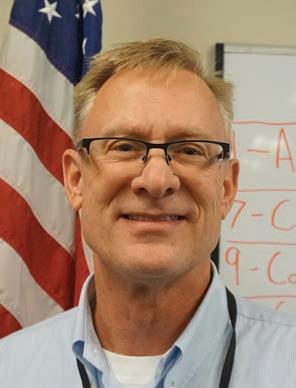
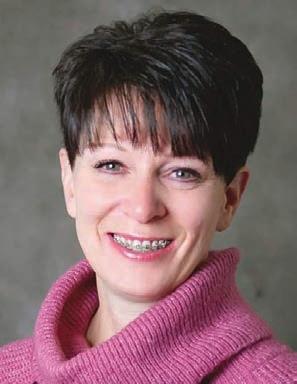
From left to right: Bonner Co. Clerk Michael Rosedale, Bonner Co. Treasurer Clorissa Koster, Bonner Co. Assessor Grant Dorman and Bonner Co. Coroner Robert Beers. Courtesy photos.
The Reader will continue printing the Panidameter showing the historic theater’s progress reaching the Phase 1 fundraising goal of $273,100 through the first year, with Ting’s donation matching helping along the way. Visit panida.org for more information.
The fair must go on
Bonner County Fair Board to revisit operations and procedures in wake of director’s death
By Lyndsie Kiebert-Carey Reader Staff
The Bonner County Fair Board met for its regular business meeting Nov. 8, receiving updates from departments and, more than anything, establishing footing around certain operating procedures after the death of Fair Director Darcey Smith earlier this month.
Bonner County Commissioner Dan McDonald shared news of Smith’s unexpected passing at the commissioners’ meeting on Nov. 1.
“Our thoughts and prayers go out to her husband and her two children,” McDonald said after a moment of silence, “and all of our Bonner County family.”
Smith became fair director in 2018 after six years as an administrative specialist in the commissioners’ office.
“In everything she did, she put 100% of her effort in to make it the best it could be,” Fairgrounds Administrative Assistant Maranda Montgomery posted to the fair’s Facebook page following Smith’s passing. “In the short time that Darcey was the Bonner County Fairgrounds Director she has accomplished so much and grew our Fair to a new peak. She was always thinking of ways to better the fairgrounds and expand it so it could continue to excel and grow.”
Smith’s impact was felt during the Nov. 8 board meeting, which saw the unprecedented attendance of commissioners’ office Operations Manager Jessi Reinbold and Bonner County Deputy Prosecutor Bill Wilson. For Reinbold’s part, she said she’d been invited to the meeting to help with some “basic housekeeping items” — of which there proved to be several on the double-sided agenda.
Two items were moved to executive session on the basis that personnel would need to be discussed, including choosing new signers on the fair’s bank accounts, as well as the approval of bills and account balances.
The meeting opened with public comment from Funky Junk founder Jennifer Wood and Carl Brenner, a local Boy Scout leader and Kiwanis member, who both offered their support of the fair board with upcoming events. Representatives of the local 4H program and Bonner County
Rodeo both provided brief updates.
Chris Larson, head of fairgrounds maintenance, shared with the board that the door to the fair’s office had been rekeyed due to there being no record of who had keys. Due to a similar lack of records associated with the main exhibit building, Larson said he would be seeking a quote to either rekey or install keypads on that building for the various groups that use the facility.
“Is that handing out keys to others, outside of the organization? That’s tricky, working with others in the community who need access,” Wilson said.
“We do it every week, all week long,” responded Vice Chairman Jody Russell, emphasizing what a hotspot the fairgrounds is for year-round community activities.
After accounting for the fair’s debit and gas cards — noted in part as “Where are they? Reasons for this card? Do we keep this card?” on the agenda — the board began to discuss various standard operating procedures surrounding all money transactions, who is allowed behind the fair office counter, and more. Chairman Eddie Gordon noted that many of these items didn’t necessarily require votes, as policies already exist, but that maybe the board could use a “refresher.”
The board opted to schedule a workshop to revisit fair operations on Monday, Nov. 14 at 4:30 p.m. at the fair office conference room.
“I think the idea is to continue to go through all of our policies and procedures, then update and readopt those,” Russell said.
The fair board then addressed several items, on which it had already voted at previous meetings, but for which there were no minutes. These items included adopting a theme for the 2023 Bonner County Fair, which will be “MeMOOries in the Making”; approving entertainment for the 2023 fair; increasing facility use fees; approving fee schedules for fair, dry, winter and summer camping in the fairgrounds RV park; adopting a new policy for washing sheep during the fair; and, finally, voting down a measure to allow outdoor vendors at the fairgrounds’ annual Christmas Craft Fair, slated for Nov. 19-20.
Bits ’n’ Pieces
From east, west and beyond
East, west or beyond, sooner or later events elsewhere may have a local impact. A recent sampling:
New data from Americans for Tax Fairness shows 465 billionaires contributed “at least” $881 million to this year’s midterm elections — a figure 27 times more than in 2010, when the Supreme Court opened the way for unlimited campaign contributions to super PACs. According to Americnas for Tax Fairness, billionaires represent 0.000002% of the population.
Both political parties have billionaires, but Republicans have far more. Billionaires provided 11.9% of campaign funding in 2020; now the figure is 15.4%, according to The New York Times.
Faith in the election outcomes are further challenged by claims that if Republicans don’t win, Democrats stole the election. There has also been a Republican movement to deny votes not counted on Election Day, even if it is not possible to tally all votes that day. Republican operatives are seeking to toss mail-in ballots, particularly in swing states. The Department of Justice monitored polls in 24 states for voter intimidation, ensuring federal voting rights laws are observed.
Economists expected job availability to drop in September due to Federal Reserve efforts to cool the economy. Instead, CNN said job openings were at 10.7 million, contrary to expectations of 10 million.
Recently the Federal Reserve approved another interest rate increase intended to slow inflation. The Financial Times notes that while wages have been rising, prices are rising faster, making the U.S. Federal Reserve’s Jay Powell a “playground bully” when he raises interest rates (which he admits will result in job losses).
According to a FT analysis, companies are passing higher costs on to customers, while using inflation excuses to “expand profit margins.” That has been encouraged by consumers not curtailing their spending, so higher prices remain in place. FT suggests Powell clarify what higher interest rates are supposed to achieve, since inflation is not declining.
Food and other industries are also jumping onto the higher prices bandwagon: Chipotle Mexican Grill, which saw a $257 million profit last quarter, said it will raise prices by almost 15% from last year, when its profits were up 26% over the previous year. Basically, says Accountable. US, corporations hide behind pandemic and supply chain problems as an excuse to exaggerate their costs.
Climate negotiators at the COP27 climate gathering are aware that China is the
By Lorraine H. Marie Reader Columnist
world’s leading producer and user of solar panels and wind turbines, and a top user of energy from hydroelectric dams and nuclear power plants. But China also burns more coal than the rest of the world combined, The New York Times reported.
Former U.S. energy official David Sandalow said there is “no solution to climate change without reducing China’s coal combustion.”
Some regions of China are reducing use of coal, others are increasing it and more coal-fired power plants are being prepared to come online.
Brazilians in their recent election returned left-wing former-President Luiz Inacio Lula da Silva to office, ousting farright populist President Jair Bolsonaro — who once said that “only God will take me out of Brasilia.”
The return of da Silva, more commonly known as “Lula,” to the presidency is expected to have a positive impact on the nation’s rainforests. According to Axios, when he previously served, from 20032010, Amazon deforestation fell 43.7%. It rose 72% under Bolsonaro, who assumed office in 2019, and during whose presidency Amazon defenders were attacked and killed as cleared forests were used for agricultural products, including cattle grazing.
COVID-19 cases are rising due to more indoor time and more transmission of COVID-19 sub-variants. So far the sub-variants can attack those who are healthy and vaccinated, and treatments may not work as well for the morphed variants. Numerous media sources peg current COVID-19 deaths at 400 per day in the U.S.
Federal prosecutors have spent over a month claiming that Oath Keepers leader Stewart Rhodes and four co-defendants are guilty of seditious conspiracy in connection with the Jan. 6, 2021 Capitol insurrection, according to CBS.
Rhodes recently testified that he never ordered any attack by his militia. Prosecutors said Rhodes’ texts and open letters are contrary to his claims. Rhodes said “being open about wanting to crack heads is what got the Proud Boys prosecuted,” in a reference to previous events the Oath Keepers attended.
Blast from the past: “Nothing worth doing is completed in our lifetime; therefore, we must be saved by hope. … Nothing we do, however virtuous, can be accomplished alone; therefore, we are saved by love.” — Rienhold Niebuhr (1892-1971), son of German immigrants, born in Missouri, awarded the Presidential Medal of Freedom. He was an ethicist and political commentator.
Emily Articulated
A column by and about Millennials
Hamilton
By Emily Erickson Reader Columnist
This past week, while getting barraged by the whirlwind of local and national political fanfare, I found a foothold in positive political engagement by revisiting our nation’s founding story, and the chronicled life of one of our most influential Founding Fathers, one hip-hop number at a time. The Broadway sensation, Hamilton, follows the life of Alexander Hamilton, and is — I’m convinced — the comfort food of politics-related media consumption.
What began as me listening to an interview of composer Lin Manuel Miranda on Adam Grant’s Re:Thinking podcast, quickly spiraled into a dayslong shuffle of the Hamilton playlist on my phone, and culminated with a 14-minute YouTube video clip of a live performance by the Hamilton cast at the White House in 2016 (which I watched… twice).
The performance was preceded by an address by then-President Barack Obama, in which he reflected on the many ways Hamilton captured the spirit of America (and promptly turned my comfort food into hard-to-swallow food for thought).
He described, “In each brilliantly crafted song, we hear the debates that shaped our nation, and we hear the debates that are still shaping our nation. We feel the fierce, youthful energy that animated the men and women of Hamilton’s generation. And with a cast as diverse as America itself, including the
outstandingly talented women, the show reminds us that this nation was built by more than just a few great men — and that it is an inheritance that belongs to all of us.”
Despite this performance taking place a mere six years ago, it struck me how far away I’ve felt lately from the ownership of the America that Obama described; the inheritance somehow less “mine” than it was before.
Every old, career-politician elected into a position of power, and every social milestone repealed in an effort to return to the fictional “good old days,” is like a wringing out of the youthful energy and belief in our dynamic ability to reflect an ever-growing and changing population.
Obama continued: “We hope that the remarkable life of Alexander Hamilton will show our young people the possibilities within themselves, and how much they can achieve in the span of a lifetime. And we hope that they’ll walk away with an understanding of what our Founders got started — that it was just a start. It was just the beginning. That’s what makes America so great. You finish the
story. We’re not yet finished.”
It seems we’ve lately lost sight of the notion that America’s finish line wasn’t 240 years ago, and that our founding documents weren’t set in stone — to be amended with the most cumbersome chisel and hammer, and thus never (or extremely rarely) done. This lack of clarity — of America as a perpetually under-construction project — makes our system feel broken, cracked to its fundamental core.
While important, the “big issues” by which we’re so divided are also a distraction from this systemic brokenness, like someone hemorrhaging from a gaping wound demanding to know on which desk they stubbed their toe (an endeavor worthy of exploring, once the knife is removed, and the stitches have set).
The wounds in our system have names, just confusing enough to further the guise that we should be paying attention to other things, like gerrymandering, lobbyists and partisanship. What if instead of redrawing lines to manipulate the popular voice, we listened to what the majority of Americans wanted? What if every candidate running for office received the same amount of money for their campaign — a campaign in which they described their qualifications, practical solutions for the future, skills in negotiation and compromise, and personal values, rather than parroted ideas from the people lining their pockets?
What if people could vote on the individual aspects of their life being affected by
politics, and for the people best equipped to solve their unique problems, regardless of the letter next to their name?
And what if the people that lead us did so not out of a desire for power and personal gain, but for the humble duty of doing a job well until it’s time to pass the responsibility to someone who can do it better?
Obama concluded: “We are the project that never ends. We make mistakes. We have our
foibles. But ultimately, when every voice is heard, we overcome them. It’s not the project of any one person. America is what we make of it.”
And I guess, I just wonder what we’re making of it.
Emily Erickson is a writer and business owner with an affinity for black coffee and playing in the mountains. Connect with her online at www. bigbluehat.studio.
Emily Erickson. Retroactive
Bouquets:
GUEST SUBMISSION:
•“Kudos (again) to Northern Lights and Avista linemen for the heroic work they did during and after the big windstorm. Going out in those conditions can’t be much fun.”
— By Ted Wert
•Here’s a hearty thank you to all of our local veterans who have served our country. We appreciate your sacrifice and dedication to our country. Thank you!
•Bouquets go out to all the volunteers and Elections employees who work the polling places and help with counting ballots. We do our part by voting, and it’s incumbent on them to do their part and count them properly. Election Day is always a long slog until the end, but their work is critical to ensuring our free and fair elections remain that way.
Barbs:
• I found another pet peeve: It’s known online as “main character syndrome.” For those who haven’t heard of it before, this essentially refers to someone who is totally self-centered. They might see themselves as the protagonist in a movie about them, while everyone else in the world is just a supporting actor, placed there to further the main character’s story. Therapist Kate Rosenblatt shared four characteristics to look out for to make sure you aren’t suffering from this fate: a sense of entitlement in which everything is about you and your problems; framing your own life as perfect, as if viewed through rose-colored glasses; unable to accept any criticism, constructive or otherwise, and; because they feel their lives slipping out of control, they attempt to “take back the reins” by assuming a position as the main character. Loving yourself is a very healthy thing, but not everyone was put on this earth to support your story. In fact, no one was. We’re all on stage together in this movie. Some have different roles, but every part is important to the total production.
Sacrifice…
Dear editor,
When I returned from Vietnam the day before Christmas in 1969, the next summer I backpacked through Europe for two months. I had a Eurail firstclass railroad pass and it was cheap.
I visited Oslo, where a college friend from Norway found records of my relatives, including my grandfather’s relatives. He then drove me to his parents’ cabin in Bergen. Along the way, I saw memorial plaques on the highway, dedicated to heroes from World War II. He said they were for countrymen who were forced to drive buses of German soldiers to different locations in his country. But many of them drove off the roads on mountain passes, committing suicide in an effort to help the war effort.
In this present age of political dissent, it is hard to relate to such dedication that a man may do to love and protect his motherland. Perhaps if not here, I wonder what an individual could do to help people in Ukraine.
James Richard Johnson Clark Fork
‘Look what’s goin’ down’…
Dear editor,
“There’s something happening here. What it is ain’t exactly clear. There’s a man with a gun over there, telling me I’ve got to beware...”
How is it, in this present day in America, that grown men are fatuously walking around displaying assault rifles and handguns like little boys playing cowboy, with no apparent sense of shame, social responsibility or common decency — right in front of impressionable children? Is this the Middle East or some banana republic where demagogues hold sway over ignorant and reactionary masses? It’s like a whole MAGA subculture has regressed into an extended, mean-spirited adolescence — a case of mass arrested development with no concept of emotional maturity — indulging in who-knows-what kind of lurid, violent fantasies.
As a USMC Vietnam veteran who carried, slept with and relied upon an AR-15 for real, all this scuzzy civilian obsession and posturing with assault weapons makes me want to puke and never stop. So for all you Trumper dupes and G.I. Joe wannabes out there: “What the hell are you so afraid of that you need to impress others with your badass power poses?”
I’m no paragon of manly virtue, but this macho B.S. has the pathetic odor of ‘compensation’ to me.
What happened to our noble American experiment of “live and let live,” with our enlightened acceptance of differences in religion, culture and lifeways as part of meaningful democracy? True patriotism for me is based on trust in our democratic system, and requires faith, hope and courage. Truly courageous people have no need to carry an arsenal of weapons. They roll with co-creating an advanced, worthy society.
“I think it’s time to stop, children, what’s that sound? Everybody look what’s goin’ down.”
Seth Phalen Sandpoint
OPINION
Downtown block party to support Pine Street Woods road access
By Reader Staff
Keeping the road to Pine Street Woods open all winter is a community effort. Each year, Kaniksu Land Trust, Pend Oreille Pedalers and Sandpoint Nordic Club host the Get (Pine Street Woods) Plowed fundraiser to ensure that nordic skiers, snowshoers, fat bikers and other winter recreationists can drive up the road to Pine Street Woods.
This year, the trio of local organizations is going all out Thursday, Nov. 10, to host the biggest Get Plowed party ever.
Cedar Street from Second to Third avenues in downtown Sandpoint will be closed 6-9 p.m. for the Get Plowed block party, featuring live music, the annual “Guess the Snowfall Contest,” fill the sandbag with “Pocket Change for Plowing,” and food and drinks from Eichardt’s, MickDuff’s, Idaho Pour Authority and Matchwood Brewing. Proceeds will go toward Pine Street Woods road winter maintenance. For more information, contact Kaniksu Land Trust at 208-263-9471 or info@kaniksu.org.
Blues power
By Adrian Murillo Reader Contributor
The time has come to praise our own unique Sandpoint sound of democracy and equality throwing it down every Monday night. I’m talking about the blues jams at Eichardt’s.
In my life, money is too tight to mention. This makes me a very frustrated musician. I can’t afford proper equipment (synth, PA, mic) and I am also a deep-blue soul living in a red state, so you know I got the blues. Every day I got the blues. But there’s nothing better for the blues than to hear the blues played live. Thank gawd for blues night.
I had forgotten about this longstanding tradition that makes Eichardt’s a down-home treasure. But I heard the Liam McCoy trio play at Matchwood this summer and was reawakened to this old passion. I asked him to perform at Pride this year and he did. McCoy, 21, also sat in on two of my songs during my set — a real thrill for me. When I heard he often jammed with John Firshi on Monday nights, I started going again to check it out. I always sit off to the side by the doorway leading upstairs. Visually, what I see of the stage is like a Picasso painting. A disjointed jumble of planes and angles, sound, motion, colors. Blue neon light in the window, rainbow flag tucked up high in the back corner of the stage, brick wall, John Firshi’s face bathed in an amber-red spotlight, the brassy glint of Denny’s sax like visual sparks of notes, bright spots of light on the other players, red guitar hanging from the ceiling, smiling faces crossing my line of sight entering or leaving. A three-dimensional painting: “Tavern Life, Early 21st Century.”
I come from a musical family. My father played all the saxes and clarinet. He had a slew of cousins who all played something: upright bass; piano; drums; percussion (congas, timbales, maracas); trumpet; or sang. It was a rare Saturday night when my father didn’t have a gig somewhere. They covered everything from big band swing (Ellington, Dorsey, Kenton) to mambo, cha-cha-cha and Mexican music (cumbias, rancheras). When I discovered at 13 that the piano was the instrument for me, my father sent me to spend a few summer weeks with a piano-player cousin of his who, when I was 14, taught me boogie-woogie grooves that he made me practice every day before I could go outside and play. I loved it.
Every adolescent boy needs to master at least one manual creative or reparative skill to keep him moving in the right direction.
Video games don’t cut it.
I had two cousins — brothers Dave and Rick. Dave was a few years older and Rick was a year younger. We all found our instruments around the same time. They turned me on to the blues. Dave was a brilliant guitar player who mastered his heroes, lick for lick, no sweat — B.B. King, Albert King, Clapton, Hendrix, Santana, Wes Montgomery. No style was beyond him. Rick, inspired by Paul Butterfield, took up the blues harp and in a couple of weeks he had it nailed as good as Butterfield could blow it. He also grew into a soulful blues singer over the years in the way only a life of racist bosses and faithless women can make a man.
We jammed at my house because I had the acoustic, upright piano. By the time I was an adult, family gatherings were three generations of musicians sharing the stage: my father and his cousins doing their swing/ cumbia thing, us doing our rock-and-rollHendrix-blues thing and the kids rapping and scratching to Funkadelic samples. This was our family expressing our shared spirit. Music was the best part of us, our healing power and pleasure. It wasn’t a party until grandma got up and danced.
I knew growing up that musicians aren’t perfect. We all had our issues, imperfections. Different political perspectives. But for us, family is family no matter what and music is the blood that runs in our veins. On stage or just jamming at home, we formed a respectful democracy of equals no matter the level of development. Everybody got a turn to shine and stretch. We wanted for all what we wanted for ourselves, to reach down deep to express full potential.
That’s the spirit I feel at Eichardt’s. Music as a democracy of equals — a family of sorts — fathered by the blues. You never know who’s going to show up to sit in.
Like, Young Sam (I didn’t get his last name) in his early teens, a study in contrasts, standing absolutely still, almost stoic, as he rips it up. He told me his influences range from the Kings (Albert, Freddie, B.B.) to Joe Bonamassa and Steve Vai, which you can definitely hear. He’s got a searching, sonic drive, a futuristic howl reaching for that cosmic soar. All within the 12-bar format. These are his woodshedding years and he’s lucky to have a live venue to hone his chops. I advised him that although it’s only natural for young players to cop the style of others, you eventually have to grow your own style, take these influences to shape your own voice of authentic, deep truth telling.
What I love hearing is the enthusiastic love for the art form Liam and Sam bring to the blues. The energy of commitment to it,
In praise of Eichardt’s Monday night ‘democracy of equals’
open to jamming with anyone for the rush and discovery it brings.
There have been nights when women stepped up to sing. Some sing in the true blues tradition of telling a story. You can hear the heartache. Others seem to be calling attention to themselves, off-beat, confusing volume for passion. You’ve got to live the life to be an authentic blues shouter. No one would say Billie Holiday was a loud singer, but every note oozed a blue life. But a blues jam is a stage of rotating desires open to any who have the heart to work out their blue feelings. I noticed that the women loved hearing a strong, loud female voice, however, which makes sense in this time when women’s agency is being repressed and criminalized.
Blues jams are healing for the people who listen. In these politically discordant, divisive times, I think what people seek from music are chord progressions and solos, however wild and uncertain at first, that always reach a sweet resolution. The experience of shared satisfaction has become a deep need and the blues provides it. You can find it every week at Eichardt’s. Firshi’s willingness to share the stage, whole sets with others, is a rare display of generosity and respect for other voices, styles.
One highlight for me was when the young Mexican musicians brought up from Baja, Calif. by our local music conservatory sat in for a set. The drummer and bass player who normally play with Firshi turned over their instruments to two of them, and a violinist and cornet player also from Mexico joined in. The kid playing bass, in particular, took to the blues like a fish to water, proving the blues is truly a universal language. I later told the young Mexican who played the bass that the blues is the real American music, not classical.
Not only was this an intergenerational moment, it was intercultural. Where else can you experience this in Sandpoint? This deserves our continual support.
As for me, my sound is steeped in the blues but I don’t really play that old 12-bar format much. I’m bent on working out a straight-ahead funk drive (which I think players like Sam and Liam can appreciate) that breaks on through to the other side, breaks the spell of fear, indifference and acceptance of the spreading authoritarianism slowly squeezing our hearts shut. Performance as ceremony of public healing.
My vocal chops have got to bring it on home for me. If I can only break my chocolate habit.
Adrian Murillo is a longtime Sandpoint writer, musician, poet and activist.
Science: Mad about
language
By Brenden Bobby Reader Columnist
Language is a bit of an enigma. It’s impossible to pin dates on the development of a particular spoken language. If it’s a written language there will be records, of course, but even these may not be truly reflective of when people first wrote things down — let alone when they started speaking.
The spoken word leaves behind no direct physical evidence. It has no record of its existence apart from secondary relics born of shared knowledge. After a word is spoken, it exists only in the minds of those who heard it until it is repeated and translated by others. Because of this method of transfer, speaking isn’t nearly as efficient as writing when trying to preserve a message, but it’s far more efficient at conveying knowledge than gesturing.
Because of the impossibility of accurately pinning a date on the formation of human language, most scientific debate on the matter has completely ceased. Very little of this topic has been discussed in the scientific community since the 1800s, but that hasn’t stopped people from forming numerous hypotheses about it. The merits of discussing something that will never be proven without time travel is questionable at best, but it’s fun to think about.
The ability to vocally communicate information isn’t a concept that’s isolated to humans. Most primates are capable of some form of vocal communication, as are dogs, cats and most birds. Many birds are capable of complex vocalizations designed to communicate specific messages. Take the black-capped chickadee as an example. Each chickadee has a
specific voice, and will perfectly replicate a call each time it makes it until an external stimulus triggers it to change the call. A chickadee calling its own name and singing “chick-a-dee-dee-dee” has been observed to be a “danger gauge” for other chickadees. This call is warning other chickadees in the area about how dangerous a moving object in their field of vision is. The more “dees” added, the more wary other chickadees should be. The caller will similarly use the exact pitch and tone each time it sings, though these pitches and tones will vary from bird to bird — similar to an accent or a dialect in human speech.
Dogs and cats are both capable of vocalizations as well, and each carries its own set of quirks specifically adapted to living in close proximity to humans. The various noises our dogs make generally serve the purpose of communicating basic needs to humans. Dogs rely more on body language than vocalizations to communicate their desires, though each dog has a unique repertoire of barks, yips, growls, howls and calls, depending on a number of factors from upbringing to breed.
Cats have also developed a set of vocalizations specifically designed to capture the attention of people. Domestic felines seem to know how to tug at our heartstrings, offering a light and pitiful “meow” that they only direct at humans. This is similar to the way we baby-talk our pets, but it is unique in the fact that it’s a response developed specifically for interspecies communication. It would be like if you spoke Dothraki to your cat but reverted to English when speaking with other humans. How do you say:”Stop clawing me” in Dothraki?
We can’t pinpoint when hu-
mans first started using language, we have to use other evidence to guess. The clearest indicator that language may have been at play among prehistoric humans are shared tool designs. It didn’t take Albert Einstein to flake chunks off a rock and create a point, but seeing identical designs popping up from Africa to Europe is a pretty good indicator that humans had some ability to do more than show others how to make a tool, but tell each other and compare notes as well.
Acheulean tools are what we think about when we imagine cavemen wielding stone tools: often pear-shaped or formed into a triangle, these first showed up around 1.6 million years ago and have been excavated as far north as France, as far south as the southern tip of Africa, and as far east as China and Indonesia.
It’s likely that language evolved in tandem with the development of tools, as crafters needed a way to communicate to others how the items were made as well as convincing other groups of people to trade goods for their tools.
It’s impossible to say what the language of humans from 1.6 million years ago sounded like. It may well have been the comical grunts we attribute to cavemen in modern media, though I’ll be the first to admit that this is a silly trope. The fact that we move our mouths differently from people that long ago doesn’t automatically make us smarter than they were. Whatever they were speaking, they were undoubtedly able to elicit the same range of emotional reactions that Shakespeare would evoke millions of years later, as their language was intrinsically tied to their life experiences.
The value of language comes from what you and those around you take from it. A song’s lyrics may bring you to tears but it may cause me to change the dial. This is just as true of other languages than our own today.
If you have a love of language arts and you want to share that love with your community, consider volunteering to become a tutor at the library. We have a magnificent team of tutors at the library, but they need help. Our population is rapidly increasing,
as is the demand for tutors. The library is able to provide training and support to get you started on the path to becoming a volunteer tutor — all you need to worry about is showing up and sharing your passion to help others learn and appreciate language like you. If this seems like something that would appeal to you, apply at ebonnerlibrary.org/volunteer. Did I mention that the library will throw parties in your honor? Our love language is pizza. Stay curious, 7B.
Random Corner
know much about chopsticks? We can help!
•The first evidence of chopsticks comes from China, about 5,000 years ago. Remains of bronze and metal chopsticks have been found in the ruins of Yin in the Henan Province.
•The earliest form of chopsticks was most likely a set of slender twigs used to pick out food from a cooking pot. The earliest evidence of people using chopsticks for eating is dated to around 400 C.E., when it is believed that food and fuel shortages led Chinese chefs to experiment with their cooking methods by dicing food into tiny pieces. This was a clever way to conserve firewood and resources, including no more need for using knives at the table.
•By 500 C.E., chopsticks had been introduced to Japan, Vietnam and Korea. Each country put its spin on the simple chopstick design. The Japanese preferred using chopsticks for religious ceremonies, splitting a single piece of bamboo in two, but leaving them joined at the
top — like a big pair of tweezers. Other countries used jade, ivory, brass and coral.
•There have been some interesting myths surrounding chopsticks over the years. At one point in China, silver chopsticks were supposedly used to detect poison, the theory being that if your food had been poisoned, the chopsticks would turn black. This wasn’t always a reliable method, though. Another myth states that you will miss a plane or boat if you use an uneven pair of chopsticks. A Korean myth says that the closer you hold your chopsticks to the tip, the longer you will remain unmarried.
•Using chopsticks has some surprising health benefits. For instance, eating with chopsticks engages 50 muscles in the body. Also, the concentration and precision of using chopsticks positively affects the brain. Finally, since it takes more effort for each bite, it helps people eat slower and chew more.
Conservation: From the Timber Wars to collaboration
What is ‘winning’ in the woods? — Part II
By Zach Hagadone Reader Staff
This article is Part 2 of the conclusion to a series of articles supported by a grant from the Idaho Humanities Council and sponsored by Friends of Scotchman Peaks Wilderness. Previous installments were published in the Feb. 2, Feb. 9, June 2, June 9 and Oct. 20 editions of the Reader. For more information on this series visit scotchmanpeaks. org. To read the entire series, visit sandpointreader.com and click on “Special Reports” on the left side of the homepage.
‘The Quincy Library Group got it all started’
Away from the headline-grabbing activist protests and court battles, resentment on the part of timber communities and political bluster of politicians, some things were quietly happening in the mid- to late-1990s that would help clear the way for greater collaboration.
In the neutral space of the public library of Quincy, Calif., an initially small number of timber industry representatives, government officials and conservationists came together trying to find a path forward to allow timber harvests within spotted owl territory, while also putting in place policies and practices to protect or at least mitigate impacts to the habitat.
For Alan Harper, director of Forest Operations for the Idaho Forest Group, it was the aptly named Quincy Library Group that really kicked off the era of growing collaboration. And he would know — he was one of its original participants.
“I think the Quincy Library Group got it all started,” he said. “It was kind of a big thing.
Before that you would never have gotten people from conservation and industry in one room together.”
Harper earned his bachelor’s degree in forest management from Humboldt State University in 1985 and went on to work laying out timber sales in northeastern California and overseeing the logging crews contracted to work on them. He went into business for himself writing forest management plans and contract logging in 1989. That put him in the perfect time and place to become involved in the Quincy Library Group.
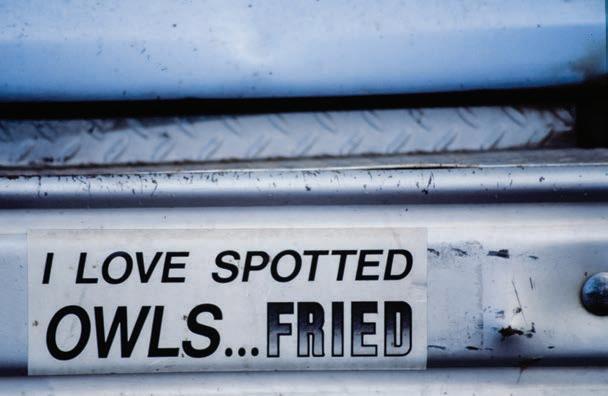
“I can remember the bumper stickers on all the loggers’ trucks that said, ‘Due to the shortage of paper you can wipe your butt with a spotted owl,’” he said. “It was quagmired down to whatever the conservation groups wanted, they weren’t succeeding; the timber people weren’t getting what they needed to keep people employed and keep communities profitable.”
After years of deliberation, the collaborative crafted the Quincy
Library Group Forest Recovery and Economic Stability Act of 1997, which sought to establish a five-year program to protect spotted owl and riparian areas, as well as thin 40,000 to 60,000 acres per year in three California national forests to protect against fire. Critically, the group’s efforts would have removed 494,000 roadless acres from future road construction or logging.
Though the Act made it through the House, it died in the Senate. However, the legislation broke ground for its time — if not by force of law, then in terms of public lands politics.
In its Sept. 29, 1997 edition, High Country News carried a 5,626-word feature article on the QLG’s efforts under the headline, “The timber wars evolve into a divisive attempt at peace.”
In that story, then-HCN Publisher Ed Marston neatly summarized the snarled conflict:
“If the timber struggle had been a declared war, industry would have sued for peace. But there was no one to surrender to. The timber wars are dispersed,
without fixed goals. The industry wants all the forests it can get, and the environmentalists want all the forest protection they can get,” he wrote.
Harper said the QLG’s greatest significance was in opening channels of dialogue that could cut through the rigidity of the various parties in the conflict.
“I don’t know if we actually resolved anything, but we started talking to each other,” he said. “I do know that for the couple of years that I was attending those meetings, at least we were talking civilly to each other, and I don’t think that there was any collaborative stuff taking place up in the Northwest prior to that.”
Though the Quincy Library Group represented a flash of collaboration, the conflict still had a ways to go before any attempt at peace — whether “divisive” or not — could succeed. Only two years after the introduction of the QLG’s Act, Seattle District Court Judge William Dwyer
ruled in 1999 that the U.S. Forest Service and Bureau of Land Management hadn’t held up their part of the Clinton-brokered bargain that required sweeping wildlife surveys on federal forests before granting logging permits in the old-growth forests of Washington, Oregon and northwest California.
For many, it looked like a step toward Dwyer’s previous ruling in 1991 that put a stop to any and all logging on 25 million acres of spotted owl habitat within federal jurisdiction.
In an August 1999 front-page article, The New York Times reported that Dwyer’s decision indicated “the region’s timber wars are flaring up again.”
‘Sufficiently included’ By the turn of the 21st century, few in industry, government or conservation were interested in seeing the region’s timber wars flare up again. Both industry and government feared continuing courtroom battles. Meanwhile, as Idaho Conservation League North Idaho Director Brad Smith said, conservation groups had “spent their political capital fighting the Timber Wars.”
The years of conflict — and the sense of weariness with it — came through in a Dec. 21, 1999 article from the Associated Press, reprinted in the Bonner County Daily Bee, on the decision by Dwyer to approve a settlement in the lawsuit brought by environmental groups earlier in the year “that halted enough logging to build a small city — but the larger fight is far from over.”
The AP reported that environmentalists promised to “aggressively push the Clinton administration to protect more ancient forests in the Pacific Northwest,”
New tree growth out of an old stump. Courtesy photo.
< TIMBER, con’t from Page 12 >
while, “Timber industry officials, who are skeptical the settlement solves anything, say they will try to make sure the stalled sales are released sometime next year.”
At the same time, the Clinton White House “acknowledged that timber battles will continue but said the approval … [by Dwyer] was a victory for the Northwest Forest Plan.”
Ultimately, in his six-page opinion, Dwyer dismissed the suit — brought by 13 environmental groups — finding that “each side made ‘substantial concessions’ in the deal.”
Those “substantial concessions” included the requirement of the Forest Service and Bureau of Land Management to study about 80 rare species potentially affected by logging on public lands, though removed nine species from the list because they were “more common than previously thought”
What’s more, the agencies were allowed to suspend surveying for 13 more “hard-to-find species if they are not discovered after one year.”
These were the “slugs and bugs” to which University of Idaho Professor Emeritus Jay O’Laughlin referred when he described the species monitoring program that came out of the Northwest Forest Plan, and the protection of which animated much of the conflict surrounding what came popularly to be known as the Timber Wars.
As with many compromises, no party was entirely happy with the outcome. The AP article stated that environmental groups were displeased with the settlement and an attendant amendment to the Northwest Forest Plan, which they said would open the way for the cutting of 1.1 million acres of old-growth tree stands.
“That’s unacceptable to us,” the AP quoted Oregon Natural Resources representative Doug Heiken, whose group prompted the suit.
“It was very disappointing,” the AP quoted Northwest Forestry Association President Jim Geisinger, doubting that even with the “major concessions” timber sales would be released
by the fall of 2000, noting that the feds had not succeeded in completing their surveys during the previous five years.
“It’s a defeat for the Northwest Forest Plan — it’s certainly a defeat for people who were counting on these timber sales,” he added.
In summary, the AP wrote that the Northwest Forest Plan intended “to settle the timber wars over the threatened spotted owl, broadly dictates the level of logging and other activities on Forest Service and Bureau of Land Management land in western Washington, western Oregon and northern California.
“The plan is supposed to ensure environmental protections in the region while allowing a minimal level of logging.”
Yet, the AP reported, “Dwyer handed a major defeat to the timber industry officials, who had intervened in the lawsuit and had asked the judge to reject the settlement. The judge turned back arguments that the settlement will hurt the industry and will not free up any sales.
“Dwyer also rejected industry officials’ claims that they were locked out of settlement talks, saying instead they were ‘sufficiently included.’”
As the hot phase of the Timber Wars moved from protests in the woods to the cold phase of the courtroom, many of the players felt the conflict had to give way.
“Both sides recognized and realized that neither were getting anywhere, and so I think a legacy is the recognition that with the right people in the room who are willing to put everything on the table and civilly discuss what the needs on the landscape
are and try to figure out a way forward, that we have some wins,” said Shawn Keough, who has spent decades in the timber industry — today serving as executive director of the Associated Logging Contractors — and began a 20-year stint as Idaho Legislative District 1 senator in 1996, retiring in 2016 as the longest-serving female senator in Idaho history.
Asked to identify a “moment” of collaboration amid the so-called “Timber Wars,” Keough said, “it was right around the early 2000s,” though, “I think originally it was very skeptically greeted by both sides as just a ploy.”
She added: “At the time I described collaboration as getting people together into the room and beating them down — and that’s not obviously physically — until they wanted to get out of the room so badly they found something they could agree on. Because it was pretty painful to bring divergent interests to the table and try to facilitate through that, moderate that, and try to figure out if there’s any common ground at all. Those are pretty painful discussions to have. Not
goals by working together,” said Brad Smith, who has worked 16 years with the ICL.
In the first decade of the 2000s, ICL participated in collaborative efforts to pass the Idaho Roadless Rule in 2008 and the Owyhee Canyonlands Wilderness Bill in 2009 — the latter which resulted in the Owyhees Public Management Act, setting aside about 500,000 acres of wilderness in southwest Idaho.
Smith called the Owyhee Initiative a “turning point” for collaboration in Idaho.
everybody bought in and not everybody buys in today.”
‘Turning point’
Idaho Conservation League pre-dated the “Timber Wars” proper, having been founded as a 501(c)(3) in 1973 and serving as a key player in the establishment of the 2.3 million-acre Frank Church-River of No Return Wilderness. During the 1980s, ICL was involved in passage of the Idaho Clean Lakes and Water Quality Act and had a hand in the Idaho Forest Practices Act in the ’90s, which gave the organization a seat at the table during the era of the “Timber Wars.”
“I think all sides realized [that conflict] wasn’t a sustainable business model for anyone, and they realized that they were more likely to achieve their
Though it had more to do with cattle grazing and mining than timber, “It was a collaborative model exported to the rest of the state,” he said. “Today we’re seeing collaboration used as a tool for many types of environmental issues.”
Roughly contemporaneous with the Owyhee Initiative, the Idaho Roadless Rule in 2008 helped clear the way for many of the collaborations to follow. The Idaho-specific legislation came about with the support of then-President George W. Bush, then-Gov. Otter, Idaho Republican Sen. Jim Risch, ICL, Trout Unlimited and others, and — according to the U.S. Forest Service — established five “management themes” for 9 million acres of designated roadless areas in the state,
< see TIMBER, Page 14 >
Bumper sticker spotted on a truck in the late 1980s. Courtesy photo.
< TIMBER, con’t from Page 13 >
described as “Wild Land Recreation; Primitive; Special Areas of Historic and Tribal Significance; Backcountry/Restoration; and General Forest, Rangeland and Grassland.”
Jonathan Oppenheimer, director of external relations for the Idaho Conservation League in Boise, said the Roadless Rule “provide[ed] the necessary space to have discussions about timber without a continuing battle over whether and how to develop the pristine undeveloped forests that make up about 50% of Idaho’s National Forest lands. …
“By setting aside the roadless issue — for the most part — it helped foster collaborative efforts and allow the space for improved dialogue,” he added.
It was also during that period from 2008-2009 that Alan Harper got involved with the Panhandle Forest Collaborative, which continues to bring together conservation groups, members of the timber industry and government officials to manage forestlands in North Idaho.
Harper came to the Gem State from California in 2000, working as resource manager for Riley Creek Lumber. He later joined Idaho Forest Group, which represents the second-largest purchaser of federal timber in the United States.
The Panhandle Forest Collaborative got going with conversations between the Idaho Conservation League and IFG, after a similar effort fell apart a few years earlier amid lawsuits filed by some of the members — despite assurances that any potential legal action would first be discussed by the group.
That second attempt included IFG, ICL, Friends of Scotchman Peaks Wilderness and the Lands Council, and — most critical to its success — enjoyed a higher level of trust.
“The good thing was we all knew each other from other collaboratives we’d tried before. At that point, we were all friends,” Harper said. “We knew we would not always agree, but I know that they would never back-stab me and they would listen.”
Among the key collaboration points, according to Harper, were industry’s desire to access federal and state timber, and conservation groups’ interest in getting certain areas protected in perpetuity.
“What really brought those groups to the table was they knew they’re never going to get any wilderness designated in North Idaho without the support of timber,” he said.
On the other hand, for timber sales to go ahead — much less be profitable — the industry learned that it was imperative
to “try to find an answer before you had to sue,” Harper added. “That was why we thought, ‘We have to get back into this.’”
‘To find a path forward’ It’s human nature to seek simplicity. We like our narratives tidy — especially when they inform a historical understanding of the present. The story of “conservation: from the Timber Wars to collaboration” is not clear cut. It is composed of clashes and fixes, which create other conflicts that require new fixes and open further fronts of potential conflict. We are not yet fully to a place where collaboration solves all problems, and not everyone buys into the process. The term itself is loaded, according to activists — retired or not — like Gary Macfarlane, who spent 30 years fighting to protect sensitive landscapes from exploitation. Some still fight the results of collaborative efforts.
That said, the conversations surrounding public land management are more nuanced, deliberative and less litigious than they have been in recent history. With collaboration there is stronger and more widespread support for both conservation and responsible timber projects and, for whatever criticisms may be leveled at it, the process is seen by those engaged with it as far more preferable than gridlock.
One telling example: the Idaho Forest Restoration Partnership, which is described as “a network of collaboration,” focused on encouraging active management of public forests to support both the health of those landscapes and the industry that relies on them. And its membership underscores the degree to which formerly divergent groups have come together: Trout Unlimited, Idaho Conservation League, Riley Stegner and Associates, the Nature Conservancy in Idaho and Society of American Foresters. Does that mean they’re doing a good job on the ground? Again, that depends on who you ask.
For Keough, it’s an ongoing evolu-
tion of interest groups and their relative ability to see across immediate aims for a perceived long-term benefit.
“It’s trying to figure out how to find common ground and accomplish work that both sides could identify as needed. It was a growing process and quite a bit of angst between then and where we are today,” she said. “And to be fair, we’re still fighting lawsuits by environmental groups. And every once in a while the timber folks throw in a lawsuit of their own, to be completely honest. … We are seeing work done and I think that’s a good legacy that’s come from that. We still have, from my perspective, environmental folks who just do not want to see one tree cut ever and let nature take its course. And we’re still seeing lawsuits on i’s dotted and t’s crossed and that’s discomforting, especially from my perspective obviously. … It’s a constant evolution of discussion and a constant changing of our community here.”
Jay O’Laughlin, the professor emeritus of forestry at the University of Idaho, describes the past 30 to 40 years since the “Timber Wars” as arriving finally at “an uneasy peace.”
“And that is through public involvement,” he said. “To be meaningful, public involvement [is] anybody who wants to have something to say about how these forests should be managed is to be included in the process, so as a result there’s been a great scratching of heads on, ‘Well, how do we do that?’ and the peace that has come about has been through people sitting down and talking to each other about how these forests that we all love but for different reasons, how they should be managed.”
Macfarlane is far less sanguine.
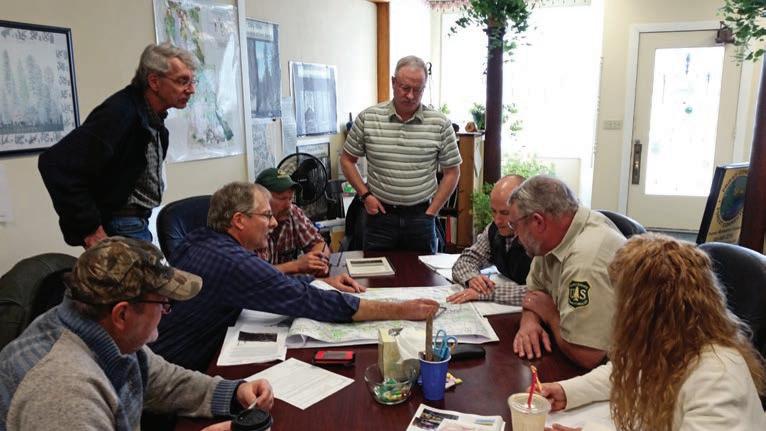
A forest collaboration group in action. This meeting of the Panhandle Collaborative Group took place in 2016. Courtesy photo.
< TIMBER, con’t from Page 14 >
“A lot of things that conservationists have been saying for a long time are coming true,” charting the conservation movement’s trajectory as one of increasing professionalization that has turned “collaboration” into “Orwellian doublespeak” that serves industry far more than its purported conservation aims.
“It was very grassroots-y back then,” he said of Cove-Mallard, where the most vigorous clashes in Idaho’s front of the Timber Wars took place. “I think it was in the ’80s when the professionalism increased quite a bit, though it existed prior to that.”
“That sort of conspiracy theory thinking and all of these things coming together — public lands, the militia having to fight against the federal government — all of this stuff is connected,” Sowards said.
“Collaboration is not the goal. It is a tool, and it only works as a tool if you have all the nuts and bolts.”
— Brad Smith North Idaho Director, Idaho Conservation League
Rather, Macfarlane said “elites define the terms of debate” surrounding public lands management today, making necessary processes like environmental reviews “pro forma” in the decision-making process.
“De facto decisions are made in that collaborative process, and then the public has their chance [to comment] and it’s a pro forma exercise,” he said. “That’s to me what makes it objectionable. It’s very anti-democratic and that’s why I call it a form of neoliberalism.”
Putting a final peg on it, Macfarlane said, “I’m not being optimistic here; we’re in a bad situation, as things are.”
Adam Sowards, an environmental historian and director of the Pacific Northwest Studies Program at the University of Idaho, looks at the state of political play from the 1980s to the present and also feels less than optimistic about how partisanship has come to bear on public lands, and what it means for the notion of “collaboration” as an engine of “conservation.”
Casting back to Idaho U.S. Rep. Helen Chenoweth-Hage, he made the connection between her rhetoric merging public lands policy with boogeymen like clandestine federal “black helicopters” patrolling the countryside and the old John Birch Society hobbyhorse of the United Nations grabbing up U.S. citizens’ property as “foreshadowing of what was to come.”
Specifically, incidents like the Bundy family-led Bunkerville and Malheur standoffs — in Nevada in 2014 and eastern Oregon in 2016, respectively — illustrate the virulence with which some Westerners push back against federal ownership and management of public lands, much preferring conflict to collaboration.
And to disabuse anyone of the notion that this is “history,” Ammon Bundy — who played a leading role in both armed incidents — unsuccessfully mounted an independent run for Idaho governor in the Nov. 8, 2022 midterm election, and Scott Herndon, who was elected to the Idaho Senate from Legislative District 1 in the same election, has made selling off public lands to private interests a central plank in his platform.
Sowards rooted much of the present ultra-conservative ideology surrounding public lands — namely that they should be “returned” via a dubious claim of ownership to individual states — as a twisting of the upswell of rights claims fronted by historically marginalized groups in the 1960s and ’70s into the preeminence of property, whether public or private.
“That rights language then gets co-opted in the ’80s and ’90s, especially around property rights, and the way jurisprudence fell toward rights rather than the public good shaped how the New Right in the Reagan years and after articulated some of its claims,” he said. “In any discussion of property rights [today] you would recognize that.”
Even Harper, who considers himself “a very right-leaning person” said “we’re as extreme on two ends of the stick as we’ve ever been” and dismissed the push to privatize public land — which would be an end to collaboration altogether — as the result of a small-yet-loud group of individuals being “whipped into a frenzy by our fine politicians. I don’t think that they really think about the big picture.”
“I can definitely be in the middle on conservation, because we need to have a balance, which is why I’ve always supported the collaborative process,” he added, noting that while he’s discouraged to see a recent uptick in litigation against timber sales — frequently initiated by groups from out of the area and uninvolved in local collaboratives — he’s encouraged to see timber companies doing things like putting acreage into conservation easements.
“That land is going to be growing trees forever — wildlife, timber and water, forever,” he said. “You look at that and I think the industry has moved a long way
toward thinking about conservation.”
That’s also apparent in Harper’s own career trajectory — starting out in the timber industry 35 years ago, participating in the Quincy Library Group, helping form the Panhandle Forest Collaborative and, now, serving on the board of the Idaho Conservation League.
“That blows a lot of people’s minds,” he said. “To do that [be a part of the second-biggest buyer of federal timber in the country] and also be able to get along with the staff and the board of a conservation group, I think, speaks a lot to where we’ve come.”
And looking back to the “cut-andrun” days of the early 20th century, to the burgeoning conservation and wilderness ethos of the late-1920s, 1930s and early-’40s, to the “run-to-cut” boomtimes of the post-World War II era to the bitter conflicts of the Timber Wars period of the 1980s and ’90s, it is clear that thinking about how — and even whether — to manage public lands has evolved in dramatic ways. As has the notion of
“collaboration.”
“Collaboration is not the goal. It is a tool, and it only works as a tool if you have all the nuts and bolts,” said Brad Smith, of the Idaho Conservation League.
Keough agreed, noting that the Timber Wars haven’t really ended, they’ve just shifted into other arenas, including recreation, forest fuels reduction and others — all potential future battlelines in the ongoing and vitally important history of how Americans seek to steward their land.
Yet, she said, “Collaboration has become a great tool, and good people on all sides of the spectrum across Idaho — and across other places, as well — get around the proverbial table and look on the ground at specific projects and try to see if they can work through something. They recognize what the need might be and work to find a path forward.”
This is Part 2 of a two-part article. For more information on this series, visit scotchmanpeaks.org. To find previous installments, visit sandpointreader.com.
The pursuit of transcendence
Local artists Romey Stuckart and Stephen Schultz honored with Idaho’s Excellence in the Arts Award
By Lyndsie Kiebert-Carey Reader Staff
It’s not a painting of the forest. It is an alternate reality and an invitation to enter; to be immersed in the beautiful chaos of the woods, where nature speaks a language we lack the words to imitate.
It is “Trestle Creek,” an oil painting by Romey Stuckart measuring approximately six feet tall and eight feet across, hung front and center upon entering the unassuming warehouse-turned-art-studio on Poplar Street in Sandpoint.
Stuckart couldn’t be interviewed for this story. Still, her spirit emanates from sources that persist since her death in 2020: her writings, the recollections of her loved ones and, perhaps most of all, from her art.
Standing in front of “Trestle Creek,” the viewer gains an understanding of Stuckart that transcends the results of any interview. With texture and color, the artist has captured not an image of fallen snags and running water, but a feeling: to walk in the woods and feel truly at home.
“She is not taking a snapshot and reproducing that,” said Kally Thurman, curator of Stuckart’s collection. “She is actually giving you the experience of being there. Those canvases are so large that you feel like you are walking into that world.”
Stuckart and her husband, fellow artist Stephen Schultz, moved to Hope in 1987. Stuckart painted “Trestle Creek” — as well as similar works with names like “Denton Slough” and “Riser Creek” — around that time, though her explorations of nature in its macro form account for only one era of her art. Her later work focused more on the micro — explorations of energy and the molecular, as much about the creative process as the result.
“She was in another mind,” Thurman said, also calling Stuckart “a leap in human consciousness.”
Stuckart’s dedication to elevating the Idaho art scene is being honored at the state level as
she, along with Schultz, has been recognized with an Excellence in the Arts Award as part of the 2022 Governor’s Awards in the Arts, a biennial recognition facilitated by
the Idaho Commission on the Arts, established in 1970. Artists are set to receive their awards at a public ceremony on Monday, Nov. 28 at the Idaho State Museum in Boise.
Top: Artist Stephen Schultz stands before one of his paintings. Left: A typical display of paints in motion at Schultz’s studio. Photos by Lyndsie Kiebert-Carey. Right: Stephen Schultz and Romey Stuckart. Courtesy photo.
Asked what it meant to be honored as a couple, Schultz said, “I really, really liked that. I thought it was great.”
It rained the day Schultz invited the Reader to tour his and Stuckart’s Sandpoint studio. The dark morning skies stood in stark contrast to the bright acrylics strewn across his workspace, where he was currently putting the finishing touches on “Diorama: Natural History,” a substantial painting measuring 12 feet across and nearly eight feet high. Like Stuckart, Schultz prefers canvases that lend themselves to world-building rather than caricature.
“I worked on this through Romey’s dying and since her death, and it needed to be completed. Now, it’s an hour away, perhaps,” he said.
Schultz’s paintings and drawings have taken on a variety of styles over his nearly 60 years as a practicing artist, but a vein of storytelling runs through his work. Figures interact with their environments in unpredictable ways — unpredictable even to Schultz — and “associative narratives,” as he called them, rather than linear narratives are formed.
“My paintings start without an idea. They start as scratches — making marks on a canvas just to break the surface,” he said. “Then, something occurs — something happens. It’s like you’re walking down the street and you bump into somebody you weren’t anticipating seeing. It would change the course of your day, or you build on that. It’s a conversation.”
Schultz and Stuckart were married for nearly 40 years, and moved from Hope to the remodeled Sandpoint warehouse around 2000. Eyes turned to “Diorama: Natural History,” Schultz reflected on the mix of emotions he’s felt since losing Stuckart to brain cancer in November 2020.
“There’s relief and grief and ‘OK, what’s next?’ All that. Loneliness. All those things that everyone experiences with the passing of someone,” he said.
The couple’s studio space has a buzzing warmth, cultivated over decades in both the art on the walls and the partnership between the artists. That warmth continues to hold Schultz in his creative endeavors, which he said still excite him — coaxing him downstairs each day, into the studio, to pick up his brushes once again.
Learn more about the Governor’s Awards in the Arts at arts.idaho.gov/ awards. To view Stuckart’s work and learn more about her, visit romeystuckart.com. To learn more about Schultz and see his work, head to swspaint.com or find @stephenschultzart on Instagram.
Top: Romey Stuckart’s painting titled “Riser Creek.” Bottom: Stephen Schultz stands before his painting titled “Anthropology.” Photos by Lyndsie Kiebert-Carey.
events
November 10-17, 2022
THURSDAY, November 10
Live Music w/ Chris Paradis
6pm @ Blue Room
The Complete Works of William Shakespeare (Abridged) [Revised] play
7:30pm @ Panida Theater
37 plays in 90 mins! Free and so fun
Get Plowed fundraiser
6-9pm @ Cedar St. in downtown Sandpoint
Annual fundraiser to support the plowing and sanding of Pine Street Woods. This is a block party. Food, drinks, music and fun!
FriDAY, November 11
Live Music w/ Lauren and Chris Duo
6:30-9:30pm @ MickDuff’s Beer Hall
Live Music w/ John Shipe
7pm @ Eichardt’s Pub
See Page 21 for more information
Veterans Day Events
See Page 20 for a full listing of events
Live Music w/ John Daffron
6pm @ Blue Room
Live Music w/ BTP
5-8pm @ Pend d’Oreille Winery
Live Music w/ Steven Wayne
7-9pm @ The Back Door
SATURDAY, November 12
Live Music w/ Ken Mayginnes
5:30-8pm @ Drift (Hope)
Science on Saturdays w/ Jim Ekins
10am @ Panida Theater
Free admission to this youth-targeted water educational program
Warren Miller annual film: Daymaker 7pm @ Panida Theater
The 73rd annual Warren Miller film to help kick off the season. $15/advance
Live Music w/ Brian Jacobs
7-9pm @ The Back Door
Sandpoint Chess Club
Live Music w/ Marty & Doug
6pm @ Blue Room
SARS Ski Swap
8am-2pm @ Bonner Co. Fairgrounds
Find great deals on snow gear before the season. $5/person, $10/family. If you have things to drop off, bring on Nov. 11.
Live Music w/ KOSH
5-8pm @ Pend d’Oreille Winery
KOSH has played with bands such as Metallica and Cheap Trick
SunDAY, November 13
9am @ Evans Brothers Coffee
Meets every Sunday at 9am
Magic by Star the Magician 5-8pm @ Jalapeño’s
monDAY, November 14
Monday Night Blues Jam w/ John Firshi
7pm @ Eichardt’s Pub
Lifetree Cafe • 2pm @ Jalapeño’ “Ego and Faith discussed”
Group Run @ Outdoor Experience 6pm @ Outdoor Experience 3-5 miles, all levels welcome, beer after
tuesDAY, November 15
Thanksgiving cookie decorating with Sawyers Bakery
5:30pm @ MickDuff’s Beer Hall (Sign up via Instagram @sawyers_bakery)
Paint and Sip with Lori Salisbury • 5:30-7:30pm @ Pend d’Oreille Winery
Come paint a winter inspired scene. $45/person. Register at 208-265-8545
Tuesday Beer Education Night • 6-7pm @ Utara Brewing Co.
A sensory exploration of various types of barley and hopes. Free to attend
wednesDAY, November 16
Live Piano w/ Bob Beadling
5-7pm @ Pend d’Oreille Winery
Laney Lou and the Bird Dogs in concert
7-10:30pm @ The Heartwood Center
A blazing exuberance to bluegrass while still honoring its traditions
ThursDAY, November 17
An Evening with Lena Haug and screening of All the Wild Horses film
6pm @ Panida Theater
Local equestrian Lena Haug will discuss her personal experience racing in the Mongol Derby this summer after a screening of the doc. film All the Wild Horses. $20
Montana Shakespeare in the Parks Complete Works of William Shakespeare presented by: Pend Oreille Arts Council Thursday, November 10 | 7:30 pm FREE
Science on Saturday Jim Ekins,Water Educator University of Idaho sponsored by: November 12 |10:00 am
CASA’s annual Purse Party
4-7pm @ Pend d’Oreille Winery
The perfect girls night out. Raffles, silent auction, wine and apps. No charge to shop and free drink with every purchase
Live Music w/ Brian Jacobs
6-8pm @ MickDuff’s Beer Hall
73rd annual Warren Miller DAYMAKER presented by Mountain Fever Prod. Saturday, November 12 | 7:00 pm $15 Advance | $17 Door
It’s Happening Right Here documentary focused on human trafficking November 14 | 7:00 pm FREE
• panida.org Theater capacity and Covid requirements vary by show. Please check specific event listings for guest admission
• (208)
POAC partners with local Mongol Derby finisher Lena Haug for a night of equestrian art and film at the Panida
By Lyndsie Kiebert-Carey Reader Staff
Lena Haug likes a challenge.
The professional equestrian has never shied from the unknown, whether it was leading horseback expeditions as a teen in Chile or, more recently, in her pilot training. Now local to Sandpoint and still active in the horse world, Haug can add the greatest challenge yet to her “done” list: the Mongol Derby, a 1,000-kilometer (roughly 620-mile) horseback race over the Mongolian steppe that she completed in nine days this past July.
“I tend to seek things that challenge my abilities and ask me to try my best and keep learning, but … the word that came out of my mouth when I finished [the race] was ‘humbled,’” she told the Reader. “I felt like I was stripped to this raw version of myself and had to fully be OK with everything that was going on.
“My expectations, luckily, were in that mindset already, starting this race, so I felt prepared for the unknown, but it was the embrace of the unknown that I think was the most humbling,” she continued. “Around Day 5 I felt like there was no such thing as ‘good’ or ‘bad,’ there just ‘was,’ and any decision I made was the perfect decision because it had to be.”
The stoke is real From dream to hard-earned reality
By Reader Staff
on Thursday, Nov. 17. The event begins with a pre-show art reception at 5 p.m., and will also feature a showing of the award-winning Mongol Derby documentary All the Wild Horses and a Q-and-A session with Haug afterward.
As for how the experience lined up with her expectations for the derby, Haug said with a laugh: “It was way more hectic and dangerous and insane than I thought it would be.”
Part of that unpredictability had to do with the horses: virtually wild and swapped out by the riders approximately every 25 miles. Beyond the mounts, other variables contributed to the grueling conditions.
“I spent a lot more time being completely out of control and learning to go with the flow than I thought I would have,” she said, adding later, “You have obstacles get in your way that you cannot predict, like wild dogs chasing you, marshes, weather, if the horse stumbles into a vole hole and flips over, if a fox jumps out in front of you — there’s just so many small variables. At one point I ended up in a valley where there were artillery missile firings going on.”
But rather than feeling helpless or afraid, Haug said she felt “a serene bliss that just held me.”
Much of that stemmed from the people Haug met along the way. She remembers one local man, helping her swap her horse on around Day 7 or 8, giving her a
Haug will share her derby experience as part of the Pend Oreille Arts Council’s Performing Arts Series at the Panida Theater annual celebration and kickoff to the ski season in the Sandpoint area. Daymaker continues that annual cross-generation experience, connecting audiences to the upcoming winter season and all it has to offer.
The iconic Warren Miller snowsports film institution is back with its 73rd annual ski and snowboard film, Daymaker, which will screen at 7 p.m., Saturday, Nov. 12, at the Panida Theater. Doors open at 6 p.m. All tickets are $15 general admission and are sold on the Panida Theater website at panida/events. org. Any remaining tickets will be sold at the box office for $17 the night of the show.
Warren Miller films are the
hug, and the connectedness she felt in that moment.
“I wasn’t sad, I wasn’t unhappy, I wasn’t hurt or anything — but even the simplicity of a hug felt so magical and warming and nurturing at that point,” she said, noting that she cried during the interaction. “I felt so vulnerable and so raw that a hug from a random person was the perfect medicine in that moment.”
Haug said the Mongolian grasslands feel “stopped in time.”
The nomadic peoples of the region live in gers — yurt-like structures — where the racers often took refuge and had the opportunity to immerse themselves in the culture.
“You can always walk directly into a ger. You don’t have to knock — you’re always welcome,” Haug said. “You step in with your right foot and you go to the left side, which is open for guests. It’s completely customary to do that — no one ever knocks. The greeting [is], ‘Hello’ or ‘Hold the dog’ as a person coming to a ger, which just means, ‘Please hold your dogs, I’m coming to get food or drink or to stay with you tonight.’ It’s such a cultural 180 from our Western culture, which is very private.”
As part of her partnership with POAC, Haug will also be giving talks about her Mongol Derby experience at local schools. She
Fans prepare for Warren Miller’s latest release, Daymaker
hopes to present to students about “what it means to have a dream.”
“Everyone has a dream of whatever capacity, and a lot of times they feel really out of reach,” she said. “This one felt incredibly out of reach for me, but taking small steps to get it started suddenly made such a far-away dream my actual reality.”
Tickets to the event are $20 for adults and $10 for students, and can be purchased at artinsandpoint.org/lena-haug or at the door.
Those with questions can call the POAC office at 208-263-6139.
Daymaker features Crazy Karl Fostvedt and a local crew of freeskiers in Sun Valley, in addition to Katie Burrell on a Canadian road trip as she attempts to go pro alongside Freeride World Tour competitor Hedvig Wessel. From there, the Warren Miller
team returns to Snowmass for the biggest party of the winter with the National Brotherhood of Skiers, where viewers will meet emerging talent that the NBS supports to further its goal of placing Black skiers and snowboarders on the U.S. Team. Daymaker also captures a trip to the Olympus Range in Greece with Michelle Parker and McKenna Peterson, plus epic powder days in British Columbia, Alaska, Snowbasin and more.
In addition to the film, the Independence Ski Team will be
on hand Nov. 12 at the Panida with its “Great Outdoors” raffle, featuring five prizes: a Schweitzer season pass, golf and cart for two at six Northwest golf courses, paddle board, five days lodging and lifts for two at Schweitzer, and a week condo stay at Holiday Shores. For more information on this year’s Warren Miller film contact Michael Boge at mountainfever1@frontier.com or call or text at 208-661-3857.
Lena Haug will sit for a Q&A session Nov. 17 after a screening of All the Wild Horses at the Panida Theater. Courtesy photo.
VETERAN’S DAY
Honoring those who served
A round-up of Veterans Day 2022 events
By Zach Hagadone Reader Staff
First celebrated as Armistice Day, marking the end of World War I on Nov. 11, 1918, the Veterans Day holiday has come to honor all who served the United States in uniform. There are a number of events and services offered throughout the region on several days beginning Friday, Nov. 11. Here are a few:
Friday, Nov. 11
LPOSD school assemblies
Various times
Various locations
Sagle Elementary’s event begins at 9 a.m., featuring a concert, light refreshments and viewing of the Honor Wall located in the school foyer (550 S. Sagle Road). Northside Elementary’s assembly begins at 1 p.m., with third- through sixth-grade students performing patriotic songs (7881 Colburn-Culver Road).
Kootenai Elementary will host a concert beginning at 1:30 p.m., with the fourthgrade class singing patriotic songs (301 Sprague St.). Sandpoint High School is offering a light breakfast to veterans, followed by an assembly honoring veterans, and a short meet-and-greet with the student council. Veterans are invited to arrive at 9:15 a.m. (410 S. Division Ave.).
Veterans Day Service at Memorial Field
801 Ontario St.
11 a.m.
The Marine Corps League will provide the honor guard and Bonner County Veterans Service Officer Bryan Hult will offer a prayer following a talk on the history of Veterans Day at a gathering next to the flagpole at the veteran memorial plaques at War Memorial Field. All are welcome to attend.
Beer and Brats at the Howard Bigelow VFW Hall
1325 Pine St.
Noon-3 p.m.
Following the service at Memorial Field, the Sandpoint VFW Post No. 2453 is hosting lunch as well as a drawing for the winners of a .22 rifle and 12-gauge shotgun by the local chapter of Disabled American Veterans, which has been
conducting a raffle to raise funds for the organization. It’s a great time to meet some local veterans. Call the VFW Hall at 208-263-9613 for more info.
Veteran’s Day dinner at Sweet Lou’s 477272 US-95 North, Ponderay 11 a.m.-10 p.m.
All current and former members of the U.S. armed forces will receive a free meal on Friday, Nov. 11, including a handcut, six-ounce, USDA choice top sirloin steak with one side. The Veterans Day dinner has been a Sweet Lou’s tradition since 2011, serving more than 4,000 free steaks in that time. The offer is valid at Sweet Lou’s locations in Ponderay, Athol (6915 E Athol Crossing Road) and Coeur d’Alene (601 N. Front St.), and good for dine-in customers only on Nov. 11. A valid military ID is required to redeem your steak. For more info visit sweetlousidaho. com or facebook.com/sweetlous.
Idaho State Veterans Home dedication
590 S. Pleasant View Road 2-6 p.m.
Idaho Gov. Brad Little will be on hand alongside local leaders to dedicate the new Idaho State Veterans Home in Post Falls. The ceremony begins at 2 p.m., followed by limited tours of the facility from 3-6 p.m.
Operation Veteran Smiles
1233 N. Government Way, Coeur d’Alene
8 a.m.-4 p.m.
Generations Dental is inviting homeless and in-need U.S. veterans to receive free dental services from Dr. Justin Rader and an on-site volunteer team. Appointments are preferred, but walk-ins will be accepted. Veterans need to bring proof of status: DD214 (separation from military) or valid military ID card (VA or military retired card). Call 208-664-9225 for more info or to make an appointment.
Saturday, Nov. 12
Veterans and First Responders Run, Walk, Roll Riverside Park District 2 Road, Bonners Ferry 9-11 a.m.
VFW Post No. 3622 hosts this event for suicide awareness and prevention, at Riverside Park in Bonners Ferry. Organizers appreciate donations, including nonperishable food items. All ages welcome.
Wednesday, Nov. 16
Free Thanksgiving dinner for veterans and seniors
30196 ID-200, Ponderay 3:30-7 p.m.
The Sandpoint Elks Lodge dinner will include turkey, ham, and all the fixings. Dine-in or takeout. Call 208-263-3811 for more info, to make an order or for transportation to the event.
Ongoing
Mobile Vet Center in Newport
The Spokane-based Mobile Vet Center visits the Hospitality House in Newport (216 S. Washington Ave.) from 10 a.m.-1 pm. on the last Thursday of every month. No appointment is required. Call Stu Sturtevant at 509-444-8387 for more info.
Idaho Female Veterans Network
This group meets on the second Tuesday of each month at VFW Post No. 3603 in Post Falls (1225 E. 3rd Ave). For more info, go to idahofemaleveterans.com.
Sandpoint War Veterans Group
War veterans of all eras gather every other Thursday from 10-11 a.m. at the Howard Bigelow VFW Hall in Sandpoint (1325 Pine St.) to support one another in navigating the unique challenges of life after war. Open to veterans of all wars. Call 509-844-1053 for more info.
Veterans Jiu Jitsu Class
Classes in jiu jitsu are offered every Monday and Friday, 7:30-8:30 a.m., at SBA Ponderay (210 Triangle Drive Unit F), intended to provide veterans with an opportunity to build mental, physical and social health as they readjust to life after war and military service. Offered in collaboration with SBA Ponderay, Veterans Community Response and the Spokane Vet Center, the month is free, after which participation costs $50 per month. Call 509-844-1053 for more info.
PETS & ANIMALS
Meet Reader, the library cat
Clark Fork Library welcomes feline addition to its staff
By Lyndsie Kiebert-Carey Reader Staff
The Clark Fork Library has a new employee, but he’s more likely to “meow” his greeting than offer book suggestions.
That new addition is Reader, a black-furred, yellow-eyed kitten with an affinity for feline shenanigans and naps among the stacks.
Library Manager Melissa Mankongvanichkul said Reader is fitting in “wonderfully.”
“He’s not scared of people — he’s very social,” she said. “He is very comfortable here.”
Library staff adopted Reader in August after he and his littermates were found abandoned on the side of the road. His natural friendliness sealed his fate as the perfect candidate for a library kitty. He can often be found watching patrons with a keen eye, playing with toys or lounging in nooks and crannies perfectly suited to a curious cat — like the dropbox at the front desk where items are returned.
Reader’s modest expenses — like litter and food — are covered by Friends of the Library, a nonprofit group dedicated to supporting the East Bonner County Library District. Pets for Life, a Humane Society-funded program through the Better Together Animal Alliance in Ponderay, will take care of his medical needs, such as vaccinations and check-ups.
There’s a broad community ef-
fort behind helping Reader thrive in his new home, and he will do his part by adding a new element of fun and comfort to the Clark Fork Library.
“Being a smaller library, people say we’re homey here, and cozy, so it’s fitting to have a cat,” Mankongvanichkul said. “He’s our official public greeter, and mascot. Part of his job is to make people feel welcome.”
Of course, Reader is only a kitten, so he’s liable to cause a little mischief here and there. Still, Mankongvanichkul said patrons have been very accepting of the new addition to the staff, and local children can often be found with Reader curled up in their laps or tucked under their arms.
“He has a naughty side to him,” Mankongvanichkul said with a laugh, “but that’s part of his charm.”
To learn more about Friends of the Library or become involved with the group’s volunteer efforts, head to ebonnerlibrary.org/
friends. To learn more about Pets for Life and their free animal care services, visit bettertogetheranimalalliance.org/pets-for-life or call 208-265-7297.
Annual Bruhjell memorial event brings people together and helps
By Reader Staff
Evans Brothers Coffee Roasters is hosting its fifth annual fundraiser benefiting Better Together Animal Alliance through the end of the year. The event is in memory of Erik Bruhjell, a 22-year-old Sandpoint resident who passed away in July 2018.
A portion of sales between now and Dec. 31 will be donated to BTAA, with the goal of raising $5,000 to help local animals in need. Evans Brothers created a
John Shipe Music, Eichardt’s, Nov. 11
Among John Shipe’s catchiest, slyest, best-written and creatively instrumented songs are “J. Edgar Hoover,” “Jesus” and “Villain” (there may be a theme there, but we’re only speculating).
Don’t believe us? The Eugene, Ore.-based “AcoustoAmericana” singer-songwriter thinks so himself, writing that the first is one of only three “important” songs he’s penned during 30 years in the biz, the second “is the most entertaining song” in his repertoire and the third “was hard to beat.”
This week’s RLW by Ed Ohlweiler
animals in need
special coffee blend called the “Bruhjell Blend,” which is available to purchase online or in any of their three cafes (Sandpoint, Coeur d’Alene and Spokane).
Bruhjell is deeply missed in the community by his friends and family, who remember him for his love of people, animals and the environment. Bruhjell also loved coffee and Evans Brothers, where he was a regular customer. Since his passing, the memorial event has raised thousands of dollars for BTAA, which are used to fund
community-based programs like the shelter’s helpline, spay and neuter fund, and medical help for sick or injured animals.
For those who may prefer to donate directly to BTAA in Erik’s memory, a link is available on the Evans Brothers website.
Visit evansbrotherscoffee. com for more information and to purchase the Bruhjell Blend, or visit shopbtaa.org to purchase limited edition Bruhjell Blend merchandise.
A snapshot of notable live music coming up in Sandpoint
Rhythmic Collective, 219 Lounge, Nov. 12
We don’t know if he’s going to play any of those tunes when he plays Eichardt’s on Friday, Nov. 11, but you should listen to them anyway at johnshipemusic.com. You won’t regret it — nor will you regret checking out the rest of this versatile artist’s catalog on Bandcamp.
— Zach Hagadone
7 p.m., FREE. Eichardt’s Pub, 212 Cedar St., 208-263-4005, eichardtspub.com. Listen at johnshipemusic. com or johnshipe.bandcamp.com.
Some call it November. Others call it the shoulder season. By any name, it is the gradual transition into winter — what some might consider a quieter time in Sandpoint.
Luckily for locals, the 219 Lounge is having none of that nonsense, as Spokane-based rock ’n’ roll cover band Rhythmic Collective is set to bring the ruckus to the Niner on Saturday, Nov. 12 from 9 p.m. ’til late.
Fronted by vocalist and guitar slayer Gil Rivas, Rhythmic Collec-
tive is a group of well-seasoned Inland Northwest musicians specializing in bringing infectious energy to venues all over the region. This mid-November gig is a reminder that Sandpoint doesn’t need an out-of-town crowd to party. Cheers to the locals.
— Lyndsie Kiebert-Carey
9 p.m.-midnight, FREE, 21+. The 219 Lounge, 219 N. First Ave, 208-263-5673, 219.bar.
READ LISTEN
Hey, did you know the Banff Mountain Film Festival has a category for books? One year, Raven’s Witness: The Alaska Life of Richard K.Nelson popped up on the screen during intermission and piqued my curiosity. What resulted was a love affair with two authors — Richard Nelson, who was a prolific writer and naturalist in the vein of John Muir; and the author Hank Lentfer, who knew Nelson and pored through his many tomes of poetic prose. Lentfer himself is no slouch, so you get two graceful writers for the price of one, all in a single volume written word candy bars for those who love frontier living or the natural world.
The band Pentangle released a box set in the past five years. If you’re like me and can’t afford the whole caboodle, I recommend the two-CD anthology Light Flight. While this is probably my favorite of all of the “folk revival” bands, the recordings are from late-’60s and early-’70s, and I have to wonder if it is in fact a “revival” or just a band with great musical chemistry and what earlier folk bands were striving for. I guess the blending of electric instruments separates it from traditional folk, but in a way you will probably be grateful for.
WATCH
Finding Finding Vivian Maier was quite a happy accident, since it’s hardly received a fraction of the publicity it deserves. If you love photography and/or a good mystery, you can get both in a well-constructed documentary that searches for this enigma of a woman, who became one of the all-time greatest street photographers after her photos were discovered accidentally and posthumously. Vivian, a professional nanny, seemed almost invisible for much of her life — except to the kids. That’s all I’m gonna say.
Reader the cat greets visitors at his new “job” at the Clark Fork Library. Courtesy photo.
From Northern Idaho News, Nov. 7, 1922
AGNES CRANSTON IS SHOT BY STRAY BULLET
As she was about to enter the Bonner County National bank, a few minutes befre 12 o’clock Saturday noon, Miss Agnes Cranston was shot through the neck from an unknown source, inflicting a serious, though not fatal wound. She was rushed to the City hospital where doctors worked for an hour and a half in locating and extracting the bullet. The bullet struck Miss Cranston just as she was about to ascend the steps at the bank. It entered her neck from the rear a little to the left of the spinal column and lodged in the front a trifle to the right of the throat; in its course passing between the spinal column and jugular vein without touching either. By this narrow margin, Miss Cranston escaped death. She is recovering at the hospital as rapidly as the flesh wound can heal.
Who fired the shot is still a mystery. Miss Cranston heard the report indistinctly and J.W. Grimm of Colburn who was nearby at the time and was the first to go to the woman’s aid, corroborates her statement as to the indistinctness of the report. Neither of them saw anyone with a gun. The bullet found by the doctors was evidently fired from a 22-rifle, and there is a general belief that it was the work of a boy, thoughtlessly shooting at the many doves which infest that vicinity. Further credence is given to this belief by the fact that shortly after the shooting a boy 10 or 12 years old was seen crossing First avenue, gun in hand, headed toward the Northern Pacific depot. At all events the shooting of Miss Cranston is believed to have been purely accidental.
BACK OF THE BOOK
‘Dear editor’
By Zach Hagadone Reader Staff
Things are bad, folks. I say this not as a partisan for any particular political party, but as a son raised in a fuzzy melange of lapsed Scottish Presbyterian optimism and German Lutheran pessimism — as an unbaptized father whose faith lies firmer in the academic realism of political economy and history, raising a pair of free kids in a national mood that wants to make them less free in every respect.
I’m not going to lie: I have a lot of fear for the future of my kids, and it is well founded.
Lucky for me, I get to hear a lot about what other folks around me think about the trajectory of our community, whether it be at the level of city, county, nation or world. It’s usually not encouraging, but the fact that it occurs at all means we’re still kicking as a society.
That is to say, I might receive more “letters” than any person in Sandpoint. I put that operative noun in quote marks because they are almost always delivered in the form of emails, but do sometimes come as typeor hand-written missives, all addressed to me as “Dear editor.”
That is and has been especially true during election times, when my cup of letters runneth over, as community members put pen to paper — or more likely fingers to keys — to give their two cents on the candidate(s) of their choice.
I take this seriously, though many of those writers may not. I really do consider these epistolary submissions as addressed to me, and treat them accordingly: as a correspondence. I don’t always write back, but sometimes I do — especially when I feel a correspondent has outrun the truth with a claim, gone too far in condemning an individual or issue that they have issue with,
STR8TS Solution
or simply overshot the word limit (which was once 300 words, though during this election cycle dropped to 200 words, and will again return to its former robustness as of this edition of the paper).
If you’re a letter writer who has heard from me, you know what I’m talking about. Contrary to what some might think, I actually do read every one of these things — and fact check them when necessary, all while trying my best to guard the essence of the opinion contained therein, whether I personally agree with it or not. And maybe especially when I don’t personally agree with it.
We don’t “censor” opinions, insofar as they are supportable with evidence or valid interpretation. Nonsense gets the bin, and some people peddle nonsense one week and the truth the next. No matter, I treat them all with the respect they are due (which is sometimes none) as true expressions of a free people freely commenting on the world around them.
This is an age-old editorial duty that I feel honored to maintain. The convention of “letters to the editor” dates to the origins of newspapering itself, which can truly be traced to the late-15th and 16th centuries in what is today called Germany. Back then, being a reporter meant serving as a hired agent to keep local nobles informed of any happenings that might affect their various business and political interests.
Beginning in the late-16th century and continuing through the 17th century, in the English-speaking world this function of information dissemination became invaluable not just to aristocrats but country squires, who called it “intelligence,” which is why you may see newspapers even to this day employing the term “intelligencer” in their name.
How these early ink-stained wretches got their intelligence was through correspondence, and that correspondence often came through networks of well-connected letter writers.
Sudoku Solution
During my graduate studies in early American history, I performed extensive thesis research on 17th and early-18th-century newspapering in Britain, the North American colonies and (to a lesser extent) the German states. Two characters who I came to especially admire were Daniel Defoe and John Campbell.
The first may be more familiar, as the author of formative novels including Robinson Crusoe. While being considered as among the first true novelists, Defoe actually cut his teeth as one of those “intelligence” gatherers (also as a spy) and, later, as the editor of The Review, a twice-weekly publication founded in 1704 in London that historians generally regard as the first modern newspaper.
For my thesis work I read hundreds of articles in just as many editions of Defoe’s Review, and they are filled with letters to the editor. Likewise, Campbell, who ran the Boston News-Letter, also established in 1704, spent days running around the backcountry of Massachusetts collecting “intelligence.” His dispatches even today ring with the exasperation and grudging satisfaction of a person who doesn’t know why the hell he’s doing what he does, but still does it out of a vague sense that “intelligence” is important. And it is, in all the ways of its meaning.
These are the forebears of what you’re either holding in your hands or reading on a screen, but they, as we, relied on you as readers — and writers. Thanks for writing, and keep reading.
One bad thing about Lassie, she was always warning you about something. Let me be surprised for a change.
Solution on page 22
Laughing Matter
Solution on page 22
By Bill Borders
CROSSWORD
ACROSS
1.Hardly believable
5.Sleighs
10.Desire
14.Gorillas
15.Radium discoverer
16.Close
17.Type of illustrator
19.Prohibits
20.Unit of energy
21.Clutch
22.Row of shrubs
23.Robber
25.Suffering
27.Anagram of “Dew”
28.Parental moms
31.Construct
34.Angered
35.Anagram of “Car”
36.Hotels
37.Strike
38.Notion
39.Morsel
40.A tree, leaf or syrup
41.Great fear
Solution on page 22
59.Bless with oil
60.Ear-related
61.Didn’t dillydally
62.Discourage
63.Writing styluses Word Week of the
a small can or drinking cup.
“Henry the town drunk always carried a cannikin in his vest pocket in case someone stumbled by with the desire to share a snort of whiskey with him.”
Corrections: We accidentally published a community event a second time last week, with a date that was expired. Apologies for any confusion about the autumn ecology birding class that was on Oct. 29.