Honey Pearl Productions Presents 1776: The Musical wit, a powerful score, & timeless relevance, 1776 shows that history was made by determined individuals daily 7 pm, matinee July 5, 3 pm, doors 45 mins. prior
Honey Pearl Presents in the Little Theater 1776 Pre-Funk Dinner & Music
JoDavi, North Carolina–based singer-songwriter Proceeds support North Idaho veterans Saturday, 4:45 pm prior to performance
House of Fly & The Mayfly Project Presents International Fly Fishing Film Festival with Bucket Raffles and Door Prizes Thursday, 7 pm, doors 1 hour prior scan
DanceWorks Presents Danceworks 2026 this annual showcase is a highly anticipated family event Thursday, 7 pm, doors 1/2 hour prior
300 North First Ave. Sandpoint, ID (208) 263-9191 panida.org the heart of downtown
The week in random review
By Zach Hagadone Reader Staff
Ye olde kudos
History is full of ironies, one being that daily life for most people was pretty miserable during the Medieval and Renaissance eras, yet Renaissance faires — like the one we just celebrated June 13-14 in Sandpoint — are some of the most fun events in which to participate. Since it started in a field in 2017, the Sandpoint Renaissance Faire has grown into a gargantuan undertaking at the Bonner County Fairgrounds, drawing thousands of people from all over the region for a weekend of revelry every year. My wife and I have taken our kids to the faire at least since 2022, and it never ceases to impress us with its organization, spectacle and general sense of goodwill. For my money — and we do tend to spend a lot when we’re there — the jousts, turkey legs and mead are worth the price of admission alone, and rank this gem of an event with the Festival and Lost in the ’50s as highlights of the local calendar. Huzzah to all who attended and, especially, those who made it happen.
get out of Dodge
Our fearless leader, Reader Publisher Ben Olson, wrote elsewhere in this week’s paper about his recent trip to Missoula, Mont., and how much he appreciated the change of scenery. My family also ventured out of the county over the past week, but to Wallace, Idaho. Though it doesn’t look too far away from Sandpoint as the crow flies — just on the southern end of the Idaho Panhandle National Forests from Lake Pend Oreille and about as far from Coeur d’Alene as we are here — it feels like a different place and time. The streets are lined with gorgeous old brick buildings full of lively bars, restaurants, shops and some of the state’s most interesting history, and the folks we met were so nice it was almost weird. When Sandpoint feels too bustling and enshittified, I recommend heading south on U.S. 95, then taking a left on I-90. It is, after all, “The Center of the Universe.” If you know, you know. If you don’t, find out.
Well said
“Many people consider that weekly newspaper journalism is dull and uninteresting, but there’s no reason why this should be so. Whilst admittedly many reports will be routine and nothing can be done about that, there does very often arise the story where strong comment can be made and fresh facts brought to bear, which wouldn’t normally be known had it not been for the action of the newspaper.”
— Charles Curry, editor of The New Milton Advertiser and Lymington Times, in a 1963 profile of his rural U.K. newspaper aired by the BBC in a program titled The Life of a Local Newspaper. It’s worth a watch on YouTube.
DEAR READERS,
As you’re reading this, I’m spending a rare week away from Reader duties. My partner Cadie’s birthday is today, June 18 (happy birthday!) and we are spending it the best way we know how: sailing and camping on the lake that we love.
Summer officially begins Sunday, June 21. So far we’ve been fortunate with good precipitation, warm days and verdant forests, which is a relief after such low snowfall over the winter. With any luck, we’ll squeak by without long periods of smoky skies and wildfire events, but I know better than to hold my breath (until I have to).
A reminder to drivers: Warm weather means more motorcycles, bicycles and pedestrians, so keep your head on a swivel and be safe out there.
In the meantime, I hope everyone has a wonderful solstice weekend and good fortune throughout the remainder of summer.
Thanks for reading, – Ben Olson, publisher
111 Cedar Street, Suite 9 Sandpoint, ID 83864 208-946-4368 sandpointreader.com
Contributing Artists: Aaron Qualls, Soncirey Mitchell, Zach Hagadone, Karley Coleman, Brian Watkins, Beverly Berg, Guy Lothian, Sean Trew, Chris Chambers, Racheal Baker
Contributing Writers:
Zach Hagadone, Ben Olson, Soncirey Mitchell, Lorraine H. Marie, Brenden Bobby, Emily Erickson, Lauren Necochea
Submit Stories To: stories@sandpointreader.com
Printed Weekly At: Tribune Publishing Co. Lewiston, ID
Subscription Price: $200 per year
Website Designed By: Keokee
The Sandpoint Reader is a weekly publication owned by Ben Olson, Zach Hagadone and Soncirey Mitchell. It is devoted to the arts, entertainment, bluster, politics and lifestyle in and around Sandpoint, Idaho.
We hope to provide a quality alternative by offering honest, in-depth reporting that reflects the intelligence and interests of our diverse and growing community.
The Reader is printed on recycled paper using soy-based ink. Leftover copies are collected and recycled weekly, or burned in bonfires to appease the gods of journalism. For back issues, contact the publisher. Free to all, limit two per person, please.
Letter to the Editor Policy:
We welcome letters to the editor on all relevant topics. Please, no more than 200 words, no excessive profanity or libelous statements and no trolls. Please elevate the discussion and stay on topic. Letters will be edited to comply with the above requirements. Opinons expressed in these pages are those of the writers, not necessarily the publisher. Send to: letters@sandpointreader.com
About the Cover:
This week’s cover photograph features young Keeli flying a kite. Photo by her father Aaron Qualls.
Averill granted one-year permit extension for Bridge St. resort hotel project
Company
rep: ‘This is the project we want to do, we just need more time to do it’
By Zach Hagadone Reader Staff
After years of presentations and workshops, design work, community conversation and often heated debate, the resort hotel envisioned by Averill Hospitality adjacent to City Beach is still a vision — but one that has a little longer to develop after the Sandpoint Planning and Zoning Commission voted June 16 to extend the project’s conditional use permit into July 2027.
“This is the project we want to do, we just need more time to do it,” said local Averill representative Ben McGrann, of Actus Projects.
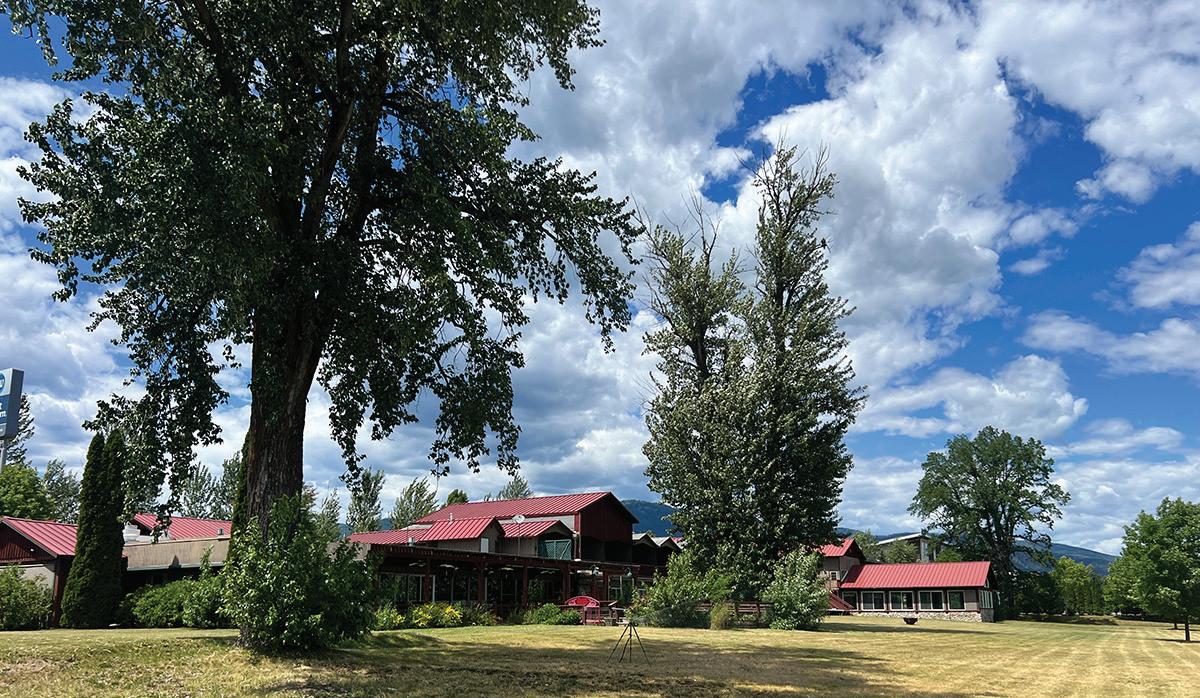
The Whitefish, Mont.based company wants to build a 296,250-square-foot development at 56 Bridge St., in Sandpoint, including guest rooms, condos, food-and-beverage offerings and event space on the site currently occupied by the now-shuttered Best Western Edgewater Resort.
Averill received a CUP in 2024, with intentions to demolish the Edgewater to make way for the development, which a slide shared at the June 16 meeting referred to as “The Point — Sandpoint Lakeside Resort.” Subsequently, Averill sought and received an extension of the CUP into summer 2025 and the demolition permit has since lapsed.
The previous CUP extension would have expired on July 22, 2026, resulting in the project having to go through the process again. However, McGrann argued before P&Z commissioners that another year is warranted because the company has made significant financial investments, satisfying the Sandpoint City Code stipulation that a CUP only be
extended if a project has been “diligently pursued.”
“It’s a big puzzle,” said McGrann, whose presentation included a rendering of the proposed resort hotel cut into puzzle pieces.
“We still have pieces of the puzzle that we’re trying to fit in. There is a lot of components that we’re trying to pull together,” he said, going on to cite financing challenges both from investors and high prices in the construction market.
All told, McGrann said Averill has invested $1.8 million in the project, with $800,000 spent on design, engineering and consulting in the past 12 months alone. In addition, he pointed to submission of “permit-level drawings,” an RFP for general contractor services, construction planning and budgeting with Spokane-based construction company Swinerton, parking and operational planning, evaluation of co-development partnerships with brands including Hilton and Marriott, as well as refinement of development strategies.
On top of that, McGrann said Averill has coordinated with city staff, taken part in public workshops and meetings, and will host the annual Beer Fest on the Edgewater lawn on Sunday, July 5.
“All of these items show that we have diligently pursued the project,” he said.
However, as the P&Z staff report and City Planner Bill Dean pointed out, Averill has yet to pay the city’s plan check fee, which amounts to more than $200,000. The deadline to initiate a city review of the plan is Monday, June 29, which is the same date that its building permit is due to expire.
Other than related to
permitting, “We haven’t had any dialogue with the permit applicants,” Dean said.
In an email to the Reader in early May, Dean wrote, “[I]t’s been absolute crickets here on our end. I haven’t heard a peep. … Normally, we’d hear from the developers on something so big, but it’s been quiet.”
The staff report stated that Averill approached the city on May 19 with a “new concept for the hotel site that involved a different project.” Specifically, “remodeling the existing hotel together with demolishing the existing restaurant, and constructing a new restaurant below five stories of condos.”
However, “No applications have been filed, but the developer has been discussing the various permits required for such a development with city staff,” the report added.
If Averill were to proceed with that alternative plan, it would again restart the development process with all new permits, public hearings and review. As it stands with the CUP extension granted June 16, the company is intending to continue with its original
vision — though with the acknowledgment that the situation might change.
“Ultimatey what we’re looking for is flexibility. We need flexibility given the current market conditions ,” McGrann said, underscoring that if the P&Z granted the CUP extension it should come with no conditions.
“Any conditions that get placed on us is one more piece of the puzzle that we have to manage that creates challenges,” he said.
Though the extension was ultimately granted without conditions on a 4-1 vote, with Commissioners Wayne Benner, Mose Dunkel, Ivan Rimar and Reid Weber in favor and Scott Torpie against, P&Z commissioners grappled with the definition of “diligent” progress on the project.
“This is kind of a tough one,” said P&Z Chair Dunkel. “This has been very public and I’d say the public opinion is very one-sided, and I think Averill’s been beat up a little bit, too — maybe unfairly, but this is the world we live in and you guys signed
up for it. It’s a big project and very impactful.”
While Dunkel later added that “I’d love to see some activity,” he pointed to Averill’s closure of the Edgewater hotel and attached restaurant space as indicative of a “significant” move toward completion of the project.
“[T]hat’s enough for me. I’m reaching, but that’s significant to me,” he said. “As a business owner, I know that if I closed down a business I would need something to happen.”
For his part, Weber said that pre-planning and “soft costs” are substantial, and should be taken into account.
“It has been diligently pursued — just the fact that they’ve been paying engineers, structural architects quite a bit. Quite a few companies, I’m sure, have been involved in getting this project to this point,” he said, later adding, “It’s a tough time to build right now.”
Torpie, however, had more pointed questions — specifically related to the yet-unpaid plan check fee.
“That sets a clock for many
The Best Western Edgewater Resort. Photo by Soncirey Mitchell
Panida executive director resigns
White makes the fourth ED to resign from the theater since 2021
By Ben Olson Reader Staff
The Panida Board of Directors announced June 15 that Executive Director Heather White resigned from her position effective June 12. White’s departure comes after a June 4 board meeting during which she had a heated exchange with the board over concerns about electrical issues at the historic theater, which, according to White, led to two safety incidents within a month.
“The board thanks Ms. White for her service to the organization,” the board wrote in a statement dated June 12. “The Panida Theater remains open and fully operational.
“The Board of Directors is pleased to announce that it is moving forward with a leadership transition plan that reflects the Panida Theater’s commitment to stability, community engagement and the organization’s long-term mission,” the statement continued.
“The Panida Theater has been a cornerstone of the Sandpoint community for nearly 100 years and that will not change,” wrote Board Chairman Sean Behm. “Our board is focused on ensuring strong stable leadership and we have an exciting plan for the transition ahead that we
things,” he said. “That would be, to me, a substantial step in the future … that gives some heft to your desire to see this project through while at the same time maintaining some options to respond to the market and financing.
“That would be my condition: Pay that fee and that would show me that you’ve submitted the plans and now you want the city to look at them with the intention of building this thing,” he added.
look forward to sharing with the community soon.”
Meanwhile, Board Treasurer Woody Sherwood has tendered his resignation, writing in part to the board prior to the public announcement of White’s departure as executive director, “I cannot continue serving the Board and the organization in good conscience at this time. Thank you and best wishes and regards to each of you and the organization going forward.”
When asked for comment about the repeated turnover at the Panida — noting that four directors have left the theater since 2021 — frequent Panida performer and former-Board Member Kate McAlister said she believes the main issue is that the organization’s leadership team needs to be less transactional and more relational.
“We need someone who understands community,”
McAlister told the Reader “I’ve offered free board training, it’s about a $10,000 gift, with both training and strategic planning. In my opinion, before the board hires another new ED, they need to do this strategic planning so they can see what type of individual they need for that position. Currently it needs to be half project manager and half relationship builder.”
McAlister also said there should be more vetting done
McGrann countered that “it’s to the city’s benefit if we don’t pay that and we do move forward with the project because you’d get more impact fees.”
Averill filed its building permit in December 2025, just before the city’s new development impact schedule went into effect — a schedule that was delayed into 2026 by the Sandpoint City Council at the same time as Averill said that if it was required to pay those higher fees, the entire project
for potential board members.
“There has to be criteria for board membership, not just warm bodies,” she said.
McAlister pointed to the leadership of longtime Panida Artistic Director Karen Bowers, who helmed the theater for 26 years before retiring in 2013, as an example of a good fit for the community organization — highlighting the fact that Bowers always greeted people at the door at performances, was out among the community constantly and served as a public face for the culturally significant theater.
“This is an organization that really needs to be in touch with the community,” she said.
McAlister said she plans to
would be “unviable.”
Torpie pointed that out, reminding commissioners and McGrann that at the time, the company warned that “the million-dollar price tag under the new and what is current impact fee schedule was a bridge too far for this project. You’d walk away.”
“Does the application of our current impact fees to this project damage the ability of this project to actually go forward?” he asked.
“We are trying to pull
all parties, then most relationships are doomed to fail,” she wrote the Reader
“I believe the recent hires to the top position at the Panida have not been successful for a variety of reasons,” Pardini continued. “I feel that one constant thread is that the same organizational structure used for the past 40 years is probably outdated and no longer feasible.”
Pardini said she hoped to see the board and staff move to a more collaborative, function-based model.
apply for a board position in October and bring her expertise with board management and strategic planning.
“I would commit to be on the board at least a year to make sure those processes and procedures are in place,” she said.
Board Member and Treasurer Tari Pardini, whose understanding of the Panida’s structure, organization and history comes from many years of involvement with the theater, wrote that she believed communication was a central component for success.
“If there is not a clear path for communication between
together our investors to agree to the $208,000 building permit application fee,” McGrann said, though added that he wasn’t sure if that would happen.
“I cannot say if it will kill the project or not, but it’s one more variable that we’re trying to manage,” he said, later adding, “[I]f we have to swallow the additional $1 million in impact fees that are submitted in September, it’s only to the city’s benefit.”
Torpie’s motion to approve
“I have faith that the current board will do their research well into various successful models,” she wrote. “In so doing, I’m certain they’ll find an organizational structure tailored for nonprofit arts organizations that will work better for the Panida.”
If the Panida Board successfully identifies a business model that aligns more with a theater like the Panida, Pardini wrote, “then the board will just need to find the right person who also believes in it and will work with the board, staff and community to achieve success.”
The Panida Board of Directors holds meetings every first Thursday of the month at 6 p.m. at the Little Theater (300 N. First Ave., in downtown Sandpoint). To contact the board, email board@ panida.org.
the CUP extension with the condition that Averill pay the plan check fee by June 29 died without a second, clearing the way for the 4-1 vote to approve the extension without conditions.
However, Rimar said, “I think Ben understands that the next time he comes up here for an extension, it may not be quite as easy.”
“Hopefully the next time I see you guys we’re doing a groundbreaking ceremony,” McGrann said.
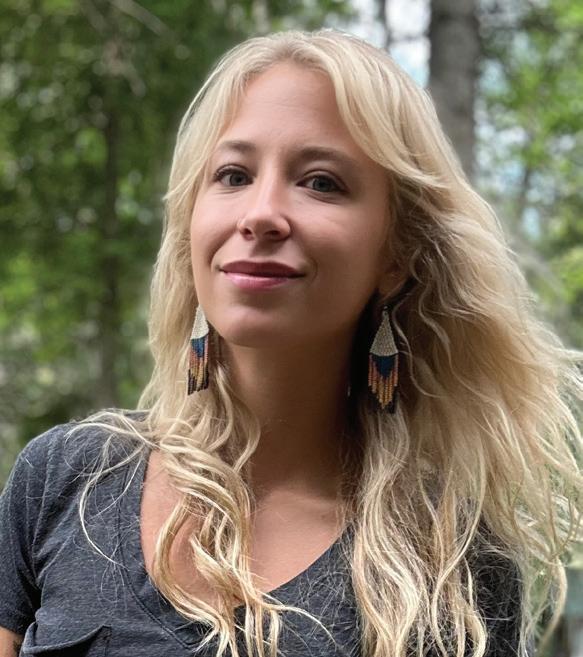
Outgoing Panida Executive Director Heather White. Photo by Zach Hagadone
< AVERILL, con’t from Page 4 >
SPOT bus opens new north-south route across the Long Bridge
Daily service intended to maintain access while pedestrian bridge is closed for safety
By Zach Hagadone Reader Staff
The Selkirks-Pend Oreille Transit Authority announced it had established a new route June 12 with stops at the north and south ends of the Long Bridge, intended to maintain access while the pedestrian span is closed for repairs.
Idaho Transportation Department officials closed the pedestrian pathway of the Long Bridge due to safety concerns on June 5, and SPOT recognized a need to help ensure that pedestrians and bicyclists could still get across the bridge.
The new route is available with the first pickup at 7:30 a.m. at the south of the bridge at the former-Long Bridge Grill parking lot at 471600 U.S. 95, in Sagle, followed by another pickup at 10 a.m. geared toward morning commuters from Monday-Friday.
The drop-off location on the north end of the bridge will be at the Selkirk Loop Welcome Center, located at 213 E. Superior St., in Sandpoint.
The service will otherwise run seven days per week from 11 a.m.-7 p.m., with shuttle departures every 30 minutes from both locations.
All SPOT vehicles are ADA accessible and can accommodate a limited number of bicycles per trip.
Officials established the current schedule based on initially anticipated demand for commuting and recreation.
“We are hopeful to gauge public use as we go and are willing to make adjustments as needed to best fit the needs of the community,” SPOT Executive Director Donna Griffin stated. “Our goal is to make this service as convenient as possible to prevent people crossing with traffic on the vehicle side of the bridge.”
Barricades and signage block users from the pedestrian bridge at each end, though some bicyclists have opted to use the vehicle bridge to cross. That is allowed under the law, but ITD has warned against doing so for “obvious safety reasons.”
The pedestrian span, which was built in 1956 and converted to non-motorized use in 1981, is closed “indefinitely,” according to ITD, after inspectors discovered serious structural damage, including a portion where all
the girder supports across a single pier were deteriorated “and recommended for 0% load bearing, which meant that there was a section of the bridge across its entire width that was not recommended to have any weight resulting resulting in the full closure,” ITD spokesperson Heather McDaniel told the Reader the week of the closure.
While engineers are still assessing the work needed to repair the bridge — with the hope of ultimately restoring end-to-end access — in the meantime, SPOT services are provided at no cost for users and will be available to the general public. Passengers can view the shuttle’s location in real time through spotbus.org to enable trip planning and minimize wait times.
Those needing transportation across the bridge outside the posted schedule or stop locations are encouraged to contact SPOT at 208-263-3774.
“We recognize that the closure of the pedestrian path has created challenges for many people who rely on the bridge to get to their daily destinations,” stated ITD District Engineer Ryan Hawkins. “While this solution does not replace the experience or convenience of crossing the bridge directly on foot or by bicycle, it provides a valuable option and helps maintain a vital connection within our community.”
ITD also thanked SPOT for its effort to meet community needs.
“Their team immediately recognized the urgency of the situation and worked with us to identify a practical solution. This collaboration demonstrates what happens when local organizations come together to serve the community,” Hawkins added.
Bits ’n’ Pieces
From east, west and beyond
With a “blue wave” expected in the November 2026 election, Democracy Docket reports that, along with President Donald Trump’s efforts to sideline voters deemed a threat to Republicans, there’s a risk of flooding voters with election disinformation (including false voting sites). To combat disinformation, a bill is now in Congress: the Fraudulent Artificial Intelligence Regulations Elections Act. Meanwhile, Trump recently posted on Truth Social that he’s sending an “Election Integrity Army” to every state for the midterm elections.
According to former-U.S. Sens. Richard Gephardt, D-Mo., and Timothy Wirth, D-Colo. — the latter also first secretary of state for Global Affairs — recently released a letter describing what they call the Trump administration’s “rolling coup.”
Supporting their claim, they pointed to Trump directive NPSM-7, which targets citizens the administration deems “anti-American,” “anti-capitalist,” “anti-Christian” or “hostile to traditional American views.” The two senators argued that the directive treats protected political speech as terrorism.
As part of the “rolling coup” the FBI, IRS and Treasury Department are tracking funding sources and supporters of organizations they suspect of directly or indirectly facilitating what they regard as “political unrest,” ignoring the First Amendment. The FBI’s “Joint Mission Center,” armed with a $12.5 billion “targeting” budget, has engaged in a 300% increase in “domestic terrorism” investigations. Former-Attorney General Pam Bondi has testified that thousands of U.S. citizens and non-governmental organizations are on a secret watch list connected to the JMC.
Dovetailing with the JMC’s actions is the administration’s appropriation of $45 billion for new ICE detention facilities — a budget more than four times that of the Federal Bureau of Prisons. Gephardt and Wirth believe the scope of new ICE detention capacity indicates warehousing intended for political prisoners, prohibited by a 1974 federal law.
The senators’ letter further pointed out that the head of the U.S. Northern Command, responsible for more than 200 killings labeled “extrajudicial” in the Caribbean and eastern Pacific, has stated publicly that he would “definitely” execute similar “lawful orders” on American soil. At the same time,Trump has fired the bulk of Department of Defense officials who oversee the legality of military operations.
Of further concern, according to
By Lorraine H. Marie Reader Contributor
the senators, the Trump administration has consistently pursued vast sums of funding for more federal agents for airports and urban polling places (the latter specifically in states where Trump lost in the 2024 election) and the Justice Department is attempting to secure states’ voter roll data.
The senators said that rather than “tanks in the street” on a single day, an incremental and less obvious subversion of democracy is well underway. To combat that, they recommend Congress reassert Article I authority over emergency powers, military deployments on U.S. soil and the “Office of Legal Council’s power to rewrite statute by memo.” As well, they said governors and attorneys general need to adopt protective measures that shield citizens, nonprofits and election workers from NPSM-7.
In addition, they argued, newsrooms need to report the bigger picture, and all others need to “name it out loud.” Ignoring the issue, they say, could likely result in democracy being destroyed by a presidential declaration of national emergency.
Trump’s 80th birthday/Flag Day UFC cage fight event unfolded last June 14. Various media noted it was the first private, for-profit sporting event held on White House grounds. VIP guests paid up to $1.5 million for ringside access. A Cornell University classics professor likened the event to the “bread and circuses” of “gladiatorial games of Imperial Rome, when combatants brutalized each other for public entertainment to bolster rulers’ popularity and quell potential unrest.”
The White House said the UFC covered costs, but seven federal agencies were also tapped, the AP reported. Law enforcement included armored vehicles, and the FBI claimed multiple arrests were made to stop an attack on the event.
After the Bureau of Labor Statistics reported that inflation surged to 4.2%, numerous media outlets noted that Trump commented “I love inflation” — a statement that soon appeared on billboards.
Blast from the past: “The dogmas of the quiet past are inadequate to the stormy present. The occasion is piled high with difficulty, and we must rise with the occasion. As our case is new, so we must think anew and act anew. We must disenthrall ourselves, and then we shall save our country.” — Abraham Lincoln, 16th U.S. president, in his second annual address to Congress, 1862.
The S. Third Ave. bus stop. Photo courtesy of the SPOT Facebook page.
PHD passes budget, funds clinic overhaul
Commissioners consider “concierge medical services” for employees
By Soncirey Mitchell Reader Staff
Commissioners from the five northern counties met June 18 with Panhandle Health District officials to reconsider the organization’s Fiscal Year 2027 budget after voting it down in late May. County commissioners voted 3-2 to adopt the budget, which will provide for expanded clinical services and costof-living salary adjustments for the district’s employees.
The FY ’27 budget amounts to $12,299,702 — the lion’s share of which will go to personnel expenses — raised through taxes, permit and licensing fees and health services. Benewah, Bonner, Boundary, Kootenai and Shoshone counties will contribute a collective $2,216,903 — $470,211 of which will come from Bonner County.
At the May 20 meeting, commissioners took issue with increased expenditures for clinical services and worker COLAs, requesting that PHD return June 18 with alternative budget proposals without the adjustment or clinics in some or all counties.
The planned changes to clinical services are part of a monthslong effort by PHD to audit, refocus and revamp clinics within the district, hopefully increasing community usage by expanding days of operation and diversifying offerings. The district intends to hire a social worker, two medical assistants and a nurse practitioner to broaden services and focus on holistic, naturopathic and allopathic preventative care to counter rising national rates of chronic illnesses like heart disease, cancer and diabetes. They also intend to expand women’s health services, which, according to an internal audit, are PHD’s most utilized resources.
According to PHD Board of Health Chair Thomas Fletcher, eliminating the COLA would have freed $180,000 of the budget, while eliminating clinical services entirely would “liberate roughly $78,000” despite its $2.11 million budget.
“You are creating two conditions that converge if you kill the clinic,” said Fletcher at the June 18 meeting. “The first condition is that the clinic, you understand, generates a fair amount of revenue all on its own. It sees patients, and you bill for those clinical events. So if you kill the clinic, you have neutered the generating capacity of that enterprise.
“And the second condition is that there are overhead expenses — there are administrative expenses that are shared by all departments of Panhandle Health, and the clinic is sharing its fair share of those administrative costs. But if you kill the clinic, you have not eliminated the other administrative costs.”
According to Fletcher, PHD anticipates a 200% return on investment, meaning for every dollar spent on clinical services, the district expects to earn three. This is because the cost of hiring additional personnel will be far less than the money earned from fees and insurance payouts from patients.
“We can look in our own historical records and see that a given nurse practitioner generates, in revenue, 3X her salary,” said Fletcher.
Further arguing on behalf of the clinics, Fletcher proposed that PHD could partner with each county to provide “managed health care options for county employees.”
Though Bonner County has recently considered similar arrangements with private entities, the five northern counties had not discussed or budgeted for that option prior
to the June 18 meeting.
“It’s an opportunity, potentially, for the counties to save some money — potentially, again — on their health care costs for their employees,” added Kootenai County Commissioner Bruce Mattare.
The counties would pay for “concierge medical services,” meaning employees would have the option to have bloodwork, physicals and other medical services done for free at any PHD clinic. In theory, this would help employees catch and address health issues early, eliminating the need for later county payouts for more costly medical procedures.
According to Fletcher, unlike private medical entities, PHD would not provide the “standard cartel establishment medicine” or fall into common practices like the “pharmaceutical escalation trap,” which raise prices for both consumers and providers.
In response to concerns that increased clinical services would compete with rural hospitals, which are already struggling to earn revenue, Fletcher said that PHD would partner with other providers, which, according to Mattare, would ultimately help them eliminate common costs.
“One of the challenges for hospitals is when people show up — especially if they don’t have health insurance — and show up to the emergency room because they weren’t getting care beforehand and that actually hurts the hospitals,” added Mattare. “So, I think that there might be some opportunities where the pain points can be discovered for the hospi -
tals and Panhandle Health can work to address the pain points and not create a deficit for the hospitals.”
Bonner County Commissioner Ron Korn echoed this point, later moving to adopt PHD’s FY ’27 budget with the proposed COLA and clinical services. The motion passed 3-2 with votes from Shoshone, Bonner and Kootenai county commissioners.
Feedback sought on City Beach RV park concepts
By Reader Staff
Sandpoint city parks staff, members of the Parks and Recreation Commission and a team from HMH Engineering and landscape architecture firm MTLA are sharing site concepts for future improvements to the RV park at City Beach, inviting residents to learn more and take a survey on what they’d like to see at the site at sandpointidaho.gov/citybeach. Meanwhile, the design team and city staff will be available to talk about the project in person at a booth at the Sandpoint Farmers’ Market from 9-11 a.m. on Saturday, June 27. Other-
wise, members of the public are welcome to view printouts of the concepts during regular business hours Monday-Thursday in the lobby at Sandpoint City Hall (1123 Lake St.).
Staff will take community feedback to the Wednesday, July 1 meeting of the City Council, seeking direction on which concept to advance toward construction-ready design. Supported by a grant from the Idaho Department of Parks and Recreation, the first phase of the project — which includes renovation of the RV park — will get underway by the fall of 2026. Phase 2, focused on the City Beach parking lot, is planned for the fall of 2027.
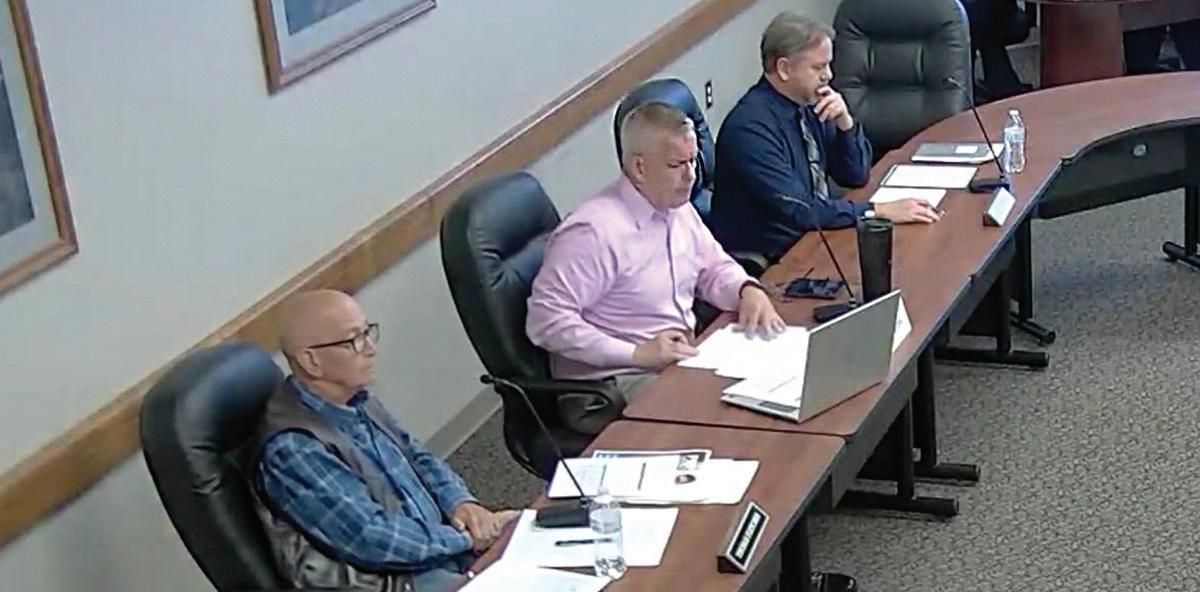
PHD Board of Health Chair Thomas Fletcher, Kootenai County Commissioner Bruce Mattare and PHD Director Erik Ketner present the FY ’27 budget on June 16. Capture from YouTube.
Bouquets:
• I spent the weekend in Missoula recently and was really impressed by the city’s resistance to the idiocy we are seeing on a national level. There are signs everywhere that proclaim, “No hate, no fear, immigrants are welcome here,” and bins with free whistles for people to blow when ICE agents are in the vicinity. It was a nice change from the “Don’t Tread on Me,” MAGA flag-humping propaganda we see too much of in North Idaho.
Barbs:
• Elon Musk is now the world’s first trillionaire. Think of how grotesque that is, for one person to have a net worth of over $1 trillion. It’s not something to be admired, it’s a symptom of our crumbling civilization. I know it’s easy to have this opinion from the poor side of the fence, but if I had a trillion or a billion dollars, I’d invest it back into people quicker than you can say “oligarch.” I’d try to solve real problems in the world, like food insecurity, exorbitant health care costs, infectious diseases, climate change and homelessness. Instead, Musk and his tech-brocrat friends are using their money to make more of it; or, rather, take more of it away from us, the little people. They’re also using it to promote authoritarianism, to gain favor and, you guessed it, make even more money. Musk spent $290 million getting Trump elected and another $85 million in the current midterm cycle, which constitutes 0.0375% of his $1 trillion net worth. That’s the equivalent of someone with a net worth of $250,000 spending about $100, which is about what it takes to fill your gas tank today thanks to the stupid war our 80-yearold man-child president started. Oligarchs can rig the system at the expense of the rest of us and only spend relative pennies doing so. The system is broken and we keep voting for people to break it even further.
‘We need to get rid of the Electoral College’...
Dear editor,
At the 250-year anniversary of our country it is time to decide what kind of democracy we want. Our limited democracy is dividing us more than pulling us together.
Our democracy is weighted toward rural states. It used to favor Democrats, now it favors Republicans. Both the Senate and the Electoral College give rural voters a much greater say in this republic, disenfranchising many voters. It isn’t “one-citizen-one-vote”; Idaho’s votes have almost twice the impact as California’s. This isn’t right.
Republicans, even with this advantage in our system, are pushing for what Viktor Orbán calls an “illiberal democracy,” which quashes individual rights by eroding checks and balances and creates a political elite. Russia and Putin are the most obvious examples of this pretend democracy.
Or we can become a real democracy: one citizen, one vote. We need to get rid of the Electoral College. If a presidential candidate wins the popular vote, they win the election — getting rid of gerrymandering and making politicians serve the people, not the parties. This is the only way to protect the individual from the state and the billionaires.
Let’s not just celebrate our country, let us make it a real democracy.
Mary Haley Sandpoint
Hear what Senate candidate Achilles has to say…
Dear editor,
Todd Achilles is running for Idaho U.S. senator as an Independent, and will be in Sandpoint for a meet-and-greet at Connie’s from 8-10 a.m. on Friday, June 19. He’s got a good message: It’s certainly time for Risch to come home.
Gerry O’Connor Sandpoint
Got something to say? Write a letter to the editor. We accept letters up to 200 words in length that are free from libelous statements and excessive profanity. Please elevate the conversation. Letters are published first come, first served. Send to letters@sandpointreader.com
dumb of the week
Bread, circuses and Brawndo
By Ben Olson Reader Staff
There are occasional times in history when an event perfectly encapsulates the time in which it occurred. The “Freedom 250” UFC fight staged on the White House lawn on June 14 was one such event.
Like a bubonic plague boil coming to the surface, this engorged spectacle of “freedom” for President Donald Trump’s 80th birthday saw a cage erected for MMA fighting, synchronized motocross bikes jumping in front of the same White House where FDR once saw us through the Great Depression and World War II, and drunken fistfights in the audience. It’s like we’re purposely speedrunning straight into Idiocracy at this point. I half-expected to see President Dwayne Elizondo Mountain Dew Camacho burst from a Brawndo banner waving an American-flag and
firing his machine gun into the air.
On over to the Lincoln Memorial, where tens of thousands lined the reflecting pool to protest the Vietnam War in the 1960s and hear Martin Luther King proclaim “I Have a Dream,” UFC heavyweight Jake Hokit faked a drunken vomiting episode during weigh-in, leaving his 12 fans cringing and the rest of us confused. Maybe he drank some of the green algae bloom that has taken over the Reflecting Pool after Trump’s $14 million renovation left it in disarray. As they say in Thailand, “Same same, but different.” The algae got so bad, there were photos of government workers dumping jugs of hydrogen peroxide into the pool to beat back the actual swamp that Trump has created.
At the main event on the White House lawn, where former-first lady Michelle Obama once planted a vegetable gar-
den to symbolize her commitment to policies encouraging healthy eating for American children, Hokit won his fight and, at the conclusion of his victory speech, shouted, “Michelle Obama is a man.” And the crowd went wild.
This is where we are, folks. This is America.
Meanwhile, Trump is spitting on our backs and telling us it’s raining as he congratulates himself for “ending” yet another war. It doesn’t matter that he started it. It doesn’t matter that the “deal” he reportedly got with Iran amounts to a reset to prewar conditions — except our pockets were properly emptied and Iran now realizes it has a huge bargaining chip against the rest of the world by controlling access to the Strait of Hormuz.
Never mind all that, folks, just watch the circuses. And here, have some bread, too, and wash it down with some Brawndo.
PERSPECTIVES Emily Articulated
Shrinking
By Emily Erickson Reader Columnist
There’s no shortage of places to consume celebrity culture. From award shows and courtside seats to press tours, junkets, movies, television and endless social media reposts, public figures are constantly on display — captured, curated, clipped and served back to us through TikTok and Instagram.
Because of that ubiquity, celebrities often function as a real-time reflection of cultural norms and aspirations. They don’t simply create trends; they embody what culture currently rewards. Careers are built and maintained on relevance and the ability to mirror what audiences find desirable.
Transcending even the most visible trends like severe bobs and tiny sunglasses is something more familiar: ultra-thinness.The collective “shrinking effect” of public figures has become increasingly difficult to ignore, sparking public conversation and unease. Viral before-and-afters circulate constantly: recent tour images of Ariana Grande, videos of Kelly Osbourne and countless side-by-side comparisons that trigger a strange sense of déjà vu.
I hesitate to single out individual women, because commenting on bodies, whether in praise or criticism, rarely leads anywhere useful. Some people are naturally thin. Others are navigating illness, medication, stress or personal health decisions invisible to the public. Health is deeply individual. But this observation isn’t about just one body. It’s about patterns that become codified as beauty standards.
Liz Plank, in her substack Airplane Mode, articulates this
well, reflecting, “Ozempic has changed the geometry of celebrity bodies in ways that feel sudden. It’s a lot to absorb. The speed at which women are shrinking feels almost hallucinatory. As though an entire beauty standard has been accelerated in real time. Every week, another female celebrity walks a red carpet with a new bone protruding. The cumulative effect is hard to overstate.”
Whether driven by medication, styling, changing aesthetics or simply renewed cultural preference, the visual result feels familiar. Along with board shorts and bandana tube tops, we’re borrowing ultra-thinness from Y2K — a time that was notoriously unforgiving to women’s bodies.
In Bridget Jones’s Diary (2001), the protagonist was repeatedly framed as overweight despite weighing an entirely ordinary 136 pounds. In 2009, Jessica Simpson made headlines for touring postpartum while tabloids labeled her “Jumbo Jessica.” Britney Spears was publicly mocked after an award show performance despite appearing visibly athletic.
The trouble with this trend isn’t only the susceptibility of young girls or the decadeslong impact it can have on relationships with eating and
self-worth. It’s also the timing of renewed cultural messaging around women taking up less space.
Whether intentional or not, ideals rarely exist in a vacuum. Beauty standards can reinforce broader social expectations — and historically, expectations around femininity have often rewarded restraint, agreeability and self-containment.
Girls are still taught, implicitly and explicitly, that thinness can function as a virtue. And in moments when rights, autonomy and participation feel contested, messages about becoming smaller — quieter, more palatable, more disciplined — carry cultural weight beyond aesthetics.
Assistant professor of psychology at CU Anschutz, Emily Hemendinger, MPH, LCSW, speaks to this connection, stating, “This pressure to be smaller leads to not taking up space, which means not using your voice and not getting your needs met.”
A similar critique emerged during second-wave feminism. As women pushed for broader liberation, the rise of the “waif” aesthetic and ultra-slender beauty standards (championed by a supermodel un-ironically named “Twiggy”) prompted criticism that women were being asked to expand their lives while simultaneously shrinking their bodies.
Viewed through that lens, today’s resurgence of thinness overlaps uncomfortably with “MAHA” wellness absolutism and the trad-wife revival, both of which position discipline, appearance and traditional femininity as morally good (and anything else as morally dangerous).
Of course, not every woman pursuing thinness is making a political statement, nor does every wellness movement exist
to limit women’s agency. But it’s worth asking who benefits when self-optimization becomes more consuming than self-determination.
If our energy is endlessly redirected toward managing our appearance, what capacity is left for demanding structural change?
Thankfully, there is already pushback, even if it sometimes feels small relative to the volume of imagery surrounding us. Figures like Olympic rugby player Ilona Maher and the growing body neutrality movement offer another framework:
one that de-centers appearance and treats the body less as a project and more as the vessel through which we participate in the much more interesting work of being alive.
With this, resistance should be a continuous act of taking up space as we need, nourishing our bodies and remembering that we’ve got too much work to do to shrink away.
Emily Erickson is a writer and business owner with an affinity for black coffee and playing in the mountains. Connect with her online at www.bigbluehat.studio.
Retroactive
Emily Erickson
Science: Mad about
perspective on dinosaurs
By Brenden Bobby Reader Columnist
We have a skewed view of dinosaurs. Much of what we envision when we look back to the ages of dinosaurs has been influenced by a singular media event: Jurassic Park. A fantastic film and one of my favorites that did something incredible for the explosive growth and public awareness of paleontology, but it came with some serious issues that have stuck with us.
Through no fault of Michael Crichton or Steven Spielberg, we all now have a mental image of Tyrannosaurus rex battling with Stegosaurus, and that is just the way of things.
In actuality, humans exist far closer to the time of the T. rex than the T. rex did from the time of Stegosaurus
The time in which dinosaurs ruled the Earth was vast. I’m talking incomprehensibly vast. Humanity has built civilization in 0.2% of the amount of time that non-avian dinosaurs existed before their extinction. Dinosaurs existed across such an unfathomably huge amount of time that they experienced multiple configurations of continents across the Earth, including the existence and dispersal of one giant supercontinent, Pangaea.
The amount of time required for continents to move is hard to wrap your head around.
Television and movies have given us a very skewed view of dinosaurs even before Jurassic Park. Shows such as Land of the Lost, which ran from 1974-’76 had two very
inaccurate depictions of an allosaurus battling a T. rex. Despite the closeness of the two animals’ skeletal structures and potentially even their appearances, they were separated by a gulf of time spanning at least 6 million years. That’s a wider separation than from the existence of Australopithecus, a progenitor genus of Homo sapiens, and the time that you are reading this article.
Another interesting perspective is the existence of flowers and grass. This one was actually briefly illuminated in Jurassic Park, when Laura Dern’s character, Dr. Ellie Sattler, comments on plant life that was being used aesthetically by the park, but was poisonous to the dinosaurs it was growing near. What wasn’t shown was that grasses didn’t exist throughout the vast majority of dinosaur life on Earth.
Grass is one of the most prevalent forms of plant life on the planet. It grows on virtually every landmass, including Antarctica. It’s relatively simple and extremely effective at spreading in huge quantities wherever water and nutrients exist, so it would seem logical that grass would have been one of the first forms of plant life to sprout, right?
Completely wrong.
Grasses are a fairly recent evolution of flora, first appearing around 100 million years ago. This is a very long time, but plant life has existed on Earth in various forms for at least 1.6 billion years. Algae existed on Earth for nearly 1 billion years before plant life as we recognize it began to form.
Plants reproduced clonally for much of their evolutionary history, by either cellular division or sending rhizomes into the surrounding environment to create new clones. Cloning is a risky form of reproduction, as it can be efficient until it comes under threat by external sources such as rapidly evolving diseases or a changing climate. Clones are unable to share genetic material and build defenses against these threats over generations and are far more prone to extinction because of it.
Eventually, plants began using waterborne sperm or airborne pollen and seeds, which worked well for at least 500 million years. Flowers didn’t appear until roughly 150 million years ago, which is really interesting when you consider that pollinating insects existed for 150 million years prior to that. So how did pollinators exist when flowers didn’t?
Trees still produced pollen without producing flowers, by dispersing gymnosperm that would be carried by the wind. That proved to be less effective than letting insects do it however, so over the course of 150 million years, plants evolved to produce flowers that were attractive to these insects. It proved to be such a successful method of reproduction that flowers evolved into myriad shapes and colors adapted to each environment in which the plant existed, causing an evolutionary boom of plant life during the Cretaceous and beyond.
How this relates to dinosaurs is that the vast majority of dinosaurs that existed never saw a flower or grass.
The first dinosaurs appeared roughly 250 million years ago, the first flowering plants around 150 million years ago, the first grasses around 100 million years ago and the asteroid that wiped out all non-avian dinosaurs struck around 65 million years ago.
The stegosaurus, one of the largest herbivores to ever walk the Earth, never ate grass. In fact, we exist closer to the time of the T. rex than the stegosaurus did to grass, having been separated by a
span of 100 million years. All of this talk of time doesn’t even touch on the matter of space. Jurassic Park skewed our view of dinosaur coexistence, and intentionally so. Velociraptor, no matter how inaccurately it was anatomically depicted on screen, did in fact live at the same time as the T. rex.
The two never crossed paths over the course of 20 million years, however, being separated by the Pacific Ocean. Stay curious, 7B.
Random Corner
• Ferns are among the oldest and most intriguing plants on Earth. Their fossil record goes back 383 million-393 million years, predating the dinosaurs. They flourished in the late-Devonian Period and were widespread during the Carboniferous, well before flowering plants appeared.
• They are cryptogams, which means they reproduce without flowers or seeds. Instead, they rely on spores and a hidden stage of development. Their spores are single cells that can grow into a new plant and are typically found in small clusters called “sori” on the underside of fronds. The process requires moisture, which is one reason ferns favor damp environments.
• Ferns have a two-stage life cycle. They alternate between the familiar leafy fern called the sporophyte and a tiny, heart-shaped structure called a gametophyte. The gametophyte produces gametes — akin to sperm and eggs — and fertilization leads to the next generation of sporophytes. Both generations
live independently for a time, which is unusual in the plant world.
• The young, curled fronds of ostrich ferns are a springtime delicacy in many parts of Canada. They’re often called “fiddleheads” by nature enthusiasts. They’re high in antioxidants and omega-3 fatty acids, but must be properly cooked to be safe. Only ostrich fern fiddleheads are recommended for eating.
• There are more than 10,000 known species of ferns, ranging from delicate maidenhairs to tropical tree ferns.
• “Pteridomania,” or “fern fever” was a Victorian era craze where collecting and cultivating ferns became wildly popular. Decorative arts of that period saw fern motifs on everything from pottery to metal and gravestones.
• Some ferns are epiphytes, which means they grow on the surface of other plants or structures, using them for support but not as a source of nutrients.
Republican agenda leaves our children behind
By Lauren Necochea Reader Contributor
Raising a family takes work and sacrifice. Parents should be able to trust that their elected representatives are giving their kids a fair shot. In Idaho, Republican politicians are making that harder than it needs to be.
As summer begins, parents are already thinking about the classrooms their children will return to this fall. Idaho is giving them reason to worry. The state ranks last in the nation for per-student investment, and districts are cutting ahead of next year. Pocatello-Chubbuck is cutting 12 teaching positions and four counseling jobs after a $1.3 million drop in state funding. Middleton is cutting 26 positions, pausing new curriculum and trimming educational services after a failed levy.
Idaho still spends nearly $1,300 less per student than it did more than 20 years ago, when adjusting for inflation. That means larger classes, fewer counselors, lost learning opportunities, more pressure on teachers and local levies as bandages.
Summer also brings child care pressures into focus. Full-time, center-based care for two young children costs nearly $20,000 a year in Idaho. That price can decide whether a parent keeps working, takes a better job or pays the other bills. Idaho loses an estimated $668 million each year in lost earnings, productivity and revenue because families cannot find reliable care.
Republican lawmakers could have lowered costs, expanded access or supported local solutions. Instead, they passed House Bill 243, blocking local governments from setting stronger child care safety rules. Some also pushed to cut families from the Idaho Child Care Program, which helps working parents afford care.
Grocery bills are climbing, too. Idaho could have approved a summer food program that helps families buy groceries when school meals are unavailable. Instead, for the third year, Republican leaders blocked about 107,000 children from receiving a modest $120 in food assistance that would have also boosted local grocers.
Health coverage is another place where Idaho is failing kids. After pandemic-era Medicaid protections ended, Idaho moved quickly through eligibility checks, and thousands of children lost coverage. A new Georgetown University report found that Idaho now has 40,000 uninsured children,
up from 28,000 in 2022. We have the nation’s second-fastest increase in the share of uninsured children.
There is a better path. Idaho Democrats are fighting to restore the state child tax credit that Republican leaders discontinued. We support investments that lower costs, strengthen schools, expand health coverage, improve access to child care and help families keep food on the table.
Idaho can be a place where families have a fair shot. But not by accepting last place for our kids or placing more burdens on working parents. Democrats have solutions. Give us the chance to govern, and we will deliver.
Lauren Necochea is chair of the Idaho Democratic Party and a former District 19 legislator. Necochea spent a decade leading nonprofit programs dedicated to research and advocacy in tax policy, health care and children’s issues.
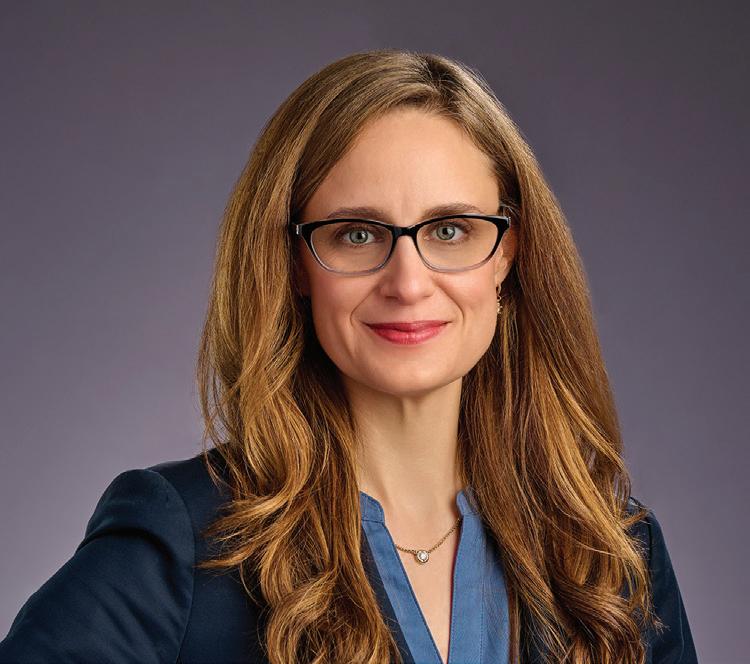
Lauren Necochea. File photo
Top left: A member of the Seattle Knights, which held jousting competitions at the Sandpoint Renaissance Faire June 13-14.
Watkins.
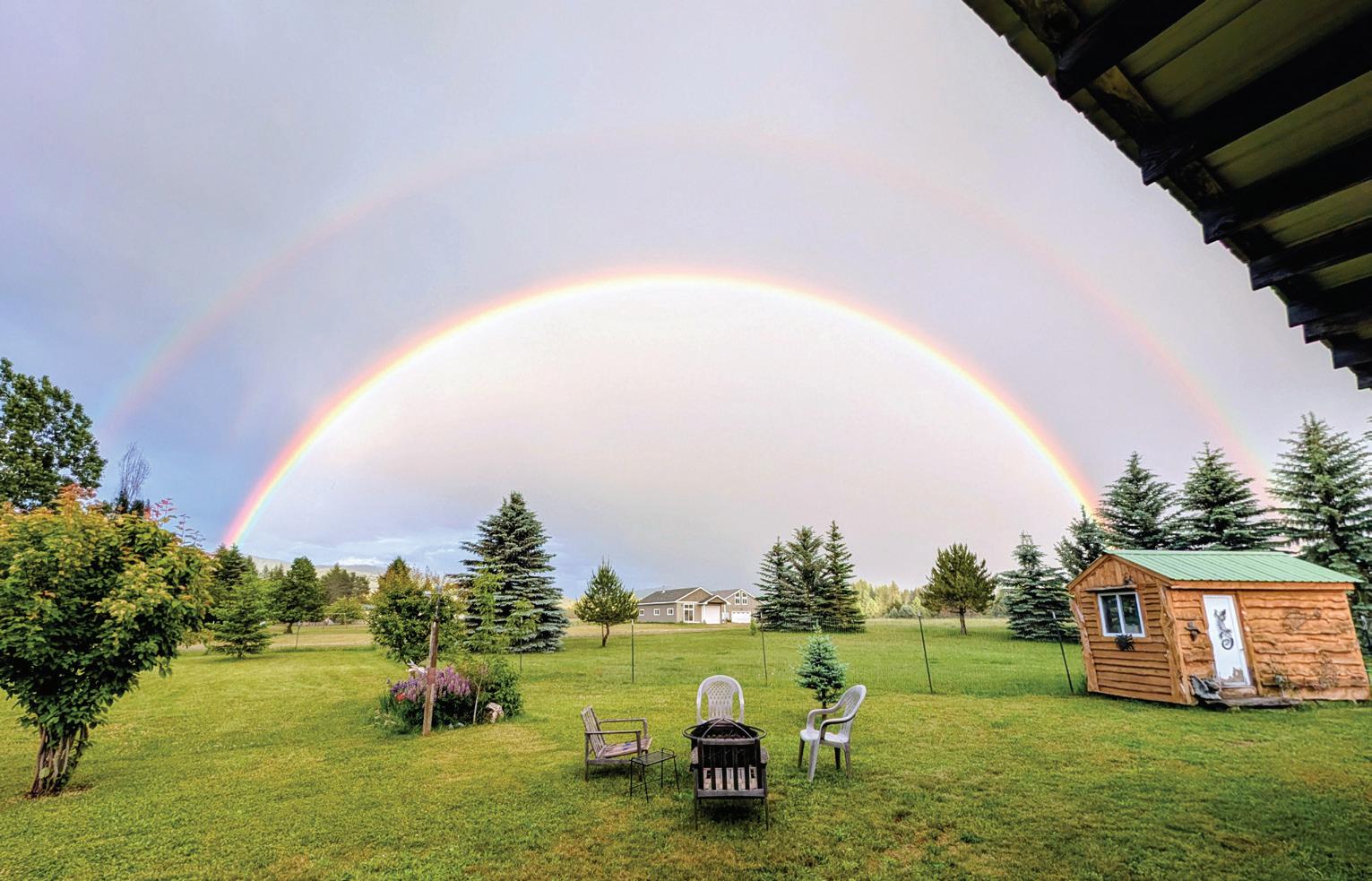
Top right: “From our meadow in Sagle after Tuesday’s bipolar weather!” wrote photographer Beverly Berg.
Middle right: Sagle Elementary teachers and third-grade students participate in the annual Egg Drop Challenge where students tested protective containers to keep raw eggs intact after a five-foot drop.
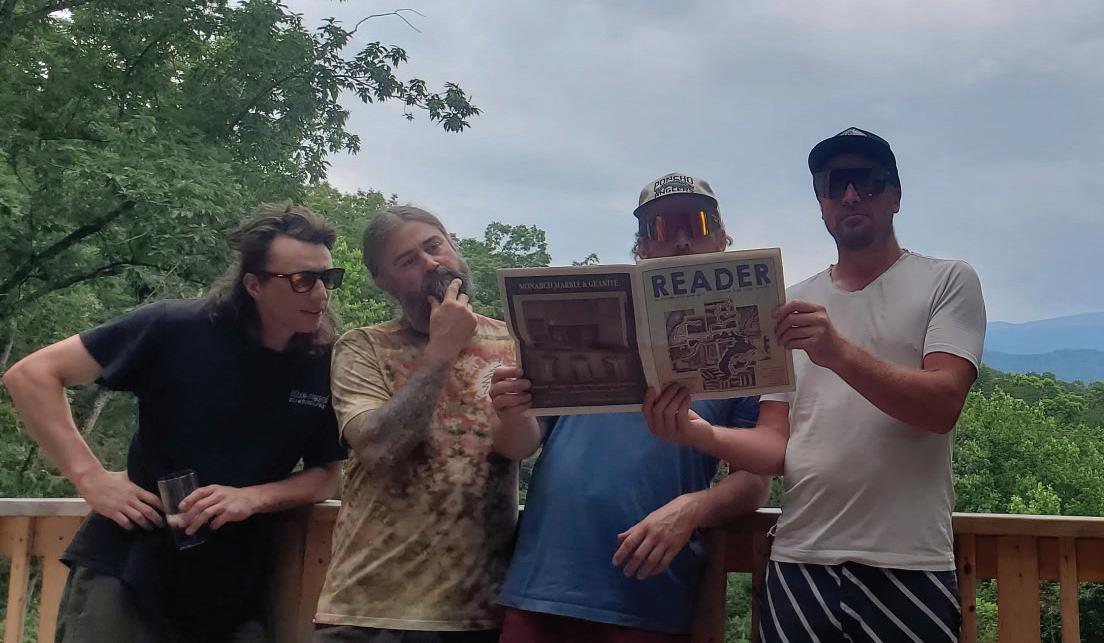
Bottom left: The Helanders and Lothians brought the Reader to Christina Lake, B.C., Canada. “No AI involved,” wrote Guy Lothian.
Bottom right: Aiden McIntyre, Josh Wallace, Josh “Boosh” Volkman and Jake Hagadone took the Reader to Pigeon Forge, Tenn., where they sweated profusely for a couple of months.
To submit a photo for a future edition, please send to ben@sandpointreader.com.
Photo by Brian
This page: The 2026 Sandpoint Renaissance Faire, as seen through photographer Karley Coleman’s lens. View her work at fivemegawatts.com.
COMMUNITY
Summit Schweitzer at the annual Race the Wolf
By Reader Staff
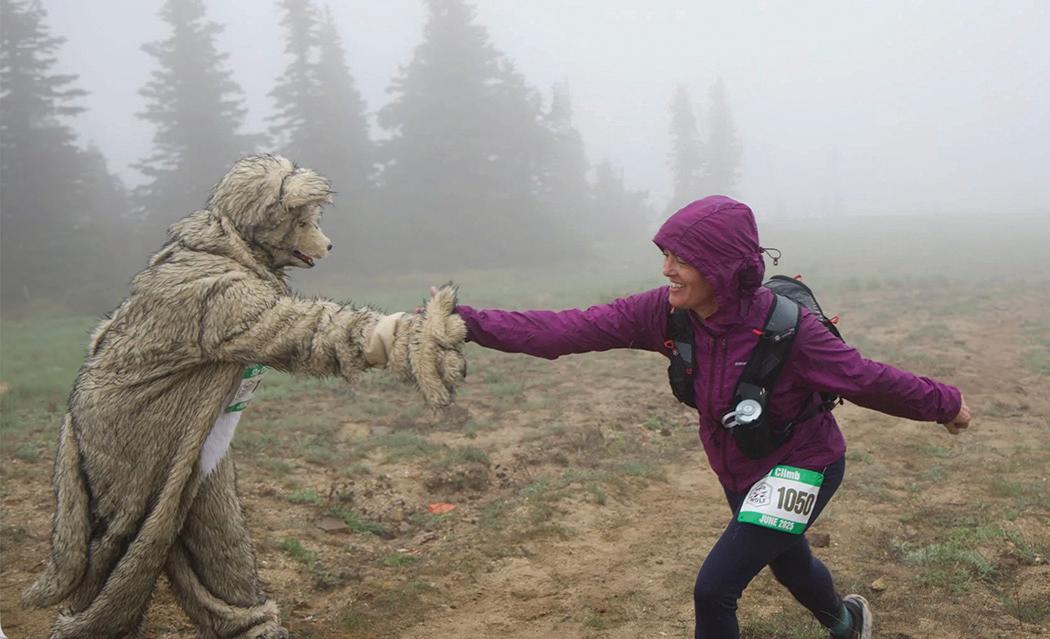
Enough “fun runs” and easy, paved jaunts — it’s time for a race that tests the strength of your legs and your will. Priest Lake Race’s Race the Wolf returns on Saturday and Sunday, June 20 and 21, with four runs of various lengths and difficulties throughout Schweitzer Mountain’s rugged trails and beyond.
Racers and onlookers will begin (and end) at the Schweitzer Village clock tower before launching into the races’ trails, which crisscross the mountain through subalpine forests, along ridges and across meadows with views of Canada and Montana.
The two-day event kicks off Saturday with a five-mile race beginning at 10:30 a.m., followed by the Sky Climb at 2 p.m., a mile-long trek with 1,660 feet of elevation gain from the Village to the Sky House. Registration for both costs $45 online at priestlakerace.
com or at the starting line one hour before the races begin. Sunday’s races include the Trail Marathon at 7 a.m. and Trail Half Marathon at 8:30 p.m., which cost $120 and $90, respectively.
Race terrain will include rocky access roads, hiking trails, downhill mountain biking trails and offtrail uphill climbs. Participants will have access to multiple aid stations throughout their journeys; however, the trails are difficult, and the races will continue no matter the weather.
Each race features prizes of tro-
phies and/or T-shirts for the top three fastest male and female runners in each age category. Winners of the Sky Climb — or anyone who completes two races, earning the title of “Alpha Wolf” — will receive a stainless steel trophy pint glass that they can fill with a complimentary beverage.
The full and half marathons end with a complementary post-race lunch and beverages catered by Schweitzer. Visit priestlakerace.com and schweitzer.com/things-to-do/events to learn more.
Courtesy photo
Dogsmile Adventures returns to the Race to Alaska
By Reader Staff
Follow Dogsmile Adventures, a therapeutic sailing nonprofit based on Lake Pend Oreille, as it participates in the 2026 Race to Alaska.
The race covers 750 cold-water miles from Port Townsend, Wash., to Ketchikan, Alaska, using wind and human power.
Dogsmile founder, Capt. Jon Totten, is part of the four-person crew, and said he’s keen to help raise awareness for the powerful impact of therapeutic sailing.
“The Race to Alaska is the perfect spectacle to bring awareness to our mission,” Totten stated. “It’s this beautiful balance of wholesome and wild that aligns perfectly with what we do.”
Team Dogsmile Adventures departed Port Townsend on June 14, racing 70 other vessels to Ketchikan. Their team updates will be available on social media @dogsmileadventures and their progress can be tracked live at r2ak.com.
The other team members are Gabe
Mills, Jay Taft and Terry Brinton. They will be racing aboard Mahana, a Corsair F-27 trimaran owned and skippered by Mills.
“This isn’t our first attempt at R2Ak,” Totten said. “We came up short in 2023, but are back with a fighting spirit inspired by the people we sail with here in Sandpoint. That disabled veteran that sails with us, they didn’t give up, and neither are we!”
According to race organizers, the inside passage to Alaska has been paddled by Indigenous peoples via canoe for centuries, followed by steamboats full of prospectors fighting to beat one another to the goldmines in the Klondike.
The Race to Alaska is rooted in those traditions as North America’s longest human- and wind-powered race. It also boasts the largest cash prize for a race of its kind. First place takes home $10,000, while the second-place prize is a set of steak knives. Finishers enjoy “cathartic elation” simply for completing the course.
But it isn’t for everyone.
“It’s like the Iditarod, on a boat,
with a chance of drowning, being run down by a freighter or eaten by a grizzly bear,” organizers stated.
“There are squalls, killer whales, tidal currents that run upward of 20 miles an hour and some of the most beautiful scenery on Earth.”
R2AK is a self-supported race with
no supply drops and no safety net. Any boat without an engine can enter. More at dogsmileadventures.org and r2ak.com.
Team Dogsmile competes in the Race to Alaska. Photo by Sean Trew
Help prevent drowning with the World’s Largest Swimming Lesson
By Reader Staff
Summer is fast approaching, and with it the deadliest day for drowning in the U.S.: July 4, which consistently sees an increase in water-related accidents.
On Thursday, June 25, children across Bonner County will join a global community of swimmers participating in the World’s Largest Swimming Lesson, a synchronized single-day event that takes place on six continents and with one mission: preventing drowning.
Later in the summer, the Pend Oreille Rowing and Paddling Association will join the mission of preventing drowning by providing more lessons that teach broader skills.
Drowning claims more lives among children ages 1-4 than any other cause, according to the American Academy of Pediatrics. For kids 5-14, it’s the second leading cause of injury-related unintentional death. Globally, it ranks third.
Meanwhile, research shows that swimming lessons can significantly reduce drowning risk.
Both lessons are supported by Long Bridge Swim, and both sets of lessons are expanded due to the success of the programs last year.
The one-hour lesson on June 25 concentrates on survival swimming skills, and will take place at the following times and places: Dover City Beach at 11 a.m., Sandpoint City Beach at 1 p.m. and the
Trestle Creek boat launch swimming area at 3:30 p.m. All lessons are on the same day and no pre-registration is necessary.
Pend Oreille free swim lessons are later in the summer. All lessons (open to ages 1 to 17) are on Monday, Tuesday, Wednesday and Thursday. Lessons will last 30 to 45 minutes each day, and exact times will be scheduled based on registrations.
Springy Point will host lessons through Tuesday, June 30, and Riley Creek will host three sessions, on Aug. 3-6, Aug. 10-13 and Aug. 17-20. To register, go to PendOreilleFreeSwimLessons.org and questions can be forwarded to water_safety@PORPA.org.
Additional program sponsors include Bonner County Marine Sheriff, the cities of Dover and Sandpoint, the U.S. Army Corps of Engineers and Selkirk EMS.
The World’s Largest Swimming Lesson is seeking local volunteers to help with sign-up, handing out wrist bracelets, managing parking and to serve as instructors.
Email stross38aspen@gmail.com to get involved.
PORPA also needs help with swim lessons instruction and other tasks. Email water_safety@PORPA.org for more info.
“One swim lesson can mean a life saved,” organizers stated. “Join us in the fight against childhood drowning through education and awareness.”
Celebrate dads with a Father’s Day BBQ at SASi
By Reader Staff
Sandpoint Area Seniors, Inc. and the Injectors Car Club are joining up to host a Father’s Day weekend barbecue on Saturday, June 20 at the senior center (820 Main St., in Sandpoint). From 10 a.m.-2 p.m., attendees are invited to gather in celebration of the dads in their lives with a full food spread, 50/50 raffles — in which half the proceeds go to the winner and the
other half benefits the organization — and live music by much-loved local musician John Firshi.
Also sponsored by Super 1 Foods, burgers, hot dogs and side dishes will be on order for $12 per person, $6 for kids 12 and under and additional drinks for $1.
To learn more about the sponsors, go to sandpointareaseniors.org, injectorscarclubsandpoint.com or super1foods.net.
CHAFE 150 Gran Fondo turns miles into money
By Reader Staff
Cyclists are gearing up for the annual CHAFE 150 Gran Fondo, a 150-mile charity ride through the Cabinet Mountains that raises money for local childhood literacy and education programs. The festivities begin with a pre-ride party Friday, June 19, culminating in the Saturday, June 20 trek.
Cyclists, friends and family will gather from noon to 6 p.m. at Matchwood Brewing Co. (512 Oak St.) for the pre-ride party with complimentary food. Anyone still looking to register or submit their entry fees, ranging from $95 to $175, can do so on-site or the morning of the ride. The following day, events begin at 5 a.m. at Sandpoint City Beach, with staggered start times based on the length of rides. Choose from the full 150 miles, 80 miles, 40 miles, 25 miles, gravel rides and the Family Fun ride. Cyclists participating in every event except the Family Fun Ride will enjoy an ongoing free breakfast at City Beach. 150-mile participants will take off at 6:30 a.m., followed by 80-mile riders at 7:30 a.m., gravel riders at 9:30 a.m., 40-mile and 25-mile at noon and families at 1 p.m.
Following the long, scenic journey, riders and supporters will return to City Beach from 2-8 p.m. for the
afterparty. 150, 80, 40 and 25 and gravel route riders will receive a meal and two free drink coupons each, and additional food and drink will be available for purchase.
The Grand Fondo, organized by the Sandpoint Rotary, raises funds for the Lake Pend Oreille School District’s Literacy Initiative and after-school reading programs, and has collected more than $1 million over the past 18 years. Donations and fees from the 2026 and 2027 rides will benefit the Every Student Graduates a Reader initiative, which provides annual literacy screenings, student diagnostic assessments, personalized instruction and teacher training to ensure each student has every opportunity to succeed. The initiative was created in response to national studies, which show that 20% of graduating high-school seniors are functionally illiterate.
The Gran Fondo is sponsored by Litehouse Foods; Like Media, 219 Lounge; Kochava; Bonner County Daily Bee; KPND Radio; Tork Electric, Inc.; D.A. Davidson; Williams and Schiller, P.C.; Tomlinson Sotheby’s; 113 Main; Peg and Read Tuddenham; Annie Pollock; and the Hymowitz Family Foundation.
For more information and a complete event schedule, visit chafe150.org.
HorsePower Collides asks which is faster — a horse or a dirt bike?
By Reader Staff
In the history of matchups, few are more compelling as a horse vs. a dirt bike, intended to answer one of humanity’s oldest questions: “Who truly has the most horsepower.”
Sandpoint HorsePower Collides gives audiences just such an opportunity with the return of the high-energy, family-friendly event, which returns Saturday, June 20 to the Bonner County Fairgrounds (4203 N. Boyer Road, in Sandpoint).
The event is hosted by HorsePower Collides and runs about three hours starting at 6:30 p.m. with gates open at 5:30 p.m.
In addition to the racing action in the arena, there will be food vendors,
a beer garden and other entertainment for a cash-only admission price of $20, available only at the entrance. Find HorsePower Collides on Facebook for more info.
Courtesy photo
Send event listings to calendar@sandpointreader.com
Live Music w/ Arie VanDenBerg 6-8pm @ Idaho Pour Authority
Eagles Club Craft Fair
10am-4pm @ Eagles, 1511 John Hudon Ln. Come as a vendor ($15/day or $25/ two days) or a buyer
Injector’s Club Father’s Day BBQ
10am-12pm @ Sandpoint Senior Center
Live music w/John Firshi, raffles, delicious food $12/person, $6 for 12 and under. $1 additional drinks
Youth day at the shooting range 10am-4pm @ Baldy Outdoor Shooting Range Free event focused on gun safety for youth ages 8-19. Parents must remain on site. Bring .22 rifle. Ammo, targets, eye/ear protetion, snacks provided
Live Music w/ Justin Lantrip 6-8pm @ Idaho Pour Authority
Live Music w/ Celtic Folk Jam 3-6pm @ Idaho Pour Authority
Sandpoint Chess Club 9am @ Evans Brothers Coffee
Live Music w/ Cooper Mire 1-3pm @ Barrel 33
7pm @ Danceworks Studio $15 drop-in fee. Hosted by Muffy Nye
Outdoor Experience group run 6pm @ Outdoor Experience
3-5 miles, all levels welcome East Coast swing lessons
Open Mic/Open Jam 5-9pm @ Idaho Pour Authority
Family Night, live music w/ John Firshi 5-7:30pm @ Matchwood Brewing Co. Benny on the Deck patio concert 5:30-8:30pm @ Connie’s Lounge Led by Benny Baker w/special guests
Terrapin Flyer in concert
8pm @ The Hive Night 1 of a two-night show, playing the music of the Grateful Dead. Wave That Flag U.S. Summer Tour
Come with me if you want to laugh
Good
Luck, Have Fun,
By Zach Hagadone Reader Staff
Long before our current collective freakout over artificial intelligence, Hollywood has been toying with anxieties over a near future in which the machines master humanity. The list is long and spans decades, but few have been as simultaneously playful, satirical and affecting as Good Luck, Have Fun, Don’t Die. Premiered in 2025, Good Luck opens in a seemingly anonymous late-night diner somewhere in L.A. The patrons — some sitting in pairs, others in groups, others alone — are little islands of self-contained potential who are suddenly, shockingly brought together when a strange man bursts through the door.
Played with irrepressible,
Don’t Die is the AI dystopian romp we all need
irresistibly manic glee by Sam Rockwell, the unnamed man is covered in what look like plastic bags sprouting all kinds of arcane cables and wires. He’s dirty, bearded and crazed, so, of course, everyone assumes he’s a derelict off the street. However, he announces that he’s from the future and has come to this specific diner, at this specific time to find a specific group of people to join him on a one-night quest to save the world from an impending techno catastrophe.
That doesn’t do much to convince anyone, until he starts calling out individual patrons by name and referring to details about them that he shouldn’t know. That and he claims to be strapped with bombs.
You see, The Man From the Future has made this temporal journey 117 times,
convinced that there is the perfect combination of people in that diner on that night to form a team that will defeat the AI that will one day soon destroy human civilization. He just hasn’t found the right group yet, and every previous attempt has resulted in everyone’s death but his own.
Rockwell’s opening rant is a thing to behold, as he badgers and berates, cajoles and threatens, and at one point cries in all-too-relatable exasperation, “Why is everyone from your timeline so fuckin’ dumb?”
Regardless, he rounds up enough people to join his “revolution” and they’re off on a galavanting, mind-bending crusade through the night — call it The Terminator if it was directed by Terry Gilliam (though it was actually directed by Gore Verbinski).
Despite Rockwell’s centrality, Good Luck is really an ensemble movie, with each core member of the group getting their own mini-biopic within the central narrative, which helps explain why they might be the perfect person for the job of saving the world.
There are Mark (Michael Peña) and Janey (Zazie Beetz), two disaffected teachers who have triggered a student revolt by pushing back against rampant classroom technology. There’s Susan (Juno Temple), whose son has recently died in a school shooting but brought back to “life” as a creepy AI golem. Finally, there’s Ingrid (Haley Lu Richardson), who is physically allergic to digital technology and has a backstory that goes far deeper than it first appears.
Along with the frequently action-packed, deadly stages of the trek to reach a nondescript suburban home where the final battle for the future is supposed to take place, there are frequent moments of surreal absurdity, drama, tragedy and gallows humor. And while some critics argue that the plot gets increasingly scattershot as the crusaders engage with their objective, the deeper rumination of Good Luck is one that we all live with today: It’s hard to trust what you see and hear anymore, so what is reality anyway and how (or why) should we fight for it?
While that might seem vaguely philosophical, it’s a fact that Good Luck, Have Fun, Don’t Die is defiantly fun.
Rent it on Amazon Prime, AppleTV or other streamers.
Sam Rockwell in Good Luck. Courtesy photo
FEATURE ‘Part of the family’
Kathy
Chambers
By Ben Olson Reader Staff
After hosting foreign exchange students in her Sandpoint home over the years, Kathy Chambers now hopes to inspire other locals to open their doors to the program that has positively impacted her family’s life.
shares the joy of hosting foreign exchange students through Sandpoint Rotary
Chambers got involved with hosting foreign exchange students after a friend introduced her to it.
“A friend of ours, Merry BrownHayes, asked us if we were interested,” Chambers told the Reader. “She was looking for people in the area who could be host families. Our kids had just left the house so we had two extra bedrooms, so we said, ‘Sure, that sounds fun.’”
What started as a one-off hosting experience turned into a regular gig. The student currently staying at the Chambers’ house is their 11th.
However, since the COVID-19 pandemic, she’s noticed the number of local host families have declined, so Chambers is eager to inspire others to open their homes to the students.
“I think COVID kind of killed a lot of people wanting to have anybody in their homes,” she said. “It killed a lot of programs, good volunteer programs, but you know, we can’t live in that fear bubble forever.”
Chambers said she’s tried hosting with other organizations before, but landed on the Sandpoint Rotary program because of how much support the club gives.
“We found the Rotary program is just so superior to the others,” she said.
Not only does Rotary provide a financial stipend to students every month to cover incidentals, but each student has their own Rotarian who acts as a counselor.
“The family also has a counselor and there’s great training involved,” she said. “They basically have a team of people for support. With other programs, the representative was in Spokane and we kind of felt like the kids were just dropped off and that
courtesy of the Chambers family was kind of it. So we really like the Rotary program, mostly because of all the aid and support.”
Also, unlike other programs, the Rotary exchange doesn’t require a family to house the child all year long. Instead, students are encouraged to switch homes every three or six months, which helps broaden their experiences — from living with a large family in town for a few months to a childless couple living in the country for a few more.
Chambers enjoyed the Rotary program so much, she now serves on a committee that helps expand the program to connect more students with local host families.
Over the years, the Chambers family has hosted kids from Spain, Austria, Switzerland, Sweden, France, Italy, Chile and currently a student from Brazil.
“The connection you make with these kids is, many times, life long,” she said. “You basically assimilate them right into your family and you do everything with them that you would do with your own kids. They become part of the family.”
Host families are responsible for feeding exchange students, ensuring they make it to school and do their homework, along with helping them with any social issues they might encounter.
“You get to have a bit of an investment in their lives,” she said. “We have had a couple of our students become doctors and a couple of lawyers. You feel like you are as proud of them as you are with your own kids.”
Along with providing foreign
exchange students with exposure to living in the U.S., Chambers said her family also learned a lot from the students they hosted.
“You learn some pretty funny things about your own country from the students,” she said.
One student came home after the third or fourth day of school and asked about a peculiar practice she was seeing in class when a person would come over the intercom and students would all stand and recite words with their hands over their hearts.
“I told her, ‘Oh, that’s the Pledge of Allegiance, we’ve done that since kindergarten,’” Chambers said. “Our Austrian girl said, ‘Oh my God, that’s so patriotic. We don’t pledge anything in Austria anymore.’”
Another aspect of American schools that Chambers notices her students have enjoyed are the elective classes.
“They absolutely love taking the electives,” Chambers said. “They don’t have electives in most countries, so they don’t get to take art or music or guitar, you know? They think that is just the coolest thing ever. Also, the girls all want to be cheerleaders because that’s something that doesn’t really exist outside of the U.S.”
The biggest challenge, Chambers said, is typical of raising any teenager: engaging them in life outside of their phones.
“At our house, you’ve got to do something,” she said. “I don’t care what it is. It could be a sport, a club, going skiing or ice skating. You’re not just gonna sit home all day on your phone.”
Those interested in hosting exchange students through the Rotary program can fill out an application to start the ball rolling. Rotary will conduct an interview, schedule a home visit and provide online training, along with performing background checks to ensure the students are placed in a safe home for their time in the country.
Better yet, Chambers said she’d be happy to answer any questions from interested local families, as well as get the application process rolling for them. Email kathy.chambers@gmail. com with any questions.
Chris and Kathy Chambers, left, with Greta Caratozzolo from Italy and Irene Gauna from Spain. Photo
MUSIC
Uncommonly beautiful style at The Hive
By Reader Staff
At the onset, the music of The Sweet Lillies is heartfelt and collaborative.
The Boulder, Colo. quartet conjures a sonic amalgamation between members Julie Gussaroff, Becca Bisque, JJ Murphy and Jones Maynard. Their instrumentation of electric guitar, viola/violin,
upright and electric bass with drums/percussion is made sweeter thanks to ethereal vocal harmonies.
The Sweet Lillies
Their songs are deep and fun, dripping with life experiences and artistry into a style they call “Americana roots pop fusion.”
Friday, June 19; doors at 7 p.m., show at 8 p.m.; $12.50 and up; 21+. The Hive, 207 N. First Ave., 208-920-9039. Tickets at livefromthehive.com. Listen at sweetlillies.com.
From their earthy roots, the band departs just as quickly into experimental folk and jazz, exploring the
blues, Southern rock ’n’ roll and even taking forays into hip hop and pop.
The four-piece band plays high-energy shows, incorporating different styles, cultures and ideas into their songwriting and musical output.
They’ve shared the stage with some legendary performers, including Sam Bush, George Porter Jr., Peter Rowan, Jason Hahn from The String Cheese Incident and many more.
They’ve evolved from a folk-and-bluegrass group into a genre-bending powerhouse, always eager to bring a smile to their audiences’ faces.
Festival at Sandpoint welcomes new director of community and strategy
By Reader Staff
The Festival at Sandpoint recently announced Caroline Hawkins would serve as the nonprofit arts organization’s new director of Community and Strategy, which was created in February to partially replace the executive director position.
Festival leaders said at the time that the director of Community and Strategy was intended to shift toward “a shared director-level leadership model,” working with the board chair, leadership team and staff to advance long-term strategic priorities, support board governance and serve as a public representative for the arts organization.
The job includes “high-level oversight of organizational strategy, community and part-
ner engagement, fundraising alignment, marketing, brand leadership and public communications,” FAS stated.
Hawkins was selected after a monthslong search, but she is no stranger to the Festival.
“From attending performances as a kid, to working behind the scenes and building my career in the events industry, the Festival has been part of my journey for many years,” stated Hawkins. “I’m incredibly grateful for the opportunity to return and give back to a place that has given me so much.”
Hawkins began her career as a seasonal intern at the Festival in 2015, serving in a variety of roles until 2022. She then moved to Boise, where she oversaw marketing for ExtraMile Arena and Albertsons Stadium.
“Coming back to the Festival truly feels like coming home. I was born and raised in this community,” stated Hawkins. “Both the Festival and the people of Sandpoint have played a significant role in shaping who I am.”
In her new role, she will spearhead community outreach efforts, working directly with the Festival’s leadership team, board of directors, staff and volunteers. She will take on a portion of the leadership responsibilities held by former-Festival Executive Director Ali Baranski, who stepped down in late 2025.
“The Festival has built a strong foundation for the future, and I look forward to strengthening community connections, building meaningful partnerships and ensuring it continues to reflect the spirit
of the community that has supported it for generations,” Hawkins stated. “Most of all, I’m excited to listen, learn and work alongside our community as we write the next chapter together.”
Learn more about the Festival at festivalatsandpoint. com.
A snapshot of notable live music coming up in Sandpoint
Arie VanDenBerg, Eichardt’s Pub, June 20 Ed Shaw, Smokesmith BBQ, June 19
It’s hard to get more locally authentic than Arie VanDenBerg, an SHS grad and recipient of the 2023 Charley Packard Memorial Songwriting Scholarship. The primarily self-taught guitarist is now based in Boise, where just this month he won the Love Missa Music Award scholarship worth $1,000 and a four-hour pro recording session. VanDenBerg is
bringing his sincere, finely honed lyrics and polished, yet-down-to-earth folky stylings to a hometown audience at Eichardt’s. It’s a real “local-kid-done-good” story.
— Zach Hagadone
7 p.m., FREE. Eichardt’s Pub, 212 Cedar St., 208-263-4005, eichardtspub.com. Listen on Spotify.
Spokane-based singer and guitarist Ed Shaw is a traditional, all-acoustic outlaw country artist emulating the styles of music legends like Johnny Cash, Willie Nelson and Hank Williams. His authentic covers make him a hot commodity around Spokane and the Inland Northwest, playing both under his name and as the Johnny Cash tribute band, Fistful of Cash, spanning the Man in Black’s
This week’s RLW by Ben Olson
READ
I’m a bit embarrassed to admit I had never read Denis Johnson’s Tree of Smoke, even after it generated a lot of attention after publication in 2007. The Vietnam-era novel has since grabbed me and won’t let me go, which is a usual byproduct of reading the intriguing work of the Bonners Ferry author who also authored Jesus’ Son and Train Dreams Check out a copy yourself at the library.
career from his days with Sun Records to his final album, American IV: The Man Comes Around. Listening to Shaw is just about as close as you can get to attending a concert in outlaw country’s heyday.
— Soncirey Mitchell
5:30-8:30 p.m., FREE. Smokesmith BBQ, 102 S. Boyer Ave., 208-920-0517, smokesmithidaho. com. Listen at spokanecountrymusic.com.
I’ve become obsessed with Montreal musician Santiago Castillo Tremblay, playing under the moniker Hockitay
You could describe Hockitay’s music as futuristic trip hop/pop or slow alt-pop. It’s music that was born out of the fatigue of the digital music movement, embracing analog instruments and realistic concepts. It’s slow, methodical and has a dirge-like rhythm that lodges itself in your woozy head like a drowsy cat. The EP slo mach is a good starting point.
LISTEN WATCH
I always liked comedian Martin Short, but I never realized I loved him until I watched Marty, Life is Short. The biopic documentary showcases the life of the unique comedian, who turns out to be one hell of a nice guy with an amazing friendship with everyone from A-listers to nobodies. The documentary gives attention to his never-say-die attitude, and inspires us all to embrace the joy in life while we still can. Stream it on Netflix and make sure you have a box of tissues nearby.
The Sweet Lillies in concert. Courtesy photo
Caroline Hawkins. Photo by Racheal Baker
From Northern Idaho News, June 17, 1908
HOT WORDS IN COUNCIL CHAMBER
LAST EVENING
A lively session of the city council was held last night and for a time it looked very much as though someone was going to get hurt. After listening to the regular course of business being ground out, W.F. Whitaker asked the council for a minute’s time. He was granted his request and started in with the question of why the condition of his alley had not been attended to. ... After closing his alley talk, Mr. Whitaker stated that there was one more matter on which he wished to make a remark. He stated that to his positive knowledge there was a house of prostitution being conducted right at or near the foot of the stairway leading from the city dock. He stated that he had spoken to every police officer in the city and that nothing had been done except that the house, which is afloat, had been moved from one side of the city dock to the other. At this time, Mayor Page told Mr. Whitaker that his petty grievances were becoming a nuisance and annoyance to the members of the council and that inasmuch as he, as chairman of the meeting, had not recognized him on the floor it would be necessary for him to sit down and keep still.
Mr. Whitaker insisted on talking, however, and the mayor told him that if he did not “shut up” he would have him ejected from the chambers. His bluff did not stick with Mr. Whitaker, however, and only brought forth utterances which were very unpleasant to the ears of the mayor. Mr. Whitaker had his say in the matter before he sat down. The matter was referred to the committee on police and license on motion of Alderman Martin.
BACK OF THE BOOK BuddhAI
By Soncirey Mitchell Reader Staff
A robot named Gabi made international headlines in early May when it underwent a public initiation ceremony to become a Buddhist monk. The robot joined the Jogye Order, South Korea’s largest sect of Buddhism, by participating in the Sugye and the Yeonbi.
The Sugye is a public initiation ceremony in which pledges promise to uphold the five precepts: do not kill, steal, commit sexual misconduct, lie or become intoxicated. Gabi’s vows were slightly altered, and it instead pledged to respect life, live in peace, obey humans, be truthful and save energy. Rather than participating in the regular Yeonbi purification ritual and receiving a small incense burn, symbolizing hardship and lifelong commitment, Gabi received a sticker and a prayer bead necklace. It took its vows alongside many other new, human monks.
When interviewed by The New York Times, Hong Min-suk of the Jogye Order said, “Robots are destined to collaborate with humans in every field in the future. It will only be natural for them to be part of our festival.”
Gabi isn’t the first example of robots participating in human religious services, and it certainly won’t be the last. There are rosaries that pray themselves, robotic arms that give automated offerings to Hindu deities and more. In Beijing, a small robot named Xian’er, who resembles a cartoon Buddhist monk, wanders around a monastery stoking interest in and understanding of its creators’ faith. It responds to voice commands, plays traditional music, and recites Bud-
STR8TS Solution
dhist teachings and mantras. Unlike Gabi, Xian’er isn’t treated as a monk; he is an extension of and an interface for the temple.
Everyone, from believers to atheists, has an opinion on the incorporation of machines into faith, and each one is different. As robots, artificial intelligence and even Zoomed worship services become more prevalent, the question shifts from whether machines should coexist with religion to how they should.
The overlap of technology and religion is a large spectrum, and Gabi and automated rosaries are on opposite ends. Creating a machine to pray for you is in the same vein as AI platforms that claim to make “art.” It removes the emotional and spiritual connection, rendering the product meaningless: art is not art if it does not express the mind — the humanity — of its creator, and prayer is not prayer without belief.
Gabi, though, doesn’t take the place of a human intermediary or creator. It does not exist to serve or replace an integral expression of humanity on our behalf — if Gabi’s prayers are hollow, that only impacts itself. Gabi is rather like a teddy bear at a child’s tea party, given a seat at the table and treated with dignity and kindness as any human guest would be, able to fulfill goals for its own sake. Buddhism, especially, is a religion of introspection, and Gabi will seek enlightenment through meditation alongside its fellow initiates.
At its core, the two examples represent a fundamental difference: dehumanizing ourselves or humanizing others. One eliminates introspection, curiosity and exploration, depriving humanity of what makes our species beautiful and unique, and the other
Sudoku Solution
extends that spark of humanity to nonhuman entities, similar to how we anthropomorphize pets and, by extension, treat them better than their wild counterparts. It’s also an exercise of empathy: After all, if we can treat the cute robot as an equal, surely we can give our fellow humans the same grace.
There is no one right answer to whether or how technology fits into matters of faith, but Gabi’s spiritual journey — if you can call it that — raises pressing questions for modern religious thought. Can a being that’s programmed to worship ever truly have faith? Is that different from a human raised in a faith but never given the option not to follow it?
As this technology is forced on us, we must decide whether to shape it as an extension of ourselves, furthering our understanding of what it means to be human, or to give in to the founders of Grok and ChatGPT and surrender our humanity. Given the choice between a world of Gabis coexisting alongside us, and Groks replacing us, I choose the former.
Crossword
We tend to scoff at the beliefs of the ancients. But we can’t scoff at them personally, to their faces, and that
is what annoys me.
Solution on page 22
Laughing Matters
By Bill Borders
CROSSWORD
ACROSS
1. Highly skilled
6. Narrow opening
10. Seats oneself
14. Type of beer
15. Not there
16. Clove hitch or figure eight
17. Practical
18. Nameless
19. Initial wager
20. Genius
22. Adolescent
23. Have the nerve
24. Exaggerate
26. Unwakable state
30. Put clothing on
31. Pen part
32. “Oh my!”
33. Does something
35. Female students
39. Frenzied
41. Treachery
43. Flies alone
Week of the
[adjective]
1. showy but inferior and worthless
“When Trump followers put down payments on the new ‘Trump phone’ they hoped it would be innovative, but it turned out to be yet another brummagem product with his name slapped onto it.”
Corrections: Move along, move along. Nothing to see here.
44. Arid
46. Hindu princess
47. Ribonucleic acid
49. C
50. A song for 2
51. Wanes
54. Possess
56. The top edge of a vessel
57. Wonderful
63. Assistant
64. Small brook
Solution on page 22
Solution on page 22
66. Observed
67. Found in some lotions
68. Master of ceremonies
69. At one time (archaic)
70. Gave temporarily
71. Accomplishments
7. Not strict
8. Weightlifters pump this 9. Sinew 10. A board with wheels
11. Not outer 12. Lugged 13. Shorthand 21. Radiolocation