Honey Pearl Productions Presents 1776: The Musical wit, a powerful score, & timeless relevance, 1776 shows that history was made by determined individuals daily 7 pm, matinee July 5, 3 pm, doors 45 mins. prior
Honey Pearl Presents in the Little Theater 1776 Pre-Funk Dinner & Music
JoDavi, North Carolina–based singer-songwriter Proceeds support North Idaho veterans Saturday, 4:45 pm prior to performance
House of Fly & The Mayfly Project Presents International Fly Fishing Film Festival with Bucket Raffles and Door Prizes Thursday, 7 pm, doors 1 hour prior
DanceWorks Presents Danceworks 2026
this annual showcase is a highly anticipated family event Thursday, 7 pm, doors 1/2 hour prior
300 North First Ave. Sandpoint, ID (208) 263-9191 panida.org the heart of downtown
The week in random review
By Ben Olson Reader Staff
14 cows for America
One of the most touching displays of diplomacy happened in the wake of the 9/11 terrorist attacks in 2001. Though the attacks were carried out entirely within the boundaries of the U.S., the impact of the event touched every corner of the world. However, in some remote villages around the world, news of the attacks traveled slowly, often only reported by word of mouth. This was the case with Kimeli Naiyomah, a Maasai student from a remote village in Kenya who attended college in California. Naiyomah witnessed the attacks on the World Trade Center while visiting New York and, when returning home to his village months later, he was the first to share the news with his community. One elder who was moved by the story asked, “What can we do for these poor people?” Naiyomah decided to offer the U.S. the most precious and compassionate gift he could: a cow. In Maasai culture, cows are sacred symbols. “The cow is almost the center of life for us,” Naiyomah said. “It’s sacred. It’s more than property. You give it a name. You talk to it. You perform rituals with it. I don’t know if you have any sacred food in America, something that has a supernatural feel as you eat it. That’s the cow for us.”
His generosity inspired other members of his tribe, which came together to offer a total of 14 cows to the people of the U.S., which were presented to the then-ambassador to Kenya in a 2002 ceremony. Options for moving the cows to the States were explored, but it was ultimately decided that keeping the herd in Kenya would be the safest way to care for it. U.S. diplomats returned to this village in southern Kenya to announce the herd was staying where it was, and that they will be blessed and their offsprings used to pay for education for the children of the village. To get the cow trust fund going, the U.S. donated 14 high school scholarships.
“What you did to help us will not be forgotten,” said then-Ambassador to Kenya Michael Ranneberger. “We did what we know best,” said an elder named Mzee ole Yiamboi. “The handkerchief we give to people to wipe their tears with is a cow.”
quotable
“We hold these truths to be self-evident, that all men are created equal, that they are endowed by their Creator, with certain unalienable Rights, that among these are Life, Liberty and the pursuit of Happiness.”
— The Declaration of Independence, 1776
for you and me
“In the shadow of the steeple I saw my people By the relief office I seen my people; As they stood there hungry, I stood there asking Is this land made for you and me?”
— Woody Guthrie’s “This Land Is Your Land”
DEAR READERS,
This week’s cover was painted by Kathy Robinson, showing our lake, a jaunty sailboat and the Lady Liberty statue that has stood over City Beach since 2003.
I included the full text of Emma Lazarus’ poem, “The New Colossus,” which is inscribed underneath the real Statue of Liberty in New York City. That poem gave us those iconic lines, “Give me your tired, your poor, your huddled masses yearning to breathe free.” Powerful words. I hope they haven’t completely lost their meaning yet.
We’re observing 250 years since July 4, 1776 and I can’t help but feel like we might’ve lost the plot somewhere along the way. It was 17th century historian Thomas Fuller who once wrote, “It is always darkest just before the day dawneth.” Let’s hope we can all find our way back to the light.
Thanks for reading. Be safe and be well.
– Ben Olson, publisher
111 Cedar Street, Suite 9 Sandpoint, ID 83864 208-946-4368 sandpointreader.com
Editors Emeriti: Lyndsie Kiebert-Carey Cameron Rasmusson John Reuter
Advertising: Ben Olson ben@sandpointreader.com
Contributing Artists:
Kathy Robinson (cover), Ben Olson, Bruce Robertson, Julia Kaufmann, Jon Hagadone, Mary Lou Hiner, Brett Batchelor, Tami Sundin, Debra Lambrecht, Sarah Mitchell, Bill Borders
Contributing Writers:
Zach Hagadone, Ben Olson, Soncirey Mitchell, Lorraine H. Marie, Brenden Bobby, Matt Lome, Emily Erickson
Submit Stories To: stories@sandpointreader.com
Printed Weekly At:
Tribune Publishing Co. Lewiston, ID
Subscription Price: $200 per year
Website Designed By: Keokee
The Sandpoint Reader is a weekly publication owned by Ben Olson, Zach Hagadone and Soncirey Mitchell. It is devoted to the arts, entertainment, bluster, politics and lifestyle in and around Sandpoint, Idaho.
We hope to provide a quality alternative by offering honest, in-depth reporting that reflects the intelligence and interests of our diverse and growing community.
The Reader is printed on recycled paper using soy-based ink. Leftover copies are collected and recycled weekly, or burned in bonfires to appease the gods of journalism. For back issues, contact the publisher. Free to all, limit two per person, please.
Letter to the Editor Policy:
We welcome letters to the editor on all relevant topics. Please, no more than 200 words, no excessive profanity or libelous statements and no trolls. Please elevate the discussion and stay on topic. Letters will be edited to comply with the above requirements. Opinons expressed in these pages are those of the writers, not necessarily the publisher. Send to: letters@sandpointreader.com
About the Cover:
This week’s Fourth of Julythemed cover art was created by Kathy Robinson.
Paid parking rollout sparks confusion
By Zach Hagadone Reader Staff
Sandpoint’s long-awaited and debated paid parking program rolled out July 1, though amid continued and widespread consternation by the public, rising even to outright protest.
Residents and visitors alike expressed their displeasure with the new system on its opening day — particularly regarding the parking kiosks located at 43 locations throughout the downtown two-hour zones on First and Second avenues, Cedar Street and portions of Third Avenue and Main and Church streets.
Sandpoint Planning and Community Development Director Jason Welker told the Reader that a software glitch affected the machines, which defaulted to full-day parking rather than the two-hour free parking provided for in the zone, and further confused would-be users.
“The kiosks are not working as designed,” he said. “They should default to the minimum of free parking It’s not what was supposed to happen.”
Welker added that the glitch was being addressed on July 1, with fixes being handled manually by technicians, and all the kiosks would be fully updated by that afternoon.
“I’m not terribly surprised there was a technical glitch, but it’s frustrating,” he said.
City officials, including Welker, emphasized that the city will only issue warnings for paid parking violations during its first two weeks to give users time to better understand the system.
The Reader spoke with more than a dozen downtown visitors throughout the day on July 1, and all said they either didn’t understand the kiosk system, opted simply not to use it or both.
Later in the day, residents also expressed their frustration at a community protest in the city-owned parking lot at Third Avenue and Church Street, where about 20 people gathered at 4 p.m. holding signs.
Organizer Sara Harris, a Sandpoint resident and downtown worker, told the Reader that she wasn’t opposed to paid
parking, just that it shouldn’t fall on locals — be they city or county residents.
“The way they’re doing it doesn’t make sense,” she said, going on to refer to the twohour zone kiosks, which enable free parking for up to two hours, then the option to add time for $4 per hour.
“It’s creating an incentive to stay longer,” she added. “The most you can pay there is $4, so the most you could pay for a full day is $24, so you could stay there all day for about half what the $50 ticket would have cost.”
Other attendees criticized what they perceived as City Hall’s lack of communication about the plan — as well as the inability for county residents to have a say — though the plan had been extensively reported by area media and worked on in public meetings and workshops over the past 18 months.
Ryan Lohman, another Sandpoint resident and local worker, argued that the parking plan should be rolled back because the city passed it without the proper ordinance in place.
To the Reader’s knowledge, that claim has yet to be evaluated by legal experts, but Lohman is going further, passing out a petition at the July 1 protest and launching a GoFundMe campaign aimed at recalling Sandpoint Mayor Jeremy Grimm and councilors who voted for the plan in the summer of 2025.
“This is the first time I’ve ever gotten involved in politics — I’ve never protested in my life,” Lohman said. “I just don’t want to see this place destroyed.
People have to have a way to undo what’s happened.”
Many of the same comments and sentiments had been roiling local social media forums over the preceding days, with dozens of posts garnering hundreds of responses decrying the paid parking system as unnecessarily complicated, intrusive to users’ privacy, detrimental to downtown merchants and potentially adopted improperly by the Sandpoint City Council.
Tensions had grown so high in the week before the rollout that Sandpoint Mayor Jeremy Grimm signed a two-page
statement posted to the city’s Facebook page calling for calm.
“Reasonable people can disagree about public policy. ,” he wrote in the statement dated June 25. “Unfortunately, the public conversation has recently taken a troubling turn. Some online discussions have included increasingly hostile rhetoric and references to violence against government officials and destruction of public property. Let me be clear: There is no place for threats, intimidation or glorification of violence in Sandpoint.”
Grimm went on to highlight “misinformation being shared online,” including “opinions and speculations presented as fact” alongside “statements that are simply inaccurate.”
While the mayor’s statement addressed several common points of contention regarding the purpose and functioning of the paid parking system, he and Welker went directly to the public with a presentation and Q&A session at the Downtown Sandpoint Business Association’s regular June 30 meeting, which drew nearly 80 attendees to Marigold Bistro at 8 a.m.
“The reason I’m here this morning is just to let you know that this is not a kneejerk reaction. This is something that the city’s been working on for well over a year and a half,” Grimm said. “We’ve had numerous meetings with downtown businesses and we’ve done surveys and studies.
“This is not some fly-bynight, let’s-try-to-extract-money-from-our-residents-and-visitors [policy].”
The paid parking system is concentrated on a number of city-owned parking lots and the two-hour zone centered in the downtown core. Users can access sandpoint.thepermitportal.com to purchase annual resident and non-resident permits for $20 and $35, respectively, enabling up to eight hours of parking per day in the city lots at Third Avenue and Church Street, Bridge Street, City Beach, Dock Street Marina and the Pend Oreille Bay Trail. Without a valid permit, users of those facilities are required to pay an hourly fee
beginning July 1. Street parking in the twohour downtown zone remains free up to the posted time limit, though parking longer than that will require payment of $4 per additional hour. Vehicles parking in that zone will be required to enter their license plate number at any of the kiosks, regardless of their permit, or through the ParkSmarter mobile app. Likewise, parking will remain free up to the three- and four-hour limits in those respective zones. However, users who wish to secure 24-hour parking in downtown lots as well as the three- and four-hour street parking zones — plus up to eight hours in the waterfront lots — can pay $40 per month.
Those with handicap placards or license plates are allowed unlimited parking in any zone or parking lot throughout the city, with no permits or kiosk check-ins required.
There are also a number of seasonal boat launch permit options, or a $10 daily launch fee, which does not include parking, for those without permits.
Complete information about the various zones, permit types and other FAQs is available at sandpointidaho.gov/parking.
At the June 30 meeting of
the DSBA, Welker emphasized that the program is intended to encourage vehicle turnover in the two-hour zone, thereby benefiting downtown businesses by giving customers more opportunities to find vacant parking stalls, and generate revenue from out-of-area users at City Beach.
“The message we got from downtown business owners who packed City Council chambers last May was that they wanted to see better enforcement over time limits downtown,” Welker said. “Technology is one way to do that. What this technology will allow is basically a doubling of the efficiency of time limits, enforcing every vehicle in that two-hour zone, which is only about one-fourth of our downtown street parking.”
Punctuated by numerous interruptions and questions asked out of turn by audience members, the meeting remained tense throughout as Welker and Grimm addressed topics and concerns ranging from the technology used in the kiosks to enforcement times, to how employees
A map of Sandpoint showing parking areas denoted by different color schemes. Courtesy image.
Coalition files grievance against school district over LPOHS campus relocation
Complaint alleges financial misuse, attendance data fraud
By Soncirey Mitchell Reader Staff
The Concerned Citizens for LPOHS Coalition, led by former-West Bonner County School District Superintendent Jackie Branum, lodged a formal grievance against Lake Pend Oreille School District on July 30 over plans to move Lake Pend Oreille High School from its historic Boyer Avenue campus.
The complaint, filed with the Idaho Department of Education and the U.S. Department of Education’s Office of Special Education Programs, demands that the district cease all relocation efforts and engage in an independent, third-party forensic audit of finances and student attendance and graduation records, among other requirements.
Among numerous claims in the 31-page document, the coalition alleges the district has violated Idaho Open Meeting Law and the Individuals with Disabilities Education Act, as well as falsified “district-wide attendance data” and misallocated public funds.
The district announced its intention to close LPOHS’s 117-year-old facility in February due to dwindling attendance, state funding cuts, and the cost of maintenance and renovations. Though the school board has yet to vote officially, the district plans to keep students in the century-old building for core classes during the 2026’27 school year, giving them the option to bus to Sandpoint High School and the Career Technical Education Center for electives or attend class online. The school will then move into the portables behind Sandpoint Middle School for the 2027-’28 school year.
Renovations to SMS are ongoing and will continue through the coming school year, when students will use the portables as temporary classrooms. The portables will also undergo major renovations using some
of the same funds to prepare for LPOHS’s student body.
The coalition has taken issue with the use of the portables, arguing that they do not provide a large enough separation from SHS and that “there is zero record of any funded, code-compliant plan or engineering layout” to add indoor plumbing and bathrooms.
“At-risk youth enroll at LPOHS precisely because they struggle with intense social anxiety, overwhelming crowds, and the rigid, high-stimulus structures of traditional campuses,” the complaint stated, later adding, “The superintendent [Becky Meyer] is attempting to solve a financial math problem, while this community and its taxpayers are fighting to protect a psychological safe haven mandated by law.”
According to an official response from the district, shared with the Reader on July 30, the portables’ classrooms will be code-compliant and include upgraded plumbing, meaning students and teachers will not have to leave campus during the school day.
“The foundational building at the new LPOHS campus is currently being remodeled this summer with the addition of student and staff restrooms, which are necessary for the SMS use of that building during next school year’s SMS renovations,” District Community Relations Liaison Shelby Struhs told the Reader. “Further remodeling will continue on this campus next summer prior to LPOHS relocating, which includes additional plumbing.”
The coalition further claimed that allowing LPOHS students to take SHS classes and positioning the campuses directly next to one another will have the unintended consequence of reducing LPOHS from an alternative school to a program in the eyes of the state. This would eliminate $314,770 in funding over three years; however, the district argues that LPOHS will
“still be considered a separate campus” and generate At-Risk Student funding, as it only needs to meet three of five criteria to qualify as a separate school under the Idaho Administrative Procedure Act.
According to LPOSD’s release, these criteria include, “Enrollment of at least 36 students, full-time enrollment, [an] instructional model different from the traditional high school” and that it “awards its own diploma or receives its own federal accountability rating.”
As for the current campus, the district’s 2023-’24 Building Condition Evaluation rated both the SMS and LPOHS facilities “unsatisfactory,” along with the Homeschool Academy and Northside and Washington elementaries. For the century-old facility, the evaluation recommended installing “structural reinforcement” to the masonry; adding a fire suppression system and ADA elevator and emergency exits; and replacing the roof, electrical services, plumbing and fire alarm system.
Unlike SMS, which has received necessary funding for renovations, the alternative high school has a projected enrollment of only 56 students for the 2026-’27 school year. According to the district, enrollment at LPOHS has steadily declined
from 94 students in 2023-’24 to 76 in 2025-’26, which had a graduating class of 29. Still, the coalition argues that attendance has historically fluctuated between highs and lows. Graduating classes of 44 in 2007 and 39 in 2019 similarly diminished enrollment for brief periods.
Reduced state funding due to low enrollment has meant LPOHS has been operating at a deficit, costing the district $528,042 over the past five years. LPOSD has recently cut costs by eliminating culinary arts, art electives and P.E., and combining the positions of principal and counselor, which the grievance calls “a deliberate strategy of resource attrition.”
LPOHS is not the only school to lose full-time employees. Sagle Elementary lost two positions this year, and students at Clark Fork High School have lost multiple electives over the past five years, necessitating online coursework.
The grievance attributes budgetary shortfalls, in part, to alleged misuse of funds and “premium public investment” in executive leadership salaries and benefits.
“While defunding classroom resources and targeting alternative tracks, the administration quietly leveraged restricted federal [Elementary and Second-
ary School Emergency Relief] pandemic relief funds through the bulk consent agenda to fund a luxury renovation and modernization of the central office executive boardroom,” wrote the coalition.
The group further alleges that LPOSD routinely buries “systemic staff cuts, curriculum reductions and facility alterations” within consent agendas, allegedly violating Open Meeting Law, to avoid school board deliberation and public oversight.
The administration labeled the ESSER allegation as “false” in its official response, stating that the money was removed from the general fund via a school board vote and was used “to meet Americans with Disabilities Act requirements as well as space and security concerns.”
General payroll expenses for the district’s administration, which total more than $2.6 million, have also come under scrutiny, with some questioning why Meyer is the third-highestpaid superintendent in the state after those of the West Ada and Boise school districts, which manage 40,000 and 21,000 students, respectively. Meyer earns $209,139 for her oversight of approximately 3,600 students.
< see LPOHS, Page 6 >
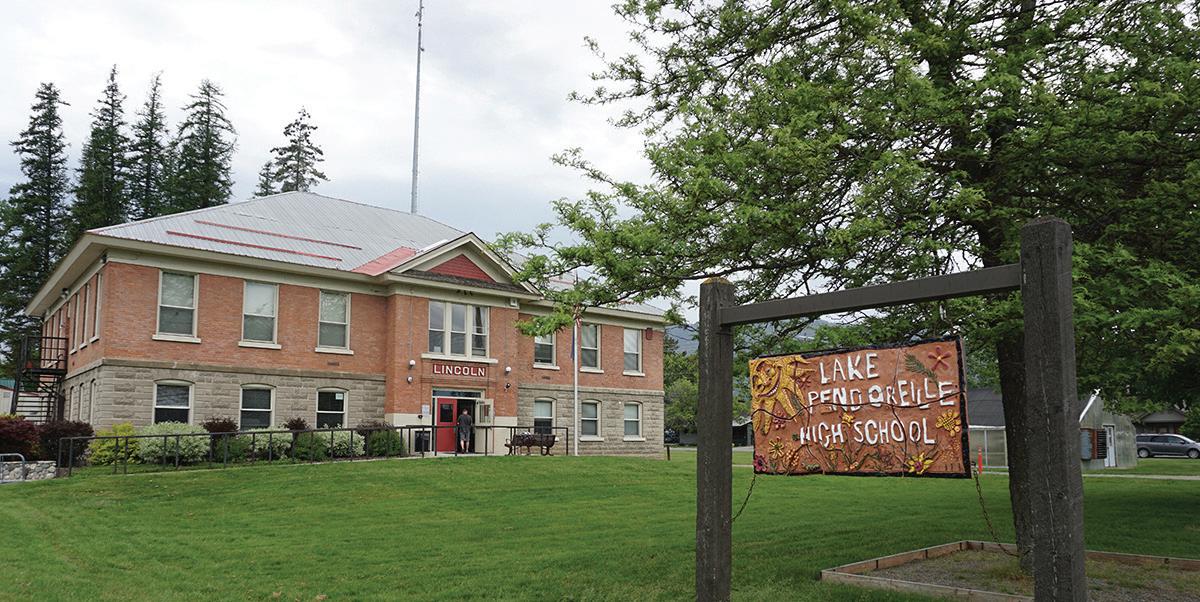
The historic Lake Pend Oreille High School campus on Boyer Avenue.
Photo by Soncirey Mitchell
NEWS
< PARKING, con’t from Page 4 > should navigate the system.
“[T]he goal here is to have downtown employees use the downtown city parking lot or to use [the downtown periphery],” Welker said. “The reason for that is when employees consume those desirable parking spaces right in front of your business, that’s less money that’s going to be spent in your business.”
In response to a question about the ability to use cash to pay for parking, Welker said the kiosks are a cashless system, and “if someone’s uncomfortable tapping a screen with their debit card or credit card or their phone or their watch, then they can park in the threehour spots.”
Sandpoint purchased the kiosks upfront for more than $220,000, which Welker said means any data collected by the machines will be handled and retained by the city.
According to Welker, the city will only write tickets for time limit violations between 9 a.m. and 5 p.m. The no-over-
< LPOHS, con’t from Page 5 >
According to Struhs, the district has already reduced its administrative costs in recent years, having consolidated two clerical positions and chosen not to replace an elementary assistant superintendent and an operations specialist following their departures.
Finally, the official grievance alleges that the current administration and schools throughout the district have been artificially inflating daily attendance metrics and graduation rates to increase state funding, which, they claim, could result in “catastrophic, multi-million dollar state funding clawbacks.”
The claims largely center on area high schools, which utilize “Flex Fridays” — optional online work days for students with a cumulative grade of at least 75%. The grievance claims that any student not on campus on a Flex Friday, regardless of whether they are in contact with a teacher, is marked with an E-code (“Excused/Educational/Working from home”) and therefore counts as present for funding purposes. The administration has disputed this, saying that students who fail to work with a teacher on Flex Fridays are marked as absent.
The coalition also alleges that to preserve graduation rates, the district transfers failing students — or anyone in danger of dropping out — to LPOHS in the fourth quarter before graduation.
They further claim that upon “initial enrollment or at critical performance thresholds across all district traditional and alternative high schools students are routinely directed or coerced by administration to sign an undated, standardized state ‘Intent to Homeschool’ withdrawal form to be held on file.”
night parking rule is intended to stop people from leaving their cars on downtown streets for extended overnight periods.
Sandpoint Police Lt. Michael Aerni, who oversees the community resource officers and therefore parking enforcement, said there is “0% chance to get a parking ticket in the middle of the night.”
Welker also raised the possibility of “turning off” the two-hour zone kiosks during the shoulder seasons — saying he thought councilors “would be open to just disabling the street kiosks” during those months. That idea appealed to Harris, who said “they definitely should do that.”
The one-hour June 30 meeting included discussion of multiple other aspects of the plan, but ultimately Grimm said the city is “not out here to be the Gestapo of parking, so we will be implementing this gradually. There’ll be a huge grace period as people understand how to enter their license plates into the kiosk. In about two weeks we’re going to be issuing warnings, so we’re not gonna try to go out there and browbeat people.”
According to the grievance, these forms are then backdated if a student drops out or stops attending class.
The administration called both accusations false, adding that if students were forced to sign homeschool enrollment papers, “we would have a 100% graduation rate at LPOHS. Two years ago the graduation rate was 50%, and last year it was 80%.”
Based on these accusations, the coalition has asked for remediation in the form of an independent fiscal analysis, a forensic attendance and state revenue integrity audit, and supplemental information on the proposed relocation, including an independent fiscal analysis of projected state funding changes, a change of occupancy permit, ADA accessibility audit, state operational inspection on the portables, public evaluation of maintenance data and an administrative overhead review.
They further request that the district cease all current relocation efforts, present proposed changes at the next school board meeting for a vote and hold a formal hearing on the relocation, among other demands.
“The Board retains the exclusive corporate authority to resolve this crisis locally and transparently,” wrote the coalition. “Failure to act will result in mandatory state intervention, public regulatory scrutiny and direct civil liability.”
As requested, the school board will vote on LPOHS’s relocation at the regular public meeting on Tuesday, July 14 at 5 p.m. Attend in person at the district headquarters in Ponderay (365 Triangle Drive). Meetings are not streamed, but all recordings are available on the LPOSD No. 84 YouTube page after the fact.
Bits ’n’ Pieces
From east, west and beyond
To replenish depleted stockpiles, President Donald Trump is using his executive authority to force defense companies to quickly produce more weaponry, NBC reported.
Federal judges have recently barred Trump from implementing his executive order requiring proof of citizenship to vote, additionally blocking plans for the USPS to refuse to deliver mail-in ballots as well as a tool Trump wanted to use to “nationalize” elections, saying the latter could wrongly purge voters from voter rolls.
Recent Supreme Court’s rulings ending protections for Haitian and Syrian immigrants and physically blocking non-citizens from stepping into the U.S. amount to six justices giving Trump the power to ignore laws passed by Congress, historian Thom Hartmann stated. The fallout of the rulings includes returning about 356,000 temporary status people to severely unstable countries, where they face possible death. SCOTUS’ minority disagreed with the majority’s claim that the Trump administration was not racially motivated in its immigration policies, citing administration statements such as that Haitians in the U.S. “eat pets,” are “poisoning the blood” of the country and that others come from “shithole countries” as indicators of racial animosity
After Congress recently passed a war powers resolution vote, Trump met with Republicans and, accounts indicate, read them the riot act. AP reported that lawmakers ran the vote again and reversed the decision, with Republicans who’d previously sided with Democrats changing their position.
“Congress Clears Housing Bill, Cementing a Rare Bipartisan Feat,” The New York Times wrote. The 21st Century Road to Housing Act, intended to increase the housing supply and lower housing costs, loosens federal regulations, eases lending rules, delivers aid for community disasters and limits how institutional investors can “play the market.” Trump initially lauded the bill, but then canceled signing it “until such time as we pass the desperately needed SAVE AMERICA ACT, which I consider to be a National Emergency.” The Act would hinder the ability for many to vote. Axios reported that under the Constitution, as long as Trump does not veto the housing bill, it will become law 10 days after he receives it
By Lorraine H. Marie Reader Contributor
— whether he signs it or not.
Common Dreams reported that under the health care “dystopia” envisioned by Trump, “cash-strapped patients would take out loans from insurers if they refuse to pay for needed care.
Meanwhile, ABC News reported that a judge has blocked Trump’s plan that would limit graduate student loans in nursing and other fields. Finally, the U.S. Department of Justice has announced hundreds of charges in a health care fraud crackdown on alleged false claims submitted to insurers worth $6.5 billion, the AP reported.
Another judge has barred immigration arrests at U.S. courthouses, according to The Times, while The Guardian reported on how leftist zines were used to sentence anti-ICE protesters to decades in prison.
The sentences have been decried as an “injustice,” after eight protesters received 30- to 100-year sentences, despite two of them not being present during a July 4, 2025 anti-ICE protest that turned violent outside the Prairieland immigration detention facility in the Dallas-Forth Worth area. The zines were claimed to be evidence of providing “material support to terrorists,” included owning an “anarchist” press and claims they were connected to “antifa,” which defendants denied. An appeal is expected.
Europe is roasting in a record heat wave, according to international media outlets, which researchers said is fueled by climate change and would have been “virtually impossible” 50 years ago when the planet was two degrees cooler.
Blast from the past: “Patriotism means to stand by the country. It does not mean to stand by the president or any other public official save exactly to the degree in which he himself stands by the country. It is patriotic to support him in so far as he efficiently serves the country. It is unpatriotic not to oppose him to the exact extent that by inefficiency or otherwise he fails in his duty to stand by the country. In either event it is unpatriotic not to tell the truth — whether about the president or about anyone else — save in the rare cases where this would make known to the enemy information of military value which would otherwise be unknown to him.” — 26th U.S. President Theodore Roosevelt (1858-1919).
Court orders Kochava and subsidiary to stop collecting, selling sensitive user data
By Zach Hagadone Reader Staff
After four years of litigation, a lawsuit brought by the Federal Trade Commission against Sandpoint-based Kochava has reached its conclusion, with a district court order finding that the tech company and its subsidiary “participated in unfair acts or practices in violation of Section 5 of the FTC Act ... in the use and disclosure of data gathered from consumers’ mobile devices and other sources without consumers’ knowledge or consent.”
In addition, the order issued June 25 and signed by Idaho U.S. District Court Judge B. Lynn Winmill bars Kochava and its data broker business Collective Data Solutions “from selling, sharing or disclosing sensitive location data without consumers’ affirmative express consent to settle allegations the companies sold location data from hundreds of millions of mobile devices that could be used to trace the movements of individuals.”
In a news release dated May 4 from the FTC, the agency recounted its allegations first made in August 2022 that consumers “had no way of avoiding the harm resulting from its collection and disclosure” of precise location data that “invaded consumers’ privacy by revealing their movements, including visits to sensitive locations such as health facilities and places of worship.”
In its original complaint filed in U.S. District Court in Idaho, the FTC alleged that specific geolocation data made available as a sample set by Kochava through the Amazon Web Services Marketplace until June 2022 could be used to disclose and trace people to sensitive areas such as abortion clinics, homeless and domestic violence shelters, and addiction recovery facilities.
Additionally, the agency stated, that kind of data could be used to infer LGBTQ+ identification and it could be combined with latitude and longitude coordinates, timestamps and a device’s “mobile advertising identifier” (MAID) to reveal the identity of its owner, making it possible to associate them with a physical home address.
“The FTC alleges that by selling data tracking people, Kochava is enabling others to identify individuals and exposing them to threats of stigma, stalking, discrimination, job loss and even physical violence,” the agency stated in an announcement of the complaint in 2022.
“The FTC’s lawsuit seeks to halt Kochava’s sale of sensitive geolocation data and require the company to delete the sensitive
geolocation information it has collected.”
At the time of the initial complaint, Kochava purchased mobile device location data from third parties, then aggregated it for sale to clients in customized feeds in order to track and assess the efficacy of targeted marketing campaigns. That data was also used by purchasers to track the success of translating advertising into foot traffic at physical locations and gauging the success of billboard ads.
However, the FTC stated in its 2022 complaint, “[I]n just the data Kochava made available in the Kochava Data Sample, it is possible to identify a mobile device that visited a women’s reproductive health clinic and trace that mobile device to a single-family residence.
“The data set also reveals that the same mobile device was at a particular location at least three evenings in the same week, suggesting the mobile device user’s routine,” the agency added. “The data may also be used to identify medical professionals who perform, or assist in the performance, of abortion services.”
In a news release in August 2022, Kochava stated that it purchased that data from mobile operating systems like Apple iOs and Google Android, along with other apps and websites — all of which required users’ consent.
According to the FTC’s news release in May, “consumers were unaware of and did not consent to this data sharing [by the defendants].”
Kochava representatives did not respond to a request for comment by press time, though in 2022 told the Reader in a statement that the FTC’s complaint was “a fundamental misunderstanding” of
how data brokering works.
According to a 2022 report in the Idaho Statesman, Kochava contended that it did not “collect, then subsequently sell data compilation that allows one to track a specific individual to a specific individual.” Instead, it paired encrypted email and IP addresses with MAID information, ensuring it stayed anonymous.
“Even if an injury to the consumer did indeed occur, it is reasonably avoidable by the consumer themselves by way of the opt-out provision to allow the data collection,” Kochava stated at the time, according to the Statesman
In addition to barring Kochava and CDS from brokering sensitive location data without the express consent of consumers, the June 25 order puts in place a long list of requirements, including:
• Creating a program to identify sensitive locations and stop precise data tied to those locations from being sold, shared or disclosed.
• Performing checks to make sure customers gave express permission before their location data was collected or used by the companies.
• Reporting to the FTC whenever the companies find that a third party has improperly shared consumers’ precise location data in violation of their agreements.
• Giving consumers a way to find out who received their precise location data and make it easy for them to withdraw consent for future sales of that data.
• Setting explicit rules for how long location data can be kept and requiring
it to be deleted after a specified period.
The order also stipulates that the sensitive location data program has to be established and implemented — with a specific written plan submitted to FTC along with how it will be maintained — no later than 90 days from the date of the order. A senior officer such as a chief privacy or chief compliance officer must be identified and report to corporate leadership at least every 12 months.
On top of that, and among other compliance requirements, customers who received precise location data within the past two years must be provided with a copy of the order within 90 days of its entry, and a report has to be filed to the FTC within 30 days of any determination that a third-party incident has occurred.
Commenting on the case in a May 26 post on its “Data Decoded” blog, multinational San Francisco-based law firm Morrison Foerster analysts wrote, “The terms of the settlement agreement highlight a trend toward more prescriptive data privacy and security requirements.”
Other companies such as General Motors and OnStar have been similarly found to run afoul of FTC regulations by collecting and selling sensitive location data to third parties, and also been required to put in place much more robust data handling policies and procedures.
The trend goes back to the Biden administration, and included FTC actions against Mobilewalla, Inc. and Gravy Analytics Inc. and subsidiary Venntel Inc. for handling location data.
“[T]he Kochava and Gravy Analytics orders share similar stringent measures, including the requirement for quarterly assessments of sensitive location lists, quarterly testing of related controls and proactive notice to the FTC for suppliers’ contractual violations,” MoFo analysts wrote.
“These developments reflect bipartisan scrutiny not only of location-data practices, but more broadly of how companies collect, share and monetize sensitive consumer information, including data that may not appear sensitive on its face, but can still reveal sensitive insights when analyzed or combined with other data sources,” the analysts added. “Against this backdrop, it continues to be imperative that companies maintain a comprehensive understanding of the data they collect, the parties with whom they share it, and how it is ultimately used, both internally and downstream.”
Find a pdf of the full court order at bit.ly/ KochavaOrder.
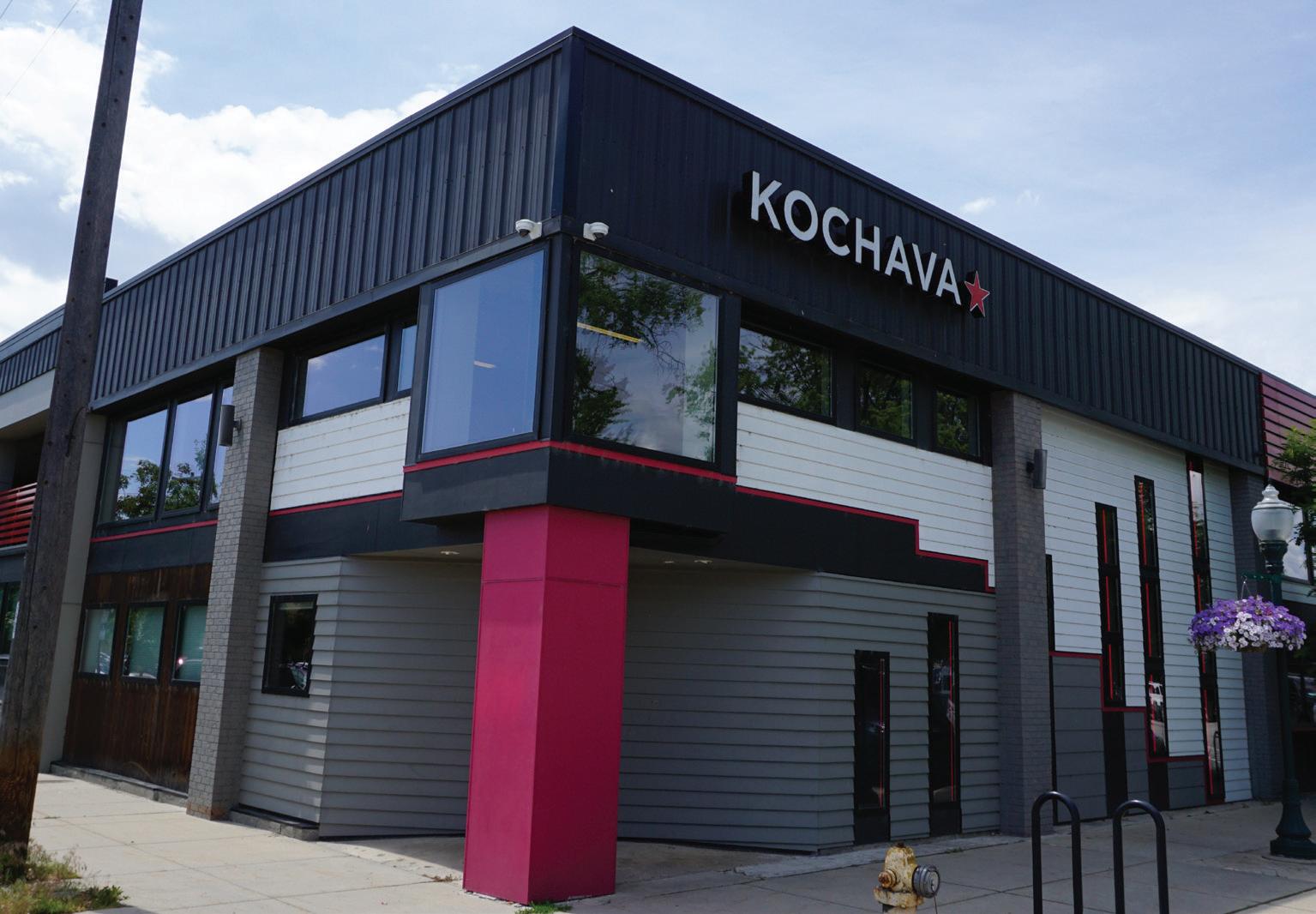
Kochava’s headquarters in Sandpoint. Photo by Ben Olson
Goose patroller deserves free parking…
Dear editor,
Bouquets:
• Bouquets go out to the Sandpoint Lions Club for taking on the annual Fourth of July festivities in Sandpoint.
Barbs:
• The new paid parking policy in Sandpoint went live on July 1 and, as expected, nobody is happy about it. Local social media forums have erupted in criticism and there was even a protest staged on July 1. Unfortunately, as is often the case in Sandpoint, it’s too little, too late. The time to protest this policy was months and months ago, not after the city of Sandpoint instituted it. Does anyone think the city is going to pass this policy, purchase and install parking kiosks all over downtown, then just abandon it because people are mouthing off on Facebook? This happens way too often in Sandpoint: People are so passionate about particular issues — and that’s great — but they don’t pay attention to when their opinions might actually affect change. We’ve written literally dozens of articles about this parking plan for more than a year, and so has the Bee, yet a lot of the social media comments seem to indicate they just heard about it. The city held workshops on the subject and discussed it numerous times at council meetings. All that said, the rollout of this parking plan has been less than stellar. The kiosks are overly complicated and even those in the know (for example, the entire editorial staff of this newspaper) are confused about the details. That wasn’t helped by an apparent software glitch in the machines on the day they went live, which has since been fixed. As of press time, we’ve had numerous people come into our office to vent and ask questions about the changes. To our dismay, we didn’t always have an answer for them. Also, watching people park outside our office all day on July 1, we noticed more than a few scratching their heads at the kiosk for upward of five minutes before getting frustrated and pulling away to park elsewhere. Let this be a lesson: pay attention, read the news and attend council meetings if you want your opinion to matter on changes like this, otherwise we’re all just pissing into the wind.
Once again the geese have returned to City Beach and, by the diligent efforts of a volunteer and her dog (with its official vest), they’ve been kept pretty much offshore. They seem to come in around 6-7 a.m. and will move on by noon with her efforts.
However the city will not give her a parking pass for the beach area, which means she will walk from First Avenue. The service she provides to the community should warrant her parking privileges for a few hours a day, but once again common sense does not prevail.
John Dvorsek Sandpoint
Suggested pre-Fourth of July viewing…
Dear editor
Retired-Federal Judge J. Michael Luttig came into national awareness in December 2020 when he was credited with convincing then-Vice President Mike Pence that there was nothing in the U.S. Constitution that could possibly allow him to unilaterally stop the count, interfere with or otherwise cause the electoral vote count authorization not to take place. Thus began Donald Trump’s efforts toward the Jan. 6, 2021 insurrection, the lies of a rigged election, the unending efforts to dominate the headlines, control the Republican Party, win the presidency in 2024 and destroy our democratic republic making himself king, dictator and the immortal giant of humanity that he always believed himself to be.
Luttig never went away. He recently spearheaded a group of 200-300 retired federal judges to file an amicus (friend of the court) brief that seems to have sidelined the $1.8 billion slush fund that would have compensated Jan. 6 rioters. It is clear Luttig and his compatriots are not finished. Even the Supreme Court is listening.
Luttig has recently appeared on Legal AF with a warning for Trump ahead of the Fourth of July. Find it on YouTube or meidasnews.com. It should be required viewing before the holiday.
Jay Omundson Cocolalla
What is an ‘American’?…
Dear editor,
Our vice president once said that his ancestors buried in U.S. cemeteries are proof he is a genuine “American.” Alternatively, he said that someone without that multigenerational assortment of bones in U.S. soil isn’t really “American.”
Then, more recently, he identified with Richard Nixon. I remember Nixon’s illegal break-in of the Democratic headquarters in the Watergate Hotel, the intrepid journalism it took to expose his coverup and the dismay in the Republican Party that one of their own would be so dishonest. A group of Republican senators told Nixon to get out or be impeached. He left in disgrace.
Is this the model for a man who hopes to be our next president? What does it tell us about his “American” values and activities today?
Immigrants to the U.S. have lower crime rates than citizens. The majority came here to build a life for themselves and their children. A number serve in our armed forces. Is their ambition, respect for the law, willingness to defend us and hard work not American? What is “American?”
Molly O’Reilly Sandpoint
Standing for truth requires kindness, curiosity and humility…
Dear editor,
Life is rarely divided into simple categories of good and evil. Most of us live in the gray areas, where people are imperfect, situations are complex and absolute certainty can be dangerous.
Too often, we assume those who disagree with us — or who are simply different — are wrong or even bad. Yet every person has redeeming qualities if we’re willing to look. Humility begins with recognizing that none of us has all the answers. We all make mistakes, hold inconsistent views and have more to learn.
Standing up for truth and justice doesn’t require self-righteousness. It requires kindness, curiosity and humility — even toward those with whom we disagree. We should resist the urge to demonize people because of their beliefs, celebrate their failures or accept every social media post as fact simply because it reinforces our own opinions. Truth is rarely found in slogans or viral posts. It requires listening, asking questions, researching the facts and being willing to change our minds when the evidence leads us elsewhere.
Having an opinion doesn’t make it true. Our communities — and our democracy — are strongest when humility, critical thinking and a genuine search for truth guide our convictions rather than certainty alone.
Kari Saccomanno Sandpoint
‘The
Spirit of ’76 is dead’…
Dear editor,
It was 1976 and the country was buzzing with excitement about our nation’s 200th birthday. I attended Southside Elementary where our principal was state Rep. Jim Stoicheff. My
best friend’s uncle was state Sen. Kermit Kiebert and our governor was the beloved Cecil D. Andrus — all Democrats. At Southside, Mr. Stoicheff gathered the entire school around the flagpole daily to recite the Pledge of Allegiance; he served his country in words and actions, and imparted that to his students.
Political affiliation meant little to me at the age of 12, but President Gerald Ford, a Republican, gave me no less reason to be proud of America or the bicentennial than the Idaho leaders I respected.
Of the many reasons I dreaded the return of Donald Trump, fearing he would steal the joy from our nation’s 250th birthday was indeed one of them. From the Trump organization trademarking the festivities to the literal swamp he made of the Lincoln Memorial Reflecting Pool, the spirit of ’76 is dead. If there’s one thing Trump is good at, it’s ruining everything he touches for everyone else, while turning a profit for (or a spotlight on) himself. Happy two hundred and fiftieth, America.
Jim Imholte Sandpoint
We accept letters to the editor up to 200 words that are free from libelous statements and excessive profanity. No trolls. Send submissions to letters@sandpointreader.com.
PERSPECTIVES
Emily Articulated
100 miles
By Emily Erickson Reader Columnist
I was introduced to ultramarathoning by my older sister Britt. She was living in Boulder, Colo., and, per the seeming citywide requirement to be either a professional athlete or in pursuit of becoming one, got into extreme endurance.
It was the middle of the 2010s, when the glamour of these events — day(s)-long, mountainous running competitions — was enhanced by the comparatively rudimentary ways in which they were completed. Gear then considered “cutting edge” is crude now, and all we knew about fueling (taking in calories and fluids) could fit in a thimble of today’s understanding.
When Britt signed up for a 100-mile run, it felt like the most insane thing a person could do. I’d be her pacer, tasked with running alongside her in the later miles, reminding her to eat and keeping her on course.
Britt’s leap to ultras, although mind-bending to me at the time, wasn’t surprising. She’d turned to endurance during other periods of our lives, too. After our mom was diagnosed with Stage 4 pancreatic and liver cancer, she’d spend hours at the gym, buoyed by having somewhere to go; by having something that felt productive while we paused our lives in an attempt to pause time. (Coincidentally, those were the same instincts that drove me to a Pentecostal church for my short stint with extreme Christianity — but that’s a story for another time.)
So when she decided to dedicate her attempt at running 100 miles through Talladega National Forest in Tennessee to our mom, whose own finish line was far too short, it made perfect sense. Because “whys” matter.
This was the first lesson I gleaned from my sister’s experience: When you’re about to ask your body and mind to take you places they’ve never been, there should be a powerful reason into which you dig your claws of resolve.
The next lesson was that getting behind on calories, sodium and/or fluids is a recipe for disaster. Her race went smoothly until it didn’t. In endurance events, we use the term “bonking” as a cute summary of a body revolting against the effort — puking, cramping, diarrhea or, in my sister’s case, hallucination.
As I shepherded her through the dense, foggy darkness of the forest at mile 70+, she saw monsters between the trees, our headlamps refracting against the film of their eyes.
I sang broken choruses of Top 40 songs to keep her (and me) from fear, and wondered whether in-race insanity could stick. I had no idea how she’d go another 30 miles.
But eventually, she did.
More than a decade later, I found myself toeing my own 100-mile starting line: The Yeti 100, traversing a long stretch of crushed limestone on Washington’s Snoqualmie Pass. It was my second attempt; the first thwarted by pre-race illness in what I now dub my COVID 100K.
This time, I was healthier in more ways than one. The journey felt like it would be more spiritual than physical and was preceded by months of mental and emotional work. If countless hours of therapy can be distilled into a single revelation, it was this: What I resist, persists.
I needed to learn how to experience discomfort with acceptance and curiosity instead of self-criticism or future-casting. Feelings happen, but the stories I wrote about those feelings were what I could change.
When fear bubbled up in relation to my run, I asked what I was actually afraid of. I realized pain didn’t scare me, the anticipation of shame did — of people learning I couldn’t do what I set out to do.
But that unraveled quickly. Most people were unlikely to know or care; and, if they did, their opinions of me weren’t my business.
Then I thought maybe I was afraid of learning that I couldn’t persevere when things got tough. But that fell apart upon inspection, too. My life has presented ample challenges — a turbulent childhood, an eating disorder, the unexpected loss of my mom to cancer, the expected loss of my dad to alcoholism. I’d experienced all of it and was still brave enough to pursue hard things; continuous acts of unglamorous perseverance.
Which led to my breakthrough: Running 100 miles — or failing in my attempt — was nothing to fear because it would change nothing about me. My “why” became a safe, contained arena to practice being the kind of person I wanted to be, not just when things were going well, but when they weren’t.
Something is bound to go awry over the course of 100 miles (cut to me projectile vomiting after too big a gulp of water at Mile 64). But I could practice meeting those challenges with acceptance, curiosity and humor — because seriously, how ridiculous. And I did it.
I finished the day with far more highs than lows, surrounded by loved ones generous enough to shepherd me on my own journey. I laughed a lot (and, shockingly, didn’t cry), finishing six hours ahead of my goal time in 17 hours and 55 minutes. I even managed to be the first female across the finish line.
But all the pride I feel is in
knowing none of it affected who I am. My 100-mile run was a celebration of all the wins I’d already achieved, rather than something to prove. The prize I’ll cherish more than my finisher buckle is knowing I’ve grown so much, and that I’m also totally unchanged. And that’s exactly as it should be.
Retroactive
By BO
Emily Erickson and crew at her aid station at the ultramarathon. Courtesy photo
Science: Mad about
the zanclean flood
By Brenden Bobby Reader Columnist
Tales of massive floods are a feature of virtually every religion in the history of humankind. The idea of a flood that can move mountains is a terrifying prospect, but is there any irrefutable evidence that this sort of thing has happened on Earth?
The Missoula floods were a major part of my fourth-grade curriculum. Local history and how massive geological events shaped our present are important to know. Lake Pend Oreille wouldn’t exist had it not been for an apocalyptic amount of water ripping through Montana, Idaho, Oregon and Washington on its way to the Pacific Coast.
During a 5,000-year period between 18,000 and 13,000 years ago, the world was in a major glaciation period commonly referred to as the Ice Age. These lower temperatures caused massive glaciers to form throughout the northern latitudes of Earth, particularly in North America. Some of these glaciers began to block major waterways by creating ice dams hundreds of feet high, particularly around modern-day Missoula, Mont. Water is extremely heavy, especially when it’s trying to move. Moving water also doesn’t freeze as quickly as stationary water, so these ice dams were only able to grow so much before giving way to the tremendous pressure of the liquid water behind them. When these dams broke, vast quantities of water were sent rushing toward the Pacific Ocean. Try to imagine a 400-foot-high wall of water ripping across the entire Pacific Northwest —
it’s difficult to wrap your head around just how massive these events were.
That’s right, events being plural, because this happened multiple times over thousands of years. Even more wild, humans inhabited North America during this period and may have not only witnessed one or several of these flood events, but recorded them in story.
Apocalyptic flood stories from the Klallam people of the Pacific Northwest describe events that are shockingly close to the Missoula floods. These floods struck with such force that they gouged away the earth to form a basin in what is now Lake Pend Oreille, forming the lake you recreate on and around to this day.
This is such a staggeringly huge event it’s almost impossible to accurately imagine. The ice dam would have stood 2,000 feet high — about as tall as the Shanghai Tower in China — holding back enough water to drown the entirety of North Idaho and western Montana.
But for as huge as the Missoula event was, it was akin to knocking over a bucket compared to the Zanclean flood.
Plate tectonics caused the European and African plates to collide 5.9 million years ago, effectively sealing the Strait of Gibraltar. This cut off the Mediterranean Sea from the Atlantic Ocean and caused a series of events that would change the ecology of northern Africa and southern Europe for hundreds of thousands of years.
Over the period of about 1,000 years, the Mediterranean dried up. We aren’t talking about water levels dropping a few feet — we’re talking the Mediterranean Sea dried up.
This created a completely new biome between the two continents that was a death trap for almost anything that dared explore this new land. Due to the configuration of the Mediterranean and the relatively small amount of water that’s able to exchange with the Atlantic Ocean, it is naturally saltier than the Atlantic. Once the water evaporated, all that salt had to go somewhere, creating a colossal salt plain where very little could survive. Try to imagine the Great Salt Lake, but it’s 1,000 miles long and 400 miles wide. That’s equivalent to a salt desert that would engulf a stretch of land north-to-south that includes Washington and Oregon, and west all the way to Minnesota.
Despite this massive salty death trap, some species of animals managed to cross between Europe and Africa. Hippopotamuses migrated from Africa to the Mediterranean, giving rise to the Cypriot dwarf hippo. Camels migrated into Turkey. Mice, voles and rabbits moved from Europe into northern Africa.
As wild as that sounds, the Mediterranean desert pales in comparison to the moment the Strait of Gibraltar finally gave way to the Atlantic Ocean. After 600,000 years of a world without the Mediterranean Sea, the immense pressure of water from the Atlantic Ocean finally caused the sealed up strait to burst open, sending an unfathomably huge volume of water roaring through the channel into a 3,300-foot-deep basin. It’s estimated that 3.5 billion cubic feet of water per second moved to refill the Mediterranean moving at speeds of up to 89 miles per hour.
Meanwhile, 240 cubic miles of rock was carried from Western Europe to the eastern Mediterranean and deposited on the sea floor.
One of the most interesting elements of the story of the Zanclean flood and the Mediterranean is the human element. Humans wouldn’t evolve as we know them for almost 5 million years after those events. However, there were legends from the ancient
An artistic interpretation of the flooding of the Mediterranean through the Strait of Gibraltar (A) and the Strait of Sicily (F). Image courtesy of Wikipedia
recorded by
in his work
that stated Hercules used his strength to carve out the Strait of Gibraltar and let the ocean flow into the Mediterranean.
Either the Greeks and Romans had some incredible foresight or, like the Klallam people, someone shared a story that was good enough to last 5 million years.
Stay curious, 7B.
Random Corner
• It’s official: According to the National Hot Dog and Sausage Council, hot dogs are not a sandwich. Also, the council clarified that the term “hot dog” refers to the sausage (not the combination of the sausage and the bun).
• Hot dogs are made of a mix of trimmings and mechanically separated meat preserved using salt and curing agents such as sodium or potassium nitrite (nitrites are what give hot dogs their signature pink color). Higher quality franks use only trimmings, while bargain brands add more mechanically separated meat.
• Hot dogs were originally made with animal intestines, but the ingredients used nowadays are primarily the muscles (and other parts, such as the liver and heart) of beef, pork, chicken or turkey, or a combination thereof.
• Hot dogs and sausages often have a “snap” when bitten into, which is due to the casing around the meat. Casings are either natural
or synthetic. Natural casings are usually made from the cleaned intestines of sheep or pigs, while collagen casings made of beef proteins are a natural alternative. Synthetic casings, such as those made with cellulose, could be used to make skinless sausages during cooking. These casings are inedible and are peeled off after the cooling step during production.
• The National Hot Dog and Sausage Council estimates Americans will eat about 150 million hot dogs on July 4 alone. The council also includes etiquette that states ketchup should not be used on a hot dog for anyone over the age of 18.
• The Apollo 11 mission to the Moon featured hot dogs in the form of “thermostabilized frankfurters” with a “thermostabilized cheddar cheese spread.” Mmm.
• Frankfurt, Germany, claims to be the originator of the hot dog. They celebrated the hot dog’s 500th birthday in 1987.
Greeks
Roman historian Pliny the Elder,
Historia Naturalis,
The Definition of Squander
By Matt Lome Reader Contributor
Fewer than two years ago, I bought a home in Sagle in the lovely suburban neighborhood located just to the south of Sandpoint’s iconic Long Bridge. One of the determining factors in my purchase was the proximity of downtown Sandpoint; a beautiful two-and-a-half-mile bike ride across the Long Bridge brought me to work.
Every day that the weather permitted, I rode my bike to work.
No longer.
For my neighbors and me, the recent closure of the pedestrian Long Bridge is a massive lifestyle setback.
“How could they allow this to happen?” we wonder in disgust, looking at the photograph of cracked foundation, crumbling cement and failing trusses.
We searched for who to blame. At the forefront is the Idaho Transportation Depart-
ment. Further in the background is ourselves.
In 2015, a structural inspection (similar to the one recently conducted that resulted in the bridge’s indefinite closure), identified several areas of concern. Furthermore, according to ITD’s reports, they performed minor inspections of the bridge every year since.
This begs the questions: What actions were taken to preserve the bridge? Considering the “areas of concern,” what yearly maintenance program was enacted to avoid a collapse? What structural upkeep went into preserving the integrity of this beloved, historic landmark?
The topic here is asset management. It is a fundamental pillar of economics, and an indispensable component to the success of any long-term improvement project. With careful and professional asset management, one enjoys a deserved level of prosperity. Asset management conducted with pride and attention is called good stewardship.
Conversely, asset management that is shirked and approached with apathy and lack of vision is called squander. Allowing our beloved pedestrian Long Bridge to fall into disrepair is the textbook definition of “squander,” which is directly correlated to poverty.
By squandering our pedestrian Long Bridge, Sandpoint has become fundamentally poorer.
Demonstrating good stewardship is not always “sexy” and shiny. It does not make something sparkling new. It is not done for show. Rather, good stewardship is a matter of self-pride. It grows into family pride, and eventually swells into community pride. When the pedestrian Long Bridge was closed by ITD as a public safety hazard, I was reminded that the bridge was originally built in 1956 as a vehicular bridge designed to bear the load of car and truck traffic. In 1981, when the current vehicular bridge (that we all drive along today)
Leadership Sandpoint fundraises for Bonner County Historical Society
By Reader Staff
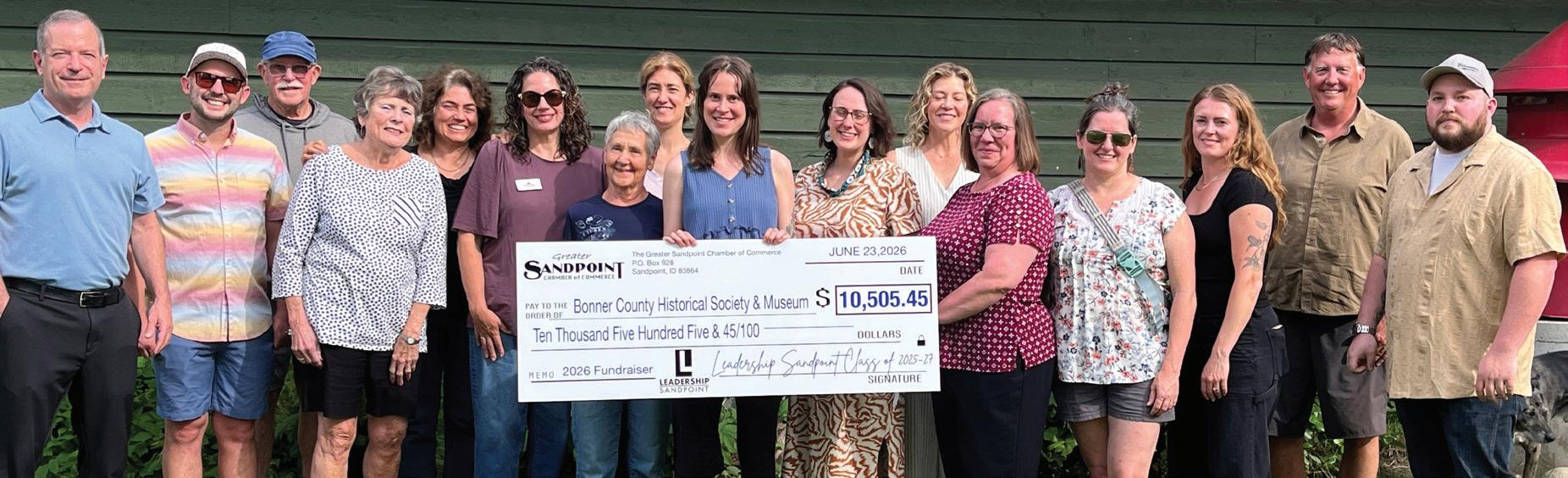
Leadership Sandpoint students presented the Bonner County Historical Society and Museum with a check of more than $10,500, which the organization raised during the class’ 2026 fundraising project. The proceeds will go toward improving museum
storage, thereby extending
The Leadership Sandpoint program is sponsored by the Greater Sandpoint Chamber of Commerce and helps students hone their leadership skills through classes and hands-on projects. While benefiting the students, the program also aims to give back to the community by contributing to fundraising efforts, donating time and connecting local businesses. Visit sandpointchamber.org for more information.
was completed, the 1956 span was closed to cars, officially becoming the pedestrian Long Bridge.
Here is a bit of math: 1956 to 2026 represents 70 years of usefulness. That’s less than one human lifetime. For comparison, here is a short list of the lifespan of other magnificent bridges across the country: the Brooklyn Bridge: 1883-present; the Manhattan Bridge: 1908-present; State Route 99, California: 1925-present; the Golden Gate Bridge: 1936-present; the Mackinac Bridge: 1957-present.
And our bridge only reaches 70 total years of usefulness?
The load-bearing responsibility of Sandpoint’s 1956 Long Bridge was massively reduced in 1981, and yet the structure could not withstand the test of time. Why? Failed stewardship.
The originators of the Long Bridge would never have imagined that an asset so precious as a two-mile bridge spanning open water would be completely squandered in 70 years’ time. Naively, they were depending on us — the future generations — to take pride in the asset, maintain it and pass it down to our descendents. Tragically, we dropped the baton.
To our great shame, we have lost a valuable commuter passageway linking one community to another. We have laid waste to an astonishingly beautiful recreational trailway. We have tossed away a priceless, wheelchair-accessible exercise route for joggers, walkers, bikers and swimmers. We have neglected a recreational marvel virtually unmatched in beauty across the continental United States. We have squandered a treasured community landmark and a beloved gathering place.
If I sound pessimistic that the pedestrian Long Bridge will be reopened any time
soon, it’s because I am. Sadly, my sinking suspicion is that the pedestrian Long Bridge might never be reopened again.
I have worked in the field of property management for more than 30 years. My experience tells me that the depth of the deterioration revealed by the 2026 inspection is profound, indeed. More importantly, my pessimism stems from the understanding that apathy, indifference and shortsightedness are difficult ailments to overcome.
To maintain an asset demands that one takes pride in the asset, pride in oneself and pride in the community in which the asset resides. Prideful stewardship would never have allowed the asset to have collapsed in the first place. It would have included yearly maintenance, routine patterns of upgrades and improvements, and a slow and steady process of upkeep to ensure that the asset survives into the future. ITD has demonstrated none of these qualities.
I openly encourage (and outright beg) ITD to prove me wrong in my prediction that the pedestrian Long Bridge will not reopen any time soon, if it ever reopens again.
If ITD were to act swiftly to repair and reopen the bridge, then this would be a major step forward in a new era of stewardship and community pride. Repairing the pedestrian Long Bridge will not be glamorous work — it will be foundational, gritty work. But it would be the work of a wealthy mindset and a prideful community. It would be a bold indication that our generation is deserving of the precious asset that we inherited, and a positive sign that we are willing to do what it takes to pass that asset forward onto generations to come.
Matt Lome is a Sagle resident.
Museum Board of Directors and Leadership Sandpoint Class of 2025’27. Photo courtesy of the Greater Sandpoint Chamber of Commerce
the lifespan of the museum’s thousands of artifacts.
FEATURE
Little free everything
By Ben Olson Reader Staff
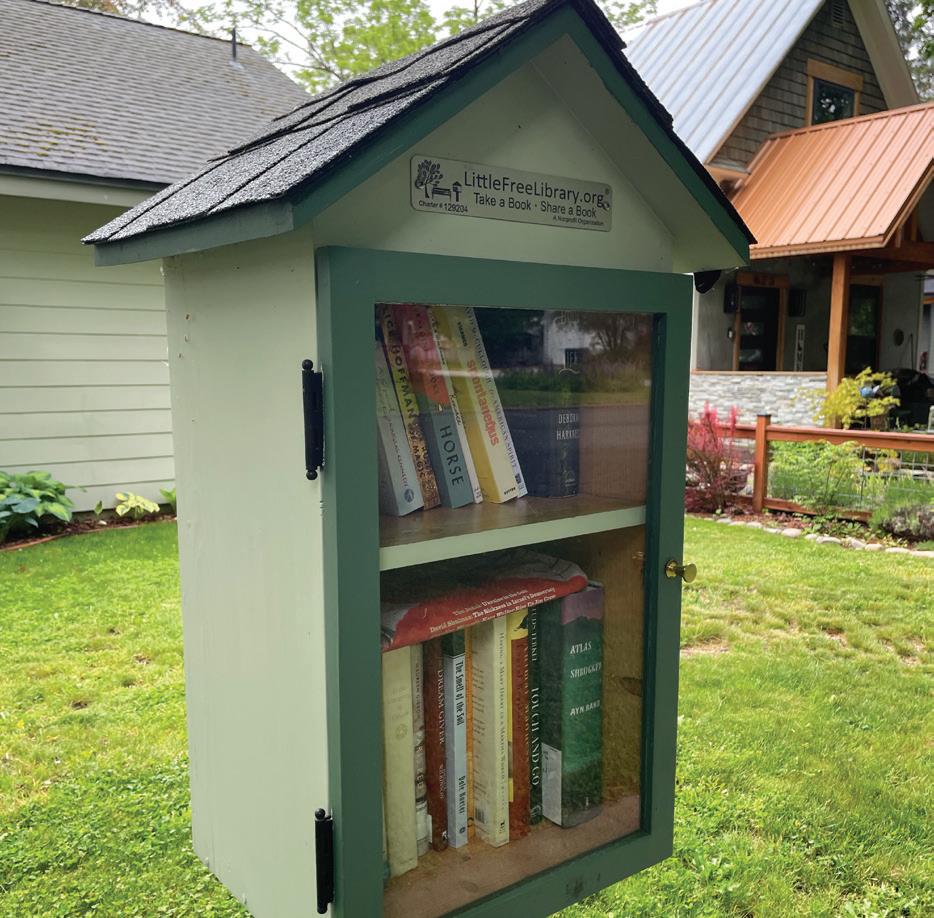
It was just 17 years ago that the first official Little Free Library was born when Wisconsinite Todd Bol built a model of a one-room schoolhouse in 2009 as a tribute to his mother. Because she was a teacher and loved to read, Bol filled the curious little box with books and put it on a post in his front yard, calling it a “little free library.”
Bol’s neighbors loved the idea, so he built more and gave them away. It was when Rick Brooks from the University of Madison Wisconsin saw Bol’s project that things began to really take off.
Bol and Brooks took inspiration from the “take a book, leave a book” collections they sometimes saw in coffee shops and public spaces. They also followed the model of industrialist and philanthropist Andrew Carnegie, who at the turn of the 20th century set a goal to fund the creation of 2,509 free public libraries across the English-speaking world (this was when the ultra-wealthy used to at least make gestures toward caring for and giving back to the people).
The pair set their own goal to surpass 2,509 little free libraries by the end of 2013, which they reached a year-and-a-half early.
Today, the Little Free Library is a registered nonprofit organization and has inspired thousands of Americans to install their own versions of the little free box, which can now be found in most cities across the country.
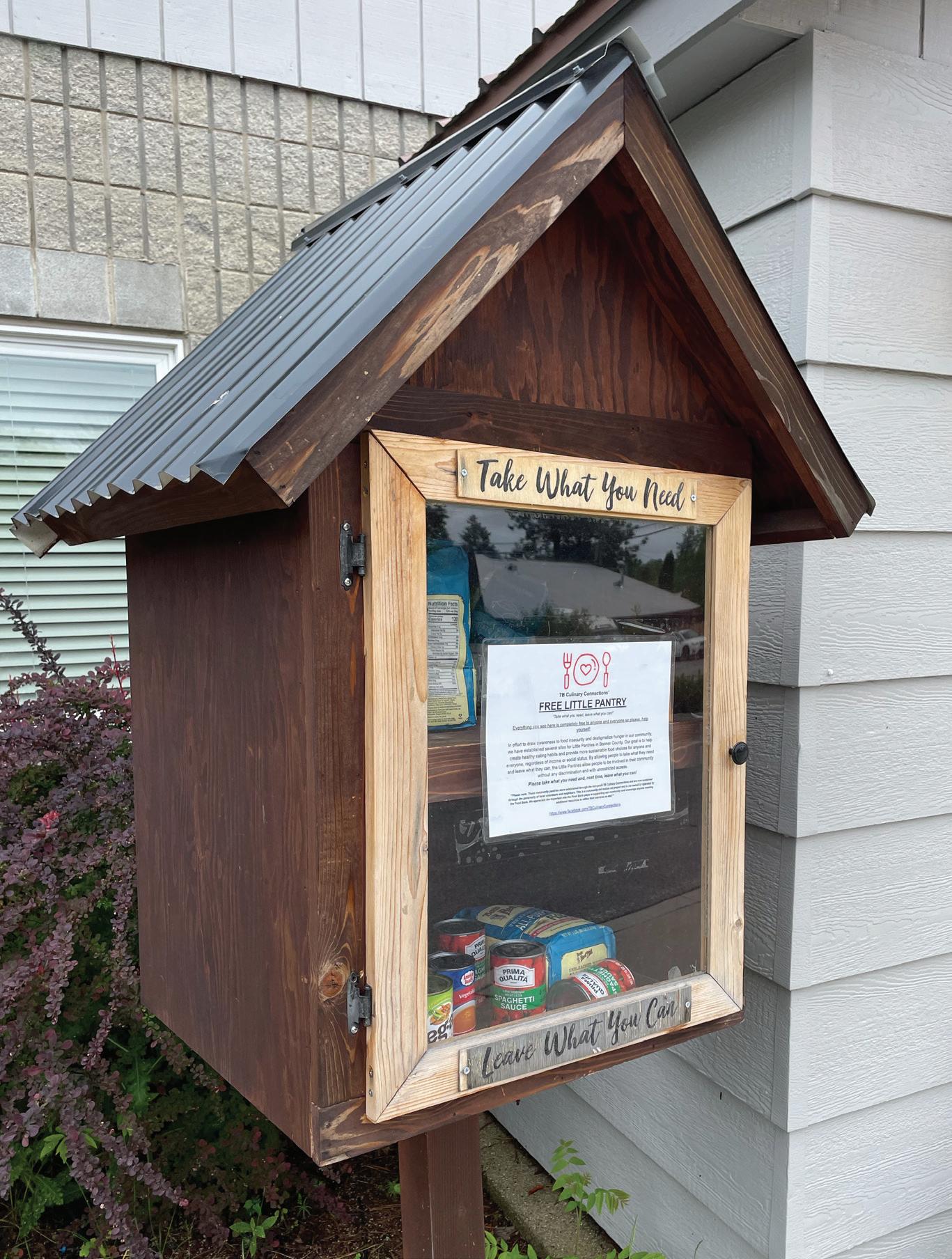
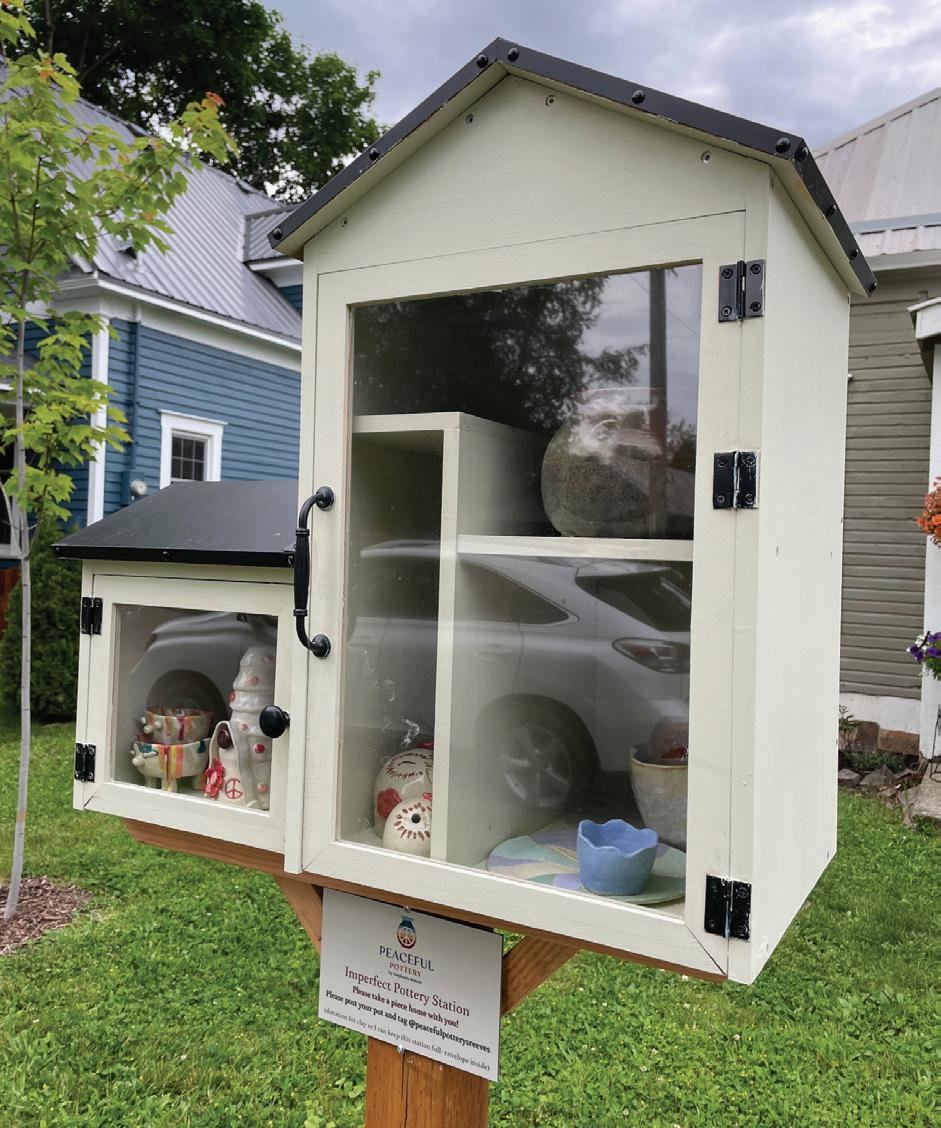
In Sandpoint, little free boxes offer more than just books, too. There are boxes filled with food, dog toys, gardening items, seeds and even pottery.
This photo essay was inspired by Sandpointian Bruce Robertson, who wrote that the boxes, “Speak to the heart of our community.” Robertson also took all the photos in this essay. While our initial thought was to include the locations where these free boxes can be found, that would ruin the fun of stumbling upon them in the wild and might encourage some people to take advantage. Also, we didn’t want to dox anyone who has a box in their yard by publishing an address in our pages. So, we encourage you all to explore your community and find these boxes on your own. Thank you to all of those who put up a “little free” box — we appreciate you looking out for us.
Exploring the ‘little free’ boxes around Sandpoint
All photos by Bruce Robertson
Top left: Interesting clouds seen over Lake Pend Oreille. The clouds are known as cirrus uncinus, sometimes referred to as “curly hook” clouds or “mare’s tail.” These clouds occur at a high altitude and are generally seen when a warm front or unsettled weather is approaching. The hooked ends indicate strong winds blowing much faster above the cloud than they are below, which usually means a weather front is on its way — an old maritime saying is, “mare’s tails and mackeril scales make tall ships carry low sails.” Photo by Jon Hagadone.
Top right: “My kids (Ben, Ida and Emma) spent a rainy afternoon teaching the dog how to enjoy the Reader in style,” wrote photographer Julia Kaufmann. “They’re hoping it’ll bring some fun to the next edition.”
Bottom left: A halo seen around the sun from a beach on Lake Pend Oreille. The formation occurs when light interacts with ice crystals suspended in the atmosphere, often indicating rain will fall in the next 24 hours. Photo by MaryLou Hiner.
To submit a photo for a future edition, please send to ben@sandpointreader.com.
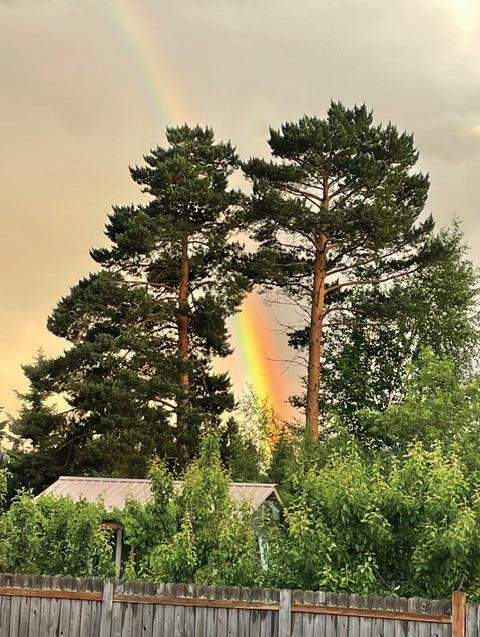
right: A rainbow poking
Bottom second from left: Levi Batchelor, 13, basks in the setting sun on the Hope Peninsula. Photo by Brett Batchelor.
Bottom second from right: Chase Sundin enjoys the backyard and the beginning of summer and the flowers. Photo by Tami Sundin.
Bottom
between trees in Sandpoint. Photo by Debra Lambrecht.
COMMUNITY
Second Harvest Mobile Market hands out free, nutritious food
By Reader Staff
The nonprofit Second Harvest Inland Northwest will bring its Mobile Market to Christ Our Redeemer Lutheran Church (1900 Pine St., in Sandpoint), where it will provide 250 families with free food from 11 a.m.-1 p.m. on Wednesday, July 8.
Founded in 1971, Second Harvest turns donations and would-be food waste into groceries, which then travel to rural areas to serve people who might otherwise be unable to access traditional food banks or affordable grocery stores.
“We want to make sure you have food to put on the table,” stated organizers.
The drive-thru station in Sandpoint — made up of a delivery truck and former city bus — will hand out fresh and nonperishable items while supplies last, with no appointment or paperwork required.
Visit Second Harvest Inland Northwest’s Facebook page for updates or 2-harvest.org for more information.
Connie Scherr honored as POAC’s 2026 Artist of the Year
By Reader Staff
The Pend Oreille Arts Council has selected artist Connie Scherr as its 2026 artist of the year, celebrating her decades spent capturing the beauty of North Idaho with paint and canvas. Scherr’s colorful, evocative work will be on display throughout July at the POAC Gallery (313 N. Second Ave., in Sandpoint) beginning Friday, July 3, with a public reception from 5-7 p.m.
Scherr moved to North Idaho in 1977, where she honed her skills in watercolor and eventually oils, crafting paintings of the local landscape alla prima, or in one sitting. Her recognizable work has since been featured on the Artists’ Studio Tour and a Festival at Sandpoint poster, at Schweitzer Art-
ists’ Studio Gallery, in POAC exhibitions and more.
“Whether painting en plein air or working from photographs and memory in her studio, Scherr allows emotion and intuition to guide each composition, often emphasizing the feeling of a place as much as its physical appearance,” stated POAC in a recent news release.
Attend Friday’s free reception to meet the artist, discuss her work and take in a timeless collection with fellow art-lovers. Call the POAC Gallery at 208-263-6139 or visit artinsandpoint.org for more information.
Sandpoint Beerfest is back for the 12th year
By Reader Staff
The 12th annual Sandpoint Beerfest returns to City Beach on Sunday, July 5, with unlimited seven-ounce pours
from noon to 5 p.m. The event takes place on the lawn in front of the Edgewater Resort (56 Bridge St.) for ages 21 and older, though children can attend if accompanied by an adult at all times.
Hosted by the Greater Sandpoint Chamber of Commerce and sponsored by Averill Hospitality, the Festival at Sandpoint, Little Munich and KTPO 106.7 MAX FM, Beerfest offers a wide variety of regional beers, ciders and seltzers for eventgoers to taste and find
their new favorites. Each participant receives a free, commemorative glass, and food, water and sodas are available for purchase for both participants and designated drivers.
Bring a chair, umbrella or picnic blanket and stay for the afternoon to socialize and listen to live bluesy rock music from the Liam McCoy Band from 1-4 p.m. Tickets are $55 per person online at events.beerfests.com/e/ sandpoint-beerfest.
Connie Scherr was honored as POAC’s 2026 Artist of the Year. Courtesy photo
New Sandpoint Tigers 60+ men’s baseball team to hold season opener
By Reader Staff
There’s a new baseball team in town, and they came to play. The Sandpoint Tigers were established this year as part of the Inland Northwest Men’s Adult and Men’s Senior Baseball leagues, which are part of the national organization that claims more than 40,000 players.
The Tigers will play against two teams from Spokane: the Dodgers and the Yankees. There are currently plans to add a fourth team to the roster starting next year. Teams include men aged 60 and over.
The Tigers will play the season opener at 11 a.m. on Saturday, July 11 at War Memorial Field in Sandpoint against the Spokane Dodgers. The game is free to attend and the team will include local players as well as some newer additions to the area.
Spectators are warmly welcomed.
“It provides aging baseball players the opportunity to continue playing a competitive sport,” said Tigers’ manager Toby Frye. “Enthusiasm has been great.”
The Inland Northwest Chapter of the league was established in 1996 with two leagues in the 18+ and 35+ divisions. Later, the 45+ division was added.
To learn more about the league and inquire about joining, visit playhardball.org.
The Sandpoint Tigers 60+ men’s baseball team. Courtesy photo
Summer reminder to start building Sand Creek Regatta boats
By Ben Olson Reader Staff
Every year (usually around the second week of September) the most local of local events paddles into town: The Sand Creek Regatta.
This “competition” is really just a celebration of community, with locals building homemade rafts from scraps and — if they float — paddling them from the Bridge Street Bridge to Cedar Street Bridge and back. Winners take home the coveted trophy (if anyone wants to take a look at the trophy, it’s displayed on the Reader’s windowsill from our 2025 win), but there are also awards for most creative designs and most epic fails.
For those who want to build boats and compete, there are only a few simple guidelines to follow. First, boats must be crafted from scraps and random supplies and must be powered by humans. That means no sails or
motors. Also, no repurposing already floating vessels (for example, you can’t take a canoe and add items to it). Finally, there must be at least one adult 18 years or older on board.
Last year’s race saw the introduction of the “Sacrifice a Tourist” event prior to the starting gun. This is when a volunteer tourist walks to the edge of the plank, utters some final words and is summarily shoved into the water. This both honors the tourists for the dollars they bring to the area, while also scratching that itch to throw a tourist in the lake (you’ve all thought
about it).
Any bona fide tourists who would like to be the 2026 sacrifice, send an email to ben@sandpointreader.com. Victims will receive a free T-shirt and a gift certificate to a local restaurant. Visit facebook.com/sandcreekregatta for more info, or feel free to contact us at the Reader if you have questions. There you have it. Start building your crafts as soon as possible and we’ll see you all on Sand Creek in September.
Handmade boats battle for glory at the 2025 Sand Creek Regatta. Photo by Sarah Mitchell
Send event listings to calendar@sandpointreader.com
Live Music w/ Liam McCoy and Friends
7pm @ Eichardt’s Pub
Live Music w/ Chris Paradis
6-8pm @ MickDuff’s Beer Hall
Live Music w/ Cody Bartels Band
5-8pm @ Smokesmith BBQ
Live Music w/ Right Front Burner
9pm-midnight @ 219 Lounge
Live Music w/ Angel Urrea
7-10pm @ MickDuff’s Beer Hall
Live Jazz w/ Bright Moments
6-8pm @ Baxters on Cedar
Live Music w/ Nic Allen
6-9pm @ Barrel 33
Music w/ DJ Just Blake 9pm-midnight @ 219 Lounge
Live Music w/ Mason Van Stone
3-6pm @ MickDuff’s Beer Hall
Live Music w/ The Flinns
12-2pm @ Smokesmith BBQ
July 2 - 9, 2026
THURSDAY, july 2
1776: The Musical (July 2-5) • 7pm @ Panida Theater
Celebrate the 250th anniversary of American independence with this special show by Honey Pearl Productions featuring John Adams, Benjamin Franklin and Thomas Jefferson navigating the struggles of birthing a new nation. $25
Live Jazz w/ Bright Moments 6-8pm @ The District
Line dancing lessons 6:30pm @ The Hive
FriDAY, july 3
Live Music w/ Zach Simms
5-8pm @ Pend d’Oreille Winery
Live Music w/ Snacks at Midnight 8pm @ The Hive
Live Music w/ Plastic Owls
6-9pm @ Blue Heron Cafe
Live Music w/ Gil Rivas
5pm @ Connie’s Lounge
SATURDAY, july 4
Sandpoint Lions 4th of July Celebrations
Live Music w/ Angel Urrea 6-8:30pm @ Matchwood Brewing Co.
Smokesmith BBQ anniversary party, live music w/ Jay Snow and the Tone Keepers
5:30-8:30pm @ Smokesmith BBQ Karaoke
6-9pm @ Eagles Club, 1511 John Hudon Ln.
Live Music w/ Oak Street Connection
6-8:30pm @ Matchwood Brewing Co.
Clark Fork 4th of July
Live Music w/ Monarch Mountain Band
2-5pm @ Barrel 33
Live Music w/ John Firshi Confluence
6-9pm @ Barrel 33
Live Music w/ Bare ‘n’ Blue
5:30-8:30pm @ Smokesmith BBQ
Live Jazz w/ Bright Moments
6-8pm @ Arlo’s Ristorante
Sandpoint Farmers’ Market
9am-1pm @ Farmin Park
Sandpoint Chess Club 9am @ Evans Brothers Coffee
Magic with Star Alexander 5-8pm @ Jalapeño’s
9:30am-dusk @ Downtown Sandpoint Kids’ Parade starts at 9:30am followed by the Grand Parade at 10am followed by a community carnival, food vendors, beer garden at City Beach. Fireworks display at City Beach at dusk
Hands on History
10am @ Bonner County History Museum
Historical crafts for kids of all ages, free entry to the museum
Historic walking tours
11am-12:15pm @ Cedar St. and First Ave. Meet at Cedar Street Bridge and First Avenue, sponsored by the Bonner Co. Historical Society
SunDAY, july 5
Live Music w/ Kip McMillan 2-5pm @ Barrel 33
Beginner Cuban salsa and rueda series 6-7pm @ Sandpoint Community Hall Email deniseellendance@gmail.com
Monday Night Blues Jam w/ John Firshi
7pm @ Eichardt’s Pub
Bridge
12:30pm @ Sandpoint Senior Center Call 208-263-6860 to RSVP
Beginner Argentine tango class
7pm @ Embody Center, 823 Main St. No partner needed. $15
Family night w/ John Firshi
7am-dusk @ Downtown Clark Fork
Starts with the Freedom Fun Run at 7am followed by VFW flag raising on school grounds at 8:30am, the parade at 9:30am and activities starting at 10:15am. See Page 20 for full info Priest River 4th of July Family Fun Festial 11am-5pm @ 111 Main St. (Priest River) Activities include a mechanical bull, arena jousting, foam street party, plastic axe throwing and more. Vendors, food, drinks. See Page 20 for more info
1776 Prefunk Fundraiser Dinner 5pm @ Little Panida Theater
A catered dinner by Ivano’s and an intimate “Cinema Soul” performance by artist JoDavi. $70-$95
12th annual Sandpoint Beerfest • 12-5pm @ Lawn by Edgewater Resort Tickets are $55 and includes commemorative glass and unlimited 7 oz. pours. Children must be accompanied by 21+
monDAY, july 6
Outdoor Experience group run 6pm @ Outdoor Experience 3-5 miles, all levels welcome
11am-1pm @ Christ Our Redeemer Lutheran Church Drive-thru event where up to 250 local families served. No appointment necessary
5-7:30pm @ Matchwood Brewing Co. Dinner, live music, beer with the fam
Summer Music Series kickoff concert 6pm @ Farmin Park
A free outdoor concert with Boot Juice performing. Drink and food vendors
ThursDAY, july 9
International Fly Fishing Film Festival 7pm @ Panida Theater
The best fly fishing films from around the world. Benefits the Mayfly Project
Bunco
12:30pm @ Sandpoint Senior Center Call 208-263-6860 to RSVP
Injector’s Car Club meeting 7pm @ Serv-a-Burger (social hour at 6pm)
Sandpoint Farmers’ Market 3-5:30pm @ Farmin Park
Live piano w/ Peter Lucht 5-7pm @ Pend d’Oreille Winery
Benny on the Deck concert 5:30pm @ Connie’s Lounge
Live Music w/ Liam McCoy and Friends 7pm @ Eichardt’s Pub
Line dancing lessons 6:30pm @ The Hive
Masters of the Universe reboot is a perfect summertime fantasy adventure
By Zach Hagadone Reader Staff
It might sound goofy or hyperbolic, but Masters of the Universe is probably your best ticket to a good time in the theater this summer.
Directed by Travis Knight and released June 5, it’s one of the rare instances when a reboot lands closer to the original source material than its predecessor, in this case the now-ancient 1987 Masters of the Universe, which was itself a reboot of the cartoon series He-Man and the Masters of the Universe, which ran for two seasons from 1983-’84 and as reruns for many years after.
The revitalized MotU is fun on every level, reveling in the essential silliness and over-the-top camp of the original cartoon while bringing top-flight cinematography and visual effects to characters that every kid of the ’80s and very early-’90s will already know and love.
It takes itself just seriously enough to sketch personalities to care about (Idris Elba’s arc as Manat-Arms is especially grown-up), but infuses it with enough blockbuster razzmatazz to keep things constantly engaging.
act of the film, Adam is separated from the sword in transit and ends up marooned on a strange planet where he spends 16 years growing up into a mid-level human resources worker at some faceless corporation.
Given how deeply embedded He-Man is with the late-Gen X/ early-Millennial crowd, it seems hardly necessary to summarize the entire plot. Suffice it to say, we meet Prince Adam of Eternia as a hapless, undersized kid who not only sucks at combat training but actively goofs around during lessons, much to the chagrin of his glowering, disapproving dad King Randor. Man-at-Arms has a little more grudging patience with the lad, who is childhood chums with his daughter, Teela.
True to form, Adam has his trusty talking tiger Cringer, and life is good for the squirrely princeling. That is, until the bad guy Skeletor (Jared Leto in his career-best performance) and his minions attack the capital city of Eternia, lay it to waste and capture Randor and Queen Marlena. Just in time, however, Adam is teleported to his mother’s homeworld of Earth with the Sword of Power, given to him by The Sorceress who guards the Power of the Universe housed in Castle Grayskull. Setting up the opening
Just as in the cartoon, Adam (played as an adult by Nicholas Galitzine) is a little bit of a weiner, kind of slow on the uptake and too earnest for his own good. He remembers where he came from, and obsesses about the sword and all the people he left behind in Eternia, but no one believes him — including his disinterested roommate; the string of women he freaks out with crazy stories on failed first dates; and his frustrated boss, who turns passive aggression into an artform. It’s clear that he’s a super nice guy, though, who exudes empathy.
Things get cooking when Adam gets a lead on the location of his long-lost sword and runs out to find it just as he’s about to get canned for spending his cubicle-bound days trolling through sword-for-sale websites.
Cutting to the chase, he finds the blade and acquires it in a laugh-outloud, chaotic scene set in a nerd emporium; but, in so doing, unwittingly sets off a beacon to Eternia that draws both friend and foe to either save him or take the power for their own nefarious purposes.
After some brief city destruction at the hands of a decidedly beastly Beast Man, he’s taken home by Teela (Camila Mendes) to an Eternia that has been devastated by more than a dozen years of oppression by Skeletor.
From there, he has to convince the Eternians in hiding that he is who he says he is, figure out how to unlock his power as He-Man and wield it to face Skeletor — the latter whom, it must be stressed, is delightfully and frequently hilariously evil (and a worthy successor to Frank Langella’s timeless rendition as the skull-headed villain nearly 40 years ago).
Juxtaposed with the 1987 film, which starred Dolph Lundgren and who makes a sly cameo in the 2026 film, this MotU is a certified romp. The older iteration was deeply influenced by both Star Wars and the ’80s fantasy teen dramedies of the day, while containing vanishingly few of the
many side characters that populated the cartoon.
Rewatching it after seeing the 2026 version, it’s striking how much the grittiness of the ’80s infused its aesthetic and storyline. None of that is the case with the new installment, which is joyfully sunny by comparison and packs in all the big names like Ram Man, Fisto, Mekaneck, TriKlops and Trap Jaw (the latter serving as an especially menacing secondary nemesis). Of course there’s also EvilLyn (Alison Brie) and The Sorceress (Morena Baccarin), and everyone gets their opportunity to shine.
In one sense, 1987’s MotU is more daring and inventive than its 2026 counterpart. However, the latter is far more easily enjoyed as a theater experience. While the ’87 version had a strong whiff of dystopia, the new film treats apocalypse as a theme park ride, and it’s one to be taken gladly and with a hearty laugh.
Semiquincentennial celebrations
By Reader Staff
Communities across the nation are coming together to celebrate America’s 250th — or semiquincentennial — anniversary Saturday, July 4 with all the necessary fireworks, barbecues, pomp and circumstance. North Idaho cities from Bayview to Bonners Ferry are going all out to mark the momentous occasion. Here’s a breakdown of local events so you know where to go to make the most of the Independence Day holiday.
Sandpoint
As usual, Sandpoint’s celebrations, put on by the local Lions Club, will begin promptly at 9:30 a.m. with the annual Kids Parade, where children of all ages can don their red, white and blue outfits; jump on their decorated bikes, scooters or wagons; and cruise around downtown. The parade begins
at the corner of Church Street and Fifth Avenue and continues down Church to North First Avenue, wrapping around to the Bonner General Health parking lot. The Grand Parade begins at 10 a.m., following the same route but ending near Fifth Avenue. From there, families will make their way to City Beach, where games, food vendors and a beer garden await. The grand fireworks display begins at dusk. Visit sandpointlions.wixsite.com/ website or the Sandpoint Lions Club Facebook page for up-todate information or to purchase raffle tickets supporting the Fourth of July festivities. Prizes include a brand-new woodstove from All About Chimneys and a bundle of firewood, or $1,000 in gift certificates.
Garfield Bay Neighbors in the Garfield Bay community will kick off the holiday with a pancake breakfast fundraiser from 8-10 a.m. in the park (1226 Garfield Bay Road) for $7 per person, followed by the 10:30 a.m. public parade. All are welcome to decorate
their ride — be it truck, tractor, bike or car — and join the procession down the street. After the parade, return to the park for an ice cream social at noon and enjoy the rest of the day outside until 7:30 p.m., when rockin’ county band Hogwire will perform on the water.
Clark Fork
If you’re celebrating in Clark Fork, prepare to rise bright and early for the 7 a.m. Freedom Fun Run, beginning at The Filling Station Christian Youth Center (108 E. First Ave.), followed by the 8:30 a.m. Veterans of Foreign Wars flag raising at the Clark Fork High School (502 N. Main St.). Activities continue at the school before moving to Memorial Field. The “Happy Birthday America! 250th” parade begins at 9:30 a.m. and will be followed by family-friendly activities at 10:15 a.m. Participate in foot races, turtle races, watermelon-eating contests, log-sawing competitions and more, in addition to the usual food, vendors, drawings and airplane drop. The celebrations conclude
Where to celebrate America’s 250th anniversary
with fireworks at dusk. Learn more at bit.ly/ClarkFork4th and register for the fun run at fillingstationyouth.com/freedom-fun-run.
Priest River Priest River Youth Connections and the Independent Order of Odd Fellows will host the Fourth of July Family Fun Festival in Priest River — a day of games, activities, vendors and food. Centered on 111 Main St., the celebrations will include a mechanical bull, arena jousting, a foam street party, plastic axe throwing, minute-to-win-it challenges and game booths, along with plenty of delicious fare, craft vendors, informational booths and prizes. Free activities will run from noon-4 p.m., while vendors will be open from 11 a.m.-5 p.m. Fireworks begin around 10 p.m. at Bonner Park West (514 Railroad Ave.). Visit the Priest River Youth Connections Facebook page for more information.
Bayview
Residents of Bayview will get a head start on the holiday with
a pre-Independence Day breakfast of “red, white and blueberry” pancakes on Friday, July 3, at 8 a.m. at the Bayview Community Center (20298 E. Perimeter Road.). All proceeds will benefit the Bayview Chamber of Commerce, which will host the Bayview Daze the following day. The July 4 parade begins at 11 a.m. — though participants should line up an hour before — and will run down North Main Avenue, adjacent to the party’s vendors and food trucks. Tour the tents and hang out on the water until 10 p.m., when the fireworks begin. See bayviewidaho.org/events-bayview-idaho for more info.
Bonners Ferry
Our Boundary County neighbors are all in for this year’s celebrations, which feature a bevy of musicians, food vendors, activities and displays. The day kicks off with the Community Parade at 3 p.m. — or 1:30 p.m for participants — beginning at the Boundary County Fairgrounds (6567 Recreation Park Road) and traveling downtown before heading up Riverside Street back to the fair. The parade ends with a community vote and prizes for Bonners Ferry’s favorite floats. Attendees can then visit local food vendors and activity booths with face painting, caricature drawing, custom T-shirts, craft tables and kids’ activities, as well as areas for sack races, volleyball games, cornhole competitions and bounce houses. Visit the VFW and American Legion station to admire an authentic 1841 mountain howitzer cannon and enter the raffle to win a chance to fire it. Attendees will also enjoy live country-Western and Americana music with Scott Stover from 4-5:15 p.m., The Herndon Girls from 5:156:15 p.m. and Brenn Hill from 8-9:30 p.m., interspersed with classical American samplings by the Bonners Ferry Community Orchestra from 6:30-7:45 p.m. The closing 25-minute firework show begins shortly after 10 p.m. Visit bonnersferry4th.com to learn more.
MUSIC
Sandpoint Summer Series kicks off its 7th year of free outdoor concerts with Boot Juice
By Ben Olson Reader Staff
For the past seven years, Robb Talbott with Mattox Farm Productions has hosted the Sandpoint Summer Series, a free outdoor concert at Farmin Park in Sandpoint. Thanks to generous local sponsorships, the concert series remains free and continues to draw nationally touring bands to the panhandle.
The series will kick off its “Odd Nights Out” concerts on Thursday, July 9 at 6 p.m. with Boot Juice, a seven-piece, high-energy band from Northern California. Boot Juice plays a fun mix of rock and Americana and are well known for their infectious energy on stage.
“They’re just fun,” Talbott
told the Reader. “Their sound is going to appeal to a lot of people and bring everyone together in the park, and that’s kind of the whole idea.”
Boot Juice plays an eclectic arrangement of original music, peppered with covers that will inspire audience members to kick off their sandals and dance on the lawn at Farmin Park.
Along with free tunes, the series will also feature a bar provided by Eichardt’s Pub and food trucks will be on site from Mandala Pizza and Mountain Food Co. Also, attendees are welcome to bring their own food and drinks, but no outside alcoholic beverages will be allowed inside the venue.
Talbott wanted to thank the community for coming out to support his efforts to obtain a Levitt Foundation grant, which
funds free, outdoor music shows around the country.
“We ended up getting 27th out of 100, which is pretty dang good,” Talbott said. “I think the top 23 applicants ended up getting money, so we were really close and we were one of the smaller communities in the running.”
Band sponsors for the series include the Pend Oreille Arts Council and Washington Trust Bank. Event sponsors are Skyright Roofing, Kester’s Kreations, KPND, Sandpoint Hotel & Suites, North Root Architecture and the Greater Sandpoint Chamber of Commerce. Critical partners include the Novas of Evergreen Realty, the Heartwood Center, Sandpoint Reader and Travis Harman Construction. The series — which takes
place on odd-numbered Thursdays in July and August — will feature the Spokane Latin band Milonga on July 23, followed by Colorado-based The Jauntee on Aug. 13 and a TBD performer for the final night on Aug. 27.
Grammy-winning trumpeter to perform Spokane concert to benefit MCS
By Reader Staff
Grammy award-winning trumpeter Chris Botti has captivated audiences around the world with his signature sound, lyrical artistry and extraordinary collaborations spanning jazz, pop and classical music. Botti will play a special concert at 8 p.m. on Saturday, July 11 at the Fox Theater in Spokane with proceeds benefiting scholarships, educational programs and artistic opportunities for youth
studying at the Music Conservatory of Sandpoint.
Botti has performed with the best of the best, including Sting, Tony Bennett, Barbra Streisand, Lady Gaga, Yo-Yo Ma and many others.
“Chris Botti has long been recognized not only for his remarkable artistry, but also for his commitment to inspiring young musicians,” said MCS Board President Frank Geisler. “We are honored to bring an artist of his stature to Spokane in support of the
next generation.”
For those interested in attending the Spokane show, round-trip coach transportation is available for just $50 per person. The bus departs from downtown Sandpoint at 5:30 p.m. on July 11 and returns immediately after the concert.
Purchase tickets and reserve your seat on the bus at sandpointconservatory.org/events.
Right Front Burner, 219 Lounge, July 3 The Flinns, Smokesmith BBQ, July 4
Are we, as a community, ready to dub Right Front Burner — a.k.a. RFB — a local musical institution, if not “icon”? I know I am, and I’m going to do just that right here and now: Catch what’s been described as “Sandpoint’s favorite party band,” but also “a local musical institution, if not icon,” at the equally inimitable 219 Lounge for an epic Friday night revelry
overflowing with funk-synth rock frisson from bassist Paul Gunter, drummer Dave Pecha and keyboardist Alvah Street. If there’s a better kick off the Fourth of July weekend, we’re not sure what it is.
— Zach Hagadone
9 p.m, FREE, 21+. 219 Lounge, 219 N. First Ave., 208263-5673, 219.bar. Listen at facebook.com/rightfrontburner.
Texas-based husbandand-wife duo The Flinns are touring the Inland Northwest this month and making a quick pit stop at Smokesmith BBQ. Stop by for an Independence Day lunch break and listen to Max and Brittney Flinn’s beautiful harmonies that bring joy and playfulness to their original Americana-country music. Their polished sound is familiar enough to country fans to make for easy listening,
This week’s RLW by Zach Hagadone
READ
I’d love to tell folks to rush out to snag copies of Jürgen Habermas’ iconic philosophical works, but maybe it’s better to recommend wading into his profound thoughts on understanding “the public” by reading the article “Jürgen Habermas Defended Reason in a Darkening Age,” published June 15 at newyorker.com. It’s a brisk, enlightening profile of the legendary thinker, who died this year at the age of 96.
and the meaningful storytelling in the couple’s lyrics elevates their performances above those of the average cover artist. Still, they might put a spin on songs by iconic couples like Johnny Cash & June Carter if the mood strikes them.
— Soncirey Mitchell
Noon-2 p.m., FREE. Smokesmith BBQ, 102 S. Boyer Ave., 208-920-0517, smokesmithidaho. com. Listen at theflinnsmusic.com.
LISTEN WATCH
Aaron MF Olson is a bona fide longtime L.A. artist with multiple albums to his name, but he also has strong Sandpoint-in-law connections and just released his debut with Country Thyme Records, titled Songs Album II. His sound is an irresistible catchy species of soft pop-rock imbued with instrumental, vocal and writing chops that have been honed over decades. Here’s hoping he plays for us next time he’s in town. Listen at aaronmolson. bandcamp.com.
Star City, the new spinoff of For All Mankind, tells the counterfactual history of how the USSR beat the U.S. to the Moon, but from the Russian perspective. Seven episodes into its first season as of press time (and new ones every Friday), it mostly lacks the fiery human complexity of FAM, but maybe that’s just the dourness of late-’60s Soviet life poking through. Regardless, it’s a worthy successor to another phenomenal but underrated show. Stream it on AppleTV.
Courtesy photo
Courtesy photo
From Northern Idaho News, July 3 1916
INSANE MAN ATTEMPTS SUICIDE
Joseph Johnson lies at the City hospital with his throat slashed in a dozen places and several ribs broken as a result of an insane attempt to take his own life. He is not dangerously hurt, however, and is expected to soon recover.
Johnson is from Portland, Ore. and was on his way to Glasgow, Scotland. He was traveling over the Great Northern road on train No. 2, due in Sandpoint at 10:25 a.m. As the train was passing through Laclede under full speed, Johnson sprang through an open window, head foremost, his act being observed just as his feet were disappearing. The train was stopped and ran back to where he lay and it was found that after his escape from the train he had made a desperate attempt to end his life by cutting his throat with a razor. He was picked up in a conscious condition and brought on to this city and taken to the hospital. Dr. Page, who dressed the man’s injuries, found that they were not near as serious as might have been expected. The only injury of consequence which he received in jumping from the train was the fracture of several back ribs. His neck was cut in a dozen places, but none of the wounds are serious. He had directed the razor mostly at the cartilage in front which resisted and prevented the blade from reaching either the wind pipe or jugular veins.
Johnson is a young man of about 25 years and it is learned is of a prominent Scotch family. The train crew observed that he had acted strangely from the time the train left Spokane, but his acts were not such as to warrant guarding him. At the hospital he stated that someone had tried to gouge out his eyes and that they were after him to place him in an asylum.
BOOK
A 360 view of ‘America 250’
By Zach Hagadone Reader Staff
I’m having a hard time with the “America 250” celebrations for a lot of reasons — mostly related to current conditions — but among them is the name, which suggests that “America” sprang into existence 250 years ago.
This isn’t to say that July 4, 1776 wasn’t a significant date; however, while it marked the historical moment when 13 of Britain’s then-26 colonies in the Americas announced their intention to form a separate union, it was as much an end as a beginning. I find what happened before that rupture to be as useful — if not more so — to understanding “America” than what occurred after.
First of all, note that the “American Revolution” actually only included half of Britain’s possessions in the hemisphere. The 13 that remained after 1776 were in present-day Canada, Florida and (principally) the Caribbean. All of those places were regarded as just as “American” as the 13 situated along the Atlantic Coast, and almost all remained loyal long after 1776. The Caribbean colonies didn’t start gaining independence until the 1960s and Canada achieved full constitutional independence only in 1982 (though it remains within the British Commonwealth).
So no, “America” didn’t suddenly smash onto the scene on July 4, 1776 with the pen strokes of a handful of bewigged men in Philadelphia. There were already multiple Americas and many different types of Americans inhabiting vastly varied landscapes and for countless reasons.
And that’s only if you consider the European-Americans — which of course is one of my other beefs with “America 250.” There was nothing new about the “New World” even
STR8TS Solution
then, and really never was. The signers of the Declaration of Independence in 1776 were farther removed in time from the first permanent European settlements in the Americas as we are from them. Our “America 250” observation doesn’t even meet the halfway point in contemplating “America” as a geographic term, which came into usage in 1507 when it was applied by a German cartographer. And, of course, the people who already called this continent home had ancestral connections stretching back into unknown millennia, during which the land went by innumerable names.
Which is all why I find the pre-revolutionary decades to be most instructive about what was later constructed and why. Also, to consider what could have been. For instance, on a research trip to Dutchess County, in upstate New York, I found the journals of Johann Conrad Weiser Jr., dated 1748-1765. They sketched a vivid and disorienting portrait of an American place and time — the forest country of New York and Pennsylvania — that read like it belonged in the Medieval, rather than Enlightenment Era.
Settlements of both Europeans and members of various Algonquian and Haudenosaunee peoples were interspersed in clusters throughout rich river valleys and vast, dark forests, interconnected only by rutty dirt tracks or ancient trails. Meanwhile, sprawling plantation estates rose seemingly out of nowhere from the banks of waterways like the Hudson, where local colonial lords ruled with feudal impunity.
Weiser was unique in that he could travel between these different American worlds. Born in Germany but raised in the backcountry of New York, he apprenticed as a teenager with the local Mohawk tribe, which later made him
Sudoku Solution
an influential translator and emissary during treaty negotiations.
More importantly, Weiser showed how another America could have been built, away from the righteous windiness of the merchants, political brokers and religious proclaimers of the seaboard cities like Boston, New York and Charleston, and (mostly) in concert with the people who were already here.
In that way, I’d consider Weiser an exemplary American — though not one of the United States — and his story reminds me that the United States of America is and always has been the latter-day product of a profoundly complex and diverse melding of places, ideas and people with histories that date back more than 500 years in some places, and tens of thousands of years in others.
We would do well to learn and remember that deep complexity — not in the spirit of lessening the ideals of unity and equality that we profess to espouse in our “founding” holiday, but to turn away from the fictitious marble-bust version of the “America 250” anti-history that makes us smaller in spirit and thought than we actually are.
Crossword
In weightlifting, I don’t think sudden, uncontrolled urination should automatically disqualify you.
Solution on page 22
Laughing Matters
By Bill Borders
CROSSWORD
ACROSS
1. Courtroom event 6. Footwear 10. Steals
14. Door pivot 15. Luau souvenirs
16. Way out 17. Group of eight 18. L L L L
19. What a grape grows on 20. Regroup (Br. sp.)
22. Border 23. Empower 24. Variety (plant or animal) 25. Ballet attire 29. Unbeatable foe 31. In pieces 33. Not analog
Automatic response
Moving
Lands and wealth
Marsh plant
Social group
Guest inviters
Being
Two-sided
Any compound of oxygen
Pig out
Solution on page 22 Word Week of the languid /LANG-gwid/ [adjective] 1. lacking vigor or force.
“The languid response to America’s 250th anniversary is largely due to fatigue over President Trump’s tendency to make the celebration mostly about himself.”
Corrections: The downtown parking map used in the news story “Paid parking goes into effect July 1” in the June 25 edition was recently updated and the new map is available on the city of Sandpoint website.
Foolish 42. Physical checkup 44. Greek god of love