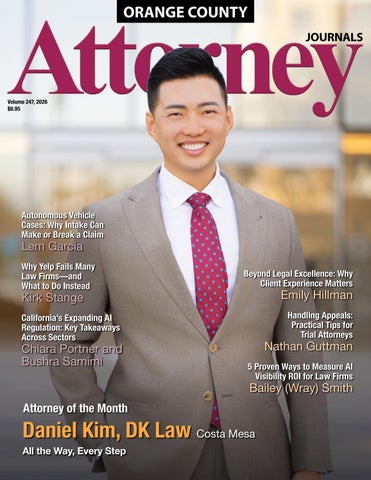
ORANGE COUNTY
Volume 247, 2026 $6.95
Autonomous Vehicle Cases: Why Intake Can Make or Break a Claim
Lem Garcia
Why Yelp Fails Many Law Firms—and What to Do Instead
Beyond Legal Excellence: Why Client Experience Matters
Emily Hillman
Kirk Stange
Handling Appeals: Practical Tips for Trial Attorneys
California’s Expanding AI Regulation: Key Takeaways Across Sectors
Chiara Portner and Bushra Samimi
Nathan Guttman 5 Proven Ways to Measure AI Visibility ROI for Law Firms
Bailey (Wray) Smith
Attorney of the Month
Daniel Kim, DK Law Costa Mesa All the Way, Every Step
When the verdict must be historic. Prominent firms refer their toughest, highest-stakes cases to BRUNO | NALU, and for good reason. With well over 100 jury trials and a record of landmark verdicts, we step in as trial counsel to radically increase the value of settlements and awards.
$857M PRODUCT LIABILITY $412M MEDICAL MALPRACTICE $48M SEXUAL ASSAULT $40M WRONGFUL DEATH $21.3M TRUCK ACCIDENT Representative verdicts. Prior results do not guarantee a similar outcome.
Keith J. Bruno & Angela Bruno, Founding Trial Lawyers, BRUNO | NALU
Refer with confidence.
Battle-tested trial counsel.
www.brunonalu.com 866.519.3098 18201 Von Karman Avenue, Suite 1180, Irvine, CA 92612
NEVADA REFERRAL & CO-COUNSEL RELATIONSHIPS NEVADA’S LARGEST & HIGHEST RATED INJURY LAW FIRM
BILLIONS WON FOR OUR CLIENTS “Rick is one of the best lawyers in the country. I call him every time I have any issue in Nevada and would not hesitate to refer him any type of case of any size.” ~ C. Michael Alder, Esq., Alder Law, Los Angeles, California, CAALA Past President and Former Trial Lawyer of the Year
LAS VEGAS: 702.444.4444 801 South 4th Street Las Vegas, NV 89101 HENDERSON: 725.444.4444 2600 Paseo Verde Pkwy. #101 Henderson, NV 89074
RENO: 775.222.2222 6900 S. McCarran Blvd., #1010 Reno, NV 89509
SPRING VALLEY: 725.888.8888 8359 W. Sunset Rd., #150 Las Vegas, NV 89113
RichardHarrisLaw.com
SUMMERLIN: 725.999.9999 1645 Village Center Cir #60 Las Vegas, NV 89134
2026 EDITION—NO.247
TABLE OF CONTENTS 6 Handling Appeals: Practical Tips for Trial Attorneys by Nathan Guttman
8 Why Yelp Fails Many Law Firms—and What To Do Instead by Kirk Stange
8
EXECUTIVE PUBLISHER Brian Topor
12 Autonomous Vehicle Cases: Why Intake Can Make or Break a Claim
EDITOR Wendy Price PUBLICATION DESIGN Penn Creative
by Lem Garcia ATTORNEY OF THE MONTH
CIRCULATION Angela Watson
16 Daniel Kim, DK Law, Costa Mesa All the Way, Every Step
PHOTOGRAPHY Chris Griffiths
by Dan Baldwin
STAFF WRITERS Dan Baldwin Jennifer Hadley CONTRIBUTING EDITORIALISTS Lem Garcia Nathan Guttman Emily Hillman Chiara Portner Bushra Samimi Bailey (Wray) Smith Kirk Stange ADVERTISING INQUIRIES Info@AttorneyJournals.com SUBMIT AN ARTICLE Editorial@AttorneyJournals.com OFFICE 1950 W Corporate Way, #21044 Anaheim, CA 92801 www.AttorneyJournals.com
16
22 Five Proven Ways to Measure AI Visibility ROI for Law Firms by Bailey (Wray) Smith
24 California’s Expanding AI Regulation: Key Takeaways Across Sectors by Chiara Portner and Bushra Samimi
26 Beyond Legal Excellence: Why Client Experience Matters by Emily Hillman
22
ADDRESS CHANGES Address corrections can be made via email or postal mail.
Editorial material appears in Attorney Journals as an informational service for readers. Article contents are the opinions of the authors and not necessarily those of Attorney Journals. Attorney Journals makes every effort to publish credible, responsible advertisements. Inclusion of product advertisements or announcements does not imply endorsement. Attorney Journals is a trademark of Sticky Media. Not affiliated with any other trade publication or association. Copyright 2026 by Sticky Media. All rights reserved. Contents may not be reproduced without written permission from Sticky Media. Printed in the USA
Handling Appeals: Practical Tips for Trial Attorneys by Nathan Guttman
C
alifornia Court of Appeal Justice Armen Tamzarian has noticed a trend: more trial attorneys are handling their own appeals. He says that these appeals can be easy to decide against trial counsel, if they simply rehash their prior disputes without recognizing the critical appellate decision points. Fortunately, trial counsel can improve their chances on appeal with the practical, non-technical tips in this eAlert. These tips, ranging from before trial through appellate oral argument, are based on recent conversations with six newer California Court of Appeal Justices.1
Why These Tips? The overarching theme of these tips is always be orienting. In other words, always consider how to favorably situate a particular point in its context. In fact, nearly every justice stressed the importance of techniques for orienting the court in briefing and argument. Orienting is particularly important on appeal for two main reasons. First, an appellate court’s misunderstandings are especially difficult for counsel to manage. As Justice Scott explained, appellate courts normally have the resources and time to decide a case without any extra input from counsel. Unlike busy trial judges, an appellate judge’s chambers can scour the cold record and exhaust lines of authority. But because there are so few opportunities for dialogue between the appellate court and counsel, it can be hard for counsel even to realize that a misunderstanding exists, let alone convince a court to reconsider its careful workup. These misunderstandings are more likely to be factual or procedural than legal. A complicated chronology or procedural history is a prime area for confusion. Second, appellate judges constantly encounter unfamiliar issues and areas of law. Unlike trial judges, appellate judges have no special assignments such as family law or criminal law. And appellate appointments are diversifying from the typical progression of civil litigator to civil trial judge. For example, Justice Scott practiced mainly as an appellate research attorney; Justices Kim and Hanasono practiced exclusively in indigent criminal defense; and Justice Feinberg went straight from attorney to appellate judge. Do not assume that the court will already know the relevant context or be able to read between the lines of the parties’ strategies. 6
Attorney Journals Orange County | Volume 247, 2026
The Tips Given this risk of disorientation, counsel on appeal must consciously and wisely use their limited opportunities to orient and reorient the court. The process can and should begin before trial even starts. The following tips focus on the record, then the briefing and finally oral argument. First, start by putting the necessary context in the right part of the trial-court record. Even though trial court and counsel all might have learned the necessary context from other discussions or briefing, that context is useless to the appellate court unless it appears as admissible evidence for the ruling being appealed (for example, summary judgment). This material can serve two main purposes. Initially, this context can help orient the appellate court in the first place. As Justice Scott mentioned, an organization chart or a similar exhibit can help the appellate court understand the dispute. Similarly, a qualified witness can explain any relevant jargon or background, for example an overview of a business relationship. And if needed, this material can help re-orient a confused or skeptical court. On appeal, an opponent can easily mischaracterize facts or issues in unexpected ways, but some basic background and context in the record makes it much easier to correct unexpected mischaracterizations. This context can be especially critical for the determinative issue of prejudice—i.e., whether the alleged error mattered to the end result. Second, use the briefing to marshal that context. This process starts with the table of contents, which Justice Scott advises to “hone” as if it were “the first and last word on your case.” Similarly, excerpting a context-setting document directly in the brief will ensure that the court sees it. However, more information doesn’t always add clarity. Attention is limited, so it is important to omit unnecessary details, which draw the reader’s mental energy away from the real focus. One simple step that Justice Richardson repeatedly stressed is to avoid confusing acronyms. Instead, use a descriptive nickname. For example, a hypothetical County Fire Protection District should be called The District, not CFPD. And looking forward, use strategic record citations in the briefing to increase flexibility later at oral argument. Nobody wants to come up blank when the court asks where to find a
particular detail in the record. For issues with significant procedural or factual background, it can be helpful to use a few overinclusive string citations to the record, made navigable with parenthetical explanations. Then, if an unanticipated point on that issue becomes relevant at argument, a reference to a labeled portion of a string citation is better than nothing. For example, when arguing that evidence was erroneously admitted, the prejudice analysis could include a footnote with string citations separately identifying every time the issue was discussed in closing argument by each party. Similarly, if a procedural issue was discussed across numerous pretrial conferences, counsel may want to cite all instances—for example, grouped with parentheticals noting the discussions that happened before versus after a critical development. At oral argument, counsel can answer a question by mentioning the relevant, labeled portion of the record citation. Third, when preparing for oral argument, specifically practice orienting and re-orienting. To be sure, it’s worth honing the ideal phrasing for the most important points. But an advocate can’t make those points unless the listener is oriented to receive them. Two techniques help. Begin by explaining the whole appeal, conversationally, to people who know nothing about it. Explain procedure, evidence, arguments—whatever matters. It’s always surprising to learn what confuses people. In this exercise, the key is
that the listener is always right. If something confuses the listener, then the explanation needs to be clearer. This exercise helps prepare the advocate to avoid, anticipate and manage misunderstandings. Then, prepare how to explain positions on key points with different levels of specificity. Since an appellate court might focus on only a limited portion of a case, but have significant resources to work it up before argument, it’s difficult to know whether the court will have the key issue down cold or completely wrong. Oral argument will be far more productive when the advocate can seamlessly transition between granular and high-level discussion, depending on the court’s needs in the moment. In sum, appeals present special risks for misunderstanding by the court, but counsel can help limit those risks with these orientation and re-orientation techniques. n Nathan Guttman is counsel at Nossaman LLP and a former state prosecutor with experience in complex trial and appellate litigation. He has successfully handled matters in state and federal courts, including the California Supreme Court and the Ninth Circuit. Nathan has drafted more than 100 appellate briefs and helps clients navigate challenging legal issues through practical advice and clear explanations of legal strategies. He earned his J.D. from UCLA School of Law and his undergraduate degree from Bowdoin College. Learn more at www.nossaman.com.
Michelle Kim (Second District, Division One), Anne Richardson (Second District, Division Two), Mark Hanasono (Second District, Division Three), Armen Tamzarian (Second District, Division Four), Aimee Feinberg (Third District) and Nathan Scott (Fourth District, Division Three). 1
Attorney Journals Orange County | Volume 247, 2026
7
Why Yelp Fails Many Law Firms—and What To Do Instead by Kirk Stange
Law firms have worried about online reviews for a long time. I wrote about this years ago in Obtaining Online Reviews for Your Law Firm (https://lawfirmpracticemanagementadvice. com/2017/03/26/obtaining-online-reviews-for-your-law-firm/). The basic point remains true: online reviews are not going away, and law firms that obtain business from the internet cannot simply ignore them. But there is a major difference between recognizing the importance of reviews and believing every review platform deserves the same amount of attention. That brings me to Yelp. For many law firms, Yelp may be one of the most frustrating places to spend reputation-management time and money. Every firm handling a significant volume of cases will eventually have unhappy clients. What makes Yelp particularly difficult is that it discourages businesses from asking clients for reviews while also using recommendation software to determine which reviews count toward the displayed rating. For law firms, that combination can result in Yelp ratings that look substantially worse than the firm’s reputation on Google, the Better Business Bureau and elsewhere online. Law firms should keep that in mind when deciding where to spend their limited marketing resources.
Law Firms Already Have a Difficult Online-Review Problem Legal services are unusual. A lawyer can provide excellent representation and still have an unhappy client. The judge may rule against the client. The opposing party may be unreasonable. Litigation may last longer than anybody expected. Attorney’s fees may become substantial. A client may have expectations that the law simply does not permit the lawyer to fulfill. The lawyer does not control all of those things, but the lawyer can still receive the one-star review. Previously in Should You Respond to Negative Reviews Online?, I addressed another part of this problem. Lawyers have confidentiality obligations that can severely limit how they respond when a former client posts an incomplete or inaccurate account of what happened. A restaurant, retailer or 8
Attorney Journals Orange County | Volume 247, 2026
contractor may be able to publicly explain the other side of a dispute. A lawyer frequently cannot. This means law firms already face disadvantages in online reviews. Yelp’s model can magnify them.
Yelp Makes It Hard to Build a Representative Review Profile Most businesses build reviews in a straightforward way. They provide good service and then ask satisfied customers for honest feedback. Law firms can use reputation-management software to make that process easier by sending clients a polite email or text with a convenient review link. Yelp discourages businesses from asking customers for Yelp reviews. That matters because unhappy clients generally do not need to be asked. The angry former client who wants to complain about a lawyer will find a place to do it. A satisfied client typically finishes the legal matter and gets on with life. Even if a satisfied client independently posts a Yelp review, the review may not affect the firm’s displayed rating. Yelp uses automated recommendation software to determine which reviews are recommended. This can produce frustrating results. A legitimate client can write a detailed review explaining that an attorney was professional, responsive, knowledgeable, compassionate or helpful, and the review can still end up in the “not recommended” section. Even lengthy reviews containing considerable detail and descriptive language can be excluded. For some law firms, it can appear that most of their favorable Yelp reviews are not recommended. Whether every excluded review should have counted is impossible for the firm to determine. The broader problem is that dissatisfied clients are naturally motivated to complain while the firm has limited ability to encourage satisfied clients to participate, and some of the favorable reviews that do appear may not affect the headline rating. It should therefore not be surprising when a law firm’s Yelp rating looks considerably worse than its ratings elsewhere.
Businesses Have Complained About Yelp for Years The frustration is hardly limited to lawyers. Businesses have complained about Yelp’s review and advertising model for years, and some of those complaints have resulted in litigation. In Levitt v. Yelp! Inc., business owners alleged that Yelp manipulated reviews to pressure businesses into purchasing advertising. Among the allegations was a claim that positive reviews disappeared after a business declined to advertise. Another plaintiff alleged that 77 reviews had been filtered, 75 of which were positive. Those were allegations, not findings of fact. The Ninth Circuit ultimately affirmed dismissal of the plaintiffs’ claims and did not find Yelp liable for extortion. The Ninth Circuit’s decision in Levitt v. Yelp! Inc. is worth reading because it shows both the nature of the business owners’ complaints and the legal outcome. There is no basis for simply claiming that Yelp removes positive reviews because a business refuses to buy advertising. At the same time, law firms can legitimately question whether they want to spend advertising dollars promoting a profile they believe does not accurately reflect their overall client experience.
Google and the BBB Are Not Perfect Either Law firms complain about Google reviews. They complain about the Better Business Bureau, too. There can be frustrating reviews, difficult complaint processes, questions about what should or should not remain online and situations where a law firm believes a platform has gotten something wrong. Neither Google nor the BBB is perfect. But compared with Yelp, they can look pretty good. With Google, law firms at least have a practical opportunity to build a broader body of legitimate client feedback. Potential clients are already using Google to search for lawyers, and reviews are connected directly to Google Business Profiles, Maps and local search results. Firms can ask clients for honest feedback consistent with Google’s policies and applicable professional rules, making it possible for satisfied clients as well as dissatisfied clients to participate. This also connects to local search. Previously in Are You in the Three-Pack in Google Maps?, I discussed the importance of local visibility. Reviews are not merely about reputation. They are part of the broader online ecosystem through which prospective clients discover and evaluate law firms. The BBB has its own frustrations, but it also provides another recognizable source through which consumers can evaluate a business. Law firms can maintain their profiles, participate in the complaint process and give prospective clients another source of information beyond a single review directory. Law firms may occasionally be unhappy with Google
or the BBB. That comes with having a significant online presence. But at least a law firm has a fighting chance on those platforms. On Yelp, restrictions on asking for reviews and the recommendation filter make developing a representative rating much harder.
Professional Profiles and Social Media Matter, Too A law firm’s reputation is much larger than reviews. Prospective clients can research individual lawyers through professional directories and recognition programs such as Super Lawyers. They can look at professional biographies, education, experience, publications, speaking engagements, bar activities, and other credentials. They can also examine what a firm publishes and how it interacts with the public through Facebook, LinkedIn, YouTube and Instagram. These sources provide context that a simple star rating cannot. Law firms should also continue developing their own websites. Detailed attorney biographies, useful legal articles, office pages, videos, podcasts, news coverage and other substantive content all give prospective clients additional information with which to evaluate the firm. I have written previously about whether online legal directories are useful and why firms should pay attention to search engine optimization. The same principle applies to reputation management: a law firm should not allow any one third-party website to control what prospective clients learn about it.
ChatGPT Makes the Broader Internet Even More Important Artificial intelligence adds another dimension. Consumers increasingly have the ability to ask tools such as ChatGPT about businesses rather than manually reviewing one directory at a time. A prospective client can ask an AI system about a lawyer’s experience, professional credentials, locations, online reviews and other information. Search-enabled AI can gather information from multiple web sources and direct users toward those sources. That makes the entirety of a law firm’s digital footprint increasingly important. A firm should want search engines, AI systems and prospective clients to find its official website, attorney biographies, Google Business Profiles, BBB information, Super Lawyers and other professional profiles, social-media accounts, news coverage, legal articles, videos, podcasts, and speaking engagements. The objective should be to create legitimate, useful and authoritative information that deserves to rank when someone
Attorney Journals Orange County | Volume 247, 2026
9
researches the firm. The stronger the firm’s overall digital footprint becomes, the less power any one directory has to define it.
A Practical Yelp Action Plan Law firms should keep their Yelp listings accurate, monitor new reviews, look periodically at the “not recommended” reviews and respond professionally when ethical obligations permit. Yelp advertising should be judged like any other marketing expense: if it produces worthwhile clients at an acceptable cost, that matters; if it does not, firms should be willing to spend those dollars elsewhere. Meanwhile, put more reputation-management energy into Google, the BBB, the firm’s website, professional profiles, social media and other credible sources. Periodically search the firm’s name and look at the results as a prospective client would. The goal is to create enough credible information that no single website dominates the firm’s online identity.
Make Yelp Less Important Law firms have limited marketing dollars and management time. The better long-term strategy is to build a broad digital reputation rather than devote disproportionate resources to one platform.
As I wrote years ago in Obtaining Online Reviews for Your Law Firm, online reviews are not going away. What has changed is the number of places where prospective clients can research a lawyer and the technology they can use to do it. Google isn’t perfect. The BBB isn’t perfect. Law firms will complain about both from time to time. But compared with Yelp, they can look pretty good because law firms at least have a reasonable opportunity to participate and build a broader picture of their client experience. Google matters. The BBB matters. Professional profiles matter. Social media matters. A firm’s own website and substantive content matter. And as AI-powered search becomes more prevalent, the overall quality and authority of a law firm’s online footprint will matter even more. Yelp can remain one piece of that picture. It does not have to define it. n In 2007, Kirk Stange founded Stange Law Firm, PC with his wife Paola and has worked diligently to grow the firm to what it is today. In addition to practicing law, Kirk spends time educating attorneys and other law professionals at CLE Seminars through the Missouri Bar, myLawCLE, the National Business Institute and other organizations. To learn more, please visit www.stangelawfirm.com.
In a world full of mergers and monopolies, count on us to keep it real.
When it comes to court reporting, video and litigation services, Peterson delivers real reporters, real experience, and real service. Day by day, year by year, case by case, we’ve been setting the high bar for integrity, technology and reach for over 35 years. Independently owned and operated 100% Woman-owned Business WBE Certified Serving CA and the US since 1986
Nationwide Reporting | petersonreporting.com | 800-649-6353
Peterson Reporting 2023 Atty Journal HPH.indd 1
10
Attorney Journals Orange County | Volume 247, 2026
4/25/23 4:45 PM
DEDICATED TO CLIENTS, TRUSTED BY ATTORNEYS. Trusted by injured clients and referring counsel across California and Arizona. We handle complex personal injury matters involving catastrophic injury, including wrongful death, brain injury, spinal cord injury, paralysis, major collision cases, slip and fall injuries, and public entity claims. Available 24/7 with free confidential consultations, including hospital and home visits. Multilingual support in Spanish, Portuguese, and Tagalog. RATED BY
We maintain consistent communication with referring attorneys and prioritize seamless case coordination. Call 833.88.SHARK or visit fieldinglawfirm.com
CALIFORNIA OFFICE
505 Technology Drive, Suite 250 Irvine, California 92618 949 • 288 • 5484
ARIZONA OFFICE
2 N Central Avenue, Suite 1800 Phoenix, Arizona 85004 480 • 542 • 5454
AWARD-WINNING ATTORNEYS
REFERRAL COLLABORATION
FREE 24/7 CONSULTATION
ORGANIZED CASE HANDLING
CLEAR COMMUNICATION
CONSISTENT CASE MANAGEMENT
Our team includes recognized, award-winning attorneys with experience handling serious and complex personal injury matters across California and Arizona.
Available anytime for case evaluation and intake. Call 833.88.SHARK or visit fieldinglawfirm.com for a free, confidential consultation.
We maintain consistent updates and direct communication so both clients and referring counsel stay informed throughout the case.
We value strong professional relationships with referring attorneys and maintain transparent, respectful co-counsel communication from intake through resolution.
Each matter is managed with structured intake, prompt review, and careful documentation to support efficient case progression and evaluation.
We bring structure and ongoing attention to complex personal injury matters, with a focus on organized handling and clear progression at each stage.
Autonomous Vehicle Cases: Why Intake Can Make or Break a Claim by Lem Garcia
On July 26, 2026, a collision involving a Waymo vehicle, a blue sedan, and a pedestrian occurred in the Pico-Union neighborhood of Los Angeles, hospitalizing two people and reportedly injuring others. According to Waymo, its vehicle was traveling at 27 mph when the sedan, going substantially faster, struck a pedestrian outside a crosswalk, then veered head-on into opposing traffic, hitting the autonomous vehicle (AV). Waymo claims the AV did nothing wrong, but the cause of the incident is still under investigation. The AV’s presence steers what must be investigated but does not determine who caused the accident. In an AV collision, liability may depend heavily on what the vehicle’s data reveals about causation, and some of that evidence may be difficult to recover if it is not identified and preserved quickly. For Southern California plaintiff firms, that changes the intake process immediately. An AV collision may initially look like an ordinary automobile case, but within hours it can raise questions involving product liability, software, data preservation, insurance coverage, and whether the firm has the expertise and resources to handle it. The decisions made within the first 48 hours after intake can significantly shape the case, often before any liability theory should be chosen.
The Legal Engine: Causation, Not Blame A manufacturer is not automatically liable for its AV involvement in an accident, nor should a lawyer take the company’s account of the accident wholesale at intake. The critical causation question may be more about whose conduct substantially contributed to the crash or increased the injuries than about who initiated the danger that caused the harm. California applies the substantial factor test for causation, which is specifically applicable to multiple potential causes and measures which actors’ conduct materially contributed to the harm.
12
Attorney Journals Orange County | Volume 247, 2026
In the Pico-Union facts, the sedan appears to have initiated the sequence by speeding and striking the pedestrian, then swerving into opposing traffic and hitting the AV. However, the AV’s data may reveal not only that the AV detected the pedestrian and speeding sedan, but when it did and what it interpreted those objects to be. An AV’s operational design domain (ODD), perception system, and response to unexpected roadway conditions may therefore become relevant to causation. In a dense environment such as Pico-Union, counsel should determine what the vehicle detected, how surrounding objects were classified, and whether the system’s braking, steering, or path-planning response affected the severity of the collision. Those questions cannot be answered simply from the fact that an AV was involved; they require the underlying data. As such, an attorney must start by asking the right questions and gathering the right information. If the AV detected the sedan, its speed, and the pedestrian, how did it react, and did its response worsen or lessen the accident outcome? Did it respond more quickly than a human could have, which may have reduced the damages? Information concerning the AV’s sensors, remote communication, braking, steering, and acceleration may, in part or in whole, implicate or exonerate the AV and clarify who or what is responsible for the accident and to what degree. Therefore, attorneys should not commit to a theory before examining the data.
The Evidence Clock Starts Immediately The most important evidence in an AV case may be sitting on a server and not for long if no one asks for it. Counsel should send broad preservation demands to all who may possess relevant evidence, such as the manufacturer, AV system developer, fleet operator, software designer, component suppliers, maintenance provider, and remote assistance provider. What the AV perceived and recorded may provide
critical insight into causation, not limited to the moment of collision or the period immediately prior. Thus, data from sensors, such as cameras, lidar, and radar, can capture what the AV “saw.” The AV’s reaction and perception may be discovered through object detection and classification information, steering, braking, and acceleration data, and path planning and collision prediction data. System warnings, interventions, disengagements, remote assistance requests and communications can reveal what the AV detected, how it responded, and who controlled the response. Software and system faults, along with records of inspections, maintenance, repairs, and calibration, may show how the AV functioned, while ride-request, routing, and trip information may reveal whether the AV operated within conditions relevant to its ODD and performance. Counsel must also seek standard accident evidence immediately, such as surveillance video, dashcam footage, traffic-camera recordings, witness statements, scene photographs, roadway conditions, and information about other involved vehicles, which may be just as perishable from overwriting as AV sensor and server data. California Vehicle Code § 38750 requires AVs operating in autonomous mode to capture and preserve at least 30 seconds of certain sensor data surrounding crashes, in readonly format, for three years. However, that is a minimum. The statute does not cover remote operator logs and maintenance and calibration data; a firm still needs to send a preservation letter quickly, not assuming the data will simply be there later, given how it can disappear in ordinary business cycles. Other relevant evidence may come via Assembly Bill 1777’s regulatory Notices of Autonomous Vehicle Noncompliance (NAVN). The bill allows law enforcement to issue a NAVN after observing an AV Vehicle Code violation or traffic ordinance while engaged in autonomous mode. The notice details the type, date, time, and location of the vehicle and alleged violation. And while the statute creates no safety presumptions, the information may provide investigative leads.
Competence, Coverage, and the Referral Decision AV cases are typically complex and time-sensitive, with multiple parties, causing the personal injury lawyer to acquire the expertise to understand and evaluate software,
engineering, accident reconstruction, data preservation, administrative regulation, and data analysis, among other technical areas supporting ordinary negligence, strict products liability, negligent or defective design, regulatory violations, and failure to warn theories. Strict product liability requires proving a defect and causation, not the duty, breach, and causation of negligence, which determines how much and how early a firm needs to consider applicable tests, such as consumer-expectation or risk-benefit. But that does not mean the attorney must be an expert; the attorney must find the right experts and associations to competently conduct discovery and prepare for trial. California Rule of Professional Conduct 1.1 requires a lawyer to provide competent representation through the education and skill reasonably necessary for a particular matter or associating with those who have it. Creating those associations early in a case is imperative after an early assessment of what resources a case requires to prosecute it and whether the firm has them, such as forensic software and engineering expertise. That competence obligation extends to coverage, as well. Early mapping of the commercial auto, products liability, and technology/E&O policies of multiple entities, such as component suppliers, manufacturers, and software vendors, for coverage is crucial for early and ongoing settlement discussions. Accident cases are governed by tort principles, including those involving AVs. The difference is the evidence needed to prove those principles. An AV case may be shaped from the moment it reaches intake by whether counsel recognizes what the case might become, identifies the evidence that must be preserved, and determines early whether the firm has the resources and expertise to handle it. n Lem Garcia is a personal injury attorney and the Founder of Lem Garcia Law in West Covina, California. He specializes in car, truck, and motorcycle accident cases, slip and fall injuries and wrongful death claims. Known for his personalized approach, he is known to provide clear communication and hands-on legal representation to ensure his clients understand their rights and feel supported throughout the process. With a track record of successful settlements and courtroom wins, Lem’s dedication to his clients has earned him a strong reputation for trust and integrity in Southern California’s legal community. For more information, visit www.lemgarcialaw.com.
Attorney Journals Orange County | Volume 247, 2026
13
Monty A. McIntyre, Esq. • Mediator, Arbitrator & Referee • CA attorney since 1980 • ABOTA member since 1995 • Past President of the SD County Bar Assn. in 2002 • Past President of SD ABOTA Chapter in 2014 • Cases handled: Employment, Torts, Business, Insurance, Real Property and Trust & Estate/Probate To easily schedule a mediation, visit Monty’s website: https://montymcintyre.com
Mediate With Monty: Get a Free 1-Year Subscription to California Case Summaries™ Always know the new case law in your practice areas. Just conduct one (Individual Attorney subscription) or two (Law Firm Unlimited subscription) private mediations with Monty in one calendar year to get a free 1-year subscription to California Case Summaries™ which provides one-paragraph summaries, with practitioner takeaways, organized by legal topic, of every new published California civil case throughout each year. Paid subscriptions are also available at: www.cacasesummaries.com
Las Vegas
Elevate Your Business Presence. Domestic Phone Answering + Nevada Mailing Address We help you look established, credible, and ready for anything. At Intelligent Office Las Vegas, we provide: • • •
Live phone answering for your business Bilingual spanish/english Flexible, affordable packages
GIVE US A CALL! 9550 S. Eastern Ave., Suite 253, Las Vegas, Nevada, 89123
14
Attorney Journals Orange County | Volume 247, 2026
702.515.7464
John Gomez Founder & CEO
Bilingual legal excellence in cases involving PERSONAL INJURY EMPLOYMENT HARM SEXUAL ASSAULT & ABUSE CIVIL RIGHTS VIOLATIONS & MASS TORTS.
BINATIONAL | BICULTURAL | BEST IN CLASS
833-GET-GOMEZ | GETGOMEZ.COM
ALL THE WAY, EVERY STEP From courtroom advocacy to community service, DK Law’s next chapter builds on a promise to show up for people when it matters most. by Dan Baldwin
Since the last time we were featured in Attorney Journals (2022), we haven’t just grown bigger. We’ve grown more intentional. Every change we’ve made, from building an in-house litigation team to investing in how we train and develop our staff, has come back to one question: how do we represent clients better? For us, that’s meant hiring talent with the right experience, building a real learning and development program so our team never stops growing, and never losing sight of the person behind the case file,” says Daniel Kim, founder and managing partner of DK Law. On the operational side, Kim has built a legal structure designed to scale. He’s formalized leadership with new executive hires, built an AI engineering team to maintain a leadership position in technology, and invested in systems that let the firm take on significantly more clients, all while still giving every client the personal attention he or she deserves. The firm employs more than 400 people—300 percent increase since being profiled in 2022. One of the most innovative and successful then and now changes is the creation of an in-house litigation team built to ensure every client has experienced trial attorneys ready to fight for them. That investment is part of a broader track record: DK Law has recovered more than $600 million and served more than 15,000 clients to date.
16
Attorney Journals Orange County | Volume 247, 2026
JOURNALS
ATTORNEY
OF THE MONTH
© Christopher Todd Studios
2026
Daniel Kim: CEO and Managing Partner of DK Law
Attorney Journals Orange County | Volume 247, 2026
17
DK Law recently added a chief operating officer who has more than 15 years of operations and transformation experience; a chief financial officer with more than 25 years of finance leadership experience across public companies and complex growth environments; and a VP of People and Culture with more than 15 years of human resources experience. Kim recently completed a full firmwide rebrand to DK Law and launched a new client-first website, dklaw.com, designed specifically to make legal help more accessible for accident victims who are often overwhelmed and don’t know where to start. The firm began in an Anaheim apartment, with Kim handling the legal side and his wife, Mina, taking care of the marketing. “It was just the two of us, building something out of nothing. When we rebranded from The Law Offices of Daniel Kim to DK Law, we weren’t just changing a name—we were honoring how far we have come. ‘DK All The Way’ is a promise that means all the way through the case, all the way through recovery, all the way to justice. It embodies how we work, how we serve, and how we fight for our clients,” Kim says.
In-House Litigation Team With a commitment to providing the best possible resources for their clients, DK Law has created a 15-member in-house litigation team with expansion plans to reach 25-30 attorneys in the relatively near future. “It’s something like a one-stop shop offering we can provide to our clients,” Kim says. The new team has already proven itself with several major successes, including a $7.5 million accident case settled this past September. While their client was preparing to unload a delivery truck, the truck backed into him / pinning him between the truck and the loading dock and causing a severe abdominal injury. He required multiple surgeries, a catheter, and skin grafts. He also needed a full-time caregiver to help him manage daily life. Attempting to avoid providing workers’ compensation, the man’s employer initially claimed he was a contracted worker. The claim was repeatedly denied from January 2024 to December 2025. Unable to work, he couldn’t afford to pay his expenses and was forced to relocate. DK Law took the case to court and held his employer accountable. The client, who is in his thirties with a family to support, finally received the compensation he needed—nearly two years after the incident that changed his life. Kim says a primary key to their success was the team’s commitment to understanding and presenting cases from the client’s point of view. “We made intentional strategic moves to humanize this case so the carrier would understand the full impact. For us, that meant making sure the adjuster saw more than
18
Attorney Journals Orange County | Volume 247, 2026
a diagnosis, they saw the daily reality of what our client lost.” Taking on the client’s perspective led to another DK Law initiative.
Investing in Our People First DK Law launched a two-year professional development course designed to grow the firm’s own talent from within. Starting this October, their learning and development manager is also leading a recurring Lunch and Learn series twice a month in which the team gathers over a meal to train together—moving beyond orientation packets toward continuous, on-the-job learning and mentorship. “That’s the kind of culture we’re trying to build here. For us, mentorship isn’t a program; it’s a way of doing business,” Kim says. Kim stresses the importance of balancing IQ with EQ, noting that EQ reveals itself when someone must react to a situation that doesn’t go the way they desired. That could be a trial, in conversations with peers, encounters with people reporting up to you, or in any number of situations. He says IQ, your ability to understand case law and the technicalities, is essential. But there needs to be a second layer of EQ. “One of the reasons we’ve been able to grow is our understanding of that EQ portion. When everything goes well, the caliber of your EQ rarely comes out. When things go wrong, that’s when your true level of EQ shows. So, we try to measure for that as early as possible in our hiring process.” DK Law is on the leading edge of technology, such as the incorporation of AI into daily operations, but has not forgotten the importance of direct human contact on intellectual and, equally important, on emotional levels. “You don’t connect with clients with IQ. IQ demonstrates your knowledge, but EQ is what connects you to your clients. That’s something that AI can’t solve.” Kim says the firm’s culture has always centered on one thing: leading with heart and never losing sight of the person behind the case. As they have grown, protecting that commitment hasn’t been an afterthought—it’s been intentional. That intention shaped how they chose their new headquarters at The MET in Costa Mesa. When they looked for their next home, they asked a simple question: how do we make this place genuinely enjoyable for our team? The new location provided the answer: a space that includes an on-site gym and wellness center with amenities to support the team’s health and wellbeing, whether that means building strength, managing stress, or having a place to recharge during a long day. DK Law employees encounter clients during some of the hardest moments of those clients’ lives, so the staff makes it a priority to show up for them as people first and not as cases.
© Christopher Todd Studios
Daniel Kim: CEO and Managing Partner of DK Law
That’s why they’ve invested in more than just a new space— they’ve invested in employee appreciation giveaways and events, wellness amenities, and a workplace where the team members can genuinely thrive. Kim says, “When we invest in our people, giving them the right technology and training, all that work translates directly into better care for our clients. The right tools and training don’t just make our employees more efficient—they help them see, firsthand, how much their work matters to a client. When someone genuinely cares about the person on the other side of a case, you can see it in the work they do.”
All the Way With Community Involvement DK Law extends its commitment from the people on their client list to the people in their community. “Fighters for You” is their year-round mission to stand with and uplift families. Each November, that commitment takes shape through their annual Turkey Drive, where DK Law attorneys, staff,
and local police officers deliver complete Thanksgiving meals and goodie bags to 500 families in Santa Ana. “Santa Ana is the community that shaped us and we’re grateful for the opportunity to help ensure our neighbors enjoy a warm and meaningful Thanksgiving,” Kim says. Mina Kim, Chief Visionary Officer (CVO) of DK Law, shares, “At DK Law, people and community always come first. We show up for families and stand with them where support is needed most. We’ve also partnered with local heroes like Hood Santa to bring laptops and printers directly to families and schools who need them.” In 2025, the firm partnered with Yana Ministry, a nonprofit built on the simple but powerful message: You Are Not Alone. For more than a decade, Yana has brought aid and hope to children around the world, and DK Law’s contribution went directly to a village restoration project in Indonesia, repairing homes, cleaning spaces, providing fresh paint, and restoring essential facilities families depend on every day. Through the DK Law global partnership with Yana Ministry, they have supported orphaned children abroad, including the
Attorney Journals Orange County | Volume 247, 2026
19
The DK Law Team
YANA Naomi Project. This initiative aims to construct a dormitory for students from Boaz’s House who attend Jakarta International University. Currently, when school breaks arrive, these students have nowhere to stay. This building will change that, while also serving as a shelter for global mission teams. This past August, DK Law welcomed Yana Ministry to its new Costa Mesa campus to launch the YANA Giving Circle, a program built on a simple idea: real change doesn’t come from a single act of generosity—it comes from people continuing to show up, month after month. Rather than focusing on onetime donations, YANA Giving Circle invites individuals and businesses to give monthly, becoming part of a community that walks alongside children and young people on their journey toward growth and independence. Opening the new campus for this launch was a deliberate choice about what Kim wants this space to represent. He believes meaningful change does not happen through one moment of giving, but through people continuing to show up. “At the end of the day, we believe advocacy shouldn’t stop at the courtroom door. Whether it’s a meal, a laptop, or monthly donations, it all comes from the same place: we fight for people, all the way,” Kim says.
Client-First Culture: The Constant Through Rapid Growth The one thing that has not changed between the “then and now” is DK Law’s total commitment to working from the perspective of the client’s needs and point of view. Scaling a firm from 50 to 100 to 400 employees, while
20
Attorney Journals Orange County | Volume 247, 2026
also operating across multiple locations, was challenging and brought about new and significant growing pains. Yet, those “growing pains” have not daunted Kim’s plans for even further growth. Over the next five years, he plans to focus on continuing to scale with purpose. Within the next 12 months, the firm expects to open seven new offices across states including Texas, Nevada, and Washington. Kim says he wants to reshape the firm and its culture into a movement built around one priority: people who need help the most. He has made sure his full team stays transparent, communicates well with clients, and keeps the process as simple as possible, all aimed at getting the best possible result for every client. Kim says, “The demand for our firm’s services has grown exponentially, but our focus always comes back to how we can best serve our clients.For many of our clients, this is likely the only time in their life they’ll ever need a personal injury attorney, and that experience carries weight most people never expect. But what we achieve for them in that moment can change the rest of their life. And what better legacy can we have than that?” n Contact Daniel Kim DK Law 555 Anton Blvd., #600 Costa Mesa, CA 92626 833-634-1497 dklaw.com
Trusted referrals start with a conversation.
FOR ATTORNEYS WHO REFER WITH CONFIDENCE
When Your Clients Freedom Is on the Line in San Diego, Refer Them to the Firm That Wins Superior Law Center is San Diego's go-to criminal defense referral—trusted by attorneys to protect their clients, and their reputations. When a client walks in with a criminal matter outside your practice area, the referral you make reflects on you. That's why San Diego and Orange County attorneys send their criminal cases to Superior Law Center. Led by Erik Friis, our firm has secured more than 2,000 victories in San Diego County since 1999, backed by 27 years in these courtrooms. We handle the full spectrum—DUI, felonies, drug and violent crimes, sex crimes, theft, federal charges, appeals, and expungements—with the discipline and discretion your clients deserve. Refer with confidence. We'll take it from there. Erik Friis, Founding Attorney—Superior Law Center
27 Years in San Diego Courts
2,000 + Victories
24/7 Free Consultations
Superior Law Center • 2667 Camino del Rio South, Suite 304-1, San Diego, CA 92108 • 619-743-9130 www.superiorlawcenter.com
5 Proven Ways to Measure AI Visibility ROI for Law Firms by Bailey (Wray) Smith
C
alculating answer engine optimization (AEO) and generative engine optimization (GEO) ROI for law firms is the new challenge for legal marketing teams. AI-generated answers now appear in 16.48% of U.S. Google searches, more than double where that figure sat earlier in 2025, according to Ahrefs. Firms that spent 2025 building AEO/GEO programs are now getting the question every marketing team eventually gets: what’s the return?
Why Traditional ROI Math Breaks for AI Search Visibility Standard SEO reporting runs on clicks. AI visibility reporting doesn’t have that column yet. Google Search Console’s generative AI performance report shows impressions only, with no click data attached, and it combines AI Overviews and AI Mode into a single number you can’t separate. Rollout has also been uneven; not every property has access to the report yet. That gap changes the conversation before you set a single KPI. If the platform measuring your visibility can’t confirm someone clicked through, “ROI” needs a different definition than the one your partners are used to from paid search.
22
The Five Leading Indicators to Track Monthly Without clicks, the measurement set shifts to leading indicators: 1. Generative AI impressions over time, tracked in Search Console as a trend line, not a single snapshot. 2. Branded search volume, the most common conversion path when someone reads an AI answer, then searches the firm’s name directly. 3. Direct traffic, with the caveat that direct traffic has always been a mixed bag and AI-driven visits are one contributor among several. 4. Intake data, asking new clients where they heard the firm’s name. This remains the only human-verified attribution channel available right now. 5. A monthly prompt-tracking scoreboard, covering a fixed list of the questions your clients actually ask. Track these five together and you get a directional read on whether visibility is moving, even without a clicks column to anchor it.
What Google’s Free Tools Can (and Can’t) Tell You About AI Visibility
The Scale Reality: AI Referral Traffic in 2026
GA4 and Google Search Console are the two tools most firms already have access to, and each covers half the picture. GA4 can show referral traffic from ChatGPT and Perplexity through its Acquisition filters, but it won’t show you citations or mentions, only the sessions that resulted from someone actually clicking a link. Google Search Console has no way to filter AI Overview impressions out from regular organic impressions; a spike in impressions on a given page is the only proxy available, and even that spike is a blend of AI Overviews and AI Mode with no way to split them apart. Between the two, GA4 acquisition filters are currently the best free way to see AI referral traffic actually landing on the site. Search Console tells you visibility is happening somewhere in the AI layer; it just can’t tell you where or how much of it converts.
This is the number that should anchor every AI visibility conversation with partners, because it’s the most defensible data point available and it isn’t the one most vendors lead with. Amsive studied 54 sites and found organic search converts at 4.60% against 4.87% for large language model (LLM) referrals, a gap that is not statistically significant (p = 0.794). On roughly 90% of the sites in that study, LLM referral traffic made up less than 0.6% of total site traffic. Read plainly: AI referrals convert about as well as organic search does, but there’s barely any AI referral traffic to convert yet. That makes AEO/GEO in 2026 a positioning investment, not an acquisition channel. Firms that treat it as the latter are going to have an uncomfortable quarterly review.
Attorney Journals Orange County | Volume 247, 2026
Dedicated AI Visibility Tracking Tools Compared Several vendors now build dedicated AI visibility tracking, sitting alongside or on top of what GA4 and Search Console give you for free. Semrush AI Toolkit tracks citations across ChatGPT, Claude, Perplexity, and AI Overviews, priced from $129.95 to $499.95 per month depending on tier. Ahrefs Brand Radar monitors five separate AI indexes against a database of more than 100 million prompts, starting at $129/month on its Lite plan. Profound processes more than 5 million citations daily across more than 4 million crawler visits and over 1 million prompts, spanning more than 20 languages; pricing is enterprise and quoted directly. Conductor offers a unified SEO and AI tracking dashboard under custom enterprise pricing, aimed at teams that want AI visibility sitting next to their existing organic reporting rather than in a separate tool. Pick based on budget and where you already live. A firm already running Semrush for SEO gains the least friction adding its AI Toolkit; a firm with enterprise budget and a dedicated GEO program gets more depth from Profound.
Connecting AI Visibility to Signed Cases This is the hardest link in the chain, and also the one partners care about most. Intake scripts asking “how did you hear about us” remain the only human-verified way to trace an AI-influenced lead through to a signed case; no platform reports this automatically yet. The workaround several agencies have built is a unified dashboard pulling GA4, Search Console, CRM data, call tracking, and ad platforms into one view, so an AI-attributed lead can be followed manually from first touch through intake. Vendor case studies exist here, and they’re worth citing with the caveat attached. Consultwebs reports a client average of a 266% case increase and 6–8X ROI in the first year using its LawEval tracking layer; treat that as a vendor-reported figure rather than an independently verified benchmark. Separately, a Legora and Ari Kaplan legal AI ROI study found 42% of firms said AI helped them win new work and 94% said it helped them respond to clients faster; that study measures internal legal AI adoption, not AI search visibility, and shouldn’t be conflated with the GEO numbers above.
How to Present AEO/GEO ROI for Law Firms to Partners Lead with the limitation before you lead with the metric. Tell partners upfront that clicks aren’t in the report yet, then
walk through what is: impressions, branded search, intake attribution, and the prompt scoreboard. Frame the whole program as a positioning bet with a review date attached, not a channel with a guaranteed acquisition number. And bring one real result from your own firm’s yearover-year data rather than an industry projection; a single concrete data point from your own site carries more weight in that room than any vendor benchmark.
FAQ Can I see how many clicks I’m getting from Google AI Overviews or AI Mode? No. Search Console’s generative AI report shows impressions only. How do I track ChatGPT and Perplexity referral traffic to my law firm site? GA4 acquisition filters currently show this traffic best among the free tools. What’s the best free tool for measuring AI visibility? GA4 combined with Search Console impressions, understanding both have real limits. What are the best paid tools to track AI citations for law firms? Semrush AI Toolkit, Ahrefs Brand Radar, Profound, and Conductor cover the space at different price points and depths. Does AI referral traffic convert better than organic? Statistically the same: 4.87% versus 4.60%, per Amsive’s study, with p = 0.794. How much of my website traffic will come from AI right now? Less than 0.6% on roughly 90% of the sites Amsive studied. How do I prove AEO/GEO ROI to partners? Frame it as a positioning investment, lead with the limitations of current reporting, and track the leading indicators rather than a projected acquisition number. What should I ask new clients at intake to track AI visibility? Where they heard the firm’s name; it’s still the only human-verified attribution channel. How often should I check which AI models are citing my firm? Monthly, run against a fixed list of the questions your clients actually ask. n Bailey (Wray) Smith is an Account Strategist at 9Sail. 9Sail is a digital marketing agency that helps law firms strengthen their online visibility and attract prospective clients. Its services include search engine optimization, paid search advertising, content marketing, digital public relations, and generative engine optimization. Through its articles, webinars, and other resources, the 9Sail team shares practical insights on legal marketing and the evolving role of AI in search. Learn more at 9Sail.com.
Attorney Journals Orange County | Volume 247, 2026
23
California’s Expanding AI Regulation: Key Takeaways Across Sectors by Chiara Portner and Bushra Samimi
On September 30, 2026, California Governor Gavin Newsom signed a number of privacy and AI bills. The AI bills place guardrails on the development, deployment, and use of AI across employment, health care, legal services, higher education, government and technology. The common theme is that AI can assist, but accountability remains with the developer, deployer or user of the AI or automated decision system. Below are key highlights of the signed AI bills and how they may affect compliance obligations. (A forthcoming alert will discuss the signed privacy bills.)
AI in the Workplace Automated Decision Systems in Employment Beginning July 1, 2027, under SB 947, employers may not use an automated decision system (ADS) to violate labor, safety, employment or civil rights laws, to infer an employee’s protected status, or to predict or take adverse action against employees for exercising their legal rights. Employers also may not rely solely on an ADS for disciplinary or termination decisions. Where an employer relies primarily on an ADS for such decisions, a human must meaningfully review and verify the output, and the employer must give the affected employee written notice describing the data the ADS used.
Workplace Surveillance Tools AB 1883 and AB 1331 limit an employer’s use of workplace surveillance tools. • Under AB 1883, employers may not use an AI-enabled workplace surveillance tool to recognize or infer an individual’s emotional state, or to collect neural data (information generated by measuring activity of an employee’s central or peripheral nervous system, and not inferred from nonneural information). Employers using such tools as reasonably necessary to comply with legal obligations or binding contracts for national security, military, space or defense purposes are exempt. • AB 1331 prohibits employers from using workplace surveillance tools to monitor employees in workplace bathrooms. Workplace surveillance is defined broadly to include video or audio surveillance, continuous incremental time-tracking, geolocation, electromagnetic and photoelectronic tracking, photo-optical systems and other means.
24
Attorney Journals Orange County | Volume 247, 2026
AI for Lawyers Under SB 574, the practice of law cannot be delegated to AI. Attorneys may not accept AI outputs at face value and must take reasonable steps to verify AI-assisted work product, including checking citations and correcting hallucinations, and may not enter confidential client information into public AI tools. Arbitrators likewise may not delegate decision making to AI, should independently verify AI outputs, and must disclose to the parties any reliance on AIgenerated information outside the record.
Health Care and AI Clinical Decision Making AB 1979 limits how AI may be used in clinical decisions, and SB 503 targets developers and deployers of AI systems that support clinical decisions. • Under AB 1979, health facilities, clinics and physicians’ offices must ensure licensed providers exercise independent professional judgment whenever AI informs patient care. AI may not independently direct, guide or supervise clinical functions that the law requires a licensed professional to perform, but may still be used for administrative functions such as documentation, appointment reminders and responding to patient information requests. • Under SB 503, deployers of AI clinical decision support systems must regularly monitor those systems and take reasonable steps to mitigate known or reasonably foreseeable risks of biased impacts. Developers must describe the system’s intended uses and provide documentation, including a high-level summary of the training data types and how the system was evaluated for performance, limitations and mitigation of biased impacts.
Changes to the California AI Transparency Act Compliance and Disclosure Requirements SB 1000 and AB 2713 amend the California AI Transparency Act by revising compliance obligations and updating disclosure requirements for AI-generated content. • Previously, the act applied to covered providers of publicly accessible generative AI systems with over 1,000,000 monthly visitors or users. SB 1000 deletes that threshold, excludes certain systems (such as products or services intended to facilitate accessibility for individuals with disabilities), replaces the term “AI detection tool” with “disclosure verification tool,” and eliminates the requirement that covered providers give users the option to include a manifest disclosure in AI-generated content.
• AB 2713 changes the AI-related obligations for large online platforms. In particular, it clarifies that large online platforms do not need to take any action or inspect system provenance data that is not compliant or interoperable with widely adopted industry standards.
AI-Generated Digital Replicas Under SB 1111, publicity protections extend to computergenerated digital replicas readily identifiable as a person’s voice or visual likeness in which the person did not actually perform or appear, or they did perform or appear but their performance or appearance was materially altered. Organizations using AIgenerated content depicting identifiable individuals should confirm consent and publicity-right requirements before commercial use.
AI in Education and Government Higher Education Standards: AB 2392 requires California’s public higher education system to join an intersegmental working group tasked with developing standards for the adoption of generative AI systems and providing AI training programs for students, faculty and staff. Government Engagement: Under SB 1159, individuals may use AI systems, such as assistive technologies, to engage with government, but AI systems, robots and agents may not independently participate in governmental processes reserved for natural persons or legal entities.
Next Steps Organizations should evaluate how AI is developed, deployed and used across their operations and whether updates to policies, practices and compliance programs are needed. In particular, organizations should consider: • Reviewing AI-driven employment and workplace monitoring practices. • Evaluating whether AI use by professionals, especially in law and health care, keeps human judgment central. • Assessing whether existing AI governance identifies, mitigates and documents actual and potential risks. • Reviewing policies on AI-generated content and transparency obligations. n Chiara Portner acts as outside corporate counsel and an outsourced member of the legal team for businesses. She assists companies in monetizing and commercializing their technology, services and products and advises on privacy and AI compliance. Bushra Samimi assists clients with commercial and technology-based transactions, including SaaS Master Service Agreements, Referral Partner Agreements, Terms of Service and other related agreements, as well as privacy and data protection compliance matters. Learn more at lathropgpm.com.
Attorney Journals Orange County | Volume 247, 2026
25
Beyond Legal Excellence: Why Client Experience Matters by Emily Hillman
W
hile preparing for an upcoming conference on client experience, I found myself reflecting on a simple but powerful idea: clients rarely judge attorneys solely on the legal advice they provide. More often, their perception of a firm is shaped by the countless interactions that occur throughout an engagement. We often think client satisfaction is earned in the big moments, such as winning a case, closing a transaction, or delivering a successful outcome. In reality, clients experience law firms moment by moment. Exceptional legal work remains a key part of every successful attorney-client relationship. However, legal expertise alone is rarely the differentiator. Most clients assume their attorney is competent. What they remember is how easy it was to work with the firm, how informed they felt throughout the process, and whether they felt valued as a client. A delayed callback, a confusing invoice, a rushed intake conversation, or an unanswered email can leave a lasting impression. On the other hand, clear communication, proactive updates, and thoughtful touchpoints can build trust even during difficult legal matters.
What is Client Experience? Client experience encompasses every interaction a client has with a law firm, from first contact through completion of the matter. While many of these interactions involve the relationship attorney, many others involve the firm as a whole. The experience begins with intake and onboarding and continues through scheduling, communication, billing, status updates, technology and ultimately the closing of the engagement. Clients do not separate these experiences into departments. To them, it is all one firm and one experience. One challenge attorneys often face is daily work becoming routine and too familiar. They send engagement letters, review invoices, request documents, and manage deadlines every day. For many clients, however, this may be their first interaction with an attorney or one of the most stressful
26
Attorney Journals Orange County | Volume 247, 2026
situations they have ever faced. What feels routine to you may feel significant to them.
Why Client Experience Matters More Than Ever The legal market has changed dramatically. Clients have more choices than ever before, including alternative legal service providers and AI-powered tools for routine legal needs. Legal expertise remains essential, but it is no longer enough to distinguish a firm. Increasingly, the differentiator is the experience clients have while working with you. According to the Client Experience Summit, 68% of law firm clients report that experience matters as much as or more than outcomes. That statistic should get every attorney’s attention. It suggests that even exceptional legal work may not be enough if the client feels uninformed, ignored or frustrated throughout the process. A strong client experience fosters loyalty, generates referrals and strengthens a firm’s reputation. As technology continues to advance, the human elements of legal service, trust, empathy, communication and relationship-building, become even more valuable.
Everyday Tasks That Can Move the Needle Because clients experience your firm moment by moment, the seemingly small interactions often have the greatest impact. Attorneys have countless opportunities each day to strengthen trust or unintentionally erode it. While we have identified that the client experience is the responsibility of the firm as a whole, we are going to focus on how you as the attorney can have an impact on a day-to-day basis. Sometimes the most routine activities are the ones that can have an unexpected impact, including: Picking up the phone. Most of our work now can be done over email, but if something is getting muddy in the backand-forth or if it has been a while since you have spoken to
the client on the phone, give them a call! In a world where everyone emails, this can make a difference and give you a chance to connect with your client in a different way. Timely responses. While not every question can be resolved right away, simply acknowledging an email can make a difference. When a client reaches out, send a response back to let them know you got the email and inform them of when they can expect a lengthier response. The same goes if they call—you can send them an email to let them know you received the message and you will call back during a specific timeframe in the future. Setting expectations. This is one that can often be handled poorly. Communicate early and often during a project and set realistic expectations. If there is going to be a delay—let them know! Transparency is key in building long-lasting trust. Case updates. In the same vein of communicating often, clients can sometimes interpret silence as inactivity. Provide regular updates to your client on case status and activities. Even if there is not a lot to report, checking in can help ease anxieties. You should try to avoid making clients reach out to you proactively because they are wondering what is going on.
When Emotions are High Legal matters are often accompanied by stress, uncertainty, and high emotions. Whether a client is navigating litigation, a business dispute, an employment issue or a significant transaction, they are often seeking more than legal guidance. They are seeking confidence, clarity and reassurance. In those moments, the way we communicate can be just as important as the advice we provide. Clients may not remember every detail of a legal strategy or every document exchanged. They will remember whether they felt heard, informed and supported. A simple update, a quick phone call or a thoughtful explanation can significantly reduce anxiety and strengthen trust. When emotions are high, attorneys who provide both legal expertise and a positive client experience create relationships that clients remember long after the matter concludes.
Do You Measure Client Experience? My hope is that this article has convinced you of the importance of client experience and given you ideas of small changes you can make to impact change and build greater loyalty. But I challenge you to take things a step further. The best way to create change is to start by benchmarking where you are
so you can determine what change is needed. I recommend you examine your processes from client intake to completion of an engagement. And, similarly, that you conduct a client feedback survey after the fact. Some questions to consider: Before Engagement • How easy is it to contact us? • How quickly do we respond? • Is intake simple and welcoming? During Representation • Are clients receiving regular updates? • Are we communicating clearly? • Are expectations documented? After Matter Completion • Do we seek feedback? • Do we thank clients? • Do we maintain relationships after the engagement ends? The client experience is not built solely through landmark wins, successful transactions or favorable outcomes. It is built through hundreds of small interactions that occur every day inside a law firm. Every phone call answered, email returned, invoice explained and update provided contributes to a client’s overall perception of the firm. When attorneys and staff understand the impact of these seemingly routine moments, they begin to see client experience not as another initiative, but as an integral part of delivering exceptional legal service. The firms that recognize this reality will not only create happier clients, they will build stronger reputations, deeper loyalty and more sustainable growth. n Emily Hillman is a managing director, trainer, and coach at Society 54, bringing more than a decade of experience in marketing, business development, and client service. She provides interim talent support and one-on-one business development coaching for attorneys and government relations professionals. Her background includes an in-house business development role at an AmLaw-ranked law firm, where she supported marketing strategy and client development initiatives. An active member of the Legal Marketing Association, Emily also speaks on business development and client service topics. Learn more at www.society54.com.
Attorney Journals Orange County | Volume 247, 2026
27
20+ Years Helping Businesses Reach More Clients
Establish Your Professional Authority! Expert writing and graphic design for your ... • Website • Presentations • Social Media • Email Marketing
• Signage • Press Releases • Print & Digital Ads • Business Cards
• Newsletters • Blog Posts • Speaking Engagements • Brochures, Flyers & More
Women-Owned Business • 215-550-1435 • penn-creative.com
PRSRT STD U.S. POSTAGE
PAID PERMIT # 100 CLAREMONT, CA
DON’T MISS OUT ON MILLIONS IN REFERRAL FEES
BRIAN CHASE OCBA Board of Directors Masters Division - 2026 Chair - OCBA Tort & Trial Section - 2023 Daily Journal Top Plaintiff Lawyer - 2020–21, 2023 President CAOC - 2015 Trial Lawyer of the Year OCTLA - 2014 Trial Lawyer of the Year CAOC - 2012 Trial Lawyer of the Year Nominee CAALA - 2012 President OCTLA - 2007
Auto Defect, Class Action, Personal Injury, Employment & Gov’t Entity
Product Liability Trial Lawyer of the Year OCTLA - 2004
9 - FIGURES Consumer Class Action
MULTIPLE 8 - FIGURES Seatback Failure - Auto Defect
MULTIPLE 8 - FIGURES Dangerous Condition - Govt. Entity
MULTIPLE 8 - FIGURES Burn Injury - Product Defect
MULTIPLE 8 - FIGURES Negligence - Rehab Facility
MULTIPLE 8 - FIGURES Motorcycle Accident
MULTIPLE 8 - FIGURES 15-Passenger Van - Auto Defect
MULTIPLE 8 - FIGURES Rollover - Auto Defect
MULTIPLE 8 - FIGURES Caustic Ingestion - Premises Liability
MULTIPLE 7 - FIGURES Wage & Hour Class Action
MULTIPLE 7 - FIGURES Wage & Hour - PAGA Class Action
MULTIPLE 7 - FIGURES Dangerous Condition - Govt. Entity
MULTIPLE 7 - FIGURES Door Latch Failure - Auto Defect
MULTIPLE 7 - FIGURES Roof Crush - Auto Defect
MULTIPLE 7 - FIGURES Airbag - Auto Defect
MULTIPLE 7 - FIGURES Tread Separation - Auto Defect
MULTIPLE 7 - FIGURES Seat Belt Failure - Auto Defect
MULTIPLE 7 - FIGURES Post-Collision Fire - Auto Defect
Nationwide Law Firm 1301 Dove Street, Suite 120, Newport Beach, CA 92660 | www.BestAttorney.com | Tel: 800-561-4887 | Serving clients since 1978