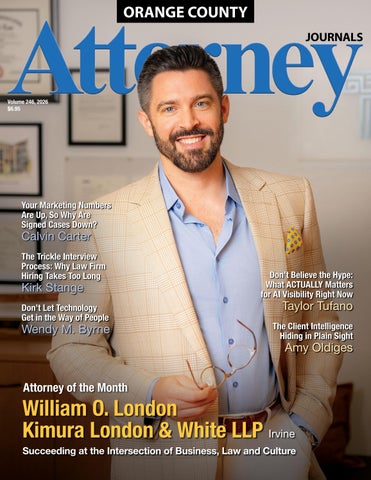
ORANGE COUNTY
Volume 246, 2026 $6.95
Your Marketing Numbers Are Up, So Why Are Signed Cases Down?
Calvin Carter
The Trickle Interview Process: Why Law Firm Hiring Takes Too Long
Kirk Stange
Don’t Let Technology Get in the Way of People
Wendy M. Byrne
Don’t Believe the Hype: What ACTUALLY Matters for AI Visibility Right Now
Taylor Tufano
The Client Intelligence Hiding in Plain Sight
Amy Oldiges
Attorney of the Month
William O. London Kimura London & White LLP Irvine Succeeding at the Intersection of Business, Law and Culture
When the verdict must be historic. Prominent firms refer their toughest, highest-stakes cases to BRUNO | NALU, and for good reason. With well over 100 jury trials and a record of landmark verdicts, we step in as trial counsel to radically increase the value of settlements and awards.
$857M PRODUCT LIABILITY $412M MEDICAL MALPRACTICE $48M SEXUAL ASSAULT $40M WRONGFUL DEATH $21.3M TRUCK ACCIDENT Representative verdicts. Prior results do not guarantee a similar outcome.
Keith J. Bruno & Angela Bruno, Founding Trial Lawyers, BRUNO | NALU
Refer with confidence.
Battle-tested trial counsel.
www.brunonalu.com 866.519.3098 18201 Von Karman Avenue, Suite 1180, Irvine, CA 92612
NEVADA REFERRAL & CO-COUNSEL RELATIONSHIPS NEVADA’S LARGEST & HIGHEST RATED INJURY LAW FIRM
BILLIONS WON FOR OUR CLIENTS “Rick is one of the best lawyers in the country. I call him every time I have any issue in Nevada and would not hesitate to refer him any type of case of any size.” ~ C. Michael Alder, Esq., Alder Law, Los Angeles, California, CAALA Past President and Former Trial Lawyer of the Year
LAS VEGAS: 702.444.4444 801 South 4th Street Las Vegas, NV 89101 HENDERSON: 725.444.4444 2600 Paseo Verde Pkwy. #101 Henderson, NV 89074
RENO: 775.222.2222 6900 S. McCarran Blvd., #1010 Reno, NV 89509
SPRING VALLEY: 725.888.8888 8359 W. Sunset Rd., #150 Las Vegas, NV 89113
RichardHarrisLaw.com
SUMMERLIN: 725.999.9999 1645 Village Center Cir #60 Las Vegas, NV 89134
2026 EDITION—NO.246
TABLE OF CONTENTS 6 Don’t Let Technology Get in the Way of People by Wendy M. Byrne
8 Don’t Believe the Hype: What ACTUALLY Matters for AI Visibility Right Now by Taylor Tufano
6
EXECUTIVE PUBLISHER Brian Topor EDITOR Wendy Price
12 The Client Intelligence Hiding in Plain Sight
PUBLICATION DESIGN Penn Creative
by Amy Oldiges
CIRCULATION Angela Watson
ATTORNEY OF THE MONTH
PHOTOGRAPHY Chris Griffiths STAFF WRITERS Dan Baldwin Jennifer Hadley CONTRIBUTING EDITORIALISTS Wendy M. Byrne Calvin Carter Amy Oldiges Kirk Stange Taylor Tufano ADVERTISING INQUIRIES Info@AttorneyJournals.com SUBMIT AN ARTICLE Editorial@AttorneyJournals.com OFFICE 1950 W Corporate Way, #21044 Anaheim, CA 92801 www.AttorneyJournals.com ADDRESS CHANGES Address corrections can be made via email or postal mail.
16
16 William O. London, Kimura London & White LLP, Irvine Succeeding at the Intersection of Business, Law and Culture by Dan Baldwin
22 Your Marketing Numbers Are Up, So Why Are Signed Cases Down? by Calvin Carter
26 The Trickle Interview Process: Why Law Firm Hiring Takes Too Long by Kirk Stange
22
Editorial material appears in Attorney Journals as an informational service for readers. Article contents are the opinions of the authors and not necessarily those of Attorney Journals. Attorney Journals makes every effort to publish credible, responsible advertisements. Inclusion of product advertisements or announcements does not imply endorsement. Attorney Journals is a trademark of Sticky Media. Not affiliated with any other trade publication or association. Copyright 2026 by Sticky Media. All rights reserved. Contents may not be reproduced without written permission from Sticky Media. Printed in the USA
Don’t Let Technology Get in the Way of People by Wendy M. Byrne
We live in a world designed for convenience. We text instead of calling. We email instead of walking down the hall. We send a message instead of having a conversation. And increasingly, we turn to artificial intelligence (AI) to help us communicate, make decisions, and get more done. From the COVID-19 pandemic, when we were forced to eliminate much of our in-person contact and quickly adapt to virtual communication, to a generation that has grown up with smartphones, social media, and digital platforms as an integral part of everyday life, face-to-face interaction has become less central to how we communicate. For many, it is even starting to feel like unfamiliar territory. Now, as AI becomes a fixture in the workplace, technology is once again changing how we communicate, collaborate, and get work done. With that evolution comes a growing concern that technology will not only change how we work but ultimately replace the human beings doing the work. There is no question that AI will transform the workplace. Some jobs will change, some will disappear, and entirely new roles will emerge. But there is one thing technology cannot replace: the value of human connection. In fact, the more digital our workplaces become, the more important face-to-face communication has become. Think about the difference between completing your to-do list and building a relationship. Is your goal simply to check off as many tasks as possible, or is your goal to build relationships that create trust, understanding, and lasting value? A digital message can deliver information quickly, but it can also be misinterpreted in tone and meaning. In addition, a digital message can’t capture the hesitation in someone’s voice, the expression on their face, the energy in a room, or the signals that tell you something is left unsaid. Those nonverbal cues are an essential part of how people understand one another.
The Value of Being Present When I ask people about the best part of their day, their answers almost always involve face-to-face connection: a conversation with a colleague, a client meeting, lunch with a friend, or an unexpected interaction. Face-to-face communication is as important with people we work with every day as it is with our clients. We can sit in the same organization and communicate almost exclusively through email, instant messages, and virtual meetings. 6
Attorney Journals Orange County | Volume 246, 2026
But co-workers are not simply names on a screen or people listed on an organizational chart. They are people with ideas, experiences, challenges, and perspectives that we understand much better when we take the time to interact with them.
Time Is Money. What Is Your Time Worth? To be fair, there is a very real argument for efficiency because time is money. That is particularly true in professional services. For example, lawyers bill by the hour, accountants track their time, consultants charge for their expertise, and doctors have packed schedules and a long list of patients to see. Therefore, it can be tempting to choose the quickest form of communication, such as sending an email or text. But is the time you saved worth it if you lose the relationship in the process? Consider a lawyer who bills $1,000 an hour. It may seem more efficient to answer a client’s question by email rather than spend 30 minutes sitting down with that client to fully understand the situation. But what if that conversation uncovers a larger business concern or if the client has been considering moving their legal work elsewhere? What if simply taking the time to listen is what convinces the client that their relationship matters? Consider a financial advisor who emails a market update instead of calling a client or an accountant who answers a complicated question with an email rather than talking through the implications. The email may save time, but is it worth the cost in trust? Also consider that emails and text messages can often create more questions than they answer. What starts as a quick message can lead to confusion, frustration, and a long chain of back-andforth that could have been resolved with a simple phone call or, better yet, a face-to-face conversation. What may feel like the more efficient option in the moment can become inefficient in the end.
Apply These Principles Directly to Business For success in business, you cannot rely solely on email or other digital communication. Sometimes, you must take the extra step and meet with a client face-to-face. Nothing replaces the personal touch of taking time out of your day to sit across the table from someone to learn more about them, understand their role, and gain a deeper perspective on their organization. That investment sends a message that you are interested in more than the matter at hand, and you want to understand their business, challenges, and goals. It also demonstrates that your relationship
isn’t transactional; rather, you see yourself as an extension of their team and are genuinely invested in their organization’s success. Naturally, in-person meetings are not always possible. Geography, schedules, travel, and other demands can make getting together in person difficult, and sometimes, a client or colleague simply prefers the flexibility of a virtual meeting. When that is the case, platforms such as Zoom, Microsoft Teams, and other digital conferencing software can still provide many of the benefits of face-to-face communication. Seeing someone’s expression, hearing their voice, and having a more personal, real-time conversation can create a level of connection that email and text simply cannot. The goal should never be to force someone to meet in person; it is to be intentional about how we communicate and to recognize when a personal connection can make a difference. I have yet to schedule an in-person meeting where the person I was meeting with was not grateful that I took the time to physically be there.
Be Intentional When Your Interactions Are Virtual If you are on a virtual meeting, turn on your camera when appropriate. Be present. Put the phone down, step away from the other screens and distractions, look at the person you are speaking with, and give them your full attention. It may seem like a small gesture, but it sends a meaningful message: You have my attention, I am here, and you and what you have to say matter. When everyone is engaged and present, even a virtual meeting can feel more personal and productive. You can see facial expressions, recognize reactions, pick up on body language, and have a better sense of whether someone is engaged, confused,
excited, or hesitant. Most importantly, you are reminded that there is a person on the other side of the screen.
At the End of the Day, It’s About People Rather than simply exchanging information, sitting across from another person is an opportunity to build rapport, listen differently, and read the room. It is an opportunity to build the kind of personal connection that can turn a transaction into a relationship, a colleague into a trusted partner, and a client into a long-term advocate. Technology has made communication faster, and AI is making it more efficient, but neither should come at the expense of being human. The question for businesses isn’t whether we should embrace technology. We should. The question is whether, in doing so, we will forget the extraordinary value of simply sitting across the table from another person and talking or, when we can’t be there in person, making the effort to be fully present with them virtually. The most valuable thing you can give someone isn’t another email, another message, or another virtual meeting. It’s your time, your presence, your attention, and the willingness to simply show up. n Wendy M. Byrne is a client-facing strategic leader focused on client development, relationship building, and identifying opportunities to create meaningful, long-term value for clients and the firm. Drawing on more than 20 years of experience in strategic communications, business development, and marketing, she works directly with clients to understand their businesses, priorities, and challenges, and to demonstrate that the firm is an integral part of their team. Learn more at www.shumaker.com.
Attorney Journals Orange County | Volume 246, 2026
7
Don’t Believe the Hype: What ACTUALLY Matters for AI Visibility Right Now by Taylor Tufano
E
very vendor pitch in legal marketing now includes “AI” somewhere in the deck, creating a lot of noise around a very complex and constantly evolving topic. When determining what matters for AI visibility, the signals that actually drive inclusion and citation today are not completely new concepts. They are the same signals that have always driven visibility, namely authority, originality, distribution, and structural clarity, applied with more discipline than most firms apply them. The fundamentals are what move the needle.
Understanding the Hype Problem and Why “AI Visibility” Got Weird AI search has seen a very large boom with high adoption rates. According to a Semrush study, website traffic from AI search is predicted to surpass that from traditional search by 2028. This sudden rise in AI and the attempt to capture AI visibility has caused much hype within the industry, leading to some deceptive sales tactics promising results that are impossible to deliver. The real risk for law firms is ensuring they will not be wasting valuable marketing dollars chasing tactics that do not move the needle while neglecting the strategies that do. The right question is “Which of the things that have always mattered for visibility now matter even more?”
What Matters for AI Visibility Right Now? To answer the question: “Which of the things that have always mattered for visibility now matter even more?” it is important to understand the things that actually matter for AI visibility right now. Let’s dive into the top five.
1. Authority Is Still an Important Signal Brand authority is a strong predictor of LLM citation frequency. It has been shown that LLMs reward sources that have demonstrated depth across a defined practice area, not
8
Attorney Journals Orange County | Volume 246, 2026
breadth across unrelated topics. For example, a firm with 40 substantive pieces on M&A will be cited on that topic before a firm with a thin content library spanning every practice area the firm serves. It is important to understand that AI systems need to confirm that “Smith & Associates” is a real firm with verifiable credentials, consistent NAP (Name, Address, Phone), and external validation before they will recommend it. Inconsistencies across Google Business Profile, directory listings, and the firm website actively hinder the firm’s chances of being cited or mentioned within an LLM response. Four Ways to Improve Your Law Firm’s Authority Law firms need to capitalize on the opportunities that can help improve the firm’s authority, such as digital PR and backlinking efforts. Four ways to improve your law firm’s authority include: • Google Business Profile (firm + each major office) • LinkedIn (firm page + active attorney profiles) • Legal directories (Martindale, Justia, Avvo, Chambers, etc.) • A steady cadence of named bylines in legal trade publications
2. Originality and Information Gain LLMs often reward websites that add something original to the training set rather than restate what has already been said hundreds of times. This is “information gain,” how much new information your content provides relative to what the model already knows. A Princeton GEO study (https://collaborate.princeton.edu/ en/publications/geo-generative-engine-optimization/) found that adding original statistics, quotations, and citations boosts generative engine visibility by up to 40% over unoptimized baselines. The unoptimized baseline scored 19.3 on visibility metrics; optimized content scored above 40, more than a 2X performance gain on the original measurement.
What information gain looks like in legal content: • Proprietary survey data from the firm’s own client base or referral network • Original case-volume analysis from the firm’s matter history, where ethically shareable • Local jurisdictional analysis competitors cannot replicate without the same on-the-ground experience • Named partner perspectives on emerging case law, written under the partner’s byline • Original research the firm publishes annually • Case results and representative experience examples What it does not look like: • Another “What is Estate Planning?” explainer • A generic state-by-state divorce guide pulled from public sources • A paraphrased summary of a recent appellate ruling already covered by Law360 and Reuters The leverage point for mid-sized firms: in AI search, content structure and originality now matter more than domain authority for individual page citations. 83% of AI Overview citations come from pages outside the organic top 10. That is the gap mid-sized firms can exploit against larger competitors with stronger domains but weaker original output. Domain authority does not protect a thin content library from being out-cited by a smaller firm producing genuinely original analysis.
3. Distribution Across the Open Web Multi-platform presence is another strong signal in current LLM citation research. Brands appearing on all different kinds of websites help boost brand authority, which in turn helps with AI visibility. The “open web” for a law firm is not just the firm site. It is trade publications, industry podcasts, conference recaps, LinkedIn posts, YouTube videos, and attorney bylines on thirdparty outlets. Each is a place where the firm’s name and topical authority get reinforced for both search and LLM crawlers. Digital PR is having an uprising because LLM retrieval systems pull from authoritative third-party content. Named coverage in Law360, Bloomberg Law, ALM publications, and equivalent niche outlets compounds AI visibility in a way that another self-published blog post does not. Most firms are not paying close enough attention to their earned media efforts, and that is where the budget should shift to include increased digital PR efforts.
4. Structured Clarity and Crawlability Another aspect to consider for your AI visibility is your content structure and your website’s overall crawlability. Simply put, how easy is your content to read and skim through, and how technically sound is your website so there are no roadblocks for search engines and AI bots to crawl. Structured Clarity Content structure is another important factor when it comes to AI visibility. Having your content structured in chunks of smaller paragraphs with proper headings receives more citations and mentions than long-form unstructured content. That is because the RAG (Retrieval-Augmented Generation) systems that LLMs use retrieve passages, not pages. If you want to optimize your existing and future content for AI visibility, your content should have front-loaded answers, descriptive H2 and H3 structure, FAQ sections for the questions clients actually ask, and definition-first sentences for terminology. All of this to say that long-form content is not going anywhere; in fact, it still wins; however, it needs to be structurally parseable so the engines can extract the right passage. This also appeals to your human users because it makes your content much more skimmable so they can easily find what they are looking for. Content freshness is also now a ranking-adjacent signal. Evergreen pages still get cited, but a regular publishing cadence keeps the firm top of mind when LLMs are deciding what to cite. A study by Ahrefs (https://ahrefs.com/blog/do-ai-assistantsprefer-to-cite-fresh-content/) has shown that “the average age of URLs cited by AI assistants is 1,064 days, compared to 1,432 days for URLs in organic SERPs—25.7% ‘fresher.’” This means that not only should your firm focus on generating new content but also on freshening up older content that is still relevant. Crawlability The other piece of the puzzle here is crawlability, which is where schema comes into play. Schema markup is worth doing, and it may be possible your site already has some implemented from previous optimization efforts. That is because schema isn’t a new concept; it has just been emphasized in importance because it helps AI crawlers understand and serve your content better. Some schema types your firm should have include: LegalService, FAQ, Article, and Organization. Some other crawlability opportunities to audit include: • Site speed and Core Web Vitals ˏ Site speed on mobile should be 70+ and 90+ on desktop ˏ Your site should be passing Core Web Vitals on both desktop and mobile
Attorney Journals Orange County | Volume 246, 2026
9
• Mobile rendering parity with desktop • Clean internal linking and topical hub structure • No redirect chains • robots.txt that does not accidentally block important content Something that you can do once you finish reading this article is to review which AI crawlers the firm’s robots.txt allows. GPTBot, ClaudeBot, and PerplexityBot are some of the major ones. Some firms have inadvertently blocked all of them, sometimes by default settings on a CMS, sometimes by a cautious IT team responding to early AI scraping headlines, but if the bots cannot access the content, whatever you do to improve your visibility does not matter.
5. Engagement Signals User engagement signals such as time on page, return visits, branded search volume, review velocity, and social engagement on firm-authored content do flow into the ranking and retrieval systems LLMs draw from. AI Overviews and ChatGPT search both rely on retrievalaugmented generation (RAG) that surfaces content from the live
10
Attorney Journals Orange County | Volume 246, 2026
web. With that said, the same engagement-influenced signals that lift content in organic search lift content in AI answers. What does this mean in practice? A law firm with high branded search volume, consistent Google reviews, and a recognizable thought-leadership presence on LinkedIn will be cited by LLMs more often than a firm with equivalent on-page content but no audience signal. The on-page work is necessary, but it is not enough to sustain a lasting impact. One thing to keep in mind is not to waste valuable marketing budget on fraudulent engagement services like fake reviews, traffic bots, or follower farms. This can end up hurting the firm in the long run, so work to get your increased engagement through SEO and GEO strategies that actually work. n Taylor Tufano is a Senior Digital Strategist at 9Sail and a motivated individual with a passion for digital marketing. She is a strong writer with knowledge and background in content and social media marketing as well as search engine optimization (SEO) and pay-per-click (PPC) advertising. Learn more at www.9sail.com.
The Client Intelligence Hiding in Plain Sight by Amy Oldiges
Your firm may already have the information it needs to strengthen client relationships and uncover new opportunities. A relationship partner knows a client is considering an acquisition. An associate knows the client’s legal team is stretched thin. A paralegal hears that the company is expanding into a new market. Marketing learns through feedback from a webinar that the general counsel is paying attention to AI. None of these pieces of information may seem particularly significant on their own. But what if the firm could connect them? Law firms gather an incredible amount of information about their clients every day. It comes from partners, associates, paralegals, legal assistants, client teams, marketing and business development professionals, client feedback programs, pitches, RFPs, and countless informal conversations. The challenge isn’t necessarily collecting more information. It’s connecting what people already know and turning it into action.
But instead, we got curious. Could she share the threshold amount? When the firm knew the invoice was going to be over that threshold, if they broke the amount up over multiple invoices, would that help eliminate extra steps for her? Her answer was an enthusiastic (and almost relieved) yes! We immediately shared what we had learned with the relationship partner and the firm’s accounting department, and the change was quickly implemented. It was a relatively small administrative change, but it sent a big message: We heard you. We understood the problem. And we did something about it to make your life a little easier. That builds trust and strengthens the relationship. And the same principle applies to the informal conversations happening every day.
Client Feedback Is Only One Piece of the Puzzle
Attorneys are trained to solve problems. When a client raises an issue, the instinct can be to immediately offer a solution—or start thinking about what other services the firm could provide. Sometimes, the better approach is to listen. Give yourself time to understand what the client is actually telling you. One simple follow-up can help: “This is what I heard. Is that about right?” When the conversation allows, have a few questions ready that encourage the client to share what’s really going on:
Formal client feedback interviews are incredibly valuable. They give firms an opportunity to hear directly from clients about what’s working, what isn’t and what matters most to them. But some of the most valuable client intelligence doesn’t look like “feedback” when it happens. Once when I was involved in a client conversation, the client raved about how much she loved working with the firm and complimented the outside attorneys on how seamlessly they collaborated with her internal team. It was everything the firm was hoping to hear. Then, as the interview began to wind down, she mentioned, almost in passing, that her finance team had recently implemented a new threshold rule for approving vendor invoices. Any invoice over that threshold triggered another layer of administrative back-and-forth that she had to deal with, and it had become a huge headache. We could have simply acknowledged it with an “Oh wow, that sounds frustrating and especially during busy season!” 12
Attorney Journals Orange County | Volume 246, 2026
Listen to Learn, Not Just to Respond
• What’s getting the most attention internally right now? • Are there any changes happening for you or your team? • Have priorities from leadership shifted? • What’s coming up that you’re starting to think about? The goal isn’t to interrogate a client looking for a crossselling opportunity. It’s to understand what matters to them and the challenges they’re facing. Sometimes that information is professional. Sometimes it’s personal.
One time in a coaching session, I had a partner casually mention that client A was a diehard Buffalo Bills fan. He also knew client B was equally passionate about the team, and both would be at the game that weekend. The partner had a great relationship with both and had frequently talked football. I suggested he introduce them. His email was simple and personable: He knew they both loved the Bills, knew they would both be at the game and thought they might enjoy connecting. Their response was appreciative, and it started a dialogue between them that was all business ... the business of football. Nothing was sold. No business-development pitch was made. He connected two people based on something he had learned about them. That’s genuine relationship building. It also illustrates why listening matters. Clients want to know that their attorneys listen to more than just the legal issues.
Connect the Dots Knowing something about a client is only the first step. The real value comes from connecting that information with what others in the firm know—and then deciding what to do with it. One of the biggest challenges I’ve seen is that valuable client intelligence often gets trapped with individuals. The relationship partner knows something. An associate knows something else. An assistant hears a passing comment. Marketing learns something at an event. Another practice group has a relationship with a different executive at the same company. Everyone may have a piece of the puzzle, but no one has the full picture. This is where your firm’s marketing and business development (MBD) team can be your biggest ally. MBD professionals are often the unsung heroes of a firm. They may not be the ones sitting across the table from the client, but they are frequently the people connecting the dots across relationships, practices and opportunities. They see what is happening across the firm and can help attorneys turn good intentions into a coordinated plan. The opportunity is to make sure they’re part of the conversation. For example, I’ve worked with client teams (made up of partners, associates, paralegals, and business professionals) that held monthly or quarterly meetings where everyone shared: • Recent client interactions and BD activity • Key developments or news • Feedback they had received • New contacts or relationships • Potential opportunities or concerns • Ways other attorneys or practice groups could help By being part of the conversation, the MBD team could then take those individual updates and turn them into something
useful: What are we hearing? What patterns are emerging? Who else needs to know? And what should we do next? During one meeting, the team learned that the client had recently experienced significant turnover among its junior associates and was having a hard time getting its new hires up to speed. The group discussed how the firm could help and decided to offer a series of complimentary training sessions focused on key issues, processes and players. The client loved the idea, the sessions were a hit, and the relationship grew. That same collaboration can change how attorneys approach business development as well. I’ve often seen multiple attorneys independently identify the same client or prospect as a relationship they want to develop. Once everyone knows what everyone else is working toward, those individual efforts can become collaborative ones. And that’s where your MBD team can really shine. They can help identify the overlap, bring the right people together, develop the plan, provide the resources and—perhaps most importantly—help keep the momentum going. Attorneys bring relationships and client knowledge. The MBD team can help connect it, organize it and turn it into action. One relationship. Multiple attorneys. One coordinated approach. That’s the power of connecting the dots.
Don’t Overlook the Intelligence in RFPs and Pitches RFPs and pitches are another often-overlooked source of client intelligence. Yes, the firm needs to answer the questions. But pay attention to the questions themselves. What is the client asking about? • AI and technology • Pricing or alternative fee arrangements • Staffing and efficiency • Industry experience • Geographic expansion • Client service expectations • Areas of anticipated growth or concern Those questions can tell you a lot about what the client cares about right now. And once the work is won, that information needs to make its way into the firm. I’ve had attorneys ask months after winning an RFP what billing arrangements and rates were agreed upon with a client and if that information was shared with the finance department. In one case, a new rate structure agreed to during a pitch wasn’t properly communicated to finance, and the firm undercharged the client for more than a year. That made for an uncomfortable conversation all around. Capturing the information isn’t enough. The right people must know about it. Attorney Journals Orange County | Volume 246, 2026
13
A Signal Isn’t an Insight AI can make it easier to monitor what’s happening with clients—leadership changes, acquisitions, industry trends, regulatory developments and more. But a signal isn’t an insight. AI can surface information. The people closest to the client provide the context. And the MBD team can help connect the dots and determine what to do with it. That’s where technology becomes truly useful: not replacing relationships and judgment, but helping firms make better use of what they already know.
Know. Connect. Act. Law firms already have an incredible amount of client intelligence. The opportunity is to make better use of it. Know what matters. Connect the people and information. Act on what you learn.
Everyone who interacts with a client has a piece of the relationship. When firms create a culture where people share what they hear, and where the MBD team can help connect the dots, that information becomes much more valuable. Because the next business-development opportunity may not be something your firm needs to discover. It may be something your firm already knows. n Amy Oldiges is an Affiliated Marketing Consultant with Society 54, bringing more than 20 years of experience helping professional services organizations, especially law firms, strengthen client relationships and grow. She has worked in-house at firms ranging from small practices to AmLaw 200 firms, so she understands the strategic, operational, and cultural factors that make marketing programs succeed. Amy works with firm leaders and practice groups to turn strategy into action, drawing on experience in client feedback programs, proposals and RFPs, market intelligence, CRM, digital initiatives, communications, and large-scale events. Learn more at www.society54.com.
In a world full of mergers and monopolies, count on us to keep it real.
When it comes to court reporting, video and litigation services, Peterson delivers real reporters, real experience, and real service. Day by day, year by year, case by case, we’ve been setting the high bar for integrity, technology and reach for over 35 years. Independently owned and operated 100% Woman-owned Business WBE Certified Serving CA and the US since 1986
Nationwide Reporting | petersonreporting.com | 800-649-6353
Peterson Reporting 2023 Atty Journal HPH.indd 1
14
Attorney Journals Orange County | Volume 246, 2026
4/25/23 4:45 PM
John Gomez Founder & CEO
Bilingual legal excellence in cases involving PERSONAL INJURY EMPLOYMENT HARM SEXUAL ASSAULT & ABUSE CIVIL RIGHTS VIOLATIONS & MASS TORTS.
BINATIONAL | BICULTURAL | BEST IN CLASS
833-GET-GOMEZ | GETGOMEZ.COM
Succeeding at the Intersection of Business, Law and Culture The Mandarin-speaking founding partner of Kimura London & White is building a firm around the whole client, not the traditional law firm model. During the past eight years, I’ve gone from being the attorney handling most of the day-to-day work to now being the attorney managing and supervising a fairly large team of professionals. And I have to be honest, I absolutely love that role,” says William O. London (“Bill” London), Founding Partner at Kimura London & White LLP. A Mandarin-speaking, international-business attorney serving high-net-worth private clients, London leads a rapidly expanding mid-sized law firm in Orange County. His practice spans business, litigation, private client, and work across international boundaries, which allows him to advise clients whose needs often overlap across multiple areas of law, commerce, and borders. Kimura London & White is recognized among the Top 100 Law Firms in Orange County and was featured in Forbes and Fortune. London leads a team of 42 professionals: 20 attorneys, 15 support staff, and 7 administrative professionals. According to the Orange County Business Journal, the firm is the fourthfastest-growing law firm in Orange County in 2026. The firm has offices in Irvine, Beverly Hills, Pasadena, San Diego, San Francisco, and New York, NY. London says, “We have unusual breadth for a firm our size. A business owner or private client may come to us with a litigation issue that also involves real estate, corporate issues, trust and estate, family, or international considerations. Rather than treating those as completely separate problems, we bring together attorneys across the firm knowledgeable and experienced in those areas and look at the client’s situation as a whole.” London and his team’s ability to handle the most complex challenges is tested and proven in the international marketplace on a regular basis.
He trusted a friend to handle his U.S. transactions, which involved several million dollars in real estate investments. The friend was no friend at all and decided to keep the funds for his own use. London and his team were well prepared to face the challenge of working together with more than 6,000 miles of ocean between client and attorney. Everyone in the group was involved in this case to help translate and communicate with the client. Kimura London & White has 14 people on its Greater China practice group. All are bilingual in Mandarin and English. They conducted online meetings in Chinese, explained the U.S. legal system and processes, and maintained active and effective open lines of communication throughout the case. The firm handled the three-year lawsuit, which culminated in a trial in which they obtained a $2 million judgment for their client. London’s Mandarin fluency and international legal training allowed him to lead that work directly. London spent a semester at Tsinghua University in Beijing, so he was more than familiar not only with the differences in law, but also with the differences in culture. One of the reasons for their notable achievements in this challenging legal arena is a recognition of the commonalities between the cultures rather than a focus on differences. “We have a lot in common. Americans and Chinese play a crucial role in the world. You have a real entrepreneurial spirit in both countries. You have a sense of capability, pride, a drive. That’s a great base for building relationships for those who recognize and act on it.”
Meeting the International Challenge
London says he and his partners have structured the firm differently from the traditional law firm model. One example is their team-based approach to complex matters. Rather than automatically assigning a client to a single attorney or practice group, they identify the legal, business,
A case in point involved a Chinese business owner who saw the incredible investment opportunities here in the United States, one of the safest places in the world for investment.
16
Attorney Journals Orange County | Volume 246, 2026
At the Intersection of Planning and Building
JOURNALS
ATTORNEY
OF THE MONTH
© Christopher Todd Studios
2026
William O. London, Founding Partner
Intersecting With Other Attorneys and Law Firms “We are also intentionally relationship-driven. Clients have direct access to experienced attorneys, and the people responsible for the strategy remain involved in the matter. The same applies to referrals. When another attorney sends us a client, we understand that they are trusting us with their own reputation and relationship,” London says. He believes in maintaining a substantial referral program, where permitted, and during the past five years has worked aggressively to establish and enhance a referral network. The firm values those relationships and has built a substantial referral 18
Attorney Journals Orange County | Volume 246, 2026
©️ Jeff Armstrong Photography
financial, and personal issues involved and bring the right attorneys into the matter early. This is particularly valuable for business owners and private clients whose litigation, corporate, real estate, estate planning, family, and international concerns may all intersect. They have also invested heavily in technology and systems designed to make legal services more responsive, including AIassisted intake and internal workflows, streamlined lead and conflict-review processes, data-driven case intake, and technology that helps the team respond to potential clients quickly while still keeping attorney judgment at the center of the process. London says that ultimately, the innovation is not any one piece of technology, but the way they are building the firm: multidisciplinary, multilingual, technology-forward, highly responsive, and structured around what the client actually needs rather than how law firms have traditionally organized themselves. One of the biggest drivers of their growth has been what London says is simply “being in the room.” The attorneys regularly attend industry events, community organizations, business groups, and professional gatherings where they build real relationships over time. The goal is not to walk into every room aggressively looking for a client with every handshake. The goal is to get to know people first, understand what they do and what they need, and become someone they know and trust before there is ever a legal need. “When that need shows up on their doorstep, they already know we’re here for them,” London says. One of the biggest differences is how they approach a matter from the beginning. They invest the time to understand what is really at stake, put the right attorneys and professionals in the room early, and are candid with clients about strategy, cost, risk, and what they believe is the best path forward. They respond in a timely manner to make sure clients are confident and never have to wait months to understand where their case stands. Ultimately, they work to combine the resources and sophistication clients expect from a larger firm with the responsiveness, accountability, and personal attention of a much more closely held practice, which is one of the reasons so many other attorneys and firms rely on Kimura London & White for specific challenges outside their normal practice areas or resources.
network based on trust, communication, and professionalism. They actively track referrals, facilitate introductions, and make sure referral arrangements are documented, honored, and handled professionally. That approach has helped build a strong network of attorneys and professionals who are comfortable sending them significant matters because they know the client and the referral relationship will be treated with care. Collaboration can include foreign counsel, attorneys in other states, accountants, wealth advisors, corporate professionals, and other specialists. In sophisticated matters, knowing when to assemble the right team is an important part of providing effective representation. “We view referrals as long-term partnerships, not one-off transactions. Attorneys who send matters to us can expect clear communication, careful handling of their clients, and transparency throughout the process. We also look for opportunities to refer matters back out when another attorney or firm is better suited for the work,” London says.
The Kimura London & White LLP Team
Putting the Right Pieces in the Right Place London says everyone on his team understands that every client is unique and must be treated differently, according to specific needs, goals, and challenges. He learned early in his career that the first questions to ask a new client should focus on determining a client’s real goals. Every client has a different goal and perhaps a different way of trying to achieve it. The real goal may not even be the one stated. Assigning the attorney or attorneys who best match that individual’s needs is crucial to ultimate success. “I am involved in supervising every case that my team handles, but I always determine: Who would be a good match for this client? Who would the client get along with the best? How would the relationship go? Because that’s really at the core; that personal connection is the basis on which all decisions are made, the client feels confident and comfortable or not, that relationship is really key.”
He describes his management style as firm but fair. He motivates the members of his team to treat each other with respect, empathy, and professionalism by leading by example. That results in a collegial, cooperative environment, which is necessary to have a competitive edge over opposing counsel. It’s a stressful, pressurepacked career in which cases can last for years, and putting the right people in the right place is essential to a successful outcome. He sets high expectations and clear standards, and keeps his employees and team members accountable. He says the attorneys have already taken the LSAT, gone through three years of law school, and passed the bar exam. They are dedicated, hardworking people who have decided to make this their career. Therefore, he sees his job in many ways as a coach who holds them to a high standard and helps them to achieve their career goals and perform at their best. “I’ve been an attorney for 15 years. I’m most proud of my team. I’ve hand-selected each one of them, and they’re all really good people. They work hard, they care, they’re always interested in Attorney Journals Orange County | Volume 246, 2026
19
Enjoying the Intersection of Community and Family Once outside the office, London is as committed to his family and community as he is to his business and his clients. He recharges by regularly playing squash, which he says helps keep him physically and mentally on top of his game. He enjoys traveling, networking, and attending business and professional events throughout the United States. The international nature of his practice provides opportunities for routine trips to China as well, which allows him to maintain relationships, strengthen his cultural fluency, and stay connected to the business communities on each side of the Pacific. He is deeply involved in Orange County’s arts community and serves as Official General Counsel and Sponsor of Pacific Symphony. He has also served on the board of Arts Orange County. He has provided counsel to the Newport Beach Firefighters Foundation and has participated in pro bono work through the Public Law Center. He ensures that the firm is also committed to the community through active support of Second Harvest Food Bank of Orange County through its Food From the Bar initiative. He has worked in Orange County for more than 12 years, which has given him a strong understanding of the local business community and the importance of long-term relationships. “I try to be involved in organizations and events and activities where I can contribute something meaningful rather than simply have my name on a membership list. Those relationships are meaningful because they allow me to use my legal experience in support of organizations that contribute to the community,” he says. London’s career reflects a consistent philosophy: strong legal work begins with understanding people and building trust. That principle has guided his work across borders and his leadership within the firm. It also continues to shape his commitment to the community and the future of Kimura London & White. n Contact William O. London Kimura London & White LLP 17631 Fitch, Irvine, CA 92614 949-776-2874 www.klw-law.com Other Offices: Beverly Hills, CA San Diego, CA Pasadena, CA San Francisco, CA New York, NY 20
Attorney Journals Orange County | Volume 246, 2026
© Christopher Todd Studios
EXP ER I ENCE
growing and learning, and we treat each other with respect and integrity, so it’s a family of sorts. Of course, it’s work, but we’re here. We’re here a good amount of our lives, and I think each one of us has played a role, created a place where we feel respected, there’s growth, there’s a sense of pride, and I get to be a part of all that, so I’m very proud and pleased about that.”
William O. London, Founding Partner
» EDUCATION • Georgetown University Law Center, Washington, D.C., J.D., 2011 • Tsinghua University Law School, Beijing, China • University of California, Santa Barbara, B.A., Law and Society, 2005
» HONORS & AWARDS • Southern California Super Lawyers, 2026–2027 • Southern California Rising Stars, 2016–2021 • Orange County Business Journal, Top Litigators & Corporate Lawyers, 2026 • Lawyers of Distinction, 2024 • America’s Top 50 Lawyers, 2024
» BAR ADMISSIONS • California • Supreme Court of the United States • U.S. District Court, Central District of California • U.S. District Court, Southern District of California
» PROFESSIONAL &
COMMUNITY ACTIVITIES • Pacific Symphony, Official General Counsel and Sponsor • Newport Beach Firefighters Foundation, Legal Counsel • Public Law Center, Pro Bono Service • Active supporter of Second Harvest Food Bank of Orange County • CEO Leadership Alliance of O.C.
» LANGUAGES • English • Mandarin Chinese
Your Marketing Numbers Are Up, So Why Are Signed Cases Down? by Calvin Carter
L
aw firm owners have access to more marketing data than ever. A typical monthly report might include Google rankings, impressions, website traffic, ad clicks, phone calls, form submissions, leads, and plenty of other numbers. The problem is that more data does not always create more clarity. Traffic can be up while signed cases are down. Leads can increase while consultations decrease. Google exposure can grow without producing more business. For a law firm owner, the real question is much simpler: Is our marketing contributing to new cases? One way to answer that is to follow the same path a potential client takes:
Potential Clients Reached Website Visits Inquiries Consultations Signed Cases Instead of looking at each number separately, look at how potential clients move through that path and where newcase opportunities may be getting lost.
1. Potential Clients Reached: Are the Right People Finding the Firm? The first number to look at is how often potential clients have an opportunity to find your firm. Depending on how your firm markets itself, that could include Google Search, Google Maps, paid advertising, legal directories, and other channels you can measure. The actual metric will be different depending on the platform. For example, Google impressions show how often your firm appeared in search results. That does not mean each impression represents a different person. So the goal is not to create a perfect count of how many individual people saw your firm. The goal is to understand whether your opportunities to be found are growing or shrinking. Then go one step deeper. Which practice areas are gaining exposure? Which are losing it? Are you gaining ground in the geographic markets that matter to your firm? An Orange County firm could see its overall search
22
Attorney Journals Orange County | Volume 246, 2026
exposure increase while losing ground for an important practice area. A San Diego firm could be getting found more often overall, but not for the types of cases it actually wants. More exposure is only valuable if it is coming from the right potential clients.
2. Website Visits: Are Potential Clients Choosing to Learn More? Being found is the first step. The next question is whether those potential clients are choosing to learn more about your firm. This is why I would not look at an increase in website traffic and automatically call it a win. Let's say opportunities to find your firm increase 20%, but actual website visits from those channels drop 8%. Your firm is showing up more often, but fewer people are choosing to visit. That tells you something very different from simply seeing "impressions up 20%" on a marketing report. You also want to look beyond total website traffic. Which practice-area pages gained visits? Which lost them? Are the pages connected to the types of cases your firm wants moving in the same direction as the website overall? For example, total website traffic could increase while visits to one of your most important practice-area pages decline. If you only look at the total, marketing appears to be improving. If you look at what is happening underneath that number, you might see a potential problem.
3. Inquiries: Are Website Visitors Contacting the Firm? Next, look at whether website visitors are actually contacting the firm. Depending on your intake process, that might include phone calls, contact forms, chats, text messages, or consultation requests. There is an important distinction here: A website visit is not an inquiry, and an inquiry is not yet a qualified potential case.
One simple number to track is:
A helpful number is:
Inquiry rate = inquiries ÷ relevant website visits
Consultation-to-client conversion rate = signed cases ÷ qualified consultations
For example, let's say website visits increase 15%, but inquiries stay flat. The immediate answer may not be to spend more money getting additional people to the website. You already have more visitors. The first question should be why those additional visitors are not contacting the firm. Maybe the wrong people are reaching the website. Maybe the messaging is not connecting with them. Maybe the contact process is difficult on mobile. Maybe the pages do not give potential clients enough reason to take the next step. The numbers will not tell you exactly which problem you have. They tell you where to start looking.
4. Consultations: Are Inquiries Becoming Real New-Case Opportunities? This is where marketing numbers need to connect with what happens during intake. If a marketing report says leads increased from 50 to 75, that sounds good. But how many of those 75 inquiries were actually potential cases your firm wanted? A useful number here is: Consultation rate = qualified consultations ÷ inquiries If inquiries increase while qualified consultations decrease, something is happening between those two stages. Maybe the marketing is attracting the wrong types of matters. Maybe the inquiries are coming from areas the firm does not serve. Maybe response times have increased. Potential clients could be dropping out before scheduling. Or there could be something in the intake process worth reviewing. This can be especially important for firms serving competitive markets such as Orange County and San Diego. Generating more inquiries does not help much if a growing percentage of them are outside the firm's service area or do not match the matters the firm handles. This is also why I would be careful about judging marketing based only on the number of leads generated. Forty inquiries that produce 20 qualified consultations could be much more valuable than 100 inquiries that produce 5. More leads do not always mean more new-case opportunities.
5. Signed Cases: Are Consultations Becoming Clients? The last number is the one law firm owners ultimately care about. How many qualified consultations became signed cases? To measure this, marketing data has to connect with the firm's intake records, CRM, case-management system, or whatever system the firm uses to track signed cases.
Now let's say qualified consultations remain steady, but signed cases decline. That tells you the problem may be happening after potential clients reach the consultation stage. Instead of focusing on generating more traffic or inquiries, look at what happens during and after the consultation. Are potential clients receiving the right follow-up? Has competition changed? Are expectations or case fit becoming an issue? Has anything changed in the process between consultation and retention? The numbers cannot tell you the exact reason. But they can tell you where to start looking and keep you from trying to solve the wrong problem. If the issue is happening after the consultation, simply generating more website traffic may not fix it.
Where Are New-Case Opportunities Being Lost? This framework becomes much more useful when you put all five numbers together. Imagine a firm sees the following changes in one month: Stage
Monthly Change
Potential Clients Reached
+18%
Website Visits
+11%
Inquiries
+8%
Qualified Consultations
-14%
Signed Cases
-17%
There are several positive numbers here. The firm is being found more often. Website visits are up. Inquiries are up. A marketing report could easily focus on those improvements. But a law firm owner should notice something more important: Inquiries increased, but qualified consultations dropped. That is where I would start looking. Getting more traffic could produce even more inquiries, but it would not explain why fewer of the firm's existing inquiries are turning into qualified consultations. The next step should be figuring out what changed between those two stages. Did lead quality change? Did the sources of those inquiries change? Are potential clients getting a quick response? Did anything change in how the firm handles or qualifies inquiries?
Attorney Journals Orange County | Volume 246, 2026
23
Now imagine the opposite. Consultations are turning into signed cases at a healthy rate, but fewer potential clients are finding the firm, and website visits have been declining. In that situation, the firm may be doing a good job once someone contacts it. The problem is that fewer people are reaching that point. Both situations can end with the same result: Fewer signed cases. But they are different problems and should lead to different next steps. That is why individual marketing numbers can be misleading when they are viewed by themselves.
A Monthly Scorecard Doesn’t Need to Be Complicated You do not need dozens of numbers to start looking at marketing this way. Each month, start with five: Stage
Question
Potential Clients Reached
Are the right prospective clients finding us?
Website Visits
Are they choosing to learn more?
Inquiries
Are they contacting us?
Consultations
Are they becoming legitimate new-case opportunities?
Signed Cases
Are those opportunities becoming clients?
Compare those numbers with the previous month and the recent 90-day trend. Once you have enough historical data,
24
Attorney Journals Orange County | Volume 246, 2026
comparing the same period year over year can also help account for normal seasonal changes. Then look at how the numbers move together. If signed cases declined, work backward. Did consultations decline? Did inquiries decline before that? Did website visits fall? Are fewer potential clients finding the firm? The goal is to figure out where the path to a signed case changed so you know what deserves attention first.
Your Marketing Report Should Tell You What to Do Next Marketing attribution will never be perfect. A potential client might hear about your firm from a friend, read your reviews, search your name on Google, visit your website, leave, and then call three days later. No marketing report is going to perfectly explain every decision that person made. It does not need to. A useful monthly marketing review should help a law firm owner answer three questions: What changed? Where are new-case opportunities being lost? What should we investigate or improve next? The goal is not perfect attribution. The goal is having enough information to understand what is affecting new-case acquisition and make a better decision about what to do next. n Calvin Carter is the founder of RankCraftr, legal marketing software for law firms, and has more than a decade of experience in search marketing. His work focuses on connecting marketing performance with inquiries, consultations, and signed cases to help law firms better understand new-case acquisition. Learn more at www.rankcraftr.com.
20+ Years Helping Businesses Reach More Clients
Establish Your Professional Authority! Expert writing and graphic design for your ... • Website • Presentations • Social Media • Email Marketing
• Signage • Press Releases • Print & Digital Ads • Business Cards
• Newsletters • Blog Posts • Speaking Engagements • Brochures, Flyers & More
Women-Owned Business • 215-550-1435 • penn-creative.com
Monty A. McIntyre, Esq. • Mediator, Arbitrator & Referee • CA attorney since 1980 • ABOTA member since 1995 • Past President of the SD County Bar Assn. in 2002 • Past President of SD ABOTA Chapter in 2014 • Cases handled: Employment, Torts, Business, Insurance, Real Property and Trust & Estate/Probate To easily schedule a mediation, visit Monty’s website: https://montymcintyre.com
Mediate With Monty: Get a Free 1-Year Subscription to California Case Summaries™ Always know the new case law in your practice areas. Just conduct one (Individual Attorney subscription) or two (Law Firm Unlimited subscription) private mediations with Monty in one calendar year to get a free 1-year subscription to California Case Summaries™ which provides one-paragraph summaries, with practitioner takeaways, organized by legal topic, of every new published California civil case throughout each year. Paid subscriptions are also available at: www.cacasesummaries.com
Attorney Journals Orange County | Volume 246, 2026
25
The Trickle Interview Process: Why Law Firm Hiring Takes Too Long by Kirk Stange
W
hen a law firm has an important position to fill, the interview process should move in an organized sequence. The firm should review the applications, select a group for first-round interviews, interview those candidates on the same day, identify the finalists, complete appropriate reference and background checks, and then conduct the final interviews on another designated day. Many law firms do not follow this process. Instead, they fall into what might be called the “trickle interview process.” One candidate interviews on Monday. Another comes in on Wednesday. Two more are interviewed the following week. A promising applicant cannot meet for another ten days, so the firm waits. Meanwhile, another resume comes in that somebody wants to consider. Before long, the interview process has stretched across several weeks. Some of the strongest candidates have accepted other jobs. The interviewers can no longer remember how the early candidates performed. The open position remains unfilled, and the hiring process seems to have no end. This is the trickle interview process. It is an inefficient way for law firms to hire.
What Causes the Trickle Interview Process? The trickle approach usually begins when a law firm schedules interviews entirely around each candidate’s availability. Instead of establishing one or two dates for first-round interviews, the firm asks each candidate, “When are you available?” Every applicant provides different dates and times. The firm then tries to accommodate all of them. Being considerate of candidates is important. However, the law firm must still control its hiring process. A firm cannot allow every candidate’s calendar to determine when the firm will make an important hire. If it does, the interviews will inevitably spread across many days or weeks. The problem can become worse when several managers or lawyers must participate. Every candidate’s schedule must then be coordinated with the calendars of multiple interviewers who also have hearings, client meetings, deadlines, and other responsibilities. What looked like flexibility quickly turns into disorder.
26
Attorney Journals Orange County | Volume 246, 2026
The Law Firm Begins Losing Good Candidates Strong candidates are rarely applying to only one employer. They may be interviewing with several law firms, companies, government agencies, or other organizations simultaneously. While one law firm is slowly conducting first-round interviews, another employer may have already completed two rounds and extended an offer. The candidate who interviewed first in the trickle process may wait two or three weeks without receiving a decision. Eventually, that person may assume the firm is not interested or that its management is indecisive. By the time the firm finally identifies its preferred candidate, that individual may have accepted another job. The law firm then moves to its second choice. But the second choice may also be gone. The firm may have to settle for a weaker candidate or restart the entire process. Moving slowly does not necessarily produce a more careful hiring decision. It may simply ensure that the best candidates are no longer available when the firm is ready to decide.
Interviewers Cannot Compare Candidates Effectively Another significant problem is the inability to compare candidates accurately. When six candidates interview on the same day, their qualifications, personalities, communication skills, and answers are fresh in the interviewers’ minds. The hiring team can compare the candidates while the information is current. That becomes much harder when the interviews occur over several weeks. The interviewers may remember the most recent candidate more clearly than the person who interviewed two weeks earlier. They may forget an excellent answer provided during an early interview. They may also remember a general impression without recalling the facts supporting it. Interview questions may change as well. One candidate may be asked difficult follow-up questions while another receives
a much easier conversation. One interviewer may focus on experience, while another focuses primarily on personality. The U.S. Office of Personnel Management’s guidance on structured interviews explains that candidates should generally be asked the same predetermined questions and evaluated under consistent standards. Conducting interviews in an organized block makes that consistency much easier to maintain. The trickle process makes comparisons less reliable and allows recency, memory, and inconsistent questioning to influence the final decision.
The Hiring Standards Begin to Drift When the process lasts too long, the standards for the position may also begin to change. At the beginning, the firm may have a clear understanding of the experience, compensation range, availability, and skills it wants. As weeks pass, managers may become frustrated with the vacancy and start relaxing those expectations. A candidate who would not have advanced during the first week may suddenly appear acceptable during the fourth week because the firm is tired of interviewing. The opposite can also occur. The firm may continue waiting for a perfect candidate who does not exist. Every time the firm nears a decision, somebody wants to interview one more applicant. There must eventually be a cutoff. Otherwise, the firm never compares a defined group and never makes a decision.
The Open Position Continues Harming the Firm An unfilled position is not merely an administrative inconvenience. When a law firm is short an attorney, paralegal, legal assistant, finance employee, receptionist, or manager, somebody else must perform that work. Existing employees may have to carry additional files, answer more calls, complete extra administrative tasks, or work longer hours. That can lead to: • Reduced productivity • Lower billable hours • Slower client communication
Interviewing one person at a time can feel less disruptive in the moment. In reality, it extends the disruption over many weeks. For practicing lawyers, scattered interviews can be especially distracting. Instead of setting aside one day for interviews and returning to their cases, they repeatedly interrupt their legal work for isolated interviews.
The Firm Can Appear Indecisive Candidates are evaluating the law firm too. A hiring process that lacks a defined schedule may cause applicants to question how the organization is managed. Long periods without communication, repeatedly rescheduled interviews, and uncertainty about the next step can make the firm appear disorganized. A candidate may reasonably wonder: • Does this firm make decisions promptly? • Does management communicate internally? • Does the firm respect deadlines? • Will employment decisions also take weeks? • Is the position genuinely open? • Does the firm know what it wants? An organized process sends the opposite message. It demonstrates that the law firm has procedures, respects candidates’ time, and can make decisions.
Follow the Proper Order of Making a Hire The solution is not to eliminate careful screening. The solution is to perform the screening in an organized order. As explained in “The law firm hiring process,” a firm should ordinarily proceed through a defined sequence: 1. Post the open position 2. Review and categorize the resumes 3. Conduct first-round interviews 4. Check references and perform any appropriate background checks with the necessary authorization
• Delayed projects
5. Select the finalists
• Employee frustration
6. Conduct second-round interviews
• Burnout • Overtime expense • Client dissatisfaction The longer the trickle interview process continues, the longer the law firm operates without the employee it has already determined it needs.
7. Deliberate and select the preferred candidate 8. Extend an offer while keeping an alternate in mind 9. Notify the unsuccessful candidates after the position is filled
Attorney Journals Orange County | Volume 246, 2026
27
Law firms often understand this sequence conceptually. The problem is that they do not execute it promptly. The first round should not remain open indefinitely. The firm should select a date, schedule the qualified candidates in consecutive time blocks, and complete the round. The same approach should be used for the finalists. As discussed in “Interview for open positions on the same day,” conducting each interview round on a designated day allows candidates to be compared while the discussions are still fresh.
A Practical Interview Schedule A law firm might structure the process as follows:
Before the First Round • Establish the requirements and approved compensation range • Require candidates to complete an employment application • Address major salary discrepancies before scheduling interviews • Review the resumes and applications • Select the first-round candidates • Prepare consistent, job-related interview questions • Reserve one interview day on the necessary calendars Compensation expectations should be addressed early. As explained in “When a candidate’s salary expectations exceed the position’s range,” (https://lawfirmpracticemanagementadvice. com/2026/08/08/when-a-candidates-salary-expectationsexceed-the-positions-range/) there is little benefit in repeatedly interviewing somebody who wants materially more than the firm is prepared to pay.
First-Round Interview Day Schedule the selected candidates thirty minutes or an hour apart, depending on the position. Ask substantially the same core questions and use a consistent evaluation form. Each interviewer should record their impressions immediately after each meeting. At the end of the day, the firm should identify the candidates who remain in contention.
Between Rounds Complete reference checks and any legally appropriate background-screening steps. Review writing samples, employment applications, compensation expectations, and other required materials. The firm should then select two or three finalists.
Final-Round Interview Day Schedule the finalists on the same day. Afterward, the decisionmakers should deliberate while all the interviews are fresh in their minds.
28
Attorney Journals Orange County | Volume 246, 2026
The final round should not become a coronation. The firm should have multiple qualified candidates so it can make a genuine choice and retain an alternate if the first choice declines the offer.
Offer Phase Once the decision is made, the firm should act promptly. A qualified candidate should not have to wait another week while managers revisit issues that should already have been resolved.
Give Candidates a Reasonable Window, Not Unlimited Control There may be circumstances in which a strong candidate cannot attend on the designated day. Law firms can exercise reasonable judgment. A short video interview or a nearby alternative time may preserve the process without causing a substantial delay. However, one candidate should not be allowed to hold up the entire hiring cycle. The firm can offer a small number of interview times and explain that it is completing the round within a defined period. Candidates who are sincerely interested will often find a way to participate. The firm should be professional and courteous, but it must remain the organizer of its own hiring process.
Stop the Trickle The trickle interview process may appear flexible, but it creates substantial problems. Candidates receive interviews one at a time. Decisions are repeatedly postponed. Interviewers forget the earlier meetings. Strong applicants accept other offers. The open position remains vacant. Law firms should interview by rounds, not by trickle. Conduct the first round within a defined window— preferably on one day. Conduct the final round the same way. Use consistent questions, compare the candidates promptly, and make a decision. A law firm cannot fill an important position efficiently when it allows the interview process to drift for weeks. n In 2007, Kirk Stange founded Stange Law Firm, PC with his wife Paola and has worked diligently to grow the firm to what it is today. In addition to practicing law, Kirk spends time educating attorneys and other law professionals at CLE seminars through the Missouri Bar, myLawCLE, the National Business Institute, and other organizations. To learn more, please visit www.stangelawfirm.com.
30
Attorney Journals Orange County | Volume 246, 2026
PRSRT STD U.S. POSTAGE
PAID PERMIT # 100 CLAREMONT, CA
DON’T MISS OUT ON MILLIONS IN REFERRAL FEES
BRIAN CHASE OCBA Board of Directors Masters Division - 2026 Chair - OCBA Tort & Trial Section - 2023 Daily Journal Top Plaintiff Lawyer - 2020–21, 2023 President CAOC - 2015 Trial Lawyer of the Year OCTLA - 2014 Trial Lawyer of the Year CAOC - 2012 Trial Lawyer of the Year Nominee CAALA - 2012 President OCTLA - 2007
Auto Defect, Class Action, Personal Injury, Employment & Gov’t Entity
Product Liability Trial Lawyer of the Year OCTLA - 2004
9 - FIGURES Consumer Class Action
MULTIPLE 8 - FIGURES Seatback Failure - Auto Defect
MULTIPLE 8 - FIGURES Dangerous Condition - Govt. Entity
MULTIPLE 8 - FIGURES Burn Injury - Product Defect
MULTIPLE 8 - FIGURES Negligence - Rehab Facility
MULTIPLE 8 - FIGURES Motorcycle Accident
MULTIPLE 8 - FIGURES 15-Passenger Van - Auto Defect
MULTIPLE 8 - FIGURES Rollover - Auto Defect
MULTIPLE 8 - FIGURES Caustic Ingestion - Premises Liability
MULTIPLE 7 - FIGURES Wage & Hour Class Action
MULTIPLE 7 - FIGURES Wage & Hour - PAGA Class Action
MULTIPLE 7 - FIGURES Dangerous Condition - Govt. Entity
MULTIPLE 7 - FIGURES Door Latch Failure - Auto Defect
MULTIPLE 7 - FIGURES Roof Crush - Auto Defect
MULTIPLE 7 - FIGURES Airbag - Auto Defect
MULTIPLE 7 - FIGURES Tread Separation - Auto Defect
MULTIPLE 7 - FIGURES Seat Belt Failure - Auto Defect
MULTIPLE 7 - FIGURES Post-Collision Fire - Auto Defect
Nationwide Law Firm 1301 Dove Street, Suite 120, Newport Beach, CA 92660 | www.BestAttorney.com | Tel: 800-561-4887 | Serving clients since 1978