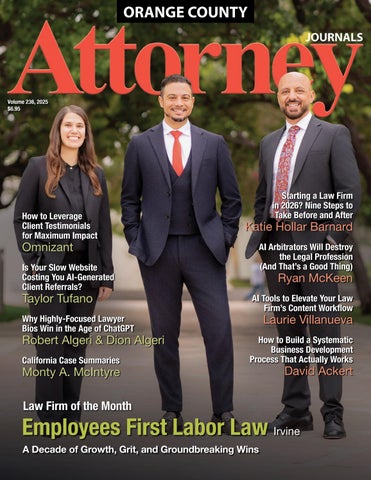
How to Leverage Client Testimonials for Maximum Impact Omnizant
Is Your Slow Website Costing You AI-Generated Client Referrals?
Taylor Tufano Why Highly-Focused Lawyer Bios Win in the Age of ChatGPT
Robert Algeri & Dion Algeri
California Case Summaries
Monty A. McIntyre
Law Firm of the Month
Starting a Law Firm in 2026? Nine Steps to Take Before and After Katie Hollar Barnard
AI Arbitrators Will Destroy the Legal Profession (And That’s a Good Thing) Ryan McKeen
AI Tools to Elevate Your Law Firm’s Content Workflow Laurie Villanueva
How to Build a Systematic Business Development Process That Actually Works David Ackert
Employees First Labor Law
A Decade of Growth, Grit, and Groundbreaking Wins
Irvine
TABLE OF CONTENTS
Imagine this scenario: A potential client types a legal question into ChatGPT, and within moments, an answer appears, sourced from the writings of expert lawyers.
In this scenario, why does the AI repeatedly quote the work of some lawyers, while others remain practically invisible?
The difference isn’t luck. It’s market positioning.
AI Rewards Specificity
In the era of AI, a narrowly focused attorney bio isn’t just clever branding; it’s the key to visibility. Bios that position a lawyer broadly, for example, as a “defense litigator” or “corporate lawyer,” get ignored. On the other hand, bios that are clearly focused on a precise niche (e.g., a securities lawyer serving venture-backed startups) are magnets for attention from the AI answer engines.
Why? Because AI rewards specificity. Attorneys who have carved out a niche naturally include language that is more precise and more likely to mirror client queries. So, when someone asks AI about “the pros and cons of a SPAC versus a traditional IPO,” the SPAC-focused lawyer has a massive advantage over a generic securities lawyer.
Topical Authority Matters
And it’s not just about keywords—topical authority matters. When an attorney consistently publishes focused, high-quality content on a specific subject, it signals to AI engines that the lawyer is a true expert. This credibility is what prompts AI to surface their name and insights in its answers.
“Bios that are clearly focused on a precise niche are magnets for attention from the AI answer engines.”
Three Steps to Achieve Narrow Positioning
Narrow positioning isn’t just about improving visibility in AI searches; it has the potential to change the economics of your practice. For example, niche-focused attorneys:
• Know precisely what clients to target, which makes marketing and business development much simpler.
• Are more memorable and authoritative, allowing them to stand out in a crowded marketplace.
AI Visibility and Attorney Bios: Why Highly-Focused Lawyer Bios Win in the Age of ChatGPT
by Robert Algeri & Dion Algeri
• Command higher fees by attracting premium clients from around the world.
With every step an attorney takes toward narrowing their focus, they reduce the number of competitors clients perceive as viable alternatives.
So, how does an attorney reshape their bio to be nichefocused? It starts with these three steps.
1. Pick a niche. Ideally, a single service for a single client type. The narrower, the better.
2. State it clearly. The first sentence of a bio should function like a positioning statement. Skip the puffery. Clients, and AI, reward you for being clear and direct.
3. Substantiate your claim of expertise. It’s not enough to simply state that you’re an authority; you need to demonstrate it. For your bio to serve as a living portfolio of reputation-building content, it should feature articles, blog posts, case studies, presentations, videos, and testimonials. The aim is to elevate it from a static resumé into a dynamic hub of authority that proves your credibility at a glance.
“When it comes to AI optimization, the fundamentals of SEO remain the foundation. When your site is technically sound, your content clear, and your authority signals strong, you are well positioned for AI.”
The Website Infrastructure Behind AI Visibility
Of course, positioning alone isn’t enough. Your bio has to live on a website that can support AI visibility. As our friend and SEO expert Joe Giovonoli says, “When it comes to AI optimization, the fundamentals of SEO remain the foundation. When your site is technically sound, your content clear, and your authority signals strong, you are already preparing for GEO, AEO, and AIO.” To achieve this:
1. Ensure that the site is “Google-ready.” This means having a website that is easily accessible by Google. For example, fast page loading is essential, and technologies like React.js
can help achieve it. Canonical URLs prevent duplicate content penalties, and semantic HTML enables AI engines to understand what matters most. Also, an XML sitemap makes content easier for search bots to discover and prioritize. And strong SEO controls over page titles, slugs, and meta descriptions directly influence what both Google and AI search results display.
2. Schema.org markup is critical. Schema markup structures data in a way that Google (or AI) can understand it. For example, Schema markup will make clear that a particular attorney authored an article. This added precision yields much greater visibility in Google and AI answer engines.
3. Engaging content formats are helpful. As always, clear, authoritative, and well-structured content is the key to SEO success. To enable this, your site should seamlessly support a mix of engaging formats, from FAQs and information graphics to videos, that reinforce and amplify their subjectmatter authority.
4. Embrace content teasing. A well-optimized website should include strategic content-teasing tools on the bios (among other places). These tools spotlight your most current and compelling pieces, such as articles, blog posts, and case studies,
that reinforce an attorney’s niche expertise, positioning them as a trusted authority in the eyes of both potential clients and AI-driven search engines.
In short, positioning plus a proper website infrastructure equals visibility. Firms that invest in both are far better positioned to stand out and get found.
The Bottom Line
In today’s AI-driven marketplace, being broadly positioned is a recipe for invisibility. However, attorneys who stake their claim on narrow ground and support their market positioning with thought leadership and success stories are more likely to be noticed and achieve success with marketing. Combine that focus with a technically sound, AI-friendly website, and you’ll do more than build a presence; you’ll become discoverable. n
Robert Algeri is a co-founder of Great Jakes, a marketing firm that develops “smarter websites, for smarter law firms.”
Dion Algeri is the Chief Marketing Strategist of Great Jakes. He is responsible for the “big think” behind client projects. His never-ending goal: build the most emotionally engaging and business-effective law firm website ever created. Learn more at www.greatjakes.com.
Monty A. McIntyre, Esq. Mediator, Arbitrator & Referee ADR Services, Inc.
To schedule, contact Haward Cho: (213) 683-1600 and (619) 233-1323 or haward@adrservices.com
Short summaries (one-paragraph), organized by legal topic, of every new published CA civil case, helping CA attorneys save time, win more, and make more money. Monthly, quarterly, annual, and annual practice area publications are available. Subscribe at www.cacasesummaries.com
Picture this: It’s Tuesday afternoon, and somewhere in your city, a potential client is sitting on their couch with a problem your law firm is perfectly positioned to solve. For the sake of this example, let’s say that their mother was recently in a car accident and needs an attorney. However, instead of opening Google, they open ChatGPT.
Within seconds, they receive a thoughtful response with a list of specific recommendations, complete with practice areas, notable case results, and even office locations. Your firm has over twenty years of experience, a track record of multi-million-dollar settlements, and an office just blocks from where this person lives. You’re the perfect fit; however, you’re not on the list. Why not?
Well, while ChatGPT was scanning the web for law firm websites across your city, your site was still loading and your competitor’s site got the recommendation instead. That potential six-figure engagement? Gone before you even knew it existed.
The True Cost of a Slow Law Firm Website
Page speed can impact the ranking of content in AI search tools like ChatGPT indirectly, as AI prioritizes high-quality, fast-loading, and technically optimized sources. While ChatGPT and other AI search tools don’t “rank” pages in the traditional sense, their algorithms favor websites that offer a better user experience, and fast-loading pages are more likely to be deemed credible and useful sources for AI-generated answers. So, what is the cost if page speed is not addressed?
Direct Revenue Loss
The most immediate and quantifiable impact of slow page speed is lost revenue, real money that should be coming into your firm but instead flows to competitors.
According to a 2024 Forbes Advisor survey, people will wait an average of 8 seconds for a website to load, but realistically, if your website takes longer than 3 seconds to
Is Your Slow Website Costing You AI-Generated Client Referrals?
by Taylor Tufano
load, that is a problem. If users aren’t getting to what they need within a few seconds, they will just move on to the next option. This is further supported by a study that found conversion rates drop by 4.42% for every additional second it takes the website to load.
Let’s put this into perspective. Consider a typical mid-size law firm with 5,000 monthly website visitors, a current page load time of 6 seconds, and an industry-average conversion rate of 3%. With an average client value of $5,000, this firm currently generates approximately 150 leads per month, representing $750,000 in monthly revenue potential.
However, if this same firm optimized its website to load in just 2 seconds—a 4-second improvement—the mathematics of conversion loss reveal a striking opportunity. Those 4 seconds of improvement, multiplied by the 4.42% conversion penalty per second, equals a 17.68% increase in conversion rates. This would boost the firm’s conversion rate from 3% to 3.53%, generating 176.5 leads per month instead of 150. The result is a monthly revenue potential of $882,500, representing a monthly opportunity of $132,500 or an annual revenue opportunity of $1,590,000.
It is important to note that the scale of this opportunity varies dramatically by firm size.
Additionally, page speed is a known ranking factor for Google, so having a slow-loading website can impact your rankings and whether potential new clients can even find you online. The same goes for AI search tools such as ChatGPT or Perplexity.
Overall, by not paying attention to the loading speed of your site, if it is failing, then you are ultimately leaving money on the table and missing out on new clients.
Brand and Credibility Damage
Beyond the measurable revenue loss, slow page speed can cause damage to your firm’s reputation and perceived credibility. Your website is often the first impression potential clients have of your firm, and when it loads slowly or not at
all, it can often give people a bad impression. For example, it can suggest poor attention to detail, which is catastrophic in a profession were missing a filing deadline or overlooking a contractual clause can destroy a client’s case.
Additionally, attorneys know that professional referrals are often the highest-quality lead source. But when someone wants to refer business to your firm, they frequently visit your website first to confirm you’re a good match or to get your contact information. If the referring party encounters a slow, frustrating website experience, they may reconsider the referral entirely.
Lastly, brand credibility extends beyond clients to potential employees. Top legal talent researches firms before applying or accepting positions. In competitive job markets where attracting talented associates can determine a firm’s growth trajectory, this hidden cost of poor website performance affects your ability to build a strong team, which in turn affects your capacity to serve clients and grow revenue.
Competitive Market Share Erosion
In the emerging AI search landscape, there’s a powerful firstmover advantage that creates compounding competitive disadvantages for slow adopters.
AI systems learn from success patterns. When a firm consistently appears in recommendations (because its site loads quickly), gets clicked by users, and presumably provides satisfactory outcomes, the AI develops a preference pattern. It begins to “trust” that source as reliable. Meanwhile, firms that consistently fail to load or timeout train the AI to skip them. Over time, this creates algorithmic entrenchment where even after you fix your speed issues, you’re fighting an uphill battle against established competitors who have months or years of positive reinforcement in AI systems.
How to Diagnose If Your Website’s Speed is Affecting the Firm
If you get to this point in the article and you are thinking to yourself, “I don’t even know if my website’s page speed is performing poorly,” you’re probably not alone. Let’s dive into how you can diagnose if your firm’s website speed is costing you potential new clients.
PageSpeed Insights
Google’s PageSpeed Insights tool is the best tool to help you diagnose your page speed issues, should any be prevalent. This tool will give you opportunities for improvements, and it’s something you can easily run and hand off to your developer to get fixed. To make things even better, it’s free!
Core Web Vitals
Core Web Vitals are a part of the PageSpeed Insights report that has grown in importance as well, which measures factors that contribute to a user’s experience. The Core Web Vitals metrics are:
• Largest Contentful Paint (LCP)– Measures loading performance
• Interaction to Next Paint (INP)– Measures responsiveness
Google has said, “We highly recommend site owners achieve good Core Web Vitals for success with Search and to ensure a great user experience generally. This, along with other page experience aspects, aligns with what our core ranking systems seek to reward.” So, by passing Core Web Vitals, you will also be improving your traditional organic search success.
Don’t Let a Slow Website Hold Your Firm Back From Generative AI Success
AI-powered search isn’t a future trend to monitor; it’s today’s reality, actively shaping which firms thrive and which will slowly see the negative impacts of not paying attention sooner. Every day that passes with a slow website is another day of invisible losses, another dozen potential clients who never knew you existed, another incremental advantage handed to your competitors.
While AI adoption is accelerating rapidly, we’re still in the early stages of this transition. In fact, most law firms haven’t yet recognized the connection between page speed and AI recommendations, haven’t tested their load times in months or even years, and are likely losing AI-generated referrals without even realizing it’s happening. That gives you a window to get ahead of this curve before it becomes exponentially harder. Don’t let a slow website be the reason your firm gets left behind. n
Taylor Tufano is a Senior Digital Strategist at 9Sail and a motivated individual with a passion for digital marketing. She is a strong writer with knowledge and background in content and social media marketing, as well as search engine optimization (SEO) and pay-per-click (PPC) advertising. Learn more at www.9sail.com.
Client testimonials build your firm’s credibility online. But there are ethical challenges with using client stories to attract new prospects. How do you use testimonials effectively and ethically?
First, know the rules. Second, follow them. Third, be strategic and get creative about using testimonials to tell your own story and get attention online.
Here’s what attorneys need to know about collecting and utilizing client testimonials for maximum impact online.
Step 1: Collect Testimonials Ethically
Ethics must be present on day one—they’re not something you can overlay afterward:
• Encourage without pressure. Invite clients to leave a review with an easy link.
• Time it right. Request it when they’re satisfied, not during ongoing work.
• Remind gently. People are busy, and it’s okay to remind, but never coerce or incentivize.
• Show appreciation. Thank them if they give you a review to reinforce goodwill.
You can encourage clients to send testimonials directly to you, and you can also encourage them to post a review directly on a platform like Google. Both are valuable, even if you have to respond to a negative review.
Remember, you need to obtain written consent to share a client’s story or quote. You must also avoid disclosing any confidential details or sensitive information.
We find that the simplest and most effective way to collect testimonials is by using a simple post-service survey. Rather than sending a personal email and forgetting to follow up, a basic survey helps you collect concise and usable testimonials with all the information fields built in (for your ease and theirs).
Step 2: Highlight Testimonials Strategically
Got ’em? Time to make use of ’em.
Here’s how you can make the most of your client testimonials to build trust and build your brand.
How to Leverage Client Testimonials for Maximum Impact
by Omnizant
• Tell a story. Structure a testimonial like a mini case study. Add your own details to explain the problem, the solution, and the outcome and then embed the client’s review as social proof.
• Make it visual. Use a client photo (with permission) or a short video clip to encourage engagement. Otherwise, use a pull-quote style to highlight the text so it stands out.
• Embrace emotion. Focus on client relief, satisfaction, or positive impact. This can be just as meaningful as the sensitive legal details that you can’t share.
• Keep it short. Limit the length to 60 words for each testimonial. People are busy and they’re scanning your content.
• SEO. Include client location or practice area keywords naturally in testimonials to help boost your search visibility.
• Place it perfectly. Don’t bury testimonials in your footer. Make sure your website design displays quotes prominently to snag attention. Put them on your homepage, on practice area pages, and on a dedicated testimonials page.
Wait! There are two final principles you need to understand: Variety means including testimonials from different practice areas or client types to appeal to diverse prospects. If all your reviews are the same, your firm will seem a little one-note. Freshness means regularly updating with new content, or at least rotating in new reviews from your collection. This demonstrates ongoing client satisfaction.
Finally, you need to weave client testimonials into multiple marketing channels. Put them where people can see them!
• Share snippets on social media
• Include them in newsletters or follow-up emails to leads
• Seek reviews on your Google Business Profile
Step 3: Maintain Compliance With Legal Advertising Rules
Your state bar has guidelines on advertising and social media— bookmark them and read them carefully. Some states have stricter rules than others, like New York.
Here are some general tips on compliance when it comes to testimonials:
• Avoid misleading claims. Do not imply guaranteed outcomes or use superlatives that can’t be backed by data.
• Be clear. Indicate when you’ve edited a testimonial for clarity or length. Better to give more information than accidentally mislead someone.
• Keep good records. Document consent so you can pull up client permission if there’s ever an inquiry.
It’s worth saying that you are responsible for compliance. Even if you work with an agency, you need to ensure that everything on your site is aligned with the legal advertising rules in your area.
Step 4: Measure and Adapt
As with all digital marketing, you need to stay involved. Test and adapt for continual improvement. You’ll find that some testimonials resonate with your prospects more than others.
• Monitor. Don’t overcomplicate it. Just track engagement and see which testimonials are driving website clicks, social shares, or consultation inquiries.
• A/B test. Experiment with formats. Try the same testimonial in text form and in video form. Try it in a short clip or a longer video. Try a single quote or a full case study. See what resonates, and see if you understand why.
• Update (but not too often). Give your current content enough time to collect accurate data. Then, refresh testimonials every six months to reflect current client satisfaction and fit your evolving practice focus.
• Extrapolate. Take what you learn and use those insights to guide future marketing campaigns and your content strategy. Are people really responding to a certain service you offer? Perhaps it’s worth a few blog posts or a behind-the-scenes video featuring your team that explains the service in more detail.
Final Tips
Ethical testimonials fuel growth. With a little care and attention to detail, you can build up a steady flow of reviews and deploy them in service of your business.
That’s because credibility is a game-changer in the legal industry. Testimonials are one of the fastest ways to build trust online. Integrated strategically into a strategic digital presence, you’ll drive leads effortlessly.
Set yourself up for success with a website design that’s built to convert. Use a tested template that spotlights testimonials and start growing your firm. n
Since 2006, Omnizant’s team of digital marketing experts, designers, developers, and writers has helped over 2,000 law firms develop powerful websites that drive business growth. Learn more at www.omnizant.com.
California Case Summaries
New California Civil Cases
by Monty A. McIntyre, Esq.
These recent case summaries were provided by Monty A. McIntyre, a mediator, arbitrator and referee at ADR Services, Inc., and come from his online publication California Case Summaries™️ (https://cacasesummaries.com), which helps California civil lawyers and law firms win more cases by always knowing the new case law in their practice areas. At ADR Services, Monty handles cases in the areas of business, employment, insurance, probate, real property and torts. To schedule a matter, contact Monty’s case managers, Rachael Boughan, rboughan@adrservices.com, (619) 233-1323, or Haward Cho, haward@adrservices.com, (213) 683-1600.
CALIFORNIA SUPREME COURT
Arbitration
Hohenshelt v. Superior Court (2025) __ Cal.5th __, 2025 WL 2302229: The California Supreme Court reversed in part the decision of the Court of Appeal. It affirmed the Court of Appeal’s decision concluding that California Code of Civil Procedure section 1281.98 is not preempted by the Federal Arbitration Act (9 U.S.C. § 1 et seq.). But the California Supreme Court reversed the Court of Appeal and disapproved numerous recent Court of Appeal decisions, concluding that section 1281.98 does not require an automatic loss of contractual arbitration rights whenever a party fails to pay arbitration fees within 30 days, finding no indication that the Legislature intended to strip companies and employers of their contractual right to arbitration where nonpayment of fees results from a good faith mistake, inadvertence, or other excusable neglect. Section 1281.98 does not displace background statutes permitting relief to a breaching party in certain circumstances. The Court of Appeal was directed to remand the matter to the trial court for consideration of whether defendant might be excused for its failure to timely pay arbitration fees, such that the stay of litigation should not be lifted and the parties should be returned to arbitration, and whether the delay resulted in compensable harm to plaintiff. (August 11, 2025.)
Employment
Iloff v. LaPaille (2025) __ Cal.5th __, 2025 WL 2414467: The California Supreme Court addressed the good faith defense of employers to the default rule that employees who prove minimum wage violations are entitled to liquidated damages under Labor Code, § 1194.2, and whether a trial court may consider a claim under the Healthy Workplaces, Healthy Families Act of 2014 (§ 245 et seq.; the “Paid Sick Leave law”) that an employee raises in the context of their employer’s appeal
to the superior court of a Labor Commissioner ruling. (§ 98.2, subd. (a).) The California Supreme Court reversed Court of Appeal on both issues, ruling that ignorance of the law is insufficient to prove a good faith defense to liquidated damages under Labor Code section 1194.2, and also concluding that employees may raise Paid Sick Leave claims in an appeal by the employer of a Labor Commissioner’s Ruling.
CALIFORNIA COURT OF APPEAL
Attorneys
County of Los Angeles v. Quinn Emanuel Urquhart & Sullivan, LLP (2025) _ Cal.App.5th _ , 2025 WL 29874701: The Court of Appeal affirmed the trial court’s order granting plaintiffs’ motion for summary judgment against the defendant law firm seeking a declaratory relief judgment finding there was no valid engagement agreement between defendant law firm and county plaintiffs, even though a engagement agreement had been signed by then-Sheriff Alex Villanueva. The central issue dispute was whether or not then-Sheriff Villanueva had the authority to retain–as opposed to select–independent counsel to represent him in a lawsuit the County of Los Angeles brought against Villanueva. Defendant law firm sought recovery of over $1.7 million in legal fees and costs. The trial court granted summary judgment for plaintiffs, finding that Sheriff Alex Villanueva lacked authority to enter into a fee agreement with defendant. It denied defendant’s post-judgment motion to file a crosscomplaint as untimely and made in bad faith, and it dismissed defendant’s separate suit for payment as barred by the compulsory cross-complaint statute and the Government Claims Act. The Court of Appeal agreed, concluding that the sheriff had no authority to retain defendant firm, that the motion for leave to file a cross-complaint was properly denied, and that defendant firm’s later lawsuit was correctly dismissed for failure to comply with procedural requirements. (C.A. 2nd, October 23, 2025.)
Elder Abuse
Frankland v. Etehad (2025) __ Cal.App.5th __, 2025 WL 2267750: The Court of Appeal affirmed the trial courts’ order sustaining defendant doctor’s demurrer to plaintiff’s causes of action alleging neglect and financial abuse under the Elder Abuse and Dependent Adult Civil Protection Act (the Act; Welf. & Inst. Code, § 15600 et seq.). The Court of Appeal affirmed the trial court, concluding that an elder cannot state a claim under the Act for “neglect” or “financial abuse” against a physician based solely on that physician’s negligent medical services while the elder resided at a skilled nursing facility. The Act limits “neglect” to “[t]he negligent failure of any person having the care or custody of any elder . . .” (§ 15610.57, subd. (a)(1), italics added), and a physician’s conduct in providing negligent medical services to an elder residing at a skilled nursing facility does not—without more—constitute “neglect” because that physician lacks the requisite “robust caretaking or custodial relationship” with the elder. Moreover, the alleged financial abuse flows inexorably from the alleged professional negligence, such abuse is indistinguishable from that negligence and also falls outside the Act. (C.A. 2nd, August 8, 2025.)
Employment
Galarsa v. Dolgen California (2025) _ Cal.App.5th _ , 2025 WL 2846580: The Court of Appeal affirmed the trial court’s denial of defendant’s motion to compel arbitration and its petition for writ of mandate seeking to overturn the trial court ruling. The trial court held that an employee could pursue a “headless”
PAGA action—one seeking penalties only for Labor Code violations suffered by other employees—and that the question of whether the plaintiff was an “aggrieved employee” need not be arbitrated. The Court of Appeal agreed, holding that under the version of PAGA in effect before the 2024 amendments, employees could bring such representative actions and that the arbitration agreement did not extend to determining PAGA standing, since that dispute belongs to the State’s Labor and Workforce Development Agency, not the individual plaintiff. (C.A. 5th, filed September 9, 2025, published October 8, 2025.)
Land Use
New Commune DTLA LLC et al. v. City Redondo Beach et al. (2025) _ Cal.App.5th _ , 2025 WL 2886322: The Court of Appeal reversed the trial court’s denial of a petition for writ of mandate challenging defendant’s housing element adopted under the state Housing Element Law (Housing Element Law; Government Code sections 65580 to 65589.11). The trial court ruled that defendant’s housing element complied with the Housing Element Law despite plaintiffs’ claims that it improperly relied on a zoning “overlay” permitting residential use on commercial and industrial land. The Court of Appeal disagreed, concluding that defendant’s overlay violated Government Code section 65583.2(h)(2) because it failed to impose mandatory minimum residential densities and allowed development without any housing, and that defendant failed to establish that one of the sites identified in the housing element, the Inglewood Avenue site currently occupied by a Vons supermarket, was properly identified as a developable site. (C.A. 2nd, October 10, 2025.) n
A Decade of Growth, Grit, and Groundbreaking Wins
Inside Employees First Labor Law’s Rise as a Premier Force in Employment and Workers’ Compensation Law
by Dan Baldwin
We’re constantly pushing to get new laws created. Employees First Labor Law is a bold, fast-growing plaintiffs’ firm with a mission to protect California’s workers. We are a powerhouse built on leadership, culture, and purpose. We’re not just winning cases; we’re shaping the future of employee rights and workplace justice in California,” says Jonathan LaCour, CEO and Managing Partner of Employees First Labor Law.
The attorneys and staff of Employees First Labor Law are not intimidated by entering highly-challenging areas in which the law is not clear. In fact, they have developed a strong track record of success with such cases. They have published opinions and earned multiple appellate victories in areas in which the law must be established or clarified through winning trials and appellate victories. For example, they recently faced a motion to compel arbitration submitted at the time of trial, where the court ruled that the arbitration agreement, even if found valid, would have been waived given that they had invoked the litigation machinery and had gone through the entirety of the case. Their goal was to create additional law that demonstrates that once a case begins and the firms begin discovery in earnest, an opposing side cannot then file a motion to compel arbitration at a later date after they had used the discovery process to their benefit.
“We envision EFLL as more than a law firm. We’re building a platform for advocacy—one that shapes public policy, influences corporate accountability, and raises the standard for how workers are treated across the country,” LaCour says.
Lisa Noveck − Partner, Jonathan LaCour − CEO & Managing Partner, and Rony Barsoum − Senior Partner
The firm, founded in October 2016, employs nine attorneys and 30 support staff.
“The EFLL team is incredible. They did amazing on my case and defended myself and many others that were in terrible situations. They were professional, caring, showed concern and answered all my questions, walking me through the case with intention. My life is honestly changed as a result of working with them and having the BEST attorneys. I am forever grateful.” —Nicole B.
Expanding By Building Leaders
LaCour says, “Leadership at EFLL has evolved from being positional to being purpose-driven. Our philosophy is that leadership isn’t about titles—it’s about influence, accountability, and alignment. We’ve built a culture where everyone, from senior partners to new associates, understands that they have the power to lead through their actions and ownership.”
That philosophy is exemplified by the firm’s expansion of its leadership structure with Partner Lisa Noveck heading the Employment Law Division and Senior Partner Rony Barsoum leading Workers’ Compensation.
Noveck has been with the firm from the beginning, playing a pivotal part of their growth as part of the senior management team. She is the firm’s first appellate attorney and handles all appellate matters. “She’s a legal rock star,” LaCour says.
Workers’ compensation is closely related to employment
law, so the incorporation of Barsoum’s successful workers’ compensation practice was a savvy move for EFLL. Attorneys and law firms are often faced with a lot of crossovers. People who are injured or discriminated against at work often get fired. The partnership allows the firm to serve customers for each issue as opposed to just one area. If someone is injured at work, EFLL can handle that issue in-house while coordinating with their employment law attorneys at the same time, something most firms are not equipped to handle.
LaCour says, “It’s not very common to have two such teams operating at a very high level at a single firm, but what happened is we had two very successful firms that essentially ended up merging to the benefit of all our clients.” The new program has achieved a series of major victories reflecting the firm’s depth, collaboration, and unwavering commitment to justice. Their employment law and workers’ compensation teams have secured millions in settlements and verdicts on behalf of California workers—from complex wage and hour cases to catastrophic workplace injury claims.
A recent Workers’ Compensation division victory, led by Barsoum, secured a $1.2 million settlement for a man who suffered a stroke on the job. “This was a hard-fought case. The insurance carriers denied liability based on conflicting medical evidence, and it took multiple depositions— including persuading several doctors to change their opinions on causation—before they finally accepted responsibility,” Barsoum says. The result not only delivered justice for the client but also underscored EFLL’s tenacity in litigating complex medical causation cases.
The Employment Law division has achieved equally remarkable results, including multiple seven-figure settlements in whistleblower retaliation and FEHA discrimination matters.
These victories reflect the firm’s ability to handle highstakes litigation while maintaining empathy and precision for every client. LaCour says, “Our success is defined by resilience and preparation. We’re proud to be a firm that fights for those who’ve been ignored, underestimated, or denied—and we win because we never stop believing in their cases.”
Noveck says, “We’re intentional about building balance. A healthy, engaged team produces better work—and that translates directly into better results for our clients.”
Back to School
As an aggressive Managing Partner, LaCour realized that in addition to becoming a lead attorney, he was also now the CEO of a large and rapidly growing business. He saw a real need to expand his leadership capabilities by expanding his knowledge and experience on the business side of managing a law firm. He went through the executive studies program at Stanford Graduate School of Business. The program is a year-long advanced executive education designed to help shape executives into leaders. It also helps identify effective ways to
build a team, make that team better, and to grow and maintain a successful business. Much of the focus is on case management to ensure that clients are led successfully from the beginning through the completion of their cases.
LaCour says one of the major benefits of the program is its emphasis on management of people—how to find them, incentivize, encourage, and give them the space needed to grow professionally and as a person. “Part of being an effective executive leader for the company is identifying ways to make your team better. You can’t just flip a switch and hire a bunch of different people. You have to work with the team to create a better squad that not only performs well, but that grows and increases in its abilities to serve the client.”
Becoming More Accountable
Through their “Shifting from Reactive to Proactive Case Management” project, the firm introduced DARCI accountability frameworks, 100-Day Change Plans, and Energy Zone assessments to increase clarity, efficiency, and collaboration. These tools have improved case outcomes, reduced bottlenecks, and strengthened communication across departments.
DARCI was implemented to identify and clarify roles, decision-making, and ownership within teams and it has proven particularly successful. DARCI is an acronym. D refers to the decision maker in the organization. A is accountability, the person who is ultimately accountable for success or failure. R, for responsible, refers to the people who actually do the work and get things done. C is a reference to the people conducting research, crafting memorandums, attending hearings, and consultants. Those are people who input strategy or expertise into it. “I” represents the informed. Those are the stakeholders. DARCI is a way of ensuring that the team is effective, allowing for high-level execution across the system.
Great People Equal a Great Firm
LaCour’s management philosophy is to hire the best quality people and give them enough leeway, with guidance, to execute at a high level. And with enough incentive to retain them for long-term success. “We say we have built a culture where excellence is expected, but empathy is required, and that’s not some marketing slogan. We don’t just fight for workers’ rights in the courtroom; we practice those same values within our own walls. Everyone here has a genuine sense of ownership. Our people don’t just complete tasks, they lead them.”
The EFLL focus on quality people continues to pay off for the firm and its clients. The firm is currently handling several high-impact cases that showcase its depth across employment and workers’ compensation law. One stands out for its novelty and potential influence on the broader legal landscape.
Barsoum is representing a registered nurse who became 100 percent disabled after contracting COVID-19 on the job. “It’s
one of the most interesting and challenging cases I’ve handled. COVID is still a relatively new type of injury in the workers’ compensation arena, and the medical and legal complexities surrounding causation and disability are still developing. It will be fascinating to see how this case helps shape the law going forward,” he says. The case underscores EFLL’s commitment to taking on cutting-edge and precedent-setting matters that push the boundaries of existing workers’ rights protections. Under Barsoum’s leadership, the firm continues to build a reputation for successfully litigating complex, medically intensive cases that others might shy away from.
“There’s an opportunity for growth here that just doesn’t exist in other firms,” LaCour says. “Everybody wants to be successful, make a good amount of money, and have that level of growth. We represent that for many of them, for all of our employees, when a lot of other firms don’t. Our goal is to give everybody a life-changing result. That’s really our goal. Going back to management style, we try to get the best people, give them the tools that they need to be successful, and incentivize them to do really well.”
The firm celebrates wins together, invests in professional development, and encourages open communication across departments. The result is a workplace that thrives on purpose, empowerment, and pride, and where every team member understands that their contribution directly impacts clients’ lives and the firm’s broader mission of justice.
Rony Barsoum, Senior Partner
The First Decade is Just the Beginning
LaCour says, “Adaptability has been at the core of EFLL’s continued success. The legal landscape is changing faster than ever, and we’ve made it a priority to evolve just as quickly—not reactively, but strategically.”
The firm has become one of California’s premier employeerights law firms, but it has plans for significant growth in services and physical locations across California and Washington state.
One of the most common complaints clients have about law firms is a lack of two-way communication, a challenge EFLL has and continues to address through greater transparency, speed, and personal connection. They have invested in technology-driven systems providing clients with realtime access to their cases, automated communication, and streamlined collaboration between departments.
On the litigation side, the firm is deepening its focus on high-value employment cases, wage-hour class actions, and catastrophic workplace injuries, while exploring emerging practice areas tied to AI monitoring, workplace privacy, and evolving labor regulations. Internally, EFLL is investing in leadership pipelines, mentorship programs, and professional development initiatives to cultivate the next generation of top trial lawyers and negotiators. Noveck and Barsoum are spearheading initiatives to build attorney training academies, ensuring EFLL’s culture of excellence and empathy scales as
the firm grows. The firm has also adapted to shifts within the profession itself, including remote collaboration, the integration of AI tools, and greater emphasis on attorney well-being.
“Clients today expect clarity and immediacy. They want to feel informed and empowered at every stage. We’ve embraced technology that strengthens those relationships while allowing our attorneys to focus on strategy and advocacy—where we add the most value,” says Noveck.
LaCour says, “Our growth has been intentional. We’ve invested heavily in people, systems, and innovation to create a culture of excellence—one where every client feels heard, every case is handled with precision, and every team member has the opportunity to thrive. The key message we want to convey is this: success at EFLL is not measured by verdicts alone, but by the lives we change and the standards we raise. What started as a passion to fight for fairness has become a movement for accountability, empowerment, and sustained excellence in California labor law.” n
Contact Employees First Labor Law
1 S Fair Oaks Avenue, Suite 200 Pasadena, CA 91105
310-853-3461
www.EmployeesFirstLaborLaw.com
Lisa Noveck − Partner, Jonathan LaCour − CEO & Managing Partner, and Rony Barsoum − Senior Partner
Last week, the American Arbitration Association announced something that should have every lawyer cheering: an AI-powered arbitrator for construction disputes that promises to cut costs by 35% and resolution time by 20%. Instead, the legal profession clutched its pearls. Critics warned of depersonalized justice, algorithmic bias, and the death of advocacy as we know it.
They’re missing the point entirely.
The real crisis isn’t AI making decisions. It’s that our current system has priced most Americans out of justice altogether.
For far too long, the powers that be have argued that the solution to the access to justice crisis is more pro bono work. It’s not. The solution is reforming the way neutrals process cases.
Hearings on the merits are good for justice. Disputes can be resolved on right and wrong and not just might making right.
The System Is Already Broken
Right now, someone with a legitimate $50,000 construction dispute faces an impossible calculation. Traditional arbitration will cost them $15,000 to $30,000 in fees before their lawyer even opens a file. A court case? Add two to three years to the timeline and double the cost. For many claimants, the math is simple: the juice isn’t worth the squeeze. They walk away from valid claims because the system designed to resolve disputes has become too expensive and too slow to access.
This isn’t theoretical. Civil cases wait years for their day in court. Plaintiffs with serious injuries can’t get to a jury. Defendants who could prove their innocence in months instead spend years under the cloud of unresolved accusations. Families navigate divorces in a system so clogged that temporary orders become semi-permanent arrangements.
The promise of justice delayed is justice denied has become our legal system’s operating principle. When resolution takes years and costs six figures, only corporations and the wealthy can afford to see cases through to completion. Everyone else settles for whatever they can get or abandons their claims entirely.
AI Arbitrators Will Destroy the Legal Profession (And
That’s a Good Thing)
by Ryan McKeen
What the AAA Actually Built
The AAA’s AI arbitrator, set to launch in November for construction disputes, promises something the legal profession should celebrate: resolution in months, not years, at a fraction of traditional costs. The system claims 35% cost savings and 20% time savings for document-based construction disputes. Those aren’t incremental improvements. They’re transformative.
More importantly, the AAA designed this system the right way. It keeps humans in the loop. It operates transparently. It builds on 99 years of arbitration expertise rather than trying to replace human judgment entirely. The AI analyzes documents, identifies issues, and suggests resolutions. Human arbitrators validate the outputs and make final decisions.
This isn’t science fiction. It’s practical technology applied to a real problem: too many legitimate disputes never get resolved because the traditional process costs too much and takes too long.
The Hypocrisy of Legal AI Critics
Here’s what makes the criticism especially rich: lawyers already use AI constantly. We use AI-powered research tools to find cases. We use predictive analytics to value settlements. We use document review platforms that deploy machine learning to identify relevant materials. Large firms have used these technologies for years to deliver faster, cheaper services to corporate clients.
But suggest using similar technology to make dispute resolution accessible to regular people, and suddenly we’re destroying the sanctity of the legal profession. The objection isn’t to AI in law. It’s to AI making legal services affordable for those who currently can’t access them.
The legal profession’s resistance to accessible AI isn’t about protecting justice. It’s about protecting billable hours.
Speed Matters More Than Lawyers Admit
The legal profession has convinced itself that slower is more careful, that every case needs years of discovery and motion practice to reach just outcomes. This is self-serving nonsense.
Many disputes don’t need exhaustive litigation. They need resolution. A homeowner fighting with a contractor over $30,000 in defective work doesn’t need three years of document requests and depositions. They need someone neutral to review the contract, inspect the work, and make a decision. The AI arbitrator can facilitate that process in months.
An injured plaintiff watching their medical bills pile up while waiting for a court date three years away doesn’t benefit from our deliberate pace. They need their case heard while the evidence is fresh and before financial desperation forces an unfavorable settlement.
Families in divorce proceedings watching their children grow up amid unresolved custody disputes don’t need more process. They need finality so everyone can move forward.
The legal system’s addiction to process serves lawyers’ economic interests more than clients’ actual needs. We’ve built a professional moat around dispute resolution and convinced ourselves it’s a temple of justice.
The Real Question About Bias
Critics worry about algorithmic bias in AI systems, and those concerns deserve serious attention. But let’s be honest about the bias baked into our current system.
Our traditional process is biased toward those who can afford to wait and pay. It’s biased toward corporate defendants who can outspend individual plaintiffs. It’s biased toward parties with resources to conduct extensive discovery, hire expensive experts, and file endless motions.
The AAA’s approach includes human oversight specifically to catch AI errors and ensure fair outcomes. That’s more transparency and accountability than exists in many human arbitrations, where arbitrators provide minimal reasoning for their decisions and appeals are nearly impossible.
Perfect is the enemy of good. If we wait for flawless AI systems before deploying them, we perpetuate a human system that’s already deeply flawed and fundamentally inaccessible to most people who need it.
What This Means for Access to Justice
The AAA’s AI arbitrator points toward a future where dispute resolution could actually be accessible. Imagine a system where a small business cheated by a vendor could get binding resolution in six months for $5,000. Where a homeowner could enforce warranty rights without mortgaging their house to pay legal fees. Where injured parties could get compensated while they’re still dealing with medical treatment rather than years later.
This isn’t about replacing lawyers or eliminating advocacy. It’s about creating a tier of dispute resolution that currently doesn’t exist. A tier between “figure it out yourself” and “spend $50,000 on lawyers.” A tier that could handle thousands of legitimate disputes that our current system simply abandons.
The technology exists right now. The AAA is deploying it. Courts should be racing to follow, not throwing up roadblocks in the name of protecting professional standards that mostly protect professional incomes.
The Path Forward
The legal profession needs to stop treating efficiency as the enemy of justice. We need to acknowledge that our current system fails most people most of the time. We need to embrace technology that can make legal services accessible rather than defending a status quo that serves lawyers better than clients.
The AAA isn’t proposing AI judges for murder trials or complex commercial litigation. They’re using technology to resolve document-based construction disputes faster and cheaper than traditional methods. This is exactly the kind of measured, supervised deployment that should guide legal AI development across the entire justice system.
If it works as promised, every area of law should be asking what comes next. Small claims. Small personal injury cases. Simple contract cases. Consumer complaints. Family law matters. Employment disputes. There’s a massive universe of legal disputes that could be resolved faster, cheaper, and better with the right technology and appropriate human oversight.
The alternative is continuing to tell millions of Americans with legitimate legal claims that justice is available only if they can afford to wait years and spend tens of thousands of dollars. That’s not a system worth defending. That’s a system begging for disruption.
The wheels of justice grind slowly, we tell ourselves, but they grind exceedingly fine. The truth is, they grind so slowly that most people never reach them at all. The AAA’s AI arbitrator is a step in the right direction.
Every lawyer who cares about actual access to justice rather than theoretical access should be asking: what dispute resolution problem can we solve next? The legal profession should be leading this transformation, not standing in its way. n
Ryan McKeen is a co-founder of Best Era, LLC. Ryan has an extensive background as a lawyer and law firm owner drives his commitment to helping the legal community thrive. Ryan is dedicated to enriching the legal field by sharing insights from his experience. He co-authored the best-selling books “Tiger Tactics: Powerful Strategies for Winning Law Firms” and “CEO Edition,” and regularly speaks at national legal conferences on topics including innovative marketing, artificial intelligence, law’s future, and effective management. Learn more at www.bestera.io.
A systematic approach to BD doesn’t kill creativity. It enables it. Most firms treat business development like an instinct. You either have it or you don’t. But relying on natural rainmakers is risky. What happens when they retire, leave, or burn out? It also creates ego-driven cultures where the firm’s best interests take a back seat to the rainmakers.
For most people, business development isn’t magic. It’s a process. And when you build it systematically, it can scale beyond personality and luck.
1. Start with a Method
Charisma may win the first meeting, but structure builds the pipeline.
Every firm needs a defined process for relationship development that clarifies expectations, focus, and follow-through.
If you don’t already have one in place, try The Short List Method. (It’s simple, repeatable, and turns BD from guesswork into discipline):
1. Identify your SMART goal. What are you trying to accomplish this quarter—more referrals, new logos, or upmarket traction? Make sure your goal is specific, measurable, actionable, realistic, and time-bound.
2. Create your Short List. Choose 9–35 key relationships that are critical to achieving your SMART goal. They should include key Clients, Prospects, and Connectors (both internal and external).
3. Nurture your Short List through helpful, personalized outreach: introductions, insights, invitations, and relevant check-ins. “Spray and pray” email sequences don’t build trust.
4. Play the long game. Our research shows it takes an average of fourteen interactions from first contact to first contract, but most people stop after just a few.
5. Track your activity. Use a CRM or pipeline management system to keep your outreach consistent and visible. When your team follows this framework, BD stops being random. It becomes intentional, measurable, and manageable.
How to Build a Systematic Business Development Process That Actually Works
by David Ackert
2. Build Momentum into Firm Culture
The best BD systems don’t rely on motivation. They rely on momentum.
Too many professionals say they’ll “get to BD when things slow down.” But they never do.
Firms that win make BD part of firm culture:
• Incentivize business development properly. Your compensation structure communicates priorities. If the reward for BD is minimal, expect minimal effort.
• Create accountability that inspires. Regular coaching and mentoring are key. To make it scalable, introduce peer coaching or BD pods that make growth a shared responsibility. Professionals stay engaged when they see others doing the same work.
• Schedule regular outreach blocks. Even a 30-minute block each week can move the needle. Consistency matters more than intensity.
When BD becomes part of how your team evaluates success, it shifts from a “nice to have” to a cultural expectation.
3. Measure What Matters
If you can’t measure it, you can’t improve it.
Most firms still rely on lagging metrics like new matters, new revenue, and hours billed. Those are important, but they only tell you what already happened. A systematic BD process also tracks leading indicators:
• Number of proactive outreach actions
• Relationship engagement consistency
• New introductions or opportunities generated These metrics reveal what’s working early, so you can course-correct before the quarter slips away.
4. Build
Feedback Loops that Reinforce Progress
A system without feedback is just a checklist. People need to see that their efforts are paying off. You can strengthen feedback loops by:
• Inviting your team to shadow you on pitch calls and meetings. Give them a defined role, then debrief afterward so they can learn from what worked and what didn’t.
• Acknowledging and encouraging effort, even small wins. Many of your rising stars are still developing their BD skills, and encouragement from leadership goes a long way.
• Sharing wins firmwide, even if it’s just a reconnection that led to a referral or proposal.
• Celebrating effort metrics (number of meaningful touchpoints) alongside revenue metrics. Leading indicators like interactions are as critical as lagging ones like new engagements.
• Using your CRM or relationship tracker to spotlight what’s working and where the pipeline is leaking.
Visible progress sustains engagement. When professionals see cause and effect, they double down.
5. Coach the System, Not Just the People
Firm leaders should reinforce The Short List Method at every level—from onboarding to partner development.
That means:
• Embedding BD goals into performance plans
• Training new professionals to build their own Short List
• Rewarding consistency and collaboration, not just big wins
• Recognizing when internal resources aren’t producing the results you want, and outsourcing to professional BD coaches who can accelerate progress
When the system is institutionalized, BD becomes part of how the firm operates, not an afterthought.
Final Thoughts
A systematic approach to BD doesn’t kill creativity. It enables it. When professionals have structure, they’re freed from the guesswork and can focus on what they do best: building trust with clients, current and future.
With The Short List Method as your foundation, BD stops depending on luck, personality, or “natural rainmakers.” It becomes a reliable, firmwide growth engine. n
David Ackert is the Co-Founder and CEO of PipelinePlus where he helps professional services firms accelerate revenue through business development strategy, training, tech-enabled coaching, and executive roundtables. He is also the author of the bestselling book, “The Short List: How to Drive Business Development by Focusing on the People Who Matter Most.” Learn more at www.pipelineplus.com.
20+ Years Helping Businesses Reach More Clients
Establish Your Professional Authority!
If you feel like you’re always racing to keep pace with your law firm’s ever-expanding content calendar, it’s not your imagination. Consistently producing high-quality blogs, engaging newsletters, and compelling social media posts takes significant bandwidth, something few legal marketers can spare.
No wonder firms are increasingly turning to Artificial Intelligence to lighten the load. When leveraged in concert with human creativity, the right AI-powered tools can transform even the worst content bottleneck into a far more efficient workflow.
AI Tools to Streamline Content Creation
Few marketing activities require more time and focus than content creation. It’s an ongoing cycle of research, writing, editing, and approvals that can easily stretch from hours into days. But these generative AI tools are quickly changing that dynamic, streamlining processes, taking on routine tasks, and leaving marketers free to focus on what matters most:
• Jasper From brainstorming blog topics and producing initial drafts to crafting social media captions and repurposing content for a monthly newsletter, this endto-end marketing platform improves efficiency across the entire content life cycle. Once given clear direction on brand guidelines and context-rich prompts, Jasper can quickly generate engaging content aligned with your firm’s voice, tone, and strategic goals.
• ChatGPT A powerful AI platform with wide-ranging content generation capabilities. ChatGPT can help your firm produce high-quality first drafts for legal articles, blog posts, and email communications.
• CoCounsel by Thomson Reuters CoCounsel uses trusted databases like Westlaw to create accurate, authoritative legal content. Perfect for client alerts, thought leadership, and regulatory updates, it streamlines content creation while minimizing factual errors.
Elevate Your Law Firm’s Content Marketing Workflows: AI Tools Worth Exploring
by Laurie Villanueva
• Clio Duo This platform leverages generative AI to distill complex legal documents, case files, and judicial decisions into clear, client-friendly summaries for newsletters, blog posts, and case studies.
• MyCase IQ MyCase IQ analyzes large volumes of legal documents, converting dense text into plain-language insights that you can use to highlight results, outcomes, or evolving trends within your firm’s practice areas.
• Grammarly The premium version goes beyond a simple grammar check, offering real-time suggestions on tone, clarity, and style. Integrating it into your workflow ensures every communication is polished, professional, and error-free.
AI-Powered SEO and Market Research
Creating great content is only half the battle; potential clients still need to find it online. These AI-powered SEO and research tools help ensure you get the right content in front of the right audience at the right time:
• Surfer SEO Surfer SEO uses AI to analyze topranking content for your keywords and provide datadriven recommendations. By assisting with structure optimization, keyword density, readability, and semantic relevance, this platform helps improve Google rankings without sacrificing tone or authority.
• Clearscope Clearscope uses advanced natural language processing to refine your keyword targeting and improve topical depth. It scores your content based on readability, keyword variety, and competitive benchmarks, then offers practical suggestions to help it stand out in search.
• Darrow Darrow leverages the predictive power of AI to analyze massive datasets for legal, regulatory, and litigation trends. By identifying emerging topics before they become mainstream, it allows your firm to publish timely, relevant content ahead of its competitors.
AI-Enhanced
Analytics and Performance Tracking
Even the most well-written content won’t move the needle if you can’t measure its impact. These AI analytics tools help you evaluate performance, identify opportunities, and refine your strategy for stronger results.
• Semrush By integrating AI into its position tracking, Semrush allows you to track how your firm appears in AIgenerated answer formats and across different AI-powered interfaces, including ChatGPT and Gemini.
• Ahrefs Known for its powerful SEO and backlink analysis, Ahrefs uses AI-powered tools to analyze content for topic coverage, generate SEO-optimized content ideas and outlines, automate keyword research, detect AI-generated content, and monitor brand presence in AI overviews
Client Engagement and Lead Generation Tools
AI doesn’t just assist with content creation. The following tools transform how your firm communicates with clients and prospects, ensuring every communication and interaction feels relevant and timely.
• HubSpot A full-scale CRM and marketing automation platform, HubSpot enables law firms to create highly personalized email campaigns based on client behavior, practice area, or life-cycle stage. You can automate followups, segment audiences, and track engagement, all from a single dashboard, helping your team nurture relationships and convert leads more efficiently.
• ActiveCampaign This platform utilizes AI agents to generate marketing content, automate campaigns, and provide insights for personalized strategies. Legal marketers can leverage these features to analyze audience behavior, predict trends, and automate tailored message delivery across different channels.
• Lately AI Lately relies on AI to repurpose long-form content into social posts optimized for various platforms. It identifies the most engaging excerpts from articles, videos, or podcasts, then turns them into shareable snippets—helping your firm maintain a consistent presence without overloading your marketing team.
• Buffer Buffer simplifies the management of multiple social media accounts, allowing your firm to plan, schedule, and publish posts in advance. Its AI analytics track engagement and performance, so you can identify which content resonates most with your audience and when it’s best to post.
Using AI Responsibly in Legal Marketing
While there’s no doubt AI can dramatically improve your team’s productivity, it’s no substitute for human judgment. Every piece of content generated with AI should be reviewed and approved by an experienced attorney to ensure it meets the highest ethical, confidentiality, and professional standards.
• Start small. Begin with a pilot project in one practice area or campaign to understand how AI performs within your firm’s workflow. Use this phase to identify strengths, address limitations, and refine internal processes before scaling.
• Establish clear guidelines. Create firm-wide policies that define where and how AI can be used. Clarify which types of content are appropriate for AI assistance (e.g., social media captions or blog drafts) and which require a fully human approach, such as legal analyses or opinion pieces.
• Maintain rigorous quality control. Implement multistep review and approval workflows to ensure every AIassisted piece meets your firm’s standards for accuracy, tone, and compliance. Incorporate legal review into your content pipeline early, not just at the end.
• Train your team. Education is critical. Make sure everyone, from marketing staff to attorneys, understands both the potential and limitations of AI. Provide regular training on prompt development, ethical guidelines, and privacy considerations.
Takeaway
When used strategically, Artificial Intelligence doesn’t replace your marketing team; it strengthens it. Pairing automation with human expertise will allow you to achieve the best possible results: more engaging content, greater efficiency, and the assurance that every piece you publish accurately reflects your firm’s brand voice and its high standards of professional integrity. n
Laurie Villanueva is the Director of Content at Good2bSocial, where she writes and refines copy for social media, websites, digital ads, email newsletters, and more for law-firm clients. She holds a degree from Penn State University and brings over 14 years of copywriting experience, including serving legal marketing clients before joining Good2bSocial. Learn more at www.good2bsocial.com.
If you’re thinking of hanging your own shingle in 2026, know there’s plenty of upside: A Clio survey shows that legal entrepreneurs are happier with their client relationships, their mental and emotional wellness, and their overall professional lives.
The Federal Bar Association, meanwhile, described the solo attorney as the “surprising outlier” to a “profession long plagued by burnout, stress, and mounting dissatisfaction,” citing data from ALPS Insurance:
• 74 percent of solo practitioners are satisfied (or very satisfied) with their current professional lives; only 9 percent are dissatisfied to any degree.
• 66 percent appreciate the flexibility of the gig, which contributes to “personal fulfillment and enjoyment.”
To be sure, this elevated state of entrepreneurship isn’t a given; it takes considerable work and, often, more than a bit of good luck. But aspiring law firm owners can set up for success with a few foundational steps early:
Before You Launch
Start with a simple business plan. This doesn’t have to be overly complicated; in fact, the simpler the better. But by taking the time to write down a simple framework for your business, you will be able to focus your time, energy and resources in your critical first year.
• What is our basic positioning? (We do X for Y)
• Who is our ideal client?
• Why are we an ideal solution for them?
• Why are we a better choice than our peers?
• Where do we want to be in three to five years?
Don’t forget to make some eliminations here, too. As the saying goes, “The essence of strategy is choosing what not to do.” What cases and clients will you purposefully not accept? Where are you truly not a great option? (Think about building referral relationships here.)
Invest in a strong first impression. Your logo and website should give confidence to both you and your clients. This is becoming increasingly important with your younger clients, who are more likely to do their own research than rely on referrals. Indeed, Gen Z and Millennial clients care more about a lawyer’s
Starting a Law Firm in 2026? Nine Steps to Take Before and After
by Katie Hollar Barnard
website (49 percent and 48 percent, respectively) than Gen X and Boomers (34 percent and 21 percent, respectively).
I participated in a panel discussion with Missouri Lawyers Weekly, “From Attorney to Entrepreneur,” and one new legal entrepreneur said she decided to build a solid visual identity early because she wanted her clients to feel safe and secure despite choosing a brand new law firm. A clean, modern, professional— and mobile-friendly!—website signals that you are serious.
Beware the pitfalls that abound in the marketing arena:
• Avoid DIY design tools that may leave you not owning your firm’s mark.
• Similarly, make sure you own, not rent, your website and URL.
• Make sure your website vendor uses a common, accessible CMS like WordPress, so you are not hostage to a proprietary platform. Determine what (and when) to delegate. You are an excellent lawyer, but owning a business carries a new set of demands, from invoicing to social media to fixing the dang printer. These administrative tasks pile up: According to Thomson Reuters, attorneys in small firms spend about 60 percent of their time practicing law, while solos spend just 55 percent of their time practicing law.
The administrative burden of running a firm not only takes away from your billable time, it takes brain space and emotional energy. (And “winging it” can bring costly mistakes when it comes to your financial records and taxes.) Think about the business side of the firm, and start a list of the allies you may need. If your first call is to a virtual CFO or law firm financial planner, they can help you project when cash flow will allow you to hire additional experts.
After You Launch
Make sure people know how to find your firm. Your new law firm has no digital footprint. Set up your startup firm on Google Business and Bing Places for Business, or look at a service like Yext that can manage your business listings on a variety of platforms.
Meanwhile, make sure you capture people who may search for your name, not the firm’s; these may be referrals or old connections you missed in the outreach campaign. We want to make sure they find you at your new firm (and not call the old place). Updating your LinkedIn profile is a must; I recommend putting a press release about the firm launch on a search-enginefriendly distribution service like PRWeb.
Make Direct Outreach
Make a list of everyone you know. Mine your current email contacts, and download your LinkedIn connections. Then sort them into groups:
• Hot Contacts These can be people who match your ideal client profile right now (remember doing that above?) or people who are in direct contact with your ideal client profile. In short, these are the humans you know in the best position to give you business. (Make sure to mind solicitation guidelines if you are in a consumer-facing practice.)
• Warm Contacts: These are people who may enter your ideal client profile at some point, or people who are one or two degrees removed. For example, if you are typically hired by CEOs, this list could be vice presidents or department heads.
• Cold Contacts: These are the people you can’t imagine giving you business. Reach out to them anyway. You never know what they (or their network) are sitting on, and your new business will not suffer from more people knowing what you do.
After you sort them, reach out. My first day “open for business,” I emailed the hot contacts; the second day, the warm contacts; the third day, the cold contacts. Make these individual and personal.
In your words, the email should convey:
“Here’s what I’m doing now.”
• Set the table, and make it straightforward.
I wanted to reach out to tell you I’ve started my own firm, Clark Kent & Associates.
“Keep me in mind for … ”
• This is the most important part: It’s where you tell your network the kind of work you want to do and for whom you want to do it.
Please keep me in mind for trademark prosecution or litigation involving consumer brands.
“Here’s why you can trust me.”
• Reinforce your credentials. Not all of your contacts are intimately familiar with your expertise, and even those that are could use a reminder.
Over the past decade, I’ve managed trademark portfolios for companies in retail, hospitality, and the beauty industry. I’ve been recognized by World Trademark Review and Best Lawyers in America.
“Here’s why I’m doing this.”
• Share the passion that led you to start your own firm, and why working with you is better than the alternatives.
I believe trademark clients are better served by a flat-fee model, and I’m excited to launch a firm with predictable pricing and no budget surprises.
“Here’s how to learn more … ”
• Invite them to learn more, and thank them for their attention. This is where you can also insert some personalization (e.g., it was great to see you last month, hope the kids are well, how about those Chiefs).
You can learn more about my new firm at [link]. Thank you for your consideration, and best wishes for the year ahead.
Focus your social media. There are myriad ways to publicize your new firm on social media, but remember, you have a firm to run now. It’s OK to not be on every platform; it’s far better to pick one strategic option and be consistent there.
LinkedIn is a natural fit for many new law firms, as your referral sources and business clients are already there. If your ideal client skews more toward young consumers, there are opportunities on Instagram and TikTok. (Although producing visually engaging, algorithm-pleasing content is more work than many expect.)
Think about where your clients are, and show up consistently there. (For other platforms, consider claiming your name/ handle, and make a post showing where they can find you and your firm updates.)
Update your rankings and credentials. If you have been recognized by Super Lawyers, Best Lawyers, Benchmark Litigation, or so on, reach out and let them know about the new firm. This is increasingly important as AI tools like ChatGPT are shown to scour attorney ranking sites for their search output.
Have entrepreneur friends. Running your own business is hard. It’s freeing and affirming and often fun, but it’s also hard. According to Forbes, 50.2 percent of entrepreneurs struggle with anxiety; 45.8 percent deal with high stress; and 26.9 percent feel lonely or isolated.
It’s imperative to have friends who can relate—friends who understand the pressure of making payroll, friends who can celebrate the wins, and friends who can tell you how they fixed such-and-such. If you don’t have those people in your circle yet, explore your bar association’s Solo/Small Firm Section, or drop by a startup networking group in your community. (Or reach out to me, I’ve been there too.)
Let your network help you. Your friends and family will be excited for you (and they should be, starting a firm is a big deal!). You will get some questions along the lines of “How can we help?” Have some answers ready for your contacts who won’t necessarily be clients.
Some examples:
• Follow your new firm on social media.
• Share or comment on your announcement post.
• Visit your website to show Google there’s interest.
If your contacts are attorneys, they can endorse you on Avvo or Martindale.
One final note: Everyone will want to buy you lunch when you have “just started out.” Those offers will dry up after a few months. Take the lunches. n
Katie Hollar Barnard Is the Founder and Chief Executive Officer for Firesign to help legal industry clients attract, win, and retain business. She draws upon more than 10 years of experience at two of the nation’s largest law firms to build brands that connect and business plans that deliver. Learn more at www.firesignmarketing.com.