



There are no mulligans on going green
San Juan Capistrano sustainable organization continues to thrive 10 years later hen the scientific community comes together and gives society copious amounts of data and studies to implore taking better care of the planet, we should listen.
For too long, humans—yes, most of us drove a gas-powered vehicle to work today, and we are writing this on computers powered mostly by nonrenewable energy—have taken advantage of the Earth’s resources and pushed it to the very brink of sustainability. That has to change.
We’re making progress. In San Clemente alone, it was recently reported that residents since 2014 have surrendered more than 875,000 square feet of lawns to xeriscaping that includes natural plants and reduces the need for water consumption. San Juan Capistrano has a preteen who’s collected a staggering amount of recyclable material over the past few years. South Orange County continues to be a hub of multiple environmental groups that are motivated in maintaining the planet by thinking globally and acting locally, as the old adage goes. But there’s still much that needs to be done. In this year’s Green Issue, we’ve centered our content on issues that can help you reduce your own carbon footprint and help your community, as well as stories about local organizations and entities committed to environmental stewardship. Please enjoy this year’s edition of the Green Issue with our hope that it will help all of us become more mindful about how we treat our only home.

Changes to San Diego Gas & Electric began on March 1 to its residential customers’ billing method for time-of-use. That means people will be billed for different costs during different times of the day and year that they use energy.
“A major reason for this shift in energy billing is that California currently has a surplus of energy during the day due to large amounts of renewable energy connected to the grid, such as rooftop solar power,” according to a press release from Sullivan Solar Power in Orange County. “However, as the sun sets and solar systems stop producing, there is a spike in demand from the grid. For this reason, utilities across California are forced to use expensive and inefficient means to meet the evening demand, raising the cost of electricity during this time.”
In order for users of solar power, which is considered a green energy source, to get the most of their dollar, Sullivan suggests mitigating peak charges by storing excess energy produced during the day in a battery and then using that energy when electricity is most expensive from 4-9 p.m. This is known as “load shifting.”
The local solar power company will host a free, educational seminar on May 4 at the Norman P. Murray Community Center in Mission Viejo to teach the public how solar power and batteries can help combat this rate change. To learn more and to register, visit solarseminar.info.
TEXT AND PHOTOS BY ANDREA CLEMETT
Ten years ago, Evan Marks founded The Ecology Center, a nonprofit organization in San Juan Capistrano, on a single acre with a vision of creating an oasis of an ecological food future.
The center’s farmland expanded after merging with South Coast Farms in October, acquiring 28 acres with 60 different varieties of organic produce and flowers.
Marks designed a community center that shows different approaches for sustainable living in innovative ways.
“Our mission is to model creative solutions for thriving on planet Earth,” Marks said. “We do this through meaningful experiences that help reimagine humanity and harmony with nature and community. We are a working organic community farm and cultural center.”
Throughout the creative process, The Ecology Center focused on the pillars of success for sustainable agriculture, which are grow, eat and make. In this way, Marks said they are showing—not telling—what the future environment can resemble.
One of the chefs is David Pratt, owner of the restaurant Brick in San Clemente, who says he shops at the farm every morning. Pratt said he designs his menus based on what is in season, because it allows for the best quality produce, unlike produce that has traveled on a ship for a month before being sold.
“We are very much a farm-to-table restaurant; much of our menu is influenced by the organic farm,” Pratt said. “The majority of our veggies . . . are ingredients from the organic produce of Ecology Center. The community in San Clemente is focused on healthy, so why not offer it to our customers?”


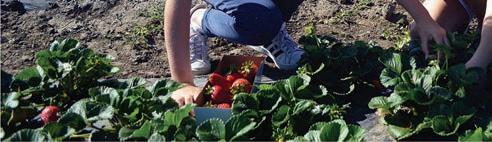
The center’s farm stand sells organic ingredients seven days a week and hosts Eco-Tots, a creative workshop for children, as well as farm tours, DIY workshops, U-pick strawberries days in which families pick berries for $4, community table farm dinners, cooking classes and demos. Beginning the first week of July, the center will host a bi-weekly Summer Supper Sunday series of dinners to celebrate the community and share various ingredients inspired by the chefs.
A handful of chefs from Berkeley to Orange County have partnered with the center to form an advisory board that designs culinary events, cooking classes and chef demos.
The Ecology Center also has expanded to a farmland in Encinitas, where a program is being developed that will utilize the crops to provide food for children’s lunches in the community. Both centers are open to the public and offer a co-op volunteer program or annual membership services that include discounted incentives. For a full calendar of events and more information, visit theecologycenter.org.
“The farm is filled with seasonal organic produce, with unique items like gardening tools, local honey, and rainwater collecting kits,” said Nick Huston, a San Clemente resident. “It is a fun stop for my wife and me to spend on a Sunday afternoon to pick up some produce, earth-loving goodies and walk around their biodynamic farming grounds.”



Celebrate the planet by giving back
BY JENNA ROSS
APRIL 13
MOTHER EARTH BEACH, CREEK AND PARK CLEANUP
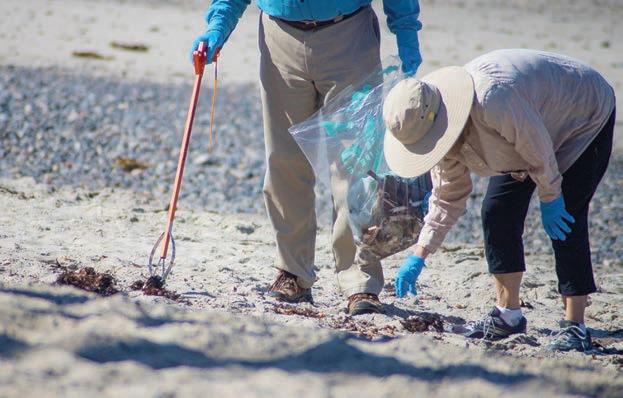
9 a.m. Meet at the lifeguard headquarters at Doheny State Beach to participate in this cleanup. The cleanup will focus on the beach in front of the campground and the area around San Juan Creek. Please bring your own gloves and a biodegradable trash bag.
APRIL 13
SAN CLEMENTE EARTH DAY CELEBRATION & BEACH CLEANUP
8:30 a.m. Presented by the San Clemente Watershed Task Force and the City of San Clemente, this year’s Earth Day celebration will start with a beach cleanup at the pier and end with a celebration at Parque Del Mar. Activities will include live music, a kids’ tent with arts and crafts, educational and art exhibits, as well as a presentation of Blue Water Business Awards to businesses that make an effort to reduce their environmental footprint.
APRIL 20
EARTH DAY NATIVE PLANTING PROJECT AT DOHENY STATE BEACH
9 a.m. Join the Doheny State Beach Interpretive Association as they plant native species throughout the Doheny Beach Campground. Meet the DSBIA at the oheny tate Beach Campfire Center, and be sure to bring a shovel, work/gardening gloves, drinking water, a hat and sunscreen.
APRIL 20
DANA POINT HEADLANDS CONSERVATION AREA EARTH DAY CELEBRATION
10 a.m. Join the Dana Point Headlands Interpretive Center as they celebrate with a day of education and fun crafts. Come learn about the rare and endangered species of the Dana Point Headlands, water conservation, recycling and Dana Point Native American communities; weave your own basket, get up close and personal with local birds of prey or snakes, get your face painted, or participate in the scavenger hunt.
APRIL 21-22
EARTH DAY WEEKEND AT THE OCEAN INSTITUTE
11 a.m.-2 p.m. Visit Ocean Institute on Earth Day weekend, April 21 and 22, to learn about insects and their essential role in keeping oceans and beaches healthy. The workshop will host a comparative anatomy lab of shrimp and grasshoppers; make your own bug box, discover why bees are key and more. Register at ocean-institute.org.

APRIL 2O
MISSION SAN JUAN CAPISTRANO CELEBRATES EARTH DAY
a.m. This will e the first arth ay celebration for the Mission. Enjoy a stroll through the gardens while learning about local bees and butterflies, watch some basket weaving demonstrations by Native American basket weavers, or pick some fruit from the Mission’s fruit trees. This event will include educational content from the Orange County Beekeepers Association and Susie Vanderlip, a Monarch Butterfly Citi en cientist.

APRIL 27
GR8OPPS EARTH DAY CLEANUP
Help clean up San Juan Capistrano with Great Opportunities (Gr8Opps), the local charita le nonprofit that emphasi es providing outdoor recreation to at-risk youth populations to help enrich their lives. Meet Gr8Opps at Red Park, where they will give you a bag, gloves and a free T-shirt, and take a walk through Capistrano Villas to clean up the neighborhood. The cleanup will end at Stone Park, where a Dia de los Ninos celebration will be taking place. For more information, visit greatopps.org.

Community choice programs aim to cut carbon emissions from state’s energy diet
BY ERIC HEINZ
California has set the loftiest goal in the country to reduce its carbon emissions and run on 100 percent renewable energy by 2045, which leaves local governments and organi ations to find ways to help the state accomplish that mission.
Dire reports of climate change have increased in frequency from highly credentialed environmental research groups and facilities, adding to the pressure California and the rest of the globe may face in the coming decade.
Community choice aggregation (CCA) organizations around the state are looking to help local governments establish joint power authorities (JPAs) to give them the opportunity to choose where their energy comes from. Community choice programs partner with energy brokers to purchase and create renewable energy direct from the source. Additionally, CCAs by law can use the existing infrastructure provided and maintained by companies such as San Diego Gas & Electric.
Energy-use portfolios are put together for each household and business that includes a mix of sources, mostly comprised of renewable sources and some nonrenewable sources.
CCAs would also have local authority over rate and purchasing autonomy as well as other decisions, as necessary, rather than having to attend meetings in San Francisco or Sacramento.
South Orange County Community Choice Alliance (SOCCA) formed about a year ago and works as an exploratory program looking to promote CCAs throughout the area.
SOCCA members Selene Lawrence, Terry Otsuki Kwa, Jackson Hinkle, Rick Erkeneff and Tyler Boden recently spoke with Picket Fence Media about their organization’s endeavors.
“We really need constituents to double-down on this,” said Stephanie Sekich-Quinn of the Surfrider Foundation, which is also working with SOCCA. “I think from a national perspective, California always leads the way. If we don’t do it now, it will be too late.”
“If we wait until 2030, we’re not going to meet that goal,” Erkeneff said. “If we start now, we can start putting incentives for people together and micro-grids.”
rkeneff said starting five year plans that augment the CCA would help start the process.
San Clemente City Council recently discussed the possi ility of taking the first step when CCA advocates came to public meetings, but they’ve been holding off on approving a technical study. Other south county cities have seemed to do the same, but SOCCA members said cities are just waiting for others to jump into the ring.
The grassroots organi ation held its first workshop in March, during which they explained to local residents and city officials their plan to bring a CCA to South County. Cities are also able to opt out of the programs at any time they want or when the contract expires.
Administrative costs are also much lower than traditional energy sources, Lawrence said, as the CCAs require fewer employees to operate.
“Even with their worst estimates . . . there’s almost always a cheaper rate for a CCA,” she said.
Background on Community Choice CCAs were made legal in 2002, when California passed AB 117, but it’s taken awhile for the energy model to reach the south part of the state, and only seven other states have adopted such legislation. Monterey Bay Community Power, for example, was established in 2013 and started operations four years later. Its first num ers were compiled in and the company has been able to garner a 2 percent saving, as compared to when it was with PG&E, which uses mostly nonrenewable energy. Marin Clean Energy has been a sustainable CCA for about a decade.
“It’s not just all JPAs that are forming; some cities are forming their own CCA,” Boden said. So far, 19 counties throughout the state have at least one CCA established or that county’s government has launched a program. Orange County has cities that have taken action, but no CCA currently operates here.
Erkeneff said CCAs are able to keep their cost lower because they’re able to predict and purchase the energy needed more efficiently through the portfolios compiled by CCA members.
“We can invest revenues back into solar power and wind and other things locally and own those assets,” he said. “When solar panels were (booming), the incentives were to sell the excess energy back to the company” in exchange for credits, Erkeneff said. “That shows that if you hit a certain number of panels in a region, you can be energy-positive by selling it back.”
Boden said because the rates, particularly in solar energy, have fluctuated over the years, it’s not uite as much a financial enefit as it once was for property owners who invested early. Short-term power contracts that don’t lock CCAs into certain rates can also help keep costs down, SOCCA members said.
Erkeneff said he has heard of some local interest in setting up a JPA, from Rancho Mission Viejo and other nearby South Orange County cities.
“I know there are some success stories coming out of San Diego, where there are some really small CCAs,” Erkeneff said. “I think Dana Point . . . would throw a good chunk of money at (a feasibility study).”
The cost of the studies is about $100,000, depending on the contract firm.
SOCCA members are planning to speak with residents in area cities in the near future about CCAs, but there are still some hurdles in getting them on board, Lawrence said.
“I think a lot of cities become apprehensive when talking about energy,” Lawrence said, adding some see it as a daunting proposal to start a new energy company that the city would manage.
Lawrence also said that as the CCAs are nonprofit organi ations, they re not eholden to public investors and, therefore, have an incentive to keep costs lower.
“We have a unique situation where our elected officials haven t een educated on this, and (politically) it doesn’t matter,” she said. “There are dozens of little cities that are coming together to form CCAs.”
SOCCA is also trying to facilitate dialogue among cities to coordinate a JPA. The city of Irvine has already completed its own feasibility study.
Boden said that the goal is to get cities to approve the feasibility study by the end of this year, so they can concentrate on 2021. If that doesn’t happen, based on how the process works, the area would have to wait until 2022 or later.
•••
For more information on community choice energy programs, visit cacommunityenergy.org.
Follow South Orange County Community Choice Alliance on social media via Facebook, Twitter or Instagram. The organization will have information on workshops and future meetings posted there regularly.
The first step is for a CC program to complete a feasibility study that would include all residents and municipalities involved. After that, it’s about another year of planning, depending on how many cities and entities are involved, and it can take a bit longer.


Joanna Clark, a local environmental activist, said the first step toward reducing your carbon footprint is switching out the incandescent light bulbs in your home for fluorescent light bulbs or LEDs. This can save on electricity, which saves on carbon emissions and what you have in your wallet.
Programmable thermostats are also another way to cut back on electricity in your home. Though some can cost more than $200, there are plenty of more affordable options online.
Another simple tip from experts is to also unplug unused electronic items from outlets to avoid “vampire” energy loss. And if you’re not using lights in certain parts of your home, shut them off; this can apply at your office, too.
nd speaking of the office, change your print settings to allow for double-sided pages for when you need to print out documents.
One way to greatly reduce the amount of carbon dioxide emitted into the air is going carless and utilizing other means of transportation, including bicycles, trains or buses.
“I have a bicycle, and whenever I can, I ride around the community without driving my car,” said Frank Larkin, a windows and doors manufacturer. He also said, “I think (riding bikes is) one of the best solutions for the average person, because there just isn’t enough of that.”
According to the U.S. Environmental Protection Agency, a typical passenger vehicle, with a fuel economy of about 22 miles per gallon, emits close to five metric tons of car on dioxide annually.
However, for many, especially here in Southern California, that might not be a feasible option. The Carbonfund.org Foundation notes there are certain driving habits that can help save more than a ton of carbon dioxide per year.
Such practices include driving the speed limit and maintaining a steady speed, as well as anticipating stops and starts. Regularly replacing air, oil and fuel filters, and having properly inflated tires, can also make your vehicle more fuel efficient.
Going to back to the importance of offsetting, if using a car is absolutely necessary to get to work, you could propose creating a carpool among some of your co-workers.
But before heading to work, don’t forget to pack a lunch. Meal prepping lunches for the work week can not only save gas on multiple car trips to lunch throughout the week, it can also reduce food waste.
BY SHAWN RAYMUNDO
With so many of today’s headlines talking about climate change and its effects throughout the world, many Americans have been looking for ways to be part of the solution.
Advocating lawmakers to do more to protect the environment and regulate the oil and gas industry is certainly one way to get involved. But you can also do your part by incorporating more conservative practices in your daily routine.
Many refer to such practices as reducing your “carbon footprint”—a term used to describe the amount of greenhouse gases, including carbon dioxide, that are emitted from an individual’s activities.
To limit his car on footprint, arry ramer, group leader for the local chapter of Citi ens Climate o y, modified some areas of his home to be more environmentally friendly. He has solar panels on his roof and uses a solar cover to keep his pool heated. Kramer also uses two rain barrels to catch and recycle rainwater for his plants. Several years, ago, he said, he removed the grass from his home and replaced it with only native plants, with the exception of some non-native plants that were in his yard when he first ought the home.
And last year, Kramer also purchased a plug-in hybrid vehicle.
Limiting your carbon footprint doesn’t necessarily mean you have to make renovations to your home, such as installing solar panels or purchasing an electric vehicle, which can e costly. nstead, first take a look at your energy ills to see where you can cut ack the more you save over time, the more pro ects and fuel efficient vehicles you might e a le to afford. The Carbonfund.org Foundation’s motto is simply “Reduce what you can, offset what you can’t.” This can apply to a myriad of daily activities between home and work.
“About one-quarter of all the food prepared annually in the U.S., for example, gets tossed, producing methane in landfills as well as carbon emissions from transporting wasted food,” according to Carbonfund.org.
And the New York Times reports that about 40 percent of the foods Americans purchase ends up being wasted.
If you’re looking for more ways to reduce food waste, you could follow Kramer’s footsteps, as he utilizes a tumbler and a worm bin. Vermicomposting, or using a worm-composting bin, helps recycle food scraps such as vegetables, tea bags, bread and coffee grounds, to name a few, according to the EPA.
If keeping worms inside your home seems a bit much for you, there are simpler solutions.
The Times proposes to avoid buying the same product twice from the grocery store by keeping tabs on what’s in your fridge and making lists. Freezing certain products including produce can extend the foods’ lifespan, and accounting for portion sizes when cooking can prevent throwing out too many leftovers.
Along those same lines, cutting out red meat and switching to vegetarian meals can greatly save on carbon dioxide. Cutting out meat completely isn’t a particularly easy thing to do, so instead consider cutting down on consuming beef in exchange for substituting more chicken and adding some vegetarian meals to your daily routine.
According to the Times, researchers have found that eliminating or reducing red meat from diets would greatly reduce carbon emissions, because red meat production requires a lot of feed, land and water.
hile the aris Climate greement was a significant leap in the right direction, governments around the world will need to continue taking steps toward implementing sustainable solutions in order to combat climate change.
In the meantime, you can begin to make a difference by implementing some of these practices to begin reducing your carbon footprint.