Crib to College 2016 - An Educational Guide to Your Child's Success
In this edition of Crib to College, we chose to include stories that help inform and appeal to students, parents, teachers and community members of all ages. We share stories about outstanding students, help parents think about financing college, showcase innovative schools and more. You’ll hear the opinions of South Orange County schools from foreign exchange students, and find ways that kids, and kids at heart, can use community offerings to enrich their education.
Places TO GO Things TO SEE
South Orange County is home to dozens of regular and year-round activities for kids
By Andrea Papagianis
There are a bevy of opportunities for kids of all ages to experience culture in South Orange County. Whether it’s attending a theatrical production, checking out museum exhibits, getting outside or more, kids in the tri-cities can explore what the world has to offer, all within a 20-minute drive.
Here are some upcoming events and exhibitions, along with year-round destinations and ongoing offerings.
TAKING CENTER STAGE
Enter the enchanting wizarding world as a live symphony orchestra performs each note from Harry Potter and the Sorcerer’s Stone while the magical film plays on a titan screen. Shows run Nov. 11-13. $49-$99. Segerstrom Center for the Arts, 600 Town Center Drive, Costa Mesa, 714.556-2787, www.scfta.org.
’Tis the season to share a holiday classic with the entire family. The heartwarming Miracle on 34th Street sees Macy’s jolly Santa Claus, Kris Kringle, confirmed as the true merriment-spreading, toy-giving man in red. Runs Nov. 25-Dec. 18. Tickets are $27-$37. El Camino Real Playhouse, 31776 El Camino Real, San Juan Capistrano, 949.489.8082, www.caminorealplayhouse.org.
EXPLORE THE OUTDOORS
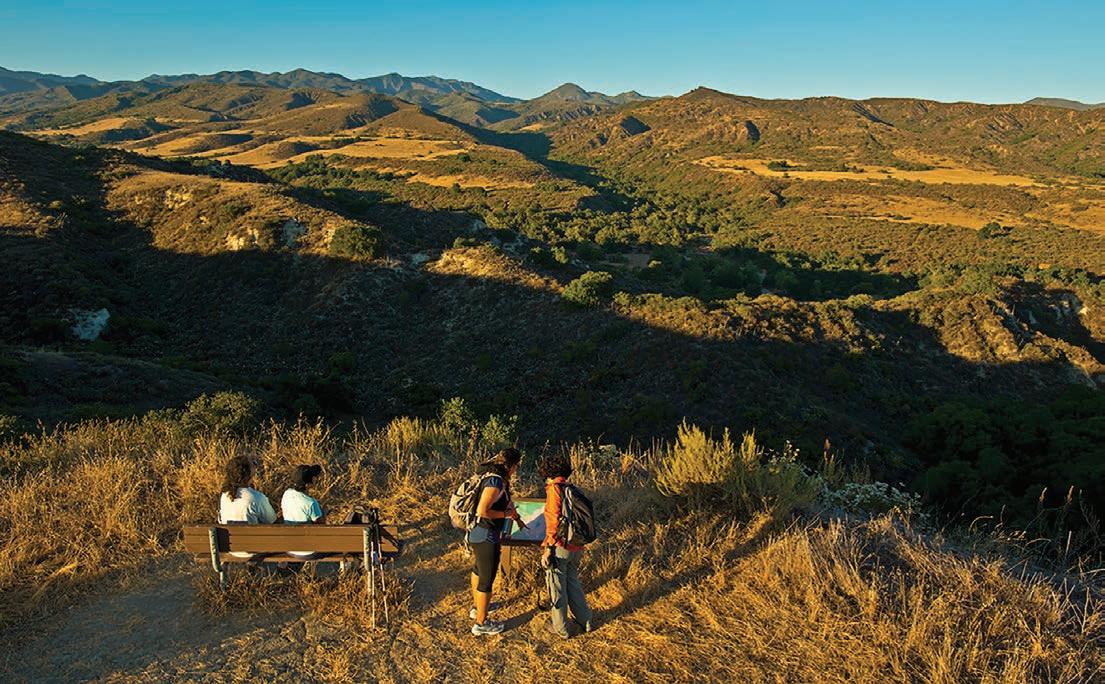
Discover the region’s natural backdrop on a one-mile, ranger-led hike through Bell Canyon. Hikes are held each Sunday from 8-9 a.m. Suitable for all ages. $5 a vehicle parking fee. Caspers Wilderness Park, 33401 Ortega Highway, San Juan Capistrano, 949.923.2210, www.ocparks.com.
It’s kids’ turn to take the stage. Cast members from ages 4 to 16 will answer the call of the Acting Academy for Kids to bring the Oscar-winning twisted fairytale Shrek to life. The beloved green ogre Shrek, Donkey, Princess Fiona, Lord Farquaad and misfit band of creatures take the stage March 19, 25 and 26. Rehearsals begin in January.
Casts will have three rehearsals over the course of the spring. Participation fee $395-$495 plus materials and costume costs. El Camino Real Playhouse, www.caminorealplayhouse.org.
A DAY AT THE MUSEUM
Through the new year, join the “heroes in a half shell,” the pizza-fanatic Teenage Mutant Ninja Turtles, and put your problemsolving and collaboration skills to the test cracking puzzles, navigating mazes and overcoming obstacles in the sewer. Tickets start at $12.95. Discovery Cube Orange County, 2500 N. Main Street, Santa Ana, 714.542.2823, www.discoverycube.org.
Explore special exhibits featuring interactive art, nature and science activities during the annual Art & Nature Festival exploring art’s
Each second Sunday, track whale seasons on this 1.5-mile hike. Greys from fall to spring, blues in summer, watch from the Dana Point Headlands as the ocean’s largest creatures migrate through local waters. Nature Interpretive Center, 34558 Scenic Drive, Dana Point, 949.248.3527, www.danapoint.org.
entwinement with the natural world. Festival runs Nov. 3-6. From 2-5 p.m. on the events last day admission is free for the Family Festival Sunday. Laguna Art Museum, 307 Cliff Drive, Laguna Beach, 949.494.8971, www. lagunaartmuseum.org.
Prominent female scientists across the study spectrum lead hands-on workshops for middle and high school aged girls aimed at giving participants an inside look at careers in oceanography, ecology, marine biology, biochemistry and more. Registration opens Nov. 14. Conferences held on Feb. 18 and March 18. Ocean Institute, 24200 Dana Point Harbor Drive, Dana Point, 949.496.2274, www.ocean-institute.org.
GRAB A TALL TALE
Tuesday is kids’ day at the Dana Point Library. Toddler story-time kicks off the festivities at 10 a.m., followed by the all-ages Stay and Play at 10:30 a.m. and preschool story-time at 11 a.m. Then, mans’ best friend becomes a beginning reader’s perfect story companion at 2:30 p.m. Dana Point Library, 33841 Niguel Road, Dana Point, 949.496.5517, www.ocpl.org/libloc/dana.
Explore one of California’s most visited beaches. San Onofre State Beach offers kayaking, surfing, swimming, fishing and more. Overnight camping in three campgrounds is available. The natural playground is located just three miles south of San Clemente on I-5. 949.492.4872, www.parks.ca.gov/sanonofre.
Sixth- through eighth-graders are invited to hang out, play games, watch movies and do crafts every Wednesday. Tween Scene is held from 3:30- 5:30 p.m. San Clemente Library, 242 Avenida Del Mar, San Clemente, 949.492.3493, www.ocpl.org/ libloc/sc.
Join the fun each Wednesday at 11:30 a.m. for stories, rhymes and songs in English and Spanish. All ages are welcome. San Juan Capistrano Library, 31495 El Camino Real, San Juan Capistrano, 949.493.1752, www.ocpl.org/libloc/sjc.
GROW WITH OTHERS
The Community Outreach Alliance (COA) is the answer to many teens’ gripe of “I have nothing to do.” Instead of developing bad habits, COA connects kids with each other in a variety of programs. COA helps create relationships through healthy lifestyles, and does so via art and music lessons, an open mic jam night, a bike club, a gaming network, sports groups and more. 1050 Calle Negocio, San Clemente, 949.388.0114, www.communityoutreachalliance.com.
Caspers Wilderness Park is an ideal place to get lost and learn from nature. Photo: Courtesy of OC Parks
OutStANdiNg Kids
WilLIam REdMonD
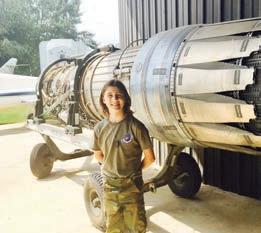
Aeronautical Engineer Student
Local students highlight what South Orange County youth has to offer
By Matt Cortina
Three local students are doing South Orange County proud at home and across the country. Whether they’re running aeronautical missions, presenting scientific lectures at museums or, you know, saving the planet, these three young people are using their talents to make the world a better place.
WhiTnEY waChTEl
Ecology Club Founder, Environmental Pioneer
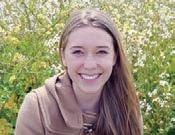
Whitney knew she wanted to make a mark on Dana Hills High School even before she was enrolled there. As a member of the Ecology Center in San Juan Capistrano, Whitney reached out to the Advanced Placement Environmental Sciences teacher at the school, Dolores Dang-Wright, and asked if she would oversee an environmental club.
Now, four years later, Whitney is a senior and the Ecology Club holds monthly educational sessions at Dana Point elementary schools to inspire youth toward a life of environmental stewardship.
“It’s a really good experience,” Whitney said. “Younger kids are going to have to inherit the planet’s situation so the ability to engage children, it’s been really cool to see their development on how excited they are when we come every month, and it’s cool to hear when they take a plant home how they are tending to them.”
Whitney says sustainability and ecology will be a part of her upcoming college experience and eventual career. For now, she’s running the club and also writing an environmental column for the Dana Hills school newspaper.
Shorecliffs Middle School’s William Redmond recently graduated from the renowned Space and Aviation Challenge at the U.S. Space and Rocket Center in Huntsville, Alabama.
William says the experience was gratifying, as he was able to use his knowledge and experience in engineering to help the group execute militarylike operations.
“It was really, really cool,” William said. “Tons of great activities. Sometimes you’d go patrolling in the nighttime. You’d fly around in jet simulators. It was overall a great thing to go through.”
The operations included nighttime excursions with missions, like, for instance, saving a downed pilot and securing intelligence while camp officials simulate gun fire.
Lectures were given throughout the program, and William says he hopes to parlay what he learned into an upcoming aeronautical program at Duke University.
KatE PoInTer
Future Cyber Archaeologist
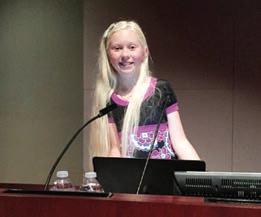
Kate Pointer, 10, is a San Juan Capistrano fifth grader, who recently gave a presentation on new techniques in archaeological technology to a full room at the Bowers Museum in Santa Ana.
Pointer says she’s been interested in the subject since watching a children’s movie several years ago. From there, her appetite for all things archaeology has been insatiable.
“When I’m older, I want to get my doctorate as a cyber archaeologist and go between the computer and office, to out around the world digging for stuff,” Kate said.
For the presentation, Kate researched excavating techniques, particularly those used in Egypt and the Middle East, where Pointer says her interest lies in the artifacts archeologists uncover of the various ancient languages and religions. She worked with several key researchers in the field to prepare.
PLAYING TO LEARN
By Eric Heinz
In traditional education, playtime has typically been regarded as a reward for hard work.
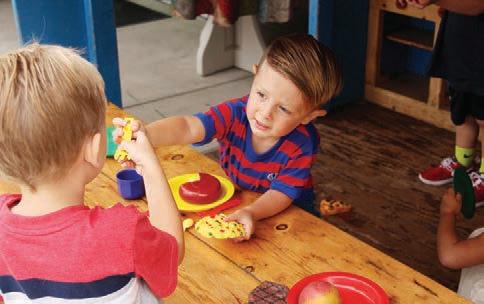
At St. Margaret’s Episcopal School’s Early Childhood Development Center (ECDC) in San Juan Capistrano, it’s part of the curriculum.
Chris Lozon, director of St. Margaret’s ECDC, said integrating students with a variety of activities helps cultivate their minds. The center focuses on students ages 3 to 5.
“We have teachers working with small and large groups, and there are parts of the play-based education where skills are being taught,” Lozon said.
The play-based curriculum focuses on particular subjects. For literacy, students play with blocks with letters on them or play some kind of game incorporating letters; the same goes with math-and-science-based learning using numbers and logic-based activities.
“Because our ratio is 1:6 (teachers to students), the teachers can work individually with children and identify patterns,” Lozon said. “Some children choose only to do blocks, and some choose only to do dramatic play, and the teachers know that they’ll need to incorporate something with patterns. They will incorporate figurines and do little drama pieces to diversify (students’) education.”
The day starts with parents dropping off their children or spending a little time with them before the children go off to make their choices of playing for the period. They then gather in a circle for story time or some other group activity before going to the “big outdoor classroom,” Lozon said.
“After about an hour out there, they go out and make more choices, and then have lunch and then cleanup and rest and then back to the outdoor classroom,” she said.
Lozon said the outdoor classroom has a garden and small animals the students are able to interact with as well as typical playground equipment.
“Young children learn from experiences, and what we provide are tons of experi-
ences,” Lozon said.
According to a 2009 study by the Center for Early Childhood Education, studies showed play-based curriculums, even without the assistance of “props” or educational toys, can be beneficial to students’ growth.
“Phonemic awareness in preschool is one of the best indicators we have about how well a child will learn to read,” the study stated. “It is not surprising, then, that early play abilities are related to reading scores many years later.”
Lozon said the school’s own research has shown progress from the time they enter ECDC to the time they graduate from high school. St. Margaret’s is a private preschool to high school institution.
“Play-based education does improve physical knowledge and sensory integration and social knowledge … and the logical mathematical knowledge is the understanding in the brain about numbers,” she said. “The true understanding is they know that one object is one and two is two. Let’s say you put up your hands and count that last finger and say five. Because of the experiences the children are building, they’re using that knowledge to build that mathematical knowledge.”
Inevitably, advertising education as “playbased” comes with raised eyebrows.
“There are very common misconceptions, and (some people) think that it’s the teachers saying, ‘Go and play’; that is not play-based learning,” Lozon said. “It’s an active, hands-on learning. The teachers have to scaffold the learning, and they work side-by-side (with the students), and they’ll sit next to them and compare and contrast their learning.”
Lozon said play-based learning also helps students with social interactions, which start to show as they enter elementary, middle and high school. She said it’s been proven that students who build proper physical attributes, such as being able to sit upright and focus during instruction, and social interaction sets a foundation to keep students engaged in their studies. •
Children learn to play through the St. Margaret’s Episcopal School Early Child Development Center’s play-based education. Photo: St. Margaret’s Episcopal School
Going Abroad
Students from all over the world are currently living, studying in South Orange County
By Kristina Pritchett
This school year, a handful of foreign exchange students are living with host families in South Orange County, including Dana Point and San Clemente.
These teens are part of the Orange County AFS Hosted Student program, which allows students from other countries to travel abroad and attend school, live with a host family and experience a different culture.
In Dana Point, Ella Tervonen traveled from Finland and attends Dana Hills High School.
In San Clemente Bárbara Wolfenson Marchant traveled from Chile; Eduardo Thomas Noronha is from Brazil; and Jón Thordarson is from Iceland. All three attend San Clemente High School. Over the summer, Monica Aguirre traveled to Japan for six weeks. But all were able to immerse themselves in a different culture.
We sat down with the four foreign exchange students and asked them what they’ve experienced so far, what differences they saw between their home countries and their Southern California lives and more.
The biggest difference, all four said, was the size of their high schools.
“The school, at least for me, is way bigger,” Eduardo said. “It’s about 10 times bigger; my school has around 300 students, and this school has around 3,000.”
Ella agreed and said there were about 600 students at her school in Finland, including middle school and high school students.
The students also said it was different how their classrooms were spread out and not under one roof. Eduardo added he was not used to the desks being in different arrangements.
“At my school, they were in straight lines; here, some are in clusters,” Eduardo said.
Jón said another big change is just speaking English every day.
“I never expected talking would be so tiring,” Jón joked.
Bárbara agreed and said if she could, she would sleep all day.
“The first week was so difficult because you had to think of what word it is, and our brains are doing a lot of work, not to translate but to understand,” she said.
When asked about the classes the stu-
“The school, at least for me, is way bigger. It’s about 10 times bigger; my school has around 300 students, and this school has around 3,000.
EDUARDO THOMAS NORONHA
”
dents are taking here, compared to the ones back home, they said there’s a difference in variety.
“Here, you have way more choices on how hard your education is,” Jón said. “You can take easy classes, you can take hard classes.”
Bárbara said there’s more choices, such as electives like ceramics, and people have the ability to choose classes.
“In my country, you cannot pick your classes,” Bárbara said.
Ella said at her school in Finland, stu-
dents will take a course for two-and-a-half months, but must complete 75 classes in three years.
Jón said U.S. History has been different, but he’s enjoying it.
“The perspective here is way different,” Jón said about the class. “I feel like there’s less differences than I thought, but we’re taught very neutrally (in Iceland).”
One thing the students also noticed are the amount of clubs in which they can choose to participate.
The boys are currently in the Blood Drive club, the Sign Language Club and the Robotics Club. Ella is in Best Buddies, Traveling Club and a couple others. Bárbara took full advantage of the variety of organizations and has joined many.
“I’m in Pennies for Puppies, because I love puppies. I’m in Cinema Club, we watch movies and eat pizza, it’s so great. I’m in Fashion Club, Cool to be Kind and more,” Bárbara said.
Ella said at her school in Finland they don’t have sports, clubs or activities like homecoming or prom.
Bárbara said going to the football games is something Americans take for granted, but since her school doesn’t have sports like that, it’s a new experience.
“Everyone is so happy, and they’re cheering,” Bárbara said.
Eduardo and Jón said they’ve noticed that the sports at the high school bring everyone together.
“Sports here mean a lot, they’re a way to
college,” Eduardo said.
Ella said she really enjoyed attending homecoming, but loved participating in the half-time show out on the field.
The boys attended a Blink 182 concert, something Jón said he’d never thought he’d get to do.
“It’s been a dream,” Jón said. “They’re my favorite band.”
The three San Clemente High students also recently attended homecoming. Before the dance, Jón said he was looking forward to it.
“It’s very different, but I think it will be a lot of fun,” Eduardo said.
Each of the students said they tried to incorporate something from their home country into their American lives. For Ella, she teaches her host parents Finnish. Bárbara has cooked for her family, and the boys are always sharing music from their home countries.
Besides school, Jón said the weather is definitely a change—and so is driving.
“There’s way more cars here. We have one road that has three lanes, and we have slippery roads,” Jón said. “It’s not really harder, but it’s harder in a different way.”
One thing the four teens could agree on was learning to rely on others for rides.
“And there’s no public transportation,” Eduardo interjected. “It makes things kind of difficult to hang out with friends because you don’t really want to bother your family, they have things to do, but you want to hang out with your friends.”
Sydney, whose Bárbara ’s host sister, said she was looking forward to having a host sibling, especially one who spoke another language she was interested in.
“We can help each other,” Sydney said. On the opposite side, students from South Orange County are also able to study abroad in other countries.
Monica, 16, a junior at San Juan Hills High School, went to Japan for six weeks over the summer.
“[I chose Japan] because I’ve always been fascinated with the Japanese culture,” Monica said.
One difference Monica experienced was going from a family with three other siblings, to a host family with older siblings who didn’t live at home any longer.
“It was definitely strange,” she said.
Another thing she noticed was the culture.
“The way they would speak to each other, their manners,” Monica said. “Things they would say or do here would be OK, but there it’s not.”
She said she enjoyed learning Japanese, and it “wasn’t as difficult” as she thought it would be.
She said her favorite part of the trip was being able to go to the mountain spring, but she also enjoyed going to karaoke with friends and meeting new people.
“I met people from Hong Kong, France, Mongolia and other countries,” Monica said.
Monica said she would have loved to stay longer but didn’t want it to interfere with her school back in the states, and would definitely plan another trip back.
To find out more about hosting or traveling with AFS, contact www.afsusa.org/ team/orange-county-ca. •
Bárbara Wolfenson Marchant, from Chile, and host sister Sydney Lantz before attending San Clemente High School’s Homecoming Dance on Saturday, Oct. 22. Photo: Susie Lantz
AFS Students (from L to R): Ella Tervonen, Bárbara Wolfenson Marchant, Jón Thordarson and Eduardo Thomas Noronha. Photo: Kristina Pritchett
As spring arrives, seniors make painstaking decisions and announce their college destination by sporting their school’s spirit wear. In August, they attend emotional farewell celebrations and delight in detailed dorm shopping.
After years of hard work, high school graduates are ready to fly from the nest. Or are they?
Emotional Readiness vs. Academic Readiness “ ”
When are high school seniors ready to fly from the nest?
By Shelley Murphy
In the coming months, anxious high school seniors will check their mailboxes and inboxes for college admissions decisions. Their collegiate fates will be determined by three words: accepted, rejected or waitlisted.
Last October, the Harris Poll, in partnership with the JED Foundation, Partnership for Drug-Free Kids and the Jordan Porco Foundation, released the results of a nationwide online survey of 1,502 college students
environments, control negative emotions or behavior and build positive relationships.”
For many college freshmen, the emotional hurdles faced their first year of college can be greater to overcome than academic obstacles.
When my boys left for college, I equated their college acceptances with college readiness. I reasoned since they’d completed the required coursework, passed the mandated tests and received college offers that they were prepared. I didn’t stop to consider how stressful the transition from high school senior to college freshman can be for students.
For many college freshmen, the emotional hurdles faced their first year of college can be greater to overcome than academic obstacles.
evaluating the freshman year experience.
The poll revealed 87 percent of students felt more emphasis was focused on being academically ready for college rather than emotionally prepared.
An overwhelming 60 percent of the firstyear college students wished they’d had more help emotionally preparing for college. Emotional readiness is a significant indicator of first-year college success. The survey defined emotional readiness as: “the ability to take care of oneself, adapt to new
The poll shines a light on the emotional toll teens face their first year of college: 50 percent of surveyed students reported feeling stressed most or all of the time. One in four freshmen admitted to feelings of loneliness and one in five reported feeling depressed all or most of the time. The majority of these students (65 percent) chose not to seek help but to keep their troubles to themselves.
Popular culture and social media exacerbate teen stress and contribute to 45 percent of surveyed students saying, “It seems like
everyone has college figured out but me.”
According to U.S. News & World Report, feelings of stress and loneliness are among the top reasons that as many as one in three first-year students don’t return for their sophomore year.
Parent support can play a key role in helping freshman cope with first-year stresses. Susan Parmelee, executive director of the Wellness & Prevention Center at San Clemente High School says, “Agree on a weekly facetime check-in, shoot for every Sunday so that kids have a chance to decompress and regroup for the week ahead.”
With 49 percent of college freshman reporting the college experience did not live up to their expectations, she advises parents to be encouraging. “Remind them that college is a time to explore new things and meet new people.”
Parmelee suggests parents begin the college conversation early and listen to their kid’s concerns. “The more we do to educate teens before they leave home, the better they will fare.”
While the results of the Harris Poll are startling, it starts a discussion among parents, educators and students about the importance of emotionally preparing teens for their first year of college.
It takes students years of hard work to make it to college and it takes time to adjust once they arrive. Emotionally supporting high school seniors as they fly from the nest to the college dorm can help them not only survive, but thrive. •
Not Your Parents’ TraDE pRogRAm
By Shelley Murphy
Last August, Capistrano Unified School District’s Regional Occupational Program (ROP) shed its decades-old title and adopted the new name, College and Career Advantage (CCA).
The objective of CCA is to provide Career Technical Education (CTE) pathways to all students from kindergarten through high school, leading to college and career success.
“We felt that this name better reflects the highly technical and high value of the program courses today,” said Pati Romo, CUSD executive director of CTE.
Established in 1970, ROP classes included wood shop and horticulture. CCA still offers some traditional courses but with a technological twist. Today, the popular Automotive Technology and Repair course includes a new computerized focus that includes industry certifications.
“We have biotechnology and forensics courses that meet the highest growth industries in Orange County. Students have a variety of choices with over 300 sections of CTE offered at the high schools,” said Romo.
To teach students cutting-edge technical skills, Romo said, “we are installing CTE
AVID:
Investigation labs at all middle schools over the next two years. We have our first one at Las Flores Middle School.”
Currently, CCA provides a well-rounded education to 7,800 students and boasts a program completion rate of 97 percent.
“Students graduate from high school as college-ready with career skills. Many of them have completed an internship with local businesses and industries such as Kaiser Permanente, Monarch Beach Hotel, CHOC and auto dealers,” said Romo.
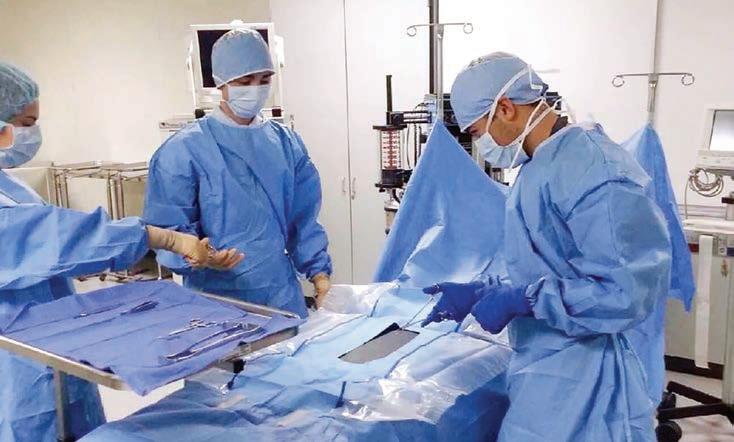
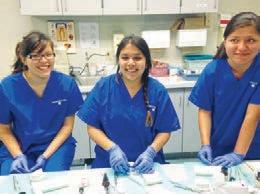
The most popular student career pathways are the health sciences, specifically patient care and biotechnology. CCA provides students the exciting experience of handson learning in a job setting. Romo said, “Our dental lab looks and smells like a dentist’s office. The surgical tech lab is an operating room. Do you remember how much you learned at your first job? It’s like that—there’s nothing like it.”
See the CCA website for more information: www.ccadvantage.org. •
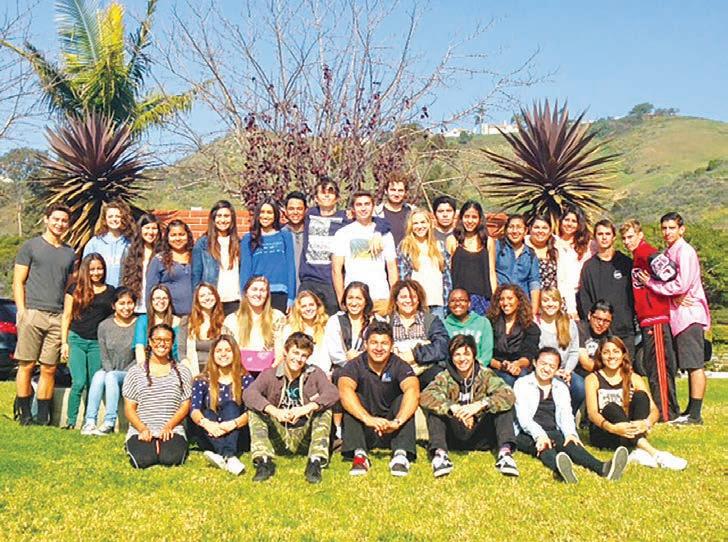
The San Clemente High School Advancement Via Individual Determination (AVID) senior class are part of a larger program that prepares students for college.
By Shelley Murphy
Established in 1980, Advancement
Via Individual Determination (AVID) is a global nonprofit organization providing students academic and social support through its college readiness program, designed to increase the number of students enrolling in four-year colleges.
At San Clemente High School, Erin Dollar serves as AVID coordinator and program teacher; she’s also a staff developer for the national AVID Center.
“AVID’s mission is to close the achievement gap by preparing all students, especially those least served in the middle
of the academic spectrum, for college readiness and success in a global society,” said Dollar.
AVID’s four-year program encourages students to enroll in challenging and rigor-
ous courses. The program holds students to high academic, behavioral and character standards; and, they learn to advocate for themselves and take ownership of their education.
“AVID is so great about teaching life skills that truly translate to college, career and life readiness,” said Dollar.
In the past two years, Dollar’s program has grown to over 250 students, becoming the largest AVID program in the school district and boasting a retention rate well above 90 percent. Dollar said student relationships built during the four years are key.
“Students really become a tight-knit family that supports and pushes each other,” she said.
For the past three years, 100 percent of AVID seniors earned acceptance at a fouryear college—although some seniors opt to attend community college instead or lack the necessary financial aid to attend.
“Our seniors have about a 74-80 percent rate of going straight to a four-year college, well above the national average,” said Dollar. “We have students at almost every UC campus, Fordham, Penn State and the list goes on.”
Just like her students, Dollar sets the bar high and said, “This year our goal is for every senior to have two or more college acceptances and a program total over $2.5 million in scholarship and financial aid offers.” •
Patient care and biotechnology are some of the more popular CCS classes amongst students. Photo: Courtesy
Photo: Courtesy SCHS
CRIB TO COLLEGE
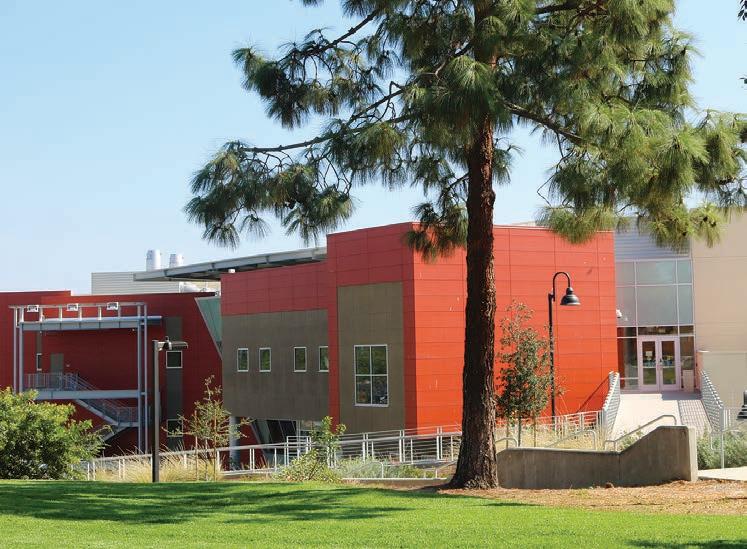
The new science building at Saddleback College features modern design and state-of-theart labs for students.
AN EDUCATIONAL GUIDE TO
Learning LAB
New science building at Saddleback College offers students new learning tools
By Victor Carno
It has been nearly two long years since construction began on the new science building at Saddleback College, but it is finally here and has exceeded most professors’ and students’ expectations. Even though the $67 million project was slated to open in late 2015, it’s certain that most academics did not mind the wait.
“There had been well over five years of planning that went into this project, even before demolition started,” Senior Laboratory Technician Tom Burrows said. “Our last science building didn’t have enough power to support all the computers and machinery we had, so having this state-of-the-art building definitely makes all of our jobs easier.”
The 51,244-square-foot building is equipped with eight lab rooms, 26 laboratory spaces, is Leadership in Energy and Environmental Design (LEED) approved and
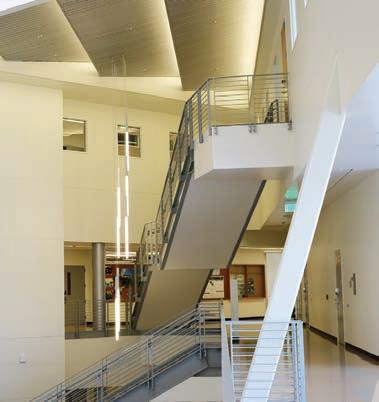
has three floors separating chemistry, biology and physics courses. Some of the added benefits of adding all these classrooms is that professors can now offer more sections of their class so that classes won’t get filled as quickly.
“We have almost double the number of labs as we did in our last building. Not only do we have more classrooms, but we have more instruments for our students to conduct their projects and experiments. We actually just installed a cadaver refrigerator recently,” Burrows said.
Chairman and Biology Instructor Steve Teh explained that the building was all about usability.
“We have research facilities on each floor, lab benches and fume hoods that allows for more experiments,” said Teh. “This whole building is a conducive learning environment, and I’m excited to see what the students will do here.”
We will soon find out what will be done in the building, as this is the first semester where classes are offered in the new science building. The building’s grand opening was Sept. 29, and even the teachers are giddy about the drastic change in buildings.
“There are so many windows. So much natural sun light is allowed in this building, which is a huge change from the last building, where my office didn’t even have one window,” Burrows said. •
Photos: Victor Carno
It Takes a Village
South Orange County schools and businesses on their community offerings
Bella Collina San Clemente
Bella Collina San Clemente is a private, family-friendly golf club where there are no strangers, just friends you haven’t met yet. In addition to the scenic 27-hole golf course, designed by legendary tournament champion Gary Player, Bella Collina also offers an active social calendar, where members enjoy wine dinners, concerts, festive holiday celebrations and much more, all year round. In addition to single and family golf memberships, Bella Collina San Clemente offers junior golf memberships for children and social memberships for non-golfers. Whether you’re looking to create lasting memories with your family or a place to escape your busy schedule, Bella Collina San Clemente is the perfect family getaway in your own backyard.
200 Avenida La Pata, San Clemente. 949.333.4830. www.bellacollinasanclemente.com.
Capo Valley Christian Schools
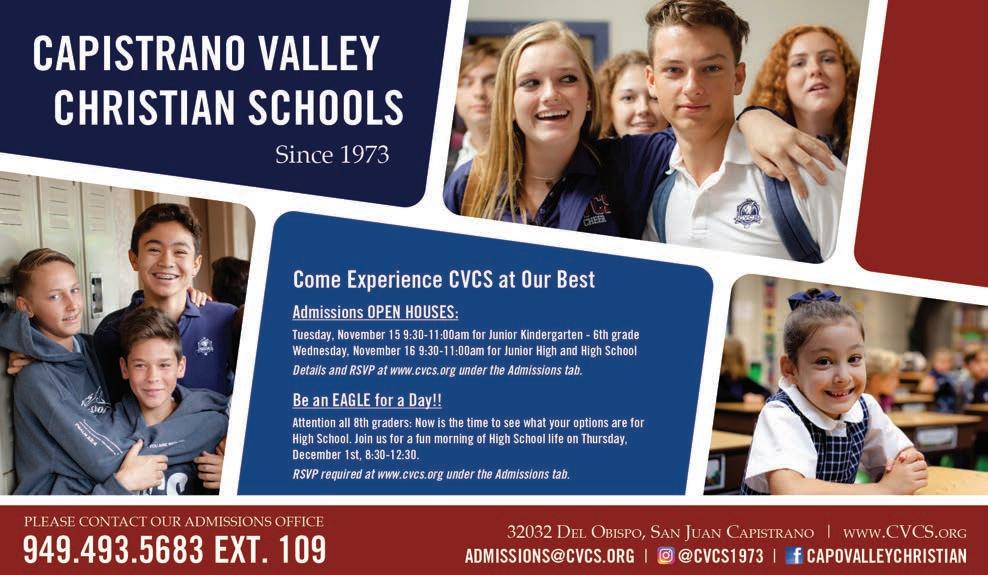
The dreams we have for our children are based on hopes for a lifetime of success, happiness and purpose. At Capistrano Valley Christian Schools, we believe the foundations of those dreams are built on a rich academic program coupled with an emphasis on spiritual and moral development. Our students learn through a program that values and develops critical thinking, innovation, creativity and foundational skills to prepare them for life after graduation. As you explore our website, we hope you sense the dynamic learning environment we have created in order to prepare our students for success in all their future endeavors.
CVCS has been serving students from junior kindergarten through high school for more than 40 years.
32032 Del Obispo St., San Juan Capistrano. 949.493.5683. www.cvcs.org.
Our Lady of Fatima Parish School Nurture ~ Encourage ~ Empower
OLF School cultivates faith-filled learners who demonstrate attainment of academic excellence, 1:1 technology acquisition, and dedicated service to their community. Visitors to our campus witness the engaging
learning environment that is centered on the value of family. Fully accredited, OLF is blessed with exceptional and dedicated teachers. OLF’s academic rigor is complemented with enriched offerings that include Spanish, Music/Piano, Art, Academic Decathlon, Technology, Choir, Physical Education and Drama. Our students cultivate a zest for life-long learning, develop effective communication skills, and advance as globally responsible citizens.
OLF’s exceptional Transitional Kindergarten, the first year of a two-year academic Kindergarten program, is specifically designed to provide 4 and 5 year olds the “developmental gift of time.” With a cross-curricular approach to instruction, all students experience differentiated opportunities in which to explore, investigate, and integrate their academic abilities. Participation in the PAL Sports League, Extended Day Care, After School Programs, and Homework Clubs round out the OLF school day.
105 N. La Esperanza, San Clemente. 949.492.7320. www.olfschool.net.
Our Savior’s Lutheran School
There’s something special going on at Our Savior’s Lutheran School. Dedicated teachers educate and inspire, creating a learning environment in which students excel academically. With small class sizes, a fully accredited school and a highly educated, credentialed teaching staff, students are able to develop their individual gifts and learn who they are—beloved children of God. Parents express their appreciation for the strong academics, and they appreciate even more the emphasis on the Christian value of love for one another. Our Savior’s Lutheran offers preschool through fifth grade with a full-day kindergarten and many enrichment opportunities for children both during and after the school day. Newborn to 3-year-old Parent and Me sessions are offered. We celebrate and honor the diversity of gifts, abilities and backgrounds each child contributes to the school community. All faiths are welcome. Open enrollment begins Feb. 17.
200 Avenida San Pablo, San Clemente. 949.492.6165. www.oursaviorsschool.net
(Continued)
Santa Margarita Catholic High School With academic tracks tailored to meet the needs of varied learners; more than 85 clubs
KEEP CALM AND CARRY ON of College Admissions
With college acceptance competition and PSAT, ACT and SAT test-taking stress levels high, we reached out to local admissions experts on ways high school students can tackle the college preparation, research and admissions processes with the least amount of resistance. Here’s what they had to say.
StRikE a bALanCE.
Find a balance between school work and extracurricular involvement: A student should add rigor appropriately to their curriculum throughout high school to continue to challenge themselves and display their preparation for college-level courses. Outside of the classroom, a student should find a few activities that they are passionate about and deepen their involvement by taking on leadership positions within the groups they feel most connected to. In college, there will be a lot to balance, between classes and involvement opportunities, so it is smart for a student to start figuring out how they can best manage their time and energy throughout high school.
—Colleen Tuohy, Admission Counselor, Chapman University
NarROw YoUr LisT.
It’s easy for students to feel building a college list is a daunting task. The fact is, students who invest time into considering their academic talents—along with personal skills and interests—are able to approach select-
ing colleges as a match to be made rather than as a prize to be won. The “match” concept provides a framework for students to be thoughtful about selecting appropriate colleges for their college lists.
—Roland Allen, Director of College Counseling, St. Margaret’s Episcopal School
Do yOuR rESeArCh.
It is most impressive when a student is able to display that they have taken the time to learn about Chapman University in more ways than just having browsed our website. If it is offered at the schools a student is applying to, I recommend taking advantage of opportunities to interview. This can be a great time to ask meaningful questions about what the student experience at a particular university is really like, as well as demonstrate interest in the university. The very best way to get an understanding of a university is by touring campus. Family vacations are a great time to tour a school, even if it might not be the one a student is considering most seriously. By touring campuses of different sizes, locations and institution types (public vs. private, for example) a student can better identify what it is that they are truly hoping to get out of their college experience.
—Colleen Tuohy, Admission Counselor, Chapman University
Be AutHEnTic.
In terms of completing the application, I encourage my students to see applying to college as a natural evolution of their secondary school experience. Specifically, they have learned to do complex research, express themselves through writing, selfadvocate and speak to adults. These are the same skills students needed when they write effective college applications and interview. I’ve found students who understand these fundamentals present the most authentic voice when they apply to college. From almost three decades as a college counselor and college admissions officer at highly selective universities, I know that authenticity goes a long way in supporting a positive outcome in the college application process.
—Roland Allen, Director of College Counseling, St. Margaret’s Episcopal School
Writing the
PerFEcT coLlEGe EsSay
By Matt Cortina
The college essay or personal statement is an important part of any prospective collegian’s application. But often, essay prompts leave too uch oo o sel in icted w iting istakes o, we s oke with at ick a is, a an le ente igh chool guidance counselo and a o e essay eade at , to find out what students can do to i o e thei essays he ollowing fi e ti s a e bo n out o what a is has seen in student essays o e the yea s
Be Straightforward
Harris advises students that one of the key things is to be straightforward with whatever experience they are writing about. He says writers should cross out adjectives and adverbs on shorter essays, and be careful not to waste the words that do make it into the essay. Lastly, Harris says it’s important not to tell the reader anything that’s already in your application.
Don’t List Accomplishments; Pick One and Expand
It’s common for students writing essays to want to list all their accomplishments, Harris said. But the best essays use one experience that shows the writer’s values and interests. There are websites and counselors available at CUSD schools to help students identify what experiences are worth sharing, Harris said, as many students have trouble identifying which parts of their stories matter and are most impactful.
Show Your Essay to Someone New
Harris says he always tells students to run their essays by people whom the student does not know particularly well, like a college counselor or tutor. Someone not familiar with the writer will be able to help the student identify areas to emphasize or elaborate on. A teacher or academic advisor can also help writers pick out the important parts of their essay.
Reflection and Growth Should Be Evident
“There has to be reflection,” Harris said. “Almost every prompt wants the student to reflect on the meaning of what they did. That’s key.”
Harris said although the UC schools’ essay require straightforward—and even non-UC schools, which have room for anecdotes, should be concise—to-the-point responses, there is still the opportunity to show what the writer has learned from their experience.
Use a Positive Tone
The tone of the essay should “always be positive and constructive, and never negative,” Harris said. A writer can minimize negativity by showing how he or she overcame an obstacle and learned from it. Pity-gathering should have no role in a college essay, which Harris says does show up sometimes in students’ drafts.
Admission Counselor, Chapman University
Colleen Tuohy Director of College Counseling, St. Margaret’s Episcopal School
Roland Allen
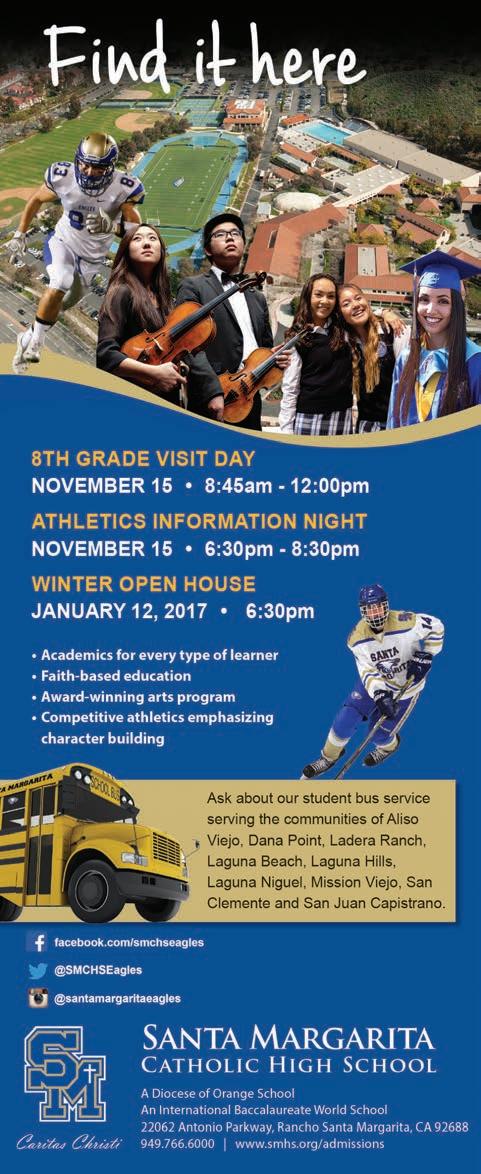
It Takes a Village (Continued) and activities; competitive, character-building athletics; and an award-winning arts program—all in a nurturing, Christ-centered environment—Santa Margarita students are empowered to grow spiritually, intellectually, socially and morally. Santa Margarita has the distinction of being the county’s only Catholic International Baccalaureate high school and is ranked as the top Catholic high school in the county by www.niche.com and The Washington Post. The school’s beautiful 42-acre campus includes a Digital Media Studio, Eagle Athletic Center, Academic Services Center, modernized Library Media Center, Olympic-sized pool and Sacred Heart Chapel. Recognized as a Microsoft Showcase School, Santa Margarita’s Oneto-One Tablet PC Program provides an immersive educational experience preparing students for college and beyond. The Class of 2016 received $47.3 million in scholarship offers with 99 percent of the class continuing their education at the college level.
22062 Antonio Parkway, Rancho Santa Margarita. 949.766.6000. www.smhs.org.
Shoreline Dental Studio
Kristen Ritzau D.D.S.
Early and regular dental care is vital to children for both their health care and social confidence. At Shoreline Dental, we help kids keep their bright and healthy smiles by working hard to prevent tooth decay and support overall oral health. We encourage regular cleanings, promote healthy habits at home and offer helpful conservative solutions for patients that may need a bit of work. Whether it is taking a look at that first baby tooth or helping teenagers whiten their teeth for the Senior Prom, Dr. Kristen Ritzau and staff provide nothing but the best care for the entire family. We offer a number of sedation options for kids and adults alike. As someone who grew up in San Clemente and is a mom of a 2-year-old, Dr. Ritzau loves to give back to the community that helped raise her.
122 Avenida Cabrillo, San Clemente. 949.245.6046. info@shorelinedentalstudio.com.
St. Anne School
Nurture with care. Teach with creativity. Embrace life. Treasure faith. These are the guiding principles that shape St. Anne School, a private, independent Catholic school that welcomes preschool through eighth grade students of all faiths. St. Anne’s mission is to develop future generations of creative thinkers, innovative problem solvers, effective communicators and emerging leaders, guided by the Catholic faith, to
influence our local and global communities for the greater good.
The St. Anne experience promotes a love of learning through rigorous academic, artistic and athletic programs. With the guidance and dedication of faculty, students gain a solid foundation rooted in problemsolving, collaboration, creative expression, leadership, faith, technology and global citizenship.
We invite you to see for yourself all that St. Anne has to offer. Join us for our Admission Open House on Thursday, Jan. 12 ,from 9-11 a.m. RSVP to admissions@st-anne.org, or call 949.276.6753.
Founded in 1979, St. Margaret’s Episcopal School is the premier, independent, collegepreparatory day school in Orange County serving 1,234 students in preschool through grade 12. A vibrant learning community where natural curiosity and academic pursuit flourish, St. Margaret’s educates the hearts and the minds of students to nurture the whole child. Students have unlimited opportunities to discover and explore interests and passions in humanities, STEM, arts, athletics, leadership and service.
The school’s Episcopal identity and mission drive a deep commitment to nurturing the growth and development of every student; who they are today and who they will become tomorrow. This enduring focus on shaping the lives of young people fosters a spirit of compassion, excellence and innovation in every aspect of the St. Margaret’s experience.
The school’s reputation for the depth and quality of its academic program brings more than 150 colleges and universities to campus annually to recruit its graduates. Boston College, Brown University, Cornell University, Duke University, Emory University, Georgetown University, New York University, University of Notre Dame, University of Pennsylvania, Stanford University and Villanova University are some of the fine institutions that welcomed St. Margaret’s graduates from the Class of 2016 this fall.
St. Margaret’s is situated on a picturesque 22-acre campus nestled in historic San Juan Capistrano, California, with dedicated campuses for each school division, worldclass learning environments and technologies, including a performing arts center, library, science and technology labs, library, athletics fields, gymnasiums and campus commons.
With 2,000 alumni who have matriculated to colleges and universities across the country, St. Margaret’s is a vital member of the San Juan Capistrano community and educational landscape of Southern California.
31641 La Novia, San Juan Capistrano. 949.661.0108 www.smes.org
Ways to Save FOR COLLEGE
By Matt Cortina
With college tuition expected to continue its steady climb—pending presidential and legislative changes, of course—and educational expenses skyrocketing, many parents are trying to figu e out the best way to ay o thei child en s educations wo o ula o tions o sa ing unds a e the o e dell ducation a ings ccount and the a ings lan oth o e ta ee o ta de e ed in est ent o tions, with ta ee dist ibution o whate e s in the account o educational e enses he e a e di e ences between the accounts ene ally s eaking, s o e o e in est ent o tions and can be used o o e educational e enditu es than s, while lans allow o uch o e oney to be in ested into the lan o o e in o ation, e iew the cha t outlining basic in o ation about both lans
A Coverdell ESA is a savings account that you can set up at many banks or financial institutions and can be used to pay the qualified education expenses of a designated beneficiary, as in one of your children. The ESA generally allows a lot of investment options, and contributions are made with after-tax money, and there are strict contribution limits for each individual ESA. Withdrawals for qualified education expenses are tax-free, and for the most part, any income or gains made on investments in the ESA is tax-free.
Tax-free distributions from the ESA can be spent on “qualified education expenses,” as long as the designation beneficiary of the account was under 18 when the ESA was created. Qualified education expenses include a number of school-related expenditures for both K-12 and college students. These include, generally, tuition and fees, books, supplies, equipment (including technology like computers), expenses for special needs services, and room and board under certain circumstances. It also includes uniforms and tutoring for K-12 students.
You can only contribute up to $2,000 per year to any given ESA. A person under 18 may only have one ESA in his or her name, but a person may contribute to multiple ESAs. Also anyone, not just the account opener or parent, may contribute to any ESA, but the total contributions from all parties to one ESA may still not exceed $2,000.
ESA holders enjoy a wide variety of investment options. ESAs can be opened by any nymber of banks or IRS-approved entities in the U.S. Generally speaking, ESAs can be invested in anything except collectibles, with the exception of U.S. Treasury coins. This includes mutual funds, stocks, bonds, money market funds and more. Earnings in an ESA grow tax-free.
You may not be able to contribute to an ESA if your income is larger than $110,000 for single filers and $220,000 for joint filers. Also, a beneficiary’s receipt of ESA funds for educational expenses may limit his or her ability to receive financial aid.
Fees vary greatly in ESAs, depending on the financial institution that manages the account. Fees can include start-up costs, per-investment move and more.
A 529 Savings Plan is a state-run investment accont where earnings grow income tax-deferred and withdrawls are tax-free when spent on qualified educational expenses. Each state has their own 529 plan, which is usually operated by a third-party financial organization. For the most part, residents of any given state can open a plan in any other state, and there are few contribution limits to these plans. Some states allow for 529 contributions to go toward a prepaid tuition plan at participating universities, but California is not one of those states.
Money from 529 plans can be distributed tax-free when used on “qualified education expenses” such as tuition, some room and board fees, books, supplies and equipment including computers, internet access fees, software and more. Special needs students can use 529 funds on additional costs required for enrollment. Crucially, 529 plans cannot be used on K-12 students as they are only reserved for higher education costs.
Contribution limits vary from state to state, but are generally much higher than ESAs. In California, for instance, a 529 plan has a total contribution limit of $371,000. Although some states allow tax deductions for contributions to a 529 plan, California does not.
A variety of investment options are afforded any given state’s 529 plan, but usually plan administrators will offer a selection of options, including index funds, mutual funds and combinations therein. There are basic categories of investment portfolios specific to 529 plans, including age-based investment portfolios, which switches from an aggressive to a conservative investment strategy as the beneficiary gets closer to college age. There’s also a guaranteed option, where the objective is to preserve the money invested in it with little risk. And under tax law, an account holder may only change their investment strategy one time per year.
There are no income limits for most 529 plans. However, the beneficiary of a 529 plan may be less eligible for financial aid.
Fees are variable and based on the type of 529 plan selected. Some of the fees are collected by the state, and some are collected by the financial institution administering the plan. Some college savings plans will reduce or waive fees if the account balance is large, or the plan owner participates in the state’s plan in which they live—California generally offers lower fees than other states.