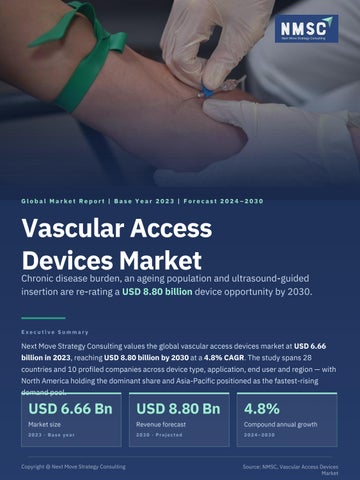
Global Market Report | Base Year 2023 | Forecast 2024 –2030
Vascular Access Devices Market
Chronic disease burden, an ageing population and ultrasound-guided insertion are re-rating a USD 8.80 billion device opportunity by 2030.
Executive Summary
Next Move Strategy Consulting values the global vascular access devices market at USD 6.66 billion in 2023, reaching USD 8.80 billion by 2030 at a 4.8% CAGR. The study spans 28 countries and 10 profiled companies across device type, application, end user and region — with North America holding the dominant share and Asia-Pacific positioned as the fastest-rising demand pool.
USD 6.66 Bn
USD 8.80 Bn
4.8%
Market size
Revenue forecast
Compound annual growth
2023 · Base year
2030 · Projected
2024–2030
Market Landscape
A steady-compounding USD 8.8 Bn essential-care market CAGR 4.8%
Market size trajectory, 2023 → 2030 (USD Billion)
6.66
6.98
2023
2024
7.66
2026
8.40
8.80
2029
2030
2023 and 2030 values reported by NMSC; interim years interpolated at the reported 4.8% CAGR for illustration.
Anchor valuation. The market stood at USD 6.66 Bn in 2023 and is predicted to reach USD 8.80 Bn by 2030 — a 4.8% CAGR that reflects non-discretionary, procedure-linked demand rather than cyclical capex. Essential-care positioning. Catheters and cannulas underpin IV therapy, central and arterial access, drug and nutrition delivery, and diagnostic blood draw — consumable
volumes that scale with admissions, not with hospital budget cycles. Two-tier device structure. Central devices (PICCs, percutaneous non-tunnelled catheters) carry higher clinical acuity and price; peripheral devices (peripheral and midline catheters) carry the volume. Coverage depth. NMSC scope spans 28 countries, 10 profiled companies with companylevel share, plus SWOT, Porter's Five Forces and value-chain analysis. Industry Ecosystem
D e v i c e T y pe
A ppl ic at io n
En d U se r
Re g i o n
Central vascular access — PICCs, percutaneous non-tunnelled and other central catheters; peripheral — peripheral and midline catheters.
Administration of drugs; administration of fluid and nutrition; diagnostics; testing.
Hospitals and clinics as the primary channel, followed by diagnostic centres and other care settings including ambulatory.
North America leads on share; Europe, AsiaPacific and Rest of World complete the four-region split.
Copyright @ Next Move Strategy Consulting
Source: NMSC report data
Growth Drivers & Opportunities
Disease burden and demographics set the demand floor Chronic disease volume. CKD affects 10.4% of men and 11.8% of women globally (ISN), with 13.3 million acute kidney injury cases a year; some 37.3 million US adults live with diabetes (NDSR 2022). Ageing demographics. The 60-plus population reached 1.4 billion in 2020, projected at 2.1 billion by 2050 (WHO, 2022) — a structural lift in admissions and catheter days. Ultrasound guidance is the upgrade cycle. Real-time vein imaging lifts first-attempt success in difficult access — commercialised in BD's Prevue II and Site-Rite 9 platforms (Dec 2023). Watch-item. High investment cost against constrained hospital budgets is the principal restraint on premium device adoption.
High-Growth Segments & Regional Opportunity Map
Where the growth concentrates
Le ading shar e
Relative opportunity weighting, qualitative
North America
PICC / central access
High
Dominant share through the forecast — leading manufacturers, deep distribution, robust infrastructure.
Peripheral & midline catheters
High
Drug administration
High
FDA sought a USD 7.2 Bn FY2024 budget.
Faste st r ising
Asia-Pacific Fluid & nutrition delivery
Moderate
Rising on a large aged population — Japan alone reports 36.2 million people aged 65+ — plus ADB's USD 650 Mn
Diagnostics & testing
Moderate
primary-care loan in Indonesia.
So What — For Capital Allocators
Investors
Strategy teams
B2B buyers
Defensive 4.8% compounder with consumable revenue and low substitution risk.
Bundle ultrasound guidance with catheters to defend price against budget pressure.
Fewer insertion attempts and lower thrombus risk carry the procurement business case.
Copyright @ Next Move Strategy Consulting
Source: NMSC; ISN; WHO 2022; FDA; ADB
Competitive Scenario
Technology differentiation →
Scale incumbents defend; specialists win on materials Competitive positioning matrix — 10 profiled companies
Bubble size ≈ breadth of access portfolio
Becton, Dickinson
Access Vascular
Teleflex B. Braun Melsungen
ICU Medical
Nipro
Siemens Health.
Medtronic Cook Medical
Fresenius
Commercial scale & distribution reach → Positioning is NMSC's qualitative read of the profiled player set; it is not a share ranking. Company-level share is available for all 10 companies in the full report.
A consolidated leadership tier. Becton Dickinson, Teleflex, B. Braun Melsungen, ICU Medical, Medtronic, Cook Medical, Fresenius Medical Care, Nipro, Siemens Healthineers and Access Vascular constitute the profiled competitive set. Two playbooks, one market. Diversified incumbents defend installed base through distribution and ultrasound-enabled placement platforms; focused entrants attack on catheter material science and thrombus reduction. Strategy mix. Product launches and acquisitions are the dominant levers used to hold position, alongside divisional build-outs that add cardiovascular and imaging adjacencies. Investment read. Regulatory clearance on complication-reducing designs is the credible route to displacing incumbent catheter volume and the most likely trigger for the next round of M&A. Recent Strategic Moves
May 2022 · Clearance
Jan 2022 · Acquisition
Apr 2021 · Expansion
Access Vascular
ICU Medical
Nipro Medical
FDA 510(k) for the HydroPICC duallumen PICC, engineered to minimise thrombus accumulation.
Copyright @ Next Move Strategy Consulting
Acquired Smiths Medical from Smiths Group, adding vascular access, syringe and ambulatory infusion lines.
Created a US Vascular Division combining vascular, cardiovascular and imaging solutions for clinicians.
Source: NMSC report data
Thank You
Let's turn this data into your next move Connect with our analyst team for segment-level sizing, company market shares for all 10 profiled players, and strategic guidance tailored to your entry, expansion or investment thesis. Every purchase includes free customisation equivalent to up to 80 analyst hours. Call to Action — Access the complete report
nextmsc.com/report/vascular-access-devices-market
Official Website
www.nextmsc.com ✆
Report Snapshot
Contact Number
Base year
+1 857 758 5017
Forecast period
2024–2030
2030 forecast
USD 8.80 Bn
info@nextmsc.com
Countries covered
28
Companies profiled
10
Follow Us
in f
LinkedIn linkedin.com/company/next-move-strategy-consulting
linkedin.com/company/next-move-strategy-consulting
Facebook facebook.com/Next-Move-Strategy-Consulting-112736100079742
facebook.com/Next-Move-Strategy-Consulting112736100079742
YouTube youtube.com/channel/UCJuVRxfBo-Dsog7BgDE4uPQ
youtube.com/channel/UCJuVRxfBo-Dsog7BgDE4uPQ
X ◎
Twitter / X twitter.com/nextmsc
twitter.com/nextmsc
Instagram instagram.com/nextmsc
instagram.com/nextmsc
2023