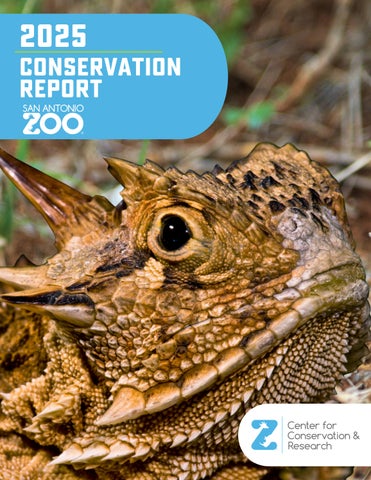
2025
conservation report
CENTER FOR CONSERVATION & RESEARCH From Texas waterways and grasslands to the rainforests of South America, the Center for Conservation & Research at San Antonio Zoo advances science-driven solutions for wildlife and the places they call home. In 2025, our teams strengthened species recovery efforts through field research, specialized animal care, collaborative monitoring and community partnerships. Working with government agencies, universities, conservation organizations and private landowners, the Center supports projects across three continents, with a particular commitment to Texas wildlife. Its work spans fish, amphibians, reptiles, invertebrates and threatened ecosystems. Findings inform conservation management, expand scientific understanding of species biology and contribute to technical reports and peer-reviewed research. Together, these efforts further our vision to secure a future for wildlife.
SAN ANTONIO ZOO’S GLOBAL CONSERVATION WORK
FIELD RESEARCH
SPECIES RECOVERY
COMMUNITY PARTNERSHIPS
LASTING IMPACT
1
TABLE OF
CONTENTS Message from the Vice President of Conservation & Research
3
Texas Horned Lizard Reintroduction Project
4
Project Selva
6
Patagonian Frog Conservancy
9
DEEPEND Restore
11
Ozark Cave Work and Cave Crayfish
12
Spring Salamanders
14
Other Conservation Programs
15
Conservation Efforts Across San Antonio Zoo
16
Message from the Vice President of Conservation & Research Dear Friends and Supporters, In 2025, conservation efforts faced growing challenges, from habitat loss to reductions in state and federal funding. Despite these obstacles, San Antonio Zoo continued to demonstrate the vital role accredited zoos and aquariums play in protecting threatened and endangered species. Through innovative research, conservation breeding and global partnerships, our teams achieved significant milestones in securing a future for wildlife. Our Center for Conservation & Research (CCR) celebrated another successful year of Texas horned lizard breeding and releases, marking six consecutive years of reintroduction efforts at the same site. Early findings suggest released lizards are surviving and reproducing in the wild. In partnership with Texas Parks and Wildlife Department, Zoo Miami and other supporters, this program continues to advance the recovery of an iconic Texas species. Internationally, Project Selva expanded partnerships with Indigenous communities in the Peruvian Amazon, supporting habitat protection and sustainable economic opportunities. In Chile, our conservation team advanced research on endangered amphibians through field surveys, artificial intelligence and genetic data collection. Closer to home, CCR continued to build on its groundbreaking success with the endangered Salado salamander, following the first successful breeding, hatching and rearing of the species under human care in 2023. Our teams also advanced research and breeding efforts involving imperiled cave crayfish and the Georgia blind salamander, strengthening scientific knowledge essential to protecting these vulnerable species. Across San Antonio Zoo, our animal care teams made important contributions to conservation. Aquarium programs advanced recovery efforts for endangered pupfish and other imperiled freshwater species, while our ectotherm team continued pioneering work with Sunda gharials. Our avian conservation programs supported threatened species, including Guam kingfishers, whooping cranes and palm cockatoos. The opening of Congo Falls marked another milestone, welcoming seven western lowland gorillas and strengthening our commitment to gorilla conservation through partnerships with organizations including GRACE and the Dian Fossey Gorilla Fund. Additional efforts involving cotton-top tamarins, Matschie's tree kangaroos and okapi further demonstrated our commitment to conservation breeding and sustainable wildlife populations. Our impact also extended through new initiatives, including the launch of Edge of the Earth: Tales of Conservation, a podcast connecting audiences with conservation experts worldwide, and collaborative fieldwork supporting the recovery of the critically endangered Mazama newt in Oregon. These accomplishments reflect the expertise, dedication and collaboration of our teams and conservation partners. As we look ahead, San Antonio Zoo remains committed to advancing scientific discovery, strengthening global partnerships and protecting wildlife for generations to come. Thank you for your continued support of our mission to secure a future for wildlife.
Danté Fenolio
VP, Conservation & Research
3
Texas horned lizard reintroduction project Since the late 1960s, Texas horned lizard populations have declined or disappeared in many areas due to habitat fragmentation and loss, the introduction of non-native species such as exotic grasses and red imported fire ants, and pesticide use. In 1977, the Texas Parks and Wildlife Department (TPWD) listed this species as threatened. The Texas Horned Lizard Reintroduction Project (THLRP) at the Center for Conservation & Research (CCR) at San Antonio Zoo was established in 2016. The project seeks to restore Texas horned lizard populations by working with private landowners to introduce zoo-hatched lizards in areas from which they have disappeared.
MILESTONES & ACCOMPLISHMENTS 1
In 2025, the team released 36 zoo-hatched Texas horned lizards into restored native habitat, bringing the cumulative total released on the property since 2020 to 324.
2
Field surveys continued at the release site, where staff and volunteers collected scat samples for genetic identification by Texas Christian University.
Texas horned lizards have different genetics depending on what geographical region they live in.
4
MILESTONES & ACCOMPLISHMENTS 3
Conducted tours for collaborators, donors, researchers, students and other interested parties. These included students from the University of Texas at San Antonio (UTSA), Angelo State University and Schreiner University; staff from San Antonio Water System (SAWS) and San Antonio River Authority (SARA); and groups from the Aquarium & Zoo Facilities Association (AZFA).
4
The team advanced reproductive research on Texas horned lizards through 12 semen-collection attempts comprising 24 individual trials. Three trials successfully collected seminal fluid for microscopic examination, contributing to the project’s understanding of reproductive methods and sample quality.
Horned lizards can shoot blood out of their eyes as a defense mechanism when threatened!
5
PROJECT SELVA Project Selva brings together Indigenous communities in the Peruvian Amazon with San Antonio Zoo, Roger Williams Park Zoo, Moody Gardens and Animal World & Snake Farm Zoo to protect rainforest on traditional Indigenous lands. Through a community-led cooperative, the project creates reliable income by supporting the sale of handmade artwork, including Japanese fish printing (gyotaku), wood carvings and woven figurines. This income helps communities meet urgent needs without having to sell logging or mineral extraction rights or clear land for agriculture during times of crisis. Project Selva also supports artist training and provides essential food, water and medicine. Designed by Indigenous community leaders, the project strengthens local livelihoods while advancing the long-term protection of wildlife and rainforest habitat.
MILESTONES & ACCOMPLISHMENTS 1
Project Selva expanded its conservation partnerships to include the Maijuna Indigenous community of the Sucusari River in the Peruvian Amazon. Through this collaboration, Maijuna artisans create handcrafted bird figurines using natural materials, which are available for purchase in San Antonio Zoo’s gift shops. These unique creations provide guests with an opportunity to directly support Indigenous communities and rainforest conservation. The partnership also introduced handcrafted whooping crane figurines, with proceeds supporting both Indigenous communities in Peru and ongoing whooping crane conservation efforts.
Project Selva supports the Maijuna Indigenous peoples of Peru who control a tract of rainforest larger than the state of Rhode Island.
6
MILESTONES & ACCOMPLISHMEnts 2
In 2025, Project Selva completed its annual bush-pilot flyover of Bora and Maijuna Indigenous territories in the Peruvian Amazon. These surveys play an important role in monitoring rainforest habitats for signs of commercial deforestation, supporting ongoing efforts to protect Indigenous lands and preserve the region’s rich biodiversity.
Our Japanese fish prints are available online at projectselva.org
7
MILESTONES & ACCOMPLISHMEnts 3
Project Selva artists expanded their collection of conservation-focused merchandise by introducing fish-printed button-up shirts and guayaberas. These handcrafted items will be available through the Project Selva website in exchange for donations, with 100% of proceeds supporting Indigenous communities working to protect the rainforest.
4
San Antonio Zoo connected board members, donors and supporters with its conservation partnerships in the Peruvian Amazon through an annual visit to the region. The visit offered firsthand opportunities to learn about rainforest ecosystems, meet Indigenous community partners and engage with the zoo’s conservation team in Iquitos, Peru.
8
Patagonian Frog Conservancy The Patagonian Frog Conservancy, led by San Antonio Zoo and Roger Williams Park Zoo for more than a decade, works alongside Chilean biologists to protect critically endangered amphibians in Chile’s temperate rainforests. This highly threatened ecosystem is home to many species found nowhere else on Earth. Conservation efforts include establishing breeding labs, monitoring emerging infectious diseases in wild amphibian populations, surveying remaining forest habitat and collecting and sharing genetic data. Together, these efforts provide critical information and resources to strengthen amphibian conservation strategies in Chile.
IN 2025... 1
The Patagonian Frog Conservancy team worked with specialists (Blumen AI) to develop a highly integrated artificial intelligence prediction model to improve habitat identification and monitoring capabilities in Chile. The model pinpointed dozens of potential habitat patches for some of the world’s most endangered amphibians and has prompted efforts to conserve a prime 6,500-hectare native forest tract known as “Predio el Bosque.”
9
2
To make on-the-ground monitoring a reality, the team started strategic discussions with Sylphium Molecular Ecology to develop a commercial environmental DNA (eDNA) detection kit. This tool will allow nonspecialized labs across Chile to easily detect endangered amphibians from water samples.
3
The Patagonian Frog Conservancy also began developing a digital hub (telmatobufo.cl) to share collected genetic data and mapped eDNA results. The project is also merging this new site with over a decade of our past Chilean amphibian conservation blog posts and basic conservation information from savedarwinsfrogs.org – our original website for the project.
4
The conservation team successfully preserved tissue samples from the endangered giant Chilean bullfrog (Calyptocephalella gayi) through biobanking, making these valuable genetic resources available for future scientific research.
5
The conservation team expanded international awareness of the Chile Mountains false toad through the publication of the children's story ‘Mila and the False Toad’ in the winter issue of Ranger Rick magazine.
10
dEEPEND RESTORE Through the DEEPEND-RESTORE collaboration, San Antonio Zoo contributes to a long-term effort with universities and museums to understand how oil spills affect wildlife in the Gulf’s deeper waters. Annual research expeditions sample wildlife at established stations and depths, allowing researchers to compare findings across years. The zoo supports wildlife photography, research coordination and public education that help document deep-sea biodiversity and communicate the project’s findings.
MILESTONES & ACCOMPLISHMEnts 1
During the 2025 expedition, the project documented more than 5,000 wildlife images, including photographs of species that may not have been photographed previously. Notable observations included a great swallower, a sea spider and a pencil smelt.
11
Ozark Cave Work and Cave Crayfish Subterranean Species Conservation
Since 2000, the Center for Conservation & Research (CCR) at San Antonio Zoo has worked to protect endangered and imperiled subterranean species across the Ozarks, Appalachians and southeastern United States. Through cave surveys, biodiversity assessments and partnerships with wildlife agencies, the project advances scientific understanding and conservation strategies for these vulnerable species. CCR has also established specialized laboratories to develop care and breeding protocols for groundwater species, helping safeguard populations against habitat loss and environmental threats. These efforts have contributed to groundbreaking reproductive successes involving the Georgia blind salamander, Dougherty Plain cave crayfish and Oklahoma cave crayfish. CCR also supports conservation efforts for federally endangered species, including the Texas blind salamander and Comal Springs riffle beetle.
PROJECT PARTNERS Rogers State University U.S. Fish and Wildlife Service University of Alabama in Huntsville New Jersey Institute of Technology State Wildlife Agencies Tulsa Regional Oklahoma Grotto The Nature Conservancy
12
MILESTONES & ACCOMPLISHMENTS 1
In March, CCR staff and collaborators conducted a week of fieldwork in the Ozarks, including biodiversity inventories, environmental DNA (eDNA) sample collection and the fifth capturemark-release-recapture survey of cave crayfish in January-Stansberry Cave.
2
The Center for Conservation & Research shared findings from its Ozark cave conservation work through a research poster presented at the Texas Groundwater Invertebrate Forum.
3
CCR staff continued to care for adult cave crayfish, rear their offspring and monitor their growth rates. Habitats were also improved with climbing and hiding structures to encourage natural behavior.
13
Spring Salamanders
(Salado and Fern Bank Salamanders) Since 2017, the Center for Conservation & Research at San Antonio Zoo has cared for the Salado salamander (Eurycea chisholmensis) and the Fern Bank salamander (Eurycea pterophila). Both spring salamanders are listed as endangered by the IUCN Red List of Threatened Species. The CCR is the only institution managing Salado salamanders onsite and was the first to successfully breed, hatch and rear them in 2023. Recorded data has been submitted for publication in a peer-reviewed journal.
MILESTONES & & ACCOMPLISHMEnts ACCOMPLISHMENTS MILESTONES 1
The team successfully hatched a third viable clutch of Salado salamander eggs and reared the offspring.
2
The team completed significant habitat upgrades, adding limestone rocks, bubblers to simulate natural spring flow and ultraviolet (UV) lighting.
14
Edge of the Earth: Tales of Conservation Podcast Launched in 2025, “Edge of the Earth: Tales of Conservation” extends San Antonio Zoo’s conservation and education outreach through an interview-based podcast exploring wildlife, field research and conservation challenges. The series features conversations with conservation experts and guests, helping the department share its work and connect new audiences with the importance of protecting wildlife. Episodes are available in video and audio formats.
Scan the QR code to check out Edge of the Earth: Tales of Conservation
OTHER CONSERVATION PROGRAMS Southeastern Cave & Groundwater Bioinventory Georgia Blind Salamander (Eurycea wallacei) Western Grotto Salamander (Eurycea spelaea) Texas Blind Salamander (Eurycea rathbuni) Mexican Blind Catfish (Prietella phreatophila) Reticulated Flatwoods Salamander (Ambystoma bishopi) Other CCR Collaborations: Crater Lake Newt Project Consultation Collaboration with University of California at San Diego Collaboration with University of Texas at Austin (UT) and St. Mary’s University
15
conservation Efforts
ACROSS san antonio zoo Conservation efforts at San Antonio Zoo extend beyond the Center for Conservation & Research, encompassing a diverse range of wildlife species from around the world. From threatened amphibians and reptiles to rare birds and mammals, these species represent the zoo’s ongoing commitment to protecting biodiversity and securing a future for wildlife.
ectotherms Pu
p fis h
BIRDS Swan goose Guam kingfisher Laysan teal Palm cockatoo Bali myna Bleeding-heart doves Bird-of-paradise Chilean flamingo Congo peafowl Whooping crane Wreathed hornbill White-winged duck Guam rail (ko’ko’) African crowned cranes Northern helmeted curassow Madagascar teal Peruvian thick-knee Southern ground-hornbill
Pupfish Sunda gharial Bolson tortoise Burmese black tortoise New Mexico ridge-nosed rattlesnake (Project Obscurus) Endangered mosquitofish Puerto Rican crested toad Viper Sustainability Group Mexican montane reptiles and amphibians
MAMMALS Matschie’s tree kangaroo Cotton-top tamarin Western lowland gorilla Okapi White rhinoceros Jaguar
16 Guam kingfisher
3903 N. St. Mary’s Street, San Antonio, TX 78212
sazoo.org