Carolyn E. Channell, Southern Methodist University
Timothy W. Crusius, Southern Methodist University
CHAPTER
11
Arguing to Persuade 250
What Is Persuasion? 250
Why Write to Persuade? 251
How Do Writers Persuade? 252
THE ASSIGNMENT 259
What Can I Write About? 259
How Do I Appeal for Action?
Questioning the Rhetorical Situation 259
How Do I Write Persuasively?
Engaging the Writing Process 261
READINGS
Soaking It All In by Nicolas Brulliard 253
Grocery bags and takeout containers aren’t enough. It’s time to phase out all single-use plastic, by L. A. Times Editorial Board 256
STUDENT EXAMPLE
Is Too Much Pressure Healthy? by Natsumi Hazama 272
CHAPTER
12
Writing an Evaluation 277
What Is an Evaluation? 277
Why Write to Evaluate? 278
How Do Writers Evaluate? 279
THE ASSIGNMENT 291
What Can I Write About? 291
How Do I Write an Evaluation? Questioning the Rhetorical Situation 291
PART III
Researching Writing 341
CHAPTER 15
Planning a Research Project 342
When Is Research Necessary? 343
How Do I Write an Evaluation?
Engaging the Writing Process 293
READINGS
Samsung Galaxy S9 Review by Julian Chokkattu 280
The Promises and Pitfalls of Online Education by Eric Bettinger and Susanna Loeb 286
STUDENT EXAMPLE
Is Classic Status Out of Reach? by Collin Dobmeyer 299
CHAPTER 13
Choosing Modes of Development 303
What Are the Modes? 303
How Do Writers Choose Modes? 305
What Do the Modes Look Like in Detail? 306
How Can I Develop a Repertoire of Modes? 324
READING Repatriation Raises Questions That Resist Sweeping Answers by Ioannis D. Stefanidis 304
CHAPTER 14
Editing Fundamentals 326
What Is Editing? 327
Why Edit? 327
How Do Writers Edit? 328
What Is the Spiraling Down Method? 328
What Matters Most in Editing? Three Key Points 339
What Kinds of Sources Do College Researchers Use? 343
How Do I Plan a Research Project? 347
How Do I Choose and Narrow a Topic? 350
How Do I Turn a Topic into a Research Question? 351
How Do I Manage the Sources I Find? 352
CHAPTER
16
Finding Sources 358
How Do I Conduct a Keyword Search? 358
What Resources Can I Find through My College Library? 361
How Do I Find Reference Works through My College Library? 362
How Do I Use a Library Catalog to Find Books and Other Resources? 364
How Do I Use Library Databases to Find Articles? 365
How Do I Use the Web to Find Reliable Websites and Online Journals? 366
How Do I Find Interactive Online Sources? 369
How Do I Generate My Own Information? 369
CHAPTER
17
Evaluating Sources 372
How Do I Decide If a Source Is Useful? 372
How Do I Decide If a Source Is Reliable? 373
How Do I Evaluate a Website? 375
How Do I Recognize False Information? 377
CHAPTER
18
Incorporating Source Materials 379
What Does It Mean to Enter the Conversation? 379
How Does Informal Writing Engage Me in the Conversation? 380
How Do I Draw Connections between Sources? 384
What Roles Can Sources Play in My Writing? 385
What Are My Options for Bringing in Source Material? 386
How Do I Acknowledge, Integrate, and Cite My Source Materials? 391
What Are the Options for Acknowledging Sources? 393
How Can I Integrate Source Material into My Writing? 394
How Do I Document My Sources? 399
How Do I Incorporate Sources without Losing My Own Voice? 399
READING The Slow Movement and Slow Reading by John Miedema 381
CHAPTER 19
Using Sources Responsibly 401
What Is Plagiarism? 401
When Do I Need to Cite My Sources? 402
How Can I Avoid Plagiarizing? 405
CHAPTER
20
Documenting Your Sources: MLA 407
How Do I Make In-Text Citations Using MLA Style? 407
How Do I Make Entries in the Works Cited List Using MLA Style? 412
STUDENT EXAMPLE IN MLA STYLE
The Benefits of Slow Reading in Our Fast-Paced Culture by Kyle Van Buskirk 426
CHAPTER 21
Documenting Your Sources: APA 433
How Do I Make In-Text Citations Using APA Style? 433
How Do I Make Entries in a Reference List Using APA Style? 438
STUDENT EXAMPLE IN APA STYLE
Popularity’s Downside: Valuing Quantity over Quality in Friendship by Audra Ames 450
Contents
PART IV
Writing in the Genres 457
CHAPTER
22
Writing a Rhetorical Analysis 458
What Is a Rhetorical Analysis? 458
Why Write a Rhetorical Analysis? 459
What Can I Write About? 461
How Do I Prepare to Write a Rhetorical Analysis? 461
What Are the Steps in Writing a Rhetorical Analysis? 462
STUDENT EXAMPLE
Rhetorical Analysis of the Section on the Church in “Letter from Birmingham Jail” by Ginny Norton 459
CHAPTER
23
Writing a Reflection 464
What Is a Reflection? 464
Why Write a Reflection? 465
What Can I Write About? 467
How Do I Prepare to Write a Reflection? 468
What Are the Steps in Writing a Reflection? 469
READING The Wonder of Ordinary Places by Julian Hoffman 465
CHAPTER 24
Writing a Visual Analysis 472
What Is a Visual Analysis? 472
Why Write a Visual Analysis? 473
What Can I Write About? 476
How Do I Prepare to Write a Visual Analysis? 477
What Are the Steps in Writing a Visual Analysis? 478
STUDENT EXAMPLE Three Girls in a Kentucky Kitchen by Ashley Jarol 474
CHAPTER
25
Writing a Literary Analysis 480
What Is Interpretation? 481
Why Interpret Literature? 481
How Do Writers Interpret Literature? 482
THE ASSIGNMENT 484
How Do I Write an Interpretation?
Questioning the Rhetorical Situation 485
How Do I Write an Interpretation?
Engaging the Writing Process 486
READINGS
Stopping by Woods on a Snowy Evening by Robert Frost 483
Désirée’s Baby by Kate Chopin 499
STUDENT EXAMPLE
The Futility of Control in “Désirée’s Baby” by Deniz Bennetts 495
CHAPTER
26
Writing an Editorial or Opinion Column 504
What Is an Editorial? 504
Why Write an Editorial? 505
What Can I Write About? 507
How Do I Prepare to Write an Editorial? 508
What Are the Steps in Writing an Editorial? 509
READING Opinion Dressed Up as Fact: Who Can We Trust for Our News? by Nicole Anderson 505
CHAPTER
27
Writing a Proposal 511
What Is a Proposal? 511
Why Write a Proposal? 512
What Can I Write About? 514
How Do I Prepare to Write a Proposal? 515
What Are the Steps in Writing a Proposal? 516
READING Promoting College Affordability by National Association of Independent Colleges and Universities 513
CHAPTER
28
Writing a Research Proposal 518
What Is a Research Proposal? 518
Why Write a Research Proposal? 519
What Can I Write About? 519
How Do I Prepare to Write a Research Proposal? 522
What Are the Steps in Writing a Research Proposal? 522
READING Research Proposal for a Paper, “Civility in the Workplace” by Amie Hazama 520
CHAPTER
29
Writing an Annotated Bibliography 524
What Is an Annotated Bibliography? 524
Why Do Writers Create Annotated Bibliographies? 524
What Should an Annotation Include? 525
What Do Annotated Bibliography Entries Look Like? 525
How Can I Support Academic Honesty When Writing Annotations? 527
CHAPTER
30
Writing Instructions 528
What Are Instructions? 528
Why Write Instructions? 529
What Can I Write About? 531
Contents xi
How Do I Prepare to Write Instructions? 531
What Are the Steps in Writing Instructions? 532
EXAMPLE How to Do the Heimlich Maneuver by the Deaconess Heimlich Institute 529
CHAPTER
31
Writing and Giving Oral Presentations 534
What Are Oral Presentations? 534
How Do I Prepare an Oral Presentation? 539
How Do I Rehearse an Oral Presentation? 540
How Do I Revise an Oral Presentation? 541
How Do I Deliver an Oral Presentation? 541
What Are Some Key Points to Remember? 542
STUDENT EXAMPLE
Date Rape Coasters by Jaclyn Jenkins 535
CHAPTER 32
Designing Documents and Using Graphics 543
What Are Document Design and Graphics? 543
Why Consider Document Design and Graphics? 544
How Does Document Design Work? 544
How Do Graphics Work? 548
What Are the Common Model Documents? 554
What Matters Most in Document Design and Using Graphics? 560
EXAMPLES
Memorandum 557
Business Letter 558
Business E-Mail 559
CONNECT
EBOOK
®
CHAPTER 33
Claiming Voice 562
What Is Voice? 562
Why Care about Voice? 564
THE ASSIGNMENT 565
What Can I Write About? 565
What Is My Rhetorical Situation? 566
How Do I Claim My Voice?
Engaging the Writing Process 567
How Do I Use Spontaneous Style? 567
How Do I Use Conscious Style? 568
How Do I Extend My Voice? 571
STUDENT EXAMPLE
The Disappearing Neighborhoods by Julie Ross 575
CHAPTER
34
Writing Portfolios 579
What Is a Writing Portfolio? 580
Why Create a Writing Portfolio? 581
How Do Writers Prepare Portfolios? 582
THE ASSIGNMENT 584
How Do I Reflect? Questioning the Rhetorical Situation 584
STUDENT EXAMPLE
Reflective Writing by Wendy Dennehy 586
CHAPTER
35
Mastering Essay Exams 590
What Are Essay Exams? 590
Why Do Instructors Assign Essay Exams? 591
How Do Writers Approach Essay Exam Questions? 591
How Should I Prepare for an Essay Exam? 593
What Are Some Good Strategies for Taking an Essay Exam? 595
What Is the Value of Essay Exams? 600
STUDENT SAMPLE ESSAY
Exam Question and Answer 598
CHAPTER 36
Writing a Blog 601
What Is a Blog? 601
Why Write a Blog? 602
What Can I Write About? 604
How Do I Prepare to Write a Blog Post? 605
What Are the Steps in Writing a Blog Post? 606
What Are Some Special Considerations for Writing a Blog? 607
CHAPTER
37
Writing a Review 609
What Is a Review? 609
Why Write a Review? 610
What Can I Write About? 613
How Do I Prepare to Write a Review? 614
What Are the Steps in Writing a Review? 614
READING DFW’s First Dedicated Egyptian Restaurant Is a Perfect Culinary Ambassador by Brian Reinhart 611
CHAPTER
38
Writing a Prospectus 616
What Is a Prospectus? 616
Why Write a Prospectus? 617
How Does a Prospectus Function in Other Situations? 618
How Do I Prepare to Write a Prospectus? 619
What Are the Steps in Writing a Prospectus? 619
STUDENT EXAMPLE
Prospectus for “Multitasking: A Poor Study Habit” by Noelle Alberto 617
CHAPTER
39
Writing Résumés and Job Letters 621
Job-Related Correspondence 621
What Conventions Do Résumés Observe? 622
What Conventions Do Letters of Application Observe? 627
STUDENT EXAMPLES
Common Résumé Format by Kimberley M. VanLerBerghe 623
Scannable Résumé Format by Manny Konedeng 624
Letter of Application by Mary O. Mahoney 627
CHAPTER
40
Writing a Lab Report 629
What Is a Lab Report? 629
Why Write a Lab Report? 630
How Do I Prepare to Write a Lab Report? 633
What Are the Steps in Writing a Lab Report? 634
STUDENT EXAMPLE
Lab Report by Deborah A. Smith 630
CHAPTER
41
Writing an Abstract 637
What Is an Abstract? 637
Why Write an Abstract? 638
How Do I Prepare to Write an Abstract? 639
What Are the Steps in Writing an Abstract? 639
STUDENT EXAMPLE
Abstract of “Popularity’s Downside” by Audra Ames 638
Index I
Comprehensive digital handbook is available in ®
ACTIVITY 5.1 Writer’s Notebook
Assessing Your Materials
After you finish brainstorming your topic using the ten questions on page 89, step back and begin looking for patterns and convergences in the material. Do you see a dominant theme in your person’s life, something that she or he is always concerned with or pursuing? Do you detect fundamental loyalties or commitments, a basic philosophy, outlook, or set of controlling attitudes or values?
WHY ENGAGING QUESTIONS?
The Spirit of Writing as Discovery
Profiles create memorable impressions, and therefore you need to be seeking the impression you want to create for yours. You may not know yet what it will be, but probably somewhere in your first exploration there are clues or intuitions. Write them down, even if you have doubts, even if some of the details do not fit. You are not committing yourself to anything yet, but you need some first ideas for further thought and to help guide the research you will probably need to do. ■
Preparing to Write
Engaging Questions is dedicated to the spirit of writing as discovery, encouraging students to interact—with the texts they read and write, as well as with peers, professors, and others involved in a writing project. By emphasizing interaction and critical thinking, Engaging Questions transforms passive learners into active learners empowered to ask their own questions and pursue those questions wherever they lead:
■ In reading and thinking before writing, to interpret texts and assignments and to evaluate the credibility of sources.
Thesis (Claim)
■ In planning and organizing, to investigate the writing situation, to find a topic, and to formulate a coherent thesis.
Reason 1 (Because...)
Reason 2 (Because...)
■ In drafting, to consider choices of style, voice, and genre and question the effectiveness of the choices made.
Evidence (Supports Reason 1)
Evidence (Supports Reason 2)
Reason 3 (Because...)
See Chapter 16, Finding Sources, and Chapter 17, Evaluating Sources, for more on using print and online materials.
■ In revising and editing, to anticipate readers’ experience with the text and see where changes could make the text more readable and effective.
You can see from the example profiles at the beginning of this chapter that the amount of research required varies considerably. Achenbach’s profile drew extensively on the files of McPhee’s students; Murphy drew on her extensive experience with the Meadowlands and what was written about them by others. How much you need depends on how long you have known and how well you know the person you have chosen and on your instructor’s assignment requirements.
Judge a person by their questions, rather than their answers. VOLTAIRE
Interviewing is the most common form of research in doing profiles, and we will devote special attention to it shortly. What other ways of acquiring information might be available to you?
BEST PRACTICES Sources of Information for Profiles
1. Besides interviewing the person you are profiling, talk to people who know your subject as well as or better than you do, such as friends, associates, family members, and other relatives.
Reason 4 (Because...)
2. Find out if your person has written anything that you might gain access to: articles, books, texts for speeches, diaries, journals, blogs, even e-mail exchanges she or he might be willing to share.
3. Ask if you may look at scrapbooks or photo albums your subject might have.
Evidence (Supports Reason 3)
Evidence (Supports Reason 4)
4. Look for information via Google, news stories you can find via your local paper’s index or your library’s databases (see pages 364–66), Who’s Who publications, résumés, bios written by your subject or by someone else, and so on. Ask your subject for help in accessing such information.
5. Arrange to attend meetings or other gatherings of people in which your subject plays a prominent role.
The flow chart above shows the structure of a case. A claim can be supported by one or more reasons.
CONCEPT CLOSE-UP
Visualizing the Structure of a Case
cha56065_ch05_074-102.indd
A case has the following structure:
The claim answers the question, What are you asserting?
Reasons answer the question, Why do you make this claim?
Evidence answers the question, What information confirms your reasoning?
Why Make a Case?
An Inquiry-Based Approach
An issue is controversial when reasonable people take different positions on it. One reason to make a case is to convince readers to accept one of those positions. For example, perhaps you feel that texting and talking on a handheld cell phone while driving should be banned. In an editorial or a blog you could make the case by pointing out how dangerous it is.
Engaging Questions works equally well as a print text in a traditional classroom or as an ebook in courses of all kinds. No matter the setting or format of your course, and regardless of the kinds of writing you teach, everything comes together in the art of questioning, in writing as discovery.
With Engaging Questions, students will learn to see writing as essential to thinking, discussing, and reading, all of which develop around the questions they pose and pursue. These key questions are built into each assignment chapter, guiding students through a process that is both creative and critical, inviting genuine engagement, and preparing them to become skilled thinkers and confident writers.
Part I of Engaging Questions assists students in developing a set of highly transferable skills that they will return to again and again whenever critical thinking, reading, and writing are in play. Students will learn to ask fundamental questions about their own writing, as well as that of others, such as:
■ What is the rhetorical situation?
Convincing other people, however, is not the only motivation for making a case. We all have casual opinions we have never thought through. How valid is one of the unexamined opinions you have? The best way to answer that question is to attempt to make a case for it. If you cannot make a good one that other people find convincing, it may be time to change or modify your opinion. Making a case, then, is not only a challenge to convince others but also a testing of how sound your own opinions and reasoning are.
■ What is critical reading?
■ What could I write about?
The Rhetorical Triangle Aristotle identified three types of appeals used to persuade.
Parts II, III, and IV introduce students to the specific questions that apply to each kind of writing and to such related activities as doing research, making an argument, avoiding plagiarism, and speaking to groups. For example:
■ How do writers make a case?
■ How do I write a visual analysis?
■ How do I decide if a source is reliable?
■ How do I deliver an oral presentation?
In the third edition of Engaging Questions , each chapter will open with a list of such questions, establishing the framework of that chapter as well as the learning objectives covered therein. The result is an innovative, comprehensive, and coherent approach to writing instruction.
Highlights of the Third Edition
For example, to save money and for other reasons, Americans are looking for alternatives to cars. One of these alternatives is the motorcycle
or scooter. Suppose you were writing an essay entitled, “Getting around on Two Wheels.”
First, what might you say to appeal to your readers’ sense of reason, or logos? You could argue that
■ Motorcycles cost far less than cars to buy and maintain.
■ They use on average about one-third as much gas.
■ They take up only about half as much parking space.
CHAPTER 14 Editing Fundamentals
■ With proper training and equipment, they are not as dangerous to operate as many people think.
ENGAGING QUESTIONS
Motorcycles could help solve many problems, including reduction in traffic, greenhouse gas emissions, and American dependence on oil.
In this chapter, you will engage with the following questions:
■ What does it mean to edit a piece of writing?
Next, how could you use pathos, or emotional appeals? The main value here is the fun of motorcycling. Motorcycles are the mechanical horse—you do not drive them, you ride them—and it should be fairly easy to appeal to the American love for freedom and adventure.
■ Why do writers edit their work?
■ How do writers evaluate their work for coherence and flow?
■ What key points can writers keep in mind when editing their work?
Finally, how could you appeal to ethos, or character? If you are a motorcyclist yourself, you could draw on your own experience. If not, interview friends who ride and cite what they say: You can borrow ethos from others, particularly if they are subject experts.
THE ART OF QUESTIONING What Really
IF YOU HAVE EVER GOTTEN A PAPER BACK COVERED WITH CORRECTION MARKS— for example, with comments in the margins like “What does this mean?” or “Don’t follow you here”—and marked with a grade lower than you anticipated, then you know what happens when you do not edit well. Instead of responding to what you have said, your instructor is responding to problems with how you have said it.
Persuades Us?
Many people say they are persuaded only by reasons and evidence. That is, logos matters most. Aristotle thought that ethos might be more powerful: If we think that a writer is intelligent, well informed, and trustworthy and has genuine concern for our needs, we will tend to believe most of what that person says. Look at advertising and you will probably conclude that pathos is the prime persuader. Nearly all ads appeal to emotions and attitudes most of all.
Look and listen for problems in the following sentence from a student’s paper:
One route that companies have already taken, and been successful, is to have meditation when something like sexual harassment occurs.
What do you think? Consider the last important decision you made. How did you persuade yourself to do one thing rather than another? If someone tried to persuade you, what kinds of appeal did the person use? Which of these appeals had the most impact on the decision you made?
If your ear heard how awkward the sentence sounds, you know it needs editing. If your eye saw that the writer meant “mediation” not “meditation”—one little “t” makes a big difference—you can eliminate a significant mistake.
Looking and listening are two essential editing skills. A third skill is rewriting to solve problems. Consider this edited version of the sentence:
One successful route companies have already taken is to mediate sexual harassment disputes.
No one will be irritated or distracted by this sentence. It says what the writer meant, and the reader will understand its meaning immediately. In short, nothing interferes with the meaning coming through. That is what editing is all about.
The third edition of Engaging Questions continues to use critical thinking, reading, and writing as its framework for instruction. The new edition also features the following significant updates:
You can learn to edit. A little knowledge about grammar can help, but you will need practice above all. Editing is a skill, learned as you do it. This chapter provides the fundamentals:
■ Understanding the process of editing and how it fits into the writing process
■ Knowing common problems to look and listen for
■ The table of contents has been redesigned to foreground the instruction and assignment types that are critical to the first-year writing course and makes this coverage accessible in the print edition as well as in the ebook. Two new chapters feature coverage of literary analysis—including a new student sample paper—and writing résumés and letters of application.
■ Applying strategies for solving problems you find
■ Learning objectives tied to each main section of chapter coverage align across print and digital editions, as well as in instructor support materials. Within the text, these objectives are presented as sets of questions for students to consider at the start of each chapter. Instructors will find the same content, posed as conventional objectives with Bloom’s levels and verbiage, within the Instructor’s Manual.
cha56065_ch14_326-340.indd 326 03/10/19 12:22 PM
■ Annotated reading selections, including formatted student papers, are now accessible within the ebook and conform to WCAG design requirements.
Here is a quick look at some of the other changes you will find within the chapters:
Chapter 1: Critical Thinking and the Art of Questioning
■ New op-ed example addresses the dangers of “alternative facts.”
Chapter 2: Reading Critically and the Art of Questioning
■ New A-head section instructs students on “dealing with the difficulties of scholarly texts.”
Chapter 4: Narrating Experiences
■ New professional reading by Brent Staples, “Just Walk on By: A Black Man Ponders His Power to Alter Public Space,” exemplifies narration in relation to the author’s own experience with everyday racism.
Preface
Chapter 5: Describing People and Places
■ Coverage of profiles has been expanded to cover “describing people and places,” including a new professional reading selection profiling New Jersey’s Meadowlands.
Chapter 6: Presenting Information
■ New professional informative reading presents data on the educational and professional opportunities available to young people today.
■ Throughout, refreshed examples demonstrate how to evaluate research effectively.
Chapter 7: Exploring a Concept
■ New professional example of concept exploration, written by sociologist Allan Johnson, asks the question “What Is a ‘System of Privilege’?”; a second example features Mark Twain’s classic “Corn-pone Opinions,” an exploration of the concept of conformity.
Chapter 8: Comparing Perspectives
■ Features a revised student paper that compares perspectives on the ethics of eating meat.
Chapter 10: Making an Argument
■ Previously titled “Making a Case,” this chapter teaches students how to develop their own opinions on controversial topics into a well-supported case, or argument.
■ Features a new professional example by teacher and blogger José Vilson who makes the case for more teachers of color.
Chapter 11: Arguing to Persuade
■ Previously titled “Appealing for Action,” this chapter now emphasizes instruction on persuasion and features two new professional examples of persuasive writing that make appeals for action—an op-ed from the LA Times on the banning of plastic bags and an article on the practice of forest bathing.
Chapter 12: Writing an Evaluation
■ Presents two new examples of evaluation, including a review of a smartphone and a professional report evaluating “the promises and pitfalls” of online education platforms.
Chapter 13: Choosing Modes of Development
■ Now available in the print edition of Engaging Questions, this chapter includes updated coverage of the various modes writers use to develop their work, as well as guidance on how these modes can be applied across assignment types.
■ New textual and visual examples throughout demonstrate modes of conceptual description, scientific description, and comparison and contrast.
■ New professional reading selection examines and calls out specific examples of the range of modes covered within the chapter.
Chapter 14: Editing Fundamentals
■ New professional examples demonstrate the moves a writer makes when editing for paragraph sequence and transitions.
Chapter 17: Evaluating Sources
■ Updated discussion and examples of evaluating sources for credibility and reliability.
■ Entirely new section addresses the question “How do I recognize false information?”
Chapter 18: Incorporating Source Materials
■ New professional reading by a specialist in information technology includes annotations that demonstrate effective note-taking on a source.
Chapter 20: Documenting Your Sources: MLA
■ Includes new instruction for citing online sources, including a new example citation for a video on YouTube.
Chapter 21: Documenting Your Sources: APA
■ Fully updated to reflect the latest guidelines put forth by the Publication Manual of the American Psychological Association, 7th edition.
New! Chapter 25: Writing a Literary Analysis
■ Entirely new coverage of literary analysis now includes instruction on how to interpret both poetry and short stories.
■ New coverage of poetry analysis walks students through Robert Frost’s “Stopping by Woods on a Snowy Evening.”
■ Chapter features full text of Kate Chopin’s “Désirée’s Baby” accompanied by a new student paper that analyzes the story’s themes for a contemporary audience.
■ New examples throughout demonstrate how to ask questions about the features of a story; how to find an angle for a literary analysis; how to think as a writer and claim voice; and how to handle topic sentences and conclusions, including first drafts, revisions, and edited versions from one student’s paper.
Chapter 32: Designing Documents and Using Graphics
■ Now available in the print edition, this coverage includes updated examples of graphics and document types throughout.
■ Chapter now puts special focus on models for business documents created on the job; an entirely new chapter (Chapter 39) addresses writing résumés and letters of application.
Chapter 34: Writing Portfolios
■ Features updated coverage of preparing electronic portfolios and puts emphasis on the importance of backing up all work.
Chapter 35: Mastering Essay Exams
■ Updated examples of essay exam topics and questions.
Chapter 37: Writing a Review
■ Features new professional review of a restaurant.
New! Chapter 39: Writing Résumés and Job Letters
■ Entirely new chapter instructs students on writing to gain employment, including how to write résumés and letters of application.
CONNECT COMPOSITION FOR YOUR COURSE
Connect Composition helps instructors use class time to focus on the highest course expectations by offering their students meaningful, independent, and personalized learning, and an easy, efficient way to track and document student performance and engagement. The following tools are available within Connect Composition.
Feature Description
Power of Process
Assignments for Before, During, and After Reading are created for each reading selection in every chapter, including student examples. Additionally, instructors can select from a bank of more than 80 professional reading selections.
Instructional Value
Guides students through performancebased assessment activities using the pedagogy of strategies instruction. Students use strategies to read and respond to the text, and instructors can assess students’ depth of engagement with the text.
Instructors may also choose from pre-built templates for guiding students through Literal and Critical Reading as well as Research and Writing.
Writing Assignments
Students can engage in peer review through the writing tool, while instructors can create rubrics and assess student writing around specific learning outcomes.
Adaptive Assessment A module is aligned to each chapter. Additional grammar-focused modules are aligned to each section in the Grammar and Style Handbook.
SmartBook® 2.0
SmartBook 2.0 highlights key concepts and creates a personalized study plan.
Students draft responses to writing prompts and receive feedback from instructors. Grammar checkers and originality detection alerts them to issues before they hand their work in.
An available rubric provides assessment transparency to students, and allows them to see why they got their grade and how to improve. Instructors may also customize this rubric, or create their own.
Provides students with adaptive practice and additional learning resources for important topics, either before or after class, or in a support course.
SmartBook 2.0 is an adaptive study resource that transforms class time from dull definitions to dynamic debates. Find out more about the powerful personalized learning experience available in SmartBook 2.0 at www.mheducation.com/ highered/connect/smartbook
Preface xix
For more information on any of these features, please email a member of the McGraw-Hill English team at english@mheducation.com.
Co-requisite Course Support
Engaging Questions also comes with a pre-built Connect course that provides customizable assignments for instructors to choose from, including support for co-requisite models. Within the pre-built course, suggested assignment combinations provide students with plenty of practice in critical reading and writing, as well as choosing correct style, grammar, and punctuation.
In addition, co-requisite course support is now available in the Engaging Questions Instructor’s Manual. Within this resource, pacing guides for each chapter of the text offer co-requisite class support activities, as well as a chart to help instructors align co-requisite instruction with the goals of the composition course. Please contact your sales representative, or a member of the McGraw-Hill English team, at english@mheducation.com, for more information.
Learning for Everyone
McGraw-Hill works directly with Accessibility Services Departments and faculty to meet the learning needs of all students. Please contact your Accessibility Services office and ask them to email accessibility@mheducation.com, or visit www.mheducation.com/about/accessibility for more information.
ACKNOWLEDGMENTS
A book like this could never be brought to completion without the work of a host of people, far too many to be recognized in the space we have.
We would like to call special attention to our developmental team on the first edition. Thank you to Cara Labell, whose ideas and expertise greatly affected the book’s focus, visual design, reading selections, and overall readiness for use in the classroom. Dawn Groundwater, with her energy, honesty, and vision, also deserves special mention. We also wish to acknowledge the work of an outstanding research librarian at SMU, Rebecca Graff, who went far beyond professional duty in helping us.
The meticulous work and generous help of Elizabeth Murphy, Mary Ellen Curley, Erin Cosyn, and Kelly Villella made possible this third edition of Engaging Questions , which includes an enhanced SmartBook. A special thanks to Rick Hecker and Debra Kubiak for managing the details of the book’s production and design and to Byron Kanoti and Dani Bennett for working tirelessly to introduce Engaging Questions to students and instructors across the country. We owe more to the people at McGraw-Hill Education than we can adequately express.
Finally our appreciation goes out to our colleagues who provided feedback on our evolving plans for the project, drafts of manuscript, and our digital vision. Thank you.
Angelina College
Diana Throckmorton
Arizona State University
Angela Clark-Oates
Baylor University
Jesse Airaudi
Brigham Young University
Brett McInelly
Cedar Valley College
Andrew Anderson
Elsie Burnett (Board of Advisors)
Suzanne Disheroon
Beth Gulley
Rebekah Rios-Harris
Marilyn Senter
Central Michigan University
Jennifer Jeremiah
Central New Mexico Community College Main
Jonathan Briggs
Claflin University
Linda Hill (Board of Advisors)
Peggy Ratliff (Board of Advisors)
Mitali Wong
Clayton State University
Mary Lamb
Coastal Bend College
Kathleen Cuyler
Christi Morgan
College of Coastal Georgia
Anna Crowe Dewart
Meribeth Huebner Fell
Community College of Aurora
Susan Achziger
Community College of Baltimore
Annmarie Chiarini
Delaware Technical Community College
Preston Becker
Lauren Canady
Del Mar College
Erica Berteros
Des Moines Area Community College
Lynn LaGrone
Will Zhang
Dutchess Community College
Angela Batchelor
Eastern Washington University
Polly Buckingham
Justin Young
El Centro College
Carrie Sanford
Finger Lakes Community College
Jacqueline Tiermini
Acknowledgments xxi
Front Range Community College
Amy Holly
Georgia Southwestern State University
Paul Dahlgren
Georgia State University, Perimeter College
Emory Abbott
Kirk Swenson
Great Basin College, Elko
Joshua Webster
Hampton University
Shonda Buchanan
Bryan Herek (Board of Advisors)
DaRelle Rollins (Board of Advisors)
Christina Pinkston Streets
Highpoint University
William Carpenter
Indiana University-Purdue University, Fort Wayne
Steven Amidon (Board of Advisors)
Karol Dehr
Jennifer Stewart (Board of Advisors)
Indiana University-Purdue University, Indianapolis
Scott Weeden
Mel Winniger
Ivy Tech Community College, Indianapolis
Judith LaFourest
Olga Ivanovic
Ivy Tech Community College, Terre Haute
Phyllis Cox
Lucinda Ligget
Leslie Stultz
Johnson County Community College
Sayanti Ganguly-Puckett
James McWard
Ted Rollins (Board of Advisors)
Matthew Schmeer (Board of Advisors)
Joliet Junior College
James Baskin
JS Reynolds Community College
Beth Bersen-Barber
Marti Leighty
Kansas City Kansas Community College
Jim Krajewski
Kapiolani Community College
Georgeanne Nordstrom
Macomb Community College
Linda Brender
Madison Area Technical College
Cherif Correa
Milwaukee Area Technical College
John Allen
Moberly Area Community College
Renee Field
Tarasa Gardner
Sherry Todd
Murray State College
Jeana West
North Central Texas College
William Franklin (Board of Advisors)
Rochelle Gregory (Board of Advisors)
North Dakota State University
Amy Rupiper-Taggart
Joshua Webster
North Lake College
Brett Bodily
Northwest Arkansas Community College
Audley Hall (Board of Advisors)
Curtis Harrell (Board of Advisors)
Timothy McGinn
Northwest Vista College
Britt Benshetler
Crystal Manboard
Oakland Community College
Subashini Subbarao
Oklahoma State University
Joseph Myers
Pima Community College
Kristina Beckman-Brito
Pittsburg State University
Lyle Morgan
Purdue University North Central
Jesse Cohn
Bob Mellin
Jane Rose
Queens University of Charlotte
Marion Bruner (Board of Advisors)
Helen Hull (Board of Advisors)
xxii Acknowledgments
Quinnipiac University
Glenda Pritchett
Richland College
Regina Favors
Rowan-Cabarrus Community College
Donna Johnson Ginn
Shelly Palmer
Sacramento Community College
Jeff Knorr
Saginaw Valley State University
Kim Lacey
Salt Lake Community College
Ron Christiansen (Board of Advisors)
Brittany Stephenson (Board of Advisors)
San Jacinto College
Ann Pearson
Santa Fe College
Rhonda Morris
Savanna State University
Emma Conyers
April Gentry (Board of Advisors)
Gwendolyn Hale
Seminole State College
Ruth Reis-Palatiere
Sheridan College
Keri DeFeo
Sinclair Community College
Susan Callender
Kate Geiselman
Southeast Missouri State University
Trishina Nieveen Phegley (Board of Advisors)
Southern Illinois University, Carbondale
Ronda Dively
Southern Illinois University, Edwardsville
Anushiya Sivanarayanan
Spokane Community College
Angela Rasmussen
Tidewater Community College, Chesapeake
Joseph Antinarella (Board of Advisors)
Truckee Meadows Community College
Robert Lively
Truman State University
Monica Barron
Christine Harker
Tulsa Community College
Joseph Myers
University of California, Irvine
Lynda Haas
University of Idaho
Jodie Nicotra (Board of Advisors)
Karen Thompson (Board of Advisors)
University of Rhode Island
Kim Hensley Owens
University of Utah
Jay Jordan
Susan Miller
University of South Alabama
Larry Beason
Allison Morrow
Patrick Shaw
University of Wisconsin, Stout
Andrea Deacon
Utah State University, Logan
Whitney Olsen
Vance Granville Community College
Maureen Walters
Virginia State University
Michael McClure
Waubonsee Community College
Mary Edith Butler
Gary Clark
Billy Clem
Ellen Lindeen
Jeanne McDonald (Board of Advisors)
Daniel Portincaso
Sarah Quirk
Wentworth Institute of Technology
Joan Holt
Western Michigan University
Jonathan Bush (Board of Advisors)
Westmoreland County Community College
Michael Hricik
Wichita State University Tech
Tina Sorenson
Danita White
Wright State University
Sarah McGinley
PART I
Exploring Writing and Reading
1 Critical Thinking and the Art of Questioning
2 Reading Critically and the Art of Questioning
3 Writing and the Art of Questioning
CHAPTER 1 Critical Thinking and the Art of Questioning
ENGAGING QUESTIONS
In this chapter, you will engage with the following questions:
■ What is the relationship between questioning and critical thinking, reading, and writing?
■ What is the relationship between thinking critically and stating opinions?
■ Why is it important to question meaning in language?
■ Why is it important to question the accuracy of statements?
■ How do writers think critically about statements based on values and beliefs?
■ What are the benefits of critical thinking?
MOST PEOPLE EQUATE INTELLIGENCE AND EDUCATION WITH KNOWLEDGE— that is, having a large store of information in one’s head. Of course, knowledge is important. A college education is partly about acquiring more knowledge by taking a wide range of courses. However, what you can do with what you know matters more. You can look up information you lack. You cannot look up the ability to think critically, interpret information, evaluate it, and put it to new uses. By thinking critically we mean the ability to examine anything you or someone else has done, said, or written to discover how sound or useful it is. Critical thinking depends on the art of questioning, which means finding, asking, and pursuing the questions that enable you to examine what you or someone else has done, said, or written. Thinking critically and questioning go hand in hand. Together, they promote genuine engagement with writing and the other language activities essential to success in college, career, and life.
Why Is Questioning Important?
Questioning helps you become engaged when performing any of the following language activities:
■ Thinking Thinking underlies everything we do. Without it, any other activity— including discussion, reading, and writing—is meaningless. Critical thinking first begins with questioning what we think, read, observe, or hear. Through critical thinking, we examine and revise our beliefs and opinions.
■ Discussing Talking with other people, which means listening to them and asking them questions, not just holding the floor ourselves, has enormous value. It is central not only to forming friendships but also to learning from and collaborating with classmates, colleagues, and others. Discussion allows us to try out and refine first thoughts in response to the thoughts and reactions of other people. Thought nurtures discussion; discussion nurtures thought.
■ Reading Reading is central to both college and career. It fuels our thinking and discussions. Whether the text is a magazine or a book, an e-mail or a report, reading it effectively means not just passing the eyes over the page but going beyond the surface to understand and question what the text says. Like thinking critically, reading critically requires thoughtful engagement.
■ Writing Because writing requires us to express our ideas completely and precisely, it is central to both college and career. Lab reports, essay exams, and research papers are common tools used to measure whether students have absorbed facts, mastered concepts, and become engaged enough to think critically and creatively about what they have learned. Writing does not end with graduation. In our knowledge-based economy, people spend up to 50 percent of their time at work composing e-mails, reports, proposals, letters, and so on.1 Even in community and personal activities, from writing letters to the editor to updating a Facebook page, writing is how we represent ourselves. Most importantly, writing our thoughts down helps us examine them; writing is a tool for questioning what we think and read and discuss.
Thinking, discussing, reading, and writing are too deeply intertwined to describe fully; Figure 1.1 will help you envision how intertwined they are.
BEST PRACTICES The Importance of Informal Writing
Throughout Engaging Questions, we will invite you to write in various informal ways. Each Writer’s Notebook provides valuable informal writing practice, but the activities can take many different forms, such as online journals, files on your computer, or even old-fashioned notebooks.
Informal writing supports all of the language activities described above. While thinking, people make outlines, flowcharts, lists, and notes. During class discussions and meetings, people write notes to hold onto interesting ideas. While reading, people annotate the margins of books or ebooks with informal notes to themselves. And writing itself usually begins with informal writing, sometimes called freewriting, intended to get early thoughts out where they can be examined. The more you write informally, the easier it will be for you to write in more formal ways.
To learn more about reading critically, see pages 13–31.
1. Deborah Brandt. The Rise of Writing: Redefining Mass Literacy. Cambridge UP, 2015.
Another Random Scribd Document with Unrelated Content
She smiled sickly and nodded her head. "I loveto travel!" she said. It didn't sound at all witty even to herself.
VI
The transfer shed was a vast and somber terminal, cold and impersonal. There was a cleared space at the center of the floor where the officials had desks and tables and rows of filing cabinets and busily clicking machinery. The women sat huddled around the edges of the shed, waiting to be called to the center and assigned to any of the various colony planets.
Phyllis clutched her small suitcase, containing the few personal items she had been allowed to take on the trip, and silently swore that once she set foot on another planet, she'd never leave it, no matter what.
"Draft 49 for the Huffer Solar System report to the routing desk! Draft 49 for the Huffer Solar System report to the routing desk!"
"That's us," Suzanne said drily. She and Phyllis and Ruby joined the others out on the floor.
"You understand," the routing official was saying, "that you're allowed your choice of planets in the Huffer Solar System. We'll read off occupational and other pertinent information and then you make your choice.
"Sunside: First planet from the system sun. Warm, humid climate. Fishing, flower-growing for export, mining, and natural handicrafts. Population ratio 7 to 1, males all somatypes and admixtures.
"Midplanet: Second planet out. Temperate climate. Farming, furtrapping, slight manufacturing. Ratio 7 to 1, all somatypes and admixtures."
"Newman's body, last planet out from the system sun...."
He finished the list and gave them five minutes to decide. The names of the three planets appeared on the floor in glowing letters. When they had made up their minds, they were to go and stand on the name.
They held a short conference.
"It looks like it's a tossup between fish and furs," Ruby said. "I think I'll take Midplanet. I like furs better than fish."
They argued a moment longer, then picked up their belongings and went and stood on the luminous letters.
VII
No doubt of it, the carpet made a fairly suitable green, Escher thought. He placed the ball firmly on the nap, stepped back a pace, and tapped it smartly with the golf club. It rolled in a beautifully straight path into the upturned water glass.
"Very nice shot, Claude."
Escher looked up and leaned the club against the side of the desk.
"I thought so, too," he agreed. "What brings you here, Mac?"
MacDonald sat down and poured himself a glass of water from the beaker on Escher's desk.
"Just wanted to pass on the compliments of the Board for the recent large upswing in woman emigrants to the colony planets."
Escher casually waved it aside.
"It wasn't much. We just had to rid ourselves of some old-fashioned notions, that's all. I was afraid, though, that the Board might disapprove of our methods."
MacDonald thought for a moment.
"No, I guess they didn't. I can't recall any members of the Board complaining about it, at least. Apparently they felt that something drastic was needed. Or, more probably, they've kept themselves carefully ignorant of just how we did it. Oh, they know we violated privacy in a lot of cases, but they're willing to overlook it."
"Very white of them, I'm sure," Escher grunted. He took up the club and set the ball back on its carpet tee. "How about a game tomorrow afternoon?"
MacDonald shook his head. "It didn't bother the Board much, Claude, but I followed your advertising and I was down to the port to see a contingent of our new colonists take off. It bothers me, Claude. The ads you sent to the different planets, the whispering campaign we arranged for, the subtle propaganda we sent out—and then the women. Don't you think there will be some sort of howl? We've definitely led them to believe one thing and here we're sending them—well, the new colonists leave a lot to be desired."
Escher looked at him coldly. "Look, Mac, let's be cynical about this. That's why it was referred to us in the first place. Of course the girls we sent aren't the most beautiful or the most glamorous. Those girls are already married and you couldn't get them to leave, no matter what you did. The girls we sent are the ones who weren't wanted here on Earth. We even killed two birds with one stone and solved the crime problem."
He held up his hand when MacDonald started to object.
"Don't say it, Mac. Stop and think for a moment. What danger can a shoplifter do on a colony planet? There's nothing to steal. And without large cities, most other types of crime will have equally tough sledding. Besides, we eliminated those who had natural criminal tendencies. Most of the others had drifted into it as an outlet for their sense of insecurity, the feeling of not being wanted."
MacDonald looked worried.
"All right, what happens when the colonists find out, Claude? What happens when they find out we shipped them the castoffs, the
leftovers?"
"The point is, Mac, they'll never find out. They're Second System colonists. You know how the Colonization Board works. Planet A colonizes planet B. Planet B colonizes planet C. Given a suitable number of generations, the people on planet C will never have seen people from planet A. Earth is planet A. The colony planets to which the women were sent are all planet Cs.
"You see, the catch is that the colonists will have no basis on which to make comparisons. They've never seen women from Earth!"
"I still don't like it. They have seen women from other planets. After taking a look at the last shipload of females that left Earth, I'm still worried."
Escher laughed. "That's because you haven't seen some of the colony women, Mac. Tell me, what is the most cultured and socially up-to-date planet? Earth, of course. Now on what planet has husband-hunting and pleasing been developed into an all-out struggle with fine scientific techniques? Earth, again. The colonists don't have a chance.
"When it comes to catching and pleasing the male, the girls from Earth have really had an education. They can take care of themselves. Don't worry about that. Who's to tell the colonists the girls aren't the cream of the crop, anyway? Not the girls themselves, certainly. And not us. I tell you they'll never find out, Mac."
"You're positive that the colonists will be pleased with the women?"
Escher hesitated. "Well, reasonably." He sounded a little wistful. He practiced his swing a few more times, barely missing the lamp on his desk.
"I thought the advertising was rather clever, too. They'll feel a great obligation to us for sending them 'Earth's Fairest Daughters.' Be good for strengthening the ties to the mother planet."
MacDonald looked somewhat happier.
"What about the women themselves, though? We sold them a bill of goods, too, you know. They're expecting modern cities and handsome, rugged heroes for husbands. I know damn well that a lot of the colonies aren't much more than sinkholes and I suspect the sanitary, rugged, thoughtful male is strictly off the artist's drawing board. What happens when the women find that out?"
Escher took the ball out of the glass and went back a few paces for another try.
"Don't forget, Mac, the girls are the ones who weren't wanted here, the ones who were heading up for lives as old maids. They're going to planets where they're strictly a scarce item, where they'll be appreciated. The colonists will think they're getting something special and they'll treat the girls that way. They'll take good care of them. There might be a few difficulties at first, but it'll come out all right."
"In other words, the whole thing hinges on how the colonists receive the girls. Isn't that it?"
The ball thunked solidly into the glass again and rolled out.
"That's right. We've hedged our bets the best we can. Now we'll have to wait and see. But I don't think we have anything to worry about."
"Uh-huh," MacDonald grumbled. "It works out nice in theory, but I wonder how it'll be in practice."
VIII
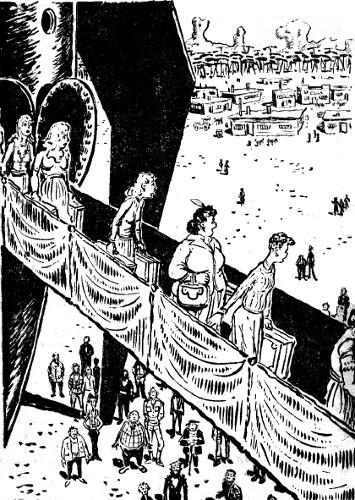
Phyllis let the deceleration press her into the cot and tried to relax. In ten minutes they would be disembarking in Landing City. Landing City, with its wide, paved streets and modern buildings, the neatly laid-out farms and the modern rocket port.
There was a clanging of bells, a sudden feeling of nausea, and she knew they had landed. In the excited buzz of conversation from the others, she got her small suitcase and filed toward the hatch. They took her name and gave her the emigration bonus, and then she was on the ramp going down, smelling the cool fresh air and feeling a damp breeze against her face.
She looked down....
The modern rocket port was a scorched expanse of dirty ground, with a rusting shed at one end that she guessed was the office. Landing City was a collection of rundown shacks and corrugated huts with mud streets and wooden sidewalks running between them. She should have guessed, she thought bitterly. She had been sold a bill of goods. And there was no going back now; she was stuck with it.
Stuck with it.
She took another look. At least it would be healthy, and there was something besides the concrete and granite of a city to look at. It wouldn't be day in and day out of sitting eight hours behind a typewriter, and then back to her lonesome two rooms for an evening of bridge or a night with a boring book.
And there was nothing wrong with the town that couldn't be remedied and improved with a little work. She and the others would see to that. Progress was going to hit Landing City whether the colonists like it or not.
The colonists....
She stared at the whiskery, ragged lot of men of all shapes and sizes that were waiting to welcome them. They had probably, she thought queerly, never heard a lecture on art in their lives. And they wouldn't have any interest in historical novels and it was an even-money bet that bridge and canasta games would bore them.
They were uncultured, she thought happily, thoroughly uncultured! Their main interest was probably in having a home and raising a family and working....
And with a shave and clean clothes, they might even be handsome! A dimly remembered poster of a blond-haired giant flashed into her mind, but she dismissed it. The men below had a hard, healthy look about them, a certain virility, an individuality that the pale men back on Earth, now that she thought of it, seemed to lack.
She was very definitely going to like it here.
Then she had a sudden, nagging thought.
How would the colonists take to her and the other bedraggled females?
IX
The twinkling fire came nearer and they could make out the outlines of the slim-ship. It rapidly grew in size and finally settled to a heavy, groaning rest on the pitted and blackened landing field.
Karl was holding his breath, staring at the outline of the hatch on the ship's rusty side. It opened and the flight of descent stairs slid out. The captain and crew came out first.
Then the women filed down the ladder, smiling timidly and looking cold and frightened.
Karl could hear Hill gulping noisily beside him and knew that his own mouth was gaping. But he couldn't help it.
The girls were gorgeous.
*** END OF THE PROJECT GUTENBERG EBOOK THE GIRLS FROM EARTH ***
Updated editions will replace the previous one—the old editions will be renamed.
Creating the works from print editions not protected by U.S. copyright law means that no one owns a United States copyright in these works, so the Foundation (and you!) can copy and distribute it in the United States without permission and without paying copyright royalties. Special rules, set forth in the General Terms of Use part of this license, apply to copying and distributing Project Gutenberg™ electronic works to protect the PROJECT GUTENBERG™ concept and trademark. Project Gutenberg is a registered trademark, and may not be used if you charge for an eBook, except by following the terms of the trademark license, including paying royalties for use of the Project Gutenberg trademark. If you do not charge anything for copies of this eBook, complying with the trademark license is very easy. You may use this eBook for nearly any purpose such as creation of derivative works, reports, performances and research. Project Gutenberg eBooks may be modified and printed and given away—you may do practically ANYTHING in the United States with eBooks not protected by U.S. copyright law. Redistribution is subject to the trademark license, especially commercial redistribution.
THE FULL PROJECT GUTENBERG LICENSE
PLEASE READ THIS BEFORE YOU DISTRIBUTE OR USE THIS WORK
To protect the Project Gutenberg™ mission of promoting the free distribution of electronic works, by using or distributing this work (or any other work associated in any way with the phrase “Project Gutenberg”), you agree to comply with all the terms of the Full Project Gutenberg™ License available with this file or online at www.gutenberg.org/license.
Section 1. General Terms of Use and Redistributing Project Gutenberg™ electronic works
1.A. By reading or using any part of this Project Gutenberg™ electronic work, you indicate that you have read, understand, agree to and accept all the terms of this license and intellectual property (trademark/copyright) agreement. If you do not agree to abide by all the terms of this agreement, you must cease using and return or destroy all copies of Project Gutenberg™ electronic works in your possession. If you paid a fee for obtaining a copy of or access to a Project Gutenberg™ electronic work and you do not agree to be bound by the terms of this agreement, you may obtain a refund from the person or entity to whom you paid the fee as set forth in paragraph 1.E.8.
1.B. “Project Gutenberg” is a registered trademark. It may only be used on or associated in any way with an electronic work by people who agree to be bound by the terms of this agreement. There are a few things that you can do with most Project Gutenberg™ electronic works even without complying with the full terms of this agreement. See paragraph 1.C below. There are a lot of things you can do with Project Gutenberg™ electronic works if you follow the terms of this agreement and help preserve free future access to Project Gutenberg™ electronic works. See paragraph 1.E below.
1.C. The Project Gutenberg Literary Archive Foundation (“the Foundation” or PGLAF), owns a compilation copyright in the collection of Project Gutenberg™ electronic works. Nearly all the individual works in the collection are in the public domain in the United States. If an individual work is unprotected by copyright law in the United States and you are located in the United States, we do not claim a right to prevent you from copying, distributing, performing, displaying or creating derivative works based on the work as long as all references to Project Gutenberg are removed. Of course, we hope that you will support the Project Gutenberg™ mission of promoting free access to electronic works by freely sharing Project Gutenberg™ works in compliance with the terms of this agreement for keeping the Project Gutenberg™ name associated with the work. You can easily comply with the terms of this agreement by keeping this work in the same format with its attached full Project Gutenberg™ License when you share it without charge with others.
1.D. The copyright laws of the place where you are located also govern what you can do with this work. Copyright laws in most countries are in a constant state of change. If you are outside the United States, check the laws of your country in addition to the terms of this agreement before downloading, copying, displaying, performing, distributing or creating derivative works based on this work or any other Project Gutenberg™ work. The Foundation makes no representations concerning the copyright status of any work in any country other than the United States.
1.E. Unless you have removed all references to Project Gutenberg:
1.E.1. The following sentence, with active links to, or other immediate access to, the full Project Gutenberg™ License must appear prominently whenever any copy of a Project Gutenberg™ work (any work on which the phrase “Project Gutenberg” appears, or with which the phrase “Project Gutenberg” is associated) is accessed, displayed, performed, viewed, copied or distributed:
This eBook is for the use of anyone anywhere in the United States and most other parts of the world at no cost and with almost no restrictions whatsoever. You may copy it, give it away or re-use it under the terms of the Project Gutenberg License included with this eBook or online at www.gutenberg.org. If you are not located in the United States, you will have to check the laws of the country where you are located before using this eBook.
1.E.2. If an individual Project Gutenberg™ electronic work is derived from texts not protected by U.S. copyright law (does not contain a notice indicating that it is posted with permission of the copyright holder), the work can be copied and distributed to anyone in the United States without paying any fees or charges. If you are redistributing or providing access to a work with the phrase “Project Gutenberg” associated with or appearing on the work, you must comply either with the requirements of paragraphs 1.E.1 through 1.E.7 or obtain permission for the use of the work and the Project Gutenberg™ trademark as set forth in paragraphs 1.E.8 or 1.E.9.
1.E.3. If an individual Project Gutenberg™ electronic work is posted with the permission of the copyright holder, your use and distribution must comply with both paragraphs 1.E.1 through 1.E.7 and any additional terms imposed by the copyright holder. Additional terms will be linked to the Project Gutenberg™ License for all works posted with the permission of the copyright holder found at the beginning of this work.
1.E.4. Do not unlink or detach or remove the full Project Gutenberg™ License terms from this work, or any files containing a part of this work or any other work associated with Project Gutenberg™.
1.E.5. Do not copy, display, perform, distribute or redistribute this electronic work, or any part of this electronic work, without prominently displaying the sentence set forth in paragraph 1.E.1
with active links or immediate access to the full terms of the Project Gutenberg™ License.
1.E.6. You may convert to and distribute this work in any binary, compressed, marked up, nonproprietary or proprietary form, including any word processing or hypertext form. However, if you provide access to or distribute copies of a Project Gutenberg™ work in a format other than “Plain Vanilla ASCII” or other format used in the official version posted on the official Project Gutenberg™ website (www.gutenberg.org), you must, at no additional cost, fee or expense to the user, provide a copy, a means of exporting a copy, or a means of obtaining a copy upon request, of the work in its original “Plain Vanilla ASCII” or other form. Any alternate format must include the full Project Gutenberg™ License as specified in paragraph 1.E.1.
1.E.7. Do not charge a fee for access to, viewing, displaying, performing, copying or distributing any Project Gutenberg™ works unless you comply with paragraph 1.E.8 or 1.E.9.
1.E.8. You may charge a reasonable fee for copies of or providing access to or distributing Project Gutenberg™ electronic works provided that:
• You pay a royalty fee of 20% of the gross profits you derive from the use of Project Gutenberg™ works calculated using the method you already use to calculate your applicable taxes. The fee is owed to the owner of the Project Gutenberg™ trademark, but he has agreed to donate royalties under this paragraph to the Project Gutenberg Literary Archive Foundation. Royalty payments must be paid within 60 days following each date on which you prepare (or are legally required to prepare) your periodic tax returns. Royalty payments should be clearly marked as such and sent to the Project Gutenberg Literary Archive Foundation at the address specified in Section 4, “Information
about donations to the Project Gutenberg Literary Archive Foundation.”
• You provide a full refund of any money paid by a user who notifies you in writing (or by e-mail) within 30 days of receipt that s/he does not agree to the terms of the full Project Gutenberg™ License. You must require such a user to return or destroy all copies of the works possessed in a physical medium and discontinue all use of and all access to other copies of Project Gutenberg™ works.
• You provide, in accordance with paragraph 1.F.3, a full refund of any money paid for a work or a replacement copy, if a defect in the electronic work is discovered and reported to you within 90 days of receipt of the work.
• You comply with all other terms of this agreement for free distribution of Project Gutenberg™ works.
1.E.9. If you wish to charge a fee or distribute a Project Gutenberg™ electronic work or group of works on different terms than are set forth in this agreement, you must obtain permission in writing from the Project Gutenberg Literary Archive Foundation, the manager of the Project Gutenberg™ trademark. Contact the Foundation as set forth in Section 3 below.
1.F.
1.F.1. Project Gutenberg volunteers and employees expend considerable effort to identify, do copyright research on, transcribe and proofread works not protected by U.S. copyright law in creating the Project Gutenberg™ collection. Despite these efforts, Project Gutenberg™ electronic works, and the medium on which they may be stored, may contain “Defects,” such as, but not limited to, incomplete, inaccurate or corrupt data, transcription errors, a copyright or other intellectual property infringement, a defective or
damaged disk or other medium, a computer virus, or computer codes that damage or cannot be read by your equipment.
1.F.2. LIMITED WARRANTY, DISCLAIMER OF DAMAGES - Except for the “Right of Replacement or Refund” described in paragraph 1.F.3, the Project Gutenberg Literary Archive Foundation, the owner of the Project Gutenberg™ trademark, and any other party distributing a Project Gutenberg™ electronic work under this agreement, disclaim all liability to you for damages, costs and expenses, including legal fees. YOU AGREE THAT YOU HAVE NO REMEDIES FOR NEGLIGENCE, STRICT LIABILITY, BREACH OF WARRANTY OR BREACH OF CONTRACT EXCEPT THOSE PROVIDED IN PARAGRAPH
1.F.3. YOU AGREE THAT THE FOUNDATION, THE TRADEMARK OWNER, AND ANY DISTRIBUTOR UNDER THIS AGREEMENT WILL NOT BE LIABLE TO YOU FOR ACTUAL, DIRECT, INDIRECT, CONSEQUENTIAL, PUNITIVE OR INCIDENTAL DAMAGES EVEN IF YOU GIVE NOTICE OF THE POSSIBILITY OF SUCH DAMAGE.
1.F.3. LIMITED RIGHT OF REPLACEMENT OR REFUND - If you discover a defect in this electronic work within 90 days of receiving it, you can receive a refund of the money (if any) you paid for it by sending a written explanation to the person you received the work from. If you received the work on a physical medium, you must return the medium with your written explanation. The person or entity that provided you with the defective work may elect to provide a replacement copy in lieu of a refund. If you received the work electronically, the person or entity providing it to you may choose to give you a second opportunity to receive the work electronically in lieu of a refund. If the second copy is also defective, you may demand a refund in writing without further opportunities to fix the problem.
1.F.4. Except for the limited right of replacement or refund set forth in paragraph 1.F.3, this work is provided to you ‘AS-IS’, WITH NO OTHER WARRANTIES OF ANY KIND, EXPRESS OR IMPLIED,
INCLUDING BUT NOT LIMITED TO WARRANTIES OF MERCHANTABILITY OR FITNESS FOR ANY PURPOSE.
1.F.5. Some states do not allow disclaimers of certain implied warranties or the exclusion or limitation of certain types of damages. If any disclaimer or limitation set forth in this agreement violates the law of the state applicable to this agreement, the agreement shall be interpreted to make the maximum disclaimer or limitation permitted by the applicable state law. The invalidity or unenforceability of any provision of this agreement shall not void the remaining provisions.
1.F.6. INDEMNITY - You agree to indemnify and hold the Foundation, the trademark owner, any agent or employee of the Foundation, anyone providing copies of Project Gutenberg™ electronic works in accordance with this agreement, and any volunteers associated with the production, promotion and distribution of Project Gutenberg™ electronic works, harmless from all liability, costs and expenses, including legal fees, that arise directly or indirectly from any of the following which you do or cause to occur: (a) distribution of this or any Project Gutenberg™ work, (b) alteration, modification, or additions or deletions to any Project Gutenberg™ work, and (c) any Defect you cause.
Section 2. Information about the Mission of Project Gutenberg™
Project Gutenberg™ is synonymous with the free distribution of electronic works in formats readable by the widest variety of computers including obsolete, old, middle-aged and new computers. It exists because of the efforts of hundreds of volunteers and donations from people in all walks of life.
Volunteers and financial support to provide volunteers with the assistance they need are critical to reaching Project Gutenberg™’s goals and ensuring that the Project Gutenberg™ collection will