01
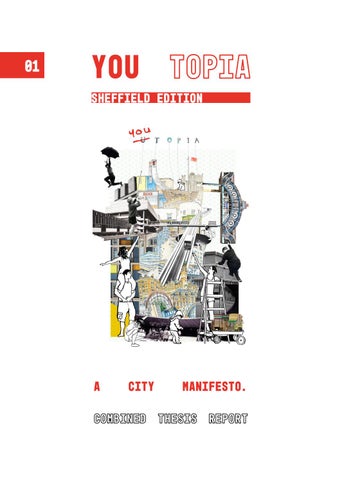
YOU sheffield edition
a
city
manifesto.
02
“The whole city is your jewellery-box; a million twinkling yellow street lights. Reach out and take what you want, you can have it all.” PULP Sheffield Sex City 1992
Samuel Letchford 170204640 ARC583 Design Manifesto Y6 MArch Architecture Sheffield School of Architecture Manifesto Word Count (not including contents, titles, images, captions, feature quotes, footnotes or bibliography) 2743 Published by SSoA 2019 © Samuel Letchford 2019 All rights reserved The moral rights of the author have been asserted 1 3 5 3 9 10 8 2 4 9 SSoA UK: Arts Tower, Western Bank, Sheffield S10 2TN www.sheffield.ac.uk/architecture SSoA is the imprint of Sheffield School of Architecture Publishing eISBN: 972-1-84867-808-5 Typeset by Samuel Letchford, Sheffield, Yorkshire Printed by EvolutionPrint in Sheffield
03
05 06 07
THE AIM OF THE GAME The Aim of the Game Assembling a Team
11 12 14 16 17
PRE GAME - SETTING THE RULES OF PLAY The Importance of PLAY The Methodology of PLAY What Does PLAY mean to you? Additional Reading and Resources
21 22 24 26 28 32 35
SETTING UP - EXPLORING THE GAME BOARD The Game Board Inhabiting the Game Board Exploring the Game Board Minigame 01 - A Space for Play Minigame 02 - The Trade Emporium Interpreting the Results
39 40 42 44 46 48 58 60 62 64 66 68 69
FORMULATING AN APPROACH - TOWARDS EVERYDAY MODERNISM Faded Dreams of Utopia Sheffield: City of the Future? The ‘People’s Republic of South Yorkshire’ Sheffield Modernism Memories of Modernism Modernism as Montage Modernism as PLAY Decline of the People’s Republic Sheffield Today Current Sheffield City Strategy Traces of the People’s Republic A Manifesto for Sheffield: METHODOLOGY
73 74 76 78 80 82 84
APPLYING THE THEORY - THE URBAN HOUSE Urban Room / Adventure Playground The Urban Room Network Current Urban Room Theory Bristol Architecture Centre + Sheffield Liveworks Urban Room --> Urban House A Manifesto for Sheffield: METHOD
89 90 92 94 97 98 100 104
MAKING A MANIFESTO - NEW SHEFFIELD MODERNISM 10 Principles for New Sheffield Modernism Grosvenor House: Monument to Failed Modernism Charter Square /Grosvenor House Analysis Zone of Influce: At a Crossroad A Physical Manifesto for New Sheffield Modernism Complexity and Contradiction in New Sheffield Modernism Next Steps
106 Bibliography 108 Visual Media
04
“THERE WAS ONCE A SOCIETY THAT BELIEVED THAT LIFE IN THE FUTURE WOULD BE BETTER FOR EVERYONE. THERE WERE PEOPLE, UTOPIAN THINKERS, WHO THOUGHT ABOUT BIG QUESTIONS OF THE CITY. TODAY IT REMAINS MORE OF A FEELING, HALF DESIRE, HALF MELANCHOLY” 1
Raumlabor Berlin, ‘Statement’, Experimental Architectural Practice < http://raumlabor.net/statement> [accessed 08.01.2019] para 12 of 20 1
05
t g
a
h
m
e e
06
aim
YOUtopia is a city manifesto game. The current climate of profit-driven, efficiency-obsessed development has resulted in the stagnation of our cities, the rationalisation of urban development limiting the capacity of architecture to flourish in the hollow space of capitalism.2 In the face of these issues, the objective of YOUtopia is simple establishing PLAYful new city-specific attitudes towards urban development and city planning, grounded in locality and produced with local people. YOUtopia is a game of collaboration - a game for the sake of PLAY and creating a better urban environment for everyone. This instruction manual will guide you through the stages of the game, acting as a step-by-step guide to aid in the creation of a YOUtopia Manifesto for Sheffield.
2
Nathaniel Coleman, ‘Utopia and Modern Architecture?’, Architectural Research Quarterly, 16 (2012) p.339
07
STUDIO IN_Residence The journey towards YOUtopia is best undertaken as a team, offering more opportunity for collaboration and creative discussion. In_residence, ASSEMBLE! Studio In_residence will be used as an exemplar team throughout this instruction manual, acting as your guide through an example journey towards YOUtopia. Studio In_residence consists of a variety of young architectural professionals, with a range of interests, who are currently studying and working in Sheffield:
ADAM Ownership Margins Inhabitation
ANNA Coproduction Disconnect Inversions
BECKY Safe Spaces Passive Contact Engagement
BRYN Enabling Anto Corruption Ground-Up
KAI Negative Play Senses Unexpected
KATE Sharing Skills Public vs Private Experiment
KIMBO Ownership Margins Inhabitation
LYDIA Exclusion Escapism Childhood
MEESAM Live/Work Segregation
MIKE.J Deconstruction Irrationality Public/Private
MIKE.M Health Inversions
SAM Irrationality Coproduction Risk
08
09
S e t t i n g the Rules of P l a y
10
“The adventure playground is a kind of parable of anarchy, a free society in miniature, with the same tensions and everchanging harmonies, the same diversity and spontaneity, the same unforced growth of co-operation and release of individual qualities and communal sense, which lie dormant in a society whose dominant values are competition and acquisitiveness… Isn’t there a place for the adventure playground or its equivalent in the adult world? 2”
2
Colin Ward, Anarchy in Action (London, Freedom Press, 1996) p.91
(Opposite) Fig.1 Notting Hill Adventure Playground, 1960s
11
12
PLAY
Fig.2 Kinderspelen (Children’s Games)
Kinderspelen (Children’s Games) Pieter Bruegel, 1560 Bruegel depicts a scene of play consuming a townscape, with children and adolecents engrossed in their activities with an intent seriousness, questioning the apparent seriousness of more ‘adult’ pursuits. This serves as one of the earliest representations of play as a serious and essential part of life.
Notting Hill Adventure Playground 1960’s Adventure playgrounds were built upon the premise that children often find more joy and freedom in ‘loose parts’, waste sites and leftover spaces, as opposed to prescriptive built playgrounds. Adventure playgrounds offer an escape from daily life and the opportunity for children to create their own fantastical worlds, untouched by the adult world around them. Fig.3 Notting Hill Adventure Playground Constructed Tower
13
Notting Hill Adventure Playground 1960’s Management of RISK is a fundemental aspect of adventure play, allowing children to make their own judgements and in the process allowing for a greater learning experience and creative freedom for those involved.
Fig.4 Notting Hill Adventure Playground ‘Risk in play’
RISKy
14
Play
Fig.5 Studio In_Residence Site Explorations Pitsmoor Adventure Playground 2018
“The game side of seriousness, the serious side of game playing”3 Hans Venhuizen Game Urbanism
‘PLAY AS A DESIGN TOOL’ forms the central methdology of the YOUtopia rulebook. By embracing play as a design tool, players maintain an openness of outlook and curiosity which can often be lost in traditional design processes. Play can be utilised as a tool throughout the design process, from initial site investigations through to 1:1 on-site testing. BEING ‘IN RESIDENCE’ entails immersing youself in a local context, making observations, engaging with people and allowing a project to emerge from these interactions. PLAY acts as a facilitator of this approach, providing an accessible and inclusive way in which to engage with the site and its inhabitants. 3
Hans Venhuizen, ‘Game Urbanism’ (Amsterdam, Valiz, 2010) p.107
15
1:1 Testing and Experimentation
A MANIFESTO for Urban Development, Rooted in Locality
Generating a Set of ‘Rules’ or ‘Attitudes’
Forming a Theory
TESTING Hypothesis
Suggesting a Hypothesis
Identifying patterns
Making Observations
Being ‘IN RESIDENCE’
Fig.6 Ground-Up ‘Inductive Research’ Methodology Diagram
A GROUND-UP PROCESS YOUtopia city building should emerge from a ground-up, inductive research approach - making observations, identifying patterns and suggesting hypothesis which ultimately come together to form a cohesive theory. This acts as a framework from which a loose set of rules can be formed, shaping an approach to urban development, rooted in local context.
16
In_Residence believe PLAY...
play
PLAY is both universal and deeply personal. It is this duality which makes play such a valuable design tool. Introductary Task As a team, discuss what PLAY means to you, and write down these ideas. Pick a selection of these definitions which you would like to carry forwards on your journey towards YOUtopia.
Fig.6 Meaning of ‘PLAY’ Library of definitions
is optimistic can be a way of letting go can be competitive can change the everyday comes out of boredom is communal is destructive + constructive embraces failure is experimental is freedom is genderless happens through free choice has a dark side has no purpose hovers between order and chaos is immersive is inclusive + exclusive is inefficient is instinctive is interactive is a way of looking at things is different is best with other people is different from the norm is rational + irrational is experimental is exploratory is fun is multi-sensory is open-ended is pointless is unpredictable is voluntary is loose parts makes you happy is manual needs rules...which can be broken is open-ended is participatory is personal is pointless requires passion reveals and develops skills is risky is role-play is sensory is simple + complex slows down time is spatial is superfluous takes you out of your comfort zone is transformative is unique is whole hearted is ‘not real life’
17
Readings and Resources Additional readings can be utilised to widen your perspective. Keeping a library of key texts can help concentrate and arrange your areas of interest.
rational -irrationality alternative urban policy as a counter to the rationalisation of urban development
The McDonaldization of Urban Development; Case Studies: free town Christiania + IBA Berlin 1979-1984/87; The power of context; towards Rational-Irrationality
October 2018 ‘Rational-irrationality’ Samuel Letchford 170204640 ARC566 Word Count: 6556
RationalIrrationality: Alternative Urban Policy as a Counter to the Rationalisation of Urban Development
Ground-Up City: Play as a Design Tool
Game Urbanism: Manual for Cultural Spatial Planning
Back from Utopia: The Challenge of the Modern Movement
Liane Lefaivre 2007
Hans Venhuizen 2010
Hilde Heynen, Hubert-Jan Henket 2002
Samuel Letchford 2018
A Guide to the New Ruins of Great Britain Owen Hatherley 2010
Complexity and Contradiction in Architecture Robert Venturi 1966
18
02 P r e - G a m e : S e t t i n g the rules of p l a y Progress summary At the end of every section, add up your progress. At the end of the process, this will form a support framework for your Manifesto.
19
PLAY is a serious and important aspect of everyday life. Non-Prescriptive PLAY allows for the creation of fantastical worlds. PLAY is risky. Embracing risk offers increased creative freedom and the potential for learning through experience.
Play is a DESIGN TOOL. It offers an accessible and inclusive approach to the design process. Working ‘in residence’ allows for a greater understanding of locality and opens up opportunites for PLAY. Shaping a manifesto is a ‘ground-up’ process. An urban approach should emerge through local interaction + observations, identifying patterns and developing an approach in response to these experiences.
PLAY: is personal + universal
20
21
EXPLORING THE gameboard
22
THE GAMEBOARD.
Fig 7 The Gameboard Ground Site Model of the Steel Route Fig 8 (opposite) The Steel Route Map
23
24
Inhabiting the Gameboard
Inhabiting LIVE WORKS Live Works acts as a point of contact and place for collaboration between academia, local organisations and the public. All research is presented in the form of public exhibitions, or otherwise made available to the public - acknowledging that all work generated has genuine, real world value to the area and its inhabitants.
Fig 9 ‘In residence’ at Live Works Presentations as public exhibitions
Fig 10 Location of Live Works On the Gameboard
25
Fig 11 Shared Resourcs model for studio and public workshop use
Adapting Playful + Accessible Representation Techniques Establishing their new connection with LIVE WORKS, studio members created a physical model of the Moorfoot Building, to be used for a series of public workshops at LIVE WORKS as well as studio purposes.
Fig 12 Model being used at a public workshop Fig 13 Model being used at a studio exhibition
26
exploring the Gameboard Local Observations Dead End Forgotten Tired New ‘Gay Quarter’ Gritty Quiet Monolithic High Street Retail Featureless + Dull Rationalised + Safe ‘High Quality Paving’ Corporate Clean and Shiny Pedestrianised Construction Sites Under Redevelopment Period Buildings Small Businesses Boundary + Passage Zone Future Uncertain New Retail Quarter Pocket of Green Period Buildings Popular Safe + Regulated Busy Lunch Spot Town Hall Retail Heavy Big Name Brands Period Buildings (If you look up) Mostly Pedestrianised Commercial Busy, No Place to be Idle Supertrams Run Down + Tired A Faded Dream - Hints of Modernism Inaccessible Walkways Scarred Historical Fast Food and Low End Retail Bus Route Fig 13 Group Site-Seeing observations
27
exploring the Gameboard
Fast Food Metal Shutters Vehicle Gateway Linear Street Road dominated Historical city entrance
Gateway Boundary Inhabited Arches Railway Threshold Overgrown
Ring Road Tarmac Heavy Vehicles Pedestrian Barrier Traffic Signals and Crossings Noisy Food Shops International Small Businesses Colourful Food Smells Linear Neighbourhood Feel Residential Terrace Housing International Population Red Brick
Experiment in Utopia Fun + Playful Colourful Communal Charitable Creative Imaginary World Fig 14 Group Site-Seeing observations
28
Mini Games, or ‘Creative Surveys’ Can be utilised as methods of investigation and experimentation throughout the design process, from initial site analysis to on-site 1:1 testing. They provide an alternative to traditional site survey methods, utilising public engagement and discussion over measuring tape and camera. Open-ended by nature, Mini Games are a playful tool through which to explore ideas and establish the direction of your YOUtopia manifesto.
29
A SPACE FOR PLAY Envisioning the city through a playful perspective; As a Gameboard.
Fig 15 A Space for Play - Pooh Sticks along the River Don Seeing the city differently, from a playful prespective
30
Encouraging Play Within the City Identifying the River Don as an underutilised asset within Castlegate, this ‘Space for Play’ encourages lighthearted use of the river and bridge infrastructure through small installations. This playspace plays upon childhood memories and is intended to trigger the inner child within people and encourage passers by to view the city in a playful manner, as a playground full of opportunities.
Fig 16 A.A Milne sketches
31
Fig.17 ‘Pooh Ships’ A tabletop version of a ‘Space for Play’
Encouraging Play Within Architectural Representation ‘Pooh Ships’ takes the the principles of ‘Pooh Sticks’ and translates them into a tabletop game, where paper boats are blown via straw along the water, in a race between the two bridges. This model is therefore a ‘Space for Play’ in minature, continuing to explore the potential for architectural represention methods to be more approachable, engaging and playful in nature. Fig 18 ‘Space for Play’ models being exhibited and played with at Pitsmoor Adventure Playground
32
33
THE TRADE EMPORIUM This game aims to learn more about an area and the people who inhabit it, placing value on peoples’ time and local knowledge as opposed to their social or economic capital.
Fig 19 An example ‘Trade Emporium’ setup
34
INSTRUCTIONS Invite members of the public to ‘trade’ any item in the either:
Emporium, in return for
- An item in their own possession - Local knowledge - A story - General chat Once you have made your trades, record them on the ‘Trade Record‘ template card (see opposite). These Trade Record cards act as receipts of each interaction, detailing what was traded and what knowledge was shared.
Step-by-step setup 01 Create your Emporium Stall! Source a table or some surface on which to set up your Emporium.
02 Stock Your Emporium! Gather a wide variety of items to stock your emporium, trying to rely largely on donations as opposed to purchases.
03 Set Up Your Stall on Site! Find a location with decent pedestrian footfall, in order to attract a wide range of participants.
04 Interact! Welcome members of the public to engage in conversation and trade!
x1 A3 Sketchpad x2 A4 Watercolour Pad x3 Balloons x3 Ballpoint Pens x1 Bounty x4 Chalk x4 Crayons x3 Dandelion Bulbs x2 Easy Peel Oranges x1 Eat Natural Bar x3 Elastic Bands x2 Foldback Clips x1 Hairband x1 Hot Chocolate Sachet x1 Lucozade x2 MDF Puzzle Pieces x1 Mini Highlighter x1 Mini Sticky Note Pad x5 Napkins x1 Oil Pastels x1 Origami Boat x3 Paintbrushes x1 Pantone Watch x5 Paperclips x5 Paper Plates x15 Pea Seeds x3 Pipecleaners x3 Plastic Cups x3 Plastic Cutlery x5 Pukka Green Tea Bags x1 Safety Pin x1 Square of Sandpaper x1 Sticky Tape Roll x1 Tennis Ball x1 Tesco Cola x5 Yorkshire Tea Bags
35
Interpreting results
Fig 20 Trade Emporium Trade Record Cards
Sam & Anna's
Sam & Anna's
Sam & Anna's
Trade Emporium
Trade Emporium
Trade Emporium
Trade Record
Trade Record
Trade Record
Trade Out: Chat x 30 mins + Paperclip x 1
Trade Out: Chat x 15 mins + Watercolour Pad x 1
Trade Out: Chat x 10 mins
Trade In:
Trade In:
Trade In:
Drawing x 1 + Multiple Stories
Details: “Thank you for making me feel like a human again” “Do you know you can hear the river flowing underneath West Street?!” “Sheffield is really diverse and the different cultures integrate well but Brexit is changing that, it’s messing with people’s heads” “Art should be more free, we shouldn’t be taught what is right and wrong, we need to let individual talent shine”
Details:
Pocket book x 1 + Multiple Stories
“Paradise Square used to be where all the public protests, preaching and markets would take place and people would climb the lampposts to heckle!” “Nearby, Painted Fabrics provides art therapy for war victims who have lost a limb through covering their injury with patterns” “I have been looking through Sheffield Archives this morning” “I’ve just started a new job so I’m pretty nervous, I just pretend I know what I’m doing” “You’ve made my day talking to me!”
Local Knowledge
Details: “We’ve lived here for 50 years!” “Sheffielders like to merge their words like... Tin-tin-tin = It isn’t in the tin Wheres-ya-goen-on-ye-sen? = Where are you going? Are you going on your own? ‘Owz thi’? = How are you?” “My son has moved to Leicester so we don’t have family here now but I would’t ever want to leave Sheffield, it’s a nice size”
Dean ‘My Sheffield’ Hand Drawing “I dont have anything to offer - let me do you a drawing” Dean’s drawing displays a ‘utopian’ vision of the city - The River Don as a lush landscape flowing through the city, nature co-existing with human life. The people are depicted as care free, playing a game of ‘pooh sticks’ over the side of Lady’s Bridge.
Fig 21 ‘My Sheffield’ Hand drawing
This suggests that everyone has utopian ideals and visions for their city.
utopia
36
Progress summary
At the end of every section, add up your progress. At the end of the process, this will form a support framework for your Manifesto.
37
Inhabit the GAMEBOARD. Working In Residence at LIVE WORKS allows for greater immersion in the local context. Establish a public presence. Making all research and presentations publically accessible encourages collaboration and public engagement. Utilise PLAYful representation techniques, encouraging interaction and shared resources. Explore the whole GAMEBOARD. First hand observations through interactions with local places and people help paint a picture of the city.
MINIGAME 01 Seeing the cityscape from a PLAYful perspective. How can small installations encourage PLAYful appropriation of space? Architectural representation can be more interactive, engaging and unprecious.
MINIGAME 02 Place value on experience, interaction and cooperation as opposed to social + economic capital. Explore dreams of UTOPIA as a PLAYful attitude towards the city. Everyone has the capacity to envision their dream cityscape.
38
39
T o w a r d s E v e r y d a y modernism
40
(clockwise from top left) Fig 22 Minitram Proposal passing by Castle Market Fig 23 Minitram Proposal crossing the Hole in the Road Fig 24 Castle Market elvated market streets Fig 25 Hole in the Road underground square
UT0PIA
“These 1960’s types of concrete monsters hold a fascination for me. They seem to have an aurora of faded optimism about them”3 H.Dary Sheffield History 3rd August 2018 The concept of ‘Utopia’ is not unfamiliar to Sheffield. The city has a deep relationship with modernism and associated utopian ideals the traces of these endeavours are evident in the forlorn concrete landscapes of Castlegate. A concrete market, stacked up towards the clouds, where streets in the sky connect market areas across different levels, whilst underground public squares link to subterranean tunnels which stretch out beneath the city.
Sheffield History, ‘Grosvenor House’, Sheffield History <https://www.sheffieldhistory.co.uk/forums/topic/17299-grosvenor-hotel> [accessed 21.01.2019] 3
41
CHARACTER COLLAGE Original Vision Futuristic Advanced Technology Colourful Ambitious Experimental Optimistic
Current Condition Decaying Melancholy Failed Ambitions Run-Down Messy Scarred Weathered
Fig 26 Castlegate past and present character Plaster and collage
42
SHEFFIELD
Fig.28 ‘City on the Move’ Snapshots Opposite Page (clockwise from top right) 01 The Fiesta Building (Jefferson Sheard) + Bus Station 02 AUEW Offices (Jefferson Sheard) 03 Hallam Tower 04 High Street Retail 05 Automobile Transport 06 Grosvenor Hotel 07 Park Hill
Fig 27 ‘Sheffield: City on the move’ Promotional Film Early 1970’s
“This City now doth, like a garment, wear The beauty of the morning; All bright and glittering in the smokeless air.”
“So William Wordsworth, poet of 200 years ago, wrote of London’s Westminster Bridge as it was then. He might have been speaking of Sheffield today.”4
The optimism and futuristic ambition of 1970’s Sheffield are exemplified in the 1970’s promotional film, ‘Sheffield: City on the Move’. Produced in a variety of different translations, including Russian, it shows Sheffield’s admirable, yet perhaps naive aspirations to secure its status as a futuristic city of the future.
Simon Norman, Youtube, Sheffield - City on the Move <https://www.youtube.com/watch?v=-v1-mT9afP4&t=476s> [accessed 21.01.2019] 4
43
44
The ‘people’s republic of south yorkshire’ 1945 - 1980 Expansion of the Welfare State Post-War Labour Tenets: - Founding the NHS - Expanding the Welfare State - Democratisation of Education Housing and providing services for the masses became a shared political goal, providing better living conditions for the thousands of working class people living in outdated slums. Labour Stronghold: The People’s Republic of South Yorkshire A thriving steel industry and liberal governance of a Labour City Council willing to spend money on public projects, saw a boom in the construction of radical social housing estates and public buildings.
Fig 29 The Guardian Article, Jan 1981 ‘The Socialist Republic of South Yorkshire’
Radical Social Architecture This era saw many now-famous radical projects spring up across the city. Sheffield became a hotspot for experimental architecture, with enough influence to have entire magazines dedicated to it’s architecture.
Fig 30 Architectural Design Magazine Sept 1961 Sheffield Edition
45
1960 Public tram service replaced with bus services
1962 Gleadless Valley completed
1961 Park Hill completed
1966 Arts Tower completed 1966 Grosvenor House completed
1965 Castle Market completed 1965 Hyde Park completed 1965 Hallam Tower completed
Fig 31 A timeline of sociopolitical + economic events from 1960 in Sheffield
1968 Roxy (O2) completed
1967 Hole in the Road completed
1974 South Yorkshire County Council (SYCC) created, overseeing provision of public transport, offering a subsidy of up to 85% of operating costs, and low fares
1970 Minirail transport proposal
1980 Sheffield City Council referred to as ‘The People’s Republic of South Yorkshire’ 1980 David Blunkett (Labour) elected as Sheffield City Council Leader
1979 Conservative Margaret Thatcher elected as Prime Minister
1985 Thatcher government begins to shut down unprofitable coal mines 1985 Sheffield council refused to set a budget as part of the ‘rate-capping rebellion’ against the Thatcher government’s drive to restrict the spending of local councils.
1983 National Union of Mineworkers (NUM) headquarters move to Sheffield 1984 National Union of Mineworkers (NUM) strike
people’s republic of sheffield
1986 Dere of S publ tran the of t pass tran priv cont
46
Fig 32 Sheffield modernism collage
47
SHEFFIELD
48
Memories of modernism
“Praised across the globe, promoted in civic brochures, written about by critics”5
The reputation of Sheffield Modernism is well documented in academic and professional circles, but what of those who lived and worked alongside these modernist creations? First hand accounts tell the story of Sheffield’s ‘everyday modernism’...
5
Tom James, ‘The Once and Future City’, Sheffield Modern - Photographs, Essays, 1 (2018) p.1
49
Fig 33 ‘New Look Sheffield’ Early 1970s Sheffield cityscape
50
Park Hill + Hyde Park Estates Fig 34a Hyde Park + Park Hill Memories
Fig 34 Hyde Park partial demolition
I have fond memories of Hyde Park and Park hill from my youth. The flats were generally very well laid out inside, with lots of light and space. I really liked my flat. The view over the east end of the city was amazing:- I could see all the way to Rotherham from my living room window, and from the front of the flat, I could see all the way up through the city centre. I loved to stand at my window in the wee, small hours, if I couldn’t sleep, and just watch the lights of the city twinkling. You can imagine what a lovely view I had, straight up High Street, over the “Hole in the Road” at Xmas, with the decorations. The Garchey waste disposal was a great idea. The system was installed in all three flats’ developments across the city, PH (Park Hill) HPF (Hyde Park Flats) And Kelvin. Sometimes it wasn’t so nice, when you got the smells of the waste, and a neighbour of mine once got a back-flow, all over her newly decorated kitchen (Pheew-ee... that didn’t half pong!) There was a good sense of community on there, it was just so sad that the flats deteriorated, socially, when the council started having to put what we used to call “problem-families” on. I have actually been thinking of applying for a unit within the housing on the soon-to-be-refurbed Park Hill. I have good memories of my Gran’s flat on PHF, and the excellent view we had of the train station. We used to watch the steam specials coming into Sheffield, such as The Mallard, the Flying Scotsman, and the Duchess of Hamilton. We had a grandstand view from Gran’s!
Anonymous Sheffield History 19th March 2009
51
Fig 35a Hyde Park + Park Hill Memories
I grew up on Hyde Park flats and my memories as a child are wonderful, we moved on there approximately late 64 early 65. The MASSIVE spaces for children to play on was incredible but has stated you would not want your children that far away nowadays. Long landing that we roller skated on seemed to go on forever and ever. Lots of friends everyone knew each other. There was a community centre where we used to go to discos and dance, a middle staircase that we just loved to go running down (it was a spiral one in the very centre of the flats). Mum would send us to Bradshaws fruit and veg, there was the newsagent, hairdressers, housing office, launderette (not everyone had a washer including us). Pubs The Target, Crows Nest, Plimsoll, Working mans club park, Gardeners. Schools close by, a swimming baths at Park Hill, a library, Norfolk park, and 5 mins into town, what more could you want ? My mum had previously lived in a prefab at Firth Park and the flats were luxury compared to that. The flats themselves were very spacious with a modern kind of kitchen with a garchee (don’t know if that is spelt correct - you put everything in Fig 35 Park Hill facade
there all your kitchen waste and of it went). We eventually moved of in 1976 to the wybourn to a house with just a gas fire and we had to boil the water it was awful after having hot water and heating all the time. Shelly Barnes Sheffield History 17th March 2009
Fig 36 View of Hyde Park
52
Castle Market Fig 37 Castle Market Upper Floor Plan
Fig 37a Memories of Castle Market
The whole layout of Castle Market with the shops on the outside and the gallery upstairs made it all more interesting for me. I thought Sheaf Market was a bit too boxy and square (if you know what I mean). Unfriendly? Never. In fact when I first started work there as a young‘un I thought the lads in the fish market were a little too friendly! Seriously though, all the stall holders had time for a bit of banter, which I didn’t notice when shopping in the Sheaf. As I said before, I am biased and thought it was a great place to work and shop, and it saddens me to think what it has come to now, shabby and run down. Saying that, I always call in when I’m in Sheffield just to check how many more stalls are empty, and how many of the old names I remember.
Carlie Sheffield History March 2013
Fig 38 Castle Market Infrastructure Section
53
I think this is so sad! Why not spend the money doing the Castle Market up instead of building a new one? Sheffield council are great at knocking stuff down, instead if putting money into stuff and leaving a bit of heritage. I agree that the area isn’t that good, but it can’t be worse than Park Hill used to be. Over the last 32 years the council have slowly ripped the heart out of Sheffield. Hole in the Road, Sheaf Market, High-Rise flats, Castle Market... That new market will have seen traders loose their livelihood, customers will not go to the new market as it doesn’t have the same feel. I remember shopping there and Fig 38a Memories of Castle Market
all the older shoppers meeting on the steps looking down on to the market. Sheffield has lost something that was loved by many Sheffield folk and that new market will never live up to the old one.
Jessica Entwistle Daily Mail October 2014
Fig 39 Castle Market Indoor market stalls Fig 38 Castle Market 1980s streetscape
54
grosvenor house
Fig 40 Grosvenor House Opening Poster
55
Fig 40a Memories of Grosvenor House
Sitting here enjoying a brew before going to work and got thinking of the buildings no longer in Sheffield. While many mourn the passing of the Hole in the Road or the Kelvin, I’ve just thought of another, once mighty building, which is no longer with us... the Grosvenor. In the late 90’s I was a regular at The Sheffield Kebab House (I think it was the Kebab of Istanbul at first). On one occasion while parked there in a brand new vehicle, I, and the new van, had the delight of being covered in wet toilet roll thrown by drunken ice hockey players from a hotel window above. Would love to have had a wander round, as these 1960’s types of concrete monsters hold a fascination for me. They seem to have an aurora of faded optimism about them. Years later I was working in Telephone House and was talking to Donna, the security lady and all round lovely person. She was telling me that on more than one occasion she had seen couples making ‘adult themed videos’ in the rooms. Apparently it had been noted on more than one occasion from one of the upper floors of Tele House that if you were waiting for a lift at the front of the building, you could see over in to the hotel. People had been seen with video equipment and “performing with the curtains open”. How true this is, I can’t say but it came from a reliable source.
H.Dary Sheffield History 3rd August 2018
Fig 41 Grosvenor House Moor Head streetscape
56
T’Hole-in-the-road
Fig 42a Memories of Hole in the Road
Castle Square is a weird underground market, off Commercial Street, with an open air ‘sun roof’, known locally as the Hole In The Road. Once it was the meeting place for tramps and downand-outs-but-on-the-way-ups. Now the authorities want to get rid of it. We’ve started the Hole In The Road campaign, the council want to fill it in with concrete, which will mean more people getting run over. We can’t let them do it. It’s all part of a conspiracy to dispense with the town centre all together, and move everything out to Meadowhall (a huge shopping complex known locally as Meadow Hell). See that fish tank in the wall? One of my earliest memories was my mum bringing me here to stop me from moaning when she was doing the shopping. I made a film of it too. Sometimes you get a whispering gallery effect in here, it sounds like someone’s talking right in your ear. There used to be benches all the way around the walls and all the old tramps would come here, like a little community centre and then one morning all the benches had gone, apart from four. It was really sad because they all turned up as usual and just stood there, dazed - their whole world had gone.
Jarvis Cocker + Nick Banks (PULP) Sheffield History 1994
Fig 42 Hole in the Road aerial view
57
Fig 43a Memories of Hole in the Road
I wanted to say that I honestly cannot think of anything that can provide a prominent and exciting feature in the town centre compared to what the hole in the road provided before 1994. There is the new feature outside the train station, perhaps the winter gardens, maybe the silver balls next to the fountains near the town centre... nothing as striking... You knew where you was at the Hole, you knew that like a rabbit warren, you could go into a direction to any used part of the centre, such as high street, markets, Snig Hill, the small old bus station, Arundel Gate, Pond Street, Midlands Bank, Rackhams, C&A and the clock on the Co-op.... Getting to the inside of the hole was like reaching the epicentre, you was halfway to where you wanted to go, you had chance to breathe the fresh air coming through the hole, and if it was raining hard you could walk under the sheltered arches and still get to where you wanted. Often, I had a cuppa in restaurant on the 2nd floor of Rackhams, and had a window view where I used to watch down onto all the walkers passing through or buses driving round. It was a very busy junction of people criss crossing through the hole and I feel this was what made shopping in the centre good, and kept you dry, certainly better than meadowhall. Even though I’m 38, sometimes things have to move on, but this is one thing I do miss.
Krystyna Sheffield History 29th July 2007
Fig 43 (above) Hole in the Road map Fig 44 Hole in the Road submerged courtyard
58
“THERE WAS ALWAYS ANOTHER MODERNISM, ONE WHICH HAS NOT CONTINUED INTO THE PRESENT DAY TO ANYTHING LIKE THE SAME EXTENT: MODERNISM AS MONTAGE, MESSINESS, AND THE DRAMA OF MULTIPLE LEVELS AND SCALES” 6
Fig 45 Park Hill levels diagram 6
Owen Hatherley, A Guide to the New Ruins of Great Britain (London, Verso, 2011) p.97
59
Fig 46 Castle Market Modernism as montage collage
CASTLE MARKET
Opposing the immaculate rationalisation of modernist design, Sheffield modernist landmarks such as Castle Market suggest an alternative approach, one grounded in the messiness of everyday life. This form of modernism aimed to nurture everyday unpredictability rather than control it, allowing itself to be swallowed by the chaos of everyday market life.
60
Park hill
If Modernism is designed to cater towards everyday life, then it must be designed to cater towards PLAY. The PLAY spaces of Park Hill are monumental opportunities for PLAY can be found everywhere. An ambition of ‘free reign’ PLAY can be seen to permeate the concrete landscape of Park Hill.
Fig 47 Park Hill Play Spaces
Fig 48 Park Hill Play Landscape
Hewn out of the same concrete as the structural form, PLAY spaces provided an playfully intimate encounter with this ‘modern’ material - a monolithic, immersive landscape to be touched, grazed against, climbed over, and shaped into alien landscapes through the mind of a child at PLAY.
61
Fig 49 Park Hill Children at Play
Fig 50 Park Hill Carved Concrete Play Forms
62
1991 Sheffield becomes a nuclear free zone 1991 Sheffield signs a peace treaty with the ‘Ukrainian Soviet Socialist Republic’ city of Donetsk, on the other side of the Iron Curtain 1986 Deregulation of Sheffield public transport and the abolition of the SYCC, passing transport into private sector control
1998 Park Hill Grade II Listed 1998 Peace Gardens completed
1994 ‘New Labour’ emerges under Tony Blair 1994 Hole in the Road demolished 1994 Sheffield Supertram opened
2017 Every seat in South Yorkshire held by Labour in the General Election
2013 Castle Market Closes 2003 Winter Gardens completed
2001 Millenium Galleries completed
2013 Moor Market opens
2010 Grosvenor House closes 2010 Park Hill refurbishment
2015 Castle Market demolished 2014 Urban Room LIVE WORKS launched
2017 Hallam Tower demolished 2016 Grosvenor House demolished
2018 Conservative government lifts council spending cap to boost social housing construction
Fig 51 Decline of the Peoples Republic of South Yorkshire 1986 - present
The decline OF THE ‘PEOPLES REPUBLIC OF SHEFFIELD’
63
The decline OF THE ‘PEOPLES REPUBLIC OF SHEFFIELD’
Fig 52 Rate Capping, job loss, demolition and deregulation collage
Privatisation + Measures which pushed the country towards privatisation and resulted in the deregulation of public services, rate-capping of spending, and the introduction of
Neoliberalism neoliberalism local council Right-to-buy.
Economic Downturn The shutting of local coal mines, combined with the switch to autonomous steel manufacturing methods, saw widespread poverty and unemployment hit Sheffield. Gone were the days of optimism, prosperity and public spending, the fuel on which the Sheffield modern movement was driven.
64
Fig 53 Modern Sheffield Development Collage
65
SHEFFIELD today
7
Tom James, The Once and Future City, Sheffield Modern - Photographs Essays, 1 (2018) p.2
66
Current SHEFFIELD CITY strategy
4.1
21st Century High St
The Moor showing proposed next phase
13
City-Plan-2018-MARCH.indd 13
Fig 54 ‘The 21st Century High Street’
12/03/2018 09:34
Retail driven, big brand commercial development “Sheffield has 261,000 residents in the top four affluency groups and currently has above average spend in relation to its retail offer. Sheffield therefore has a higher ‘spend potential’ than many cities where the size & quality of retail offer is greater, such as Cambridge or York, indicating there is a very significant potential for further retail growth”8
“The vast majority of the investment proposed in the plan is expected to come from the private and third sectors”9 City Plan 2018 Sheffield City Council, This is Sheffield: Our City Centre Plan 2018-28 (Sheffield, Sheffield City Council, 2018) p.14 8
9
Sheffield City Council (2018) p.94
67
E Plan iv. Retail Strategy
A
Historic Shopping Spine Moorfoot to Wicker Consolidated Shopping Core
D
C
B
A
Fargate/Orchard Square - refresh public realm and encourage more food and drink
B
The Moor - new space for fashion and comparison shopping with further leisure and residential and improved links to London and Ecclesall Roads
C
Heart of the City 2 - major expansion of shopping offer including brands and independents with office, residential and public uses on upper floors. New high quality public
D
Division St/Devonshire St - established small and independent retail and food & drink
E
Castlegate - transition from large retail to mixed use workspace, leisure, independents Emerging Independent areas Chapel Walk, Moor Market, Campo Lane, Shalesmoor, Castlegate Local centres - London Rd, Ecclesall Rd, St.Vincents, Kelham Island, Spital Hill Landmark building
Plan iiia: Heart of the City 2 Master Plan – Street Level
Fig 55 City Centre strategy plan
Fargate City Hall
Masterplan - Streetscape
ol ers Po Bark
Fig 57 New Retail Quarter Demolition Plan
Peace
ess St
s Leah Yard
ge St
Church
brid
St Matthews
Gardens
Burg
Cam
er St Carv
ion St
Divis
Fig 56 New Retail Quarter Masterplan
Town Hall
1
P
ess St
rg s Bu
Cros
St ne
Char
les St
sto
am St
ingh
Rock
ga Trafal
P
r St
Pin
Charter Sq
Key to Streetscape Uses: Pedestrian Spaces F&B
heritage designations, related planning policy
Leisure
A R C H I T E C T S
Offices Parking Debenhams
Residential r eM oo
iva l
Service
Ga
te
Facades to be retained
Th
Ro w Ch art er
L E O N A R D
|
rn
Design and Architecture
David Leonard Architects
City-Plan-2018-MARCH.indd 18
Chapter 4
|
Desig n and Arc hitec ture
2 0 1 8
Chapter 4
Retail
M A R C H
D E S I G N
Fu
A R C H I T E C T S
58
Hotel 26
D E S I G N
M A R C H
2 0 1 8
Wellin
L E O N A R D
St gton
59
A Private Sector Streetscape A retail streetscape dominated by private sector commerce. Where are the public sector elements? 18
12/03/2018 09:34
4.0 Heritage Designations, Related Planning Policy Framework and Guidance
Summary of Statutorily and non-Statutorily Protecte Sites and Monuments Scheduled Monuments There are no statutory Scheduled Monuments located within the Proposals Area or within a 500 metre radius assessment area. Conservation Areas
The following streets at the eastern end of the NRQ Proposals Are all lie within the City Centre Conservation Area. These areas are characterised by predominantly public, retail and commercial buildings, generally of no more than five storeys, interspersed with small public open spaces and modern buildings, sometimes of substantial height: · Pinstone Street (all) Demolition + New Build ·
Barker's Pool (all)
·
Burgess Street (all)
· Cross Burgess Street (all) Demolition and ‘regeneration’ · Charles Street (all) Cambridge Street (north of Wellington Street) (all) strategy for the New· Retail · Cambridge Street (south of Wellington Street) (east side Quarter. Black Hatch represents only) demolition. The published Conservation Area Appraisal is accompanied by a pla showing the area boundaries and identifying listed buildings and Figure 4.1. Parameter Plan 4 : Conservation Area and Listed Buildings, demolitions and remedial works - Source: BDP Masterplan Note: The buildings at 18-20 Pinstone Street are not included as Unlisted Significant Buildings in the Sheffield Urban Design Compendium and so are not indicated as such in this plan. They are however identified as significant in RPS Historic Environment’s Assessment of Heritage Assets (see Figure 1.3)
unlisted buildings of local or townscape merit (that is, 'positivecontribution buildings' as referred to in PPG15) (see Figure 4.2). It
should be noted that there are inconsistencies between this plan an the Urban Design Compendium plans in respect of townscape buildings, and, furthermore, that the CA plan is out of date. We
reproduce the CA plan, then, for the sake of completeness but refe
the reader to RPS' more detailed plan identifying built heritage asse (see Figure 1.3).
68
traces of the People’s republic?
The University of Sheffield is a public research university, formed with the input of £50,000 public money. The university has the opportunity to feed this research back into the local community.
The Modernist Society is dedicated to engaging with twentieth century architecture and design, through publishing, events, exhibitions and collaborations.
Sheffield School of Architecture (SSoA) Has a reputation as a ‘socially minded’ school, valuing the social and cultural importance of architecture.
Live Projects + Live Works Live Projects sees students working on real briefs with real people in the local community, sharing their skills and learning within the city. Live Works ‘partners with community groups and public sector organisations across the city and the region, supporting community-led urban regeneration’.
Sheffield Labour Majority Following the 2017 General Election, Labour holds all seats for the Sheffield region, signifying that strong political base remains in the city.
Fig 58 Remenants of the People’s Republic? Collage
69
METHODOLOGY COULD THE OPTIMISTIC IDEALS AND THE SOCIAL, CULTURAL AND TECHNOLOGICAL AGENDA OF SHEFFIELD MODERNISM BE A SOURCE OF INSPIRATION FOR A NEW INTERPRETATION OF MODERNITY, COMBINING VALUABLE ASPECTS OF THE PAST WITH A GROUND-UP APPROACH WHICH EMBRACES EVERYDAY COMPLEXITIES?
70
Progress summary At the end of every section, add up your progress. At the end of the process, this will form a support framework for your Manifesto.
71
A faded sense of Utopia. Ghosts of a more ambitious past are evident in Sheffield’s urban fabric. 1960s/70s optimism and pride, where did this come from, and where did it go? Post-War expansion of the Welfare State, emphasis on social housing and public infrastructure. Emergence of the People’s Republic of Sheffield, and ‘Sheffield Modernism’, pushing for a better quality of life for everyday people. Everyday Modernism - the messiness of everyday life consumes public infrastructure. Sheffield Modernism - Modernism as Montage, messiness, multiple levels + scales, and PLAY.
1980’s decline of the People’s Republic and the Sheffield Modern Movement. Modern Sheffield development - rational projects driven by rational efficiency, lacking in public service. Current Sheffield urban strategy driven by big name retail, destructive re-development. Identifying the remenants of the People’s Republic - can these groups push for a change towards social responsibility? METHODOLOGY Could the agenda of Sheffield Modernism be a source of inspiration for a new interpretation of modernity - Everyday Modernism?
72
73
The urban ‘ h o u s e ’
74
Fig 59 Similarities between the Urban Room and the Adventure Playground Collage
URBAN ROOM // “the same tensions and everchanging harmonies, the same diversity and spontaneity, the same unforced growth of co-operation and release of individual qualities and communal sense� 10 10
Colin Ward, Anarchy in Action (London, Freedom Press, 1996)
75
Fig 60 Combining the Urban Room with the adventure playground collage
URBAN ROOM //
76
“EVERY TOWN AND CITY SHOULD HAVE A PHYSICAL SPACE WHERE PEOPLE CAN GO TO UNDERSTAND, DEBATE AND GET INVOLVED IN THE PAST, PRESENT AND FUTURE OF WHERE THEY LIVE, WORK AND PLAY. THE PURPOSE OF THESE URBAN ROOMS IS TO FOSTER MEANINGFUL CONNECTIONS BETWEEN PEOPLE AND PLACE, USING CREATIVE METHODS OF ENGAGEMENT TO ENCOURAGE ACTIVE PARTICIPATION IN THE FUTURE OF OUR BUILDINGS, STREETS AND NEIGHBOURHOODS” 11
The Urban Rooms Network, About Us, The Urban Rooms Network <https://urbanroomsnetwork.wordpress.com/about> [accessed 21.01.19] 11
77
URBAN ROOM Fig 61 Mapping the Urban Room Network
Newcastle City Futures: People, Place, Change NEWCASTLE
urban room blackburn blackburn Live Works Sheffield
hereford civic society hereford
collaborative centre for the built environment Northampton
church street urban room westminster
the architecture centre bristol
nEW lONDON aRCHITECTURE CAMDEN Bounce Back Arts CIC weymouth
BERMONDSEY STREET SOUTHWARK
Folkestone Urban Room Folkestone
stamp SOUTHWARK
78
Current Urban Room theory Tapping into existing frameworks, sharing resources + facilities
Fig 62 Mind-Mapping and analysing the recommendations of the Farrell Review
Making built environment education a more prevalent part of education
Recommendation #01 PLACE institutions and agencies should develop online resources for teachers and professionals to teach architecture and the built environment across a whole range of subjects.
Recommendation #02
Recommendation #03
These institutions and agencies could create a task force within the framework of the government’s Cultural Education Plan which would be eligible for Lottery funding and could link to the Construction Strategy 2025 implementation plan.
Built environment professionals could facilitate and enable young citizens (including Young Mayors, local youth councils and the UK Youth Parliament) to hold PLACE Reviews of their local environment or school building.
Could make better use of strong local labour support/ acitivity of political groups in Sheffield?
Funding Important!
Recommendation #04
Should explore ways of securing lottery funding (or other sources of funding)
INCENTIVE for young people to get involved + reveal talents
Recommendation #05
Could help create incentive for SSoA graduates staying in Sheffield
PLACE institutions should make incentives like accreditation and Continuing Professional Development credits (CPD) available for professionals volunteering and mentoring in schools.
PLACE institutions could establish a National Schools Architecture Competition for secondary-school students, in collaboration with the Department for Education, to showcase their creative and problemsolving skills, with awards presented by leading architects.
Nominating dedicated roles, elevating the profile of careful urban planning
Tap into the passionate public of Sheffield lots of local interest in architecture
IDENTIFY who these local institutions are
How can we work with them?
Recommendation #06 Each local authority could nominate a built environment professional from the private sector and an elected member to champion local design quality. “Civic Champions” actively engaging with neighbourhood forums could help shape neighbourhood plans and improve design quality.
79 Recommendation #08
Recommendation #07 The Local Government Association (LGA) and the Design Network could create a template for partnership agreements between built environment practices and neighbourhoods, villages and towns to champion the civic through education and outreach.
Look into potential relationships with these groups
What is their presence in Sheffield?
All Core Cities and Key Cities could introduce Open House Weekends to engage with the public about their built environment and make as many otherwise inaccessible buildings as possible open to the public.
Making use of Sheffield’s many iconic works, both well known and less known. Spreading awareness of architecture
Recommendation #09
Linking communities and frameworks
Sheffield has lots of artist collectives and art spaces, these could be better utilised and cooperated with
Who could get involved in Sheffield?
Recommendation #10
Recommendation #11
Architecture and built environment centres could explore PLACE Review franchises as social enterprises to act as the profit-making arm of a charitable body.
PLACE institutions and built environment agencies, the Design Network and the LGA could research the feasibility and viability of urban rooms and establish pilots in different sized towns and cities where there are no architecture and built environment centres.
Creative generation of funding likely necessary to get the Urban Room up and running
Provide a training facility for this to happen? Essential to WORK WITH planners and not against them!
Arts Council England and the Crafts Council could research and reinforce the role of artists and the arts in contributing to the planning, design and animation of our public realm and architecture.
Could the Urban Room concept be expanded upon in Sheffield, building upon LIVE WORKS and creating an inspirational example for other towns and cities?
Recommendation #12 All individuals involved in making decisions about the built environment should receive basic training in placemaking and design literacy and it should be given the same status as legal and financial training for elected Councillors.
Fig 63 MindMapping and analysing the recommendations of the Farrell Review
80
BRISTOL An independent and not-forprofit charity. “The Architecture Centre’s mission is to encourage the understanding and enjoyment of architecture and the wider built environment, and to champion better buildings and places for everyone.”12
Fig 64 Architecture Centre Illustration
Independent Urban Design Forum Public Exhibition Space Public Workshops Open Doors Programme Ask an Architect Lectures and Public Talks Summer Schools Networking Fig 65 Child-friendly family workshop
Construction Projects Festivals Awards + Competitions
Fig 66 Independent Urban Design Forum The Architecture Centre, About us, The Architecture Centre <https://www.architecturecentre.org.uk/about-us> [accessed 21.01.19] 12
Fig 67 Local Arts Exhibitions
81
LIVE WORKS Launched in 2014, Live Works is the UK’s first permanent university-led Urban Room. Live Works partners with community groups and public sector organisations across the city and the region, supporting community-led urban regeneration.13 Shared Public Exhibition Space Design Services Project Office Local Community Research Centre Shared Local Business Space Live Projects Meeting Space Post - Live Projects Office Space Public Workshops
Fig 68 SSoA public exhibition
One-Off Events
Fig 69 Shared space with local organisations 13
Fig 70 Public Design Workshop
Live Works, Who we are, Live Works <http://live-works.org/who-we-are> [accessed 21.01.19
82
Future of the urban room
Fig 71 Urban Room / Urban House Diagram
Independent Forum For the review of city development projects
02
Public Workshops To support and encourage public engagement with their urban environment
03
Live Project Studios For local architectural students and professionals, providing a space for the continuation of Live Projects
04
Educational Facilities To support the education and involvement of young people in the production of their environment
05
A Public House / Play Space openly accessible and integrated into local infrastructure.
06
Exhibition Space For art and architecture exhibitions
07
Research Facilities To fuel and support integration between academia, research and the local community
08
Tech Facilities For educational, professional and public use, to aid in the exploration of the built environment
09
Events Space For both large and small events, talks + Lectures
10
Office and Retail Space For the support of local independent industries
The urban house
01
83
URBAN HOUSE
Education and Academic Partners
Built Environment Groups and Professionals
Local Authority
Funding Partners
Fig 72 Collage of ‘additional players’
84
METHOD EXPRESSING AN ‘EVERYDAY MODERNISM’, STRIVING TOWARDS A CO-PRODUCED CITY DRIVEN BY THE OPTIMISTIC AMBITION OF THE SHEFFIELD MODERNIST MOVEMENT AND ROOTED IN EVERYDAY COMPLEXITIES. HOW CAN THE ‘URBAN ROOM’ CONCEPT EVOLVE AND EXPAND TO NURTURE THIS APPROACH TO CITY BUILDING?
Fig 73 (opposite page) The modern co-produced city Collage
85
86
Progress summary At the end of every section, add up your progress. At the end of the process, this will form a support framework for your Manifesto.
87
The Urban Room // The Adventure Playground. The Farrell Review provides a comprehensive reference for the ambitions of the Urban Room concept. Architecture Centre + Urban Room. AC Programme of activities, combined with the local integration and co-production qualities of the Urban Room.
The Urban Room ---> The Urban House. Exanding the influence and reach of the Urban Room concept, to become an integral urban public service. Additional Players required for the ‘Urban House’ include characters from educational institutions, built environment groups, local authority, and funding partners. METHOD ‘Everyday Modernism’ can be explored through the medium of the Urban House, imagining the fantastical potential of the everyday.
88
89
New sheffield modernism
90
New sheffield Modernism 01
Modernism as montage standing against the rational language of modernism, instead working with everyday complexities - Mess is More.
02
An architecture of action research experimenting with new technology, materials and theory
03
An architecture of levels - responding to the unique topography of Sheffield.
04
Immersed within and connecting to the dynamics of city infrastructure.
05
Embracing the ‘considered risk’ of PLAY.
06
Creative re-use rather than destructive demolition.
07
For the public Sector, creating a better living environment for everyone.
08
City dwellers are specialist consultants.
09
Public projects should be designed, planned and implemented in co-operation with local professionals, academia, authorities and members of the public.
10
Developed ‘in residence’, immersed in local context. Fig 74 The 10 Principles of ‘New Sheffield Modernism’
91
“SHEFFIELD IS STILL A UNIQUE CITY, WITH A SENSE OF POSSIBILITY ABOUT IT... IF IT IS TO REMAIN UNIQUE, IT COULD DO WITH SPENDING LESS MONEY TRYING TO MAKE ITSELF LIKE EVERYWHERE ELSE AND MORE TIME ON THE NEGLECTED SPACES THAT MAKE IT SO” 14
Fig 75 Grosvenor House South Elevation 14
Owen Hatherley, A Guide to the New Ruins of Great Britain (London, Verso, 2011)p.106
92
GROSvenor house
Fig 76 Arrival Sequence ‘Seamless transition between modern transport and leisure’
Fig 77 Telecommunications and Service Sequence The convenience and efficency of mdoern technology
93
a landmark to modernist failures
Sitting here enjoying a brew before going to work and got thinking of the buildings no longer in Sheffield. While many mourn the passing of the Hole in the Road or the Kelvin, I’ve just thought of another, once mighty building, which is no longer with us... the Grosvenor. In the late 90’s I was a regular at The Sheffield Kebab House (I think it was the Kebab of Istanbul at first). On one occasion while parked there in a brand new vehicle, I, and the new van, had the delight of being covered in wet toilet roll thrown by drunken ice hockey players from a hotel window above. Would love to have had a wander round, as these 1960’s types of concrete monsters hold a fascination for me. They seem to have an aurora of faded optimism about them. Years later I was working in Telephone House and was talking to Donna, the security lady and all round lovely person. She was telling me that on more than one occasion she had seen couples making ‘adult themed videos’ in the rooms. Apparently it had been noted on more than one occasion from one of the upper floors of Tele House that if you were waiting for a lift at the front of the building, you could see over in to the hotel. People had been seen with video equipment and “performing with the curtains open”. How true this is, I can’t say but it came from a reliable source.
Despite grand beginnings as a luxury ‘hotel of the future’, the Grosvenor is more commonly remembered as a worn down, gritty hotel - none of the futuristic grandeur originally displayed.
H.Dary Sheffield History 3rd August 2018
Fig 78a (above) Grosvenor House ‘Memories of Modernism’ Fig 78 Grosvenor House falling into disrepair
The Grosvenor is a LANDMARK TO THE FAILINGS OF MODERNISM, highlighting the futility of the modern movement to shape a future utopia.
94
Charter square + grosvenor house
Fig 79 Grosvenor House Long section North/South
Fig 80 Grosvenor House and Charter Square location aerial sketch
95
GROSvenor house / CHARTER SQUARE
Fig 81 1950s Fine Urban Grain Diverse + Fine Urban Grain Industrial Units, workshops, factories, pubs, houses, cinemas, markets.
Fig 82 1960s Modernism + Rise of the Automobile Destructive development, retail, subways, roads, car parks, hotels, concrete, material experimentation, leisure.
Fig 83 2019 (Proposed) Heavy Retail + Public Realm Large retail, offices, food outlets, public realm, destructive development, pedestrianisation, standard materials.
96
Grosvenor [urban] house
Technical Agenda The monumental, technological and design ambition of the Moorfoot building.
Fig 84 Grosvenor House failings as a piece of modernism, comparing to other locations in Sheffield with similar characteristics
Technical and Social agenda of the Modern Movement
Doesnt quite manage to succeed at either - a modernist landmark which lacks the ICONIC status of other Sheffield landmarks. Rather demolishing and repeating the same mistakes of destructive modernism, How could the Grosvenor be shaped to become an ‘Urban House’ and physical manifesto for New Sheffield Modernism, acting as an example for a new approach to urban development?
Social Agenda Small scale, everyday life services and the social value of fine urban grain streets.
97
Zone of influence
HEART OF THE CITY 02 (NEW RETAIL QUARTER)
HEART OF THE CITY 01 Central Location Located in the Heart of the City, Grosvenor House is located alongside civic buildings such as the City Hall and Town Hall. Providing a new public service to the city, Grosvenor Urban House can represent a civic building for the modern age.
THE MOOR REDEVELOPMENT
Fig 85 Grosvenor House proximity to current city development zones
Proximity to Areas of Development Grosvenor House is located alongside key areas of city development strategy. As an Urban House, Grosvenor House would be ideally located to influence the development of these new city districts.
98
GROSVENOR URBAN HOUSE
Public Space / PLAY / Infrastructure Playful inverventions responding to the surrounding landscape and infrastructure
Fig 86 Public Space and Play collage
Light Retail / Office Units Renovated streetside units, providing space for local independent industries Fig 87 Potential retail usage collage
99
Action Research // Material + Technical experimentation Material and technological explorations, playing with the existing fabric of the Grosvenor concrete frame. Fig 88 Material testing and exploration collage
Urban Forum + Public Workshops Reviewing current city development strategies and projects + Small scale exploratory worshops to encourage public engagement. Fig 89 Urban room and public workshop collage
100
COMPLEXITY AND CONTRADICTION IN
“hybrid rather than pure, compromising rather than clean, distorted rather than straightforward... Messy vitality over obvious unity� 15 Robert Venturi, Complexity and Contradiction in Architecture, 2nd revised edition (New York, Museum of Modern Art, 1977) p.16 15
101
Fig 90 Questioning the rational language of traditional modernism
102
Progress summary At the end of every section, add up your progress. At the end of the process, this will form a support framework for your Manifesto.
103
New Sheffield Modernism, a manifesto for a new approach to urban development Working with what makes Sheffield unique. Failed modernist monuments. Grosvenor House - A formerly futuristic modernist project which was defeated by the gritty realities of the city. Changing history - what if the Grosvenor was creatively re-used rather than demolished, retaining what makes Sheffield unique.
Grosvenor [Urban House] Using Grosvenor House as a physical manifesto for New Sheffield Modernism, converting it into a new Urban House for public engagement with their urban environment. Central location to influence and help shape current and future development zones. Exploring ‘New Sheffield Modernism’ via Grosvenor Urban House. What would this look like? Complexity and contradiction in New Sheffield Urbanism. A language of messy vitality over obvious unity.
104
What’s Next?
01 Design Language and Programme Exploring how the principles of New Sheffield Modernism can be explored through the Urban House format, within Grosvenor House. How does this interpretation of the modern movement interact with the modernist elements of the 60s?
02 Grosvenor House Autopsy Analysing, pulling apart, investigating the spaces and structure of the Grosvenor House.
03 Material and Spatial Explorations Speculative and experimental design explorations, how can the Grosvenor be adapted/added to/carved away/altered to?
04 1:1 In Residence Investigations Detailed investigations on a small scale, on site and 1:1 - in residence testing and exploration of ideas.
105
106
Books Dunne, Anthony and Raby, Fiona, Speculative Everything: Design, Fiction and Social Dreaming (Cambridge, MIT Press, 2013) Flanagan, Mary, Critical Play: Radical Game Design (Cambridge, MIT Press, 2009) Hatherley, Owen, A Guide to the New Ruins of Great Britain (London, Verso, 2011) Hatherley, Owen, Militant Modernism (Winchester, O Books, 2008) Haydn, Florian and Temel, Robert, Temporary Urban Spaces: Concepts for the Use of City Spaces (Basel, Birkhauser, 2006) Henket, Hubert-Jan and Heynen, Hilde, ed, Back from Utopia: The Challenge of the Modern Movement (Rotterdam, 010 Publishers, 2002) Huizinga, Johan, Homo Ludens: A Study of the Play-Element in Culture (London, Routledge Keenan Paul, 1949) Jacobs, Jane, The Death and Life of Great American Cities, Vintage Books Ed (New York, Random House, 1992) Koolhaas, Rem, Delirious New York: A Retroactive Manifesto for Manhattan (New York, Monacelli Press, 1994) Lefaivre, Liane, Ground Up City: Play as a Design Tool (Rotterdam, 010 Publishers, 2007) Ritzer, George, The McDonaldization of Society, 8th Ed (Los Angeles, Sage, 2015) Sheffield City Council, This is Sheffield: Our City Centre Plan 2018-28 (Sheffield, Sheffield City Council, 2018) Till, Jeremy, Architecture Depends (Cambridge, MIT Press, 2013) Tschumi, Bernard, The Manhattan Transcripts, New Ed (London, Academy Editions, 1994) Venhuizen, Hans, Game Urbanism : Manual for Cultural Spatial Planning (Amsterdam, Valiz, 2010) Venturi, Robert, Complexity and Contradiction in Architecture, 2nd revised edition (New York, Museum of Modern Art, 1977) Venturi, Robert, Scott-Brown, Denise and Izenour, Steven, Learning from Las Vegas, revised edition (Cambridge, MIT Press, 1977) Ward, Colin, Anarchism: A Very Short Introduction (New York, Oxford University Press, 2004) Ward, Colin, Anarchy in Action (London, Freedom Press, 1996)
Articles + Journals Boer, Rene, ‘Smooth City’, Volume, 52 (2017) Coleman, Oliver, ‘Utopia and Modern Architecture?’, Architectural Research Quarterly, 16 (2012) James, Tom, ‘The Once and Future City’, Sheffield Modern - Photographs, Essays, 1 (2018) Hatherley, Owen, ‘The Hilltop Republic of Socialist Sheffield’, Sheffield Modern - Photographs, Essays, 1 (2018) Oosterman, Arjen ‘Access for All’, Volume, 53 (2018) Rhead, Eddy, ‘A Positive Education’, Sheffield Modern - Photographs, Essays, 1 (2018)
107
Online Audio/Video or Podcasts Simon Norman, Youtube, Sheffield - City on the Move <https://www.youtube.com/watch?v=-v1-mT9afP4&t=476s> [accessed 21.01.19] British Movietone, Youtube, Sheffield - Most Modern in the Provinces <https://www.youtube.com/watch?v=WlPGaVuwSPQ> [accessed 21.01.19]
Web Sources The Architecture Centre, About us, The Architecture Centre <https://www.architecturecentre.org.uk/about-us> [accessed 21.01.19] Live Works, Who we are, Live Works <http://live-works.org/who-we-are> [accessed 21.01.19] Raumlabor Berlin, ‘Statement’, Experimental Architectural Practice <http://raumlabor.net/statement> [accessed 08.01.2019] Sheffield History, ‘Grosvenor House’, Sheffield History <https://www.sheffieldhistory.co.uk/forums/topic/17299-grosvenor-hotel> [accessed 21.01.2019] The Urban Rooms Network, About Us, The Urban Rooms Network <https://urbanroomsnetwork.wordpress.com/about> [accessed 21.01.19]
108
All visual media created by the author over the course of this thesis, unless listed below: Fig 1 - [photograph] https://rbkclocalstudies.wordpress.com/tag/notting-hill-adventure-playground [available 21.01.19] Fig 2 - [digital image] https://en.wikipedia.org/wiki/Children%27s_Games_(Bruegel) [available 21.01.19] Fig 3 - [photograph] https://rbkclocalstudies.wordpress.com/tag/notting-hill-adventure-playground [available 21.01.19] Fig 4 - [photograph] https://rbkclocalstudies.wordpress.com/tag/notting-hill-adventure-playground [available 21.01.19] Fig 12 - [photograph] http://www.theglasshouse.org.uk/reimagining-moorfoot-steel-drums-on-the-steelroute [available 21.01.19] Fig 16 - [pencil sketches] <https://www.etsy.com/listing/400033097/pooh-sticks-winnie-the-poohchristopher?ga_order=most_relevant&ga_search_type=all&ga_view_type=gallery&ga_search_query=classic%20 pooh&ref=sr_gallery_16> and <https://www.shropshirestar.com/news/2015/08/26/want-to-play-poohsticksshropshire-bridge-is-one-of-the-best> [available 21.01.19] Fig 22 - [photograph] <https://deskgram.net/p/1896668868676540023_7198768337> [available 21.01.19] Fig 23 - [photograph] <http://shefeld.tumblr.com/post/114082925029/sheffield-minitram-study-castlesquare-1974> [available 21.01.19] Fig 24 - [photograph] <http://shefeld.tumblr.com/post/114082925029/sheffield-minitram-study-castlesquare-1974> [available 21.01.19] Fig 25 - [photograph] <https://www.sheffieldhistory.co.uk/forums/gallery/image/976-the-hole-in-theroad-sheffield-8>[available 21.01.19] Fig 27 - 28 - [video frames] Simon Norman, Youtube, Sheffield - City on the Move <https://www.youtube. com/watch?v=-v1-mT9afP4&t=476s> [accessed 21.01.19] Fig 29 - [newspaper scan] <https://www.theguardian.com/uk-news/the-northerner/2015/jan/06/sheffieldsocialist-republic-south-yorkshire-1981> [available 21.01.18] Fig 30 - [scan from print
journal] Crooke, Pat, ‘Sheffield’, Architectural Design, 09 (1961)
Fig 34a - [transcribed text] edited by the author <https://www.sheffieldhistory.co.uk/forums/ topic/934-park-hill-flats/?page=4> [accessed 21.01.19] Fig 34 - [photograph] http://www.picturesheffield.com/frontend.php?keywords=Ref_No_ increment;EQUALS;t03278&pos=2&action=zoom [available 21.01.19] Fig 35a - [transcribed text] edited by the author <https://www.sheffieldhistory.co.uk/forums/ topic/934-park-hill-flats/?page=4> [accessed 21.01.19] Fig 35 - [photograph] <https://billstephenson.co.uk/social-documentary/streets-in-the-sky-hyde-parkflats-1988> [available 21.01.19] Fig 37a - [transcribed text] edited by the author <https://www.sheffieldhistory.co.uk/forums/ topic/351-castle-market> [accessed 21.01.19] Fig 38a - [transcribed text] edited by the author <https://www.dailymail.co.uk/news/article-2809863/ Eerie-images-chilling-glimpse-inside-bustling-market-closed-eight-decades-serving-customers-Sheffield. html> [accessed 21.01.19] Fig 37, 38 - [scan from print
journal] Crooke, Pat, ‘Sheffield’, Architectural Design, 09 (1961)
109
Fig 39 - [photograph] <http://shefeld.tumblr.com> [available 21.01.09] Fig 40a - [transcribed text] edited by the author <https://www.sheffieldhistory.co.uk/forums/ topic/17299-grosvenor-hotel> [accessed 21.01.09] Fig 40 - [scanned poster] <http://shefeld.tumblr.com> [available 21.01.09] Fig 41 - [scanned postcard] <http://shefeld.tumblr.com> [available 21.01.09] Fig 42a - [transcribed text] edited by the author <https://www.sheffieldhistory.co.uk/forums/topic/31the-hole-in-the-road> [accessed 21.01.19] Fig 42 - [photograph] <http://gallery_1_88_211670thechemistryset.tumblr.com/post/82322910194/castlesquare-hole-in-the-road-sheffield-c> [available 21.01.19] Fig 43a - [transcribed text] edited by the author <https://www.sheffieldhistory.co.uk/forums/topic/31the-hole-in-the-road> [accessed 21.01.19] Fig 43 - [drawing] edited by author <<http://shefeld.tumblr.com> [available 21.01.09] Fig 44 - [photograph] <https://www.sheffieldhistory.co.uk/forums/gallery/image/972-the-hole-in-theroad-sheffield-4> [available 21.01.19] Fig 45 - [scan from print
journal] Crooke, Pat, ‘Sheffield’, Architectural Design, 09 (1961)
Fig 47 - [scan from print
journal] Crooke, Pat, ‘Sheffield’, Architectural Design, 09 (1961)
Fig 48 - [scan from print journal] Hatherley, Owen, ‘The Hilltop Republic of Socialist Sheffield’, Sheffield Modern - Photographs, Essays, 1 (2018) Fig 49,50 - [photograph] <https://www.theguardian.com/artanddesign/gallery/2015/jun/09/britainsbrutalist-playgrounds-in-pictures> [available 21.01.19] Fig 54 - 57 - [digital images and drawings] Sheffield City Council, This is Sheffield: Our City Centre Plan 2018-28 (Sheffield, Sheffield City Council, 2018) Fig 64 - [illustration] <https://www.tripadvisor.co.uk/LocationPhotoDirectLink-g186220-d212271i63295553-The_Architecture_Centre-Bristol_England.html> [available 21.01.19] Fig 65 - 67 - [photographs] <https://www.architecturecentre.org.uk/whats-on> [available 21.01.19] Fig 69 - [photograph] <http://www.theglasshouse.org.uk/reimagining-moorfoot-steel-drums-on-the-steelroute> [available 21.01.19] Fig 70 - [photograph] <https://aalfy.org/108themoor> [available 21.01.19] Fig 76,77 - [frame stills from video] British Movietone, Youtube, Sheffield - Most Modern in the Provinces <https://www.youtube.com/watch?v=WlPGaVuwSPQ> [accessed 21.01.19] Fig 78a - [transcribed text] edited by the author <https://www.sheffieldhistory.co.uk/forums/ topic/17299-grosvenor-hotel> [accessed 21.01.09] Fig 78 - [photograph] <http://shefeld.tumblr.com> [available 21.01.09] Fig 81 - 82 - [map] edited by the author <https://digimap.edina.ac.uk/roam/map/os> [accessed 21.01.09] Fig 83 - [map] Sheffield City Council, This is Sheffield: Our City Centre Plan 2018-28 (Sheffield, Sheffield City Council, 2018) Fig 90 - [photograph] edited by the author <http://www.midcenturyhome.com/le-corbusiers-villa-savoye> [available 21.01.19]
110
111