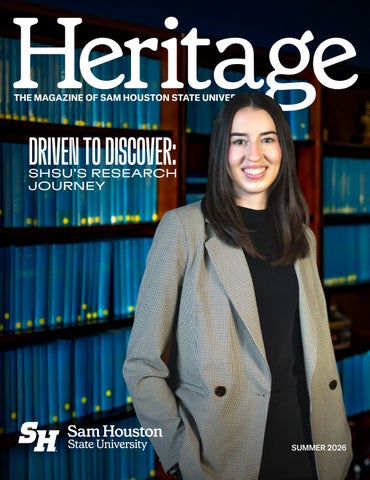
Heritage THE MAGAZINE OF SAM HOUSTON STATE UNIVERSITY
DRIVEN TO DISCOVER:
SHSU’S RESEARCH JOURNEY
SUMMER 2026
A MESSAGE FROM THE PRESIDENT Research often starts with uncertainty. At Sam Houston State University, it is what we do with that uncertainty that defines us. We ask questions not only to understand the world, but to improve it. For generations, SHSU has been guided by a powerful ideal: The measure of a Life is Its Service. That calling continues to guide our work today through faculty pursuing bold questions, students applying curiosity and determination to discovery and alumni whose scholarship and service strengthen communities across Texas and beyond. This issue of Heritage explores an important chapter in SHSU’s research journey. Across our colleges, classrooms, laboratories and community partnerships, Bearkats turn inquiry into impact. Their work advances knowledge in fields that shape daily life, from education and counseling to health, security and the environment. Research at SHSU connects directly to teaching and student success. It equips students to think critically, ask informed questions and apply what they learn to real-world challenges. Through mentorship, hands-on experience and creative scholarship, they learn how to carry knowledge beyond the university and apply it where it matters most. In this issue, you will read about doctoral students and graduates whose research is improving the way counselors are trained, helping student-athletes succeed in the classroom and expanding access for learners with diverse needs. We are addressing issues such as Type 2 diabetes, carbon emissions and sustainable agriculture. As you read this issue of Heritage, I invite you to see Sam Houston State University as a place where research and impact are inseparable. Our work is driven by discovery, grounded in purpose and carried forward by people who believe in the promise of this university. Together, we are shaping a future worthy of our mission and the Bearkat name.
Alisa White, PhD President, Sam Houston State University
INSIDE:
Chief Marketing Officer and Public Information Officer Jeff Harris
Editor
2
Why We Research
5 6 8 9 10 13 14 15 16 18
Doctoral Programs Driving Innovation Clinical Psychology Forensic Science Digital and Cyber Forensic Science Counselor Education Criminal Justice Curriculum and Instruction Educational Leadership Higher Education Leadership Instructional Systems Design and Technology Osteopathic Medicine
Emily Binetti
Writers
Emily Binetti Mikah Boyd Brittany Foreman Arina Garcia Amber Sellers Emilee White Damikka Willis
Creative Direction & Design Zack Jones
Photography
Justin Calhoun Tega Okperuvwe Joseph Palma Amber Sellers
Associate Director of Print Services Lori Proctor
20
Cultivating a Research Culture
Heritage Online Mikah Boyd
24 26 29 32
Spotlight on BRIDGE Bridging Innovation and Impact Rethinking Diabetes Treatment Seed Funds for Blossoming Research Growing Environmental Gains Along the Road
35 36 37
SHSU Receives Historic Gift for Agricultural Sciences In Memoriam Class Notes
Texas State University System Board of Regents
Sam Houston University Foundation Board of Trustees
Stephen Lee, Chairman • Bastrop Tom Long, Vice Chairman • Dallas Charlie Amato, Regent • San Antonio Duke Austin, Regent • Houston Sheila Faske, Regent • Rose City Russell Gordy, Regent • Houston William F. Scott, Regent • Nederland Alan L. Tinsley, Regent • Madisonville John "Johnny" Weisman, Regent • New Braunfels Elizabeth Diaz Arreola, Student Regent • Beaumont Brian McCall, PhD, Chancellor • Austin
Russell S. Molina, Chairman • Houston Joel R. Michael, Vice Chairman • Friendswood Charles W. Jones III, Secretary • Huntsville Ferne S. Frosch, Treasurer • Huntsville E. Brooke Beierle • Stafford Mia D. Gradney • Richmond John Hoyt, Jr. • Woodway Brian J. Starr • Houston DeeAnn Thigpen • Houston Christopher L. Tritico, Sr. • Houston Ryan M. Weber • Houston Matthew Bethea (Ex-Officio) • Huntsville Amanda Withers (Ex-Officio) • Huntsville
Every effort has been made to ensure the information contained in this issue is accurate. We apologize for any errors or omissions and ask that you bring them to our attention. Please report any corrections to: Integrated Marketing Communications Box 2105 Huntsville, TX 77341-2105 936.294.4406 heritage@shsu.edu
Discover
the Benefits of Giving Wisely shsu.edu/giving
Su m m er 2026
1
Why We Research by: Sumanth Yenduri, PhD
2
s h s u.e d u/h e r itage
A
university is shaped by what it teaches and how it engages students with meaningful opportunities. At Sam Houston State University, I have seen that connection in research and scholarly activity, driven by talented faculty with a genuine commitment to student success. There is an amazing breadth of subject matter expertise and interdisciplinar y collaboration across a wide range of disciplines. The deep drive among our faculty to pursue and successfully secure large, highly competitive grants is not only exciting, but it is transformative for our students, the institution and our communities. This commitment to impactful research works hand-in-hand with our faculty’s focus on our students. At its core, students are here in pursuit of direction, purpose and opportunity. Our responsibility is to keep that central motivation at the forefront and to ensure we are doing everything we can to help them be successful in their aspirations. When we approach education through that lens, research becomes a powerful asset.
Sumanth Yenduri is the provost and senior vice president for Academic Affairs at SHSU. Acting as the chief academic officer since 2025, he strives to improve the student academic experience, promote faculty success, foster impactful research and facilitate community engagement.
"It deepens learning, connects students to real-world challenges and equips them with the skills and experiences they need to move confidently into theirfutures." SHSU faculty engage both undergraduate and graduate students in research opportunities organically. Nearly 200 undergraduate students are currently funded through grants and actively engage in research. At Sam, we see this great success due to our faculty’s dedication to experiential learning. Countless factors can pull students away from their academic path, but research often creates reasons for them to persevere. It can reshape a student’s experience to see how their learning connects directly to real-world applications. That sense of relevance becomes a powerful motivator for persistence and completion. Additionally, the knowledge and skillsets gained from conducting and participating in research and scholarly activities are valuable after graduation. It elevates
student opportunities in the job market as well as in the pursuit of further degrees. Across our region, businesses and organizations face challenges that could benefit from academic insight and student involvement. These are meaningful opportunities to serve our community. Through numerous established centers and institutes with faculty expertise and engaged students, there are strong pathways to partner with the community, identify needs and work collaboratively on solutions. For example, the CARES Center (Center for Assessment, Research and Educational Safety) is committed to producing rigorous, applied research that informs policy and practice to create safer learning environments. It is only one example among dozens. From our Law Enforcement Management Institute of Texas to our new Aging Research Collaborative, researchers at Sam Houston are doing transformative work. For any academic enterprise, research and scholarly activity is foundational. The value of research goes beyond elevating an institution’s prominence and visibility; it plays a critical role in attracting and retaining students and faculty. In many ways, research and scholarly activity are central to how an institution grows, differentiates itself and builds lasting influence. By creating new knowledge, Sam Houston State University strengthens student learning and translates research into meaningful, real-world impact on our communities.
Sum m er 2026
3
PURSUE YOUR EXCELLENCE ELEVATE YOUR CAREER WITH AN ADVANCED DEGREE OR CERTIFICATION.
4
s h s u.e d u/h e r itage
FOR MORE INFO, VISIT SHSU.EDU/START
DOCTORAL PROGRAMS DRIVING INNOVATION
Understanding Minds, Shaping Justice CLINICAL PSYCHOLOGY
A
t Sam Houston State University, doctoral research is designed to bridge academic endeavors with real-world impact; a mission reflected in the work of Inneké Vargas, a clinical psychology doctoral student whose research sits at the intersection of psychology and the legal system. Her dissertation focuses on forensic psychological evaluations in immigration cases, in which clinicians assess the mental functioning and well-being of individuals in legal proceedings. These evaluations are frequently used and can play a critical role in decisions that shape an individual’s future. “These reports can significantly influence legal outcomes,” Vargas said. “Ensuring they are conducted ethically and consistently helps protect both the individuals being evaluated and the integrity of the legal process.” Through her research, she is surveying practicing clinicians to examine how closely current evaluations align with best practices. By identifying areas where additional guidance or training may be needed, she aims to strengthen the quality and consistency of these assessments across the field. Reflecting the program’s broader emphasis, her work
Inneké Vargas
integrates clinical practice with academic research; an approach that prepares students to contribute meaningfully beyond the classroom. One of the most formative experiences in her doctoral journey came through a research project at SHSU, where she facilitated a student focus group centered on personal experiences and individual development. “The students discussed how race was talked about in their families as well as experiences of racism throughout their lives and how they developed resilience in response,” Vargas said regarding her research. “Hearing those perspectives strengthened my perspective and helped me better understand how systemic and interpersonal racism shape mental health, which has made me a more thoughtful clinician.” Collaboration has also been central to her growth. Faculty mentorship has helped refine the foundations of her work, while peer collaboration has provided space to exchange ideas and navigate challenges. She describes the program as highly collaborative, with strong faculty and peer support that helps students navigate their graduate studies. “My department has been very supportive through mentorship, structured research training and opportunities to collaborate with faculty on ongoing projects,” she said. In addition to technical research skills, Vargas has developed strengths she did not anticipate, including clinical listening and interviewing. “Before graduate school, I did not have prior clinical experience, so engaging in research on people’s lived experiences required learning how to ask thoughtful questions, listen carefully and approach sensitive topics with empathy.” Support from faculty and access to established researchers within SHSU and across the country have further strengthened her work and is now providing insight into how research can inform practice at a broader level. As she looks ahead, Vargas hopes her research will contribute to more ethically sound and scientifically grounded forensic psychological evaluations. More broadly, she aims to support systems where psychological expertise is used to promote fairness, informed decision-making and the wellbeing of vulnerable populations. Her work reflects the purpose at the heart of SHSU’s research mission: preparing scholars who not only advance their fields but also make a meaningful difference in the communities they serve. Su m m er 2026
5
DOCTORAL PROGRAMS DRIVING INNOVATION
DNA: One Case at a Time FORENSIC SCIENCE
T
he forensic science doctoral program at Sam Houston State University attracts many students from all over the world. An education that is seen as an opportunity to sharpen your skills from undergrad; graduate school is an opportunity to get into the next level of forensic science. The forensic science graduate level topics consist of forensic biology, chemistry and toxicology, controlled substances, trace evidence and microscopy, instrumental analysis, crime scene investigation, pattern evidence, law and forensic science, ethics, quality assurance and statistics. These topics are highlighted through the program to provide students with a unique and interdisciplinary experience during their time at SHSU. It’s not just about the classes but also how
you apply textbook knowledge to real world cases, that goes beyond the classroom. Ahana Chatterjee’s journey in the program has been a part of her passion for forensic science. Originally from India, she studied biotechnology at a private university in Kolkata, where she learned about the Innocence Project during a course, which sparked her idea to pursue a career in forensic science. Founded in 1992, the Innocence Project was created to be the primary driver of criminal justice reform using DNA and scientific advancements to overturn wrongful convictions. “I’m a full-blown forensic DNA girl,” Chatterjee said. “My specialty in research involves examining challenging samples. A lot of my work focuses on degraded bone samples and touch
Ahana Chattergee
6
s h s u.e d u/h e r itage
DNA, cases where traditional DNA typing doesn’t perform as well. I’m particularly interested in these non-traditional, complex samples and developing improved approaches for their analysis, especially in kinship and identification contexts where establishing biological relationships is critical, like in missing persons and disaster victim identification cases.” It’s a difficult research area because extracting interpretable DNA profiles from something like burned human bones can be complicated. The hardest samples are usually from crime scenes or unidentified human remains, where DNA is often really limited or degraded. On top of the complex process of DNA extraction, when it comes to research, financial barriers can arise, leading to more issues down the line. For instance, laboratories that don’t have the correct resources tend to have large backlogs of cases. That’s where Chatterjee’s passion for research comes in. “There are already many genetic panels available, but I’m currently developing a new panel which is designed to be more accessible and help all laboratories that are working with limited resources,” she said. Forensic science is essential in every country, as missing person cases involve real people and need to be solved in a timely manner. To that end, Chatterjee believes that these cases should be solved no matter the cost. Throughout the hard work of conducting this research, Chatterjee has learned it’s not just about finances, but manpower as well. “Collaboration is key to our department,” Chatterjee said. “We work closely with interdisciplinary research teams and collaborate with companies from all over the world like QIAGEN, ThermoFisher Scientific and a group that’s based in the Netherlands. We recently completed an interdisciplinary project that brought different areas together, DNA and trace, where we worked with bone powder and tested different methods to develop a prescreening approach. The goal was to better understand the samples before moving forward with full DNA analysis.” Collaboration between students with different forensic science focuses creates opportunities to learn beyond the lab, especially through teamwork and shared problem-solving “My principal investigator and mentor within the program is Mayra Eduardoff, but we call her Dr. E,” Chatterjee said. “She’s been my biggest support system during my time at Sam Houston, and I wouldn’t be where I am as a professional if it wasn’t for her.” Through Chatterjee’s experience in wet labs, she learned to conduct a variety of experiments, analyze the data within a limited timeframe, engage in teamwork with other scientists, while also receiving once-in-a-lifetime mentorship. All of which were essential to develop Chatterjee’s ability to identify people across disciplines that can make a difference in a real-life situation. “Since my research is targeted toward assisting laboratories with large backlogs of cases and limited funding, I see it impacting society by potentially solving more cases more quickly,” she said. “Even if it helps to solve one case, that’s one piece of the puzzle that’s figured out and that's someone’s family getting the closure they need.” Chatterjee’s passion for forensic science is more than just textbook knowledge but a goal to help others who are in need, regardless of their financial status.
On the cover: Doctoral student Anne Wingert’s contributions to criminal justice research will leave a lasting impact on future generations of students and scholars in the field. More on page 10.
See More. Learn More. Heritage Online! Through our enhanced digital version of Heritage, designed to complement our print version, you will find even more information and interactive features, such as videos and web links to keep you up to date on university news and your gifts at work.
Available at: shsu.edu/heritage
Su m m er 2026
7
DOCTORAL PROGRAMS DRIVING INNOVATION
Where AI Meets Investigation DIGITAL AND CYBER FORENSIC SCIENCE
A
s artificial intelligence continues to reshape industries, Chukwuemeka “Emeka” Ihekweazu is applying it to one of the most detail-driven fields: digital forensics. Ihekweazu’s research explores how AI can strengthen processes in digital forensics, particularly in training and compliance. His work centers on developing an interactive, capture-the-flag-style environment that guides users through the steps of a digital forensic investigation. “I’m using AI as a tool to help reinforce the process,” he said. “It’s not just about getting answers; it’s about understanding how to approach each step correctly.” In digital forensics, professionals must follow a structured m e t h o d o l o g y, f r o m identifying and collecting data to analyzing findings and presenting results. Ihekweazu’s research uses AI to simulate that process, helping users evaluate whether they are following proper procedures and identifying potential gaps in their approach. The work has practical implications for both education and industry, where accuracy and consistency are essential, particularly in situations where findings may be subject to external review. Chukwuemeka “Emeka” Ihekweazu His interest in the field was further shaped by a formative experience early in his doctoral journey at Sam Houston State University. After receiving support through a National Science Foundationfunded opportunity, Ihekweazu attended a digital forensics research workshop, where he engaged with experts from both academia and industry. “That experience showed me how much depth there is in this field,” he said. “It goes far beyond what most people expect.” Since beginning the program, Ihekweazu has contributed to multiple research publications and presentations, building a growing body of work in the field. He credits faculty mentorship
8
s h s u.e d u/h e r itage
and peer collaboration with helping him develop both his research and technical communication skills. “When I started, I didn’t really know how to approach academic writing,” Ihekweazu said. “Through mentorship and working with others in the program, I was able to develop those skills and apply them in my research.” That support extends beyond the classroom through opportunities to engage with professionals across the field. Through conferences, research and collaboration, Ihekweazu has gained a clearer understanding of how his work applies in both academic and industry environments. In addition to research skills, he has developed a wide range of practical abilities, including technical writing, data presentation and professional communication skills reinforced through coursework, workshops and hands-on experience within the program. Institutional support has also played a key role in his development. Through departmental and graduate school funding, Ihekweazu has been able to present his research at conferences and engage with broader academic and professional communities. “That kind of support makes a difference,” he said. “It allows you to fully participate and grow as a researcher.” Looking ahead, Ihekweazu hopes his work will contribute to more structured, reliable approaches within digital forensics. He aims to ensure that processes are not only effective but also clearly documented and defensible when reviewed. He also sees growing opportunities for future professionals in the field. “There’s a need for SHSU students in cyberspace,” he said. It’s a need his work, and SHSU’s research programs, are helping to meet.
Alexia Florentin
DOCTORAL PROGRAMS DRIVING INNOVATION
Where Purpose Meets Practice COUNSELOR EDUCATION
R
esearch is just as personal as it is professional. For Alexia Florentin, that belief isn’t just an idea; it’s the foundation of her work and her time in the counselor education doctoral program at Sam Houston State University. As a practicing therapist of nearly a decade, her decision to pursue a PhD wasn’t about adding credentials. It was about expanding her influence. “I started out as a mental health therapist who just wanted to go back to school because I felt like it could have positive impacts that extend beyond myself and to my colleagues and clients,” Florentin said. “We are guided by not just our own personal lives, but how this impacts real counselors and clients.” Today, she serves as a professor at Texas State University, teaching graduate students in a professional counseling program, but her work extends far beyond the classroom. At its core, her research focuses on strengthening the counseling field as a whole. “My field of study is exactly what it’s titled. It’s education, supervision and research for mental health therapists and counselors,” Florentin said. “My research centers around how
we can better train, educate and supervise our therapists that are out there in the field.” That focus on improving the profession is a defining element of the doctoral experience. Students are not only learning to practice counseling, but are also learning to shape its future. For Florentin, the most transformative part of that process was the dissertation, something she described as both extremely demanding and deeply rewarding. The process is rigorous, requiring students to review existing research while also collecting and analyzing their own data. Through it all, Florentin's dissertation became the foundation that continues to shape her work today. Her research focused on the psychological grief families experience when navigating addiction, an extension of both her clinical work and personal experience. “I worked in rehabs, and I ran family groups for family members of people that were struggling with addiction,” Florentin said. “I also have a loved one who struggled with addiction so I can relate to that. My dissertation set me up for success because now I have a foundation for what my research Sum m er 2026
9
trajectory will look like in the future.” Collaboration also plays a critical role in the doctoral experience and professional research. Florentin intentionally sought out opportunities beyond the university to broaden her perspective, which helped her better understand not just the research itself, but the importance of the people behind it. “You want to work with people that not only work well with you, but are going to be accountable and organized,” Florentin said. “You want to love the research that you do and be a part of a team that you love.”
Beyond skill-building and career advancement, her work is also about representation, both in the classroom and in the field at large. That sense of purpose continues to guide her work as both an educator and a researcher, reflecting the broader mission of SHSU’s counselor education doctoral program: to develop professionals who are not only highly trained but deeply connected to the work they do. In counseling, research isn’t abstract; it’s human, and for those like Florentin, it’s both deeply personal and profoundly impactful.
DOCTORAL PROGRAMS DRIVING INNOVATION
Discoveries That Drive Impact CRIMINAL JUSTICE
A
s a leading institution in criminal justice education nationwide, the Sam Houston State University College of Criminal Justice hosts one of the earliest criminal justice doctoral programs, awarding the university’s first doctoral degree in 1973. Since then, the college has produced hundreds of doctoral graduates whose research has gained national and international recognition. On course to join them is criminal justice doctoral candidate Anne Wingert. Through her research, Wingert aims to uncover findings that will help service practitioners better support individuals affected by early-life trauma. She examines the long-term outcomes of early-life adversity to clarify its implications, with the goal of deepening understanding of how childhood experiences shape justice-related outcomes across one’s life. “I’m focused on examining if and how unique forms of childhood abuse, neglect and household dysfunction are linked with consequences in young adulthood like risk-taking behavior, victimization and contact with the criminal justice system,” Wingert said. “It is my responsibility to ensure my work communicates any implications that may help practitioners tailor and implement the necessary intervention and prevention programs that best serve those impacted by trauma.” Wingert’s interest in this area of research was sparked after an internship with a child advocacy center while completing her undergraduate degree. This practical experience, in combination with close connections with SHSU faculty, led her to pursue a doctoral degree. Having earned a master’s degree in criminal justice and criminology from SHSU, Wingert’s continued collaboration with faculty has fostered professional and personal growth, strengthening her skills and confidence as a researcher. “Professionally, my faculty mentors have helped refine
10
s h s u.e d u/h e r itage
my research ideas, polished my writing and ensured that everything I am pursuing aligns with a strong research agenda and pipeline,” she said. “On a personal level, they have always encouraged me to put my best foot forward, shared wisdom from their own experiences working in academia and offered unwavering support through every curveball.” For her dissertation project, Wingert explores the associations between early life-adversity, childhood unpredictability and risk-taking behaviors in young adulthood among a sample of undergraduate students. A better understanding of how this experience relates to trauma and behaviors that may lead to contact with the justice system has important implications for criminological theory and early intervention programming. From designing the survey, collecting her own data from over 1,000 students and drawing theoretical and practical conclusions, she described this project as her “most formative research experience thus far.” Invited to present her dissertation findings, she was among 40 advanced doctoral students selected to participate in the 2026 Academy of Criminal Justice Sciences Doctoral Summit in Philadelphia, Pennsylvania. “The focus on unpredictability as a dimension of unhealthy child development has not been studied much in criminology or criminal justice,” said Eric Connolly, criminal justice and criminology professor and Wingert’s dissertation chair. “The nature and topic of Anne's dissertation exemplify many of the qualities I have come to expect from her: originality, thoughtfulness and a high level of scientific rigor.” With a faculty position secured for this fall, Wingert’s esteemed work as a scholar and researcher will lay the groundwork for educating and mentoring future generations of criminal justice students, researchers and practitioners.
Anne Wingert Sum m er 2026
11
LEAD IN SERVICE TO OTHERS LEARN, LEAD, MAKE A DIFFERENCE.
SHSU-COM PREPARES FUTURE OSTEOPATHIC PHYSICIANS TO IMPROVE HEALTHCARE ACCESS AND OUTCOMES ACROSS TEXAS AND BEYOND.
FOR MORE INFO, VISIT SHSU.EDU/COM 12
s h s u.e d u/h e r itage
DOCTORAL PROGRAMS DRIVING INNOVATION
Expanding Access for Every Learner CURRICULUM AND INSTRUCTION
A
fter spending 30 years teaching students with educational support needs, Susan Gollihugh is now earning a doctorate in curriculum and instruction with a concentration in special education. Her goal is to use what she learns from her degree and experience to implement a system that helps students with support needs learn alongside their peers while continuing to receive the assistance they need. As a former teacher for the deaf and hard of hearing, Gollihugh witnessed students with support needs becoming increasingly isolated as a side-effect of receiving the assistance they require. “That’s where I’m like there has to be a better way to provide services to kids who have these different abilities and make them feel a part of the classroom, like they’re contributing to their peers, engaged and on a level playing field,” she said. Gollihugh is currently researching ways to launch a shared, digital platform for teachers and related service providers to exchange information on a student’s needs and progress. In the current system, the student is pulled from class for their supplemental lesson and is returned with a hasty progress report. While receiving this progress report, the teacher must keep an eye on their 19-20 other students. With their attention divided, Gollihugh noted information was easily lost during this handoff process and sees the digital platform she’s working on as a way to ease this process. “I’ve seen inclusive practices get better over the years, but we still have a way to go with including students who have extensive support needs in general education settings,” Gollihugh said. To Gollihugh, easing these lines of communication can help students with support needs stay with their classmates for longer amounts of time, preparing them for the demands of the adult world. By simplifying the process for relaying information while students are pulled from and returned to class, it will shorten the amount of time this takes, keeping all the students on task, no matter the setting or circumstances. “Everyone, to a degree, needs structure or boundaries, but it has to be balanced with allowing for fun,” Gollihugh said. “When teachers create that, you have teachers with good instructional control and kids that are not bouncing off the wall but can still have fun and express themselves.” In her current role as an admission, review and dismissal facilitator at Montgomery County Independent School District’s Oak Hills Junior High, she’s out of the classroom but still
Susan Gollihugh
supporting students with special needs by coordinating with parents, educational support staff and educators. Through this work, and the work she is conducting through her research, Gollihugh is making strides toward a future where curriculum and instruction is built around including students of all abilities. “I’m one of those teachers who believes ALL students belong in the classroom—without exception,” she said. “Achieving that takes a lot of work and a collective shift in mindset, but it’s the only way to ensure our students truly thrive as contributors to society. I want my legacy to be simple: helping the next generation feel deeply connected in their classrooms, their communities and the world at large.” Summ er 2026
13
DOCTORAL PROGRAMS DRIVING INNOVATION
Clearing Educational Hurdles EDUCATIONAL LEADERSHIP
I
nnovation drives change but what sparks innovation? Determined individuals who don’t just identify problems but solve them for the betterment of those who come after. Anita Bundage, a graduate of Sam Houston State University’s educational leadership doctoral program, only became a middle school coach because her former coach said her alma mater needed one. When she took on that role, she would have never expected she’d continue to work with middle schoolers, much less become an assistant principal who tackled student athlete learning gaps. Now, Bundage oversees more than 500 student athletes and honors students at Conroe Independent School District’s Stockton Junior High. Throughout her 24 years of teaching, she noticed student athletes were struggling to balance their academic and athletic roles. The issue would become even more evident should they suffer an injury and lose the ability to play competitively. “I’ve seen so many kids with talent fall short because there
was no balance,” she said. “There wasn’t that academic balance, or they got injure d and suddenly, they weren’t that kid who could play anymore, they were just wooing in the wind because they didn’t know what to do.” It was through her doctoral research that Bundage found a potential solution: adding supplementary lessons to the annual strength and conditioning (SAC) camp. In the summer of 2025, Bundage and her colleagues hosted SAC Camp Next Steps. This expanded version of SAC camp began with a workout session, followed by a light meal thanks to sponsorships with H.E.B. and other organizations. Then, English and mathematics teachers lead supplemental lessons before kids are sent to learn leadership skills by listening to various speakers. “We’re taking advantage of the fact that they’re going to come to SAC camp. They’re going to come to work on being an athlete, and since you’re here, we’re going to teach you these other things too because we know it’s important,” Bundage said.
Anita Bundage
14
s h s u.e d u/h e r itage
As she saw her camp improve student-athletes’ learning, she saw their futures grow brighter as well. In her research, she went to general education instructors to see what challenges they faced when working with student athletes. They also noted how youngsters struggled to strike a balance between their roles of student and athlete. In the eyes of these educators, Bundage’s SAC Next Steps camp is a step in the right direction. “I learned from interviewing teachers for my dissertation that when coaches are involved in the learning process, kids tend to tighten up and lock in a little bit,” Bundage said. “During camp, I’m walking the hallways and I’m seeing it working. These are seventh grade babies who are coming in, and actually starting
to catch on, and see the value in learning.” She’s now looking to equip even more students with even more tools for success. Looking ahead, she is collaborating with her peers across Conroe ISD to incorporate the program on other campuses. For 2026, Bundage has partnered with First Financial Bank to teach financial literacy and has already received frantic calls from parents fearing they missed the registration deadline for this year’s SAC Next Steps camp. “It’s something we can do in the school system that allows parents to see we’re not just trying to get the athletic talent out of their kid, we’re really trying to get them set up for success,” Bundage said.
DOCTORAL PROGRAMS DRIVING INNOVATION
Passion for Persistence HIGHER EDUCATION LEADERSHIP
L
eadership experience is a muscle that needs to be built throughout time. The doctoral program in higher education at Sam Houston State University offers two concentrations, administration and academic support programs. With every professional’s experience being different based on the many passions they may pursue, graduates from this program gain the skills to lead institutions of higher education effectively and ethically. Gabriela Zepeda’s journey started at Galveston College with an associate's degree in education before she transferred to the University of Houston-Clear Lake for her baccalaureate degree in education. “I went into undergrad wanting to be an elementary school teacher, but when COVID happened, my goals had shifted to working with students from disadvantaged backgrounds,” Zepeda said. To do this, she came to SHSU to earn her both her master and doctorate in higher education administration. Ze p e d a’s concentration is in academic support programs, and her research focuses Gabriela Zepeda (center) on first-generation students who come from low-income backgrounds. Throughout her research process, she has been seeking answers as to how universities can help students stay on track and continue from one semester to the next. Student motivation, persistence and helping students succeed in college are important in her work, particularly in her experience
as the TRiO Upward Bound academic coordinator for Galveston College. TRiO programs are a form of federal outreach and student services curated to identify and provide resources and support for individuals who come from disadvantaged backgrounds that are pursuing higher education.
“Being able to connect the theories we’re learning in the program and apply them to the community college students I interact with on a daily basis has made this research experience formative,” Zepeda said. Collaboration is a huge part of her experience in higher
Sum m er 2026
15
education and research in the doctoral program. As a TRiO coordinator at Galveston College, Zepeda is involved in many student activities at the institution, which has assisted with the fieldwork portion of her academic research. “Communication and collaboration have always been there with my faculty and even my other peers, who are also online students,” Zepeda said. “These interactions have exposed different perspectives and different approaches, which challenges my thinking and strengthens it.” Apart from her academic journey, Zepeda has been learning how to develop technical skills like research design and data analysis; and how to relay her results in a way that resonates with different stakeholders. “One of the biggest things I’ve learned is adjusting how I can present research results and getting my message across regardless of the audience,” she said. On top of the high-quality education she has received through the doctoral program, SHSU has opened opportunities for Zepeda to receive grants and participate in fellowships
in and out of the university while maintaining clear lines of communication with her professors. “The mentorship and encouragement I received from faculty has helped me tremendously, especially with the work-life balance between my studies and work,” Zepeda said. This academic year, Zepeda had the opportunity to travel with Galveston College to Washington D.C. during policy week to advocate for TRiO programs that were in jeopardy of losing funding. The experience emphasized how advocacy is essential for preserving programs that help students from disadvantaged backgrounds. “I want my work to contribute to the creation environments where students not only survive college, but they feel like they belong and can succeed, showcasing the benefits of their college experience extend beyond simply going to class,” she said. Zepeda hopes her research will shift perspectives on students choosing to not continue their college journeys from questions of “Why are students struggling?” to “What can we do differently to support students from all walks of life?”
"The mentorship and encouragement I received from faculty has helped me tremendously, especially with the work-life balance between my studies and work.”
- Gabriela Zepeda
DOCTORAL PROGRAMS DRIVING INNOVATION
Innovation That Shapes How We Learn
INSTRUCTIONAL SYSTEMS DESIGN AND TECHNOLOGY
I
n today’s academic landscape, curriculum is often standardized; however, individual learning styles and needs vary significantly from person to person. The online doctorate in instructional systems design and technology (ISDT) at Sam Houston State University challenges that idea, allowing working professionals like Arlene Ramirez and Jonathan Kinsey to research more effective ways to deliver instruction. “All of us learn differently,” Ramirez said. “The advent of technology gives us so many different opportunities to finetune how someone receives the information, so they can comprehend what they are learning.” Ramirez knows firsthand the benefits of tailoring learning to an individual’s needs. As chief learning officer for Hospitality Financial and Technology Professionals, she works alongside a team that includes Waneta Hebert, another graduate of SHSU's ISDT doctoral program, to develop comprehensive learning solutions, professional development and certification programs
16
s h s u.e d u/h e r itage
for finance and technology professionals in the hospitality industry. The quality of these offerings has also enabled her to build strategic partnerships with allied associations, delivering scalable education that helps the industry collectively move forward. While universities often teach more “macro” concepts, Ramirez said professionals often encounter new challenges once they enter the workforce. The ability to connect theory with real-world challenges is a key focus of the ISDT doctoral program. Additionally, the program’s cohort model creates opportunities for students to learn from each other’s professional backgrounds. Ramirez, whose career is rooted in hospitality and finance, initially felt intimidated entering a program where many classmates had degrees in instructional design or education. “I came from a totally different background,” Ramirez said. “But having access to the different experiences provided by my
Jonathan Kinsey
cohort members was great because I was able to learn so much.” By studying the intersection of technology, strategy and learning theory, students explore how instructional design can influence outcomes in a wide range of environments. The program also gives students the flexibility to investigate the issues that matter most to them in their professional work. For Kinsey, who is currently in the program, that flexibility has allowed him to focus his research on a group he believes is often overlooked in higher education. “Adult online learners are an untapped market,” Kinsey said. “What I’m wanting to investigate is the friction happening between adult online learners and the institutional systems they have to navigate.” By analyzing behavioral data across multiple institutional systems, Kinsey hopes to develop a machine learning model that can help university administrators predict academic outcomes and improve the online learning experience for adult students. Ramirez’s research took a different direction but was similarly shaped by her professional experience. She examined how corporate-level human resources professionals at luxury hotels designed onboarding programs for new employees and has since encouraged them to incorporate learning theories,
demographics and instructional design principles in staff training. Like Ramirez, Kinsey said the concepts he learned in class have made him an effective problem solver in his role as executive director of online professional learning at SHSU Online. “There’s this alignment where I’ve been able to take what I’m learning in the classroom and immediately apply it in a context that’s in my workplace,” Kinsey said. As they continue their work, both Kinsey and Ramirez hope their research will make a lasting impact. While Kinsey aims to move into leadership roles focused on online learning for adults, Ramirez’s goals center on empowering others through education and helping people recognize their own growth potential. “It’s all about making that impact on people’s lives where they can improve and be happy, and I think education does that for people,” Ramirez said. “Hopefully that's something I can do as I move forward in the future.” Through research, collaboration and real-world application, students in the instructional systems design and technology program are developing learning experiences that help people grow, no matter where they are in their educational or professional journeys. Sum m er 2026
17
Wyatt Mayer
18
s h s u.e d u/h e r itage
DOCTORAL PROGRAMS DRIVING INNOVATION
Learning to Think Like a Physician OSTEOPATHIC MEDICINE
A
t SHSU’s College of Osteopathic Medicine (SHSU-COM), one third-year student doctor is discovering that research can be one of the most powerful tools for learning how to practice medicine. For Wyatt Mayer, research has become an important part of learning to think like a physician, not as a résumé builder but as a way to ask better questions and think more deeply about patient care. He has been involved in a range of projects, from anatomy and embryology education to case reports developed during clinical training. While the topics vary, the experience has shaped how he approaches medicine, helping him think more critically, ask better questions and look beyond standard medical algorithms when caring for patients. His curiosity about research began before medical school, when he worked with an otolaryngology team to design a simulator for myringotomy procedures, a surgery in which doctors place small tubes in a child’s eardrum to treat recurring ear infections. The project introduced him to the role research can play in improving medical education and patient care. When he arrived at SHSU-COM, Mayer knew he wanted research to remain part of his medical school experience. “I always knew that if similar opportunities came up, I would be interested,” he said. “Even if someone doesn’t want research to be a major part of their career, I think doing at least one project helps you think differently.” During his time at SHSU-COM, he has participated in several research efforts, including anatomy education initiatives and clinical case reports from his clinical rotations, the hands-on training medical students complete in hospitals and clinics during the third and fourth years of medical school. One of his most meaningful projects explores how virtual reality technology could help students better understand embryology, the early stages of human development before birth. By turning a complex topic into an interactive visual experience, the project aims to help medical students better understand how the body forms and why certain congenital conditions occur. Equally important has been the mentorship he
received along the way. Faculty members, particularly within the anatomy department, helped guide the research process and build his confidence in taking projects from concept to completion. “Working on that project helped me go from having ideas to understanding the steps needed to actually take a project from beginning to end,” he said. Through SHSU-COM travel funding, Mayer also presented research findings at conferences in Portland and Seattle, sharing the team’s work with educators and researchers across the country. For Mayer, the value of research extends well beyond publications or presentations. Instead, it has shaped how he approaches patient care and clinical decision-making. “A lot of times in medicine we follow algorithms,” he said.
“Research helps you think about why we’re doing something and whether there might be a better way.”
- Wyatt Mayer As he continues his medical training at SHSUCOM, that mindset will remain central to the physician he hopes to become, approaching each patient with curiosity, critical thinking and a commitment to continual learning. For students considering research opportunities at SHSU-COM, Mayer says the key is simple. “If you want to conduct research at the COM and you’re willing to work for it,” he said, “there are plenty of ways to get involved.” For Mayer, those opportunities have transformed research from an academic interest into an essential part of becoming a physician. Summ er 2026
19
CULTIVATING A h c r a e s e R CULTURE THE GROWTH OF GRANT FUNDING
O
ver the years, research has grown from a quiet priority into a defining part of Sam Houston State University's identity. Chad Hargrave, vice president for research and strategic partnerships, said the shift began in the early 2000s, when university leaders made a deliberate decision to elevate research excellence. At the time, administrators restructured faculty workloads, creating a research-intensive track and signaling that scholarship would stand alongside teaching as a core mission. “The purpose was to increase research excellence and to align the university behind a research mission, in addition to the scholarly mission,” Hargrave said. “Good curriculum development and good instruction are functions of good researchers. It is interconnected.”
20
s h s u.e d u/h e r itage
Over time, grant activity became more embedded in campus culture. When Hargrave joined the university in 2018 as associate vice president for research, he found steady momentum but opportunities to expand participation and coordination. Rather than seeking additional resources, he introduced a strategy focused on communication and facilitation, shifting his office to a more outward-facing model that raised awareness of funding opportunities and guided faculty through the proposal process. “It was made clear to faculty that the goal was to build a strong partnership of support,” Hargrave said. “Assistance through each step, with a commitment to doing everything within institutional capabilities to help ensure their success.” A key metric became the number of proposals submitted. “You’re not going to get a grant if you don’t ask for
Summ er 2026
21
22
s h s u.e d u/h e r itage
it,” he said. “If submissions increase, awards will follow.” Over the past eight years, faculty participation has grown, and research activity has expanded across disciplines. Today, roughly a quarter of faculty members submit grant proposals annually, with many others contributing to active projects. “That progress has strengthened research across campus and clarified where we excel,” he said. “We now have far more grant-active faculty. It’s part of the culture.” Research activity also directly benefits students who gain
success and future potential. The analysis helps guide a more directed approach. “All of this evolution over the years puts us in a position to take what we’ve learned and put a new strategy on top of it — to improve with more focus,” Hargrave said. “Eight years ago, when we first started this, we didn’t have that.” The university recently launched the Task Force for Research Enterprise to shape its next phase. Drawing on institutional data, the group has identified four priority areas where SHSU
“Last year, about 15% of our grant expenditures supported students. Those who engage in research and mentorship see stronger retention and completion rates.”
Chad Hargrave
VICE PRESIDENT FOR RESEARCH & STRATEGIC PARTNERSHIPS
hands-on experience through paid research assistantships and mentorship. “As our research enterprise has grown, so have opportunities for students,” he said. “Last year, about 15% of our grant expenditures supported students. Those who engage in research and mentorship see stronger retention and completion rates.” Last year, Hargrave and his team revisited their original strategy, using institutional data to identify areas of research
shows strength and potential for national distinction, including defense and security, forensics, education and training and biomedical fields. “The aim is to continue supporting research across campus,” Hargrave said. “But we also want to concentrate on areas where we have clear strengths and can emerge as national leaders.” The next chapter for SHSU builds on a foundation laid over two decades by positioning research as a central component of academic excellence and student success.
SHSU SUBMISSION & AWARDS 2018 132 proposals submitted 47 proposals awarded
$6,587,095
2024 238 proposals submitted 97 proposals awarded
$32,196,553
Sum m er 2026
23
Bridging Innovation & Impact
A
growing investment in interdisciplinary research is helping Sam Houston State University faculty tackle real-world challenges, from healthy aging to workforce development, while expanding the institution’s research footprint. Two years ago, the university’s Office of Research and Sponsored Programs launched the Building Research, Innovation, Discovery and Growing Engagement, or BRIDGE program. The initiative supports interdisciplinary projects aimed at solving regional challenges while positioning faculty to secure external grant funding. Backed by the Provost Innovation Fund, BRIDGE provides seed funding for high-impact research in areas such as health, education, the environment and economic development. The program is designed to build long-term research capacity while producing tangible benefits beyond campus. BRIDGE has encouraged collaboration across colleges and departments, helping break down traditional academic silos. That approach has led to the formation of faculty research clusters, including the BRITE Consortium — short for biomedical research, innovation, training and employment
24
s h s u.e d u/h e r itage
— which brings together researchers from multiple disciplines under a shared agenda to advance biomedical research, workforce development and collaborative innovation. In its second year, the program expanded to support proposals with the potential to develop into research centers. One project selected for funding has since evolved into the Aging Research Collaborative, a cross-campus initiative focused on healthy aging. The collaborative connects faculty in biomedical, public health, social and behavioral sciences with students and community partners to address aging-related challenges in Texas and beyond. Organizers aim to grow the initiative into a regional and national leader in aging research while training future professionals in related fields. The BRIDGE program reflects SHSU’s continued commitment to expanding research collaboration and innovation with real-world impact. By investing in earlystage ideas, BRIDGE is strengthening SHSU’s research culture to deliver solutions that extend beyond the university into the communities it serves.
SPOTLIGHT ON BRIDGE-FUNDED PROJECTS
Sum m er 2026
25
26
s h s u.e d u/h e r itage
SPOTLIGHT ON BRIDGE-FUNDED PROJECTS
Rethinking Diabetes Treatment
"
They don’t really have the tools needed to know what to do next, and that spurred the idea of adding a little psych intervention that really targets why people avoid engaging in their healthcare." - Ryan Marek Associate professor of clinical psychology
D
iabetes was first recognized as a national emergency by the Center for Disease Control in 1994. Since then, researchers from across the nation have developed numerous ways to help patients manage their diabetes symptoms, leading to breakthroughs left and right, but there are those who see the guidance as optional, not lifesaving. It’s an issue that Ryan Marek, associate professor of clinical psychology, has seen on display across East Texas. Despite attending regular check-ups with their physicians, receiving medication and being directed to lower their A1C, their condition remains the same. “They come back three months later, and their A1C doesn’t go down, and they feel like they failed, or their physician may chide them for that,” Marek said. “They don’t really have the tools needed to know what to do next, and that spurred the idea of adding a little psych intervention that really targets why people avoid engaging in their healthcare.” Having formerly worked at SHSU’s College of Osteopathic Medicine, Marek approached the project with his eyes set on East Texas, especially as most of the region’s residents live in healthcare deserts. As he drove around the area to assess access to healthcare as well as healthy food options, which are essential to managing A1C, he was shocked at what he found. In place of grocers with fresh produce, meats and other healthy foods are local convenience stores, where most foods are canned or frozen. While those items are fine to consume in moderation, people trying to manage their diabetes can see their symptoms worsen due to the high amounts of sodium and sugar they contain. “So even if you’re trying to make healthy choices, there’s only so many options available to you,” he said. The finding came as a surprise to Marek and his fellow researchers. While collaborating with partners at institutions across the state gave him data, going in the field and seeing the absence of fresh foods for himself demonstrated why the most common advice, maintaining a balanced diet, is difficult to follow. This discovery led to Marek pivoting his focus to promoting the second most common bit of advice, tracking blood sugar levels. It’s in this realm that Marek has seen success incorporating a bit of psychology into treatment. He employs what is known as acceptance and commitment therapy, which encourages individuals to acknowledge that something may be uncomfortable, but embrace the situation, and commit to making the best of things to stay aligned with their values. “We’re not trying to eliminate or change those thoughts, but getting people to notice their experiences, to stay present in the moment, and then ultimately take actions in what aligns to what’s most valuable to them,” Marek said. “So, we then are presenting them with the question, ‘Is it worth tolerating having these unpleasant thoughts or sensations if it means that it’s moving you closer toward your values?’” So far in his research experience, he has worked primarily with older populations who have spent years grappling with the discomfort that comes with checking glucose levels throughout the day, especially around others. To combat the years of anxiety that has built around the act, Marek and his peers had Sum m er 2026
27
to dig deep to find a strong enough motivator. “Grandkids are definitely a value that pops up a lot. We’re getting them to think about if they want to be healthy and live long enough to see their grandkids grow up. That alone is way more powerful than the thought of not wanting to check their blood sugar in the morning,” Marek said. Now a year into the project with some of the participants, data is showing early signs of success by dividing participants into two different groups: one that receives education only and another group that receives education, continuous glucose monitors and acceptance and commitment therapy. In both groups, the participants’ bloodwork showed a drop in their A1C levels after three months. While both saw success, the group that received glucose monitors and acceptance and commitment therapy had a sharper drop, indicating Marek’s multi-level approach is highly effective. Further proof of early success is how the subjects in both groups kept these threemonth mark levels stable at the one-year mark. “These are small test groups, not quite reaching the amount we need to say things definitively, but they still serve as preliminary data demonstrating that the initial treatment
28
s h s u.e d u/h e r itage
is getting these A1Cs to drop and stay stable,” Marek said. “It suggests they’ve implemented these lifestyle changes, and those changes have kind of stuck with them, which is promising.” With this preliminary data under their belts, Marek and his team are pursuing funding from the National Institute of Health to keep this work going. The project was only able to achieve so much thanks to the support of a SHSU BRIDGE Program grant, which offers support to SHSU faculty who are pursuing transformative research that will meet the evolving needs of the region and beyond. “Doing this collaborative work between Sam Houston and my colleagues at institutes, like Baylor University and University of Texas - Health, helps build trust in the community. It shows that we’re all in this together,” Marek said. “We have, and will continue to have, lots of resources that can be attractive to some of these other institutions across Houston. There may be somebody at a big hospital downtown who has an idea but is lacking a resource we can offer. Now, since we’ve worked with their institution before, they know they can rely on us to make that idea come to life.”
SPOTLIGHT ON BRIDGE-FUNDED PROJECTS
Seed Funds for Blossoming Research T
hrough Shiyam Nair, Sam Houston State University’s BRIDGE Program seed funding is seeing sprouts of innovation spring up in suburban schools. Nair, assistant chair and associate professor of agricultural sciences, is using the funds to expose suburban students to agriculture through sustainable, user-friendly hydroponic systems. To him, introducing these students to this form of urban agriculture opens the door for them to become agricultural entrepreneurs from their cul-de-sacs. As a scholar in the agricultural profession, Nair is aware of the pressure of urbanization on agriculture. Moreover, Dallas and Houston, two cities that many Bearkats call home are ranked two and three in the list of top cities by population in food deserts. “With agriculture students, we usually think they are coming from a rural area, but not really. Most of our students don’t have
enough connection with agriculture. They are coming out of the suburbs of Houston, so they don’t have exposure to what we call conventional agriculture,” Nair said. Without that exposure to conventional agriculture, the idea of cultivating crops remained a concept, but through Nair’s research, agriculture would become something tangible to them. His first step in making this happen was securing and establishing three hydroponic systems at SHSU’s Gibbs Ranch that serve as the project’s control systems. For this, he partnered with Kaitlin Hopkins, an assistant professor in the
"
That's what Sam Houston is all about and, obviously, the more responsible, productive citizens we have, the better the state will be." - Shiyam Nair Assistant chair and associate professor of agricultural sciences
Summ er 2026
29
School of Agricultural Sciences, who led students in the handson experience of installing these systems. They became well versed in every step of the process, from mixing the nutrient-rich water that flows through the system’s reservoirs and serves as the plants’ growing medium to installing the necessary pumps and drainage, then monitoring the growth of the crops. With the control established, the students confident in their knowledge, partnerships with fellow faculty members, Mark Hainline and Alma Contreras-Vanegas, forged and Nair’s goal of promoting urban agriculture driving them forward, they entered the field. This time, their field consisted of agriculture classrooms at four Houston-area high schools. At each location, Hopkins assisted in the installation and maintenance of the systems, while Nair’s students utilized the educational materials and guidance provided by Hainline and Contreras-Vargas to lead the classes. “I’m trying to serve the students the best way possible by giving them a lot of experiential learning opportunities to grow,” Nair said on his approach to conducting research. “Doing that will improve our retention and can also recruit more students.” One of the experiential learning activities that also serves as a selling point for students is undergraduate research. On top of their participation in this project, Nair’s use of the BRIDGE funds to purchase the hydroponic systems lent itself to undergraduate research on production and economics in agriculture. They also were able to use the plant growth data collected from the hydroponics systems at Gibbs Ranch and compare it to that of the Houston high schools. Outside their work of cultivating crops in the classroom and at Gibbs, Nair and his team continued their urban agriculture outreach through a series of workshops on building DIY hydroponic systems at home. While seemingly disconnected to the hydroponic cultivation happening in the high schools, Nair sees it as a key part of his work. Service has always been at the core of his pursuits and is one of the things that drew him to SHSU. “This is all possible because I’m in a university that cares for that service aspect as well as the teaching aspect because they’re all interconnected,” Nair said. “Even when I’m doing research-oriented work, at the same time it makes me better in my classroom because I have all this real-life experience to share with my students.” The professor had another layer to his research plan, one that would engage an even greater number of people in not just agriculture but agricultural entrepreneurship. Through a collaborative effort with ABM Islam, an assistant professor of digital and cyber forensics science, Nair developed Veggie Mart, a marketing app that will connect individual producers with local customers. While still in the beta stage, the app serves as
30
s h s u.e d u/h e r itage
SPOTLIGHT ON BRIDGE-FUNDED PROJECTS
a capstone to the BRIDGE project, as Nair was able to effectively utilize the funding to serve his students and the Greater Houston area. To move forward and make the app widely available, Nair is pursuing external funding with a partner that shares his passion. He shared his experiences on this project with his students every step of the way, immersing them in multiple aspects of agriculture, systems installation and management, cultivation, teaching and research. The multi-pronged approach benefits his students by exposing them to different career paths they could take while also extending the reach of his research to more people. It also serves as an example of how to use their knowledge for the benefit of others. “Students need to learn their business skills and agriculture skills, but at the same time, they need to be responsible citizens. I want them to also feel that service mentality. That’s what Sam Houston is all about and, obviously, the more responsible, productive citizens we have, the better the state will be,” he said. Alongside student engagement and serving the community, another key feature of this project, and many that Nair is involved in, is its replicability. By using relatively cheap, simple hydroponic
equipment in the partner high schools, researchers across the country can recreate the project and its student-centered process in their communities. Looking at the long-term effects of his BRIDGE project, Nair sees urban and suburban students being introduced to agriculture earlier, well before they enter college, giving future agricultural studies majors a head start on the things they will study on campus. He also aims to see these students and their schools producing and selling leafy greens, tomatoes, chilies, eggplants and any other crops they learn to grow beyond their time with Nair through the Veggie Mart app. In the meantime, he hopes that he served as a positive role model to his students and inspired them to think of how they can serve their communities in their future endeavors. “I’m always looking at how I can use these grants to support my students and the community. Once we serve our students and our community, then everything else will get served,” Nair said. “And while all grants have a component to serve the students from an academic standpoint, I really want to serve them and help them grow as a contributing member of society.”
Summ er 2026
31
Growing Environmental Gains Along the Road I
t’s been said time and time again that to combat global warming, the world’s population must work together and take whatever little steps they can to contribute to the cause. The ideation and execution of all other world-preserving measures are left to the professionals. Professionals such as Momen Mousa, assistant professor of Construction Management at Sam Houston State University, have been at the forefront of the fight for the planet’s survival, crafting new ways that people and municipalities can contribute to the cause. Currently, he is using the university’s BRIDGE funding to identify plant species that excel at capturing the carbon emitted by roadways and use Artificial Intelligence to develop a decision-making tool for departments of transportation (DOTs) to use.
“Traditionally, state DOTs select roadside vegetation based on factors like soil erosion, maintainability, safety considerations, but they never consider which plant species is better than others in terms of storing carbon,” Mousa said. Mousa and his team are utilizing gas analyzing equipment to measure the amount of carbon being emitted by the road and absorbed by the plants. While he had expected to have data at this point, the research team faced major setbacks in the setup of the gas analyzer. The first of these being the cost, listed at around $35,000, the equipment required a sizable amount of funding. Then, the device was found to be leaking, resulting in another round of waiting for a functioning one. “This is one of the reasons state DOTs don’t consider carbon sequestration in selecting their plants. Because to simply know which plant species is better than the other in terms of storing carbon, they will need to buy this expensive equipment,” he said. After getting the equipment sorted and interest building around campus, Mousa found partners in John Pascarella and Kaitlin Hopkins, professor and assistant professor, respectively within the School of Agricultural Sciences. As a collective, they are looking
32
s h s u.e d u/h e r itage
SPOTLIGHT ON BRIDGE-FUNDED PROJECTS
to advance this research even more through external grants and partners within the Texas Department of Transportation (TxDOT). The idea the research team has pitched to TxDOT would serve as a virtual catalogue of high-performance, carbonreducing plants. Employees can then input their regional climate information into the software, which will then flood the screen with organized information on various plants that can be used to adorn roadsides, prevent erosion and help offset the carbon footprint of paved highways. “State entities right now, they have roadside vegetation on the sides of roads, so their plants are already storing carbon,” Mousa said. “What we are trying to do is tell them that instead of having this specific plant, let’s use another plant so the stored carbon will be increased. Basically, what we’re trying to do is maximize the carbon storage.” While it seems simple enough when put in layman’s terms, the task Mousa and his peers have taken on is mountainous. It requires utilizing the gas analyzer to collect field data while also gathering lab measurements with the goal of amassing about 1,000 data points. The dataset will then be input into an AI machine learning program, which is used to train the software they will provide to their end-users at the DOTs. “This way, when we go to TxDOT, we can tell them they will just use this software and not have to do any field or lab measurements or purchase any specialized equipment,” he said. “State DOTs, they want simple tools. They don’t want to go over field measurements or lab measurements; they want to have everything easy and straightforward.” He has also planned out another way to sweeten the deal for these state entities using carbon storage credits in the carbon offset market. The credits represent the removal of one metric ton of carbon dioxide from the atmosphere. Companies and entities can purchase credits to balance out the amount of
carbon emissions they produce, making Mousa’s research a money-saving one. As the entities reduce the amount of carbon they emit, the fewer credits they are required to purchase based on local and federal environmental law. “We are expecting that these results may push or may help TxDOT and other state agencies to use our software to help reduce their carbon emissions,” he said. “Since lowering their emissions can generate revenue, we hope they see this as a way to help the agency financially while helping the environment.” Mousa and his colleagues are able to process the swaths of data they collect to provide lightning-fast yet regionally specific results through AI. As they develop the back end of the software, they are feeding all the variables that could impact the growth of roadside vegetation, accounting for just about every possibility. The result will have a user interface that presents information in a spreadsheet. Once the regional climate information is fed into the system by the user, the software will sort through the entries, eliminating flora that isn’t suited for that area until it finds a selection of plants with the most carbon-reducing potential. Mousa hopes that by doing the heavy lifting to offer alternative vegetation options that can provide financial benefits as well as environmental ones, will incentivize municipalities to get involved in conservation efforts. “Climate change is no longer a distant issue. It’s affecting everyone, it’s affecting current generations, all communities and future generations,” Mousa said. “I am driven by the idea that science can solve this problem and that you can solve this problem without the need for significant funds. That’s the key motive that fueled my research because people know there are different ways to reduce greenhouse gas emissions, but see it as costly, which is why we want to give them options with some financial incentive.”
Sum m er 2026
33
UNIVERSITY ADVANCEMENT
SHSU RECEIVES HISTORIC GIFT TO STRENGTHEN AGRICULTURAL SCIENCES T
he College of Science and Engineering Technology at Sam Houston State University has received an anonymous donation, marking the second largest gift in the university’s history. The contribution establishes the Byler Endowed Chair of Agricultural Sciences, advancing SHSU’s mission to serve as a leader in agricultural education, research and industry collaboration across Texas. While both the donor and total amount will remain confidential, the impact of this gift will be transformative. “This extraordinary act of generosity reflects a deep belief in the power of agricultural education and the role of SHSU in shaping the future of the industry,” said Melinda Holt, dean of the College of Science and
Engineering Technology. “Through this endowment, we will expand our outreach, elevate our programs and further position SHSU as a premier destination for agricultural innovation in Texas.” The Byler Endowed Chair will be an established leader who wishes to connect students, faculty, alumni and industry partners and create new opportunities for research, learning and community impact. “Sam Houston State University has a proud history rooted in serving Texas’s agricultural community,” said Holt. “This gift honors that legacy while empowering us to build the future, to educate the next generation of leaders and innovators.”
Summ er 2026
35
I N M EM O R I A M †
A FAREWELL TO... Jimmie Williene (Smith) Story '43 Estelle (Riley) Carter '47 Fern Loraine (Wiese) Quebe '47 Marcia Golden (Smith) Halfin '49 '52 Willie Ewing Belcher '50 Mattie Lea (Wiggins) Gardner '50 James Curtis Lock '50 Jarvis E. Miller '50 Rowena Chrystine Sturdevant '50 Doris Bell (Heard) Thompson '50 Sidney Albert Wallace '50 '70 Charles Donald Williams '50 '62 Thomas Vinnedge Jenkins, Jr. '51 '58 Phyllis Janet (Neal) Smith '51 Byron Walton '51 James Rayburn Wash '51 Charlsie Faye (Lacy) Nygard '52 Mary Eleanor (Clark) Stiles '52 '63 Jennings "J.B." Bryan Arrington, Jr. '53 Joe Neil Folk, Sr. '53 '53 Betty Lee (Gunn) Tompkins '53 Leslie William Wright, Jr. '53 Leon Frank Braunagel '54 Tommye Lee (Pierce) Crabb '54 Bobby Hallmark '54 Dolores Alene (Gee) McCurley '54 Donald Allen Morgan '54 Benita Dell (Brown) Sharp '54 Col. John Baptista Airola USMC (Ret.) '55 Deward Cleon Carlisle '55 Ira E. "Bud" Haynie '55 '61 William Lee (Bill) Hutson '55 '60 Madelyn Heloise (Gore) LongCastles '55 Daniel Barker Maeyers '55 Charles Kenneth Andrews '56 Ella Fay (Lamar) Brooks '56 Bonnie Mel (Nicholas) Red '56 Shirley Dean (Wise) Brinkley '57 Lonzo "L. C." Cleveland Courtney, Jr. '57 Carolyn Elizabeth (Kappe) Ferguson '57 Onetia (Skelton) Sheppard '57 Herbert Jake Hanson, Jr. '58 Martha Jane (Weaver) Hertenberger '58 Georgia Irene (Kanak) Losack '58 Claude Larry Parks, Sr. '58 Julianna Judy (Ferguson) Downe '59 Chaplain Brigadier General Hiram "Doc" Jones '59 Charles Wayne Majors '59 Raymond Schomburg, Jr. '59 Roland Alexander Brinkley, Jr. '60 '70 Col. Terry M. Carlton USA (Ret.) '60
36
s h s u.e d u/h e r itage
Joan Elaine (Lanahan) Coe '60 Davis Eppes '60 Jerral Beth (Woods) Gallagher '60 Ronald Walter Williams '60 Edward Earl Blackwell '61 Wilbur Lee Bridges '61 Esther Louise (Steinbrink) Harris '61 John Henderson Davidson '62 Martin Edward Green '62 Doyle Raymond Happe '62 Gwendolyn "Gwen" Mae (Lewis) Hauk '62 '66 Nan Ellen (Blankenship) Kana '62 Cecil Wayne Wimberly '62 Rex Allen Black, Jr. '63 '66 Walter Earl Dollar '63 '66 Joyce Marie Kelley '63 '78 Robert "Bob" Louis Fuller '63 Ellen Velma (Jacobs) Kennedy '63 '75 William "Billy Ray" Krenek '63 Mary Pauline (Bruce) Phillips '63 Ralph Warren Brown '64 Richard Whitfield Denn, Jr. '64 '71 Billy Jack Greer '64 Lummus Arnold Hannes '64 Larry Murphy '64 Mary Ann (Harris) Davis '65 Connie Mack Fair '65 Dennis Wayne Ferguson '65 Sandra Louise (Williams) Hathaway '65 Charles Edward Hill '65 David Harold Hoke '65 Jack Stanley Johnson '65 Linda Gay (Thornton) Monroe '65 Judy Ann (Hammett) Nielsen '65 Otis Rhea Schmidt '65 Danny Earl Spence '65 '67 Lillie Faye (Tampke) Braune '66 James Roy Chaka '66 John Albert Haynes, Jr. '66 John Lovejoy Henning III '66 Randall Ray Lerche '66 Sue Frances (High) Mote '66 Jerry Lynn Ballard '67 Donald Edmund Bell '67 '68 Barry Eugene Blackwell '67 Lonnie William Carr '67 Thomas Houston Finney '67 Cheryl Anne Fowler '67 Rikky Bob Hawkins '67 Rex Nolan Hendrix '67 Mary Eugenia (Minton) Hull '67 '87 Charles Louis Kielman, Jr. '67 Curtis Robert King '67 Billie Jean (Hudson) Kirby '67 Paul Alexander McBeth '67 Leslie "Les" Charles McDonald, Jr. '67 Raymond Alton Patschke '67 Covey Leroy Smith '67
Richard L. Stone '67 Leonard Joe Wolff '67 Lonnie George Dunkin, Sr. '68 Mary Frances (Logan) Haney '68 James Edward Holt '68 Dean Franklin Hood '68 Laura Lee (Coleman) Kazmiroski '68 Jane Harriet (Polk) Keese '68 David Eugene Pate '68 Earl F. Remmert '68 Lewis W. Rooks '68 Fred Smith, Jr. '68 Richard Lobdell Surface '68 Georgia Marie Chambless '69 Jane Olive (Praytor) Mallery '69 William Landers Nash '69 John Garate Polanco, Jr. '69 Lawrence "Sonny" Theodore Polzer '69 Phil Howard Pressler '69 James Alvin Scott '69 '73 Lorena Kay (Benge) Serafin '69 Earl James Thompson '69 John Charles Willis, Jr. '69 John James Britsch '70 David Gene Heimann '70 John Michael Hoke, Jr. '70 Rosa Ann (Kennedy) Josey '70 '88 Sandra (Schlottman) Lange '70 Mary Catherine (Simps) McCoy '70 Christy Fay (Hasse) McMillan '70 Billy Bob Pinkerton '70 Janet Lorilei (Goodman) Solomon '70 '74 Jerrell Lee Sowell '70 Ralph Dewilton Bryan, Jr. '71 Kenneth Roger Craycraft '71 Ovid Ritch Day '71 Diane Gay (Monroe) Dunn '71 Ishmael "Dusty" Caton Rhodes, Jr. '71 '75 Thomas Lewis Baker '72 Betty Louise (Miller) Flowers '72 Richard Pompa Galvan '72 Jack Allen Goble '72 John Jeffers Middleton '72 Marian Elyse (Hall) Peavy '72 Tommy Joe Przyborski '72 Nelda Ann Whatley '72 Brad Oneil Whittle '72 Evelyn Artie Wilson '72 Jerald David Calame '73 Alice Lee Cliburn '73 William Terrell Cochran, Jr. '73 Gary Guy Hext '73 Danny Layne Lewis '73 Gary Phillip McCullough '73 Kenneth Dale Smith '73 '81 Gary Lee Smith '73 Claudia Anniece (Jordy) Tucker '73 Robert W. Vasicek, Jr. '73
James Robert Wilson '73 Cynthia Jean Kraft Reid '74 '88 Clifford Oran Chappell, Jr. '74 William Charles Hearn '74 Sandra Sue (Brooks) McAlister '74 Yvonne (Hadley) Mosburg '74 Joseph "Pat " Paul Petrisky '74 Michael Martin Vitek '74 Donald Paul Cox '75 Bryan Smiley Hartnett '75 William Francis Schaaf, Jr. '75 Deborah Marie (McCoy) Black '76 '79 Fredrick Anthony Box, Jr. '76 Robert Walter Bussell '76 Gary Gene Eakin '76 Dorothy "Beth" Elizabeth Hester '76 Suzette Lynne (Gustine) Moore '76 The Honorable Roy Mancha Quintanilla '76 Betty Louise (Hogg) Reeves '76 Larry Wendell Stafford '76 Jenny Sue (Hoot) Caldwell '77 Gregory Patton Farrar '77 '78 Michael William Hogan '77 Janet Marie (Hamman) Hunt '77 Nancy (Rauschuber) King '77 Phillip Wayne Little II '77 Vincent Earl Marquart '77 Beverly Gayle (Frenzel) Roark '77 Jane Worth (Buckow) Turner '77 James Ray Wallace '77 Thomas Anthony Wolff '77 John Wesly Amick, Jr. '78 James "Jim " Taylor Carr '78 Joyce Ann (Dedear) Gullett '78 Virginia Louise (Hutchens) Helm '78 James Allen Jordan '78 David Gilbert Mannen '78 Donald Kirk Martin '78 Donna Harrell (White) Phenix '78 Milton Earl Roberts '78 Mary Ethel (Dickerson) Yates '78 Vivian Maxine (Lovett) McDaniel '79 Mary Etta (Enloe) Bangs '80 Mary Claire (Doggett) Becker '80 Joan Chris (Crunk) Corley '80 Valerie Gail Myers '80 Frankie Ray Sullivan '80 Harold Doyce Beaird '81 Marilyn Retha (Williams) King '81 Mary Landry Blackstock '82 Charles Thomas Kuhnel '82 Susan Rose (Forson) Brinkley '83 James Kenneth Ladner '83 Stella Danielle Tune '83 Ann (Harper) Bonner '84 Rodney Lynn Cooper '84 Clarence Edward Mahlmann, Jr. '84 '85
Roy "Buddy" Clark Anderson Jr. '85 Joe Slaydon Falco III '85 Benjamin Clyde Hancock '85 David George Laden, Jr. '85 Charlotte Patterson Field '86 Randall Kirk Freudenberg '86 Anne Mooney Guidry '86 Linda Sue (Kowierschke) Miller '86 Peter Brian O'Hare '86 Belton Leon Plake '86 Vera Marie (Zarzour) Plumb '87 Connie Lorene (Goodson) Robertson '87 Bret LaValle Hassler '88 Robin Glenda (Harmon) Pelletier '88 Mary Patricia (Scott) Taylor '89 Jefferson Stuart Thomas '89 Betty Jeannine Bailey '90 Frances "Fran" Elizabeth (Edwards) Hendrick '90 James Quintanilla '90 '91 Vidal G. Sepulveda '90 Theodore Chavez '91 Randall Curtis Page '91 '97 Shirley (Hegemeyer) Biehunko '92 Nancy Ferrell Davis '92 Julie Ann (Corrigan) Murphy '92 David Kelly Wallace '92 Nathan Ray Worrell '92 Bobby Lee Vernengo, Jr. '93 Derek Foster Beck '96 Alan William Lucas '96 Dalton Neal Webb '96 Robert Kent Dickerson '97 '01 Barry Mark Phillips '97 Jerry Wayne McAdams '98 Mark Gregory Langwell '00 James Nicholas McGregor '01 Justin Bauer Soward '01 Steven Ross Torno '01 Clinton Dean Robinson '03 Marcella Leigh (Cary) Trotter '04 Donshay Michael Bond '07 John "Johnny" Edward Patton III '07 Stephanie Ann (Cooksey) Douglas '08 Luther Joseph McGee, Jr. '08 Maria Irma (Infante) Scott '08 Steven Alexander Brace '09 Amanda "Mandy" Ann (Johnson) Smith '09 Marion Klier Wieners '09 Morgan A. (Montello) Wright '09 Lyle Robert Hill '10 James Michael Joublanc '11 Brandy (Burkhalter) Norris '12 George William Goloby III '14 Colton Thomas White '21 Walter Daniel Melnyk '22 Austin Lee Farmer '23 Hannah Marie Knight '25
*9/29/25 - 4/30/26
CLASS Michael Lewis ’75,
was reappointed by Governor Greg Abbott as Sabine River Compact Administration Commissioner. He is an investigator with the Newton County District Attorney.
Anton Vincent ’92,
president of Mars Snacking, North America and Global Ice Cream, has been named the 2026 Kettle Award recipient. Presented by the National Confectionery Sales Association, the award honors outstanding contributions to the confectionery industry across education and personnel training, energy and environmental sustainability, product innovation and more.
Cecil Leon Cummings, Jr. ’71,
was inducted into the Agriculture Teachers Association Hall of Fame. A retired agricultural teacher, he devoted 28 years to the field and previously served as president of the SHSU Agricultural Alumni Association.
Jessica Rodriguez-Wahlquist ’15,
Robert Beck ’03,
Kathleen (Shanahan) Maca ’83,
has joined the anchor desk on Spectrum News 1’s statewide morning show, Your Morning. She joined the Austin station in 2022, serving in multiple roles before becoming traffic anchor and later midday anchor.
has been named one of “Houston’s 50 Most Influential Women of 2025” by Houston Woman Magazine. Maca is the author of five books, including A History of the Hotel Galvez, Galveston’s Tremont House: A History, Ghosts of Galveston, and Galveston’s Broadway Cemeteries. She is also an admiral in the Texas Navy, a cemetery preservationist, member of the NSDAR and a working historian and Certified Tourism Ambassador guide in Galveston.
was promoted to president of Royer Commercial Interiors. She brings 30 years of experience in office furniture, interior design and project management and previously served as the company’s vice president of services.
was reappointed by Governor Greg Abbott to the Texas Crime Stoppers Council. Gilmore is a part-time professional staff civilian and a reserve police officer with the Amarillo Police Department with 47 years of law enforcement experience.
Lisette Hernandez ’19,
has joined the Houston Cougars as their strength and conditioning coach. His experience includes collegiate roles at USC, Texas and Oklahoma, as well as time with the Dallas Cowboys.
Honor (Byrd) Rowe ’90,
Perry Gilmore ’73,
Bennie Wylie ’99,
was named an owner at Sorrels Law. After joining the firm as its youngest partner, she now becomes the youngest lawyer to advance to owner with the firm. She currently serves on SHSU’s Alumni Board of Directors.
retired after 47 years as a professional double bassist. For the past 20 years, he was principal bassist of the Symphony of Southeast Texas. He retired as a Texas Music Educator in 2017 after 31 years of service. He resides in Spring, Texas, with his wife, Rosa.
NOTES Send your Class Notes updates to us at heritage@shsu.edu.
Sam Houston State University Box 2537 Huntsville, TX 77341-2537
RISE TO
GREATER
ENGAGE WITH BEARKATS EVERYWHERE! FOR MORE INFO, VISIT ALUMNI.SHSU.EDU