COLLEGE OF HEALTH SCIENCES
ANNUAL PUBLICATION
FALL 2026 | SAM HOUSTON STATE UNIVERSITY
A MESSAGE FROM THE DEAN Hello Bearkats and Friends!
TABLE OF
What a remarkable year it has been for the College of Health Sciences! Our latest annual publication celebrates growth, innovation, and our unwavering commitment to the health and wellbeing of our students, community, and state.
CONTENTS
This year’s edition highlights our Academic Community Engagement (ACE) courses, where classroom learning meets real-world impact. Students step beyond campus to partner with local organizations, conduct meaningful research, and address pressing community health needs—education that transforms both students and the communities they serve.
04
Pursue Your Excellence in the College of Health Sciences
06
Learning By Doing: Preparing Workforce Ready Professionals Through ACE
08
Research With Purpose
10
Healthy Starts, Strong Futures
12
Beyond the Lab
14
Preparing Future Clinicians to Lead With AI
16
Camper to Counselor
18
Opening Doors to the Future of Healthcare
20
Built for Impact: HPB Programs
24
Centralized Space Expands Community-Facing Resources
the work happening throughout COHS, and we're just getting started. Connect with us Thank you for learninglike more our exciting We’re endlessly proud the work happening anytime if you'd toabout get involved or2025–2026. support our programs. Stay of tuned—the best is yet throughout COHS, and we’re just getting started. Connect with us anytime if you’d like to get involved or to come. WE AREStay COHS! support our programs. tuned—the best is yet to come. WE ARE COHS!
26
Building the Future of Care: The Woodlands Center Renovation Expands SHSU Nursing Capacity
Best regards, Best regards,
28
SHSU Nursing Leads Texas in Preparing Practice-Ready Graduates
30
SNAPPI Strengthens Texas’ Nursing Workforce
32
COHS Locations Map
34
Annual Giving
You’ll also meet COHS Bridge Scholar Mackenzie Woodward, who is working with Dr. Mario Muñoz to evaluate how AI can influence evidence-based exercise prescription—part of our commitment to ensuring that as technology advances, so does the quality and equity of the health outcomes it supports. We’re also delighted to share the story of Brooke Cerny, whose path to becoming a Bearkat began as a camper at the COHS Summer Camp, sparking the curiosity that led her to SHSU. We’re also excited to share a new central location for the SHSU Food Pantry and Tripod’s Career Closet with you, serving SHSU and Walker County—because caring is our business! This year also marked a milestone: the opening of our new Health Professions Building (HPB), a state-ofthe-art facility equipping students and faculty to train the next generation of healthcare leaders. Alongside this, we celebrate the provisional accreditation of our Master of Physician Assistant Studies (MPAS) program, a major step toward preparing elite PAs for Texas and beyond. Our Doctor of Physical Therapy program continues to progress, and we celebrate three new programs: the Master of Health Administration, BS in Clinical Exercise Science, and BS in Sport Management—each reflecting our commitment to preparing work-ready professionals for evolving healthcare needs. We close this year’s overview celebrating our School of Nursing’s expansion, the renovation of the SHSU–The Woodlands Center, and the continued growth of the Shared Nursing Academic Professional Partnership Initiative (SNAPPI)—our direct response to the nursing shortage, ensuring Texas has the Thank you for learning more about our exciting 2025–2026. We're endlessly proud of compassionate, capable nurses it needs for generations to come.
Ryan K. Zapalac, Ph.D. Ryan K. Zapalac, Ph.D. Dean, College of Health Sciences
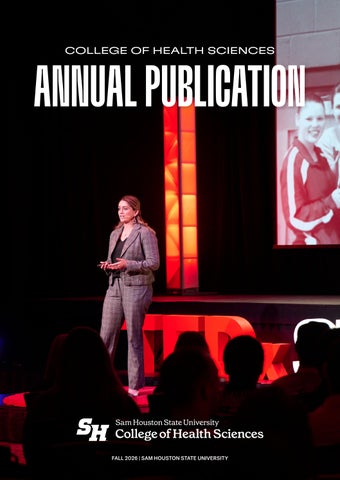
Cover Photo Description: Dr. Mayrena Isamar Hernandez delivers her TEDx talk on the vital role of secondary school athletic trainers in promoting youth sport safety and addressing disparities in access to athletic training services.
CONTRIBUTORS Dr. Devon Berry Dr. Michael F. Brown Ms. Brooke Cerny Dr. Linda Fergus Dr. Andrew Gonzalez Dr. Kathleen Gilbert Dr. Desha Johnson Makiya Ms. Karen Leonhart Dr. Tabbetha Lopez Dr. Mario Muñoz Prof. Ron Reed Dr. Micheil Spillane Ms. Mackenzie Woodward Dr. Ryan Zapalac
Integrated Marketing Communications Jeff Harris, Chief Marketing Officer & Public Information Officer, IMC Editor Jamie Fails, Director of Communications, IMC Design Brynn Bland, Graphic Designer, Brynnbland.com COHS Annual Publication Managing Editor Ms. Karen Leonhart, Marketing Communications and Event Coordinator, COHS
Dean, College of Health Sciences
2
Annual Publication | COHS | 2026
Annual Publication | COHS | 2026
3
PURSUE YOUR
EXCELLENCE
14 UNDERGRADUATE PROGRAMS
IN THE COLLEGE OF HEALTH SCIENCES Clinical Exercise Science, 3+2 Option for MSAT
COLLEGE AND DEPARTMENT LEADERSHIP Dr. Ryan Zapalac
Dr. Devon Berry
→ Dean, COHS
→ School of Nursing Director
Fashion Merchandising, BS Food Science and Nutrition, BS
6
Health Care Administration, BS Health Sciences, BS Health Sciences, 3+2 Option for MSAT
Prof. Ron Reed
Dr. Jennifer Didier
→ Associate Dean, COHS
→ Kinesiology Chair
Human Performance & Wellness Management, BS
Dr. Harsh Buddhadev
Dr. Amanda Scarbrough
Interior Design, BS/BA
→ Interim Associate Dean, COHS
→ Public Health Chair
Kinesiology, BS
Public Health
Dr. Mary Williams
Dr. Thamizhisai Periyaswamy
Nursing, BSN
→ Assistant Dean, COHS
→ Human Sciences Chair
Kinesiology
Physical Education Teacher Education, Double Major Kinesiology & Education, BS
Ms. Karen Leonhart
Dr. Sambit Mohapatra
→ Marketing Communications and Event Coordinator, COHS
→ Physical Therapy Chair
Public Health, BS
Prof. Wilma Mealer
Public Health, 4+1 Option for MPH
→ Physician Assistant Studies & Athletic Training Chair
Sport Management, BS
DEPARTMENTS Human Sciences
Nursing Physical Therapy Physician Assistant Studies and Athletic Training Click to visit our department pages.
9 GRADUATE PROGRAMS
Athletic Training, MSAT Dietetics, MS Health Administration, MHA Health Care Quality & Safety, MS Kinesiology - Sport & Human Performance, MS Physician Assistant Studies, MPAS Public Health, MPH Sport Management, MS *Physical Therapy, DPT - in development expected Fall 2027
4
Annual Publication | COHS | 2026
Annual Publication | COHS | 2026
5
LEARNING BY DOING Students in ACE courses don’t just study professional skills, they practice them. Through research projects, health assessments, nutrition education and community partnerships, students gain experience in skills employers consistently rank among the most important for career success such as:
→ Professional Communication → Critical Thinking → Teamwork and Collaboration → Problem Solving → Adaptability → Leadership
LEARNING BY DOING:
Preparing Workforce-Ready Professionals Through ACE
Academic Community Engagement (ACE) courses transform learning into action. Students move beyond lectures and textbooks to apply their knowledge in real-world settings alongside community partners. ACE combines academic instruction with meaningful community engagement, allowing students to develop professional skills while addressing genuine community needs. Across the COHS, ACE experiences take many forms. Students conduct health assessments with veterans, teach nutrition education to local families, collaborate with first responders on research initiatives, and partner with schools, healthcare organizations, and community agencies throughout the region. While each experience is unique, they share a common
6
Annual Publication | COHS | 2026
goal, transforming classroom knowledge into professional practice.
The following stories highlight how our students are gaining hands-on experience, building career-ready skills, and making meaningful contributions to the communities they serve.
96
→ Community Engagement
ACE SPOTLIGHTS: Making an Impact Across COHS While every ACE experience looks different, they share a common goal: connecting classroom learning with community needs. Across the college, faculty and students are partnering with schools, healthcare providers, nonprofits and campus organizations to create meaningful learning opportunities that prepare students for professional success. Throughout this section, check out some examples of our faculty putting ACE into action.
ACTIVE ACE COURSES IN SPRING 2025
Annual Publication | COHS | 2026
7
RESEARCH WITH
PURPOSE
For students working alongside Assistant Professor Andrew Gonzales, research is more than collecting data—it’s an opportunity to make a meaningful impact on the health and wellness of first responders across Texas. Students contribute to active studies examining firefighter and law enforcement fitness, injury prevention, stress, and long-term health outcomes. From data collection and analysis to presenting findings at professional conferences, they gain firsthand experience in the research process while developing skills that translate directly to future careers. “Our projects are very student-driven,” Gonzales said.
“Students are learning how to think critically and adapt in real time because research and fieldwork are constantly changing.”
Partnerships with fire departments, law enforcement agencies, and clinical testing organizations expose students to the realities first responders face while helping them understand how evidence-based research can influence future policies and wellness standards. Several students have independently presented their work at national conferences, gaining confidence as emerging professionals. Beyond technical skills, they learn skills such as:
ACE Spotlight:
ACE Spotlight:
COURTNEY
ADANNAA
Service Through Advocacy
Sharing Stories, Building Understanding
Courtney Wallace, clinical associate professor in the public health department, is introducing students to the power of service through a partnership with the National Marrow Donor Program. Students learn how to educate others about marrow donation while helping register potential donors, gaining valuable experience in health communication, advocacy and community engagement.
Adannaa Alexander, clinical associate professor in the public health department, is helping students foster empathy and connection through the Kats Shelf Project. Working alongside communication studies faculty and campus partners, students help preserve personal stories for a digital collection and facilitate meaningful conversations between storytellers and members of the university community.
WALLACE
ALEXANDER
Click here or scan the QR code to learn about Professor Wallace’s program.
→ Communicating effectively → Collaborating across disciplines → Building relationships with the community The experience demonstrates that workforce readiness isn’t developed solely in a classroom. It comes from solving real problems, working with real people, and understanding how research can improve lives.
8
Annual Publication | COHS | 2026
Annual Publication | COHS | 2026
9
HEALTHY STARTS, STRONG FUTURES
For students, the experience reinforced an important lesson:
Successful nutrition professionals must be able to connect with people as well as understand the science behind healthy eating. By working directly with families, students developed communication, leadership, and problem-solving skills while helping reduce barriers to healthy food access. The result was a learning experience that strengthened both community health and professional preparation.
ACE Spotlight:
ACE Spotlight:
MASTERS OF SCIENCE IN
MEGAN
ATHLETIC TRAINING
Interprofessional Collaboration Graduate dietetics students are helping local families build healthier habits while gaining the practical experience needed to become effective nutrition professionals. Through the Healthy Starts at Home initiative, funded by a Powell Foundation grant, students partnered with Walker County Head Start families to deliver nutrition education, provide meal kits and promote healthy eating habits among caregivers and children. The initiative was led by Tabbetha Lopez, director of the Graduate Program in Dietetics and assistant professor, alongside Linda Fergus, assistant professor and program director of Food Science and Nutrition. The SHSU Food Pantry also partnered with the
10
Annual Publication | COHS | 2026
program, providing a variety of fresh produce for the families. Topics included meal planning, healthy eating on a budget, label reading, and increasing fruit and vegetable consumption. The program gave students the opportunity to practice nutrition counseling and community outreach while learning how to translate evidence-based recommendations into practical solutions for families. Working alongside undergraduate students, they also helped lead interactive activities for children featuring food exposure sessions, gardening projects, games and visits from Samisaurus, a fruit- and vegetable-loving dinosaur mascot.
Our Master of Science in Athletic Training program is helping prepare the next generation of healthcare professionals through an interprofessional partnership serving local student-athletes. For the third consecutive year, students in athletic training, dietetics, and graduate medical education have partnered with Willis ISD to provide preparticipation physical examinations for middle and high school students. The initiative gives students hands-on experience working in collaborative healthcare teams while providing an important service to the community.
GARCIA Designing for Wellness Megan Garcia, assistant professor of practice in human sciences, is helping students transform design concepts into real-world solutions through a partnership with the Campus Recreation Center. Students in the interior design senior capstone studio developed proposals for a wellness and recovery room, applying evidence-based design principles while working with a real client. The project provides professional experience and may influence future campus improvements.
Annual Publication | COHS | 2026
11
ACE Spotlight:
DAPHNE
FULTON Promoting Health on Campus Daphne Fulton, clinical associate professor in the public health department, alongside public health faculty and students, is creating experiential learning opportunities through the SHSU Employee Health Fair. Students in the Exercise Physiology Laboratory course discover that the best preparation for a healthcare career often happens outside the classroom.
The annual event connects faculty and staff with health and wellness resources while providing students with hands-on experience in health promotion, outreach and community engagement.
The course, led by Micheil Spillane, assistant professor in the Department of Kinesiology and director of both the Sport and Human Performance Laboratory and the Exercise Biochemistry Laboratory, provides critical realworld training. Through a partnership with Vine & Valor, students conduct health and fitness assessments for veterans, applying concepts they have learned in the laboratory to realworld situations. Working in small teams, they evaluate fitness measures, interpret results, and communicate findings while practicing the professional interactions common in healthcare settings. Experience challenges students to think beyond textbook scenarios. During one assessment, students worked with a veteran who used a wheelchair. Faced with a situation they had not anticipated, they adapted the evaluation process while maintaining professionalism and focusing on the participant’s needs.
Moments like these teach lessons that cannot be replicated in a traditional classroom.
Students learn to communicate effectively, adapt to changing circumstances, and make informed decisions while working with individuals from diverse backgrounds and experiences. At the same time, veterans receive valuable health and fitness information that can support their wellness goals. By combining technical knowledge with hands-on experience, the course helps students build the confidence and professional skills needed to enter graduate programs and careers ready to serve others from day one.
THE MEASURE OF A LIFE IS ITS SERVICE 12
Annual Publication | COHS | 2026
Annual Publication | COHS | 2026
13
That work is made possible through the COHS Bridge Scholarship Program, a one year experience designed to prepare, support and inspire high-achieving undergraduate students who are considering graduate or professional education. Through faculty mentorship, hands-on research, community engagement and academic development, students gain the confidence and practical experience needed to succeed beyond their bachelor’s degree.
For Woodward, the experience has been an opportunity to bridge classroom knowledge with meaningful research. Working alongside Muñoz, she helped develop research protocols approved through the Institutional Review Board, build data collection tools, conduct participant sessions and present the team’s work at the National Conference on Undergraduate Research. More importantly, the project helped her see how concepts learned in the classroom translate into real-world patient care.
Bridge Scholar Mackenzie Woodward, a kinesiology major expected to graduate in May 2027, joined Muñoz’s research team to help evaluate the role AI can play in evidencebased exercise prescription. Their project, Developing an AI Prompt Library for Evidence Based Exercise Prescription: A Microsoft Copilot Agent Evaluation Study, examines whether AIgenerated exercise programs are safe, accurate, personalized and professionally communicated.
PREPARING FUTURE CLINICIANS TO LEAD WITH AI Artificial intelligence is reshaping healthcare, creating new opportunities and new responsibilities for tomorrow’s healthcare professionals. College of Health Sciences students aren’t simply learning to use AI. They are learning how to command it responsibly to improve patient care while maintaining the critical thinking and clinical judgment healthcare demands. In Assistant Professor Mario Muñoz’s kinesiology courses and research lab, students explore how AI can support evidence-based decision-making by creating patient care profiles, developing exercise prescriptions and evaluating treatment recommendations. Rather than accepting AIgenerated responses at face value, students learn how to ask better questions, critically assess the results and refine prompts to produce
14
Annual Publication | COHS | 2026
recommendations that align with established clinical guidelines. “Under our project for the Bridge program, student Ms. Mackenzie Woodward and I are creating a manual of appropriate prompts to use with AI platforms in order to get the best exercise and physical activity recommendations from these tools,” said Muñoz.
“Teaching students how to communicate effectively with AI is just as important as teaching them how to evaluate the information it provides.”
Research participants use Microsoft Copilot to create exercise programs based on patient profiles while the research team evaluates each response for safety, evidence based accuracy, specificity to the individual’s needs and professionalism. The findings are helping establish best practices for integrating AI into exercise science while reinforcing that technology should complement, not replace, clinical expertise.
“AI can be a great tool to utilize in healthcare so that we can do better by our patients” Woodward said. “However, AI cannot fully account for a person’s lived experiences, values or personal motivations. We as future healthcare professionals still maintain an ethical responsibility to consider every aspect of a person’s health plan from program design to an individual’s goals and circumstances.” As AI continues to evolve, so will its role in healthcare. By combining innovative research with hands-on student experiences, we are preparing graduates who understand not only how to leverage emerging technologies but also when to question them. Through experiences like the COHS Bridge Scholarship Program, Bearkats graduate ready to lead with knowledge, compassion and the critical thinking skills needed to deliver exceptional patient care in an increasingly technology-driven world. Annual Publication | COHS | 2026
15
CAMPER TO When Brooke Cerny arrived at the College of Health Sciences Summer Camp as a high school junior, she knew she wanted a career in healthcare — but she wasn’t sure what that journey would look like. “I had a general interest in healthcare,” she said. “However, I had limited knowledge of the wide variety of career paths within the field.” Like many students attending the camp, Brooke was exploring both potential majors and possible colleges. The three-day experience gave her something that brochures and websites could not: an authentic glimpse into life as a Bearkat. Through hands-on activities, faculty presentations and conversations with current students, she discovered the many opportunities within the COHS while gaining a better understanding of where her own interests fit. “When I attended camp, I was a junior in high school and was still trying to determine where I wanted to attend college and what career path I wanted to pursue,” Brooke recalled. “The camp gave me insight into the diverse programs and opportunities offered by the College of Health Sciences while also allowing me to experience campus life firsthand.” Living in the residence halls, eating on campus and spending time with other students helped transform Sam Houston State from a university she was considering into a community where she could imagine herself belonging. That sense of familiarity stayed with her long after camp ended. “When I arrived as a freshman, I already knew my way around campus, and I recognized many of the faculty members because they had spoken during camp,” she said. “Having previously attended the COHS camp made campus feel very welcoming and familiar, and that additional sense
COUNSELOR 16
Annual Publication | COHS | 2026
“I wanted to become a camp counselor because I wanted to help create a positive and encouraging environment for students who may be in the same position I was.” - Brooke Cerny SHSU Kinesiology Student
As a counselor, Brooke hopes campers leave with more than information about healthcare careers. She wants them to leave believing in themselves. “My hope is that campers leave feeling more confident in their future, more informed about healthcare careers and excited about the opportunities available to them,” she said. “If I can help campers feel more confident about their goals, excited about higher education or inspired to pursue a career in healthcare, then I know I have made a difference.” For Brooke, the camp was more than a summer experience — it was the beginning of her journey at Sam Houston State University. Today, by welcoming the next generation of campers, she is helping others take that same first step.
of belonging boosted my confidence immensely during my first year.” Today, Brooke is a kinesiology major with plans to become a physical therapist. Alongside her coursework, she competes as a member of the SHSU women’s track and field team, participates in the Honors College and serves as a student assistant in the College of Health Sciences dean’s office. Each experience has reinforced the values she first discovered during camp — service, leadership and community. Now, Brooke’s journey has come full circle. This summer, she returned to the College of Health Sciences Summer Camp as a counselor, helping guide students through the same experience that helped shape her own future. “The camp played an important role in helping me choose both my major and my university, and I wanted to give back by helping future students navigate those same decisions.”
WANT TO LEARN MORE? Click here or scan the QR code to watch Brooke’s interview and learn more about her journey in the College of Health Sciences!
Annual Publication | COHS | 2026
17
OPENING DOORS TO THE FUTURE OF HEALTHCARE The College of Health Sciences reached a major milestone with the opening of the new Health Professions Building on the Sam Houston State University Conroe campus. More than a new facility, the four-story, 81,500-square-foot building represents SHSU’s commitment to preparing practice-ready healthcare professionals through immersive learning, collaboration and innovation. Designed to mirror the realities of modern healthcare, the HPB brings together students and faculty from four graduate programs: athletic training, dietetics, physician assistant studies and physical therapy. Located alongside the SHSU College of Osteopathic Medicine and SHSU Physicians Clinic, the building creates a unique environment where future healthcare professionals learn side by side while developing the teamwork and communication skills essential to patient-centered care. Purpose-built for hands-on education, the facility features advanced simulation labs, specialized clinical instruction spaces, collaborative classrooms and technology-rich learning environments. These spaces allow students to apply classroom knowledge in realistic settings while working alongside peers from other health disciplines. The opening was celebrated with a ribbon-cutting ceremony and community open house that welcomed students, faculty, staff, healthcare partners, alumni and local leaders eager to experience the new facility firsthand. Their excitement reflected the building’s broader impact — not only on SHSU students, but on the future of healthcare across Texas. That future officially began when Dr. Mary Barnes Williams led ATTR 5310: Clinical Evaluation and Assessment Fundamentals, becoming the first scheduled course held in the new building. It marked the beginning of a new chapter for the College of Health Sciences and for the generations of healthcare professionals who will learn, collaborate and serve from within its walls.
18
Annual Publication | COHS | 2026
Annual Publication | COHS | 2026
19
Master of Science in Dietetics Internship (MSDI) Tabbetha D. Lopez, PhD, RD, LD, FAND Dietetics Internship Program Director, Assistant Professor
Health Professions Building Programs
Good nutrition is foundational to healthy communities, and the Master of Science in Dietetics Internship prepares future Registered Dietitians to address some of today’s most pressing public health challenges. Through more than 1,000 hours of supervised practice and partnerships with healthcare systems, food banks, schools and community organizations, students gain hands-on experience improving nutrition access and health outcomes across the region. From operating the student-led SHSU Farmers’ Market to working with Head Start programs and the American Heart Association, students learn how nutrition impacts individuals, families and communities. The new Health Professions Building will further enhance this preparation through advanced teaching kitchens, simulation spaces and opportunities for interprofessional collaboration. These experiences ensure graduates are prepared to promote wellness, prevent chronic disease and improve community health throughout Texas.
Master of Physician Assistant Studies (MPAS) Wilma Mealer, MPAS, PA-C Physician Assistant Studies & Athletic Training Chair, Founding Program Director, Clinical Professor Expanding access to healthcare begins with preparing skilled providers to serve where they are needed most. The Master of Physician Assistant Studies program is designed to help address primary healthcare needs across rural East Texas and other medically underserved communities. We are excited to welcome our first cohort in fall 2026! Students develop clinical knowledge and decision-making skills through simulationbased education, cadaver dissection, ultrasound training and structured clinical rotations spanning family medicine, emergency medicine, surgery, pediatrics, behavioral health and more. Partnerships with leading healthcare systems and community health centers provide broad clinical experiences while exposing students to diverse patient populations. Located within the Health Professions Building, the program fosters collaboration with future physicians, athletic trainers, physical therapists, dietitians and nurses. Through innovative training and strong community partnerships, graduates are prepared to improve healthcare access and deliver high-quality patient care throughout Texas.
20
Annual Publication | COHS | 2026
Annual Publication | COHS | 2026
21
Doctor of Physical Therapy (DPT) Sambit Mohapatra, PT., Ph.D. Physical Therapy Chair, Founding Program Director, Professor
Master of Science in Athletic Training (MSAT) Mary L. Williams, EDD, LAT, ATC Athletic Training Program Director, Assistant Dean, Associate Professor Athletic trainers play a vital role in preventing injuries, promoting wellness, and helping individuals return safely to activity. The Master of Science in Athletic Training program prepares students through a hands-on, competency-based curriculum that combines classroom instruction, simulation and extensive clinical experience. Students complete six semesters of clinical rotations in settings ranging from secondary schools and collegiate athletics to physician practices, rehabilitation clinics and community healthcare environments. Community engagement is a cornerstone of the program, with students participating in outreach initiatives such as Special Olympics Texas, Ironman Texas, rodeo events and annual pre-participation physical examinations for local student-athletes. Through interprofessional collaboration and immersive learning opportunities, students develop the clinical, communication, and leadership skills needed to serve active populations of all ages. The Health Professions Building will further strengthen these experiences by providing innovative training environments that prepare graduates to meet the evolving healthcare needs of their communities.
22
Annual Publication | COHS | 2026
As demand for physical therapists continues to grow, the Doctor of Physical Therapy program is preparing future clinicians to help individuals regain movement, restore function and improve quality of life. Scheduled to welcome its first cohort in fall 2027 (pending approval by CAPTE), the program combines rigorous academic preparation with extensive clinical education experiences designed to develop confident, practice-ready professionals. Located in the Health Professions Building, students will benefit from advanced instructional spaces and proximity to one of the nation’s strongest healthcare markets. The program’s integrated clinical education model provides continuous real-world experience throughout the curriculum, allowing students to build clinical reasoning, patient care and professional skills over time. Through partnerships with healthcare providers across the region, graduates will be prepared to meet the growing rehabilitation needs of Texas communities.
BEARKATS PUT IN THE
WORK.
Annual Publication | COHS | 2026
23
CENTRALIZED SPACE EXPANDS COMMUNITY-FACING RESOURCES SHSU Food Pantry & Tripod’s Career Closet
This reflects both the growing need within our campus and community and the scale of experiential learning opportunities available to students. Each interaction represents not only service delivery, but a moment for students to develop critical skills in communication, logistics, client care and public health practice. This spring, in collaboration with the COHS Dietetics Program and Montgomery County Food Bank, we hosted three farmers markets across our main campus, The Woodlands Center and the College of Osteopathic Medicine. These markets provided fresh, nutritious produce to students while offering experiential learning opportunities in food distribution, client engagement and health promotion. Students participated in everything from logistics and inventory management to nutrition education developing competencies essential for practiceready graduates. Innovation continues to drive our work. We are advancing a food recovery initiative that repurposes surplus campus dining food into ready-to-heat meals — reducing waste while expanding access. This initiative introduces students to emerging models in sustainability, food systems and public health intervention while reinforcing the importance of resource stewardship.
At Sam Houston State University, the Food Pantry and Tripods Career Closet serve as more than basic needs resources — they are living laboratories where students gain hands-on, practice-ready experience through meaningful community partnerships and innovative service models. Both resources are operated by the College of Health Sciences and are available to the entire university, with the food pantry also open to local community members. Through strategic collaborations with organizations such as the Houston Food Bank, Montgomery County Food Bank, American Heart Association and Dress for Success Houston, students are actively engaged in addressing
24
Annual Publication | COHS | 2026
By embedding students within these programs and partnerships, we are not only meeting immediate needs but also equipping future professionals with the skills, empathy and practical experience necessary to lead in their fields. Through innovation and collaboration, SHSU continues to prepare graduates who are not only career-ready — but community-ready.
food insecurity, health disparities and career readiness. These partnerships allow students — particularly in dietetics, public health and related disciplines — to apply classroom knowledge in real-world settings, from conducting nutrition education and supporting farmers markets to assisting with client services and program operations.
During the 2025–2026 academic year, the SHSU Food Pantry recorded 4,797 visits and distributed over 89,000 pounds of food.
The upcoming expansion of our Food Pantry and Tripods Career Closet into a centralized, community-facing space represents a transformative step forward. This integrated model will provide students with opportunities to engage in interdisciplinary service — bridging food access, professional development and holistic student support in one setting.
MAKE AN IMPACT Click here or scan the QR code to learn more about supporting the food pantry and leaving an impact on the Bearkat Community!
Annual Publication | COHS | 2026
25
→Upgraded Instructional Spaces →Advanced Simulations →Skills Laboratories →Flexible Classrooms →Enhanced Support Areas for Student and Faculty
BUILDING THE FUTURE OF CARE:
The Woodlands Center Renovation Expands SHSU Nursing Capacity The renovation and expansion of Sam Houston State University’s The Woodlands Center (TWC), which houses the School of Nursing, represents a major investment in the College of Health Sciences’ strategic priorities—expanding student access, advancing academic excellence and strengthening the university’s service to the state of Texas. As progress continues, the project remains on track toward substantial completion in fall 2026, reflecting careful planning, strong partnerships and sustained institutional commitment. The transformation of the facility includes new and upgraded instructional spaces, advanced simulation and skills laboratories, flexible activelearning classrooms and enhanced areas to support students and faculty. Several renovated spaces have already reached completion or are in final phases, while others are rapidly transitioning from construction to interior finishes. Together, these updates are creating a modern, high-functioning academic environment
26
Annual Publication | COHS | 2026
designed to support innovative teaching, immersive learning and interprofessional collaboration.
70 percent over the coming years—while maintaining the high-quality educational experience expected by students, employers and accrediting bodies. This growth directly supports regional and statewide workforce needs, particularly in nursing, where demand continues to outpace supply. Beyond capacity, the renovation enhances SHSU’s ability to deliver practice-ready education. Expanded simulation and practice environments support competency-based learning and deeper partnerships with leading healthcare systems, positioning graduates to transition smoothly into professional roles. These investments align squarely with institutional
priorities focused on student success, workforce innovation and meaningful community impact. As it nears completion, the renovated Woodlands Center stands as a visible expression of SHSU’s commitment to growth with purpose—expanding access, enabling excellence and delivering tangible value to the students and communities it serves.
Strategically, the TWC renovation is foundational to the School of Nursing’s long-term growth plan. The expanded footprint enables a significant increase in enrollment capacity—approximately
70%
increase in enrollment capacity in the coming years. Annual Publication | COHS | 2026
27
SHSU NURSING LEADS TEXAS IN PREPARING PRACTICE-READY
GRADUATES
As healthcare systems across Texas continue to face critical nursing shortages, the SHSU School of Nursing is taking a bold and proactive approach to preparing the next generation of nurses. SON recently became the first program in Texas to fully redesign its curriculum to align with new standards established by the American Association of Colleges of Nursing and the Texas Board of Nursing, positioning SHSU SON at the forefront of competency-based nursing education. The shift reflects a nationwide transformation in how nurses are educated. Rather than focusing solely on lectures, memorization and test performance, competency-based education emphasizes measurable skills, clinical judgment, communication and real-world application. According to Michael Brown, assistant director of didactic learning, the redesign required months of collaboration, planning and innovation from faculty and staff across the school of nursing. “There has been a huge shift in the type of education needed in healthcare,” Brown explained.
“We wanted to ensure our graduates are not only knowledgeable, but truly practice-ready.” The redesigned curriculum was built with direct input from community healthcare partners and clinical sites. Faculty worked closely with
28
Annual Publication | COHS | 2026
employers and bedside preceptors to identify gaps they were seeing in new graduates entering the workforce. The feedback was clear: students often understood concepts academically but needed stronger preparation in applying those skills confidently in clinical settings. In response, SHSU SON rebuilt the curriculum from the ground up instead of making small adjustments to existing courses. The result is a student-centered learning model focused on outcomes and observable competencies. Students now demonstrate progression indicators — measurable behaviors and skills that show they can apply knowledge effectively in real patient-care situations. The program uses a three-pronged approach to learning: classroom instruction integrated with experiential learning, hands-on competency demonstrations and immersive clinical experiences with bedside preceptors. Students participate in adaptive quizzing, virtual interactive case studies, simulations and technology-based assessments designed to identify weaknesses early and personalize learning experiences. The curriculum also incorporates innovative student support systems, including a unique restoration and wellness course focused on stress management, test-taking strategies, professional preparation and overall student success. Faculty members act more as coaches and mentors, helping students continuously build confidence and competency throughout the program.
The ultimate goal is to graduate nurses who can transition seamlessly into the workforce and positively impact patient outcomes from day one.
“We want to produce graduates who don’t just pass a test,” We want nurses who can immediately go into the community and make a difference.” As nursing shortages continue to challenge healthcare providers nationwide, SHSU SON’s forward-thinking approach is already attracting attention across the state. By embracing innovation, listening to workforce needs and prioritizing student success, the School of Nursing is helping strengthen the healthcare pipeline and ensuring Texas communities have access to highly skilled, compassionate and workforce-ready nurses. More than 300 hopeful students applied to begin their nursing careers at SHSU in the fall of 2026. This fall will be an exciting time to start the nursing program, as the school is currently increasing enrollment, and for the first time
will have a cohort of 108 students. Enrollment will continue to increase over the next two semesters, with a plan to accept 144 students per semester starting in fall 2027. SHSU is hopeful that a 70% enrollment increase over past semesters will help to alleviate some of the nursing shortages in the area. Graduates of the SHSU school of nursing have found successful careers after completing their degrees. The first-time NCLEX pass rate for SHSU graduates has been 94% or higher for the past five years, with 100% of graduates passing the licensing exam since the beginning of the program in 2011. Each semester, around 70% of SHSU students are offered nursing positions at hospitals in the Greater Houston area before they graduate.
LEARN MORE For more information, interested students can contact the School of Nursing at nursing@shsu.edu
Annual Publication | COHS | 2026
29
SNAPPI STRENGTHENS TEXAS’ NURSING WORKFORCE As Texas faces a growing nursing shortage, leaders at the College of Health Sciences School of Nursing (SON) are building innovative solutions designed to strengthen the healthcare workforce from the classroom to the bedside. Through the Shared Nursing Academic Practice Partnership Initiative (SNAPPI), SHSU’s School of Nursing is helping create practice-ready nurses while also addressing one of the profession’s greatest challenges: the shortage of nursing faculty. Developed by SHSU SON and funded through the Texas Higher Education Coordinating Board’s Nursing Innovation Program, SNAPPI creates partnerships between healthcare systems and academic institutions to expand clinical training opportunities without removing experienced nurses from the workforce. “SNAPPI is more than just a program,” said Desha Johnson Makiya, PhD, MBA, RN, CCRN, PCCN,
“By sharing nurses between clinical and academic settings, SNAPPI helps solve two workforce challenges at once.”
with SHSU’s School of Nursing and SNAPPI leadership team.
“It’s a commitment to the future of healthcare in Texas.” The model is simple but transformative. Instead of asking experienced nurses to leave clinical practice for lower-paying academic positions, healthcare partners “share” nurses with nursing programs. SHSU purchases a portion of the nurse’s time so they can teach students during their regular hospital shifts, maintaining their clinical role, schedule, and salary while mentoring future nurses. The approach directly addresses barriers identified by statewide workforce studies. Texas is projected to face a shortage of more than
56,000 registered nurses by 2036, with one of the largest contributing factors being a lack of qualified nursing faculty. SNAPPI helps bridge that gap by supporting clinical nurses who want to teach while continuing bedside care. The initiative launched full operations in 2025 with hospital partners including Houston Methodist, Memorial Hermann, HCA Houston Healthcare, and St. Luke’s Health – The Woodlands Hospital. The program trained 55 students in its first semester, with overwhelmingly positive feedback from both students and nurse educators.
Support from partners and donors continues to fuel expansion efforts. The William S. and Lora Jean Kilroy Foundation recently awarded SHSU $100,000 to help grow the initiative, while the program also received nearly $1 million in state grant funding for the 2025–2027 cycle. Looking ahead, SNAPPI leaders are exploring expansion into rural communities, where healthcare staffing shortages are often even more severe. Pending approval from the Texas Board of Nursing, SHSU hopes to pilot the use of BSN-prepared nurses as clinical faculty in rural hospitals to increase access to nursing education in underserved areas. Through innovation, collaboration, and workforcefocused education, SHSU is helping shape the future of nursing in Texas — producing graduates who are ready to work, ready to lead, and ready to make an immediate impact in their communities.
Click here or scan the QR code to learn more about SNAPPI and their mission to support nursing education.
Students benefit from smaller clinical cohorts, hands-on mentorship, and immersive workplace learning experiences that help them transition from student thinking to professional nursing practice. “Because the instructor is already part of the hospital team, there’s no disconnect,” said SHSU graduate and SNAPPI participant Jessica Infante. “You stop thinking like a student and you start thinking like a nurse.” The program’s success is drawing statewide attention. SNAPPI leaders recently submitted and were accepted to present the initiative at the Texas Nurses Association conference, one of the premier professional nursing gatherings in the state. The goal is not only to share the model, but to help healthcare organizations and academic institutions across Texas replicate it in their own communities.
30
Annual Publication | COHS | 2026
Annual Publication | COHS | 2026
31
4
1
5 8
7
Huntsville
6
9 11
Sam Houston National Forest
12
10 Willis Montgomery
1/2
2
13
14
15
Pinehurst
16 17
1 | Lee Drain Building, Kinesiology (KINE) 2 | COHS Dean’s Office 3 | CHSS Building, Public Health (HLTH) 4 | Human Sciences 5 | Food Pantry 32
Annual Publication | COHS | 2026
3
Magnolia
3
6 | Austin Hall 7 | Thomason Building 8 | Evans Building 9 | Estill Building 10 | Lee Drain Annex 11 | B.K. Marks Admin 12 | Rather Comm. Building
13 | Lowman Student Center 14 | Smith-Hudson Building
Tomball
17 | Gaertner Performing Arts Center
New Caney
Spring Humble
1
2
Huntsville Campus
Conroe Campus
The Woodlands Center
Main Campus
Health Professions Building (HPB)
School of Nursing (SON)
925 City Central Ave, Conroe, TX
3380 College Park Dr, The Woodlands, TX
15 | Academic Building I 16 | School of Music
The Woodlands
1905 University Ave, Huntsville, TX
3
Annual Publication | COHS | 2026
33
Lee Drain Building, Suite 201 1900 Avenue I PO BOX 2301 Huntsville, TX 77341
MAKE A
CHANGE By donating to the Bearkat Community, you are providing students with life-changing educational opportunities and investing in their futures! Be a part of shaping the lives of current and future Bearkats.
To donate and learn more, visit shsu.edu/giving. We thank you for your support.
34
Annual Publication | COHS | 2026