WINTER 2025
In Review
WashU Sam Fox School The First Decade
2005
WashU announces the creation of the Sam Fox School of Design & Visual Arts, uniting the academic units of Architecture and Art with the Kemper Art Museum; Carmon Colangelo named inaugural dean.
July 1, 2006
Island Press expands through the Arthur and Sheila Prensky Visiting Artist Residency, supporting up to three artists each year for a weeklong residency in the research-based printmaking workshop.
Official launch of the WashU Sam Fox School.
2010
JAMES BYARD
STEPHANIE SCHLAIFER
2006
STAN STREMBICKI
2009
Art on Campus, a percent-for-art program administered by the Kemper Art Museum, is established to fund the purchase and commission of public art on the Danforth Campus.
Sam Fox School celebrates openings and dedication of Mildred Lane Kemper Art Museum, Earl E. and Myrtle E. Walker Hall, and the Kenneth and Nancy Kranzberg Art & Architecture Library, all designed by Pritzker Prizewinning architect Fumihiko Maki.
2014
JAMES BYARD
2007
The Master of Landscape Architecture program is launched.
JOE ANGELES
2016
The Sam Fox School establishes the Office for Socially Engaged Practice to connect WashU students and faculty with the community for meaningful collaborations in art, architecture, and design.
The Alberti Program: Architecture for Young People begins, welcoming St. Louis children in grades 4–8 to campus to explore architecture and design each summer.
2008
Sam Fox School Research Office is established.
Carmon Colangelo is installed as the Ralph J. Nagel Dean of the Sam Fox School.
2022
2023
The WashU Sam Fox School Gallery opens on Delmar Boulevard, providing two formal gallery spaces for exhibitions less than a mile from campus. The Kemper Art Museum opens its largest exhibition to date with Making Their Mark: Works from the Shah Garg Collection, featuring more than 80 artworks by women artists spanning eight decades.
The Sam Fox School launches Shaping the Future, a 2022–32 strategic plan recommitting the school to three key areas: digital transformation, sustainable practices, and strengthening communities through art, architecture, and design. WHITNEY CURTIS
PETERAARON/OTTO
2019
The Master of Fine Arts in Illustration & Visual Culture is launched, welcoming its first cohort of artist-authors the following year.
The Sam and Marilyn Fox Foundation establishes and later (2022) permanently endows the Sam Fox Ambassadors Graduate Fellowship Program. The fellowships provide full-tuition waivers and accompanying stipends for graduate students.
CAROL GREEN
The Sam Fox School and McKelvey School of Engineering collaborate on WashU's first entry in the U.S. Department of Energy's Solar Decathlon competition. CRETE House, formed from six precast concrete panels, ties for second place in the Architecture contest.
2018
2025
WHITNEY CURTIS
SAM FOX SCHOOL
2017
Andrew Witt is named the inaugural Kavita and Krishna Bharat Professor. The Sam Fox School endowment surpasses $200 million—nearly quadrupling since the school’s founding—to support scholarships, faculty, and research.
2026
The James Harrison Steedman Memorial Fellowship in Architecture, a collaboration between the WashU Sam Fox School and AIA St. Louis, celebrates 100 years.
KEMPER ART MUSEUM
The Kavita and Krishna Bharat Professorship, a role focused on the intersection of artificial intelligence and design, is announced at the inaugural AI + Design symposium presented by the Sam Fox School and McKelvey School of Engineering. The professorship holds a joint appointment in McKelvey.
2024 WashU dedicates the East End Transformation, including the opening of Anabeth and John Weil Hall, home to the Sam Fox School’s graduate programs. The newly renovated and expanded Kemper Art Museum opens with a major exhibition by renowned Chinese dissident artist and activist Ai Wei Wei.
Professor Linda C. Samuels is named the inaugural Director of Sustainable Design and Environmental Justice. The Master of Design for Human-Computer Interaction and Emerging Technology is launched, welcoming its first cohort in 2025, and the second AI + Design symposium, “Learning from AI,” explores how perspective gained from AI can impact and influence creative practices.
WashU Sam Fox School The Second Decade
Contents 02 In the Field 16 The Spirit of the Place Reflecting on 20 Years at the Sam Fox School with Dean Carmon Colangelo
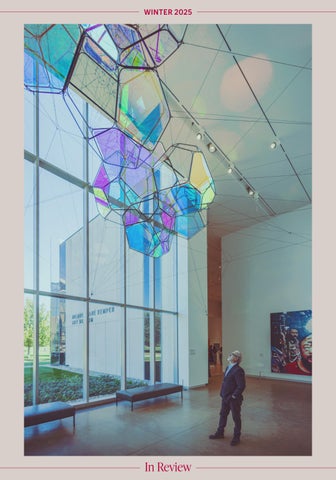
22 In the Classroom 28 In the Community 34 Students & Alumni 40 News & Updates ON THE COVER: Carmon Colangelo, the Ralph J. Nagel Dean, often visits the school’s Kemper Art Museum, what he calls a rejuvenation strategy. Colangelo will step down in June 2026 after 20 years as the school's inaugural dean. For more on his thoughts on the joys and challenges of the role, see p. 16. PHOTO: CAITLIN CUSTER
THIS YEAR marks the 20th academic year for the Sam Fox School, and my 20th and final year as dean. I can’t help but feel immense pride for the things we have accomplished as a school: from the early challenges to unite three distinct units, to the development and completion of our first strategic plan—including the addition of Weil Hall and the expansion of the Mildred Lane Kemper Art Museum—to the launch of new programs in Landscape Architecture, Illustration and Visual Culture, and Human-Computer Interaction and Emerging Technology. We have advanced from a novel concept to a national leader in art, architecture, and design education. The following pages are both a look back at our remarkable progress over two decades and an update on our 2024–25 academic year. Our most recent achievements build on our areas of priority focus including digital transformation in our fields, sustainable practices for a changing planet, and strengthening communities both locally and globally. We are finding new ways to work with technology that leverage emerging digital tools while continuing to interrogate ethical practices. We are partnering with innovative alumni on projects that make use of eco-friendly materials for the fashion industry and provoking important conversations about the environment through museum exhibitions and symposia. And we are working in community in ways that are mutually beneficial for the City of St. Louis and our students, particularly important after this year’s devastating tornado. We are also continuing to invest in the people that represent the future of our fields. Our undergraduate students benefit from WashU’s need blind and loan-free policies and, thanks to the generosity of our community, we have been able to increase financial aid for graduate students by 95% over the last 10 years. We have also been able to recruit and retain incredibly talented faculty with endowed professorships: this year we hired Andrew Witt, the inaugural Kavita and Krishna Bharat Professor in AI and emerging technology, and installed Aki Ishida, Director of the College of Architecture and Graduate School of Architecture & Urban Design, as the Sam and Marilyn Fox Professor. What an honor it has been to be part of an institution whose vision is to realize a more just, sustainable, humane, and beautiful world. Artists, architects, designers, and curators are uniquely qualified to achieve these goals as they forge new ways to see, experience, and live in the world around us. Thank you for your dedicated and ongoing commitment to our success. It has been the greatest privilege of my lifetime to help chart the first 20 years of the Sam Fox School. I can’t wait to see what the next decades bring.
Sincerely,
Carmon Colangelo Ralph J. Nagel Dean, Sam Fox School E. Desmond Lee Professor for Collaboration in the Arts
SAM FOX SCHOOL IN REVIEW
CAITLIN CUSTER
01
02
IN THE FIELD
PHOTOS BY HADLEY FRUITS FOR LANDMARK COLUMBUS FOUNDATION
SAM FOX SCHOOL IN REVIEW 03
Yes, And
Ahrens, Vale, Murphy playfully engage with architectural history Caitlin Custer As 2024–25 Exhibit Columbus University Design Research Fellows, Sam Fox School faculty Chandler Ahrens, Constance Vale, and Kelley Van Dyck Murphy paired with the Columbus Area Visitors Center to honor architect Alexander Girard’s work in Columbus, Indiana—particularly the dollhouse he created for the Miller House—with a dollhouse of their own. Approximately 20 WashU architecture students assisted in creating the work over the summer. The installation flips Columbus’ architecture “inside out” to reveal more than a dozen interior spaces. Dolls designed by students in grades 4–9 who who participated in the school’s summer Alberti Program animate the interiors, while a surrounding set of platforms allows visitors to climb and view the upper levels. By revealing the city’s hidden interiors, the piece invites visitors to weave their own stories of Columbus’ architectural legacy.
IN THE FIELD
Training and Critiquing AI through Art Artist Tiffany Calvert creates historically inspired still life paintings with an AI twist Story and photos by Caitlin Custer
04
Artist Tiffany Calvert is busy wrapping up a day in her studio, putting the finishing touches on a largescale still life oil painting. In 2025, it might seem like an anachronism, something from another century. The catch: the image was created in part by a custom AI diffusion model. Calvert, who chairs the Sam Fox School's MFA in Visual Art program, has always been interested in blending old and new techniques. She believes there’s value in exploring historical traditions in modern contexts, asking what paintings and other artworks mean in a world of digital images and what they can tell us about perception and image commodity. “I chose abstract painting as a mode on purpose—its intention is to interrupt an image and make it harder to look at, so that as a viewer, you have to think about your own process of looking,” she says. “As we’re flooded with images all day, if an abstract painting can ask you to slow down for a minute and feel yourself figuring out what you’re seeing, that’s so important to understanding and perceiving the truth, believability, and reliability of images.”
Calvert started focusing on Dutch and Flemish still life paintings in 2014. “They’re so incredibly detailed, that in some ways they become abstract—they’re no longer realistic,” she says. She gathered some 650 images of still life paintings from various internet archives and entered them into a StyleGAN, or style-based generative adversarial network. From there, she generated still life images to use as a springboard in her own work that involves painting abstractly in response to and over top of the still life. “I’ve been using digital media in parallel to my artistic practice since my undergraduate degree in the ’90s,” she says. “At the time, I was developing my own artistic abilities at the same time as early versions of the internet and Photoshop were coming out. Because I acquired that knowledge on my own, I felt like I had a solid understanding of the behind-the-scenes operations and how the apps actually worked. That continues to be very important to me.” Then, a roadblock. Just as Calvert was arriving at WashU in fall 2024, the program she had been using changed its protocol and no longer supported her need for precise control over the image set. She explored other programs, but recognized she wasn’t going to progress without technical help due to the limitations of publicly available AI applications and her own coding knowledge. “I was so happy to be at WashU at that moment, because there is real intent and motivation
behind putting together teams for interdisciplinary research,” she says. Chad Henry, the school’s director of research and innovation, connected her to Associate Professor Ulugbek Kamilov and doctoral candidate Shirin Shoushtari in the McKelvey School of Engineering. “Bek and Shirin were already working on a custom diffusion model, and it was a very fortunate overlap in my methodologies and their project,” Calvert says.
SAM FOX SCHOOL IN REVIEW
ENTER AI
TESTING GROUND The model the McKelvey team is developing can work with smaller data sets—like Calvert’s set of 650 images—with higher accuracy. The model doesn’t collage bits and pieces from different images, but rather invents a truly new image. “Our work with Tiffany has been very valuable because we get real world, expert feedback on how our model is performing,” Shoushtari says. She went on to note that the collaboration with Calvert revealed to them that, in addition to viewing each generated image as a whole, they needed to focus on very small elements of each image to further the model’s ability. “While this exact model will only be applicable to Tiffany’s data set,” Shoushtari says, “the tools are transferable, so we may be able to use what we’ve learned here in other applications such as medical imaging.” The team also hopes that the collaboration leads to a platform for artists to use to generate images with their own data sets. “So many AI platforms are taking control and artistic direction
05
IN THE FIELD 06
out of the hands of the artist,” Calvert says. “We hope to create something that gives back that control and precision.” ABSTRACTION AND CRITIQUE “A diffusion model develops an image by inserting noise periodically, systematically, and then the model learns to generate an image out of that noise,” Calvert says. “Abstract painting does the same thing. It’s inserting interruptions, obfuscations, complications, something irresolvable into an image—because then it captures your ability to process what you’re seeing.” By viewing an image for a long time, Calvert believes that you can begin to understand your own perception. For her own practice, Calvert was most interested in the shortcomings of the AI model that reveal the very human biases in datasets, and therefore the dangers that AI will replicate and magnify those biases. “In order to visually critique the model, it’s more interesting to find those divisions, gaps, and failures in its processing,” she says. “Some of these AI-generated images we see online are so slick, so smooth… I think that abstract painting is uniquely positioned to criticize them, to push into the seams
and deconstruct them to look at images more carefully,” she says. Once the AI model has created a new image for Calvert to paint over, she gets to work preparing. A key part of her process is applying a customdesigned vinyl stencil, covering parts of the image while leaving openings for her to paint over. “I create the stencil to be reminiscent of cubism and desktop computer windows layered over each other,” she says. Once the canvas print of the image arrives, she stretches it on a frame, applies the vinyl, and spends a few hours mixing paint. Then, she has a single day to paint abstractly in response to the image and remove the vinyl before the paint dries. “I find the boundary of a single day useful, because it means I can’t lose confidence in myself or the painting,” Calvert says. “I have to respond in a single, very concentrated session like this, and either it works or it doesn’t.” As she begins to peel the vinyl, Calvert explains the value of prolonged looking. “If you stay with an image for a long time, you begin to look at it more critically, which has a big impact on how we perceive the world around us.”
SAM FOX SCHOOL IN REVIEW 07
IN THE FIELD
On the Bookshelf THE MYTHMAKERS: THE REMARKABLE FELLOWSHIP OF C.S. LEWIS AND J.R.R. TOLKIEN John Hendrix In The Mythmakers, John Hendrix, the Kenneth E. Hudson Professor of Art and chair of the MFA in Illustration & Visual Culture program, delivers 200-plus pages of illustrations, musings, biography, and mythic retelling of the friendship and collaboration of two of the 20th century’s greatest literary giants. In August 2025, it was announced that the graphic novel, nominated for the Will Eisner Comic Industry Award, will become an animated feature film with production company Burns & Co., producer Aaron Burns, and filmmaker Justin Strawhand. REBUILDING THE AMERICAN TOWN Patty Heyda
08
In Rebuilding the American Town (Routledge, 2025), Patty Heyda, professor of urban design and architecture, and co-author David Gamble of MIT profile nine small municipalities, all with populations under 50,000, that are transforming to serve their communities and meet the future. They highlight the creative planning and design strategies employed to remain vibrant, equitable, and viable in the face of metropolitan sprawl, population shifts, political Read more on the website. division, economic shortfalls, and climate change. ADAM PENDLETON: TO DIVIDE BY Meredith Malone (editor) To Divide By is edited by Kemper Art Museum curator Meredith Malone, who also organized the exhibition of the same name, which explored Pendleton’s interest in creating a conversation between mediums, as well as his belief in abstraction’s capacity to destabilize and disrupt. The edition includes essays from Malone, Joshua Chambers-Letson of Northwestern University, and critic Hal Foster, as well as a conversation between Pendleton and critic Isabelle Graw and the complete transcripts of two film portraits by Pendleton. To Divide By was named best monograph of 2024 by the Midwest Art History Society. THINKING THROUGH SOIL: WASTEWATER AGRICULTURE IN THE MEZQUITAL VALLEY Seth Denizen and Montserrat Bonvehi Rosich In Thinking Through Soil, Assistant Professor Seth Denizen and Visiting Assistant Professor Montserrat Bonvehi Rosich, who both teach in the architecture and landscape architecture programs, explore the soil—which they describe as one of the globe’s most understated and under-researched resources—in the Mexico City and Mezquital Valley region through scientific, historic, and urbanist lenses and its implications for public health outcomes.
Learn more in this video profile.
SAM FOX SCHOOL IN REVIEW
THINKING THROUGH GRAPHIC DESIGN HISTORY: CHALLENGING THE CANON Aggie Toppins In her debut book, Associate Professor Aggie Toppins shows how students and practicing designers can enrich their work by thinking historically about design. With thoughtful analyses, stimulating creative prompts, inspiring case studies, and perspectives from designers all over the world, this book challenges our traditional understanding of graphic design history, and the very notion of the design canon, offering ways to shape socially engaged, critical practices.
Read more on the website.
FRANK LLOYD WRIGHT Robert McCarter Robert McCarter, the Ruth and Norman Moore Professor of Architecture, analyzes the renowned twentieth-century architect’s work chronologically, exploring each building’s spatial experience, material and tectonic character, and relationship to the landscape. Now in a fully revised and updated new edition, this definitive account of the life and work of the modern master features an extensive selection of archival drawings, specially commissioned photographs, redrawn plans, and detailed drawings, as well as a complete list of Wright’s buildings and projects compiled by the Frank Lloyd Wright Archives. WHEN THE DARK CLOUDS COME Danielle Ridolfi What began as her thesis for the MFA in Illustration & Visual Culture program is now Lecturer Danielle Ridolfi’s debut picture book. When the Dark Clouds Come is a mindful exploration of the coming and going of an ordinary summer event—a thunderstorm. The text invites a curiosity about the ways in which the storm impacts the objects in a young child’s view and the layered, textured collages strengthen the book’s focus on multi-sensory learning. RADICAL ATLAS OF FERGUSON, USA Patty Heyda In Radical Atlas, shortlisted for the On the Brinck Book Award and Lecture, Heyda uses more than 100 maps to chart the often opaque forces that have shaped Ferguson and other first-ring American suburbs since the early 1980s. She explores how tax incentives, housing codes, roadways, policing, philanthropy, and even landscaping can work against the fundamental betterment of residents’ lives.
09
IN THE FIELD 10
PHOTOS BY CAITLIN CUSTER
SAM FOX SCHOOL IN REVIEW 11
Island Press welcomes Waddell, Hauser Emily Hellmuth The Sam Fox School’s Island Press welcomed two artists to the research-based printmaking shop during the 2024-25 academic year as Arthur L. and Sheila Prensky Island Press Visiting Artists. In fall 2024, Stacy Lynn Waddell was in residence working alongside students. Using the texturally rich process of collagraph, her project involved figurative images produced at human scale. A mixed media artist, Waddell’s work considers art historical narratives that correspond to political structures, highlighting visibility, desire, and power. Painter EJ Hauser collaborated with Master Printer Tom Reed and students during a weeklong residency in March 2025. Hauser’s paintings are both graphic and open to interpretation, teetering between iconography and something familiar but abstract. Island Press is led by Director Lisa Bulawsky and Master Printer Tom Reed with support from Assistant Printer Erin Johnston. For more information on both projects visit islandpress.washu.edu.
IN THE FIELD
Seeds: Containers of a World to Come Kemper Art Museum Liam Otten Adapted from article originally published in WashU’s The Source
PHOTOS BY JOSHUA WHITE / JWPICTURES.COM
12
Installation views of Seeds: Containers of a World to Come at the Kemper Art Museum, Washington University in St. Louis (February 21–July 28, 2025).
“The range of artistic explorations on view are critical but also hopeful in their embrace of interconnection and entanglement.” – Meredith Malone, curator at the Kemper Art Museum
On view at the Kemper Art Museum at Washington University in St. Louis from February 21 to July 28, 2025, the exhibition Seeds: Containers of a World to Come featured recent works and new commissions by ten nationally and internationally known artists for whom the seed is the kernel, both literally and metaphorically, for their investigations into issues of environmental fragility, preservation, and possibility in the face of the global climate crisis. Participating artists included Shiraz Bayjoo, Carolina Caycedo, Juan William Chávez, Beatriz Cortez, Ellie Irons, Kapwani Kiwanga, Jumana Manna, Anne Percoco, Cecilia Vicuña, and Emmi Whitehorse. Working within a multiplicity of geographical and cultural contexts—both local and global—these artists create sculptures, films, installations, and paintings that range from abstract to speculative to documentary. Through the compelling artworks on view, visitors traveled from community gardens to global seed storage vaults; engaged Indigenous knowledge systems and plant-cultivation technologies; and celebrated feminist care practices. Ahead of the exhibition opening, Meredith Malone, curator at the Kemper Art Museum, said, “Seeds aims to spark active and imaginative responses through encounters with dynamic artworks that reflect on and reframe our understanding of current environmental challenges and our connections to the natural world.” She continued, “The range of artistic explorations on view are critical but also hopeful in their embrace of interconnection and entanglement.” Caycedo, in her new commission Ñañay Kculli ~ S’oam Bawi Wenag ~ Kiik K’úum, carved a trio of enormous seeds—squash, beans, corn—from wood as elegant sculptural abstractions. Kiwanga’s Vivarium series (2020) reimagines the nineteenthcentury Wardian case, a portable greenhouse, as biomorphic inflatable sculptures. Manna’s essayfilm Wild Relatives (2018) examines the relationship
SAM FOX SCHOOL IN REVIEW 13
between the complex geopolitics of seed banking, migration, and the loss of biodiversity due to industrial agriculture. Cortez’s steel sculpture Chultún El Semillero (2021) exudes a futuristic sensibility—an imagined space capsule, a living garden, and a seed bank preserving seeds for the future. Two other commissioned artworks anchored the exhibition in St. Louis. Chávez’s floor-based assemblage, Survival Blanket (Decolonize the Garden: From Seeds to Bees) is rooted in stewardship, gardening, and empathy for urban ecosystems. The piece also builds on the work of Chávez’s North Side Workshop, a native, nontoxic garden located a few blocks from downtown and the Mississippi River. For their commission, Irons and Percoco worked with WashU faculty, students, and community members to forage thousands of seeds from plants growing in vacant lots, broken sidewalks, and abandoned infrastructure across the St. Louis region. The seeds made up their Next Epoch Seed Library. During the run of the exhibition, visitors were invited to browse the library and take a selection of seed packets with them. Seeds: Containers of a World to Come was curated by Malone and Svea Braeunert, a research associate at the University of Applied Sciences Potsdam in Germany.
IN THE FIELD
PHOTOS BY JOSHUA WHITE / JWPICTURES.COM
Installation view of Making Their Mark: Works from the Shah Garg Collection at the Kemper Art Museum, Washington University in St. Louis (September 12, 2025–January 5, 2026). 14
Making Their Mark: Works from the Shah Garg Collection Kemper Art Museum Liam Otten Adapted from article originally published in WashU’s The Source
In 2014 Komal Shah visited the Whitney Biennial in New York. Entering the galleries, she was struck by two large abstract paintings. “One was by the artist Laura Owens, the other by Jacqueline Humphries,” Shah remembered. The work was bold and muscular but also sly and playful. “It spoke to me. I was completely mesmerized.” In the decade since, Shah has emerged as one of the most influential collectors in the United States. The Shah Garg Foundation, which she established with her husband, alumnus Gaurav Garg (BS ’88, MS ’90), aims to amplify the voices of women artists and artists of color through scholarship, exhibition, and public engagement. This fall the Kemper Art Museum at Washington University in St. Louis presented Making Their Mark: Works from the Shah Garg Collection. Spanning nearly eight decades and featuring nearly seventy artists, the survey placed leading contemporary practitioners in dialogue with an earlier generation of artists whose work anticipated current discussions of figuration and abstraction as well as identity and power.
SAM FOX SCHOOL IN REVIEW
“Making Their Mark explores how women artists, especially those working in abstraction, pushed through societal and art-making conventions by embracing unique approaches to painting, craft techniques, uncommon materials, advanced technologies, and eclectic formal vocabularies,” said Sabine Eckmann, the William T. Kemper Director and Chief Curator of the Kemper Art Museum. On view from September 12, 2025, to January 5, 2026, Making Their Mark is the largest exhibition that the Kemper Art Museum has ever presented. More than eighty artworks, many grandly scaled, filled the museum atrium and rotating exhibition spaces as well as three galleries typically dedicated to the permanent collection. “Many of these artists are widely celebrated,” Eckmann added. “Others are still underrecognized. Several have never before been exhibited in St. Louis. The Kemper Art Museum is honored to shine a light on their accomplishments.” Making Their Mark: Works from the Shah Garg Collection is curated by Cecilia Alemani, the Donald R. Mullen Jr. Director and Chief Curator of High Line Art in New York, and Eckmann. The exhibition debuted in New York in fall 2023 and traveled to the Berkeley Art Museum and Pacific Film Archive in 2024. Following its St. Louis iteration, the show will travel to the National Museum of Women in the Arts in Washington, D.C., and the Arizona State University Art Museum.
Credits SEEDS: CONTAINERS OF A WORLD TO COME is made possible by the leadership support of the William T. Kemper Foundation. All exhibitions at the Kemper Art Museum are supported by members of the Director’s Circle, with major annual support provided by Emily and Teddy Greenspan and additional generous annual support from Deborah Beckmann and Jacob Kotzubei, Michael Forman and Jennifer Rice, Julie Kemper Foyer, Joanne Gold and Andrew Stern, David and Dorothy Kemper, Ron and Pamela Mass, and Kim and Bruce Olson. Further support is provided by The Andy Warhol Foundation for the Visual Arts; the Missouri Arts Council, a state agency; the Hortense Lewin Art Fund; the Ken and Nancy Kranzberg Fund; and members of the Mildred Lane Kemper Art Museum.
MAKING THEIR MARK: WORKS FROM THE SHAH GARG COLLECTION is made possible through the lead support of the Shah Garg Foundation and the leadership support of the William T. Kemper Foundation. All exhibitions at the Kemper Art Museum are supported by members of the Director’s Circle, with major annual support provided by Emily and Teddy Greenspan and additional generous annual support from Deborah Beckmann and Jacob Kotzubei, Michael Forman and Jennifer Rice, Julie Kemper Foyer, Joanne Gold and Andrew Stern, David and Dorothy Kemper, Ron and Pamela Mass, and Kim and Bruce Olson. Further support is provided by the Hortense Lewin Art Fund, the Ken and Nancy Kranzberg Fund, and members of the Kemper Art Museum.
15
THE SPIRIT OF THE PLACE
SAM FOX SCHOOL
16
Colangelo pulls a print at a workshop in Florence, Italy, one of WashU’s study abroad programs. COURTESY CARMON COLANGELO
Colangelo as a graduate student at Louisiana State University in the 1980s.
Reflecting on 20 Years at the Sam Fox School with Dean Carmon Colangelo Caitlin Custer
SAM FOX SCHOOL IN REVIEW
The Spirit of the Place GARA LACY
17
Congratulating the class of 2024 at the Sam Fox School Recognition Ceremony. “Every day I come in to work, I kind of pinch myself. The energy, creativity, and sense of possibility from running into people and seeing new projects take shape always gives me a lift.” When Carmon Colangelo tells people about his job—the Ralph J. Nagel Dean of the Sam Fox School— one of the first, often surprising, things he shares is that it’s fun. “Being part of a community like this is such an honor and very gratifying,” he said. “The complexity of the job can be daunting at times, but it’s layered with joy, creativity, and meaningful relationships. The Sam Fox School is a place where serious work and serious play often go hand in hand.” As an undergraduate, faculty and leadership roles weren’t exactly on Colangelo’s radar. He came from a working-class Italian immigrant family in Ontario, Canada, and pursued printmaking in part for its utility as an applied creative skill, one where he could transfer his knowledge of technology, material, and tools to other types of work. When he got to graduate school, he found that the experience of teaching and helping others was rewarding. “I saw my professors’ success—having an art practice, access to materials and space, teaching, being in community, sustaining themselves. All that made sense to me and seemed like a good path forward,” he said. Colangelo’s first teaching job was as a sabbatical replacement faculty member at Louisiana State University—where he earned his MFA in printmaking—followed by positions at West Virginia University and the University of Georgia. As a young professor, he received advice to lay low or risk ending up on several committees, which would cut into his time for creative work. Colangelo didn’t take that advice, however well-meaning. “I always identified with the responsibility of building a program, going above and beyond, and giving students the best experience possible,” he said. “I realized that if I didn’t do it, nobody would. It was just a matter of stepping up.”
THE SPIRIT OF THE PLACE
In his 2014 commencement address at Louisiana State University, Colangelo told graduates how he focused on accepting challenges that came his way for the greater good. “I volunteered and was ready and willing to do what was needed to build the print program, then the graduate program, next the department, followed by a school, and finally a college… along with that responsibility and work came greater rewards and more opportunities.” But, importantly, he never gave up making art and instead has found that the balance between administrative and creative work makes him better at both. FULFILLING A VISION
18
After 13 years at West Virginia University and 9 at the University of Georgia, Colangelo heard about a new opportunity in St. Louis that would bring art, architecture, and museum under one banner—the beginning of the Sam Fox School. He remembers then-Chancellor Mark S. Wrighton’s strong vision and support for the arts. “He used to say that the school had to be five stars, which was music to my ears,” Colangelo said. “It meant that university leadership understood that there needed to be a real commitment here.” Arriving on campus in 2006, Colangelo was immediately tasked with navigating reactions to the newly formed Sam Fox School, which united the historic School of Art, School of PAMELLA HENSON
Colangelo and Sam Fox outside Weil Hall in 2021.
Architecture, and Mildred Lane Kemper Art Museum, the first art museum west of the Mississippi River. Initial opinions were split— some thought it was just a convenient merger, while others saw the larger vision of a more collaborative and interdisciplinary place. “I saw it as aspirational, even a little intimidating,” Colangelo said. “At the Sam Fox School, you can work at any scale, from the object to the city, and anything in between. You can’t do that just anywhere,” he said. “Plus, the museum provides such great opportunities and has a direct impact on the education of our students.” Colangelo thinks of the past 20 years in two distinct, decade-long chapters. He spent much of 2006–2015 proving the merit and value of the school, establishing its identity, and building a strategic plan. The second chapter, beginning with his installation as the Ralph J. Nagel Dean in 2016— “Ralph and I agreed, I had to be Carmon 2.0”—has been filled with sustaining the school, building new state-of-the-art facilities, bolstering faculty and research, focusing on degree programs, and strengthening the endowment. BUILDING COMMUNITY The position of a dean, Colangelo said, comes with a lot of freedom to choose your priorities. For him, the most important duties are leading by example and showing the humanistic side
JAMES EWING
SAM FOX SCHOOL IN REVIEW
Kuehner Court, the interior courtyard and centerpiece of Weil Hall, includes a two-story living green wall. of the job. What he thinks about most often are questions around caring for students and nurturing an environment of trust and sharing among faculty and staff. “In times of stress—financial, political, health—being in the moment and being present for the community is often the most important thing we can do,” he said. In addition to overseeing the operation of the school, Colangelo takes an active role in fundraising along with the school’s advancement team. He often travels across the country to visit studios and architecture offices and attend museum and gallery exhibitions and academic conferences, making connections with alumni and supporters. “For me, fundraising is extremely gratifying and so inspiring in terms of getting to see what people are accomplishing, especially our alumni. It’s a big privilege,” he said. In his two decades as dean, the school’s endowment has grown from $56.7 million to more than $200 million. That growth has allowed the school to focus on fulfilling its strategic goals of reducing student debt and offering more scholarship support, along with supporting research and endowed professorships. Even with his demanding administrative schedule, Colangelo has maintained an active studio practice. In recent years his work has been shown nationally and in St. Louis at the Saint Louis Art Museum, Bruno David Gallery, and the 21c Museum Hotel. He believes that staying active in his studio has kept him grounded and
growing. “It reminds me of the challenges faculty and students face in their creative work,” he said, “and being in that space of learning and making helps me lead with empathy and authenticity.” THE SPIRIT OF THE PLACE Perhaps the most visible of Colangelo’s accomplishments as dean are the construction of Weil Hall and expansion of the Kemper Art Museum, both part of WashU’s East End Transformation. The school went from a group of buildings at the far corner of campus behind a parking lot to a thoughtfully designed campus-within-a-campus situated at the university’s front door. Anabeth and John Weil Hall, completed in 2019 and LEED Platinum certified, now houses the school’s graduate programs, additional making space, and administrative offices. “A lot of the time, the dean’s office is on an upper level, way in the back,” Colangelo said. “I wanted to be visible on the ground floor, very available, near students and the action.” Next door, the Kemper Art Museum— which Colangelo visits often as one of his “rejuvenation strategies”—was expanded with a significant increase in gallery space and a new focus on building dialogue through its exhibitions. “This end of campus offers much to appreciate—from its beautiful buildings and the value of contemporary architecture, to its thoughtful design that fosters shared public space and a balance between work and rest,” Colangelo said.
19
THE SPIRIT OF THE PLACE
SAM FOX SCHOOL
20
Andrew Newman, John Weil, Anabeth Weil, Andrew Martin, and Carmon Colangelo cutting the ribbon to mark the official opening of Weil Hall. STAN STREMBICKI
Colangelo with Marilyn and Sam Fox at the October 2006 dedication ceremony for the Kemper Art Museum.
ABBY SCHULKIND
SAM FOX SCHOOL IN REVIEW
Exploring the Alberti: Architecture for Young People student exhibition in June 2024. He was also instrumental in starting the university’s Art on Campus program, which sets aside one percent of eligible capital projects and renovations on the Danforth Campus for the purchase and commission of public art. Today, the university has eight works on view through the program, each with its own story. Colangelo can see Dan Graham’s “Bisected Circle” from his office, where he loves to watch people’s curiosity unfold as they discover and interact with the work. After largescale construction projects and navigating a global pandemic, Colangelo said the biggest thing that has kept him up at night is support for student scholarships. “In the last five years, significant fundraising efforts have resulted in a 90.5% increase in donor-funded graduate scholarships,” he said. Supporting students throughout their education means they graduate with less debt, a factor he notes is critical in the creative fields. Offering in-demand programs that will create a new generation of leaders has been another priority. “The Master of Landscape Architecture was a new program that really helped forge our identity, and I credit Bruce Lindsey, former Dean of Architecture, for that,” Colangelo said. “The MFA in Illustration & Visual Culture with John Hendrix did the same thing, and the new MDes
for Human-Computer Interaction & Emerging Technology with Jonathan Hanahan is positioned to be another school-shaping program.” When Colangelo collaborates with his team, he sees it as a continued effort to build community. “Our faculty are totally dedicated to teaching. They’re passionate, resilient, collegial, and available,” he said. “And our staff teach me something new every day—I couldn’t do it without them and am so impressed by how much everyone juggles.” Colangelo has hired more than half of the current faculty and cites the creation of the Office for Socially Engaged Practice and support of Island Press, the school’s research-based printmaking workshop, among his proudest achievements. “Buildings are important, but the people you hire are even more your legacy,” he said. “It really makes the spirit of the place.” LOOKING FORWARD Today, Colangelo is mindful that the school is navigating another period of change, shaped by shifting funding realities, the rising cost of education, and evolving expectations among students and families. Throughout his final year as dean, he’s focusing on the same sense of purpose and mission that has guided the school’s early success, and
21
THE SPIRIT OF THE PLACE
continued conversation with students. “These students are going to make a difference in our world,” he said. “They’re more socially and environmentally engaged, they think more about leadership, equity, and responsibility. I’m excited to see how they address these issues in their work.” Colangelo would love to see the school become even more robust in its financial support of students and faculty research, along with continuing to grow in interdisciplinary collaboration. “I hope the idea of the school and what it offers continues to grow,” he said. “When I started, of course I was scared. ‘Is this going to work? Am I up for the task? Are we really going to get all of this done?’” Colangelo said. “But 20 years has gone by fast, and the school has surpassed all my expectations. I am so proud that we’re in this space, that this has all come together.” THE NEXT CHAPTER When he steps down as dean in June 2026, Colangelo is looking forward to more time in the studio, a freer schedule, family time, and some boredom. “For someone like me, who is driven by the next task, I’m teaching myself to slow down, think differently, and enjoy that time.” Colangelo will takew a yearlong sabbatical following the end of his deanship. “The closer I get to the end of my tenure, the luckier I feel to have worked in this place, with such incredible people,” Colangelo said.
CAITLIN CUSTER
22
Taking selfies with students at Foxapalooza in 2025, the school’s celebratory kick-off to the academic year.
CAITLIN CUSTER
SAM FOX SCHOOL IN REVIEW
“I am so proud that we’re in this space, that this has all come together.” – Carmon Colangelo
23
Visiting the Kemper Art Museum’s “Making Their Mark: Works from the Shah Garg Collection,” in 2025.
IN THE CLASSROOM
Course Spotlight: Shared Ecologies & Design Caitlin Custer
CAITLIN CUSTER
24
How do we teach design of the built environment, particularly as we are responsible not only for the impacts to human experiences, but also for the impacts we make on countless other species and systems? This question is central to the pedagogy of the landscape architecture program at WashU’s Sam Fox School and explored deeply in the Shared Ecologies & Design course. “Today, design students need to be able to think creatively about a better future for many interrelated forms of life,” said Assistant Professor Seth Denizen, who taught the course in the 2024–25 academic year. Shared Ecologies & Design is a requirement for the Master of Landscape Architecture program and a more recent addition to the requirements for undergraduate architecture students—it will also be a required course for Master of Architecture students beginning in fall 2026. Structured to balance theory and practice, the course discusses the relative newness of ecology as a field and how it has since evolved from a subfield of biology to its own interdisciplinary area influenced by science, politics, literature, design, and more. “Architecture is an ecological project,” said Denizen. “The built environment leaves a heavy ecological footprint in the energy and resources it requires while, at the same time, producing new ecological relationships that change the shape of the footprint, recalculate its costs, and determine its politics.” In the ongoing climate crisis, Denizen continued, designers can’t afford to ignore the ecological impact of their work. “If there was ever a time when it was possible to think about human and non-human thriving as separate questions, that time has passed.” Sam Pounders, MLA ’24, described how, from the beginning, the course invited students to ask questions about how ecological thinking was developed. “It is really bound up in the philosophy of the 19th century,” she said. “Beginning our studies at this intersection helped frame the nebulous starting point of ecological thinking and nestled it into the interdisciplinary and collaborative history of design in the built environment.” Through readings, case studies, and field trips, students in the course increase not only their scientific literacy of ecological ideas, but also their capacity to see and identify such ideas in the built environment. They also participate in design debates, which emphasize the importance of critique, persuasion, and discussion. “Making persuasive arguments about design is a skill that needs to be
WORK BY SAM POUNDERS, MLA '24
of two materials, can we create room for non-human, sometimes even inert lifeforms?” she asked. “Considering a detail for water, pollinators, or the enjoyment of the laborer who will be carrying out the construction provides many new possibilities. In a time when climate resilience needs all of our attention, creating space for these options can have a profound effect on the built environment.” Denizen hopes that students walk away with a new take on how to work in the built environment. “What I want to teach students is how to completely unravel the nature-culture binary that has constrained the solution space of their discipline and led us directly to our contemporary socio-ecological crisis.” Derek Hoeferlin, professor and chair of the Master of Landscape Architecture program, shared that Denizen was an ideal faculty member to develop and implement the course, among other aspects of the program. “Shared Ecologies, first taught in 2022, has been fantastic and filled an ever-critical gap in delivering ecological knowledge to architecture and landscape architecture students,” Hoeferlin said. “We hope to expand it beyond the Sam Fox School and share these valuable perspectives with the larger WashU community.”
SAM FOX SCHOOL IN REVIEW
learned through practice,” Denizen said. “If we can’t argue over design, we can’t be designers.” Pounders said she valued both the readings and class discussion components of the course. “That is where horizons really expand, intersections can be recognized, and dots connect,” she said. “These are moments that a cohort can return to and discuss throughout a semester or year as foundational experiences in their design thinking.” The course also spends time delving into specific types of ecologies—community, evolutionary, landscape, disturbance, and epidemiological, to name a few. During the community ecology week, students studied the concept of a coastal keystone species in the Pacific Northwest. From there, they studied a design project in the harbor of New York City called Living Breakwater, which reintroduced oysters to flood mitigation structures. “Basically, we use case studies to test our ability to apply the ecological concepts we have learned in the first part,” Denizen said, “and then debate the design merit, ecological value, and environmental justice outcomes of the project in question.” As a landscape designer at Christner Architects after graduation, Pounders regularly referenced perspective gained from Shared Ecologies. “When designing at the intersection
25
IN THE CLASSROOM
PHOTOS BY WHITNEY CURTIS
26
Ethical Exotics Liam Otten There are many paths to a career in fashion. Kahan Chavda, BSBME ’16, began his scuba diving off the Florida Keys. “‘What are those fish?’ They’re beautiful,” Chavda recalls asking the divemaster. The response was swift and vehement. “He ranted for 10 minutes!” The fish, it turned out, were lionfish, a striking but invasive species native to the Indo-Pacific. In the 1970s, a few dozen lionfish made their way into the Caribbean Sea. Lionfish are now wreaking environmental havoc across the Atlantic basin. In some areas, their population densities have grown to more than 1,000 fish per acre. “Lionfish will eat anything that moves,” Chavda says. “They can strip the life off a coral reef system in weeks. They eat the juvenile grouper and snapper that Caribbean fishermen rely on. It’s a tale of ecological and economic destruction.” Though surprised and disillusioned, Chavda also was intrigued. As a biomedical engineering major in WashU’s McKelvey School of Engineering, he’d been trained to break down big, complex problems into component parts. “What can be done? How do we cut through ambiguities? How do we add some structure?” Today, Chavda is a co-founder and the chief commercial officer of Inversa, a Florida-based company that is pioneering the field of ethically harvested leathers. Launched in 2020, Inversa made its Paris Fashion Week debut last September in collaboration with acclaimed Uruguayan designer Gabriela Hearst.
RETURNING TO CAMPUS Ruppert-Stroescu is an authority on sustainable textiles. She holds a patent for RECLEM, a process for textile upcycling and sustainable garment design. She is sympathetic to innovations like “vegan leather,” which aim to avoid the harms of industrial-scale leather production. “Vegan leather seems to be a good solution,” she explained in a recent talk for TEDxStLouisWomen. “It protects animals, right? But most vegan leather is plastic-based. Like other plastics, it will sit in landfills for hundreds of years before biodegrading. And it can’t compare to the comfort factors of tanned natural hide.” Last spring, Ruppert-Stroescu invited Chavda back to campus for a workshop with six senior fashion design students. Speaking to the group, he chronicled Inversa’s origins, ambitions and launch. He described
SAM FOX SCHOOL IN REVIEW
All python pieces in Hearst’s spring/summer 2025 collection, “Summoning the Goddesses,” were developed using Inversa’s line of invasive Burmese python leather. Since being introduced to the Everglades via the exotic pet trade, this deadly constrictor has decimated native mammal populations, including foxes, racoons, opossums, and cottontail and marsh rabbits. “Sustainability in fashion is a huge problem,” says Mary Ruppert-Stroescu, associate professor and head of fashion design in the Sam Fox School. “Loss of biodiversity is a huge problem. Destruction of natural habitats is a huge problem. Yet somehow, Kahan and Inversa are harnessing the power and creativity of fashion to restore and protect endangered species and ecosystems.” “What could be better than that?”
“Kahan and Inversa are harnessing the power and creativity of fashion to restore and protect endangered species and ecosystems.” – Mary Ruppert-Stroescu
27
IN THE CLASSROOM 28
early iterations of the business, including ventures into food supply and jewelry, which helped shape the company’s ultimate direction. He discussed sourcing logistics, humane and regulatory standards, and the biochemistry of fish and reptile skin. He explained how keeping an ecosystem free of invasive species helps to restore native flora and fauna. And speaking just miles from the Mississippi River, he described how silverfin, also known as invasive river carp, is disrupting the world’s fourth-largest watershed. “In some places, carp have replaced 95% of the [native] biomass,” Chavda says. “That means that there are areas of the river that have almost no native life. There’s no native vegetation. There’s no native fish. It’s created an existential threat throughout the Mississippi.” START IMAGINING But Chavda didn’t only bring stories. He brought samples. Inversa currently restores three ecosystems— the Caribbean reefs, the Greater Everglades, and the Mississippi River Basin—through three leathers, lionfish, python, and silverfin, all offered in a variety of colors and finishes. The students,
meanwhile, brought detailed drawings. The goal for the day? Match the right materials to the right accessories. “As a fashion designer, when you touch a material, you can really start imagining what you’ll do with it,” Indigo Amunategui says. “You get the feel for how it would fit on a body. That opened a world of possibilities.” Joining the group was Gabe Batson, cofounder of local luxury goods manufacturer Tufts & Batson, who offered feedback and technical advice. Each designer then chose one drawing, specified one or more Inversa leathers, and integrated their selections into a final tech pack. In fashion industry jargon, “a tech pack is a compilation of design specs, measurements and details,” explains Brooke Cowan. “Written down and compiled into a document, it can be passed off to whoever is manufacturing or producing the product. “Leather has a very structural appeal,” adds Cowan, who designed a slim-profiled handbag in burgundy and camel silverfin. “There are a lot of things you can play with in terms of shape and structure. Getting to work with these interesting leathers really inspired me.”
Over the next several weeks, Tufts & Batson fabricated prototypes. On April 26, those pieces made their runway debut before an audience of hundreds, as part of Voilà, WashU’s 96th annual Fashion Design Show. Vivian Nguyen designed a small clutch in red Inversa python. The piece complements her capstone collection, Intertwined, which is based on the Red String of Fate, an East Asian folk belief symbolizing the power of relationships. “I drew inspiration from my Vietnamese heritage,” Nguyen says. “I thought of the red envelopes that my parents would give me and my family during Lunar New Year.” Emily Carlin chose sapphire lionfish to accentuate the warm hues of her Reverie collection. Maggie Maichel designed a large carryall from alternating strips of green lionfish and black silverfin. Julia Yuan combined white silverfin and natural python for a boldly textured geometric purse built on circles and arcs. Amunategui, whose retro-tinged Venus in Chrome collection examines beauty standards through the lens of industrial design, created a minaudiere (a type of evening bag) in quilted red Inversa python. But making that selection wasn’t easy. “I found myself drawn to every material we were presented,” Amunategui says. “It’s amazing how something so negative can be transformed into something so beautiful.”
SAM FOX SCHOOL IN REVIEW
ON THE RUNWAY
29
IN THE COMMUNITY
Building Community with the Office for Socially Engaged Practice Summer Public Design Workshop pairs students and community partners for design-build project Caitlin Custer KEVIN DE MIRANDA
30
“It’s easy to get stuck in our own heads about how we want to make a design. But once you have the end user in front of you, and you’re able to talk with them, it really gives you a different perspective.” – Nicholas Chiu, graduate architecture and urban design student As the Sam Fox School celebrates its 20th anniversary, it's also renewing its commitment to building and sustaining relationships with community partners throughout St. Louis. Part of that commitment includes an emphasis on collaborations through the school’s Office for Socially Engaged Practice, especially design-build projects. “When we started planning for our next decade,” Matt Bernstine, director of the office said, “taking on a community-driven actionable project was at the top of our list. A design-
AUDREY WESTCOTT
Throughout the three-week program, students met with Muhammad several times, including a site visit to learn more about the project’s context, along with presenting their design proposals for the screens. “The students really set the tone for me,” Muhammad said. “After coming out to the site and spending time getting a feel for the space and the community, they gave me some beautiful selections to choose from.” Chandler Ahrens, chair of graduate architecture, and Gregory Cuddihee, project manager for public design projects, led the workshop. “Students started out with no preconceived ideas, then came up with a design and fabricated it in just three weeks,” Ahrens said. The final week tasked the students with choosing materials and fabrication techniques—aided by Ahrens’ and Cuddihee’s expertise in fabrication—and building the prototype on campus. The pavilion was designed by Bemberg Architecture, led by alumnus Max Bemberg, MArch ’11, and is set to break ground this fall. This project “was very different from working in studio or in academia, because I was working with real life people, a team, and a client,” undergraduate architecture student Huda Abdesumad said. Muhammad found the collaboration meaningful and said she enjoyed seeing the students’ creativity and vision. “By working hand in hand
SAM FOX SCHOOL IN REVIEW
build project provides meaningful real-world experience for students and very direct support for our community.” To pilot the idea of a design-build project, the office created the inaugural Summer Public Design Workshop in summer 2025. Chief among its goals was to ensure that the school was really listening to its community in St. Louis. “We put out a call for proposals to our neighbors and received lots of worthy project ideas,” Bernstine said. The selected proposal came from Fatimah Muhammad, founder of the nonprofit Be Well Café & Market, 25-year resident of St. Louis’ Hyde Park neighborhood, and chair of the Hyde Park neighborhood association. “Hyde Park is a very purposely disinvested area that is now on the rebound,” she said. “Be Well addresses the lack of fresh, affordable food access, the lack of support for black and brown minorities, and the lack of development that occurs here.” Muhammad established a farmers market across from the café in 2020 and has been working toward her vision of a permanent pavilion ever since. Students who participated in the workshop designed, prototyped, and fabricated custom metal screens that will enclose the pavilion. When completed, the screens will provide both security and an expressive visual identity for the market.
31
IN THE COMMUNITY
with the community, I have no doubt that their contributions will leave a meaningful and lasting impact on our neighborhood,” she said. Carmen Ribaudo, who earned her MFA in Visual Art from the Sam Fox School in 2025 and is the 2025–26 academic year’s Post-MFA Studio Fellow, noted that the project was an example of how to work thoughtfully and responsibly as an artist in collaboration with others. “The Office for Socially Engaged Practice was one of the things that I saw made WashU unique,” she said. “I saw that there was a lot being prioritized here for social engagement in the arts.” In its next decade, Bernstine and his team hope that the office will take on more community driven design-build projects and continue its role as a connector for students and the community beyond campus. “Our office is a resource not only for students and faculty to grow their ideas, their research, and engage with their community, but also for community residents and stakeholders to identify projects and bring them to WashU to work on them together,” he said. KEVIN DE MIRANDA
32
KEVIN DE MIRANDA
CAITLIN CUSTER
AUDREY WESTCOTT
SAM FOX SCHOOL IN REVIEW 33
KEVIN DE MIRANDA
Support for the Summer Public Design Workshop is provided by the generosity of an anonymous donor. The workshop and screen were offered at no cost to Be Well through the collaboration. Additional support for the pavilion was provided by the Community Development Agency of St. Louis and the Metropolitan Sewer District’s Project Clear Initiative, which created a rain garden surrounding the pavilion.
IN THE COMMUNITY
Sam Fox School Launches Design Openings in Covenant Blu Grand Center Neighborhood Multiyear collaborative initiative pairs local design team and WashU faculty with community organizations to enrich neighborhood Caitlin Custer
34
The Sam Fox School recently announced the launch of Design Openings, a multiyear collaborative initiative that invites local interdisciplinary design teams to animate public life in the Covenant Blu Grand Center neighborhood through long-term creative design projects and collaborations. The inaugural project, Everything Under the Sun is a large-scale steel sculpture that will be installed by early 2026 in a lot at the intersection of Delmar Boulevard and Leonard Avenue, at the northeastern edge of the Grand Center Arts District. The concept for the installation was inspired by the roughly east-west orientation of St. Louis streets and their alignment with sunrise and sunset throughout the year. The installation includes a monumental steel sculpture that will allow sunlight to filter through in perfect alignment with the city’s street grid during sunrise and sunset on specific days each year. The experience will be enhanced with regular public programs tied to sunrise and sunset and community experiences on the site. Everything Under the Sun was conceived by Jonathan Stitelman, senior lecturer in architecture and urban design, who led a team including Becca Leffell Koren, senior lecturer in communication design; Max Bemberg, project architect; RJ Hartbeck, photographer and storyteller; Josh Levi, sound design lead; and Chris McCrossan of Trocofab. Their proposal was selected by a jury of local community stakeholders. Stitelman came up with the idea while he was experimenting in the school’s wood shop. “I
wanted to make something with care that was both massive and delicate, solid and ephemeral,” he said. “My hope is that this singular object can become a place for gathering, storytelling, and sharing a sunset.” The proposal included an animated map that illustrates how the sun’s alignment throughout the seasons matches to the alignment of city streets. “By showing how someone a few streets over is experiencing the same thing—the sun setting into the city—we want to create this shared moment that builds connection,” he said. The permanent installation is sited on property owned by the Kranzberg Arts Foundation, a key player in the transformation of the Grand Center Arts District. The foundation has committed over $50 million in capital and programming funds to support community development, placemaking, and arts infrastructure, particularly in the district’s eastern edge. In addition to the professional team, the school’s Office for Socially Engaged Practice has selected three graduate student fellows to work on the project: Master of Architecture candidate Annamarie Olsen, MFA in Visual Art candidate Dallas Spears, and Master of Architecture/Master of Urban Design candidate Christopher Tobin. “The steps we’re going through to make this project a reality offer a lot of real-world experience,” Gregory Cuddihee, project manager of public design projects shared. “The fellows have met with the city, they’re looking into programming partnerships, working through marketing, doing site analysis, studying renderings and
ILLUSTRATION BY JONATHAN STITELMAN
SAM FOX SCHOOL IN REVIEW 35
“We’re not just building installations, we’re building a place to bring people together across St. Louis.” – Matt Bernstine, director of the Office for Socially Engaged Practice what the sun is doing on a given date. The best part is that they are working together and exploring interests they might not have been able to in the classroom.” Matt Bernstine, director of the Office for Socially Engaged Practice, said that by “aligning design, community, and the rhythms of the natural world, we’re not just building installations, we’re building a place to bring people together across St. Louis.” “The Sam Fox School has done a tremendous job bringing together talented faculty to harness creativity for this collaborative initiative,” said Cara Starke, executive director of the Pulitzer Arts Foundation. “We are thrilled by their innovative projects that enrich our city while enhancing the student experience.” The initiative is made possible with funds from an endowment established by Emily Rauh Pulitzer to support collaborative projects between WashU and the Pulitzer Arts Foundation.
STUDENTS & ALUMNI
Supporting Our Alumni Three artists expand their practices with the Stone & DeGuire Contemporary Art Award Caitlin Custer
36
One of the Sam Fox School’s most impactful avenues for supporting its alumni is the Stone & DeGuire Contemporary Art Award, which provides $25,000 to MFA or BFA alumni each year to advance their practice. The 2024 awardees were Marie McInerney, MFA ’12; Lavar Munroe, MFA ’13; and Amy Usdin, BFA ’82. The work created through the award often serves as a springboard for artists to reach the next step in their career. Usdin successfully applied for an exhibition at the Minneapolis Institute of Art—her first solo show in a major museum—thanks in part to the bodies of work she further developed with the award. “The award had significant impact on the growth of my practice,” Usdin shared. Usdin focuses on fiber arts, bringing together weaving and aging materials—like fishing nets and fly nets for horses—to encourage empathy, connection, and shared humanity. The award enabled Usdin to purchase fibers and studio equipment necessary for efficient weaving, including an additional floor loom that allows her to work on different pieces simultaneously, as well as fun installation and photography of her work. She was also able to access the highly specialized digital TC2 looms in Cleveland and Chicago, the only publicly accessible looms of their kind on the continent. In addition to her upcoming solo exhibition at the Minneapolis Institute of Art, her work was shown in a solo exhibition at the Appalachian Center for Craft. Munroe, a 2023 Guggenheim Fellow and 2018 Sam Fox School Awards for Distinction honoree, used his Stone & DeGuire Award to further his research and exploration in Zimbabwe. Since his f irst visit in 2022, he was fascinated by the country’s social, political, cultural, and spiritual history. “I went into small villages and studied something called kurova guva, which is the calling back of the spirit,” he said. Munroe would photograph those practices, and from there make paintings with materials including acrylic, spray paint, jewelry, newspaper, glitter, shells, and more. The work
has been shown in Chicago, Miami, New York, and London. Munroe’s work will be on view at the Bahamian pavilion at the 2026 Venice Biennale. “The Stone & DeGuire Award has truly been a catalyst,” he shared, “fueling my practice, expanding my reach, and affirming the significance of my work on the international stage.” The support of the Stone & DeGuire award can even extend to important, if unglamorous, daily tools, such as the used vehicle McInerny purchased. She shared that her practice “engages ancient mythologies and natural phenomena to consider human agency within the framework of our ecological future.” In keeping with those themes, she frequently creates site-specific and site-responsive installations that require multiple visits throughout an exhibition. For her, a reliable vehicle made it possible to make work and transport it—and herself—for the installation, including one in Center, Colorado, as part of the summer solstice exhibition, Longest Light. She created her work, “Falling Into Sun,” on-site with handmade paper, dyed buttermilk, gold leaf, and meteorite. In addition to the vehicle, the award supported McInerny’s self-publication of catalogs of recent work to share with institutions, curators, and gallerists, along with the purchase of supplies to support ongoing work. She has completed work on the first catalog—which includes an essay by Sara Stepp, academic curator at the Mulvane Art Museum—and has two additional catalogs in development, each based on recent exhibitions. She also completed a 360-degree silk sky for future exhibition in a gallery rotunda as part of the “Attentuations: Helios” series, along with additional new work. “Awards like the Stone & DeGuire offer invaluable access to support that is broad in scope,” McInerny shared. “Rather than receiving projectspecific funding, I was able to make long-term investments in my practice so that I may build future opportunities for myself and my work.”
SAM FOX SCHOOL IN REVIEW
AMY USDIN, "EVENTIDE," 2025, ANIMAL AND PLANT FIBERS ON VINTAGE HORSE FLY NETS, 72 X 28 X 15 INCHES. IMAGE COURTESY THE ARTIST.
37
STUDENTS & ALUMNI 38
MARIE BANNEROT MCINERNEY, "FOR SOME AN EPILOGUE," 2024, HAND-DYED SILK ORGANZA AND STEEL, 144 X 132 X 6 INCHES. PHOTO BY E.G. SCHEMPF.
SAM FOX SCHOOL IN REVIEW 39
LAVAR MUNROE, “VISITATION RITE,” 2025, ACRYLIC, SPRAY PAINT, AIRBRUSH, LATEX HOUSE PAINT, GRANDMOTHER’S EARRINGS, AND GLITTER ON CANVAS (TRIPTYCH), 58 X 48 INCHES. IMAGE COURTESY THE ARTIST.
ABOUT THE STONE & DEGUIRE CONTEMPORARY ART AWARD Presented by the Sam Fox School every one to two years, the Stone & DeGuire Contemporary Art Award provides $25,000 in funding to each recipient to advance their studio practice. The award is exclusively for MFA and BFA alumni of the College of Art working in sculpture, painting, or expanded mixed media. Applications for the 2026 cycle open November 1, 2025. The award was created by Nancy Stone DeGuire and Lawrence R. DeGuire Jr. via a bequest to the school. It was their desire to help fellow alumni artists advance their studio practice. The pair met as undergraduate art students at WashU. They were married in Graham Chapel in 1969 and earned their Bachelor of Fine Arts degrees in 1970. The husband-and-wife duo began their artistic collaboration in 1972, working together as Stone & DeGuire to produce a single object. This partnership evolved from parallel, individual investigations of alternatives to the picture plane—a synthesized interest in spatial concerns, informally united with flexible materials. The force of their work coalesces around ties that bind rather than separate—an artistic collaborative whose shared studio practice was merely one facet of an inseparable personal union.
STUDENTS & ALUMNI
Career Catalysts WashU architecture and design interns leave their mark in St. Louis Zach Trabitz
“Fellowships like this fill an important gap, showing students what it’s like to work at an actual firm.” – Patrick Hatheway, MArch ’22
40
Bedgid Aurelie Laguerre, MArch ’26, is studying architecture because she loves to build—not just beautiful structures, but strong communities. That is why Laguerre joined the CityStudioSTL Fellowship, a funded internship program that connects Sam Fox School students with local firms to conduct meaningful civic projects. Last summer, Laguerre worked at Christner Architects, where she helped design new outdoor spaces at New City School. She chose the firm for its thoughtful approach to design. “One thing that I found very appealing with Christner was how they’re based in St. Louis,” said Laguerre. “A lot of their work is within their own city. That’s very inspiring to me because, as an architect, that’s how I see myself working. I wanted to contribute to where I’m from and my city.” Sponsored by the Sam Fox School’s Office for Socially Engaged Practice, the CityStudioSTL Fellowship provides students in architecture, landscape architecture, and urban design a stipend to complete a 12-week civic or pro bono project. Matthew Bernstine, director of the Office for Socially Engaged Practice, said the program sharpens students’ design skills and cultural literacy. “We have to figure out how to talk to one another when figuring out design,” Bernstine said. “Contextually, designing in St. Louis is going to be different from designing in any other city or region. Students have to be culturally literate and learn to interact with different groups of people.” A major part of the program is the cohort experience, which gave Laguerre a broader view of her field and the professional opportunities available to her.
“In our cohort, we’re all on different projects all over St. Louis, so it’s very nice to sit down and have mini check-ins with each other,” Laguerre said. “Along with learning about what we're each doing, we can ask each other about our experiences with navigating the corporate environment versus an educational one. We also talk about tips and tricks with design programs like Revit or AutoCAD.” Patrick Hatheway, MArch ’22, an architectural associate at Christner, said the CityStudioSTL Fellowship prepares students for the complex and fast-paced world of architecture. “Architecture is one of the fields of study where a degree cannot fully prepare you for the practice,” said Hatheway. “WashU does a really good job of teaching students the design process, but fellowships like this fill an important gap, showing students what it’s like to work at an actual firm. In Bedgid’s case, she really excelled at building relationships and opening up the lines of communication at the start of a project.” Laguerre said relationships are key in architecture. She was impressed by the way Christner pivoted its plans for the playground after a devastating tornado tore through the St. Louis region in May, including the neighborhood surrounding New City School. “Christner was very open to helping in this situation, not necessarily because of their contract, but as a form of due diligence,” Laguerre said. “That inspired me. I see myself engaging in a similar practice, really listening to the people and communities where I work.”
SAM FOX SCHOOL IN REVIEW 41
COLE BERNSTEIN
NEWS & UPDATES
News & Updates AKI ISHIDA, AIA, LEED AP, was installed as the Sam and Marilyn Fox Professor in September 2025. In her installation address, Ishida (pictured, second from left with her family) noted her gratitude for celebrating the occasion with the Fox family and "the impact of their generosity and leadership, as well as the responsibility to live up to this honor." The prestigious professorship will support Ishida's ongoing research, teaching, and dedication to advancing the school's mission. Ishida is also the Director of the College of Architecture and Graduate School of Architecture & Urban Design in the Sam Fox School. Her career as a practitioner and educator has resulted in numerous built works, publications, and awards from leading architectural organizations.
ANITA KAN
42
ANDREW WITT was named the inaugural Kavita and Krishna Bharat Professor, a role which focuses on the intersection of artificial intelligence with art, architecture, and design, effective Jan. 1, 2026. The professorship includes a joint appointment in the McKelvey School of Engineering. Witt will lead university efforts in AI and design, integrating emerging technologies into both academic and studio experiences and developing new courses and research frameworks that shape the future of design education and practice. He will teach interdisciplinary studio and seminar courses in AI, computational design, and geometry in both schools and serve as core faculty for the Sam Fox School’s new Master of Design for HumanComputer Interaction and Emerging Technology.
THEO WELLING
In September, the WASHU SAM FOX SCHOOL GALLERY opened on the Delmar Loop less than a mile from campus in a building formerly occupied by the Regional Arts Commission. The 2,950square-foot space provides students and faculty two formal gallery spaces for presenting exhibitions and also shows work by widely known contemporary artists.
Brown (left) with student scholarship recipient Nicholas Chiu at the 2024 Scholarship Celebration.
TED CHRISTNER (1932–2025) was a longtime supporter of the Sam Fox School as an alumnus and former National Council member. He graduated from the WashU School of Architecture in 1957 before founding Christner Architects in 1963. He grew the firm, which recently joined with CannonDesign, to one of the largest and most respected in the region. The firm regularly hosts WashU graduate architecture students as CityStudioSTL Fellows during the summer to work on community-based projects in the region. A recipient of the 1999 the Distinguished Alumni Award, he served on the Architecture National Council and the Sam Fox School National Council from its inception until 2015.
ARTHUR L. PRENSKY, MD (1930–2025) was a professor emeritus of neurology, art collector, and benefactor of the Sam Fox School and Mildred Lane Kemper Art Museum. He first began collecting prints under the guidance of Ronald Greenberg of The Greenberg Gallery and eventually built a collection of prints including well-known artists such as Robert Rauschenberg, Jasper Johns, Roy Lichtenstein, and Keith Haring. With his late wife, Sheila Prensky, he donated more than 120 works of art to the Kemper Art Museum. In 2008, he endowed a visiting artist residency at Island Press, the Sam Fox School’s research-based printmaking workshop, to support students learning the art of printmaking along with visiting artists advancing their creative practice through printmaking.
In Memoriam
SAM FOX SCHOOL IN REVIEW
CAROL GREEN
EDIE BROWN (1953–2024) was a devoted member of the Sam Fox School's National Council and a steadfast champion of its students. A proud WashU parent to Zach Kimberling, a 2009 graduate of the undergraduate architecture program, she was incredibly generous to the school, thoughtfully adding her voice to the National Council and establishing the Edie Brown Endowed Scholarship in Architecture, which has now been awarded 18 times benefitting 7 students.
43
NEWS & UPDATES
Financials and Data Financials
44
INCOME (IN THOUSANDS)
FY25
FY24
Undergraduate Tuition
$25,456
$24,211
Graduate Tuition
$9,769
$10,005
Gifts
$2,048
$1,623
Endowment Distribution/Support
$11,681
$11,539
Other Income
$1,242
$1,438
TOTAL
$50,196
$48,816
EXPENSES
FY25
FY24
Salaries/Benefits
$17,349
$16,328
Undergraduate Aid
$7,943
$7,237
Graduate Aid
$6,902
$6,142
Operations
$4,052
$3,932
Central University Charges
$20,395
$18,659
TOTAL
$56,641
$52,298
Endowment VALUE
FY25
FY24
Total Endowment Market Value
$200,154,690
$183,637,907
ENDOWMENT INCOME SPENDING
$4,655,282
$4,215,973
Scholarships
$2,652,423
$2,292,521
Faculty & Staff
$1,562,204
$1,331,192
Programs & Operations
$440,655
$592,260
GRANTS AND AWARDS
$470,000 $2,274,134 Sam Fox School and WashU Grants
External Grants and Awards
SAM FOX SCHOOL IN REVIEW
By the Numbers
ADVANCEMENT OUTCOMES
$7,152,123 $1,627,699 Total Gifts to the Sam Fox School
In Annual Fund Contributions
1764
1667
Total Donors
Total Annual Fund Donors
$3,204,717 $323,040 Raised for Sam Fox School Scholarships
Raised for the Kemper Art Museum
KEMPER ART MUSEUM
30,010
2,960
1,812
619
78
1,077
Total Visitors
Public Program Visitors
WashU Visitors
K-12 Visitors
Student-Educator-Led Tours
Visitors Reached by Student-Educator-Led Tours
262
8
Total Paid Members in FY25
Special Member Program Opportunities
45
NEWS & UPDATES
Enrollment
761 585 total students
176
undergraduate students Domestic
Undergraduate Architecture 246
213
Undergraduate Art 339
295
Graduate Architecture 127
92
Graduate Art 49
32
graduate students International 33
44
35
17
Scholarships 46
FY25
Tuition
Average Scholarship
Students Receiving Scholarships
Undergraduate Architecture
$64,500
$69,390
53.8%
Undergraduate Art
$64,500
$69,883
50.1%
Graduate Architecture
$59,026
$40,445
91%
Graduate Art
$49,060
$37,344
94%
SAM FOX SCHOOL STUDENT TUITION SUPPORT Operations-Supported Undergraduate Architecture $2,717,711
$2,206,313
Undergraduate Art $5,225,447
$4,590,442
Graduate Architecture $5,063,739
$3,956,206
Graduate Art $1,838,077
$806,450 $1,031,627
Donor-Supported $511,398
$635,005
$1,107,533
Sam Fox School in Review Winter 2025 CAROL GREEN
RALPH J. NAGEL DEAN Carmon Colangelo ASSOCIATE DEAN Nicole Allen ASSOCIATE DEAN FOR FINANCE AND OPERATIONS Meredith Gugger EXECUTIVE DIRECTOR OF ADVANCEMENT Sarah Sligo DIRECTOR OF COMMUNICATIONS Emily Hellmuth EDITOR Caitlin Custer DESIGNER Jane Zhang
Celebrated artist and 2024 MacArthur Fellow Ebony G. Patterson, MFA ’06, delivered a keynote address of hope and encouragement at the Sam Fox School’s 2025 Recognition Ceremony.
“Your generation is seeding and tilling a desire to imagine and reimagine our collective survival. We must do what we have always done: we dream, we work, we make, we care, we hold space…we make our plan, we work our plan.” – Ebony G. Patterson, MFA ’06
CONTRIBUTORS Joe Angeles Cole Berstein James Byard Whitney Curtis Kevin de Miranda Hadley Fruits Carol Green Pamella Henson Anita Kan Gara Lacy
Liam Otten PeterAaron/OTTO Stephanie Schlaifer Abby Schulkind Stan Strembicki Zach Trabitz Theo Welling Audrey Westcott Joshua White
In Review is published by the Sam Fox School. Content may be reprinted with appropriate credit to the publication, school, and university. WASHU SAM FOX SCHOOL MSC 1218-313-105 One Brookings Drive St. Louis, MO 63130-4899 samfoxschool@wustl.edu 314-935-9300 samfoxschool.washu.edu @washusamfoxschool
Sam Fox School of Design & Visual Arts MSC 1213-209-105 One Brookings Drive St. Louis, MO 63130
SAVE THE DATE!
Join us on campus April 17 to celebrate 20 years of the Sam Fox School at WashU. MORE DETAILS COMING SOON.