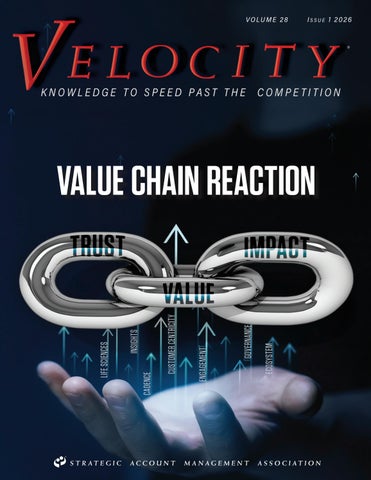
VOLUME 28
Issue 1 2026
VALUE CHAIN REACTION
S T R AT E G I C
ACCOUN T
M A NAGEM EN T
A S S O C I AT I O N
Considering Sales Training Events for
2026
?
THERE’S A NEXT-GEN ALTERNATIVE BUILT FOR REAL RESULTS.
Precision Guided Selling (PGS) delivers real-time, AI-powered 100% custom guidance that guides your reps to execute your actual sales strategy — on every deal, at every stage, 24/7 - 365. (for the same price as training events)
WHY IT MATTERS Sales training is valuable — but static. Reps forget most of it. Managers don’t have time to coach it. PGS puts the strategy in motion inside every deal immediately, not just the workshop. KEY BENEFITS
Replaces one-time training events with 24/7, deal-specific guidance from qualify to close. Increases win rates, deal quality, and renewals. Easy to fund: most teams cover PGS through existing training budgets. COMPARE US TO SALES TRAINING
BOOK A DEMO CARRIE@CLOSESTRONG.AI WWW.CLOSESTRONG.AI
FOR A DEEPER ARTICLE
SCAN QR CODE
FEATURES 15 What SAM Excellence Looks Like
33 Beyond Codes of Conduct: Ethical selling in
large accounts 20 The End of the Traditional Advisory Board:
How continuous engagement drives strategic value in life sciences
39 What Customers Value 49 Customer-Centric Curricula: The strategic
27 KAM at a Crossroads
imperative for modern account excellence
DEPARTMENTS 9 Quick Takes 12 Data Watch
VE L O C I T Y ® A PUBLICATION OF THE STR ATEGIC ACCOUNT MANAGEMENT ASSOCIATION
Publisher: Rosemary Heneghan Editor-in-Chief: Nic Halverson Creative Director: Aimee Waddell Advertising: Ashley Davis
Vol . 28
I ssue 1 2026
The Strategic Account Management Association is a global knowledge-sharing and networking organization devoted to developing, promoting, and advancing strategic customer-supplier value, collaboration, and learning.
Management Association (SAMA). The SAMA® logo is a registered trademark of the Strategic Account Management Association.
Changes of address, suggested articles, and requests for extra copies of this publication should be directed to:
Velocity ® is published three times a year. An annual subscription is free.
4740 N. Cumberland Ave.
No part of this publication may be reproduced or transmitted in any form or by any means without written permission. Copyright © 2026 by the Strategic Account
For membership information or to join SAMA, contact Mike Johnson at 312-2513131 x120 or johnson@strategicaccounts. org.
SAMA #389 Chicago, IL 60656 Tel: 312-251-3131 • Fax: 312-251-3132 www.strategicaccounts.org
Ve l o c i t y ®
3
SAMA CORPORATE MEMBERS ABM Industries Inc. Advanced Industrial Devices Agilent Technologies Inc. Air Liquide Airbus Defence and Space Alnylam Pharmaceuticals Amgen Canada Arcadis Consulting UK Ltd Astellas Pharma Inc. AVI-SPL Axis Communications AB Bellevue University
Honeywell Building Automation Hovione Hyatt IDEXX Laboratories, Inc. John Deere Johnson & Johnson Liberty Mutual Lilly USA, LLC. LP Building Solutions Lubrizol Merck/MSD
bioMérieux
New York Power Authority Inc.
Black & Veatch
Novo Nordisk Inc.
Blue Cross Blue Shield of North Dakota
O-I
Boehringer Ingelheim Carlisle Construction Materials
Owens Corning Pfizer, Inc. Philips
CAS
Premier Inc.
Ceva Santé Animale
Pure Storage
CH Robinson
Saint-Gobain
ChemTreat
Sanofi Inc.
Cisco Systems, Inc.
Siemens
CPC Worldwide
Solecta, Inc.
DHL
Solenis LLC
Diversified
Sonoco
Donaldson Company, Inc.
Southworth Products Corporation
Eisai, Inc. Elanco Animal Health Empire Life Endress + Hauser
Renae Leary Chief Commercial Officer – Americas Ansell
Dr. Hajo Rapp, Ph.D. SVP and Global Head of Cybersecurity Sales TÜV SÜD AG
Christine Marsh Senior Vice President Boehringer Ingelheim
Mary V. Ruiz CEO & Co-Founder MHAYA.ai
Dino Bertani Vice President of Alliance Management Zealand Pharma
Danielle Matteson Senior Director of Global Advanced Services & CX Strategic Accounts Pure Storage, Inc.
Jennifer Stanley Partner McKinsey & Company
Jim Ford Operating Partner True North Venture Partners Chairman of the SAMA Board
Zine E. Moufakir Senior Director of Global Commercial Readiness Honeywell International Inc.
Eric Gantier President, Global Engineering, Manufacturing & Energy DHL Customer Solutions and Innovation (CSI)
Shawn Parker Executive Director, Strategic Account Management & Corporate Group Sales Hilton
Denise Juliano Group Vice President, Life Sciences Premier Inc.
Namita Powers Principal ZS Associates
Steve Andersen President and Founder PMI
*Dominique Côté CEO and Founder Cosawi, and Principal, The Summit Group
*Ron Davis Retired - Executive Vice President, Head of Customer Management Zurich Insurance Group
Alex Tremblot Vice President of the Group Strategic Accounts Program Air Liquide Brad Weintraub Senior Vice President, Global Strategic Accounts Program AVI SPL
*Rosemary Heneghan Retired - Director, International Sales & Operations, Worldwide IBM
*Distinguished Board Advisors (lifetime contributors; non-voting members)
Terumo Europe N.V. Thales The Sherwin-Williams Company
Expeditors International
TreviPay
Formerra
TÜV SÜD
GE HealthCare
UL Solutions
Genmab US, Inc.
Vallourec
Hays
Veolia WTS USA Inc.
Hilton Worldwide
Wajax Limited
Ve l o c i t y ®
Dr. Michael Ahearne Professor of Marketing and C.T. Bauer Chair, Bauer College of Business, EMEA University of Houston
supplyFORCE
Exact Sciences
4
SAMA BOARD OF DIRECTORS
SPECIAL THANKS TO SAMA’S PROVIDERS
Vol . 28
I ssue 1 2026
V ELOCIT Y® A PUBLICATION OF THE STRATEGIC ACCOUNT MANAGEMENT ASSOCIATION
Publisher: Rosemary Heneghan Editor-in-Chief: Nic Halverson Creative Director: Aimee Waddell Advertising: Ashley Davis
SAMA 2026 EVENTS SAMA Academy Online Offered year-round https://strategicaccounts.org/sama-academy
SAMA Staff Executive Interim President & CEO: Rosemary Heneghan Finance/Operations/Meetings Director of Finance, Meetings and Operations: Fran Schwartz Operations and Meetings Manager: Tracy Cundari
ABM Academy: Next Generation ABM Customer-Led, Team-Enabled February 18-19 Online: strategicaccounts.org/event/abm-academy
Finance Manager: Christina Ponstein Creative Director: Aimee Waddell Salesforce Administrator/IT Manager: Erin Pallesen Customer Success Director, Customer Solutions and Marketing: Ryan Martin Senior Manager, Customer Success: Michael Johnson Customer Success Manager: Chris Cain Customer Success Manager: Brad Maloney Knowledge, Certification & Training Director, Knowledge, Certification & Training: Libby Souder Assistant Director, Knowledge & Training: David Schweizer Assistant Director, Certification & Training: Stephanie Fahey Knowledge, Training & Certification Coordinator: Steven Allen Research Research Services Manager: Christine Army Strategy, Marketing & Communications
2026 SAMA Annual Conference May 18-20 Phoenix, Arizona Arizona Biltmore Hotel strategicaccounts.org/event/2026-sama-annual-conference
Editor-in-Chief: Nic Halverson Marketing Manager & Sponsorship: Ashley Davis
For more information, visit https://strategicaccounts.org/en/events. Join the conversation with SAMA on LinkedIn at www.linkedin.com/company/strategic-account-management-association. Follow SAMA on X at www.twitter.com/samatweet.
6
Ve l o c i t y ®
Vol . 28
I ssue 1 2026
EDITOR’S CORNER
Nic Halverson
talent, sophisticated processes, advanced tools — yet they are
Editor-in-Chief Strategic Account Management Association (SAMA)
city streets,” they write. Keep reading for their solutions on
asking that race team to operate on the equivalent of crowded how to get your team off the streets and onto the track. “Beyond Codes of Conduct” finds Steve Hoyle, Founder of
The new year always ushers in a state of reflection. We say
Real Sales Manager, ruminating on the ethics of selling in
goodbye to the past and embrace the path ahead, vowing to
large accounts as he explores three main approaches: follow
reevaluate our methods and make changes that will allow us
the rules, follow the consequences, and follow your judge-
to become our most authentic selves. Oftentimes, this self-
ment.
examination brings us to a crossroads and sparks a reckoning with our own ethics and morality. Ideally, if we’re open and honest, we arrive at a moment of clarity and discover what we value most. And from this point of realization, we start building a plan of action to align our new mindset with the impact and outcomes we seek.
In a reprinted chapter from his recently published book “Go to Customer: A Guidebook to Selling What’s Possible — for Enterprise Account Teams,” author Dave Irwin, Founder and CEO at Polaris I/O, describes his own “wake-up call” in the article “What Customers Value.” He writes, “for years we had been leading with technology, not outcomes. We were
Coincidently, the articles in this issue of Velocity are nearly
selling the engine, not the results.” Read on to learn about the
congruent with the arc of self-improvement described in
“painful truth” he had to confront and how he recalibrated
the paragraph above — the values-driven progression from
his approach.
reflection to action.
In previous Velocity articles, Dominique Côté, CEO &
Our first piece pays homage to SAMA’s own Harvey
Founder of Cosawi and Principal at The Summit Group,
Dunham, who is retiring after almost a decade of service
outlined the importance of organizations creating a SAM
to SAMA and an astonishing 45-year career in strategic
Center of Excellence. One factor, she says, emerged as a key
account management. In “What SAM Excellence Looks
element for enabling that transformation: the development
Like,” Harvey draws on a long career of building world-class
of a customer-centric curriculum. “Such a curriculum is not
SAM programs, while sharing hard-earned lessons and sage
a training program in the conventional sense,” she writes in
advice for those who will carry his torch. Harvey has been a
this issue’s final piece. “Rather, it is an integrated capability
mentor to us all and we are forever grateful for his profound
framework that aligns mindsets, behaviors, and processes
and practical impact on our SAMA community.
across all customer-facing roles, enabling organizations to
Next, in “The End of the Traditional Advisory Board,” Dr.
engage with coherence, relevance, and purpose.”
William Ford, Founder of the Prime Meridian Group, writes
As we look toward 2026, coherence, relevance, and purpose
about the emergence of a new model “based not on episodic
stand out as more than just aspirations. They are the bearings
transactions but on continuous engagement,” as a “strategic
that guide our path forward, with the customer firmly rooted
approach that advances year-round value creation between life
as our true north. n
sciences companies and their key customers.” In “KAM at a Crossroads,” a team of ZS authors diagnose a problem in the key-account-management garage of life sciences organizations. “They’ve invested in building something that looks and feels like a high-performance F1 team — elite
Vol . 28
I ssue 1 2026
Ve l o c i t y ®
7
QUICK TAKES
IF YOU BUILD IT, THEY WILL COME Times of increased uncertainty tend to trigger a familiar instinct in organizations: Turn inward, safeguard margins, preserve cash, and delay decisions. Understandable, sure, but this approach often creates unintentional consequences, especially for strategic accounts. During moments like these, when customers, internal stakeholders,
relevant for the strategic account
by taking note of which ones help
and partners are seeking clarity and
management (SAM) community. By
navigate uncertainty and which ones
reassurance, companies risk appearing
definition, strategic accounts are high-
add friction. They prioritize suppliers
transactional, distant, and preoccupied
stakes, long-term relationships. How
who are understanding, consistent, and
with their own challenges.
companies behave under pressure —
accountable over those that simply pass
when budgets narrow, forecasts blur,
the buck, scale back, and retreat behind
and priorities shift — dictates trust far
contract terms and conditions.
However, a recent Harvard Business Review article, “How Leaders Can Build Stakeholder Trust in Uncertain Times,“ offers a timely counterpoint. Authors Sarah J. Sucher, Professor of Management Practice at Harvard Business School, and David M. Bersoff, Head of Research at the Edelman Trust Institute, write that leaders must make a mindset shift:
more than how organizations perform in calmer times.
needs to be a core strategic discipline
Today’s uncertainty is no abstract concept. Economic volatility, trade disruptions, geopolitical strife, and meteoric advancements in tech are drastically affecting customers’ cost frameworks,
investment
choices,
and risk tolerance. According to the
“Instead of following the natural
2025 World Economic Forum’s Chief
instinct to focus inwardly on survival,
Economists Outlook report, 82% of
you must instead seek to understand
chief economists describe global eco-
how uncertainty is playing out in
nomic uncertainty as “very high,“
the lives of your stakeholders,“ they
while the Economic Policy Uncertainty
explain. “You can then use this infor-
Index reached its highest level in 30
mation to create ’certainty bubbles’ that
years.
alleviate their anxiety.“ This Vol . 28
perspective
I ssue 1 2026
Against this backdrop, strategic cusis
especially
For SAM leaders, this trust-building
tomers are reevaluating their partners
— point blank. Not sure where to start? Fortunately, the HBR article details three ways organizations can build trust during times of ambiguity: Become a source of predictability, certitude, or stability.
1. Predictability “Uncertain times upend our ability to predict what the future will hold, breaking expected links between cause-and-effect (’if I do X, then Y will follow’) and the associated reliability that people count on in their daily lives,“ the authors write.
Ve l o c i t y ®
9
QUICK TAKES
Strategic account managers can counter this by reinforc-
For SAM teams, this might mean offering time-bound
ing what will remain consistent: service levels, cadence of
commitments, early visibility into potential changes, or sce-
engagement, and decision-making processes. Transparent
nario-based planning discussions. Certitude doesn’t demand
account reviews, regular executive check-ins, and proac-
perfect answers; it requires credible ones. Customers value
tive communication demonstrate reliability. With strategic
partners who help them plan, even when the outlook is hazy.
accounts, predictability often matters more than optimism.
2. Certitude
3. Stability The authors state that stability “entails a decision to bear
Firms often possess better access to market intelligence,
or absorb some of the financial costs of the uncertainty rather
internal planning signals, and directional decisions than
than passing it all on to your stakeholders given your vastly
their stakeholders. “Companies can use these advantages
greater resources, financing options, and ability to postpone
to increase trust by identifying and creating ’knowns’ for
or shift priorities in the near-term.“ For strategic accounts,
their customers, suppliers, and employees amid a plethora of
this might include new pricing disciplines, phased imple-
unknowns and unknowables,“ the authors explain.
mentations, or flexible terms when customers are strained. These approaches are not without trade-offs. But as the authors illustrate through multiple examples, organizations that act as shock absorbers, rather than shock amplifiers, tend to deepen loyalty and emerge stronger when conditions improve. A key takeaway from the article is that “creating certainty for stakeholders is not about working directly to address the larger societal challenges that underlie the uncertainty,“ the authors write. “It is about offering immediate, concrete uncertainty relief using resources entirely within your control or influence.“ For the SAM community, this underscores a longstanding truth: Strategic relationships are tested most during disruption. Customers will remember who listened, who leaned in, and who demonstrated shared accountability when options were pinched. As the authors wisely note, organizations that embrace a trust-building approach during uncertainty do more than just protect relationships; they position themselves as a go-to partner that’s poised to accelerate growth — and lead — when economic recovery arrives.
n
Adapted from “How Leaders Can Build Stakeholder Trust in Uncertain Times,“ by Sandra J. Sucher and David M. Bersoff, published November 14, 2025, by Harvard Business Review.
10
Ve l o c i t y ®
Vol . 28
I ssue 1 2026
DATA WATCH
THE KAM
ADVANTAGE Research from ZS highlights the measurable impact of a well-designed key account management (KAM) strategy. Across four case studies in pharma and life sciences, KAM accounts delivered faster growth than non-KAM accounts. The data underscores how KAM drives stronger partnerships, better launch outcomes, and improved customer perceptions by reinforcing its value as a lever of strategic growth. Check out ZS’s article “KAM at a Crossroads“ on page 27 to put these numbers in context and move your high-performance KAM engine “off crowded streets and onto the open track.“
12
Ve l o c i t y ®
Vol . 28
I ssue 1 2026
Impact of Key Account Management — By the Numbers A well-designed and executed KAM strategy can deliver…
50% faster growth Across case studies, KAM accounts consistently grew faster than non-KAM accounts
4 Case Studies
• 2 large pharma companies with established programs • 1 new program focused on rare disease • 1 new program focused on oncology
Stronger customer perceptions
Better launch performance
• A new KAM program conducted voice-of-customer research
• 30% more growth and • 10% faster growth rate 18 months post launch for KAM accounts vs. similar non-target accounts
• 50% of respondents considered the pharma company as their preferred manufacturer partner
Preferential engagement and partnerships
• 2 x increase in number of clinical trials for a new medical/ commercial KAM tandem program • One partnership drove a +50% share shift in 4 months
Source: 2025 ZS
Vol . 28
I ssue 1 2026
Ve l o c i t y ®
13
WHAT SAM EXCELLENCE LOOKS LIKE Harvey Dunham takes a bow as he reflects on lessons learned over his long career of building world-class SAM programs
By Nic Halverson Editor-in-Chief SAMA
After nearly a decade of service to SAMA — and a remarkable 45-year career in strategic account management — Harvey Dunham, Managing Director of Strategy, is retiring. Harvey’s impact on our community has been both practical and profound. He helped shape SAMA’s direction and thought leadership, while never losing sight of what matters most: the people doing the work, the customers at the center of it, and the discipline required to build great programs. From guiding global leaders to advancing sustainability and sales transformation, Harvey has consistently raised the standard for what excellence in SAM looks like — and he’s done so with warmth, candor, and an unwavering commitment to helping others succeed. On behalf of the SAMA community: Thank you, Harvey! We’re deeply grateful for your leadership, your generosity, and the legacy you leave with practitioners around the world.
Vol . 28
I ssue 1 2026
Ve l o c i t y ®
15
Looking back, what’s the most important evolution you’ve witnessed in strategic account management during your career? Harvey Dunham: My first exposure to SAM was in the
permission from the Food and Drug Administration in the U.S.), the inventing pharma company gets an exclusive patent to make and sell said product for 10 years, to recoup what they spent to develop, educate, and sell the product.
mid-1980s. I was five years into my 35-year career with
Once the 10-year exclusivity has been reached, the so-
Square D company, prior to being acquired by Schneider
called patent cliff is reached, and low-cost suppliers start
Electric in 1991. At that time our largest customers were
manufacturing and selling at prices well below what the
Ford, General Motors, and Chrysler.
drug inventor could afford. Schneider’s pharma team worked
The procurement people at each of these three automotives banded together and insisted Square D assign a 100%-dedicated, top salesperson to each of the three companies. Their rationale for making the request is that they did not have time to deal with Square D’s internal complexity. Each insisted that they wanted one point of contact who was 100% focused on them and them alone.
with four global pharma companies in North America and Europe who all entered their 10-year exclusivity protection within months of each other and faced “falling off the patent cliff“ in 2013. Our SAMs knew this and knew that their protection was about to crumble — virtually overnight. To say the least, our SAM team was in fear of being eliminated because our customers like Merck, Pfizer, and
In terms of the biggest evolution — I think it’s happen-
GlaxoSmithKline could not compete with generic competi-
ing right now. Artificial intelligence, combining the brain
tors that simply bought the ingredients, formulated them,
power of human beings, and aligning them to your own
and sold them at less than half of what we were charging.
company’s business — it’s a new frontier. I believe that agentic AI will become a great sales tool in a SAM’s arsenal. Many questions a strategic account customer can have will soon be found by the supplier’s agentic AI. This is like having a 24/7 personal assistant who knows the industry, the strategic account that supplies the SAM’s customer, and can see where the client is headed in the future by listening to investor calls, consuming written forward-looking strategies, and deftly reacting to unanticipated developments. I don’t believe that digital agents will replace SAMs. People will still buy from people. What the digital agent will do is give the SAM the best briefing they have ever had, based on the strategic account’s past, current, and future
I was new to this whole phenomenon. It took about four months to understand how threatening this patent cliff was. Once I got it, Linda Carlson — former Program Manager at Schneider — and I arranged a SAM meeting in France to figure out what we were going to do. The meeting in France turned out to be a godsend. My first break in leadership with my new pharma-SAM role came when I realized that our SAMs only knew how to sell their customer’s blockbuster product. This was all capitalexpenditure selling, which involved helping our customers build new plants to make the drug and sell it in growing markets.
needs — and what the SAM’s company should do to adapt to market changes.
How did your experiences at Schneider Electric — especially in sustainability and sales transformation — shape your view of what great SAM leadership looks like? In 2012 I had just inherited Schneider Electric’s SAM pharmaceutical team. As I researched this relatively new market, I quickly learned that many of our half dozen strategic accounts were facing what was dubbed “the patent cliff that pharma companies must adhere to.” When a new pharma product is developed and deemed safe enough to recommend and sell (which takes 10 years or more to get 16
Ve l o c i t y ®
Vol . 28
I ssue 1 2026
Our blind spot was that we never paid attention to what else our strategic accounts were making, in addition to their blockbuster products. In manufacturing lingo, this is called OPEX — operating expenses. Prior to the Paris meeting I asked each SAM to find out what their strategic account’s OPEX budget was for their factories worldwide. It turned out that their OPEX expenditures to keep their factories running was huge! When running factories 24/7 across the world, the one thing you can be sure of is that something is breaking somewhere, and we could send
My work with helping AVI-SPL launch and grow their SAM program is one of my prouder moments during my time at SAMA. AVI-SPL did such an excellent job preparing for and focusing on building a truly great SAM program.
our electrical experts to help get them back online ASAP. One lost day of production would easily cost $1 million. When I brought this to our SAM’s attention, they quickly realized that their narrow focus on blockbusters gave them tunnel vision. Each SAM had so much business with their strategic account in getting the blockbuster manufacturing line up and running that they could not see what was happening in their strategic accounts. During the meeting our best and most successful pharma SAM shared that he had put a whole team of people together to serve GlaxoSmithKline’s pharma business globally. The other three SAMs were stunned.
and connect with someone in Colorado. Also, locals abroad who run large facilities like banks often have local friends that they trust and give their business to. AVI-SPL sells very sophisticated telecommunications that link their large customers via huge, protected networks that could be devastated by hackers. At AVI-SPL’s request I attended their SAMs’ first meeting. The 20 or so attendees were excited and had many ques-
Suddenly, we realized that by calling on our same cus-
tions. My contribution was to define what good strategic
tomers and helping them run their plants continuously, we
account management looked like: Become your customer’s
could easily bankroll what we were going to lose when the
go-to person, how to get started, and define how the SAM
patent cliff crumpled.
and support staff needed to successfully become “glocal“ — global, but local. For example, be there for your customer
What were the key lessons you learned when helping AVI-SPL build its SAM program from the ground up? My work with helping AVI-SPL launch and grow their SAM program is one of my prouder moments during my time at SAMA. AVI-SPL did such an excellent job preparing for and focusing on building a truly great SAM program.
wherever they may be and connect them to the right people internally, as needed. I also shared that they would be trained to become a global strategic account program. This meeting was highly interactive. I was lucky to leave by midnight to get back to Chicago. Best of all, AVI-SPL shared this interactivity across its global organization, top to bottom —from leadership to frontline teams — and with customers, both internally and externally. They’ve done a
Before AVI-SPL even called SAMA, their board and CEO
remarkable job. No one has matched AVI-SPL’s ability to
had already identified why their large global customers were
turn their salespeople into strategic account managers. A
not growing outside of the U.S. Basically, their top global/
year later, AVI-SPL won a SAMA Excellence Award for
multinational customers used AVI-SPL exclusively in the
Outstanding Young Program on their first attempt. And
U.S. and hardly at all outside of the U.S. Why? Because
their excellence has never stopped.
AVI-SPL’s customer experience in the U.S. was top notch!
AVI-SPL grew handsomely with their strategic accounts
Simultaneously, in the rest of the world, their custom-
over the first few years; then they started experimenting
ers bought locally as much as they possibly could. Why?
with selling their SAM program to companies that used
Language barriers, for starters. There was no direct con-
their competitors. To their surprise the companies AVI-
nection to AVI-SPL’s experts, headquartered in Colorado.
SPL had no relationship with at all wanted to sign up. This
Imagine the difficulty being in Malaysia and trying to find
continues through today.
Vol . 28
I ssue 1 2026
Ve l o c i t y ®
17
One of the big concepts I always reiterate is that strategic account management is a business strategy; it’s not a sales strategy. I can’t stress that enough!
For each strategic account, be sure that the SAM is continually tracking and communicating progress, as well as looking around for innovation opportunities at the corners and edges of their assigned strategic account, because this is where net new growth will come from. SAMs need to be on the lookout for new ecosystem partners who can bring new skills, capabilities, and revenue to
What did AVI-SPL do differently that accelerated their maturity? Well, they really had to organize their entire company because the left hand really didn’t know what the right hand was doing and vice versa. What they did best was this cross-
any given SAM program. To gauge success and momentum of a SAM program, remember that the program’s growth, on average, should be at least two times the annual growth rate of accounts that are strictly transactional.
company, internal alignment, which is the key to all of this. And there was one other thing AVI-SPL did exceptionally well: They found the decision makers — those with the authority within the ecosystem to move the needle.
You’ve emphasized that achieving excellence in SAM requires 100% company commitment — from the board to frontline teams. What have you learned about creating that kind of internal alignment?
Based on your work with companies worldwide, what are the top two or three capabilities that will define successful SAM programs over the next decade? One of the big concepts I always reiterate is that strategic account management is a business strategy; it’s not a sales strategy. I can’t stress that enough! Secondly, a successful SAM program aligns from the customer being at the center of your strategy, on up to the board. Lastly, as you annually
First and foremost, I talk to the people. I care about what
review each strategic account and consider adding new cus-
you’re experiencing. I care about what our customers are
tomers, carefully weigh each new customer’s opportunities
experiencing. I care about the interoffice interactions and
to grow with you, and take note of their CEO and C-suite’s
relationships between people. I’m certainly no one-minute manager because I can be very chatty. But if I see something, I say something. All this builds authenticity and trust.
willingness to partner and the leadership makeup of their organization. I like to use a bowling analogy: If you want to roll a strike, make sure you hit the head pin first.
In more nuts-and-bolts terms of achieving internal alignment, put your SAM program at the center of your strategy, with buy-in from the top down, starting with the board and ending with your latest new hire. And make sure the head of your SAM program reports directly to the CEO, whenever possible! Your CEO and executives must fully support
What I really like about SAMA is that we don’t promise
and guide the SAM program giving regular updates semi-
we can do everything. We show you what good strategic
annually or annually, internally and externally.
account management looks like, and we can connect you
Every year, audit each SAM program individually at the
18
Personally, what have you learned about leadership, partnership, and impact from your years serving the SAM community?
with people who will share their experience, challenges,
leadership level to ensure that you are getting the proper ROI
and solutions. With SAMA, it’s about dialogue and our
on your program with each strategic account. Communicate
vibrant community, and the exchange of knowledge that
the success of your entire SAM program far and wide —
comes from that interaction. Bringing people together and
internally with your employees, and externally with your
giving them an opportunity to talk with one another —
shareholders. And certify every strategic account manager,
that’s where real impact happens. Do we learn more from
so they have the proper training.
books or from people? is kind of how I see it. n
Ve l o c i t y ®
Vol . 28
I ssue 1 2026
According to SAMA research, top performing SAMs are 3x as likely to record outstanding growth, profitability, and customer satisfaction.
Private SAMA Certification with PMI SAMA’s Certified Strategic Account Management (CSAM) program is the most widely recognized certification for strategic account managers (SAMs) and their leaders today. Customized and scaled to fit your organization’s unique environment, private SAMA certification is available through PMI. Designed for those looking for training specific to their organization and industry, this approach is based on working with real accounts and live opportunities throughout the certification process. Courseware and tools have been designed and developed to support the SAM journey of your account managers and can also include their crossfunctional team members. Curriculum and coaching guides are provided to equip SAM managers and leaders to coach to the pressure-points of contemporary SAM success and reinforce the training for greater business impact.
PMI is is aa sales sales performance PMI and account consulting and trainingand management consulting organization that delivers training organization that PMI salutes SAMA’s continued customized solutions to commitment to equip and delivers customized solutions enableindustry-leading sales professionals and to industry-leading global organizations for success! companies worldwide. companies worldwide. This copy block will hold approx. 300 characters. We To find outthis more could also use areaabout for a private SAMA Certification data point, or “About PMI” info, or call-to-action related to Toa find about without PMI,more contact: CSAM/certification.
private SAMA Certification info@performancemethods.com with PMI, contact: info@performancemethods.com
Join PMI at the 2026 SAMA Annual Conference in Phoenix, AZ, and at one of our 2026 Core 1 Workshops in February, June, September and November, And E10 - Coaching to SAM Behaviors, in June!
THE END OF THE TRADITIONAL ADVISORY BOARD How continuous engagement drives strategic value in life sciences By William Ford, MD Founder Prime Meridian Group
For decades, advisory boards have been a fundamental
are legitimate, insight driven, and compliant with anti-
way for life sciences companies to engage with healthcare
kickback and Office of Inspector General (OIG) guidelines
professionals and key accounts. These boards were designed
that prohibit offering, paying, soliciting, or receiving any-
to gather clinical insights and build relationships that could
thing of value to influence the referral of services or items
influence commercialization strategies. Historically, the
covered by healthcare programs. A single annual event no
model relied on occasional interactions. For example, a
longer meets the clear documentation standards required by
company might gather a group of providers once or twice a year to present data and then move forward. However, that approach is no longer effective. In today’s environment, which is characterized by rapid innovation cycles and changing customer expectations, the traditional advisory model has become inadequate. Annual or semiannual meetings can no longer keep pace with clinical needs or the deeper strategic alignment required to drive value. What is emerging instead is a model based not on episodic transactions but on continuous engagement. This is a
compliance teams. Second, medical innovation has accelerated. Therapies and real-world evidence evolve at unprecedented speed. Label expansions, new data sets, and competing products require timely insight collection. Episodic feedback cannot drive timely decision-making. Third, healthcare professionals expect more. Strategic customers no longer want to be observers in product discussions. They want a voice in shaping patient journey
strategic approach that advances year-round value creation
considerations and healthcare system alignment. Strategic
between life sciences companies and their key customers.
account management in life sciences must respond to this new reality.
The decline of the traditional advisory board Three forces are driving the decline of the traditional advisory model. First, regulatory scrutiny has intensified. Organizations must demonstrate that advisory engagements 20
Ve l o c i t y ®
Continuous engagement and the spoke-andwheel model Continuous engagement is the future. In place of annual Vol . 28
I ssue 1 2026
advisory gatherings, companies are adopting advisory
For example, an advisory pod in chronic care may begin
structures based on constant interaction and recurring
by identifying barriers to patient onboarding. Later ses-
value exchange. The Prime Meridian Group calls this the
sions may focus on testing revised messages or design-
spoke-and-wheel model. In this format, multiple small
ing new patient support workflows. The company applies
peer groups or pods, i.e., the spokes, engage regularly
feedback after each meeting and shares the results at the
through virtual or live meetings. A strategic hub coordi-
next. Advisors see direct evidence that their contributions
nates overall direction and aligns internal stakeholders.
matter.
Rather than a single static advisory meeting, the company
This builds loyalty and produces insights that are more
sustains insight capture and partnership throughout the
actionable than those generated in traditional advisory
year. This approach supports strategic alignment at mul-
settings.
tiple levels. It creates ongoing collaboration between the company and the advisor. It also opens opportunities for peer-to-peer learning among providers and accounts. This is a hallmark of modern strategic account management. Each engagement is part of a broader relationship journey.
Advisory pods as insight engines The best continuous engagement programs treat advi-
Proven experience across life sciences The Prime Meridian Group has operationalized this structure across numerous therapeutic areas including neurology, rare diseases, oncology, and diagnostics. In one oncology program, advisors collaborated through eight virtual meetings over two years. They helped refine clinical care algorithms and guideline interpretations for
sory pods as insight engines. These pods meet quarterly
community providers. This contributed to increased clini-
or more often, and each interaction builds upon the last.
cal confidence and stronger brand integration at launch.
Meetings are structured around real-world scenarios.
In another example, a rare disease manufacturer used
Instead of static data presentation, the format encourages
continuous engagement pods to uncover operational chal-
providers and key account leaders to solve case challenges,
lenges at specialty pharmacies that were causing treatment
share clinical experiences, and co-design program ele-
delays. Based on pod feedback, the company redesigned
ments.
distribution protocols and implemented clinician-facing support tools, which strengthened patient access within six months. In both cases, success was rooted in continuity. Advisors remained engaged not just for compensation, but because they saw their work shape real outcomes. The organization in turn built stronger relationships and accelerated impactful decision-making.
Strategic account management principles at work This continuous engagement model is directly aligned with core strategic account management principles, especially those emphasized by the Strategic
Account
Management
Association (SAMA). Insights are not collected and Vol . 28
I ssue 1 2026
Ve l o c i t y ®
21
4. Focus on co-creation. Invite your customers to help solve problems, not just to observe them. 5. Build compliance into the process. Continuous engagement gives visible evidence of ethical intent, which strengthens regulatory posture and relationship trust.
Conclusion: The future is continuous The traditional advisory board delivered value in its time. But in the current environment, life sciences companies need something more dynamic. Continuous engagement structured through a spokeand-wheel model helps organizations develop strategic customer relationships. At the Prime Meridian Group, we shelved. They are applied into the engagement cycle in a
believe this shift is not simply a tactical change, but rather
way that advances outcomes for both the company and
it is a strategic evolution. Advisory boards are not disap-
strategic customers. Advisory pods allow the collection of
pearing. They are transforming. The future will belong to
diverse perspectives while maintaining consistency at the
companies that understand this truth. A strategic account is
program level. The hub structure ensures that internal teams act upon insight quickly and consistently. Finally, continuous engagement creates a transparent record of value generation. It demonstrates that the relationship is not transactional but strategic, and customers trust
not a single interaction. It is a continuous relationship built on partnership and shared learning. And in the end, it is not the meeting itself that matters. It is what happens between the meetings. n
what they can see.
Five lessons for strategic account professionals Whether in life sciences or another industry, these lessons can strengthen strategic customer engagement: 1. C onsistency is essential. One-time meetings cannot support strategic planning. Regular engagement builds
Dr. William Ford is a Chief of Hospital Medicine and the Founder of the Prime Meridian Group, a consulting firm that offers unique solutions to healthcare and pharmaceutical companies, including advisory board solutions, educational training, sales meeting training, and e-learning solutions. Connect with him on LinkedIn at linkedin.com/in/william-ford-md-mba-89a5325.
accountability and insight momentum. 2. Create communities, not committees. Advisory pods create peer networks that foster deeper input than isolated meetings. 3. Apply insights through action. Feedback is only valuable when it drives change. Show advisors how their input affects decisions. 22
Ve l o c i t y ®
Vol . 28
I ssue 1 2026
NEW IN 2025:
SELL SHARPER. GROW FASTER.
The Sharpest Way to Sell to High-Stakes Customers Most organizations don’t lose deals because of products. They lose them because of misalignment with the customer and their own team. Whetstone sharpens how your teams sell, serve, and grow your high-stakes customers by fixing the alignment gaps that stall deals, weaken execution, and erode confidence. This is not training. This is behavior change, powered by readiness, clarity, and the only system built for high-stakes customer leadership.
Sharpen how you sell. Sharpen how you grow. Sharpen with Whetstone.
WHETSTONEINC.CA
The Whetstone High-Stakes Alignment SystemIP The Hero’s Journey for SalesIP
The Pit Crew Advantage for TeamsIP
External Alignment
Internal Alignment
Behavior Change The Execution EngineIP
When the Stakes Are High, Alignment Decides Who Wins High-stakes growth does not happen by accident. It happens when organizations align how they understand customers, how teams work together, and how decisions get executed under pressure. When alignment is strong, momentum builds naturally. Customers engage with confidence. Teams move with clarity. Execution holds as stakes rise. Alignment is not a cultural ideal or a leadership aspiration. It is a system that determines which opportunities become durable growth and which never quite materialize. Organizations that treat alignment as a system rather than a sentiment are better positioned to win the right customers, grow them deliberately, and sustain trust as complexity increases.
The High-Stakes Alignment SystemIP The High-Stakes Alignment SystemIP aligns how organizations move from opportunity to growth by focusing on alignment where it matters most. With customers. Across teams. In execution. Teams use the system to shorten time-to-decision, improve cross-functional execution, and increase confidence in renewal and expansion conversations. The system operates through three interconnected components. 1. The Hero’s Journey for SalesIP High-stakes customers are navigating risk, visibility, and consequence. Their decisions unfold across a journey where they see themselves, not you, as the hero. Understanding the Hero’s Journey for SalesIP reveals alignment gaps early. It clarifies what is at stake for the customer and where misalignment quietly slows momentum. When sales teams align to that journey, trust builds faster and growth has direction.
2. The Pit Crew Advantage for TeamsIP Winning high-stakes customers requires internal coordination that holds as complexity increases. The Pit Crew Advantage for TeamsIP aligns roles, decisions, and handoffs so teams operate like a pit crew rather than a relay race. Customers experience consistency not confusion. 3. The Execution EngineIP Insight alone does not sustain growth. The Execution EngineIP ensures alignment shows up in daily behavior. In decisions, workflows, and follow-through. This is where alignment becomes durable under pressure. Together, these components make alignment systemic, not episodic.
A Simple Way to See Your Own Patterns If you are focused on opportunity and growth, the most useful place to begin is visibility. The High-Stakes Readiness ScorecardIP provides a fast, objective view of how aligned your organization is across customers, teams, and execution. In less than five minutes, it highlights where alignment is strong, where it is breaking down, and where focused effort can make the biggest difference.
Take the High-Stakes Readiness ScorecardIP to see where alignment is helping—or quietly costing—you growth.
SCAN QR CODE OR CLICK to answer a few questions and receive your High-Stakes Readiness ScorecardIP and report.
ELEVATE YOUR STRATEGIC MANAGERS FROM GOOD TO GREAT.
Use SAMA’s Individual Competency Assessment to: • Understand your SAMs’ current-state strengths and weaknesses • Discover how your account managers compare to each other and/or to competitors • Find SAMA resources and training tied to specific skills in need of improvement
SAMA’s Best-in-Class SAM Competency Model® •F acilitate meaningful coaching
3
Joint Solution Development, Co-Creation & Reaching Agreement
2 Strategic Account & Opportunity Planning
Strategic Account Manager Competencies & Skills 1 Understanding Organizational Priorities
SAMA’s SAM Competency Model
Want more information? Contact assessments@strategicaccounts.org.
5
Overall Relationship and Outcome Management
4 Multifunctional Account Team Leadership
KAM AT A CROSSROADS Insights and imperatives to unlock key account management’s full potential in life sciences
Five years ago, key account management (KAM) surged to the top of the agenda for life
By Namita Powers
sciences executives. When traditional field
Principal
engagement stalled during COVID access lock-
ZS
downs, trusted key account managers still found
Alex Simon Principal ZS
ways in — helping customers navigate a stretch of unprecedented complexity that only a true KAM strategy could address. Fast-forward to today, and many life sciences
Amelia Summerell
organizations find themselves at an unexpected
Associate Principal ZS
thing that looks and feels like a high-perfor-
crossroads: They’ve invested in building somemance F1 team — elite talent, sophisticated processes, advanced tools — yet they are asking that race team to operate on the equivalent of crowded city streets. Designed for long-range, precision, and strategic navigation, many KAM teams are sent onto city streets, where their full performance has no room to unfold. Earlier this year, ZS conducted the “State of KAM in Life Sciences“ study to understand this paradox. Through a large-scale survey and indepth interviews with leaders from 22 KAM teams across 13 companies, a consistent theme emerged: Executives want the acceleration and agility that KAM promises, but the conditions executives create rarely enable these teams to perform as designed. Successful KAM requires three elements — programmatic approach, steady executive stewardship, and investment in purpose-built tools. Desire for KAM impact is high, yet few organizations have put all three pieces in place.
Vol . 28
I ssue 1 2026
Ve l o c i t y ®
27
Many senior leaders remain fixated on short-term commer-
of KAM programs reporting into a vice president or
cial impact, despite substantial evidence that KAM delivers
higher increased by 21%. Today, more than half of KAM
its greatest value over longer time horizons.
teams report into their own dedicated function, doubling
The ZS research provides insights to: • Understand the current state of KAM in life sciences
still do not understand KAM; more than one-third of KAM leaders felt KAM was not well understood in their
• Identify where and why KAM has yet to reach full potential
organization, and this knowledge gap remains a critical
• Share recommendations for a path forward
barrier. While this executive engagement elevates KAM
The state of KAM today
demonstrate impact and value to an organization. Senior
Our research study found three key takeaways in the state of KAM today: 1. K AM leaders have made considerable progress in addressing major issues impacting key account management in life sciences. In 2020, KAM leaders were struggling with pharma-specific challenges such as medical / commercial collaboration, a lack of B2B-specific value propositions, and legal / compliance barriers. A
and creates opportunity, it also creates greater urgency to executives are asking KAM leaders to deliver more direct sales impact over a shorter period of time, and KAM leaders are struggling because this is not what their teams are designed to deliver. 3. As a result, KAM leaders are spending more time measuring impact than generating impact. KAM leaders struggle to demonstrate the short-term impact demanded by executives, as it is inconsistent with the purpose and remit of a KAM strategy. This leaves KAM
chief driver of these barriers was life sciences organiza-
leaders trying to measure anything and everything to
tions approaching key account management with the
justify their team’s existence. For many KAM leaders,
same tools, processes, and policies as traditional field
this push to find anything is driven by fear; about two-
sales. One participant noted that “Many leaders think of
thirds of KAM leaders believe their programs are at risk
KAM similar to a sales rep role… it is a demand facilita-
of being deprioritized. However, not all executives are
tion not a demand generation role.“ Over the last five
focused on the short term. One CEO created a culture of
years, many organizations invested in addressing these
not tracking short-term sales impact early in his orga-
barriers. One organization did this by educating HQ
nization’s KAM journey. He used a balanced scorecard
functions on the differences between KAM and tradi-
of metrics, initially focusing on leading indicators such
tional sales. Others developed unique KAM tools, pro-
as customer perceptions and successful implementation
cesses, and policies such as KAM-specific customer rela-
of joint initiatives with top accounts. After three years,
tionship management (CRM) tools and KAM-specific
he finally reviewed sales performance and found KAM
compliance frameworks. The intent was to leverage the
accounts were outperforming other accounts with 2x
power of humans plus technology for KAM strategy. Our
growth rates.
research found companies were successful at investing
These takeaways from the current state of KAM in life
to address these barriers: 50% decline in the perception that legal and regulatory restrictions are a significant barrier, 30% improvement in the perceived effectiveness of KAM value propositions / solutions, and strong satisfaction with dedicated fit-for-KAM CRM tools.
28
from 2020. Despite this renewed interest, executives
sciences paint a precarious picture: KAM in life sciences is currently at a crossroads and is not on course to reach its full potential. A central tension emerged across companies: There is often a mismatch between the strategy leaders articulate and the
2. This success has drawn the attention of top executives,
resources or conditions they provide. Organizations expect
many of whom remain limited in their understand-
KAM teams to manage complex, senior-level relationships
ing of KAM. With consolidation occurring across the
and build multi-year collaborations, yet they assign account
healthcare ecosystem, life sciences executives are more
loads nearly identical to those used for entry-level account
focused on their largest, most organized accounts and
management. Our benchmarking shows no meaningful
KAM strategy than ever before. In many life sciences
difference in accounts per KAM between programs imple-
organizations, senior roles are taking direct control over
menting advanced, configurable solutions and those focused
KAM programs. Between 2020 and 2025, the number
on tailoring product messages — strong evidence that the
Ve l o c i t y ®
Vol . 28
I ssue 1 2026
strategy is still not fully understood or enabled. These constraints are not incidental. In the rush for short-term proof points, many executives unintentionally limit teams designed for this long-term, programmatic impact. The result is consistent across organizations: KAM programs built for top performance are forced to run far below their intended capability. The data shows how far companies have come — and how far they still need to go. More than 90% of programs now focus on implementing customer-facing solutions, yet only ~50% of organizations measure anything related to those solutions. When short-term demands dominate, even the most advanced KAM infrastructure sits underutilized, and organizations revert to pharma-centric metrics rather than creating long-term, mutual value. Until leaders create the right conditions, KAM will remain a high-performance engine navigating city streets — capable of much more, but seldom given the space to reach top speed.
Setting a new course With many KAM programs at this crossroads — and limited organizational patience for impact — organizations need to set the right conditions for long-term performance. The steps below can help KAM programs finally run the race they were designed for. Double down on the near while you make the case for
broader organizational strategy, KAM leaders reduce the perception that KAM is unable to support broader organizational goals. While key account managers typically are not demand-generating roles in life sciences, they clearly have meaningful business impact. Clarity from the start about objectives and their alignment to organizational and brand strategy will reduce risk down the road.
the far. The state of KAM research paints an uncertain
While short-term metrics can generate buy-in, the full
picture of KAM in life sciences, yet we also believe that
potential of KAM is best observed over the longer term.
KAM has never been more important. In the meantime,
Focusing on win-win solutions over the long term typi-
KAM leaders must navigate their leaders’ expectations.
cally generates the strongest impact to organizations — as
To do so, we suggest doubling down on the near as they
another recent ZS study demonstrated. ZS partnered with
build a case for the far. While there is tremendous value in
four clients who made programmatic investments into their
longer-term engagement, the reality of market pressures,
KAM strategies and gave KAM teams the space (and time!)
the importance of launch performance, and demands from
to execute them. For each of these programs, ZS conducted
investors will always keep life sciences executives needing to
a long-term retrospective analysis. While the companies
keep one eye on the short term. A KAM strategy that does
and strategies were quite different, the impact of KAM was
not acknowledge that reality is always going to be fighting
strikingly similar. Across all four cases, ZS found that a
a losing battle.
well-designed and executed KAM strategy can deliver 50%
When selecting priorities and metrics, KAM leaders must show clear intent to address near-term barriers to brand or class adoption and show direct impact on metrics that are
faster growth and meaningful non-sales impacts. Highlevel findings from the case studies can be seen in the Data Watch section of this issue (see p. 12).
valued across the organization. By reinforcing this message
Educate, educate, educate. Pursuing near-term impact
that KAM is a critical and embedded component of your
while building KAM understanding can open the door to
Vol . 28
I ssue 1 2026
Ve l o c i t y ®
29
stronger executive engagement in KAM and a willingness to build toward longer-term value creation. Once the spark is lit, executive engagement and stewardship becomes make-or-break for KAM programs. Executives who are fully invested in KAM programs are actively engaged with key accounts, understand the day-to-day, and ultimately support the KAM team in overcoming internal roadblocks. This active engagement from executives starts with proper education. Executive education should focus on: • The purpose & remit of a KAM strategy: When, where and why to deploy a KAM strategy. • K AM metrics that matter: How to measure and track the impact of a KAM strategy. • K AM ways of working: How to enable an organizationwide approach to engaging with your most important customers.
• Develop a consistent organizational approach to viewing account performance, which aligns to the purpose and remit of KAM. Pair this with executive training to help the leaders ask the right questions, uncover critical account insights, and contribute meaningful (versus distracting) input. • Embed systematic and consistent ways of conducting top-to-top meetings and executive sponsorships, to ensure productive and meaningful interactions between executives, KAM teams, and the organization’s most important customers. • Develop an organizational approach to KAM strategy and resourcing: Similar to how most life sciences companies have a consistent way of doing brand planning despite brand marketers rotating in and out of the role, develop
• Supporting KAM as a leader: What questions and objec-
an organizational way of approaching KAM strategy by
tives a leader should focus on to support an impactful
aligning KAM program objectives and resources with
KAM strategy.
brand strategy, and provide a framework and toolkit for
This education and executive buy-in needs to be sustained
the common decisions in KAM commercial resourcing.
by giving leaders real opportunities to learn about these
The good news: An F1 car stuck on city streets is not a
accounts, understand their needs in the market, and engage through top-to-top programs and executive sponsorship programs. One KAM program invested in multiple half-day sessions with a range of cross-functional partners including marketing, legal, and analytics. The education sessions focused on understanding KAM strategy, measuring KAM impact, and clarifying KAM ways of working. Surveys conducted before and after the sessions found a 27% increase in participants’ KAM understanding and willingness to advocate for KAM. Embed KAM as an organizational capability that lives beyond leadership life cycles. Once the full executive
failed investment — it’s an underused one. The machinery is sound. The talent is there. The potential is proven. What’s missing is the right track and the right conditions to let the system operate the way it was built to. With better education, clearer expectations, and a programmatic approach that survives leadership turnover, life sciences companies can finally move KAM off crowded streets and onto the open track — where it can deliver the speed, precision, and compounding value it was designed for. n Namita Powers is a Principal in ZS’s Philadelphia office. She leads Global Commercial Models for ZS and is pushing life sciences
leadership team has been educated (beyond just a single
manufacturers for more disruptive, value-driving engagement
leader), building organizational capabilities is an important
approaches. She is also a board member of the Strategic Account
way to sustain and deepen the buy-in. This helps to shift
Management Association.
the ownership and accountability for top accounts to the
Alex Simon is a Principal in ZS’s Evanston office. Alex focuses on
whole organization rather than
engagement and planning processes to help organizations drive
just leaving it to the function or field teams. Given the amount of turnover we see in life sciences organizations, we need to ensure that a programmatic approach to KAM becomes the organizational way of working and outlives leadership life cycles. This can 30
take a variety of forms:
Ve l o c i t y ®
more impact from their KAM programs and has led dozens of KAM projects across ZS’s pharmaceutical and MedTech clients for the past decade. Amelia Summerell is an Associate Principal in ZS’s Philadelphia office and is the Global KAM Solutions Lead. Amelia brings a research-driven approach to helping clients and has authored multiple ZS studies. She focuses on organized customer strategy and go-to-market models, and has led multiple, multi-year KAM transformations. Vol . 28
I ssue 1 2026
NEW IN 2025:
0l
© 2025 Valkre Solutions, Inc. All rights reserved.
VALKRE.COM
There is nothing artificial about intelligence generated directly from your most important human relationships.
PEOPLE
PROCESS
INSIGHTS
Elevate the skills of the team & more effectively connect to your customer
Predictable, repeatable & measurable customercentric SAM engagement methods & practices
Voice of the Customer feedback with actionable insights
“Building a good customer experience does not happen by accident. It happens by design.”
-Clare Muscutt, Customer Experience Entrepreneur and founder CMXPERIENCE
THE CHAPMAN GROUP DIFFERENCE Dedicated Experts to support your account engagement efforts
Total SAM Solution Provider with process, methodology & tools
Emphasis on Direct Customer Feedback to drive collaborative strategic planning
Billions of ROI Delivered through our high-impact solutions
+1 410.381.7113 / www.ChapmanHQ.com
BEYOND CODES OF CONDUCT: ETHICAL SELLING IN LARGE ACCOUNTS
By Steve Hoyle
Editor’s note: Jan Johannsen, BuildSys, Harvord Pharmaceuticals, Pip Peterson, and Val
Founder Real Sales Manager
Vessinger are fictional entities used for illustrative purposes. The scenario draws on real-world situations, with details altered to protect confidentiality. Jan Johannsen is in a dilemma. As the BuildSys strategic account manager (SAM) for Harvord Pharmaceuticals, a global leader in pharmaceutical manufacturing, she has had a very successful two years. Revenues from the account grew at twice the industry average, and all indicators on the account dashboard presented at every monthly business review are positive and mostly improving. Harvord is now the largest account in Jan’s division, which supplies sophisticated intelligent building systems. But today Jan is concerned about how to handle a request from Pip Peterson, the Global COO of Harvord and the key executive champion that she has been cultivating for many years. Pip has requested that Jan expedite delivery of some equipment to a new Harvord manufacturing facility. While he explained this was necessary to ensure timely production of new life-saving drugs which are in short supply globally, Jan suspected that Pip just wanted everything to progress smoothly before he went on annual vacation. Pip was very adamant, saying that if Jan could not “do the right thing“ then he would have to “review“ some other major projects.
Vol . 28
I ssue 1 2026
Ve l o c i t y ®
33
In effect, Pip was blackmailing Jan to deliver the equipment quickly, or risk losing some big orders in the pipeline — orders which Jan and the division badly needed to
Following the rules is what philosophers and ethicists
make this quarter’s forecast. The big problem was that
call a deontological approach, which focuses on duty and
the equipment in question was experiencing long delivery
rules to determine what is the “right” course of action. It is
times, and BuildSys has a policy of first to order, first to get delivery, and there were many orders in the queue, from other customers, ahead of Harvord. In examining the queue Jan saw that most of those customers were very small resellers, who are nowhere near as important or strategic to BuildSys as Harvord.
mostly associated with the 18th-century German philosopher Immanuel Kant. In deontology, an action is morally good if it follows the correct moral rules or duties, regardless of the consequences. For example, a rule might be “never lie,” and a deontologist would say lying is always wrong, even if telling the truth leads to a bad outcome. The emphasis is on the action itself and adherence to universal moral law.
As the SAM for the division’s largest and most successful customer, and with major orders at stake, Jan knew that if she put pressure on the product managers, then it was
Deontology has many advantages in that it can give very clear “rules” that in theory lead to a very easy determination of whether something is “right” or “wrong.” The big downside,
possible to get the equipment delivered almost immediately.
particularly for account managers, is that it does not consider
Indeed, many of Jan’s colleagues were saying that she would
the peculiarities of particular situations and the nuances very
“be crazy” not to do so. Yet, Jan felt uneasy about giving in
often involved in decisions that must be made. For example,
to Pip. After all, it was he who used the phrase “do the right
“do not lie” is very clear and simple; however, it might not
thing.“
always apply, such as when a professional procurement
Jan had to decide quickly and thought back to some recent training on ethical decision-making which explained that there are three main approaches to dilemmas such as this, known as follow the rules, follow the consequences, or
executive asks you if “that is the absolute best price that you can offer.” Follow the consequences: This approach says that Jan
follow your judgment. Jan decided to explore what each
should not think about the action itself — in this case
approach would suggest she should do.
rescheduling deliveries — but think about all the conse-
Follow the rules: This approach says that Jan should simply consult the rules, firstly, from a legal perspective, and then from any internal or professional codes of conduct and other company guidelines. Jan knew that there was nothing illegal about rescheduling deliveries. BuildSys has a code of conduct, which reads very impressively and says things like “act with honesty and integrity“ and “treat all customers equally.“ In addition, there are operating guidelines which state the “first to order, first to get delivery” rule, but the guidelines also say that this can be modified in exceptional business circumstances. If Jan adopted a “follow the rules” approach, then Pip’s request should probably be refused. 34
Follow the rules
Ve l o c i t y ®
quences of the action and then choose the option that leads to the greatest good for all the various stakeholders involved.
WHO
GOOD FOR THEM
BAD FOR THEM
Pip
Gets to go on vacation with peace of mind
–
Harvord
Manufacturing facility on schedule
–
Harvord Access to life-saving customers drugs more quickly (but we are skeptical of this)
–
Other resellers
Because they are smaller businesses, this supply chain delay could be especially damaging.
Jan
Short-term orders Precedent set: Pip can dictate and secured, happy customer expect that BuildSys can bend the rules.
BuildSys
Short-term revenue, happy strategic customer
Relationship declines with smaller customers, especially resellers. Potential eroding of culture of ethics across the company. Vol . 28
I ssue 1 2026
Jan decided to list out the key people involved, the stakeholders, and the good or bad outcomes for them whether she rescheduled the delivery or not. Having done this analysis, Jan realized that the decision was finely balanced and came down to deciding between short-term goals (orders and Pip placated) versus the longer-
We use consequentialist type thinking in account management all of the time, as we make plans and carry out actions that are designed to meet our longer-term goals, typically involving building revenue and profits from the account over time, and involving keeping them as a happy and loyal customer.
term relationship with Pip, and Jan’s own perception within
Consequentialism, specifically utilitarianism, can help us
BuildSys. She also realized that from the point of view of
with many ethical decisions, but it has four big drawbacks.
BuildSys senior executives, the balance probably came down
One is that it is very difficult to predict consequences for all
in favor of not rescheduling, as relationships with lots of
the independent stakeholders involved. Second is the issue
smaller customers and reputation in the marketplace would
of unintended consequences that cannot be foreseen. Third
be more important.
is that it can lead to some stakeholders being treated very
Jan also realized that the analysis was incomplete, as it was impossible to be sure about whether or not the delivery would really impact the supply of new drugs that can save lives, and predicting the impact on other customers, who may or may not find out what BuildSys had done, was very difficult, as was predicting what they might do about it.
Follow the consequences Follow the consequences is what philosophers and ethicists call a “consequentialist” approach — an ethical theory that says the morality of an action is determined by its outcome or consequences. Simply put, the ends justify the means. The main idea is that the most ethical choice is the one that will produce the greatest good and the least harm. An action isn’t judged as good or bad (like telling a lie or keeping a promise); it’s judged based on what results come from it. This means that before acting, you should try to predict which choice will lead to the overall best situation for everyone affected. The most famous form of consequentialism is utilitarianism. This view specifically argues that the best action is the one that maximizes overall happiness or pleasure and minimizes suffering for the largest number of people.
badly, such as the smaller resellers in this case. And finally, you will often be comparing apples and oranges, for example balancing out reputation in the industry and Pip’s personal agenda. Overall, after conducting the consequentialist analysis, Jan is not convinced but leaning towards going along with Pip’s request for rescheduling. For Jan, the two things that tipped the balance are the (dubious) issue of life-saving drugs being made available and the fact that Jan — personally — and the division badly need the orders that Pip could delay, if they are to meet their quarterly forecast number and earn personal bonuses. But Jan is not entirely comfortable with this, and so decides to look at the issue from a “follow your judgment” approach. Follow your judgment: This approach encourages Jan to use practical wisdom, based on the character traits that have been developed with experience. Jan decides to discuss the dilemma with someone who is the wisest person that Jan has ever worked with — her old manager Val Vessinger. Val is nearing retirement now but has worked in sales and sales management in complex B2B for their entire life. Jan once asked Val how they became so wise, and Val replied that it was simply a matter of reflecting on every decision and every experience that they had over a long career, and con-
If you have a choice between two actions, a consequen-
stantly trying to figure out how they could have improved.
tialist would choose the one with the better overall conse-
The other factor that Val singled out was to be constantly
quences, even if it requires an action that seems wrong on
curious, which meant reading, listening to podcasts and
the surface.
videos, and, above all, trying to listen to somebody with
For example, a consequentialist might have to break a small promise (a seemingly bad action) if keeping it would cause a major, widespread disaster (a bad outcome). The consequentialist would choose to break the promise to prevent the greater harm. Vol . 28
I ssue 1 2026
whom you vehemently disagree! Val asked Jan to reflect on the current dilemma and consider it from the perspective of the person that Jan wanted to be. Goldilocks and the three bears provide a memorable catchphrase here — “not too much and not too little.“ They
Ve l o c i t y ®
35
started by thinking about being customer focused, where
should strengthen their joint operational planning, so that
the best approach, according to Val, was to be not too much,
circumstances like this wouldn’t happen again.
because then you can’t possibly represent the best interests of your company, and not too little, which would lead to ignoring the real needs of your customer. In this case, given the circumstances, the right amount of customer focus might err towards being more receptive to their needs. Val and Jan then discussed moral courage, which they both felt was a very important attribute for a strategic
was not as good as they had imagined. This suggests that Pip viewed it more as a supplier-customer relationship rather than the partnership that Jan thought they were aiming for.
Virtue ethics and phronesis
account manager. Again, too much courage might be reck-
Virtue ethics is the name given to an approach based
less, and too little might be cowardly. The “right amount” in
largely on the work of Aristotle some 2,400 years ago. He put
this case is probably to be a little more courageous in response
forward the notion that as rational animals, our purpose was
to Pip’s very assertive, some might say aggressive, requests.
to achieve a fully fulfilled life (in Greek, eudemonia). The way
Val and Jan continued to look at all of the other traits of the
to do that involved cultivating and nurturing virtues, which
best possible account manager that Jan aspired to be (see box on next page) — and saw that having “just the right amount” of any particular trait varied by the precise context and situ-
are dispositions of character, described in his most-read book, “The Nicomachean Ethics” (written, many say, for his son Nicomachus).
ation. So, if Pip had been slightly less insistent, the amount
Aristotle devised the “golden mean” for virtues being some-
of courage that would be appropriate for Jan to display would
where between two extremes of excess and deficiency, and
have been slightly different. Jan realized that making the best
importantly it is not a simple-math midpoint, but a context of
decision was not always straightforward, and being wise was
sensitive judgment. For example, Aristotle defined courage
something to be developed over time.
as the golden mean between recklessness and cowardice,
To make the actual decision about what best to do, Val explained the overall highest virtue that the Greeks had
which would be different for different people in different situations.
first discovered more than two thousand years ago, which
He gives the example of the general, who has knowledge,
they called practical wisdom. This is the ability to dis-
training, and responsibility, and the ordinary soldier, who is
cern the right action in a specific complex, ambiguous,
expected to follow orders. The same behavior, for example,
and fast-changing situation, balancing a range of different
charging ahead, would be necessary and courageous for a
short- and long-term goals. As with other traits, the best
general showing leadership, but rash and disobedient for a
way is a balance between overly simplistic and impulsive
soldier who is expected to stay in rank.
decision-making and being overly cautious and “paralysis by analysis.”
Many modern philosophers and ethicists advocate for a form of neo-Aristotelean moral conduct. One of the most
Val encouraged Jan to use her judgment, considering what
important concepts for leaders and KAMs is the super virtue
the very best SAM would do in these circumstances. They
of practical wisdom (phronesis in Greek). It is Aristotle’s
discussed it further and concluded that Jan would go back
term for the intellectual virtue that enables a person to make
to Pip and have an honest but forthright conversation. If
good decisions about how to live and act. It’s not theoretical
Pip assured her that it really would make the difference for
knowledge but the ability to judge well in concrete situations
new, life-saving drugs to be manufactured sooner, then Jan would investigate if it were feasible to arrange for some loan equipment to keep the project plan on track, or if that wasn’t possible, to do all they could to expedite the shipment. If it was to meet some internal Harvord project plan (unspoken, Pip’s vacation), then it would not be fair to BuildSys’s other customers and Jan would have to refuse, explaining that if Pip was in the position of a smaller customer, he would appreciate this. Jan also suggested that they 36
In addition, Jan made a note that the relationship with Pip
Ve l o c i t y ®
— seeing what matters, balancing competing outcomes, and choosing the right action for the right reasons. A person with phronesis understands both universal moral principles and how to apply them appropriately in particular circumstances. Practical wisdom develops through experience and habituation, not abstract instruction alone. One learns it by repeatedly practicing virtuous actions, reflecting on outcomes, and learning from wise role models. It requires emotional maturity, moral sensitivity, and the ability to deliberate well. Over time, Vol . 28
I ssue 1 2026
through consistent practice of virtues (like courage, temper-
The balance between:
ance, justice) and guided by good upbringing or mentorship,
• E xcess: Over-familiarity, flattery, boundary-crossing
a person’s perceptions become refined. Eventually they can see what the situation demands. In short, phronesis is cultivated by living a virtuous life, observing the practically wise, and gaining experience in making real-world moral choices.
Virtues of a key account manager The character traits (virtues) that will lead to success will vary by your individual role, the customer(s) you manage, your company, and your situation, but in general might consist of:
• Deficiency: Coldness, detachment, purely transactional behavior 7. Magnanimity: Confident ownership of large responsibilities with humility and generosity. The balance between: • E xcess: Arrogance, entitlement, self-promotion • Deficiency: Lack of confidence, excessive deference, reluctance to lead 8. Perseverance: Steady pursuit of long-term customer value despite obstacles and uncertainty. The balance between:
1. Practical wisdom
• E xcess: Stubbornness, refusal to adapt
The ability to judge and choose the right course of action
• Deficiency: Giving up early, chasing short-term wins
in complex, ambiguous, fast-moving situations. The balance between: • E xcess: Over-analysis, paralysis, unnecessary complexity • Deficiency: Impulsiveness, simplistic decisions, failure to anticipate consequences 2. Justice Fair and honest treatment of customers, partners, and internal teams. The balance between: • E xcess: Rigid legalism, fairness that undermines legitimate company interests • Deficiency: Favoritism, dishonesty, biased representation 3. Courage Willingness to confront difficult truths and act rightly under significant pressure. The balance between: • E xcess: Aggressiveness, reckless confrontation • Deficiency: Compliance, avoidance, silence in the face of wrongdoing
Postscript Jan used this episode with Pip to reconsider her approach to decision-making, particularly where there is an ethical element involved that affects people’s well-being. She now appreciates that “follow the rules” and “follow the consequences” are valid tools that can help in some situations. However, in the dynamic, ambiguous, high-pressure world of most key account managers — where rules can’t anticipate every complex situation and consequences are hard to assess — leaders often have to rely on “follow your judgment.” Jan realized that to make effective decisions KAMs should strive to be more like wise Val. Some decision-making and ethics training would help with this, but it is much more a mindset and getting into the habit of constantly reflecting, being curious, and learning from all of life’s experiences.
4. Temperance: Self-regulation and emotional balance in the
For Jan this meant starting to keep a very small journal
face of stress, incentives, and conflict. The balance between:
to write in every day, arranging get-togethers with other
• E xcess: Passivity, lack of urgency • Deficiency: Greed, overwork, emotional reactivity 5. Truthfulness: Honest, accurate communication that builds
SAMs on a regular basis to discuss and learn from difficult decisions that they faced, and asking Val to be a mentor who can help and guide her on the journey. n
long-term trust. The balance between: • E xcess: Bluntness, oversharing sensitive information
Steve Hoyle uses his vast experience in account and sales
• Deficiency: Exaggeration, overpromising, misleading opti-
management to combine coaching, consulting, and training for
mism 6. Appropriate social conduct: Warm, respectful relationship-building suited to diverse key account contexts. Vol . 28
I ssue 1 2026
account managers and sales managers with research into ethics of selling, as a doctoral student at London South Bank University Business School. Contact him at stevehoyle@mac.com and connect with him at linkedin.com/in/steve-hoyle-2a30681/.
Ve l o c i t y ®
37
2026
SAMA ANNUAL
CONFERENCE May 18-20, 2026 Arizona Biltmore | Phoenix, Arizona
The 2026 SAMA Annual Conference delivers what attendees value most: meaningful, real-world insights from fellow practitioners, engaging dialogue with industry leaders, and the opportunity to build lasting connections with people who understand the challenges and potential of customer-centric growth. What sets this event apart is the breadth of industries represented. This isn’t just a conference. It’s a working community — one designed to sharpen your thinking, expand your toolkit, and strengthen your impact.
https://linkly.link/29uDc
WHAT CUSTOMERS VALUE
By Dave Irwin
Editor’s Note: This article is reprinted in full from Chapter 8 of the recently
Founder and CEO Polaris I/O
released book “Go to Customer: A Guidebook to Selling What’s Possible — for Enterprise Account Teams“ with permission from the author and publisher.
In the chapters ahead, we will explore a critical shift in how organizations must align their capabilities, resources, and value with what customers truly need and expect. This is no longer a static exercise. It’s a dynamic, ongoing process of adaptive alignment. As customer environments, priorities, and stakeholders evolve, so must our ability to stay in sync. In today’s competitive landscape, the companies that modernize their systems, processes, and skill sets to operate at the speed of their customers will not only grow faster — they’ll outpace and displace competitors who fail to keep up. I learned this lesson the hard way. Another RFP landed on my desk with a tight deadline, little insight into the customer’s real needs, and even less confidence in winning. Still, we responded, just like we always did. This one came from a major retailer investing in a new omnichannel marketing platform. We followed the standard playbook: polished technical documentation, detailed implementation plans, and a showcase of our team’s capabilities. It was thorough. It was professional. It was exactly what everyone else was doing. Then came the moment that changed everything. During one of the review meetings, the customer, clearly exasperated, said something I’ll never forget: “All you guys are the same. We don’t care about the technology — we can’t even tell the difference. What we want is someone who can run the campaigns and get the results. Can you do that?“ It was a wake-up call. For years we had been leading with technology, not outcomes. We were selling the engine, not the results. That comment forced me to confront a painful truth: We weren’t aligning with what the customer valued. And what they valued wasn’t the technology. It was the outcomes driven by the technology. We had assumed they knew what to do with our solution, but they really didn’t. They were retail experts, not campaign experts.
Vol . 28
I ssue 1 2026
Ve l o c i t y ®
39
From that moment on, we flipped our approach. We led with campaign performance, not product specs. We showcased the processes, people, and analytics that would drive measurable results. We stopped talking about what our technology could do and started proving what we would deliver. We used our own tools to run real campaigns, analyze performance, and continuously improve results. The transformation was fast and dramatic. We went from being seen as a reliable but minor player to a serious competitor. Our win rate jumped tenfold. We started beating larger firms still stuck in the old model. Analyst reviews improved. Customers noticed. And all because we stopped assuming what they wanted and started listening to what they actually needed. This experience taught me that real differentiation doesn’t come from what you build. It comes from how well you align with what your customers are trying to achieve. If you want to win in today’s market, don’t just sell what you have. Solve what they value.
success, not just as products, but as strategic solutions. This isn’t just a sales tactic — it’s a mindset. It requires curiosity, empathy, and a commitment to delivering value beyond the product itself. When we lead with insight, not inventory, we earn trust. When we speak about outcomes, not options, we gain relevance. A call to action Let this be your call to break free from the product-first mentality. Challenge assumptions. Ask better questions. Seek to understand before you seek to sell. The future belongs to those who can connect with customers on a deeper level — not through features, but through foresight. The opportunity is clear: Move from product obsession to customer obsession. That’s how we differentiate. That’s how we win.
Addressing customer misalignment: Recognizing the root causes In the early days of industry, business was straight-
Reframing the product mindset: A strategic imperative In today’s market, the tendency to overvalue our own products, what we call “productitis,“ is a common but costly
go-to-market strategies, and assigned quotas by territory. Customer needs were simpler, and product-centric approaches sufficed.
misstep. It stems from a deeply ingrained mindset: the
Today the landscape is unrecognizable by comparison.
belief that our offerings are inherently exceptional and that
Customer challenges are multifaceted, organizations are
customers will naturally recognize their value. The reality
sprawling across business units and geographies, and digi-
is far different.
tal commerce has introduced unprecedented complexity.
Customers aren’t buying products. They’re seeking solutions. Regardless of how innovative or feature rich your
Yet many organizations persist with outdated go-to-market mindsets, failing to adapt to the realities of modern markets.
product may be, most buyers can’t distinguish it from the
Only 28 percent of account management chan-
competition. They’re unlikely to invest the time or energy
nels consistently achieve their cross-selling and
to do so. The marketplace is saturated with similar offer-
growth goals.¹
ings, and to the customer it often feels like choosing between twenty indistinguishable options on a grocery store shelf. This sameness has made traditional product-centric selling obsolete. Buyers have evolved. They conduct their own research, form opinions independently, and increasingly avoid sales conversations that revolve around product features. The shift: From product to purpose
40
forward: Companies designed products, developed
The result is a widening gap between what suppliers offer and what customers actually need — a gap that continues to grow in the absence of meaningful change. The modern enterprise: Complexity and silos Organizational silos are no longer confined to departments; they now span newly acquired business units, each with its own priorities and processes. Marketing and product teams often operate in isolation, focusing on merg-
To succeed in this environment, we must shift our focus
ers and acquisitions to drive revenue rather than fostering
from what we sell to why it matters. This means align-
organic growth. Sales teams are left to “figure it out,“ tasked
ing with customer priorities, understanding their business
with cross-selling into “white space“ without a unified view
challenges, and positioning our offerings as enablers of their
of customer needs. Too often only account sellers, those
Ve l o c i t y ®
Vol . 28
I ssue 1 2026
closest to the customer, have any real understanding of what buyers want, and even then, their insights rarely reach senior leadership. The persistence of outdated approaches Despite these challenges, management frequently clings to legacy strategies, reinforced by habit rather than insight. Customer feedback mechanisms remain product-centric, asking, “What do you think of our product?“ instead of the more critical, “What needs do you have that we can
The critical role of solution alignment Success hinges on one decisive factor: Aligning your solution precisely with the customer’s needs. Its impact has only grown stronger, surpassing all other factors in determining outcomes. When evaluating why deals are won or lost, the ability to fit your solution to the client’s requirements emerges
help address?“ Leadership may overlook the true source of
as the most significant predictor. This decisive factor is a
underperformance, attributing missed targets to sales execu-
call to action. Organizations that consistently ensure their
tion rather than systemic misalignment with customer needs.
offerings address the true needs of their customers position
Account sellers become mere messengers, pitching what the
themselves to outperform competitors and secure lasting
company provides, not what the customer demands.
relationships.
A call to action: Shifting mindsets and embracing opportunity
Key drivers of wins and losses Many elements influence success, but Corporate Visions’
This is a pivotal moment. With the advent of AI and
published research shows executive buyers rank these deci-
advanced analytics, leaders have a unique opportunity to
sion-making factors as most critical, in order of importance:
realign solutions with customer needs and empower account
• Align solution to needs.
sellers with new, effective workflows. However, realizing this potential requires a fundamental shift in mindset —
• Articulate meaningful value.
one that prioritizes serving customers above meeting inter-
• Negotiate creatively.
nal sales targets.
• Deliver compelling communications.
Leaders must begin with the customer and work backward, designing strategies that solve real problems rather than pushing products to meet financial forecasts. This approach demands courage, discipline, and a willingness to challenge established norms. The cost of misalignment Misalignment is not a minor issue; it is expansive and multidimensional. Recent research from Corporate Visions highlights that: B2B buyers frequently stick with existing solutions or develop in-house alternatives when external vendors fail to demonstrate a clear path forward. Even when buyers express interest, deals often stall because proposed solutions do not fit evolving needs or because sellers cannot articulate tangible value. Too many sales reps focus on features rather than business fit and measurable outcomes, perpetuating the cycle of misalignment.² Consider the lost opportunity cost: Imagine your win rates are only 30 percent of what they could be, along with your average deal size. What would that add up to? It would be astronomical — and this is corrected with alignment,
• Demonstrate clear differentiation. • Help justify decisions. • Provide expert insights. • Resolve concerns responsively. The research clearly concluded that the single biggest predictor of sales success is solution alignment — aligning your solution to buyer needs. Based on buyer feedback from 120,000 win/loss reports over a two-year period, this one competency has: • “Emerged as the top driver of deal outcomes across wins, losses, and no-decisions—becoming more influential than any other sales competency. • Shown surprising independence from other skills. While most competencies work in concert, solution alignment increasingly drives decisions on its own. • Demonstrated consistent growth in importance with new data from each quarter, confirming it’s not a temporary trend but rather a fundamental shift in buying behavior.”³ Getting the solution aligned is the cornerstone — without it, strengths elsewhere won’t make up the gap.
not incremental investment. Vol . 28
I ssue 1 2026
Ve l o c i t y ®
41
Aligning solutions with customer needs Achieving alignment between solutions and customer needs is not only more effective but also less burdensome than maintaining misalignment. Removing organizational silos fosters efficiency and innovation, while collaboration across departments accelerates progress and unlocks new opportunities. Listening to customers requires less effort than avoiding their feedback, and it yields far greater rewards.
Overcoming internal bias When asked to list company capabilities, organizations frequently generate a wide range of responses, many of which are overly detailed, biased by departmental perspectives, or focused on technical minutiae. This tendency, “productitis,“ can cloud judgment and obscure what truly matters to customers. It is important to recognize that one’s
The integration of artificial intelligence enables organiza-
position within the company shapes internal viewpoints,
tions to combine diverse capabilities into tailored solutions
but these perspectives rarely mirror the priorities of deci-
that address specific customer outcomes. By leveraging
sion-makers on the customer side.
both historical and real-time customer input, automation can streamline these processes, liberating employees from restrictive workflows and empowering them to serve customers with creativity and agility.
Note: • Technically. A capability is any form of intellectual property your company possesses. Since there are so many different forms of businesses, there are many different
Empowering account sellers
intellectual property laws and business models based on
When account sellers are consulted, their requests con-
those patterns.
sistently center on eliminating obstacles that hinder their performance. They require the following: • Support systems that simplify complexity. • Automation that delivers relevant solutions precisely when needed. • Tools that facilitate clear communication and rapid deliv-
• Simply. A capability is an ingredient that can be combined with other ingredients to add more value based on a given customer’s situation. Adopting a customer-centric perspective To bridge this gap, organizations must adopt a top-down approach. The focus should shift from internal features to
ery of customer-centric solutions.
the attributes customers genuinely value:
Providing these resources enhances productivity and
• Trust and reputation: Customers prioritize working
ensures that solutions are delivered at scale and speed,
with vendors who are recognized as trustworthy and
directly aligned with customer expectations.
competent in their field.
The path forward This approach embodies the core principles of a robust Go to Customer strategy and the Selling What’s Possible™ methodology. By prioritizing alignment, collaboration, and customer-centric innovation, organizations position them-
• Proven track record: Demonstrated success in delivering outcomes for similar clients is highly persuasive. • Comprehensive capabilities: Skills, processes, experience, and methodologies must be evident and aligned with client objectives.
selves to achieve sustainable growth and lasting customer
• Innovative approach: The ability to bring vision, new
loyalty. The choice is clear: Empower teams to break free
ideas, and robust solutions to the table sets partners apart.
from outdated barriers and enable them to deliver what
• Breadth and depth: A strong portfolio of features, func-
customers truly need.
Matching solutions to needs: Begin with a capabilities inventory Understanding and aligning organizational capabilities
42
what customers seek.
tions, strategic partnerships, and data-driven insights enhances credibility.
Unlock your team’s know-how with AI-driven capability mapping
with customer needs is essential for delivering value and
Building a dynamic, AI-accessible capability inventory
building strong client relationships. While suppliers possess
is essential for organizations aiming to stay competitive
a deep knowledge of their own offerings, there is often a
and innovative. By thoughtfully organizing your products,
disconnect between what organizations value internally and
services, and areas of expertise into a clear inventory, you
Ve l o c i t y ®
Vol . 28
I ssue 1 2026
Customers Value Capabilities That Span Many Areas
categories to keep them accessible and actionable — the next essential step is to connect each capability to a clear, meaningful outcome. This alignment is not just a best practice; it’s fundamental to delivering
Functionality
Labor
Research
Knowledge
Approaches
Data
to capabilities, you create a direct line between what
Skills
Case Studies
Ideas
you offer and what your customers genuinely need.
Processes
Expertise
Access
Features
Vision
Customers
real value for your customers. By mapping outcomes
It’s important to remember that you rarely understand a customer’s true end goals right from the start. Preliminary signals only provide hints. Through intentional discovery, ongoing dialogue, and collab-
enable a seamless combination of offerings to suit evolving customer needs. Take a critical look at your current capability list — don’t limit yourself to existing structures. Consider how new services or solutions can be bundled
orative engagement, you uncover deeper insights into their challenges and ambitions. As these emerge, you’re equipped to strategically combine the right capabilities in a way that not only addresses surface-level needs but
with your technologies, enhancing customer value by relieving them of complex manage-
Capability Map
ment responsibilities. Now is the time to identify untapped
CAPABILITY BUNDLING
opportunities. Providing expertise as specialized on-demand resources or retainer-
PRODUCT
SERVICE
based solutions not only differentiates your
Platform
Implementation
Software
Technical Services
User Interface
Program Management
paign technology proved highly successful,
Hosting
Project Management
yielding incremental fees and delighted cli-
Utilities
Adoption & Support
INFORMATION
PROCESSES
Data Sources
Workflows
Data Processing
Inquiry Response
gather customer feedback and analyze suc-
Inputs / Outputs
Problem Resolution
cess stories to spark the creation of new,
Security
Service Center
EDUCATION
COMMUNITY
inventory to ensure your organization con-
User Guide
Customer Forum
sistently delivers the unique value clients
How-to Manuals
Reference Program
deserve. Start this process now — success
Training Workshops
User Groups
hinges on agility, innovation, and relentless
Certifications
Case Studies
Articles & Whitepapers
Conferences
Thought Leadership
Peer Connections
business but also opens up new streams of revenue. For instance, adding campaign management services to support your cam-
ents. This work is not a one-time project; it’s an ongoing strategic practice. Success requires close collaboration among marketing, finance, and product teams. Regularly
desirable capabilities with measurable outcomes. Make each thoughtfully developed capability readily accessible within your
focus on customer impact. Connect capabilities to outcomes After establishing your list of capabilities — ideally organized within broad, intuitive Vol . 28
I ssue 1 2026
Ve l o c i t y ®
43
delivers on the outcomes that matter most to them. Approaching solution design from this perspective
Critical considerations for delivering value aligned to customer outcomes
ensures you remain flexible, responsive, and laser-focused
Highlighting return on investment (ROI) without
on customer success. The work may seem demanding,
anchoring it to a clear time frame or budget cycle can under-
but each thoughtful connection between a capability and
mine executive confidence and decision-making. Executives
a desired outcome brings you closer to building trust,
require a comprehensive framework that not only quantifies
strengthening relationships, and producing measurable
value but also contextualizes how and when that value will
impact. Ultimately, this rigorous, customer-centered think-
be realized.
ing is what turns potential into performance. Creating a simple inventory might look something like this.
To promote clarity and informed decision-making, outcomes should be defined with explicit attributes — before associating them with specific products, services, or expertise. Example: Structuring outcome attributes for a service • S ervice
name:
Pipeline
Opportunity Prioritization • D esired
state:
Prioritized
Opportunities Delivered as a Service
What is an outcome? An outcome, particularly from a customer’s perspective,
• Accountable owner: CRO • Strategic initiative: Enhance Pipeline Quality
extends far beyond simple financial impacts. In practice,
• Success metric: Achieve 80 Percent Close Rate
outcomes encompass a range of attributes, such as conve-
• Key stakeholders: Account Sellers
nience, reliability, quality, and overall satisfaction, that executives carefully evaluate when determining the true
The Outcome Wheel
value of a product or service. While this might initially sound theoretical, it’s actually a fundamental part of our everyday decision-making process. We all instinctively assess value through multiple lenses, not just price.
FUTURE STATE
Recognizing this, it becomes essential to consider the
WHAT?
full spectrum of customer outcomes, because understanding and delivering on what truly matters to customers is what sets exceptional organizations apart. By broadening your perspective and appreciating the diverse factors that
TIME FRAME WHEN?
contribute to customer value, you unlock the potential to
OWNER
1 6
2
5
3
WHO?
drive meaningful impact and lasting success. There are three correlated areas: • W hat is the future state and is the value of achieving the result of the future state worth the effort? • How will this future state be achieved and when will we achieve it? • W ho is the executive owner and where are the impacted stakeholders in the company? 44
Ve l o c i t y ®
STAKEHOLDERS WHERE?
4
INITIATIVE HOW?
SUCCESS MEASURES WHY? Vol . 28
I ssue 1 2026
• Time frame: Three Months Leveraging AI-driven bundling for customer outcomes Building an inventory that links products, services, and expertise to clearly defined outcome attributes
Mapping the Buying Center COMPETITORS
GOVERNMENT ECONOMY
enables organizations to lead with customer outcomes
CUSTOMERS SHAREHOLDERS
TECHNOLOGY SUPPLIERS
and intelligently bundle capabilities, especially when integrating generative AI. This approach aligns
GLOBAL COMPANY
solution-selling with what customers value most and positions offerings for maximum impact. The power of prepackaged bundles Account sellers often show strong enthusiasm for leveraging prepackaged solution bundles that have a proven track record of successful sales and delivery. These pre-bundles serve as an elevated tier of capabilities, much like choosing a ready-made dinner from the grocery store instead of selecting individual ingredients. This approach is critically important because these bundles are strategically engineered to align with common customer needs and desired outcomes, ensuring a more seamless and effective sales process. However, a common challenge arises as many sellers remain focused on selling smaller, individual product components. This focus can inadvertently limit their engagement to lower organizational levels within the customer’s hierarchy, often without their awareness. This phenomenon relates directly to the “gorilla“ effect discussed in chapter 6: the tendency to miss or ignore opportunities at higher levels of urgency and strategic importance.
outcomes customers seek, enables organizations to identify
To maximize impact and revenue potential, it is essential
and replicate winning solutions by answering key questions:
to equip account sellers with pre-bundles that correspond
• W ho are the key stakeholders seeking these outcomes?
to higher-altitude customer needs. When the customer’s urgency and complexity escalate, providing a comprehensive pre-bundle — integrating products, services, and expertise that directly address these elevated outcomes — empowers sellers to align with the buyer’s priorities and engage meaningfully at the appropriate organizational level. This strategic alignment not only drives stronger business outcomes but also advances the seller’s positioning as a trusted adviser capable of delivering impactful solutions. Establishing repeatable patterns through outcome mapping A reverse-engineered approach, starting with the Vol . 28
I ssue 1 2026
• W hich capabilities have consistently delivered such outcomes? • W hat success rates, margins, pricing, costs, and time-toresults have comparable solutions achieved? • Is there documented evidence of proven customer impact and successful delivery? Proactively mapping buying centers, altitude levels, and outcome patterns creates a blueprint for scalable, repeatable success. It empowers account executives with tested recommendation sets, increasing both confidence and effectiveness in engaging executive stakeholders.
Ve l o c i t y ®
45
Optimizing bundle performance: A strategic imperative for enterprise growth To drive sustainable growth and competitive advantage, companies must rigorously track and analyze the performance of capability bundles proposed to customers. Winloss analyses that focus on bundles (comprehensive sets
business results. Bundled solutions that solve complex problems efficiently position providers as indispensable partners. 6. L everage historical successes: Using data from past wins to inform future engagements maximizes success
of capabilities) offer a streamlined, insightful approach to
rates. Aligning bundles to customer context and proven
understanding which combinations deliver the greatest
outcomes ensures relevance and boosts confidence in
business outcomes.
proposed solutions.
Why tracking bundles matters Tracking how often specific bundles are proposed, purchased, and successfully delivered, alongside the outcomes
Role by role: Steps to shape the future For account teams
realized, provides critical data that fuels AI-driven sales
Imagine a future where intelligent systems seamlessly
optimization. These datasets empower advanced algorithms
match the ideal capabilities to your customers’ precise
to recommend precisely tailored bundles matching evolv-
needs. To thrive in this landscape, it is essential to be
ing customer needs, thereby maximizing the likelihood of
meticulous and deliberate in capturing customer require-
closing deals. This approach represents the new frontier of
ments with accuracy and depth. Customers communicate
insight-driven selling in large enterprise accounts, where
their needs most effectively through the outcomes they
complexity demands precision.
aspire to achieve. Your role is to convincingly sell the gap,
Key principles for leveraging bundles effectively 1. Expertise over product: Customers increasingly value the expertise guiding them through complex solutions as much as the products themselves. Position knowledge and advisory capabilities at the core of the sales journey to deliver meaningful impact. 2. Innovation as a constant: Innovation remains paramount. Gartner consistently highlights the rapid evolu-
the difference between their current situation and their desired future state, while emphasizing the urgency and risks associated with leaving that gap unaddressed. Success depends on fully understanding all stakeholders involved and carefully assessing their unique objectives. By doing so, you dramatically increase your likelihood of winning and sustaining business over the long term. For marketing
tion of customer expectations fueled by technology —
Marketing must evolve beyond traditional approaches
especially AI — and shifting behaviors. Continuously
by partnering closely with product teams and finance
refine existing capabilities, create new bundles, and offer
leaders to design compelling capability bundles. The most
choices that align with these dynamic requirements to
valuable customer insights often come from your largest
stay ahead.
clients, who act as bellwethers for the broader industry.
3. Data integrity fuels AI effectiveness: Maintaining upto-date, accurate data on capabilities and their delivered outcomes is essential. Clean datasets enable AI to make reliable, context-sensitive recommendations that resonate with client needs in real time. 4. Bundling enhances margins: As transactional sales face
Use these insights as the foundation to innovate, crafting new combinations of products, services, and expertise that directly respond to market needs. Your challenge is to create packages and pricing models that clearly demonstrate the value linked to the outcomes delivered, making it easier for customers to understand and justify their investment.
margin compression and automation, capability bundles
For management
become vital to preserving and enhancing profitability.
Breaking down internal silos is not merely advisable; it is
Bundles that deliver superior customer outcomes justify premium pricing, thus driving higher margins and shareholder value.
46
and expert know-how — that deliver faster, measurable
mission critical. Obstacles that reinforce isolation between departments undermine collaboration, stifle innovation, and ultimately weaken performance. Companies that
5. Accelerated time to value: Buyers increasingly prioritize
thrive unify their teams around a shared principle: work-
asset-based services — leveraging intellectual property
ing backward from the customer. This approach mandates
Ve l o c i t y ®
Vol . 28
I ssue 1 2026
As we’ve seen, the intelligent use of data and AI to tailor capability bundles sets the stage for winning deals and driving growth, but there’s an equally critical piece to the puzzle that often goes overlooked: the human element. Because no matter how sophisticated your analytics or how innovative your offerings, it’s the people behind the capabilities who truly shape customer value and competitive differentiation. So, what happens when the very expertise your customers depend on is tangled in internal roadblocks or misaligned priorities? In the next chapter, we’ll explore why “who“ delivers your solutions matters as much as “what“ you’re selling and how organizations that get this right unlock not just sales, but lasting trust and strategic advantage.
cross-departmental cooperation, fostering engagement
stakeholder perspectives incorporated into the solution?
and collective ownership of corporate goals. To embed
Your insight leadership is indispensable to guiding account
this culture, consider redefining objectives, goals, and
executives to consistently deliver actionable, precise solu-
incentive structures so they reinforce shared accountability. When teams succeed together, the business succeeds overwhelmingly. For sales enablement Sales enablement professionals are the champions for this transformative vision. Your role is to recommend robust frameworks, select the right tools, and identify strategic partners who can help design and implement new processes that align capabilities with customer needs. Crucially, the solutions you facilitate must be intuitive and actionable for account sellers in the field. Focus intently on how success will be measured, not just in outputs, but through tangible
tion recommendations from the outset. By anchoring the commercial process in deep insight, you empower the entire team to win bigger, faster, and more frequently. n
¹ Gartner, “Drive Growth Through Smarter Account Management,“ Gartner, accessed October 2, 2025, https://www.gartner.com/ en/sales/trends/drive-growth-through-account-management. ² A nton Rius, “B2B Buying Behavior in 2025: 40 Stats and Five Hard Truths That Sales Can’t Ignore,“ Corporate Visions (blog), January 14, 2025, https://corporatevisions.com/blog/b2b-buying-behavior-statistics-trends/.
impact on sales performance and customer satisfaction.
³ C orporate Visions, “When ‘Solution Fit’ Fails, Nothing Else
Your influence will determine how effectively this vision is
Works,” Winsight research brief (n.p.: Corporate Visions, n.d.),
executed and embraced.
PDF, https://corporatevisions.com/resources/sales-skills/when-
For commercial insight strategists
solution-fit-fails-nothing-else-works/.
As the architects of alignment, you bear the vital responsibility of ensuring every opportunity is tightly calibrated between customer needs and recommended solutions.
Dave Irwin is Founder and CEO of Polaris I/O. He has 30 years of
This means rigorously identifying gaps in understand-
experience in B2B as a President, GM, CMO, and CSO. Connect
ing and thoroughly validating customer outcomes. Are all
with him on LinkedIn at linkedin.com/in/irwindave.
Vol . 28
I ssue 1 2026
Ve l o c i t y ®
47
CALL FOR VELOCITY SUBMISSIONS
Why Submit an Article?
Article Requirements
the topics most relevant at this time are:
Velocity is the official publication of SAMA. It provides a forum for the exchange of information relating to the practice of strategic account management and is the vehicle that enables SAMA members to be the best community of practice. Thousands of account professionals, SAM managers, and C-level executives at the world’s largest and most forward-thinking companies read Velocity to learn about best practices and next practices from professionals who are facing the same challenges they are.
Articles must be directly applicable to strategic account management (not just sales). It helps to keep in mind that SAMA’s audience consists of those who work in complex, highly matrixed organizations and focus on building strong and mutually beneficial relationships with a company’s most important customers and partners.
• O rganizing and running the SAM
Articles must avoid directly promoting a product or service.
significant revenue with your customer,
Velocity articles range between 2500 and 3500 words, covering three to five pages. These ranges are approximate; somewhat over or under these word counts is fine if justified by the content.
externally
By having an article published in Velocity, you’ll be recognized as having expertise on the topic, and you’ll elevate your visibility within the community and your own organization. Your organization will benefit by having its name brought to the attention of the wider community as a thought leader. But you’re not a writer, you say? Not a problem. Your professional knowledge is more important than your writing skills. The SAMA editorial staff can help with grammar, organization, and style. If you can write a business letter, you can author an article. If your firm has a public relations, marketing, or communications department, they may be able to help you document your knowledge and experience. Do make sure, though, that you provide them with in-depth information and that you review their documentation of your knowledge and experience for accuracy and to ensure it meets the article requirements below.
Case Studies Case studies are particularly welcomed, answering the questions and following the format of: • what was the issue; • w hat were the steps taken to address the issue; • w hat resulted for the SAM, the SAM’s organization, and that of the SAM’s clients?
Articles from consultants and academics are welcome, but bringing aboard a practitioner co-author will get you to the top of the pile. If that’s not possible, please consider adding concrete, real-life examples from your work with clients. Graphics that aid in understanding an article are also welcomed. In addition, please consider contributing original research in graphic form to Velocity’s Data Watch column. If you’ll be working with graphic designers or printers, have them contact halverson@ strategicaccounts.org for the more technical requirements for graphics.
program central office • G oing
deep:
information
uncovering from
and
strategic
about
the
customer • L everaging technology, data, and/or analytics to change the way you drive working internally and/or collaborating • Implementing innovation • Deploying disruption • Quantifying and validating customer value in a case that resulted in a valuebased price solution or that prevented losing a deal and/or the customer
Elements of a Successful Submission An article doesn’t need to contain ALL of the following, but the more boxes it checks off, the higher priority it will be given. ✓ Practitioner author or co-author ✓ If written by a consultant or academic, must incorporate practitioner point of view ✓ Real, concrete business examples that exemplify the concepts discussed in the article
Who We Want To Hear From
✓ Hard data
✓ SAMs and sales executives, managers, and account managers at all levels
✓ Innovative concepts/“Next practices“
✓ Procurement, strategic sourcing, and supplier relationship management executives
✓ Human element
How To Submit If you already have a white paper, case
✓ Independent consultants and academics working with strategic account organizations. Articles co-authored by a consultant and a practitioner, or an academic and a practitioner, lend credibility to theory.
study, or article ready to go, send it to
Key Subject Areas
description and any supporting materials to
While authors may choose a topic most relevant to their own experience, some of
Velocity Editor-in-Chief Nic Halverson at halverson@strategicaccounts.org.
You
will be notified that your article has been received and is under review. If you just have an idea for an article, send a brief halverson@strategicaccounts.org.
CUSTOMER-CENTRIC CURRICULA: THE STRATEGIC IMPERATIVE FOR MODERN ACCOUNT EXCELLENCE Lessons from Arcadis on building consistent, insight-led client engagement
By Dominique Côté
Organizations across industries continue to face unprecedented complexity in how to
CEO & Founder Cosawi Principal The Summit Group
engage and create value for their customers and clients. Hybrid interactions, rapidly evolv-
and
to solve the real problems and find broader solutions. In this environment, traditional com-
Phil Black Client Director Arcadis
ing market dynamics, and the increasing interdependence of customer ecosystems have accelerated the need for more strategic, insight-led, and co-created relationships. Today, customers and clients do not want to be sold anymore, but they want to partner differently mercial training models — often fragmented across roles and functions — are insufficient to support the level of partnership customers and clients now expect. When I first introduced the five critical success factors of a strategic account management (SAM) Center of Excellence (COE), one factor consistently emerged as central to enabling sustainable transformation: the development of a customer-centric curriculum. Such a curriculum is not a training program in the conventional sense. Rather, it is an integrated capability framework that aligns mindsets, behaviors, and processes across all customerfacing roles, enabling organizations to engage with coherence, relevance, and purpose. This concept has only grown in significance. In many organizations, commercial and technical teams continue to operate with disparate competency models, varying definitions
Vol . 28
I ssue 1 2026
Ve l o c i t y ®
49
of value, and inconsistent engagement approaches. These
security and diversification, and livable cities, improving
silos create discontinuity in the customer experience and
quality of life through their presence in 30+ countries. In
hinder the organization’s ability to present a unified, stra-
2024, they achieved €5.0 billion in gross revenues.
tegic front. A customer-centric curriculum resolves this by providing a single, cohesive foundation — anchored in an outside-in perspective — that guides how teams understand customer context, create joint value, and orchestrate complex account relationships. The experience of Arcadis in the United Kingdom illustrates how such a curriculum, when intentionally designed
Before COVID-19, Arcadis had several development initiatives in place, including a broad client-focused academy. While valuable, these efforts reflected a common challenge across the industry: Training content was largely generic,
and embedded, can become a powerful catalyst for organi-
fragmented, and not explicitly connected to the company’s
zational transformation.
strategic-account ambitions. The curriculum did not yet
Arcadis is a leading global partner driving some of the most transformative projects of our time. They help clients make sustainable choices by combining digital innovation,
50
An evolution from general training to strategic customer focus
provide a unified, customer-centric engagement philosophy capable of shaping how teams collaborated, planned, and delivered value.
human expertise, and future-focused skills across environ-
Recognizing this gap, Arcadis made a deliberate decision
ment, energy, water, buildings, transport, and infrastruc-
to elevate its development architecture. Instead of adding
ture sectors. Taking design, engineering, architecture, and
more courses or modules, the organization reframed its
consultancy to the next level, they use data-driven insights
approach around a cohesive customer-centric curriculum,
to co-create environments that reflect their clients’ business
culminating with SAMA’s Certified Strategic Account
and stakeholder needs. With 36,000 people, they unite
Manager (CSAM) certification. This curriculum would
global expertise to tackle challenges like climate, energy
serve as the backbone of its capability-building strategy —
Ve l o c i t y ®
Vol . 28
I ssue 1 2026
one anchored in internal relevance and aligned with external best practices from the SAM discipline.
What distinguishes Arcadis’ approach is the balance between internal specificity and external rigor, thought leadership, and benchmarking. Global SAM principles are
A tiered and integrated development architecture Arcadis’ curriculum evolved into a two-tiered structure that enabled both scale and depth. The Client Focus Academy became the entry point for a wide population of customer-facing professionals. Its purpose is not merely to introduce tools, but to establish a consistent language and mindset across teams. Participants work directly on
adapted to reflect Arcadis’ strategic priorities, commercial models, governance processes, and customer/client realities. This localization ensures that the curriculum does not remain abstract, but becomes a true enabler of how Arcadis engages its markets.
Coaching and sponsorship as structural enablers
their own accounts and are supported by coaches who help
A defining feature of Arcadis’ curriculum is the role of
them link concepts to their daily responsibilities. This early
coaching. Rather than positioning coaching as optional
alignment ensured that customer-centric thinking perme-
reinforcement, Arcadis institutionalized it as a core component of its development architecture.
ates broadly and quickly across the organization. For account leaders managing the most complex and strategic relationships, Arcadis developed a more advanced,
immersive
curriculum
aligned with the CSAM pathway — the Growth Accelerator Program (GAP). This program integrates busi-
What distinguishes Arcadis’ approach is the balance between internal specificity and external rigor, thought leadership, and benchmarking.
ness simulations, internal co-creation
It’s another critical success factor when a behavioral switch is needed. Coaches — experienced internal practitioners — provide continuity, contextual insight, and personalized guidance. They support learners in translating the curriculum into decisions and behaviors within their own accounts and challenge the learners to go outside of their comfort zones.
work, coaching, and formal assessment. The emphasis is not only on elevating engagement
Leadership sponsorship further reinforces the system.
skills but on application: Participants are expected to use
By actively participating in the journey, modeling expected
the curriculum in real situations, co-develop value with
behaviors, and advocating for the program, senior lead-
customers, and demonstrate measurable progression in
ers signal that customer-centricity is foundational to the
strategic thinking and account orchestration throughout
business, not simply an initiative. This level of sponsorship
time. They continue to grow and enhance their engagement
aligns with CoE principles and is critical to success — some-
skills as they make them part of their DNA — essentially
thing that we see as a must-have in the work we do, if the
becoming the sherpas for Arcadis to go through this busi-
investment in skilling up is to be successful and sustained.
ness transformation.
Without visible leadership engagement, customer-centric
“Our SAMA accreditation development program is designed to build a sales force that communicates consis-
curricula, and a strong Center of Excellence, organizations struggle to achieve sustained impact.
tently, adopts a unified approach, and changes the mindset
“SAMA training has helped to transform my high-
necessary for ambitious growth,“ said Nora Taylor, Sales
performing account leaders into strategic influencers and
Director at Arcadis. “Gathering a diverse group of del-
converted our accounts into powerful growth engines,“
egates fosters networking, knowledge sharing, and new
said Darren Cook, Sector & Market Director at Arcadis.
client opportunities through a strong, well-connected
“It has built greater confidence to lead with insight, con-
network. Effective sales require strong leadership — both
vert deep client knowledge into visionary and impactful
within our teams and in guiding our clients toward valu-
solutions, and inspire my team toward shared goals. For
able outcomes for their organizations and businesses. The
my part of the business, this targeted leadership impact
program incorporates leadership development through
has accelerated growth, strengthened collaboration and
360-degree assessments, structured training, and coach-
strategic partnerships, and set a benchmark for excel-
ing, which has contributed to our impressive results.“
lence.“
Vol . 28
I ssue 1 2026
Ve l o c i t y ®
51
Impact on capability, culture, and customer engagement Over six years and multiple cohorts, Arcadis’ customercentric curriculum has contributed to a notable evolution in how teams think, align their way of thinking and working, and collaborate and engage with customers and clients.
While outcomes in professional services environments cannot always be isolated to a single variable, the organization has experienced enhanced customer alignment, increased strategic opportunity shaping, and improved internal coordination — hallmarks of a mature SAM environment.
Account plans reflect deeper insight into customer objec-
“Becoming accredited with the Strategic Account
tives and contexts. Engagements are increasingly struc-
Management Association has been transformative for
tured around joint value creation. Internal collaboration
me,” said Andrew Dutton, Sector Leader at Arcadis. “The
across functions has strengthened, supported by a shared
SAMA tools have helped me plan and develop accounts
vocabulary, ways of working, and consistent expectations
more effectively, particularly in understanding what truly
of strategic engagement. Importantly, the program has also
drives our clients. More importantly, though, SAMA has
become aspirational within the organization. Demand now
given me the confidence to engage and operate success-
exceeds available cohort capacity, reinforcing its credibil-
fully with clients at board level.“
ity and demonstrating that capability-building rooted in customer-centricity can shift culture as powerfully as it shifts skill.
52
The broader implication: Customer-centric curriculum as a strategic enabler
They also created GAP program alumni who continue to
What Arcadis’ experience underscores is a broader truth:
elevate the skillset through peer-to-peer exchanges, shar-
Customer-centric curricula represent one of the most
ing, and an ongoing refresh of thought leadership by bring-
powerful levers for enabling SAM excellence and trans-
ing speakers and ideas that cultivate constant closeness to
forming commercial organizations. They bring coherence
changes in its clients’ ecosystem.
across roles, ensure global consistency with local relevance,
Ve l o c i t y ®
Vol . 28
I ssue 1 2026
empower account leaders to act strategically, and embed outside-in thinking into the organization’s culture. “I lead a highly complex multi-disciplinary account with a large account team. Adopting SAMA tools has
Dominique Côté is CEO & Founder of Cosawi (www.cosawi. com) and can be contacted at dcote@cosawi.com. Phil Black is UK Key Client Program Director at Arcadis. Connect with him on LinkedIn at linkedin.com/in/philip-black-1465821b.
driven a robust and structured approach consistently across a diverse range of areas on the account,“ said Will Waller, Account Director at Arcadis. “The impact has been consistently rigorous assessment of client need, our response, and the competitive field. Outputs have materially impacted our strategy on specific pursuits, and applying SAMA techniques is helping us increase win rate.” A well-designed curriculum does more than develop skills; it shapes the organizational identity. It reinforces the belief that value is co-created with customers, that insight precedes solutions, and that partnership — not product — is the foundation of sustainable growth. As companies continue to navigate increasingly complex markets, the organizations that will differentiate themselves are those that build integrated capability systems — systems that align learning, coaching, leadership, and process around the customer. Customer-centric curricula sit at the center of this alignment. They translate strategy into behavior, equip teams to engage with sophistication and empathy, and ensure that the organization consistently shows up in ways customers recognize as valuable. n
Vol . 28
I ssue 1 2026
Ve l o c i t y ®
53