FINANCE & GOVERNANCE
F INAN CE FORUM
Insights on The Future of Money: Balancing Competition & Resilience in the Evolving Tech Landscape
June 15 to 17, 2026 Schloss Leopoldskron Salzburg, Austria
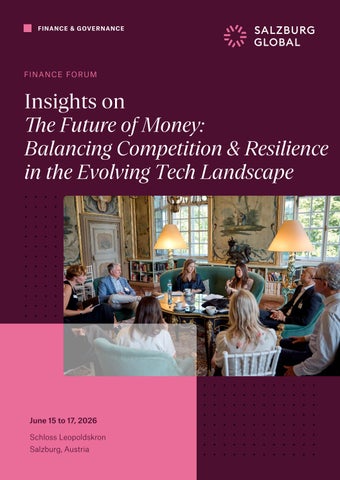
The 16th annual session of the Salzburg Global Finance Forum convened from June 15 to 17, 2026, at Schloss Leopoldskron in Salzburg, Austria. Co-chairs Klaas Knot, former Chair of the Financial Stability Board, and Lael Brainard, former Vice Chair of the US Federal Reserve Board, posed a critical question: How can financial regulators and market participants manage geopolitical shifts and balance competition and resilience across a rapidly transforming technological landscape? From stablecoins, CBDCs, and tokenized deposits to AI and evolving payment systems, discussions centered on how financial frameworks must adapt while preserving trust, stability, and inclusion. The gathering of roughly 60 senior-level public and private sector leaders—including CEOs, heads of regulatory bodies, central bankers, and institutional investors—highlighted a noteworthy takeaway: Whereas the previous year’s forum assessed the global financial architecture as “shaken, but not deterred,” the 2026 landscape reveals clearer, structural shifts toward increasing geoeconomic fragmentation and the pursuit of strategic autonomy. Regional blocs are actively seeking to insulate themselves from external shocks, and a rising tide of economic nationalism is eroding the rules-based multilateral system. Yet, while competition and systemic resilience have historically been viewed as contradictory forces— with competitive innovation threatening stability—some participants highlighted how technologydriven economic growth can serve as a primary engine of long-term national resilience. Breakthrough advancements in tokenization, 24/7 digital networks, and agentic artificial intelligence (AI) are rapidly becoming the core infrastructure of markets. As different jurisdictions chart distinct paths between public settlement architectures and private digital currencies, global regulatory cooperation faces strain. To avert balkanization, participants stressed the need to preserve cross-border interoperability and narrow regulatory focus onto critical cross-border touchpoints. Meanwhile, despite intentional de-risking efforts and the development of structural alternatives, the global primacy of the US Dollar persists in the immediate horizon.
While conversations took place under the Chatham House Rule, the following seven key insights emerged from Fellows' candid discussions.
1
Competition and Resilience: Re-Evaluating an Historical Dichotomy Through Technological Innovation Discussions highlighted that the relationship between competition and financial resilience has shifted at times across distinct historical periods. In the pre-2008 global financial crisis (GFC) era, international policy prioritized market competition and deregulation. Conversely, the postcrisis era focused on stability and defensive resilience, imposing high capital requirements that pushed systemic financial activity outside the formal bank regulatory perimeter. Participants observed that the current 2026 landscape marks a new era: a period characterized by intense sovereign competition and strategic autonomy across payments and AI stacks. The drive for greater sovereignty has stimulated varying degrees of deregulation in the hope of catalyzing new market entrants and innovation. Underscoring this shift away from post-GFC regulatory caution, a counter-narrative emerged among several speakers who argued that innovation-led competition is itself a crucial source of resilience with the added potential to alleviate the fiscal pressures currently constraining most advanced economies. Drawing an historical parallel to the unprecedented macroeconomic expansions generated by large-scale private investments in railroads, proponents emphasized that enabling tech-driven innovation allows economies to expand productively, outgrow structural sovereign deficits, and build durable capital buffers capable of withstanding future geopolitical shocks.
2
Redefining the Regulatory Perimeter: The Growth of Non-Bank Financial Institutions (NBFIs) Decades of prescriptive post-crisis capital standards and strict pre-approval requirements have limited the growth and innovative capacity of traditional banks, some argued. Over time, these constraints, along with technological development that has outstripped regulators’ institutional capacity, have pushed lending and financial activity to NBFIs and the private credit market. The migration of traditional bank lending to NBFIs presents challenges under current market conditions, other participants noted. The private credit space faces stress from opaque asset valuations, lack of standardized secondary market discovery, and sudden, AI-driven portfolio disruptions. Some participants noted that these private credit risks predominate in the U.S., although others argued those risks are broadly contained. There was consensus that trying to curtail risks by simply expanding the traditional banking rulebook to NBFIs could backfire. Instead, many argued for an adaptive, tiered approach that tailors compliance requirements to an entity’s de facto systemic risk profile. Such a regulatory approach would suggest regulating functional activities evenly across the board without trying to force specialized, non-deposittaking fintech firms into traditional insured depository bank frameworks. Notably, other participants argued that policymakers must ensure efforts to create tailored frameworks do not simply allow some actors to avoid key regulatory requirements. By contrast, policymakers should reduce burdens on banks so they can compete with nonbank lenders and providers, thereby reducing private credit risks.
3
Specialized Charters, Evolving Business Models, and Regulating New Products To accommodate a payments landscape being rewritten by technology, some participants advocated for specialized national payment and stablecoin charters. The conventional regulatory default, i.e., treating every financial intermediary as an insured deposit-taking bank, stifles technological deployment and fails to capture the true risk mechanics of modern value transfer networks, some participants contend. In the U.S., a dedicated federal payment charter framework would expand the formal regulatory perimeter while providing non-bank innovators with streamlined, safe access to central bank payment rails. Crucially, discussions noted that the intensive policy debates in the United States over optional federal payments frameworks, stablecoin issuer oversight, and direct clearing access are not geographically isolated. Comparable jurisdictional evolutions are occurring (or already have) across major global financial centers like the UK and Europe, as regulators recognize that clear, tailored perimeter rules can help to promote competition. In fact, the U.S. is the only G7 nation not to provide direct system access to non-bank payment firms. Finally, the dialogue extended to retail-facing financial product innovation, where participants highlighted the rapid rise of Buy Now, Pay Later (BNPL) platforms and Earned Wage Access (EWA). Participants emphasized that trying to rigidly force these innovative offerings into legacy credit frameworks, rather than crafting bespoke, tailored oversight regimes, often introduces unnecessary market friction and can undermine consumer-friendly financial options. While some jurisdictions struggle to adapt to these consumer-finance shifts, other global regulatory frameworks have proven much more forward-leaning on this front. Australia, for instance, was explicitly noted for its proactive stance in developing modified consumer protection guidelines that cleanly accommodate the distinct operational profiles of alternative financing structures, such as BNPL.
4
Navigating the Frontier of Automated Finance and the Governance of Agentic AI Artificial intelligence has seen rapid adoption across financial services, but companies have taken a cautious and deliberate path to its deployment, in particular with the integration of autonomous Agentic AI. As AI evolves toward independently executing high-speed trades, managing complex corporate treasuries, and initiating large-scale payments, it is fast becoming a central arena for intense global competition. Some forum participants expressed the critical importance of creating durable and stable rules to govern this transition, while others pointed out that sovereign nations are actively competing to advance their AI capabilities at the fastest possible rate. This race for technological supremacy has introduced geopolitical friction. The dialogue highlighted growing resilience concerns stemming from the United States recently blocking allies from accessing its most advanced AI models. This restrictive posture has fueled interest in developing domestic alternatives or looking toward Chinese models to secure their technological autonomy. Concurrently, this shift into automated finance demands highly adaptive corporate and regulatory governance frameworks to address emerging risks. Beyond immediate operational threats like cybersecurity vulnerabilities and fraud, participants expressed concern over potential cascading failures or atomic contagion—scenarios where interconnected AI agents could trigger cross-border market disruptions at speeds that outrun human intervention. Conversely, a powerful counter-narrative emerged emphasizing that the incredible economic growth driven by AI can itself serve as a core engine of long-term national resilience. For example, AI can assist regulators in market oversight and surveillance. Automation of reporting and risk management functions reduces human error and increases real-time monitoring capacity. To safely capture this economic upside, many rejected overbroad, rigid legislation in favor of dynamic risk management frameworks, adaptive technical controls, and cross-system stress testing tailored to specific deployment risk tiers.
5
Monitoring the Rise of Stablecoins, Tokenized Deposits, and CBDCs and Managing Sovereign Risks in the Global South Participants discussed the parallel rise of private stablecoins, tokenized deposits, and Central Bank Digital Currencies (CBDCs). The global path forward is marked by divergent public and private approaches across different countries and regions. For instance, the United States remains generally hostile toward CBDCs, choosing instead to pursue private-sector stablecoins, which hold promise for expanding the reach of the US Dollar, but carry risks regarding financial crime and international dollarization. Participants underscored the ease with which global consumers can access dollar-backed stablecoins as increasing potential adoption of the greenback. In economies with an unstable local currency, merchants could begin accepting digital payments in dollar-backed stablecoins and consumers could hold value in this form of currency. This dynamic could further destabilize local currencies and challenge domestic monetary policy .
In contrast, Europe is aggressively pushing forward with efforts to offer both retail and wholesale CBDCs to ensure long-term sovereignty and strategic autonomy, deliberately prioritizing systemic resilience over pure market efficiency. While framed as complementary to existing private payment instruments, this European push has sparked debate over whether citizens require direct access to central bank money or if such architectures will negatively impact private sector solutions. Other jurisdictions are charting different paths; Australia, for example, is narrowing its focus exclusively toward wholesale CBDC development rather than retail applications. Meanwhile, real-time payment systems have worked exceptionally well to boost financial inclusion across emerging markets, though the rapid retail adoption of foreign dollar-backed stablecoins presents a double-edged sword. While these stablecoins provide consumers in the Global South with vital access to stable money, they simultaneously threaten to undermine local fiat currencies and the tools regulators can access to manage their economy, such as capital controls or liquidity provision to manage external shocks. As such, several developing governments have aggressively promoted domestic fiat-backed stablecoins or domestic CBDCs as a public counter-anchor.
6
Tokenization of Markets and Real-World Assets: Redefining Infrastructure and Regulatory Clarity The tokenization of markets and real-world assets represents a foundational shift toward a 24/7 financial ecosystem, offering real-time, highly efficient, and programmable value transfer networks. However, participants discussed how executing this transition requires structural guardrails and an emphasis on industry-driven standards to successfully manage the complex interplay between tokenized systems, artificial intelligence, and stablecoin or CBDC infrastructures. To accelerate the global adoption of tokenized infrastructure—particularly for traditional asset classes—policymakers must shift from reactive posture to delivering explicit regulatory clarity and strong “tone from the top” support. A key friction point lies in capital requirements: For digital networks to scale, regulators must recognize the same capital treatment for tokenized assets as their legacy equivalents, ensuring compliance frameworks do not artificially penalize technological innovation. Crucially, systems must be interoperable to avoid the balkanization of market infrastructure. Some noted that by prioritizing open, interconnected network standards over siloed, permissioned architectures, the industry can harness the programmability of digital assets while preserving global market cohesion.
7
The Enduring Primacy Yet Increasing Challenges of US Dollar Hegemony Despite increasing global geopolitical fragmentation, concerted efforts by rival geoeconomic blocs to construct alternative settlement rails, and the digitization of money, the US Dollar continues to be the world’s undisputed reserve asset and safe haven. Nevertheless, a number of participants expressed a key takeaway: This privilege must not be treated as a permanent entitlement. The biggest long-term threats to the greenback's dominance are internal rather than external, spearheaded by the unsustainable and explosive trajectory of the US federal debt. Furthermore, the weaponization of the SWIFT network through expanding sanction regimes has accelerated the development of rival digital sovereign stacks and alternative financial plumbing. While the massive growth of USDbacked stablecoins currently reinforces global dollarization through new digital channels, a long-term bifurcation of the global monetary system remains a risk if trust in the underlying US institutional framework erodes.
The next Salzburg Global Finance Forum is scheduled for June 14 to 16, 2027. Stay tuned for updates online. Nicola Daniel, Senior Advisor, Finance and Governance ndaniel@salzburgglobal.org
Our Partners & Sponsors Executive Partner
Partners
Sponsors
Knowledge Partner
How You Can Help Us Spread the Word We want to change the conversation on the world’s most pressing issues. Your voice is a powerful way to do this. We’d appreciate your help in making Salzburg Global and the perspectives of our Fellows more visible, so we can broaden the conversation. Share our social media content We regularly post insights and conversation starters on important topics across LinkedIn, Facebook, Instagram, Threads and Bluesky. If you are posting content on social media relevant to conversations we are having on pressing global issues, tag us with @SalzburgGlobal. Please also repost, share, or forward our content when you sense its relevance to others in your network. Share our newsletter Our monthly newsletter is packed with diverse perspectives on pressing global issues. You can subscribe to our newsletter at: www.salzburgglobal.org/newsletters
WWW.SALZBURGGLOBAL.ORG
Salzburg, Austria
Washington, D.C., USA
Salzburg Global Seminar, Inc.
Salzburg Global Seminar, Inc.
Schloss Leopoldskron
1541 14th Street NW
Leopoldskronstrasse 56-58
Suite 2 West
A-5020 Salzburg, Austria
Washington, D.C. 20005
+43 (662) 83 9 830
+1 (202) 637 7683
info@salzburgglobal.org
info@salzburgglobal.org