volume 7 number 36 3 October 2026
salvosonline.org.au print post approved PP100001474
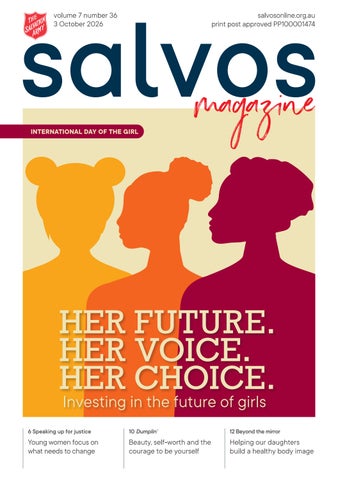
INTERNATIONAL DAY OF THE GIRL
HER FUTURE. HER VOICE. HER CHOICE. Investing in the future of girls
6 Speaking up for justice
10 Dumplin’
12 Beyond the mirror
Young women focus on what needs to change
Beauty, self-worth and the courage to be yourself
Helping our daughters build a healthy body image
“A child can teach an adult three things: to be happy for no reason, to always be busy with something, and to know how to demand with all their might that which they desire.” – Paul Coelho
PHOTO BY KELLY SIKKEMA ON UNSPLASH
3 October 2026
Editorial What is The Salvation Army? The Salvation Army, an international movement, is an evangelical part of the universal Christian Church. Vision Statement Wherever there is hardship or injustice, Salvos will live, love and fight alongside others to transform Australia one life at a time with the love of Jesus. Mission Statement The Salvation Army is a Christian movement dedicated to sharing the love of Jesus by: • Caring for people • Creating faith pathways • Building healthy communities • Working for justice The Salvation Army Australia acknowledges the Traditional Owners of the land on which we meet and work and pay our respect to Elders, past, present, and future. We value and include people of all cultures, languages, abilities, sexual orientations, gender identities, gender expressions, and intersex status. We are committed to providing programs that are fully inclusive. We are committed to the safety and wellbeing of people of all ages, particularly children.
Scan here to connect with The Salvation Army services
Scan here to subscribe to Salvos Magazine
Founders: William and Catherine Booth Salvation Army World Leaders: General Lyndon and Commissioner Bronwyn Buckingham Territorial Leader: Commissioner Miriam Gluyas Secretary for Communications and Editor-In-Chief: Lieut-Colonel Paul Hateley Publications Manager: Cheryl Tinker Editor: Simone Worthing Graphic Designer: Ryan Harrison Enquiry email: publications@salvationarmy.org.au All other Salvation Army enquiries 13 72 58 Press date: 11 September 2026 Printed and published for The Salvation Army by Commissioner Miriam Gluyas at Focus Print Group, Chester Hill, NSW, Darug Nation lands.
Focus on change The upcoming United Nations (UN) International Day of the Girl (11 October) is observed each year to both celebrate girls’ achievements and highlight the challenges they face worldwide. The UN states that “It is a day that belongs to everyone who cares about girls and their rights. On this day, we come together to recognise and advocate for the full spectrum of girls’ rights.” Globally, women and girls continue to face oppression and violence and are devalued, disrespected and undermined. Some progress is being made in some countries, but deep challenges remain. The Salvos are part of the fight against the injustices facing girls and women, giving a voice to the silenced, and supporting them to raise their own voices. The Salvation Army stands for equity and equality in every sphere of life. In this edition, we highlight some of the areas where the rights of girls and women are undermined and how people can help; young women share their views on social justice, and the importance of seeing ourselves as created in God’s image. For more information, go to un.org Simone Worthing Editor 3
Salvos Magazine
Feature
Her future. Our shared responsibility. International Day of the Girl, observed annually on 11 October, is a global moment to celebrate girls everywhere, amplifying their voices, actions and leadership. It’s a day to recognise and advocate for the full spectrum of girls’ rights. Did you know? • 133 million girls are out of school today. • Adolescent girls aged 15-19 are more likely to not be in education, employment or training than their male peers. • Almost 4 in 10 adolescent girls and young women do not finish upper secondary school. • Nearly 1 in 4 adolescent girls aged 15-19 who were ever married or partnered experienced intimate partner violence in their lifetimes. • More than one third of adolescent girls and boys aged 15-19 consider a husband to be justified in hitting his wife under certain circumstances. • The percentage of underweight adolescent girls aged 10-19 has only declined slightly in the last three decades, from 10 per cent to 8 per cent. • With only five years remaining of the 2030 Sustainable Development Agenda, no country with data has met even half of 16 Sustainable Development Goals (SDG) targets crucial to adolescent girls’ well-being. Source: Girl goals: What has changed for girls? Adolescent girls’ rights over 30 years 4
What can you do? Girls everywhere need our love, care, attention and empowerment. Their unique skills and presence in the world will herald powerful opportunities for transformation, bringing balance, creativity and growth to a world that desperately needs them. (Imagine the grace, solutions and wholeness that would emerge if the number of girls five times the population of Australia were simply given the gift of education?) So, we ask: • Where can you give, or invest in local and international causes, that will benefit girls? •
How might your heroes and examples of faith include and uplift girls?
•
And finally, how can your prayers and generosity transform not only Australia one life at a time, but the entire world, one girl at a time? Who knows what influence your belief in girls will have 120 years in the future.
News
3 October 2026
Helping women in period poverty A group of Salvos women from Adelaide recently came together to help make menstrual health kits for women and girls experiencing disadvantage. The Project Day was held in partnership with Days for Girls Australia (DfGAL), a global charity transforming the lives of women and girls by providing reusable menstrual health kits, education and support. The City Women’s Group came together as a team to complete 35 kits, with 148 partially completed. In many parts of the world, girls miss school or face shame and isolation simply because they lack access to menstrual products. Through volunteers, local partnerships and social enterprises, Days for Girls helps restore dignity, improve health, keep girls in education and create opportunities for brighter futures. Australia included Working in more than 145 countries including Australia and the Pacific, the organisation believes that every girl deserves the knowledge, resources and confidence to thrive, because periods should never be a barrier to opportunity. From 1 July 2024 to 30 June 2025, DfGAL organised for 40,342 girls and women to receive kits in 24 countries around the world. Around 17 per cent of these kits were distributed in Australia. South Australia has the third-highest rate of period poverty in Australia, behind Tasmania and the Northern Territory. In 2024, more than 60 per cent of South Australians who menstruated struggled to afford sanitary items.
Adelaide-based social worker Cate Sherlock says it is an invisible struggle plaguing communities across the state (www.abc.net.au). “There is stigma and shame about having poor self-care, when in reality they can’t afford multiple period products in a day.” Using socks as sanitary pads, wearing tampons for more than two days and stealing products from supermarkets are just some of the lengths women and girls are going to in order to afford period products. Scan here to learn more about Days for Girls Australia and how you can help. 5
Salvos Magazine
Feature
Speaking up for justice
Young women from around the world focus on change Inclusivity and justice for all women demand a world where every woman and girl, regardless of her background, identity or circumstances, has equal access to opportunities and resources, and lives free from discrimination, exclusion and violence. The International Social Justice Girls is a collective of young women and girls from across the globe, united in their commitment to challenge entrenched inequalities and transform the status quo. Bella, Canada I would describe social injustice as an equality issue that usually affects marginalised people and happens because of government, human rights problems and, especially, hate. Social justice looks like people working together, all on different life journeys and experiences, for a single goal through different means to achieve a safer and more loving world. I have faced injustice for simply being a girl through experiences at work and school. At work, I’m perceived as too small or feminine for the job, as I work in a maledominated field. At school, people have perceived me as weak or fragile, which resulted in being bullied and picked on through the majority of middle school. My main support system has been The Salvation Army through the churches and programs that give me a place and a home, and through friends that I made going into high school. My family’s been a big support as well. 6
If I could speak to communities, leaders, and churches of today, I would ask them to reach out within schools and places that teens frequent, because I know many girls in my community that want support, but don’t know where to get it. I would also say create a more inclusive and intentional space for women and girls.
3 October 2026
Feature
... social justice means fairness and equal rights for everyone. Grace, Papua New Guinea I’m 22 and currently in my fourth year pursuing a Bachelor of Arts in Communications for Development Studies. To me, social justice means fairness and equal rights for everyone, especially in the way people are treated, respected and given opportunities in society. Social injustice, on the other hand, is when people are left out or treated unfairly. One injustice I have faced as a woman relates to land ownership. I come from a patrilineal society where land is customarily passed down from father to son and decisions about land are made by men. In most of Papua Niugini’s communities, including where I’m from,
women cannot own land and are excluded from inheritance under customary rules. Because I am a woman, I did not receive land from my father’s side of the family. The belief in our culture is that girls will marry and move to their husband’s village. This made me realise how cultural norms can limit opportunities and security for women simply because of gender. On my mother’s side, the land was shared equally among her father’s children, and my grandmother was fully in charge of how that land was managed. When I told her that I wanted land of my own, she didn’t dismiss my feelings. Instead, she explained that it was time to let go of some traditional practices that made women feel excluded, and that as a Christian, she believed that everyone should have equal rights because we are all created in the image of God. I felt truly seen, heard and valued. If I could speak directly to communities today, I would encourage families to start sharing land with their daughters as well as their son. Ensuring girls have access to land helps create safer and more inclusive spaces where they can thrive and make choices for their own lives.
Scan here to watch the full version of this story. 7
News
Salvos Magazine
Salvos win Charity of the Year award
Lieutenant-Colonel Paul Hateley (Secretary for Communications) and Amity Cartwright (Head of Brand and Marketing) with the Charity of the Year award. Lieut-Colonel Paul Hateley speaks at the Roy Morgan Trusted Brands 2026 award night.
Roy Morgan – Australia’s best-known and longest-established market research company – held its Trusted Brand Awards for 2026 last month, with The Salvation Army winning the Charity category. “This award isn’t given by a panel. It’s given by the public, which makes it both the most meaningful recognition we could receive, and the most humbling,” said Lieutenant-Colonel Paul Hateley, Secretary for Communications. “There’s a saying I keep coming back to: trust is won in drops and lost in buckets. It’s earned slowly – one conversation, one meal, one night of safe accommodation, one person treated with dignity. And it can be emptied in a single moment. “So, we don’t accept this as a verdict. We accept it as a balance we’re responsible for maintaining – one that has to be topped up daily, by thousands of officers, employees and volunteers, most of whom will never be recognised like this. 8
“For an organisation like ours, trust isn’t a reputational nicety. It’s the operating condition. Paul explained that the Salvos don’t work alone. “We work alongside and in partnership with extraordinary organisations – in homelessness, family violence, addiction, disaster recovery, financial hardship – many of whom are doing work that no one applauds, in places no one is watching. Trust in our sector is something we hold collectively. When one of us earns it, we all benefit. When one of us loses it, we all carry the cost. So, this recognition belongs, in part, to all not-for-profits who are working for better outcomes for others. “To our donors, thank you for trusting us with your gifts. “To the people who come to us at a time in need, thank you for trusting us. To our officers, staff and volunteers, thank you for being the creators and custodians of trust. You are the heroes.”
3 October 2026
News
New SAES depot enables greater impact The Salvation Army Emergency Services (SAES) depot in Victoria has relocated to a new and larger home in Epping, after more than 30 years in Eltham. “As the operational hub for SAES in Victoria, the depot will house staff, vehicles and supplies in one location - enabling faster response times when disaster strikes. It also opens the door for training, meal preparation and hosting corporate visitors at functions, which were not possible before,” says Carolyn Spratling (State Coordinator – Response Victoria). “This move marks an exciting milestone for our team,” says Major Bindy Lupis, National Manager for The Salvation Army’s Emergency Response Service. “And it creates new opportunities to strengthen our emergency response capabilities and support communities when they need us most.”
Salvation Army and Woolworths personnel at the depot opening.
“We are incredibly grateful for the support, partnerships and encouragement we continue to receive, and to our phenomenal volunteers who make our work possible every day,” she says.
Salvos offer support in Nepal The Salvation Army is working with partners and local contacts assessing needs and supporting communities affected by the ongoing emergency in Nepal. Some aid has reached isolated communities. Access remains extremely difficult. Roads and other transport routes have been washed away, leaving severely affected areas including Timure, Uttargaya, Dhunche and Betrawati, largely cut off. Despite these challenges, one Salvation
Army contact was able to reach Dhunche and Syafrubesi by chartered helicopter, gathering information on local needs and distributing a limited quantity of essential supplies, including rice, salt, light blankets and clothing. Through Salvation Army partners and local contacts, further supplies including clothing, blankets, mattresses, noodles, soap and rice have also reached affected communities. Assistance is ongoing, guided by assessments of the needs of communities. 9
RCA RECORDS, PUBLIC DOMAIN, VIA WIKIMEDIA COMMONS
3 October 2026
Faith Talk
Dumplin’ – the courage to be yourself Beauty, self-worth and being made in God’s image by Karen Masters
My daughter and I like to watch movies together. We discuss the costumes, the set designs, camera angles, the acting, dialogue, director choices and the story line. So, when she asked if I would like to watch Dumplin’ with her, I said yes, not knowing what to expect. It was obvious the movie would be good with the opening sounds of a Dolly Parton song, which continued to feature throughout the movie. The story follows a girl not understood by her mother and having recently lost her aunt, with whom she was very close. She is struggling through her late teenage years, feeling like she does not fit into the typical mould. She is later joined by others who also have difficulty fitting in. To find acceptance, she first needs to learn to accept herself as she is, and to accept and trust others. Help comes from a very unusual source; people who had been friends with her aunt help the girl and her friends to find their own courage and self-worth. As two people who have not always fitted in, my daughter and I both related to different aspects of the journey these girls were on. I found that we did not have a lot to discuss about this movie; we were busy feeling for these girls and experiencing their joy as they discovered their own courage, self-worth, and acceptance from those around them.
I found my own reassurance in an unusual way. I had never felt beautiful, but when my daughter was born she was the most beautiful thing I had ever seen. I looked after her in the best way I could and loved her with all my heart. When she was about three years old, I was tying her shoelace and looked up into her beautiful face and saw myself; she looked like me, and she was and is still beautiful. In Genesis chapter 1, we read about the creation story, how God made the world and how he made humans. In verse 27 we read; “So God created human beings in his own image.” And in verse 31 we read; “Then God looked over all he had made, and he saw that it was very good!” We were made in God’s image, and he saw that what he had made was very good. When God looks at us he sees himself reflected back; we are acceptable and very good just as we are. We are worthy, loved by God with all his heart. As we accept and trust the people around us, those who God has placed to help us, may we each find our own courage and self-worth. “You don’t have to look like everybody else. You don’t have to be a raving beauty to be special and to be beautiful.” – Dolly Parton Major Karen Masters is a Salvation Army Officer (pastor) and Communications Care and Support Officer. 11
My Story
Salvos Magazine
BEYOND THE MIRROR
Helping our daughters build a healthy relationship with their bodies begins with the way we speak about ourselves. by Amy Durand
A friend recently asked me for advice on raising her daughter and it got me thinking. As someone who has researched, written about, and helped a lot of women and girls around body image and selfesteem, this question made me wonder: what am I intentionally doing to raise my own young daughters in a way that sets them up to thrive in a society that is geared towards tearing them down?
In my psychotherapy work, I ask the client to verbalise what they say to themselves when they look in the mirror. What I often hear is, I’m ugly, fat, need to lose weight, disgusting … When this negative self-talk is all they hear, that is what they embody and believe about themselves.
Question one: Where did you learn what beauty is?
“Ultimately, we found that diet culture refers to a set of ever-changing myths about food and bodies, promoting the idea that one’s body weight automatically equals health, and that foods can be simplistically categorised as ‘good’ and ‘bad’. It also comprises a moral hierarchy of bodies that preferences the thin-ideal while masking a fear of fat.”
I grew up in the 90s, surrounded by images of women being praised for being thin. Those who were slightly bigger were openly criticised in the media for being fat. Objectification is what we call it now, and it’s still present. When we are raising daughters, they see and hear everything, including the things we think are hidden. We are their first source for learning what beauty is. What an incredible opportunity we have to teach them well. 12
Dr Natalie Jovanovski and Tess Jaeger, two researchers at Melbourne University, researched ‘diet culture’ and defined it:
Question two: What do you say about yourself, that you could instead acknowledge and leave at the mirror? On my insecure days, when I look in the mirror and feel ‘less than’, am I carrying
3 October 2026
We are their first source for learning what beauty is.
that with me through the day, or do I acknowledge the feeling and leave it at the mirror? My daughters are taking in everything I say. When I say something negative about how I look, what they learn is, “Mummy doesn’t like herself” – and what does that teach them? Question three: What messages have you learnt about food and where did you learn them? We’ve subscribed moral implications to food, when food has no morality and we’re neither good nor bad when we eat it. Pediatric dietician Dr. Kyla has a different approach, which is working for families nationwide. “What I want to do is encourage confident, adventurous eaters who feel good about food, rather than trying to push kids into healthy eating through fear, or shame or worry … This idea that you have to eat certain food before you’re allowed to eat other foods … [that] you have to eat a certain amount …
That’s not trusting your body, listening to your internal cues.” When it comes to feeding my daughters, I get to choose what I provide for them, and they choose how much of it they eat. When we listen to our bodies and become in-tune with what they’re saying to us, we are more likely to make healthier choices. When it comes to parenting daughters, we all take different approaches. We are all unique and wonderful and our daughters are representations of us. They learn from us how to be in the world. When we are aware of what we bring to the table in terms of our history, experience, trauma and healing, we get to choose what we lay down, and they choose what they pick up. We can’t force our life lessons and wisdom into them, any more than we can broccoli, but we can choose what we put on the table. Amy Durand is a Mission Support writer for The Salvation Army. 13
Taste of Life
🍳
Banana and oat bread
Ingredients 3 bananas, 3 eggs, ½ cup milk, 2 tbsp oil, 3 tbsp sugar, 3 cups rolled oats, 2 ½ tsp baking powder, 1 tsp salt, 1 tsp cinnamon, 1 tsp vanilla extract, ½ cup crushed walnuts (or chocolate chips) Method Pre-heat oven to 160°C. Grease/spray loaf tin. In a bowl, mash bananas then mix through each ingredient individually until they are all mixed well. Pour mixture into loaf tin. Bake for 30 minutes, then cover with foil. Bake for 50 minutes. Remove and cool for 20 minutes before removing from tin and allowing to cool completely.
☺
Believe in Good: Tips
“Don’t be concerned about the outward beauty of fancy hairstyles, expensive jewellery, or beautiful clothes. You should clothe yourselves instead with the beauty that comes from within, the unfading beauty of a gentle and quiet spirit, which is so precious to God.” 1 Peter chapter 3, verses 3-4 New Living Translation 14
💡
Salvos Magazine
Quiz
1. Who was credited with introducing cotton goods to Europe? 2. Which country produces the most cotton? 3. Which country is the largest exporter of cotton? 4. In which environment does the cotton plant thrive? 5. How long has cotton been cultivated by man?
🔍
Tum-Tum
On which page of this week’s Salvos Magazine is Tum-Tum hiding?
In 1974, I was appointed a Member of the Order of the British Empire and ABC Sportsman of the Year. 6
5
3
2
9
8
5
6
4
1
7
9
4 1
1 7
3 9
2 8
7 4
9 6
8 5
In 1985, I was inducted into the Sport Australia Hall of Fame, being upgraded to Legend in 2017.
🧩
Fill in the grid so that every row, every column and every 3x3 box contains the digits 1 to 9.
5 4 8
7 3 2 8
4 2 8 3
6 4 7 5
5 1 9 6
1 8 3 2
3 7 5 4
2 9 6 1
In 2007, I was appointed as a Member of the Order of Australia for service to the community, including supporting people with cancer.
6
In 2013, I was named in Australia’s Top 100 Sportswomen of All Time.
😆
1
3
2
4
9 5 6
6 9 5
2 8 1
4 7 3
5 6 9
1 2 8
3 4 7
2026 Puzzle #7 6
5
3
2
9
8
1
3
8
7
2
4
4 1
7
8
2 5
6
7
8
4
5 9 6
6 5 9
2 4 3 7
6
3
8
1
5
9
9
7
4
3 2 1 8
2 1
1 7 4
✏
5
3
9
6
7 3
4
1
8
7
1 2
8
1
5
7
2
2 8 3
9 6 7
1
5
1
2
8
6
6
3
9
8
1 3
2
8
5
6 1
7
Have a laugh
Why did the dog sit in the shade? What do you call a goat who loves to tell jokes? How do spiders communicate?
Through the World Wide Web
8
7
Answers
8
Why do cows wear bells?
📖
Because their horns don’t work
Born in 1951, I represented Australia as a sprinter, winning seven gold and two silver medals at Commonwealth Games and three silver medals at Olympic Games.
Sudoku 2026 Puzzle #1
A kid-der
🥸
Who am I?
3 October 2026
Because he didn’t want to be a hot dog
Take Five
Bible byte
“For we are the product of his hand, heaven’s poetry etched on lives.” Ephesians chapter 2, verse 10a The Voice translation
3
9 6 5
Quiz: 1. Alexander the Great 2. China 3. USA 4. Tropical and 2026subtropical Puzzle #4 conditions 5.17,000 years 4 2 3 6 5 7 9 8 I am: Raelene Boyle 9 7 8 2 1 4 5 6 3 Tum-Tum: 6 5 3 is 8 hiding 9 7 behind 4 1 2 the screen on page 8. 7
9
1
3
4
6
5
1
9
8
6
2
2
4
3
5
8
7
8 2 5 3 7 4 1 6 9
3 6 9 2 1 8 5 7 4
2 5 8 4 3 7 6 9 1
2026 Puzzle #1
15
1 4 7 6 5 9 3 8 2
6 9 3 8 2 1 7 4 5
5 8 2 7 4 3 9 1 6
4 7 1 9 6 5 8 2 3
4 7 3 5 8 2 6 9 1
20 2 8 5 6 1 9 7 3 4
20 4 7 3 9 1 6 5 8 2
20
Have you taken care of your Will? A gift in your Will can help The Salvation Army create a long-lasting impact in the lives of those experiencing hardship. Find out how you can start or continue your legacy of generosity. Contact The Salvation Army’s Wills and Bequests team and ask for a free Wills booklet. Together, we can give hope where it’s needed most long into the future. CONTACT US TODAY
1800 337 082 or visit salvationarmy.org.au/wills