People will forget what you said, People will forget what you did,
but people will never forget
how you made them
feel.– Maya Angelou
What is The Salvation Army?
The Salvation Army, an international movement, is an evangelical part of the universal Christian Church.
Vision Statement
Wherever there is hardship or injustice, Salvos will live, love and fight alongside others to transform Australia one life at a time with the love of Jesus.
Mission Statement
The Salvation Army is a Christian movement dedicated to sharing the love of Jesus by:
• Caring for people
• Creating faith pathways
• Building healthy communities
• Working for justice
The Salvation Army Australia acknowledges the Traditional Owners of the land on which we meet and work and pay our respect to Elders, past, present, and future. We value and include people of all cultures, languages, abilities, sexual orientations, gender identities, gender expressions, and intersex status. We are committed to providing programs that are fully inclusive. We are committed to the safety and wellbeing of people of all ages, particularly children.
At the right time
A casserole dropped off at the front door. A school mum offering to bring your kids home. A text from a friend to say they’re at the supermarket, so what can they pick up for you?
When someone sees a need and responds to it, the impact of a small act of kindness can be huge.
That casserole is more than a meal. It is someone recognising you are going through a difficult time and caring enough to do something about it. Looking after children or picking up a few groceries is more than being thoughtful. It’s someone wanting to lighten your load.
Scan here to connect with The Salvation Army services
Scan here to subscribe to Salvos Magazine
Founders: William and Catherine Booth
Salvation Army World Leaders: General Lyndon and Commissioner Bronwyn
Buckingham
Territorial Leader: Commissioner Miriam Gluyas
Secretary for Communications and Editor-In-Chief: Lieut-Colonel Paul Hateley
Publications Manager: Cheryl Tinker
Editor: Simone Worthing
Graphic Designer: Ryan Harrison
Enquiry email: publications@salvationarmy.org.au
All other Salvation Army enquiries 13 72 58
Press date: 8 May 2026
Printed and published for The Salvation Army by Commissioner Miriam Gluyas at Focus Print Group, Chester Hill, NSW, Darug Nation lands.
Jesus talked about us being a light to others by showing compassion and love. “You should be a light for other people. Live so that they will see the good things you do and praise your Father in heaven,” (Matthew chapter 5, verse 16 Easy-to-Read Version).
Our kindness, offered just at the right time, can brighten a dark moment in someone’s life.
For stories and more information go to salvosonline.com.au
Faye Michelson Acting Editor
Salvos Alexis program meets a critical need
Providing coordinated, specialist care to those who need support
by Lerisse Smith
No community escapes family violence.
In regional areas, however, the crisis is escalating at an alarming pace.
Morwell and Wonthaggi are among the worst-affected areas in regional Victoria. The Inner Gippsland Area (IGA) is consistently recording some of the highest Family and Domestic Violence (FDV) rates in the state when adjusted for population.
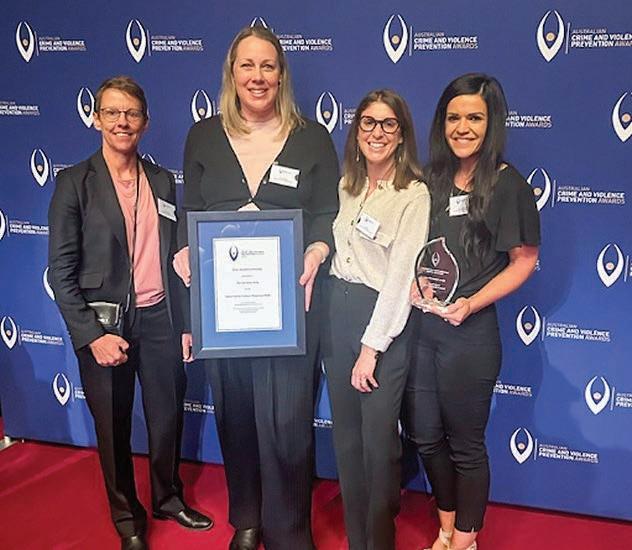
Yet transformational change is happening – powered by the awardwinning Salvos Alexis program.
The specialist family violence response, embedded directly within Victoria Police Family Violence Investigation Units, is closing a critical service gap and ensuring those most at risk don’t fall through the cracks.
“Postcode should never determine safety,” said Lani Kahn, Practice Leader of the Alexis Family Violence Response Program.
“Family violence is not just a metropolitan issue – it’s a regional reality, and in places like Gippsland, the impact is often more severe. Specialist, timely and coordinated intervention works – especially for the families facing the highest risk. Programs like Alexis exist to help make sure those who need support the most don’t fall through the system gaps and cracks.”
Seeing results
What sets the Alexis team apart is its remarkable results.
Independent RMIT evaluations reveal Alexis significantly reduces violence and risk, with up to an 85 per cent reduction in recidivism in early evaluations, a 66 per cent decrease in risk at case closure, an 83 per cent engagement rate with people using violence (compared to around 10 per cent in mainstream intake), and zero victim-survivors reporting worsening violence due to Alexis involvement.
Alexis was born in 2014 as a partnership between The Salvation Army and Victoria Police in response to the need for a more coordinated, timely and specialist response to family violence between police and social services, particularly in instances of high risk and recidivism.
Postcode should never determine safety.
“We work with the highest risk, most complex families,” Lani said. “Often repeat police callouts, chronic risk and people who haven’t been able to engage with traditional services. We can work with victim-survivors, people using violence, or both – depending on what will best reduce risk.”
“We work to ensure clients are as safe as possible in whatever current circumstances they are in,” Lani explained. “We prioritise engagement before change, safety within context, and stabilisation before long-term planning – that’s particularly important in regional areas where options are limited, and risk escalates quickly.”
Regional communities also face compounding risks.
Distance and isolation make access to support and safety planning harder, while limited specialist services and long waitlists delay early intervention, resulting in repeated crises and risk situations. Furthermore, housing shortages and cost-of-living pressures increase stress and reduce coping capacity, reduced anonymity in small towns can deter disclosure, and delayed emergency responses due to geography compound risk.
“These factors don’t cause violence – violence is a choice – but they compound the situations of victimsurvivors and people using violence,” remarked Lani, “leading to higher recorded incidents and more severe presentations.”
Practitioners, too, face unique challenges in small towns.
They are more identifiable, confidentiality is harder to protect, and risk can extend beyond office hours. Caseloads are often high-risk and complex, with fewer services to refer into, making specialist, embedded models even more important.
“Family violence work sits at the intersection of safety, dignity, and human rights – and it’s one of the few areas where skilled, early intervention can genuinely change life trajectories for women, children, and whole families,” reflected Lani.
So, what keeps her motivated?
“I became a social worker because I wanted to work directly with people experiencing harm, inequality and injustice,” she said. “I’m particularly motivated by work that doesn’t just respond to crisis but has the possibility of reducing risk and preventing harm from repeating across generations.”
PHOTO BY VITALY GARIEV ON UNSPLASH
Confronting violence, creating change
Program grows men’s resilience and transforms lives
by Lerisse Smith
The Men’s Behaviour Change Program (MBCP), delivered by The Salvation Army Family Violence Team in Gippsland, Victoria, is a program supporting men who have used violence in their intimate-partner relationships. This article is the result of a conversation between National Family Violence Specialist Lilly McKeich and Integrated Men’s Services Team Leader Rebecca Wilson.
Led by Rebecca, the program provides a structured group environment where men are supported to examine their attitudes towards women, identify and address the shame often linked to their behaviour, and work towards meaningful change. At the heart of the program is a steadfast commitment to the safety and wellbeing of all victim-survivors and affected family members, ensuring that their voices and experiences remain central throughout the process.
How it works
The MBCP group comprises up to 14 men meeting face-to-face during the day, or in an online group in the evening. Each group includes twice-weekly two-hour sessions, with 20 sessions in a program. Additionally, each client has two individual sessions with the facilitators.
Our group work is facilitated by both a male and female facilitator. This is to model healthy, respectful relationships to the clients.
The primary aim of the MBCP is to promote the safety and wellbeing of victim-survivors by addressing the use of family violence through risk assessments and safety planning.
Managing risk for the impacted family members we work with is a dedicated Family Safety Contact (FSC), who offers support to current or former partners, to
ensure their voices are heard and safety is prioritised.
While we recognise that many people have experienced significant trauma, we also acknowledge that trauma alone does not cause violence; many people who have faced adversity do not choose to use violence. This understanding helps guide our approach: one that holds men accountable for their behaviour while also recognising the complex factors that may influence their choice to use violent behaviour.
Not all of the men are motivated to make change, even if they’re mandated to be in the group by an order from Corrections or Child Protection. We discuss what’s happened within their families, the use of violence, and assess their capacity to take on the information and reflection in the group setting. It
can be quite confronting for some of our men; often they have never had these direct conversations.
We give the men an opportunity to tell their story and put a boundary in place around language or behaviour. If they say something inappropriate and blame their family violence behaviour on the victimsurvivor, we will immediately reinforce that it isn’t ok.
Risks involved
Our men can be very vulnerable. As the reflection and understanding of the violence used in their relationships develops, this can increase risk to themselves (self-harm) and to their families. The men are having first-time conversations about the impact of their behaviour on partners, children or family members.
We often hear, “I don’t want to be like my old man,” only to later realise that their own violent behaviour mirrors what they experienced as children from their father.
This realisation can have a profound impact, often triggering deep feelings of shame and guilt.
We are very aware of the impacts this can have on the men, and they are supported with additional referrals to other services. Safety planning is completed with clients by facilitators and is completed with family members by the FSC.
The men are offered a space in the group to reflect on their violent behaviour and are given the tools to make a change and record this in a documented safety plan to promote accountability. This is done in a respectful, non-judgmental, supportive manner to strive for safe and positive outcomes for the families we work with.
Scan here to read the full version of this story.
Life on the frontline
Every day, the highly skilled Salvation Army Alexis team works on the frontline, prioritising engagement before change, safety within context, and stabilisation before long-term planning. The work can be tough, challenging and emotionally taxing. So, what drives them to take it on and find meaning and resilience in such demanding roles? Lani Kahn, Practice Leader of the Alexis Family Violence Response Program, shares some insights.
Staff stay resilient in their demanding roles because they are driven by purpose – they know their work matters.
We are a service that helps those most in need avoid falling through persistent gaps and cracks. Being part of a specialist, evolving program – one that will continue to grow and develop – is highly motivating for staff . The role offers room to develop, adapt practices, and ensure traumainformed responses.
If somebody works in the family violence sector, you want to be part of that change. You want to be part of reducing harm for people, working on injustice and inequality –all of those sorts of things that come out day to day. It’s not just the immediate risk; you want to work towards breaking those intergenerational cycles.
PHOTO BY NADINE E ON UNSPLASH
Team care
Vicarious trauma is managed through layered supervision and support, making staff wellbeing a core safety priority. Staff receive ongoing external clinical supervision to process trauma exposure, manage risk, and reflect on practice.
Fortnightly or monthly supervision with team leaders ensures complex cases are discussed and accountability is shared, ensuring no one carries risk alone. Daily debriefing, case consultation and reflective practice help staff navigate
challenges, moral distress and ongoing exposure to family violence.
Strong connections between embedded practitioners and policing teams are central, with shared case responsibility preventing isolation in decision-making.
Structured wellbeing support encourages worklife boundaries, regular leave, and rest. Managing stress is essential for skilled practitioners, allowing them to go home confident that their work prevents harm and changes trajectories for high-risk individuals.
World Environment Day 2026: A global call for climate action
With a population of just under 10 million, the Republic of Azerbaijan lies at the boundary of Western Asia and Eastern Europe. It shares borders with Russia, Georgia, Armenia and Iran, and is bordered on the east by the Caspian Sea.
In 2026, Azerbaijan will play the important role of hosting the global observance of World Environment Day, with the theme, Time for Nature.
World Environment Day, celebrated this year on Friday 5 June, will focus on the urgency of
climate action. With rising temperatures, collapsing ecosystems and disruptive weather extremes, humanity stands at a tipping point. But we are not powerless.
The 2026 theme underscores that climate action is not just about reducing carbon emissions – it is about rethinking the systems that power our economies and repairing our relationship with the climate. By doing so, we can secure a safer, healthier, and more just future for all (worldenvironmentday. global).
In order to protect nature for the future, we must take climate action now. Besides the actions and policies of governments, it is essential that we all play a part in reducing pollution, slowing or preventing climate change, and reducing deforestation.
Check your local news and social media for events to be held in celebration of World Environment Day. You can read more about World Environment Day at internationaleventday. com/event/worldenvironment-day-20216
PHOTO BY AARON BURDEN ON UNSPLASH
PHOTO BY NOAA ON UNSPLASH
PHOTO BY ANGELA BENITO ON UNSPLASH
ChaotiC kids, CrunChy lawns and blustery days
Windy days and unexpected glimpses of God
by Belinda Davis
PHOTO BY BIANCA SURI ON UNSPLASH
There is a phenomenon that teachers and carers recognise and dread – the impact of a windy day on the behaviour of children. For some undefined reason, all children seem to go a little stir crazy on windy days. It is not something you can really avoid, but if you’re aware of it, you can put plans in place to help deal with the ‘fun’ that is probably coming your way.
There was a time when I noticed a negative reaction to this type of weather – despite not being in a teaching environment –that was definitely driven by where I lived. Our home was in a street lined on both sides with giant oak trees. They spread a beautiful canopy of protection from sun and heat during the summer and gave our neighbourhood a picturesque environment … and then autumn would come.
Autumn is the time the leaves would go from lush green to brown in what seemed like half a day, and then fall to the ground. While I can accept that jumping in piles of leaves is a fun activity of noise and sensation, it felt like every leaf from the 40 trees in our section of the street found their way to our front yard.
No one could sneak past our property as the crunching beneath their footfall gave their presence away immediately. There were so many leaves that we couldn’t
physically keep up with getting them into the fortnightly green waste bin collection and having our yard look leaf free.
As I would hear the forecast for a blustery day, or the movement of the trees in the breeze at night, I would be filled with dread at the impact on our yard and the level of extra gardening time that would be required as a result.
God is like the wind
As a child, I was taught that God is like the wind (John chapter 3, verse 8). You cannot see the wind or touch the wind, but you can certainly identify where it has been by observing the impact it has had. If you are outside, you can feel the wind on your skin, you can hear its effect in the trees and you can witness where it has been. God is certainly like that.
While we can’t physically see God, we can feel his presence with us, we can hear him speaking through others and we can see where he has been at work in the lives of people.
The main difference between God and windy days is that I am not filled with dread at the prospect of clearing leaves after a God encounter!
Major Belinda Davis is a Salvation Army officer (pastor), serving as a prison chaplain. She blogs at a-blessed-life.com
God’s unshakeable love: Dallas’ story
Dallas grew up completely surrounded by gambling and drinking. From as young as four or five, he remembers his mum working for a local bookmaker, taking bets in the garage. Other family members gambled too, and by the time he was nine, Dallas’ grandmother was putting small bets on for him every Saturday. Many of the family were also heavy social drinkers.
“Gambling and drinking were normal. It was part of life,” Dallas says.
But that early exposure set him on a path that would take years to break free from.
A spiral out of control
As a teenager, Dallas only ever wanted to work with horses. He became a harness trainer and driver – another environment steeped in gambling. A tragic accident in 2004 injured Dallas and claimed the life of a close friend, and his life spiralled into darkness.
“I hadn’t been offered counselling and all I was
doing was trying to mask what was inside,” he says.
“I now know it was PTSD, depression and anxiety, and the only way I knew how to cope was to gamble and drink.”
The self-destruction lasted years. Dallas’ marriage ended, his health suffered, and he reached breaking point.
Overcoming addiction, one step at a time
In 2013, Dallas contacted and entered a Salvation Army residential rehabilitation service for drug, alcohol, and gambling addiction, to help deal with his addiction struggles.
“The moment I went through the gates, I just felt at home,” Dallas says.
“I’d always believed in God, but I’d never had a relationship with him. Once I began [participating in worship and faith services] everything changed. The program not only saved my life, it showed me a much better life.”
Dallas stayed longer as a graduate mentor.
“I was trained to sing as a young boy but could never sing in front of people. One of the managers asked if anyone wanted to join a worship team and my hand went up straight away. From that day on, I’ve never had a fear of singing in front of people.
Dallas found his way into Salvos church (corps) life, worship, and meaningful work. He later retrained as an aged care nurse – something he ‘never would have considered but absolutely loved’ –and today, is retired.
Finding peace through faith
The turning point in his journey, Dallas says, was learning to surrender his will to God.
“In stressful times I might think, ‘Gee, I could do with a beer.’ But then I think, ‘What would God want for me?’ Certainly not to go down
that path, because one drink would become 100.”
“What having God in my life has done is give me peace and calmness. No matter what’s thrown at me, I just hand it over to God – and that gives me peace,” he says.
“The Bible says, ‘In Christ you are a new creation’ –and that’s who I am.”
Believing in goodness for the journey forward
Dallas admits there have been relapses along the way. “Every time I relapsed, it was part of the journey
because it made me realise that’s not who I am. It just kept solidifying the truth that I don’t need this. God has a much better plan for me.”
Today, Dallas is married, raising a stepson and enjoying being a grandfather.
“By the grace of God, they love me. I’m a much better grandfather than I was a father in earlier years, and now I’m a better father too. I just consider it an absolute blessing that God has deemed me fit,” he says.
�� Cheese pinwheels
Ingredients
1 egg; 1 tbsp water; 1 sheet frozen puff pastry, thawed; ½ cup cream cheese; ¼ cup grated cheese; ½ cup chopped bacon; 2 tbsp chopped herbs
Method
Pre-heat oven to 200 degrees.
Line baking tray with baking paper.
Whisk egg and water together in small bowl.
Lightly flour work surface before unrolling pastry sheet, brush the pastry with the egg wash.
Spread cream cheese over pastry, sprinkle grated cheese, bacon and herbs, leave 2cm border on side furthest away.
Roll the pastry tightly, from closest side, into one long roll.
Cut pastry roll into slices, place the slices flat onto the baking tray, lightly brush the top with egg wash.
Bake for 15min until golden brown. Serve warm.
Instead of bacon, try caramelised onion/tomato/capsicum.
☺ Believe in Good: Tips
“Kind words do not cost much. Yet they accomplish much.“ – Blaise Pascal
This week, compliment, appreciate and encourage others.
1. In which year was the first hot-air balloon launched?
2. Who were the first passengers on board?
3. A hot-air balloon is made of three parts. What is the balloon known as?
4. What is the passenger compartment known as?
5. The heart of the hot-air balloon is the burner. What gas does it use?
Tum-Tum
On which page of this week’s Salvos Magazine is Tum-Tum hiding?
Who am I?
Born in 1936, I am best known for my involvement in Australian rules football.
I played football from 1953 until 1969 with Melbourne and Carlton, then I coached Carlton, North Melbourne, Melbourne and Sydney until 1995.
I was inducted into the Sport Australia Hall of Fame in 1987, and in 2006 was lifted to the status of Legend.
I was the first player to be inducted into the Australian Football Hall of Fame in 1996.
There is a statue of me at the Melbourne Cricket Ground and a bronze bust in my hometown of Guildford.
✏ Answers
Tum-Tum: is hiding in the flower on page 9.
Quiz: 1. 1783 2. A sheep, a duck and a hen 3. The envelope or canopy. 4. The basket or gondola. 5. Propane I am: Ron Barassi
�� Sudoku
Fill in the grid so that every row, every column and every 3x3 box contains the digits 1 to 9.
�� Have a laugh
Why are cats good at video games?
Because they have nine lives.
What do you call a cat that bowls?
What is a cat’s favourite kitchen utensil?
Why was the cat so small?
Bible byte
An alley cat.
A whisker
Because it only ate condensed milk.
“Treat everyone you meet with dignity. Love your spiritual family.”