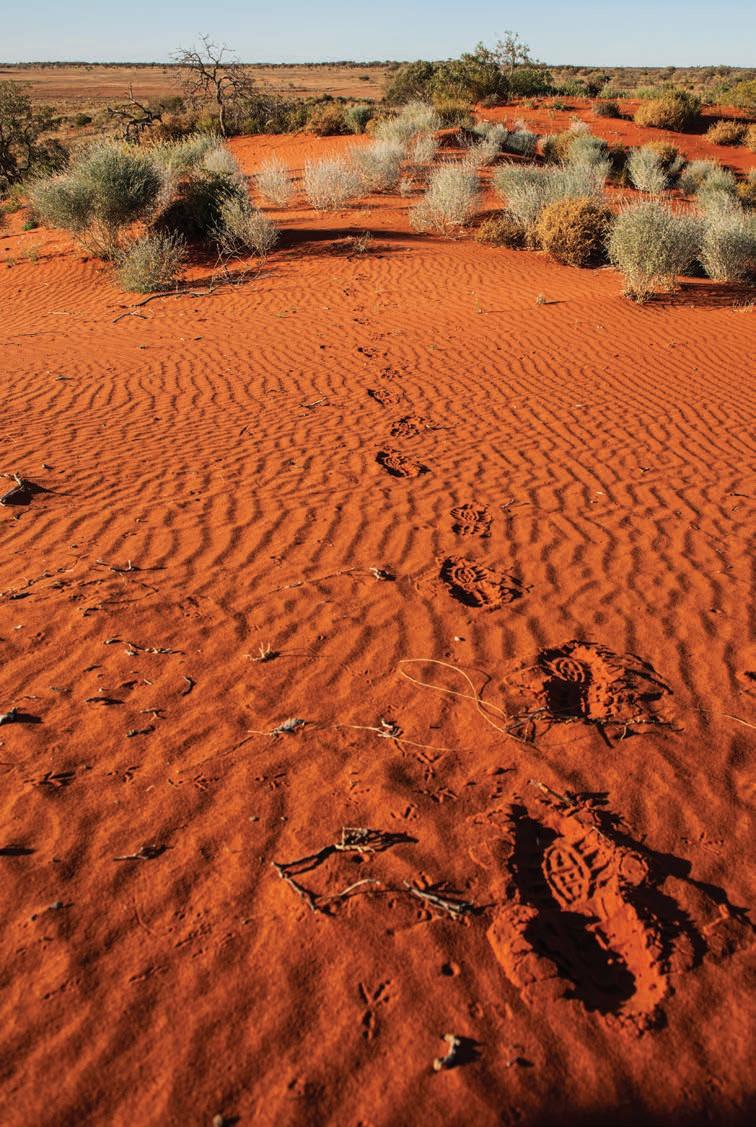
“Maybe, then, we will each choose a life similar to that of our ancestors: one of leaving soft footprints and a light touch on this landscape, and with a kindness for each other.”
- Dr. Anita Heiss
What is The Salvation Army?
The Salvation Army, an international movement, is an evangelical part of the universal Christian Church.
Vision Statement
Wherever there is hardship or injustice, Salvos will live, love and fight alongside others to transform Australia one life at a time with the love of Jesus.
Mission Statement
The Salvation Army is a Christian movement dedicated to sharing the love of Jesus by:
• Caring for people
• Creating faith pathways
• Building healthy communities
• Working for justice
The Salvation Army Australia acknowledges the Traditional Owners of the land on which we meet and work and pay our respect to Elders, past, present, and future. We value and include people of all cultures, languages, abilities, sexual orientations, gender identities, gender expressions, and intersex status. We are committed to providing programs that are fully inclusive. We are committed to the safety and wellbeing of people of all ages, particularly children.
Everyday kindness
I recently asked the six-yearold son of a friend of mine, what National Reconciliation and NAIDOC Weeks meant to him.
“Just being kind to people, every single day!” he said, rather emphatically. (He had been learning about these weeks in primary school and had attended some events with his school.)
I asked him how to be kind. “Sit with someone who doesn’t have a friend, learn new things about people and just help people to have a better day.”
Sounds simple. And doable. The world would certainly be a more humane and compassionate place if we followed this little boy’s advice.
Scan here to connect with The Salvation Army services
Scan here to subscribe to Salvos Magazine
Founders: William and Catherine Booth
Salvation Army World Leaders: General Lyndon and Commissioner Bronwyn
Buckingham
Territorial Leader: Commissioner Miriam Gluyas
Secretary for Communications and Editor-In-Chief: Lieut-Colonel Paul Hateley
Publications Manager: Cheryl Tinker
Editor: Simone Worthing
Graphic Designer: Ryan Harrison
Enquiry email: publications@salvationarmy.org.au
All other Salvation Army enquiries 13 72 58
Press date: 5 June 2026
Printed and published for The Salvation Army by Commissioner Miriam Gluyas at Focus Print Group, Chester Hill, NSW, Darug Nation lands.
Perhaps it’s a caring text to a struggling friend, a visit to an elderly relative, volunteering for a worthy cause or showing respect to those with different beliefs and cultures – kindness is an expression of our shared humanity and greatly benefits both the giver and the receiver.
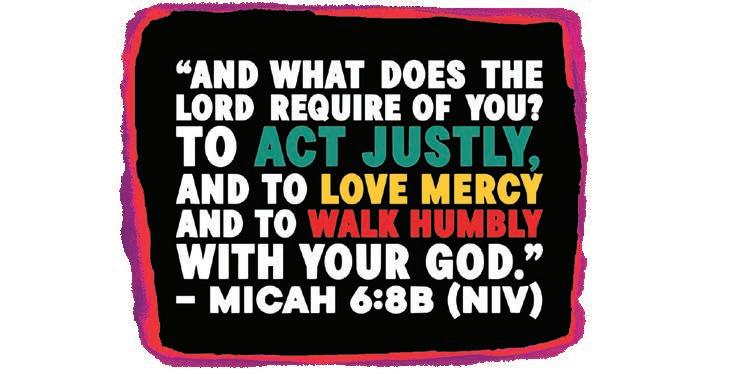
The Bible puts it neatly in Micah chapter 6, verse 8: “What else does the Eternal ask of you but to live justly and to love kindness …”
Check out salvosonline.org. au for more stories.
Simone Worthing Editor
Reconciliation
Everyday actions, personal responsibility and a calling to care
by Jasmine Hutchinson
NAIDOC Week (5-12 July) is fast approaching. And we have recently observed National Reconciliation Week (27 May-3 June), where the theme ‘All In’ called for all of us to be united in our vision and efforts for a just, equitable and reconciled Australia. How that translates into action looks different for everyone. For Jasmine and her family, reconciliation was a calling guided by faith, focused on transforming lives through everyday acts of care, humility and love.
Growing up, I was largely unaware of a world divided along racial lines. I did not view my heritage as something requiring defence or explanation. Instead, I was raised by two principled and compassionate parents who instilled in me – from an early age – a clear understanding of right and wrong, a commitment to loving others, and a deep respect for elders.
In our household, compassion was not abstract – it was practised daily. My parents consistently extended care to those in need, whether through providing meals, shelter, or simple acts of generosity. Their actions reflected a quiet but unwavering belief in the importance of supporting others.
A defining moment for our family occurred in 1986 during a visit to my aunt and uncle. It was there that they were given a piece of paper bearing a photograph of my brother as a six-week-old, accompanied by the words, ‘I need a home’.
This moment unfolded against the backdrop of significant legislative change in Australia, where policies had shifted to ensure that Aboriginal children could be adopted by Aboriginal families, recognising the vital importance
For Jasmine and her family, reconciliation is both personal and national.
of cultural identity, connection and belonging.
In January 1987, at 14 months of age, my brother was formally welcomed into our family. His adoption was not simply a legal process, but the beginning of a lifelong bond grounded in love, care and shared identity.
A place of refuge
Following this, my parents made a sustained commitment to supporting vulnerable children. They became foster carers for Aboriginal children and provided emergency care for others in need, continuing this work into the early 2000s. Over the years, our home became a place of refuge and stability for many children, shaped by consistency, compassion, and a strong sense of responsibility to others.
As we reflected during National Reconciliation Week, and now in NAIDOC Week, these experiences take on renewed meaning. For many, it is a time to consider the broader national journey toward reconciliation – acknowledging history, strengthening relationships, and building respect between Aboriginal and Torres Strait Islander peoples and the wider community.
For our family, however, the way we understand this journey is deeply personal. In conversations with my parents today, we do not primarily frame their actions within the language of reconciliation or policy. While others may interpret their contributions through that lens, our
understanding is grounded in something quieter and more immediate.
We see it as a calling.
It was not a role they pursued for recognition, nor one defined by public discourse. Rather, it was a path that unfolded naturally – guided by faith and a shared belief in serving others.
We believe it was something God chose for us.
In living out that calling, my parents impacted many lives in profound and lasting ways – not through grand gestures, but through consistent acts of care, humility and love. In the context of National Reconciliation Week and beyond, this reflection does not stand apart from the national conversation, but alongside it – a reminder that reconciliation can also be expressed through everyday actions, personal responsibility, and a commitment to walking with others in dignity and respect.
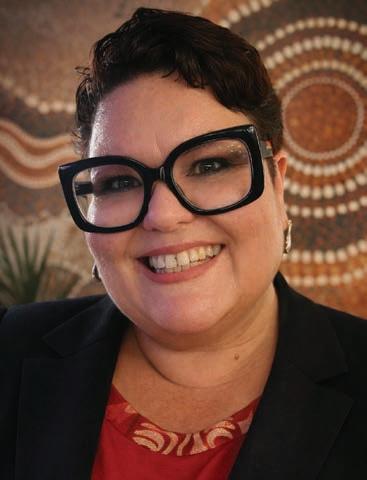
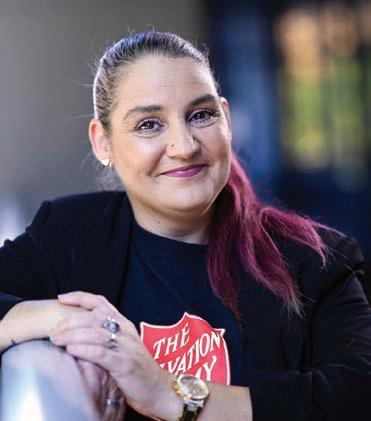
Jasmine is a proud Wakka Wakka woman who works as an Aboriginal and Torres Strait Islander Engagement Officer for The Salvation Army Employment Plus.
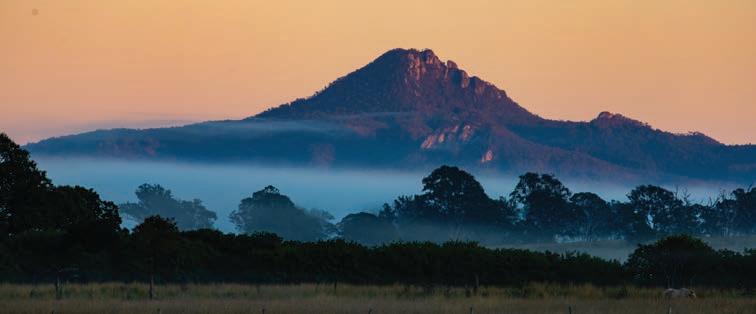
Jasmine is from Wakka Wakka Country in South East Queensland, which includes Mt Barney.
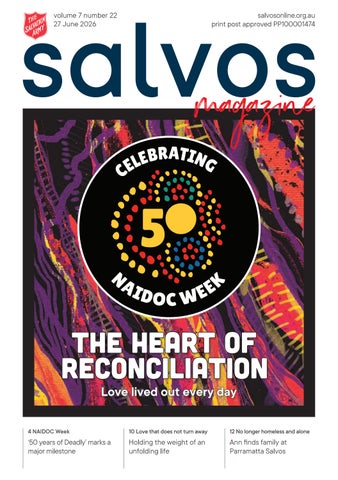
NAIDOC Week: 50 years of deadly
by Tahana Turner
NAIDOC Week 2026, celebrated 5-12 July, is dedicated to recognising and celebrating Aboriginal and Torres Strait islander peoples and cultures. NAIDOC stands for National Aborigines and Islanders Day Observance Committee.
For 50 years, NAIDOC Week has been a space for truth-telling, celebrating culture, recognising resistance, and affirming the strength and dignity of First Nations peoples.
This year’s theme, ‘50 Years of Deadly’ marks an important milestone.
‘Deadly’ is a word that speaks to excellence, strength and pride. Deadly can also mean having a strong sense of identity and culture, while looking ahead to a hope-filled future.
This theme honours the generations who made NAIDOC possible:
• The Elders who stood firm
• The organisers who created space
• The artists who painted, sang and danced, turning the struggle of recognition into a beautiful expression of culture
• The communities who have continued to show up, year after year.
NAIDOC has never been just a week.
It has always been a platform. A strong walk of pride. A celebration. And a statement of survival.
It reminds us that progress has not come by chance, but because people refused to be silenced and chose courage, community and hope.
Today and tomorrow
50 Years of Deadly also recognises Aboriginal and Torres Strait Islander peoples today:
• Grounded in culture
• Strong in identity
• Leading change across every field, from health and education to media, business and the arts.
It is about telling our stories: in our own voices, in our own way, and on our own terms.
And it is about the future:
• The next 50 years
• Young people growing up proud
• Languages remaining and returning
• A deeper reconnection to Country
• And the ongoing work for justice, dignity, and healing – carried forward with new tools, new voices and the same fire.
Hope lives in the actions we take today for the generations to come.
In Isaiah chapter 43, verse 19, the Bible says, “See, I am doing a new thing! Now it springs up; do you not perceive it?”
God is doing a new thing! A fresh, current and future-focused move of God is happening amongst our Aboriginal and Torres Strait Islander communities now.
Join with us
50 Years of Deadly is not just a marker of time passed.
It is a reminder of momentum – of what is possible when cultures lead and community comes first.
NAIDOC belongs to mob. It always has.
The theme asks us to look back upon 50 years – to acknowledge the stories, the conversations, the meaningful connections we have encountered, alongside Aboriginal and Torres Strait Islander peoples.
We would like to take this time to acknowledge and honour our non-Indigenous brothers, sisters and churches who have walked beside us, and celebrated being deadly with us so far throughout these 50 years. Your conversations with us, your listening ears and the way you have joined with us in ceremony has been deadly. So, thank you.
As representatives of The Salvation Army, and of our mobs and communities, we offer this encouragement – to keep listening deeply, to walk with greater respect, and to honour what has come before us by continuing the work of the Lord side by side.
Let’s be ALL IN and DEADLY for the next 50 years.
Tahana Turner is the Queensland Aboriginal and Torres Strait Islander Engagement Coordinator for The Salvation Army.
Bulldogs bring hope to café project
Katie
The Salvation Army has launched a new social service café in the Melbourne suburb of Footscray, in partnership with the Western Bulldogs Community Foundation (WBCF).
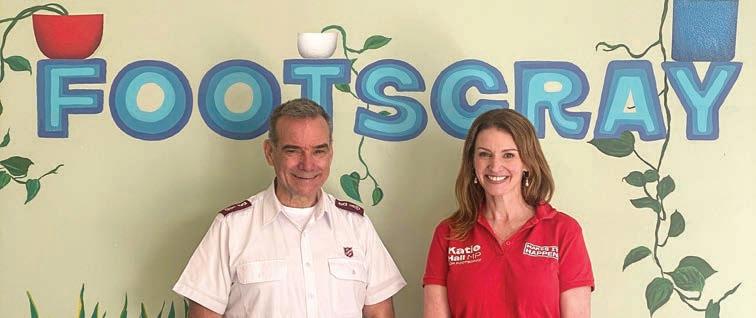
The Lighthouse Café, which has been backed by the Victorian Labor Government, will accommodate about 40 people inside, and serve as a place to find a free meal and a pathway to homelessness services, alcohol and other drugs programs and mental health support.
The centre, officially opened on 20 May, has been developed by Project 614 in Bourke Street in collaboration with the Western Bulldogs AFL team.
Bulldogs stars Tom Liberatore and Cody Weightman have committed to supporting the project. Tom Liberatore will generously donate 200 gourmet dim sims each week to the café, and Cody Weightman has personally designed a multimedia mural for the interior of the space.
(From left) Hannah Singleton, General Manager WBCF, with Bulldogs players Cody Weightman and Tom Liberatore.
Project 614 corps officer (pastor) Major Brendan Nottle, said The Salvation Army had been overwhelmed by the level of goodwill from the Footscray community towards the initiative. He also said The Salvation Army was deeply thankful to the Victorian Government, in particular Premier Jacinta Allan, Minister for Mental Health Ingrid Stitt and Member for Footscray Katie Hall, for their support.
“The Lighthouse Café will help improve food security, lack of connection and lack of access to services,” Brendan said.
Major Brendan Nottle and
Hall MP in front of the artwork by Western Bulldogs star Cody Weightman. Images: Project 614
IDAHOBIT Day shows need for a safe place to belong
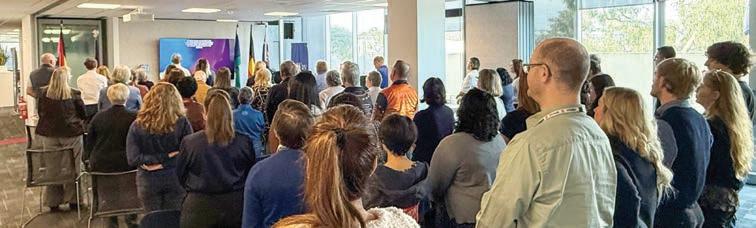
Salvation Army officers (pastors) employees and volunteers gathered at The Salvation Army’s Melbourne chapel service for IDAHOBIT Day. Image: Supplied
The Salvation Army in Australia marked IDAHOBIT Day last month with events in Melbourne, Adelaide and Darwin.
IDAHOBIT Day marks the International Day Against Homophobia, Biphobia, Intersexism, and Transphobia. The Salvation Army’s Inclusion Statement states that the movement values and includes people of all cultures, languages, abilities, sexual orientations, gender identities, gender expressions and intersex status.
At the Melbourne event, Captain Kris Halliday, Mission and Spirituality Engagement Coordinator for the Salvos, presented from the Bible about the importance of non-discrimination and drew on the themes from The Way – the spiritual focus of The Salvation Army Australia for 2026.
Kris said that many might find themselves wondering whether or not they belong, and if they could bring their whole selves to their work, church or communities. He said that the Way of Jesus was not to avoid or suppress people who were different, but rather to ask what we can
learn as we move toward others with dignity, compassion and welcome.
Amanda Brummell Lennestaal prayed for those in the LGBTQIA+SB community who have faced fear and rejection while living with courage and integrity.
“God of justice, on this International Day Against Homophobia, Biphobia, Intersexphobia and Transphobia, we pray for every person who today carries the weight of being unwelcome: the young person afraid to be known, the parent grieving a child rejected, the worshipper unsure whether the altar is theirs, the colleague who hides a part of themselves at work, the one in lands where their very existence is criminalised, the one whose prayers have been whispered in the dark. May they know that they are seen by you, held by you, and beloved of you, not at the margins of your heart, but at its centre,” Amanda prayed.
– Kirralee Nicolle
Love that does not turn away
Holding the weight of an unfolding life
by Amanda Brummell Lennestaal
There is a sofa in my living room that has seen better days. I bought it secondhand from a Salvos Store a few years ago, never particularly comfortable, never especially attractive, but all I could afford at the time. Over the years it has become the place where much of life with my teens has unfolded. It has held long days that didn’t resolve neatly, conversations that circled without clear endings, bodies that were tired or restless or simply needing somewhere to land. It has also held unexpected laughter, and moments of connection that felt, at times, hard won. The fabric is worn, the frame uneven. By any reasonable standard, it should be replaced.
Faithful presence
And yet it remains. Not for its material value, but for what it has come to represent: a faithful presence that doesn’t require life to be orderly first.
In a culture that equates value with appearance and prefers replacement over endurance, there is something quietly countercultural about that kind of faithfulness.
The Christian story has a similar disregard for what looks resolved or acceptable. At its centre is not simply the description of Jesus’ death at what we now call Easter, but the reality that his death was the inevitable consequence of how he lived.
Jesus moved persistently toward those pushed to the margins, touching those deemed unclean, speaking with those excluded, restoring dignity to people reduced to labels or problems to be managed. He disrupted systems that depended on separation and hierarchy, not through force but through proximity. And that kind of love exposes fault lines. It reveals who is excluded, who is burdened, and who benefits from things remaining as they are.
That kind of disruption rarely goes unanswered. Jesus is executed, and the reason is inseparable from the life he lived.
It is a pattern that is not confined to the past.
Right now, decisions made in distant centres of power are reshaping the lives of people who had no seat at the table. Trade policies negotiated between governments are driving up costs for families already stretched thin. Military strategies drawn up far from the frontlines are being absorbed, body by body, by those with the least power to resist them.
In Gaza, in Sudan, in Iran, where ordinary people navigate the consequences of geopolitical pressure they did not choose, the distance between those who decide and those who bear the cost has rarely felt wider.
This is precisely what the life of Jesus interrupts.
Rather than operating from a distance, he moved toward those most affected. Rather than insulating himself from complexity, he entered it. His authority was expressed not through control or detachment, but through presence and a willingness to absorb cost rather than deflect it. A love that refused to uphold exclusion, that exposed inequity, that reordered who belonged, is not easily accommodated by systems that depend on hierarchy and distance.
So now what?
Which raises an uncomfortable question: what might it mean to embody this kind of love now?
The love we see in Jesus does not wait for resolution before drawing near, nor does it withdraw when the cost becomes apparent. It remains.
Perhaps that is where the real challenge of Christianity sits, not only in what we believe about the cross and resurrection, but in what we are willing to risk in how we live. Because a love that moves toward the margins, that refuses distance, and that names what is broken will always carry consequence.
Sometimes that looks less dramatic than we imagine. Sometimes it looks like returning, again and again, to the same worn spaces, holding what is in front of us without turning away. Sometimes it looks like a sofa that should have been replaced long ago, still faithfully holding the weight of life as it continues to unfold.
Not because it is perfect. But because it remains.
*Amanda Brummell Lennestaal is General Manager for Diversity, Equity and Inclusion at
The Salvation Army.
PHOTO BY OSCAR ARAGON ON UNSPLASH
No longer homeless and alone
Ann finds family at Parramatta Salvos
by Lauren Martin
Ann was living in her car with her four children when a support worker suggested she go to the nearest Salvation Army centre for food and other assistance. That centre was the Parramatta Salvos in Sydney’s west, where Ann found belonging and reconnection with Jesus.
“You feel like a complete failure,” says Ann about her experience of homelessness with her children. “It wasn’t just going without; it was the physical and mental toll that it took on me to see my children suffering … living in a car with no blankets and no pillows.
“What food I could get, I fed my kids.”
Ann is loving life with the Salvos. Photos: Adam Hollingworth
Ann was unable to provide her kids with the basic life essentials that millions of Australians take for granted – a shower, a pillow, and a hairbrush to detangle her child’s hair before school. After suffering through more than 20 years of domestic violence, the humiliation of homelessness nearly broke her.
Salvos connection
When Ann met Major Kylie Collinson and the team at Parramatta Salvos, she received more than material support. “They made me feel loved and appreciated and welcomed into the community,” she said.
After receiving initial assistance and finally securing housing, Ann began volunteering at the Salvos’ Market Day on Wednesdays. A fellow volunteer then invited her to church.
“I was a little bit hesitant to walk in,” she says, citing some bad experiences she had in church when she was a child. “But what I found was The Salvation Army is completely different from any other church. The community there were so friendly and loving.”
Ann says that reconnecting with her faith and seeing her children make their own decision to follow Jesus have been life changing. “My twins have just become adherents (members),” she says. “I cried. I was so proud!”
Ann recently shared her story at The Salvation Army’s Red Shield Appeal media launch in Sydney.
Ann’s youngest son has become a junior soldier (junior member), and her sevenyear-old daughter is preparing to do the same. The kids love attending Salvation Army camps in Collaroy on Sydney’s northern beaches; the older teens go to Parramatta Salvos Youth; and one of the highlights of the year for the family is attending Parramatta Salvos weekend away.
Rebuilt trust
“I used to find it very difficult to trust people,” says Ann. “But I can talk to them about anything. They know my story; they have not judged me. Whether you’re covered in tattoos and piercings, whether you have drug or alcohol problems, the Salvos don’t judge.”
Major Kylie says it’s been a privilege for her and the corps (Salvos church) community to journey alongside the family.
“Ann is a great mum and she and Ray [Ann’s partner] … are great parents. Their kids are fantastic. Our community has really embraced this beautiful family in lots of different ways,” she said.
Earlier this year, the corps family threw a birthday party for Ann. It was the first time in her life that her birthday had been celebrated. Kylie says, “And last week, Ann asked me if I would conduct their wedding next year, which is really exciting!”
After the birth of her youngest child, Ann asked Kylie to dedicate her. At the same time, Parramatta Salvos officers and leaders dedicated all of Ann’s other children. It was a public symbol of the family’s inward commitment to God and to their church.
“This corps is one of the most amazing places I have ever walked into,” says Ann. “The people here uplift you. They make you feel wanted and needed. They have changed mine and my children’s lives in so many ways.”
Scan here if you would like to donate to the Red Shield Appeal 2026.
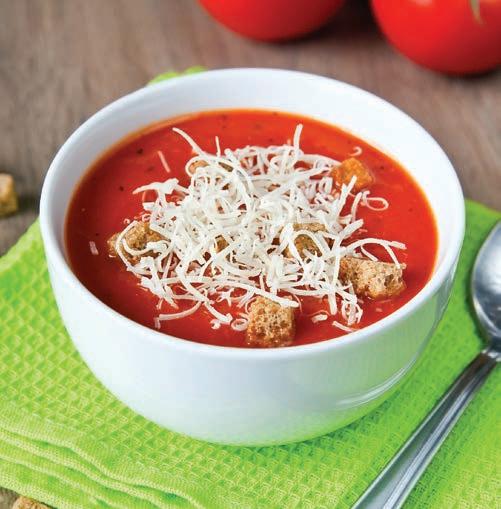
�� Tomato and zucchini soup
Ingredients
1 small onion, finely chopped; 1 small zucchini, thinly sliced; 1 tsp minced garlic; 2 tsp dried herbs; 2 cups tomato puree; 1½ cups chicken stock; ¼ tsp sugar; salt and pepper to taste; Parmesan cheese and bread (optional).
Method
Place onion, zucchini, garlic and herbs into 2-litre microwave dish. Pour over 1 tbsp water. Cover and cook for 4 minutes.
Add tomato puree, stock, sugar, salt and pepper. Cover, cook for 3 minutes. Stir and cook for another 3 minutes.
Serve with a sprinkle of Parmesan cheese and hot bread.
☺ Believe in Good: Tips
“A tree is known by its fruit; a man by his deeds. A good deed is never lost; he who sows courtesy reaps friendship, and he who plants kindness gathers love.”
– Saint Basil
1. Name a fruit that contains pips?
2. Citrus fruits have a thick skin; what is it called?
3. What climate do citrus fruits grow in?
4. What type of fruit is an apricot?
5. Why are potatoes, carrots and radish called root vegetables?
On which page of this week’s Salvos Magazine is Tum-Tum hiding?
Did you know?
Over the 100-year history of the Archibald Prize, 37 Indigenous artists have taken part. Two are among the winners: Vincent Namatjira (2020) and Blak Douglas (2022), and Meyne Wyatt won the Packing Room Prize in 2020. There have been 153 portraits of Indigenous people and six have been the subject of winning portraits: Albert Namatjira (1956), David Gulpilil (2004), Geoffrey Gurrumul Yunupingu (2009), Adam Goodes (2020), Karla Dickens (2022) and Iluwanti Ken (2026).
#8Puzzle2026 246315897
Martin Ball is the only New Zealander winner of the Packing Room Prize (2008).
Answers
Tum-Tum: is hiding behind the dog on page 11.
2. The rind. 3. Hot, sunny, tropical, humid. 4. A stone fruit. 5. Because the roots are the edible part.
#5Puzzle2026
Quiz: 1. Apple, pear, grape.
Fill in the grid so that every row, every column and every 3x3 box contains the digits 1 to 9.
#2Puzzle2026
#7Puzzle2026
�� Have a laugh
What lights up a soccer stadium?
Why shouldn’t you write with a broken pencil?
Where can you buy chicken broth in bulk?
Why did the golfer bring two pairs of pants? A soccer match. The stock market. Because it’s pointless. In case he got a hole in one.
#4Puzzle2026
“Work toward unity, and live in harmony with one another.”
Romans chapter 12, verse 16a The Voice translation