The Salvation Army, an international movement, is an evangelical part of the universal Christian Church.
Vision Statement
Wherever there is hardship or injustice, Salvos will live, love and fight alongside others to transform Australia one life at a time with the love of Jesus.
Mission Statement
The Salvation Army is a Christian movement dedicated to sharing the love of Jesus by:
• Caring for people
• Creating faith pathways
• Building healthy communities
• Working for justice
The Salvation Army Australia acknowledges the Traditional Owners of the land on which we meet and work and pay our respect to Elders, past, present, and future. We value and include people of all cultures, languages, abilities, sexual orientations, gender identities, gender expressions, and intersex status. We are committed to providing programs that are fully inclusive. We are committed to the safety and wellbeing of people of all ages, particularly children.
Shopping for stones
My daughter texted me to see if I could visit the ‘shop’ outside their house. I arrived to find two six-year-olds sitting behind a table waiting patiently for customers. Their merchandise was a selection of washed and dried stones from the driveway, ranging in price from five cents to $10. The vendors pointed out the special characteristics of the stones – this one had sparkly bits, that one had a brown streak, another was smooth. I took out my coins and asked them how many stones I could buy. As it happened, I had enough money to buy them all. Delighted, they ran off to the driveway to replenish their stock.
Scan here to connect with The Salvation Army services
Scan here to subscribe to Salvos Magazine
Founders: William and Catherine Booth
Salvation Army World Leaders: General Lyndon and Commissioner Bronwyn
Buckingham
Territorial Leader: Commissioner Miriam Gluyas
Secretary for Communications and Editor-In-Chief: Lieut-Colonel Paul Hateley
Publications Manager: Cheryl Tinker
Editor: Simone Worthing
Graphic Designer: Ryan Harrison
Enquiry email: publications@salvationarmy.org.au
All other Salvation Army enquiries 13 72 58
Press date: 29 May 2026
Printed and published for The Salvation Army by Commissioner Miriam Gluyas at Focus Print Group, Chester Hill, NSW, Darug Nation lands.
We all work in one way or another and don’t always experience the uncomplicated pleasure shown by the young stone merchants. I like a verse in the Bible that encourages us to see that what we do is important. “Whatever you do, work at it with all your heart, as though you were working for the Lord” (Colossians chapter three verse 23, Good News Translation). It gives an extra shine to those everyday tasks. Faye Michelson Acting Editor
Women and money
Finding the skills we need
by Fay Foster
When I started my first full-time job in 1974, I was paid less than were some of my workmates who were doing the same job.
The reason? They were men, I was a woman.
Thankfully, equal pay for equal work has become an established part of our employment laws. But in other ways, women are still financially disadvantaged.
Women in Australia earn, on average, 14.6 per cent less than men (that’s just over $250 per week), and have 52.8 per cent less superannuation at retirement. Eightyone per cent of one-parent families are headed by women, and women represent more than two thirds of primary carers for people who have a disability, mental illness, chronic condition, terminal illness, an alcohol or other drug issue or who are frail aged (womenandmoney.org.au).
Caring duties often mean that women can only work part-time, and sometimes need to take a total break from the workforce. Even when women work fulltime, they often do so in industries where their wage is so low that they cannot afford to pay childcare costs, which can mean reverting to part-time hours.
When long-term, full-time care is required, a woman may be absent from the workforce for many years. This affects not only current income, but also opportunities to re-enter the workforce, future opportunities for promotion, and
the amount of superannuation a woman will have at retirement.
The financial wellbeing of women often decreases dramatically following a divorce or separation. The emotional trauma of a broken relationship is often compounded by changes in income and financial responsibilities. This is also a time when financial abuse may begin or worsen. When a partner refuses to pay joint debts or child support, or drains joint back accounts, the other partner may be left with the financial responsibility for
a family, with insufficient funds to make ends meet. Eighteen to 23 per cent of sole parents are living below the poverty line (womenandmoney.org.au).
For these reasons, it is important for women to take their finances seriously and try to ensure that they are financially independent.
Salvos Moneycare Manager for Western Australia, Mandy Dehnel, says, “Financiallyaware women are empowered women. What I want women to understand is:
A – be OK on your own first.
B – if you do get in a relationship, have money conversations before you move in together. How is the money going to be spent? How are you going to earn it? What joint goals are you going to work toward?”
Free resources for managing money
Thankfully, there are some great, free resources available to help us take control of our money.
One is the Salvos’ book You’re the Boss, which can be downloaded from the Moneycare website, accessed by scanning the QR code on page 7. This content is also available as a free online course, Be the Boss. You’re the Boss acknowledges that most of us (especially women!) were never taught how to manage our money. But once we are empowered with information, skills and know-how, we will be able to spot danger signs and avoid crises before they arise.
It might also be wise to make an appointment to speak with a financial counsellor (a free service) to plan the way ahead. You can make an appointment or have a live chat with a Moneycare financial counsellor on this same website.
As women, money may not always be our top concern; but learning how to manage what we have is an important skill for navigating our lives and can give us increased confidence that whatever happens in the future, we will be okay.
EOFY made easy:
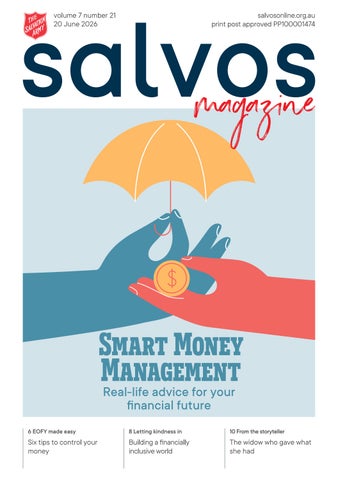
Six tips to take control of your money
The end of the financial year (EOFY) can be a stressful time, but also a great opportunity for a fresh start. Now is the time to seize that opportunity and get control of your finances. To help you, the Salvos Moneycare team has put together six timely tips to help you on the way. These tips may not resolve every challenge, but they can help you start the new financial year with less stress and more confidence. You can also get in touch with Moneycare at any time for free resources and counselling.
1. Take stock of your financial position
This is an important step towards effective money management. Look over your income, expenses, debts, and savings from the past year. Review the performance of your investments too, if relevant. Even a simple snapshot can give you clarity and confidence as you move forward. It also helps to identify your financial strengths and potential financial risks.
2. Check for unclaimed deductions or entitlements
There are various deductions, offsets, or rebates that you could be eligible for. This is especially likely if you’re working, investing, or caring for someone. To make sure you’re getting what you’re owed, use the Australian Taxation Office (ATO) website ato.gov.au to access the Tax Help Program.
3. Refresh your personal money plan
Because costs shift and circumstances change over time, it’s a very good idea to revisit your personal money plan (budget). Decide what matters most, adjust for rising expenses, and build a little buffer for the unexpected. A fresh plan can bring peace of mind and put you in a good position for the financial year ahead.
4. Spend wisely
Make sure you prioritise the important expenses like school costs, car registration and utilities. Look at what’s due in the next few months and plan ahead to avoid stress later.
Try to look out for such things as EOFY sales. It can be tempting for the ‘bargain mindset’ to take over. Before any purchase, ask yourself: ‘Do I need it, and can I afford it?’ A good deal isn’t really a deal if it causes stress down the track.
5. Make a plan for your tax refund
A tax refund can be a helpful financial boost — and so it is important to carefully plan how you will use it ahead of time. It could go towards your savings, bills, paying down debt, or covering another upcoming cost. A little planning can help you get the most from a lump sum tax return and put you in a stronger financial position.
6. Check in on your superannuation
Your super is your money, even if retirement feels far off. Use this time to:
• Look for lost super through MyGov (my.gov.au)
• Check your insurance settings and costs inside super
• Make sure your beneficiary details are current.
You can find helpful information on these websites:
• servicesaustralia.gov.au/financialinformation-service. This website includes free videos on topics such as income and assets, superannuation and retirement.
• The Association of Superannuation Funds of Australia (ASFA) website (superannuation.asn.au).
Very importantly, never be ashamed to ask for help if you’re struggling. There are people who can support you every step of the way.
If you’d like to make a free appointment with a financial counsellor to help you manage your money this winter, call Moneycare on 1800 722 363 or scan the QR code below to have a live chat with a financial counsellor on our website.
And if you’ve got time to take a deeper dive into your behaviours around money, our eBook You’re The Boss will provide you with the tools to help you take action today.
Scan here for more information or to make a free appointment with Moneycare.
LETTING KINDNESS IN
We often think of kindness as something we give – offering help, sharing resources or supporting others through difficult moments – but when the roles are reversed, receiving kindness can feel surprisingly difficult. Even when it’s freely given, it can bring up guilt, vulnerability, or the urge to ‘pay it back’ straight away.
In my role at The Salvation Army, I work in financial inclusion, and this often comes up. Financial inclusion refers to the process of ensuring that all of us, regardless of our income, have access to useful and affordable products and services. It’s also about feeling safe to ask for help, to accept support, and to be part of a community that focuses on connection over independence.
When receiving help feels like failure or a burden, it can create invisible barriers. We may delay reaching out because accepting feels too heavy.
I noticed this in a small way myself recently when I was without a car and relied on lifts from friends. It seemed like such a simple, practical help but underneath, I felt that quiet pull to even the score and to not inconvenience anyone (especially when support was needed more than once).
But what if we didn’t rush to repay?
When we allow ourselves to receive kindness, whether it’s a lift, financial support, or understanding, we create space for something more than a transaction. We create connection, and that connection is at the heart of inclusion.
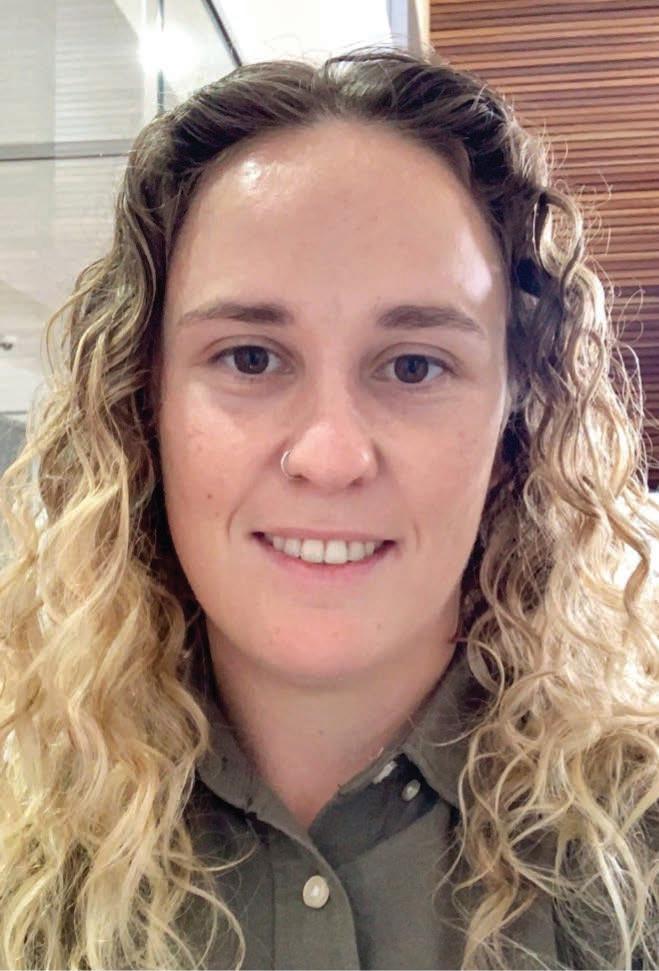
Jessica works with the Salvos to help build a more financially inclusive world.
Receiving kindness isn’t passive. It’s an active, often vulnerable practice of trusting that we are worthy of care without conditions. It also allows others to express generosity – something that strengthens communities, not just individuals.
If we want a more financially inclusive world, we need to normalise not just giving help, but receiving it too.
Because sometimes, the most powerful thing we can do is simply say yes.
– Jessica Sanderson Financial Inclusion Project Officer Community Services Moneycare
Breaking ground for social housing
A unique partnership is at the forefront of a social housing project in Victoria’s south-west.
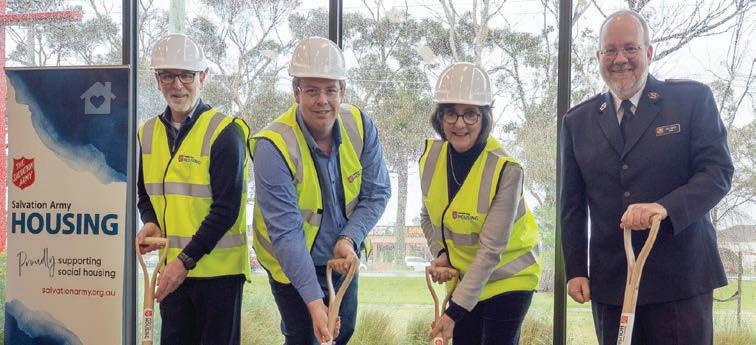
A groundbreaking $18.9 million Salvation Army social housing project has commenced in Warrnambool, with construction now underway on the pioneering development in Victoria’s south-west, supporting families and people at risk of homelessness.
In partnership with Homes Victoria, the development will feature 14 two-bedroom townhouses and seven three-bedroom townhouses.
“This isn’t just a bricks and mortar exercise, this is a lives-transformed exercise,” says Major Mal Davies, who oversees the Salvos in Victoria.
“What excites us is the fact that we will have people that we can not only support and help in practical ways, but perhaps also talk to about Jesus and about how life can be better.”
Vision
The project aims to create a setting where housing, multiple supports and
connection intersect in one place.
Mal reflects that working with people experiencing homelessness is not simply putting a roof over their heads.
“There are almost always other issues, multiple issues that we need to address. So, where we get this sort of opportunity to address a range of issues with a person is just incredibly helpful,” he says.
Funding for the project includes a $11 million contribution from Homes VIctoria and the State Government, through the Build and Operate Program. Construction is set to be completed by July 2027.
At its heart, the development is focused on long-term housing and targeted support for families and individuals at risk of homelessness. The four single-level units with two bedrooms will cater for women over 50, who have applied for housing through the Victorian Housing Register. – Lerisse Smith
From the Storyteller
StorieS acroSS the centurieS Still relevant today
The widow who gave what she had
by Fay Foster
Jesus was a great storyteller. His short, succinct parables (another word for stories) have shown people how to live God’s way for centuries, and still do today.
Sometimes we can feel as though we’re always on the receiving end of life, and don’t have much to give.
We see famous people starting charities and raising crazy amounts of money for bushfire victims, or starting an orphanage in Africa. We hear of people starting food banks or giving scholarships so that underprivileged kids can complete their studies.
When we see that, it’s easy to for us to think that we have nothing to give, or that the small amounts of money we can donate to good causes are not worth giving.
Jesus once watched people dropping their offerings into the collection plate in the synagogue (the Jewish church). He saw the rich people putting in their money. Then he saw a poor widow put in two pennies. He said, “The plain truth is that this widow has given by far the largest offering today. All these others made offerings that they’ll never miss; she gave extravagantly what she couldn’t
afford – she gave her all!” (Luke chapter 21, verses 1-4; The Message version).
It doesn’t matter what we can or cannot afford to give. We don’t have to be rich to make a difference. The important thing is that we give with a good heart, at a cost to ourselves. We know that real life is about more than looking after ourselves. We want to help others and make a difference.
Time and talents
When we talk about giving, it’s not just our money or possessions that matter, although our gifts of money, clothing, food and such are definitely valuable and needed.
In the Bible book of 1 Peter, chapter 4 verse 10, we read: “Each of you should use whatever gift you have received to serve others.”
So, what gifts do we have?
The gifts we have all been given are our time and our talents. Combine time
with talents, and we have the gift of opportunity to serve others.
For some of us, that means volunteering. This could include serving food, mowing lawns, visiting people in hospital, helping our elderly neighbours with shopping or housework, watering someone’s pot plants or taking them meals when they’re sick. It could mean having a chat with someone who’s on their own, or just asking someone how they are or giving them a compliment.
Giving is good for us
Research has found that as you help someone or give a gift, your brain
secretes ‘feel good’ chemicals such as serotonin (which regulates your mood), dopamine (which gives you a sense of pleasure), and oxytocin (which creates a sense of connection with others). Giving also lowers our blood pressure, thereby protecting our heart. It reduces stress and feelings of depression, boosts selfesteem and increases happiness (health. clevelandclinic.org). We were made to be givers!
God loves that we give as we can! He says that whatever we do for those who need our help, we do for him. When we give, he sees our hearts and smiles on our kindness.
Facing a wave of financial instability
Josie finds ‘lifeline’ in Salvation Army’s care
Following the release of The Salvation Army’s Financial Inclusion Action Plan (FIAP) Impact Highlights Report for 2018 – 2025, we share the story of a community member who experienced the benefits of financial inclusion when she was facing hardship.
Josie* faced a series of setbacks and blows to her housing and financial stability over a period of several months. With no family or friends close by and no other support networks, she reached out to The Salvation Army for help.
“The Salvation Army has been a lifeline for me,” Josie said. “They have provided consistent support at every step of my journey.”
When Josie first moved into a new property in a new suburb, she did so without essential household items such as a fridge and washing machine. Staff at The Salvation Army corps (church) nearby introduced her to a No Interest Loans Scheme (NILS) worker, who was able to process a priority application
so she could purchase the items she urgently needed.
But Josie’s challenges weren’t over. A few months later, she was referred to the Moneycare team as her housemate had left unexpectedly after not contributing adequately to their shared expenses, and Josie was left to pay a large bill. Josie was supported to call her utility provider and arrange a manageable payment plan. Moneycare staff also helped Josie organise payments for her water bills and car registration, enabling her to gain greater control of her finances.
Sadly, however, Josie was unable to find another housemate, and was forced to live in her car alongside her service dog, who provided vital emotional support. As Josie lives with PTSD, anxiety and depression, homelessness compounded her symptoms, and her life circumstances impacted heavily on her mental and physical health.
Focused support
Determined to stay positive, Josie kept regularly attending her local Salvation Army
They have provided consistent support at every step of my journey.
church and participating in the Celebrate Recovery program. Eventually, she was offered a community housing property.
Josie moved in but then faced another challenge. Her car needed urgent repairs, and Josie was still trying to get back on her feet. To make matters worse, Josie was targeted by a social media loan scam, and her Centrelink pension money was gone.
Josie reached out to NILS for support, and the worker referred her to Doorways (emergency relief), where she accessed a food voucher to help her survive the next fortnight. She also received education on how to protect her identity, as well as referrals to additional support services.
Unfortunately, Josie’s car then stopped working altogether. Again, The Salvation Army stepped in, referring Josie to the NILS for Vehicles program run by Good Shepherd Australia New Zealand, and providing documentation and communication across services.
Josie was also invited to participate in
the Positive Lifestyle Program (PLP), and she agreed. She says this helped her to reflect on the challenges in her life, break them down into manageable parts and develop strategies to address them. She says she often returns to her workbook for continued resources and support options.
Josie has reflected on her journey with The Salvation Army through a time of personal crisis, and says the services haven’t just helped her to survive, but have enabled her to build a foundation for long-term stability.
“The NILS program helped with practical needs like a fridge and car repairs, while the Positive Lifestyle Program gave me the tools to stay emotionally strong,” Josie shares. “Doorways helped with essentials like food when I was in crisis, and Moneycare gave me budgeting advice that helped me keep my bills up to date.
My local church and Celebrate Recovery have also been a spiritual anchor in my journey and connection to community.”
*Name has been changed for privacy
�� Seed Cake
Ingredients
½ tsp salt; 185g butter; ¾ cup sugar; 2 tbsp lemon juice; 3 eggs, lightly beaten; 2 tbsp apricot jam; 3 cups selfraising flour; ¾ cup milk; 1 tbsp caraway or fennel seeds
Method
Pre-heat oven to 180ºC.
Grease, spray or line cake tin.
Cream salt, butter, sugar and lemon juice until it’s light and fluffy. Gradually add eggs.
Stir through jam. Gradually add flour and milk alternately. Add seeds. Bake for 1 hour.
☺ Believe in Good: Tips
World Music Day – 21 June
“Beautiful music is the art of the prophets that can calm the agitations of the soul; it is one of the most magnificent and delightful presents God has given us.”
– Martin Luther
This week, take time to stop and really listen to your favourite music.
Quiz
1. What is the purpose of a canoe?
2. What are canoes made of?
3. What position do you need to be in for paddling a canoe?
4. If your canoe capsizes, what should you do?
5. What safety gear should you have for canoeing?
6. How do you steer a canoe with one person?
��Who am I?
I was born in Melbourne in 1953.
I am an actress, appearing in theatre, movies and in many television series and documentaries. I am also a presenter on radio.
In 1995, I received a Member of the Order of Australia for services to children and the performing arts.
I was a Play School presenter from 1978 – 2001.
PHOTO COURTESY KAREN MASTERS
Have a laugh
What do you call a royal giraffe?
What is a giraffe’s favourite fruit?
Your high-ness Neck-tarines
Why is the giraffe so wellrespected?
Why do giraffes sing in the rain?
Because everybody looks up to him. Because they don’t fit in the shower.
Tum-Tum
On which page of this week’s Salvos Magazine is Tum-Tum hiding?
Answers
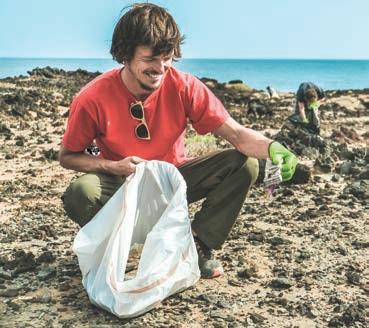
Tum-Tum: is hiding behind the volunteer cleaning up the beach on page 11.
I am: Noni Hazlehurst
5. Life jacket, helmet, first aid kit 6. With a double-bladed paddle.
4. Stay with the canoe
racing 2. Wood, plastic and fibreglass 3. Sitting
Quiz: 1. Transportation, fishing,
Word search
Words are hidden vertically, horizontally, diagonally, forwards and backwards. Enjoy!
Acoustic
Band
Banjo
Bluegrass
Blues
Brass
Classical
Composer
Drums
Flute
Folk
Guitar
Harmony
Melody
Orchestra
Percussion
Piano
Reggae
Rhythm
Rock
Strings
Trumpet
Vocal
Woodwind
“Trust in the Lord with all your heart and lean not on your own understanding.”
Proverbs chapter 3, verse 5 New International Version