volume 7 number 34 19 September 2026
salvosonline.org.au print post approved PP100001474
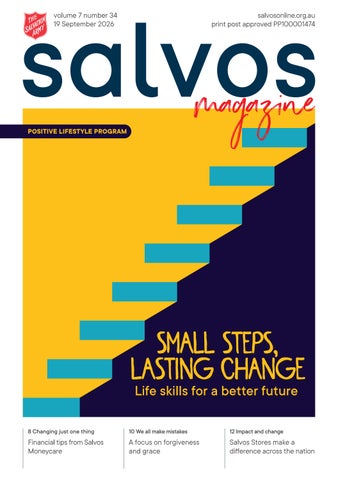
POSITIVE LIFESTYLE PROGRAM
SMALL STEPS, LASTING CHANGE Life skills for a better future
8 Changing just one thing
10 We all make mistakes
12 Impact and change
Financial tips from Salvos Moneycare
A focus on forgiveness and grace
Salvos Stores make a difference across the nation
“You can’t go back and change the beginning, but you can start where you are and change the ending.” – C S Lewis
19 September 2026
Editorial What is The Salvation Army? The Salvation Army, an international movement, is an evangelical part of the universal Christian Church. Vision Statement Wherever there is hardship or injustice, Salvos will live, love and fight alongside others to transform Australia one life at a time with the love of Jesus. Mission Statement The Salvation Army is a Christian movement dedicated to sharing the love of Jesus by: • Caring for people • Creating faith pathways • Building healthy communities • Working for justice The Salvation Army Australia acknowledges the Traditional Owners of the land on which we meet and work and pay our respect to Elders, past, present, and future. We value and include people of all cultures, languages, abilities, sexual orientations, gender identities, gender expressions, and intersex status. We are committed to providing programs that are fully inclusive. We are committed to the safety and wellbeing of people of all ages, particularly children.
Scan here to connect with The Salvation Army services
Scan here to subscribe to Salvos Magazine
Founders: William and Catherine Booth Salvation Army World Leaders: General Lyndon and Commissioner Bronwyn Buckingham Territorial Leader: Commissioner Miriam Gluyas Secretary for Communications and Editor-In-Chief: Lieut-Colonel Paul Hateley Publications Manager: Cheryl Tinker Editor: Simone Worthing Graphic Designer: Ryan Harrison Enquiry email: publications@salvationarmy.org.au All other Salvation Army enquiries 13 72 58 Press date: 28 August 2026 Printed and published for The Salvation Army by Commissioner Miriam Gluyas at Focus Print Group, Chester Hill, NSW, Darug Nation lands.
Daily new beginnings We often hear sayings such as ‘Good things come in small packages’, ‘From little things, big things grow’, and ‘The journey of a thousand miles begins with a single step’. These can become clichés, of course, but there is something reassuring about knowing that we can make positive changes in our lives that don’t have to be huge to make an impact. A few years ago, a friend of mine with recurring health struggles started a program that got her from doing no exercise at all, to walking 5km. It took almost a year and there were tears, doubts and restarts along the way, but she got there in the end. My friend is not running marathons and some of her struggles remain, but her overall physical and mental health is much better, and she has more energy, creativity and confidence. Small changes will look different for each of us. Every day is a new opportunity to put them into practice. Lamentations chapter 3, verse 23 tells us that God’s mercies “are fresh every morning”. May we each experience that today! Simone Worthing Editor 3
Feature
Small steps,
lasting
change Managing life’s challenges and building a better future Recognising and expressing anger in healthy ways. Helpfully addressing depression and loneliness. Identifying and dealing with stress. These are just some of the topics covered in The Salvation Army’s Positive Lifestyle Program (PLP) – an eightsession course used by hundreds of facilitators across Australia for people who want to see ongoing change in their lives and build a better future. “The Positive Lifestyle Program encourages participants to apply important life skills to support them in finding work, managing stress and dealing with loss, as well as planning for better outcomes in relationships, mental health, various personal issues and reconnection with community,” says Christine Pickens, National Coordinator for PLP for The Salvation Army Australia. “This program is for the person who wants change – to do things differently – and is beneficial for everyone seeking to become the best version of themselves.” Originating in Canada, the PLP was introduced to Australia by The Salvation Army in the 1990s to be used in courts 4
Salvos Magazine
and prisons. The updated material is now used in a wide variety of fields and settings. The program can be done as a one-on-one journey with a trained facilitator or in group sessions. The methodology takes participants through a self-awareness-raising process, focusing on personal difficulties they may be unable to identify or address. These include discontentment, fear, anger and fatigue. It also, though, emphasises that they are people of worth, to be valued. Christine explains that part of the reason people like PLP is that it’s a short course and is delivered alongside a trained facilitator who journeys with them as they learn to focus on personal challenges they may need help to identify and address to become “a better version of themselves”. “Often, when people experience challenges in life or are uncertain about their future direction, learning about their strengths, what they think and feel and how they respond actually helps them prepare to engage with themselves, others and life in different ways,” she shares. “PLP helps them apply the skills they learn and develop in practical and healthy ways. And it helps them see areas they want to focus on and provides strategies for getting there. “Basically, it’s transformational. That’s what inspires me with PLP – seeing people’s lives change.” Eight topics With flexible delivery, this program is a non-invasive, non-judgmental way to encourage participants to consider the following eight aspects of their lives:
Feature
19 September 2026
The Positive Lifestyle Program is available for individuals or groups in a range of Salvation Army centres across the country.
•
Self-awareness: ways to know and look after yourself • Anger: ways to recognise and express anger in healthy ways • Depression and loneliness: ways to helpfully address depression and loneliness • Stress: ways to identify and deal with stress • Grief and Loss: ways to express grief and handle loss • Assertiveness: ways to be assertive with others • Self-esteem: ways to build your selfesteem and nurture yourself • Goal setting: turning what you experienced into future directions and ongoing change. There are many sites around Australia that offer the PLP, and not just within The Salvation Army (see QR code below). There are also other organisations
and churches trained by the Salvos to facilitate the PLP. In addition to the individual PLP program, other variations of the program are available. These include: PLP Youth, PLP High School (including Aboriginal and Torres Strait Islander session material), a simplified Chinese version of PLP and PLP Discipleship Journey (for those wanting to explore Christianity more deeply). PLP is one of those programs that works towards transforming one life at a time. The PLP methodology takes people through a process of raising selfawareness to help participants become a better version of themselves.
Scan here to find a PLP provider near you. 5
Feature
Salvos Magazine
A positive new chapter
Salvos program helps Cassie rebuild her confidence, find her voice and reconnect with the things she loves by Cassandra
I grew up in Bundaberg. More of a loner, I kept to myself most of the time. Dad was my biggest supporter. I moved away early, fell pregnant and had my child in South Australia. I was gone for 25 years. My life was pretty hard. I lived in a violent relationship for 16 years and had nine children. When I returned to Bundaberg with my now husband, I discovered I was autistic and had bipolar disorder. That’s probably why I had kept to myself as a child and young teenager! We found a property to live in, but quickly, a real estate agent put up our rent, priced us out of housing and we ended up homeless for nearly one year. We took our case to court, and it was
6
during that time that I came into contact with the Salvos. I was seeing Paula, a case worker with The Salvation Army’s Moneycare, who was helping me with my finances and getting back on track. The Salvos also enabled me to get counselling and psychological help around the nightmares and other struggles I have as a result of domestic violence. This is a really hard one for me. Paula suggested I do the Salvos Positive Lifestyle Program (PLP) with Danielle, the facilitator of the program. Danielle, along with Centacare, also assisted me through the court case, which we won.
Feature Life-changing impact It was a really good idea to do the course. I needed help with my mental health – I had overdosed too, before starting PLP. It’s hard for me to pick up on my own and other people’s feelings, and this course really helped. It has also enabled me to communicate better with others, to connect more with my NDIS workers and be more open to having them work with me. If I am not feeling connected, I can express that. I can stand up for myself. The PLP has also helped me to get out of my shell a lot more. I can now go to the sewing classes which I love. I wanted to learn to read a sewing pattern, which I did – and made a dress for a friend. I am also doing quilting, and I like to think I am talented. The program has given me the confidence to engage with other activities in the community, and I am gradually getting back into the hobbies I liked doing. These include candlemaking and photography. I even won
19 September 2026
a photography competition! I just love taking photos. I went to the Salvos church a couple of times and found it really friendly and encouraging. They are all great people, the whole lot of them. Overall, I really enjoyed the course. Danielle being female made it easier, and I even got a framed certificate at the end! I am grateful for my life where I am. My kids all have good jobs and we keep in contact. My husband is supportive and has helped me to make changes and live a better life. I have two Indian ringnecks (parrots), and a therapy dog, and am getting on well with my NDIS workers. I have put into practice many of the things I learned in PLP. I see Danielle every now and then and catch up. It’s always so good to see her. I can access support when I need it, and I do, which really does help. The Salvos are always there for me.
7
Feature
Salvos Magazine
The power of changing one thing Financial tips from Salvos Moneycare
8
Feature
There are lots of clichés when it comes to change. The bottom line? Change is often difficult. That’s why the best way to approach change is to focus on just one thing. One small behaviour change can bring you closer to the life you want. Firstly, start with something you want. When it comes to money, do you have a goal? Write it down. Imagine what your life could be like if you achieved your goal. What does it look like? Feel like? Sound like? Secondly, choose just one thing you will do to achieve your goal. For example, if your goal is to get out of debt, you might choose to write down a list of what you owe and prioritise the items from most important to least. Now, break it down into actionable, small steps and plan when, where and how you are going to do your one thing. Using the above example, are you going to write your list of who you owe money to tomorrow or next week? Will you write it on a sticky note for the fridge, or save it in the notes on your phone? How will you make this list? Be clear about each of the little steps needed.
19 September 2026
Keep your eyes on your goal and the benefits you will experience by making this change. Are there any obstacles standing in your way? Plan your way around it and expect ‘relapse’ as part of the process. Small setbacks are expected whenever you attempt to make a change. The key is to keep moving forward. Make a very specific decision about something you want to do and don’t question it. Give yourself little rewards to reinforce your behaviour along the way and you will soon find yourself enjoying the real rewards of your accomplished goal. And, if you’d like support to manage your money as you work towards your goal, call Moneycare to see if you can make a free appointment with one of our independent, non-judgmental financial counsellors on 1800 722 363. Scan here for more information, or to book your Moneycare appointment.
9
Faith Talk
Salvos Magazine
We all make mistakes Trading judgment for humility, forgiveness and grace by James Burns
Caution! Beware! Mistakes are possible! This was the warning I saw on the rear of a car used by a driving school, advising other drivers not to get too close and to be prepared for the unexpected from the learner. Good advice to keep the learner and other road users safe. Will it, though, stop other drivers from tailgating or becoming frustrated that the learner has the temerity to hold up their important journey by a few minutes? How quickly we drivers forget what we were like when we first sat behind the wheel. Isn’t that so much like human nature – that we are quick to notice the faults in others, while ignoring our own? If I had a personal T-shirt printed it should really say, “Caution! Beware! Mistakes are inevitable!” For how many times do we slip up every day? No judgment Jesus had something to say about our judging other people when he told the story about the person with a ‘log’ in their eye complaining about someone who had a ‘speck’ in theirs. The word picture that he drew was so over the top that it was certain to grab people’s attention. And how relevant coming from a carpenter! Behind the absurdity of the illustration, though, was the human tendency to focus on the minor faults of others while ignoring one’s own more significant shortcomings. 10
When I recalled the phrase, “To err is human but to forgive is divine,” I assumed that it came from the Bible. Apparently, though, it is attributed to an essay by Alexander Pope in the early 18th century. It may even go back to the Greek philosopher, Plutarch, in the 1st century. Whatever its origin, the proverb serves as a moral guide, suggesting that, while everyone makes mistakes, the ability to forgive others reflects moral strength and spiritual maturity. But the Bible also has its own take on this. Each time we pray The Lord’s Prayer, we ask God to forgive our sins, wrongdoings or moral failures to the extent that we forgive others who do the same to us. If you’re like me, there are days when God won’t be forgiving me much if it depends on how much I have forgiven others! But I do God an injustice by suggesting that his forgiveness is solely based on our forgiveness of others, for the Bible tells us that “if we confess our sins to God, he will keep his promise and do what is right: he will forgive us our sins and purify us from all our wrongdoing,” (I John chapter 1, verse 9, Good News Bible). But our forgiving others for real, imagined or minor slights or mistakes that have affected them still seems a good habit to embrace. Do you need to forgive someone today, before you can ask God to forgive you?
Faith Talk
19 September 2026
11
My Story
Salvos Magazine
LASTING IMPACT AND CREATIVE CHANGE Salvos Stores make a difference Australia wide by David Collinson
The Salvation Army is one of Australia’s most trusted charities. Its foundation was built on the Christian faith over 140 years ago. The Salvos provide both spiritual and practical support through a network of over 1000 locations, offering places of worship, care for the aged and a range of supports for those in need. Each year, the Salvos provide around 1.2 million nights of safe accommodation, 1.6 million meals and nearly $25 million in financial assistance. The Salvos have been there for thousands of women and children escaping domestic violence each year, offering them a path to safety and a new start. From big cities to small country towns, The Salvation Army is there to offer hope and support to people when they need it most. Hundreds of stores Funds raised through more than 400 Salvos Stores across Australia help ensure that these programs can operate. Items generously donated by the community are individually sorted and priced by a team of changemakers who 12
ensure everyone who shops with us can find great-value homewares, clothing, accessories, furniture and more. Collectively, these individual actions of shopping, donating and volunteering with us have significant impact, as 100 per cent of profits support the lifechanging work of The Salvation Army. In addition to supporting the community Australia-wide, millions of items are given new life and are kept in circulation every month. By choosing to shop, donate or volunteer with Salvos Stores, you are contributing to a circular economy by giving pre-loved goods a second home, while also helping The Salvation Army to support those in need. Together, we can create a lasting impact and positive change for tomorrow. Major David Collinson is Executive Officer, Salvos Stores Australia Scan here to find a Salvos Store near you, or to shop online.
My Story
19 September 2026
13
Taste of Life
🍳
Last minute dinner rolls
PHOTO: KAREN MASTERS
💡
Salvos Magazine
Quiz
1. How many sub-species of gorilla live in Africa? 2. What is a gorilla’s favourite food? 3. Where do gorillas live? Ingredients 2 cups self-raising flour, 1 cup milk, 4 tbsp mayonnaise, pinch of salt. Method Pre-heat oven to 175°C. Prepare muffin tin, lined with paper cases. Mix together all ingredients and spoon into tin. Bake for 15 minutes. Serve hot.
☺
5. How much can a male gorilla weigh in the wild? 6. How long is the gestation period for gorillas? 7. How long do gorillas live in the wild?
🔍
Tum-Tum
Believe in Good: Tips
“O Lord my God, when I in awesome wonder Consider all the worlds thy hands have made; I see the stars, I hear the rolling thunder, Thy power throughout the universe displayed.” – Stuart K Hine 14
4. How do gorillas prefer to live?
On which page of this week’s Salvos Magazine is Tum-Tum hiding?
Take Five
Gymnastics was first used in ancient Greece, where it was used to train soldiers for strength, flexibility and speed.
🧩
Fill in the grid so that every row, every column and every 3x3 box contains the digits 1 to 9.
2
The youngest Olympic medallist is Dimitrios Loundras, who won bronze at the age of 10 in 1896.
8
5
9
😆
3
8 2
8
9
7
4
2
7
7
5
1
5
6
4
3
6
8
8
9
1
5
5
3 2
7
8
7
6
4
1
3
6 1
9 2 5 8
Have a laugh
I tried to make a broom joke … Why don’t dust bunnies ever win races?
What is a cleaner’s favourite song? 9
7
6
4
5
3
3
6
8
9
2
1
7
8
4
5
1
2
8 2 1
3 7 4
5 9 6
1 8 2
6 5 9
Bible byte
I can see clearly now.
5 7
9 1
8 2
7 4
2 3
2
4
1
3
8
7
📖
It soaked it all in.
I told my sponge a joke …
They always get swept away.
1 6
4 5
“Therefore, if anyone is in Christ, the new creation has come: The old is gone, the new is here!” 2 Corinthians chapter 5, verse 17 New International Version 4 9 6 3
6 2 8 5
3 1 7 4
2026 Puzzle #7
5 3 9 6
8 4 1 7
9 5 2 8
7 6 3 9
✏
6
8
Simone Biles holds the record for the most World Championship medals in gymnastics, with 30.
Answers
4
1
The first perfect 10 scored in Olympic gymnastics history was given to Nadia Comaneci in 1976.
Competition events for men are floor, pommel horse, rings, vault, parallel bars and horizontal bars. For women, there are floor, vault, uneven bars and balance beam.
Sudoku 2026 Puzzle #8
But it just swept everyone off their feet.
❓
Did you know?
19 September 2026
15
Quiz: 1. Four 2. Bamboo 3. Tropical and sub-tropical Africa 4. In family groups 5. Up to 227kg 6. 10 months 7. Up to 40 years Tum-Tum: is hiding in the photo on page 5. 6 3
5 2 8
9
6
5
9
7 4 8 1 2
1 7 3 4
4 1 7 3 8 2 9 5 6
2 8 5 1 6 9 4 7 3
3 9 6 4 5 7 2 8 1
2026 Puzzle #8
1 7 4 2 3 8 6 9 5
9 6 3 7 4 5 1 2 8
7 4 1 8 2 3 5 6 9
8 5 2 9 1 6 3 4 7