volume 7 number 29 15 August 2026
salvosonline.org.au print post approved PP100001474
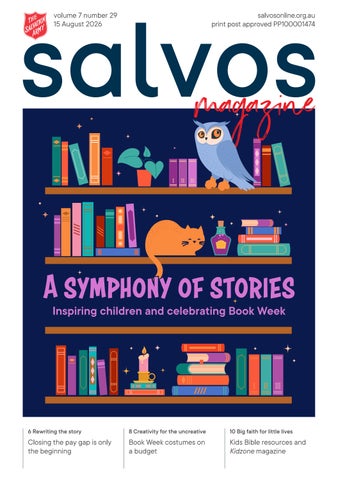
A symphony of stories Inspiring children and celebrating Book Week
6 Rewriting the story
8 Creativity for the uncreative
10 Big faith for little lives
Closing the pay gap is only the beginning
Book Week costumes on a budget
Kids Bible resources and Kidzone magazine
PHOTO BY DANIEL JOSHUA ON UNSPLASH
“Storytelling is among the oldest forms of communication. Storytelling is the commonality of all human beings, in all places, in all times.” – Rives Collins
15 August 2026
Editorial What is The Salvation Army? The Salvation Army, an international movement, is an evangelical part of the universal Christian Church. Vision Statement Wherever there is hardship or injustice, Salvos will live, love and fight alongside others to transform Australia one life at a time with the love of Jesus. Mission Statement The Salvation Army is a Christian movement dedicated to sharing the love of Jesus by: • Caring for people • Creating faith pathways • Building healthy communities • Working for justice The Salvation Army Australia acknowledges the Traditional Owners of the land on which we meet and work and pay our respect to Elders, past, present, and future. We value and include people of all cultures, languages, abilities, sexual orientations, gender identities, gender expressions, and intersex status. We are committed to providing programs that are fully inclusive. We are committed to the safety and wellbeing of people of all ages, particularly children.
Love stories When my daughter turned eight, she was given a kids Bible by one of her little friends at her birthday party. Another little girl saw the book and asked what a Bible was. My daughter hesitated and then answered, “It’s a big book of stories about God’s love and all the things he has done for us.” A pretty good summary, I thought. The little girl was intrigued and went on to read my daughter’s new Bible and ask lots of questions. She and my daughter are still friends to this day. The Bible remains the world’s best-selling individual book, with 5-7 billion copies sold worldwide. According to the Bible Society Australia, the number of languages with at least portions of Scripture translated now stands at 7378.
Scan here to connect with The Salvation Army services
Scan here to subscribe to Salvos Magazine
Founders: William and Catherine Booth Salvation Army World Leaders: General Lyndon and Commissioner Bronwyn Buckingham Territorial Leader: Commissioner Miriam Gluyas Secretary for Communications and Editor-In-Chief: Lieut-Colonel Paul Hateley Publications Manager: Cheryl Tinker Editor: Simone Worthing Graphic Designer: Ryan Harrison Enquiry email: publications@salvationarmy.org.au All other Salvation Army enquiries 13 72 58 Press date: 24 July 2026 Printed and published for The Salvation Army by Commissioner Miriam Gluyas at Focus Print Group, Chester Hill, NSW, Darug Nation lands.
As Book Week approaches, children across the country are celebrating all things books and reading. If you’d like to give your children or grandchildren a kids Bible or weekly kids magazine to explore and add to their reading pile, check out our recommendations on page 10. Happy Book Week! Simone Worthing Editor 3
Feature
Salvos Magazine
A symphony of stories Inspiring children and celebrating Book Week by Fay Foster
in Australia. The very first theme was ‘United Through Books’. I suspect that this theme embodied the whole purpose of celebrating a national Book Week: to promote a love for reading, to celebrate children’s literature, and to bring us all together over an entertaining book. Through activities that inspire young readers and foster creativity and imagination, children are encouraged to develop and share a lifelong love of books.
If you’ve ever walked past a primary school during the last week of August, it is very likely that you would have seen a crowd of children dressed in amazing costumes. A multitude of superheroes, Wallies with their red and white striped shirts, Harry Potters with their roundrimmed glasses, and Alices in their blue and white dresses are some of the favourites. You might even spot the occasional cat in a hat, or even a magic pudding! This annual phenomenon is a much-loved tradition in celebration of Book Week. Every year since 1945, the Children’s Book Council of Australia (CBCA) has set a national theme for Book Week 4
The theme for this year’s Book Week – to be celebrated 22-28 August– is ‘Symphony of Stories’. Award-winning author-illustrator of Gymnastica Fantastica and other children’s books, Briony Stewart, designed the themebased artwork for the week. “I decided to try and show what stepping into a symphony of stories might be like,” said Briony. “A huge colourful collection of characters bursting out of a book representing their different stories with weird and wonderful instruments.” While schools and public libraries conduct activities to celebrate Book Week, families can also use this week to encourage reading at home and discuss stories together. Book Week is a wonderful opportunity to inspire children’s imagination, celebrate Australian literature, and help young readers connect with the joy of books. – Fay Foster
15 August 2026
Off the Shelf
Off the shelf
Lost for words? Quirky and delightful words for every book lover Whether you’re a casual bookworm or a certified bibliophile, chances are you enjoy an unusual or interesting word. To celebrate Book Week (22-28 August), here’s a round-up of some of my favourite bookish terms.
PHOTO BY HARRISON MITCHELL ON UNSPLASH
As you crack the spine of a brand-new book or step into a cosy bookshop, you probably enjoy the bibliosmia, which is the distinctive aroma of books. Speaking of bookshops, hands up if you’re guilty of tsundoku. This is a Japanese term for acquiring books and letting them pile up without reading them. Living near a good bouquiniste (second-hand book dealer) is often directly linked to tsundoku. With so many books lying around, you’re probably your friends’ go-to person for a good recommendation and a loan. But do you have a friend who borrows books and never returns them? Well, now you can call them exactly what they are: a biblioklept. But better to be friends with a biblioklept than a biblioclast, a destroyer or mutilator of books! Oh, the horror! To help keep track of your library (stolen or otherwise), perhaps use ex libris, printed or decorative bookplates or name stamps usually stuck to the inside front cover of a book.
Is there a better way to end the day than tucked up in bed with a good book? Librocubicularists (people who love to read in bed) would say ‘no’. But how to choose that next riveting read? Like deciding what to watch on Netflix, book lovers can suffer reading paralysis when staring for too long at their bookshelves or bookshop wish list. Which leads to abibliophobia, an affliction I am never likely to suffer. Abibliophobia is the fear of running out of things to read. Not likely, right? And thank goodness for that. Happy reading! – Andrea Redford 5
Feature
Salvos Magazine
Rewriting the story
Closing the pay gap is only the beginning by Amanda Brummell-Lennestaal
This week we celebrate both Book Week dress-up day and Equal Pay Day on 25 August. Both tell us something about stories – the ones we read, and the ones we live. While children step into costumes of heroes and adventurers, many women are living stories that go unseen. We are the ones stitching together school costumes late at night, re-arranging work schedules for parades, covering caregiving leave that is never counted as career-building time. Women in Australia work more hours of unpaid labour at home than men, and single mothers shoulder even more, carrying double shifts of caregiving and breadwinning. 6
These micro moments add up. They accumulate into missed promotions, smaller superannuation balances, fewer chances to study and reskill. They show up in who can stay late at the office, who can network at corporate dinners, who is visible when decisions about advancement are being made. Flexibility is still treated as a concession for mothers, instead of a norm that could level the playing field for everyone. For women who are victim-survivors of domestic and family violence, the stakes are even higher. Career progression is not a luxury, it is survival. When there is no partner to act as an economic buffer, being restructured out or held back at
Feature
work means poverty and vulnerability for entire families. For women like me, survival is our strength. We work with grit and creativity because our lives depend on it. We adapt and we stretch, not because we want to carry so much, but because survival leaves us no other choice. But survival should not be the benchmark for Australian women. Economic security must be. Safety must be. Dignity must be. For leaders in government and business, the call is clear: equal pay is only the first page. The real work is rewriting the whole story – building systems and workplaces that value care, make flexibility the norm,
15 August 2026
and ensure that women are able to build careers with the same security and opportunity as men. This is not a side issue. It is about justice and dignity. It is about national prosperity and future competitiveness. A country cannot claim fairness and a business cannot claim innovation if women are asked only to survive while men are free to thrive. The next chapter must be different. Equal pay, equal opportunity, equal freedom to write our own futures. Amanda Brummell-Lennestaal is General Manager – Diversity Equity and Inclusion, for The Salvation Army Australia. 7
Feature
Salvos Magazine
Creativity for the uncreative
Book Week costumes on a budget by Amy Durand
When I was growing up we didn’t celebrate Book Week, but there were plenty of dress-up days. Mum would pull out the sewing machine and produce incredible costumes. Looking back, I have no idea how she found the time or the talent. I still have one of the aprons she made and now, years later, my own girls happily dress up in it.
a simple “Hello, I’m...” badge can make all the difference. It’s a fun way to help teachers, parents and classmates recognise who your child is dressed as.
These days, many of us don’t have the sewing skills of previous generations, or the time. With the rising cost of living, buying a professionally made costume isn’t always realistic either. The good news is that Book Week doesn’t have to be expensive, complicated or perfect. It’s about the love of reading, and the chance your child gets to step into their favourite pages.
5. Search your wardrobe first See what you already have in your wardrobe. Build the costume around your character’s main colours. Yellow pants and a red top become Winnie-thePooh. You’ll be surprised what you can create from everyday clothing.
Here are 10 simple tips to creating a ‘do it yourself’ (DIY) Book Week costume: 1. Start with a favourite book Choose a character your child knows and loves. They’ll feel more confident dressing up as someone they can recognise and talk about. 2. Look for a character with a feature The easiest costumes are often the most recognisable. Think about the one thing that immediately identifies the character – a golden ticket for Charlie Bucket, Harry Potter’s glasses, or Where’s Wally’s striped shirt. You don’t need every detail when one signature item tells the story. 3. Add a name tag If your character is a little less obvious, 8
4. Pin on the book cover Print or photocopy the front cover of the book and attach it to the costume. It’s an instant clue and a great conversation starter.
6. Let cardboard do the heavy lifting Cardboard is one of the most versatile craft supplies you’ll ever use. It can become crowns, shields, robot parts, wings, oversized crayons or signs. For example, grey clothes paired with cardboard panels covered in aluminium foil can quickly transform your child into the Tin Man from The Wonderful Wizard of Oz. 7. Never underestimate a good hat Sometimes the hat is the costume. A simple crayon tip made from coloured paper, paired with matching clothes, creates an instantly recognisable character from The Day the Crayons Quit. 8. Finish with a prop The right accessory can pull everything together. A basket becomes Little Red Riding Hood, a wand transforms any child
15 August 2026
Feature PHOTO COURTESY KAREN MASTERS
PHOTO COURTESY KAREN MASTERS
This outfit was created from sheets from Salvos Stores. Sewing trousers for the costume (above) sourced entirely from Salvos Stores. Salvos Stores are a great place to find affordable clothing and accessories.
into Harry Potter, and a magnifying glass instantly says Sherlock Holmes. Often, the prop is what people notice first. 9. Visit your local Salvos Store Op shops are treasure troves for Book Week. Capes, hats, jackets, old-fashioned clothing and quirky accessories can often be found for just a few dollars, making them a budget-friendly alternative to buying a brand-new costume. 10. Make sure it’s comfortable Remember that your child will be wearing their costume for an entire school day. They need to be able to sit on the floor, run around at lunchtime, eat, and visit the bathroom without needing constant
adjustments. If it’s comfortable, they’ll enjoy wearing it all day. Need inspiration? If you’re still drawing a blank, don’t panic. Google, Pinterest and ChatGPT are fantastic places to brainstorm ideas, especially if you already know your child’s chosen book. Search for the character’s name followed by “DIY costume”, or ask for ideas using clothes and materials you already have at home. You might be surprised how many creative, low-cost ideas are only a few clicks away. Amy Durand is Mission Support Writer for The Salvation Army in Western Australia. 9
Faith Talk
Salvos Magazine
Big faith for little lives
Kidzone Magazine Kidzone is a weekly, national publication for kids aged 5-14, produced by The Salvation Army Australia.
Using pop culture in a way that is relevant, positive and educational, the magazine features competitions, video game news, Bible stories, puzzles and activities. The team also provides a weekly Kidzone leaders’ guide, designed for volunteers and kids’ ministry leaders who use the magazine content when working with groups of children. “Its real primary purpose is to introduce kids to Jesus in a way that is fun and relevant,” said Senior Manager Editorial and Museums Cheryl Tinker. 10
More than 27,000 young readers enjoy Kidzone each week. The magazine is distributed throughout Australia to Salvation Army churches, centres and Salvos Stores. It is also regularly given out when the Salvos connect with their local community, at special events, or in family hampers.
Scan here for more information, resources or to subscribe to Kidzone.
Faith Talk
Bibles for kids
A visit to your local bookstore – Christianfocused or not – or their websites, can often leave parents and caregivers overwhelmed and somewhat confused at the wide range of choices available. Among all the great books written for children, some are specifically designed to help kids learn about God and introduce them to Jesus. To help those looking for something suitable for their children or other kids in their lives, some of the Salvos Magazine team recommended a few to consider: The Jesus Storybook Bible, by Sally LloydJones, tells the stories of Jesus and how they come together to tell the big story of God’s love. One of our readers with two young children commented, “This one is more traditional, but I appreciate a lot about it, and it’s well-written.” What is God Like, by Rachel Held Evans. Described by one reader as “a gentle and expansive look at the God that
15 August 2026
‘people have wondered about since the beginning of time but is far too big for any of us to fully see’. Beautifully illustrated and inclusive.” The Book of Belonging: Bible stories for Kind and Contemplative Kids is designed for families seeking a Bible storybook that reflects the diversity of God’s people. One user says, “Highly recommended for primary-aged kids. This unique Bible storybook is inclusive, historically accurate and encourages curiosity and a sense of belonging.” These books can be purchased on the Sally Lloyd-Jones, Penguin and Fishpond websites. Scan here for more information and suggestions for books for toddlers to 12-year-olds. 11
My Story
Salvos Magazine
Stories that shape change Jena combines a passion for storytelling and social justice to influence policy, inspire action and help create a more just Australia The Salvation Army’s Policy and Advocacy team recently welcomed another staff member, Jena Clarke. The Policy and Advocacy team is part of The Salvation Army’s newly formed Centre for Mission Impact, and advocates to influence key decision-makers and those who have the power to implement social policy change across state and federal jurisdictions in Australia. Salvos Online journalist Kirralee Nicolle recently caught up with Jena to find out about her background, her passions, and why she loves what The Salvation Army does. Can you tell me a little bit about your background and how you ended up here at the Salvos? I graduated in 2024, having studied social justice and creative writing. I really loved my time at uni, and I learned a lot about the world, its need for justice and ways of achieving equity through that process. In 2025, I spent time volunteering with refugees and asylum seekers around Sydney, and that was a really rewarding experience and something that I still do. I loved those connections, but I knew that I wanted a role where I could use my gifts in writing and language to make change. So, I joined the Policy and Advocacy team in November as a volunteer to learn about what the team did. It quickly became clear that I wanted to further dedicate myself to the incredible work the team was doing. That’s a really interesting combination – social justice and creative writing. What are some ways that you’ve used that already, either in this role or previously? I think the strengths of that combination came to the fore at uni. All of my creative writing assignments had a bit of a social justice twist to them, and I felt like I was 12
using writing and stories to talk about society and what was going on for real people. Then, as I’ve come into this team, I use the same skills to edit work or to analyse it. I’m learning a lot from the team because it’s a different kind of writing, but I have a deep appreciation of language as something so powerful, and so I’m so glad I can bring that appreciation into this role. You’ve already mentioned that you’ve done some volunteering with refugees and asylum seekers, but I’m curious about what specifically draws you about this work and about the work of the Salvos? I think it’s pretty clear that the Salvos have such a big reach around Australia and have been making changes for people on an individual level, on a community level and on a wider level for a long time. Since volunteering with the team and now being on staff, I’m seeing that we take what we see in Salvos services and we share that with the states and Commonwealth and say, ‘Hey, this is what people really need, and this is what will be beneficial for the people that we are interacting with.’ I sometimes found that when you study and think about all the difficult things
My Story
15 August 2026
Jena Clarke is the new face on The Salvation Army’s Policy and Advocacy team.
that we face in society, it can feel like there’s no hope, but I feel like Salvos has this real hopefulness about it as an organisation. And that comes through in this kind of advocacy work, because we’re having the real conversations and we’re trying to make change for people in a really structural way. Outside of work, what are your interests and hobbies? I love words. I love to write, and I love to read. I’m always reading short stories. While our personalities don’t align, I love
the way Hemingway wrote! I have a great appreciation for the way he used setting to tell the whole story and get a deeper point across. What are your hopes for this role going forward, and what are some of the things that you’re looking forward to? I’m excited to grow in this role. I’ve got a lot of passion and to be able to learn from the expertise of the team is unreal. I’m looking forward to supporting the team in the work that they do, and I’m also keen to use my gifts to benefit others. 13
Taste of Life
🍳
Spinach and cheese triangles
💡
Salvos Magazine
Quiz
1. What is the amount of light or darkness on a photograph known as? 2. What is shutter speed measured in?
Ingredients 150g feta, crumbled; 80g spinach leaves, thinly sliced; 1 onion, thinly sliced; 1-2 eggs, lightly beaten; 2 sheets puff pastry; salt and pepper; sesame seeds; salad if desired. Method Preheat oven to 200°C. Mix feta, spinach and onion. Add most of the egg to bind the mixture. Season with salt and pepper. Cut each pastry sheet into four squares. Spoon mixture onto half of the square to make a triangle, leaving a 1cm border. Brush border with egg and fold pastry over, pressing the sides together to seal. Brush top with remaining egg. Sprinkle with sesame seeds. Place on prepared baking tray and bake for 25 minutes. Serve with salad.
☺
Believe in Good: Tips
“Respect for ourselves guides our morals, respect for others guides our manners.” – Laurence Sterne 14
3. In photography, what is the unit of measurement for light called? 4. What type of lens allows for a wider field of view in a photograph? 5. What term is used where the main subject of a photograph is intentionally blurred? 6. What is used to stabilise a camera and reduce vibrations during long exposures?
📆
On this day
16 August, 1898 The Loop-the-Loop Roller Coaster patent was awarded to Edwin Prescott. First installed in Coney Island, New York, the roller coaster was able to carry four people at a time.
Take Five
😆
Have a laugh
What do you get when you cross a centipede with a parrot? A walkie-talkie Which snakes are the best at maths? Adders How do birds prepare for tests? They don’t – they just wing it. Why were all the penguins laughing? Because the emperor penguin had no clothes. What do you get from a pampered cow? Spoilt milk
🔍
Tum-Tum
On which page of this week’s Salvos Magazine is Tum-Tum hiding?
✏
Answers
🧩
15 August 2026
Word search
F Z M Q G B L A N G U A G E S Y S E L F H E L P P F B P G S D T B I O G R A P H Y B O A P D T I I V I A U T H O R E L P O I E I F H A R D C O V E R R E L A X N H K S C I E N C E Q C R I R T F G P X D R O M A N C E B T Y B O Z O I WF I C T I O N A I P O R H E M H L I B R A R Y C C L O M X T T I H A N D B O O K S H K A Y R R S O L I T E R A T U R E T U Y A T F A I R Y T A L E S D I X F V O WD I C T I O N A R Y O H U E R H F M A G A Z I N E S N P Q L Y G U A R D I N G H Z U P T G Y M N O V E L L A H Y P S M Words are hidden vertically, horizontally, diagonally, forwards and backwards. Enjoy! Author Biography Diary Dictionary Fairytales Fiction Guarding Handbook
📖
Hardcover History Information Languages Library Literature Magazine Novella
Paperback Poetry Politics Romance Science Self help Textbook Travel
Bible byte
“The Scriptures were written to teach and encourage us by giving us hope.” Romans chapter 15, verse 4 Contemporary English Version 15
Tum-Tum: is hiding behind the pink moon on page 4. Quiz: 1. Exposure 2. Seconds 3. Lux 4. Wide-angle lens 5. Soft focus 6. A tripod