Toilet twinning spreads sanitation round the world
14 November 2020 20p/25c
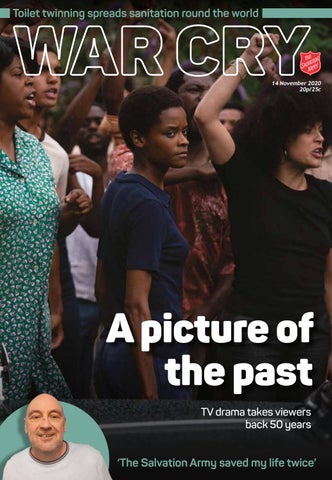
A picture of the past TV drama takes viewers back 50 years
‘The Salvation Army saved my life twice’
The Salvation Army is a Christian church and registered charity providing services in the community, particularly to those who are vulnerable and marginalised. Motivated by our Christian faith, we offer practical support and services in more than 700 centres throughout the UK to all who need them, regardless of ethnicity, religion, gender or sexual orientation. To find your nearest centre visit salvationarmy.org.uk/find-a-church
What is the War Cry? The Salvation Army first published a newspaper called the War Cry in London in December 1879, and we have continued to appear every week since then. Our name refers to our battle for people’s hearts and souls as we promote the positive impact of the Christian faith and The Salvation Army’s fight for greater social justice.
WAR CRY Issue No 7500
Editor: Andrew Stone, Major Deputy Editor: Philip Halcrow Production Editor: Ivan Radford Assistant Editor: Sarah Olowofoyeku Staff Writer: Emily Bright Staff Writer: Claire Brine Editorial Assistant: Linda McTurk Graphic Designer: Rodney Kingston Graphic Designer: Mark Knight Email: warcry@salvationarmy.org.uk The Salvation Army UK Territory with the Republic of Ireland 101 Newington Causeway London SE1 6BN Tel: 0845 634 0101 Helpline: 020 7367 4888 Subscriptions: 01933 445445 (option 1, option 1) or email: subscriptions@satcol.org Founder: William Booth General: Brian Peddle Territorial Commander: Commissioner Anthony Cotterill Editor-in-Chief: Major Mal Davies Published weekly by The Salvation Army ©The Salvation Army United Kingdom Territory with the Republic of Ireland ISSN 0043-0226 The Salvation Army Trust is a registered charity. The charity number in England, Wales and Northern Ireland is 214779, in Scotland SC009359 and in the Republic of Ireland CHY6399. Printed by Walstead Roche Ltd, St Austell, on sustainably sourced paper
Your local Salvation Army centre
INFO 2 • War Cry • 14 November 2020
EDITOR From From the editor’s desk
DID you know that reading a magazine could change your life? That SINGING good for you. So claim say scientists quoted on the but in might seemislike an outrageous from a magazine editor, BBC Future website. experts saidwho thathad singing this week’s War Cry weThe meet someone that can very boost experience. our moods and sense social connection. Cally Magalhães was of lying on her bed in Milton Keynes, reading Perhaps itwhen is with benefits mind street that people been a magazine, shethese saw an articleinabout kids inhave Brazil. joining online choirs during lockdown. In this week’s issue, the She read that they would sleep under the streets in the tunnels and War Cry’s Sarah Olowofoyeku joins and a virtual rehearsal thewhen London sewers for safety from paedophiles the police, butofthat the International Gospel Choir to discover for herself the pleasures heavy rains came, they would drown in their sleep. people found ofChristian, singing alone, yetthat together with others. Cally, ahave committed decided she could not stay in her Meanwhile Austen Hardwick has found similar value in running. comfortable home and believed that God wanted her to move halfway This week’s Warto Cry also America includesto anhelp interview the marathon across the world South those with children. runner who found thatlater, his sport helped him to regain hishelping life after More than 25 years Cally is still working in Brazil he suffered while early forties. young peoplethree who strokes are finding lifeinahis struggle, including those who are However, it was not only running that helped Austen’s recovery. imprisoned. His Christian played a vital in him taking a positive ‘I didn’t wantfaith to be one of thosepart Christians that went to church approach to all that he faced. on Sunday and was back to normal on Monday,’ Cally tells us. And I was in hospital,’ Austen says,has ‘I asked Godevery to take her ‘When life story clearly shows that her faith impacted daywhat and I was going through and to transform me through it.’ every part of her life as she looks to help others. Christians thatChristian God canwho takeworks any situation or anything Seren Boyd believe is another for the good of people that they do or face and use it to make a positive impact in others’ in other countries. She works for Toilet Twinning, a campaign run by lives or their own. Thatsafe hassanitary been the experience of painter Tearfund that provides facilities to some of the Oliver 4.2 billion Pengilley. people in the world who wouldn’t otherwise have them. Oliver had developed a successful career an artistinwith ‘As a Christian organisation, we believe veryasstrongly the some of his work selling for significant sums of money. But, as he tells importance of restoring people’s lives, standing against poverty and the War Crytheir thisdignity,’ week, he grew recognising she tellsfrustrated. us in an interview in this week’s ‘I didn’t see the meaning of it,’ he says. Now he travels to issue. churches overtothe to paintperson, pictures during worshipconditions You don’tallhave beworld a particular living in certain sessions and his faith-based artwork has helped other peopleofinyour or specific places in the world to experience God’s restoration their own faith journey. life. Anyone is able to turn to God and have their life changed – it’s an It is an amazing truth thattoGod opportunity that is available all. can take any skill a person has or any situation they are facing and can transform it into something that can change their lives and the lives of the people around them.
Contents
What is The Salvation Army?
FEATURES 3
Frank recollections
TV drama plays back events of 50 years ago
4
Flushed with success
The difference toilet twinning can make
7
Dramatic changes behind bars
Former performer’s work with prisoners
10 ‘It was my best chance to live’
How one man recovered from addiction
REGULARS
12
Team Talk
13
Out of the Mouth of Babes
14 Puzzles 15
War Cry Kitchen
7
10
Front-page picture: BBC/McQueen Limited/ Des Willie
15
TELEVISION
It’s a frank look back Sarah Olowofoyeku watches a story of discrimination
T
HE year is 1968, and Trinidad-born Frank Crichlow (Shaun Parkes) has just opened the Mangrove, his new restaurant in Notting Hill, London. But running the business is no piece of cake, as the first film in Steve McQueen’s Small Axe anthology reveals. Mangrove, one of five films which tell the stories of London’s West Indian communities, is based on true events and is scheduled to be broadcast on BBC One tomorrow (Sunday 15 November). Police officers have their eyes on Frank’s restaurant from opening night, and their motives are revealed when one officer says: ‘The thing about the Black man is that he’s got his place, but he’s got to know his place.’ That officer, PC Pulley, pays the Mangrove a visit, questioning Frank about what is going on inside and intimidating him. This is followed by a series of police raids on the restaurant, which had quickly become a hub of safety, support and sanctuary for the members of Notting Hill’s West Indian community. Altheia Jones-LeCointe (Letitia Wright), a young biochemistry student and a member of the Black Panthers, shows her support for Frank. Together with others, they also try to protect the young men among them who are subject to police brutality, often after unwarranted stop and searches carried out because they ‘fit the description’. Everyone in the community is tired of the relentless racist harassment they receive at the hands of the police. A demonstration is organised. On Saturday 9 August 1970, a group of protesters march to local police stations to make their voices heard. The protest results in the arrest of nine of the organisers including Frank, Altheia and Barbara Beese (Rochelle Sandall). The group are put on trial in a
highly publicised case. Frank is ready to give up when one evening during the 11-week trial, he pulls out a Bible from his drawer. He opens it, takes out a picture of his mother and father wedged between pages, and turns it round to see, on the back, the words: ‘In God you must trust.’ For many Black people, their faith in God has been a source of strength and comfort throughout times of racial injustice. A passion for justice has been fuelled by their experiences of inequality, as well Shaun Parkes plays as their firm belief Frank Crichlow that God made all human beings in his image and to be equal. Through this year’s protests against police brutality and the recent Windrush scandal, it is clear that, while there have been many victories along the way, the fight for equality continues. But the reassurance for all people who put their trust in God is that ‘the Lord loves justice, and he won’t ever desert his faithful people’ (Psalm 37:28 Contemporary English Version). Whatever hardships we may be facing as communities or as individuals, if we turn to God, we can know that he will always be with us.
BBC/McQueen Limited/Des Willie
The community is tired of the racist harassment
Barbara Beese (Rochelle Sandall) and others organise a protest against police brutality
14 November 2020 • War Cry • 3
Flushing away World Toilet Day on Thursday (19 November) seeks to highlight the plight of 4.2 billion people who currently lack access to safe sanitation facilities. To mark the day, SEREN BOYD from Toilet Twinning talks to Emily Bright about how sanitation saves lives
I
T all began with 500 toilets in Burundi. Christian charities Tearfund and Cord teamed up to create Toilet Twinning in 2010, viewing it as a shortterm fundraising campaign to boost sanitation in the country. A decade later, almost 140,000 toilets have been twinned, reaching approximately 839,000 people across 45 countries. Now run solely by Tearfund, Toilet Twinning has made quite a splash. Seren Boyd, who works for Toilet Twinning’s media and public relations team, explains how the campaign works: ‘When you twin your toilet, you pay a one-off £60 donation, which is then directed into our water sanitation work. ‘Toilet Twinning raises funds to provide proper
Seren Boyd
A Toilet Twinning loo in Ivory Coast
4 • War Cry • 14 November 2020
toilets, clean water and hygiene training in the poorest communities in the world.’ She outlines where Toilet Twinning operates. ‘We specifically work in hardto-reach and fragile conflict-affected communities. We want to make sure that even the most vulnerable and remote communities can get life-changing sanitation facilities.’ An estimated one million people are taught about hygiene each year through programmes funded by the campaign.This
poverty
INTERVIEW
A Zambian family stand proudly
hygiene education strand of Toilet Twinning’s work is crucial to the successful spread of sanitation, as Seren outlines. ‘We always work closely with the community to establish what their needs are. We start with education as it’s about encouraging behaviour change in communities where they’ve never had toilets before or don’t know the importance of handwashing.’ Part of this education, says Seren, is about respectfully challenging cultural traditions in instances where they endanger people’s health. She cites an example: ‘We work in rural communities in Afghanistan, where, in more conservative communities, washing your hands means that you would lose the blessing of the Mullah. In other places, for women to use the same toilet as their father-in-law is considered a taboo, and dishonouring to social and family norms.’ Through providing educational resources and offering training in communities, the campaign reaches a
wider audience with its message. ‘We often find that working through schools and educating children is a very effective way to encourage families to have a toilet,’ says Seren. ‘We also generally work through churches, church-based organisations and with other community
Poor sanitation cripples a family leaders to show them the importance of good sanitation facilities for their community.’ She elaborates on the transformative impact that such good sanitation facilities can have: ‘Having a toilet enables a family to take a first big step out of generational poverty. If you don’t have a toilet, then you’re trapped in a vicious cycle of ill health due to poor sanitation, which cripples a family’s ability to earn, to work, to go to school, to get an education and
Bridget and Lodeth benefit from the Toilet Twinning programme
outside their new toilet
therefore to better their prospects. ‘A large proportion of their money goes on medicine or accessing health facilities. But having a toilet means that their health improves and their money is not being spent on healthcare. So they can build up reserves, better themselves and develop their assets.’ Seren shares statistics which back her claim: ‘The World Health Organisation says that for every £1 spent on sanitation, it has a return of £5.50 in increased productivity and lower healthcare costs. So toilets are a cost-effective way of driving development.’ One beneficiary of Toilet Twinning’s life-changing impact was 14-year-old Bridget, who lived in a village in one of the poorest areas in Uganda. She and her schoolmates used to miss classes in order to collect water from a contaminated spring up to a mile away, and the smell of the old school toilets would make Bridget retch. But thanks to Toilet Twinning, the school has a tap stand and new toilets, and the girls were taught how to wash their hands properly. As a result of these changes, 65 girls re-enrolled in the school within three months and attendance rates soared. Bridget now has her sights set on completing her schooling and achieving her dream of becoming a nurse. Toilet Twinning is consolidating its efforts to improve sanitation in the wake of the coronavirus pandemic. In March, it launched an offshoot campaign called Tap Twinning, to fund handwashing facilities and reduce the transmission of the virus in the remote communities in which it works. Seren says that there are several additional risk factors facing those living in developing countries: ‘Nearly every country is affected by the virus, and where communities don’t have access to healthcare or handwashing facilities, the risk of contracting viruses is huge. And when you live in poverty, your immune
Turn to page 6
➥
14 November 2020 • War Cry • 5
From page 5 system is depressed. Handwashing is the single most effective deterrent for the spread of infection.’ For many living on the poverty line, building their own sanitation facilities may seem like an unaffordable luxury. But, for those communities supported by Tap Twinning, that’s no longer the case. ‘In very remote communities, water is perhaps scarce and infrastructure is expensive, costly and time-consuming,’ says Seren. ‘So we’ve made sure that handwashing stations are simple to use. ‘A key example of that is the Tippy Tap. It’s effectively a jerrycan rigged up on a wooden structure operated with a foot pedal. This is a simple way of encouraging communities to have a handwashing station right by their house, which uses scarce amounts of water. ‘We’ve got a large project in Haiti where the Tippy Taps have been a key intervention. ‘We also train communities to not only build these things but to use them regularly and properly. And we hope that a lot of the new habits learnt during the
We’ve made sure handwashing stations are simple to use pandemic will continue post-pandemic and continue to have an effect on health in the longer term too.’ Seren recalls there was ‘a huge outpouring of generosity’ after the Tap Twinning appeal was launched nine months ago. The campaign reported
projects in Ethiopia and Uganda The Tap Twinning initiative runs (above and left)
that £300,000 was donated within two weeks of the appeal starting. Seren is hoping that supporters will be just as generous in Toilet Twinning’s upcoming fundraising drive. ‘On World Toilet Day, we have what we ironically call a big push every year to twin as many toilets as possible, and we have hundreds of people twinning their toilets on that day. Every year it gets bigger and bigger.’ Seren takes a moment to explore the motivation that has driven Toilet Twinning’s success for the past decade. She explains that while Toilet and Tap Twinning support people of all religions and none, the campaigns flow from the faith foundation of Tearfund. ‘Everybody has the right to water and
6 • War Cry • 14 November 2020
sanitation. It’s in the UN Declaration of Human Rights,’ she emphasises. ‘As a Christian organisation, we believe very strongly in the importance of restoring people’s lives, standing against poverty and recognising their dignity. ‘We think it’s important to work with local churches, who are often at the heart of their communities. The churches have a passion to see people freed from poverty. They don’t make distinctions between what faith people are. They’ll reach out to anybody and everybody. ‘It’s wonderful to see how a church community can be the heart of an intervention that changes people lives in a dramatic way.’
INTERVIEW
Performer acts to help prisoners reform CALLY MAGALHÃES tells Sarah Olowofoyeku how she went from dancing for the Queen to staging drama workshops in a Brazilian prison
A
S a little girl, Cally Magalhães dreamt of becoming a dancer. At the age of 15, she gained a place at a dance school and shortly after that she performed at the Royal Albert Hall in front of the Queen. She had a bright future but unfortunately, because of a curvature in her spine, a doctor warned her never to dance again. Today, 40 years later, Cally is in a line of work that she could never have dreamed of. She is the founder of the Eagle Project, a youth prison ministry in São Paulo, Brazil. It all started soon after she became a Christian. After her dancing dreams were dashed, Cally discovered a talent for acting and worked for some years as a professional actress. She was teaching alongside acting and life was going well. ‘Then I met a man,’ she tells me. ‘We fell in love and got married but I found out he had been seeing another man.’ The relationship ended and Cally was at breaking point. ‘I didn’t want to live any more,’ she says. ‘But some people invited me to church. They met in a school, which was strange to me. I thought a church should have a steeple.’ She went along anyway and was amazed by what she saw. ‘I knew some Christians from university and thought they were a bunch of weirdos,’ she admits. ‘But in this church, I saw people worshipping and people who looked like they knew God intimately. I knew that these people had something and I needed it too.’ Soon after that first church visit, Cally
Cally Magalhães decided to become a Christian. She went through a deep process of healing following the breakdown of her marriage and received help from God to forgive her husband. Her life was changed. ‘I said to God: “I don’t want my life any more, you can have it.” I told him that I didn’t want to be one of those Christians that went to church on Sunday and was back to normal on Monday. I said he could do what he wanted with my life. And of course, that’s the most dangerous prayer you can pray.’ Cally found that she had a heart for telling people about Jesus, and went on
I didn’t want to live any more
Turn to page 8
➥
14 November 2020 • War Cry • 7
From page 7 short mission trips in India and Bosnia, as well as reaching children in schools in the UK through running assemblies. She believes that one day in 1994, God showed her where she was to go next. ‘I was lying on my bed in Milton Keynes,’ she says, ‘looking at a magazine, and I saw an article about street kids in Brazil. I read that they would sleep under the streets in tunnels and sewers for safety from paedophiles and the police, but when the heavy rains came, they would drown in their sleep. I thought: “I can’t just stay here in my comfortable home.”’ Cally felt that God was calling her to go to Brazil. Five years later, after training with Youth with a Mission, taking an English teaching course and visiting Brazil, she got ready to move to São Paulo. She joined a mission organisation and made arrangements to connect with people from a church in São Paulo. She was going to be working in what are known as favelas – slums, some of which are like small towns with thousands of inhabitants. ‘They are some of the poorest and most dangerous places in the world,’ Cally writes in her new book, Dancing With Thieves. In the book she describes her life in Brazil, which included getting married and becoming a mother of two, and the many amazing events that took place throughout her 21 years in the country
– especially the ways in which she was able to help others. This included providing food parcels to the many people Cally uses psychodrama to in the country help prisoners not reoffend living hand to mouth and unable to buy food if they are not working. The food has proved to be life-saving to those who and began writing a programme to use receive it and has opened a door for Cally in the prisons. When we were able to go to share her faith. in with the programmes, we were asked She also started a youth prison whether we wanted to work with first-time ministry, the Eagle Project in 2006, when offenders or the ones who were in for the one of the street children that she worked third, fourth, fifth time. I said we wanted with was imprisoned. The organisation the ones who had been in multiple times, that was accompanying him had lost its because they’re the ones who needed our funding, so Cally was invited to visit the help most. boy. That began many ‘In psychodrama we use a technique years of visiting prisons called role-reversal and put the boys in the to talk with and pray for position of the victim, or members of their the young men in there. family, or the police officer who arrested Many of the boys, them. When they do that, you can see though, would reoffend the moment they begin to understand on their release or end how others might feel. We had boys who up back on the streets. Cally prayed for a had done two or three sessions before new way of supporting them. they were released, and they would soon ‘In 2011, my friend from the UK sent be back in the prison. But for those who me a book about a project in Birmingham carried on, after about the fifth session, that uses psychodrama in prisons,’ she something began to sink in. And by the says. ‘Around the same time I learnt about tenth session, there was a real change. restorative justice and the two just went Now 70 to 80 per cent of the boys we hand in hand. So I studied psychodrama work with don’t reoffend.’ and did a course in restorative justice In her book, she tells the story of one
They begin to understand how others might feel
8 • War Cry • 14 November 2020
INTERVIEW After completing Cally’s programme, Luiz Henrique left prison and trained as a barber
Luiz Henrique endured poverty and abuse in childhood man who experienced that change through the programme. Luiz Henrique had a terrible childhood, in which he endured poverty and physical abuse. He was suspended from nursery at the age of two for trying to strangle another child. As he grew older, he ended up in youth prison twice from the age of 14. Luiz Henrique engaged in the Eagle Project’s role-play of a robbery he’d committed but in the role of the victim. He spent that night unable to sleep, realising that he needed to change otherwise he would remain in prison or end up dead. Today Luiz Henrique has opened a hair salon and is fulfilling his dream of helping young boys in his neighbourhood, through teaching them to be barbers. Cally writes that Luiz Henrique ‘calls me “mum”. We meet up for lunch about once month, and I am so blessed to see how well he’s doing.’ Cally has two sons of her own but over the years has gained many more ‘sons’ and ‘daughters’ through her work. While the road has been far from easy, she is sustained in her work by God. ‘People sometimes think you give your life to God and everything’s going to be okay, but it really isn’t. My life is a daily battle. If it’s not the car breaking, then it’s
health problems, or something wrong with my sons, or it’s financial, or something to do with the project. I am on the front line. But if that’s where God has called me to be, then I know that he’s with me, and I wouldn’t want to be anywhere else.’ l Dancing with Thieves is published by Sarah Grace Publishing
Cally has helped many street kids in São Paulo
14 November 2020 • War Cry • 9
Last orders Ahead of Alcohol Awareness Week (16–22 November), GARY MELLOR tells Claire Brine of the steps he took to overcome addiction
G
Library picture posed by model
ARY MELLOR can recall the moment he hit rock bottom. He was sitting alone in his Manchester flat with the curtains closed, drinking 50 cans of beer plus half a bottle of vodka a day. ‘I didn’t answer the phone or door. I didn’t eat or wash. I had to drink about ten cans before I could get out of bed in the morning, otherwise I couldn’t function,’ he says. ‘My family knew I’d lost control and they tried to help me. But I pushed them away. I just sat there and wallowed in my own self-pity.’ Gary explains that his dependency on alcohol began in his early twenties. After work, he’d always have a drink. ‘I started off going to the pub twice a week, then it became three times, then before I knew it, I was in there seven days a week,’ he says. ‘I tried to quit and did about 20 detoxes, but I remained a heavy drinker. Every other week, I ended up in hospital because of my alcoholism.’ When Gary’s doctor informed him that his body was ‘giving up’, he decided to confront his addiction. He heard about a place in Swindon called the Gloucester House addiction treatment centre, run by The Salvation Army, and decided to check it out. ‘As soon as I stepped in and walked around the place, I felt comfortable,’
10 • War Cry • 14 November2020
INTERVIEW
Gary Mellor
he says. ‘It was homely. The staff were amazing.’ After moving into Gloucester House, Gary got clean. He moved into his own flat. For three years, he lived a life free from alcohol. Then he relapsed. ‘I was in Somerset on a lovely day, and I happened to drive past a pub,’ he recalls. ‘I thought: one pint would be nice. So I went in and ordered a lager. I knew where it would take me. ‘After my drink, I drove home, had a cup of tea and a sandwich and thought: I’ve smashed it. Then I decided to go for a drive. But I knew exactly where I was heading. I drove to the nearest wine shop.’ Gary started drinking frequently – and in secret. At the time, he was facilitating meetings for Alcoholics Anonymous. ‘Eventually I admitted to the group that I’d been drinking, so I couldn’t take the meetings any more,’ he says. ‘But all that did was free me up to go on a mad bender, because I didn’t have anything to hide. Suddenly I was back at square one.’
After more drinking, Gary ended up in hospital. The same doctor who’d treated him many times before gave him a sober warning. ‘He said to me: “Gary, you need to get back in treatment or you’ll be dead within three months.” His words sank in. I said I would go back to rehab, as long as I could go back to Gloucester House.’ On 17 January 2020, Gary moved back into the addiction treatment centre. This time, he says, it has been a different experience. ‘The first time I stayed at Gloucester House, I did what was asked of me in order to tick boxes,’ he says. ‘But this year when I moved in, I knew it was my last chance. I understand now that my body can’t take even one more drink.’ Gary threw himself into the recovery programme, which included the 12 steps of Alcoholics Anonymous. He also enjoyed picking up some new skills in the centre’s workshop. ‘During the day I took part in the group work, where we explored the
My life is a different story now
triggers and thought processes behind our addictions. Then on Monday and Wednesday afternoons, we would chill out in the workshop doing things like glass painting, woodwork and pottery. I learnt how to engrave plaques, which I sent to my family. I also made a plaque for Gloucester House.’ After six months of rehabilitation, Gary was ready to move out of the main treatment centre and into its neighbouring house. The long-term plan is to find a flat on his own again – and to stay clean. ‘I know that I can,’ he says. ‘My life is a totally different story now. I used to be an angry person but I’ve become much more chilled. I also feel I have a purpose. I’ve got good relationships with my five sons and seven beautiful grandkids. And I’ve become a step mentor at Gloucester House, helping the lads work through the programme themselves. ‘The Salvation Army has saved my life twice, so I want to give something back to the treatment centre after everything it has done for me.’
14 November 2020 • War Cry • 11
EXPLORE
Prayerlink THE War Cry invites readers to send in requests for prayer, including the first names of individuals and details of their circumstances. Send your Prayerlink requests to warcry@salvationarmy.org.uk or to War Cry, 101 Newington Causeway, London SE1 6BN. Mark your correspondence ‘Confidential’.
j
Becoming a Christian
There is no set formula to becoming a Christian, but many people have found saying this prayer to be a helpful first step to a relationship with God
Lord Jesus Christ, I am truly sorry for the things I have done wrong in my life. Please forgive me. I now turn from everything that I know is wrong. Thank you that you died on the cross for me so that I could be forgiven and set free. Thank you that you offer me forgiveness and the gift of your Holy Spirit. Please come into my life by your Holy Spirit to be with me for ever.
Team talk
talk ‘ ’ Team talk
Thoughts for today
Claire Brine gives her take on a story catching the attention of War Cry reporters
HEY chaps, it’s your turn on Thursday (19 November) as it’s International Men’s Day, which also happens to fall in Men’s Mental Health Month. While both campaigns aim to celebrate the positive contribution that males make to the world, it also recognises that many of them are suffering in silence with poor mental health. It’s a problem that needs addressing. The Office for National Statistics reports that in 2019, more than 75 per cent of suicides in England and Wales were carried out by men and boys. Men and boys who couldn’t see a way out from depression, anxiety, stress and other problems. Men and boys who didn’t feel they could ask for the help they so desperately needed. Last week, mental health campaigner Matt Haig appeared on BBC One’s Morning Live, reflecting on how ‘bad’ a year 2020 has been for people who struggle with poor mental health. When questioned about coping with lockdown anxiety, We certainly do he suggested that people should try to focus have enough to their minds on the present. Rather than regretting the past or worrying about the future, ‘it’s about cope with concentrating on the day at hand’, he said. His words reminded me of a passage in the Bible, when Jesus advised the people around him: do not worry about tomorrow – you’ve got enough to cope with today (see Matthew 6). It’s almost as if he’s speaking about 2020, because in the middle of a global pandemic, we certainly do have enough to cope with. It’s understandable that people feel depressed and anxious. But what if, just this once, those of us prone to worrying about tomorrow tried not to? Would we find greater strength in handling our present? Would the practice of focusing on today – allowing ourselves room to acknowledge the pains and problems it presents, but not allowing ourselves to look further into the future – help our mental well-being? Honestly, I don’t know. But one thing I do know is that, however dark our thoughts may be right now, Jesus assures us that we don’t need to worry about what happens next. He’s got it in hand. And when it comes to today, he’s already facing it with us – one moment at a time.
"
Thank you, Lord Jesus. Amen Tick one or more of the options below, complete the coupon and send it to
a
War Cry 101 Newington Causeway London SE1 6BN
Basic reading about Christianity Information about The Salvation Army
Looking for help?
Contact details of a Salvation Army minister Name Extract from Why Jesus? by Nicky Gumbel published by Alpha International, 2011. Used by kind permission of Alpha International
12 • War Cry • 14 November 2020
Address
Or email your details and request to warcry@salvationarmy.org.uk
EXPRESSIONS
Rosemary Dawson on the life lessons she has learnt from her grandchildren
Googling God
E
q
quick quiz 1
2
Who accompanied Neil Armstrong and Buzz Aldrin on the Apollo 11 mission?
In the board game Cluedo, what is the name of the vicar?
a
3
What team won the Cricket World Cup in 2019?
4
Who played President Nelson Mandela in the 2009 film Invictus?
5
In music, what is the name for the simultaneous sounding of three or more notes typically in harmony?
6
What is the fabled thirteenth colony in the 2004-09 sci-fi TV series Battlestar Galactica? ANSWERS
ARLIER in the first coronavirus lockdown, my son and his wife decided that it would be a good time to hold family prayers on Easter Sunday afternoon and remember their scattered family and people in their church. Twelve-year-old Abigail was elected to say the first prayer, but somehow it didn’t come out in the way she had expected. ‘Dear Google,’ she began. When the other family members started laughing, Abigail realised her mistake and began again – properly this time: ‘Dear God …’ It’s what we adults call ‘a Freudian slip’, described by the Concise Oxford Dictionary as ‘an unintentional error regarded as revealing unconscious feelings’. In many people’s minds, Google is the highest ‘go-to’ authority. It’s the first place they turn to for a telephone number, facts about science, history or world statistics. And as I recently discovered, it even tells you how to make a face mask to guard against the coronavirus. Google always seems to have the last word. But there are some things Google can’t do. It can’t listen to our prayers and petitions, nor can it answer them. It cannot promise to be with us in times of trouble or distress. It cannot change lives and bring a new sense of purpose to those who ask it for help. Only God can do that, as the Bible writer Isaiah tells us: ‘He made the world to be lived in, not to be a place of empty chaos. “I am the Lord,” he says, “and there is no other”’ (Isaiah 45:18 New Living Translation). And we would do well to remember that.
BOOK REVIEW Our Roots: The Beautiful Stories of our Grandparents and Great-Grandparents Edited by Yazmin McKenzie Black Jac Media YOUNG Black writers share stories about their grandparents and great-grandparents in this new collection. The book was created in March after UK schools were forced to close because of the national lockdown. The children’s anthology is full of rich details about their grandparents. It tells how the older generation spent their childhood, how they’ve managed to adapt to life in the UK and, in some of the profiles, why they turn to faith as a source of help. The 27 young writers – aged from 5 to 13 – compiled the book in a matter of months. Children connected with their grandparents online and interviewed them virtually with a list of 40 questions that they created themselves. They then took part in a literary session and worked with their parents to complete their writing. The result is a beautiful book, which speaks of memories that will be cherished into the future, and a legacy that will last far beyond the current pandemic.
Linda McTurk
14 November 2020 • War Cry • 13
1. Michael Collins. 2. Reverend Green. 3. England. 4. Morgan Freeman. 5. A chord. 6. Earth.
CROSSWORD CROSSWORD PUZZLES
QUICK CROSSWORD ACROSS 1. Put an end to (7) 5. Assess (5) 7. Henley, for example (7) 8. Silent (5) 10. Hunted animal (4) 11. Without an idea (8) 13. One of two (6)
14. Deceive (6) 17. Dreamt up (8) 19. Intelligent (4) 21. Punctured (5) 22. Disastrous (7) 23. Crouch in fear (5) 24. Ship (7) DOWN 2. Fragment (7) 3. Appraise (4)
4. Annually (6) 5. Assembled (8) 6. Male relative (5) 7. Refill (9) 9. Flavourless (9) 12. Perplex (8) 15. Consistent (7) 16. Card suit (6) 18. Permit (5) 20. Mocking remark (4)
SUDOKU
Fill the grid so that every column, every row and every 3x3 box contains the digits 1 to 9
HONEYCOMB HONEYCOMB
9
5
Each solution starts on the coloured cell and reads clockwise round the number
Answers
7
2 5
2 7 8 1 5 2 7 6 3 6 8 3 4 2 1 4 7 8 4 1
Wordsearch
Look up, down, forwards, backwards
4 and 2 diagonally 9 5 1on the 6 grid 8 to 7 find 3 these James Bond films 8 5 1 7 3 9 2 4 6 CASINO ROYALE 6 3 7 4 8 2 5 9 1 Z T H L I D T D Z R H L J G G H V S S DIAMONDS ARE S H Y B P F E R T C E P S K O A E B F 3 9 5 2 7 4 6 1 8 FOREVER E E L T M P E K Z S K K L D L I U R Y FOR YOUR EYES ONLY 1 6 4 9 5 8 7 3 2 I L L N Z Q G L B O U W A J D M U K D GOLDENEYE D I A M O N D S A R E F O R E V E R F 7 8 2 1 6 3 4 5 9 GOLDFINGER T V B C W T D D C Z S T E D N C Z V O 5 7 6 8 9 1 3 2 4 LIVE AND LET DIE E I R N L A I J C Z J V U H E O U V R MOONRAKER L N E V Q U E M C O E Q G L Y S O Z Y 2 1 3 6 4 7 9 8 5 D G D L Y R K Q E N M P A U E L M M O NO TIME TO DIE 9 4 8 3 2 5 1 6 7 N D N H Y N T C W T Z Y C W X Y U U U QUANTUM OF SOLACE SKYFALL
SPECTRE
THE LIVING DAYLIGHTS
THUNDERBALL
HONEYCOMB 1. Edible. 2. La-di-da. 3. Fitted. 4. Sublet. 5. Pledge. 6. Double. QUICK CROSSWORD ACROSS: 1. Destroy. 5. Gauge. 7. Regatta. 8. Tacit. 10. Prey. 11. Clueless. 13. Either. 14. Delude. 17. Imagined. 19. Wise. 21. Holed. 22. Ruinous. 23. Cower. 24. Steamer. DOWN: 2. Segment. 3. Rate. 4. Yearly. 5. Gathered. 6. Uncle. 7. Replenish. 9. Tasteless. 12. Bewilder. 15. Uniform. 16. Hearts. 18. Allow. 20. Jibe.
4 8 6 3 1 7 5 2 9
TOMORROW NEVER DIES
2 5 3 9 6 8 7 1 4
9 1 7 5 4 2 6 3 8
5 7 4 2 9 1 8 6 3
1 3 8 7 5 6 9 4 2
6 9 2 4 8 3 1 7 5
8 2 5 6 7 4 3 9 1
7 4 9 1 3 5 2 8 6
3 6 1 8 2 9 4 5 7
SUDOKU SOLUTION
2 1 4
1 4 7
8
14 • War Cry • 14 November 2020
7 3
ordsearch ordsearch ordsearch ordsearch ordsearch
1. Fit to be eaten 2. Snobbish (2-2-2) 3. Made to fill a specific space 4. Lease a property to a subtenant 5. Promise of a donation to charity 6. Twice an amount
6
7 4 6
YOU ONLY LIVE TWICE
A A U E C A L O S F O M U T N A U Q R E Y H O Z B R Q E R R D Y Z G K X X E V L T W P R L G O L D F I N G E R J Y I I J Y O U O N L Y L I V E T W I C E L G X M Y T I A V N M Y D Q W Z O Q S V H O C Z S F W S N P R M W D L V Z O A T H N A Y L E O G B D U Z H K Y J N Y S Z C K Z A X E V K U O Y S R J N L U L W S I Y C Y F E B Z F I K D U I Y
6 8 7
3 6 3
4
D Beef and barley soup Ingredients
Method
1tsp rapeseed oil
Heat the rapeseed oil and onions in a pan and cook gently for 5 minutes, stirring regularly. Add the minced beef and stir for 5 minutes until starting to brown, breaking up any clumps with a wooden spoon. Mix in the garlic, carrots, swede, leek and celery and cook for 5 minutes, stirring regularly.
2 large onions, finely chopped 250g lean minced beef 2 garlic cloves, crushed 2 carrots, chopped 1 small swede, finely chopped 1 medium leek, finely chopped 2 sticks celery, chopped SERVES
20g plain flour
4
Sprinkle the flour over the mince and vegetables, mixing well. Stir in the beef stock.
1.5-litre low-salt beef stock 50g pearl barley ½ tsp dried thyme Black pepper 2tsp chives, chopped, to garnish
Garnish with the chives, to serve.
Stuffed aubergine Ingredients
Method
2 aubergines, halved lengthways
Preheat the oven to 180C/350F/Gas Mark 4.
1tsp rapeseed oil 1 onion, finely chopped 320g mushrooms, sliced
Mix again and add the pearl barley, thyme and a pinch of pepper. Bring to the boil and turn down the heat. Cover and simmer gently for 30 minutes.
Scoop the flesh out of the aubergines, chop and set aside. Place the aubergine skin-side down on a baking tray and bake for 15 minutes.
Meanwhile, heat the oil in a pan, add the onion and cook for 4 minutes. Add the mushrooms and chopped aubergine flesh, 2 garlic cloves, crushed then cook for a further 5 minutes. Mix in the garlic, canned tomatoes and oregano, then cover 400g can chopped and simmer for a further 5 minutes. tomatoes Stir in the borlotti beans and 1tsp dried oregano spinach and continue cooking for another 2 minutes. 400g can borlotti beans, drained Remove the aubergine skins from the oven and fill with the bean and 80g fresh spinach vegetable mixture, then place in 360g pack tofu, diced an ovenproof dish. Scatter with tofu, return to the oven and bake 62g reduced-fat for 20 minutes. mozzarella 1 fresh tomato, chopped 2 spring onions, chopped 8 basil leaves, torn
Top with the sliced mozzarella and continue baking for a further 20 minutes. Remove from the oven and scatter over the fresh tomato, spring onion and basil leaves, to serve.
Recipes reprinted, with permission, from the Diabetes UK website diabetes.org.uk
SERVES
4
14 November 2020 • War Cry • 15
Psalm 34:8 (New International Version)