FILM © Universal Pictures
RING F TRUTH Emma’s expectations don’t marry up with reality, writes Emily Bright
LIDING gracefully through the G greenhouse on her estate, the rich, smart and beautiful Emma
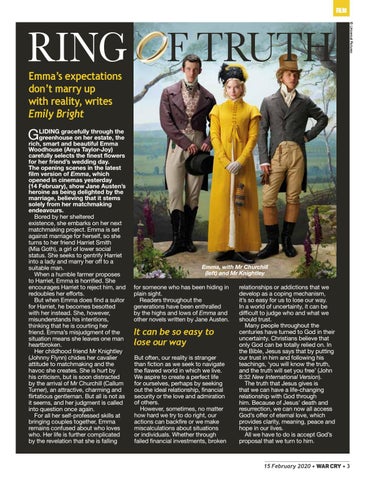
Woodhouse (Anya Taylor-Joy) carefully selects the finest flowers for her friend’s wedding day. The opening scenes in the latest film version of Emma, which opened in cinemas yesterday (14 February), show Jane Austen’s heroine as being delighted by the marriage, believing that it stems solely from her matchmaking endeavours. Bored by her sheltered existence, she embarks on her next matchmaking project. Emma is set against marriage for herself, so she turns to her friend Harriet Smith (Mia Goth), a girl of lower social status. She seeks to gentrify Harriet into a lady and marry her off to a suitable man. When a humble farmer proposes to Harriet, Emma is horrified. She encourages Harriet to reject him, and redoubles her efforts. But when Emma does find a suitor for Harriet, he becomes besotted with her instead. She, however, misunderstands his intentions, thinking that he is courting her friend. Emma’s misjudgment of the situation means she leaves one man heartbroken. Her childhood friend Mr Knightley (Johnny Flynn) chides her cavalier attitude to matchmaking and the havoc she creates. She is hurt by his criticism, but is soon distracted by the arrival of Mr Churchill (Callum Turner), an attractive, charming and flirtatious gentleman. But all is not as it seems, and her judgment is called into question once again. For all her self-professed skills at bringing couples together, Emma remains confused about who loves who. Her life is further complicated by the revelation that she is falling
Emma, with Mr Churchill (left) and Mr Knightley
for someone who has been hiding in plain sight. Readers throughout the generations have been enthralled by the highs and lows of Emma and other novels written by Jane Austen.
It can be so easy to lose our way But often, our reality is stranger than fiction as we seek to navigate the flawed world in which we live. We aspire to create a perfect life for ourselves, perhaps by seeking out the ideal relationship, financial security or the love and admiration of others. However, sometimes, no matter how hard we try to do right, our actions can backfire or we make miscalculations about situations or individuals. Whether through failed financial investments, broken
relationships or addictions that we develop as a coping mechanism, it’s so easy for us to lose our way. In a world of uncertainty, it can be difficult to judge who and what we should trust. Many people throughout the centuries have turned to God in their uncertainty. Christians believe that only God can be totally relied on. In the Bible, Jesus says that by putting our trust in him and following his teachings, ‘you will know the truth, and the truth will set you free’ (John 8:32 New International Version). The truth that Jesus gives is that we can have a life-changing relationship with God through him. Because of Jesus’ death and resurrection, we can now all access God’s offer of eternal love, which provides clarity, meaning, peace and hope in our lives. All we have to do is accept God’s proposal that we turn to him.
15 February 2020 • WAR CRY • 3
Fab for every Last year, Strawberry Field – the childhood haunt of John Lennon that inspired a Beatles hit – reopened with a new visitor centre and an employment training programme for young people. Philip Halcrow travelled to Liverpool to find out how the Salvation Army site is serving people from near and far
W
fans and to provide training for young people who face barriers to employment. And on this weekend in January, the first group of trainees on its Steps to Work programme are graduating. The original Victorian house was replaced by new accommodation in the early 1970s. In 2005, as ideas about how best to care for children changed, Strawberry Field was closed. But last September it reopened and is becoming a destination for people from around the world and closer to home. ‘After it closed,’ says Kathy, who was appointed mission director for Strawberry Field in 2018, ‘The Salvation Army wanted to know how best to use the site to serve the people of Liverpool. ‘There was a lot of prayer, and The Salvation Army carried out research which revealed that there are something like a million people in this country with a learning disability and that about half would love to have work but only 7 per cent are in paid work. The research also found that 31 per cent have no contact
Turn to page 10
➥
Strawberry Field ‘as John would have seen it’ and the new centre
8 • WAR CRY • 15 February 2020
PA
PHILIP HALCROW
HEN John Lennon was younger, so much younger than he was when the Beatles released ‘Strawberry Fields Forever’ in 1967, he would play with his friends and attend the summer fêtes that took place here. Today, rubbing her hands against the cold as we walk through the gardens of Strawberry Field, Liverpool L25, Major Kathy Versfeld stops to show me a see-through display panel that superimposes the image of a grand old house on to the real-life modern landscape behind it. ‘This,’ she says, ‘is where you get to see the place as John would have seen it, had he come up from the back wall – this would have been his view of the house and the steps.’ At Strawberry Field – the place that helped to inspire the Beatles’ hit – some things have gone, and some remain. The stones of the old site are still present in the steps and in the benches along the path. When the young John Lennon hung out in its grounds with his friends in the middle of the 20th century, the house was a Salvation Army children’s home. In 2020 The Salvation Army is using the site to welcome Beatles
FEATURE
yone
Paul, George, Ringo and John in 1967, the year they released ‘Strawberry Fields Forever’
15 February 2020 • WAR CRY • 9
Major Kathy Versfeld
fearful that the person might not get on with others in the workplace. But when we put a trainee on a placement, our work coaches have meetings with the employer and the trainee, and those relationships become quite close. ‘Now we’re finding that some of the employers want trainees to come back for a second placement. They like the experience.’ Chris, one of the first Steps to Work graduates, speaks with enthusiasm about his
placements. Having studied performing arts and drama at college, he was happy that Strawberry Field found him placements at three Liverpool theatres. ‘In my first placement at the Unity Theatre, I was an usher, collecting tickets and showing people to their seats,’ he says. ‘I was there for three months, and then three months at the Hope Street Theatre. ‘Then I went to the Everyman Theatre. That was the biggest place to go, because it’s so well known. At first I worked as an usher, then on the café side of things and cleaned the tables and spoke to the customers, and then I worked at the box office, where they showed me how to make bookings. ‘I learnt a lot at the Everyman. The people there are really friendly – they don’t rush you or put unnecessary pressure on you.’ Chris enjoyed his theatre experience. The Everyman was so impressed by Chris that it offered him a position. Other trainees talk to me about how much they have appreciated Steps to Work. Rumbi, who wants to work in a school or nursery, says that Strawberry Field ‘helped me with my confidence’. Mike, whose work placements helped him gain experience in catering, also talks about becoming more confident and adds: ‘I love coming here. I’ve enjoyed being able to see the work coaches and meet a load of nice people. It’s just somewhere to come and chill and relax.’ Strawberry Field has a track record of being a place where people love to be. As well as supporting young trainees, the new-look centre offers a welcome to Liverpudlians and the thousands of Beatles fans from around the world who turn up at its gates, fascinated to see the place that John Lennon sang about going to. Kathy says: ‘Every year 60,000-plus people have been coming to the gates and looking in. The Salvation Army wanted the centre to become a place of refuge for them too.’ As well as the café, the centre includes an exhibition put together by Jerry Goldman, the former director of The Beatles Story, Liverpool’s permanent Fab Four-focused exhibition. Equipped with an audio guide, visitors can go on tour through the space and learn about the history of Strawberry Field, the song that it inspired and The Salvation Army. In video clips
Chris
Rumbi
Steps to Work manager Alan Triggs
From page 8 with friends or family. ‘So by bringing young people with learning disabilities together for skills training, we’re not only meeting a need around employment, but we’re also addressing problems of isolation and loneliness. When they come here, there’s a sense of community.’ In the well-populated café at the new centre, Alan Triggs, manager of Steps to Work, describes how the training programme has begun to help these young people. ‘A lot of the time in their past, they have been told what they can’t do or what’s not possible,’ he says. ‘We focus on what they can do.’ The Steps to Work team help the trainees identify their interests and their strengths, and they find them work placements. ‘When we get to know the young people, we tend to find out early on what sector they want to work in,’ says Alan. ‘About two thirds of them already have an idea of what they’re good at, but some don’t really have a clue. ‘In Steps to Work the trainees go on three work placements, so if they’re unsure of what they want to do, they can try different sectors. For example, they may go on a retail placement and find they don’t like it, so then we may get them to try childcare.’ Alan and his colleagues train the young people in money management, CVs and interview techniques. They also help them with some of the other challenges faced by people with learning difficulties. ‘Some of them are confident in travelling by public transport, but others may fear getting lost or what they could be faced with when they get on a bus. If they are on the autistic spectrum, a lot of our trainees won’t travel at peak times or when there are a lot of schoolchildren on the bus, because it’s very noisy and the situation is quite erratic. So we provide travel training – we give them a process they can follow to travel almost anywhere in the city region. ‘We look at different ways in which they can travel and the benefits of those. Then we have a day where we go to a hotel for lunch. We look at what time we need to be there to eat, how long it will take us to get there, what time we’ll need to leave, and we build in a bit of contingency time in case we miss a bus. We get the trainees to download an app and talk them 10 • WAR CRY • 15 February 2020
through using the technology to get to the hotel in time. It gives them the confidence to be able to travel.’ The Steps to Work team, says Alan, ‘don’t just deliver a trainee to a work placement and wave goodbye’. Instead, they regularly visit the trainee. They also support the employers. ‘In the past, employers in general have been apprehensive of taking on somebody with a learning difficulty, because they have been
I’ve enjoyed being able to see the work coaches and meet a load of nice people
FEATURE
An exhibition tells the story of the site and the song a former resident recalls life at the children’s home, and a teenage friend recalls knocking John sideways by introducing him to Little Richard’s single ‘Long Tall Sally’. The audio guide also leads visitors outside and round the grounds, which are open to everyone with no need for them to pay. Kathy says that one of Strawberry Field’s values is generosity. ‘Before we reopened, there were discussions about whether we should charge people to come into the gardens. No doubt many would have paid to come. But we decided that, although people have to pay for the exhibition, we wanted people to be able to access the garden and this space freely.
Mike
In the garden, Kathy points out quotations on plaques, designed to invite those wandering its long and winding paths to consider some of the subjects raised Julia Baird by ‘Strawberry Fields Forever’, John Lennon’s other music and the Christian ministry of The Salvation Army. Anyone wanting to explore further whether all you need is love or what kind of world is worth imagining can visit a prayer space or talk with Captain Louise Brown, who leads a Salvation Army ‘Fresh Expression’ – ‘a new way of being church’ – on site. Kathy says: ‘There’s a real sense that God is at work here. Often people come up to me and their opening line is, “I’m not religious but…” Then they tell me that they came to a prayer meeting here and felt that their prayer had been answered. Or they say that they came out into the gardens and just felt something amazing.’ Julia Baird sees connections between what Strawberry Field meant to her brother, John Lennon, and what it means to people today. Julia, the honorary president of the Strawberry Field project, has seen the first trainees go through the Steps to Work programme and has come down to Strawberry Field this weekend to hand them their certificates. ‘We used to call this place “the orphanage”,
though it was not technically true,’ she tells me. ‘I do know – and even back then we did know – that in fact some of the children here had parents who were still alive but that it was enormously problematic for some families to be kept together in postwar Liverpool. ‘We know that John used to climb over the walls and watch the girls playing. It was blatantly a place of sanctuary for him – we know because he wrote the song.’ In late 1966, when the members of the Beatles went off to do their own projects before reconvening, John travelled to Spain to play Private Gripweed in Dick Lester’s surreal film How I Won the War. ‘When you’re filming, there’s a lot of hanging around,’ says Julia, ‘and while he was in Almeria, he wrote “Strawberry Fields Forever”. They’d all had a really tacky year in 1966. They were happy to leave behind the madness of public touring. ‘It sounds like mishy-mashy talk but they did want some time for themselves to reflect on who they wanted to be. And the song that John wrote was “Strawberry Fields” because he was thinking back, and Strawberry Field was a place of sanctuary for him. ‘And it’s a place of sanctuary for all these students. They can always come back here. That’s why I call Strawberry Field their forever home.’ 15 February 2020 • WAR CRY • 11
PHILIP HALCROW
John was thinking back, and Strawberry Field was a place of sanctuary for him
EXPLORE Prayerlink YOUR prayers are requested for Karl, who is being released from prison; and for Laura and her son, who are in need of strength. The War Cry invites readers to send in requests for prayer, including the first names of individuals and details of their circumstances. Send your requests to Prayerlink, War Cry, 101 Newington Causeway, London SE1 6BN. Mark your envelope ‘Confidential’.
Becoming a Christian There is no set formula to becoming a Christian, but many people have found saying this prayer to be a helpful first step to a relationship with God Lord Jesus Christ, I am truly sorry for the things I have done wrong in my life. Please forgive me. I now turn from everything that I know is wrong. Thank you that you died on the cross for me so that I could be forgiven and set free. Thank you that you offer me forgiveness and the gift of your Holy Spirit. Please come into my life by your Holy Spirit to be with me for ever. Thank you, Lord Jesus. Amen Extract from Why Jesus? by Nicky Gumbel published by Alpha International, 2011. Used by kind permission of Alpha International
Nigel Bovey gives chapter and verse on each book in the Scriptures
Colossians OLOSSAE was located in the region C of Phrygia (in modern-day Turkey). Although the Book of Acts records that
Paul visited the region, this letter to the Colossian Christians raises the possibility that he had not met them (2:1). He is mentoring their local church founder, Epaphras, who has visited him in his Roman prison (1:7 and 4:12). The letter focuses on two themes: who Jesus Christ is and how Christians should behave. Paul addresses the prevailing ‘deceptive philosophy’ (2:8), which denied the divinity of Christ. The word ‘Christ’ comes from the Greek word christos, meaning ‘anointed’. Its Old Testament Hebrew equivalent is ‘mashiyach’, from which the word ‘messiah’ originates. Paul now outlines the nature of that divine anointing. Jesus’ death and resurrection are the way God chose to forgive and redeem people (1:14). Christ is ‘the image of the invisible God’ (1:15) – meaning that if we
Key verse ‘For in Christ all the fullness of the Deity lives in bodily form’ (Colossians 2:9 New International Version)
want to know what God is like, we need only look at Jesus. Christ has the divine attributes of Creator and sustainer of the universe (1:16 and 17). He is the head of the Church and, therefore, rightly the object of worship (1:18), and he is divine (1:19 and 2:9). Through his death and resurrection, Christ has reconciled a sinful creation with its
Believers are to live as Jesus lived, showing compassion and gentleness sinless Creator (1:20–22). His death is the means by which God forgives all our sin (2:13 and 14). He is the fulfilment of the principles and practices of the Old Testament Law (2:16 and 17). Using imagery familiar at the time, Paul describes Christ as sitting at God’s right hand (3:1). One day, Paul assures his readers, they will be with Christ (3:4). In preparation for that unknown day, believers are to stop their old life of sin, characterised by the likes of sexual immorality, anger, malice and greed. Instead, they are to live as Jesus lived, showing compassion, kindness, and gentleness, being forgiving and ruled by love (3:5–14), ensuring they conduct all their relationships in ways that honour God (3:18–4:6).
"
Looking for help? Just complete this coupon and send it to War Cry 101 Newington Causeway London SE1 6BN Basic reading about Christianity Information about The Salvation Army Contact details of a Salvation Army minister
12 • WAR CRY • 15 February 2020
Name Address