FEATURE
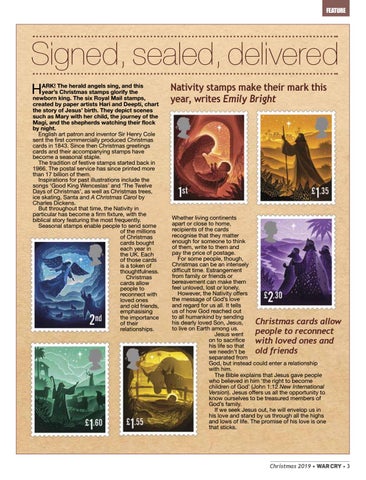
Signed, sealed, delivered ARK! The herald angels sing, and this H year’s Christmas stamps glorify the newborn king. The six Royal Mail stamps,
created by paper artists Hari and Deepti, chart the story of Jesus’ birth. They depict scenes such as Mary with her child, the journey of the Magi, and the shepherds watching their flock by night. English art patron and inventor Sir Henry Cole sent the first commercially produced Christmas cards in 1843. Since then Christmas greetings cards and their accompanying stamps have become a seasonal staple. The tradition of festive stamps started back in 1966. The postal service has since printed more than 17 billion of them. Inspirations for past illustrations include the songs ‘Good King Wenceslas’ and ‘The Twelve Days of Christmas’, as well as Christmas trees, ice skating, Santa and A Christmas Carol by Charles Dickens. But throughout that time, the Nativity in particular has become a firm fixture, with the biblical story featuring the most frequently. Seasonal stamps enable people to send some of the millions of Christmas cards bought each year in the UK. Each of those cards is a token of thoughtfulness. Christmas cards allow people to reconnect with loved ones and old friends, emphasising the importance of their relationships.
Nativity stamps make their mark this year, writes Emily Bright
Whether living continents apart or close to home, recipients of the cards recognise that they matter enough for someone to think of them, write to them and pay the price of postage. For some people, though, Christmas can be an intensely difficult time. Estrangement from family or friends or bereavement can make them feel unloved, lost or lonely. However, the Nativity offers the message of God’s love and regard for us all. It tells us of how God reached out to all humankind by sending Christmas cards allow his dearly loved Son, Jesus, to live on Earth among us. people to reconnect Jesus went on to sacrifice with loved ones and his life so that old friends we needn’t be separated from God, but instead could enter a relationship with him. The Bible explains that Jesus gave people who believed in him ‘the right to become children of God’ (John 1:12 New International Version). Jesus offers us all the opportunity to know ourselves to be treasured members of God’s family. If we seek Jesus out, he will envelop us in his love and stand by us through all the highs and lows of life. The promise of his love is one that sticks.
Christmas 2019 • WAR CRY • 3
Star’s in their Matthew’s Gospel describes how a star led some magi – or ‘wise men’ – to embark on a quest to find and worship the infant Jesus. Ever since, people have been trying to identify it, Professor DAVID WILKINSON tells Philip Halcrow
T
WO thousand years after the gospel writer Matthew described how it appeared in the east, it is still appearing on cards and in Nativity paintings and plays. The star that provided a clue to the birth of Jesus has fascinated scientists and scholars for centuries. Wise men are still trying to solve the mystery of what it was. With PhDs in theoretical astrophysics be possible from our understanding of and systematic theology, the Rev astronomy.’ Professor David Wilkinson of Durham David’s observation is that there are University can look at the star from two three main astronomical phenomena perspectives. that could provide an explanation for ‘Biblical commentators from the the star. 3rd century onwards have raised ‘The first is a comet, which chimes questions about it,’ he says. ‘You don’t with Matthew’s statement that it moves have to be a scientist to be intrigued across the sky. by what it was and what it signified. ‘The second possibility is a close We can see from the tradition that grew planetary conjunction where, for into astrology that people were always fascinated with what happened in the sky. Astronomy really started with You don’t have to be a Galileo and others in the 16th century, and virtually all of them were Christians, scientist to be intrigued so they would have had some interest in by what the star was the star.’ David says that those trying to follow example, Saturn and Jupiter can come the clues to the Bethlehem star turn to together so close in the sky that they evidence in two main spheres of study. appear to be one bright star. ‘The first type of evidence is the text. ‘The third possibility is a supernova Matthew gives one or two insights, but explosion. When stars get to the they’re not easy to identify fully. The end of their lives, they lose control of second task is to identify what might
6 • WAR CRY • Christmas 2019
David Wilkinson
themselves and explode in very bright events. ‘They are the possibilities from science. Then we’ve got to ask the question: Did any of those events happen about the time Jesus was born?’ David says that anyone wanting to answer the question can go to two kinds of sources. ‘One is astronomical records. For instance, the Babylonians and the Chinese were very good observers of the sky.
INTERVIEW
eyes
God used the stars to reach out to people who weren’t Jews and who didn’t know the Scriptures ‘The other type of source is calculations of planetary conjunctions. The laws of physics are fairly stable at the level of the orbits of planets, so we can do computer modelling to say what the sky looked like at the time of Jesus’ birth.’ But even when Bethlehem star searchers are equipped with the biblical text, ancient records and modern calculations, it does not follow that they can easily find what they are looking for. ‘One of the problems is knowing exactly when Jesus was born,’ says David, ‘and none of the three astronomical possibilities quite fit with the dating.’ David believes that there is space for a fourth possibility – ‘that it was a miraculous sign in the sky. It cannot be ruled out by science, because it would be God doing something beyond his regular sustaining of the laws of physics.’
He is not, however, convinced by a further theory. Some scholars think that the narrative about the wise men is not history but a different type of literature. ‘Some have argued that the story was created by Matthew to say how important Jesus was. I have to say that if someone was making the story up, I think they would have done a better job. To me, it has a ring of truth because not every detail is specified, not every question is answered. ‘I can almost imagine Matthew receiving this story and thinking that he needed to include this information, though he wished he had more details about it.’ Some people today may wish they had more information on the star. But David says that one significant detail that does appear in the narrative is often overlooked. ‘Often we’ve become obsessed with
the star and missed the point that, in a sense, the star didn’t lead the wise men to Christ. They saw a star and travelled to Palestine and then went to see King Herod. Herod consulted the religious scholars, and it was from the Scriptures that they found out that Jesus would be born in Bethlehem.’ As it stands – even with astronomical questions hanging over it – the story of the wise men sheds light on the significance of the way Jesus came into the world. ‘It says that God reaches out to people beyond our normal expectations,’ says David. ‘He used the stars to reach out to people who weren’t Jews and who didn’t know the Scriptures. ‘But the story also shows that seeing God at work in creation can only take you a certain distance. You have to search the Scriptures to find out about Jesus.’
Christmas 2019 • WAR CRY • 7
T I A F M L E A F A L M E A F O R A K I N GN F I
OR A K
Sarah Olowofoyeku reports on the meals bringing people together at the most wonderful time of the year
’T
IS the season to be eating. Food is usually in abundance during the Christmas period. Festive dinners with friends and colleagues take place throughout the month. Then comes the day itself, complete with turkey, stuffing, pigs in blankets and roast potatoes – or whatever a family’s tradition might be.
In many people’s eyes, The Salvation Army is also an integral part of the festive season, with some saying that ‘it’s not Christmas until you’ve heard the Salvation Army band playing’. The bands can be found in shopping centres, town squares, hospitals and at the front of carol services, accompanying congregations singing in celebration of ‘Christ, the newborn King’. It is just one of the ways that the organisation seeks to reach out to people at this time of year. Among the people they try to reach are those who may have a more difficult experience of Christmas. People facing problems such as isolation, poverty or homelessness do not always feel the season is the most wonderful
8 • WAR CRY • Christmas 2019
time of the year and may not be able to afford an all-the-trimmings Christmas dinner. But food and the Army go hand in hand all year round. And hundreds of Salvation Army churches across the country host a Christmas Day meal, especially for those who are marginalised, vulnerable or lonely. One such church is Lowestoft Citadel. Lisa King co-ordinates the day, when up to 100 people are provided with a Christmas dinner
People come who might otherwise not be eating anything with all the trimmings. Lisa, who works fulltime as a paediatric nurse, begins preparations in October. ‘Once upon a time, I used to start in August!’ she says. ‘But now I’ve got my head round things a bit more, I can start later.’ In the lead-up to the day, Lisa will invite some regular guests by phone, and also link up with organisations such as Age UK to see who else may like to attend. ‘We get people who are lonely, who haven’t got family or whose family live away,’ she says. ‘The homeless come, as well as those who have chaotic lives and might otherwise not be eating anything.
We have volunteers who go and pick them up.’ It’s a whole-day affair, which features an entertainer who sings with the guests. Everyone also goes home with a gift bag containing some goodies. In addition to the logistics of inviting people and arranging pick-ups, Lisa has to oversee the food, which comes from The Salvation a range of sources. Army hosts With so many mouths Christmas to feed, there’s a lot dinners with all of food to buy, and Lisa has an extensive the trimmings shopping list. But she is able to tick the items off her list through the generosity of others. Supermarkets, shops and businesses donate some of the food, and the rest is purchased with monetary donations that The Salvation Army receives. Organising a meal for such a large number of people takes a lot of work, but Lisa doesn’t do it alone. She says: ‘I have a group of about 40 volunteers. We start on Christmas Eve by decorating the tables, preparing the vegetables and getting the gift bags ready. Then on Christmas Day, we are there from 11.30 am to 6 pm. Some of our volunteers are new and just want to help out one Christmas, but some come year after year.’ Lisa herself has been serving the
T I F
FEATURE Library pictures posed by models
G N
Lisa’s shopping list for Christmas Day dinner: 24kg turkey crown
community year after year. ‘It feels as if I’ve always done it, so I couldn’t imagine doing anything different,’ she says. ‘Christmas can be sad for so many people, perhaps because it’s a reminder of what we haven’t got. So for that one day, the dinner makes life a bit different and helps people to take their mind off whatever they have going on.’ The day certainly affects those who attend. Lisa recalls the story of a man who had been disowned by his family and who was glad to pull a cracker with somebody and have a paper crown on his head for the first time. ‘For that one person, it’s worth it,’ she says. A nurse by vocation and a volunteer in
the community, taking care of others is a priority for Lisa. And she is motivated by her Christian faith. ‘I think God would want us to think about these people. He challenges us to do what we should for others, and he wants us to love them and make Christmas what it should be for them. Providing a meal, some entertainment and coming together can bring people a bit of peace and joy for that day.’
35kg potatoes 28kg Brussels sprouts 28kg carrots 28kg parsnips
SERVES
100
200 sausages 2kg bacon 3 jars of honey 8 pints of cream 120 Yorkshire puddings
50 mince pies
50 slices of Christmas puddin g A Christmas cake
A trifle
Fruit salad
Christmas 2019 • WAR CRY • 9
EXPLORE Prayerlink YOUR prayers are requested for Carianne, who is having a difficult time, and for her mother, who is concerned about her; and for Deb and her son-in-law, who are in need of hope, faith and strength. The War Cry invites readers to send in requests for prayer, including the first names of individuals and details of their circumstances. Send your requests to Prayerlink, War Cry, 101 Newington Causeway, London SE1 6BN. Mark your envelope ‘Confidential’.
Becoming a Christian There is no set formula to becoming a Christian, but many people have found saying this prayer to be a helpful first step to a relationship with God Lord Jesus Christ, I am truly sorry for the things I have done wrong in my life. Please forgive me. I now turn from everything that I know is wrong. Thank you that you died on the cross for me so that I could be forgiven and set free. Thank you that you offer me forgiveness and the gift of your Holy Spirit. Please come into my life by your Holy Spirit to be with me for ever. Thank you, Lord Jesus. Amen Extract from Why Jesus? by Nicky Gumbel published by Alpha International, 2011. Used by kind permission of Alpha International
Nigel Bovey gives chapter and verse on each book in the Scriptures
Who is Jesus? ACH of the four gospels emphasises E particular aspects of what Jesus did and who Jesus was. How each writer pic-
tures Jesus is reflected in the way they treat his nativity. Mark’s Gospel – the first to be written – doesn’t mention the birth of Jesus at all. To Mark, Jesus is a man of action. As if holding up frames on a strip of film, Mark presents snapshots of Jesus at work. Jesus calls disciples, casts out demons, heals the sick, preaches the good news and cleanses a leper – and that’s just chapter 1. With many mentions of miracles, Mark portrays Jesus as focusing not on his own past but on other people’s futures. Matthew writes to a male-dominated Jewish readership, aiming to convince them that Jesus is the long-promised kingly Messiah. He starts with a genealogy, tracing Jesus’ Jewish credentials through King David to the founding father of Judaism, Abraham (1:1–16). Matthew tells the story of Jesus’ conception through the eyes of Joseph. Matthew alone records that the young Jesus is honoured by ‘wise men’ or ‘magi’, who, having followed a star, arrive in Jerusalem, looking for a new king (chapter 2). Four times within his narrative of Jesus’ birth and early years, Matthew cites Old Testament prophecy with the comment that it has been fulfilled. Throughout the gospel, Matthew quotes the Jewish Scriptures at least another ten times.
In Luke’s eyes, Jesus is for everyone. He traces the genealogy of Jesus beyond Abraham to the founding father of all humanity – Adam (3:23–38). Luke tells the conception story through the eyes of Mary and her cousin Elizabeth (1:26–56). Luke goes on to record many
How each writer pictures Jesus is reflected in the way they treat his nativity instances of Jesus’ ministry to women. Luke notes that the first people to see Jesus were working shepherds (2:8–20). Throughout Luke’s Gospel, Jesus encounters ‘ordinary’ people. John emphasises the divinity of Jesus. He does not include details of what happened at Jesus’ birth, but commences with a philosophical consideration of what the Incarnation means. He sees Jesus as ‘the Word’, the eternal, divine, life-giving Creator, who became human flesh and blood (1:1–14). Echoing the divine name that God revealed to Moses – ‘I am who I am’ (see Exodus 3:14) – John records seven occasions when Jesus, pointing to his divinity, refers to himself as ‘I am’.
"
Looking for help? Just complete this coupon and send it to War Cry 101 Newington Causeway London SE1 6BN Basic reading about Christianity Information about The Salvation Army Contact details of a Salvation Army minister
12 • WAR CRY • Christmas 2019
Name Address