Vicar on being a rugby star’s mum
7 November 2026 50p/60c
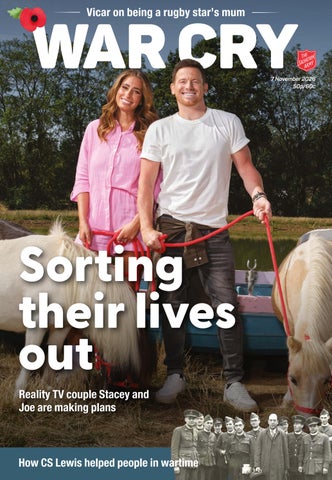
Sorting their lives out Reality TV couple Stacey and Joe are making plans
How CS Lewis helped people in wartime
UNCORRECTED
What is The Salvation Army? The Salvation Army is a Christian church and registered charity seeking to share the good news of Jesus and nurture committed followers of him. We also serve people without discrimination, care for creation and seek justice and reconciliation. We offer practical support and services in more than 600 centres throughout the UK. Go to salvationarmy.org.uk/find-a-church to find your nearest centre.
What is the War Cry? The Salvation Army first published a newspaper called the War Cry in London in December 1879, and we have continued to appear every week since then. Our name refers to our battle for people’s hearts and souls as we promote the positive impact of the Christian faith and The Salvation Army’s fight for greater social justice.
WAR CRY Issue No 7806
Editor: Gareth Dickens, Major Managing Editor: Philip Halcrow Staff Writer: Emily Bright Staff Writer: Claire Brine Staff Writer: Ewan Hall Editorial Assistant: Linda McTurk Graphic Designer: Mark Knight Graphic Designer: Matt Penberthy Email: warcry@salvationarmy.org.uk The Salvation Army United Kingdom and Ireland Territory 1 Champion Park London SE5 8FJ
From the editor’s desk Like many other people, I was introduced to CS Lewis and the land of Narnia by having The Lion, the Witch and the Wardrobe read to me at primary school. This tale of evacuee children, talking animals and magic fired my imagination. I’m sure I wasn’t the only child who wondered whether stepping into a wardrobe might take me on a similar adventure – though sadly it never did. I was, however, inspired to read for myself more of Lewis’s work, including the other Chronicles of Narnia books, his science fiction trilogy, and, as an adult, his non-fiction works such as Mere Christianity. Often Lewis’s books had their roots in his own life experience, and, in a War Cry interview this week, scholar Bruce R Johnson reveals some of the ways in which the Second World War influenced his later writing. During the war, Lewis took evacuee children into his home and was a member of the Home Guard, but it is his extensive work with RAF chaplains that Bruce examines in his new book From Airmen to Aslan with CS Lewis. Lewis’s initial talks to RAF personnel did not go well but, as Bruce says, ‘from his failures, he adjusted his approach’, and he adopted a questionand-answer format rather than delivering a prepared speech. Coupled with this new technique, his talks became increasingly focused on encouraging people, because he understood some of their fears and anxieties – as a 19-year-old he had been wounded while serving with the British Army in France during the First World War. The motto of the RAF Chaplains’ Branch is ‘To serve, not to be served’. It is based on words of Jesus to his followers, urging them to adopt such an attitude in their interactions with other people. As this weekend we remember the service and sacrifice of armed forces personnel and civilians in times of conflict, they are words we can all embrace. If we do, they will lead us towards creating a better, more just and more caring world.
When you’ve read the War Cry, why not pass it on ➔ ➔ ➔
Tel: 0845 634 0101 Subscriptions: 01933 445445 (option 1, option 1) or email: subscriptions@satcol.org Founders: Catherine and William Booth International leaders: General Lyndon Buckingham and Commissioner Bronwyn Buckingham Territorial leaders: Commissioners Jenine and Paul Main Editor-in-Chief: Major Andrew Stone Published weekly by The Salvation Army © The Salvation Army United Kingdom and Ireland Territory ISSN 0043-0226 The Salvation Army Trust is a registered charity. The charity number in England, Wales and Northern Ireland is 214779, in Scotland SC009359 and in the Republic of Ireland CHY6399. Printed by CKN Print, Northampton, on sustainably sourced paper
INFO Your local Salvation Army centre
CONTENTS FEATURES
3
In a Pickle At home with Stacey and Joe
6
Before the wardrobe The wartime work of Narnia author CS Lewis
9
Not all tea and training Vicar reflects on being the mum to an England rugby player
13 Look how far we’ve come Exhibition invites people to explore author and illustrator’s imagination REGULARS
FO 4
Team Talk and War Cry World
12 What Did He Say? 14 Puzzles 15 War Cry Kitchen Front-page picture: BBC/OPTOMEN TELEVISION/JUDE EDGINTON
2 • WAR CRY • 7 November 2026
6 9 13 15
BBC/OPTOMEN TELEVISION
Stacey and Joe share their home life with viewers
Home comforts
There are moments to treasure TV preview: Stacey and Joe: In Too Deep BBC1 and iPlayer By Claire Brine
T
he doors of Pickle Cottage are open – and celebrity couple Stacey Solomon and Joe Swash are inviting viewers to step inside their home and catch up with the family. In the first episode of the latest series of Stacey and Joe ‘everyone’s moving on nicely with life’, remarks actor and TV presenter Joe. The couple’s little kids are growing up fast, moving through nursery and primary school. The bigger kids are now young men, with the eldest, Zach, thinking about applying for a summer job at Camp America. Joe is also thinking about work and the future. He has plans to open a big fishing lake near the couple’s home in Essex and tells viewers how he hopes to make it a viable business. He wants to plant wildflowers in the grassy areas to ‘give it some colour’, install some glamping pods that guests can book for a little getaway, and create sociable spaces so families can visit and enjoy the odd picnic. With so many ideas bouncing around
Joe’s head, it’s helpful that his partner is the presenter of BBC1’s decluttering series Sort Your Life Out. Stacey agrees to help Joe get organised and make his dream become a reality by encouraging him to focus on one job at a time. On top of the lake project, Stacey and Joe are busy running round after their children, taking care of their numerous animals and pursuing their careers. Managing the diary is a constant juggling act – but they make it work. When Stacey is required to go away on a business trip, Joe holds the fort at home. He’s happy to. Pretending to be a monster, he chases his two young daughters up the stairs for their bathtime. He makes them giggle by throwing them on the bed. Then they snuggle up to him as they watch TV in their pyjamas. ‘I really treasure those moments where nothing happens,’ he tells viewers, ‘because I’m always doing something, I’m always a million miles an hour.’
He’s not alone. Perhaps many of us, too, have the habit of rushing through life, ticking off one job after another, only to find more demands heading our way. That’s why it’s good for us all to slow down on occasion. To take time to appreciate the things in our lives that we value. To allow ourselves space to connect with the God who loves us and whose presence gives us purpose. Encouraging a people who needed to learn the value of rest, God said: ‘Be still, and know that I am God’ (Psalm 46:10 New Living Translation). When we press pause on life, and begin to treasure the moments in which nothing much may appear to be happening, God can be at work in our hearts. We can open ourselves to experiencing the restoring power of his love, joy and peace, preventing us from running on empty. We can marvel at the beauty of life – and express thanks for it. When we take time to join the family of God, it’s a moment that changes everything. 7 November 2026 • WAR CRY • 3
Team talk TEAM WA
talk ‘ TALK’ j Already decking the halls
Claire Brine gives her take on a story that has caught the attention of War Cry reporters ‘It’s never too early,’ said Becky Evans, from Felixstowe, in a BBC article online about getting ready to celebrate Christmas. ‘I am Christmas crazy. I love what it’s about – the build-up, how it makes you feel... So the decs are up.’ The article revealed that Becky ‘started the trend of putting up her Christmas decorations early about eight years ago’. Her Instagram account is full of festive content, including daily ‘countdown to Christmas’ posts, which attract more than 116,000 followers. Although Becky’s grandchildren were reported to be fans of her Christmas cheer, the article said that her husband ‘does not quite share’ the same passion for decorations (or putting them up 100 days early). But, over the years, Becky has gone on to accumulate so many festive ornaments, baubles and trinkets that she has had to convert her summer house into Christmas storage space. ‘Christmas just gives you a fuzzy feeling that you can’t explain,’ she said. ‘It’s just magical.’ As a Christmas fan, I can easily understand the desire to get the party started early and to make the most of the festive season. I, too, love seeing the twinkly lights, glittering baubles and stacks of presents piled up under the Christmas tree, leaving me with the ‘fuzzy feeling’ that Becky talks about. But Christmas is about far more than the warm feeling we get in our heart when we see a street full of fairy lights. The celebration behind the decorations should never be forgotten. The reason we decorate is to celebrate the birth of Jesus. In my house, when I finally get round to opening the box full of tinsel and baubles, I’ll come across a simple Nativity scene that I bought when my daughter was born. She’ll help me to set it up, and we’ll talk about Christmas being a celebration of Jesus’ birthday. I’ll try to explain to her that Jesus was a gift from God, that his birth brings us hope and peace, and that it was a moment which changed the world for ever. When it comes to getting our heads round the Christmas story, we may not be able to explain it, but it’s never too early to reflect on it.
Becky’s Instagram account is full of festive content
Team talk 4 • WAR CRY • 7 November 2026
Modern slavery fighters honoured A long-serving member of The Salvation Army’s anti-trafficking team, along with an ITV journalist who reported on The Salvation Army’s work, have been honoured at an awards ceremony for their contribution to the fight against modern slavery. Norree Webb, who recently retired as a first responder co-ordinator for The Salvation Army, received the rebuilding lives award from the Human Trafficking Foundation. Her award recognises the exceptional work that she has carried out for more than 15 years. Starting as a volunteer who would drive survivors to safety, Norree went on to join The Salvation Army’s modern slavery staff. She conducted more than 2,000 interviews, gathering information from survivors, and trained professionals to identify signs of exploitation. At the same awards ceremony, journalist Marina Jenkins of ITV News West Country won the award for best news piece dealing with modern slavery. Her report highlighted The Salvation Army’s work in supporting survivors.
Marina and Norree with their awards
Do you have a story to share? a warcry@salvationarmy.org.uk TheWarCryUK
B salvationarmy.org.uk/warcry
R CRY
WnRLD ALAMY
It’s more than just football at Brentford Three Brentford footballers have spoken on the club’s website about the role that their Christian faith plays in their lives and careers. Fabio Carvalho (pictured), Igor Thiago and Josh Dasilva said that they regularly pray, read the Bible and support one another through challenges on and off the pitch. Igor explained that faith had helped him to avoid taking the wrong path in life when, at the age of 13, he lost his father. Josh rediscovered Christianity while recovering from a serious knee injury. Fabio turned to faith after finding footballing success unfulfilling. He said: ‘In football, you see so much so early. So much money, so much of the world. We have this now, but it could be gone tomorrow. ‘I don’t just see myself as a footballer; that’s not my identity any more. Before, it was football, football, football. Now it’s, “What can I do for the Lord?”’
Salvation Army voices support at Rough Sleeping Summit An emergency bed is only part of the solution to the problem of rough sleeping, The Salvation Army said when it attended the first Rough Sleeping Summit, hosted by Andy Burnham at Downing Street. Ahead of the summit, which brought together local authorities, housing providers, businesses, charities and individuals, The Salvation Army set up a rapid taskforce to look at how it could respond to the government’s desire to see everyone sleeping rough being offered a place to stay by Christmas. The church and charity already provides supported accommodation for more than 2,500 people every night at 77 locations across the UK and Republic of Ireland, and the taskforce learnt of how Salvation Army centres could expand their services or start new responses to the problem of homelessness. At the summit, The Salvation Army made an initial offer to: l Provide up to 100 additional direct-access beds in England; l Appoint up to 10 people who would co-ordinate homelessness services regionally as needed; l Mobilise its centres across England to explore the provision of drop-ins, day centres, hospitality, outreach and emergency accommodation; l Work with public sector partners to explore making further social housing, modular accommodation and move-on options available. Representing The Salvation Army at the summit, Chief Secretary Colonel Howard Russell stressed that providing an emergency bed is only part of the answer to homelessness. He pointed out that society also needs to offer suitable housing for people to move on to and support which addresses the barriers that cause and prolong homelessness. After the summit, Colonel Russell said that he felt encouraged. ‘There was a real sense that government, local authorities, charities, churches and businesses recognise that no single organisation can solve this alone,’ he said. ‘I was particularly struck by the emphasis on seeing the person and not just the statistic. The recognition that faith and community groups are essential partners – because of the local relationships and trust they have already built with people forced to sleep rough – was also encouraging.’ He added that he was ‘realistic about the scale of the challenge’, but said that ‘there is a willingness to work together, and The Salvation Army is ready to play its part’.
Cliff sings reggae for Christmas Cliff Richard is aiming for his fifth Christmas No 1 with the release of a reggae song based on the Bible’s Psalm 23. According to The Sun, the singer has ‘teamed up with Chris Eaton, who wrote his 1990 charttopper “Saviour’s Day”, for the track’. The paper quoted Cliff as saying: ‘I’ve never sung reggae before but Chris is really good at it. He’s phrased it like that, so I’m learning reggae.’ Cliff’s previous Christmas No 1 hits include ‘I Love You’ in 1960 with the Shadows, ‘Mistletoe and Wine’ in 1988, ‘Do They Know It’s Christmas?’ with Band Aid II in 1989 and ‘Saviour’s Day’ in 1990.
7 November 2026 • WAR CRY • 5
‘CS Lewis went to extraordinary lengths to do his part’ To mark Remembrance Sunday (8 November), CS Lewis expert BRUCE R JOHNSON reveals how the Chronicles of Narnia author brought hope and wisdom to prisoners of war and RAF personnel during the darkest days of the Second World War Bruce R Johnson
T
he tale of benevolent lion Aslan, his merciless adversary the White Witch and the tea-loving talking faun Mr Tumnus has unlocked the imagination of children around the globe. As they step into the wardrobe with four young evacuees, readers of The Lion, the Witch and the Wardrobe discover a world of magic and talking animals. CS Lewis added another six books to his series, which became known as The Chronicles of Narnia. ‘The books have a sense of wonder in them,’ says Bruce R Johnson. ‘Lewis doesn’t tell you how to feel, but he evokes emotions and touches the heart. He has a clear sense of goodness being compelling. We want things to turn out well for kind people. When people are oppressive, we want justice done. Those themes have lasted the test of time. ‘Lewis is also trying to show that if an imagined world can be deep, then the
6 • WAR CRY • 7 November 2026
Interview by Emily Bright spiritual world can be real and compelling as well.’ Arizona-based Bruce has unlocked some of the author’s inner world through editing Sehnsucht: The CS Lewis Journal, which examines Lewis’s life and work through a literary, philosophical and historical lens. As manager of the CS Lewis Correspondence Project – which is collecting the author’s correspondence so that it can be available to scholars – Bruce also has access to the author’s personal writings. All this expertise provides him with helpful insights into what shaped the writer’s work – knowledge which he has drawn on in his new book, From Airmen to Aslan with CS Lewis, connecting Lewis’s Narnian stories with his wartime experiences. ‘When he was about 16,’ says Bruce, ‘he had an image in his head of a faun carrying packages through a snowy wood.
He thought: “Maybe I’ll do a story about that sometime.”’ But it wasn’t until the Second World War that the main characters of Aslan’s kingdom entered the story – the Pevensie children. ‘The day before the declaration of war, Lewis opened his house to his first evacuees, teenage girls,’ explains Bruce. ‘In several cases, he helped pay for their college schooling, nursing school or their time at the Royal Academy of Dramatic Art. ‘Famously, one of the last evacuee girls that stayed there, June Flewett, later known as the actress Jill Freud, became the model for Lucy Pevensie. I think of Mr Tumnus saying, “I never knew what a human was like before I met you.” That’s the quality she exhibited. Then, after the war, he began dreaming of lions.’ While Lewis’s literary accomplishments are well documented, his wartime
COURTESY OF THE RAF MUSEUM LONDON
CS Lewis visits the RAF Chaplains’ School, Cambridge, in April 1944
exploits sometimes go under the radar, something that Bruce redresses ahead of Remembrance Sunday. ‘He was keen to do his part during the war and went to extraordinary lengths,’ says Bruce. ‘When the Home Guard was formed after the fall of France, he served for two nights a week in Oxford, patrolling the streets in the wee hours to ensure people had their blackout curtains up.’
He selected books to be sent to PoW camps
L
ewis also worked hard to educate soldiers abroad, drawing on his resources as a fellow and tutor in English language and literature at Oxford University. Bruce says: ‘He developed the first programme for British PoWs to study
English and get a degree from Oxford. He also selected religious books to be sent to PoW camps in Europe and did his radio broadcasts for the BBC Forces Programme.’ During the Blitz, Lewis also published The Problem of Pain, which tried to explain why a good and all-powerful God would allow suffering. It caught the eye of Christian leaders who realised that the RAF and the under-recruited ranks of its chaplains needed a morale boost. ‘After the Battle of Britain was over,’ says Bruce, ‘the dean of St Paul’s Cathedral gifted a fund to the Royal Air Force chaplaincy as a thank you for what the RAF did defending London.’ In March 1941, RAF chaplain-in-chief Maurice Edwards used the fund to recruit a reluctant Lewis to speak about faith at
Turn to page 8 f
Lewis drew on his wartime experiences to write ‘The Lion, the Witch and the Wardrobe’ 7 November 2026 • WAR CRY • 7
From page 7
ALAMY
the RAF station in Abingdon, Oxford. His talk was a flop. Happily, he was given the benefit of the doubt and toured across other RAF stations in England, Scotland and Wales that summer. ‘From his failures, he adjusted his approach,’ says Bruce. ‘For instance, he discovered that the question-answer format with a live audience can be effective. Rather than having a prepared speech, he’d wait for people to ask their questions.’ His RAF talks also helped him hone his wartime broadcasts on the BBC Home Service, in which he shared his theological ideas. He gave 25 radio addresses over four series between August 1941 and April 1944. His broadcasts became the basis for his book Mere Christianity. ‘You see the effect of his RAF work in Mere Christianity,’ says Bruce. ‘For example, in his third series of broadcasts, the BBC instructed him to write talks like
CS Lewis
8 • WAR CRY • 7 November 2026
he would do for the RAF. So the third section of Mere Christianity is specifically geared to a military audience. The fourth section starts with a speech that he gave on Palm Sunday at RAF Feltwell.’ In 1944, Lewis began speaking at the RAF Chaplains’ School at Cambridge University. But, as RAF padre Charles Gilmore reported, it took a while for the audience to warm up.
He is extraordinarily kind to folks that are a mess
‘G
ilmore was worried that the speech to the chaplains was overly academic at first,’ says Bruce. ‘But suddenly, Lewis made a provocative statement about grace. He said that prostitutes and pawnbrokers are more open to turning toward God than other
people. The chaplains became engaged and there was give and take as Lewis connected with his audience.’ For Lewis, the talks became ‘not about winning the argument but encouraging people’, says Bruce. ‘During his last RAF talk in 1945, the chaplain present wrote that a corporal asked a very unpleasant question and that Lewis used his great intellect to crush the man. ‘Afterwards, the chaplain came up to Lewis and said: “I’m sorry about Corporal So-and-so.” And he replied: “No, it was my fault. You should never crush somebody; however unpleasant they are. You must find a way to encourage them.”’ Over the years, Bruce adds, the author softened. He became ‘more faithful and kinder, the more he followed Christ’. Bruce says: ‘You see this in the war years. He gets all this fan mail. People are asking serious questions about their spiritual lives and he feels duty-bound to answer them. He writes tens of thousands of letters in his life and gets better at answering people’s questions. He is extraordinarily kind to folks that are a mess.’ Lewis’s softer approach would shape his later work. ‘In his writing after the war,’ says Bruce, ‘he uses his creative side to show God as kind, appealing and majestic. He illustrates that holiness is powerful, enlightening and can add joy to life. Those themes come to the fore in the Narnia series.’ Re-examining Lewis’s tireless wartime work, Bruce concludes that ‘anecdotal evidence’ shows that his books and talks ‘opened up minds to a new way of thinking’. He says: ‘One PoW who read Lewis’s The Screwtape Letters while he was incarcerated decided that he didn’t want to be about hate. So he stopped hating the Germans. He said: “I don’t respect them much, but I don’t hate them any more.” ‘Another time, when Lewis was present, one RAF officer stood up and said: “This is the first time I’ve heard anyone give any reason to believe that the Bible might be true.”’
l From Airmen to Aslan with CS Lewis is published by SPCK
ALAMY/ SOPA IMAGES
For the love of rugby The Rev OLIVIA COLES reveals what it’s like to be mum to an England rugby player, how she prays for her son Alex, and why tea is key to her ministry Interview by Emily Bright
England’s Alex Coles
R
The Rev Olivia Coles
ugby club Northampton Saints came marching into Alex Coles’s life when he joined their academy at just 13 years of age. At 15, he wore the red rose on his rugby shirt for the first time when he represented England at under-16s level. Since then, he has lifted the Premiership trophy twice for his club and become part of the senior England squad, who begin the fourth round of their Nations Championship campaign this weekend. But to the 27-year-old’s mum – the Rev Olivia Coles – Alex is much more than the sum of his sporting achievements. ‘We’re so proud that he plays for England,’ says Olivia. ‘But for me, it’s about him becoming who God wanted him to be, using his skills and gifts and showing compassion and care to others through a team that supports him. ‘I still remember that when Alex was little, a boy from the opposing team got knocked down in the middle of a football
game, and he rushed over to help him up. Showing compassion was far more important to him than being in goal.’ Years later, Alex’s family – his mum, dad Alasdair and sister Kana – continue to be among his greatest cheerleaders. From the stands of Everton’s football stadium, they watched England defeat Fiji 73-8 during a Nations Championship fixture this summer.
I pray that Alex and the team give of their best
W
atching rugby as a spectator can stir many emotions – joy, frustration and even sorrow. But imagine being a player’s mum… ‘A lot of people ask me whether I worry
Turn to page 10 f 7 November 2026 • WAR CRY • 9
From page 9 about him getting injured. Of course! But I try not to think about that,’ explains Olivia. ‘Instead I’m usually praying that Alex and the team play well and give of their best.’ She admits that ‘it’s tempting to pray for a win’ and that it is gutting when his team loses ‘after they put their heart and soul into a game’. But, as Christian parents, Olivia and her husband have tried to teach their son that his inherent value far outweighs any of his on-pitch performances. ‘From a faith point of view, we have had conversations with Alex,’ says Olivia, ‘because when you’re an international player, you’re measured on your performance. That really challenges your identity. ‘Alex has a strong work ethic, discipline and the desire to succeed. But at times, he hasn’t made the England bench. That’s been tough, yet hugely important in developing his understanding that he is
Olivia with her son Alex, husband Alasdair and daughter Kana
worth more than how well he plays or any of his achievements.’ Alex first became interested in rugby at the age of 11. When one of his friends joined Newmarket Rugby Club, he begged to go too. But initially Alex seemed underwhelmed by the experience.
I was impressed with my son’s discipline
‘F
or the first few times, Alex didn’t really enjoy it,’ says Olivia. ‘He was also football mad and played cricket and hockey. So his rugby only took off when he was at secondary school. Sport was where his friendships were and was a good way to work off energy. ‘Alex’s height meant he had a natural ability. Things became a bit more serious for him when he was picked up by
the academy.’ While Alex’s dad was a keen rugby fan, Olivia describes herself back then as a ‘bit of a fair-weather supporter’. She says: ‘If I thought they’d serve good coffee, and there were lots of lovely mums I could chat to, I’d be keen to go and watch him play. I was a bit hopeless at the side of the pitch, though, because I’d be so busy chatting or waiting in the coffee queue that I’d miss one of his tries. ‘But we would happily take him to his matches. He would go once a week to Saints Academy. We’d often take him with a friend, and I’d love hearing these smelly, muddy boys all chatting in the back of the car on the way home.’ When Alex joined the academy, Olivia quickly realised that ‘there was a lot of sacrifice involved’ for him. ‘He was contracted, so couldn’t go off skiing or do other mad sports. He had to have his holidays when they told him, and even from the age of 14 or 15, he had to find a gym that he could go to while on holiday. I was impressed with my son’s discipline, from his diet to how he trained.’ One thing that Alex could not do because of his sport during his teenage years was go to church. Weekends were usually packed with fixtures. ‘We felt that he loved sport so much that, as his parents, we had to go with it and encourage him,’ explains Olivia. ‘We prayed that the seeds of faith sown through all the Christian camps and holiday clubs that he’d gone to would develop as he grew to be an adult.’ The seeds of faith were planted in Olivia herself when she was young.
My faith grew from seeing God’s love in action
‘W
hen I was a baby, my dad gave me a Bible that is very precious to me,’ she says. ‘He underlined Proverbs 3:5, which says: “Trust in the Lord with all your heart.” That verse has been hugely important. ‘I’ve always wanted God to send stone tablets down to say: “Olivia, this is what you should do.” But God doesn’t work like that. He gives us freedom. And at times, we just have to keep holding on with our fingernails and trust him.’ Olivia’s dad was a vicar, so faith has always been part of her family culture. ‘My faith grew from seeing community
10 • WAR CRY • 7 November 2026
MARK PAIN/ALAMY LIVE NEWS
ANDREW MATTHEWS/ALAMY
Alex in action for Northampton Saints (left) and England
and God’s love in action through my parents,’ she reflects. ‘Those values – a pastoral heart and sense of community – were the seed of me wanting to become ordained into ministry.’ Growing up in ‘a mixed inner-city parish’, Olivia cherished ‘the sense of open house’. All kinds of people came to their door – the bishop, actors, those just out of prison, those experiencing homelessness and those who were wealthy. She reminisces about her parents’ hospitality towards one man, Reg, who experienced homelessness. ‘I’d make a cup of tea and a sandwich for Reg. He came one Christmas too.
He hadn’t had a bath in a while, so when he took one, he left a wonderful black rim round it. He put on a clean shirt and joined us and the church for a Christmas meal. I just thought that this is what God is about – community. For me, it was a picture of Heaven.’ Olivia embodies hospitality today through her ministry. Ordained in 2015, she has served at St Mary’s and St Andrew’s Church in Whittlesford, Cambridge, for the past eight years. ‘I couldn’t really put on the vicar application form: “I want to be ordained because I love having cups of tea with people”,’ she jokes. ‘But at the heart of
it, that’s what it’s about – walking with people and welcoming them. ‘Recently, I did three weddings and two funerals in eight days. It’s an absolute privilege to be with people in their times of greatest joy and also their hardest moments.’ Olivia prays that – whatever the situation – she can be ‘a cog in the wheel of showing God’s love to people’. The rugby player’s mother, who cares about who her son is beyond the game, takes a similar attitude in her approach to ministry. ‘As a vicar, I encourage others to see that our worth is in Christ,’ she says.
7 November 2026 • WAR CRY • 11
Prayerlink
What did he say?
The War Cry invites readers to send in requests for prayer, including the first names of individuals and details of their circumstances, for publication. Send your Prayerlink requests to warcry@salvationarmy.org.uk or to War Cry, 1 Champion Park, London SE5 8FJ. Mark your correspondence ‘Confidential’.
j
Lynne Shaw takes a look at some of the significant sayings of Jesus
Becoming a Christian
There is no set formula to becoming a Christian, but many people have found saying this prayer to be a helpful first step to a relationship with God
Lord Jesus Christ, I know that I have done things in my life that are wrong and I’m sorry. Thank you that I can ask you for forgiveness because of the sacrifice you made when you died on the cross. Please forgive me and help me to live a better life in the future as I learn how to love you and follow your way of living. Thank you, Lord Jesus.
Greater love has no one than this: to lay down one’s life for one’s friends – John 15:13 A recent glance at a financial website revealed to me that you could exchange your £1 for 1.19 euros, 1.91 Australian dollars and 45.04 Thai baht. Apparently, the British pound is stronger than expected. When Jesus was talking about the worth of love, however, he didn’t mention anything about it being calculated in money, although he did indicate a cost: how much we’re prepared to give for the sake of others. If we were to offer other modern paraphrases of Jesus’ words, we could say: ‘Mega charity is to put aside yourself for your friends, family and community.’ Or: ‘The exchange rate for love is your whole self, and it can’t be bettered.’ However we would put it, I see the truth of Jesus’ words illustrated in a mother who is prepared to drive across town in the early hours of the morning to pick up her son when he needs a lift. I see it in the hours, days and lives given to care for a loved one. I see it in the many people who have been publicly thanked for work that has often gone on behind the scenes, changing communities for the better. When Jesus spoke of ‘no greater love’, he also gave his disciples the example of himself. He said: ‘Love each other as I have loved you’ (John 15:12 New International Version). The disciples didn’t yet know the full extent of that love, but they had already seen the wholehearted way in which he cared for them. Adverts often claim that a new version of a pizza, shampoo or pet food is the best yet. However, there’s always room for improvement – and the same can be said for each one of us. Whether we’re spouses, siblings, colleagues or just connected as members of society, there’s always an opportunity for us to be stronger, more giving, more understanding, more patient and kinder.
"
Want to know more? a
To receive basic reading about Christianity and information about The Salvation Army, complete this coupon and send it to
If you’ve prayed this prayer, scan the QR code or contact us using the coupon on this page
War Cry 1 Champion Park London SE5 8FJ
Name
Address
Or email your name and postal address to warcry@salvationarmy.org.uk 12 • WAR CRY • 7 November 2026
‘The Boy, the Mole, the Fox, the Horse ... and You’ – a drawing made for the exhibition by Charlie Mackesy
Bestsellers’ artwork illustrates a point
QUICK QUIZ 1
Who is the new host of TV’s House of Games?
2
What is the capital city of Oman?
3
Who wrote the novels Housekeeping and Gilead?
4
Who directed the 2009 film Avatar?
5
In which Cornish town is the Barbara Hepworth Museum and Sculpture Garden?
6
Which group has had hit albums with If You’re Feeling Sinister and Dear Catastrophe Waitress?
ANSWERS
Charlie Mackesy exhibition reveals artist’s creative process Feature by Ewan Hall
A
boy and three animals are being joined at a southeast London gallery by thousands of visitors. Dulwich Picture Gallery is staging an exhibition of drawings by author and illustrator Charlie Mackesy. Charlie Mackesy: The Boy, the Mole, the Fox, the Horse … and You, which runs until 7 February, lets visitors step into the artist’s imagination. It showcases sketches and finished illustrations from his book The Boy, the Mole, the Fox and the Horse – which has sold more than 10 million copies since its publication in 2019 – and its successful follow-up Always Remember. Alongside Charlie’s work for the books, visitors can see an original drawing made just for the exhibition. They are also able to listen to an audio guide by the artist, in which he discusses his technique and how he approaches his art. Curator Kate Bryan says that Charlie’s ‘distinct hand distils emotional and psychological messages into elegantly simple artwork’. She says it is ‘universally regarded across all ages and continents’ and is loved ‘because it embraces our imperfections, gives gentle reassurance and reminds us there is power in vulnerability’. The books’ hints of imperfection and vulnerability are underlined in how the exhibition displays the artist’s early designs and ideas alongside the finished products. Rather than hiding mistakes, it shows that imperfection is a natural part of the creative process. Despite the message on display, many of us spend time worrying or trying to hide our imperfections for fear of how others might perceive us. We try so hard to appear successful, confident and in control even when we are really struggling. Yet Christians believe that there is someone who already knows all our flaws but who does not see them as diminishing our value. In the Bible, the early Church leader Paul hints at a persistent struggle he was facing. But he records Jesus as telling him: ‘My grace is enough; it’s all you need. My strength comes into its own in your weakness’ (2 Corinthians 12:9 The Message). If we confide in Jesus, we will find that he does not expect us to be the flawless finished product. Instead, he is happy to meet us in our imperfections and offer us love and acceptance – something it’s always worth remembering. 7 November 2026 • WAR CRY • 13
1. Michael Sheen. 2. Muscat. 3. Marilynne Robinson. 4. James Cameron. 5. St Ives. 6. Belle and Sebastian.
PUZZLES Quick CROSSWORD ACROSS 1. Wall painting (5) 5. Meeting (5) 8. Last letter of Greek alphabet (5) 9. Agree (5) 10. Deduce (5) 11. Once more (5) 12. Resound (4) 15. Spurn (6) 17. Rescued (5) 18. Final part (6) 20. Overtake (4) 25. Kiosk (5) 26. Digit (5) 27. Course (5) 28. Elude (5) 29. Old (5) 30. Reverie (5) DOWN 1. Ripe (6) 2. Enjoy (6) 3. Faithful (5) 4. Hold up (5) 5. Swooned (7) 6. Decline (6) 7. Emporium (6) 13. Swindle (3)
SUDOKU
Fill the grid so that every column, every row and every 3x3 box contains the digits 1 to 9
8 7 5 1 3 2 1 4 9 6 1 3 1 7 3 4 6 8 3 5 7 6 3 5 8 9 7 2 3 6
14. Sack (3) 15. Colour (3) 16. Lettuce (3) 17. Slighted (7) 18. Overjoyed (6)
W RDSEARCH
19. Subtract (6) 21. Impeach (6) 22. Shriek (6) 23. Regal (5) 24. Tatter (5)
Look up, down, forwards, backwards and diagonally on the grid to find these words associated with bravery
M O B HONEYC
P D S Q X G V X F V V GOU KMV S V S E V SMR J Z V I P HC F Z T J GKQD J NA I GNQP ZGB V BY P F V S P I R I T J T H I OWS Q E D C Z S S E L R A E F MN QW V G T AH I UNE E Z LQLML ZNAD T R QMZ P P L X C Z R V Q S R Z H F I P FQ I HB T Z EO I CUQP PR N Z C D C F A Q N D R I OO L Z UW GA L L AN T RYUZCQ I ZODH KY X L F C I AD T A Z EC L J YO N C D D V QMH A I X D H A Y K I Z H J SCSUORU T NE VDANZ P L Y Z T C B D F G R R EMUQ X Z K QZ F S S END LOB I S AN I HN S S PBBH I E I FQ J V SCHV X MY E Q K K R SMQ U S Q E G K L T E D Z G F SMK X Z F ZWC Y Y B D
Each solution starts on the coloured cell and reads clockwise round the number 1. Industrial action 2. Small accommodation 3. Talented 4. Christmas decoration 5. Stinging plant 6. Edible tuber
ANSWERS 3 9 5 4 1 6 7 8 2
8 7 2 5 9 3 6 1 4
4 6 1 8 7 2 9 5 3
2 1 7 6 3 5 4 9 8
9 5 4 7 2 8 3 6 1
6 3 8 1 4 9 2 7 5
7 8 3 2 6 1 5 4 9
1 4 9 3 5 7 8 2 6
5 2 6 9 8 4 1 3 7
HONEYCOMB 1. Strike. 2. Bedsit. 3. Gifted. 4. Tinsel. 5. Nettle. 6. Potato. QUICK CROSSWORD ACROSS: 1. Mural. 5. Forum. 8. Omega. 9. Tally. 10. Infer. 11. Again. 12. Echo. 15. Reject. 17. Saved. 18. Ending. 20. Pass. 25. Booth. 26. Thumb. 27. Route. 28. Evade. 29. Dated. 30. Dream. DOWN: 1. Mature. 2. Relish. 3. Loyal. 4. Delay. 5. Fainted. 6. Refuse. 7. Market. 13. Con. 14. Bag. 15. Red. 16. Cos. 17. Snubbed. 18. Elated. 19. Deduct. 21. Accuse. 22. Scream. 23. Royal. 24. Shred.
14 • WAR CRY • 7 November 2026
ADVENTUROUS AUDACIOUS BOLDNESS COURAGE DARING DAUNTLESS FEARLESS FORTITUDE
GALLANTRY GRIT HARDINESS HEROISM INDOMITABLE INTREPID SPIRIT VALOUR
SERVES 4
Cornish hake pasties with chunky tartare sauce INGREDIENTS 10 October 2026 For the pasties 500g shortcrust pastry 500g MSC Cornish hake, skin removed and roughly chopped 1 leek, finely sliced 2 potatoes, peeled and diced 100g Gouda cheese, grated 1tsp wholegrain mustard 1tsp Dijon mustard 1tbsp fresh dill, chopped 1tbsp fresh chives, chopped 1tbsp Cornish clotted cream ½ tsp nutmeg, grated Salt and freshly ground black pepper Milk or beaten egg, for glazing For the sauce 2tbsp mayonnaise 1 preserved lemon, diced ½ shallot, finely diced 1tbsp capers, roughly chopped 1tbsp gherkins, diced 1tsp fresh dill, chopped 1tsp fresh chives, chopped
METHOD Preheat the oven to 200C/Gas Mark 6. Line a baking tray. Roll out the pastry and cut into 4 rounds approx 22cm in diameter. Mix the hake, leek, potatoes, cheese, mustards and herbs in a large bowl. Gently fold in the clotted cream and season with the nutmeg, salt and pepper. Divide the filling between the pastry rounds, placing it in the centre of them. Fold the pastry over to form a semi-circle. Press the edges of the pastry together and crimp to seal. Brush with the beaten egg or milk. Bake on the tray for 35-40 minutes, until golden.
1 lemon, zest
Meanwhile, make the tartare sauce by mixing all the ingredients together and season to taste.
Salt and freshly ground black pepper
Serve the pasties warm with the tartare sauce.
Recipe by James Strawbridge reprinted courtesy of the Marine Stewardship Council. For more information visit website msc.org
7 November 2026 • WAR CRY • 15
Peace in our time, O Lord, To all the peoples – peace! John Oxenham