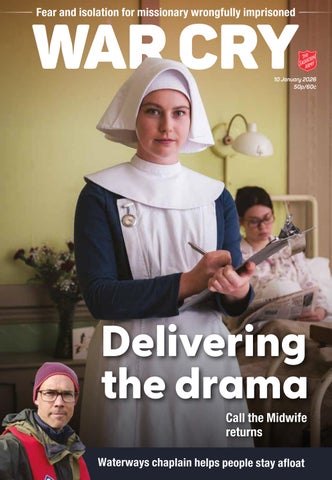
Fear and isolation for missionary wrongfully imprisoned
10 January 2026 50p/60c
Delivering the drama Call the Midwife returns
Waterways chaplain helps people stay afloat
What is The Salvation Army? The Salvation Army is a Christian church and registered charity seeking to share the good news of Jesus and nurture committed followers of him. We also serve people without discrimination, care for creation and seek justice and reconciliation. We offer practical support and services in more than 700 centres throughout the UK. Go to salvationarmy.org.uk/find-a-church to find your nearest centre.
What is the War Cry? The Salvation Army first published a newspaper called the War Cry in London in December 1879, and we have continued to appear every week since then. Our name refers to our battle for people’s hearts and souls as we promote the positive impact of the Christian faith and The Salvation Army’s fight for greater social justice.
WAR CRY Issue No 7763
Editor: Andrew Stone, Major Managing Editor: Philip Halcrow Staff Writer: Emily Bright Staff Writer: Claire Brine Staff Writer: Ewan Hall Editorial Assistant: Linda McTurk Graphic Designer: Mark Knight Graphic Designer: Natalie Adkins Email: warcry@salvationarmy.org.uk The Salvation Army United Kingdom and Ireland Territory 1 Champion Park London SE5 8FJ
From the editor’s desk Do you ever check the label when you buy a new item of clothing to ensure that it’s not hand-wash only? Having to wash laundry by hand can be hard work and time-consuming. It’s why so many people own an automatic washing machine or make use of a laundrette. But not everyone has such convenient options available – particularly in areas of the world where the need to hand-wash all clothes becomes a physically painful and time-intensive burden. In this week’s War Cry, we find out more about the Washing Machine Project, a social enterprise that helps people in low-income or remote areas by supplying communities with specially designed manual washing machines. James Tucker, who attends Kettering Salvation Army church, works for RS Components, an engineering supply company which has supported the project. He feels that his role in the partnership is connected with his Christian faith, which, he says, ‘is about looking after people, making sure they are happy and healthy’. This week we also speak with Andrew Brunson, whose faith inspired him to go to Turkey to spread the good news of Jesus. Andrew says that he faced death and bomb threats and was shot at because of his work. After several years in the country, he was arrested by the authorities on false charges and spent two years in overcrowded and dangerous institutions. Andrew explains the impact that his imprisonment had on his faith and how he went from questioning God’s existence to deciding that he would place his hope in him. ‘I decided I would fight for my faith,’ he says. ‘I determined: I’m going to love God even if I don’t see his love. I’m going to be faithful even if I don’t see his faithfulness. And God rebuilt my heart and relationship with him.’ Christians are not immune from suffering – or from having doubts about their faith. But if they decide to stay close to God, they can know that he is able to help them through even the toughest of times.
When you’ve read the War Cry, why not pass it on ➔ ➔ ➔
Tel: 0845 634 0101 Subscriptions: 01933 445445 (option 1, option 1) or email: subscriptions@satcol.org Founders: Catherine and William Booth International leaders: General Lyndon Buckingham and Commissioner Bronwyn Buckingham Territorial leaders: Commissioners Jenine and Paul Main Editor-in-Chief: Major Julian Watchorn Published weekly by The Salvation Army © The Salvation Army United Kingdom and Ireland Territory ISSN 0043-0226 The Salvation Army Trust is a registered charity. The charity number in England, Wales and Northern Ireland is 214779, in Scotland SC009359 and in the Republic of Ireland CHY6399. Printed by CKN Print, Northampton, on sustainably sourced paper
INFO Your local Salvation Army centre
CONTENTS FEATURES
3
Special delivery Call the Midwife returns
4
Drum roll The project supplying washing machines abroad
6
Anchored in faith How chaplains support boaters
9
‘I feared dying in a Turkish prison’ A falsely imprisoned missionary tells his story
13 Big break The Masters snooker tournament begins
FO
REGULARS
12 Browsing the Bible 14 Puzzles 15 War Cry Kitchen Front-page picture: BBC/NEAL STREET PRODUCTIONS/LUKE ROSS
2 • WAR CRY • 10 January 2026
4 6 9 15
BBC/NEAL STREET PRODUCTIONS/LUKE ROSS
Sister Catherine tends to Thelma
Intensive care BB C L EA /N
R ST
Attending a traumatic birth rattles Sister Catherine
EET
A
Later that day, she reflects on how the events of the day unfolded. Did she do everything she could? Was there anything she should have done differently? Sister Monica Joan (Judy Parfitt) offers words of steady reassurance from her decades of experience. ‘I recall that unabating voice,’ she tells Catherine. ‘The doubt that pursues you home and seeks to be your bedfellow. But say this to yourself: Tonight, a child breathes. Tonight, a mother lives. Tomorrow, you will resume your tasks.’ Speaking before the start of the new series, Molly Vevers explained that her character will face some ‘challenging and harrowing cases’, but that Sister Monica Joan ‘becomes a real support system for Sister Catherine, almost like a grandmother figure’. And Molly added that, in addition to support from her fellow nuns, Catherine relies on her belief in God to see her through. ‘When things are really awful,’ she told the War Cry, ‘her faith gives her a kind of inner strength and a determination to keep going and keep fighting the good fight.’ Someone who was familiar with
UR TN EY
special delivery is due to arrive on our TV screens tomorrow (11 January). BBC1’s Call the Midwife returns. In the first episode of the 15th series, set in 1971, Nonnatus House is celebrating Pancake Day – and a milestone for one of its residents. Sister Catherine (Molly Vevers) has received her official certification as a midwife, allowing her to go out on her first solo antenatal round. But the experience offers a harsh dose of reality. Her first patient is Thelma Cutler (Izzy Meikle-Small), whose intractable nausea, six months into her pregnancy, is sapping her reserves of strength. Catherine is on hand to provide muchneeded reassurance, telling her patient: ‘You don’t have to be brave all the time, Thelma. Sometimes it’s all right to say this is hard.’ It’s advice that Catherine will soon have to apply to herself. During one visit, disaster strikes. Thelma suddenly goes into labour at 28 weeks, resulting in a life-or-death scenario for her dangerously premature baby. Catherine races across the road to seek the medical support of Dr Turner (Stephen McGann). As the baby is bluelighted to hospital, Catherine is left visibly shaken by her first solo delivery.
UCTIONS/OL LY C PROD O
TV preview: Call the Midwife Sundays BBC1 and iPlayer By Emily Bright
Sister Monica Joan
fighting the good fight was Paul, one of the leaders of the early Church. During his life, he endured all kinds of trauma – including mob violence, imprisonment and shipwreck. But Paul assured his fellow believers: ‘Christ gives me the strength to face anything’ (Philippians 4:13 Contemporary English Version). And through that strength, he was able to tell the world how anyone could enjoy a relationship with God if they believed in Jesus. Paul’s declaration is just as true today. Jesus will always provide the strength we need to face each day. Discovering a relationship with him is a life-changing experience. All we have to do is call for his help. 10 January 2026 • WAR CRY • 3
WASHING MACHINE IS MAKING LIFE LOADS BETTER A Salvation Army member has been assisting a project that frees up people worldwide from the burden of hand-washing Feature by Philip Halcrow
James Tucker with one of the Divya washing machines that RS Components helped to develop
A
project to supply newly designed manual washing machines in low-income and remote areas of the world has been making life easier for individuals, families and communities – and a member of The Salvation Army is glad to be a part of it. James Tucker, who attends Kettering Salvation Army church, works for RS Components, which supplies items to the engineering industry. In his position as social impact partnerships manager, he has helped the company team up with the Washing Machine Project, a social enterprise that began in 2019 with the aim of helping communities which still had to wash clothes by hand. ‘We have offered our expertise and skills, and we made a commitment to raise a million pounds to help the project grow,’ says James. Flora Edmiston, partnerships manager at the Washing Machine Project, explains that the social enterprise was founded by Navjot Sawhney. He had studied aerospace engineering at Queen Mary University London and had gone on to
join home appliance company Dyson, but then left to work with charity Engineers without Borders in India. ‘Nav’s next-door neighbour in Tamil Nadu was a woman called Divya,’ says Flora. ‘She was married with a family, and Nav became good friends with her. He saw that she would spend a huge amount of time hand-washing clothes outside her house. She would tell him that, as well as taking a long time, it would give her back pain. ‘Nav promised that he would come up with an easier way for her to wash clothes. He said he would invent a washing machine that ran without electricity.’ Returning to the UK, Nav worked on prototypes, and the Washing Machine Project has since delivered the Divya washing machine – named after the neighbour who inspired the project – not
Founder of the Washing Machine Project Navjot Sawhney 4 • WAR CRY • 10 January 2026
only to Divya, but also to thousands more people in a list of low-income, remote and displaced communities. RS Components began to lend a hand in the project’s early days, after a member of staff met Nav at an event. James says: ‘The machines have been designed so that they are easy to maintain. They’re built with spanners and screwdrivers. So we were able to provide a lot of the tools and some of the components for the early machines.’ RS has even assisted in the building of the Divyas. ‘We offer all our employees two paid volunteer leave days per year,’ says James. ‘So in the UK we gave the Washing Machine Project an area in one of our distribution centres in Corby, and we mobilised our staff to help assemble the machines. ‘Over the past four years, we’ve built hundreds of machines
Using the washing machine in Mexico
with our employees. We’ve recently extended our volunteering network, and we’ve now built them in our other sites in the UK – in Warrington, London and Nuneaton – as well as in Warsaw, Johannesburg, Milan, and Bad Hersfeld in Germany.’ Flora says that the Washing Machine Project has also benefited from RS’s logistical know-how. ‘It has been a big challenge for us to get the washing machines to where they’re needed, which can sometimes be remote communities,’ she says. ‘So it has been helpful to work with a company that knows all about importing and exporting.’ The Divya washing machine has now found its way not only to individual households in countries including India, Mexico and Ghana but also to refugee camps in Uganda and Greece as well as a field hospital in Gaza. And the Washing
Machine Project hopes that the appliances will help address a series of potential problems faced by individuals and communities.
It’s a burden that falls on women and girls
‘B
efore we distribute any washing machines, we do a needs assessment to find out what problems exist in the area,’ says Flora. ‘The main ones that come up time and time again are problems of time, water and effort. ‘Hand-washing clothes is incredibly time-intensive – it can take up to 20 hours a week. It’s like a part-time job. Or, across the year, that’s the time that a child can spend in full-time education. ‘It’s also water-intensive, which can be a problem in communities where water is scarce. ‘And people
who wash by hand consistently report pain in their joints, as well as skin irritation from detergent. ‘It’s a humanitarian issue. And it’s a burden that falls predominantly on women and girls.’ James notes that the founder of the Washing Machine Project is a Sikh, and that ‘Nav’s faith plays quite a strong role in his desire to give back’. Similarly, James, as a member of a Christian congregation, appreciates the opportunity to combine his own faith with his work in promoting social action. ‘I’m driven by my values of fairness, doing the right thing and giving everybody equity,’ he says. ‘My faith is about looking after people, making sure they are happy and healthy. So I feel I’m in a privileged position of having an opportunity to work from a corporate setting to support charities that are making a difference. ‘From a faith perspective, I want to make sure people have what they need to live a full life.’
Partnerships manager Flora Edmiston 10 January 2026 • WAR CRY • 5
In rough times, waterwayS chaplains offer support The Rev CHRIS UPTON, the national lead for Waterways Chaplaincy, explains how the charity helps boaters who are struggling to stay afloat The Rev Chris Upton
PEXELS/SONIA LIVSHITS
‘W
6 • WAR CRY • 10 January 2026
aterways Chaplaincy started because of The Salvation Army,’ says the Rev Chris Upton, the national lead for the charity which supports people living and working on the canals and rivers of England and Wales. ‘It was 2010, and a Salvation Army study had found that a lot of people living on the waterways were facing poverty and mental health problems. At the time, there wasn’t a Christian presence on the Grand Union Canal around St Albans, so the Army started a chaplaincy programme there. ‘Gradually that small team developed into a national charity, and today we have more than 100 chaplains all around the inland navigable waterways and rivers.’ Made up largely of volunteers, Waterways Chaplaincy aims to support any users of rivers, canals and towpaths, including boaters, workers, dog walkers and fishermen. Sometimes chaplains offer physical assistance, such as helping people to move their boat through a lock. Other times,
Interview by Claire Brine
they’re on hand to provide a listening ear, supporting boaters who struggle with mental health problems or with the loneliness of living in isolation. They are also often called upon to point boat dwellers with no postcode in the right direction to access medical services or state benefits. ‘Some houseboat owners are living their best life,’ says Chris. ‘They get to treat their boat like a caravan and use it for leisure. But then there are people who buy a boat because they can’t afford a house. And, while the value of a house tends to increase over the years, the value of a boat always decreases. So a lot of the time we meet boaters in financial difficulties. ‘Recently I helped a guy who couldn’t live on his boat any more, so he had started living in his car. He had terrible mental health problems. It got to a point where he needed to get his boat out of the water, but he couldn’t afford to do it. So I found a way in which we could move his boat out of the canal and on to some hard standing. It meant that he wasn’t being
WATERWAYS CHAPLAINCY
A Waterways chaplain chats with people along the towpath
chased by the licensing authorities any more, nor did he need to pay insurance for a boat that he couldn’t live in. ‘People come to us for all kinds of help every day.’
If they can’t buy food, life becomes difficult
S
ometimes the chaplains hear from boaters whose problems are brought on by a particular season. Winter on a canal boat can be exceptionally cold. Summer can also be difficult. ‘Last summer we had the biggest drought on record, so a lot of the locks were closed, meaning that boaters weren’t able to move around the network,’ says Chris. ‘When that happens, boaters might end up living five miles away from a shop or water point. And if they can’t empty their toilet, get fuel or buy food, life becomes difficult.’ In their efforts to support boaters effectively, Waterways chaplains tend
to walk the same bit of towpath each week at the same time. A number of chaplains also pay weekly visits to marinas, enabling them to get to know the locals on the boating scene.’ Chris says that, by visiting the same places regularly, chaplains become familiar to people. Newcomers to the area know that the chaplain can give them useful information such as the location of a chandlery, where they can pick up boating supplies, or of the nearest supermarket for their groceries. As well as meeting chaplains along the towpath, boaters are able to contact Waterways Chaplaincy through its website. Chris collates all the requests for help, works out where each boater is located, then alerts the nearest chaplain so that contact can be made. ‘This week I had an email from a boater who asked for a food parcel, which is a common request,’ says Chris. ‘Another email came from
Turn to page 8 f
FRANK GREAVES (pictured), who attends the Salvation Army church in Staines, reflects on his role as a Waterways chaplain
‘
In many cases, being a Waterways chaplain is about having a chat and a cup of tea with people. Lots of boaters are lonely – some of them have gone through a marriage break-up and don’t see their land-based family much. Others are feeling low or struggling with finances. In the winter, particularly, living on a boat can feel quite challenging. So, as chaplains, we are there to say: ‘Hi, how are you doing?’ We’re also there to offer practical help regarding issues such as sorting out difficulties in boat licensing or mooring and connecting with social services. I particularly enjoy helping boaters get through locks – there are lots of opportunities to chat. Because people recognise us, we aren’t seen as strangers, but as knowledgeable helpers. Going out as a Waterways chaplain, you never know what you might end up doing. But I think that’s the beauty of it.
10 January 2026 • WAR CRY • 7
WATERWAYS CHAPLAINCY
From page 7 someone who wanted advice about the rent on their permanent mooring. And then I got a message from someone who said they were finding everything overwhelming and needed some support. They’d been living alone with their dog, their boat was in disrepair with the shower and heating not working, and they were struggling with depression.’ In such bleak circumstances, Waterways Chaplaincy aims to bring hope.
The main thing is that people don’t feel alone
‘W
Chaplains celebrate Easter by handing out sweets and hot cross buns to boaters
be more likely to do that too. ‘My mindset has always been: there but for the grace of God go I. The chaplain’s purpose is to offer care, support and the reminder that we need to look out for one another. We don’t push our Christian faith on to people, but a good number of people find a lot of comfort in what we do.’ Some of them even end up going to
WATERWAYS CHAPLAINCY
e can’t solve everyone’s problems – but we can solve some of them,’ says Chris. ‘The main thing is that people don’t feel alone. We can go with them to their doctor appointments. We can deliver food parcels. We can help them access universal credit. We offer physical, practical help. ‘The other thing we try to do, as chaplains, is make the waterways a bit more caring and compassionate. If we can model that behaviour, if we can look after our brothers and sisters, then the boatbuilders at the marina may be more likely to do that. And the chandlers may
Many people who seek help from Waterways chaplains own boats that have fallen into disrepair
8 • WAR CRY • 10 January 2026
church – like Ben, who was befriended by a Waterways chaplain called Charles. ‘When Charles came across Ben’s boat, it was moored and looked abandoned,’ says Chris. ‘No one was on board, so Charles left a chaplaincy leaflet in the cockpit. Some weeks later, he received a phone call from Ben, asking to meet up. The pair arranged to meet in a café, and met up on several other occasions. ‘After a while, Ben started going to the church that Charles attended. Then he brought along his mother and uncle. He said that Charles had helped him to rediscover the Christian faith of his youth.’ When Ben got married, Charles was invited to the wedding. And it’s stories like this, says Chris, which highlight the importance of having a Christian presence on the country’s waterways. ‘Jesus wasn’t born in a church – he was born in a stable,’ he explains, ‘and that shows me that God works outside the box. He’s bigger than the Church. ‘Jesus’ entire ministry was focused on people who were on the “outside”. I think that people are increasingly looking for the sacred and the divine outside church walls. ‘My hope is that when people come into contact with Waterways Chaplaincy, they will know that they are loved and they are valuable.’
‘I feared I would die alone in a Turkish prison cell’ ANDREW BRUNSON, a missionary wrongfully imprisoned by Turkish authorities for two years, recalls how his incarceration broke him and how, during the darkest time of his life, he began rebuilding his faith Interview by Emily Bright
‘W
Andrew Brunson
e lived in Izmir, in western Turkey,’ says Andrew Brunson, an American missionary who served in the city for 23 years with his wife, Norine. ‘Our goal was to start groups of Turkish believers where there were no other churches.’ It was a place that over time felt the effects of conflict. ‘There was a civil war in Syria, and Isis began to attack very strongly in some areas,’ says Andrew. ‘When that happened, Kurdish people flooded into Turkey, which shares a border with Syria. And Izmir was a jumping-off point for many people who tried to get to Greece as refugees on rafts or boats. ‘People had experienced great losses – many of them had family members who were killed – and they were desperate for food. Driven by our love for Jesus, Norine and I tried to help the refugees with clothing, food and heating. We also shared our faith with them.’ Throughout their years in Turkey – and whoever they encountered – the couple aimed to communicate their
Turn to page 10 f
10 January 2026 • WAR CRY • 9
From page 9 faith respectfully. ‘We weren’t trying to pull people away from their own beliefs,’ Andrew explains. ‘Instead, our approach was to say that we were followers of Jesus and had found hope in him. We were willing to answer anyone’s questions. We tried to be visible so that seekers could find us.’ The couple established a church and distributed more than 1,000 copies of the New Testament each month. But making themselves visible as missionaries was dangerous. ‘There were death threats and bomb threats over the years,’ recalls Andrew. ‘I was shot at. We knew that there was a level of risk, and we learned to live with that.’ Andrew, who grew up with his missionary parents in Mexico, had a ‘strong drive’ to share his faith from a ‘very early age’. He decided to follow in their footsteps and spent a formative year in the UK with the Christian missionary charity Operation Mobilisation. ‘During that time with Operation Mobilisation, Norine and I saw many people going into the Muslim world,’ he remembers. ‘And God put that same calling on our hearts independently
10 • WAR CRY • 10 January 2026
from each other. ‘One of the reasons we went to Turkey is that it’s the largest unevangelised country in the world. Most Turks have never met a Christian in their lives. Most Turkish cities do not have a church in them or anybody who could present the gospel to people directly. After a few years, our hearts really became tied to those people and to that country.’
I had all these questions and doubts about God
A
fter 23 years in Turkey, Andrew and Norine’s ministry was going from strength to strength, and they were awaiting the approval of their permanent resident visas. On 6 October 2016 they received a message that the police were looking for them, so they reported to the station the next morning, hoping for confirmation of their permanent residency. But, on arrival, they were issued with the deportation order G-82 – Threat to National Security. Andrew had heard of the order being used as a pretext to deport missionaries. ‘Usually if a foreigner receives a
deportation notice, it takes about a day to deport them,’ says Andrew. ‘But somebody decided to keep us.’ After one of the policemen received a phone call, events quickly escalated. The couple were arrested, handed over to counterterrorism police and detained at the Isikkent removal centre. Two weeks later, Norine was released. But Andrew was transferred to the Harmandali removal centre and kept in solitary confinement for seven weeks. His only respite came from Norine’s visits. ‘My wife became my lifeline,’ he says. ‘She was the only person I could have visits from, and she tried to encourage me so that I would have hope. I had all these questions and doubts about God, and she kept pointing me to the truth. Without those visits from her, I don’t know if I would have survived.’ Andrew’s situation would become bleaker still – he was sentenced to serve time in Sakran, a high-security prison. ‘The authorities accused me of being a terrorist, a military spy, and of trying to overthrow the Turkish government,’ he says. ‘Although the government knew it was false, it served their purposes to make an example of me.’
Andrew and Norine on a speaking tour of the UK last year with anti-persecution charity Release International
During Andrew’s incarceration, Turkish government officials threatened to impose three life sentences on him, to be served in solitary confinement. It seemed that he was being used as a political pawn in negotiations with the US. Locked up 24/7 in an overcrowded cell, Andrew began having panic attacks. He considered ending his own life. ‘For two years, I was living with the fear that I would be in a Turkish prison cell for the rest of my life and die alone,’ he says. ‘Under those circumstances, I broke emotionally, physically, psychologically. But I also broke spiritually, which really surprised me. ‘I had expected to have supernatural strength and a sense of God’s presence. But I felt abandoned. I even questioned whether God exists. I had many doubts and questions and was very confused. During that first year, I became suicidal.’ Andrew was later transferred to Buca, a maximum-security prison. But in his second year of incarceration, he resolved to dig deeper into his Christian faith. ‘I decided I would fight for my faith. I pursued God, taking my doubts and questions and locking them away, saying:
“I’m not going to give a place to these in my mind any more.” ‘I determined: I’m going to love God even if I don’t see his love. I’m going to be faithful even if I don’t see his faithfulness. And God rebuilt my heart and relationship with him.’ On 12 October 2018, Andrew’s case was brought to trial again. He was found guilty of supporting a terrorist group and was sentenced to more than three years’ imprisonment.
It was an emotional rollercoaster
H
owever, the authorities suddenly released him, pending his appeal, and his travel ban was lifted – he was free. Andrew and Norine raced to the airport before the Turkish government could change its mind. ‘It was an emotional rollercoaster,’ Andrew recalls. ‘I went from that sinking feeling of the conviction and sentencing to my sudden release. ‘The verdict was a face-saving way to release me, because they’d held me
for two years and it had been raised on the agenda between the United States and Turkey at a high level. The Turkish economy had also collapsed when the American president imposed sanctions on the country related to my case.’ Within 24 hours of Andrew’s release, he and Norine found themselves in the White House, being welcomed back to the US. Reflecting on his experiences in Turkey, Andrew can relate to the early Church leader Paul, who also faced wrongful incarceration. ‘My favourite Bible verse right now is 2 Timothy 4:1. Paul is in prison and expects to be executed, and he says: “The Lord will rescue me from every evil deed and bring me safely into his heavenly Kingdom.” ‘That verse describes my imprisonment, and also my hope that, when I face any difficulty, I’m going to lean into God even if I don’t understand. ‘While in prison, I was so broken. I had no sense of God’s presence. But as I look back now, I can see how the Lord Jesus was shepherding my heart. He was bringing me through suffering, pain, grief and loss and protected my heart.’
10 January 2026 • WAR CRY • 11
Prayerlink The War Cry invites readers to send in requests for prayer, including the first names of individuals and details of their circumstances, for publication. Send your Prayerlink requests to warcry@salvationarmy.org.uk or to War Cry, 1 Champion Park, London SE5 8FJ. Mark your correspondence ‘Confidential’.
j
Becoming a Christian
There is no set formula to becoming a Christian, but many people have found saying this prayer to be a helpful first step to a relationship with God
Lord Jesus Christ, I know that I have done things in my life that are wrong and I’m sorry. Thank you that I can ask you for forgiveness because of the sacrifice you made when you died on the cross. Please forgive me and help me to live a better life in the future as I learn how to love you and follow your way of living. Thank you, Lord Jesus.
If you’ve prayed this prayer, scan the QR code or contact us using the coupon on this page
Browsing the Bible Nigel Bovey gives chapter and verse on each book of the Scriptures Acts Gospel-writer Luke is the author of the Acts of the Apostles, a ‘whathappened-next’ account of the early Church in the years after Christ’s resurrection. Beginning with the ascension of Jesus into Heaven (1:1–11), it records the growth and expansion of the Christian movement and the fulfilment of Jesus’ promise to his disciples (1:8) that they would receive spiritual power. In the early chapters, the focus is on Peter, one of Jesus’ closest followers, who is the preacher on the Day of Pentecost, when the once-frightened disciples are empowered by God’s Spirit to speak openly about the risen Jesus. On that day, some 3,000 people are converted (2:41). Peter and John appear before the religious leaders to explain their behaviour (chapter 4). Opposition mounts. Peter and other apostles are flogged, but they refuse to stop preaching (5:40–42). Stephen is stoned to death, becoming the first martyr (chapter 7). Many believers escape Jerusalem and head for nearby Judaea and Samaria. While in the Samaritan port of Caesarea, Peter receives a vision in which God tells him that the good news about Jesus is for Gentiles as well as Jews (chapter 10). The later chapters focus on Paul who, as a pious Jewish leader, is initially against the early Church, but who experiences a dramatic conversion on a road to Damascus (chapter 9). Afterwards, it is Paul who leads the mission to the Gentile world, embarking on three tours. The first takes in Cyprus and parts of modern-day Turkey (chapters 13 and 14). During the second, despite being flogged and imprisoned, he visits fledgling churches in Greece and Turkey (15:40 to 18:22). On his third journey, he revisits some churches (18:23 to 20:38) before arriving in Jerusalem, which is in uproar (chapter 21). Paul is accused of heresy and imprisoned. His life is threatened. As a Roman citizen, he successfully appeals to be tried by a Roman court. He is transported to Rome, where, pending trial, he lives under house arrest (chapters 22 to 28).
"
Want to know more? a
To receive basic reading about Christianity and information about The Salvation Army, complete this coupon and send it to War Cry 1 Champion Park London SE5 8FJ
Name
Address
Or email your name and postal address to warcry@salvationarmy.org.uk 12 • WAR CRY • 10 January 2026
Cue the action
QUICK QUIZ 1
Who last year became the first winner of BBC1’s The Celebrity Traitors?
2 3 4 5 6
Who is the author of the bestselling novel The Secret of Secrets? ‘Swifties’ is the nickname given to fans of which US singer? For her performance in which film did Halle Berry win the Oscar for best actress in 2002? The Winter Olympics are set to take place in which country next month? Which branch of maths is associated with the mnemonic SOHCAHTOA?
ANSWERS
The Masters breaks off Feature by Ewan Hall
I
t’s no fluke that crowds will be heading to Alexandra Palace this Sunday (11 January). Snooker’s elite are about to get the ball rolling at the Masters. Over the next week, the world’s 16 highest-ranked players will compete for what is considered to be one of the sport’s three most prestigious – ‘triple crown’ – prizes, alongside the UK and World Championships. Last year, the contestant with the best cue arm was Shaun Murphy. The Englishman defeated his compatriot Kyren Wilson 10-7 in the final to become only the 12th player to win the Masters more than once. Both are expected to be among those contesting this year’s event. Up to 2,200 fans will be watching each match at Ally Pally itself, while many more around the world will be watching the coverage on the BBC, TNT and other channels. ‘It is a fantastic event,’ Jimmy White, the 1985 Masters champion, told TNT Sports. ‘To pick a winner of that tournament is very difficult as every match is like a final.’ For the players, tension and nerves will be at their peak as they battle to tame the baize. And, while those of us watching on may never truly feel the pressure of performing under this kind of intense scrutiny, we may understand the feelings associated with having to make a decisive move, the fear of making the wrong choice and the dread of watching everything unravel. Perhaps we have all experienced the age-old anxiety of uncertainties: What do I do next? What if it all goes wrong? Over the centuries, however, many people have found that God helps them to face such fears and anxieties – and even overcome them. One Bible writer thanked God for helping him in tough times, praying: ‘When I am afraid, I keep on trusting you… I trust you and am not afraid’ (Psalm 56:3 and 4 Contemporary English Version). If we choose to put our trust in God, we too will find comfort in the unknown and a sense of being supported when anxious about the future – and it will be no fluke. 10 January 2026 • WAR CRY • 13
1. Alan Carr. 2. Dan Brown. 3. Taylor Swift. 4. Monster’s Ball. 5. Italy. 6. Trigonometry.
PUZZLES Quick CROSSWORD ACROSS 1. Mature (5) 5. Drying cloth (5) 8. Snake (5) 9. Consecrate (5) 10. Monastery head (5) 11. Leather fastener (5) 12. Electric wire (4) 15. Stick (6) 17. Pool of money (5) 18. Fount (6) 20. Destiny (4) 25. Seat (5) 26. Chunky (5) 27. Combine (5) 28. Deputy doctor (5) 29. Mould (5) 30. Mix (5) DOWN 1. Snub (6) 2. Penetrate (6) 3. Repulsive (5) 4. Farewell (5) 5. Calamity (7) 6. Waver (6) 7. Small (6)
13. Circuit (3) 14. Lively dance (3) 15. Consumed (3) 16. Rodent (3) 17. Finger joint (7) 18. Rank (6)
Fill the grid so that every column, every row and every 3x3 box contains the digits 1 to 9
6
3
5 1
6 2 5 9 1
7 2
19. Part of the eye (6) 21. Busy (6) 22. Stretch (6) 23. Humorous play (5) 24. Food fragment (5)
1 2 6
8 7 6
1 3 8
7 4 9 3 4 9
3 2 3
6
W RDSEARCH Look up, down, forwards, backwards and diagonally on the grid to find these words associated with the future
M O HONEYC B
J K C G N OQ H C B H T L Z O P S X J Y P PWP L F Q S Z X A B R N Q N P P B G G I K J R F Q F U E V A E E Y U E VW J I C B Q D G T Y Q Z F R L V X V S T B D D E K F NW J Z C G U I P K I Q Z H E S A Q E QWOQ D P Z E X U T MC K E R G V E S L J E I Y C S ZMC Y R Q U K E Q Z S L O K H T N E U Q E S B U S Q ZWU Z J O L A I S Z H G P T P Z A F J H P E H B T E L Q Z P Z S C Y J H N V R S X S I L A I T N E T O P B MW N C J J Z O F J L B K S ZMR B Y D C N J I N N O V A T I O N I B P QG Z A P N C I H N Z K Q S Y N X V J G G L R T Q L N B K Q F P S G E C J J I P Q Z Y S Z Q T U Z T T O V X D B D T S WW D Z Q A N T I C I P A T I O N L
Each solution starts on the coloured cell and reads clockwise round the number
1. Express admiration 2. Oily substance 3. Light fall of rain 4. Middle Eastern river 5. Cloth used to protect garments 6. High-pitched cry
ANSWERS 6 9 3 5 1 8 4 7 2
4 8 7 9 2 3 1 6 5
1 5 2 7 4 6 9 3 8
3 2 5 4 8 7 6 1 9
8 6 4 3 9 1 5 2 7
9 7 1 2 6 5 8 4 3
5 1 6 8 7 2 3 9 4
2 3 9 6 5 4 7 8 1
7 4 8 1 3 9 2 5 6
HONEYCOMB 1. Praise. 2. Grease. 3. Shower. 4. Jordan. 5. Napkin. 6. Shriek. QUICK CROSSWORD ACROSS: 1. Ripen. 5. Towel. 8. Adder. 9. Bless. 10. Abbot. 11. Thong. 12. Flex. 15. Adhere. 17. Kitty. 18. Spring. 20. Fate. 25. Chair. 26. Thick. 27. Unite. 28. Locum. 29. Shape. 30. Blend. DOWN: 1. Rebuff. 2. Pierce. 3. Nasty. 4. Adios. 5. Tragedy. 6. Wobble. 7. Little. 13. Lap. 14. Jig. 15. Ate. 16. Rat. 17. Knuckle. 18. Status. 19. Retina. 21. Active. 22. Extend. 23. Farce. 24. Crumb.
14 • WAR CRY • 10 January 2026
SUDOKU
ANTICIPATION EVENTUAL EXPECTATION HEREAFTER INNOVATION NEXT PLAN
POSSIBILITY POTENTIAL PROSPECTIVE SOON SUBSEQUENT SUCCEED UPCOMING
SERVES 4
Gardener’s pie INGREDIENTS
METHOD
1tbsp vegetable oil
Heat the oil in a large non-stick saucepan over a medium heat. Add the onion and cook until it starts to soften, then add the garlic and cook for a further minute.
1 onion, diced 2 garlic cloves, crushed 400g can chopped tomatoes 400g can haricot beans, drained and rinsed 300g frozen mixed vegetables
Stir in the tomatoes, beans, vegetables, stock, thyme and some pepper. Bring to the boil and simmer for 5 minutes. Tip into an ovenproof dish and arrange the potatoes over the top. Sprinkle with the cheese and place under the grill for 7 minutes, until golden brown. Serve immediately.
150ml reduced-salt vegetable stock 2tsp dried thyme Freshly ground black pepper 2 x 550g cans new potatoes in water, drained and sliced lengthways 50g reduced-fat cheddar cheese, grated
SERVES 4
Minestrone soup INGREDIENTS
METHOD
100g wholewheat spaghetti
Cook the spaghetti according to the packet instructions until al dente, then drain and rinse in cold water. Set aside until needed.
Oil spray 1 medium onion, diced 2 courgettes, diced 2 large carrots, diced 400g can chopped tomatoes 500ml reduced-salt vegetable stock ½ tsp dried mixed herbs 410g can cannellini beans, drained 100g kale or Savoy cabbage, finely shredded
Spray a large non-stick saucepan with the oil and place over a medium heat to warm. Add the onion and cook for 3-4 minutes, until it begins to soften, then add the courgettes and carrots and cook for a further 3 minutes, stirring continuously. Add the remaining ingredients and bring to the boil. Reduce the temperature, cover and simmer for 10 minutes. Tip the spaghetti into the saucepan and cook for 2-3 minutes, until the vegetables are tender. Serve immediately.
Freshly ground black pepper, to taste
Recipes reprinted, with permission, from the World Cancer Research Fund website wcrf-uk.org
10 January 2026 • WAR CRY • 15
G O D S AY S : I WA N T TO G I V E YO U
FOR A GOOD LIFE IN THE FUTURE Jeremiah 29:11 (Easy English Bible)