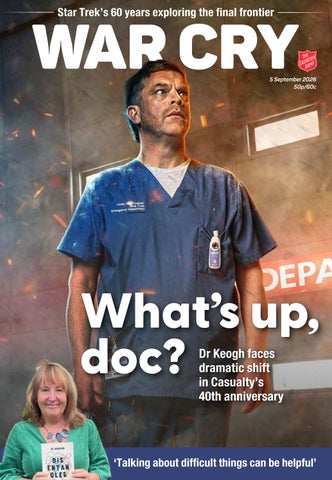
Star Trek’s 60 years exploring the final frontier
5 September 2026 50p/60c
What’s up, doc? Dr Keogh faces dramatic shift in Casualty’s 40th anniversary
‘Talking about difficult things can be helpful’
What is The Salvation Army? The Salvation Army is a Christian church and registered charity seeking to share the good news of Jesus and nurture committed followers of him. We also serve people without discrimination, care for creation and seek justice and reconciliation. We offer practical support and services in more than 700 centres throughout the UK. Go to salvationarmy.org.uk/find-a-church to find your nearest centre.
What is the War Cry? The Salvation Army first published a newspaper called the War Cry in London in December 1879, and we have continued to appear every week since then. Our name refers to our battle for people’s hearts and souls as we promote the positive impact of the Christian faith and The Salvation Army’s fight for greater social justice.
WAR CRY Issue No 7797
Editor: Gareth Dickens, Major Managing Editor: Philip Halcrow Staff Writer: Emily Bright Staff Writer: Claire Brine Staff Writer: Ewan Hall Editorial Assistant: Linda McTurk Graphic Designer: Mark Knight Graphic Designer: Matt Penberthy Email: warcry@salvationarmy.org.uk The Salvation Army United Kingdom and Ireland Territory 1 Champion Park London SE5 8FJ
From the editor’s desk Some television shows seem to have been around for ever, such is their influence on our culture and lives. Star Trek, for instance, has given us the popular catchphrases ‘live long and prosper’ and ‘the final frontier’. As we celebrate the show’s 60th anniversary in this week’s issue, we also mark 40 years of Casualty. The hospital drama might not have shaped our language, but long-time fan Dr Katie Giles tells us how it was a ‘strong pull’ in her choice of career. Casualty and Star Trek bring medicine and science face to face with human emotion, and the interaction between the head and the heart is often where the greatest drama lies. That interaction also lies at the centre of the life and work of the French mathematician and philosopher Blaise Pascal, as author and theologian Graham Tomlin makes clear in an interview this week. In his book Blaise Pascal, Graham explores the life of this remarkably talented and influential figure, who died aged just 39. Graham makes it clear how much we owe to Pascal, whose pioneering work helped lay the foundations for today’s computers, wristwatches, insurance policies and much more. Graham explains: ‘When you look around, Pascal’s fingerprints are on so many things that we deal with every day.’ Alongside his scientific and mathematical work, Pascal had also been fascinated with the Christian faith since childhood and a powerful encounter with God as an adult transformed his life. That experience made Pascal think deeply about how people could come to believe for themselves. Graham tells us that Pascal understood that faith was much more than just an intellectual decision. ‘He’s one of the greatest philosophers and mathematicians and scientists,’ he says. ‘Yet he realises that reason can only take you so far. We can only know God through the heart.’ It’s a realisation which can be life changing for us too. We can discover, as Pascal did, that ultimate happiness is only found in the presence of the God who made us.
When you’ve read the War Cry, why not pass it on ➔ ➔ ➔
Tel: 0845 634 0101 Subscriptions: 01933 445445 (option 1, option 1) or email: subscriptions@satcol.org Founders: Catherine and William Booth International leaders: General Lyndon Buckingham and Commissioner Bronwyn Buckingham Territorial leaders: Commissioners Jenine and Paul Main Editor-in-Chief: Major Andrew Stone Published weekly by The Salvation Army © The Salvation Army United Kingdom and Ireland Territory ISSN 0043-0226 The Salvation Army Trust is a registered charity. The charity number in England, Wales and Northern Ireland is 214779, in Scotland SC009359 and in the Republic of Ireland CHY6399. Printed by CKN Print, Northampton, on sustainably sourced paper
INFO
CONTENTS FEATURES
3
Dramatic inspiration How Casualty fan went on to become a doctor
6
Happiness at the cutting edge of science An extraordinary life transformed by faith
9
Managing mindsets Helping mental health through openness
13 To boldly go
Your local Salvation Army centre
Sixty years of Star Trek REGULARS
FO 4
Team Talk and War Cry World
12 What did he say? 14 Puzzles 15 War Cry Kitchen Front-page picture: BBC STUDIOS/ALISTAIR HEAP/MATT BURLEM
2 • WAR CRY • 5 September 2026
6 9 13 15
The team at Holby City Hospital are in a fight to save lives after an explosion
BBC STUDIOS/ALISTAIR HEAP/MATT BURLEM
Trauma informed As Casualty marks its 40th anniversary with an explosive storyline, a real-life doctor reveals how she was inspired by the show TV feature: Casualty BBC1 and iPlayer By Claire Brine
B
lood, sweat and tears. Staff working in the emergency department at Holby City Hospital are used to seeing the lot – handling births, deaths and everything else in between. But when Casualty celebrates its 40th anniversary this weekend, the double bill goes off with a bang bigger than anyone could expect. At the nearby St James’ Hospital, there’s an explosion. Countless people are hurt. Paramedics search the rubble for victims. Doctors are under pressure to save lives. Back at the Holby base, consultant Dylan Keogh (William Beck) tries to get to grips with the scale of the problem. Gravely, he tells his team: ‘We’re the only ED in the city.’ As scenes of devastation are depicted on screen, long-time Casualty fan Dr Katie Giles will be at home watching the drama unfold. The consultant radiologist and breast screening programme director at Torbay Hospital in Devon cites the series as her inspiration for studying medicine. She started watching the programme in 1990, when she was nine years old. ‘I can remember when Charlie [Derek Thompson] was shot and Brenda Fricker – who played a nurse called Megan – screamed “You shot Charlie!” at the gunman,’ Katie recalls. ‘I thought that the emergency department was all action,
blood and gore. I can vouch for the fact that it isn’t in real life!’ As the years passed, Katie remained fascinated by watching doctors at work – even if they were fictional. ‘Seeing a whole team helping someone in desperate need was a strong pull,’ she says. ‘Being a doctor looked like hard work but interesting. ‘I remember a young doctor on the show died in a fire while trying to get the body of a deceased patient away from the flames. That level of compassion stuck with me, and I firmly believe care doesn’t end when the patient’s heart stops beating.’ After qualifying as a junior doctor in 2004, Katie started working in the emergency department. Was it anything like being in Casualty? ‘Some bits, yes,’ she says, ‘like the pressure and conflicting interests, becoming close to colleagues to be able to get through, and the huge array of conditions you see. The show has also weaved in lots of NHS-relevant stories: targets, budgets, difficulties finding beds for patients, and violence towards staff.’ In 2009, Katie joined the radiology department and continues to find her role at the hospital rewarding. ‘It’s a huge privilege that I can make
Dr Katie Giles someone’s worst day less awful by showing compassion,’ she says. Compassion is certainly a vital quality in life – and not just for doctors. All of us could practise it more. And we can learn how by looking to Jesus as an example. Whatever situation confronted him, Jesus treated the people he encountered with compassion and kindness. He fed people when they were hungry. He spent time with individuals who were sick and cast out from society. He refused to condemn a woman caught in adultery, telling those who wanted to stone her that they should do so only if they had never done wrong themselves. Jesus understood that life was sometimes painful – which is why he urged people to follow him. Receiving God’s love and showing love in return, he said, was the best way to live. It still is. When we make God’s love our focus, our heart will change for the better. 5 September 2026 • WAR CRY • 3
Team talk TEAM WA
talk ‘ TALK’ j Footballer supporters
Ewan Hall gives his take on a story that has caught the attention of War Cry reporters It’s the football club nobody wants to sign for. Set up by Stephen Kelly, Sands United Basingstoke helps men support each other through the trauma of losing a baby. Explaining why he set up the team, Stephen told BBC News, ‘I lost my daughter, Amelia Grace Kelly, in October 2020. ‘My wife got some support from the local hospital [and there were] support groups for bereaved families. The support group wasn’t really my cup of tea. I knew of other men who had been affected by baby loss in Basingstoke and from there, it’s grown exponentially.’ The Hampshire team has more than 50 participants who attend weekly training sessions and aim to play matches twice a month. The team are a mix of abilities, from people who have never played to academy-level footballers. For instance, Barry Lee-Harris, who was totally new to the sport, has found attending and being amongst others facing similar challenges to be a safe space. ‘I don’t really talk about feelings much,’ said Barry. ‘But since Sands United has been going on, I’ve started to open up a bit more. ‘I’ve started talking to a couple of guys in the group so it’s really good that I’ve got that support around me.’ Although I have never experienced the heartbreak of losing a baby, I understand the importance of having support during life’s most challenging moments. And while encouragement from family, friends and others is important in those periods, the one I turn to most is God. Through my faith in him, I have a constant source of strength and hope. In the Bible, God reassures his people that he is with them, saying: ‘Do not fear, for I am with you; do not be dismayed, for I am your God. I will strengthen you and help you’ (Isaiah 41:10 New International Version). If we choose to put our faith in God, we will find comfort, strength, hope and assurance for the challenges we face in our own lives. Even when circumstances seem overwhelming, I’m reassured by the fact that, with God’s help, there is always light to be found, even in the darkest of situations.
The one I turn to most is God
Team talk 4 • WAR CRY • 5 September 2026
Mum supported with debt advice
A Salvation Army debt advice service has helped a mother of three stabilise her debts and rebuild her life. When Betty fell seriously ill during the Covid-19 pandemic, her world changed overnight. A mum and health professional, she went from caring for others to months in hospital, unable to work. At home, the reality was stark: no income meant rising debts and the very real fear of losing everything. It was through a neighbour that Betty was connected to The Salvation Army’s debt advice service in Luton. What followed was not just financial guidance, but steady, compassionate support at a time when life felt overwhelming. A dedicated adviser worked alongside her—negotiating with creditors, securing breathing space and helping stabilise urgent debts. But it didn’t stop there. Food parcels arrived when cupboards were empty. Support extended to her wellbeing, with practical and emotional care working hand in hand. This quiet, consistent presence – often unseen – helped Betty begin to rebuild. Today, she speaks of hope where there was once despair. ‘The Salvation Army didn’t just help me with debts, they gave me hope,’ she says. The Salvation Army is unique in that it provides bespoke local support through some 600 centres across the UK. To support your local Salvation Army services go to: salvationarmy.org. uk/big-connection l Betty’s name has been changed
Do you have a story to share? a warcry@salvationarmy.org.uk TheWarCryUK
B salvationarmy.org.uk/warcry
R CRY
WnRLD Michael Sheen, Dr Dave Megson and the Rev Paul Cawthorne
Actor digs into toxic waste dumps
Aid for earthquake victims
Salvation Army workers provided essential items to victims of an earthquake in Venezuela
BBC/WALL TO WALL MEDIA/STEPHEN HART
Actor Michael Sheen spoke to a Shropshire vicar turned environmental campaigner for a two-part BBC2 documentary on toxic waste dumps in Wales and the West Midlands. In Buried with Michael Sheen, which is available on BBC iPlayer, the actor joined the Rev Paul Cawthorne and environmental scientist Dr Dave Megson in testing soil for the carcinogenic ‘forever chemicals’ known as polychlorinated biphenyls, or PCBs. These PCBs were dumped in disused quarries by global company Monsanto across Wales and the northwest of England in the 1960s and 1970s. Paul, who oversees several churches in Shropshire, has spent the last 10 years trying to highlight the issue of toxic tips since a deathbed confession from a parishioner who had worked in chemical waste dumping. In the areas of Brofiscin and Ty Llywd in Wales – two of the 14 sites which Paul and Dave tested – the levels of PCBs were 160 times and 140 times higher than the national average, while at Alvanley in Cheshire, the levels were nearly 2,000 times higher, indicating serious leaks from the discarded barrels of chemicals.
The Salvation Army provided emergency assistance and support over the summer to communities affected by earthquakes across the Philippines, Indonesia, Venezuela and Japan. Since 8 June, the succession of disasters has killed thousands of people, displaced families and caused widespread damage to homes, infrastructure and essential services. The church and charity has provided practical support, including food, drinking water, bedding, sanitation, clothing and medical care alongside emotional and spiritual support. Captain James-Mark Casidsid, the Salvation Army’s emergency service coordinator in the Philippines, said: ‘Disaster response is about far more than delivering relief. It is about restoring dignity, offering hope and demonstrating God’s love through compassionate action.’ In response to all of the disasters, The Salvation Army worked alongside government agencies, other churches, community organisations and humanitarian partners to identify needs quickly and avoid duplication of provisions.
5 September 2026 • WAR CRY • 5
ALAMY/COLAIMAGES
‘He was a great intellectual, but realised that reason could only take you so far’ 6 • WAR CRY • 5 September 2026
‘Blaise Pascal’ by Philippe de Champaigne
‘H
Graham Tomlin
GRAHAM TOMLIN, author of a new biography of Blaise Pascal, reveals how the 17th-century French mathematician laid the groundwork for computers, wristwatches and insurance policies Interview by Emily Bright
e was on the cutting edge of the scientific and mathematical explorations of his time,’ says theologian Graham Tomlin, who has written Blaise Pascal, a book on the 17th-century French academic. ‘He worked on some obscure things, like conic sections – different shapes and how you measure what the shapes are. He was famous for the development of probability theory, which is everywhere in our world today and is used to calculate things like insurance policies. Pascal did the first modern experiments on the weight of air and helped to establish that there was such a thing as a vacuum, which was a big debate at the time.’ Graham adds that one of Pascal’s creations also shaped computer science. ‘He invented a calculating machine, the Pascaline, which is an extraordinary piece of engineering. It was a machine that could calculate addition, subtraction, division and multiplication up to hundreds of millions. It was expensive to produce and no one wanted to buy it. But when people tell the story of the modern computer, they often talk about the Pascaline as a step in that direction.’ Graham points out that Pascal pioneered in other ways too, becoming the first person to wear his timepiece on his wrist rather than in his pocket and inventing an urban transportation system in Paris. ‘Whoever had a hand in the development of the computer, the wristwatch, insurance or predicting the weather has a pretty important place in the history of the world we live in,’ he summarises. ‘When you look around, Pascal’s fingerprints are on so many things that we deal with every day.’ But Pascal wasn’t interested only in mathematics and science – he delved into theological matters too. His fascination with the Christian faith was sparked during childhood. ‘He grew up in a fairly conventional
Catholic family,’ says Graham. ‘When his father had an accident, two bone setters, the Deschamps brothers, were brought in. They happened to be Jansenists. This particular group within 17th-century French Catholicism believed that conversion was not just moral or intellectual but actually a fundamental change of the heart that only God could do. Therefore, you had to put yourself in a position where God might change your heart. ‘The Deschamps brothers persuaded the family to have a much more serious Christian devotion and they had a big influence on Pascal.’
He discovered this intensely personal God
Y
ears later, at the age of 31, Pascal’s life was transformed by faith. While praying alone in his room late at night on 23 November 1654, he had a powerful encounter with God, which lasted two hours. Pascal never told a soul about it. But when he died at the age of 39, a servant preparing his body discovered notes detailing the experience – which became known as Pascal’s ‘Night of Fire’ – within the lining of his jacket. ‘It was a visceral, emotional account of his experience of the God revealed in Jesus Christ,’ Graham explains. ‘He discovered this intensely personal God, who both gives and demands everything. This changed everything for Pascal. ‘He wanted to give himself to people at the bottom of Parisian society, and he took a poor family into his house. He invented buses for the sake of the poor. Rich people could get around Paris quite easily because they had big carriages, but poor people couldn’t. The bus was a way for
Turn to page 8 f COURTESY OF GRAHAM TOMLIN
Pascal invented the Pascaline calculating machine 5 September 2026 • WAR CRY • 7
From page 7 them to get around this expanding city in a way they couldn’t do before. ‘Pascal also found this desire growing in him to persuade his sceptical, sophisticated friends that they could find their true happiness in God. He started to write an explanation of Christianity, something that was trying to draw people into the faith.’ After his Pascal’s death, friends found fragments of paper around his room on which he had scrawled his philosophical thoughts. They decided to compile, edit and publish the papers in a book now known as the Pensées. ‘Pensées means thoughts,’ explains Graham. ‘So when you pick up a copy of the Pensées today, you’re really picking up the notes for a book. Some entries are very short; others are quite long. They offer a really interesting set of arguments
for Christianity.’ Graham outlines the some of the arguments and their significance. ‘Pascal recognises that life is not straightforward, and that God is not always obvious,’ he says. ‘One of his arguments is that of the wager, which is not trying to shoehorn people into belief but instead helps us understand how we make decisions about it. ‘He says that at the end of the day, there’ll be a verdict: there is a God or there isn’t a God. If you believe that God exists and you’re right, you’re headed for eternal bliss. If you bet that God exists and you’re wrong, well, you haven’t missed a great deal. Maybe a bit of selfsatisfaction in this life. But at the end of life, you just disappear into nothingness anyway. ‘If you bet that God doesn’t exist and
8 • WAR CRY • 5 September 2026
He advised: Talk to God as if he’s listening to you
‘H
e advised people to open the Bible and read it as if it is God speaking to you. Go to church as if it is the place where you will learn the wisdom to live well. Talk to God as if he’s really listening to you, and it will fall into place that you are actually talking to someone. ‘For Pascal, true Christianity is a matter of the heart before it is a matter of the head,’ Graham adds. ‘He’s a great intellectual. He’s one of the greatest philosophers, mathematicians and scientists. Yet he realises that reason can only take you so far. We can only know God through the heart. So he makes that important distinction. ‘He doesn’t think you persuade someone of the Christian faith by coming up with clever arguments as to why God exists or why Jesus has risen from the dead. He says that, before you show people the truth of Christianity, you’ve got to make it attractive. You’ve got to make them want this to be true. We can then wait for God to do the miracle of kindling a love for him within their hearts. ‘Then, as people start to love God, the love for other things begins to fade into the background. That’s what conversion is. It’s a change of the heart. It’s a change of desires. It’s a change of love. Pascal believed that we will only find ultimate happiness in the presence of God who made us.’
COURTESY OF GRAHAM TOMLIN
Caption for this one and more here etc like this one
you’re right, again, you haven’t gained a great deal either – you go into nothingness too. But if you bet that God doesn’t exist and you’re wrong, well, that’s serious. Pascal’s argument is that if you were really being rational, you would always bet on belief because the odds are far better. But some people just don’t want to believe.’ However, according to Graham, Pascal offered hope to non-believers. ‘Pascal thought you could find faith by acting as if you did believe – treating each person that comes to you with respect and love, as if they were someone precious, made in God’s image, and that Jesus had died for them.
Pascal’s philosophical writings about faith, published after his death, became known as the ‘Pensées’
l Blaise Pascal is published by Hodder & Stoughton
‘There’s no shame in speaking out about difficult things’ Clinical neuropsychologist JO JOHNSON explains why opening up to others is key in helping our mental health and offers guidance on how to process our thoughts and listen well Interview by Emily Bright
‘I Jo Johnson
’ve worked in prisons, and I’ve met Ron Kray and Peter Sutcliffe,’ says clinical neuropsychologist Jo Johnson, remembering her encounters with both the gangster and serial killer at Broadmoor, a high-security psychiatric hospital. ‘They opened doors for me and were polite to me, which was a big plot twist. I think I went to Broadmoor wanting to see the monsters. Because, if you can see the monsters, you know how to keep yourself safe, don’t you? We’re good, they’re bad. ‘But nobody ever said: “I want to be evil.” There’s something in all of us, I think, that’s in God’s image. As a Christian, I
believe that God puts his values inside us. That’s where we get our moral compass from.’ Jo, though, is a realist, noting that, as fallible human beings, our behaviour and God’s values don’t always align. She highlights the words of an early Christian, Paul. ‘In the Bible, Paul says that whatever he tries to do, he doesn’t do, and what he doesn’t want to do, he does,’ she tells me. ‘That’s the truth, isn’t it? Even just for five minutes, I can’t be the person I would ideally like to be. ‘We often know we’ve fallen short, which brings guilt, shame and covering up. If I get
Turn to page 10 f
5 September 2026 • WAR CRY • 9
From page 9 caught out, I’m going to deny it and blame someone else. Or I don’t tell anybody about what I’ve done, or I pretend it hasn’t happened. We practise varieties of selfprotection and self-promotion, which are useless. ‘But if we nip sin in the bud, it’s got much less potential to harm. Terrible things would happen less if we could confess things to each other and be emotionally honest without feeling that the other person is going to judge our mistakes as worse than theirs.’ In her book Disentangled, Jo examines how we can tackle our negative thought patterns and behaviours, drawing on her
10 • WAR CRY • 5 September 2026
experience of supporting clients through acceptance and commitment therapy (ACT).
Observe what thoughts are grabbing your attention
‘W
ith ACT,’ she tells me, ‘the acceptance part is noticing thought patterns, not going into a fight with them. Then the commitment bit is being committed to actions that are in line with our values. So I start by talking about
what’s important to a person and how they’d like to behave. The top ones people always say are that they’d like to be kinder, more patient and more grateful. ‘Then we start to look at what thoughts and feelings take the client away from behaving like that and asking them to accept that they have them. Trying to get rid of those thoughts and feelings just makes them worse. So once we accept that they are there, we explore them.’ Such self-awareness is something that Jo takes from Scripture. ‘In the Bible,’ she says, ‘Paul talks about taking responsibility for patrolling what’s going on in your head, because that’s the control centre for what your life looks like. He encourages us not to allow selfish, sinful thoughts to take over territory in our minds. The idea is that we notice our thoughts, name them and consider where it’s going to end if we buy into them.’ Along those lines, Jo offers some practical pointers on how to better manage our thoughts. ‘Stop, then take notice of a few breaths as a way of anchoring yourself,’ she says. ‘Observe what thoughts are grabbing your attention and what feelings are going on in your body – whether that’s mental or physical. Moving can also be good for our nervous system – it unsticks us. Then think about how you want to use your mouth and body in that moment.’ Sometimes, Jo explains, managing our mindset may require opening up about our struggles, whether with a mental health professional, friend or family member. As a Christian, Jo believes that there’s no shame in speaking out and that there’s ‘nothing too bad for Jesus’. She encourages people to ‘bring those difficult things into the light of other people and the light of Jesus’. And as they do so, she says, they should be kind to themselves. ‘This is hard,’ she confides. ‘But God does not want you beating yourself up. He knows your story. He also knows all those feelings of rejection, isolation, frustration and disappointment. ‘God’s Son, Jesus came to save us from shame by taking our guilt and our sin – that’s grace. Jesus stood in our place and gifted us his perfection. That truth will allow us to be honest with other people. Shame grows in isolation, but the Bible gives us a perfect remedy. Our ultimate guilt and shame is gone. Our daily failings are covered.’ However, Jo notes that an important part of the healing process is to make
Moving can be good for our nervous system
amends where necessary and change behaviour. ‘Ideally for our own psychological wellbeing,’ she says, ‘we need to repent, repair and restore our relationship with God and other people when we screw up. That’s the prescription that grace allows.’
You need to listen well and ask good questions
D
ealing with our own struggles is one thing. But listening to someone opening up about their own can be quite another. Jo admits that, as humans, we’re not always great listeners. ‘In the face of distress,’ she says, ‘some people jump in and try and solve our problems. Others might run away from someone in distress, ignore them or cross the street because they can’t deal with it. Or they might invalidate the person’s
experiences by telling them what to think and feel. ‘For instance, a friend of mine lost her husband a couple of years ago. I asked: “Was it a happy marriage?” She said: “You’re the first person to ask me that. It was a dreadful marriage. He was abusive. He was a dreadful father. But everybody said I must be feeling so devastated.” She had felt ashamed about her relief that he was gone and for wanting to move on as quickly as possible.’ Jo believes that careful listening can transform the dynamic of someone opening up, so that they feel heard and understood. She offers a few pointers. ‘If you get under people’s stories, you can start to understand,’ she says. ‘So you need the time to listen well, and you need to ask good questions. When you’ve done all of that and you’ve validated the person’s feelings, I would then ask: “What does this show the person cares about and what are their feelings telling me
about the problem?” ‘I often would write down what the person says so that they can see their own inner content. At the end of all of that, we can look at it together and say: “No wonder you feel so weighed down. But do you really believe these thoughts are truth, and will you let them be your guide?” ‘I want to enable people to make their own discoveries, because no one ever changed their behaviour by being told off. If there’s no immediate solution, I just offer to pray for God’s wisdom and redemption. It’s about offering people support.’
l Disentangled is published by the Good Book Company
5 September 2026 • WAR CRY • 11
What did he say?
Prayerlink The War Cry invites readers to send in requests for prayer, including the first names of individuals and details of their circumstances, for publication. Send your Prayerlink requests to warcry@salvationarmy.org.uk or to War Cry, 1 Champion Park, London SE5 8FJ. Mark your correspondence ‘Confidential’.
j
Becoming a Christian
There is no set formula to becoming a Christian, but many people have found saying this prayer to be a helpful first step to a relationship with God
Lord Jesus Christ, I know that I have done things in my life that are wrong and I’m sorry. Thank you that I can ask you for forgiveness because of the sacrifice you made when you died on the cross. Please forgive me and help me to live a better life in the future as I learn how to love you and follow your way of living. Thank you, Lord Jesus.
Lynne Shaw takes a look at some of the significant sayings of Jesus ‘What God has joined together, let no one separate’ – Matthew 19:6 You may have heard this saying of Jesus at a wedding or two. While it is specifically about marriage, with a warning of the distress people feel if a marriage breaks down, I believe there’s something in it that’s relevant for us all, whatever our relationship status. I wonder if you’ve ever had to be careful which carriage of a train you got on. At Horsham, for example, the front portion heads off to Portsmouth and the rear to Bognor Regis. Until the divide, the train operates as one unit – where the driver takes the train is where all the carriages go. The connection between the carriages is solid, and so they operate as one, even though there may be 8 or 12 separate carriages and two driver cabs. If it were possible for the drivers in each cab to set their part of the train going in different directions before uncoupling, how potentially catastrophic would that be! There can be drivers in relationships – outside influences, other people with their own agendas, tragedies and traumas – that can influence people in different ways. But two people in any kind of relationship need to be pulling in the same direction if they want things to be helpful for both parties and those around them. In the Bible, one writer compares a relationship to being like a body. Such imagery reminds me that it is impossible for the head to go one way while the feet go another. And it is very difficult for two people to do something together when they’re wanting entirely different things. Being joined with someone else – through friendship, work or marriage – takes work and could be described as conscious coupling. While Jesus was teaching about the strength of the bond in marriage, and warning against damaging that bond, I think there is a deep principle here that we can all embrace: when we intentionally travel together and take direction from Jesus, everyone benefits.
"
Want to know more? a
To receive basic reading about Christianity and information about The Salvation Army, complete this coupon and send it to
If you’ve prayed this prayer, scan the QR code or contact us using the coupon on this page
War Cry 1 Champion Park London SE5 8FJ
Name
Address
Or email your name and postal address to warcry@salvationarmy.org.uk 12 • WAR CRY • 5 September 2026
Exploring strange new worlds An original five-year mission marks 60 years on screen Feature by Ewan Hall
S
QUICK QUIZ 1
2 3 4 5 6
Which Bulgarian city is scheduled to host the Eurovision Song Contest next year?
ixty years have passed since Star Trek first invited audiences to boldly go where no one had gone before. After its debut in 1966 with the episode The Man Trap, the original TV show has spun off into a variety of series and films – all followed by an enthusiastic fan base. On 8 September – the date when the show received its first airing on NBC – fans and cast will be celebrating six decades of voyages aboard the USS Enterprise. Created by Gene Roddenberry, the original series focused on the adventures of Captain James T Kirk and his crew as they explored new worlds and faced galactic challenges. Since then, the Enterprise has been commanded by many more captains, including Spock and Jean-Luc Picard. To celebrate the diamond anniversary, a new series of comics are being released, along with Star Trek-themed Lego sets. Meanwhile, the Science Museum in London has beamed in a warp trail so that fans and curious members of the public can explore items from the franchise and discover how Star Trek inspired real world science. Reflecting on the show's legacy, Gene Roddenberry once said: ‘The human race is a remarkable creature, one with great potential, and I hope that Star Trek has helped to show us what we can be if we believe in ourselves and abilities.’ Gene’s message is one that has inspired generations of fans. Yet believing in ourselves isn’t always easy. We may experience moments of self-doubt, failure and uncertainty about what we are capable of. However, in those times when we doubt ourselves, we can know that God always sees the possibilities within us and promises to help us fulfil our potential. In the Bible, one person who could have had doubts heard God say to him: ‘Be strong and courageous. Do not be afraid; do not be discouraged, for the Lord your God will be with you wherever you go’ (Joshua 1:9 New International Version). Anyone can experience God’s presence. If we’ll follow him, we can live long after our present life and prosper knowing his love.
Who plays the title role in Spider-Man: Brand New Day? Which fictional English football club is at the centre of the TV show Ted Lasso? Who wrote the novel 1984? ‘Siete’ is the Spanish word for which number?
ANSWERS Captain Kirk, Dr McCoy and Spock aboard the ‘USS Enterprise’
ALAMY/LANDMARK MEDIA
Madagascar is located off the coast of which other African country?
5 September 2026 • WAR CRY • 13
1. Burgas. 2. Tom Holland. 3. AFC Richmond. 4. George Orwell. 5. Seven. 6. Mozambique.
PUZZLES Quick CROSSWORD ACROSS 1. Power (5) 4. Sticky (5) 8. Exclamation (3) 9. Adored (5) 10. Assisted (5) 11. Play on words (3) 12. Reverse of coin (5) 13. Acrobat (7) 16. Climbing aid (6) 19. Bodice (6) 23. Plunge (7) 26. Sensible and solemn (5) 28. Enemy (3) 29. Paved garden area (5) 30. Answer (5) 31. Increase engine speed (3) 32. Urgency of action (5) 33. Church official (5) DOWN 2. Donor (5) 3. Frog larva (7) 4. Derides (6) 5. Allure (5) 6. Alpine singing (5) 7. Snake (5)
Fill the grid so that every column, every row and every 3x3 box contains the digits 1 to 9
9 3 4 5 4 8 7 2 1 7 6 9 6 3 1 5 8 7 7 2 5 4 1 9 3 4 3 4 8 2
21. Sluggish (5) 22. Prior to (6) 23. Hint (5) 24. Tally (5) 25. Origins (5) 27. Two-footed (5)
9. Even (5) 14. Prohibit (3) 15. First woman (3) 17. Purpose (3) 18. Perish (3) 20. Notice (7)
W RDSEARCH Look up, down, forwards, backwards and diagonally on the grid to find these school subjects
M O B HONEYC Each solution starts on the coloured cell and reads clockwise round the number 1. Going to happen 2. Customer 3. Humorous drama 4. Rat 5. Try hard 6. Hungry Mr Man
ANSWERS 9 4 7 5 6 1 2 8 3
8 5 3 2 9 4 7 6 1
1 2 6 7 3 8 4 5 9
7 8 2 6 1 3 5 9 4
3 1 5 9 4 7 6 2 8
4 6 9 8 5 2 1 3 7
2 9 1 4 8 5 3 7 6
6 7 4 3 2 9 8 1 5
5 3 8 1 7 6 9 4 2
HONEYCOMB 1. Future. 2. Client. 3. Comedy. 4. Rodent. 5. Strive. 6. Greedy. QUICK CROSSWORD ACROSS: 1. Might. 4. Tacky. 8. Aha. 9. Loved. 10. Aided. 11. Pun. 12. Verso. 13. Tumbler. 16. Ladder. 19. Corset. 23. Immerse. 26. Sober. 28. Foe. 29. Patio. 30. Reply. 31. Rev. 32. Haste. 33. Elder. DOWN: 2. Giver. 3. Tadpole. 4. Taunts. 5. Charm. 6. Yodel. 7. Adder. 9. Level. 14. Bar. 15. Eve. 17. Aim. 18. Die. 20. Observe. 21. Tardy. 22. Before. 23. Imply. 24. Match. 25. Roots. 27. Biped.
14 • WAR CRY • 5 September 2026
SUDOKU
I Q I S S EN I SUBHQT S ZQO PHY S I CA L EDUCA T I ONA WW R T Q R G N I T U P M O C T R V CZO F V YG J QCHEM I S T RY I K T E Z L HMDQ ZMAMA R DQ T W S A I H R S Z MW R H N P E B H I U I S S E E VDAQBDGKCQV Z GHME D I A S T U D I E S B I O E Q O Z I J F X U H E J O O P B WW NA XBDV RRQSGCPG L S E L S NROU XWF I DQU F R Z O Z C HNR L TQL GZQG L NAH I GH I MKWS H NQQH Z F Y P K F E Y P V U YMV U ZWX E O P H P Z F V MS D S L U Z S R H V Q Z Y EWH D HMH X I J F S D DG P HQG Y T N QF I Z F CZ J R I H T I LQPQZ DRE L I G I OUS S T UD I E SN ART AND DESIGN BIOLOGY BUSINESS CHEMISTRY CITIZENSHIP
COMPUTING DRAMA ENGLISH FILM STUDIES GEOGRAPHY HISTORY
MATHS MEDIA STUDIES MUSIC PHYSICAL EDUCATION RELIGIOUS STUDIES
SERVES 4
Cod burger with spiced apple sauce INGREDIENTS 100g panko breadcrumbs 1-2tbsp dill, freshly chopped 1 lemon, zest ½ tsp smoked sea salt, plus extra for the sauce 5tsp Cajun seasoning 4 MSC cod fillets 2tbsp plain flour 2 eggs, beaten 2 Bramley apples, peeled, cored and diced 1 shallot, finely diced 2tbsp light brown sugar 1tbsp thyme, freshly chopped 1 chilli, deseeded and sliced ½ lemon, juice 1tbsp olive oil 150ml vinegar Vegetable oil, for frying 4 seeded brioche burger rolls, sliced in half Coleslaw Watercress and rocket 2 spring onions, finely sliced Skin-on fries, to serve
METHOD Mix the breadcrumbs with the dill, lemon zest, ½ tsp smoked sea salt and 3tsp Cajun seasoning in a bowl. Coat the cod fillets in the flour, then dip into the beaten egg in a separate bowl and coat in the breadcrumb mixture. For extra crunch, repeat with more egg and flour. Set aside. To make the sauce, add the apples, shallot, sugar, thyme, chilli, lemon juice, olive oil, vinegar, the remaining 2tsp Cajun seasoning and a pinch of smoked sea salt to a pan and cook for 20 minutes, until the apple softens and the sauce turns sticky. Remove from the heat and allow to cool. Heat the vegetable oil in a pan and cook the cod for 3-4 minutes on each side, until golden brown and cooked through. Drain on kitchen paper and set aside. Toast each burger roll half, spread some coleslaw over the base and add a handful of salad. Add a cod fillet and a spoonful of apple sauce. Garnish with the spring onions and serve with the fries.
Recipe by James Strawbridge. Reprinted courtesy of the Marine Stewardship Council. For more information visit msc.org
5 September 2026 • WAR CRY • 15
I knew that through God, all things were possible Dolly Parton 1946 – 2026