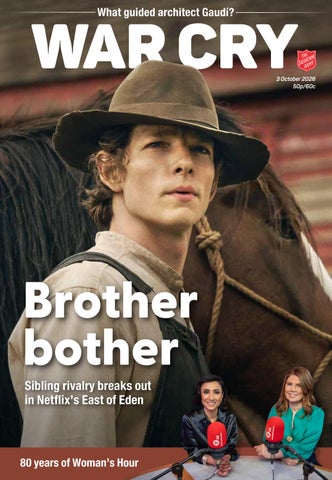
What guided architect Gaudí?
3 October 2026 50p/60c
Brother bother Sibling rivalry breaks out in Netflix’s East of Eden
80 years of Woman’s Hour
What is The Salvation Army? The Salvation Army is a Christian church and registered charity seeking to share the good news of Jesus and nurture committed followers of him. We also serve people without discrimination, care for creation and seek justice and reconciliation. We offer practical support and services in more than 600 centres throughout the UK. Go to salvationarmy.org.uk/find-a-church to find your nearest centre.
From the editor’s desk
Email: warcry@salvationarmy.org.uk
It may surprise many people to discover that churches and Christian charities interact with an estimated 50 per cent of preschool-age children. That statistic from the Heart of the Neighbourhood report, produced by Gather Movement, certainly surprised local councils, says Mark Cowling, a member of the Christian networking organisation’s leadership team, in an interview in this week’s War Cry. The report is based on the information received from 1,632 churches and Christian charities – among them The Salvation Army – and charts the types of support they offer to people of all ages, including assistance with food security, homelessness and mental wellbeing. Mark is clear why churches and Christian charities seem to be so effective at offering such services. ‘As Christians, we’re driven to love our neighbours,’ he says. ‘And a vital strength of the Church is that we can offer relational support, week after week – because poverty isn’t just material.’ If Heart of the Neighbourhood is about highlighting positive outcomes, then East of Eden shines a spotlight on how things can go badly wrong for families and individuals. In this issue of the War Cry, we look at the new Netflix drama series based on John Steinbeck’s 1952 novel. The story follows several generations of a family who suffer the terrible consequences of jealousy and anger. And in a twist worthy of the story itself, the new drama is written and produced by Zoe Kazan, granddaughter of Elia Kazan, who directed the 1955 film version of East of Eden starring James Dean. But East of Eden is based on a far older story. It’s a retelling of the Bible story of the brothers Cain and Abel, a story of jealousy which led to murder and Cain’s banishment to ‘the land of Nod, east of Eden’ (Genesis 4:16 New International Version). It’s a story of good and evil and the freedom to choose what we do. We still face those decisions. We must choose between right and wrong – but we can be assured that our good choices will make a positive difference to other people and in our own lives.
The Salvation Army United Kingdom and Ireland Territory 1 Champion Park London SE5 8FJ
When you’ve read the War Cry, why not pass it on ➔ ➔ ➔
What is the War Cry? The Salvation Army first published a newspaper called the War Cry in London in December 1879, and we have continued to appear every week since then. Our name refers to our battle for people’s hearts and souls as we promote the positive impact of the Christian faith and The Salvation Army’s fight for greater social justice.
WAR CRY Issue No 7801
Editor: Gareth Dickens, Major Managing Editor: Philip Halcrow Staff Writer: Emily Bright Staff Writer: Claire Brine Staff Writer: Ewan Hall Editorial Assistant: Linda McTurk Graphic Designer: Mark Knight Graphic Designer: Matt Penberthy
Tel: 0845 634 0101 Subscriptions: 01933 445445 (option 1, option 1) or email: subscriptions@satcol.org Founders: Catherine and William Booth International leaders: General Lyndon Buckingham and Commissioner Bronwyn Buckingham Territorial leaders: Commissioners Jenine and Paul Main Editor-in-Chief: Major Andrew Stone Published weekly by The Salvation Army © The Salvation Army United Kingdom and Ireland Territory ISSN 0043-0226 The Salvation Army Trust is a registered charity. The charity number in England, Wales and Northern Ireland is 214779, in Scotland SC009359 and in the Republic of Ireland CHY6399. Printed by CKN Print, Northampton, on sustainably sourced paper
INFO Your local Salvation Army centre
CONTENTS FEATURES
3
Sons and brothers A family drama as old as time
6
Gathering together The daily support churches offer communities
8
God’s architect Author reveals how nature and faith shaped striking designs
13 By women, for women Eight decades of information, education and encouragement REGULARS
FO 4
Team Talk and War Cry World
12 What Did He Say? 14 Puzzles 15 War Cry Kitchen Front-page picture: COURTESY OF NETFLIX © 2026
2 • WAR CRY • 3 October 2026
6 8 13 15
Oh, brother!
TV feature: East of Eden Netflix By Emily Bright
P
aradise feels very far off in Netflix’s East of Eden. The drama series, which tracks the lives of two half-brothers, is based on the 1952 novel by John Steinbeck – which itself took inspiration from a much older story. Charles (Mike Faist) and Adam (Christopher Abbott) Trask have grown up under the shadow of an abusive and domineering father, Cyrus (Tracy Letts). Cyrus repeatedly favoured his elder son, Adam, over his younger. While Charles seemed like a natural soldier and longed to get out into the world, Adam was a more sensitive soul who didn’t want to fight. But Cyrus, who briefly fought in the US Civil War, overruled their preferences, enlisting Adam in the cavalry and forcing Charles to stay home and manage the farm. Both sons resented the life that their father chose for them. Charles – increasingly jealous at his father’s favouritism towards his half-brother – beat Adam up in a fit of rage the night before he joined the army. As the years go by, they must work out
whether they can reconcile and resist the paths that their father has carved out for them. Their sibling relationship is complicated further in adulthood when a young woman, Cathy Ames (Florence Pugh), crawls bloodied and bruised on to their doorstep in search of refuge. Adam takes her in and cares for her, but her past is darker than either of them could have imagined. Although Charles doesn’t know her personal history, he doesn’t trust Cathy, and her presence in the house creates a deeper divide between the brothers. The choices Adam makes about Cathy will not only determine his own future but also play out in his relationship with Charles and the generations that follow them. As he forges his own path, can he make the right decisions? John Steinbeck’s novel, which lies behind the new drama, harks back to the story of Cain and Abel, two brothers in the Bible. Just like the Trask brothers, Cain and Abel have the power to choose: to do good
COURTESY OF NETFLIX © 2026
Half-siblings try to step away from a traumatic past
Life gets complicated for Charles, Adam and Cathy in ‘East of Eden’
or to do evil. In the Bible, God warns Cain: ‘You will be accepted if you do what is right. But if you refuse to do what is right, then watch out! Sin is crouching at the door, eager to control you. But you must subdue it and be its master’ (Genesis 4:7 New Living Translation). Tragically, despite God’s warning, Cain’s jealousy overcame him, and he committed the first murder recorded in the Bible. Since then, humanity has struggled with cycles of violence, cruelty and hurt. But it has also been offered hope that it can forge a brighter future. Threaded through the Bible is a powerful message of God’s offer of redemption and how he equips us to make the right choices. He sent his Son, Jesus, to die on a cross for our sins, so that we can be forgiven and start afresh. And if we follow Jesus, he will give us the strength we need to tackle our problematic behaviour. He can help us to choose our next steps wisely and to carve out a more hopeful future of paradise regained. 3 October 2026 • WAR CRY • 3
Team talk TEAM WA
talk ‘ TALK’ j I choose you…
Ewan Hall gives his take on a story that has caught the attention of War Cry reporters A new investment craze is centring on an unlikely source – Pokémon cards. The children’s trading card game has become a kind of currency, with individual cards, packs or booster boxes becoming a sought-after commodity among collectors and fans. Trading card store owner Juliano Scibelli told BBC News: ‘People see them as an investment, a retirement fund or a way to secure their future.’ What started as a fun card game for young people to play has grown into something much bigger. Rare and exclusive cards are blasting off in price. A 1998 Pikachu card – one of only 39 known copies – sold for $16.5 million at auction in February. With the rise in card values, old fans of the card game, video games or animated series have been returning and buying into them. ‘A lot of people who got into Pokémon are now in their 30s and 40s, so it’s no longer just for children,’ said Juliano. ‘I grew up in the 1990s, and I remember it being the biggest thing. ‘Now I get customers in their 70s and 80s. That wasn’t the case years ago.’ Juliano added that he was worried the hobby had become too focused on the financial values of the cards rather than the game of collecting them all. Having grown up playing and trading Pokémon cards, I’m amazed by the financial value that people place on certain pocket monsters. But their popularity and price can alter over time. Which is why I am grateful to have found in my faith someone whose value will never fade – Jesus. In reminding Christians to remain faithful to their beliefs amid changing circumstances, one Bible writer reassured his readers: ‘Jesus Christ is always the same, yesterday, today and for ever’ (Hebrews 13:8 Easy English Bible). While trends come and go, my relationship with Jesus never changes. His love, acceptance and presence remain a constant – and that is priceless.
Growing recognition for volunteer
A Salvation Army volunteer who has transformed an area of Keighley Salvation Army church into a thriving garden has won recognition for his produce at the town’s agricultural show. Matthew Towers first connected with Keighley Salvation Army in West Yorkshire through its Victory Programme, which teaches participants how to cook on a budget. After teaching himself to garden – which, he says, aided his recovery from an alcohol addiction – he transformed a derelict yard at Keighley Salvation Army into a green space that now produces a wide variety of vegetables that help to support the church’s café and food bank. ‘I was nervous about Keighley Show,’ Matthew says. ‘The weather was really bad on the Friday when I was supposed to take the vegetables down there, so I fretted all night that something was going to go wrong. But in the end I got second for my chillis and third for my sweetcorn.’
A Pikachu card sold for $16.5 million
Team talk 4 • WAR CRY • 3 October 2026
Matthew’s sweetcorn won third prize
Do you have a story to share? a warcry@salvationarmy.org.uk TheWarCryUK
B salvationarmy.org.uk/warcry
R CRY
WnRLD
Danny Murphy hands it to tournament winners
Match of the Day pundit Danny Murphy presents the trophy to the winners of The Salvation Army’s annual five-a-side football tournament for teams of people experiencing homelessness. More than 30 teams from around the UK took part in this year’s Partnership Trophy competition, which aims to use football to boost morale and wellbeing among people who have received support from The Salvation Army’s homelessness services. This year’s winners of the competition – which was held in Manchester and which receives backing from Pep Guardiola’s family charity the Guardiola Sala Foundation – were the team from Founders House Lifehouse in east London. Joining Danny Murphy in mingling with the players and offering encouragement was Manchester City and Belgium forward Jérémy Doku.
Raye of sunshine brings joy with prayers Brit award-winning singer and songwriter Raye (pictured) spread smiles across the streets of London when she recorded the new music video for her single ‘Joy’, whose lyrics contain quotes from prayers in the Bible. The video follows Raye and her sisters, Amma and Absolutely, as they hand out sunflowers to passers-by, encouraging moments of kindness and positivity. The song – which appears on her latest album, This Music May Contain Hope – includes the lyric, ‘I may cry through the night,/ But my joy comes in the morning’, which echoes Psalm 30:5, while the lines ‘Cover me with your feathers, Father./ Shelter me with your wings’ uses the imagery of God’s protection in Psalm 91:4.
Boost for cathedral music projects Cathedrals and churches across England are set to benefit from nearly £440,000 in funding, after the Cathedral Music Trust announced grants as part of its 70th anniversary celebrations. The grants will help the places of worship open up new opportunities for community participation in music, including children’s singing initiatives. Among the cathedrals to receive grants are Peterborough, Birmingham and Newcastle. ‘At a time when many people feel increasingly disconnected, and as technology continues to reshape the way we live, work and create, the value of making music together has never been greater,’ says Jonathan Macdonald, chair of Cathedral Music Trust. ‘Cathedral music brings people together across generations and backgrounds through shared musical experiences.’
3 October 2026 • WAR CRY • 5
‘We can offer support, week after week’ MARK COWLING of Gather Movement explains how a network of Christian charities and churches – working alongside civic authorities and other organisations – are transforming their communities Interview by Emily Bright
Mark Cowling
‘C
ivic and health leaders are blown away by how much the Church is doing,’ says Mark Cowling of Gather Movement. ‘For many of them, it’s a culture shock to realise that churches do more than Sunday services.’ Since its inception 15 years ago, Gather Movement has encouraged collaboration between churches, Christian charities and other organisations such as the NHS and local councils. It has also mapped the services that these collaborations provide. Gather Movement now operates in 150 towns and cities across England, working with more than 8,000 organisations to coordinate services benefiting communities. For a new report, Heart of the Neighbourhood, Gather Movement surveyed 1,632 churches and Christian charities – including The Salvation Army – to chart their impact. Between them, the organisations provided 12,840 services
6 • WAR CRY • 3 October 2026
in the areas of mental health, food security, care for children and families, housing and homelessness. Mark is no stranger to the value of church networks. Before joining Gather Movement in 2022, where he now serves on the leadership team, he worked closely with other church leaders as a vicar in Bolton for more than a decade. And a question to Gather Movement from a mayor of Greater Manchester has influenced his thinking. ‘A number of years ago, Andy Burnham was looking to find a way to connect and collaborate with churches and with the whole faith sector across Greater Manchester. His question was: “Who do I call if I want to speak to the Church? Which number do I ring?”’ Mark and his colleagues at Gather Movement put together a list of all the churches in Greater Manchester – more than 1,000 across 10 boroughs.
‘We’d heard from Andy Burnham and others that the key priorities for a city or a town to flourish were around food security, mental health, children and families, housing and homelessness. We contacted every church leader of those 1,000 churches across Greater Manchester and asked them a set of questions about the 55 key services that we identified.’ This mapping programme sparked the idea to chart the services offered across the rest of the country. Gather Movement has now produced the Heart of the Neighbourhood report to reveal its findings so far. Among its most notable discoveries is that churches and charities interact with an estimated 50 per cent of early years children before they start school. ‘When you tell local councils that statistic,’ says Mark, ‘their eyes widen and their ears prick up. If we can help
children start well, then their life chances are hugely increased. Toddler groups are the ideal environment for brain development and school-readiness skills to develop.’
We’re driven to love our neighbours
C
hristian organisations are playing a key role in the area of mental health too. The report found that they offer 2,445 services in England, such as crisis support groups and lunch clubs to reduce social isolation. Mark says: ‘Mental health is a big need. Up to 20 per cent of patients that visit a GP don’t need medicine. They need a social prescription: a group where they can go and be known and listened to. ‘So we’re excited about GPs being able to send people to all the different social
and physical activities that churches and charities do, as well as the more specific mental health courses that they run.’ One example featured in the report is that of the Night Light Cafés in Lincolnshire, which were established in response to high suicide rates in the area. The NHS found that mental healthrelated 999 calls spiked after its specialist services closed for the day. So the cafés were set up to provide out-of-hours mental health support in non-clinical and community settings, providing refreshments, a listening ear and signposts to further help. Commissioned by the NHS, the cafés are run by independent Christian charity the ACTS Trust across Greater Lincolnshire. ‘The Night Light Cafés are a place where people can come if they’re in distress or in crisis,’ says Mark. ‘Even ambulance drivers will drop off people to
the cafés rather than take them to A&E. They’ve been a phenomenal success.’ Mark explains why churches and Christian charities seem to be so effective at offering services and support to their areas. ‘As Christians, we’re driven to love our neighbours,’ he says. ‘The Church has, I think, some of the biggest voluntary numbers of any sector or organisation. There are nearly 40,000 churches across the UK, operating in deprived areas, wealthy areas – the whole mix. ‘And a vital strength of the Church is that we can offer relational support, week after week – because poverty isn’t just material. Having a place where relationships can be rebuilt and renewed is what the Church is all about. ‘The mission that God gives us is to seek the peace and prosperity of our places.’
3 October 2026 • WAR CRY • 7
Looks Família KIT S TAN FO RD
La Sagrada Família
Peter Stanford
The visually striking buildings designed by Antoni Gaudí have become some of the most-visited landmarks in Barcelona. PETER STANFORD’s fascination with them has led him to write a biography of the architect Interview by Philip Halcrow
‘A
nyone wandering around Barcelona is going to see his buildings,’ says journalist and author Peter Stanford, ‘particularly on the Passeig de Gràcia, where the Casa Milà and Casa Battló face each other. They’re both spectacular. You can’t miss them. So even if he hadn’t built the Sagrada Família, he would have been important.’ The Catalan capital attracts 16 million visitors every year – and many of them want to take in the colourful landmarks designed by architect Antoni Gaudí. They tour Park Güell with its 110-metre snake-like bench or they can stop and stare at the frontage of Casa Calvet. ‘But Sagrada Família also has this peculiar story behind it,’ says Peter, ‘and it looks like nothing else you’ve ever seen. ‘Most people have an idea what a cathedral looks like. And at the heart of Sagrada Família there is a gothic cathedral – there’s a nave, a transept and a high altar. But what’s different is the shape and the form of it, particularly the features that come from the very strong view Gaudí had of nature, which means that there are no straight lines, no 90-degree angles.
8 • WAR CRY • 3 October 2026
OF PETER STANFOR ESY D URT CO
Casa Milà (above) and Casa Calvet (left), two of Gaudí’s buildings in Barcelona
‘It’s a gothic nave in lots of senses – you’ve got pillars holding things up and they are clearly stone, but they’re also shaped like trees. As they reach up, they go off into stone branches and stone leaves. ‘And they’re all holding up the roof, because what Gaudí hated about medieval gothic architecture was that, in order to have these very tall buildings, you had to have flying buttresses on the outside to hold them up. He thought flying buttresses disfigured buildings. So all these stone trees and branches were about strengthening the building. ‘The other weird thing about his buildings was that he used the catenary arch, which looks like the two arches on the M of McDonald’s. It is somewhere between a U and a V, somewhere between a rounded Anglo-Saxon arch and a pointed gothic one. Gaudí firmly believed that it was the strongest shape in nature – and indeed its strength is shown in Sagrada Família because the arches
have held it up for all this time. ‘Then there are these fantastic 18 towers.’ Back in the 1980s, when Peter first encountered it as a teenager, the basilica was far further from completion than it is today, even though a century had passed since Gaudí had taken on the project. Peter was fascinated by what he could see of it – including one of its façades depicting the Nativity – and the scale of it. He was also intrigued by its unfinished state.
Who was the man behind it?
‘I
was wondering: “Will it ever be finished or was it some old man’s folly?” And then I began asking: “Who was the man behind it?”’ Prompted by a more recent visit, which left him asking the same questions, Peter decamped to Barcelona for a few months in 2023 to research and write a biography of the man behind the still-to-be completed church.
‘It seemed to me that there were two sorts of books about Gaudí,’ he says. ‘There were books written by architectural historians, who were keen to place him in the canon of architecture and say who he got his ideas from. Then there were hagiographies written by people who wanted him to be made a saint and who tended to round his life off and say that everything he did was good. ‘But there was nothing in between. I thought that someone ought to write a book that didn’t avoid architecture as a subject and that also didn’t treat this man as a plaster saint, but instead looked at him with some insight into why he did the things that he did. ‘The other important reason for me writing the book is that I am Catholic. I wanted to bring to the book an understanding of someone who was
Turn to page 10 f 3 October 2026 • WAR CRY • 9
From page 9
brought up in the same tradition as Gaudí, because that tradition informs so much of what goes on in his buildings.’ The result of Peter’s research and his empathy with Gaudí’s faith is Gaudí: God’s Architect. ‘A lot of Gaudí’s buildings were grand houses for very rich people,’ Peter tells me. ‘They were commercial, so you might expect them to be, let’s say, secular. But every single one of those buildings is stuffed with religious symbols, if you have eyes to see them. ‘A good example is his first commercial contract, Casa Vicens. It’s beautiful, luxurious. Outside it’s very Moorish, Arablooking. When you go inside, there’s a gentlemen’s smoking room downstairs and a ladies’ sitting room. Gaudí decorates the ladies’ sitting room with 33 white doves flying round the ceiling. If you understand
the background, you know that the doves are a biblical symbol and that Jesus died at 33 years of age. ‘Fast-forward to the end of Gaudí’s life when he’s building the Nativity façade on the Sagrada Família. In the middle is a green ceramic tree. What’s sitting on the tree? White doves. ‘The same ideas keep running through Gaudí’s buildings, whether they are commercial or religious.’ Peter says that faith played a key part in Gaudí’s perspective on his work, right up until the day when he was killed by a tram on his way home from the Sagrada Família building site. It was a faith that seemed to undergo a significant development. ‘It would be fair to say,’ Peter suggests, ‘that just after he graduated in 1878, Gaudí was a bit of a dandy and a man about town. I think God was a bit less prominent
The roof of the ‘spectacular’ Casa Battló
in his life then. ‘He did two or three houses – his most famous one was for his big patron Eusebi Güell. He built Palau Güell, and suddenly he was everybody’s darling. Everyone was trying to commission him. But he chose not to take any of those jobs. Instead, he took a job for a newly founded religious order of nuns who had a rather rickety old building and wanted him to build some upper floors on it.’ Col·legi Santa Teresa, Peter explains, echoed the faith of its inhabitants. ‘The order of nuns was named after Teresa of Ávila, who wrote The Interior Castle, a book which said that you don’t have to go out to find God because God is already inside you. So Gaudí’s building has no handle on the front door. It’s saying that you don’t need to go anywhere to find God – he’s already there.’ Gaudí’s encounter with the religious tradition of Teresa – which also spoke symbolically of the soul making a journey towards God through many mansions – seemed to affect him.
He felt his work was somehow guided by God
COURTESY OF PETER STANFORD
‘T
10 • WAR CRY • 3 October 2026
he project made him stop and think about what he was doing,’ says Peter. ‘Did he want to be a commercial architect, taking money from the rich? Eusebi Güell was in many ways a good patron – although he was also, either directly or indirectly, involved in the slave trade well after the Church had clearly said what it had felt about slavery. But did Gaudí want to work for those people or did he want to do God’s work? ‘From that moment on, he did carry on working for commercial clients, but in a way as a compromise to fund his work on Sagrada Família. He felt his work was somehow guided by God.’ A friend of Gaudí’s recalled that whenever the architect was asked to give a completion date for the Sagrada Família, which was always running out of money, he answered: ‘God is my client, and he is in no hurry.’ Peter says: ‘When Gaudí says that God is his client, he does not mean that God was sending down angels who were handing him architectural plans. However, we know what he meant because he is remembered as having talked about trying to convey in his buildings the glory of God – and as having felt that he had failed to do it adequately.’ If Gaudí was working for God, Peter continues, then the client-employee
CO E SY URT
ALA MY /GL
AR C
TANFORD ETER S OF P
VE HI
Chagall-like stained-glass in the crypt at Colònia Güell
Antoni Gaudí
relationship was not always smooth. ‘Gaudí had this sense that he was failing God all the time. His was a very penitential kind of faith. He was deeply depressive. And yet, in trying to realise the love of God, he built these fantastically joyful buildings.’ One ‘absolutely fantastic’ building is the last commission that the architect carried out for Güell. ‘Gaudí was going to build a huge church at Colònia Güell, a village that the businessman was building for his workers. However, Güell became too ill for the project to be finished and his sons axed it. ‘But what did get built was the crypt. Everything is crooked, even the pillars. The benches all bend outwards. It’s sort of a church in the round, which we didn’t really get in Catholicism until the 1960s. The windows look like they’re by Marc Chagall – Gaudí was doing Chagall before Chagall. If you didn’t know any better, you’d think Peter Blake had done the candle rack in the 1960s – it’s like pop art.’ Even though the Sagrada Família – as Peter emphasises – was not started as a
project by the central church diocese but by a lay organisation, Gaudí envisaged it as having a grand religious purpose. ‘This was a time when people were leaving the Church and joining up with radical unions that were atheist. Gaudí felt that the Sagrada Família would bring people back to God. ‘He felt that the world was becoming godless at the beginning of the 20th century – and indeed he was right, certainly in terms of Europe. He thought that if there was this fantastic building that dominated the city’s skyline, it would draw people in. ‘So in one sense it isn’t the building he wanted it to be, because he wanted it to be a building that would bring people back to the Catholic Church. But it didn’t.’ And yet… ‘I went to a couple of Masses there,’ says Peter, ‘but even when you’re there with the tourists wandering round, there’s just something about it. There’s something about the light flooding in through the stained-glass windows. There’s something about the scale of it. There are playful bits
in it – like the covering over the altar, which looks a bit like a café umbrella with grapes and sheaves of corn hanging. I sensed that, even though it was very busy with visitors, there was a sense of awe and of the transcendent. ‘I would suggest that of the five million people who go inside the Sagrada Família every year, a good 90 per cent have no formal religious attachment, and yet quite a lot of them come out having felt inspired in some way. ‘I think that some buildings can remind us of this other dimension to our world – and the Sagrada does it better than anywhere else I’ve been.’
l Gaudí: God’s Architect is published by Hodder & Stoughton
3 October 2026 • WAR CRY • 11
What did he say?
Prayerlink Your prayers are requested for Bernadette and her daughter. The War Cry invites readers to send in requests for prayer, including the first names of individuals and details of their circumstances, for publication. Send your Prayerlink requests to warcry@salvationarmy.org.uk or to War Cry, 1 Champion Park, London SE5 8FJ. Mark your correspondence ‘Confidential’.
j
Becoming a Christian
There is no set formula to becoming a Christian, but many people have found saying this prayer to be a helpful first step to a relationship with God
Lord Jesus Christ, I know that I have done things in my life that are wrong and I’m sorry. Thank you that I can ask you for forgiveness because of the sacrifice you made when you died on the cross. Please forgive me and help me to live a better life in the future as I learn how to love you and follow your way of living. Thank you, Lord Jesus.
If you’ve prayed this prayer, scan the QR code or contact us using the coupon on this page
Lynne Shaw takes a look at some of the significant sayings of Jesus No one can serve two masters – Matthew 6:24 If you are a footballer in the middle of a game, imagine trying to please both team managers. A long time ago, when I used to go to every Portsmouth home game, we would wonder if one of the players wasn’t doing exactly that, every time he scored an own goal! Or imagine you are a pop musician but with a manager wanting one thing and the record label wanting another. It gets even more complicated if you don’t agree with either of them. What do you do? Or what if you are in a newly committed relationship, but instead of talking problems through with your partner, you keep turning to your parents. Jesus wisely pointed out that we cannot serve two masters, leaders or authorities without it changing how we relate to at least one of them. We may well end up hating one and loving the other, or devoted to one and neglecting the other. We all have priorities in our lives. They compete for our time, focus and even love. If we are careful to give each the right attention, then – with a bit of working things out and putting good boundaries in place – we can manage them. What Jesus was talking about, however, went even deeper. He was teaching us about the very foundations of our lives – about how our key beliefs shape our actions. For instance, if we believe that God is love and asks us to love our neighbour as ourselves, then this affects how we interact with everyone who comes our way. Alternatively, if we believe that the sense of security offered by money is the most important thing of all, then that influences every decision we make and how we treat all sorts of people. In particular, Jesus suggests that we cannot offer our undying devotion to these two things – God and wealth – simultaneously. He urges us, by his teaching, to make wise choices and discover that selfless and loving action reaps rewards of lasting value.
"
Want to know more? a
To receive basic reading about Christianity and information about The Salvation Army, complete this coupon and send it to War Cry 1 Champion Park London SE5 8FJ
Name
Address
Or email your name and postal address to warcry@salvationarmy.org.uk 12 • WAR CRY • 3 October 2026
‘Woman’s Hour’ presenters Anita Rani and Nuala McGovern
STEVE BRIGHT/BBC
QUICK QUIZ 1
Which TV cook is the new judge
2
‘Sept’ is the French word for
3
Who plays Elinor Dashwood in
on The Great British Bake Off?
which number?
the new film version of Sense and Sensibility?
4
Which cyclist this year won his
5
What is the capital of Slovakia?
6
Who had a No 1 hit in 1997 with
fifth Tour de France?
the album Open Road?
ANSWERS
TIME TO TALK Woman’s Hour celebrates 80 years on air Feature by Claire Brine
T
o focus on women’s voices and lives – that has always been the point of Radio 4’s Woman’s Hour. Next Wednesday (7 October), the programme presented by women, for women celebrates its 80th anniversary with a special edition broadcast live from Glasgow Women’s Library, the UK’s sole accredited museum of women’s history. To mark the milestone, presenter Nuala McGovern will delve into the show’s archives to reflect on eight decades of storytelling and will also reveal the results of a poll investigating women’s ability to speak up for themselves. Speaking up – to challenge, inform and inspire – has always been key to Woman’s Hour. Launched in 1946, the programme initially provided tips on cooking and household management to help women with the postwar recovery. Over time, however, the show gained traction for its discussion of subjects that were formerly considered taboo, such as the menopause, abortion and homosexuality. The programme has also featured groundbreaking interviews with dozens of prominent figures who have opened up about their lives, including Nancy Astor, the first woman to take her seat in the House of Commons; campaigner for girls’ education Malala Yousafzai; and England footballer Leah Williamson. By exploring a variety of topics from a female perspective, Woman’s Hour has aimed to show women that they matter – that their experiences are important and their feelings worth sharing. For many of us, having the space and time to talk honestly about our lives can be liberating. Some parts of our story may be easy to discuss; but other aspects may seem too complicated or emotionally draining to explain. Perhaps we also worry about how our words will be interpreted by whoever is listening. We needn’t fear when we talk to God. The Bible assures women and men everywhere that ‘he is kind and patient, and his love never fails’ (Psalm 103:8 Contemporary English Version). Millions of people across the years have found those words to be true. When we confess the mistakes we have made in our lives, God will forgive us. When we ask for guidance for the future, he will help us work out our next steps. Whatever we tell him, God will listen with compassion – every hour of the day. 3 October 2026 • WAR CRY • 13
1. Nigella Lawson. 2. Seven. 3. Daisy Edgar-Jones. 4. Tadej Pogacar. 5. Bratislava. 6. Gary Barlow.
PUZZLES Quick CROSSWORD ACROSS 1. Fundamental (5) 5. Humorist (5) 8. Haul (5) 9. Stage play (5) 10. Extemporise (2-3) 11. Opponent (5) 12. One of a pair (4) 15. Hug (6) 17. Infection (5) 18. Supplicated (6) 20. Yell (4) 25. Suffer (5) 26. Apply force (5) 27. Presses (5) 28. Animal organs (5) 29. Mature (5) 30. Not now (5) DOWN 1. Spending plan (6) 2. Fried prawns (6) 3. Allure (5) 4. Slice (5) 5. Envious (7) 6. Slaughtered (6) 7. Partial refund (6) 13. Armed conflict (3)
SUDOKU
Fill the grid so that every column, every row and every 3x3 box contains the digits 1 to 9
6 8 7 3 2 1 6 8 3 5 4 7 5 6 3 7 6 4 8 9 4 8 3 5 7 9 6 8 6 7 14. Offer (3) 15. Hint (3) 16. Depressed (3) 17. Deer meat (7) 18. Mollycoddle (6)
19. Dormant (6) 21. Skilful (6) 22. Not as great (6) 23. Deride (5) 24. Broil (5)
M O B HONEYC Each solution starts on the coloured cell and reads clockwise round the number
1. Brief look 2. Motor vehicle fuel 3. Turn into ice 4. Instrument used for sewing 5. Close-fitting necklace 6. Fibrous tissue attaching muscle to bone
ANSWERS
Look up, down, forwards, backwards and diagonally on the grid to find these architects
P X VUKOVQT F DZ J B FQXR C EMP ROQB L V J QGB L B V X RQN L X S P K H T Q Z QH BWT S P J J RWS E I MN G C KMD X N B QZ RQP R I GAUD I ZWV CA Y Y S X Q B Z N VWN S E F D X B J C MV H J WR I G H T O I I G P A Q E T S R R G L K R S A Q J B SWHMC Z Q E A L G A Z C Q X J F H U AWU B N I U F B Z PW J I QMY Z D S X P E S Z T OOU C BWE G V T I D A J ZUX F S S AUQL ECGXDGN WD B C B Q I T X X H H Z T NWO D Z R R Z F U L L E R Q QW I S Q A D V I O D Z Q S Y Y R WW Z B V Y J U UWC R Q B S B S I R Z S J G U P D D Q E F T Q D PME T H C E EWC X ZO L EGNA L EHC I MEQKY A
9 8 3 5 2 6 7 1 4 4 1 5 3 7 9 2 6 8 7 6 2 4 8 1 9 5 3 6 5 1 7 4 3 8 9 2 3 9 8 1 6 2 5 4 7 2 4 7 9 5 8 1 3 6 8 7 9 6 3 5 4 2 1 5 3 4 2 1 7 6 8 9 1 2 6 8 9 4 3 7 5
HONEYCOMB 1. Glance. 2. Petrol. 3. Freeze. 4. Needle. 5. Choker. 6. Tendon. QUICK CROSSWORD ACROSS: 1. Basic. 5. Joker. 8. Heave. 9. Drama. 10. Ad-lib. 11. Rival. 12. Twin. 15. Cuddle. 17. Virus. 18. Prayed. 20. Bawl. 25. Incur. 26. Press. 27. Irons. 28. Offal. 29. Ripen. 30. Later. DOWN: 1. Budget. 2. Scampi. 3. Charm. 4. Carve. 5. Jealous. 6. Killed. 7. Rebate. 13. War. 14. Bid. 15. Cue. 16. Low. 17. Venison. 18. Pamper. 19. Asleep. 21. Adroit. 22. Lesser. 23. Scoff. 24. Grill.
14 • WAR CRY • 3 October 2026
W RDSEARCH
FOSTER FULLER GAUDÍ GEHRY HADID ISOZAKI LE CORBUSIER
MICHELANGELO MIES PEI PIANO SULLIVAN WREN WRIGHT
SERVES 1
Vegetable breakfast omelette INGREDIENTS
METHOD
2 large British Lion eggs
Whisk together the eggs, milk and seasoning in a medium bowl or jug. Set aside.
1tbsp milk
Heat a little oil or butter in a medium non-stick frying pan over a low-to-medium heat. Add the pepper and mushrooms and stir well. Cook for 4-5 minutes, stirring occasionally.
Salt and freshly ground black pepper ½ pepper (red, yellow or orange), chopped 2-3 chestnut mushrooms, chopped
Add the spinach and cook until wilted. Pour in the egg mixture, tilting the pan so it covers the base. Cook for 2-3 minutes, until almost set. Sprinkle over the cheese, if using, then gently fold the omelette in half with a spatula or palette knife. Remove from the heat and leave for 1 minute to allow the cheese to melt. Slide the omelette on to a plate and serve immediately.
Handful spinach 1tbsp grated cheese (optional) Olive oil or butter, for cooking
SERVES 2
Mediterranean egg wrap INGREDIENTS
METHOD
1tsp olive oil
Heat the oil in a non-stick frying pan over a medium heat.
4 large British Lion eggs Freshly ground black pepper Dried oregano (optional) 3-4tbsp hummus 2 wholemeal wraps, warmed 1 ripe tomato, sliced 30g feta cheese, crumbled (optional)
Meanwhile, whisk the eggs in a bowl along with the pepper and, if using, oregano, until the mixture becomes foamy. Pour the egg mixture into the pan to cook, stirring continuously with a spatula, until scrambled. Remove from the heat. Place the wraps on 2 plates and spread with the hummus. Spoon over the scrambled eggs, then add the tomato and, if using, feta cheese. Add a handful of rocket leaves to each wrap. If using, squeeze some lemon juice over the top, to taste. Fold the wraps and serve immediately.
Rocket leaves 1 lemon, juice (optional)
Recipes reprinted, with permission, from the British Egg Information Service website egginfo.co.uk
3 October 2026 • WAR CRY • 15
1 John 4:19 (Good News Bible)