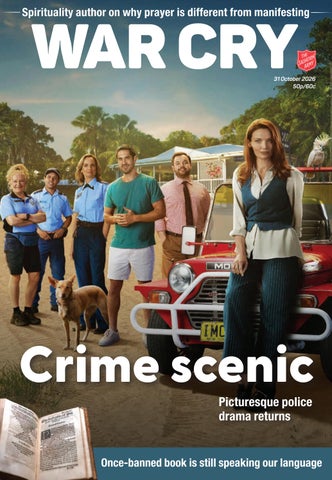
Spirituality author on why prayer is different from manifesting
31 October 2026 50p/60c
Crime scenic Picturesque police drama returns
Once-banned book is still speaking our language
UNCORRECTED
What is The Salvation Army? The Salvation Army is a Christian church and registered charity seeking to share the good news of Jesus and nurture committed followers of him. We also serve people without discrimination, care for creation and seek justice and reconciliation. We offer practical support and services in more than 600 centres throughout the UK. Go to salvationarmy.org.uk/find-a-church to find your nearest centre.
What is the War Cry? The Salvation Army first published a newspaper called the War Cry in London in December 1879, and we have continued to appear every week since then. Our name refers to our battle for people’s hearts and souls as we promote the positive impact of the Christian faith and The Salvation Army’s fight for greater social justice.
WAR CRY Issue No 7805
Editor: Gareth Dickens, Major Managing Editor: Philip Halcrow Staff Writer: Emily Bright Staff Writer: Claire Brine Staff Writer: Ewan Hall Editorial Assistant: Linda McTurk Graphic Designer: Mark Knight Graphic Designer: Matt Penberthy
From the editor’s desk A Bible app has announced that more people are using it every day than a year ago. As we report this week, YouVersion says that globally more than 18.5 million people a day are turning to the app, a 13 per cent increase on last year. As well as releasing information on the number of people who use it, YouVersion revealed the terms that people globally search for the most. They include ‘anxiety’ and ‘hope’. Unsurprisingly, English is one of the 2,000-plus languages offered by the app in a variety of versions – and you don’t have to look too far into them to find phrases that were introduced into the English-language New Testament by the man who made the first translation from the Greek texts 500 years ago. William Tyndale’s terms such as ‘salt of the earth’ and ‘eat, drink and be merry’ still appear in modern Bibles. They have also spilt into everyday language. When Tyndale made his translation into English, he did so in the face of huge opposition. As Penny Sexton of St Paul’s Cathedral tells us this week, religious and state authorities – who relied on a Latin Bible in churches – feared that they would no longer have control if people had the Bible in their own language. But Tyndale carried on with his work. And, though his book was banned and burnt, and he was hunted down abroad and executed, his work was not kept down. ‘Eighty per cent of the King James Bible New Testament is Tyndale,’ says Penny. ‘His words have influenced the Bibles we read today.’ William Tyndale’s legacy is not only the phrases such as ‘powers that be’ and ‘sign of the times’, which have become part of everyday speech. He wanted everyone to have access to the Bible. He wanted everyone, amid their anxiety, to know God’s message of hope.
Email: warcry@salvationarmy.org.uk The Salvation Army United Kingdom and Ireland Territory 1 Champion Park London SE5 8FJ
When you’ve read the War Cry, why not pass it on ➔ ➔ ➔
Tel: 0845 634 0101 Subscriptions: 01933 445445 (option 1, option 1) or email: subscriptions@satcol.org
CONTENTS
Founders: Catherine and William Booth International leaders: General Lyndon Buckingham and Commissioner Bronwyn Buckingham Territorial leaders: Commissioners Jenine and Paul Main Editor-in-Chief: Major Andrew Stone Published weekly by The Salvation Army © The Salvation Army United Kingdom and Ireland Territory ISSN 0043-0226 The Salvation Army Trust is a registered charity. The charity number in England, Wales and Northern Ireland is 214779, in Scotland SC009359 and in the Republic of Ireland CHY6399. Printed by CKN Print, Northampton, on sustainably sourced paper
INFO
FEATURES
3
A g’day for Return to Paradise fans Aussie crime series is back
6
What’s the attraction of witchcraft, tarot and nature worship? Author examines craving for spirituality
9
Banned, burnt – but now celebrated 500 years of a groundbreaking book
13 A dose of nostalgia
Your local Salvation Army centre
Peak Practice arrives on streaming service REGULARS
FO 4
Team Talk and War Cry World
12 What Did He Say? 14 Puzzles 15 War Cry Kitchen Front-page picture: RED PLANET PICTURES/BBC STUDIOS/JOHN PLATT
2 • WAR CRY • 31 October 2026
6 9 13 15
Detective Mack must investigate after an artist is killed by his own work TV preview: Return to Paradise BBC1 and iPlayer By Ewan Hall
T
he audience can hardly believe their eyes when confronted with the latest performance art by Viktor Shevchenko (Lani Tupu). As they look on, his muse walks through the crowd and seems to plunge a knife into him. So begins the first mystery in the new series of Australia-based cosy crime drama Return to Paradise. The shocking spectacle is just one of the attractions at the Dolphin Cove art fair, where Detective Sergeant Mackenzie ‘Mack’ Clarke (Anna Samson) finds herself on uniform patrol alongside her boss, Senior Sergeant Philomena Strong (Catherine McClements). Mack’s assignment is actually intended as a punishment from Philomena for a personal issue – but at least it forces the pair into an awkward conversation about the absence from town of Philomena’s son, Glenn Strong (Tai Hara), and Mack’s role in it. Glenn’s decision to leave is personal for Mack too. Since returning to this picturesque corner of Australia, she has struggled to move on from her former fiancé, and her unresolved feelings came to a head at Glenn’s wedding when
his bride, Daisy, accused him of being more excited to see Mack than her. The confrontation halted the marriage and prompted Glenn to leave Dolphin Cove. No one has heard from him since. Philomena and Mack’s conversation is interrupted when a woman approaches Mack. It is her mother, who has not spoken to her in a long time. She reveals that she has returned to town to help an artist friend with a project at the fair. Moments later, everyone’s world is turned upside down. Arriving at a crime scene, Mack learns from Detective Senior Constable Colin Cartwright (Lloyd Griffith) that Viktor has been murdered. There seems to be little mystery surrounding the attack itself. Video footage quickly identifies the culprit: the muse is none other than Mack’s mother. Despite evidence leading the rest of the investigating team to believe that this is an open-and-shut case, Mack’s mum pleads that she is innocent and that the knife was a prop. Furthermore, a jelly baby in Viktor’s hand leaves Mack wondering if there is more to what happened than meets the eye.
RED PLANET PICTURES/BBC STUDIOS/JOHN PLATT
A dying art
Mack and her team have mounting evidence of her mother (left) being the murderer Throughout the episode, Mack finds herself juggling her personal struggles with an investigation that everyone says is solved. While we may not be detectives, many of us know what it feels like when problems pile up – whether it’s the case that a family relationship has broken down, we are troubled by our past, or people have jumped to the wrong conclusions about what we may have said or done. Sometimes there are no answers when we try to go it alone – but Christians believe there is another option available. In the Bible, Jesus offers the invitation: ‘Come to me, all you who are weary and burdened, and I will give you rest’ (Matthew 11:28 New International Version). Many have investigated the claim and found it to be true. If we turn to Jesus when we feel overwhelmed, we will find someone who is ready to help. He doesn’t tell us that life’s challenges will disappear, but he does promise to be with us through them. Our lives may not always be a paradise, but Jesus is a source of comfort and strength that we can keep returning to. 31 October 2026 • WAR CRY • 3
Team talk TEAM WA
talk ‘ TALK’ j Photographs celebrate history in the making
Ewan Hall gives his take on a story that has caught the attention of War Cry reporters Since 1984, October has been Black History Month in the UK. The Ghanaian journalist and activist Akyaaba Addai-Sebo first organised the initiative after consoling a colleague whose seven-year-old son had asked: ‘Mum, why can’t I be white?’ He wanted to create an opportunity to celebrate Black heritage and culture while highlighting contributions that have been often overlooked or misrepresented. Since then, the month has been celebrated every year in the UK, and this year has been no different. The theme for 2026 has been Honouring our Communities. A pack of resources for schools, workplaces and other venues has featured photographs of 54 people – those known locally or nationally – who have made important contributions to society. Among them are Councillor Lilian Seenoi-Barr, Northern Ireland’s first black mayor; Adebola Adisa, who has been creating opportunities for black residents to play an active role in her home town of Darlington; and the late Kanya King, who created the Mobo (Music of Black Origin) awards after being told at the age of 16 by a careers adviser that, if she was lucky, one day she could manage the local supermarket. While I can never fully comprehend what these individuals will have faced in achieving what they have, I am in awe of their desire to make the world a better place and to fight against injustice and prejudice. While not every Black achievement has received the recognition it rightfully deserves, Black History Month reminds me that God recognises and values every person. The Bible puts it like this: ‘God created mankind in his own image, in the image of God he created them’ (Genesis 1:27 New International Version). God loves us all. He shows concern for those who face injustice in the world and encourages us to seek justice, show compassion and to treat all people with dignity and respect.
I am in awe of their desire to make the world better
Team talk 4 • WAR CRY • 31 October 2026
Walker goes the extra miles
A 91-year-old who described The Salvation Army as his ‘family’ during his time as a Blitz evacuee has walked more than 1,200 miles to raise funds for the church and charity. Joe Wallace initially planned to cover 874 miles – the equivalent distance from John o’ Groats to Land’s End – through a series of walks close to his home in Cambridgeshire. However, when he finished the challenge within a year, he decided to keep going, and travelled to Cornwall on his birthday to end his walk by covering three miles to Land’s End. Joe said that he ‘felt elated’ when he reached the signpost marking Land’s End. He has raised £10,000 for five charities – including The Salvation Army – which have special significance to him and his family. He said: ‘The Salvation Army was the first charity I thought of because at the age of seven I followed the Army band with my mother and sister from an openair meeting to the Army hall at Uxbridge. ‘We had recently been bombed out of London during the Blitz and my father stayed in a rented home in London to keep his job. Growing up, I only saw him at weekends, and the Army became my family.’
Do you have a story to share? a warcry@salvationarmy.org.uk TheWarCryUK
B salvationarmy.org.uk/warcry
R CRY
WnRLD
England rugby union captain Maro Itoje revealed on the For the Love of Rugby podcast that his Christian faith prompts him to refrain from swearing on the pitch. When asked by hosts Ben Youngs and Anthony Watson whether he made ‘a conscious effort’ to keep his language clean during pre-match speeches, Maro said: ‘It is a conscious effort ... but it’s not so conscious because I just never do it. And to be honest, it’s mainly for religious reasons. I don’t believe that is the way the Lord wants us to use our mouths... No judgement on other people, but I try to refrain from that.’ Maro, who plays as a lock for England, spoke on the podcast before the fourth round of the Nations Championship gets under way on 6 November.
Rise in people using Bible app More than 18.5 million people a day use YouVersion’s Bible app – an increase of 13 per cent on last year. YouVersion reveals that the UK ranks as the seventh biggest user of the app in the world, with a 6 per cent increase in daily Bible app usage in the past year. The most common global search terms on the app included ‘anxiety’, ‘hope’ and ‘healing’. ‘Psalm 91’ was the single mostsearched term, referring to a passage which tells of how God is a source of refuge and comfort in difficult times. The statistics were released ahead of Global Bible Month, which takes place in November to celebrate the impact of Scripture. During the month, YouVersion will display Bible verses on the digital billboards at Piccadilly Circus in London, at Times Square in New York and in the Dotonbori district in Osaka.
ALAMY/MARK PAIN
Itoje explains mouth guard
Maro Itoje in action for England against France
Partners make plans for Christmas table A Christian charity and a coalition of organisations – including the BBC and NHS – are running a joint campaign to build social cohesion in the run-up to Christmas. Oasis Charitable Trust and the Together Coalition are aiming to create at least 1,000 Tables of Welcome across the UK with their campaign Together at Christmas. The purpose of the tables will be to bring together people of different ages, backgrounds, cultures, faiths and experiences who may not otherwise mix. Young people from schools and colleges as well as people from businesses, charities, faith communities and civic institutions are encouraged to host a table. To date, more than 240 tables have been pledged and registered.
No God or know God? A series of radio interviews is exploring whether it is possible to know that there is a God. In the latest series of Questions of our Times, produced by Premier Christian Radio and the Christian Evidence Society, former editor of the War Cry Major Nigel Bovey is asking guests to offer their insights into God’s existence. Among the interviewees being quizzed on the subject are Dr Joshua Sijuwade, teaching fellow in philosophy at the University of Birmingham, former archbishop of Canterbury Dr Rowan Williams, and geneticist Dr Ruth Bancewicz of the Faraday Institute for Science and Religion in Cambridge. Each episode of Questions of our Times is broadcast on Premier, and videos of the interviews are being posted on the Premier Plus and Christian Evidence Society websites. 31 October 2026 • WAR CRY • 5
Search for the
Sacred
As Halloween approaches, writer, scholar and podcaster BELLE TINDALL-RILEY explains why all kinds of spiritual practices are becoming more mainstream and how Christianity can meet people’s craving for something greater Interview by Emily Bright
‘I
Dr Belle Tindall-Riley
6 • WAR CRY • 31 October 2026
went to Glastonbury for the first time in 2024,’ says Dr Belle Tindall-Riley, a writer, biblical scholar and co-host of the podcast Re-Enchanting. ‘People always reach for spiritual or religious language to explain what it feels like to be there. They might call it “heaven on earth” or have a spiritual experience while watching Arctic Monkeys. It has a reputation as something more than just a secular music festival. ‘There’s an area called the Healing Field, which is huge. Every spiritual option you could imagine is there. It was bursting at the seams with people. What struck me was: They’ve all paid an eye-watering amount of money to be here. Shania Twain is playing on the Pyramid Stage. So why are they queuing for 45 minutes to get a tarot card reading? ‘I gradually realised that being spiritual but not religious is becoming more mainstream. I noticed decks of tarot cards on sale in every Waterstones by the till, like the way mints or chewing gum are in supermarkets. ‘As a society, we’re more willing to openly seek
Glastonbury Festival’s Healing Field hosts a variety of spiritual practices
spiritual answers to spiritual questions and crave things that, 10 years ago, we would have thought were purely for the new age crowd.’ Belle has written a book, The Sacred Ache, to explore the subject of spirituality – a task which she approached with ‘a generous curiosity about why spiritual practices are so popular and what it is within our human selves that is drawn in’. As Halloween rolls round again, she believes that taking a measured approach to the day is the best way forward. ‘As a Christian, I have a spiritual world view,’ she says. ‘I believe in goodness and evil, in light and dark. So it’s not about walking into this stuff thinking it’s all benign, but we can be more relaxed than we have been historically. ‘As Halloween approaches, Christians are like: “It’s time to defend Jesus.” But there’s a big difference between going all in with it and just dressing your child up as an Avenger. That doesn’t threaten our love or belief in Jesus.’
In the recent past, Halloween tropes may have seemed to be remote – the preserve of storytelling and historical witch-hunts. Today, though, practising witchcraft appears to be growing in popularity.
Our disconnection from the Earth is scaring us
‘M
any women are identifying as witches,’ says Belle. ‘I think so much of it is linked to the female identity. Women want to know that our femininity isn’t an inherent weakness, to be pushed down or shoved aside, but can be celebrated. ‘But I also believe that it’s connected to this longing to live a spiritual life, and for us to not feel like we have to assimilate men to get there. Witchcraft seems to have always celebrated and championed women.’ Belle believes that, in the past, the Church has sometimes done ‘a terrible
job telling the truth about how God views women’. She describes herself as being ‘convinced that God made women not to be a “helper suitable” for men – as the English translation of Genesis 2 puts it – but as a power to stand parallel to men, which is a better translation of the Hebrew’. She points out too that ‘Jesus goes out of his way again and again to remind people of how God made women to be a power to equal men, and he did not disqualify them from collaborating with him’. Her view leads her to the conclusion that ‘the Christian story affirms the role, dignity and equality of women in every sense of the word: economically, socially and spiritually’. While it is predominantly women who are being attracted to certain practices, Belle notices that men seem to be drawn specifically to nature worship, pantheistic spirituality and pagan religion. ‘Humans are so deeply disconnected
Turn to page 8 f 31 October 2026 • WAR CRY • 7
From page 7 “the first day of the week” and “still dark”. ‘The scholar NT Wright says that the language of the “first day” and the “dark” is the same language used in Genesis about the creation of the world. So the resurrection story is like God starting again. There will be a restoring, resurrecting and redeeming which started with Jesus’ physical body and which will ripple to the very edges of the cosmos.’ Belle says that the Christian tradition offers people the opportunity to reach out to this redemptive God through prayer. ‘People manifest to the universe,’ she says. ‘But the God I believe in is not a something. He’s a someone who knows me and cares.’ She admits, though, that prayer isn’t always easy. ‘The fact that God can say no to me
PHILIP KING
from the Earth that we call our home that it’s starting to scare and hurt us,’ she says. ‘We’re setting our home on fire, and the fact that we can’t stop it, can’t even slow it down, is terrifying us. We’re also sceptical of anything that feels manmade because we make scary things, like AI. So some people are trying to repair their connection with the natural world by worshipping it. ‘I understand that craving, but I believe that the natural world worships God alongside me. I would say that we were designed to live deeply connected to it.’ Belle adds that the Bible offers a message of hope for the natural world. ‘John’s Gospel is painstakingly detailed in the story of how Jesus is raised to life,’ she says. ‘John writes that when Mary goes to find Jesus and discovers that his tomb is empty, it is
Belle talking about her book at the Greenbelt Festival
8 • WAR CRY • 31 October 2026
feels important, but it does make prayer more vulnerable. If you manifest and nothing happens, maybe you weren’t precise enough or the stars weren’t in the right place, whereas when you pray to God for something and it doesn’t happen, you have to wrestle with the fact that someone who claims to love you more than anything in the world has said no.’
God coming to Earth is a wild claim
D
espite the potential for disappointment in prayer, Belle warns people to be ‘wary of other spiritual options that give you what you want when you want’, because ‘they become this seductive, almost addictive substance’. She explains: ‘The difference between so many of the spiritual practices and Christian practices is that Christianity is not about instant gratification or putting you at the top of the pyramid. So it feels more trustworthy to me. ‘But God has made us to be able to hear him sometimes, which is wild. We can learn what Jesus sounds like through the Bible, but also through the way he speaks in nature, through friends and strangers, in all kinds of art and creativity. For me, Jesus bursts out of the pages of the Bible and fills the pages of my life.’ Belle believes that Christianity’s extraordinary story can satisfy a world searching for something to alleviate its sacred ache. ‘As Christians we tend to shy away from the weirder, more unexplainable parts of our faith,’ she says. ‘But that’s exactly what many people are craving. There’s a quote that says: “If you think that you’ve got God figured out, it’s not God you’ve got figured out.” ‘There are things in our faith which are a total mystery or we can’t explain. God coming to Earth is a wild claim that we make – but I see that not as a weakness, but as a strength.’
l The Sacred Ache is published by SPCK
‘Everybody was important enough’
PHILIP HALCROW
GRAHAM LACDAO/ST PAUL’S CATHEDRAL
Penny Sexton
This year marks the 500th anniversary of a book that continues to influence people’s lives – and language. PENNY SEXTON of St Paul’s Cathedral, which holds one of the world’s three surviving copies, explains the great achievement of the linguist and priest William Tyndale, who made the first translation of the original biblical texts into an English New Testament Interview by Philip Halcrow
‘T
his is what we’re talking about,’ says Penny Sexton, collections engagement manager at St Paul’s Cathedral, looking at a small book in a display case. ‘It’s one of only three in the world.’ The book we are looking at in the cathedral library is rare because copies of it were banned – and burnt. But this year, St Paul’s Cathedral is celebrating the 500th anniversary of the book, whose effects are still being felt today – even in the language that people speak every day. ‘It’s the Bible written in English,’ says Penny. ‘The text for “the plough boy”. The text, basically, for anybody.’ It introduced people to the message of the Bible – and introduced everyday phrases such as ‘the salt of the earth’ and ‘sign of the times’ to the English language. Before scholar, linguist and priest William Tyndale produced his New
Turn to page 10 f 31 October 2026 • WAR CRY • 9
From page 9
ALAMY/GL ARCHIVE
Testament – the first translation made from the original Greek language into English – clergy in churches were reading from the Vulgate, an old Latin version of the Bible. Part of a movement determined to reform the Church, Tyndale had a goal. ‘I see Tyndale as a modern-day activist,’ says Penny. ‘He described his aim as wanting “the plough boy” – the ordinary person – to be able to understand and read the Bible, which meant that it had to be in English. So he translated it directly from the Greek (for the New Testament) and Hebrew (for the Old Testament). It had never been done before. ‘The authorities were not happy with him for doing this, which meant that he had to go abroad to work.’
Translator William Tyndale
10 • WAR CRY • 31 October 2026
Tyndale had been born in Gloucestershire around 1494. During his education at Cambridge and Oxford, he had learnt Hebrew and Greek, the original languages of the Bible texts. He became convinced that all people should have access to the message of the Bible – which meant making it available in their own language. However, he did not have the approval of the authorities for his work. ‘When people went to church, they heard Latin,’ says Penny. ‘For the church authorities, the idea that you could have your own personal Bible that you could read for yourself – if you could read – or that you could listen to in your own language meant that control had been taken away from them. ‘The state controlled the church too, and
Henry VIII was also against what Tyndale was doing. So it became a tricky situation.’ Determined to press on with his task, Tyndale moved abroad and eventually published the book which is now on special display in the St Paul’s library.
It was small so it could be secretly distributed
‘I
t was printed in Worms in Germany in 1526,’ says Penny, ‘and it was brought over here by boat. Tyndale’s family were in the business of shipping material, cotton and things. So the New Testaments were hidden in bales of goods. ‘The reason it was printed quite small is that it was a pocketbook so that it could be very secretly distributed. Certainly people managed to get a few sent around the country. It must have been by a subtle process, by word of mouth. ‘The books got distributed. But then the authorities who were against what Tyndale was doing burnt the majority of them – ironically, just outside here.’ A decade later, Tyndale – who had been working on translating the Old Testament from Hebrew into English – was captured in Antwerp, and imprisoned and executed in Vilvoorde, Belgium. Neither the killing of Tyndale nor the suppression of his writings, however, could put an end to their effect. ‘The irony,’ says Penny, ‘is that Henry VIII, who had opposed Tyndale, later approved what is known as the Great Bible. He allowed it to be put in parish churches so that everyone could read it in English. ‘It was only 15 years after Tyndale had died. And the Great Bible relied heavily on the work of Tyndale.’ Not only the Great Bible. ‘Eighty per cent of the King James Bible New Testament is Tyndale,’ says Penny. ‘His words have influenced the Bibles we read today.’ Penny appreciates the way in which Tyndale’s style achieved the accessibility
PHILIP HALCROW
St Paul’s Cathedral, which holds one of the three known surviving copies of Tyndale’s 1526 New Testament
that he saw as key to helping people understand the Bible. ‘He wrote with a certain fluidity to his language. The spellings in his Bible are not the ones we use today, but even so, if you read the text, you absolutely know what he’s saying. His language is clear.
All these phrases we use today are Tyndale’s
‘I
also like that his work sounds as if he has written it directly for you. One of the sections we have lost from our copy of the New Testament is Tyndale’s note to readers at the back of the book – it’s as if he saw the Bible as a gift for you.’ Certainly Tyndale’s work has been a gift to the English language. ‘It blew my mind,’ says Penny, ‘when I found out that all these phrases that we
use today were Tyndale’s. “The powers that be” and “The spirit is willing” from the New Testament and “Taskmaster” from the Old Testament are all from him. And how many mugs are there in people’s kitchens that have the phrase “Eat, drink and be merry” on them!’ His influence was beyond words, in more ways than one. In making the Bible available to everyone, he was pushing forward a particular world view. ‘He saw that everyone was important enough to have the Bible,’ says Penny. ‘It’s inclusive.’ So this year, the cathedral is celebrating the 500th anniversary of Tyndale’s New Testament. Visitors can watch a video presented by TV historian Ruth Goodman. They can flick through a digital scan of the book’s pages, all of which will be uploaded online next year. But perhaps most significantly they can
join a tour that will take them to see the book itself. ‘This banned book was being burnt here – and now we’ve got one protected in our library,’ says Penny. ‘It has only been out once before on public display.’ Looking down at the pages at which the book is open, Penny says: ‘I will have to turn them soon, because we need to be aware of the sensitivity to light, but I did want to put it open here at the start of John’s Gospel, because it says: “In the beginning was the Word.” ‘We love the fact that we have managed to conserve and preserve this amazing book, but we know that not many people are aware we have it. The anniversary is an opportunity to celebrate its significance, which is connected with everything we do nowadays at the cathedral – because we want everybody to come in, be with us and understand the word of God.’
31 October 2026 • WAR CRY • 11
What did he say?
Prayerlink The War Cry invites readers to send in requests for prayer, including the first names of individuals and details of their circumstances, for publication. Send your Prayerlink requests to warcry@salvationarmy.org.uk or to War Cry, 1 Champion Park, London SE5 8FJ. Mark your correspondence ‘Confidential’.
j
Becoming a Christian
There is no set formula to becoming a Christian, but many people have found saying this prayer to be a helpful first step to a relationship with God
Lord Jesus Christ, I know that I have done things in my life that are wrong and I’m sorry. Thank you that I can ask you for forgiveness because of the sacrifice you made when you died on the cross. Please forgive me and help me to live a better life in the future as I learn how to love you and follow your way of living. Thank you, Lord Jesus.
Lynne Shaw takes a look at some of the significant sayings of Jesus Love your enemies – Matthew 5:44 Can we do difficult things? I remember that when I was much younger, some people would say to me: ‘There’s no such word as “can’t”.’ I’d want to reply: ‘Of course there is. You’ve just used it!’ Their words felt dismissive of the struggle to do something difficult. It would be so much better to say: ‘I believe in you. You can do this with the right help, tools and understanding.’ When we read the teaching of Jesus to ‘love your enemies’, we might understandably say: ‘I can’t do that.’ We may have some good reasons for not wanting to love our enemies. But what if we can do this hard thing and it actually does something beneficial for us? Why would Jesus ask us to love our enemies? There is a proverb that says, ‘Two wrongs don’t make a right’, meaning that a hurtful response will not make the original wrongful act better. Choosing to love our enemies instead of retaliation is a way potentially to solve a problem. The kind of love that Jesus was talking about is sometimes referred to as unconditional love, which is less about emotions and more about action. If I provide clean drinking water, I must do it for everyone, regardless of how I feel about them. If there’s someone in front of me who’s cold and hungry but considered an enemy, I should still help them to get warm and fed. This kind of love is about seeing past any argument or wrongdoing, and choosing to meet the needs of a fellow human. Jesus exemplified such love. Out of love for all humanity, he gave his entire life over to ensuring that everyone could know a full life. It doesn’t matter what wrong we have done; Jesus loves us unconditionally. We can choose to love in a similar way because of a hope that, in doing so, we will make the world a better place. Seeing the person in front of us as another human – someone more like us than we might care to admit – opens up the possibility for us and our enemy to build an understanding based on kindness.
"
Want to know more? a
To receive basic reading about Christianity and information about The Salvation Army, complete this coupon and send it to
If you’ve prayed this prayer, scan the QR code or contact us using the coupon on this page
War Cry 1 Champion Park London SE5 8FJ
Name
Address
Or email your name and postal address to warcry@salvationarmy.org.uk 12 • WAR CRY • 31 October 2026
PEAK SEASON Viewers can revisit medical drama TV feature: Peak Practice ITVX By Claire Brine
T
QUICK QUIZ 1
Who plays the title role in the
2
Anne Elliot is the heroine of which
3
Who directed the 1982 film
4
In computing, what does the
5
Which group had a No 1 hit in 2006
6
What is the capital city
TV crime series Father Brown?
Jane Austen novel?
Blade Runner?
he doctors are in – so viewers are invited to book an appointment with the popular 1990s medical drama Peak Practice, streaming on ITVX. First broadcast in 1993, the programme followed the lives of doctors and patients in the fictional town of Cardale in the Peak District. The series began when Dr Jack Kerruish (Kevin Whately) returned to the UK from Africa – where he had established a clinic – and applied for a post at the Beeches Surgery, run by Dr Beth Glover (Amanda Burton). Despite an initial tension between the pair, she eventually hired him to join her team. The series progressed by exploring the romantic relationship that developed between Jack and Beth, the marital problems facing their fellow GP, Dr Will Preston (Simon Shepherd), and the challenges of providing healthcare in a rural area. Fast-forward to the 12th series, broadcast in 2002, and life at the Beeches looked very different. Beth and Jack were no longer working at the surgery, having moved to Africa. Will had divorced his first wife and remarried – but the relationship was under strain. And the final episode ended when a nurse jumped off a cliff, dragging bride-to-be Dr Alex Redman (Maggie O’Neill) with her. It was a dramatic climax – but viewers never got to find out what happened next, as Peak Practice was abruptly cancelled. There would be no series 13. Though not knowing how a story ends may be frustrating, in real life none of us know what’s around the corner. We cannot predict what will happen tomorrow or when our days will come to an end. Christians, however, are comforted to know that when their life on Earth is over, their story isn’t – because God offers them the gift of eternal life. The Bible describes eternity with God as a heavenly home with ‘no more death, suffering, crying, or pain’ (Revelation 21:4 Contemporary English Version). Anyone can get there, as long as we are willing to confess our wrongdoing to God, receive the forgiveness he offered through his Son, Jesus, and give him our heart. When we do that, the best of our story is yet to come – and it features a happy ever after. GPs Will, Jack and Beth treated patients in the Peak District
abbreviation PDF stand for?
of Hungary?
ALAMY/RGR COLLECTION
with their album Beautiful World?
ANSWERS 1. Mark Williams. 2. Persuasion. 3. Ridley Scott. 4. Portable document format. 5. Take That. 6. Budapest.
31 October 2026 • WAR CRY • 13
PUZZLES Quick CROSSWORD ACROSS 1. Festival (4) 3. Chart (3) 5. Run (4) 7. Give in (9) 9. Wither (4) 10. Amount owed (4) 11. Recurring period (5) 14. Thin candle (5) 15. Also-ran (5) 17. Astound (5) 18. Comrades (5) 19. Snort (5) 20. Useful (5) 23. Taunt (4) 25. Aid (4) 27. Abducted (9) 28. Repast (4) 29. Kindled (3) 30. Downpour (4) DOWN 1. Shine (4) 2. Adjoin (4) 3. Clemency (5) 4. Jury (5) 5. Action (4) 6. Injure (4) 7. Boisterous comedy (9)
Fill the grid so that every column, every row and every 3x3 box contains the digits 1 to 9
9 8 1 3 7 1 2 3 6 3 1 6 7 9 2 5 4 2 3 5 9 9 8 3 2 8 2 3 7 6
8. Comforted (9) 11. Collide (5) 12. Connected links (5) 13. Sad poem (5) 14. Male cat (3) 16. Groove (3)
21. Cancel (5) 22. Warehouse (5) 23. Disable (4) 24. Slay (4) 25. Inheritor (4) 26. Scheme (4)
W RDSEARCH Look up, down, forwards, backwards and diagonally on the grid to find these Beatles songs
M O HONEYC B
G S G C R Z H T S S B Q R U P Q V I Q C R A C H Z E C P PMZ X R A Z D J H H C N T Q Y Z D A Y T R I P P E R X Z I E N I R AMB U SWO L L E Y Z C A U U O C X D DMZ J P G E H R B U Q J T Q D K P R C Y K F Y A I S B D HWG K F A E N E Z A J Q S E S H A O F G Y P GM T Q T N Q N E D U H Q C O R Z G H Z Y T C S L N P T E V X V K GOQ X H T D O F E Q L Y H B P O AWOMZ B V Q A R I Y E O T L A U Z Q R L MZ R V B L I J A Y N D Y A A Y G I L E F Q Q C T D S O I F S E L N MM T E T L T C O A E H K Q Y K ZM F E L E H O D Z E ZMV C S N GQ L G E Z S R L YWH X E K A P Q Y S H E L O V E S Y O U D B R B G D ZME K O J X R O E J U V Q WX U O K C N D Z X I F E E L F I N E
Each solution starts on the coloured cell and reads clockwise round the number 1. Material used for surfacing roads 2. Stay just below boiling point 3. Penalise 4. Breakfast food 5. Liquid that forms in mouth 6. Wild dog
ANSWERS 9 8 1 3 6 2 5 7 4
3 5 2 1 7 4 6 8 9
7 6 4 5 9 8 1 2 3
8 1 3 4 2 7 9 6 5
5 9 7 6 8 3 4 1 2
4 2 6 9 5 1 8 3 7
2 3 5 8 4 6 7 9 1
6 7 9 2 1 5 3 4 8
1 4 8 7 3 9 2 5 6
HONEYCOMB 1. Tarmac. 2. Simmer. 3. Punish. 4. Muesli. 5. Saliva. 6. Jackal. QUICK CROSSWORD ACROSS: 1. Gala. 3. Map. 5. Dash. 7. Surrender. 9. Wilt. 10. Debt. 11. Cycle. 14. Taper. 15. Loser. 17. Amaze. 18. Mates. 19. Grunt. 20. Handy. 23. Mock. 25. Help. 27. Kidnapped. 28. Meal. 29. Lit. 30. Rain. DOWN: 1. Glow. 2. Abut. 3. Mercy. 4. Panel. 5. Deed. 6. Hurt. 7. Slapstick. 8. Reassured. 11. Crash. 12. Chain.13. Elegy. 14. Tom. 16. Rut. 21. Annul. 22. Depot. 23. Maim. 24. Kill. 25. Heir. 26. Plan.
14 • WAR CRY • 31 October 2026
SUDOKU
BACK IN THE USSR CAN’T BUY ME LOVE DAY TRIPPER FROM ME TO YOU HELLO, GOODBYE HEY JUDE I FEEL FINE LADY MADONNA
LOVE ME DO PAPERBACK WRITER PENNY LANE PLEASE PLEASE ME SHE LOVES YOU TICKET TO RIDE YELLOW SUBMARINE YESTERDAY
SERVES 4
Roasted pumpkin, blueberries and spiced lentils INGREDIENTS 1 pumpkin, peeled and deseeded 2tbsp avocado oil ½ tsp ground cumin
METHOD
1tsp smoked paprika
Cut the pumpkin into large chunks. Toss with the avocado oil, cumin, smoked paprika and a pinch of salt and pepper. Transfer to a roasting tray and cook in the oven for 40 minutes, until golden and cooked through.
Salt and freshly ground black pepper 2tbsp maple syrup 100g pecans 100g blueberries 400g can green lentils, drained 2tbsp olive oil 1 pomegranate, seeds
Meanwhile, heat the maple syrup and pecans in a frying pan for 3 minutes, stirring well. Set aside to cool. Once the pumpkin is cooked, add the blueberries, lentils, olive oil and a pinch of salt to the roasting tray. Stir well and return to the oven for 5 minutes. Remove from the oven and scatter over the pecans and pomegranate seeds, to serve.
Recipe reprinted, with permission, from the Love Fresh Berries website lovefreshberries.co.uk 31 October 2026 • WAR CRY • 15
Love is the most durable power in the world Martin Luther King Jr