Webmaster
Spider-Man returns to cinemas
Hair care can bring dads and their kids together


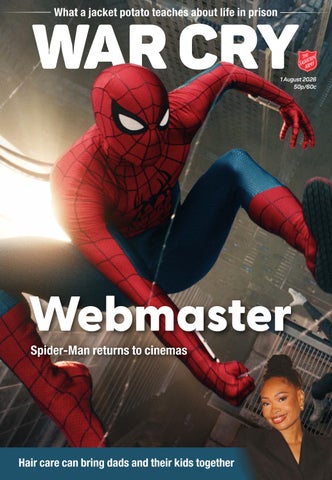
Spider-Man returns to cinemas
Hair care can bring dads and their kids together
The Salvation Army is a Christian church and registered charity seeking to share the good news of Jesus and nurture committed followers of him. We also serve people without discrimination, care for creation and seek justice and reconciliation. We offer practical support and services in more than 700 centres throughout the UK. Go to salvationarmy.org.uk/find-a-church to find your nearest centre.
The Salvation Army first published a newspaper called the War Cry in London in December 1879, and we have continued to appear every week since then. Our name refers to our battle for people’s hearts and souls as we promote the positive impact of the Christian faith and The Salvation Army’s fight for greater social justice.
A new Spider-Man film is released this weekend. As we suggest in this week’s War Cry, one of the appeals of superhero movies may be the clear-cut differences between the heroes and the villains and the way that ultimately the good guys triumph and the baddies end up behind bars – with the key thrown away.
In real life, however, things are seldom that black and white. It is possible to recognise the wrongs that have been committed by those in prison – and the pain caused to others – while also realising that, with the right support, prisoners can build a life that plays a positive role in society.
This week, we speak to Jamelia Donaldson, who runs a course teaching dads in prison how to braid their children’s textured hair. The course aims to help the men build better relationships with their children upon release.
‘When a father learns to care for his child’s hair, he’s learning a language of connection,’ Jamelia tells us. ‘We understood just how impactful dads can be in their children’s lives. And, regardless of any choices those dads have made in the past, we felt that their kids still deserved time with them to create quality memories.’
Editor: Gareth Dickens, Major
Managing Editor: Philip Halcrow
Staff Writer: Emily Bright
Staff Writer: Claire Brine
Staff Writer: Ewan Hall
Editorial Assistant: Linda McTurk
Graphic Designer: Mark Knight
Graphic Designer: Matt Penberthy
Email: warcry@salvationarmy.org.uk
SE5 8FJ
Tel: 0845 634 0101
Subscriptions: 01933 445445 (option 1, option 1) or email: subscriptions@satcol.org
Founders: Catherine and William Booth International leaders: General Lyndon Buckingham and Commissioner Bronwyn Buckingham Territorial leaders: Commissioners Jenine and Paul Main Editor-in-Chief: Major Andrew Stone


Jamelia is motivated in her work by her Christian faith, as is Simeon Sturney, who speaks to us about his experience of working in a women’s prison as a chaplain.
‘There’s a misconception that chaplains are removed from the realities of prison life, but we’re not,’ he says. ‘We see what happens on the wings and hear people’s stories every day.’ And what he sees is that ‘when everything else has been stripped away, faith can offer familiarity, hope and a sense of purpose. For many prisoners, hope is what they need most.’
It is not only prisoners who need hope. It’s a vital component for us all if we are to experience a fulfilling life – and God is able to offer us a hope that will last for ever, if we choose to turn to him.




Spidery superhero should be back to save the day – but something is wrong
Film feature: Spider-Man: Brand New Day in cinemas from 29 July
By Emily Bright

PeterParker (Tom Holland) is back to save New York in Spider-Man: Brand New Day. But life is more complicated than it used to be.
In the last film, Spider-Man: No Way Home, his fellow superhero Dr Stephen Strange cast a spell – to protect the universe – which erased Peter’s very existence from everyone’s memory.
Now, there’s a sinister and invisible force threatening New York – and SpiderMan is the only one who is immune to its powers and can save the city. However, the villain behind it threatens all those that Peter holds dear and will stop at nothing to get his way.
To make matters worse, Spider-Man realises something is wrong. He is concerned that he’s ‘losing his mind’, and he feels out of control.
He meets with scientist Bruce Banner (Mark Gruffalo), whose alter ego is the Incredible Hulk and who has apparently discovered a way to suppress mutating
DNA. Peter wants to know if there’s a way for Bruce to keep only the good side and to eradicate the bad.
Bruce hints that the reality of being a human is more complex than that – after all, who would decide which parts of human nature are good or bad?
Perhaps one of the reasons that superhero films are so popular is the way they offer a binary fight between good and evil. But it may also be true that we can relate to the humanity of superheroes on screen – their flaws, emotions and struggles.
We may connect with Peter’s desire to get rid of the bad aspects of personality while keeping the good. But doing so is not always simple. Someone who knew full well the complexities of trying to be good was an ancient Bible hero, Paul.
Entering the story as a villain who approved of killing Christians, Paul underwent a huge character transformation in a memorable plot twist:
he became a Christian and sought to spread Jesus’ message of God’s love across the world.
Yet even as he tried to do the right thing, he was also very human. He once wrote: ‘I can’t explain my actions. Here’s why: I am not able to do the things I want; and at the same time, I do the things I despise.’ He went on: ‘Is there anyone who can free me?’ He quickly answered his own question: ‘I am thankful to God for the freedom that comes through our Lord Jesus’ (Romans 7:15, 24 and 25 The Voice).
We, too, can find freedom from our complex web of weaknesses and struggles, if we put our trust in Jesus. He doesn’t expect us to be perfect but, through God’s Holy Spirit, he can forgive us for the wrong we have done and enable us to become kinder and more loving people.
If we ask him for help, he will come to our rescue.
Ewan Hall gives his take on a story that has caught the attention of War Cry reporters
What would you do if you came face to face with your favourite celebrity?
That’s what happened to a group of Beatles fans who, while enjoying a Fab Four-themed guided bus tour in Liverpool, saw Paul McCartney sitting in the back of his car.
The fans then got a further shock when they realised that Paul was on a video call to fellow Beatle Ringo Starr.
‘It was surreal,’ Neil Morton, driver of the Magical Mystery Tour bus told the BBC News website. ‘I had pulled up at the traffic lights on Hope Street when who should I see – Sir Paul with Ringo on Facetime. He waved to us and everybody took photos. The passengers could not believe it.’
As a fellow Beatles fan, I can hardly imagine bumping into Paul McCartney – let alone when he was on the phone to Ringo Starr, and especially somewhere as ordinary as a set of traffic lights. Most people would expect to see a celebrity at a concert or special event, not while going about their routine life.
Yet some of the most significant encounters I have had in my life have happened in the most ordinary places.
I’m not referring to any meetings with celebs in the aisle of my local supermarket, but to times when I’ve encountered God. Sometimes we may assume that God can be found only in a church or at a religious event. However, we can encounter him wherever we are and whatever we’re doing.
In the Bible, God regularly meets people in unexpected places and in everyday situations. It happened to a man called Moses who went on to lead the Israelite people. He was an outcast in the wilderness when he encountered God. A prophet called Jeremiah heard from God while watching a potter at work.
God is not limited to special places. We can meet him during a conversation with a friend, a chance encounter or in an ordinary day. And once we’ve encountered him, our life can be fab for ever.
Gold coins worth nearly £30,000 have been discovered underneath the altar of a church, saving the 14th-century building from closure, BBC News reported.
At St Wilfrid’s Church in Melling near Lancaster, the Rev Jane Lee and another minister were getting ready for morning prayers when they found a plastic bag containing a box, in which were nine gold Britannia coins.
Jane recalled that she and the minister both burst into tears after discovering the coins, which were ‘desperately needed’ to help meet the shortfall in the £750,000 needed to fund urgent repairs to the building.
The gift was left with a note on Salvation Army-headed paper and dated 16 July 2022, which said: ‘I would like to donate these nine Britannia coins to Melling Church – the plastic bag identifies a bullion dealer. James, a servant of the living God.’
Jane explained that she was ‘extremely grateful’ to the mysterious benefactor and that the coins would ‘be a seed’ in supporting grant applications and other fundraising. She added that the money was the answer to their prayers.


Broadcaster and priest the Rev Canon Dr Giles Fraser reflected on the habit of churchgoing in an interview with Radio Times
The magazine explained that the vicar of St Anne’s Church in Kew, west London – whose Radio 4 series Church Going with Giles Fraser began last month – set out to discover on the programme ‘whether or not Christian denominations ... are in decline’.
Giles explained that his own congregation had grown by a third over four years.
Commenting on the appeal of Christian worship today, he said: ‘Parents are not necessarily passing on faith to their children. A lot of young people discover it for themselves.
‘We used to think there was a battle of hearts and minds. If the church was losing, something secular was winning. But people don’t buy into that Richard Dawkins stuff any more.’
When questioned why ‘pews are filling up in some places’, the priest replied: ‘People want beauty, something numinous, beyond themselves yet rooted in their lives, too.’
A signed original print by David Hockney that was discovered in a book at the Salvation Army charity shop in Norwich has been sold in an online auction for tens of thousands of pounds.
When a copy of the book Paper Pools, published by the artist in 1980, was donated to the shop about a year ago, there was nothing to suggest that it was anything out of the ordinary. But volunteer and local artist Jemma Banks recognised that it was potentially significant: tucked inside was an original print signed by Hockney, who died in June.
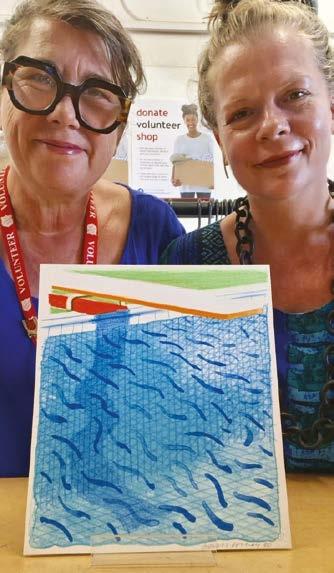
After carrying out research on the item, The Salvation Army’s trading arm SATCoL listed the book for auction online, and it was purchased by an anonymous bidder for £41,160.
Jemma said: ‘I’m delighted that something hidden away for so long will now help raise money for people in our community.’
Jemma Banks (left) and store manager Maria Zacharias with the signed print
Major Gareth Dickens is the new editor of the War Cry, taking over the post from Major Andrew Stone, who has been appointed editor-in-chief of The Salvation Army’s Publishing Department.
Before training to become a Salvation Army minister, Gareth worked as a hospital pharmacist. In the 32 years since his ordination, he has mainly served in Salvation Army centres in the northwest of England.
He says: ‘Following an editor of the calibre of Major Andrew Stone is a daunting challenge to pick up. But I look forward to building on all that he has done and, as part of the War Cry team, continuing its mission to communicate the positive impact of Christian faith and The Salvation Army’s fight for greater social justice.’
‘I’m tell I ng an everyday story of
Prison
chaplain
and
author
SIMEON STURNEY discusses his ministry and how his books let readers see what life is truly like behind bars
Interview by Ewan Hall

Over the past 20 years, Simeon Sturney has listened to the stories of women whose lives have been shaped by trauma, loss and poor choices. Those stories have not necessarily made news headlines, but they have stayed with him.
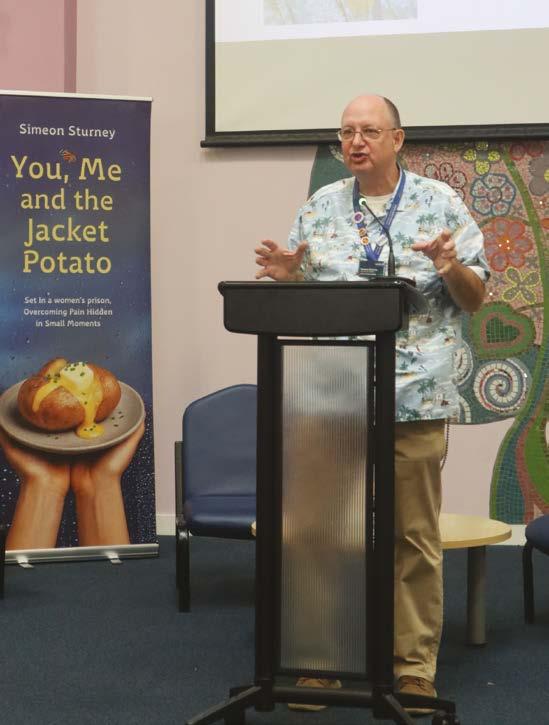
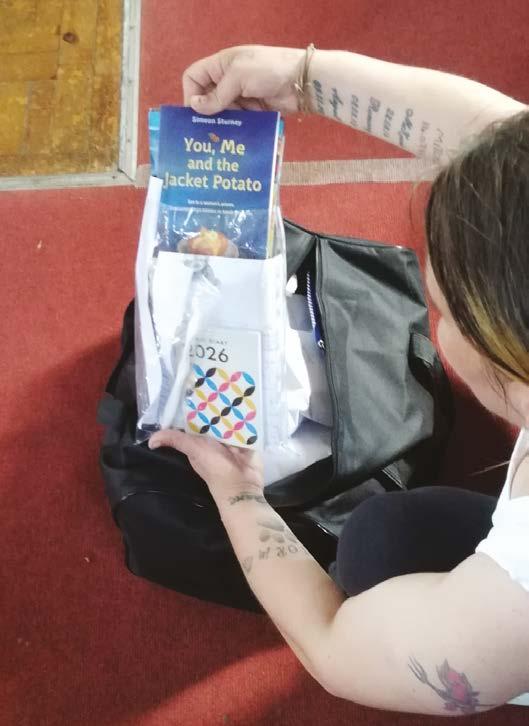
As a chaplain for a women’s prison in southeast England, Simeon wants to share the truths behind those stories –and he has tried to convey them in his new book, You, Me and the Jacket Potato

‘I have worked in the same prison for over two decades, although in different roles,’ Simeon explains. ‘I wrote my first book on women’s prisons for people who were interested in working or volunteering in prisons. It was aimed at Christians and included parts of my own life story and experiences.
‘After that, I wrote a second book for professionals, but as I was writing it, I found myself wondering: “Hold on a moment, shouldn’t I write something for the women?”
‘Some of the women in our prison had seen the first two books and told me how much they liked them. So I wrote You, Me and the Butterfly and now its prequel, You, Me and the Jacket Potato, which are fictional but based heavily on everything I have seen in my work.’
Simeon’s new book traces the experiences of a character named You, who was introduced in You, Me and the Butterfly. She is reflecting on the events that led to her ending up in prison.
‘At the time I wrote You, Me and the


Butterfly, I thought I was going to write one book on You’s story,’ says Simeon. ‘But when I published it, the response from women was amazing. They absolutely loved it.
‘What they appreciated most was that it told their story. It was the everyday story of a woman in prison, and it showed what prison life was like.
‘So, I thought let’s build on that story, and that’s where this book comes from.’
Although the gender of the protagonist in the story is confirmed in the book, Simeon felt it was important that the character’s name was ambiguous.
‘If I gave the character a name, it would be associated with a particular culture,’ he says. ‘By calling her You, people of different ethnicities and backgrounds can all relate to the story.
‘The book is written for both men and women. It’s also for family members and others who want to understand the reality of prison life, rather than the version shown in TV dramas or films.
‘When the book was launched, many

of the women were adamant that it should be available to men’s prisons too. There’s already a lot written about men’s prisons, but many women in prison have a partner who is also serving time or whose actions contributed to the women ending up there. They want the men in their lives to understand what prison is like for them.’
Onecrucial moment in the book involves a jacket potato in the cafeteria. Simeon uses the incident to show the broader truth about trauma.
‘It’s often the everyday, seemingly small things that trigger trauma,’ he says. ‘We expect anniversaries to be difficult, but sometimes it’s something much simpler. I’ve seen how a look, a tone of voice or a broken promise can escalate into something much bigger. Someone
says they’ll bring you a book and doesn’t, or promises you a pen and it never arrives. Suddenly, you’re wondering: “Have they got a problem with me?”
‘I wanted to choose something small but deeply personal. In the book, You’s grandfather is one of the few people who has been there for her throughout her struggles. When he dies, she’s reminded of him through his favourite food – a jacket potato.
‘On the day of his funeral, she sees jacket potatoes on the menu and takes it as a sign. But when she reaches the servery and asks for a second potato, she’s told there are only enough for one each.
‘Something as simple as that can be a trigger. It’s something the women would immediately understand. Portion control is a huge issue in prison. The person holding the serving spoon holds the power, and every prisoner knows it.’
Simeon’s aim in writing the books was
Turn to page 8 f
From page 7
not to sensationalise, but to show what life is truly like for women behind bars.
‘Some women have given the books to their mums or partners, because they want them to understand that reality,’ he says.
‘Women who are in prison for the first time have also told me that the books helped them make sense of what was happening to them. Before that, their only reference point was the media and its often-overdramatised portrayals.’
I’ve spent a long time listening
Simeon can share these stories with readers because of his work in prison, especially as a chaplain. As a result of his work, and particularly the fact that he has been at the same institution for two decades, he has been able to build trust with the inmates, who understand that he is there not to judge them but to offer them hope and space for change.
He explains: ‘Women often ask me, “How do you know all this?” But I’ve
spent a long time listening. Some tell me that they assumed the book was written by a woman because they didn’t think a man would understand these experiences. Others who’ve known me for years simply say: “You’ve seen it all, haven’t you?”
‘What surprised me was how many women said the book’s credibility came from it being written by a chaplain. One told me readers would trust the account because it came from someone the public sees as impartial. She felt that people might dismiss the same stories if they were written by prisoners.
‘There’s a misconception that chaplains are removed from the realities of prison life, but we’re not. We see what happens on the wings and hear people’s stories every day. That’s why I wanted to write honestly about the reality of prison, without judgement.
‘Prisons are also places where many explore or return to faith. When everything else has been stripped away, faith can offer familiarity, hope and a sense of purpose. For many prisoners, hope is what they need most.’
Through his work as a chaplain
and author, Simeon’s faith has been influenced by the women he supports.
‘They will stop me on the prison wing, ask about the book, talk about faith and then ask for prayer there and then,’ he says. ‘It has reminded me that we have a God of the present moment, not just of Sundays or special occasions.
‘What the women have taught me is simple – don’t wait. If someone needs hope, support or prayer, now is the right time.’

Jamelia Donaldson
Business owner JAMELIA DONALDSON explains why she developed
a course to teach dads how to care for their
children’s hair – and then decided to run it in prisons
Interview by Claire Brine
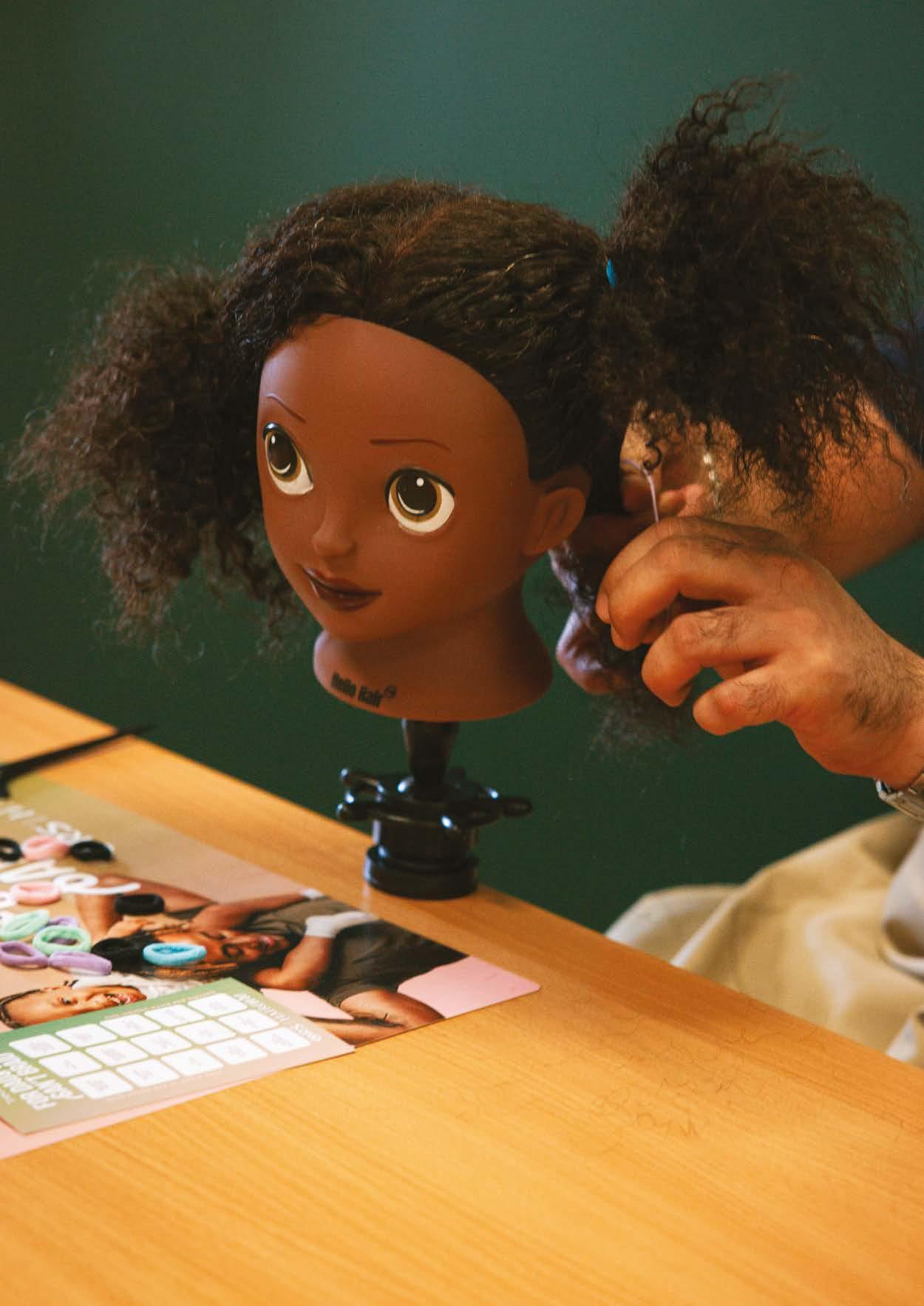
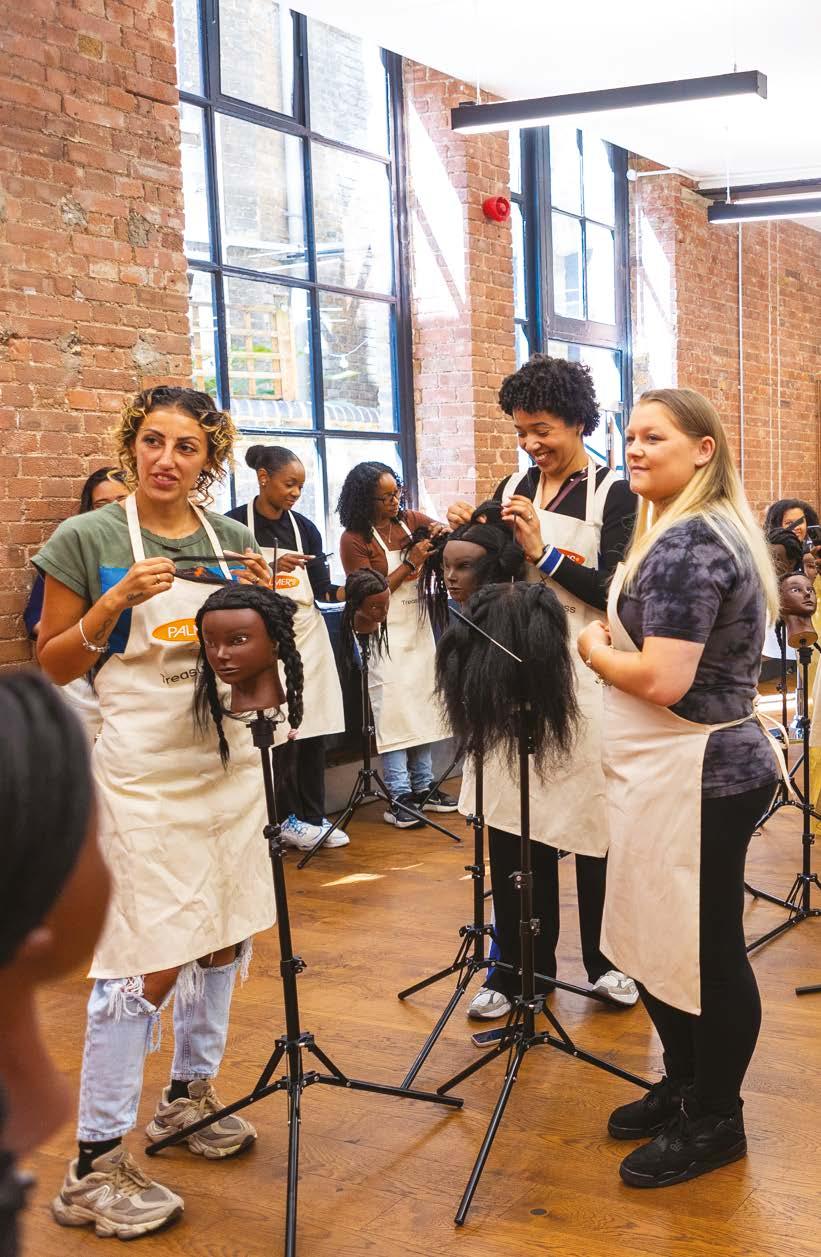
Incarcerated fathers practise their skills on styling heads
In the run-up to Father’s Day last year, Jamelia Donaldson and her colleagues came up with an idea: to run a course teaching dads how to braid their children’s naturally textured hair.
‘It was meant to be a one-off event,’ says Jamelia, the founder of TreasureTress, a subscription service which sends shoppers monthly boxes containing hair care products. ‘But once we advertised the course on Instagram and TikTok, the demand from dads was so huge that we ended up running it pretty much every month for the rest of the year.’
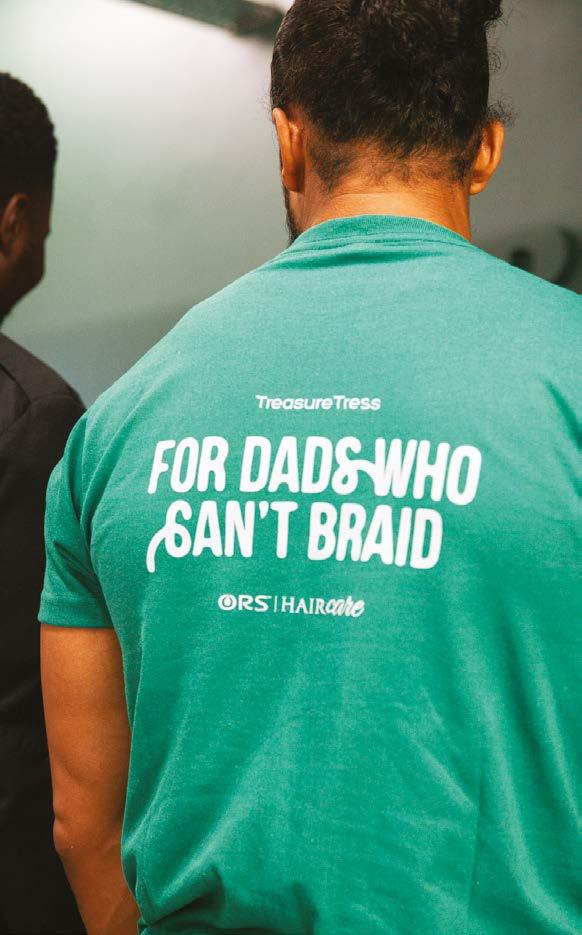
Earlier this summer, Jamelia took the course, For Dads Who Can’t Braid, into HMP Brixton in south London. Over four weeks, incarcerated fathers used styling heads to learn skills such as how to part and detangle hair and how to style with braids or cornrows. The aim was to help them build stronger relationships with their children through the act of taking care of their hair.
‘Hair is never just hair in our community –it’s love, it’s identity, it’s quality time,’ explains
Turn to page 10 f
From page 9
Jamelia. ‘When a father learns to care for his child’s hair, he’s learning a language of connection. So when Brixton prison invited us in to run the course, we said yes. We understood just how impactful dads can be in their children’s lives. And, regardless of any choices those dads have made in the past, we felt that their kids still deserved time with them to create quality memories.’
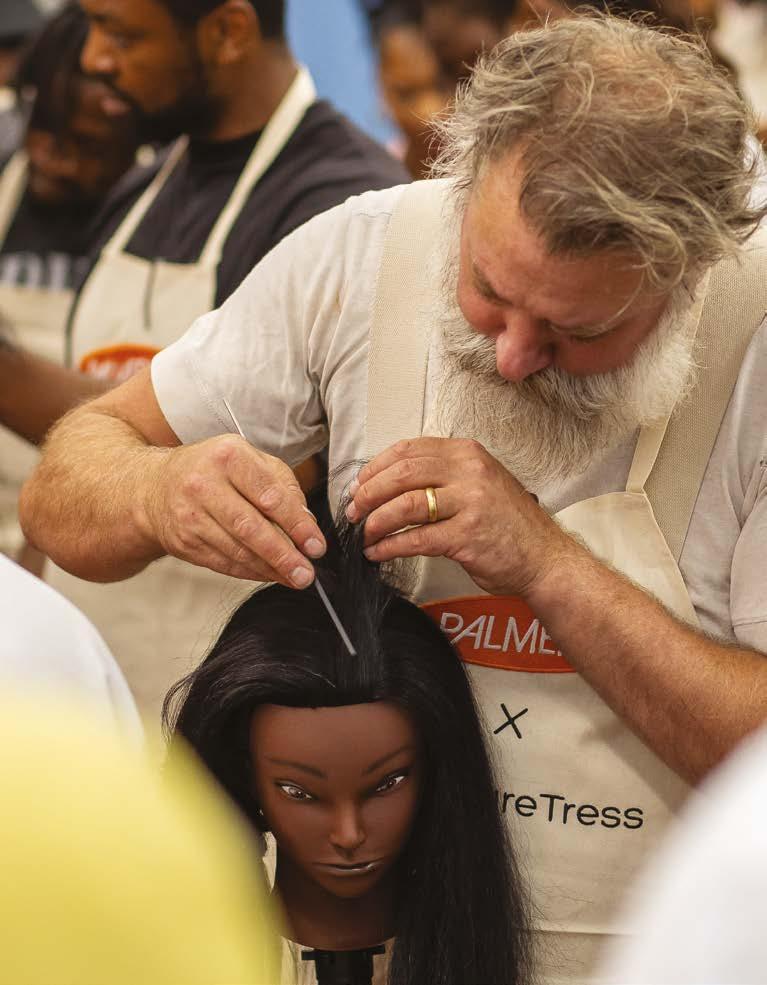
Each week, the course sessions started with a male host delivering a short talk to the group about his own life, experiences of fatherhood and faith. The dads were then taught a number of techniques by a professional hairstylist, after which they were invited to practise the skills for themselves. As they worked on the styling heads, members of the TreasureTress team were on hand to offer one-to-one support.
‘At the end of the sessions, the men would take it in turns to talk about what they’d learnt that day,’ says Jamelia, ‘and it was so refreshing to hear them say “I’m proud of myself” and “I’m really excited to do this hairstyle on my child.” It was special to see the safe and sacred space that these guys created.’
It encourages them to be active in their kids’ lives
On the final day of the course, the prisoners’ families were invited to be part of the session, which enabled the dads to try out their hairstyling skills on their children for the first time. One child described their dad’s efforts as ‘decent’,
On TreasureTress courses, dads and mums learn how to care for their children’s textured hair
while another noted how the past four weeks had changed their father, saying he had become ‘calmer and more relaxed’.
The fathers, too, expressed their gratitude for having completed the course, telling Jamelia that it had helped them to feel ‘more connected’ to their children. Prison staff added that the fathers had become ‘more happy, enthusiastic and willing to learn’.
Jamelia explains: ‘The For Dads Who Can’t Braid course is about boosting the men’s self-esteem. In prison, guys may not be told that they’re “doing great”, or they rarely hear a “well done”.
‘We noticed early on in the course that the dads got frustrated quickly when they couldn’t pick up a particular hairstyle, and they wanted to quit. But we said: “No, we believe in you and we’re not leaving until you get this right.” That one-to-one pep talk brightened them and helped them to open up.
‘The other thing that the course did was to give them responsibility. One dad said that it’s always assumed that a mum will do their child’s hair, but now he knows that when he’s looking after his kids, he can do everything to care for them – wash them, clothe them and look after their hair properly. Hair maintenance is a part of hygiene.’
Jamelia was pleased to see the group not only learning new skills but also bonding during the sessions.
‘There was a real sense of brotherhood in the room,’ she says. ‘The dads would tease one another and give each other compliments. They felt part of something –and that’s important because it encourages them to become more active in their kids’ lives. They were showing themselves that they wanted to take their relationships with their children seriously.’
For Jamelia, teaching incarcerated dads about hair care is about far more than their learning how to braid. Her whole approach to business is tied up with her Christian faith. It was her belief in God which motivated her to launch TreasureTress back in 2015.
‘The Bible says that we are fearfully and wonderfully made,’ she reflects, ‘but when I was young, I hated my hair. I wanted naturally straight hair because I felt that it was the epitome of beauty. That’s what all the magazines were saying.
‘Years later, around the time I got the idea to start TreasureTress, my brother and
his partner had a daughter – and I knew that I didn’t want her to grow up hating her hair like I did. I was motivated to create a place where people of all shapes, sizes and hair types could embrace their version of beauty. I believe that hair is about so much more than the aesthetics. It’s about identity, self-esteem and celebrating who you are.
We need to act on the gifts God gives us
‘The moment I started embracing my natural hair, I started caring more about my entire body – what I was eating, how I was looking after myself. I began to challenge my preconceived ideas. I asked myself: Why have I always thought that straight hair is more beautiful than Afro curly hair? How can I dispel that idea?
How can I make sure the next generation don’t grow up hating their natural hair too?’
Jamelia felt that her desire for people to love their textured hair – and to help them find suitable products to care for it – was inspired by God.
‘I’ve always had a deep-rooted sense that every life is purposeful,’ she says. ‘So when I came up with the idea for TreasureTress, I knew that I needed to use it to gel with others and serve God’s Kingdom. We shouldn’t be clenching our gifts tightly.
‘At the end of my life, will I be told by God, “Well done, good and faithful servant” for the way in which I’ve lived? That’s my motivation.
‘Any time I have an idea about the business and am procrastinating on it, I remind myself: “Jamelia, this isn’t yours. You have to put your gift into the world or else God wouldn’t have given it to you.” I have a deep belief that all of us need to act
on the gifts that God gives us.’
After leaving a career in finance to launch her business, Jamelia decided to expand the reach of TreasureTress by staging events in the community. Over the past 10 years, she has organised Mummy and Me afternoon teas for girls and their mums; development workshops for teenage girls, teaching them self-defence skills, how to care for their natural hair and how to write a CV; business panel events where invited speakers and entrepreneurs share advice on how to develop a brand or company; and For Mums Who Can’t Braid (which prompted the launch of For Dads Who Can’t Braid).
‘My prayer is that the business will continue to grow – and on a global scale,’ Jamelia says. ‘I want us to take For Dads Who Can’t Braid into prisons nationwide. There is so much power in community, so bringing people together will always be the bedrock of what we do.’
Your prayers are requested for L, who is in prison.
The War Cry invites readers to send in requests for prayer, including the first names of individuals and details of their circumstances, for publication. Send your Prayerlink requests to warcry@salvationarmy.org.uk or to War Cry, 1 Champion Park, London SE5 8FJ. Mark your correspondence ‘Confidential’.
Becoming a Christian
There is no set formula to becoming a Christian, but many people have found saying this prayer to be a helpful first step to a relationship with God
The parable of the father and his two sons (part two)
– Luke 15:11–32
‘There was a man who had two sons,’ says Jesus as he starts his story. ‘Two sons’ – yet it’s nearly always the younger one that readers focus on. He took everything that he had been given by his father and broke up the family by going his own way before realising his mistake and returning home penniless.
Yet, when Jesus was telling this story, his listeners also heard about the older brother. This son was angry at the extravagant party thrown for his remorseful sibling by their father. But the father reminded him: ‘Son, you are always with me, and all that is mine is yours’ (Luke 15:31 New Revised Standard Version).
Lord Jesus Christ,
I know that I have done things in my life that are wrong and I’m sorry.
Thank you that I can ask you for forgiveness because of the sacrifice you made when you died on the cross.
Please forgive me and help me to live a better life in the future as I learn how to love you and follow your way of living.
Thank you, Lord Jesus.

If you’ve prayed this prayer, scan the QR code or contact us using the coupon on this page

The older brother had stayed with his father while his younger sibling had deserted the family. He had everything he needed materially, but he lacked compassion for his brother.
We could guess at a backstory here. Maybe the brothers had once been great friends, but the elder of the two had felt betrayed when the younger one went away – not to mention a sense of loss at his absence. Maybe the younger brother had been jealous of the elder, and leaving had helped ease his feeling of rejection.
Jesus didn’t give us any backstory. But he did give the father’s reasons for celebrating the return of the younger son. The father explains to his elder son: ‘We had to celebrate and rejoice, because this brother of yours was dead and has come to life; he was lost and has been found’ (15:32).

In this scene, I see a picture of undeserved extravagant love, demonstrated by the father, and of jealousy, shown by a son who already has everything but still resents his brother. The older brother’s attention is stuck in the moment, and he fails to see the wealth he has had all along.
That’s it – that’s all Jesus gives us. The message is of restoration and wholeness. A family had been split apart, but reconciliation was possible because of love.
‘There was a man who had two sons,’ said Jesus. And now the family was whole again.
And our heavenly Father’s love makes it possible for us to be part of his family.

To receive basic reading about Christianity and information about The Salvation Army, complete this coupon and send it to
War Cry 1 Champion Park London SE5 8FJ



1
Fringe entertainment on the Royal Mile
Who sings the No 1 hit song ‘I Knew It I Knew You’, which features in the Toy Story 5 film?
What animal lives in a sett?
In which city are the Commonwealth Games taking place? 3 4 5 6 2
Which country’s flag comprises three horizontal stripes of – in descending order – blue, black and white?
Milly Alcock plays superhero Kara Zor-El in which action film?
Who is the author of the novel The Long Shoe?


By Ewan Hall
Come
one, come all – Edinburgh Fringe venues open their doors next Friday (7 August). The Scottish capital will then be home to three weeks of performances and creative events from around the world. More than 2,000 shows across a wide variety of genres will be on offer to the public. Comedy, theatre, music … and circus acts – the Fringe covers it all.
Every year, the festival’s dates are circled on many up-and-coming performers’ calendars. They certainly were back in the early 2000s for British-American comedian and 21-time Emmy winner John Oliver, who last year returned to the Fringe for an interview with CBS News programme 60 Minutes
‘As you can see, this is controlled mayhem,’ he said, walking the streets. ‘Some of it will be great, some of it will be otherworldly bad, but the fact that the two can exist concurrently is kind of the point.’
John knows how shows can go wrong – he remembers how he bombed at one of his early Fringe gigs. There were only four people in the audience at the start, and, as his routine went from bad to worse, each of them walked out, leaving just John and the sound engineer, who asked if he wanted to continue. John joked back: ‘Do you mean this show or my career? Certainly, it feels like I’ve got some decisions to make.’
Our lives are defined by the choices we make when we stand at life’s crossroads. We may have to decide whether to take a new job, start a new relationship or move somewhere new. The good news is that we don’t have to make those judgements alone. God offers to help us – if we choose to accept him into our lives.
One early Church leader wrote to other Christians: ‘If you don’t have all the wisdom needed for this journey, then all you have to do is ask God for it; and God will grant you all that you need. He gives lavishly and never scolds you for asking’ (James 1:5 The Voice).
God is ready to guide and support us through every challenge. Even if we have made bad decisions in the past without his input, he does not criticise us, but will help us to move on.
All we have to do is come to him.
ACROSS
1. Dull (4)
3. Gratuity (3)
5. Moderately hot (4)
7. Possession (9)
9. Tug (4)
10. Seize (4)
11. Restrain (5)
14. Irritable (5)
15. Representative (5)
17. Urge (5)
18. Spine (5)
19. Thrust (5)
20. Dizzy (5)
23. Believe (4)
25. Genuine (4)
27. Essential (9)
28. Bucket (4)
29. Also (3)
30. Cash register (4) DOWN
1. Hurry (4)
2. Basin (4)
3. Subject (5)
4. Adhesive (5)
5. Summons (4)
6. Colliery (4)

7. Frank (9)
8. Splendid display (9)

Each solution starts on the coloured cell and reads clockwise round the number


1. Primary colour
2. Eight pints
3. Indian leader
4. Paris tower
5. Hug

the grid so that every column, every row and every 3x3 box contains the digits 1 to 9
11. Expiring (5)
12. Recorded (5)
13. Mass meeting (5)
14. Small child (3) 16. Foot digit (3) 21. Torpid (5)
22. Club for dancing (5)
23. Trickle (4)
24. Repast (4)
25. Gait of a horse (4)
26. Wicked (4)
Look up, down, forwards, backwards and diagonally on the grid to find these words associated with connection
Eiffel. 5. Cuddle. 6. Almond.
Taped. 13. Rally. 14. Tot.
True. 27. Necessary. 28. Pail. 29. Too. 30. Till. DOWN: 1. Dash. 2. Bowl. 3. Theme. 4. Paste. 5. Writ. 6. Mine. 7. Outspoken. 8. Pageantry. 11. Dying.
Impel. 18. Thorn. 19. Lunge. 20. Giddy. 23. Deem.
Haul. 10. Take. 11. Deter. 14. Testy. 15. Agent.
6. Oval edible nut-like kernel AFFINITY AGREEMENT ASSOCIATION ATTACHMENT BELONGING COMMUNITY CORRESPONDENCE INTERDEPENDENCE KINSHIP LINK LOVE PEOPLE PLACES RELATIONSHIP SOCIAL SUPPORT
QUICK CROSSWORD ACROSS: 1. Drab. 3. Tip. 5. Warm. 7. Ownership.
4

INGREDIENTS
Butter, for greasing
METHOD
Oil
250g potatoes, peeled and grated
80g spinach, roughly chopped
4 spring onions, thinly sliced
1 garlic clove, crushed
Salt and freshly ground black pepper
Dried chilli flakes (optional)
4 large British Lion eggs
4 brioche burger buns
Preheat the oven to 200C/Gas Mark 6. Grease a 4-hole Yorkshire pudding tin with butter and place it on a metal baking sheet.
MAKES 2

INGREDIENTS
Oil, for greasing
6tbsp tomato pasta sauce
8 pitted green or black olives, roughly chopped
6 cherry tomatoes, quartered
2 wholemeal tortilla wraps
2 British Lion eggs
50g grated cheddar and mozzarella cheese mix
1 yellow pepper, cut into sticks




Heat a little oil in a non-stick frying pan and cook the grated potatoes over a medium heat for about 5 minutes, until they are tender. Add the spinach, spring onions and garlic. Increase the heat and continue to cook until the spinach leaves are wilted and most of the liquid has evaporated.
Remove the pan from the heat and season the potato mixture well with salt and pepper and, if using, chilli. Crack the eggs into a large jug, then beat with a whisk or fork. Add the potato mixture and stir well.
Divide the mixture between the holes in the greased tin and bake for 15-20 minutes, until the burgers are golden.
Remove from the oven, loosen the edges with a knife and leave to cool slightly.
Toast the inside of the buns, then fill with the spinach and egg burgers along with your favourite salad fillings and toppings.
Preheat the oven to 220C/Gas Mark 7. Lightly oil a baking tray large enough to hold 2 tortillas.
Place the pasta sauce in a bowl and stir in the olives and tomatoes.
Pour half the sauce over a tortilla, then use a spoon to spread it to the edges, leaving a 3cm border. Create a hollow in the centre of the sauce and crack in an egg. Scatter half the cheese around the egg, covering the sauce, then place pepper sticks around the egg. Repeat with the second tortilla.
Bake both tortillas in the oven for 6-8 minutes or until the egg has set. Leave to cool slightly