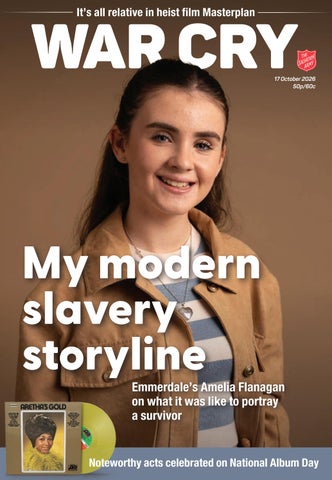
It’s all relative in heist film Masterplan
17 October 2026 50p/60c
My modern slavery storyline
Emmerdale’s Amelia Flanagan on what it was like to portray a survivor
Noteworthy acts celebrated on National Album Day
What is The Salvation Army? The Salvation Army is a Christian church and registered charity seeking to share the good news of Jesus and nurture committed followers of him. We also serve people without discrimination, care for creation and seek justice and reconciliation. We offer practical support and services in more than 600 centres throughout the UK. Go to salvationarmy.org.uk/find-a-church to find your nearest centre.
From the editor’s desk
Email: warcry@salvationarmy.org.uk
It has been more than 50 years since ITV1 soap Emmerdale first appeared on television screens as Emmerdale Farm. In its early years, the action often centred on the family kitchen table presided over by widowed farmer Annie Sugden. Since then, the drama has shortened its name and broadened its scope of characters and plotlines, but at its heart there remain the stories of people and their relationships – tangled as they can be – set within a rural landscape. The very first episode of Emmerdale Farm caused a stir by starting with a funeral. Last year, a major storyline caused an even bigger stir, as April, Dylan and Bear Wolf were enmeshed in modern slavery and exploited by human traffickers. In the War Cry this week, actress Amelia Flanagan, who plays April, reflects on her character’s experience and why her story was worth telling. She says that she ‘wanted people watching at home to be able to see what life is really like for young people who are exploited, which is why so much research went into it’. That research included seeking guidance from The Salvation Army’s Anti-Trafficking and Modern Slavery Department. Since 2011, the church and charity has been contracted by the government to provide specialist support for adult survivors of modern slavery in England and Wales. The Salvation Army’s involvement in tackling modern slavery, however, goes back to its earliest days. Salvation Army chaplain Major Estelle Blake explains: ‘It tried to expose the reality of young girls being sold into exploitation, bringing it to the attention of the Victorian government and wider society.’ Estelle is clear that her work with modern slavery survivors is not about fixing the past but about being a representative of Jesus, showing people love and hope, ‘and empowering them to see they can move forward’. Whatever our past, God offers us all love and hope, which can and will help us to step into a better future.
The Salvation Army United Kingdom and Ireland Territory 1 Champion Park London SE5 8FJ
When you’ve read the War Cry, why not pass it on ➔ ➔ ➔
What is the War Cry? The Salvation Army first published a newspaper called the War Cry in London in December 1879, and we have continued to appear every week since then. Our name refers to our battle for people’s hearts and souls as we promote the positive impact of the Christian faith and The Salvation Army’s fight for greater social justice.
WAR CRY Issue No 7803
Editor: Gareth Dickens, Major Managing Editor: Philip Halcrow Staff Writer: Emily Bright Staff Writer: Claire Brine Staff Writer: Ewan Hall Editorial Assistant: Linda McTurk Graphic Designer: Mark Knight Graphic Designer: Matt Penberthy
Tel: 0845 634 0101 Subscriptions: 01933 445445 (option 1, option 1) or email: subscriptions@satcol.org Founders: Catherine and William Booth International leaders: General Lyndon Buckingham and Commissioner Bronwyn Buckingham Territorial leaders: Commissioners Jenine and Paul Main Editor-in-Chief: Major Andrew Stone Published weekly by The Salvation Army © The Salvation Army United Kingdom and Ireland Territory ISSN 0043-0226 The Salvation Army Trust is a registered charity. The charity number in England, Wales and Northern Ireland is 214779, in Scotland SC009359 and in the Republic of Ireland CHY6399. Printed by CKN Print, Northampton, on sustainably sourced paper
INFO Your local Salvation Army centre
CONTENTS FEATURES
3
More than the Mona Lisa Planned heist becomes a complicated family affair
6
Hidden in plain sight Emmerdale actress reflects on modern slavery storyline
10 Present with survivors Salvation Army chaplain supports victims of trafficking 13 Keeping the discs spinning Celebrating National Album Day
10 13
REGULARS
FO 4
Team Talk and War Cry World
12 What Did He Say? 14 Puzzles 15 War Cry Kitchen Front-page picture: ITV
2 • WAR CRY • 17 October 2026
6
15
Roger wants to steal the ‘Mona Lisa’
AMAZON MGM STUDIOS
A night at the museum Family relationships are under strain when a newly reunited father and his children attempt an art theft Film preview: Masterplan Prime Video By Ewan Hall
I
t’s an unexpected family affair. In Prime Video’s Masterplan, Chiara (Simona Tabasco) and Jay (Victor Belmondo) face a dilemma when a man claiming to be their father offers them the opportunity to take part in the heist of a lifetime. Unaware of their sibling relationship, Chiara and Jay are talented thieves in their own right. She is a gifted Italian cybercrime expert who can hack into the most secure digital systems, while he is a French explosives specialist with a flair for daring break-ins. Things take an unusual turn for both of them when they receive separate invitations to a mysterious new assignment on the shore of Lake Como. Expecting nothing more than another lucrative personal payday, the pair are surprised when they are forced to work together to break into a heavily protected mansion. Despite arguing the whole time, Chiara and Jay open the specified safe, only to find it empty. But the real shock comes when the lights are turned on and the homeowner, Roger (Stanley Tucci),
reveals that the entire exercise was a test. A retired master thief, he believes Chiara and Jay possess the skills to help him. There’s just one small matter to add – they are brother and sister and he is their father. While Chiara struggles to forgive the man who abandoned her family, Jay rationalises the revelation. The new partnership is already on rocky ground. Roger tries to bring them on side with a ‘family heist’, telling them of his plan to steal the Mona Lisa from the Louvre. The task will require trust and teamwork from the recently revealed family. They will need to overcome their differences if they are to pull off the theft of the century. The revelation that Chiara and Jay are family, and that their father is an infamous thief, changes everything for the siblings. Suddenly, the heist is no longer just about stealing the Mona Lisa. It’s about coming to terms with a dad they never knew, dealing with feelings of hurt and abandonment and deciding whether they can trust him. And given all that, it is no surprise their
Jay and Chiara are experienced thieves
family relationships are strained. Compared with most families, their dysfunction is on another level. However, that does not mean many of us can’t relate to the challenge of navigating family dynamics. It’s common to face complications in our everyday lives, whether it be the absence of a family member, a strained relationship or a broken boundary. But, whatever their experience, Christians can take comfort in knowing that there is a heavenly Father who cares for them wholeheartedly. In the Bible, one early follower of Jesus’ teaching reminds his readers of God’s extraordinary love, writing: ‘Think about how much God the Father loves us. He calls us his children!’ (1 John 3:1 Easy English Bible). Any of us can have a close relationship with God. All we have to do is say sorry for our past mistakes, accept his offer of forgiveness and put our trust in him. Even when we turn away from him, he will never abandon us – and he is always ready to welcome us into his family. 17 October 2026 • WAR CRY • 3
Team talk TEAM WA
talk ‘ TALK’ j Untold treasure
Emily Bright gives her take on a story that has caught the attention of War Cry reporters David Oyelowo is sailing the high seas as the swashbuckling and villainous pirate Long John Silver, becoming the first black person to play the role on screen. The actor features in a six-part TV adaptation of Treasure Island – based on the 19th-century novel by Robert Louis Stevenson – which is now being streamed on Paramount Plus. Ahead of the show’s release, David told Radio Times what the role meant to him. ‘When I was a kid playing pirates in my room, the images in my head were not of people who look like me,’ he reflected. ‘Now black boys and girls, and white and brown boys and girls, are going to see imagery that breaks down a subtle prejudice in their minds.’ As a fan of the storytelling of both Treasure Island and David Oyelowo, I’m delighted. I also firmly believe that any step towards improving representation on screen – or in any other sector – is essential to show children that they can achieve many of their dreams, regardless of their ethnicity, gender, class or physical ability. Black History Month, which celebrates the contribution of Black heritage and culture each October, gives me pause for thought about how society could be more inclusive. In my Christian faith, I see how diversity is represented in the most beautiful way. The Bible features the stories of people from all walks of life, who are treasured and chosen by God. He empowers them to speak up for injustice and to build a better world. That’s just as true for us all today. The world’s bestselling book also tells how God’s Son, Jesus, reached out to those who were overlooked or marginalised by prejudice, helping them to discover and then share the best possible news with the world: his redemption of all humankind. I pray that, regardless of their backgrounds, present and future generations may grow up knowing – and being inspired by – their immeasurable value to God.
Improving representation on screen is essential
Team talk 4 • WAR CRY • 17 October 2026
Front room faith
The story of how Black Christians from the Windrush generation built communities of faith after arriving in Britain is being told in an immersive theatrical production marking Black History Month. The Front Room Experience: Church explores the experiences of Black Caribbean newcomers in the 1950s and ’60s. Facing racism and exclusion from some established churches at the time, many Black Christians opened their own homes to create spaces for prayer, worship and fellowship. Over time, some of these ‘front room’ groups grew into Black-led churches that continue to serve communities across Britain. Set in the front room of a Black Caribbean household, the immersive production recreates one of these original church gatherings through storytelling, live gospel music, faith and humour. It runs from 22 to 25 October at live music venue the Front Room in Croydon.
Tolkien tribute Lord of the Rings author JRR Tolkien is to be honoured with a permanent memorial in Westminster Abbey’s Poets’ Corner. Predominantly made from native woods, the tribute is a sculpture inspired by the writer’s ‘Tree of Tales’, a picture that he drew throughout his life. The dean of Westminster, Dr David Hoyle, said that the memorial, which is due to be unveiled next year, would honour ‘a master storyteller, a scholar, a man with a Christian imagination and a writer who helped some of us understand that a commitment to life and virtue might be costly and courageous’.
Do you have a story to share? a warcry@salvationarmy.org.uk TheWarCryUK
B salvationarmy.org.uk/warcry
R CRY
WnRLD
Archives gather memories of Aberfan disaster support
Members of The Salvation Army who 60 years ago offered support to people affected by the Aberfan disaster gathered at the Big Pit National Coal Museum in Blaenavon to record their memories. On 21 October 1966, a coal-waste spoil tip slid down a mountainside in the south Wales mining village of Aberfan, engulfing the Pantglas Junior School and a row of houses. The disaster killed 116 children and 28 adults. Members of The Salvation Army served refreshments to the workers who were digging at the mountain of debris, assisted in a makeshift mortuary and visited bereaved families to offer pastoral care. At the Aberfan Remembered event, people connected to The Salvation Army were invited to share their memories of the disaster and the role they played in supporting the devastated community. The stories were recorded for the Big Pit National Coal Museum and The Salvation Army’s International Heritage Centre. Major David Tribble, a retired Salvation Army officer, was 15 at the time of the tragedy. He explained that his father, Major Derrik Tribble – also a Salvation Army officer – accompanied bereaved parents as they entered the mortuary to identify their children’s bodies. David said: ‘My sisters and I only learned about the disaster when we got
David and Sheila talk with Steven Spencer from The Salvation Army’s International Heritage Centre home from school. Dad returned that evening. He had been working in the chapel and the mortuary. When he saw my two younger sisters, the reality of what he witnessed suddenly hit him. He looked at them and burst into tears. ‘He later returned to the mortuary to help parents identify their children, but it was seeing his own daughters that brought home the true weight of the tragedy.’ Sheila Davies, 94, who worships at the Salvation Army church in Merthyr Tydfil, also attended the remembrance event to reflect upon her experiences. ‘Two memories from Aberfan have
never left me,’ she said. ‘Both came while visiting parents who had lost children in the disaster. One mother answered the door in obvious agony and said: “We knew no happiness until she came to live here and now that’s been taken away from us.” Those words have stayed with me ever since. ‘On another visit, a man opened the door and simply asked: “Where is your God now?” That question has stayed with me too. ‘Even with faith, there are moments when tragedy makes you wonder where God is. I’m grateful that my faith has sustained me to this day.’
To be another set of TV pilgrims Seven celebrities have set off on an ancient pilgrim route to record the ninth series of BBC2’s Pilgrimage. The programme, which is scheduled to be aired in the spring next year, follows celebrities with various faiths and beliefs as they walk and talk together and visit sacred sites. The route they are taking for the new series will be announced nearer to transmission. The celebrities taking part are (pictured from left) comedian Shabaz Ali, who is a practising Muslim; former politician Mhairi Black, who was raised Catholic; Nina Wadia, a practising Zoroastrian; TV personality Ferne McCann, a Christian; TV presenter Janet Ellis, a humanist; YouTuber Jay Foreman, who was brought up in the Jewish faith; and artist and comedian Leigh Francis, who doesn’t identify with a particular faith.
17 October 2026 • WAR CRY • 5
‘MY EMMERDALE CHARACTER SHOWED HOW MODERN SLAVERY IS HIDDEN IN PLAIN SIGHT’ Last year The Salvation Army’s anti-trafficking team offered guidance to scriptwriters from ITV1 soap Emmerdale as they created a storyline in which teenager April Windsor was groomed and exploited by traffickers. To mark Anti-Slavery Day (Sunday 18 October), soap actress AMELIA FLANAGAN reflects on April’s experiences and why, one year later, her story of control and abuse was worth telling Interview by Claire Brine
6 • WAR CRY • 17 October 2026
W
hen Emmerdale producers outlined Amelia Flanagan their plans for the character of April, explaining that the schoolgirl would be groomed and exploited in a county lines storyline that would reveal the horrors of modern slavery, teenage actress Amelia Flanagan felt the weight of responsibility. The Salvation Army for help. Since ‘What happened to April last year is 2011, the church and charity has been happening all the time across the country, contracted by the government to provide so I felt both honoured and daunted specialist support for adult survivors of to be given such a massive storyline,’ modern slavery in England and Wales. says Amelia, who plays the daughter of Such support includes relocating survivors longstanding character Marlon Dingle. to safe houses; offering access to legal ‘I remember having a meeting with Laura, advice, healthcare, counselling and one of the show’s producers, where we educational opportunities; providing talked about how April had been homeless financial assistance; and giving help in and met her boyfriend Dylan on the obtaining employment and housing. streets, and then Laura explained that it was all going to lead into a county lines drugs storyline. I was excited to be trusted with it and hoped that I could present April’s situation in a true light. ‘I also wanted people watching at home fter members of The Salvation Army’s to be able to see what life is really like for Anti-Trafficking and Modern Slavery young people who are exploited, which Department attended an online script is why so much research went into it. meeting to discuss how traffickers might That’s why we worked with you guys at groom, exploit and control their victims, The Salvation Army.’ the soap’s writers went on to create In their efforts to create scenes which some of the most harrowing episodes realistically depicted the exploitation in the programme’s history. Viewers of April and Dylan – along with their witnessed the helplessness of Dylan as neighbour Bear Wolf – at the hands of he was forced to carry drugs in order mother-and-son traffickers Celia and to clear a rising ‘debt’ imposed by Ray and Celia; the horrors faced by Bear as Ray, Emmerdale’s writers turned to
April was keeping everything a secret
A
ITV
Ray (Joe Absolom) groomed April
pril to fiths) forced A Celia (Jaye Grif tried to sell her for sex d carry drugs an
he became trapped in forced labour by day and locked in an attic by night; and the unmitigated terror felt by April as she discovered that she was being sold for sex. ‘I was shocked to learn that exploitation like this is a really common thing,’ Amelia says. ‘And if you’re not caught up in it, the signs of it happening around you are really
easy to miss. Modern slavery is hidden in plain sight. We saw that in how April’s story played out. ‘Her family had no idea what was going on because April was groomed in such a way that made her keep everything secret. How she was forced into her situation was eye-opening for me. And I think it’s great that Emmerdale has raised awareness of
Bear Wolf (Joshua Richards) was made to sleep in an attic
these issues, because the story helped people my age to understand the signs that they need to look out for. I didn’t have much of a clue beforehand.’ April had been feeling lost in life when she first encountered Ray and Celia in the summer of last year. She had recently run away from home, endured a stint of living on the streets and had given birth to a stillborn baby. Amelia believes that her character’s vulnerability made her an easy target for the traffickers to prey on, especially after they had already groomed Dylan. ‘April got into the drug-running side of things because Dylan, who had no money, saw Ray as a father figure who was helping him,’ Amelia explains. ‘They were both convinced that he was a good guy. ‘I also think that at the age of 16 or 17, you have this feeling of: “I’m an adult and don’t need my parents any
Turn to page 8 f 17 October 2026 • WAR CRY • 7
From page 7
more.” That sense of pride played a part in why April fell into her situation. ‘And once she was trapped in it, her dad Marlon and stepmum Rhona didn’t realise – even though they were living under the same roof as her. They just thought she and Dylan were being teenagers who were out spending time with their friends.’ While Ray and Celia controlled April and Dylan, others who lived in the village were oblivious of the horror unfolding in front of them. In their eyes, Ray and Celia were friendly neighbours who were pleasant to be around. ‘We’d film a café scene with about eight characters in it, and the first bit would show people just ordering a coffee, then the cameras would turn to April and Dylan at the moment when Ray and Celia were telling them what their next job would be,’ Amelia explains. ‘Making the conversation look “normal” was one of their tactics. It looked like they had just bumped into April and Dylan to say hello – but really they
were controlling them. It’s scary how open it all was. ‘Another scene that sticks out for me was the one where April is dreaming that she and Marlon are together, but then Ray comes in and shoots him. I think it showed the gravity of the situation for April and how responsible she felt as she tried to keep the secret from her family to keep them safe. In April’s head, that dream showed the outcome of what would happen if she shared the truth with anyone.’ Towards the end of last year, when Marlon and Rhona discovered the abuse that April had suffered for so long, the couple’s hope that their daughter would be free from Ray and Celia’s demands disappeared almost instantly as the traffickers began to threaten the entire family. ‘Celia pinned Rhona up against the wall and was digging her nails into her,’ Amelia remembers. ‘Marlon and Rhona
ITV
In public places, Ray would give April instructions for her next job
8 • WAR CRY • 17 October 2026
wanted to protect their child but realised that they couldn’t. Instead, they were in on the secret as well and had to keep quiet. They were blackmailed for money. That snowball effect was massive – but it’s because people in slavery get trapped in a cycle. They face a debt that keeps growing, but there’s no way of ever paying it off because it’s an imaginary sum of money.’ Though the family’s suffering looked like it would never come to an end, viewers felt a shred of hope in January when April decided to tell her story to the police. The pivotal moment marked the start of Ray and Celia’s downfall – and brought the first glimpse of freedom for April and Dylan. But the teenagers’ trauma wasn’t over instantly. Because of the pain inflicted on her parents, April felt guilty for her actions. For a long time, she struggled to see herself as a victim. According to The Salvation Army’s anti-trafficking team, such a response is common among survivors of modern slavery. Amelia can understand why. ‘April felt responsible for what she put her family through,’ she says. ‘If she hadn’t run away from the village, or if she’d turned to her parents sooner, maybe things wouldn’t have ended up in the way they did, so she had this sense of: “I’ve done this to myself.” It was really hard for her to accept that what happened to her and Dylan wasn’t her fault. ‘I think it’s important that Emmerdale has shown how trauma like this can stick with people. It
ITV
Ray con t even tur rolled the lives o ning up at Dylan f April and Dyla n (Fred K ’s home ettle),
doesn’t disappear overnight. This modern slavery storyline has lasted a year because these characters are changed for ever by what they have been through.’ To stress her point, Amelia reflects on a scene which was broadcast over the summer in which Dylan struggled emotionally after seeing police tape around the village. ‘It showed that his trauma was still sitting with him badly,’ she says. ‘He has struggled to move on. April tried to be the supportive girlfriend and talked about looking into therapy with him.’ While the young couple continue to live with the pains of the past, Amelia believes that April’s story is ultimately one of hope. She hints at positive times ahead. ‘April and Dylan are definitely getting to a better place,’ she says. ‘And I think it’s great for real-life survivors to see that there can be a future beyond slavery. ‘Over the summer, April got her GCSE results – which she sat late after everything that had happened – and she has started to study for her A-levels. There have been talks about her going
to university. It’s important to show that, despite suffering a great trauma, there is light at the end of the tunnel. Survivors can go on to live a good life.’
I’ve been honoured to raise awareness
A
fter learning that she had received a nomination in the best young performer category at the Inside Soap awards, Amelia was asked by interviewers to reflect on how she felt April had changed over the past year. She responded that the character had become more mature and resilient. But has the storyline changed Amelia at all? ‘It’s opened my eyes massively to what is going on in the world,’ she tells me. ‘April’s life is very different to mine. I’m very lucky to have a lovely family and a lovely life, but it’s important to realise that not everybody has that. ‘I’ve been honoured to raise awareness about exploitation – and it has been good when people have reached out to tell me
that the storyline has helped them see things in a different light. Even my own grandparents have said to me they had never really understood the severity of county lines, grooming and modern slavery before watching it happen.’ To younger viewers in particular who have been educated by scenes they have witnessed on Emmerdale, Amelia has an important message. ‘My advice would be to keep yourself surrounded by those who care and love you,’ she says. ‘Instead of bottling things up – which is the worst thing you could do – talk to people who can help, because there are amazing groups out there to support anyone who is dealing with situations like this. ‘My hope is that, in the years to come, people will look back on this storyline and say: “That was such an important story for Emmerdale to tell.” It might have been sad at times, and we’d all love to live in a world of just sunshine and rainbows. But the reality is: this is happening all over the world – and it’s important that people know about it.’
17 October 2026 • WAR CRY • 9
‘We can’t fix the past, but we can be present with survivors’ Salvation Army chaplain Major ESTELLE BLAKE talks about her work of supporting people who have been the victims of modern slavery Estelle Blake
‘M
any people still picture modern slavery as it appeared centuries ago,’ says Major Estelle Blake. ‘But the reality of slavery today is often far less obvious and far more hidden.’ Estelle sees the reality first-hand in her work as a chaplain in The Salvation Army’s Anti-Trafficking and Modern Slavery Department. ‘Too often people think slavery and trafficking is happening elsewhere, but it is happening on our streets and in our communities. There is a phrase we use that encapsulates everything: “hidden in plain sight”.’ Modern slavery may be closer to home than many realise. British nationals have consistently featured in the top 5 nationalities – out of 123 – entering support for adult victims in The Salvation Army’s figures for the past six years.
10 • WAR CRY • 17 October 2026
Interview by Ewan Hall
‘The Salvation Army’s involvement in tackling modern slavery goes right back to its earliest days,’ says Estelle. ‘It tried to expose the reality of young girls being sold into exploitation, bringing it to the attention of the Victorian government and wider society. That commitment has remained part of our mission ever since. ‘And 15 years ago, The Salvation Army was awarded the Home Office contract for England and Wales to support victims of modern slavery.’ As a chaplain, Estelle aims to be a shoulder to lean on. ‘We don’t believe people are just physical human beings,’ she says. ‘They have a soul, a spirit and a need for emotional wellbeing, and chaplaincy is there – alongside our staff – to provide survivors with that support. We want survivors to know that they are loved,
welcomed and not alone.’ As well as caring for survivors, Estelle offers support to staff. ‘They carry a huge responsibility and often can’t talk about their job to friends and family because of the need to protect victims and places of safety,’ she says. ‘Helping victims is a massive privilege, but it can also be a burden. ‘As a chaplain, I don’t have the power to change someone’s circumstances, but I can offer a listening ear and compassion. Sometimes that involves praying if someone asks, but often it’s simply being present and helping people know that they are valued.’ Estelle also helps to connect survivors with communities and churches – safe spaces where they can volunteer, build relationships and simply be themselves. It is when survivors make such connections
Common types of exploitation Sexual exploitation
Domestic servitude
Criminal
Organ removal
Forced surrogacy
Forced marriage
Illegal adoption
Child soldiers
Benefit fraud
Forced labour
Drug cultivation
Street/ Petty crimes
that sometimes Estelle and her colleagues most clearly see the impact of their work.
Chaplaincy is about being a representative of Jesus
‘I
was recently at a wellbeing and sports day event held for survivors, where more than 100 of them came together for a day of fun, friendship and celebration,’ Estelle remembers. ‘One woman attended for the first time, and the staff member who had been supporting her kept saying: “I’ve never seen this version of her.” The woman was happy, dancing and simply enjoying herself. ‘She had travelled hours just to be there, but for one day she was surrounded by people who understood not only what
it meant to be a victim of exploitation, but what it meant to be a survivor. ‘At the end of the event, all participants were given a certificate, and before she went up to receive it, she said that she was going to strut her stuff like she was on a catwalk – and that is exactly what she did. Everyone cheered as she walked up, and her support worker could not believe the transformation. ‘That is why we do what we do. As chaplains, we can’t fix people’s past or take away what they have experienced, but we can be present with them. For me, chaplaincy is about being a representative of Jesus in their situation, and that means showing people love and hope and empowering them to see that they can move forward.’ Witnessing survivors regain confidence and joy can be powerful reminders of why
chaplaincy matters, says Estelle. ‘One person can’t change the world, but you can change the world for one person. As chaplains, we represent something bigger than ourselves, and what motivates me is the belief that nothing is impossible for God. ‘I don’t rescue people – that’s the role of the police and other agencies. What I do is walk alongside people who have been brought out of some of the worst moments of their lives. I want to see them move from being victims to survivors and overcomers. But if someone is standing in front of me, they are already a survivor because they’re still here. ‘For me, chaplaincy is not just about seeing the person in front of you as they are today, but recognising who they can become and helping them take the next step towards that future.’
17 October 2026 • WAR CRY • 11
What did he say?
Prayerlink Your prayers are requested for Ros, who is recovering from an accident and has health problems. The War Cry invites readers to send in requests for prayer, including the first names of individuals and details of their circumstances, for publication. Send your Prayerlink requests to warcry@salvationarmy.org.uk or to War Cry, 1 Champion Park, London SE5 8FJ. Mark your correspondence ‘Confidential’.
j
Lynne Shaw takes a look at some of the significant sayings of Jesus Blessed are the peacemakers – Matthew 5:9
Becoming a Christian
There is no set formula to becoming a Christian, but many people have found saying this prayer to be a helpful first step to a relationship with God
Lord Jesus Christ, I know that I have done things in my life that are wrong and I’m sorry. Thank you that I can ask you for forgiveness because of the sacrifice you made when you died on the cross. Please forgive me and help me to live a better life in the future as I learn how to love you and follow your way of living. Thank you, Lord Jesus. If you’ve prayed this prayer, scan the QR code or contact us using the coupon on this page
In conversation, my daughter told me about a comedian who, during one of his routines, remarked that none of us are born with core values, but rather they’re ‘lied into’ us. Although it seemed a cynical perspective, one part of it was true: we’re not born with core values. We learn them from our parents, teachers and friends. For instance, I was taught to be a peacekeeper. And, as a parent and a former teacher, I have found that being able to keep the peace has its uses, like when children are getting into an argument at school or at home. Jesus, however, didn’t talk about ‘peacekeepers’; instead, he said it was the ‘peacemakers’ who are blessed. What’s the difference? Peacekeepers prevent violence and maintain an often-superficial kind of peace held together by a fragile truce. Peacemakers, on the other hand, want to resolve the root causes of conflict. They seek a lasting peace that can signify the restoration of good relations. I wonder if it’s possible to be a peacemaker if you haven’t first experienced true peace. Perhaps peacemakers dream of what true peace is like, and that’s what drives them on. There’s a quality to the peace offered by Jesus that rises above what tries to disturb us and break us. It’s less about ‘what doesn’t kill you makes you stronger’ – as philosopher Friedrich Nietzsche and singer Kelly Clarkson have suggested – and more about understanding that God, as the source of life, makes us whole. The world is a mess and full of destruction, but nothing can separate us from God’s love. When we know that truth deep in our bones, it brings a kind of peace that we want to share – which will often lead us to become peacemakers. We’ll know when an important relationship is not going well. And then we can try to make our peace with that person by listening to them carefully, seeking to understand them and identifying common ground. When we choose to live according to the value of peacemaking, we bless those we live with – and, said Jesus, we will be called ‘children of God’, because we will be doing something that is eternally and universally good.
"
Want to know more? a
To receive basic reading about Christianity and information about The Salvation Army, complete this coupon and send it to War Cry 1 Champion Park London SE5 8FJ
Name
Address
Or email your name and postal address to warcry@salvationarmy.org.uk 12 • WAR CRY • 17 October 2026
And isn’t it iconic, don’t you think?
National Album Day celebrates artists who have made a lasting impact
QUICK QUIZ 1
In which Italian city is the Uffizi Gallery?
2
Who played Jack Dawson in the 1997 film Titanic?
3 4 5 6
What is the final letter of the Greek alphabet? Which TV historian’s new book about the monarchy is titled Queens and Kings? Who had a hit in 1971 with their album Meddle? Which Premier League football club plays its home matches at the Stadium of Light?
ANSWERS
Feature by Philip Halcrow
T
he day is vinyl-ly here. The annual celebration of albums comes back round on Saturday (17 October). Since 2018, National Album Day has been encouraging people to discover the joy of the longer-playing musical art form, whether experienced in a physical or digital format. Each year, record labels offer special re-releases that echo a chosen theme, this year’s being Icons. Cue special editions of titles by noteworthy artists such as Pulp (Different Class), Bob Dylan (Desire) and Aretha Franklin (Aretha’s Gold). ‘An icon may mean different things to different people, but there will always be an emotional connection between the artist and fan,’ says a National Album Day spokesperson. ‘Icons make music across different genres that is often timeless and has the power to transcend and speak to different generations.’ Appearing this year alongside the individual acts’ re-releases are specially made compilations featuring various artists. John Cooper, of record label Trapeze, explains the thinking behind Country Icons, Street Corner Icons (a celebration of doo-wop), Rock’n’Roll Icons and Blues Icons. ‘We didn’t want to just throw a compilation together,’ he says. ‘We have chosen what we believe is the artist’s best-known or most representative song. ‘The reason we made these compilations was really to invite people to listen to these artists, who are individually icons, and then, if they like what they hear, lead them towards the artists’ own complete albums.’ Perhaps, for instance, a listener to Country Icons – celebrating a style that is experiencing a boom – will follow the path from Johnny Cash’s ‘I Walk the Line’ to his reflective American Recordings series, or will be inspired by Bill Monroe’s ‘Blue Moon of Kentucky’ to hear his genre-defining album Knee Deep in Blue Grass. Or maybe they will be led from Kitty Wells’s US hit single criticising unfaithful men ‘It Wasn’t God Who Made Honky Tonk Angels’ to her Dust on the Bible, where tracks explore the themes found within the religious text: that God offers people forgiveness for when they have ‘wandered far away’ and the opportunity to start again – itself a message that has reverberated through generations. 17 October 2026 • WAR CRY • 13
1. Florence. 2. Leonardo DiCaprio. 3. Omega. 4. Lucy Worsley. 5. Pink Floyd. 6. Sunderland.
PUZZLES Quick CROSSWORD ACROSS 1. Communication (7) 5. Artificial silk (5) 7. Antiquated (7) 8. Get knowledge (5) 10. Abandon (4) 11. Scare (8) 13. Disregard (6) 14. Voucher (6) 17. Motorcycle sport (8) 19. Asian garment (4) 21. Rejoice (5) 22. Irregularity (7) 23. Engine (5) 24. Defame (7) DOWN 2. Part (7) 3. Slightly open (4) 4. Call for repeat (6) 5. Faith (8) 6. Leaven (5) 7. Agree (9) 9. Person of no importance (9) 12. To whom money is owed (8) 15. Poster (7)
SUDOKU
Fill the grid so that every column, every row and every 3x3 box contains the digits 1 to 9
6 3 7 1 5 3 2 9 6 3 9 5 2 6 3 7 4 8 5 4 6 9 2 5 1 1 8 6 9 3
16. Annoy (6) 18. Explode (5) 20. Concluding section in music (4)
M O HONEYC B Each solution starts on the coloured cell and reads clockwise round the number 1. Rwandan capital 2. Of cattle 3. Small racing car (2-4) 4. Offensive remark 5. Bar on motor vehicle 6. Deeply distressing experience
ANSWERS 5 1 2 8 6 7 4 9 3 3 9 4 1 2 5 6 8 7 7 8 6 3 4 9 2 1 5 8 2 5 7 3 4 1 6 9 9 6 3 5 1 2 7 4 8 4 7 1 9 8 6 5 3 2 2 4 9 6 5 8 3 7 1 1 5 7 4 9 3 8 2 6 6 3 8 2 7 1 9 5 4
HONEYCOMB 1. Kigali. 2. Bovine. 3. Go-kart. 4. Insult. 5. Bumper. 6. Trauma. QUICK CROSSWORD ACROSS: 1. Message. 5. Rayon. 7. Archaic. 8. Learn. 10. Quit. 11. Frighten. 13. Ignore. 14. Coupon. 17. Speedway. 19. Sari. 21. Exult. 22. Anomaly. 23. Motor. 24. Slander. DOWN: 2. Section. 3. Ajar. 4. Encore. 5. Religion. 6. Yeast. 7. Acquiesce. 9. Nonentity. 12. Creditor. 15. Placard. 16. Harass. 18. Erupt. 20. Coda.
14 • WAR CRY • 17 October 2026
W RDSEARCH Look up, down, forwards, backwards and diagonally on the grid to find these music artists
WP UOQ J K H A N Y HML N Z S F B C S Q A UGDG X L R N DMB G V OPQZ T S E L RAHCY ARHK J B D T V K L I E I WO B D I V A D I D V S Z EG J SN F QOG L HPO J YHQRHB I I Z ENEQP I Y LW L GD R P N A SMN C I X N D E L Q A Z X K A E BQ A I LMK V G L Y B N D C Q N Y L DMQ H F Q I MS P T DQHARRY S T Y L E S B J E AD ZW T A B K T AWO V C N E Z R R J KPNH T S L X Y F NKZD J P T A NRX T S A EDV P Y Y V ZRSOK WQ Z A R E T H A F R A N K L I N I T HE B E A T L E SMF QX V V X X Z E Q Z Q N G X AWG C P F V L H I Q A C G A I R E D N OWE I V E T S A I KS E L TON J OHNCS Y P P ADELE ARETHA FRANKLIN BOB DYLAN DAVID BOWIE DOLLY PARTON ELTON JOHN ELVIS PRESLEY HARRY STYLES
JIMI HENDRIX MADONNA OASIS PINK FLOYD QUEEN RAY CHARLES STEVIE WONDER THE BEATLES
SERVES 2
Cinnamon French toast INGREDIENTS
METHOD
2 large British Lion eggs
Whisk together the eggs, milk and cinnamon in a shallow bowl.
125ml milk ½ tsp cinnamon 4 thick slices wholemeal bread Butter or olive oil, for cooking Greek yogurt Mixed berries Toasted almonds, chopped Honey (optional)
SERVES 2
SERVES 2
Dip each bread slice into the mixture, turning to coat both sides. Heat a little butter or oil in a medium non-stick frying pan, until foaming. Use a spatula to lift the bread from the egg mixture, allowing any excess liquid to drip off, then cook in the pan for 2 minutes on each side, until golden. Transfer to a plate and repeat with the remaining bread. Top each slice of bread with a spoonful of yogurt, a scattering of mixed berries and toasted almonds. Drizzle with honey, if using, to serve.
Cannellini bean and egg shakshuka INGREDIENTS
METHOD
1tbsp olive oil
Heat the oil in a frying pan over a medium heat. Add the onion, pepper and a pinch of salt, then cook for 7-10 minutes, until the onion begins to soften.
1 small onion, chopped 1 red pepper, chopped Salt 2 garlic cloves, finely chopped 1tsp smoked paprika 1tsp ground coriander ½ tsp ground cumin 400g can chopped tomatoes 400g can cannellini beans, drained and rinsed
Add the garlic, smoked paprika, coriander and cumin and cook for 1 minute, stirring well. Add the tomatoes and cannellini beans and stir well, then bring to a simmer and cook for 10-12 minutes, until the sauce thickens. Make 2-4 small wells in the sauce, then crack an egg into each. Cover the pan with a lid and cook for 5-7 minutes, until the egg whites are set, but the yolks are still runny. Serve immediately.
2-4 large British Lion eggs
Recipes reprinted, with permission, from the British Egg Information Service website egginfo.co.uk 17 October 2026 • WAR CRY • 15
Focusing on God’s
promises
instead of the world’s problems is the best way to overcome fear Joyce Meyer