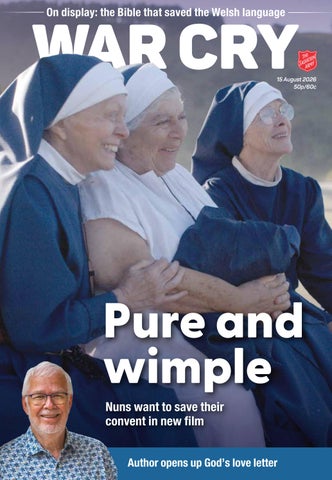
On display: the Bible that saved the Welsh language
15 August 2026 50p/60c
Pure and wimple Nuns want to save their convent in new film
Author opens up God’s love letter
What is The Salvation Army? The Salvation Army is a Christian church and registered charity seeking to share the good news of Jesus and nurture committed followers of him. We also serve people without discrimination, care for creation and seek justice and reconciliation. We offer practical support and services in more than 700 centres throughout the UK. Go to salvationarmy.org.uk/find-a-church to find your nearest centre.
What is the War Cry? The Salvation Army first published a newspaper called the War Cry in London in December 1879, and we have continued to appear every week since then. Our name refers to our battle for people’s hearts and souls as we promote the positive impact of the Christian faith and The Salvation Army’s fight for greater social justice.
WAR CRY Issue No 7794
Editor: Gareth Dickens, Major Managing Editor: Philip Halcrow Staff Writer: Emily Bright Staff Writer: Claire Brine Staff Writer: Ewan Hall Editorial Assistant: Linda McTurk Graphic Designer: Mark Knight Graphic Designer: Matt Penberthy
From the editor’s desk A regular feature of National Trust sites is a second-hand bookstore selling old and newer titles to help fund the charity’s conservation work. One of the old books which visitors can see at the National Trust’s Ty Mawr Wybrnant site, but which they certainly can’t buy, is a Welsh-language Bible from the 16th century. In this week’s War Cry, Fflur Owen – who takes care of the farmhouse where the book’s translator, William Morgan, was born – tells us about the treasured possession. ‘It’s an important book for the people of Wales in terms of our identity,’ she says. ‘Languages are living things, and, without this Bible, many of us wouldn’t be speaking Welsh today.’ But it’s not only the language in which it’s written that makes a Bible important – what matters more is the person its words describe. ‘I’m inspired by Christ,’ Fflur says. ‘The Bible talks of him as God, but he leaned into being human – that’s the best thing.’ Someone else who has been inspired by the words of the Bible is Gilbert Lennox. This week, he tells us how reading the Bible has had an effect on him. ‘The Bible is totally different from anything else,’ he says. ‘It’s God’s love letter to us personally. Jesus said that the words he spoke had authority and life.’ In his interview, Gilbert explains how he has written a book to encourage other people to read what he considers to be God’s word. ‘If you build your life on the Bible, you may not immediately see the relevance of quite a lot of it. But when your life is tested and if the foundation isn’t there, you can be very badly shaken. That’s why I think it’s so vital that the Bible is part of our diets.’ Millions of people have shared Gilbert’s experiences of finding help through God’s word and its promise of his presence. If we read and accept the truths found in the Bible ourselves, we’ll find hope to be a regular feature of our lives.
Email: warcry@salvationarmy.org.uk The Salvation Army United Kingdom and Ireland Territory 1 Champion Park London SE5 8FJ
When you’ve read the War Cry, why not pass it on ➔ ➔ ➔
Tel: 0845 634 0101 Subscriptions: 01933 445445 (option 1, option 1) or email: subscriptions@satcol.org Founders: Catherine and William Booth International leaders: General Lyndon Buckingham and Commissioner Bronwyn Buckingham Territorial leaders: Commissioners Jenine and Paul Main Editor-in-Chief: Major Andrew Stone Published weekly by The Salvation Army © The Salvation Army United Kingdom and Ireland Territory ISSN 0043-0226 The Salvation Army Trust is a registered charity. The charity number in England, Wales and Northern Ireland is 214779, in Scotland SC009359 and in the Republic of Ireland CHY6399. Printed by CKN Print, Northampton, on sustainably sourced paper
INFO
Your local Salvation Army centre
CONTENTS FEATURES
3
Film habit Nuns want to save their convent in comedy drama
6
Speaking the same language Why visitors enjoy seeing a Welsh-language Bible
8
‘It’s a divine and very human book’ Author explains the value of the Bible
13 Tackling a new season The English Football League kicks off REGULARS
FO 4
Team Talk and War Cry World
12 Tell-tale Signs 14 Puzzles 15 War Cry Kitchen Front-page picture: LIGHTBULB DISTRIBUTION
2 • WAR CRY • 15 August 2026
6 8 13 15
DRIVING FOR A MIRACLE In the ultimate road trip – bar nun – the sisters seek their convent’s salvation Film preview: Holy Days in cinemas from 14 August By Emily Bright
A
young boy cycles to a convent in New Zealand in 1974, and Sister Agnes (Judy Davis) greets him warmly. ‘Well, Brian Collins,’ she asks, ‘what have you done this time?’ ‘Blasphemy,’ he confesses sheepishly, and she invites him inside. Brian’s confession in the opening moments of Holy Days, based on the 2013 novel of the same name by Joy Cowley, is just a pretext to talk to the nuns about his personal struggles. Years after his mother’s death, he still misses her and is struggling to be civil to his father’s girlfriend, Liz (Nat Boltt), who has moved in. Brian (Elijah Tamati) chats to Sister Mary Clare (Jacki Weaver), who admits that she misses his mum too. ‘We loved your mum. She didn’t want to go, Brian. She tried and tried to stay. It’s not right,’ she says, before adding, ‘Verily, verily I say unto thee, trust in the Lord, trust and be free’ – and she tries to lighten the mood by gliding across the convent
floor with him. But when Brian returns home, he lashes out at Liz. As he hides in his bedroom after his outburst, his dad comes upstairs and tells his son that he misses Brian’s mum too. He also explains her ancestry – her family line can be traced back to a sacred mountain in the South Island. Brian is determined to visit it. One day, while hiding in the nearby church’s confessional, Brian overhears the bishop declaring that the nuns – including Sister Luke (Miriam Margolyes), who is mentally frail – will be forced to leave their convent. The building will be sold to developers and demolished to make way for new flats. Brian reveals this heartbreaking news to the nuns. The fun-loving sisters decide to embark on an impulsive road trip to the South Island to find his great aunt, who holds the lease that guarantees their right to live on the convent’s land. With his dad’s permission, he tags along,
seeing it as the perfect opportunity to visit his mum’s ancestral mountain. The race is on to save the convent by returning with the deeds before demolition day. Along the way, Brian grieves the loss of his mother while the nuns process their situation and do their best to trust the future of their convent to God. In times of uncertainty and upheaval, it can be difficult to know what to put our trust in. The good news is – as Sister Mary Clare would say – we can put our trust in the Lord. He is an unchanging source of strength and power, who can help us in our biggest challenges. A wise man of faith once wrote: ‘With all your heart you must trust the Lord… Always let him lead you, and he will clear the road for you to follow’ (Proverbs 3:5 and 6 Contemporary English Version). Those words are just as true for us today. If we put our faith in God and follow his guidance, he will show us the route forward. And, if we invite him into our lives, we’ll be in for the adventure of a lifetime.
Sister Mary Clare takes the wheel on the nuns’ road trip
LIGHTBULB DISTRIBUTION
15 August 2026 • WAR CRY • 3
Team talk TEAM WA
talk ‘ TALK’ j Left-field idea gives new life to tents
Ewan Hall gives his take on a story that has caught the attention of War Cry reporters Every year, over 250,000 tents are left abandoned at festivals across the country, according to the Association of Independent Festivals. Often the tents are too damaged to be reused by charities and end up in landfill, contributing to environmental waste. Designer and owner of JO Studios, Jess O’Riley, sees potential in discarded tents. To help reduce festival waste, she collects them and repurposes them as bags, waterproof jackets and streetwear. ‘It doesn’t look like it’s made from a tent because I’ve turned it inside out, quilted it and really elevated the material,’ she told BBC News. ‘My favourite thing is changing the way it’s viewed by using design to make it exciting.’ And her work has certainly struck a chord. It has even been known to go full circle, with festivalgoers wearing garments made from tents that were abandoned at the same event the year before. ‘My main aim is to spread the message but also make sustainability really cool, really accessible,’ said Jess. Her work challenges assumptions of what is worth keeping. Materials that have been abandoned, damaged and written off are given a new purpose through her creativity and care. Some of her tents had been left in mud, ripped and forgotten. Yet they could still be used to make something valuable. Jess’s idea of giving these tents a fresh start despite their damage led me to think about my faith and the teachings of the gospel, which emphasise that Jesus sees potential in us all – however broken, abandoned or forgotten we may feel. The Bible tells of many moments when people felt broken or lost, but were given a fresh start by Jesus. In Luke’s Gospel, Jesus tells three stories in which he used a lost sheep, a lost coin and a lost son to paint a picture of how no one is beyond the possibility of experiencing God’s love. No matter what we have done or how hopeless we think we are, God loves us and wants to be in our lives. We need never feel abandoned if we accept his love.
Jesus sees potential in us all
Team talk 4 • WAR CRY • 15 August 2026
Homelessness help boosted
A £1.07 million donation from a grant-making charity has been awarded to The Salvation Army to help people experiencing homelessness who are unable to access local authority accommodation. The funding from Benefact Trust will extend the existing support that the church and charity’s homelessness services provide to more than 2,000 people every night in its supported accommodation centres, known as Lifehouses. Alongside accommodation, residents at the centres have a dedicated support worker and access to healthcare and mental wellbeing support, employment and training opportunities and specialist help for debt or addiction. Nick Redmore, director of homeless services at The Salvation Army, said: ‘We are extremely grateful for this generous grant. Many people forced to sleep rough have been legally judged as not vulnerable enough to make them a priority for local authority housing even when they are living on the streets, sometimes for years. ‘Our Lifehouses are much more than somewhere to stay. They are places where people who’ve felt ignored and abandoned will find not only practical assistance but also safety, dignity and hope.’
Do you have a story to share? a warcry@salvationarmy.org.uk TheWarCryUK
B salvationarmy.org.uk/warcry
R CRY
WnRLD
Teams support wildfire emergency workers
Volunteer Robin Stokes serves refreshments to firefighters in Suffolk
The Salvation Army’s emergency response teams provided food, drinks and emotional support to hundreds of firefighters in Greater Manchester, Derbyshire and Suffolk who were tackling some of the wildfires that have swept across the UK this summer. At Yeoman Hey and Swineshaw reservoirs in the northwest of England, volunteers from the church and charity prepared more than 1,000 sandwiches for emergency service workers, as well as providing them with hot lunches, evening meals and other refreshments. Fiona Okbi, emergency response lead for The Salvation Army in the region, said: ‘We see offering this support as part of our service and mission, doing what our local community needs, and we are thankful that we can help. ‘We see firefighters working tirelessly to get the fires under control and are proud to serve alongside them on the front line, offering muchneeded supplies so that they can carry on with keeping the area safe.’ In Suffolk, members and volunteers staffed their emergency response vehicle at Dunwich Heath until the early hours, providing sandwiches, hot dogs and drinks to the emergency services. In Derbyshire, The Salvation Army has supported firefighters at four moorland wildfires since April. Major Carelle Daws, leader of The Salvation Army in the East Midlands, said: ‘Our emergency response team exists to care for those who are caring for others. Whether it’s a cup of tea after hours on the fire ground, a freshly made sandwich, or simply a friendly face asking how they’re doing, these moments remind emergency crews that they are valued and supported.’
Twinfluencers lend a hand Social media influencers the Maka Twins, who are known for cleaning public spaces in London, have volunteered at The Salvation Army in Nunhead to help it prepare for a summer of free or low-cost family activities. The team at the south London church run a busy food bank all year round, and throughout the summer are also offering £1 food bags – which include a sandwich, fruit, crisps and a drink – alongside free activities such as board games and arts and crafts events to help ease financial pressure on families during the holidays. During their visit, twins James and John Makanjuola assisted at the food bank, cleaned tables and tidied the outdoor area by removing weeds and sweeping up rubbish. They later shared a video of their visit with their 124,000 Instagram followers. John said: ‘All kids should be able to relax and have some fun over the summer holidays, but we know too many families can barely afford to feed their kids, never mind pay for days out or activities. We love the work The Salvation Army does to help families who struggle with the cost of living, so we wanted to use our social media platform to raise awareness.’
John and James Makanjuola 15 August 2026 • WAR CRY • 5
Language was no barrier for Welsh Bible writer FFLUR OWEN of the National Trust explains how 16th-century clergyman William Morgan ‘saved the Welsh language’ by translating the Bible into his mother tongue Interview by Claire Brine
Fflur Owen
‘W
NATION AL T R
US TI
MA
GE S/ PA
U IS RR
William Morgan’s birthplace
HA
6 • WAR CRY • 15 August 2026
preventing Welsh people from being able to participate fully in worship. The arguments from scholars and clergymen that Welsh people should have a Bible in their own language fell on deaf ears. It wasn’t until 1563 – after Elizabeth I had ascended the throne – that things gradually began to change. The Queen gave an order that the Bible should be translated into Welsh by St David’s Day in 1567. This was a political decision after
L
illiam Morgan was the first person to translate the whole Bible into Welsh,’ says Fflur Owen, who takes care of the National Trust farmhouse site Ty Mawr Wybrnant, where Morgan was born in 1545. ‘As a result, he saved the Welsh language. ‘During the middle of the 16th century, Welsh had become a bit messy, dialectally, and the language was starting to fall into disrepair. It was desperate for structure and form, and Morgan gave it that through his translation.’ Morgan – a clergyman who went on to become bishop of Llandaf and, later, bishop of St Asaph – spent 10 years working on Y Beibl Cyssegr-lan, the Welsh Bible, after which 1,000 copies were pressed. The first was presented to Queen Elizabeth I in 1588. Another copy from the batch is currently on display at Ty Mawr Wybrnant in the Conwy Valley. Earlier this year, the site and the Bible featured in the BBC2 series Hidden Treasures of the National Trust.
‘It’s an important book for the people of Wales in terms of our identity,’ says Fflur. ‘Languages are living things, and, without this Bible, many of us wouldn’t be speaking Welsh today. So we’re grateful for it. ‘People are also interested to come and see the 1588 Bible because a lot of them still gravitate towards churches, even if they don’t attend regularly. They question what it means to have faith, or what the elements of faith are. I discuss these topics with our visitors quite a lot.’ History books reveal that the years preceding Morgan’s translation were marked by the religious revolution known as the Reformation. It was the period when King Henry VIII separated England and Wales from the Roman Catholic Church and established the Church of England. In 1536, the Act of Union joined Wales with England, resulting in English being declared the official language. Welsh people were banned from using their mother tongue in official records and in courts of law. In 1538, the King issued another order. Churches were instructed to use only the English Bible during their religious services,
NATIONAL TRUST IMAGES/PAUL HARRIS
‘Y Beibl Cyssegr-lan’ on display at Ty Mawr Wybrnant
the reign of her sister, Queen Mary I, who had sought to re-establish Catholicism in England. By promising a Welsh Bible for Welsh people, Elizabeth hoped to garner more support for the new Protestant expression of the Christian faith. The scholar William Salesbury got to work on producing a Welsh translation of the New Testament, but the final text was deemed too difficult to read because of its Latinised spelling. Morgan’s translation of the entire Bible – which came a little over 10 years later – was immediately favoured because of its use of rich and clear language that everybody could understand.
F
or the first time in history, Welsh people could access a Bible written in their mother tongue. Congregations heard it being read aloud in church every Sunday. ‘I can imagine the Welsh Bible being met with a lot of enthusiasm,’ says Fflur. ‘It signified that Welsh people were welcome in this religion. They could now move past their “stained-glass window” level of understanding. Morgan’s Bible included them. It allowed them to participate. After being told by Henry VIII
NATIONAL TRUST IMAGES
It allowed Welsh people to participate
that they didn’t exist, it must have felt a Bible, a Glaswegian Bible – we even have huge relief for Welsh people.’ a biker Bible. All these different kinds of While she’s inspired by the story of Bibles exist so that the contents can be how Morgan’s Bible came into being, accessible for everyone. Fflur is also interested in the stories at ‘My favourite Bibles in the library the heart of Christianity. She has enjoyed are the copies we have in the Welsh reading about Jesus. language, some of which are quite small ‘I’m inspired by Christ,’ she says. ‘He because they have been carried around has a complete stillness and acceptance in someone’s breast pocket. You can see of where everybody is in their life. He’s that they’ve been held through life and kind. The Bible talks of him as God, but loved.’ he leaned into being human – that’s the best thing.’ After walking A conservator carries out through Morgan’s restoration work on the 1588 Bible farmhouse and viewing the 1588 Bible, visitors to Ty Mawr Wybrnant are free to browse other copies of the religious text. The site’s library contains more than 300 Bibles in 150 languages. ‘There are Japanese Bibles which are tiny, because Christians who were persecuted for their faith needed to hide them quickly,’ says Fflur. ‘We also have old family Bibles, going back to the 1600s. Then there’s a Scouse
15 August 2026 • WAR CRY • 7
A READER’S GUIDE TO THE GOOD BOOK D
Gilbert Lennox
Bible teacher GILBERT LENNOX describes how the Scriptures are a love letter from God and explains why it’s worth getting to grips with them Interview by Emily Bright
8 • WAR CRY • 15 August 2026
riving a family friend to Belfast airport more than 50 years ago would transform 18-year-old Gilbert Lennox’s outlook for ever. His passenger, Professor David Gooding, was a scholar in philosophy, ancient languages and literature based at Queen’s Belfast. ‘As a teenager,’ Gilbert tells me over Zoom from his home in Coleraine, Northern Ireland, ‘the invitation to drive my father’s car was too good to miss. But the conversation I had with Professor Gooding was a remarkable turnaround for me. ‘He took me seriously and talked to me as an adult. He was interested in my answers and kept probing. Our conversation went on for hours. He even bought me lunch – chicken and chips as I recall – so that he could continue the conversation. That conversation set the direction for the rest of my life.’ And, as Gilbert – a Bible teacher and retired church leader – explains in his book God Speaking, David asked him a powerful question: ‘Well, my boy, why are you alive? What are you living for?’ He then proceeded to explain the importance of the gospel to Gilbert and impressed on him the importance of delving more deeply into Scripture. The Scriptures have captivated Gilbert ever since. ‘The Bible is totally different from anything else,’ he explains. ‘It’s God’s love letter to us personally. Jesus said that the words he spoke had authority and life. You don’t get that with Shakespeare or Dickens or any modern novelist. I love reading novels, but this is at a different level. ‘You’re tapping into the ultimate truth behind the universe that explains why it is we can think at all, why it is we search for meaning and why it is we are the way we are as human beings. It is the most exciting, exhilarating and important issue for folks.’ In God Speaking, Gilbert reveals how
to get to grips with the exhilarating truth he found in the Bible. He explores why reading the Bible matters, he provides helpful strategies for engaging with it and he examines its overarching story. ‘What excited me way back in my early 20s,’ he tells me, ‘when I was looking more objectively at the evidence for the authenticity of Scripture, was to realise that it had been revealed over 1600 years. It’s by so many different authors writing in different cultures. And yet you can trace the narrative right through, beginning with “In the beginning God” and ending up with the fantastic scenes at the end of the Book of Revelation.’
The place to start is with the portraits of Jesus
G
ilbert says that the Bible is inspired by God’s Holy Spirit and yet ‘the personalities of the authors come through also – so it is both a divine book and a very human book’. He admits that it’s not always easy to read the Bible. So he recommends that, rather than rushing through it cover to cover, people could focus on a specific book of the Bible, returning to it repeatedly to become more familiar with it. ‘If people are coming entirely new to the Bible,’ he says, ‘then I would always recommend that they start by reading one of the Gospels, because the central person is the Lord Jesus. The place to start is to come face to face with the wonderful portraits of Jesus in the New Testament. ‘It’s quite hard for most people to read an entire Gospel in a sitting. But I do recommend that they read it in chunks, so that they get enough in their mind that they’re not forgetting what they read the previous day.’ Gilbert encourages those with a
Turn to page 11 f
G E N E S
I
S
E X O D U S L
E V
I
T
I C U S
N U M B E R D E U T
S
E R O N O M Y J O S H U A J U D G E
S
R U T
H
1
S A M U E
L
2
S A M U E
L
1
K
I
N G S
2
K
I
N G S
1
C H R O N
I
C L
E
S
2
C H R O N
I
C L
E
S
E
Z R A
N E H E M I E S
A H
T H E R J O B
P S A L M S E C C L S O N G
P R O V E R B
S
E
S
O F
S
I
A S
T
E
S O L O M O N I J
S A
I
A H
E R E M I
A H
L A M E N T A T E
Z
I O N S
E K
I
E
L
D A N
I
E
L
H O S
E A
J O E
L
A M O S O B A D
I
A H
J O N A H M I C A H N A H U M Z
E P H A N
I
A H
H A G G A Z
E C H A R
I
I
A H
M A L A C H
I
15 August 2026 • WAR CRY • 9
MATT BOTSFORD/UNSPLASH
H A B A K K U K
M A
T
T
H
E W
M A
R
K
L
U
K
E
J
O H
N
R O M A
N
S
1
C O
R
I
N
T
H
I
A N
S
2
C O
R
I
N
T
H
I
A N
S
G A
L
A
T
I
A N
S
E
P
H
E
S
I
A N
S
P
H
I
L
I
P
P
I
A N
C O
L
O
S
S
I
A N
S
1
T
H
E
S
S
A
L
O N
I
A N
S
2
T
H
E
S
S
A
L
O N
I
A N
S
1
T
I
M O
T
H
Y
2
T
I
M O
T
H
Y
SINCERELY MEDIA/UNSPLASH
A C
T
S
T
I
T
U
S
P
H
I
L
E M O N
H
E
B
R
E W S
J
A M
E
S
1
P
E
T
E
R
2
P
E
T
E
R
1
J
O H N
2
J
O H N
3
J
O H N
J
U
D
E
R
E
V
E
10 • WAR CRY • 15 August 2026
L
A
T
I
O N
S
From page 8 Christian background to take a short book, usually – although not exclusively – from the New Testament. ‘However,’ he says, ‘if they’re into literature or poetry, then I would go perhaps to an Old Testament book like Ruth – something short that they can read at a sitting. I think that’s one of the most important things.’ He adds that the New Testament letters can sometimes feel easier to engage with. Written by Jesus’ followers after his death and resurrrection, they provide guidance on how to live as a Christian. Gilbert believes that these letters can feel ‘more contemporary’ and ‘slightly easier to bridge the cultural gap between the 21st and 1st century’. Gilbert also thinks that the brevity of some of the letters can help in familiarising readers with their content. ‘For instance, 2 John has 13 verses, and most people can cope with that. When they read a letter again and again, people develop the confidence that they have started to get to know one of the 66 books of the Bible. ‘I find just taking one letter and rereading it truly changes things, because the key reason we do it is to get to know God.’ Gilbert offers a helpful analogy to explain why reading God’s word slowly and carefully helps people to connect with God. ‘If somebody you love has written you a letter, you tend not to just race through it and then look for another one. I would prefer just to read it and read it again and savour the words so that I could almost memorise it. That, I think, is one of the major benefits of taking this bookby-book approach. ‘Spend the time reading the Bible, don’t rush to try to find an application like “be nice to the cat” or “write a kind letter to granny”. Those things are fine, but that isn’t what the Bible was written for. It’s about getting to know God and is about relationship. ‘The best application could be if I discovered today something more about God and how wonderful he is.’ Some people may find it tempting
to search for instant soundbites from the Bible to solve all their problems. But Gilbert explains that taking time to understand a passage fully is key. ‘Have we really read the text, and if so, what does the text actually say, rather than what I would like it to say? We need to take more time to let the text speak, observing what is there. That is where most of the work of effective Bible reading is done – at the observation stage.’ Gilbert also acknowledges that the meaning of Bible verses can sometimes be misinterpreted and misapplied.
The Bible is more than a book
‘W
hen deception is on the rise,’ he says, ‘with the internet, YouTube and all the deepfakes, people are taking verses out of context and twisting them. They can end up going down rabbit holes after all kinds of wrong emphases.’ He argues that a working knowledge of the Bible and its context can counteract such falsehoods. ‘Read the text for yourself,’ he says. ‘Make sure that you know it, because most of the problems arise from people taking stuff out of context. ‘The Bible is more than a book, but it’s not less than a book. If you took a random line from Shakespeare and made it mean whatever you wanted it to mean, it wouldn’t be proper interpretation. ‘There’s a modern fixation with my truth and your truth, but if you start twisting verses, you’re cutting yourself adrift and leaving yourself open to all kinds of nonsense.’ However, Gilbert believes that, if applied correctly, the wisdom of the Bible provides a crucial foundation for life, guiding people to make the right decisions and helping them to demonstrate the love of God to others. And there’s always more to learn from the Bible. ‘The Bible is about the thoughts, concepts and ideas that God talks to us about,’ he says. ‘I have been married
49 years this year to the same wonderful lady. And I’m still discovering things about her. ‘Now maybe it’s because I’m a slow learner,’ he laughs. ‘That’s always possible. But getting to know a person is just such an amazing thing. And that’s, of course, what God is offering us in his word.’ Gilbert can testify to the power of reading the Bible in his own life. ‘My own personal experience,’ he says, ‘looking back over all these years, is of the transformative impact of taking Scripture seriously and doing what Jesus said, seeking to build my life on his words and on himself. ‘If you build your life on the Bible, you may not immediately see the relevance of quite a lot of it. But when your life is tested and if the foundation isn’t there, you can be very badly shaken. That’s why I think it’s so vital that the Bible is part of our diets.’ He has also seen the damage done when people have strayed from the wisdom of the Bible. ‘I have spoken to so many people over the years – particularly in my role as a pastor in a church – who look back with enormous regret because they didn’t do those simple things of trusting God and what he said and thought they knew better, and in the end made terrible mistakes. ‘Of course, there’s always a way back. God’s forgiveness is always there. But you can’t get back the time and the damage that has been done. There’s forgiveness, but sin also has consequences. ‘Having that central thing that I want to build my life around – the Lord Jesus and what he says – makes such a difference.’
l God Speaking is published by SPCK
15 August 2026 • WAR CRY • 11
Prayerlink The War Cry invites readers to send in requests for prayer, including the first names of individuals and details of their circumstances, for publication. Send your Prayerlink requests to warcry@salvationarmy.org.uk or to War Cry, 1 Champion Park, London SE5 8FJ. Mark your correspondence ‘Confidential’.
j
Becoming a Christian
There is no set formula to becoming a Christian, but many people have found saying this prayer to be a helpful first step to a relationship with God
Lord Jesus Christ, I know that I have done things in my life that are wrong and I’m sorry. Thank you that I can ask you for forgiveness because of the sacrifice you made when you died on the cross. Please forgive me and help me to live a better life in the future as I learn how to love you and follow your way of living. Thank you, Lord Jesus.
If you’ve prayed this prayer, scan the QR code or contact us using the coupon on this page
Tell-tale signs Lynne Shaw explores how Jesus’ stories pointed to a bigger picture The treasure and the pearl – Matthew 13:44–46 I watch a TV series, Tracker, based on books by Jeffery Deaver. In it, the main character, Colter Shaw, responds to people’s requests to find their missing loved ones. In the latest episode I saw, a young mum-to-be gathered all the financial resources she could to engage Colter’s expertise in tracking down her missing husband. At that crisis moment she chose to find her husband because he was her treasure: everything would feel meaningless without him. Jesus told a story about the discovery of some treasure, and a similar one about a valuable pearl. There’s a subtle difference between the two stories. In the first, a man finds the treasure by accident. In the second, a merchant finds a pearl while looking for it. However, in both stories the outcome is the same: once the person finds their valuable item, they sell everything they have so that they can acquire it. The stories, though, weren’t really about precious objects. Jesus was talking about the value of a way of life lived with God. He was talking about allowing God’s ways to change our minds and hearts. There’s an old saying: home is where the heart is. Having moved more than 20 times, I’ve learnt that home is not a house, a town or a county. Instead, it’s where love resides. If I had a treasure map, ‘X marks the spot’ would not be a single location but wherever peace, healing and kindness show up. These are hallmarks of a meaningful life. When Jesus told those two short parables about shiny objects, he was prompting us to consider what we value above all else, what makes life meaningful. Lasting value is found in fully embracing God’s ways. Jesus was showing us that there is nothing more important than to live, love, care and share in ways that honour others and our planet, and therefore God. Committing ourselves to live in the way that Jesus taught produces a generous lifestyle that will lead us to have a rich and full life that has nothing to do with our bank balance or our insurance inventory.
"
Want to know more? a
To receive basic reading about Christianity and information about The Salvation Army, complete this coupon and send it to War Cry 1 Champion Park London SE5 8FJ
Name
Address
Or email your name and postal address to warcry@salvationarmy.org.uk 12 • WAR CRY • 15 August 2026
QUICK QUIZ 1 2 3 4 5 6
Which metal is represented by the symbol Fe? Singer Mariah Carey and Westlife had a No 1 hit in 2000 with which song? In which ocean is Challenger Deep, the deepest point beneath the surface of the Earth’s waters? Alan Cumming hosts the US version of which reality TV game show? Who wrote the novel Great Expectations? Which car manufacturer produces the Frontera?
ANSWERS
Playing the long game EFL fans wonder what lies ahead as a new season begins Feature by Ewan Hall
A
nother action-packed calendar in the English Football League kicks off this weekend, as the 2026–27 campaign gets under way. After just 83 days and a World Cup since the conclusion of last season, the 72 teams of the Championship, League One and League Two are taking to the pitch again. Over the next nine months some supporters will travel thousands of miles by road and rail to follow their teams every week. As the tables reset to zero, many of those fans will have a renewed sense of optimism that this is their year. With the unpredictability of football, unfancied clubs can emerge as surprise contenders – although, equally, promotion contenders can become strugglers. It’s all to play for. And if not everyone expects a positive outcome, every fan and player will be hoping for one, whether that means challenging for promotion, securing silverware or establishing themselves in their division and avoiding a repeat of past struggles. New beginnings have the capacity to be scary both on and off the pitch, especially if we find ourselves in unknown situations such as starting a job, forming a relationship or moving home. The prospect of what lies ahead can leave us feeling overwhelmed. When facing a daunting new beginning, Christians, however, can take solace in knowing that God is with them. They feel the reassurance of the Bible’s promise that ‘the Lord will watch over your coming and going both now and for evermore’ (Psalm 121:8 New International Version). If we choose to put our trust in God, we will receive his support as we step into new seasons of our lives, allowing us to face the future with confidence rather than fear. And while new beginnings may bring challenges, God will be there with us in all our wins, setbacks and fresh starts. 15 August 2026 • WAR CRY • 13
1. Iron. 2. ‘Against All Odds’. 3. The Pacific. 4. The Traitors. 5. Charles Dickens. 6. Vauxhall.
PUZZLES Quick CROSSWORD ACROSS 1. Melody (5) 5. Surmise (5) 8. Open sore (5) 9. More pleasant (5) 10. Passageway (5) 11. Reject with disdain (5) 12. Garden hut (4) 15. Ditch (6) 17. Hasten (5) 18. Yell (6) 20. Member of enclosed order (4) 25. Firearm (5) 26. Sediment (5) 27. Rectify (5) 28. Adroit (5) 29. Loathsome (5) 30. Shrub fence (5) DOWN 1. June, July etc (6) 2. Safe (6) 3. Swear (5) 4. Happen (5) 5. Storehouse (7) 6. Flag (6) 7. Detective (6)
SUDOKU
Fill the grid so that every column, every row and every 3x3 box contains the digits 1 to 9
1 4 6 3 8 2 5 4 7 3 5 1 2 5 3 4 9 3 1 2 2 9 7 6 9 3 7 8 8 6 2 13. Abbreviated royal title (3) 14. Seabird (3) 15. Attempt (3) 16. Tin (3) 17. Gossip (7)
18. Depress (6) 19. Alcove (6) 21. Insult (6) 22. Ignite (6) 23. Frequently (5) 24. Demise (5)
W RDSEARCH
M O HONEYC B
Look up, down, forwards, backwards and diagonally on the grid to find these rainforest animals
G Z Q E H A K D J A Q XWZ OG C Y O I K Y L Z D H P D V L MM N L D I R K A C I K O NMZ Y P QOO B F G F T G NWB H T O L S Z H U Z R G G T G L B T T T O U C A N D N Z Q Z H R Q B Q N OQ CWH A E Q T ZMR Z A ZWF R N T L A L D N Z A P C I V D K T Z D S P T C L E Q A I B S E R N I H P L O D R E V I R K N I P H U OWZMS C A O G R T ZMG E U Y S S I J S Z U P L CWV V V O A E P N I D Q F G A J KM F I C R R N A R G O S C A R L E T MA C AW I X K T G P F J D S T X C Z R B Q P L T X E O Z T N A R E T T U C F A E L V O F Y I TWP C Z D H Q H K Z Q A NWL T O E S Q I K TWZ O V N XMD ZWX X L Z F Q H V R I P A T Y H V E Z N
Each solution starts on the coloured cell and reads clockwise round the number 1. Made from pressed curds 2. Unhappiness 3. Long-eared burrowing mammal 4. Walk awkwardly 5. Senior member of clergy 6. Oily lubricant
ANSWERS 5 3 4 1 8 9 2 6 7
1 8 6 7 2 3 9 5 4
7 2 9 4 6 5 3 1 8
4 6 7 2 5 8 1 9 3
3 9 1 6 4 7 8 2 5
2 5 8 9 3 1 7 4 6
6 7 2 8 1 4 5 3 9
8 1 3 5 9 6 4 7 2
9 4 5 3 7 2 6 8 1
HONEYCOMB 1. Cheese. 2. Misery. 3. Rabbit. 4. Hobble. 5. Bishop. 6. Grease. QUICK CROSSWORD ACROSS: 1. Music. 5. Guess. 8. Ulcer. 9. Nicer. 10. Aisle. 11. Spurn. 12. Shed. 15. Trench. 17. Hurry. 18. Shriek. 20. Monk. 25. Rifle. 26. Dregs. 27. Amend. 28. Adept. 29. Nasty. 30. Hedge. DOWN: 1. Months. 2. Secure. 3. Curse. 4. Occur. 5. Granary. 6. Ensign. 7. Sleuth. 13. HRH. 14. Auk. 15. Try. 16. Can. 17. Hearsay. 18. Sadden. 19. Recess. 21. Offend. 22. Kindle. 23. Often. 24. Death.
14 • WAR CRY • 15 August 2026
CLOUDED LEOPARD GIANT OTTER GREEN ANACONDA HOWLER MONKEY JAGUAR LEAFCUTTER ANT MOUNTAIN GORILLA
OKAPI PINK RIVER DOLPHIN POISON DART FROG SCARLET MACAW SLOTH TAPIR TOUCAN
SERVES 2
Air fryer crispy chilli beef INGREDIENTS
METHOD
1 lean thin-cut beef sirloin steak, cut into thin strips
Place the beef in a large mixing bowl and add the cornflour and five-spice. Season with salt and pepper, to taste. Toss to coat well.
6tbsp cornflour
Heat the air fryer to 200C and spray the basket generously with oil. Lay the beef strips evenly on the base of the basket. Spray the beef strips with oil until the cornflour coating disappears completely.
2tsp five-spice Salt and freshly ground black pepper Oil spray 2tbsp sweet chilli sauce 2tbsp hoisin sauce 2tsp garlic and ginger paste 320g bag fresh mixed stir-fry vegetables Sesame seeds, to garnish (optional) Rice, to serve
Cook the beef for 6-7 minutes, then remove the basket and turn the beef over. Return to the air fryer and cook for another 6-7 minutes, until crispy and cooked through. In a small bowl, stir together the sweet chilli and hoisin sauce. Set aside. Spray a large non-stick pan or wok with oil and heat on a medium heat until hot. Add the garlic and ginger paste and cook for 2-3 seconds, then add the vegetables and stir-fry for 2-3 minutes, tossing frequently. Set aside. Remove the crispy beef from the air fryer and toss in the sweet chilli and hoisin sauce to coat well. Garnish with sesame seeds, if using. Serve with the stir-fry vegetables and rice.
SERVES 2
Air fryer sirloin steaks with chips and salad INGREDIENTS
METHOD
2 lean beef sirloin steaks, about 225g each
Remove the steaks from the fridge at least 20 minutes before cooking. Brush with a little oil and season generously.
1-2tsp rapeseed oil
Preheat the air fryer to 200C for a few minutes. Place the steaks in the basket, with half the butter on top of each steak. Cook for 6-8 minutes (for medium).
Salt and ground black pepper 30g butter Chips, steak sauce and a green salad, to serve
Once cooked, remove and cover loosely with foil on a plate. Allow to rest for a few minutes. Serve with chips, steak sauce and a green salad.
Recipes reprinted, with permission, from the Agriculture and Horticulture Development Board website simplybeefandlamb.co.uk
15 August 2026 • WAR CRY • 15
With people impossibility exists; with God all things are possible.